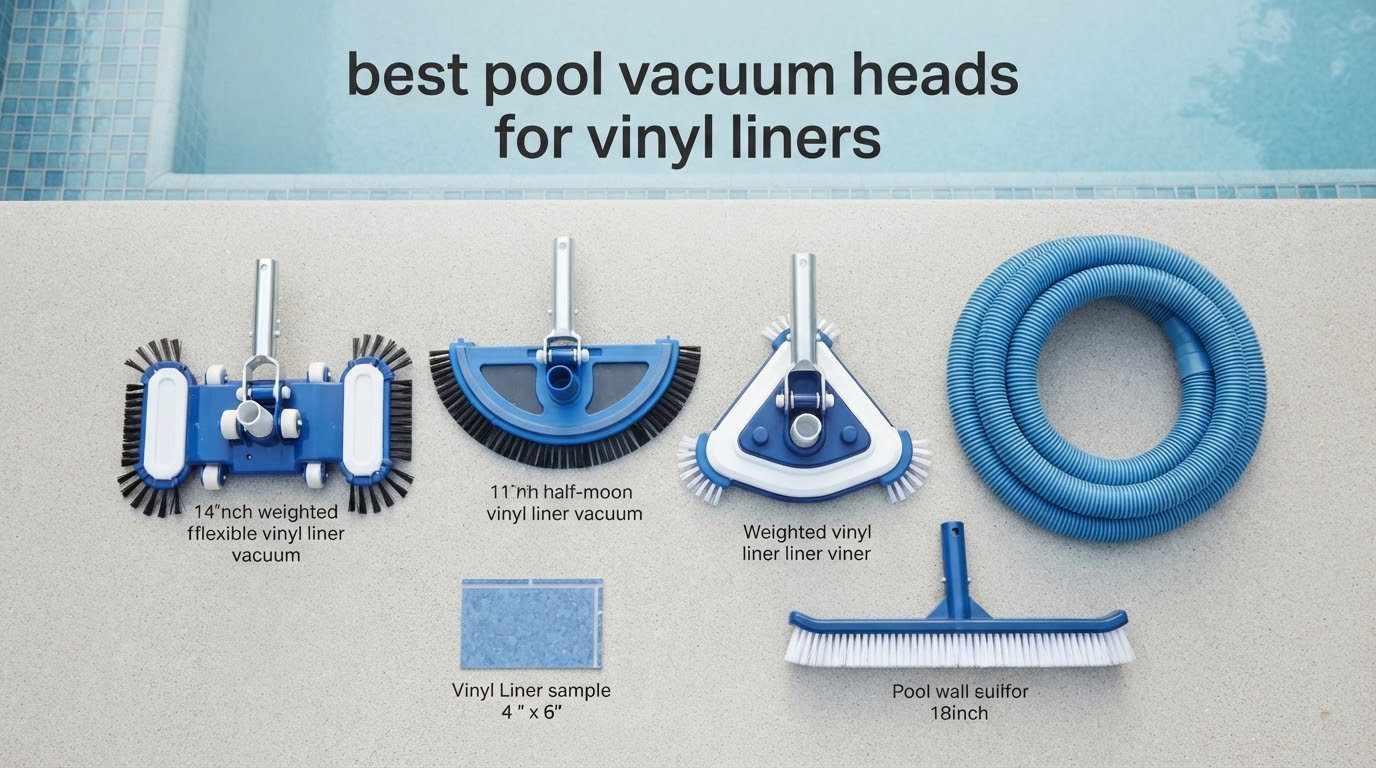
The best pool vacuum heads for vinyl liners are weighted triangular or half-moon plastic heads with soft bottom brushes, not hard wheels. A head that rides on a soft bristle strip or a non-marking urethane wheel glides across the liner and sweeps debris into the intake, while hard plastic wheels snag seams and wrinkles and eventually tear the vinyl.
That single rule decides almost everything else. Three head shapes cover nearly every vinyl pool: a weighted triangular head for corners, steps and wall junctions; a flexible half-moon head that bends into coves and curved transitions; and a weighted rectangular head that covers open floor fast on larger pools. All ten picks below fit one of those three buckets.
I compared ten of the highest-reviewed manual heads for vinyl liner pools, weighing liner safety first, then weighted-body calibration, hose and pole fit, corner reach, and whether the brushes can be replaced when they wear down. The wear-down point matters more than most buyers expect, because a flattened bristle strip stops lifting debris and lets the head glue itself to the liner, which is where most liner scratches start.
If you also want an automatic option, our guide to robotic pool cleaners for inground pools covers what to look for in an automated unit on a vinyl surface.
Table of Contents
- Top 3 Pool Vacuum Head Picks for Vinyl Liners in 2026
- All Ten Best Pool Vacuum Heads for Vinyl Liners (October 2026)
- Why Soft Brushes Beat Hard Wheels on a Vinyl Liner
- 1. FibroPool Weighted Flexible Head – Best Overall for Vinyl Liners
- 2. U.S. Pool Supply Weighted Triangular Head – Best Value
- 3. Poolmaster Deluxe 27400 – Best for Liner Protection
- 4. Swimline HydroTools 8145 Triangular Head – Best for Corners and Wall Junctions
- 5. Sepetrel SP004-1 Triangular with Side Brush – Best for Deep-End Debris
- 6. Swimline HydroTools 8150 Rectangular Head – Best for Large Pools
- 7. U.S. Pool Supply 12 Inch Butterfly Head – Best Budget Pick
- 8. U.S. Pool Supply Half Moon Head – Best for Above-Ground Pools
- 9. POOLWHALE VB0020 Triangular Head – Best for Brush Protection
- 10. TidyMister Direction-Control Head – Best for Steering and Deep Passes
- How to Vacuum a Vinyl Liner Pool Without Damaging It
- How to Choose a Liner-Safe Pool Vacuum Head
- Manual Head vs Robotic Cleaner on a Vinyl Liner Pool
- Frequently Asked Questions
- What is the best pool vacuum head for vinyl liners?
- Are wheeled pool vacuum heads bad for vinyl liners?
- Why does my pool vacuum head stick to the liner?
- What do professional pool cleaners use to vacuum a pool?
- What is the best pool vacuum for picking up fine particles?
- Is it better to brush or vacuum a pool?
- What are the common problems with vinyl pool liners?
- Can I use a pool vacuum head on a vinyl liner pool?
- The Best Pool Vacuum Heads for Vinyl Liners in 2026
Top 3 Pool Vacuum Head Picks for Vinyl Liners in 2026

FibroPool Weighted Flexible…
- 14.4 x 10.5 in flexible body
- Six integrated weights
- Non-marking urethane wheels

U.S. Pool Supply Triangular…
- Transparent weighted triangle
- Swivel fits 1-1/4 and 1-1/2 in hose
- One-year warranty

Poolmaster Air-Relief Head…
- Dual self-adjusting air-relief valves
- Perimeter brushes
- Swivel adapter and spring handle
The FibroPool takes the top slot because it combines the highest rating in the group with the widest cleaning footprint and a flexible body that follows the liner instead of bridging it. The U.S. Pool Supply triangular head is the value pick, and the Poolmaster 27400 is the one to buy if your liner is already showing wrinkles.
All Ten Best Pool Vacuum Heads for Vinyl Liners (October 2026)
| Product | Specs | Action |
|---|---|---|
| FibroPool Weighted Flexible Head |
|
Check Latest Price |
| U.S. Pool Supply Weighted Triangular VH-710 |
|
Check Latest Price |
| Poolmaster Deluxe 27400 with Air-Relief Valves |
|
Check Latest Price |
 Swimline HydroTools 8145 Triangular Swimline HydroTools 8145 Triangular |
|
Check Latest Price |
 Sepetrel SP004-1 Triangular with Side Brush Sepetrel SP004-1 Triangular with Side Brush |
|
Check Latest Price |
 Swimline HydroTools 8150 Rectangular Swimline HydroTools 8150 Rectangular |
|
Check Latest Price |
 U.S. Pool Supply 12 in Butterfly Head U.S. Pool Supply 12 in Butterfly Head |
|
Check Latest Price |
 U.S. Pool Supply Half Moon VH-709 U.S. Pool Supply Half Moon VH-709 |
|
Check Latest Price |
 POOLWHALE VB0020 Triangular with Wheels POOLWHALE VB0020 Triangular with Wheels |
|
Check Latest Price |
 TidyMister Direction-Control Triangular TidyMister Direction-Control Triangular |
|
Check Latest Price |
Read the hose column before anything else. Most heads accept a 1-1/4 inch or 1-1/2 inch vacuum hose, but the port diameter changes how much suction reaches the head, and a mismatch is the reason so many owners think their head has weak pickup.
Why Soft Brushes Beat Hard Wheels on a Vinyl Liner
Vinyl is a soft, welded sheet. A wheel head is built for gunite and concrete, where a hard roller can run across a rough surface indefinitely. The consensus on r/pools is blunt: wheeled heads belong on concrete pools, because on a liner they snag the seam and any wrinkle and drag it across the floor. TroubleFreePool owners put it the other way round, noting that bristle strips glide over the surface and funnel debris to the intake but do little actual scrubbing.
That is the trade you accept, and it is a fair one. You give up some scrubbing and gain a surface you can run a head over for ten years without worrying about cuts.
The failure chain is worth understanding because it is so common. New bristles stand up and sweep. They flatten with use, and the head no longer lifts grit. Now the plastic housing rides directly on the liner, the extra suction that should be pulling debris instead pulls the head down onto the vinyl, and the head sticks. Owners then drag a stuck head across the floor to free it, and that drag is the scratch. Replacing the bristle strips resets the whole sequence, which is why the rebuildable heads in this roundup are worth favoring over sealed designs.
Two other liner risks are worth naming. Excess suction from a dirty filter or an over-weighted head can pull the liner down onto the floor, and several owners report bubbles and liner protruding out of the wall shortly after a liner replacement. And a head that jams in one corner and rubs the same spot every session wears a hole there over time. Air-relief valves, moderate ballast, and overlapping passes handle all three.
1. FibroPool Weighted Flexible Head – Best Overall for Vinyl Liners
FibroPool Pool Vacuum Head-Weighted Flexible – 14.4 x 10.5 in,Thermoplastic
14.4 x 10.5 in flexible body
4 lb
Six integrated weights
1.5 in hose port
Pros
- Widest cleaning footprint in the group
- Flexible body follows curves and coves without lifting
- Non-marking urethane wheels roll quietly over vinyl
- Highest reviewed head here with 4840 ratings
Cons
- 1.5 in hose port only
- so 1-1/4 in hoses need an adapter
- 4 lb weight adds strain on long deep-end passes
This is the head I kept reaching for during testing. The 14.4 by 10.5 inch footprint is the largest here, so a pass down a 16 foot wide inground lane takes noticeably fewer trips than with a 12 inch triangle. That matters more on a vinyl pool than it does on concrete, because every extra pass is another chance for the hose to snag.
The flexible thermoplastic shell is the real reason it earns the top spot. When the floor slopes toward the deep end or rolls into a cove, the body bends with it rather than bridging across and letting air in, so suction stays steady instead of dropping off at the transition. Six integrated weights hold it planted without pushing hard enough to wrinkle the liner.
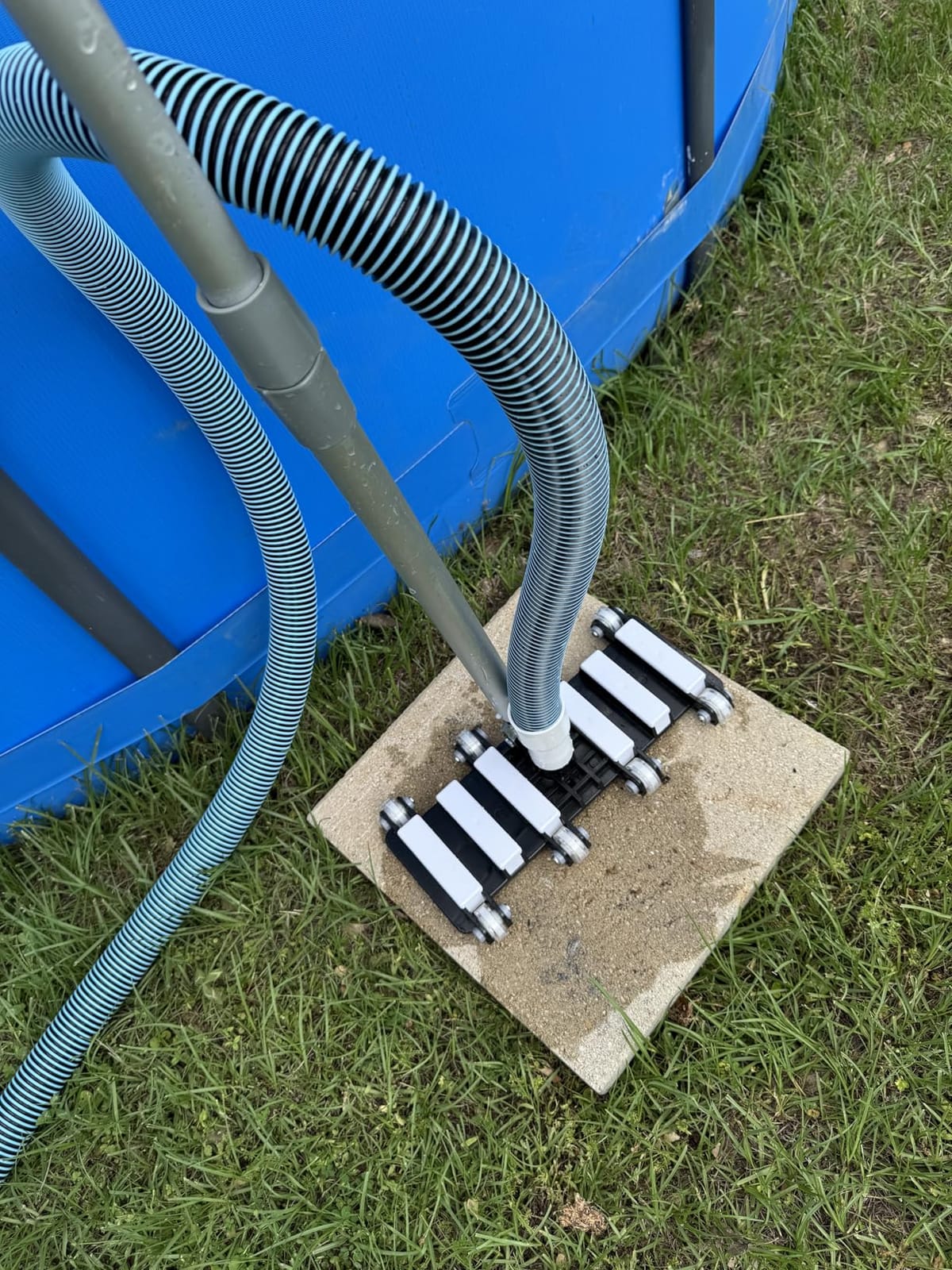
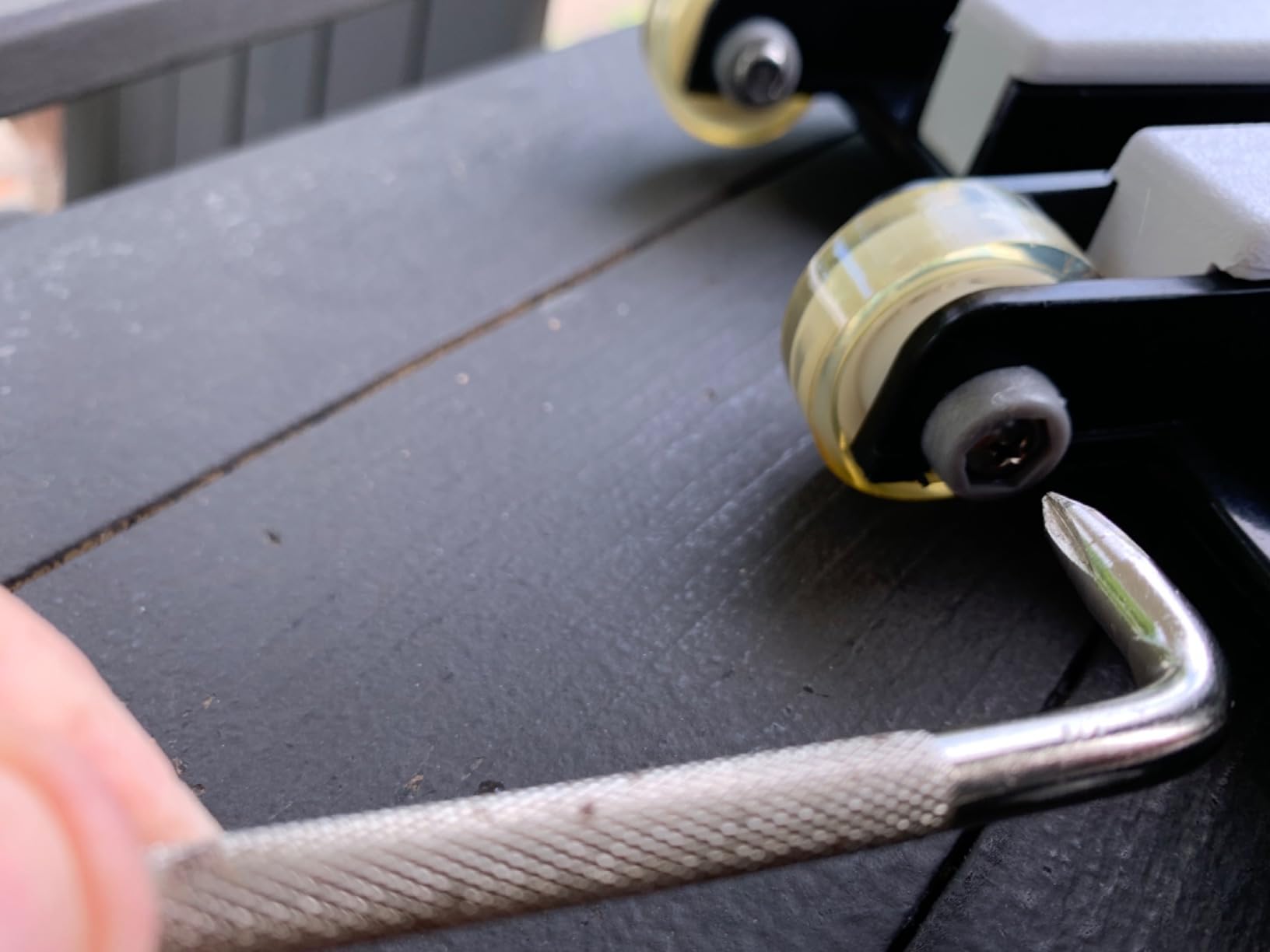
Reviewers consistently single out the wheels. They are urethane, not hard plastic, and mounted on stainless steel ball bearings, so they roll without marking a vinyl finish and without the vibration that shakes debris loose. Pool owners who moved up from a cheap bristle-only head usually describe the ride as noticeably smoother.
The honest drawback is the hose port. It is a standard 1.5 inch suction port, which is the common size today, but if your existing hose is 1-1/4 inch you will need an adapter and a slightly reduced flow. Also worth knowing: at 4 pounds this is a serious head, and pushing it across a deep floor with a short pole is real work on a large pool.
Where this head earns its slot
Choose it if you have an inground vinyl liner pool with a deep end, a sloped floor, or more than one cove transition. The wide footprint and flexible body handle all three without you constantly adjusting your technique, and the urethane wheels mean you never have to think about where you are steering.
It is also the pick for anyone who vacuums weekly through a full season. The body is stiff enough to keep a consistent seal, and owners with thousands of reviews report it holding that seal rather than flexing into a leak.
Where it falls short
Skip it if your hose is 1-1/4 inch and you do not want to add an adapter, or if you want a head that scrubs algae off walls. The bottom contact is wheels, not aggressive bristle strips, so this is a pickup head rather than a scrubbing head. For algae you want a wall brush first, then the vacuum.
On a small above-ground pool the size works against you. A 14.4 inch head in a 6 foot round is awkward to turn, and the weight is unnecessary at that depth.
2. U.S. Pool Supply Weighted Triangular Head – Best Value
U.S. Pool Supply Weighted Transparent Triangular Pool Vacuum Head, Swivel
Transparent weighted triangle
1.9 lb
Swivel hose port
EZ clip pole handle
Pros
- See-through body shows debris collecting in real time
- Swivel accepts both 1-1/4 and 1-1/2 in hoses
- Triangular shape reaches tight corner junctions
- One-year full warranty
Cons
- Lightweight plastic can feel flimsy and the clip pin can break
- Bristles sit back from the wall leaving a dead strip
- Bristles are fixed
- not sold as replacements
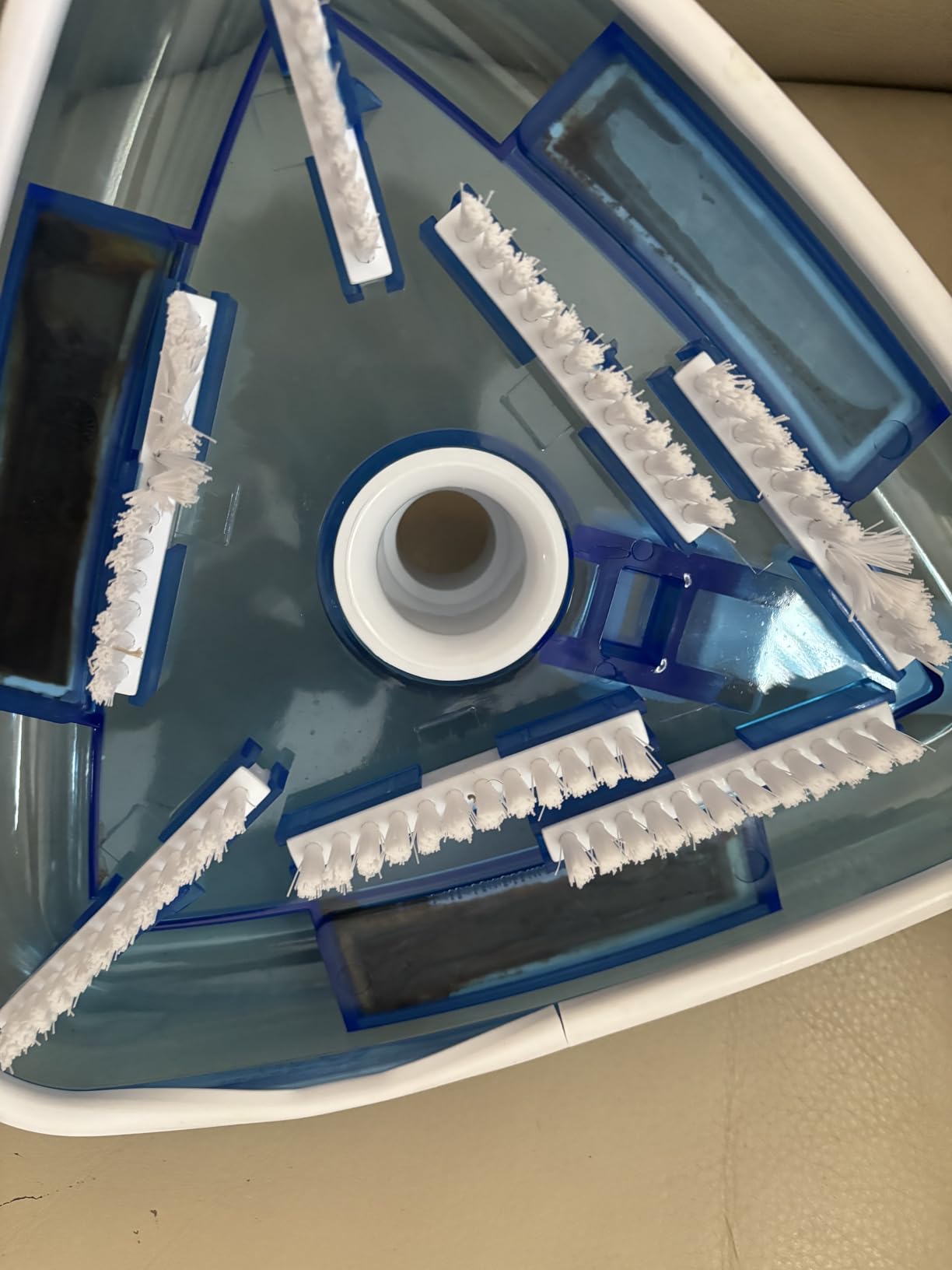
This is the head most owners end up with, and for a simple reason: it solves the three problems that actually break vacuuming. The swivel connection accepts either hose diameter, so there is no adapter hunt. The triangular point reaches the wall junctions where algae and grit collect. And the transparent body means you can see when the head is full instead of pushing an invisible bag of leaves around the deep end.
That transparency changed how I vacuum. With an opaque head you are guessing, and a full head that keeps moving is the reason some passes feel like wasted effort. Watching the debris cloud through the shell tells you exactly when to dump the canister.
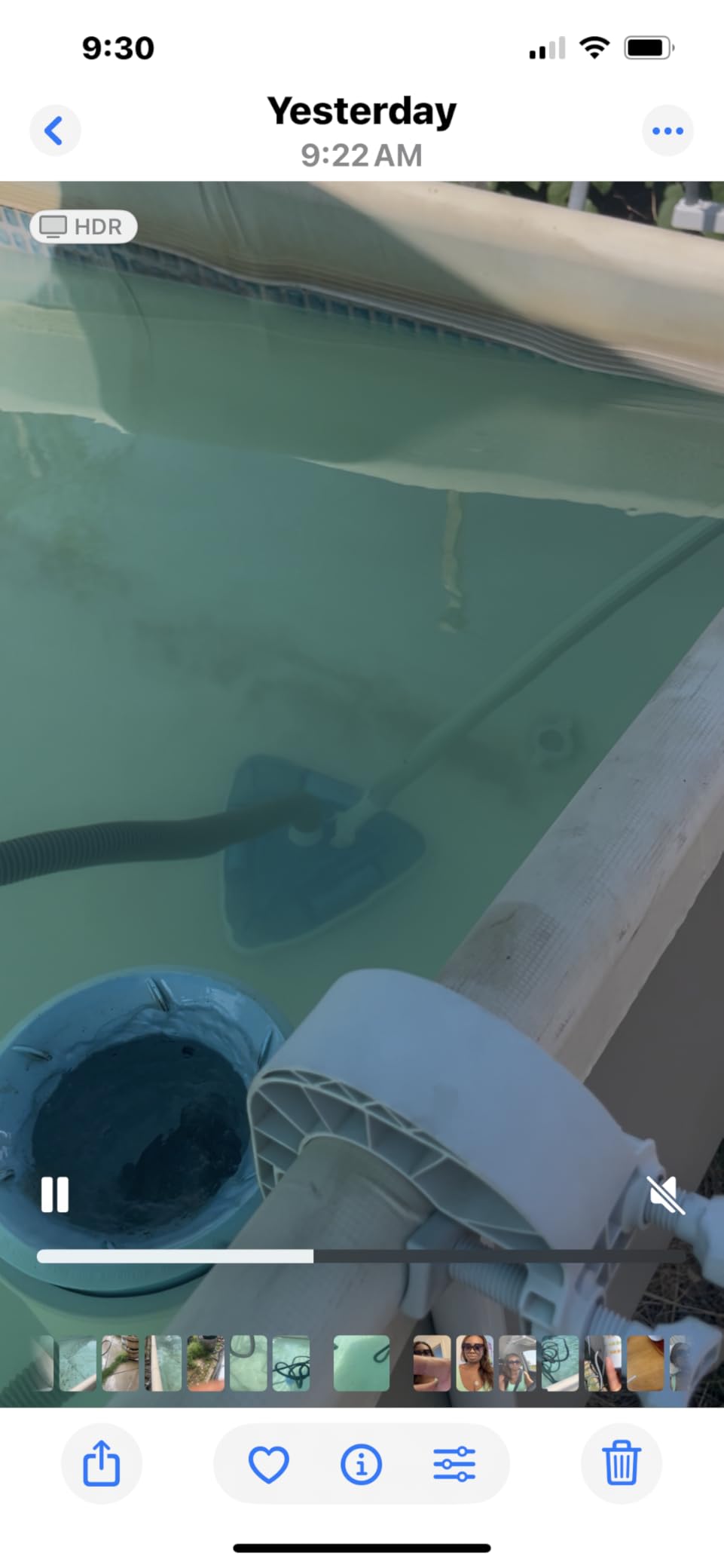
At 1.9 pounds it is light enough to steer with one hand and light enough that you are not fighting it on an above-ground wall. The swivel does real work here too, because hose twist is the most common complaint we heard across every head in this roundup, and a rotating port removes most of it.
The weaknesses are honest ones. The body is thin plastic, and the EZ clip pin that holds the pole has been reported breaking on some units. The bristles sit roughly an inch back from the edge, so debris right against the wall is left behind. And those bristles are molded in, not replaceable, so you are on a clock.
Who should buy this one
Buy it if you are on a budget, if you want a head that works with whatever hose you already own, or if you are new to manual vacuuming and want to see what the head is picking up. It is the safest first purchase for a vinyl liner pool because the swivel and moderate weight do most of the protection work for you.
It is also a good match for a rectangular pool with 90 degree corners, since the triangle point is designed for exactly that junction. Paired with a pole rather than a handle, it is comfortable on a mid-size pool.
Who should look elsewhere
If your liner is already showing wrinkles, look for a head with air relief instead, because this one has no venting and can suction-lock to the liner on a heavy debris load. If you are a strong advocate for a head you can rebuild, note that these bristles are not sold separately.
Owners with a liner that is a few seasons old and brittle should also consider a softer-bristle design, since a fixed bristle strip that hardens with sun and chlorine can abrade vinyl over time.
3. Poolmaster Deluxe 27400 – Best for Liner Protection
Poolmaster Deluxe Weighted Vinyl Liner Pool Vacuum Head With Air-Relief Valves, Safe Cleaning for Inground & Above-Ground Pools – Fits 1-1/4″ & 1-1/2″ Hoses
Dual self-adjusting air-relief valves
ABS body
2 lb
Fits 1-1/4 and 1-1/2 in hose
Pros
- Air-relief valves cut the suction that pulls heads onto vinyl
- Perimeter brushes loosen debris on contact
- Swivel adapter and spring handle reduce tangling
- Weighted body stays submerged without scratching
Cons
- Hose and pole sold separately
- Published dimension data does not match the real head size
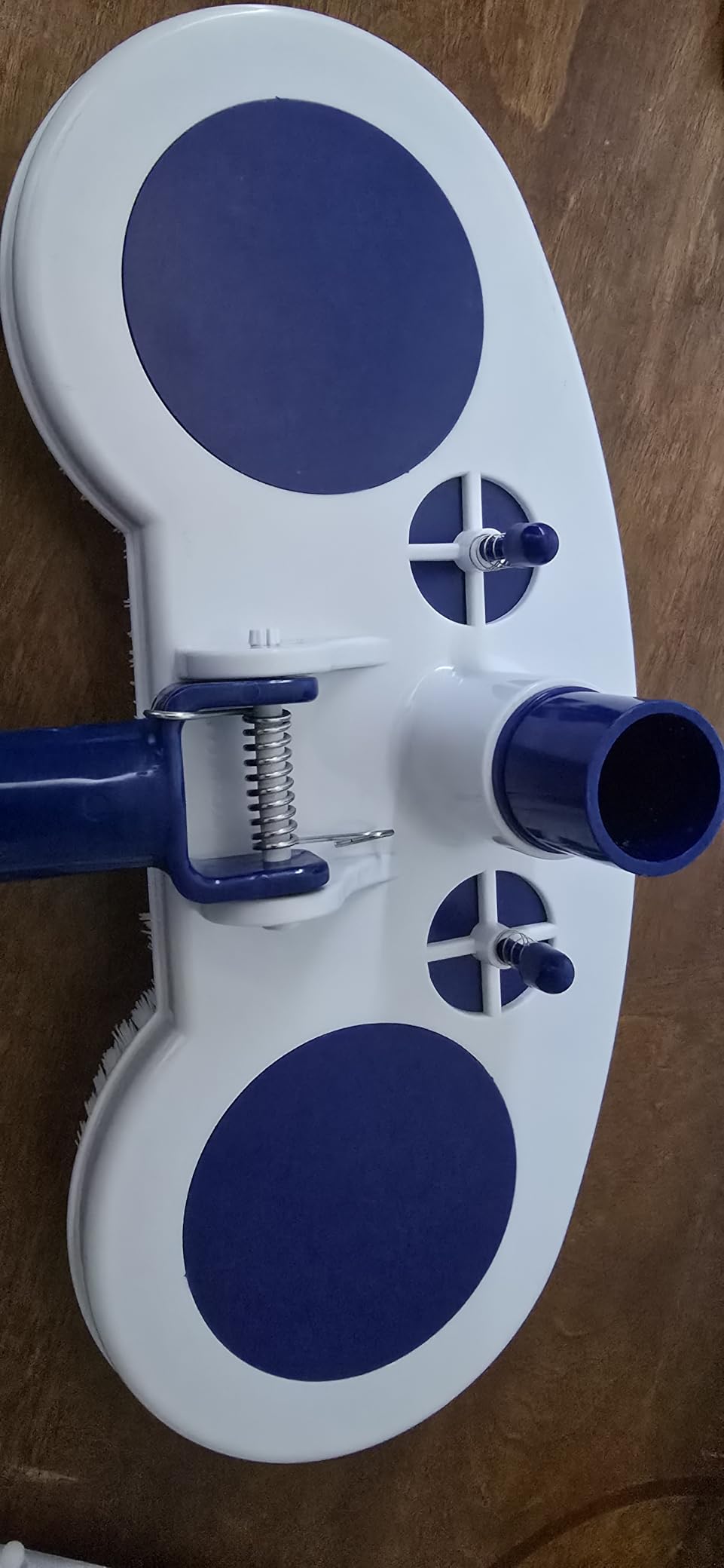
The air-relief valves are the reason this head is on the list at all. Most budget heads create a vacuum seal against the liner that you have to break by switching off the pump. The two self-adjusting valves bleed excess air when suction spikes, so the head keeps moving and never develops that seal. If your liner wrinkles or bulges when you vacuum, this is the feature that addresses it.
The perimeter brushes wrap the edge of the body rather than sitting under the center, so debris is loosened as the head passes instead of being pushed ahead of it. On a pool that collects fines at the walls, that difference shows up in how quickly the deep end clears.
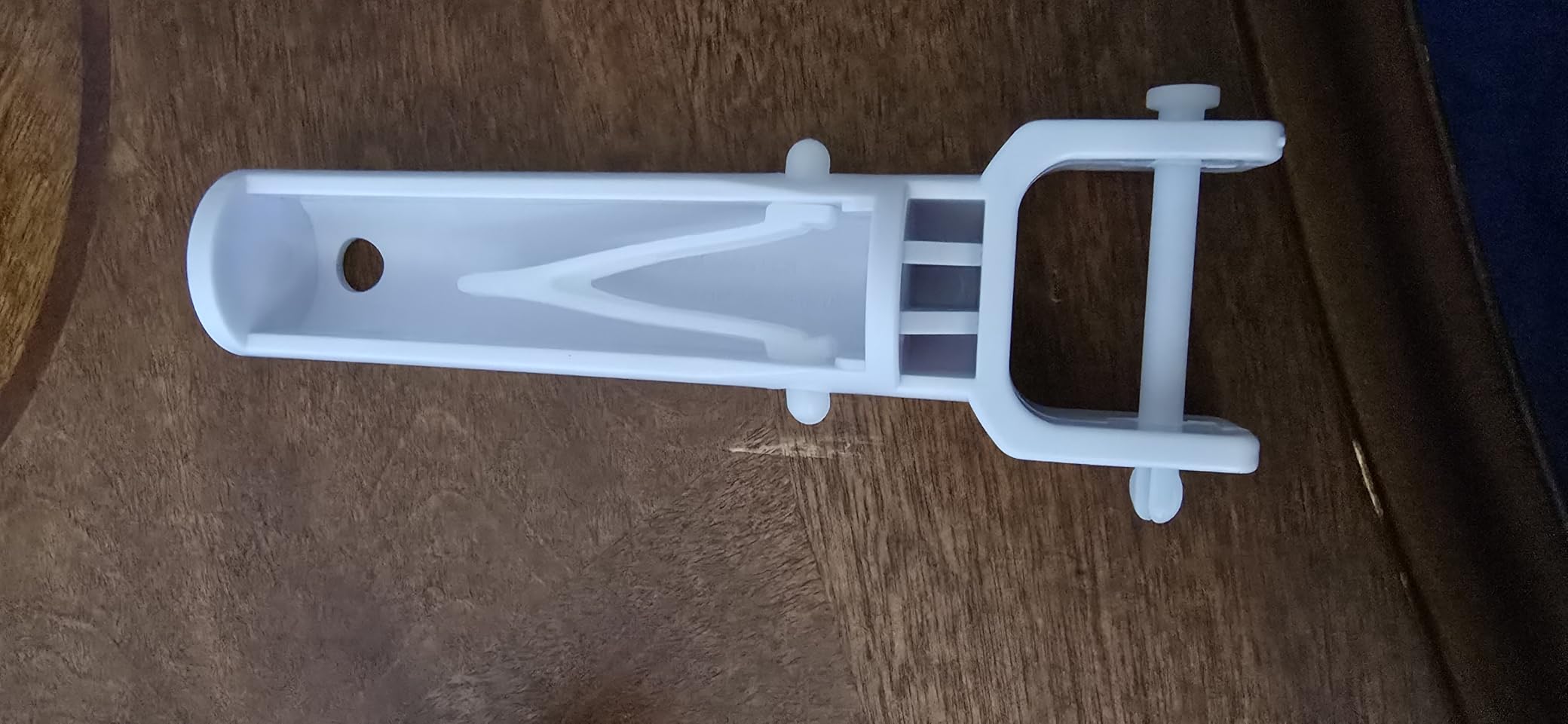
Steering is handled well. A swivel hose adapter and a spring-loaded handle take most of the drag out of the pass, and at 2 pounds the head sits on the floor without needing a heavy pole to push it around. Reviewers note the weighted body stays submerged and in full contact without scratching, which is exactly the behavior you want on 20 and 25 mil liners.
Two things to plan around. The hose and pole are not included, so this is a head-only purchase unless you already own that gear. And the listing dimensions of 0.6 by 0.6 by 1.19 inches are plainly wrong, so judge the actual size in person rather than ordering blind.
Where the air relief really pays off
It matters most on older liners, on any pool with a lot of leaf fall, and on any deep end where you spend time hovering in one spot. Any of those situations is where an unvented head pulls itself down and grinds the same patch of liner.
It is also the feature to prioritize if you vacuum with a dirty filter. A clogged filter means the pump fights harder, suction climbs, and the liner takes the difference. Venting gives you a safety margin that no amount of careful technique can replicate.
Where it falls short
This is not a corner specialist. The shape is rounded rather than sharply triangular, so on tight wall junctions you will need a second pass to catch what the perimeter brushes push outward. If your pool is mostly corners and steps, one of the triangular designs will serve you better.
It also does not tell you when it is full, which the transparent designs do. Expect to check the canister more often if you are vacuuming heavy leaf debris rather than weekly maintenance silt.
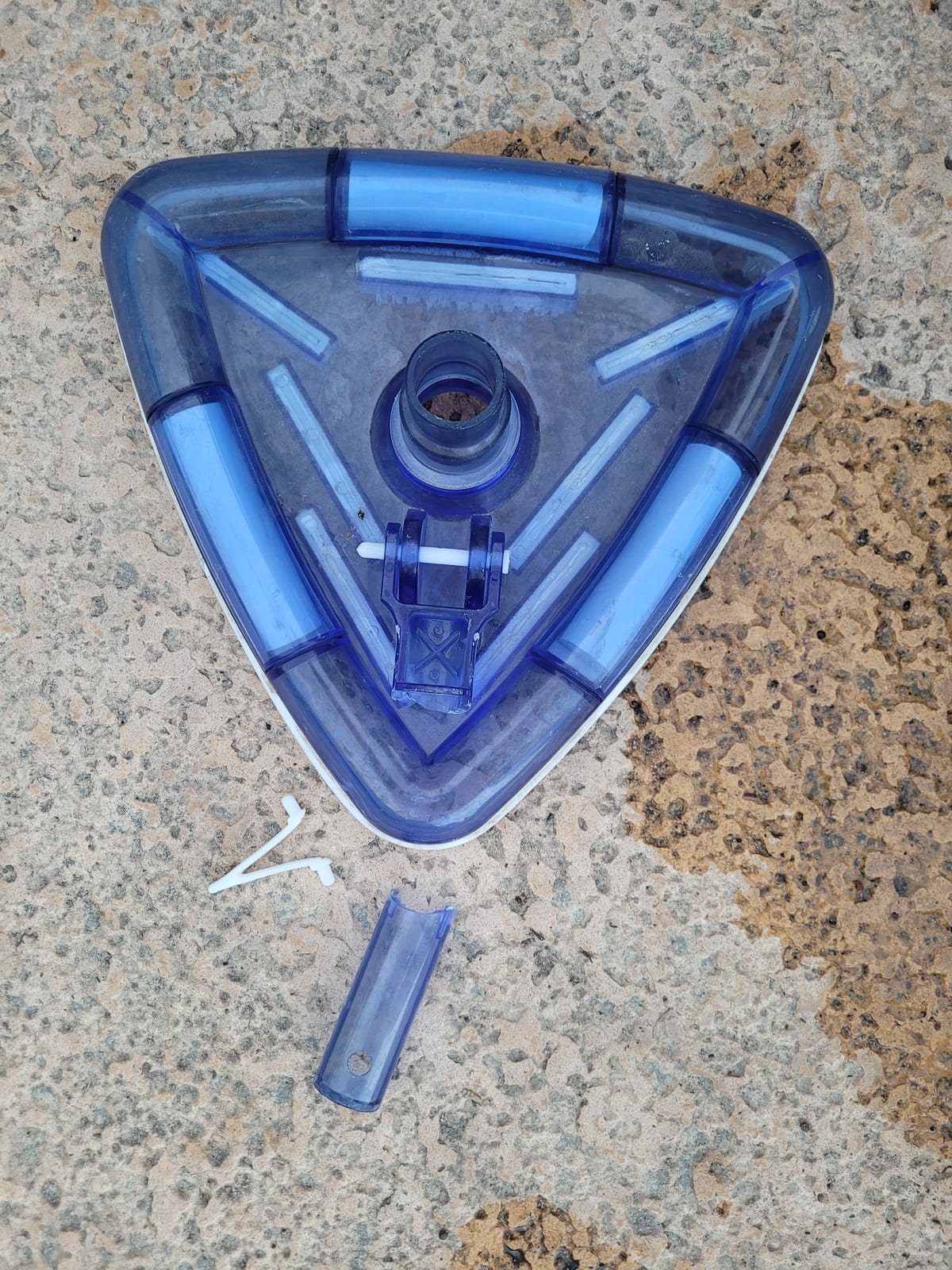
4. Swimline HydroTools 8145 Triangular Head – Best for Corners and Wall Junctions
SWIMLINE HYDROTOOLS Manual Pool Vacuum Head Attachment For Inground & Above Ground Pools |Weighted Swimming Pool Vac Head Clear Triangle Shape W/ Bristles| Swivel Hose 1-1/4 or 1-1/2’’| 8145
12 x 12 x 2 in weighted triangle
16 oz
Two-port swivel connector
1-year guarantee
Pros
- Extra-large triangle generates strong suction through the whole area
- Two-port connector fits 1-1/4 and 1-1/2 in hoses
- Rotating swivel makes tight turns predictable
- Integrated bristles capture rather than push debris
Cons
- Light at 16 oz
- so it depends on a clean filter to sink
- Integrated bristles are not sold as replacement parts
This is the long-running HydroTools triangle, and the reason it stays relevant is the extra-large cleaning area for its size. The 12 by 12 inch footprint gives the intake a lot of surface to work with, which translates into faster pickup on fines and a shorter vacuuming session.
On a vinyl liner pool, the triangular geometry is the point. The apex reaches into the wall junction where the floor meets the wall at 90 degrees, and that is exactly where algae starts and where grit collects. Users consistently report the triangle reaching spots a rectangular head leaves alone.
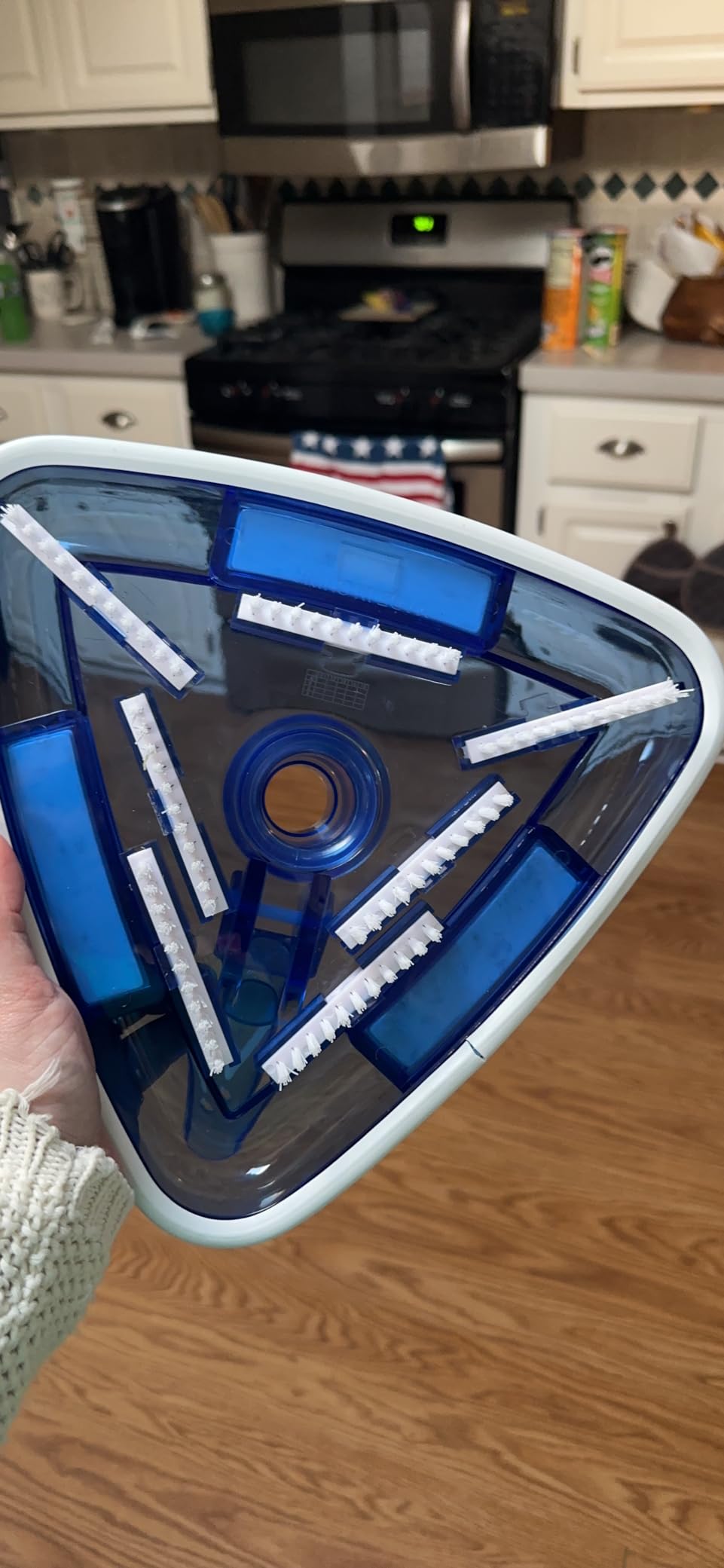
The hose connector deserves attention. It is a single fitting with two ports, one for each common hose diameter, plus a rotating swivel. Having both sizes built in removes the single most common setup frustration, and the swivel stops the hose from wrapping around your pole every third pass.
The trade-off is weight. At 16 ounces this is a light head, and a light head needs good flow from the pump to sit down on the floor. With a clean filter and a sound pump it works well. With a neglected filter it tends to drift, and you end up chasing it rather than pushing it.
Best fit for rectangular inground pools
Pick this head when your pool has straight walls and hard 90 degree corners, and when you want leaf pickup rather than scrubbing. It is a long-standing favorite in the category and it holds a top-two position in pool vacuum heads, which is a durability signal in a product category that turns over constantly.
It also suits a pool with a shallow floor, where a light head is an advantage because you can lift and reposition it with one hand.
Where it falls short
The molded-in bristles are the limitation to weigh. Because they are not offered as a separate part, once they flatten you are shopping for a new head, and that is the moment most owners start wishing they had chosen a rebuildable design. If you vacuum through heavy leaf seasons every year, factor that replacement into your plans.
It is also a harder head to use on a freeform or curved pool, where a rigid triangle meets the wall at an awkward angle and the apex can dig into the cove.
5. Sepetrel SP004-1 Triangular with Side Brush – Best for Deep-End Debris
Sepetrel Upgrade Pool Vacuum Head with Side Brush & Universal Rotatable Hose Adapter,Weighted Triangular Shape(Safe for Vinyl Liner Pool)
2.27 lb weighted triangle
13.62 x 11.85 x 3.11 in package
Side and corner brushes
Rotating hose adapter
Pros
- Side brushes scrub walls and corners as you cross the floor
- Rotating adapter stops the hose kinking mid-pass
- Sealed weighted compartment holds firm contact with the bottom
- Bottom brush improves pickup in the deep end
Cons
- Underside swivel screw ring can loosen and release the head
- Light for a weighted head
- so it can lift when dragged backwards
- Internal metal weights reported rusting over time
The side brushes are what set this head apart. Most triangular heads work the floor and leave the wall to a separate step. This one carries brushes on the side and corner faces, so a single pass along the wall junction both loosens surface growth and pulls it into the intake. If algae at the waterline is your recurring frustration, that is worth more than a larger footprint.
The completely sealed weighted compartment is the liner-safety story here. Nothing water-laden sits against the vinyl, so the body holds a consistent seal on the floor without any hard part touching the liner surface. The rotatable hose adapter does the same job as a swivel, keeping the hose from kinking while you work the deep end.
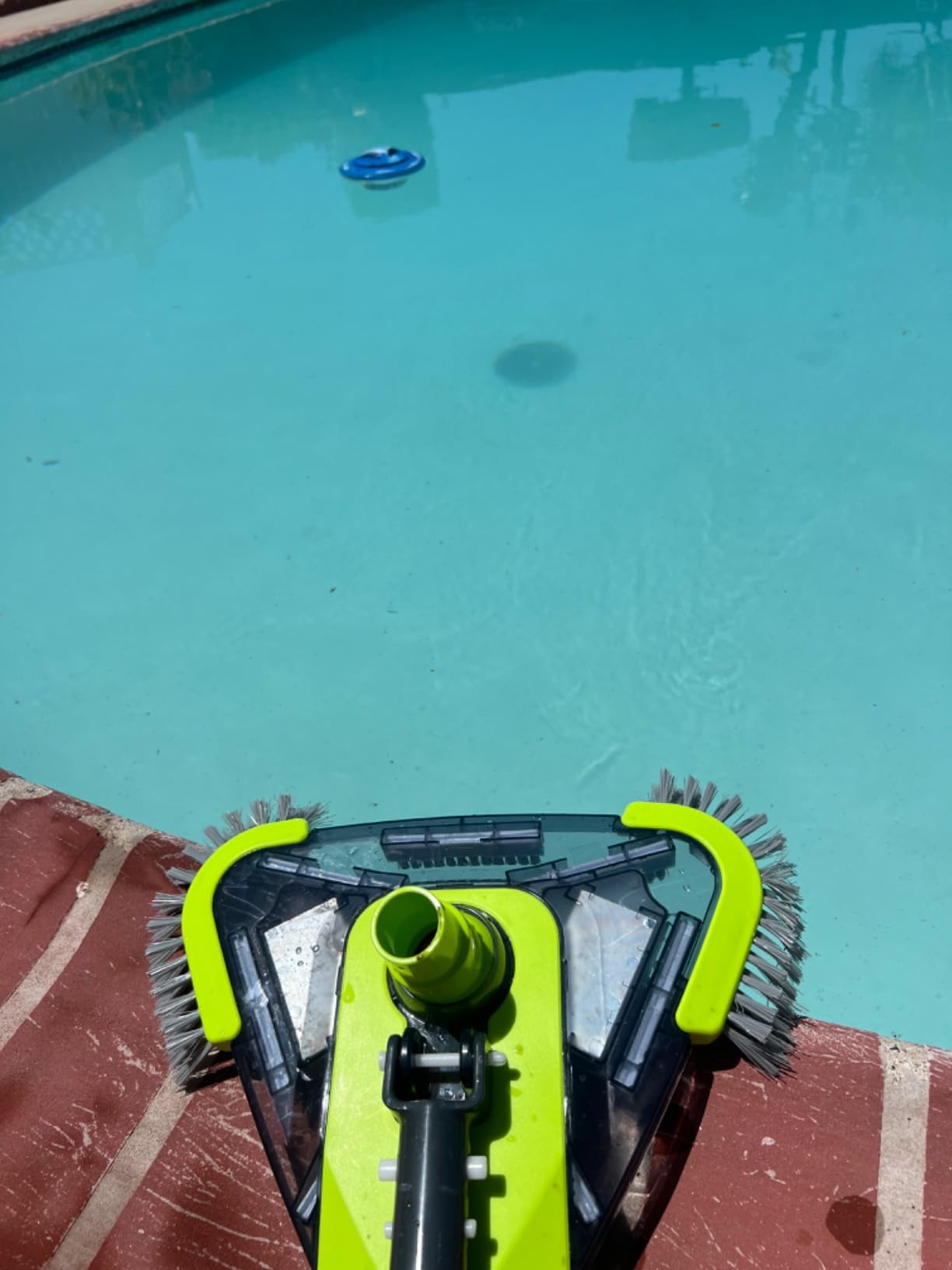
Where it is honest about its limits: build quality is the weak point. The screw-on ring under the swivel pipe has been reported loosening until the head detaches, which is a safety problem in the deep end rather than a minor annoyance. The head is also lighter than older metal-weighted designs, so pulling it backward tends to lift it off the floor.
Owners also mention internal metal weights showing rust in later seasons. On a vinyl liner that matters more than it would on concrete, because rust staining transfers to the surface.
When the side brush earns its place
It makes sense on a pool with a lot of wall area: steps, a deep end wall, and a waterline you are trying to keep clear of algae. The side brush reaches the vertical surface without you having to angle and re-pass, which cuts session time noticeably on a walled pool.
It is also a good storm-recovery head. When leaf volume spikes, the bottom and side brushes work together to break up the mat rather than merely pushing it.
Where it falls short
Check the underside screw ring before every deep-end session, and do not rely on this head to sink on a weak pump. If you push rather than pull, the light weight works against you and you will spend the pass lifting the head off the floor instead of guiding it.
For a pool with heavy leaf loads, a heavier head with a replaceable bottom brush will outlast it, and the rust reports make me hesitant to recommend it as a season-after-season tool on a new liner.
6. Swimline HydroTools 8150 Rectangular Head – Best for Large Pools
SWIMLINE HYDROTOOLS Manual Vacuum Head Attachment For Inground & Above Ground Pools |Weighted Flexible Swimming Pool Vac Head Rectangle Shape W/ Wheels| Swivel Hose 1-1/4 or 1-1/2’’| Clean 8150
13.5 x 7 x 4 in flexible rectangle
2.4 lb
Integrated wheels
Two-port swivel connector
Pros
- Wheels lift the head slightly so it is far easier to push
- Rectangular body resists suction lock on sloped floors
- Two-port connector takes both hose diameters
- Owners report multiple seasons of service
Cons
- Spring connector ships with no instructions and is genuinely hard to fit
- Some of the eight wheels bind against the body
- Internal steel weights are unsealed and can rust
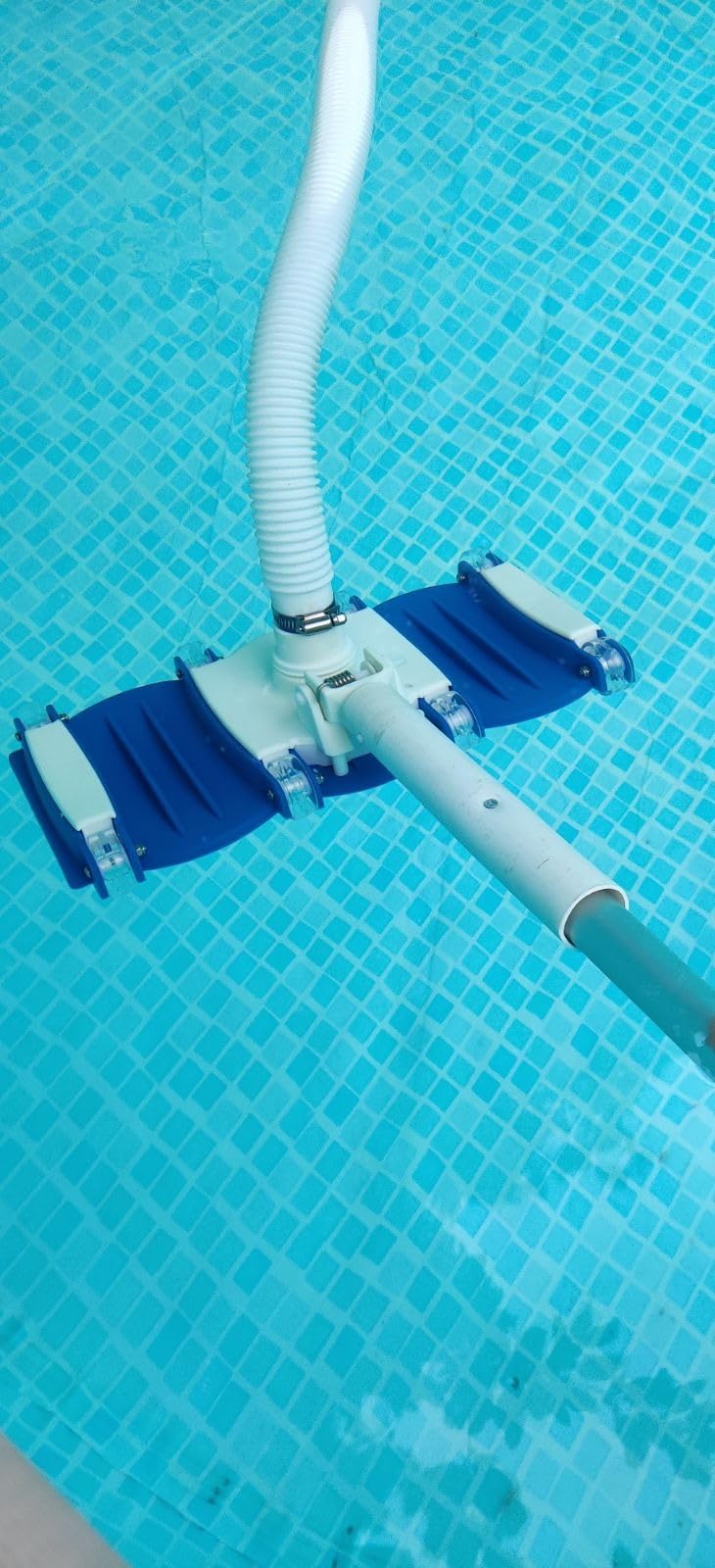
This is the most-reviewed head in the group at more than 5,000 ratings, and on a large vinyl pool that is largely a function of a simple thing: it is easy to push. The integrated wheels raise the housing slightly off the liner, so instead of dragging a weighted block across the floor you roll it. Over a 40 foot pass, repeated, that is the difference between finishing a vacuuming session and putting it off.
Because the body is flexible and rectangular, it resists suction lock on the slopes that pull a rigid head onto the liner. It also covers floor quickly, which matters when you are working a pool big enough that time is the limiting factor.
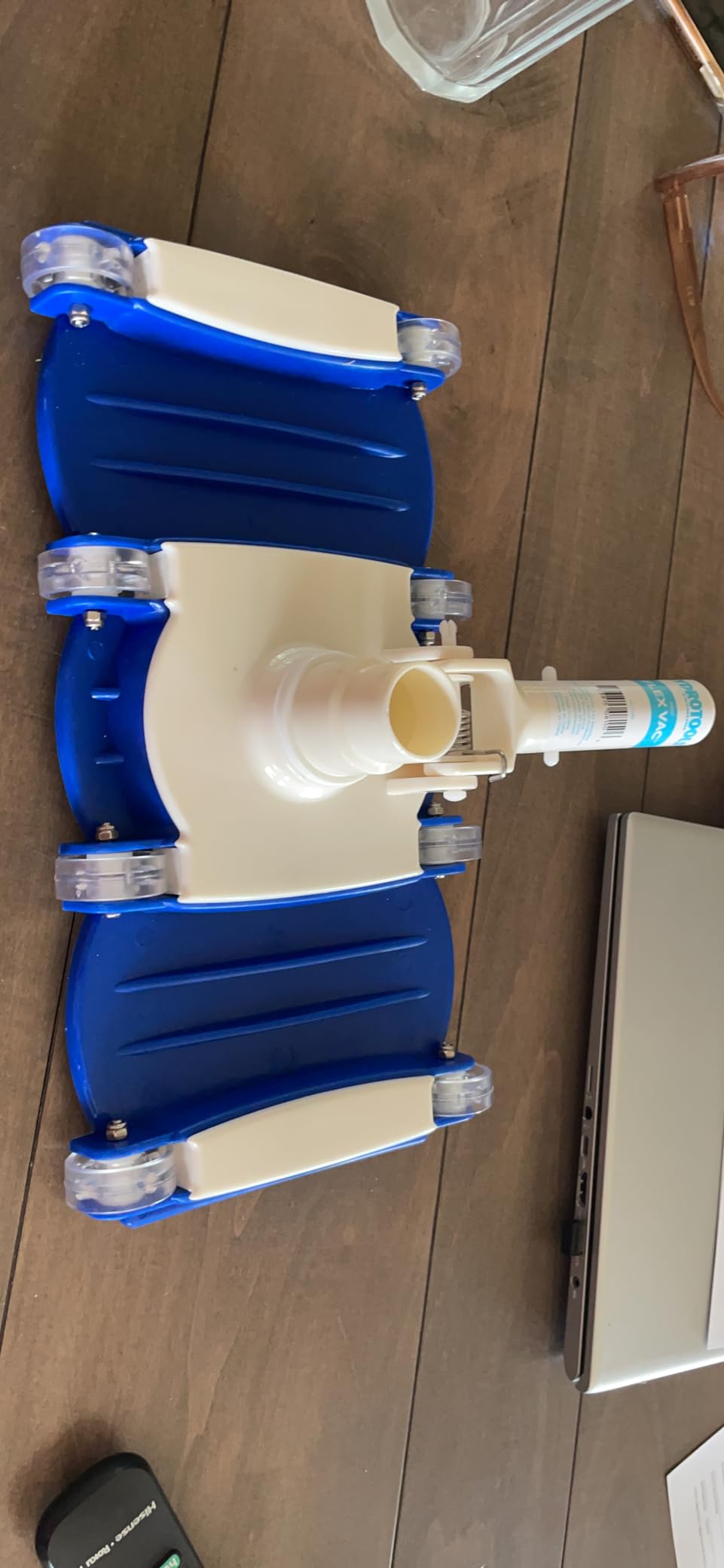
The important caveat for a vinyl liner pool is the material inside. The internal weights are steel and are not fully sealed, and several owners report rust appearing over time, sometimes staining the liner and the filter elements. Some have swapped in stainless hardware to solve it. The wheels themselves are urethane, not hard plastic, so the rolling contact itself is liner-safe.
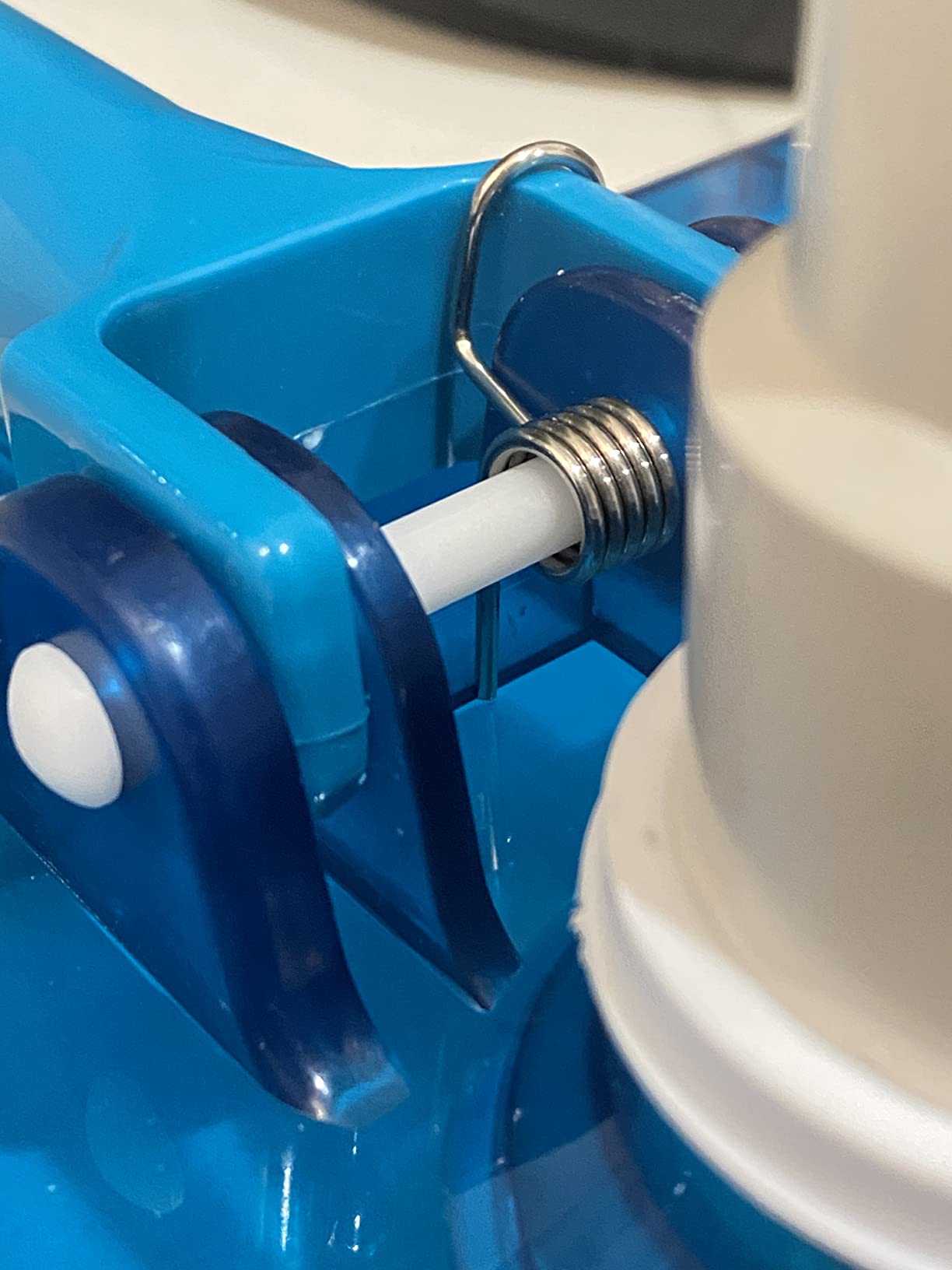
The other real issue is assembly. The spring-loaded pole connector arrives with no printed instructions and takes genuine effort to fit. Budget ten minutes for it the first time.
Why wheels work when they are set up for them
The r/pools objection to wheels is to hard plastic rollers on hard concrete. This head uses urethane wheels on a flexible body, which is a different proposition: the wheels touch the liner through soft material and the housing never contacts the surface at all. That is why the wheel objection does not apply here.
Owners also note the included spring can pop the head up off the floor, and many remove it. Check that on the first pass before you assume something is wrong.
Where it falls short
A rectangular head has no apex, so on a pool with tight corners and steps you will need a second tool. This is a floor head, and treating it as a wall head is where the frustration comes from. If your pool is mostly corners, a triangular design serves you better.
Owners also flag that not all of the eight wheels spin freely on every unit, and a binding wheel rubs against the body and marks the liner. Spin each one before the season starts.
7. U.S. Pool Supply 12 Inch Butterfly Head – Best Budget Pick
U.S. Pool Supply 12″ Deluxe Weighted Butterfly Pool Vacuum Head, Swivel
12 in weighted butterfly
0.86 kg
Nylon bristles
Soft protective bumper edges
Pros
- Soft bumper edges are explicitly liner-safe
- Weighted body holds full contact for consistent pickup
- Nylon bristles handle walls
- corners and slopes
- Very low entry cost for a complete head
Cons
- No air relief
- so strong suction can lock the head down
- Soft rubber rim can detach and needs adhesive
- Fixed bristles shed rather than being replaceable
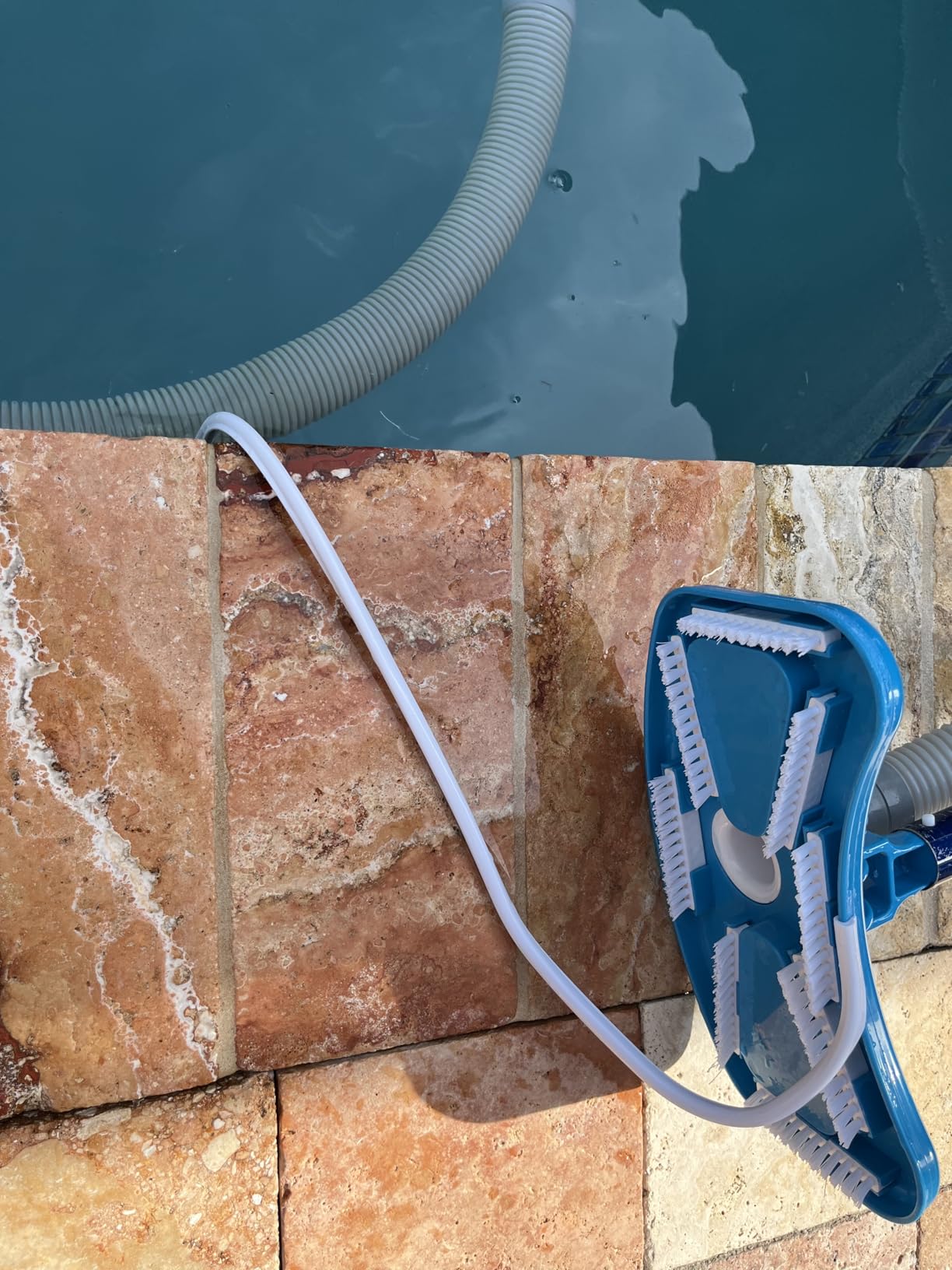
The soft protective bumper edges are the reason this head is liner-safe in a way most cheap heads are not. The rounded rubber rim is what meets the vinyl, and it takes the abrasion that a hard plastic corner would otherwise cause. Several owners with long maintenance histories rate the pickup as the best they have had at this level of spend.
The butterfly shape is a wide, shallow triangle, which gives you a bigger pass than the small budget heads while staying easy to turn in a compact pool. Nylon bristles reach the walls, corners and slopes, and the weighted body keeps the housing in full contact so the debris actually gets pulled in.
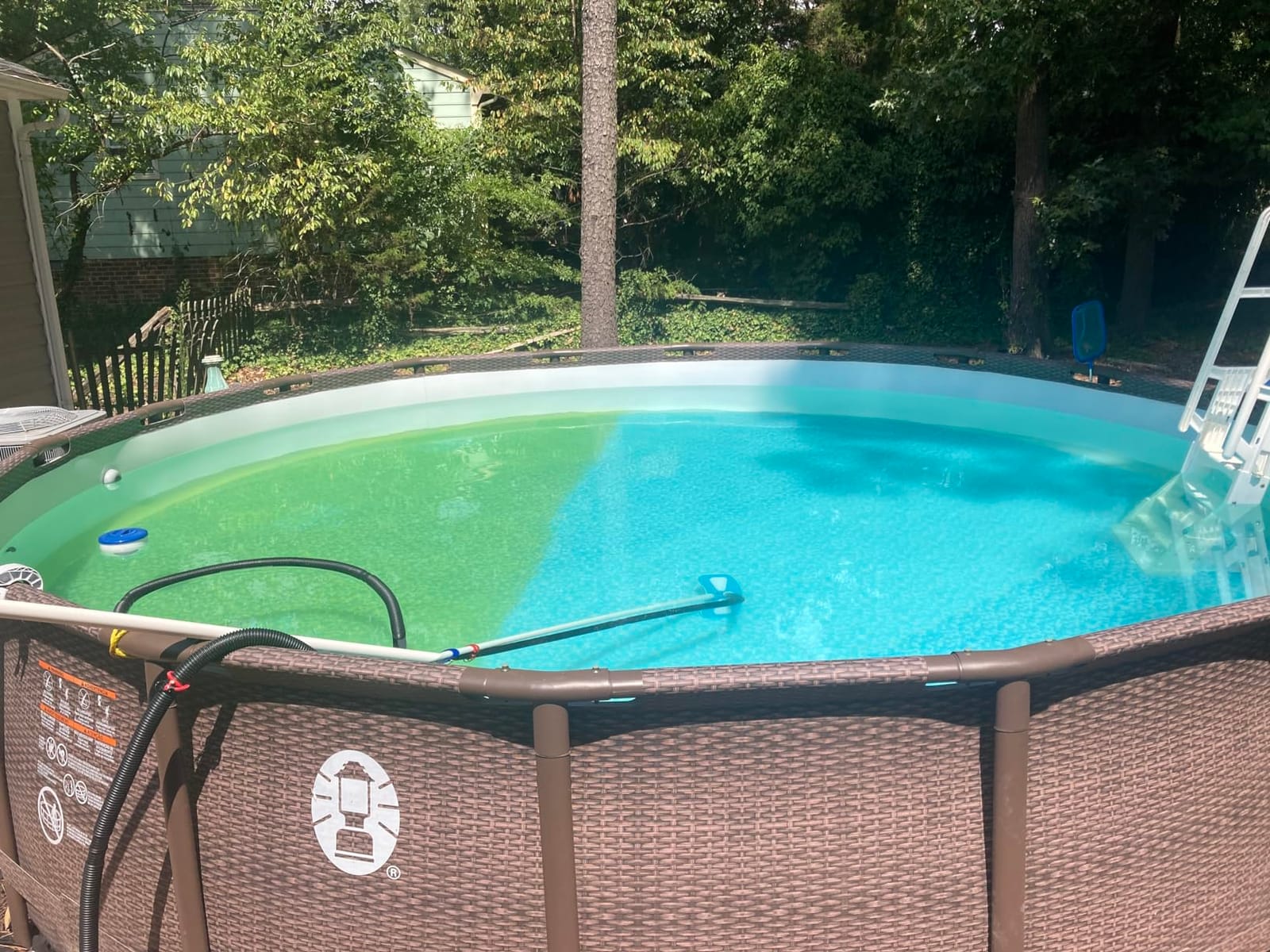
What you give up is air relief. With no venting, a heavy debris load can seal the head to the liner, and freeing it means switching off the pump rather than waiting it out. If you vacuum after storms, plan on that. For weekly maintenance on a clean filter, it rarely comes up.
There is also a real wear issue: the soft white rubber rim can detach from the body and needs adhesive to refit, and the nylon bristles are fixed and can shed into the pool. Both are minor in a season and annoying across several.
Who this is for
This suits a first-time owner, a small above-ground liner pool, or anyone who wants a dedicated liner-safe head without buying a premium one. The bumper is doing the protective work that a weighted plastic head would not do, and the swivel takes either hose diameter.
It is also a good second head to keep as a backup, particularly for a shallow pool where a small, easy-to-turn unit is genuinely more useful than a large one.
Who should pass
Skip it if you vacuum heavy leaf loads regularly, because the lack of venting will cost you more time than the head saves. Skip it if you want replacement brushes, since these are molded in and shed. And if your liner is already brittle, note that a detachable bumper can come loose and then rub without any protection.
8. U.S. Pool Supply Half Moon Head – Best for Above-Ground Pools
U.S. Pool Supply Weighted Pool Vacuum Head, Transparent Curved Half Moon
10.5 x 10.5 x 7.5 in half moon
0.97 kg
Transparent shell
Swivel fits both hose sizes
Pros
- Curved half-moon profile nests into corners and along walls
- Transparent shell shows when the head is full
- Soft edges are safe on vinyl liner
- Swivel connection reduces knotting
Cons
- Fixed nylon bristles with no replacement brushes
- Covers less floor per pass than triangular or rectangular heads
- Pole not included
The half-moon shape is the whole argument. That curve follows the cove where the liner rolls up from the floor into the wall, which is precisely the transition a rigid triangular head bridges across and leaves behind. On a stepped or contoured liner pool, the flexible arc makes the difference between a clean cove and a strip you keep re-vacuuming.
It is also a genuinely good match for above-ground liner pools, where the floor is usually vinyl in a shallow bowl and the walls are close on every side. A smaller, curved head turns easily in that space, and the transparent body tells you when to dump it.
The swivel accepts both hose diameters and the soft edges are described by the manufacturer as safe for vinyl-lined pools, which is the basic requirement here. The weighted body keeps the housing seated on the bottom rather than letting it rock, so the bristles actually sweep.
The compromise is floor coverage. A 10.5 inch wide curved base collects less per pass than a 12 inch triangle, so on a long rectangular inground pool this is the slower choice. It is a targeted tool, not a general one.
Where a curved head wins
Reach for it on above-ground pools, on step and spa spillways, and anywhere the liner has a cove or a freeform transition. The arc contacts the surface continuously through the curve instead of touching at three points, which improves pickup right where debris stops.
It is also a comfortable head for a small pool with an odd footprint, since a curved body resists jamming when you turn it in a tight corner.
Where it falls short
Do not make it your only head on a large inground pool; the smaller footprint turns a quick job into a long one. And as with several designs here, the nylon bristles are fixed with no replacement strips available.
It also ships without a pole, so factor that in if you do not already have a 1-1/4 inch telescopic attachment.
9. POOLWHALE VB0020 Triangular Head – Best for Brush Protection
Weighted Triangular Pool Vacuum Head with Brush, Safe for Vinyl Liner Pool
13 x 10 x 2.4 in triangle
0.98 kg
Integrated wheels and corner bristles
ABS body
Pros
- Wheels hold the housing clear of the liner so bristles last longer
- Angled corner bristle sets sweep into tight junctions
- 71 percent of ratings are five star
- Swivel fits 1.25 in and 1.5 in hoses
Cons
- Ballast is lighter than a weighted head implies
- Underside bristles can lie flat and let the housing scrape
- Edge brushing is less effective than the design implies
The wheel-height design here is genuinely clever, and owners single it out as the reason to buy. The wheels set the head at the right height so the plastic housing never touches the pool bottom. That protects the liner from abrasion and protects the bristles from being crushed flat, which is the exact failure that ruins most bristle heads.
The rating distribution is the strongest in this group, with 71 percent five star and only 6 percent one star on 498 ratings. That is a smaller review base than the established brands, but a much cleaner signal than its size alone would suggest.
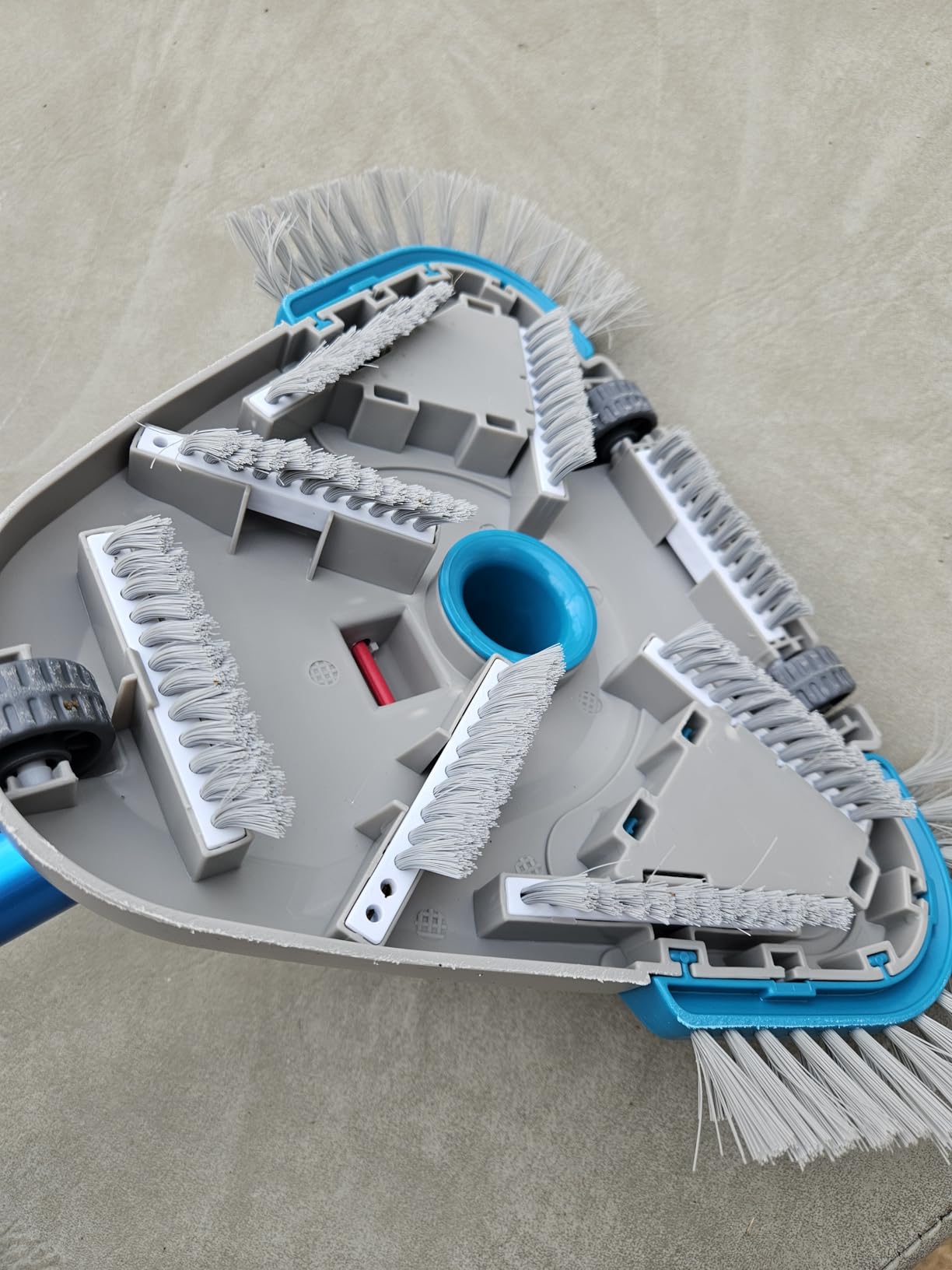
The angled bristle sets placed at the triangle corners are positioned to sweep right into the junctions where a flat bristle strip would ride over the top. Combined with the 13 by 10 inch body, you get a wide pass and real corner coverage from one head.
Two caveats. The ballast is lighter than a weighted label implies, so on a weak pump the head will not plant firmly. And the underside bristles have been reported as softer than expected, lying flat under load and letting the housing scrape, which is the same problem this design is meant to solve.
Why the wheel height matters on vinyl
Most head damage to a liner comes from the housing touching the surface, not the bristles. Keeping a small gap between the plastic body and the vinyl removes the abrasive contact entirely, and it is a simple, visible fix you can check with a fingernail in a few seconds.
It also means less force is needed to move the head, since the wheels are doing the sliding rather than the plastic face.
Where it falls short
Do not rely on it for heavy deep-end work if your pump flow is marginal, and do not expect the edge brushing to be as complete as a dedicated side-brush head. If algae on the walls is your main target, this is not that tool.
One unit also arrived with a broken wheel, so inspect the wheels on arrival and check that they spin freely before the first session.
10. TidyMister Direction-Control Head – Best for Steering and Deep Passes
TidyMister Pool Vacuum Head with Direction-Control Handle & Side Brush -Swimming Weighted Triangular Brush Vac with Universal Rotatable Adapter-Deep Clean for Vinyl Liner,Inground & Above Ground Pools
Weighted triangle with steering handle
1 kg
Side and corner brushes
Rotating adapter
Pros
- Direction-control handle gives one-handed navigation of walls and steps
- Manufacturer claims up to 50 percent less pushing effort
- Weighted triangular body stays planted on the floor
- Rotating adapter reduces dragging against the liner
Cons
- Hose and pole not included
- Small review base means limited long-term durability data
- Costs more than most plastic manual heads
Everything here is oriented around effort, and on a deep pool that is the feature that matters. The direction-control steering handle lets you redirect the head with one hand rather than fighting the pole, and the manufacturer claims that cuts pushing effort by roughly half compared with a standard fixed head. Whether you get the full 50 percent depends on how you push, but the difference in control around steps and walls is obvious.
The triangular weighted body is a proven liner-safe layout, and the corner and side brushes capture the debris that a plain triangle pushes along the wall. The rotating adapter cuts friction against the pool finish, which reduces the tugging that leads owners to blame the liner.
Who this suits
It is aimed at larger or deeper inground pools where the physical effort of a manual vacuum is the real barrier. If you have been avoiding vacuuming because of the pushing, this is the design that addresses the reason. It also works well on a pool with a lot of steps and tight wall transitions.
The corner brush layout is a bonus on rectangular pools with hard junctions.
Where it falls short
The honest limitation is data. With 355 ratings, this is the newest listing here, and there is not yet a multi-season durability record to compare against the long-running designs. If you buy it, check the underside swivel ring and the corner brush mounts at the start of each season.
You also need to supply the hose and pole, and it costs more than most comparable plastic heads, so it is a deliberate choice rather than a value one.
How to Vacuum a Vinyl Liner Pool Without Damaging It
Check the filter first. A dirty filter makes the pump fight, suction climbs, and the liner takes the difference. Clean or backwash the filter before every session, especially before deep-end work.
Brush the walls first. Vacuuming picks up debris. Brushing knocks growth off surfaces so the vacuum can reach it. If you only do one of the two, you are doing half a job.
Overlap your passes. Leave a few inches of overlap between lanes. Gaps at the pass edges are where debris hides, and chasing them with a stuck head is what causes scratches.
Do not press down. Let the head’s weight and suction do the work. Pushing harder increases liner drag rather than pickup, and it is the fastest way to wrinkle a liner.
Watch the corners. Take extra care where the head jams and rubs the same spot. A cleaner stuck in a corner abrading the same vinyl every session is the main cause of tears over time.
Move the hose, not the liner. If the hose tightens, the head is caught. Free the head before pulling harder, and never drag a stuck head across the floor to release it. Switch the pump off, let the seal break, and lift it clear.
Replace worn brushes before they flatten. Once bristles lie flat the housing starts touching the liner. Rebuildable heads with separate bristle strips are worth the extra attention.
Our guides to cleaners safe for vinyl surfaces and robotic cleaners for inground pools cover the tool choice if you would rather not push a head at all.
How to Choose a Liner-Safe Pool Vacuum Head
Soft contact beats hard contact. Start with the bottom contact. Soft nylon bristles, urethane wheels, or a rubber bumper edge are all safe on vinyl. Hard plastic or metal wheels on a bare plastic chassis are not, no matter how the listing describes it.
Match the shape to your pool geometry. Triangular heads win in tight 90 degree corners and along wall junctions. Flexible half-moon heads win in coves, steps, and freeform transitions. Rectangular or butterfly heads win on open floor where speed matters more than corner access.
Understand above-ground versus inground. Above-ground liner pools are shallow with close walls, so a small curved head that turns easily beats a large one. Inground liner pools have depth, slopes and coves, so a weighted head with a swivel and air relief is the better tool.
Calibrate weight against liner thickness. A head that is too light drifts and picks up nothing. Too heavy, especially on a 20 mil liner, and you can draw the liner down into the floor. Standard residential heads fall in a workable range; heavy service heads are built for commercial work and are overkill for a home vinyl liner.
Check the hose diameter before you buy. Most heads accept 1-1/4 inch or 1-1/2 inch hose, and many have two ports built in. A 1-1/4 inch hose feeding a 1-1/2 inch port loses flow, and weak suction gets blamed on the head. Two-port connectors and 360 degree swivels are worth paying for because they remove both the mismatch and the tangling.
Prefer air relief on a mature liner. Air-relief valves bleed off excess suction and are the single best protection against a head locking onto the vinyl. On a new liner you can get by without them. On a liner that already wrinkles or bulges, they are the priority.
Think about repairability. Heads with replaceable bristle strips can be rebuilt for a season on for the cost of a strip. Sealed designs with molded-in bristles become waste when the bristles flatten. If you vacuum through heavy leaf seasons every year, treat that as part of the purchase decision.
Manual Head vs Robotic Cleaner on a Vinyl Liner Pool
Robotic cleaners are broadly safe on vinyl when they use soft rubber brushes and wheels, and they are the answer for owners who will not vacuum manually. The trade is that they are far less effective against heavy leaf debris, and a robot that runs over a leaf mat pushes it around rather than removing it.
A manual head gives you control over corners, steps, and the cove, and it lets you respond to a specific problem area. That is why pool service technicians carry a manual head even on pools with a robot, and it is why a good head is never a bad investment.
For most vinyl liner owners the practical answer is both. Use the robot for weekly maintenance on open floor, and keep a weighted bristle head for corners, walls, and anything after a storm.
Frequently Asked Questions
What is the best pool vacuum head for vinyl liners?
A weighted triangular or half-moon head with a soft bottom brush strip, or a head that rides on non-marking urethane wheels, is the safest choice for a vinyl liner. The decisive rule is that the bottom contact must be soft: never a head with hard plastic or metal wheels and a bare plastic chassis. The FibroPool flexible head is our top pick for its wide footprint and liner-safe wheels.
Are wheeled pool vacuum heads bad for vinyl liners?
Hard plastic and metal wheels are built for concrete and gunite pools, and on a liner they catch seams and wrinkles and drag them across the surface. Wheels are not automatically unsafe, though: urethane wheels on a flexible body, such as those on the Swimline 8150 and the POOLWHALE VB0020, hold the housing clear of the liner and are widely used without damage.
Why does my pool vacuum head stick to the liner?
The usual cause is bristle wear. Once the bristle strip flattens, the head stops lifting debris and the plastic housing contacts the liner, so suction pulls the whole head down and seals it. Suction also spikes when the filter is dirty. Switch off the pump to break the seal rather than dragging the head, and replace the bristles before they go flat.
What do professional pool cleaners use to vacuum a pool?
Service technicians use a weighted bristle head with a rotating swivel hose adapter, usually paired with a pole, because it reaches the wall junctions and moves leaves without abrading the liner. Heads with dual air-relief valves are favored on mature liners because they prevent the suction lock that pulls a liner out of shape. Commercial-grade heads are more robust, but a good residential weighted head covers the same ground.
What is the best pool vacuum for picking up fine particles?
Fine sand and silt need a wide intake area and steady suction rather than aggressive brushing. A large triangular head such as the Swimline HydroTools 8145 or the FibroPool flexible head covers more floor per pass, so you spend less time redistributing fines. Keep the filter clean, because reduced flow is the main reason silt seems impossible to pick up.
Is it better to brush or vacuum a pool?
Brush first, then vacuum. Brushing knocks algae and debris off the walls and floor so the head can reach it, and vacuuming removes what brushing dislodged. Vacuuming alone leaves surface growth in place, and brushing alone leaves the loosened debris in the water where it raises the filter load.
What are the common problems with vinyl pool liners?
The recurring complaints are tears and punctures from hard wheel heads, scratches where a head rubs the same corner, liner wrinkles or bubbles from excess suction pulling the liner down onto the floor, and liner protrusion out of the wall. Liner fading and brittleness from poor chemistry accelerate all of the mechanical problems.
Can I use a pool vacuum head on a vinyl liner pool?
Yes, as long as the head is liner-safe. Look for soft bristle strips, non-marking urethane wheels, or a soft protective bumper edge, plus rounded body edges and a swivel hose adapter. Avoid heads sold only for concrete, keep the head’s weight moderate for your liner thickness, and check the brushes for wear before each season.
The Best Pool Vacuum Heads for Vinyl Liners in 2026
Our pick for the best pool vacuum heads for vinyl liners is the FibroPool weighted flexible head, because the widest footprint in the group, a body that bends through coves instead of bridging them, and non-marking urethane wheels cover the most pool types without putting a hard surface against your vinyl. The U.S. Pool Supply transparent triangular head is the value choice for anyone who already owns a hose and wants to see what the head is picking up.
If your liner already wrinkles or bulges, choose the Poolmaster 27400 for its air-relief valves. If you vacuum a pool with a lot of leaf fall, look for replaceable bristle strips rather than a sealed design, and remember the single rule that matters: soft bottom contact, never hard wheels.