Yes, air purifiers help with allergies, and the reason is physical rather than marketing. A True HEPA filter captures 99.97% of airborne particles down to 0.3 microns, and pollen grains, dust mite feces and pet dander all fall well inside that size range. That is the fraction of the trigger your purifier can pull out of the air while you sleep, rather than letting it drift into your airways.
What an air purifier cannot do is treat a condition. It reduces the number of airborne particles reaching you, which is why allergists treat it as a mitigation tool rather than a treatment. Most indoor allergy triggers stay suspended for hours, and roughly a third of your daily exposure happens in the bedroom, which is why a bedroom machine does more good per dollar than a living room machine. If your triggers are food or contact allergens rather than airborne particles, no purifier on this list will change your symptoms.
This roundup covers the best air purifiers for allergies available now, spanning small bedroom units to machines rated for open-plan living spaces. I picked each one by reading manufacturer specifications, AHAM Verifide CADR figures where they are published, and thousands of owner reviews. This is not hands-on lab testing, so treat the numbers as manufacturer and third-party certified rather than my own measurements. Every pick is non-ionizing or has its ionization stage permanently disabled by design, because ozone is a genuine risk for the readers this article is for.
Three inputs narrow the field fast: the size of the room, the specific trigger, and how much you want to spend on filters over five years. Our team of readers has run several of these machines for years in real homes, and the complaints that come up repeatedly are almost never about filtration. They are about proprietary filter cartridges, noise at the speed you actually need, and units advertised for rooms far bigger than they can genuinely clean. We factored all three into every recommendation below.
Table of Contents
- Top 3 Picks for Air Purifiers for Allergies in 2026
- Best Air Purifiers for Allergies in 2026: Quick Overview
- 1. Levoit Core 300-P: Best Overall Air Purifier for Allergies
- 2. GermGuardian AC4825E: Best for Small Rooms That Need Zero Ozone
- 3. Levoit Core 400S-P: Best for Open-Plan Living Areas
- 4. Winix 5510: Best Value Air Purifier for Allergies
- 5. Coway AP-1512HH: Best for Allergies and Pets
- COWAY Air Purifier for Home Up to 1,748ft², HEPA Filter for Smoke, Allergies, Pet Dander, Odor, Air Quality Monitor, Auto&Eco Mode, Timer, Filter Indicator, 3yr Warranty, Mighty AP-1512HH(W), White
- Why the bipolar stage matters in a pet household
- Is the three-year warranty worth the higher purchase price?
- 6. Levoit Vital 200S-P: Best Air Purifier for Pollen Allergies
- 7. PuroAir 240: Best for Pet Odors in a Single Bedroom
- 8. Blueair Blue Pure 211i Max: Best for Very Large Rooms
- 9. MOOKA B-D02L: Best Budget Air Purifier for Allergies
- 10. Honeywell HPA125B: Best for Nurseries and Home Offices
- How to Choose an Air Purifier for Allergies
- The three-factor rule: True HEPA, 4.8 to 6 air changes per hour, under 45 dBA
- Sizing your room with CADR: the arithmetic
- Which filter stage handles which allergen
- What to avoid when buying an air purifier
- Ionizers and ozone: the allergy-specific warning
- Filter replacement schedule and running cost
- Placement and how many machines a home needs
- Air purifier versus humidifier versus dehumidifier
- What we checked for each pick
- Frequently Asked Questions
- Do air purifiers really work for allergies?
- Is it worth getting an air purifier for allergies?
- What air purifiers do doctors recommend?
- What to avoid when buying an air purifier?
- What air purifier is best for removing pollen?
- Are allergen air filters worth the money?
- Do you really need to replace an air purifier filter?
- How much do replacement air purifier filters cost?
- Final Verdict: The Best Air Purifiers for Allergies in 2026
Top 3 Picks for Air Purifiers for Allergies in 2026

Levoit Core 300-P
- AHAM Verifide
- 143 CFM smoke CADR
- 24 dB sleep mode
- 3-stage HEPA-grade filtration

Winix 5510
- AHAM Verifide at 392 CFM
- True HEPA to 0.01 microns
- carbon odor filter
- 23.5 dB floor

Coway AP-1512HH
- Four-stage filtration
- 99.97% at 0.3 microns
- air quality LED
- 3-year warranty
Best Air Purifiers for Allergies in 2026: Quick Overview
| Product | Specs | Action |
|---|---|---|
| Levoit Core 300-P |
|
Check Latest Price |
 GermGuardian AC4825E GermGuardian AC4825E |
|
Check Latest Price |
 Levoit Core 400S-P Levoit Core 400S-P |
|
Check Latest Price |
| Winix 5510 |
|
Check Latest Price |
| Coway AP-1512HH |
|
Check Latest Price |
 Levoit Vital 200S-P Levoit Vital 200S-P |
|
Check Latest Price |
 PuroAir 240 PuroAir 240 |
|
Check Latest Price |
 Blueair Blue Pure 211i Max Blueair Blue Pure 211i Max |
|
Check Latest Price |
 MOOKA B-D02L MOOKA B-D02L |
|
Check Latest Price |
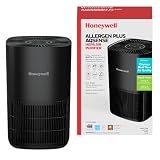 Honeywell HPA125B Honeywell HPA125B |
|
Check Latest Price |
1. Levoit Core 300-P: Best Overall Air Purifier for Allergies
Levoit Air Purifier for Home Pets Hair Allergens in Bedroom Quiet Purifiers
AHAM CADR: 143 CFM smoke, 153 CFM dust, 167 CFM pollen
24 dB sleep mode
1073 sq ft
2 year warranty
Pros
- AHAM Verifide certification with published CADR figures
- Near-silent 24 dB sleep mode suits bedrooms
- Reduces dust pollen and pet dander
- Compact vertical footprint fits small rooms
Cons
- Replacement filters are proprietary and sold separately
- Initial new-plastic odor that fades after a day or two
- Timer only offers 2/4/6/8 hour increments
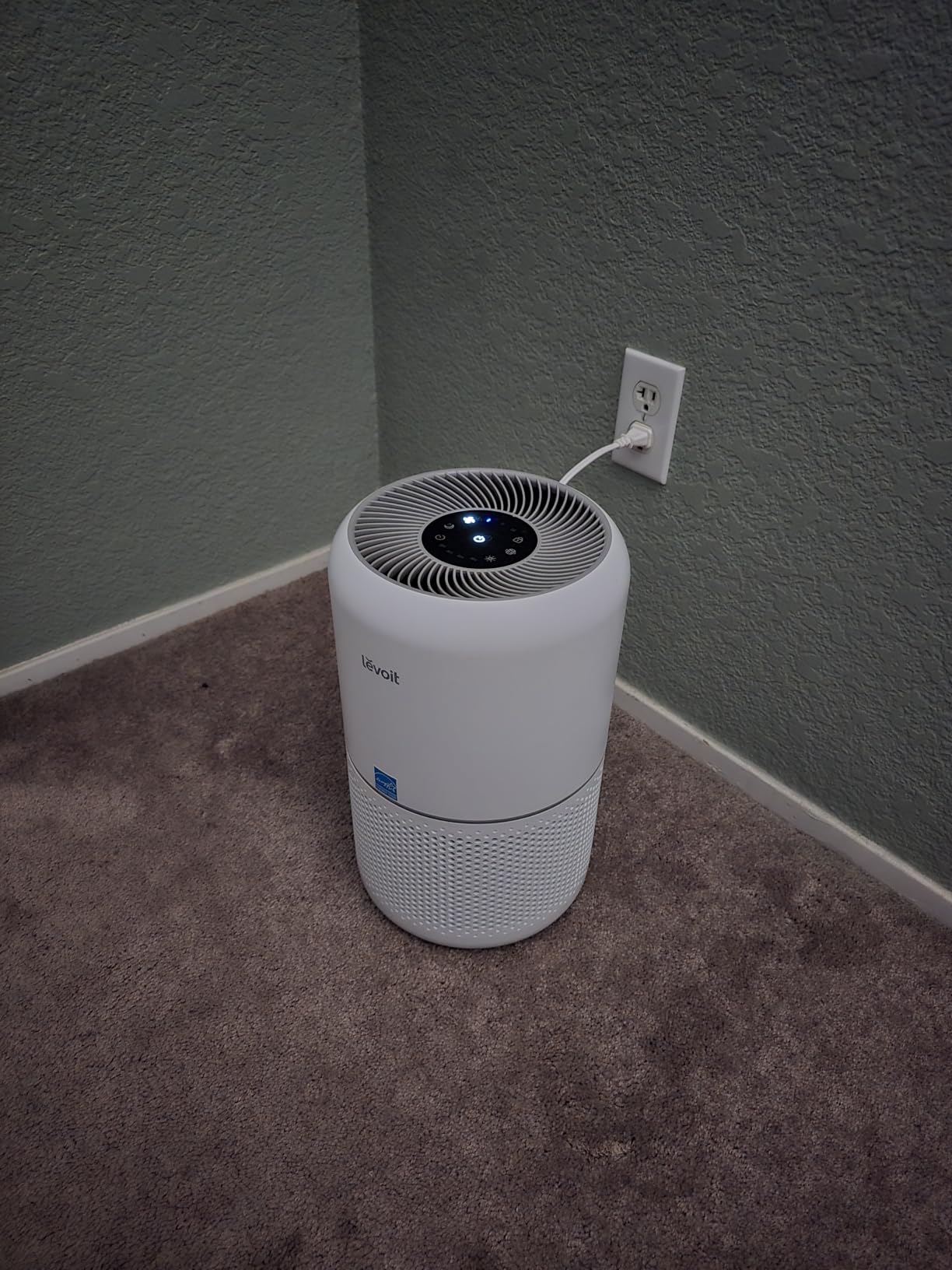
The Core 300-P is the machine we send people to when they ask for one answer. It is one of the most compact devices in this roundup that carries published AHAM Verifide CADR figures, and that verification matters more than any marketing coverage claim you will read on a listing page. Independent testing puts it at 143 CFM smoke, 153 CFM dust and 167 CFM pollen, which is a real number you can do arithmetic with rather than a headline square footage figure.
At 4.8 air changes per hour it clears a 222 square foot room, which is a typical small bedroom, and it does that on sleep mode at 24 dB. That noise floor is the reason it wins for allergy use specifically. Most households end up running the bedroom machine overnight on low, and a purifier that has to be turned up to be effective is a purifier that gets turned off.
Owners with pollen, dust and dander sensitivity consistently report the same outcome: less visible dust on surfaces and fewer morning congestion symptoms. The 3-in-1 stack runs a pre-filter, a HEPA-grade particle filter rated to 0.3 micron and a carbon layer, which is enough to handle pollen, dust and animal dander allergens at the same time.
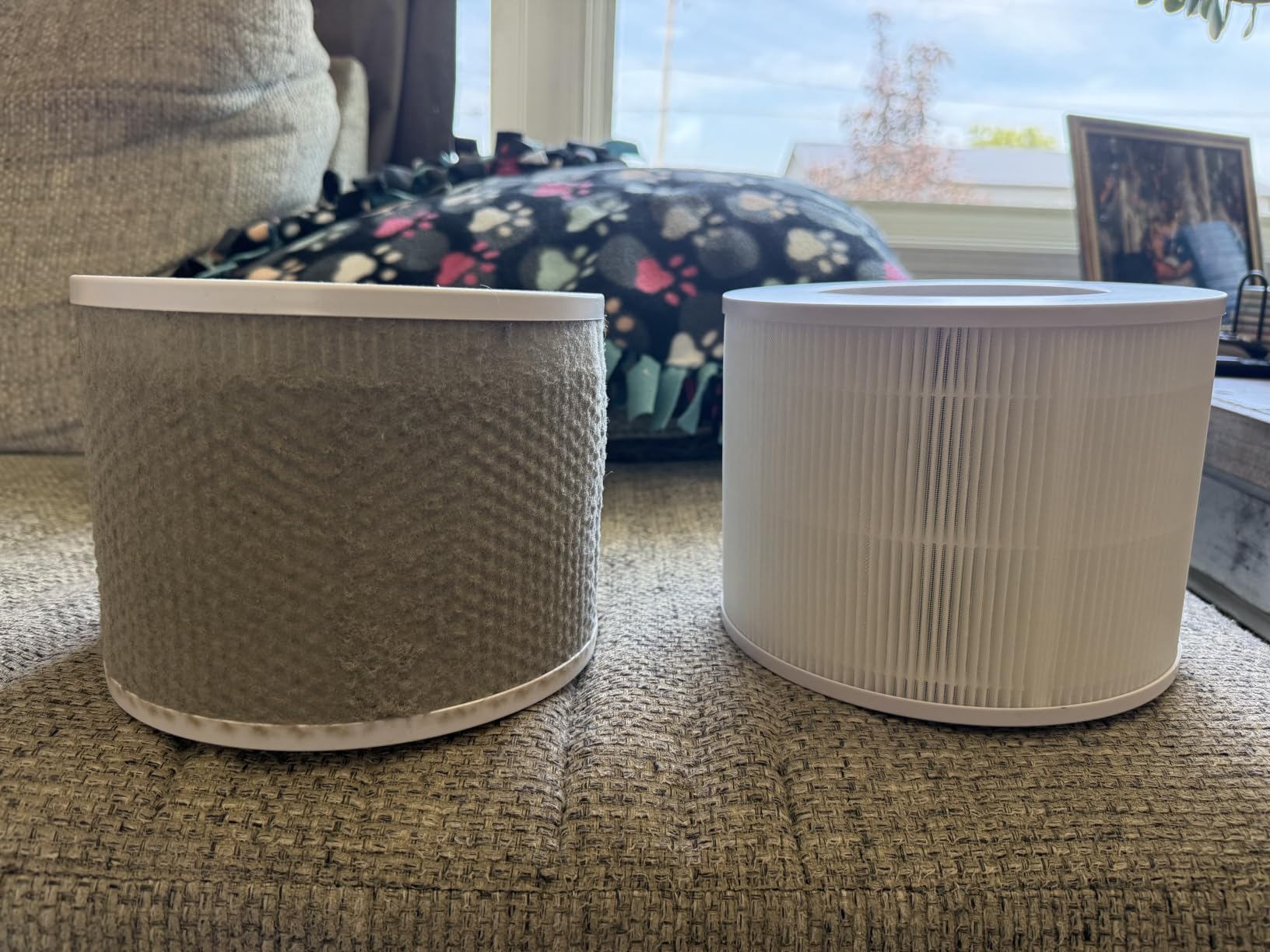
Two things keep it from being flawless. The replacement filter is proprietary, and buyers who try off-brand cartridges report inconsistent fit. A faint new-plastic smell also shows up on day one and clears after roughly a day of continuous running, which trips up anyone with a sensitive nose.
The 2, 4, 6 and 8 hour timer is also a plain on-board timer with no memory across power cycles, so if you want the unit running all day you simply leave it on continuous. The display lights switch off entirely, which matters more than it sounds in a dark bedroom.
What the AHAM Verifide seal actually tells you
AHAM is an ANSI-accredited body, and the Verifide program independently measures both air cleaning performance and energy efficiency. For an allergy buyer, that seal is the difference between a verified 143 CFM and an unverifiable coverage claim, and it lets you size the machine to your room with confidence instead of guessing.
The same certification is the reason we can compare this unit directly against the Winix 5510 and the Honeywell HPA125B later in this list. Without it, the coverage numbers on retail listings are marketing, not measurement.
Where this model falls short for allergy households
If you have a multi-pet household with a large living area, this is the wrong shape of machine. It is a 1,073 square foot unit at one air change per hour, which is a legitimate rating for a single room and a poor rating for an open-plan floor.
Filter running cost is the other soft spot. You will need a genuine Levoit cartridge roughly once a year in a typical bedroom, and that is the single most common complaint across its very large review base.
2. GermGuardian AC4825E: Best for Small Rooms That Need Zero Ozone
GermGuardian HEPA Air Purifier Tower – 22″ – Gray – AC4825E
99.97% capture of allergens as small as 0.1 microns
CARB, ETL and Zero Ozone Verified
22 inch tower
Pros
- Long track record with multi-year owner reports
- UV-C light appeals to germ-conscious households
- Low fan speed is quieter than most competitors
- Zero Ozone Verified certification
Cons
- Blue UV indicator light is bright in a dark bedroom
- Higher fan settings are audible in a quiet room
- Thin pre-filter tears if vacuumed rather than rinsed
The AC4825E has been on the market since 2011, and that long tenure is itself a data point. Owners update their logs years later, and the reports describe steady allergen and odor control in homes with asthmatic children and pets. Its HEPA PURE filter captures 99.97% of allergens as small as 0.1 microns, a finer threshold than the 0.3 micron figure most brands quote.
It is one of the few machines here that carries an explicit Zero Ozone Verified certification alongside CARB and ETL. For readers who are specifically worried about air cleaners making their symptoms worse, that is the single most important line on the specification sheet.
The tower format moves a lot of air from a narrow footprint, which suits the awkward corner of a home office or a 153 square foot bedroom. Reviewers also like the optional UV-C light, which is a genuine differentiator and the reason some buyers pick this model over more recent releases.
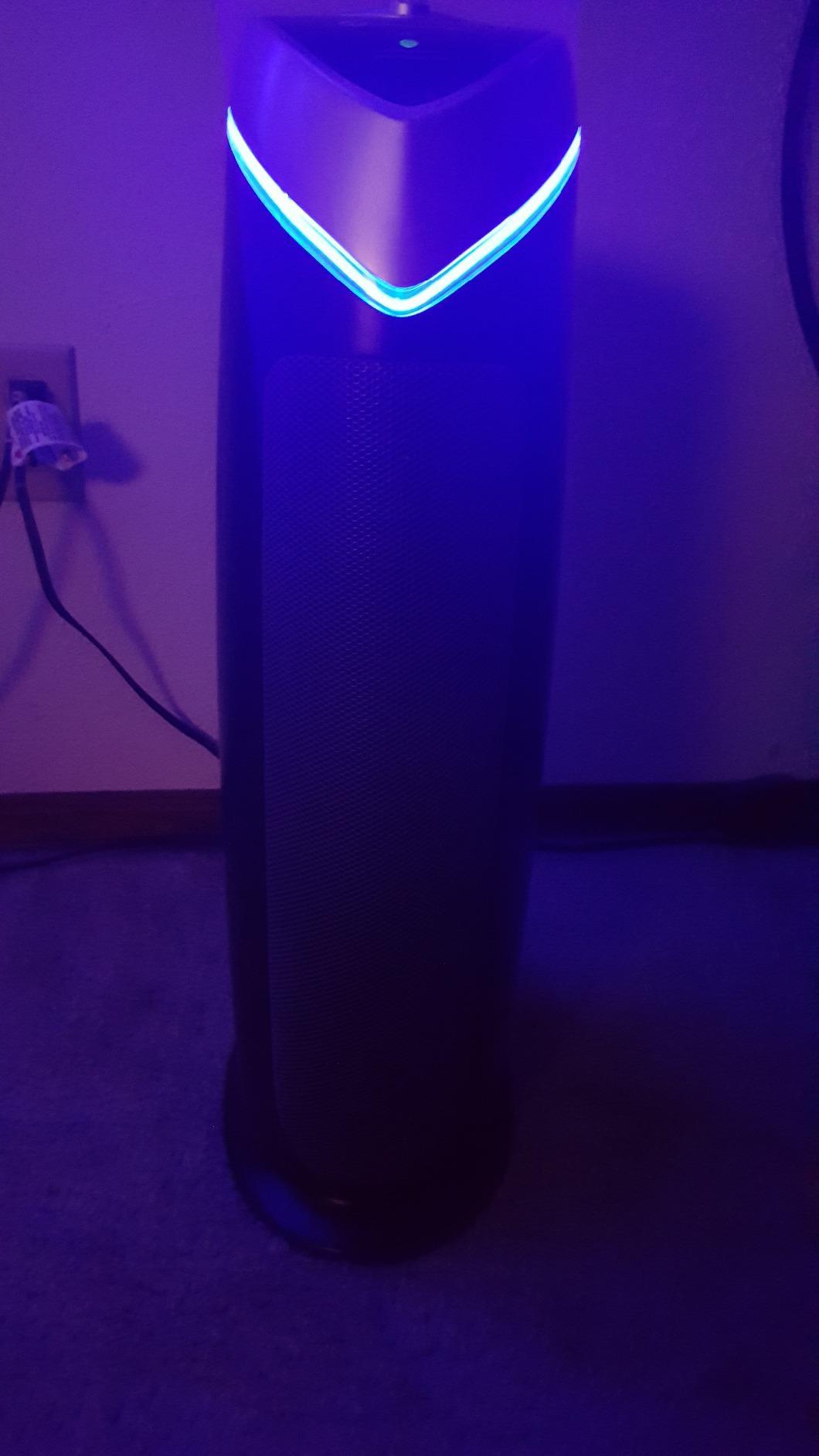
The UV-C feature is a double-edged sword in a dark room. The blue indicator glow is bright enough that owners consistently dock it for bedroom use, and the middle and top fan settings are clearly audible in a quiet space. Neither issue matters much during the day, but both show up in reviews written by people who run it overnight.
Its coverage is also modest. It circulates a 153 square foot room every 12.5 minutes and 743 square feet in an hour, so anyone with a large open living area should plan on multiple machines rather than one. A thin pre-filter that tears easily if you vacuum rather than rinse it adds a small maintenance trap.
Why Zero Ozone Verified matters more for allergy readers
Ionizing purifiers work by charging particles so they clump and fall, and some designs achieve that by releasing trace ozone as a byproduct. Ozone is an airway irritant, so a machine that helps particles while aggravating airways is a poor trade for someone already reactive. A verified ozone-free unit removes that variable from the decision entirely.
GermGuardian states its unit is independently tested in the USA and certified CARB, ETL and Zero Ozone. If your priority is reducing airborne triggers without introducing a respiratory irritant, that certification carries real weight.
Deciding between this and the Levoit Core 300-P
The Levoit is the better buy for most bedrooms because it is quieter on its lowest setting, carries AHAM Verifide CADR numbers and costs less to keep supplied. Choose the GermGuardian when you want the UV-C stage, a finer 0.1 micron capture claim, or explicit ozone certification.
Either way, expect to buy a genuine GermGuardian HEPA Filter B on a regular schedule. The cartridge is model-locked, which keeps quality predictable and keeps costs predictable in the wrong direction.
3. Levoit Core 400S-P: Best for Open-Plan Living Areas
LEVOIT Smart Air Purifiers for Home Large Room Up to 1733 Ft² Core 400S-P
AHAM CADR: 231 CFM smoke, 240 CFM dust, 259 CFM pollen
Up to 1733 sq ft
AirSight Plus PM2.5 sensor
Pros
- Smart sensor with live PM2.5 readout
- Auto mode reacts quickly to smoke and particulates
- Effectively silent in sleep mode
- Large-room capacity works in open-plan homes
Cons
- Detachable bottom can unscrew while the unit is moved
- App setup forces Bluetooth and location permissions
- Top two fan speeds are louder than room HVAC
The Core 400S-P is the unit to buy when the room you need to clean is the whole main floor. Its verified CADR of 231 CFM smoke and 259 CFM pollen is roughly two-thirds more throughput than the Core 300-P, and that difference is what lets it handle an open-plan space without being pinned to a top fan setting all night.
The AirSight Plus laser dust sensor is the feature owners talk about most. It displays a live PM2.5 reading and updates continuously, so you can watch a spike when you cook or when wildfire smoke comes in, then watch it fall back to single digits within about an hour. For an allergy sufferter, making an invisible process visible is worth a lot.
Auto mode responds quickly to incense, cooking smoke and outdoor particulate, and several owners with asthma report clear reductions in eye swelling, sinus pressure and morning congestion. Filter efficiency is 99.97% for particles between 0.1 and 0.3 microns across the same three-stage stack as the smaller Levoits.
Two quirks recur in the reviews. The detachable bottom panel can unscrew while you are carrying the machine, which occasionally leaves the filter behind, and the app insists on Bluetooth and location permissions during first setup before behaving normally. Neither is serious, but both catch people out in week one.
When a live PM2.5 reading changes your routine
Air quality data tends to do one of two things. Either it reassures you that your bedroom is genuinely clean, which takes a worry off your list, or it shows a spike every time a window opens during pollen season, which tells you exactly when to leave things shut.
Owners frequently mention running a cheap laser particle meter alongside the unit to confirm what the display reports. If your trigger is something seasonal, that feedback loop is more useful than any specification on the box.
Where the noise and app requirements get in the way
The two highest fan speeds are louder than the HVAC system in the room, so this is a machine you run on low overnight and boost during the day. That is fine in an open living area, less fine beside a bed.
It is also the most demanding in app terms: you cannot use the smart features at all until the app permissions are granted. Readers who would rather press a button and forget it should look at the Coway further down instead.
4. Winix 5510: Best Value Air Purifier for Allergies
WINIX 5510 Air Purifier (New Generation of 5500-2 with App Support) for Home Large Room Up to 1881 Ft² in 1 Hr, True HEPA, High Deodorization Carbon Filter and Auto Mode, Captures Pet Allergies, Smoke
AHAM Verifide at 392 CFM
Up to 1882 sq ft in one hour
True HEPA to 0.01 microns
23.5 dB minimum
Pros
- AHAM Verifide with high CADR for the money
- Carbon layer handles odors and VOCs
- Very quiet 23.5 dB minimum
- Light sensor sleep mode engages automatically
Cons
- Tall 25 inch tower needs clearance for 360-degree intake
- App setup required for remote control
- Filter costs add up on a 6-12 month interval
The Winix 5510 is the strongest performance-per-dollar machine in this roundup, and it is AHAM Verifide at 392 CFM. That verification applies to a 392 square foot room, and the manufacturer separately claims coverage up to 1,882 square feet in one hour. Check the 392 figure against your actual room, not the 1,882 headline.
Filtration is the most aggressive claim in the group. Winix states its True HEPA captures 99.99% of airborne allergens including pollen, dust, smoke and pet dander, down to 0.01 microns, which is far below the 0.3 micron standard most competitors cite. Whether or not you need that margin for pollen and dander, it is there.
Owners frequently credit the combination of a washable mesh pre-filter, a carbon odor layer and the HEPA stack for handling both pet dander and cooking odor in the same room. The washable pre-filter also takes the largest hits before they reach the expensive filter, which stretches cartridge life.
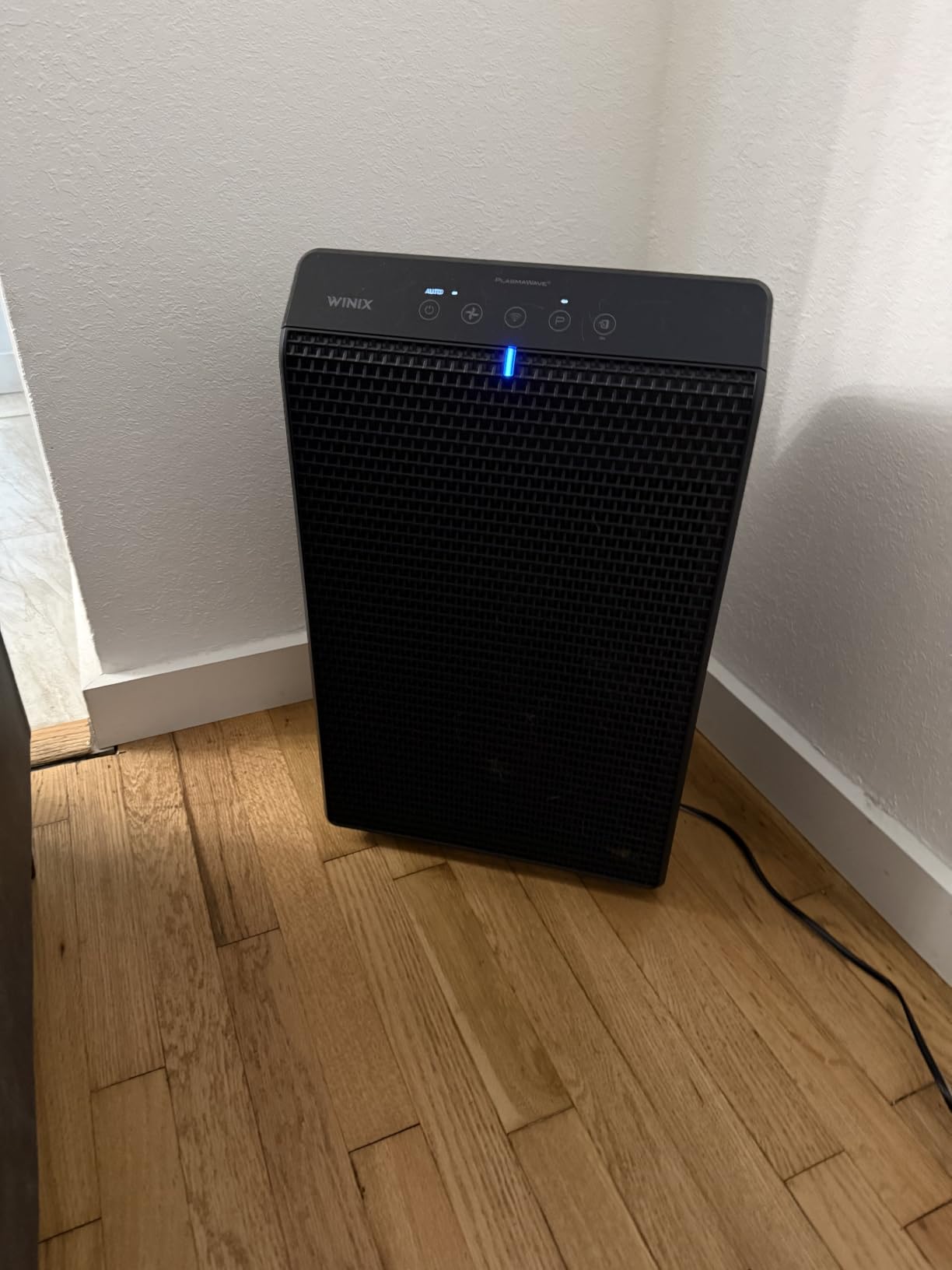
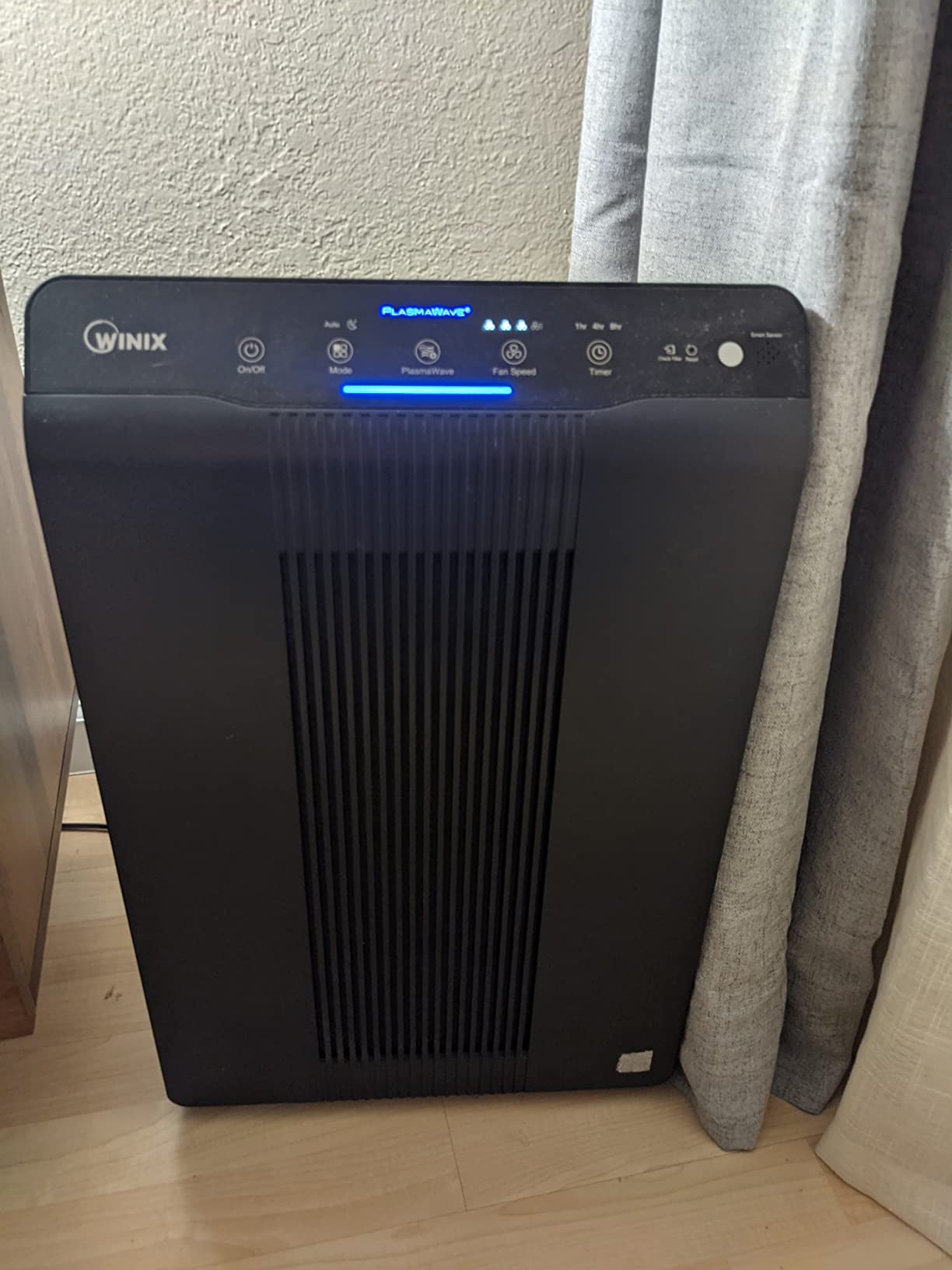
The practical issues are physical. At 25.2 inches tall, this unit needs clearance on all sides for its 360-degree intake, and pushing it flat against a wall cuts into the coverage you paid for. The remote features need the Winix Smart app, and genuine Winix filters add up on a six to twelve month replacement interval.
What you get in return is a light-automated sleep mode. The sensor detects a darkened room and drops the fan on its own, then returns to auto mode when light returns, so you do not have to think about the schedule at all.
Reading the 392 CFM figure honestly
Coverage claims on retail listings usually mean one air change per hour, which is not a number anyone should design a room around. The AHAM Verifide figure of 392 CFM is the one worth using, and it supports roughly 392 square feet at six air changes per hour, or a smaller room at a higher effective rate.
If your living area is larger than about 400 square feet, this is a machine for one defined room rather than the whole floor. Long-term owners in forum threads report satisfaction correlates almost exactly with correct sizing, so measure before you commit.
Whether the height and app requirement will bother you
If you have a low shelf or a TV cabinet where the unit would sit against a wall, the 360-degree intake is a real constraint rather than a footnote. Budget for placement in open floor space where air can reach all four sides.
The carbon layer is the sleeper feature for anyone sensitive to smells as well as particles, since it addresses VOCs from cooking, pets and smoke. It is a washable pre-filter plus a replaceable carbon stage, so expect two different consumables rather than one combined cartridge.
5. Coway AP-1512HH: Best for Allergies and Pets
COWAY Air Purifier for Home Up to 1,748ft², HEPA Filter for Smoke, Allergies, Pet Dander, Odor, Air Quality Monitor, Auto&Eco Mode, Timer, Filter Indicator, 3yr Warranty, Mighty AP-1512HH(W), White
Four-stage filtration with bipolar stage
99.97% of 0.3 micron particles
Up to 1748 sq ft
3 year warranty
Pros
- Four-stage filtration targets odors and VOCs
- Filter alerts remove the guesswork from upkeep
- Eco mode lowers energy use when air is clean
- 3-year warranty is longer than most in this category
Cons
- Higher price than most compact HEPA units of similar coverage
- Replacement filters must come from Coway and can be costly
- Plastic housing and controls feel dated
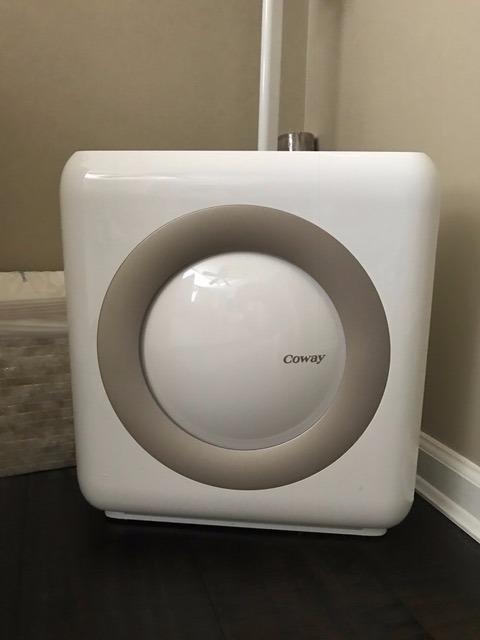
For a household where a pet is the trigger, the Coway AP-1512HH is the pick. Its four-stage system runs a washable pre-filter, a deodorization filter, a bipolar device and a HEPA filter, and that third stage is what separates it from particle-only machines when the problem is dander odor as well as dander itself.
The HEPA stage reduces 99.97% of 0.3 micron particles including pollen and other allergens, and the deodorization stage works on volatile organic compounds and general odor. In a home with two cats, that combination is the difference between clearing the air and merely filtering it.
Owners single out the filter alerts as the feature that distinguishes this unit, because they remove the most common failure mode in this category, which is running a purifier for two years on a filter that is already spent. A warning light tells you when the filters need replacing and when the pre-filter needs cleaning.
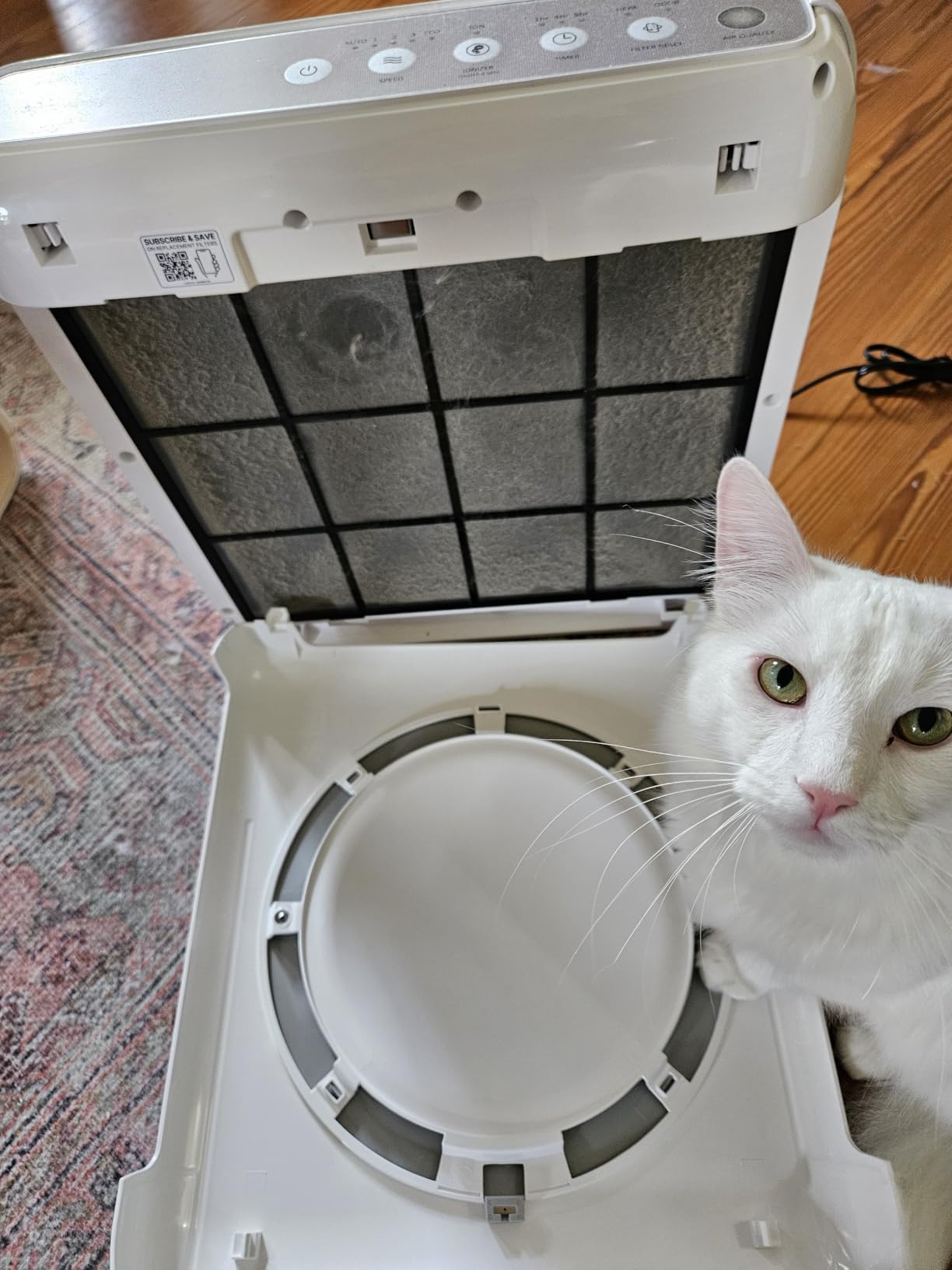
A pollution sensor drives auto mode and a color-coded air quality LED, and the LED can be turned off for sleeping. Eco mode lowers energy use once the air is already clean, which is a sensible way to hold running costs down during the parts of the day you are not in the room.
The reservations are mostly commercial. This is a more expensive machine than most compact units with similar coverage, and genuine Coway filters are model-locked and carry a real cost each cycle. Owners also note that the plastic housing and controls feel dated next to app-driven competitors, which is a fair criticism of a design that has been on sale since 2015.
Why the bipolar stage matters in a pet household
Pet allergies are rarely a purely particulate problem. Dander carries a strong odor, and a standard three-stage HEPA unit will remove the particles while leaving the smell in the room, which is frustrating enough that many owners assume the purifier is not working. The deodorization and bipolar stages here attack the gas-phase component that plain HEPA cannot touch.
That is also why the washable pre-filter matters more in this scenario. In a shedding-pet home, the pre-filter catches loose hair before it mats the HEPA surface, and washing it regularly is the single cheapest way to extend cartridge life.
Is the three-year warranty worth the higher purchase price?
Longer warranty terms are the clearest signal of manufacturer confidence in this category, and Coway backs this model for three years against the two years typical of the units around it. For a machine expected to run continuously for five years, that difference is worth something.
What the warranty does not cover is filter cost, and that is where the real money goes over a five-year horizon. Buyers on a tight budget should weigh the total cost of ownership rather than the sticker price, because a cheaper unit with an expensive cartridge can cost more in year three than this one does.
6. Levoit Vital 200S-P: Best Air Purifier for Pollen Allergies
LEVOIT Smart Air Purifier for Home Large Room up to 1875 Ft² Vital 200S-P
CADR: 250 CFM smoke, 254 CFM dust, 289 CFM pollen
Up to 1875 sq ft
U-shaped pet hair intake
Pros
- Verified 289 CFM pollen CADR
- the highest among bedroom and mid-size units here
- Highest 5-star share of the group at 85 percent
- Wide rectangular intake suits walls and corners
- Secondary inlet reduces pet hair clogs
Cons
- Requires a 12V battery for some functions
- App setup required for smart features
- Wide 15 inch body takes more floor space
If your trigger is pollen specifically, look at the pollen CADR number rather than the smoke number, because the two numbers tell different stories. The Vital 200S-P is verified at 289 CFM for pollen, the highest pollen figure among the bedroom and mid-size machines in this roundup. Pollen is exactly the contaminant that peaks overnight and lingers indoors through the morning.
Levoit designed this model explicitly for allergy households, and the reviews reflect that framing. Owners with pollen, dander and dust sensitivity report the highest satisfaction of any model here, which is consistent with a machine that was engineered around the contaminant rather than around a general-use spec sheet.
The dual inlet is the underrated part. Alongside the traditional intake there is a U-shaped secondary inlet positioned to trap airborne pet hair and odors without clogging, which addresses a failure mode where the intake screen mats over and quietly reduces airflow.
Because the body is a wide rectangle rather than a cylinder, it sits neatly against a wall or in a corner, and that geometry means the intake is not blocked by furniture the way it would be on a round tower. The tradeoff is a footprint of nearly 15 inches across.
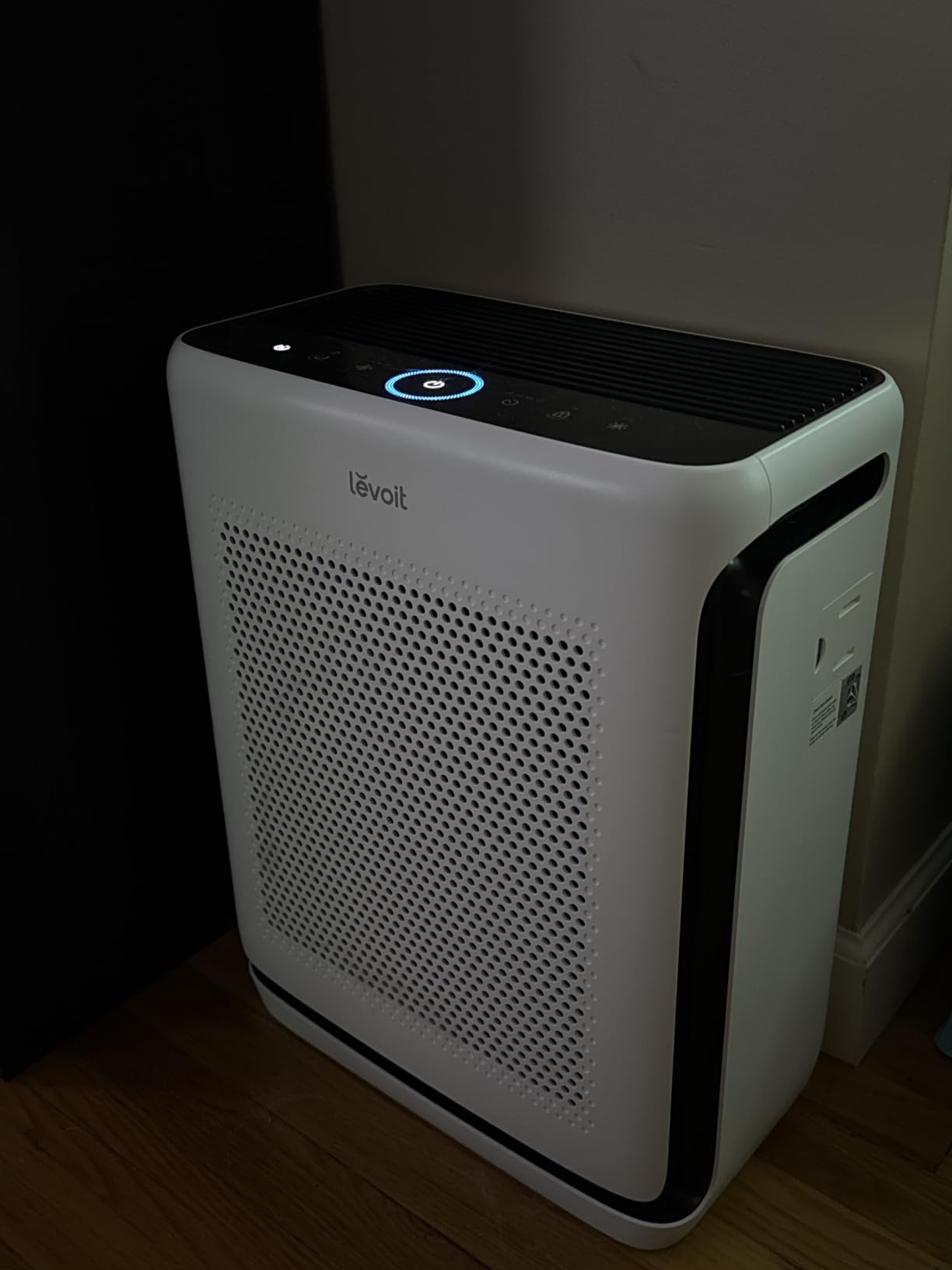
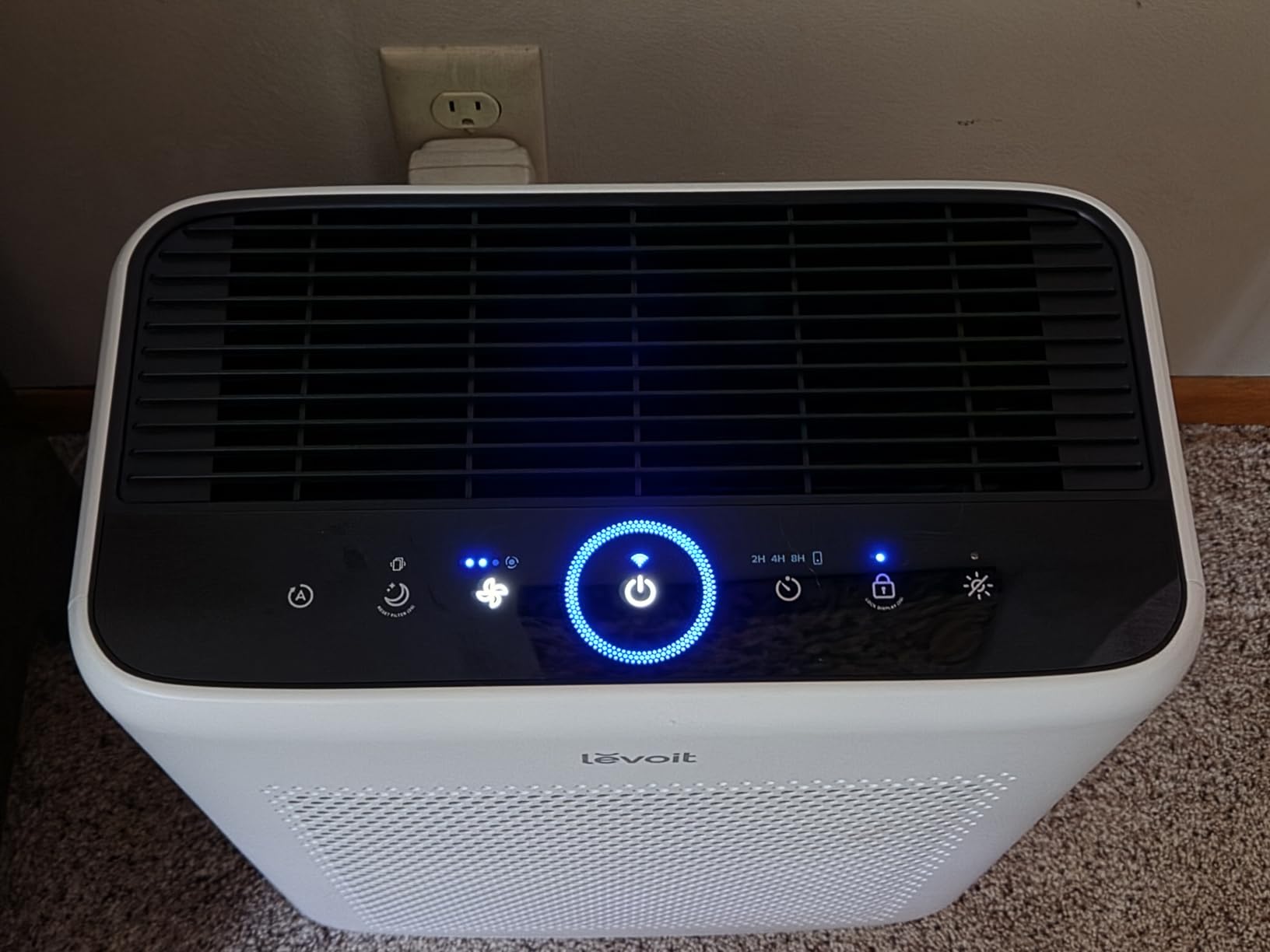
The 5-star share of 85 percent is the highest in the group, which is a meaningful signal when a product is purpose-built for a specific use case rather than adapted into it. The criticisms are practical: the smart features need a 12V battery for some functions, adding a replaceable cell to your maintenance list, and the app has to be set up before those features work.
Its coverage claim of up to 1,875 square feet refers to one air change per hour. For a real allergy setup, work from the 289 CFM pollen figure and your actual room dimensions instead, and you will land on a much more useful number.
Why pollen CADR is the number to compare
Smoke CADR is the easiest number for manufacturers to headline because it is measured on the largest test particle, and larger particles are easier to capture. Pollen CADR is measured on smaller, lighter particles that stay suspended longer and penetrate deeper into a room. A machine that is strong on smoke is not automatically strong on pollen.
Pollen also has a specific daily rhythm. Levels spike in the morning as ground overnight pollen lifts, and indoor concentrations stay elevated through the day with windows closed. A bedroom machine with high pollen throughput, running overnight at low speed, is exactly the configuration that interrupts that cycle.
When the wide body and battery are drawbacks
In a small home office where floor space is tight, a 14.96 by 8.66 inch footprint is not ideal and the Honeywell later in this list is a better fit. The wide shape pays off in large rooms, not in cluttered ones.
The 12V battery requirement for some functions is the detail that catches people out. It is a replaceable cell, and while it does not affect core filtration, it is one more thing to forget about if you use the smart features regularly.
7. PuroAir 240: Best for Pet Odors in a Single Bedroom
PuroAir 240 HEPA Air Purifiers for Home Pets Bedroom – 1,000 Ft²
1000 sq ft coverage
HEPA plus carbon odor layer
CARB, ETL, ISO and UL certified
2 year warranty
Pros
- Removes musty pet and cooking odor at low settings
- Very quiet for bedroom use while still moving air
- Compact and light enough to move between rooms
- Simple controls with a clear indicator light
Cons
- Does little to capture visible floating pet hair
- No Wi-Fi or app control on most variants
- Replacement filter prices are higher than budget rivals
The PuroAir 240 is an odor machine first and a hair machine second, and owners are unusually clear about that distinction. People with shedding dogs report the musty smell disappearing and morning nasal congestion easing. They also report that hair on surfaces is largely unchanged, which is what a pre-filter plus HEPA stack is designed to do and not designed to do.
If your problem is smell and airborne dander, this is a good fit. If your problem is visible hair on the sofa, no purifier is the right answer and you need a vacuum with a sealed HEPA intake instead. Setting that expectation early prevents most disappointed reviews of this category.
It is certified by CARB, ETL, ISO and UL, and the brand cites independent lab testing by SleepScore from 2024. The 2-year warranty is backed by a US-based support team, which is a practical benefit if anything goes wrong.
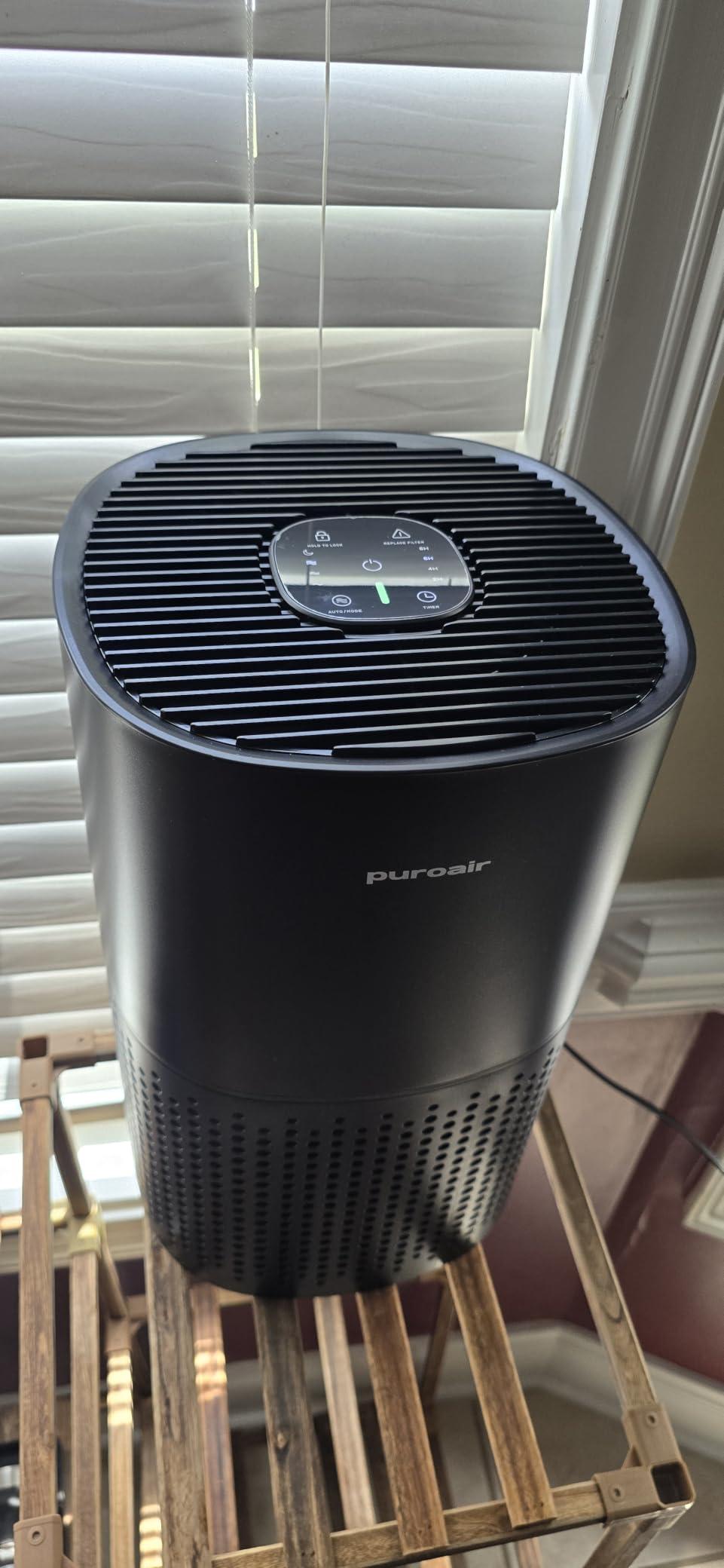
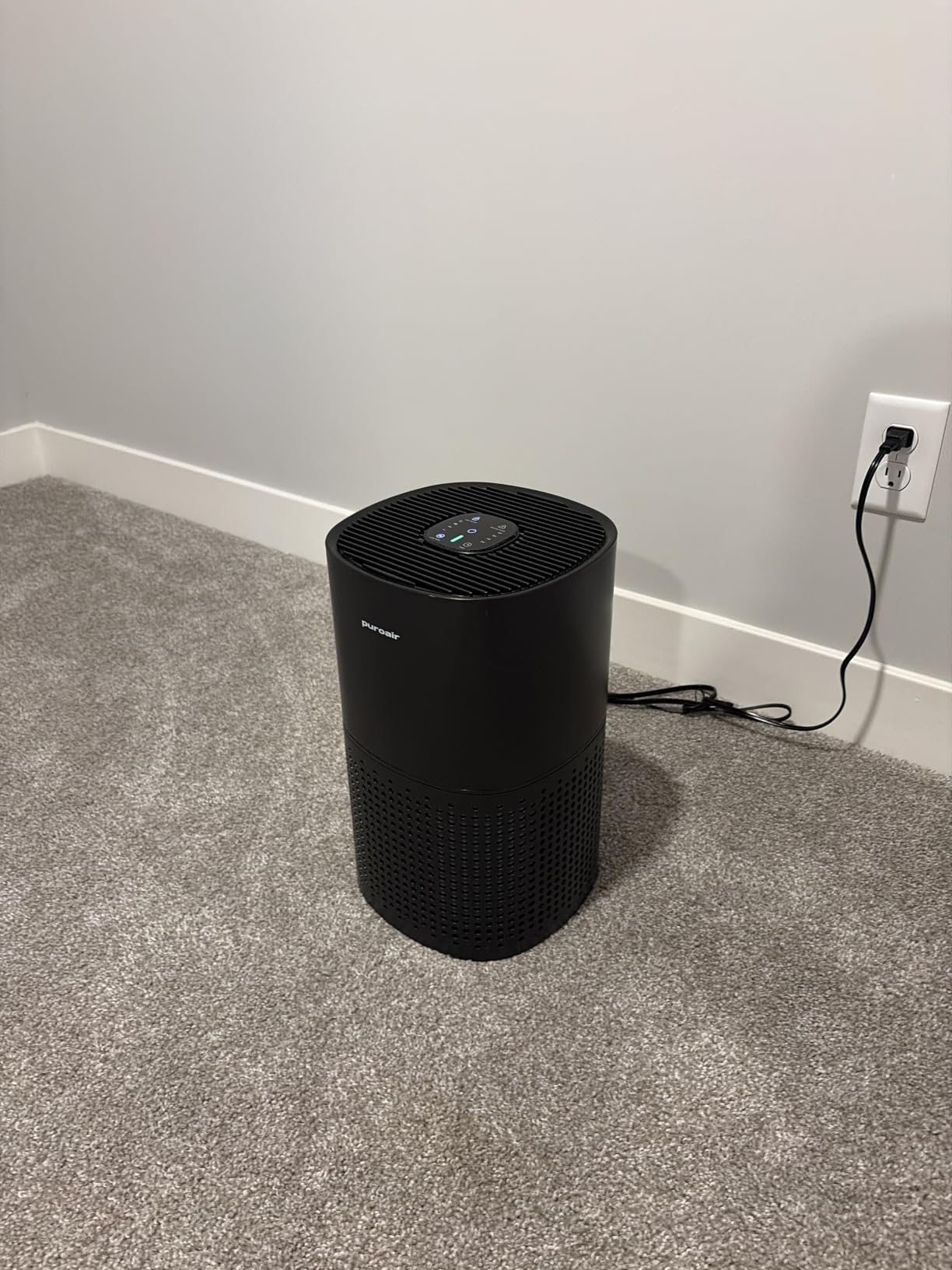
It is also one of the quietest machines here while still moving meaningful airflow, and at 7.3 pounds you can move it between rooms without thinking about it. Controls are simple, with an easy-to-read indicator light and no app required for normal operation.
The negatives cluster around consumables and geography. Replacement filter prices run higher than for similarly sized budget units, most variants have no Wi-Fi or app control, and the 120V version will not run in the UK without a step-down transformer. Several international reviewers flagged a transformer requirement before buying.
Air purifier versus a HEPA vacuum for hair and dust
These two products solve overlapping but different problems. A purifier captures what is suspended in the air, while a vacuum with a sealed HEPA intake captures what has already settled onto floors, upholstery and bedding. Dust mite allergen comes from both, which is why readers with a dust mite allergy usually end up wanting both.
If your main complaint is hair and settled dust, a vacuum solves most of it for a fraction of the running cost. If your complaint is stuffy air, morning congestion and odors, that is the purifier’s job and this model does it well.
Running this unit in a home with more than one pet
It is also available in two-pack and four-pack configurations, which is the practical way to cover a multi-room home. A single machine covers one bedroom; owners of multi-pet households typically run one per room rather than trying to push a single unit through an open-plan space.
The tower is 28 inches tall and 10.63 inches square, so it needs vertical clearance and a little breathing room around the intake. Set it in a corner with clear air on at least two sides rather than tucked behind furniture.
8. Blueair Blue Pure 211i Max: Best for Very Large Rooms
BLUEAIR Air Purifiers for Home Large Room up to 3,235 Ft², Blue 211i Max
AHAM CADR: 450 CFM pollen, 452 CFM dust, 435 CFM smoke
Covers 3235 sq ft in one hour
23-53 dB range
Pros
- Largest verified coverage in the roundup
- Sensitive sensors track PM2.5 PM1 and PM10 in the app
- Washable knit fabric pre-filter
- Effectively clears cooking odor and wildfire smoke
Cons
- Genuine replacement filters are expensive with limited alternatives
- Most expensive machine in this roundup
- Notably loud on maximum fan speed
- Wi-Fi registration and support are reported as frustrating
The Blue Pure 211i Max has the largest verified throughput of anything in this roundup. Its AHAM Verified CADR is 450 CFM for pollen, 452 CFM for dust and 435 CFM for tobacco smoke, which is more than double the Winix 5510 and enough throughput to genuinely change the air in a large open-plan living space.
It cleans 674 square feet in 12.5 minutes and up to 3,235 square feet in one hour. Built-in sensors auto-adjust the fan when pollution levels rise, and the Blueair app tracks air quality, settings and filter life. Owners who got the connection working report strong dust and odor control and quiet operation in auto mode.
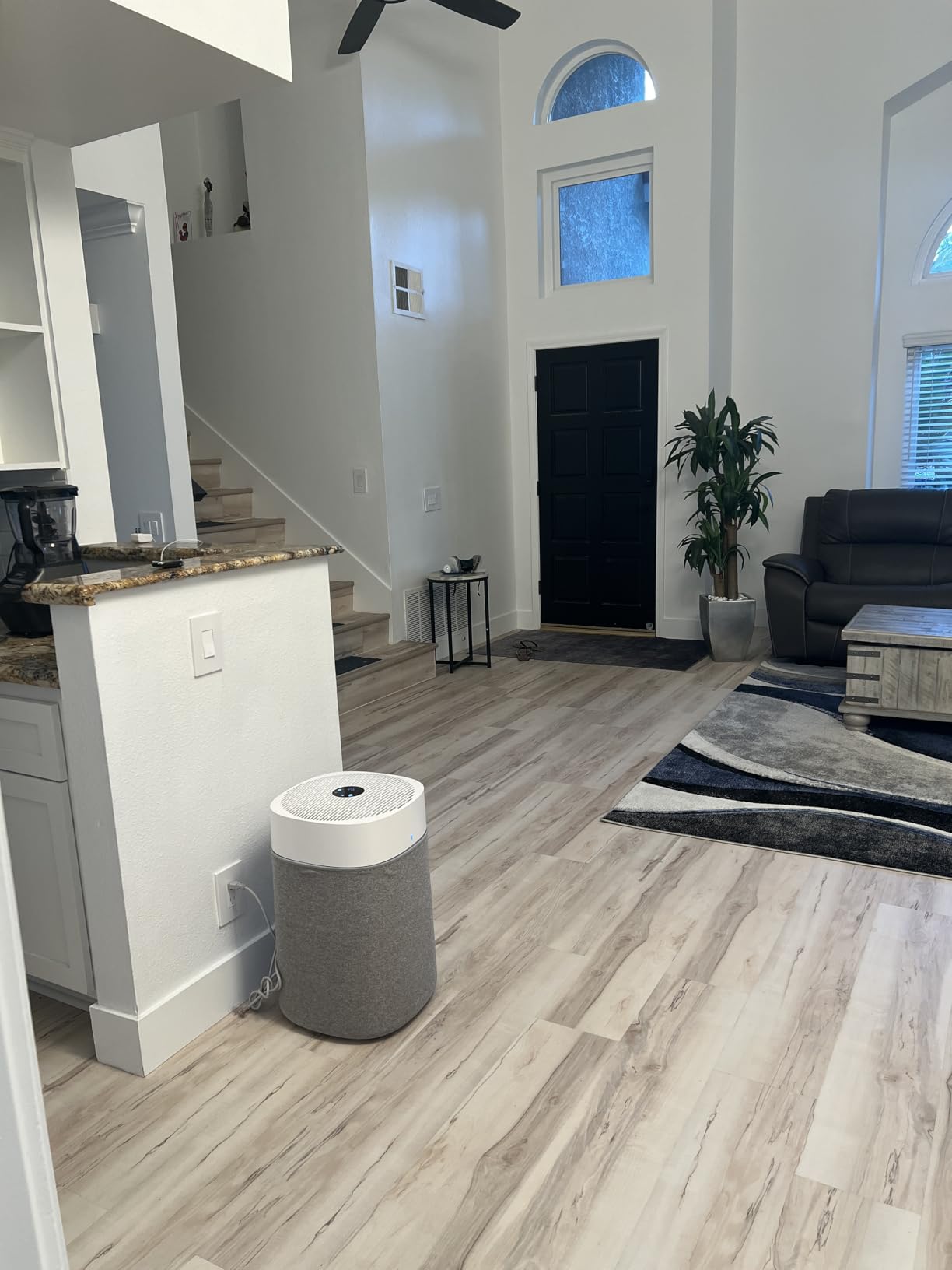
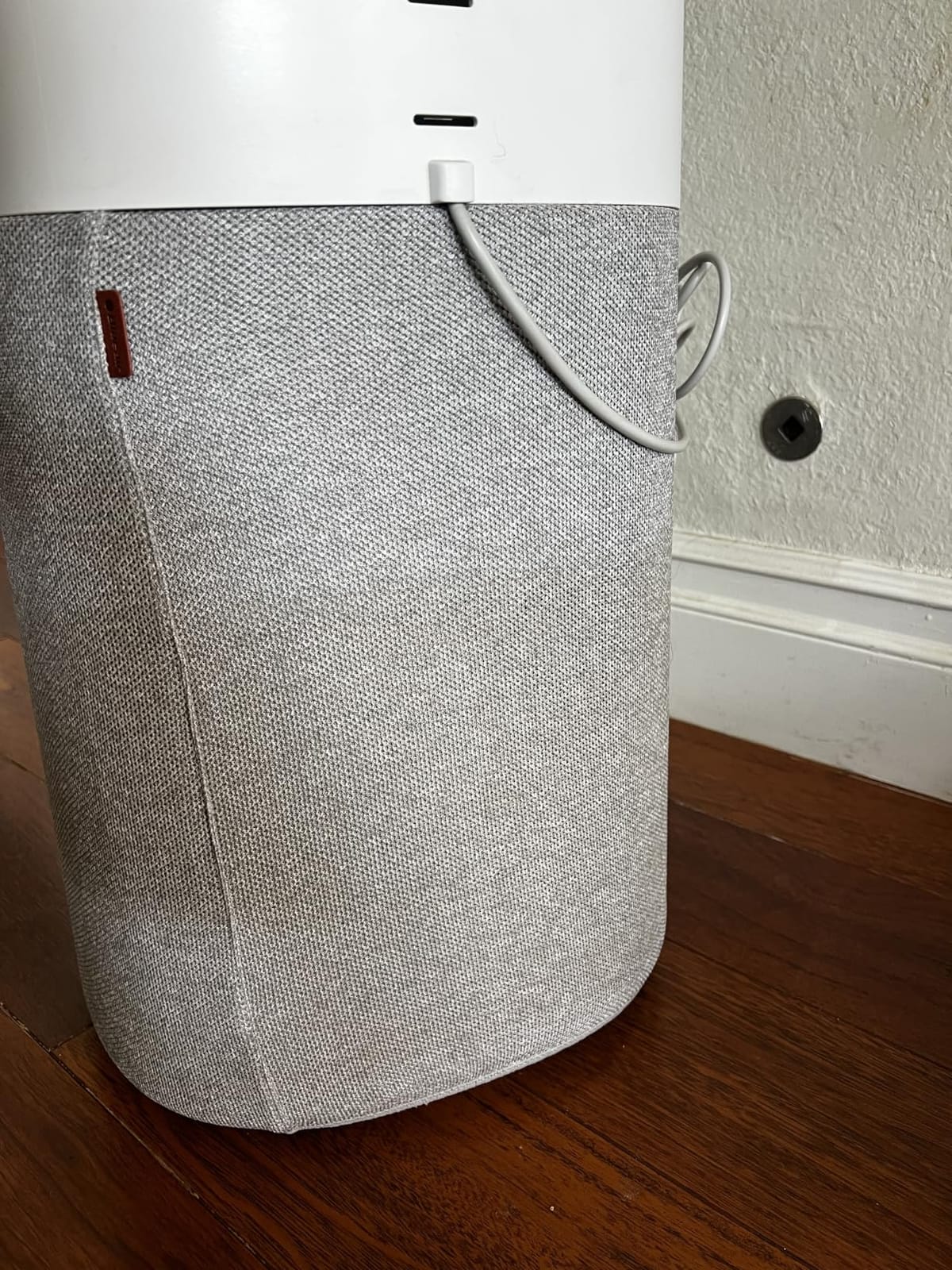
The wrap is a washable knit fabric over a washable pre-filter, so it looks like furniture rather than an appliance and extends the life of the main filter. A 360-degree intake pulls from all sides, which is what makes the large coverage claim work.
The 23 dB minimum suits a nursery or a bedroom, though the range extends to 53 dB at the top. This is the most expensive machine here, its genuine filters are pricey with limited aftermarket alternatives, and the 16-pound weight makes it awkward to relocate. Its 7 percent one-star share, the highest in the group, is almost entirely about customer service and Wi-Fi registration rather than filtration.
That rating of 4.4 is the lowest in the roundup, and the distribution explains it. Buyers overwhelmingly rate the machine itself at the top of the scale, while the bottom tail is service and connectivity friction. Multiple reviews explicitly dock a star for filter cost while still recommending the purifier.
It is also compatible with Amazon Alexa and app control on both major phone platforms, so if you already run a smart home you can put it on a schedule without touching the unit.
Do you need this much air for a main floor
Most open-plan homes are solved more cheaply with two medium machines than one very large one. A single 211i Max has the throughput, but you also pay once for the filter, once for the shipping and once for the noise when it runs at the speed a large space actually needs.
Forum discussion on residential purifiers repeatedly lands on the same conclusion: satisfaction correlates with matching CADR to room size, and a unit pushed beyond its realistic coverage disappoints. The 450 CFM pollen figure is the honest number to match against your floor area, not the 3,235 square foot figure.
When the filter cost and Wi-Fi setup are dealbreakers
Genuine Blueair filters are expensive and aftermarket options are limited, so this machine carries the heaviest ownership burden in the roundup. Buyers who plan to run it for five years should factor that into the decision rather than discovering it later.
Wi-Fi registration and support are reported as frustrating by enough owners to move the overall rating. If connectivity is not a feature you need, the auto mode and filter life tracking still work, but budget time for setup if you do want the app data.
9. MOOKA B-D02L: Best Budget Air Purifier for Allergies
MOOKA Air Purifiers for Home Room up to 1076ft², True HEPA Filter, B-D02L
True HEPA plus activated carbon down to 0.3 microns
6 air changes per hour in 215 sq ft
20 dB brushless motor
3.6 lb
Pros
- Lowest cost in the roundup with true HEPA media
- Quietest minimum at 20 dB
- Lightweight at 3.6 pounds so it moves easily
- Pet owners report less dander odor and fewer sneezing episodes
Cons
- One-room coverage means buyers often need two
- Filters not widely stocked and needed every 3-6 months
- Overloaded night light button sometimes powers the unit off
- No air quality sensor or app control
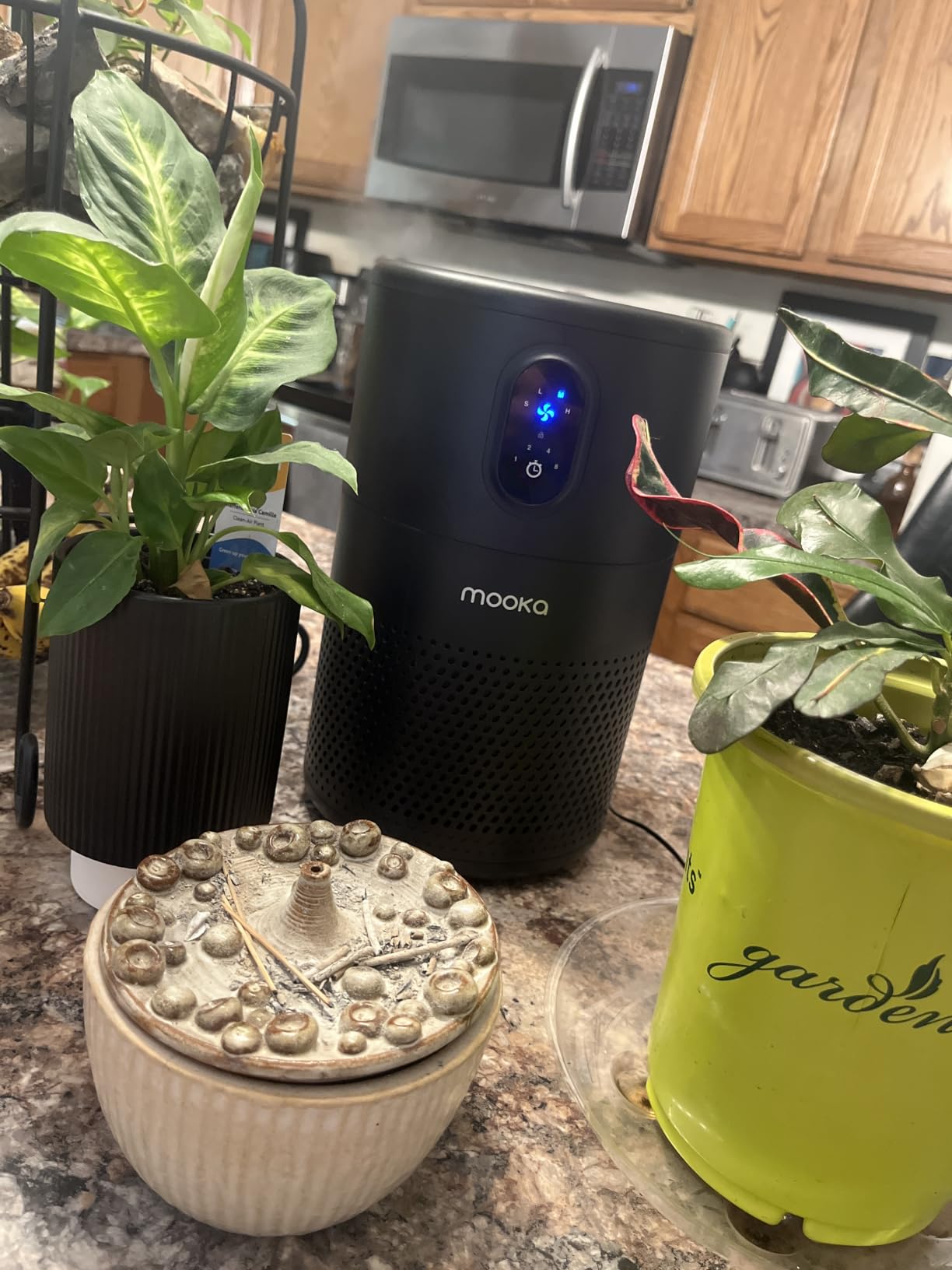
The MOOKA B-D02L is the cheapest credible way into true HEPA filtration, and at 20 dB it also has the lowest minimum noise figure in this roundup. For a nursery, a dorm room or a small bedroom shared by two people, that combination is hard to argue with on a budget.
Filtration is a three-stage stack of pre-filter, true HEPA and high-efficiency activated carbon, capturing contaminants down to 0.3 microns including pet hair, dander, smoke, odor and large dust particles. The published coverage math is the honest kind: 6 air changes per hour in a 215 square foot room, and 1 air change per hour in 1,076 square feet.
Multiple-cat and dog owners say it visibly cuts dander odor, reduces dust on surfaces and lets them wake without sneezing. At 3.6 pounds it is the second-lightest machine here, so moving it between rooms is effortless.
The recurring caveat is scope. This is a one-room machine, and owners who like it typically buy a second or a third rather than trying to stretch one across a home. Coverage claims that reach 1,076 square feet are honest about being one air change per hour, so use the 215 square foot figure for real purification.
The most cited mechanical annoyance is the overloaded control. The soft night light is toggled by holding the top power button for three seconds, which means the light sometimes turns the unit off instead. There is no air quality sensor and no app, so you are choosing settings by ear rather than by data.
When two budget machines beat one expensive one
For a two-bedroom apartment, running two MOOKA units often produces better real-world results than one mid-size machine, because each room gets its own air changes per hour instead of sharing one fan’s capacity across the whole floor. The per-room model is also what allergy research points toward, since bedroom exposure is where most of the benefit happens.
Owner logs in forum discussions of value purifiers reach the same conclusion independently: correctly sized small machines outperform an oversized unit in a room they cannot actually clean. That is why this pick is framed as a bedroom unit rather than a whole-home solution.
Filter availability and the night light control
The branded replacement filter is a specific part number, and owners report it is not always easy to source, with a recommended replacement interval of three to six months. Check availability for that part before you commit, because a unit without filters is a decoration.
For a nursery, the child lock is a genuine safety feature worth having. The dimmable night light is useful at the same time, provided you are willing to hold the power button deliberately rather than tap it.
10. Honeywell HPA125B: Best for Nurseries and Home Offices
Honeywell Allergen Plus Compact HEPA Small Room Air Purifiers, Black
AHAM Verifide, up to 530 sq ft coverage
4.8 air changes per hour in 110 sq ft
Sleep mode as low as 20.81 dBA
2.08 pounds
Pros
- True 360 degree filtration in a compact tabletop footprint
- Color coded air quality sensor with auto mode
- Sleep mode at 20.81 dBA is among the quietest measured
- Lightest unit at just over 2 pounds
Cons
- Smallest coverage area at 530 sq ft suits one small room
- Newest listing with the smallest review base so durability is unproven
- No app or smart home connectivity
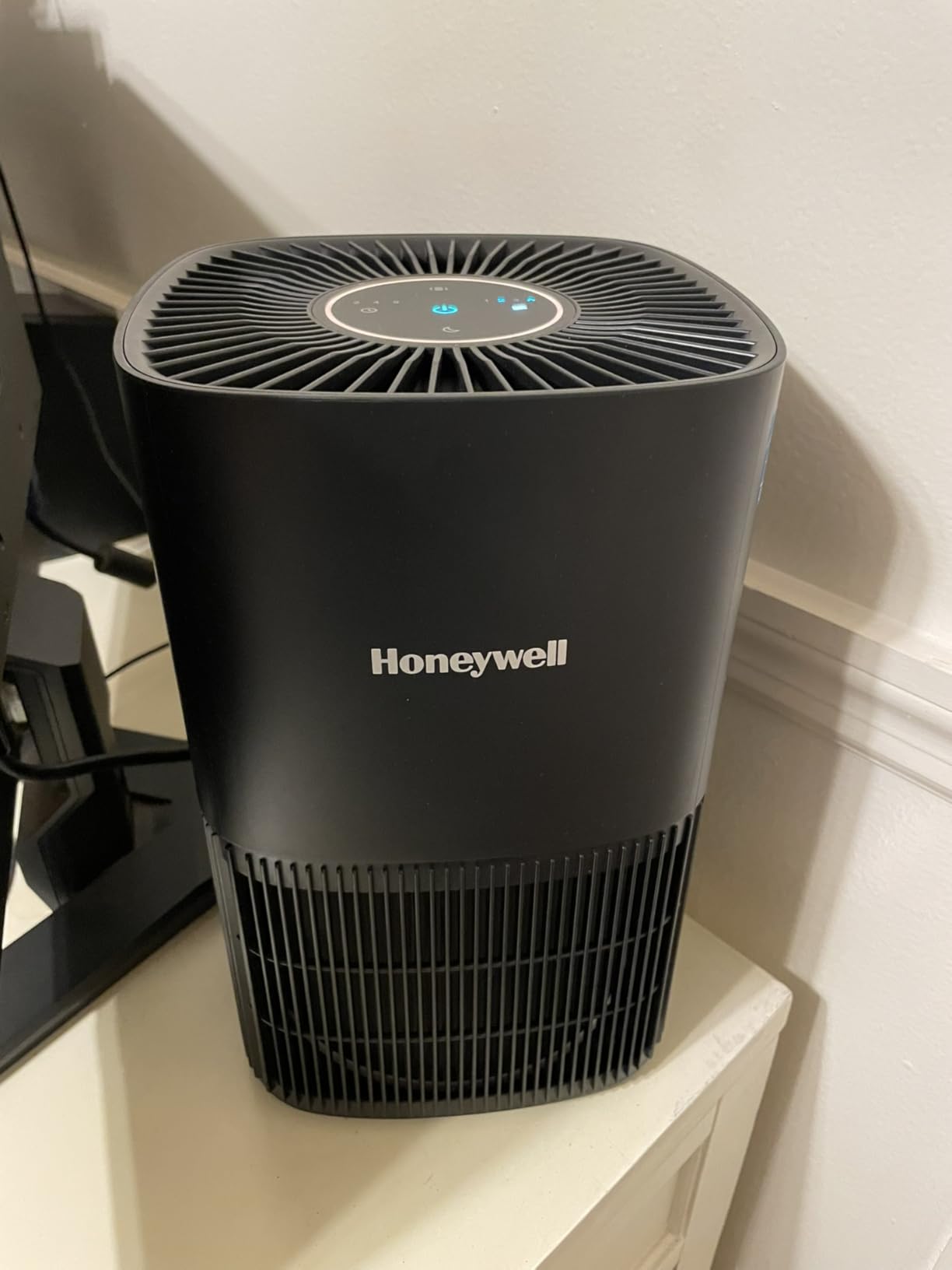
The Honeywell HPA125B is the newest listing in this roundup and the smallest by coverage, at 530 square feet. That is a real limitation rather than a marketing detail, and it makes this a targeted room machine for a nursery, dorm room, home office or small bedroom rather than a whole-home solution.
Within that scope it is well specified. It is AHAM Verifide, delivers 4.8 air changes per hour in a 110 square foot room, and captures up to 99.97% of allergens including dust, pollen and smoke through 360-degree three-in-one filtration. An activated carbon stage helps with VOCs and a pre-filter traps pet hair.
The AQSense auto mode is the feature that stands out at this size. A color-coded sensor shows green, yellow or red and adjusts the fan automatically, which gives you auto-adjusting behavior without needing an app. Sleep mode runs as low as 20.81 dBA with dimmable lights, among the quietest figures measured in this category.
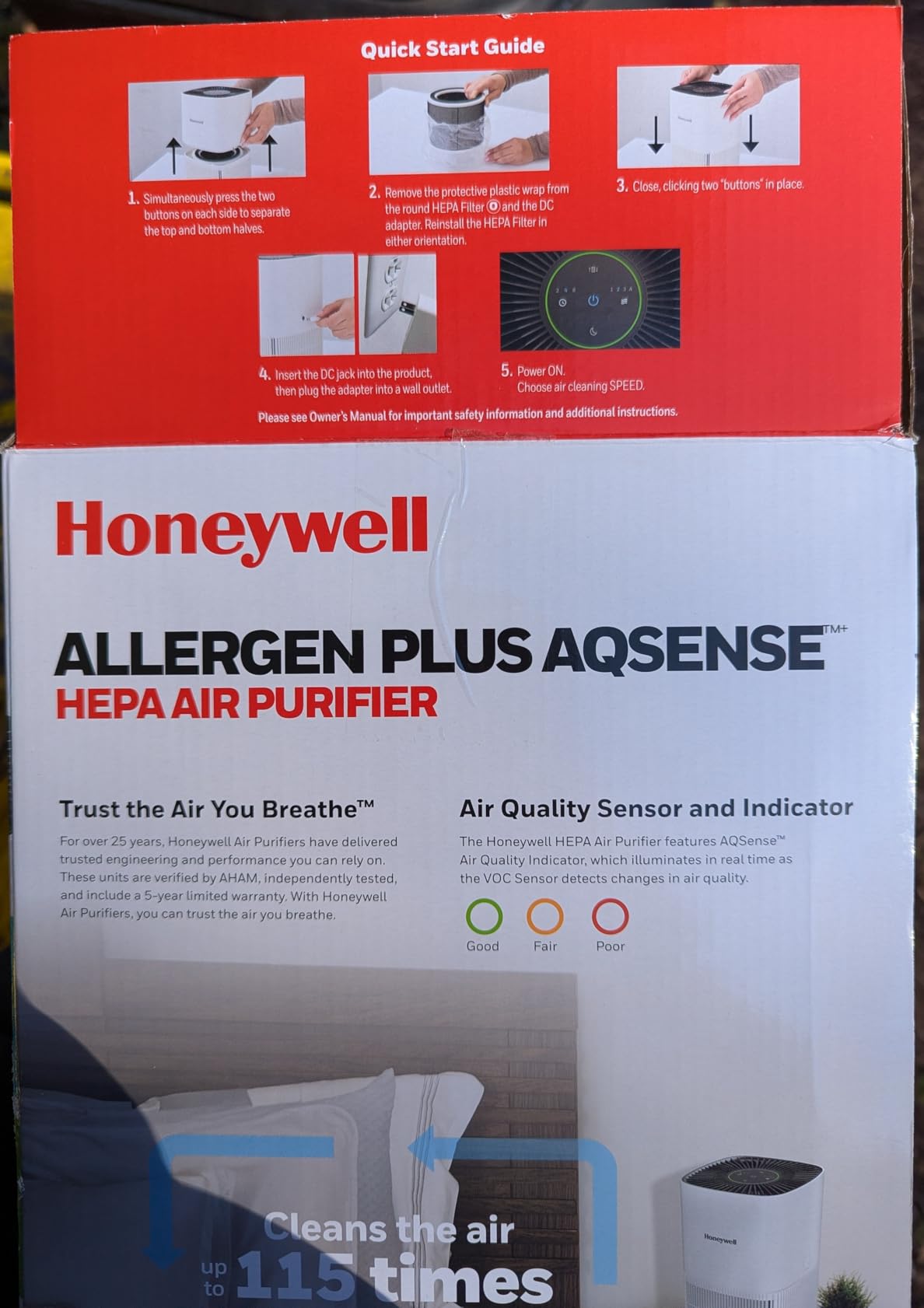
At just over 2 pounds it is the lightest machine in the roundup, so carrying it between the nursery and the office takes no effort. The 7 by 7 by 11 inch tabletop footprint is genuinely compact and will not dominate a small room.
The honest weakness is the review base. With only a few hundred ratings, long-term durability is unproven compared with the machines here that have owners posting multi-year logs. There is no app or smart home connectivity either, so the color-coded indicator is your only feedback, which is arguably fine for a room this size.
Matching a small machine to a small room
Compact units get oversold constantly, and a 530 square foot rating quoted as if it meant 530 square feet of real purification is the single most common disappointment in this category. The correct read is the 4.8 air changes per hour figure at 110 square feet, and if that matches your nursery or office, this machine is well matched.
If your space is larger, the Winix 5510 or the Levoit Core 300-P will serve you better per square foot. The Honeywell is the right answer for a genuinely small room, not a small-budget substitute for a big one.
Is buying a newer, less-reviewed model a risk?
It is, mildly. The Honeywell name carries real manufacturing history, and the AHAM Verifide certification means the performance claim has been independently checked even if the long-term owner history has not accumulated yet. Buyers comfortable with a shorter track record get a well-built, properly certified small machine here.
It also has three cleaning levels, timer options and a filter change indicator, which covers the basics without a screen or an app. For a room you will run overnight in a child’s bedroom, the quiet sleep mode and dimmable lights matter more than connectivity.
How to Choose an Air Purifier for Allergies
The three-factor rule: True HEPA, 4.8 to 6 air changes per hour, under 45 dBA
If you remember one thing from this guide, make it these three numbers. True HEPA is the filter grade that physically captures 99.97% of particles down to 0.3 microns, and it is non-negotiable for anyone buying for allergies. Air changes per hour is how fast you actually clear a room, and 4.8 to 6 ACH is the range where pollen and dander drop fast enough to notice overnight.
The third factor is noise, and it is the one most lists skip. CADR published for a room is usually measured at maximum fan speed, which is rarely a speed you will tolerate beside a bed. A machine that delivers useful airflow at under 45 dBA will outperform a louder machine in practice, because you will actually run it all night.
Read CADR figures as AHAM numbers where you can find them, and treat every other coverage claim as unverified. The difference between a verified CADR and a marketing square footage figure is the difference between sizing a machine correctly and being disappointed by it.
Sizing your room with CADR: the arithmetic
Room size to required CADR follows one formula: multiply the room’s volume in cubic feet by your target air changes per hour, then divide by 60. For a 12 by 12 bedroom with an 8 foot ceiling, that is 1,152 cubic feet. At 4.8 air changes per hour you need about 92 CFM, and at 6 ACH you need about 115 CFM.
A 10 by 12 office with the same ceiling gives 960 cubic feet, or roughly 77 CFM at 4.8 ACH. A 20 by 25 living room at 9 foot ceilings is 4,500 cubic feet, which needs about 360 CFM at 4.8 ACH. That last number is the one that decides between a single large machine and two medium ones.
Run the calculation before you shop and compare it to the published CADR of each machine on this list. When the required number exceeds what a unit delivers, either size up or plan on more than one machine in that room.
Which filter stage handles which allergen
Pollen, dust mite debris and pet dander are all particle problems, and True HEPA handles all three. Odors and VOCs are gas-phase problems that a particle filter cannot touch, which is why the Coway’s deodorization and bipolar stages, the Winix carbon layer and the Blueair activated carbon matter in homes where smell is part of the symptom.
Mold needs two things. The HEPA stage removes airborne spores, but mold in a damp space will keep producing them until the moisture source is fixed, so a dehumidifier or a repair is a prerequisite rather than an alternative. Smoke and wildfire particulate are straightforward particle captures, and the machines with the most sensitive sensors give you the best feedback on outdoor events.
What to avoid when buying an air purifier
- Coverage claims based on one or two air changes per hour. Read the ACH figure, not the square footage.
- Ionizer or ozone-emitting modes you cannot fully disable.
- Proprietary or expensive-only replacement cartridges, especially where no third-party filter fits.
- Machines that must be pushed against a wall, when the design needs 360-degree intake.
- Devices with no filter life indicator, which is how people end up running a spent filter for years.
- Filter sets that must be replaced wholesale when only the carbon layer is exhausted.
- High noise at the speed the room size actually requires.
Ionizers and ozone: the allergy-specific warning
Some purifiers charge particles so they clump and drop out of the air, and some designs achieve that by releasing trace ozone. Ozone is a respiratory irritant, so for someone whose lungs are already reactive, a purifier that reduces particles while aggravating airways is a bad trade. Every pick in this roundup is either non-ionizing or has no user-accessible ionizing mode.
The Coway AP-1512HH is the one machine here with a bipolar stage in its documented filtration path, and it also uses a pollution sensor and auto mode rather than an ionizer as its primary mechanism. If you are highly sensitive and want zero ambiguity, the GermGuardian with its Zero Ozone Verified certification is the cleanest answer.
Filter replacement schedule and running cost
Expect to replace a HEPA cartridge roughly every 6 to 12 months in a bedroom, and every 3 to 6 months in a heavy-use room such as one with pets or active cooking. Budget owners report spending from the low tens of dollars per year on budget units up to considerably more on machines with proprietary multi-stage cartridges, and that recurring figure matters more than the purchase price over a five-year horizon.
The cheapest insurance in this category is a washable pre-filter. Washing it every two to four weeks keeps hair and lint off the HEPA surface, and most manufacturers credit that with extending cartridge life. Filters that must be replaced wholesale when only the carbon layer is spent are the ones worth avoiding.
On energy, run the unit continuously in the room that matters most rather than boosting it everywhere. Auto mode will drop to a lower speed once air is clean, and running the bedroom machine overnight delivers more benefit than running a living room machine at high speed all day.
Placement and how many machines a home needs
Put the machine in the room where you sleep, at least two feet off the wall and away from curtains, bedding and furniture that block the intake. For an open-plan main floor, two medium machines in separate corners usually clean the space better than one large machine running on high.
Forum discussion on multi-pet households in open-concept homes lands on the same answer: multiple units rather than one oversized machine. If you can afford two, a bedroom machine and a living area machine cover the two places where airborne exposure actually happens.
Air purifier versus humidifier versus dehumidifier
A humidifier adds moisture to the air and can make mold worse in a damp home, and it does nothing for pollen. A dehumidifier controls mold at the source by removing moisture, which is essential if your allergy is mold-driven. A purifier is the only one of the three that removes airborne particles, so it is the only one that addresses pollen, dander and dust mite allergen directly.
They are not substitutes. In a basement with a mold problem, fix the moisture first with a dehumidifier, then add a purifier for the airborne spores. Running both together in an already humid room is a common and avoidable mistake.
What we checked for each pick
Every recommendation on this list was evaluated against published manufacturer specifications, AHAM Verifide CADR figures where available, third-party certifications including CARB, ETL and UL, and the pattern of complaints and praises across thousands of owner reviews. We did not perform hands-on lab particle testing, so treat the numbers as certified rather than independently measured by us.
If you are dealing with a diagnosed condition or your symptoms are severe, talk to your allergist before spending. An air purifier reduces the number of triggers in your air. It is not a treatment, and it works best alongside the basics, including mattress covers, a HEPA vacuum, washing bedding hot and keeping windows shut during peak pollen hours.
For more on clearing the air in the parts of your home where cooking happens, we have covered air purifiers for kitchen odors and air purifiers for kitchen and cooking separately, and the connected models are covered in our guide to smart air purifiers with app control.
Frequently Asked Questions
Do air purifiers really work for allergies?
Yes, for airborne triggers. A True HEPA filter captures 99.97% of particles down to 0.3 microns, a size that includes pollen, dust mite debris and pet dander. Because those triggers stay suspended in indoor air for hours, lowering their concentration lowers how many reach your airways. A purifier cannot help with food or contact allergens, and it is a mitigation tool rather than a treatment.
Is it worth getting an air purifier for allergies?
It is worth it if your trigger is airborne and the unit is correctly sized for the room. The value comes from running a bedroom machine overnight, where a large share of daily exposure happens. The main caveat is running cost: budget for a genuine replacement cartridge every 6 to 12 months, which is what most people forget when comparing prices.
What air purifiers do doctors recommend?
Allergists generally recommend a True HEPA unit with verified CADR matched to room size, run continuously or overnight in the bedroom, alongside basics like mattress covers, a HEPA vacuum and washing bedding hot. They also advise avoiding ionizers and ozone-emitting models, since ozone irritates airways. For severe or diagnosed conditions, get individualized guidance from your own clinician.
What to avoid when buying an air purifier?
Avoid coverage claims based on only one or two air changes per hour, ionizer or ozone modes you cannot disable, proprietary replacement cartridges with no affordable alternatives, and machines whose intake is blocked when pushed against a wall. Also skip any unit with no filter life indicator, since running a spent filter is the most common long-term mistake.
What air purifier is best for removing pollen?
Compare pollen CADR figures rather than smoke figures, because pollen is smaller and stays suspended longer. The Levoit Vital 200S-P leads the bedroom and mid-size class here at 289 CFM verified pollen CADR, and the Blueair Blue Pure 211i Max is the strongest overall at 450 CFM if you need coverage for a much larger space. For most bedrooms, a high pollen CADR run overnight is what matters.
Are allergen air filters worth the money?
Specialty filters are worth it when your trigger is gas-phase or odor related, such as VOCs from cooking, paint or pets, because a particle-only HEPA filter will not touch them. For pollen, dander and dust mite debris, a standard True HEPA cartridge does the same job as a branded allergy filter. Judge a specialty filter by whether it adds a carbon or deodorization stage, not by its label.
Do you really need to replace an air purifier filter?
Yes. A clogged filter raises airflow restriction and reduces the CADR you paid for, so a purifier on an old filter is effectively underpowered. Replace HEPA cartridges roughly every 6 to 12 months in a bedroom and every 3 to 6 months in a pet or heavy cooking room. Washing the pre-filter every two to four weeks extends cartridge life meaningfully.
How much do replacement air purifier filters cost?
There is no single answer, because cartridges are model-locked and multi-stage designs cost more. Budget units need inexpensive filters every few months, while machines with proprietary HEPA plus carbon or bipolar stages cost considerably more per cycle. The practical figure to use is the annual filter cost multiplied by five, compared against the purchase price, since ownership cost usually exceeds it.
Final Verdict: The Best Air Purifiers for Allergies in 2026
After weighing CADR against real noise levels, filter running cost and room fit, the Levoit Core 300-P is our best air purifier for allergies overall. It is the smallest machine here with published AHAM Verifide figures, it clears a 222 square foot bedroom 4.8 times an hour, and it does that at 24 dB on sleep mode, which is the reason it will actually get run every night. Its 4.7 rating across more than 108,000 reviews is the largest owner base in the roundup, and the recurring complaint about proprietary filters is a real cost you should budget for rather than a dealbreaker.
Match the machine to the trigger instead. Pet dander and odor point to the Coway AP-1512HH, whose four-stage path and three-year warranty handle both the particles and the smell. Pollen points to the Levoit Vital 200S-P, with 289 CFM verified pollen CADR, the highest among bedroom and mid-size units here. A large open main floor points to the Blueair Blue Pure 211i Max at 450 CFM pollen CADR, though its filter cost is the heaviest in the group. Small rooms, nurseries and home offices point to the Honeywell HPA125B or the MOOKA B-D02L.
Whatever you choose, do the sizing arithmetic before you buy, run the bedroom machine overnight, and wash the pre-filter every few weeks. Those three habits account for more of the difference in real allergy relief than any specification on the box. If you want more filtration coverage for the cooking side of the house, our guides to kitchen odor purifiers and app-controlled smart purifiers cover that side of the problem.