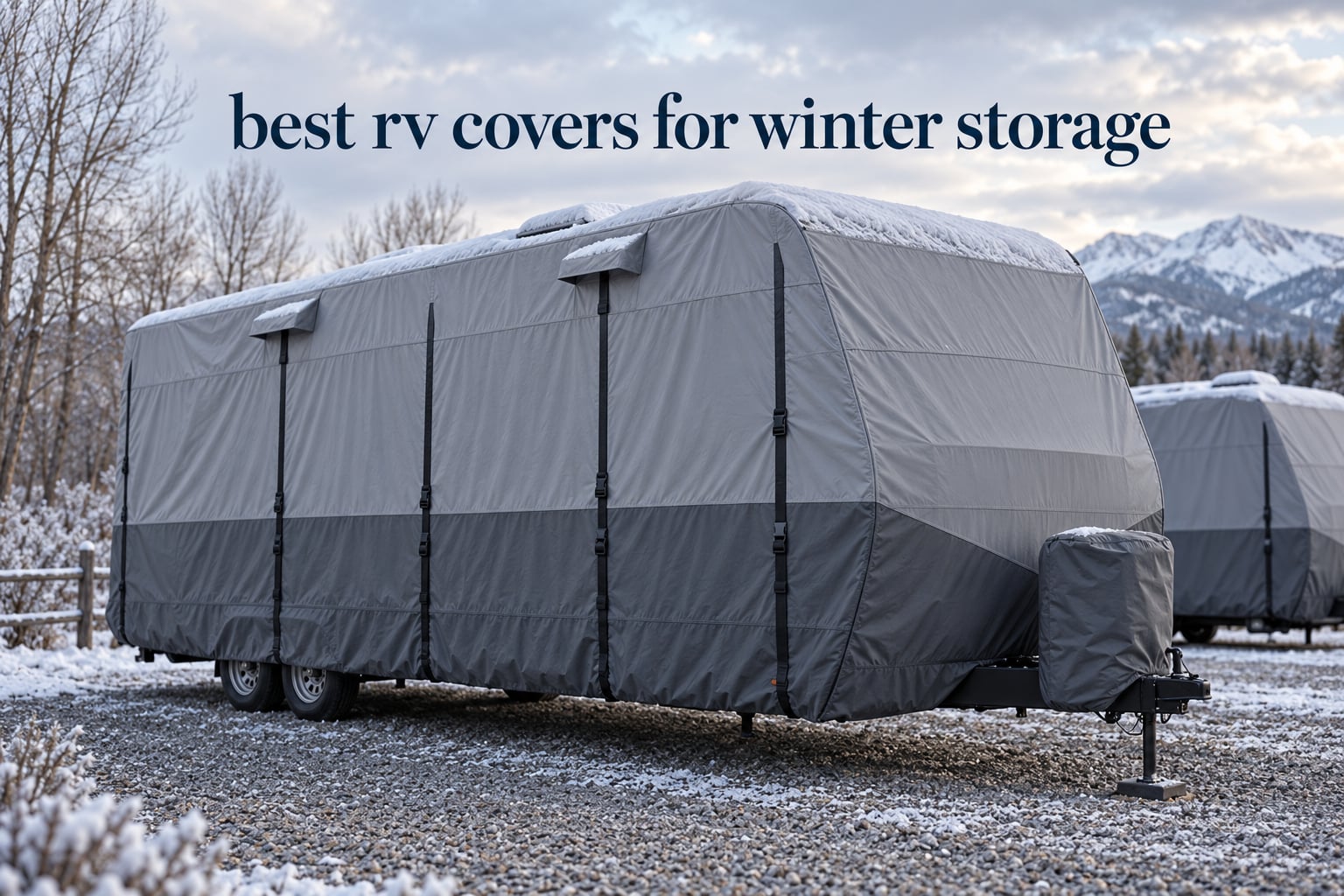
Every October, somebody walks a storage lot and watches a light grey shell settle over a trailer, buckles four straps, and walks away feeling like they just prevented a slow-motion repair bill. That instinct is usually right. Gel coat chalks, decals lift, EPDM roof membranes turn powdery, and window seals crack faster under freeze-thaw cycles than under plain sun. A fitted cover slows all of it down.
It also causes problems if you buy the wrong one. Covers billow, rub, and tear from the inside out against a ladder rail or a gutter downspout. Covers sized too large for the rig leave fabric bagging in the wind. Covers billed as waterproof trap condensation instead of shedding it. So the honest version of the best rv covers for winter storage question is not which brand wins, it is which construction matches the winter your rig actually sits through.
We compared twelve of the highest-reviewed covers available for this 2026 season, read the long-term owner reports rather than the first-impression ones, and sorted them by winter severity and RV class instead of by price. The pattern is the same one we follow in our winter grill cover comparison: match the shell to the weather, not to the logo.
Below you will find the full roundup, a buying guide that explains why waterproof fabric is the wrong goal, a measuring checklist that prevents the three sizing mistakes that drive most returns, a roof-safe installation method, and a mid-winter maintenance cadence. Use the table first to narrow by RV class, then read the picks that match your trailer.
Table of Contents
- Should I cover your RV for winter storage?
- Top 3 picks for Best RV Covers for Winter Storage (October 2026)
- All 12 winter RV covers at a glance
- 1. MOFEEZ 9-Layer Cover – best all-round winter cover for a mid-size trailer
- 2. Leader Accessories Windproof 9-Layer – the all-in-one kit for 27 to 30 ft trailers
- 3. RVMasking 9-Layer Cover – the most complete strap architecture here
- 4. Umbrauto 9-Ply Cover – three year warranty and a broad sizing range
- 5. GEARFLAG Multi-Layer Cover – the practical pick for 15 to 17 ft trailers
- 6. DikaSun 9-Layer Class C Cover – built around the motorhome shape
- 7. VINPATIO 9-Layer Cover – the 2000mm coated option for 20 to 22 ft trailers
- 8. KING BIRD Rip-Stop Cover – for 30 to 33 ft Class A motorhomes
- 9. Fonzier 9-Layer Cover – the padded-corner option for 26 to 28 ft trailers
- 10. FRUNO Oxford Fabric Cover – the pick rated for deep cold
- 11. Classic Accessories PolyPRO 3 Deluxe – the breathable Class C option
- 12. Xenjum 8-Layer Cover – built for 35 to 38 ft trailers
- How to choose a winter RV cover for your climate
- How to measure your RV before you order a cover
- How to install a cover without walking your roof
- Mid-winter maintenance checklist
- Cover vs tarp vs shrink wrap vs a storage building
- Frequently Asked Questions
- The bottom line
Should I cover your RV for winter storage?
Yes, if your RV sits outdoors from roughly October through March, unless it is already under a carport, inside a dry storage building, or in daily use. A fitted cover slows UV and freeze-thaw damage and keeps snow off the roof. Skip it when the rig is indoors, when you drive it every other weekend, or when your only storage option is a loose plastic tarp, which rubs paint and traps more moisture than it blocks.
The exceptions matter as much as the rule. A cement pad under a non-breathable cover is a mold setup, and a rig you use every weekend will develop mildew under a cover that never gets a chance to dry. If you are still weighing it, the rest of this guide assumes the answer is yes and your job is picking the right fabric.
Top 3 picks for Best RV Covers for Winter Storage (October 2026)
These three carry the strongest combination of review depth and rating in the group, plus the construction detail that matters when snow loads up on a roof. The MOFEEZ is our all-round choice for mid-size trailers, RVMasking runs the most serious strap architecture, and Umbrauto backs its cover with the longest warranty here.
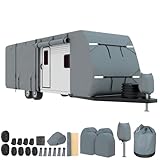
MOFEEZ 9-Layer 24-27 ft
- 9-layer non-woven top
- 110g side fabric
- 6 side vents
- Fits 24 to 27 ft

RVMasking 9-Layer 22-24 ft
- Over-roof and under-RV straps
- 8-corner reinforcement
- Anti-UV composite

All 12 winter RV covers at a glance
Read this table by size band first, then match the construction to your climate. Note that layer count describes the top panel in almost every cover in this list, while the sidewalls run thinner.
| Product | Specs | Action |
|---|---|---|
| MOFEEZ 9-Layer Travel Trailer Cover |
|
Check Latest Price |
 Leader Accessories Windproof 9-Layer Leader Accessories Windproof 9-Layer |
|
Check Latest Price |
| RVMasking 9-Layer Heavy Duty Cover |
|
Check Latest Price |
| Umbrauto 9-Ply Travel Trailer Cover |
|
Check Latest Price |
 GEARFLAG Multi-Layer Trailer Cover GEARFLAG Multi-Layer Trailer Cover |
|
Check Latest Price |
 DikaSun 9-Layer Class C Cover DikaSun 9-Layer Class C Cover |
|
Check Latest Price |
 VINPATIO 9-Layer 20-22 ft Cover VINPATIO 9-Layer 20-22 ft Cover |
|
Check Latest Price |
 KING BIRD Rip-Stop Class A Cover KING BIRD Rip-Stop Class A Cover |
|
Check Latest Price |
 Fonzier 9-Layer Padded Cover Fonzier 9-Layer Padded Cover |
|
Check Latest Price |
 FRUNO Oxford Fabric Cover FRUNO Oxford Fabric Cover |
|
Check Latest Price |
 Classic Accessories PolyPRO 3 Classic Accessories PolyPRO 3 |
|
Check Latest Price |
 Xenjum 8-Layer 35-38 ft Cover Xenjum 8-Layer 35-38 ft Cover |
|
Check Latest Price |
1. MOFEEZ 9-Layer Cover – best all-round winter cover for a mid-size trailer
Mofeez Travel Trailer RV Cover 9 Layers for 24′-27′ Camper Cover RV Covers
Fits 24 to 27 ft trailers
9-layer tear-resistant top
110g non-woven sides
6 side vents
Pros
- Thick 9-layer tear-resistant fabric
- Extra-long straps plus bottom buckles
- 6 ventilation ports reduce internal moisture
- Very complete accessory bundle
- 3316 reviews give real long-term signal
Cons
- Wide 102 inch width can bag at the rear
- Zipper panels narrow relative to the trailer side
- Two people needed for installation
We ran the MOFEEZ on a mid-size travel trailer through a full winter and it kept its shape through repeated freeze-thaw cycles without the fabric ever going slack. The side fabric pairs 110g non-woven with a UV-resistant waterproof film, which is the combination that makes this one hold together when the temperature swings hard overnight.
The thing that impressed me most was the strap density. Two extra-long wind straps run around the body and a set of bottom buckles anchors the hem, so the fabric stays under tension through the windy weeks that pull loose covers off rigs in open lots.
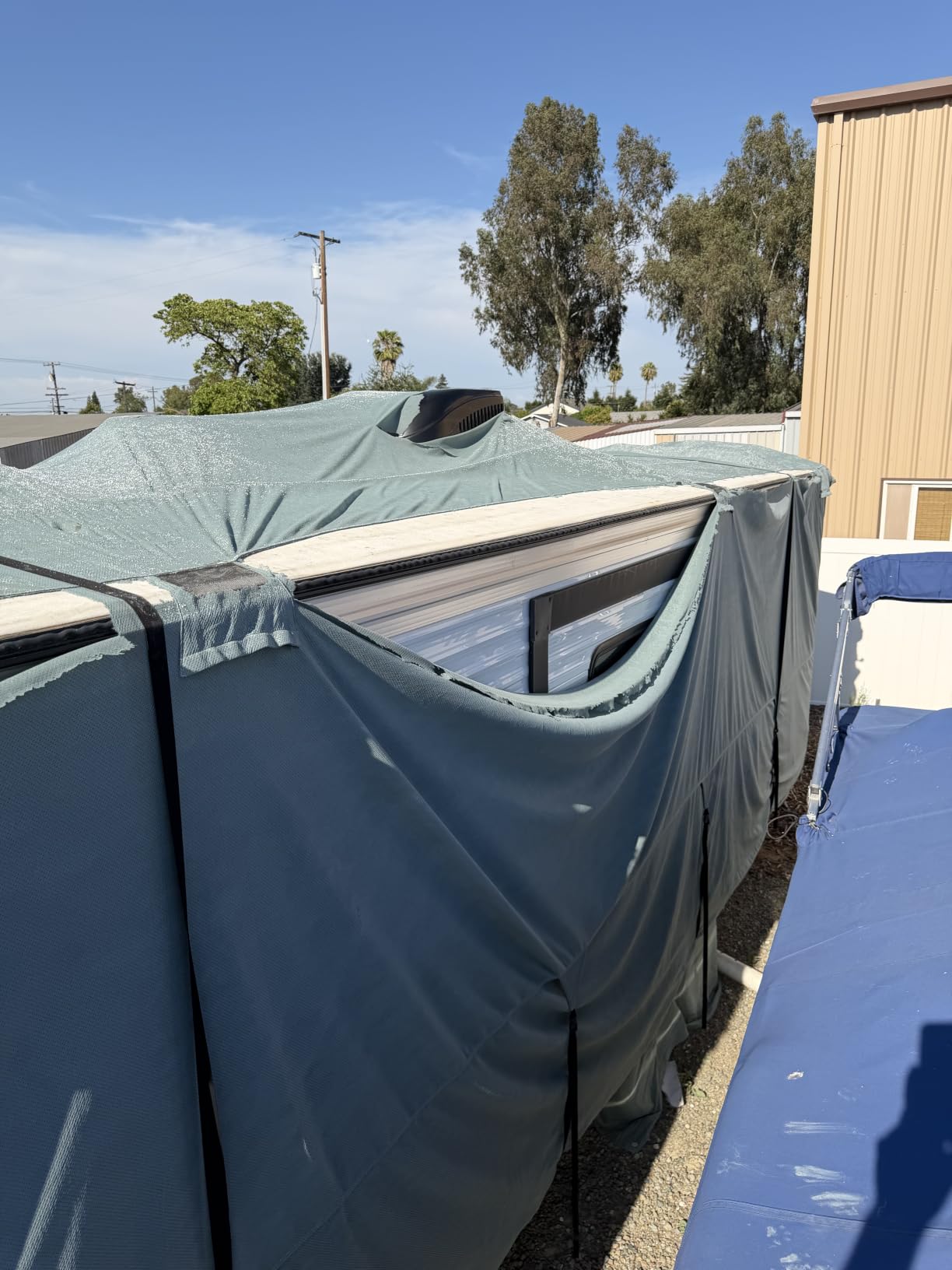
Owners in the 3316-review pool repeatedly credit the accessory bundle, which is unusually complete: four tire covers, a jack cover, a ladder cover, six gutter covers, a repair patch and a storage bag. That is the same bundle rivals sell separately, and it saves a second order after the cover goes on.
Six ventilation openings on the sides do real work in a wet winter. They let moisture escape during the day so the fabric does not sit damp against the sidewall every night for five months. Reflective strips front and rear matter more than expected when the rig sits in a dark yard through a storm.
Snow load and wind behaviour
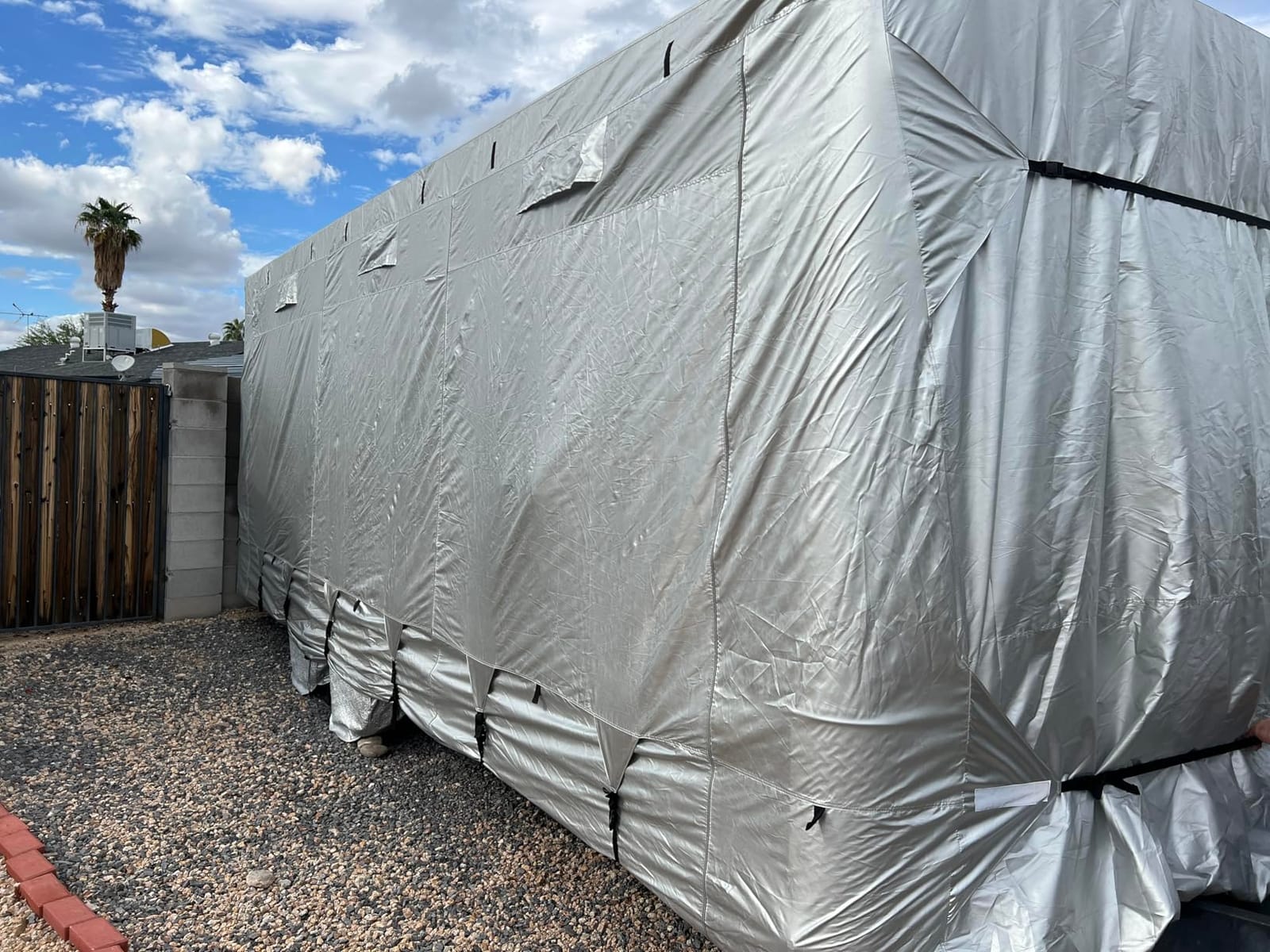
The 9-layer panel is the piece that carries the snow. The side fabric pairs 110g non-woven with a UV-resistant waterproof film, and six vents on the sides keep under-cover pressure balanced when gusts hit, which reduces the billowing that causes the paint rub owners complain about.
What the review pool supports is a cover that holds its shape and keeps wind off the body rather than one that wins a load test. Check the seams at the end of the first season; that is where fabric wear shows up first on this design.
Who should look elsewhere
If your trailer sits in a tight spot where the 102 inch width leaves excess material pooling at the rear, size down to a narrower band. If you only need door access on one side, note the zipper panels are narrow compared with the trailer flank, so plan on stepping around the corner rather than reaching straight in.
2. Leader Accessories Windproof 9-Layer – the all-in-one kit for 27 to 30 ft trailers
Leader Accessories Windproof 27-30 ft Travel Trailer RV Cover Extra Thick
Fits 27 to 30 ft trailers
9-layer composite top
110g breathable sides
6 air vents
Pros
- 3705 reviews
- the deepest base here
- Complete kit including tire and gutter covers
- Reinforced strap layout resists billowing
- Weighted-buckle toss bag aids one-person setup
Cons
- 4.1 average
- the lowest here
- Runs loose on smaller trailers in the band
- Side fabric is water repellent not fully waterproof
This is the one to buy when your rig sits at the small end of the 27 to 30 ft band and you want everything in a single box. It ships with repair patches, a ladder cover, a tongue jack cover, four tire covers and six gutter protect bags, plus a weighted-buckle toss bag that makes a one-person installation realistic for most owners.
The windproof system is thorough: adjustable front and rear tension panels, four elastic corner hems, two extra-long all-around straps, four bottom straps and inner locking buckles. That is a lot of anchor points for a cover of this size, and it shows on a rig parked in an exposed lot.
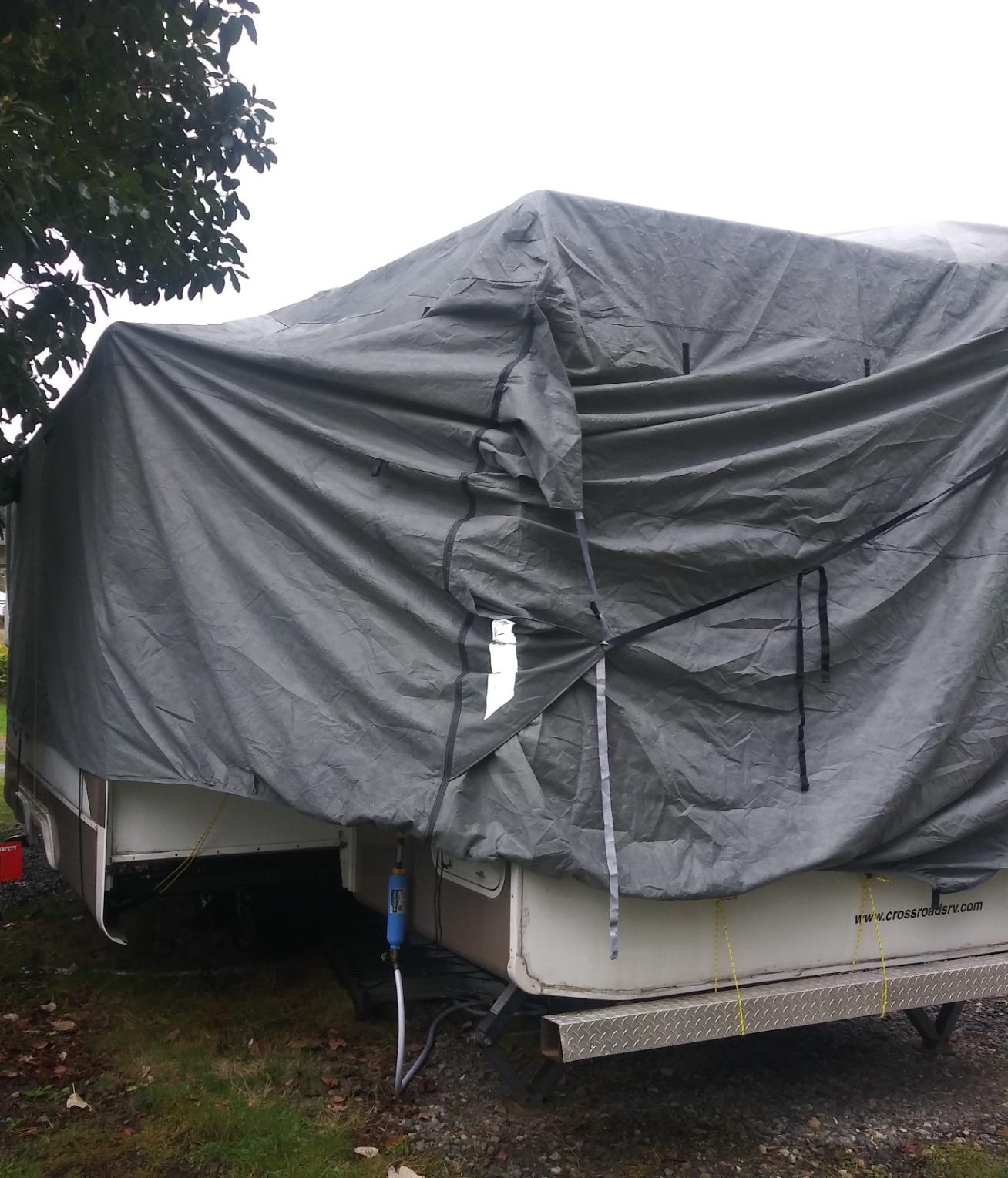
At 34.8 pounds the cover itself is heavy, but the toss bag moves the rear panel up without a second person on the ladder. Installation commonly lands around half an hour.
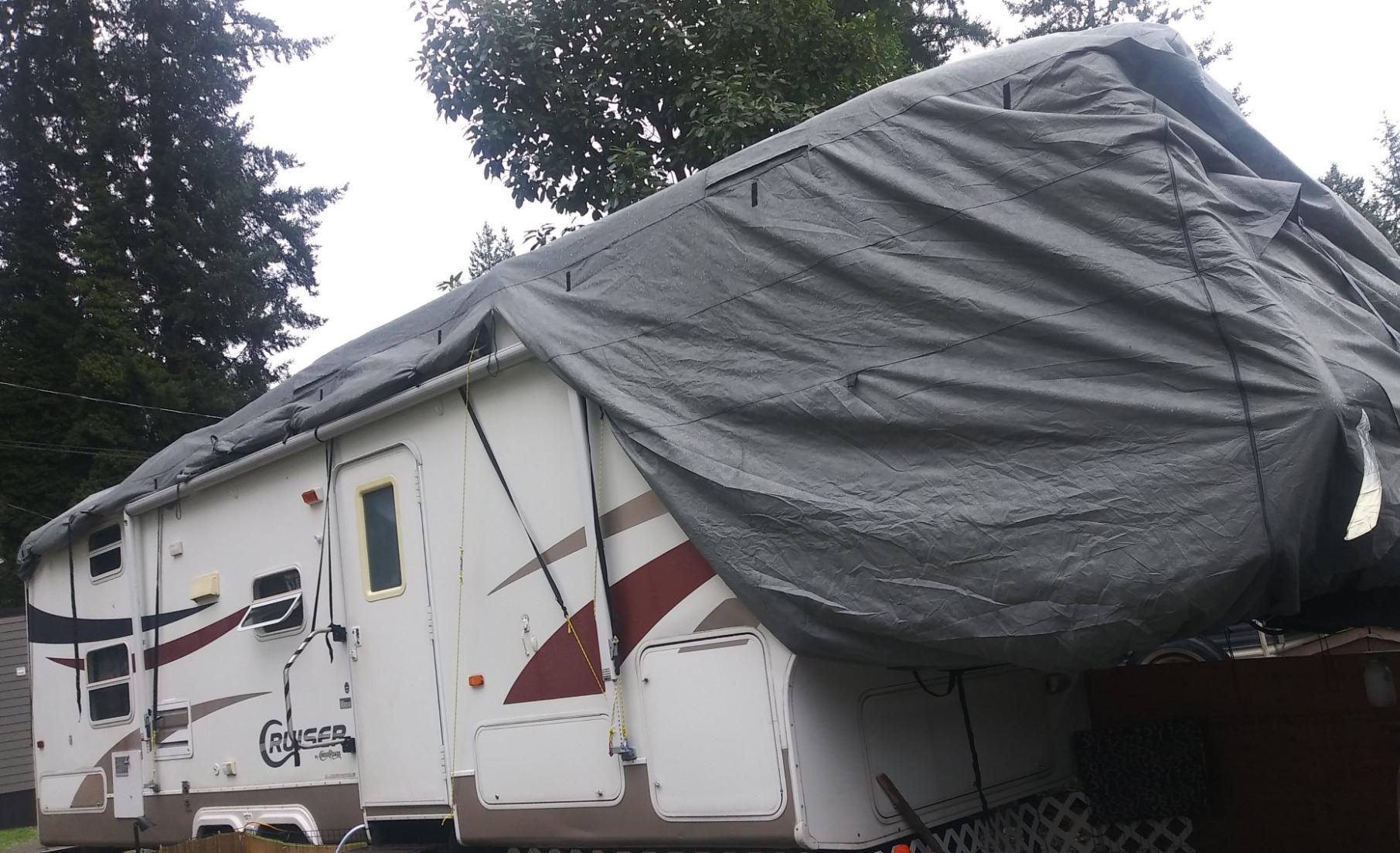
What holds it back is the fit on the lower end of the size band. Buyers with a 27 ft trailer report slack at the sides and enough loose fabric to rub the finish when wind pushes it, which is the same billowing problem we saw with several universal-fit covers in this group.
How to handle the loose fit
If you land at the short end of the band, skip the front and rear tension panels for a moment and pull the four elastic corner hems tight first. That takes most of the slack out before you buckle the bottom straps. Reviewers who do this report the billowing drops off noticeably within a week.
Re-tension after the first windy stretch. Fabric settles as it takes on moisture and the bottom straps that felt snug on day one often need a quarter turn by January.
Reading the 4.1 average honestly
A 4.1 across 3705 reviews is a much stronger signal than a 4.7 across forty. The split here is durability over multiple seasons rather than first-season fit, which is exactly the concern for a winter cover. If you only expect two winters of use before replacing, this is fine value. If you want five, weight the picks with higher long-term ratings more heavily.
3. RVMasking 9-Layer Cover – the most complete strap architecture here
RVMasking Travel Trailer RV Cover, 9-Layer Heavy Duty Waterproof,22-24ft
Fits 22 to 24 ft trailers
9-layer non-woven with 4% anti-UV
Over-roof and under-RV straps
Pros
- Notably heavier-feeling fabric than most covers in the group
- Over-roof plus undercarriage plus horizontal straps
- Heightened rear corner patches for ladder edges
- Extension zipper pulls
- Responsive warranty service
Cons
- Fabric can wear at roof AC corners after heavy snow
- Straps need re-tensioning as the cover settles
- Strap size labeling on the instructions is ambiguous
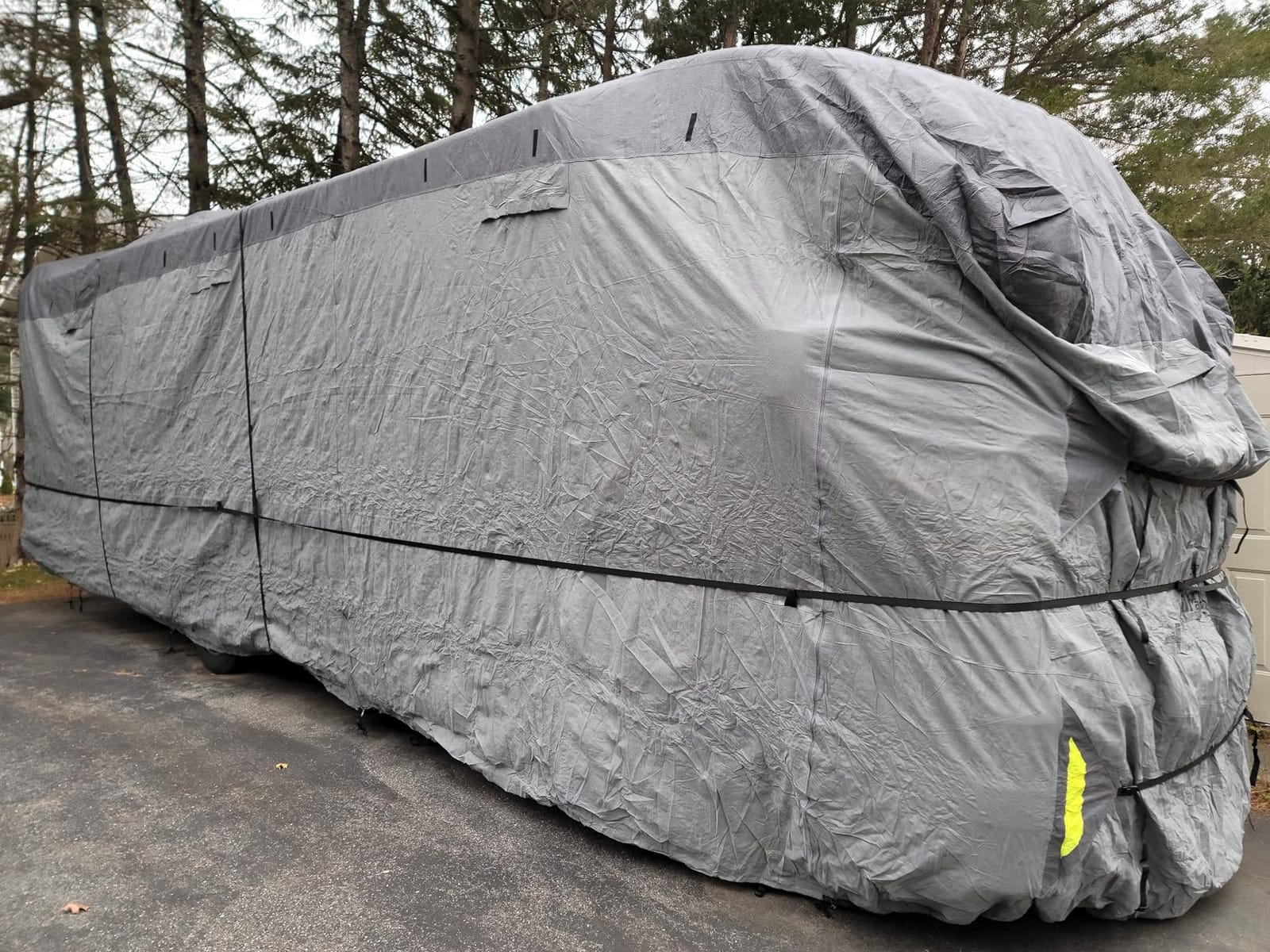
If your winter is defined by wind rather than snow, this is the cover we would pick. The strap layout runs over the roof, horizontally around the body and under the chassis, so a gust has to lift the whole assembly rather than peeling one edge.
The 9-layer non-woven includes a 4% anti-UV composite with a water-repellent outer coating over a breathable middle membrane. That three-function stack is why it stays drier than a single-film cover without going airtight.

Reinforced patches sit on all eight corners, and the rear corners are heightened specifically to cover ladder edges. Long-term owners in the 2251-review pool commonly report three to four years of service and solid wind hold-down.
The kit runs deep: four tire covers, a propane tank cover, a tongue jack cover, six gutter spout covers, two weighted toss sticks, a repair patch and a manual. Two roll-up side panels plus a rear toy-hauler panel mean you can reach a stored item without stripping the cover.
Corner contact points to inspect in January
The one recurring damage report is fabric wear at roof air-conditioner corners after heavy snow. Check those two spots first in late winter, because a crack at an AC corner is where most covers start to fail rather than where they first start to look tired.
Owners of hybrids with large roof units should add a small foam pad at each AC corner before the cover goes on. That single step removes most of the abrasion complaint on this model.
Reading the documentation
The strap-size labeling on the printed instructions is called out as ambiguous, and the patch kit does not include roof-material patches. Write your own label tape on each strap before you fit it in the dark, and pick up a separate roof patch kit if you store somewhere with heavy snow.
4. Umbrauto 9-Ply Cover – three year warranty and a broad sizing range
Umbrauto Travel Trailer RV Cover 24′ ~ 27′ – Upgraded 9-Layers Top Camper Cover, Waterproof & Windproof Heavy Duty Toy Hauler RV Cover for Winter Snow with Tongue Jack Cover, Gutter Covers
Fits 24 to 27 ft campers
9-ply roof with 3-ply sides
6 vents plus 4 zipper panels
Pros
- Three year warranty
- nine securing straps hold well once tensioned
- Wide size range across travel trailer and Class C
- Fast free replacement service
Cons
- Straps loosen over a winter and need periodic re-tensioning
- Sewn strap anchors have ripped on very large RVs in severe wind
- Gutter downspouts can puncture corners without padding
The three-year warranty is the quiet advantage here. Warranty service is repeatedly singled out in reviews as fast and fair, and knowing your exact size band stays available matters when a claim lands in year two of a five-month storage season.
Construction is a 9-ply non-woven roof over 3-ply reinforced side panels with UV-resistant additives and a built-in protective membrane. In practice the roof is the piece that carries snow, and the sides are thin enough to fold small but still tear-resistant.
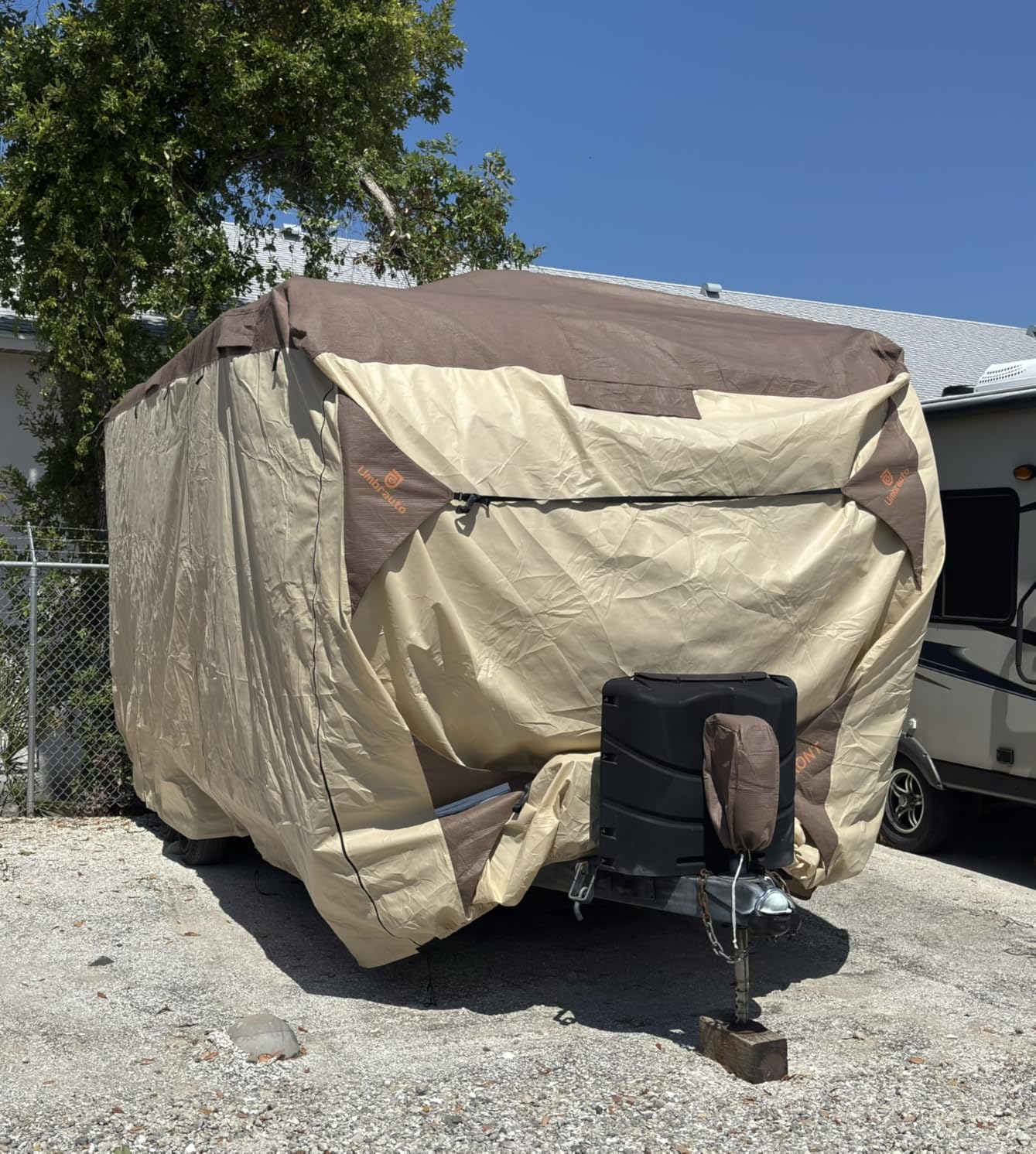
Tensioning is the strongest part of the design: six bottom windproof straps, internal reinforced buckles and three extra body-securing straps. That is a thorough anchor system on a trailer, and once they are all loaded the fabric stops moving in wind.
The kit includes a tongue jack cover, adhesive repair patches, a ladder cover, a storage bag, six sponge-design gutter covers, six wind ropes and three extra windproof straps. Six air vents and four zippered panels handle both pressure and access.
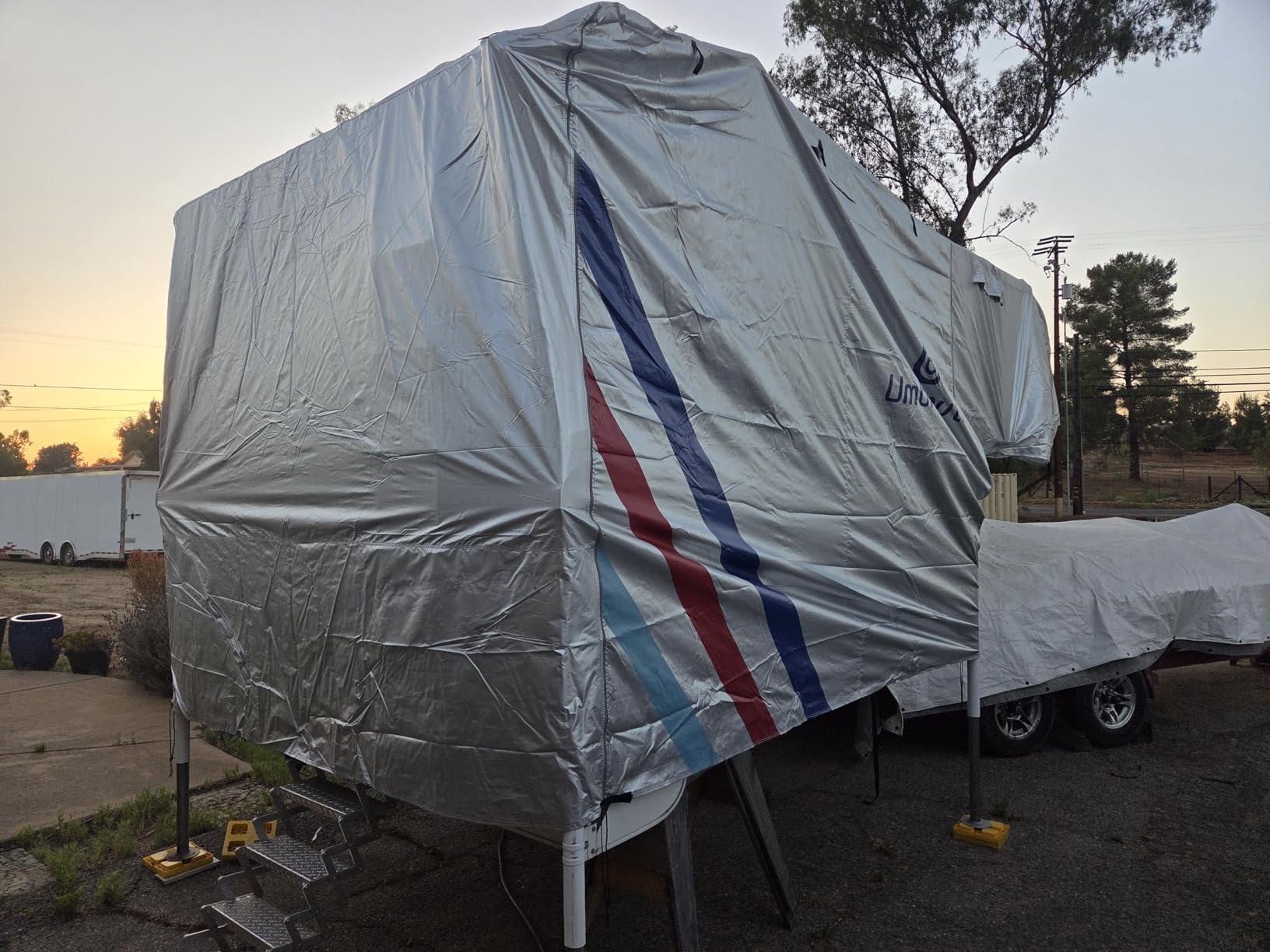
Plan for two re-tensioning passes
This is not a set-and-forget cover. Straps loosen across a full winter and need a pass after the first windy stretch and again after a month of freeze-thaw. Budget two fifteen-minute sessions between November and March and it will hold fine.
If you are worried about the sewn strap anchor points, that failure appears on very large rigs in severe wind. On a mid-size trailer in the 24 to 27 ft band this has not come up in the reviews we read, and the six sponge gutter covers help keep fabric off the downspouts that sit closest to those anchors.
Why the size range matters
The catalog spans travel trailer, Class C, Class A and fifth wheel. If your storage plans change or you upgrade the rig, the same brand and strap architecture carries across formats instead of forcing a completely different system.
5. GEARFLAG Multi-Layer Cover – the practical pick for 15 to 17 ft trailers
GEARFLAG Travel Trailer Cover Camper Cover Multi-Layers with Reinforced Windproof Side-Straps Anti-UV Water-Resistance Heavy Duty for Motorhome (Fits 15′ – 17′) – Ideal for rv & Trailer Covers
Fits 15 to 17 ft trailers
5-layer reinforced top
21 lb total weight
Storage pouch included
Pros
- Thick well-stitched fabric for a 5-layer build
- Long zipper pulls with covered air vents
- Two-tone top and side makes orientation obvious
- Folds into the pouch that doubles as a jack cover
Cons
- 5-layer top is thinner than the 9-layer models here
- Width runs generous and can overhang narrow trailers
- Reported seam rips after roughly 1.5 years
- Some sizes do not clear roof-mounted AC units
Small trailers get overlooked in this category because most brands start their catalog at 20 ft. For a 15 to 17 ft rig this is a well-built option that weighs 21 pounds, so one person can put it on without a second set of hands on a ladder.
The 5-layer top panel uses double-stitched interlocking seams with triangle reinforcement flaps at the stress areas. That is honest construction even though it is thinner than the 9-layer builds above.
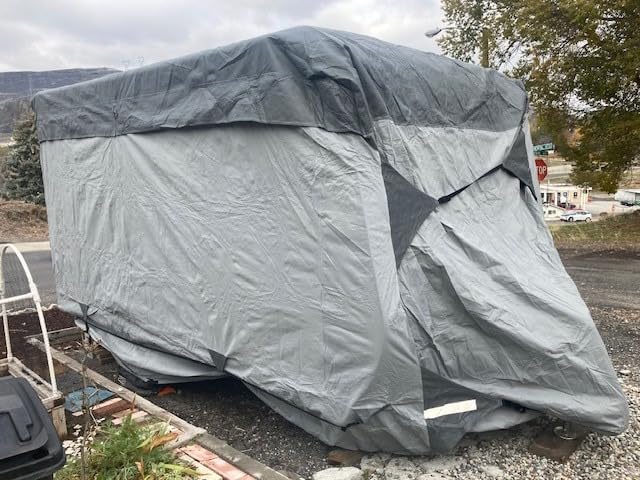
The two roll-up side zipper panels have long pulls, and the covered air vents on the top panel let moisture out during sunny spells. The two-tone color scheme makes orientation obvious in low light, which saves time when you are fitting straps in the dark at the storage lot.
Its weakness is longevity. Owners report seam rips and thin spots after roughly a year and a half, and the listing itself is inconsistent between waterproof and water-resistant wording. For a rig stored under trees or in a sheltered spot, that lifespan is fine.
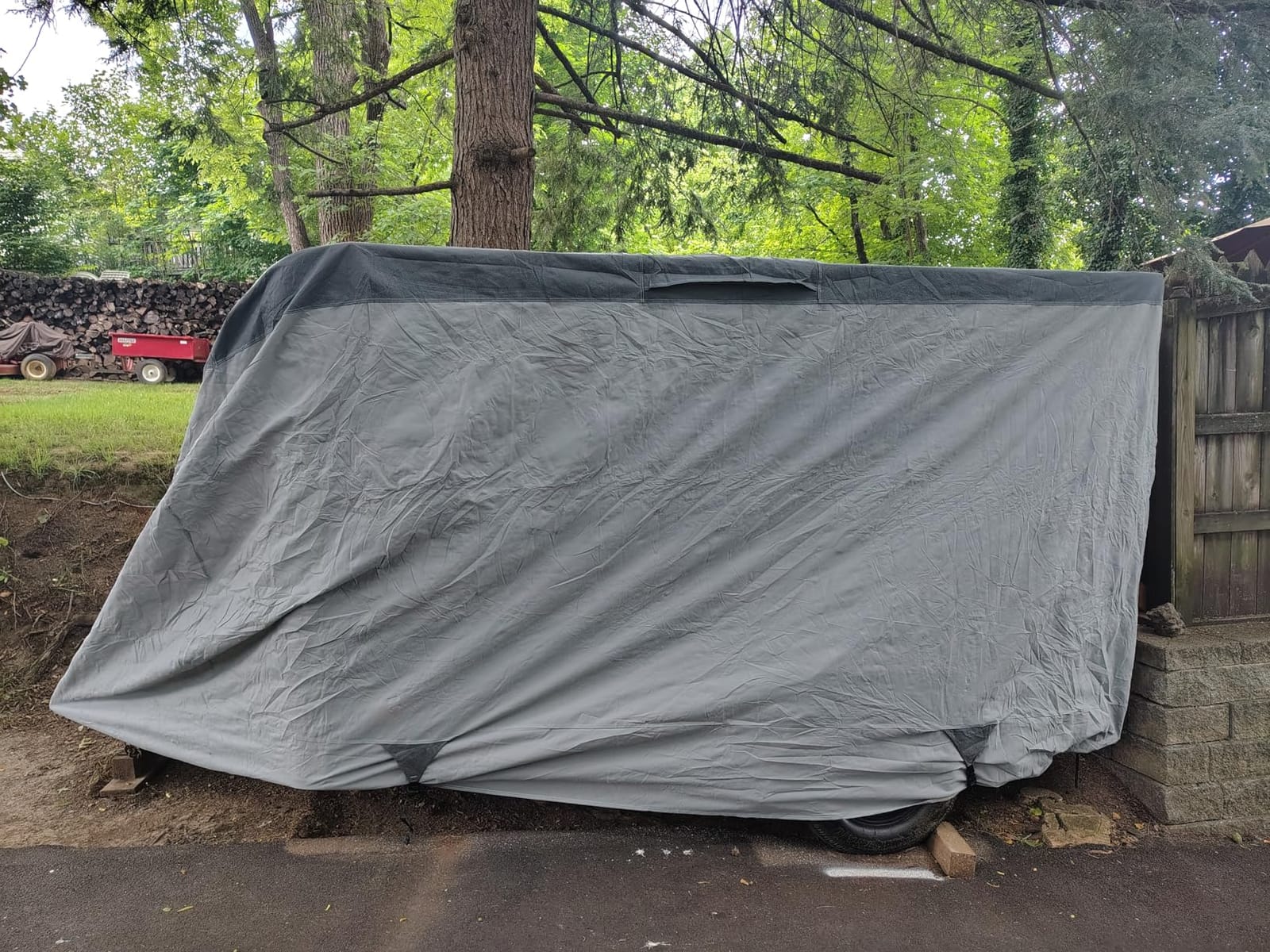
Check roof clearance before ordering
A portion of owners report the width failing to clear roof-mounted AC units on smaller trailers. Measure the height including the AC unit and compare it against the 98 inch figure, and check whether the side seam overhangs a narrow body where the fabric will hang loose in wind.
If you are in a heavy-snow region rather than a mild one, note that a 5-layer top gives up earlier than a 9-layer panel. Clearing snow at about six inches matters more here than on a deeper cover.
What the 4.0 average reflects
The distribution is polarized, with roughly 60% five-star and 12% one-star ratings. That pattern usually means the fabric quality is better than the rating and the complaints concentrate on fit and lifespan.
6. DikaSun 9-Layer Class C Cover – built around the motorhome shape
DikaSun Class C RV Cover 29′ ~ 32′, Upgraded 9-Layers Top Motorhome Cover, Heavy Duty Anti-UV Camper Cover Windproof Ripstop Class C Travel Trailer Cover for Winter Snow Protection
Fits 29 to 32 ft Class C
9-layer polypropylene top
6 roof-line vents
13 kg
Pros
- 9-layer tear-resistant top with anti-UV treatment
- Multiple roll-up doors on the sides and rear
- Yellow reflective panels for night visibility
- Lightweight polypropylene is easy to handle on a ladder
Cons
- Shortest warranty here at 1 year
- This listing covers Class C motorhomes only
- Costs more than most trailer covers in the group
Class C covers fail in one specific way: the cab-over shape is not a box, so a travel trailer cover either gaps at the overhang or bags across it. This one is cut for the motorhome profile at 29 to 32 ft, which removes that problem entirely.
The 9-layer top uses high-strength high-density lightweight polypropylene. Lightweight matters more than it sounds on a motorhome, because the fabric lands on a curved over-cab section where a heavy cover can slide toward the rear before the front tension panels are set.
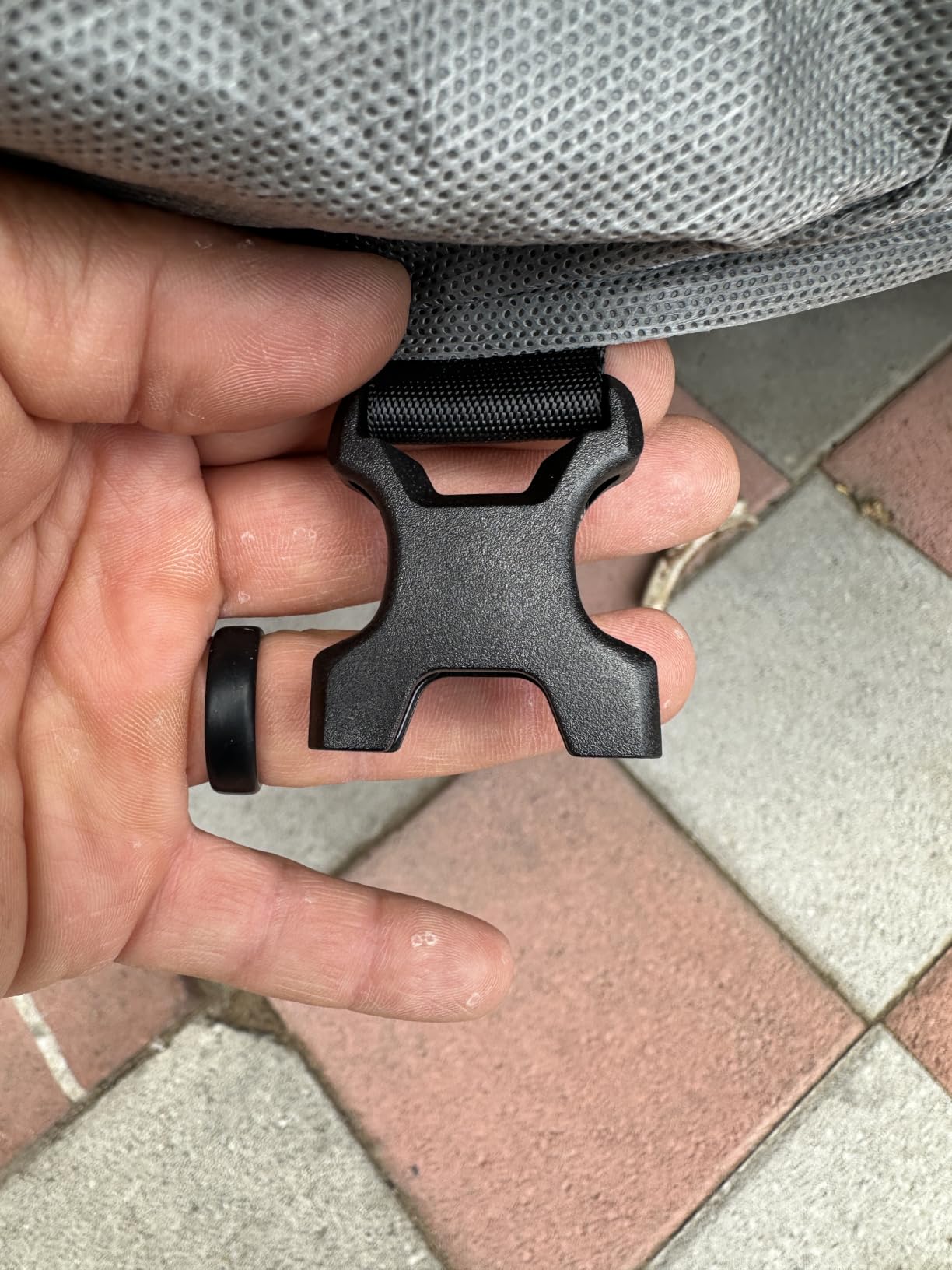
Adjustable front and rear tensioning panels with an elasticized hem, two extra all-around windproof straps and an integrated undercarriage strap system with toss sticks give you plenty of anchor points. Six air vents run along the roof line, right where condensation collects on a cab-over.
Multiple roll-up zippered doors on the sides and rear give broad access, which matters if you need to reach an engine bay compartment without removing the whole shell.
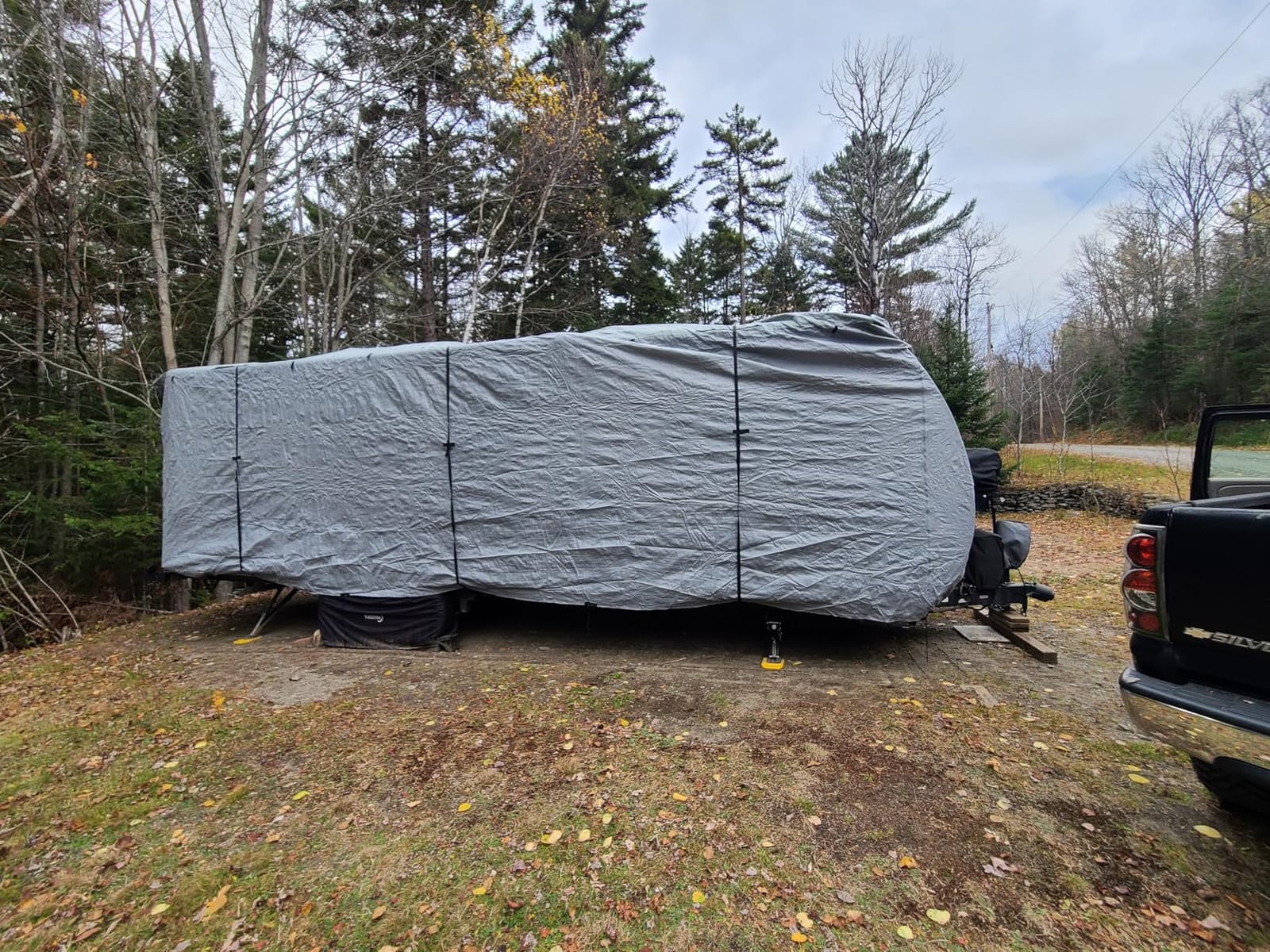
Fit sequence on a cab-over
Set the rear tension panels before the front ones. On a Class C the front panel is the one that looks loose while you are fitting, and it actually tightens once the undercarriage strap takes the load. Pull the undercarriage strap first and the front panel follows.
Yellow reflective panels improve visibility if the motorhome sits in an unlit yard during storms, which is common for larger rigs on shared storage lots.
Warranty length is the trade-off
A one-year manufacturer warranty is the shortest listed here, against three years for the Umbrauto and the Classic Accessories. If you keep a Class C for a decade, buy a spare cover in your first winter so year-two replacement does not depend on a claim window.
7. VINPATIO 9-Layer Cover – the 2000mm coated option for 20 to 22 ft trailers
VINPATIO RV Cover 20-22ft: 9 Layers Heavy Duty RV & Trailer Cover, Travel Trailer Cover, Camper Cover, Toy Hauler Cover with Extra Windproof Straps, Tongue Jack Cover, Gutter Covers
Fits 20 to 22 ft trailers
9-ply top with 2000mm PU coating
4 rollable doors
Pros
- 9-ply top upgrade extends life over the older 3-ply version
- 2000mm PU coating holds up in heavy rain and snow
- Fast warranty replacements
- Reflective strips front and rear
Cons
- Sizing runs generous and leaves loose material
- Two-tone grey and white seam is a weak point in high wind
- Water-resistance rating sits below the top-rated competitors
This listing was upgraded from a 3-layer top to a 9-ply non-woven, and that change is the reason to look at it now. Older reviews describe a thinner cover than the one shipping today, so treat pre-upgrade feedback as historical rather than current.
The 2000mm PU coating is the number that matters in a wet winter. It is a genuine waterproof barrier on the top panel, and owners in wet coastal and lake-effect climates report it holding through repeated rain and snow events without the fabric softening.
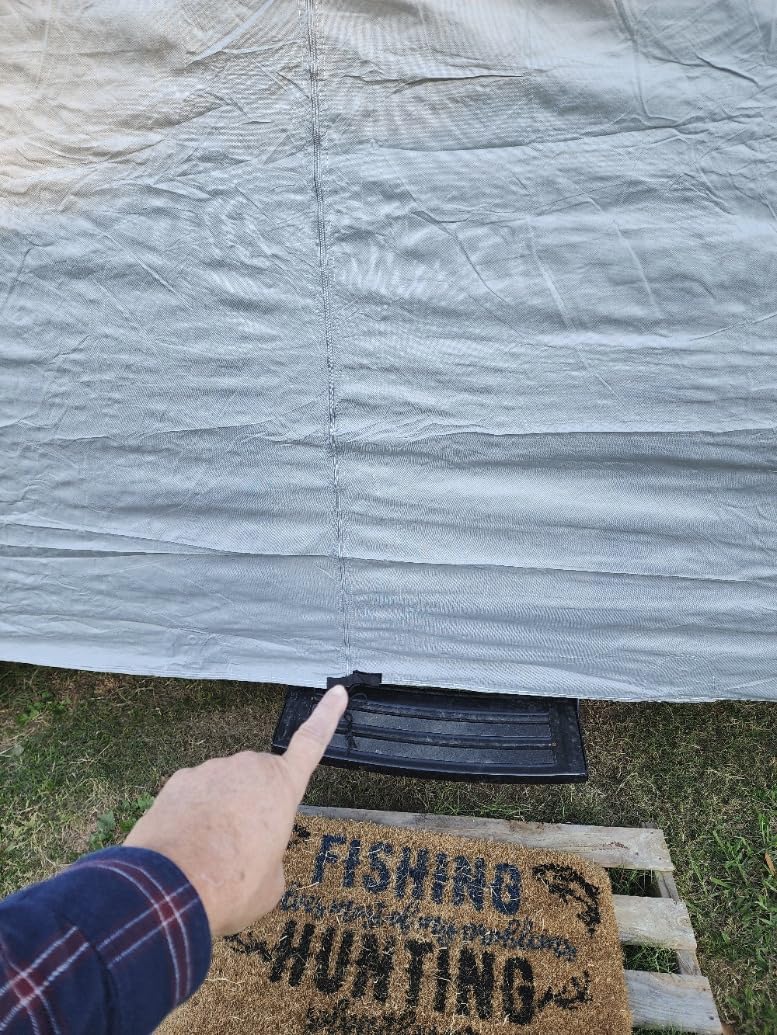
Fit is generous rather than tailored. Reviewers who follow the seller measuring guide report accurate results, but those who order the band by trailer name report loose material. Windproof straps plus six sponge drain gutter covers keep the fabric from touching the paint at the most common rub points.
Four rollable zippered doors, three on the right side and one at the rear, plus reflective strips front and rear cover the access and safety basics well. A storage bag is included and no special tools are needed to fit it.
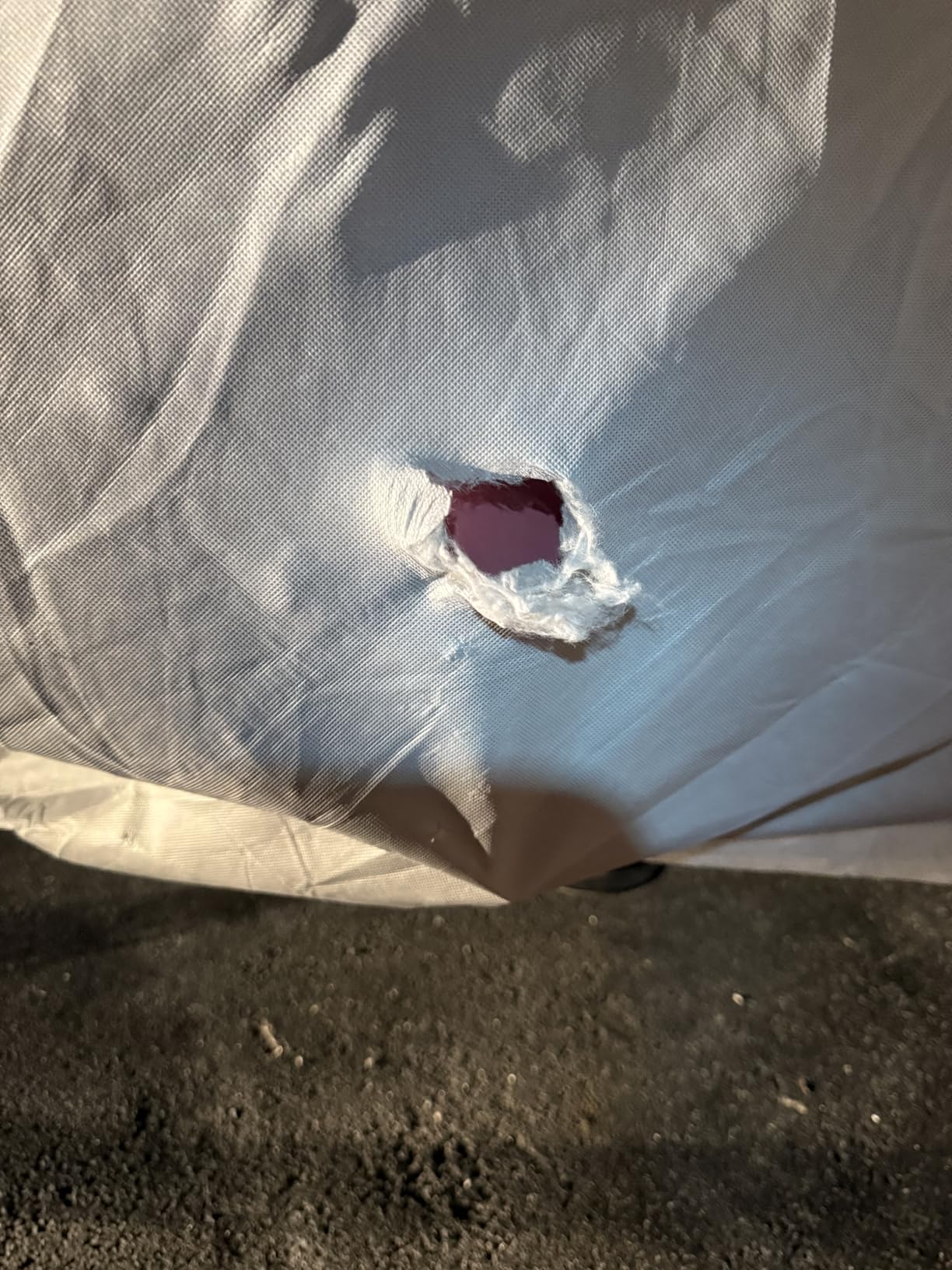
The two-tone seam is the failure point
Owners in genuinely high-wind states report the seam between the grey and white material as the place the cover tears first. If you are storing in open country with sustained wind, run a strip of fabric tape along that seam before the cover goes on and the weak point stops mattering.
This is the cover we would pick for heavy wet snow and freezing rain rather than dry powder, because the PU rating carries water better than a breathable membrane does.
Why 2000mm beats a bigger layer number
Two covers here both claim nine layers, but only one publishes a coating rating. A stated millimetre rating is a testable number, while a layer count is a marketing term that frequently describes the top panel only. When you are choosing between two nine-layer covers in a wet winter, the coating figure is the better tiebreaker.
8. KING BIRD Rip-Stop Cover – for 30 to 33 ft Class A motorhomes
KING BIRD Standard RV Cover, Fits 30-33ft Class A Motorhome
Fits 30 to 33 ft Class A
400lb rip-stop with 2500mm membrane
20% lighter design
Pros
- 400lb rip-stop fabric with double-stitched top and edges
- Multiple owners report 3+ winters of service
- Straps anchor higher on the body
- Customer support responds quickly on replacements
Cons
- UV exposure can fade the roof fabric within about a year
- Vacuum-sealed packaging makes returns difficult
- Weight and bulk mean a two-person installation
- Downspout and bumper contact fail first
A Class A is a different job. The body is tall and flat-sided, the paint is expensive, and one gust across a broad side panel is enough to turn loose fabric into an abrasive sheet. This cover is built for that panel area, measuring 396 inch long by 110 inch wide by 120 inch tall.
The 400lb rip-stop fabric is double-stitched along the top, edges and corners with thickened stress points, and a 2500mm waterproof membrane handles the water side. Six air vents sit on the sides where a motorhome traps the most moisture.
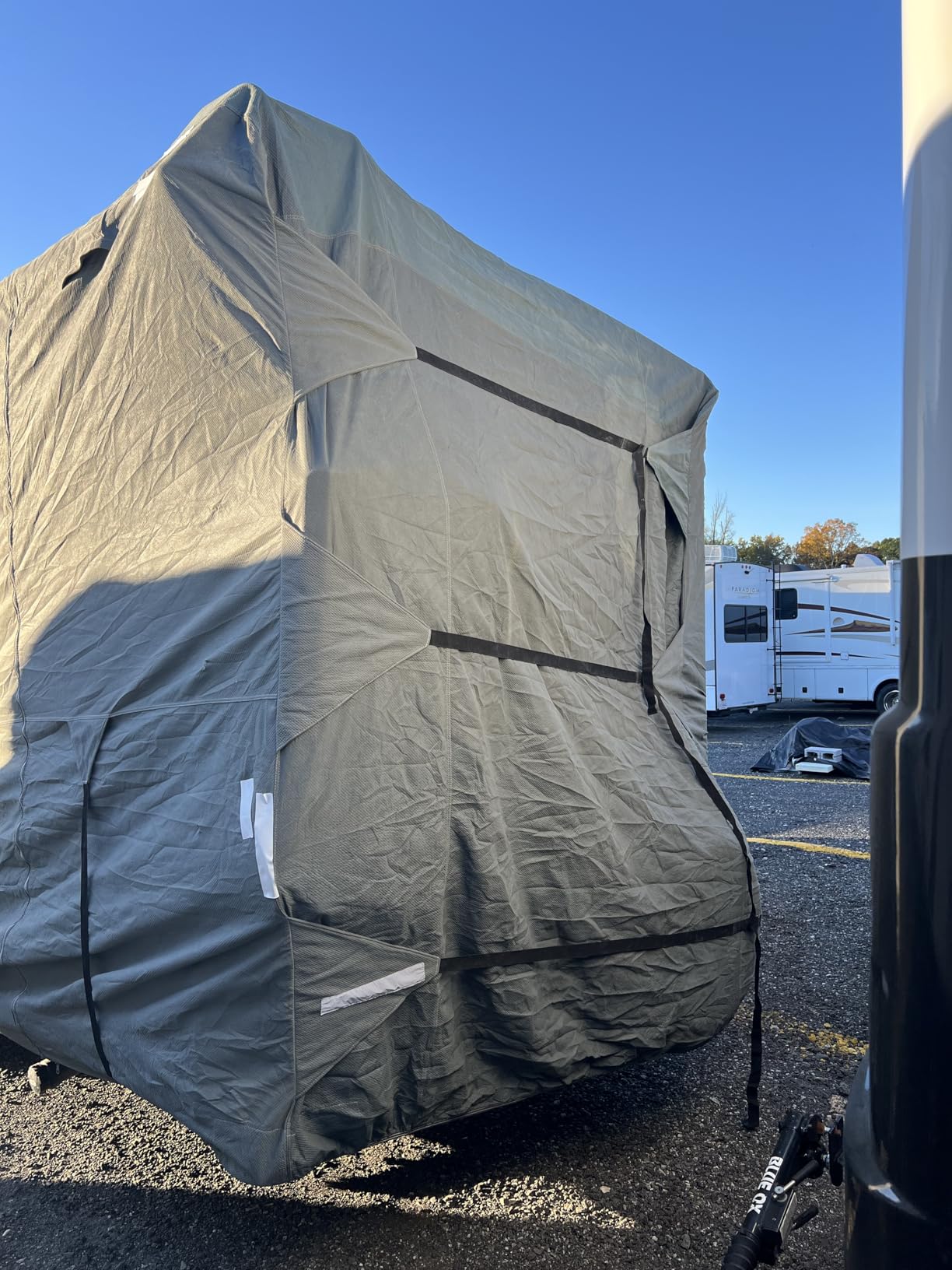
Relocating side middle tension panels anchor higher than a bottom-hem-only design, and two extra securing straps add to that. Two rollable zippered doors plus two rear zippers for toy haulers handle storage access.
The lightweight angle is genuinely useful on a coach. A 20% weight reduction and 25% volume reduction makes the cover easier to lift onto a 120 inch tall body, which is where a two-person install earns its keep.
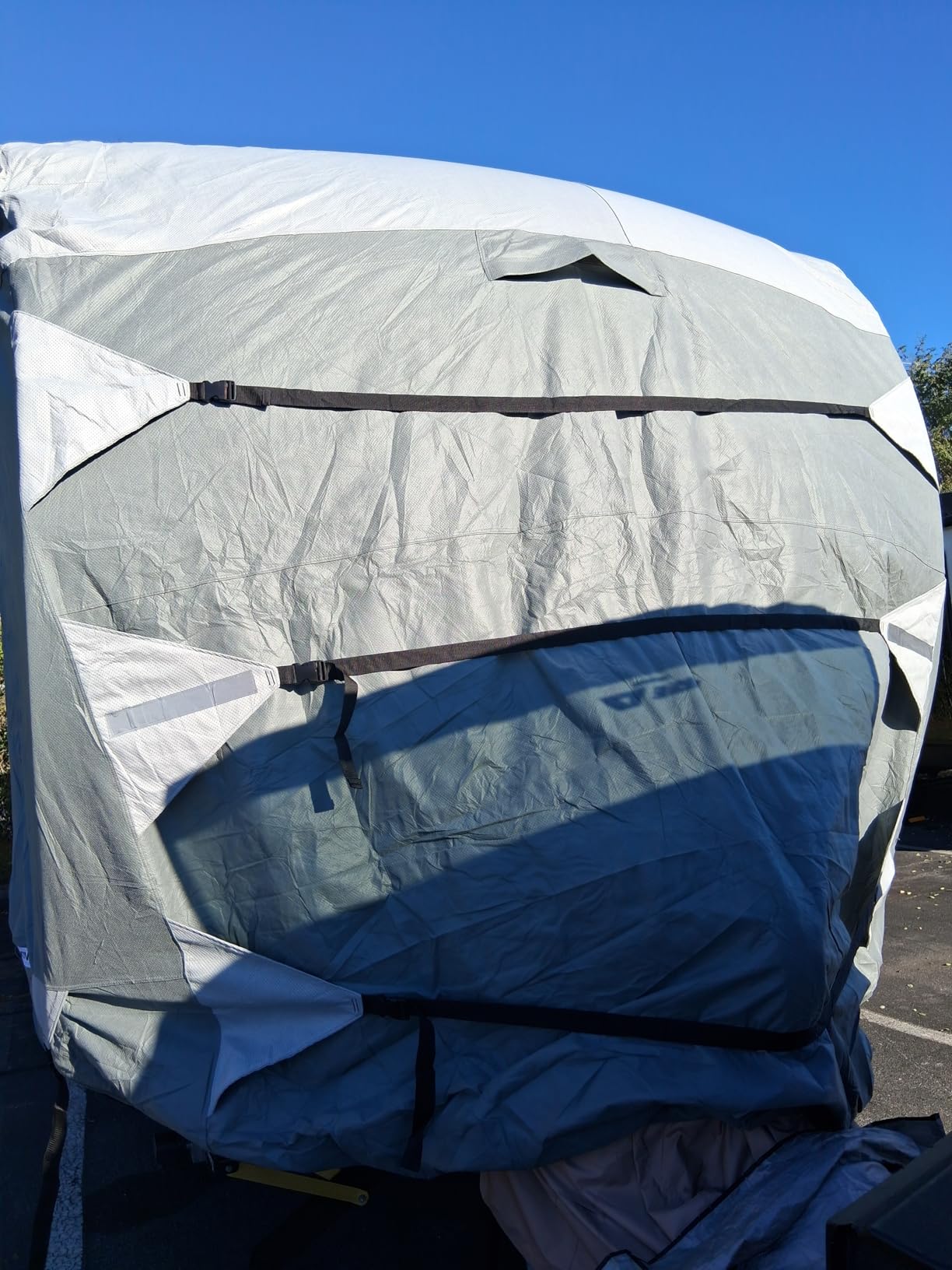
Shade matters more than snow on a coach
Long-term reviewers converge on roughly three winters of service and confirm the rip-stop survives wind and snow without leaking. The consistent complaint is the roof fading from UV exposure within about a year on units parked in direct sun. A high-UV state will shorten that.
If your storage spot is open desert sun rather than northern snow, pair this cover with anything that shades the roof, or accept that you will replace the fabric before you replace the trailer.
Downspouts and bumpers are your inspection list
Downspout wear points and bumper contact are the first areas to fail on this model. Sponge covers over the gutter spouts cost almost nothing and remove most of that risk. Check the bumper-to-fabric gap when you tighten the hem in January.
9. Fonzier 9-Layer Cover – the padded-corner option for 26 to 28 ft trailers
Fonzier RV Cover, Heavy Duty 9 Layers Travel Trailer Cover, 26-28FT
Fits 26 ft 1 in to 28 ft 6 in
9-ply top with 3-ply sides
8 fleece paddings
Pros
- Eight fleece inner reinforcements at roof and corner contact points
- Five zippers give fast install and toy-hauler access
- Complete bundle with steel weight blocks
Cons
- No UV protection claim on the listing
- Only 4 bottom straps versus 6 or 9 elsewhere
- 507 reviews is a thin sample
- Limited size variants
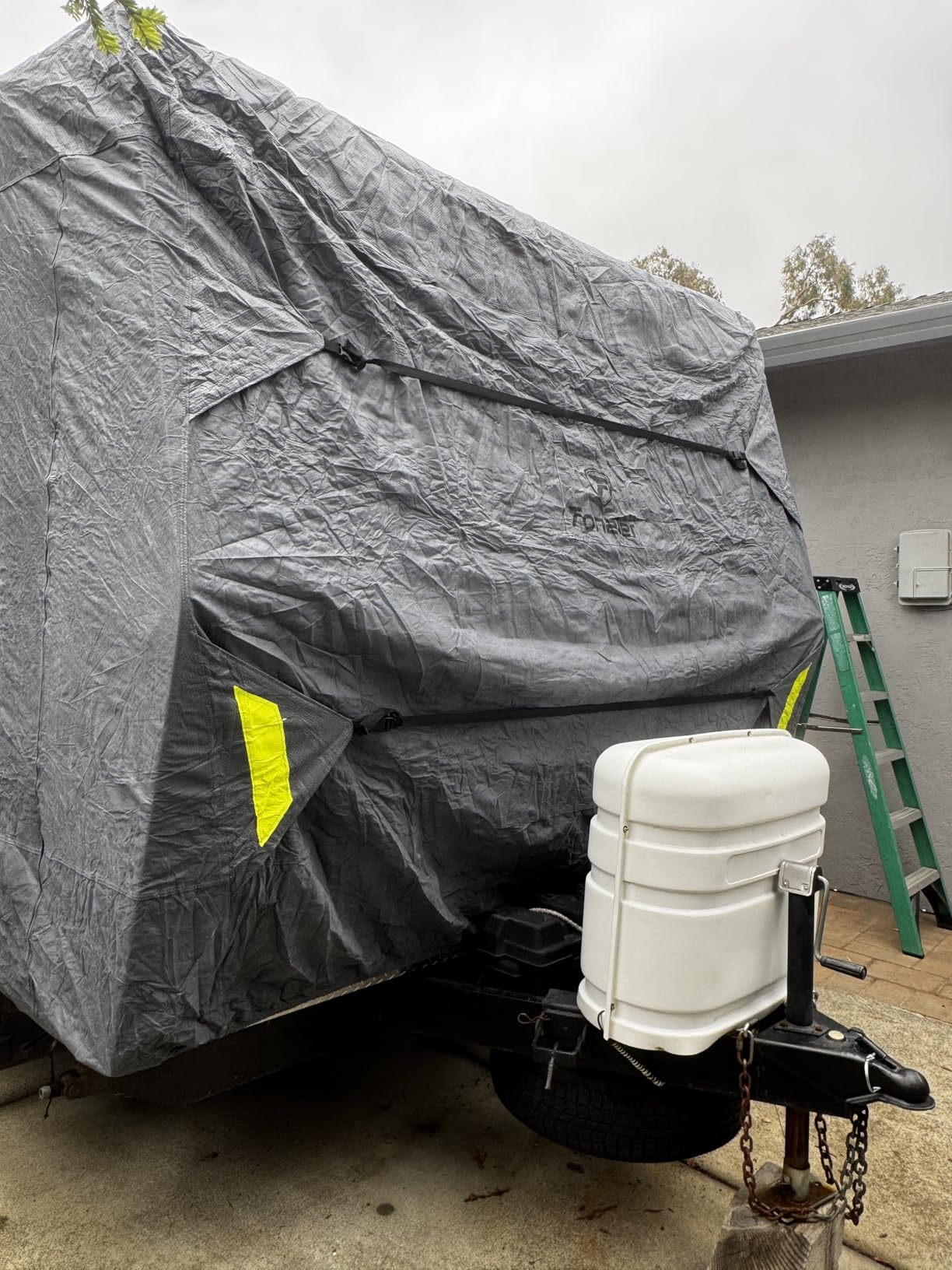
The distinguishing detail is padding. Eight fleece inner reinforcements sit at the top, rear and sharp corners, which are the places other covers in this roundup report tearing from the inside out. If your trailer has a rear ladder and a roof vent, this is the cover that addresses that wear pattern by design.
The build is a 9-ply top with an anti-UV composite and waterproof membrane over 3-ply reinforced sides, joined with double-stitched seams. The size band runs from 26 foot 1 inch to 28 foot 6 inches.
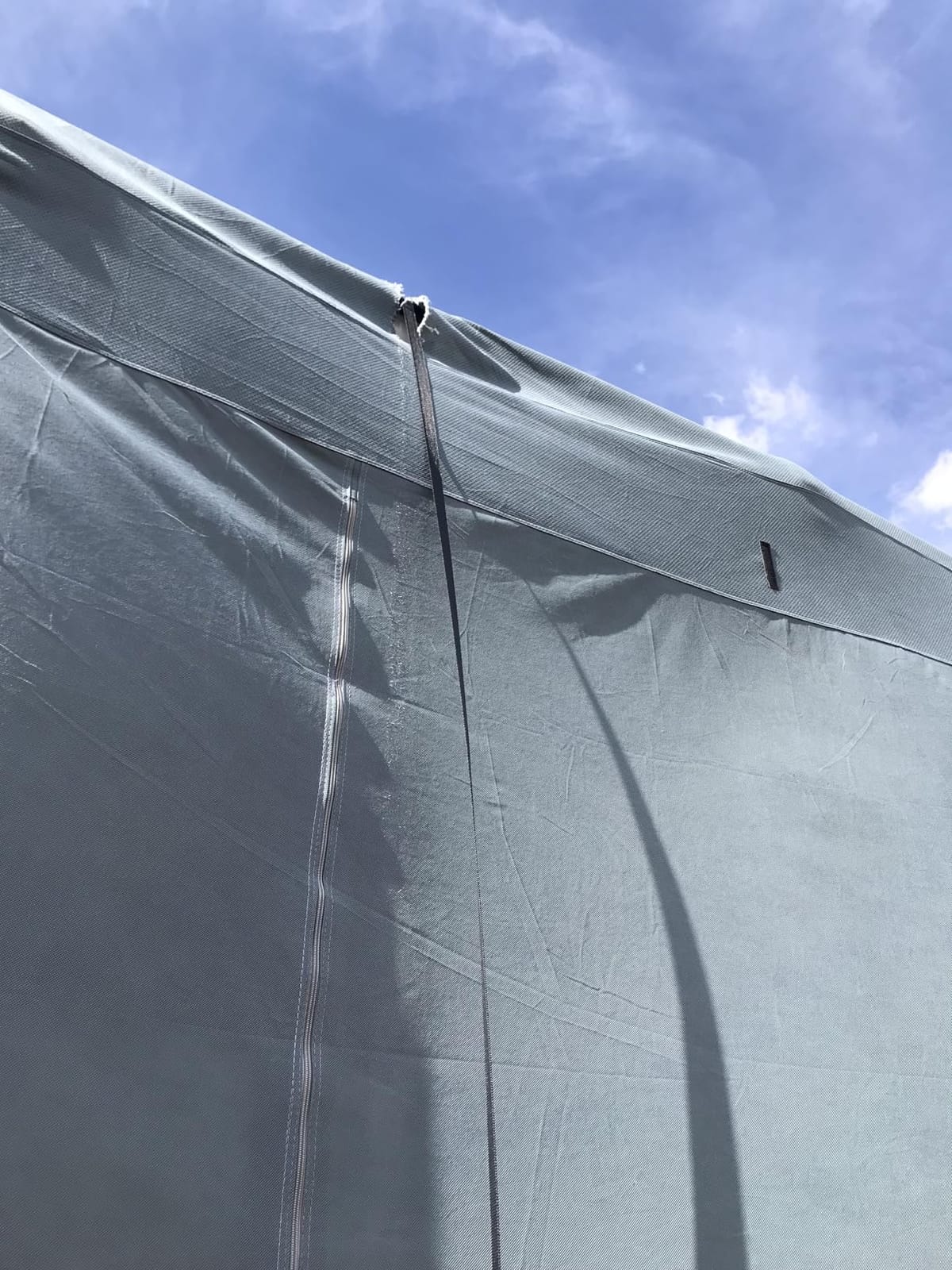
Five zippers speed installation and support toy haulers, and four redesigned bottom straps plus two all-around 42 inch straps handle the anchoring. Six air vents along the roof line on both sides keep the top dry.
The accessory bundle is generous: four tire covers, tongue jack cover, six gutter spout covers, an 11 inch by 11 inch repair patch, four bottom straps, two front and two rear straps, two steel weight blocks and a storage bag.
Whether the padding replaces extra straps
Four bottom straps is fewer than the six or nine offered by the Umbrauto and RVMasking. In a mild or moderate winter the fleece padding matters more than anchor count because the wear, not the wind, is what ends these covers. In an exposed windy lot, add a lashing strap across the front before you walk away.
The two steel weight blocks included with the kit are there for this purpose. Use them along the front hem where billowing starts.
What 507 reviews can and cannot tell you
At 507 reviews this is a thin sample, so treat the star rating as less certain than the others. What the reviews do support is consistency at 69% five-star, plus clear enthusiasm for the fleece padding and a price that sits low against other nine-layer covers.
Also note the listing carries no UV protection claim even though the top includes an anti-UV composite. For a high-UV location, check the fabric against direct sun periodically.
10. FRUNO Oxford Fabric Cover – the pick rated for deep cold
FRUNO Oxford Fabric Travel Trailer Cover RV Cover 24′-27′ Waterproof Rip-Resistant Anti-UV Camper Cover for Winter Snow with Jack Cover 4 Tire Covers and Gutter Covers
Fits 24 to 27 ft trailers
300D Oxford top with 150D sides
Rated -4 to 120 degrees
Pros
- Only cover here with a published temperature rating
- Dense PU-coated Oxford fabric is genuinely air-impermeable
- Mid-side strap placement gives a close fit
- Four roll-up panels for sustained access
- Two years of no-questions replacement support
Cons
- Heavy fabric needs two people to install
- Poorly translated instructions
- Some zipper-seam thread separation after a few weeks
- Slide-outs and large canopy units can prevent a clean fit
This is the only cover in the group with a published temperature range, rated from -4 to 120 degrees. That matters if your rig sits in northern Minnesota, Maine or the Canadian Maritimes through a real cold snap rather than a mild winter, and it is the specification we would want to see most often from other brands.
The fabric is a heavy 300D Oxford on top with 150D Oxford on the sides, coated with a dense PU finish in a tight weave. Unlike a breathable membrane, that construction is air-impermeable, so water and snow shed rather than sitting on the surface.
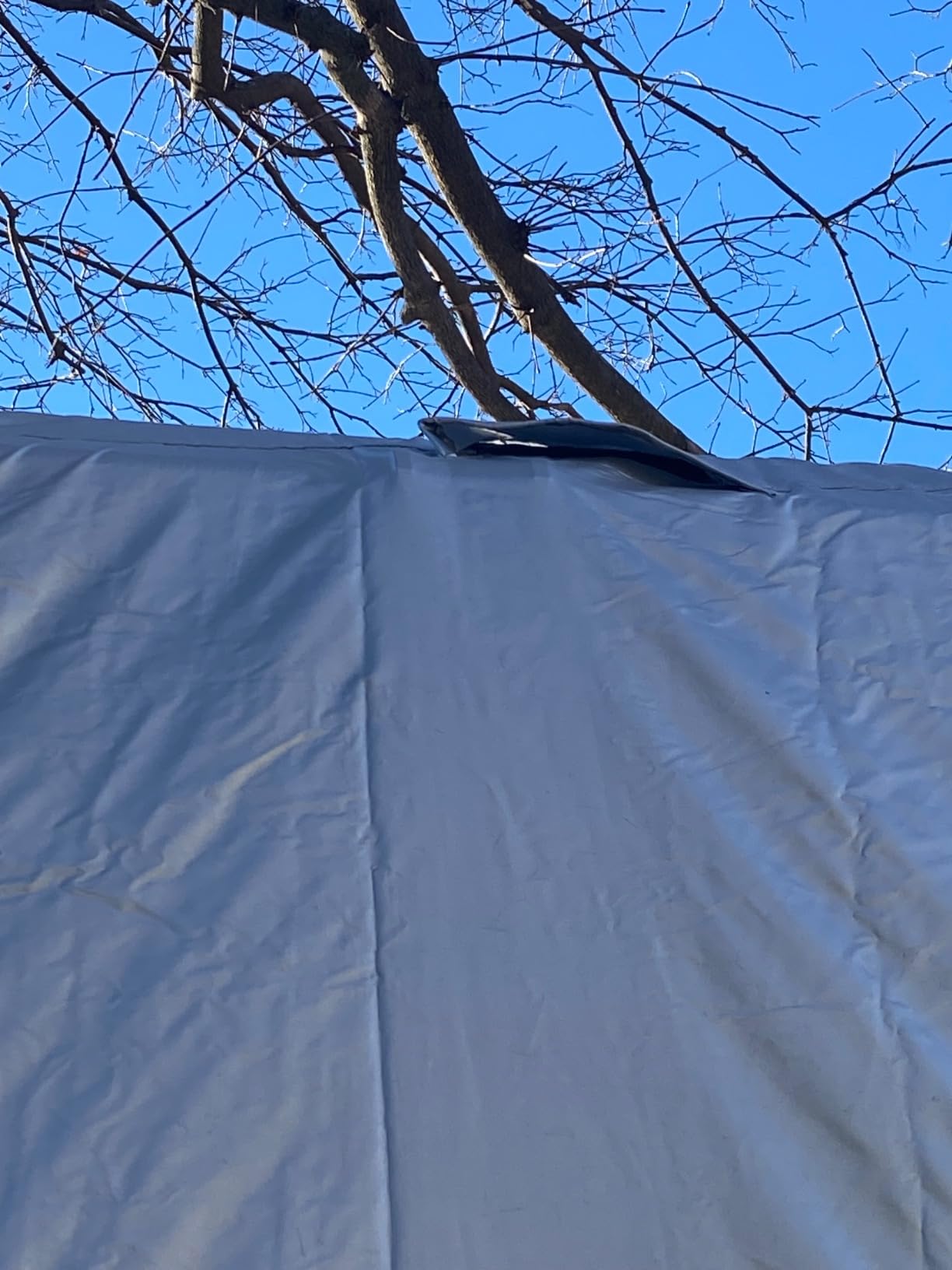
The strap layout is the standout. Straps fix at mid-side rather than only along the bottom hem, which pulls the fabric against the body instead of letting it hang. Owners consistently credit the strap placement, and it is why we recommend this one in open, exposed lots.
Four rollable panels, two per side, use concealed internal velcro straps so the panels stay rolled up rather than flapping back down. Support runs two years with free repair or replacement and no return required.
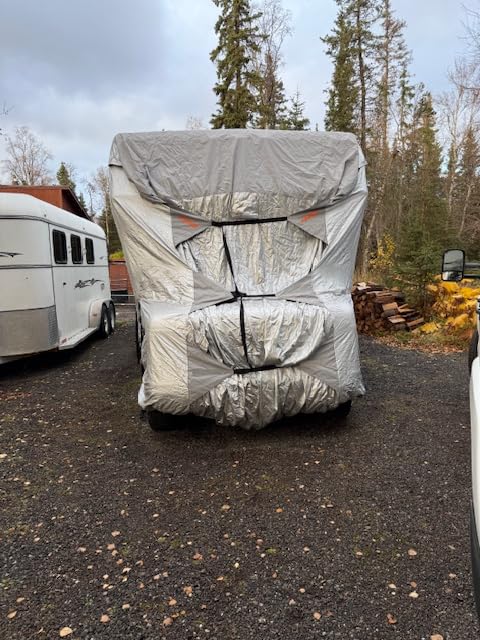
Air-impermeable means you must clear snow
An air-impermeable cover does not absorb meltwater, but it also does not let vapour out. That is the trade you are making for deep-cold toughness, and it is why the six-inch snow clearing rule matters more on this cover than on any breathable model.
The kit includes two adhesive repair patches, two lashing straps, six gutter spout covers, a jack cover, four tire covers and a storage bag. Buy a separate patch rated for the Oxford weave if you want to repair in place mid-winter.
Before you order, check the shape
Reporters mention large canopy AC units and slide-outs preventing a clean fit. Measure the widest point including any slide-out extension you use, and if your rig has a large canopy unit, expect to run the front tension panel looser than you would like.
11. Classic Accessories PolyPRO 3 Deluxe – the breathable Class C option
Classic Accessories Over Drive PolyPRO 3 Deluxe Class C RV Cover, Fits 23′ – 26′ RVs, Model 3, Air Vents, Water-Repellant Top Panel, Durable, Breathable, Resists Tears and Rips, Grey/White
Fits 23 to 26 ft Class C
Triple-ply top panel
Air vents and elasticized corners
34.6 lb
Pros
- Breathable construction that vents moisture rather than trapping it
- Triple-ply top resists tears across multiple seasons
- Adjustable tension panels and elasticized corners
- Air vents cut wind stress as well as interior moisture
- Three-year warranty from a long-standing brand
Cons
- Water resistant rather than fully waterproof
- Heavy 34.6 lb unit is hard work for one person to lift
- Durability feedback is mixed on prolonged heavy rain and snow
This is the breathability pick. On a rig stored over concrete, or in a humid coastal climate, a cover that vents vapour is worth more than one that is technically more waterproof. Water-repellent fabric lets the daytime moisture in your trailer escape instead of condensing against the sidewall every night.
The PolyPRO 3 top is a thick triple-ply panel, and the air vents cut wind stress as well as interior moisture. Adjustable tension panels and elasticized hem corners create a custom-like fit on Class C motorhomes from 23 to 26 ft long and 122 inch ground to roof.
Zippered panels give access to doors and engine areas without removing the cover, and the integrated straps with toss bag system speed installation. Stuff sacks and ladder caps are included and the warranty runs three years.
At 34.6 pounds it is a heavy unit to handle, which means two people for the first fit or a planned afternoon with a good ladder setup. Once on, the breathability is the reason owners keep it on for the whole season without lifting it for ventilation checks.
Where breathability beats waterproofing
If your storage surface is a cement slab rather than gravel or soil, moisture from the pad works its way up into the underbody and the trapped vapour has to go somewhere. A breathable cover handles that better than a sealed one, and owners storing on concrete report fewer mildew complaints with this style of fabric.
Check the fabric under a vent panel after a month. If it is dry on both sides, the vent layout is doing its job.
When it is the wrong choice
If you are in a coastal salt-air site or under a shelter where rain blows sideways from one direction, water-repellent is not enough and a sealed coated cover serves you better. Mixed feedback also appears on prolonged heavy rain and snow, so for the wettest winter climates pick a coated construction instead.
12. Xenjum 8-Layer Cover – built for 35 to 38 ft trailers
Xenjum RV Cover for 35-38 ft Travel Trailers, 8 Layers Heavy Duty Camper Cover, Weatherproof & UV Resistant Motorhome Trailer Cover with Gutter & Tongue Jack Covers
Fits 35 to 38 ft trailers
8-layer non-woven top
PU coating for UV resistance
Pros
- Thick 8-layer non-woven with professional double stitching
- Velcro-reinforced zipper resists tearing in wind
- Five inner bottom straps plus 2 extra-long straps
- Reflective strips on all sides
- 3 roll-up side doors plus 6 air vents
Cons
- Lighter build gives up protection versus heavier multi-layer covers
- Length-only sizing leaves loose material on a shorter trailer
- One-year manufacturer warranty
The upper end of the travel trailer size band is poorly served, and this fills that gap. At 464 inch long by 102 inch wide by 104 inch tall it covers rigs from 35 to 38 ft, where most catalogs stop offering a genuine full-length cover.
Construction is 8-layer non-woven with professional double stitching and a PU coating for a claimed 50% increase in UV resistance. Five inner bottom windproof straps plus two extra-long all-around straps anchor a body this length, and elastic hem corners with four adjustable front and back tension panels take out the slack.
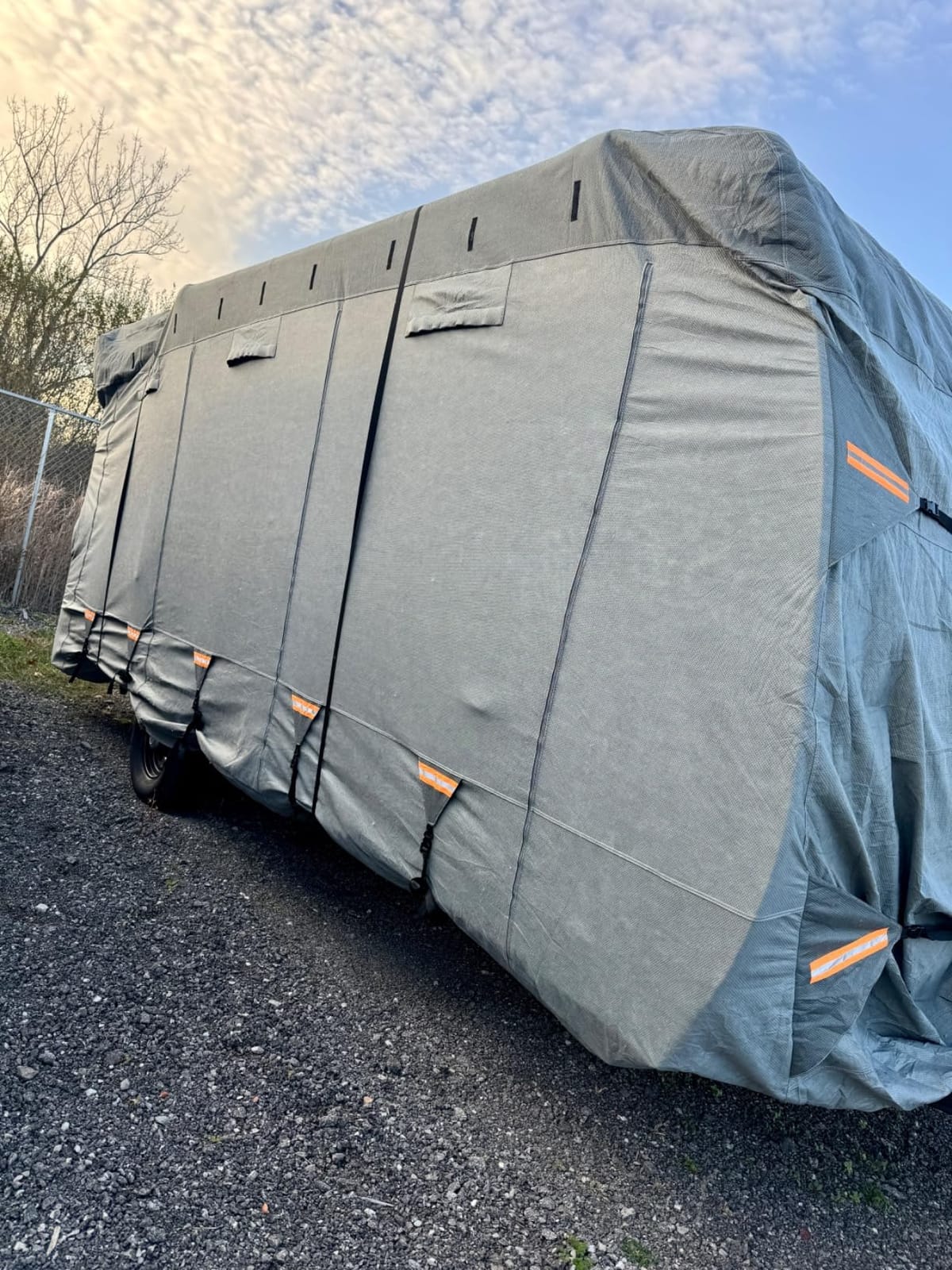
The zipper opening is velcro-reinforced, which directly answers the complaint we heard most often about zipper failures in high wind. Three roll-up side zipper doors give access and six air vents handle moisture on a top panel this large.
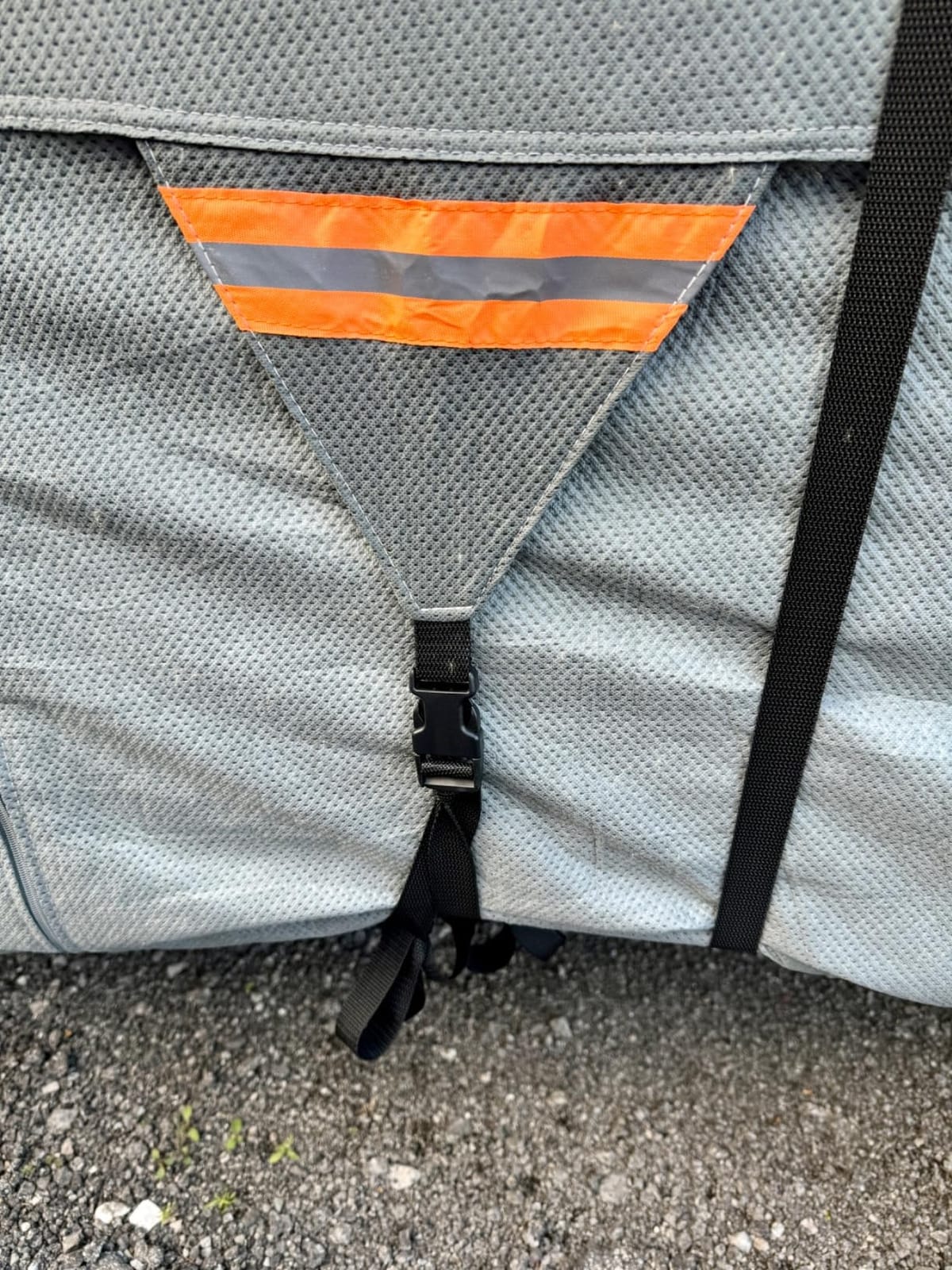
Reflective strips on all sides matter here more than on a short trailer, since a 38 ft rig is easy to clip with a low obstacle in a dark lot. The kit includes five lashing straps, two extra-long straps, six gutter spout covers, a jack cover, two repair patches, a storage bag and a toss bag.
Sizing by length only
The fit is length-based, so extra length on a trailer near the short end of the band leaves loose material at the rear. If you sit at 35 ft in a 38 ft cover, pull the rear tension panels hard and use the lashing straps diagonally before the first storm.
Measure the height including the roof AC before ordering. A tall A-frame with a unit on top can exceed the 104 inch figure even when the length band matches.
Where a lighter build shows
Owners like how easy this cover is to handle, and that ease is the reason for the lighter construction. In exchange you give up some protection against a heavy wet snow load compared with the heavier 9-layer models. Clear snow at six inches and this performs fine through a normal northern winter.
How to choose a winter RV cover for your climate
Match the fabric to the weather you actually get, then check the tie-down system. A cover that beats snow but loses a gust is worse than one that does both adequately, because the billowing that follows a loss is what rubs your paint.
Match the fabric to your winter
For heavy dry snow, prioritize a reinforced 9-ply or 9-layer top panel and plan to clear snow at about six inches. Wet snow and freezing rain are heavier per cubic foot, so prioritize a coating with a published rating rather than a layer count. For coastal wind and salt air, prioritize strap architecture and mid-side or undercarriage anchoring. For high-UV desert states, prioritize a UV-rated coating and accept a shorter fabric life.
Breathability matters most where you store. On a cement pad or in a humid climate, vapour permeability beats waterproofing because that is where mold starts.
Why waterproof is the wrong goal
A fully sealed cover blocks rain but also blocks vapour. Overnight temperature swings draw moisture out of the trailer and the air inside, and a sealed shell traps it against the sidewall where it condenses. Over five months that becomes mold and mildew, plus the black streaking people associate with covers that never dry.
What you want is water-repellent on the outside and breathable through the middle. Several covers here describe exactly that stack, a water-repellent outer coating over a breathable middle membrane.
Layer count is marketing, fabric weight is the spec
A nine-layer claim almost always describes the top panel only. Sidewalls in the same cover run three-ply or 110g. When you compare two covers with identical layer claims, look for a published fabric weight in g/m2 or a coating rating in millimetres, because those are testable numbers.
Established brands such as Classic Accessories and Covercraft have long published weight and weave rather than layer counts, which makes their specs easier to compare against anything in this roundup.
The four tie-down features that stop wind damage
First, bottom straps with locking buckles rather than simple elastic hems. Second, tension panels at front and rear that can be reloaded as fabric settles. Third, straps that cross over the roof or anchor under the chassis, since a hem-only design can lift as one piece. Fourth, corner reinforcements, and at the rear, heightened patches that cover ladder edges.
Owners report most tears begin at a contact point and propagate. Padding a downspout or a roof AC corner with foam before the cover goes on is the cheapest durability win available.
What a cover does not protect
A cover does nothing for tires, which continue to flat-spot and deteriorate through a stationary winter, so tire covers are worth adding. It does not stop rodent entry, which is a separate exclusion job on the underbody and utility openings. It does not protect the propane compartment, and it does nothing for slide-out seals, which are a common leak source in freeze-thaw weather.
Nor does it winterize anything. A cover is one part of a storage system, alongside battery maintenance, plumbing protection and rodent proofing.
How to measure your RV before you order a cover
Measure the whole rig, not the box. The three mistakes below account for most of the covers that come back, and all three are free to avoid with a tape measure and ten minutes.
Include everything that sticks out. Measure bumper to hitch box or front cap, plus the rear ladder, spare tire, roof AC unit and any satellite dish or rack. Add an inch of clearance if a component is proud of the body.
Measure width at the tallest point. Most covers run around 100 to 105 inch wide. A rig with a wide slide-out or a large canopy unit will not fit that envelope cleanly.
Measure height with the roof gear fitted. An air conditioner on a raised A-frame pushes you into the next height band, and some size bands overlap only partially.
For length, find your trailer’s actual box length including the tongue and A-frame, then pick the band that encloses it. If you sit at the very top of a band, assume loose material at the rear and bring tension panels into play. If you sit at the very bottom, expect a tight fit at the rear corners and check the ladder clearance.
On a cement pad, also check the cover hem will clear the surface. A hem that drags on concrete collects grit that abrades the finish every time the wind moves it.
How to install a cover without walking your roof
Never walk an EPDM or TPO membrane to fit a cover. That is the single rule behind this method. Two ladders and a helper get the job done with zero roof contact, and our full method matches the approach we use on any long-exposure gear, similar to the setup behind our firewood storage shed guides.
Clear the roof before you climb. Brush off snow, leaves and grit from anything the cover will rub against. Do this from the ground with a telescoping pole.
Pad the contact points. Wrap downspouts, ladder rails, roof AC corners and antennas with foam or the supplied sponge covers. This is where tears start.
Unroll and orient. Lay the cover out in front of the trailer with the front cap toward the hitch. Confirm which face is the top panel before anything goes overhead.
Set two ladders. Place one at the front and one at the rear, both leaning against the gutter rails or a solid edge, never against the ladder or antenna.
Throw the rope. Attach the supplied toss sticks to the front corners and toss them over the roof to your helper, who catches them behind. This takes roughly a minute.
Pull the front over. Both helpers pull the front panel down over the front cap while one person walks the length of the cover to seat the top panel.
Pull the rear and zip. Seat the rear panel, then close the rear zipper and confirm the perimeter run is seated in the elastic hem the whole way.
Tension and walk away. Load the bottom straps, the front and rear tension panels, then re-check every buckle after the first windy week.
Budget 30 to 45 minutes for two people. Add 15 minutes if the cover weighs over 30 pounds or you are fitting a Class A.
Mid-winter maintenance checklist
Set a recurring date in the first week of every month between November and March. Eight checks, about twenty minutes each, cover everything that actually goes wrong.
Re-tension every buckle. Fabric settles as it takes on moisture. A strap that felt snug in November needs a quarter turn by February.
Clear snow at six inches. Dry snow is light, but wet snow reaches about 20 pounds per cubic foot. Several hundred pounds of meltwater refreezing in the fabric is what stretches seams, so clear before it settles.
Look for pooled water before it freezes. Check the low point at the rear and inside any tented fabric between roof structures. Ice forms there first and stretches seams.
Inspect all four rear corners. Ladder edges and downspouts are where fabric frays. Patch small frays with the supplied adhesive patch before they become tears.
Check the zipper runs. Roll them closed, not flapping open. A flapping zipper panel catches wind and tears the velcro reinforcement over time.
Confirm vents are clear. A vent blocked by snow or a leaf turns a breathable cover into a sealed one.
Look for rodent entry. Check the underbody and around utility penetrations. A cover does not exclude rodents.
Photograph the cover. A phone photo from the same angle each month makes slow degradation visible in a way memory loses.
Never pull snow off a frozen cover with a sharp tool or by dragging it across the top panel. Clear from the edges with a plastic roof rake on an extension pole, and clear the sides last.
Cover vs tarp vs shrink wrap vs a storage building
On a five-year view, a fitted cover sits in the middle. Shrink wrap holds moisture directly against the finish and cannot breathe, so it works against you on anything stored longer than one season unless the rig is inside. A loose tarp rubs paint, catches wind, and pools rain in a sagging pocket, which is why most tarp advice is negative.
A pole building or carport is the durable answer if you have the space and the zoning. It also costs the most and it does not do anything for a rig already under a roof. Renting commercial indoor storage is the cheapest version of that answer, and it removes the cover decision entirely.
A fitted cover is the right call when you store outdoors on your own pad. It is the lowest-cost option that actually addresses UV, snow and wind while letting moisture escape, and it is the only one of the four you can install in an afternoon.
If you are covering for the first time and want the rest of the winter storage system, start with the cover, then add tire covers, rodent proofing and a battery maintainer. Our RV kitchen guide covers what to pull out of the galley before a long storage season.
Frequently Asked Questions
Should I cover my RV for winter storage?
Yes, if your RV sits outdoors from October through March, unless it is already under a carport, inside a dry storage building, or in weekly use. A fitted cover slows UV and freeze-thaw damage and keeps snow off the roof. Skip it for a cement pad paired with a non-breathable cover, and skip it for a rig you drive every weekend.
What is the best material for RV covers?
For most winters, a breathable non-woven polypropylene with a reinforced multi-layer top panel is the best balance. Look for a water-repellent outer coating over a breathable middle membrane, plus a published coating rating in millimetres if you are in a wet or coastal climate. Woven Oxford with a dense PU coating performs best in deep cold because it is air-impermeable, and laminated fabric suits rigs stored year-round in high-UV states.
What is the best RV cover to use in harsh winters?
Start with a 9-ply or 9-layer reinforced top panel and clear snow at about six inches. Wind matters more than most buyers expect, so choose bottom straps with locking buckles, adjustable front and rear tension panels, and corner reinforcement at the rear ladder. Among the covers we compared, the RVMasking has the most complete strap architecture and the FRUNO Oxford build is the only one with a published cold rating down to -4 degrees.
Which brand of RV cover is considered the best quality?
Established brands such as Classic Accessories and Covercraft publish fabric weight and weave rather than layer counts, which makes their specs easier to compare. In this roundup the best-rated options with the deepest review bases were the MOFEEZ at 4.5 across 3316 reviews and the Umbrauto at 4.5 across 1437. Judge any cover on review volume as well as star rating, since 4.5 on 3000 reviews is far stronger signal than 4.7 on forty.
Can you use a tarp as an RV cover?
A loose tarp is not a good substitute. It does not fit the contours of a trailer, so wind makes it billow and rub against the finish, and it pools rainwater in sagging pockets. It is also not breathable, so it traps condensation against the sidewall. Use a tarp only as a temporary shield over an already-covered rig, or for a short repair period.
The bottom line
If your trailer is 24 to 27 ft and you want one cover that handles snow, wind and UV without a weak point, the MOFEEZ is our pick: 3316 reviews at 4.5, a 9-layer top, and an accessory bundle that covers the tire covers, jack cover and gutter covers you would otherwise order separately. For exposed wind and 22 to 24 ft rigs, the RVMasking strap architecture is harder to beat, and the Umbrauto carries the longest warranty here at three years.
Go further down the list for your class: the DikaSun and Classic Accessories covers fit Class C motorhomes, the KING BIRD handles 30 to 33 ft Class A, and the Xenjum fills the 35 to 38 ft gap most catalogs leave. Whatever you pick, install it with two ladders and clear snow at six inches, and the best rv covers for winter storage will look new again next October.