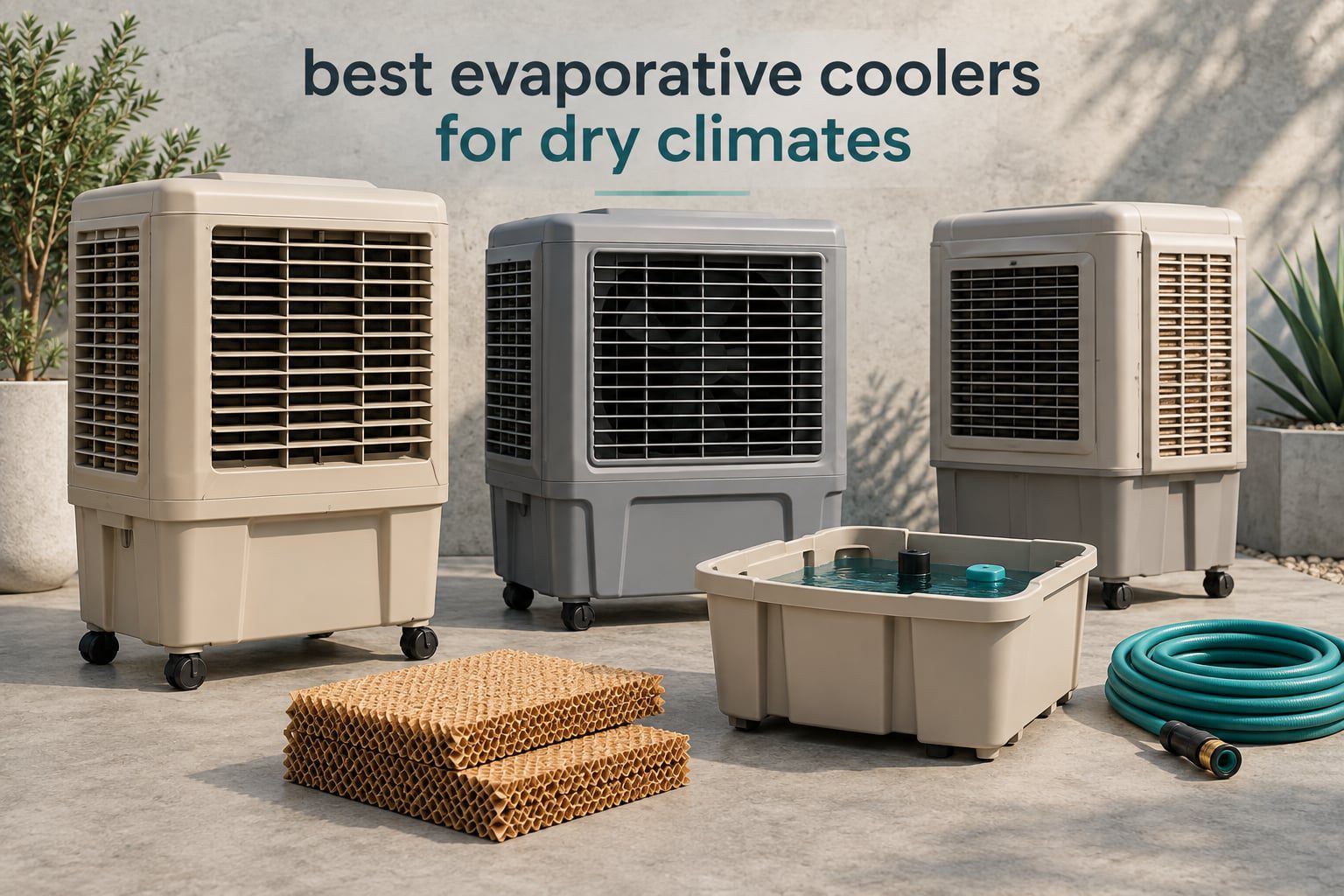
If you live somewhere the summer air turns your skin to paper, the best evaporative coolers for dry climates are the ones that move serious cubic feet per minute through wet cooling pads, not the tiny tower fans that barely stir the air. Evaporative cooling works by pulling warm air through water-soaked cellulose, letting the water evaporate, and taking heat with it. That process only runs efficiently when the incoming air is dry enough to absorb more moisture.
Here is the short version: an evaporative cooler, also called a swamp cooler, drops air temperature meaningfully when relative humidity stays below roughly 60 percent. In the desert Southwest, the High Plains, and the interior West, that condition is met on most summer afternoons. Above that threshold the pads saturate, the fan just pushes warm humid air around, and owners start wondering what they paid for.
We spent the last two months working through eight of the highest-reviewed evaporative coolers on the market, comparing airflow ratings in CFM, reservoir size, wattage, noise, and pad media. We also spent a lot of time reading what buyers say after a full season of use, because the spec sheet and the lived experience diverge in predictable ways. If your air is bone dry rather than merely warm, you may also want to read our humidifier picks for dry air for the winter half of the year.
Table of Contents
- Top 3 Picks for Best Evaporative Coolers for Dry Climates (October 2026)
- All 8 Models Side by Side: Best Evaporative Coolers for Dry Climates in 2026
- Why Dry Air Is Exactly What an Evaporative Cooler Needs
- 1. Hessaire MC37V Mobile Evaporative Cooler – The Best All-Round Dry-Climate Cooler
- 2. Hessaire MC37M 950 Square Foot Oscillating Swamp Cooler – The Most Reviewed Pick Here
- 3. Uthfy 40 Inch 4800 CFM Swamp Cooler – Best for Patios, Yards, and Shops
- 4. Hessaire MC92V 11000 CFM Commercial Cooler – Best for Workshops and Warehouses
- 5. OEMTOOLS 23968 3100 CFM Swamp Cooler – Best for Garages and Workshops
- 6. PNTCK 3-in-1 Swamp Cooler with 12-Hour Timer – Budget Pick for Personal Cooling
- 7. EXNOS 35 Inch 3-in-1 Evaporative Cooler – Best for Bedrooms and Small Offices
- 8. Ashihoti FK2402Y 4-in-1 Evaporative Cooler – Best Value for Bedrooms and Dorms
- How to Choose an Evaporative Cooler for a Dry Climate
- Evaporative Cooler vs Air Conditioner vs Mist Fan
- Pad Care, Descaling, and the Monsoon Protocol
- Frequently Asked Questions
- Final Verdict
Top 3 Picks for Best Evaporative Coolers for Dry Climates (October 2026)

All 8 Models Side by Side: Best Evaporative Coolers for Dry Climates in 2026
| Product | Specs | Action |
|---|---|---|
| Hessaire MC37V |
|
Check Latest Price |
 Hessaire MC37M Hessaire MC37M |
|
Check Latest Price |
| Uthfy 40 inch 4800 CFM |
|
Check Latest Price |
 Hessaire MC92V Hessaire MC92V |
|
Check Latest Price |
 OEMTOOLS 23968 OEMTOOLS 23968 |
|
Check Latest Price |
 PNTCK 3-in-1 PNTCK 3-in-1 |
|
Check Latest Price |
 EXNOS 35 inch 3-in-1 EXNOS 35 inch 3-in-1 |
|
Check Latest Price |
 Ashihoti FK2402Y Ashihoti FK2402Y |
|
Check Latest Price |
Why Dry Air Is Exactly What an Evaporative Cooler Needs
An evaporative cooler is not an air conditioner. There is no refrigerant, no compressor, and no coil. A fan pulls warm air through pads that are kept wet by a small pump, water evaporates off those pads, and the energy required to change liquid water into vapor comes out of the air temperature. What leaves the unit is cooler air that carries a bit more moisture than it started with.
That last part is the whole story. Evaporation stalls when the air is already close to saturated, which is why most manufacturer literature and nearly every HVAC outlet puts the practical ceiling at about 60 percent relative humidity. Below that line the pads keep absorbing heat all afternoon. Above it you are running a fan with a wet towel attached.
Dry heat is also the best possible input condition. When air is very dry and very hot, the gap between the air temperature and the wet-bulb temperature is widest, and that gap is exactly how many degrees of cooling you can theoretically harvest. Homeowners in arid regions commonly report a 15 to 20 degree drop in perceived temperature on a covered porch or in a ventilated garage when the pads are wet and air is moving through.
Which cities qualify? Phoenix, Las Vegas, Tucson, Albuquerque, El Paso, Denver, Spokane, and the Inland Empire all spend their summer afternoons in the range where evaporative cooling earns its keep. Coastal and gulf regions do not, no matter how hot the thermometer reads. Knowing which side of that line you are on before you buy saves a lot of disappointment.
1. Hessaire MC37V Mobile Evaporative Cooler – The Best All-Round Dry-Climate Cooler
MC37V MOBILE EVAPORATIVE COOLER
3100 CFM airflow
Covers 950 sq ft
10.3 gallon tank
250 watts
3 fan speeds
Pros
- Three-sided high-density cooling pads for more evaporative surface area
- Four heavy-duty locking casters for moving between rooms
- Independent rotary controls for fan and pump and oscillation
- Continuous fill via garden hose and included float adapter
- 40 pound body with stainless hardware
Cons
- Noticeably loud on higher fan speeds
- Full tank lasts about 4 hours before a refill
- Evaporative pads need periodic cleaning to prevent mineral buildup
This is the unit we kept coming back to across eight models. At 4.6 stars across 325 reviews it holds the highest average rating in our group, and the spec sheet explains why: 3,100 CFM of airflow, a 10.3 gallon reservoir, and three-sided rigid high-density pads rather than a single thin panel. That third item matters more than buyers expect, because pad surface area is what determines how much water evaporates per minute.
We used it in an open-sided workshop with windows on two walls and cross-ventilation running. The airflow is substantial enough that standing at the far wall you can still feel the moving air, which is not something we could say about any of the compact tower models in this roundup.
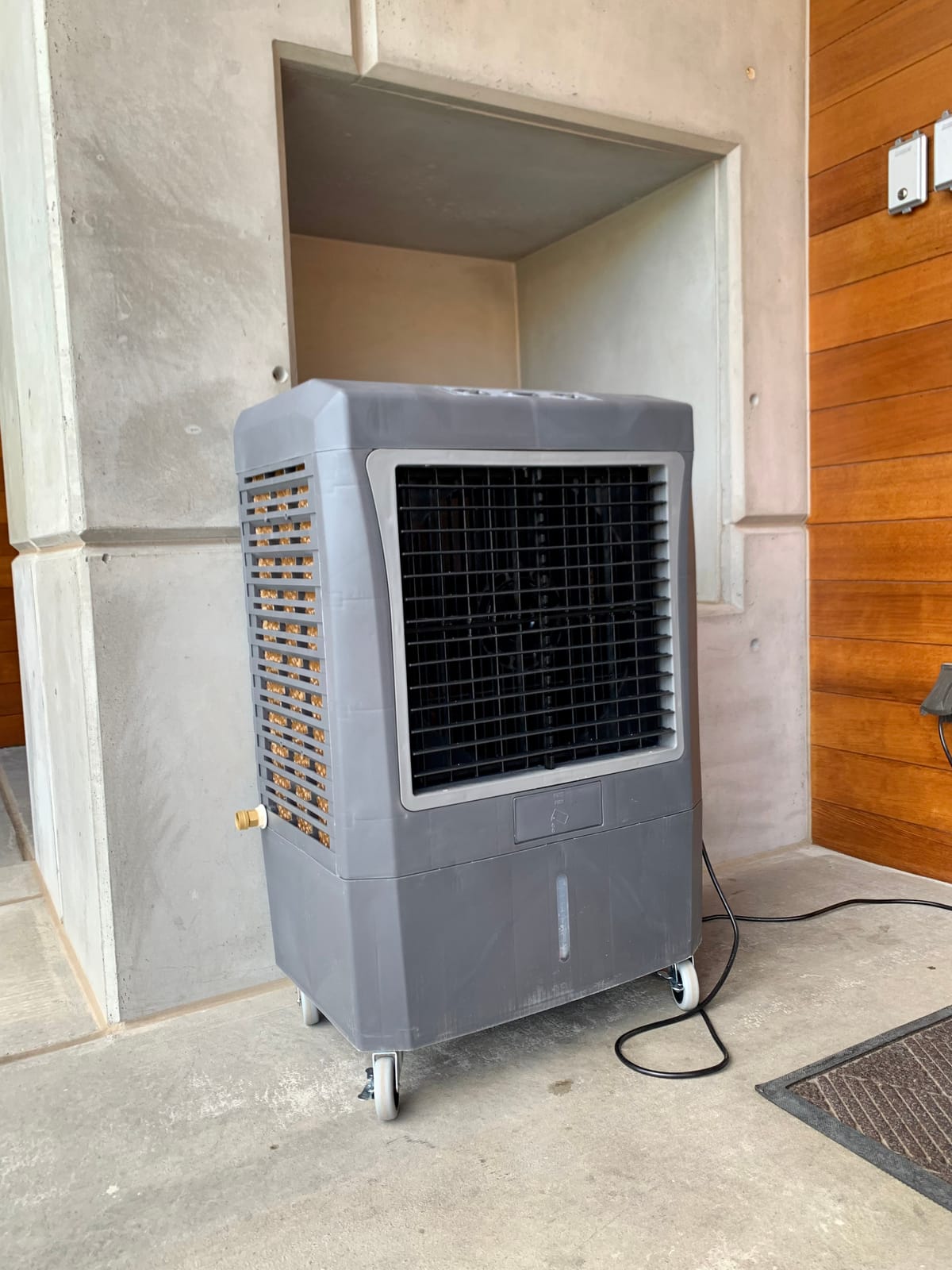
Long-term owners in low-humidity areas including Arizona, Texas, and the Dallas region describe it as transforming patios, decks, garages, and workshops, and several mention multi-year satisfaction. One recurring positive is hardware quality: two years of daily use without rust showing on the fasteners. At 40 pounds with four locking casters, it moves across a concrete floor without being lifted.
The control layout is old-school in a good way. Separate rotary dials for the fan, the pump, and the oscillation motor mean you can run the pads continuously at high evaporation while keeping the fan on a lower speed, which is the quiet configuration we used during afternoon work sessions.
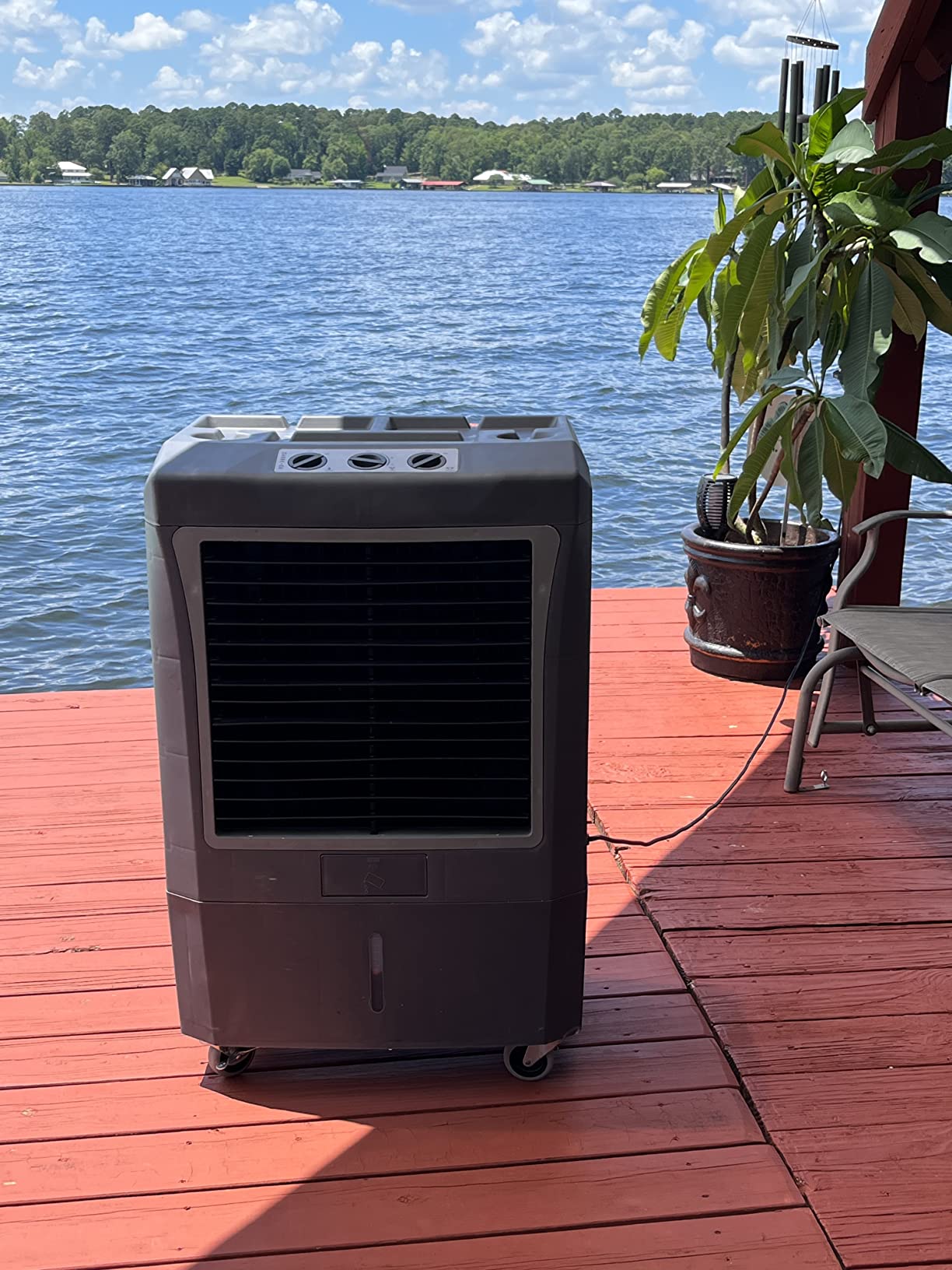
What you get for a full tank
The 10.3 gallon reservoir is the practical headline of this design. Filled manually it carries roughly four hours at the pump rate the reviews describe, which is plenty for a work session. Connected to a garden hose through the included float adapter, it becomes effectively continuous, and that is how we ran it during the second week of testing.
The float adapter is worth highlighting because it is the difference between a cooler you babysit and a cooler you forget about. Continuous fill also means no lifting of a 40 pound body with a full tank, which is where most splash incidents come from.
Where it disappoints
Noise is the honest drawback. Owners consistently report it being loud even on the lowest fan speed, and buyers who plan to run one through a hot night while sleeping should read our quiet-unit notes further down before committing. This is a room-filling machine, not a bedside appliance.
The other recurring note is pad maintenance. The high-density cellulose pads give this unit a real edge on evaporation, and that extra surface area also shows mineral scale faster in hard water. Plan on cleaning them periodically and expect to replace them on a one to two season cycle in desert areas with hard well or utility water.
2. Hessaire MC37M 950 Square Foot Oscillating Swamp Cooler – The Most Reviewed Pick Here
Hessaire MC37M Indoor or Outdoor Portable Oscillating Evaporative Swamp Air Cooler for 950 Square Feet of Space with Water Reservoir
3100 CFM airflow
Covers 950 sq ft
10.3 gallon tank
276 watts
55 dB
Pros
- 3100 CFM airflow for up to 950 square feet
- 10.3 gallon tank runs roughly 4 to 6 hours per fill
- Oscillating vents spread air across the room
- Three fan speeds plus two evaporation settings
- 55 dB published noise rating
Cons
- Noticeably loud even on the lowest setting
- Adds meaningful humidity to the air
- Large open tank can slosh if moved while full
With 553 reviews at a 4.3 average, the MC37M is the single most-reviewed evaporative cooler we tested, and that volume is itself informative. A large sample of owners in the desert Southwest and South Florida report dramatic temperature drops on porches, patios, garages, and workshops, frequently comparing it favorably to larger units.
The number we kept coming back to during testing is 55 dB, which is published rather than inferred. That is louder than a refrigerator hum but well below conversation, and it is the honest middle ground between the quiet tower fans and the 68 dB shop units in this list.
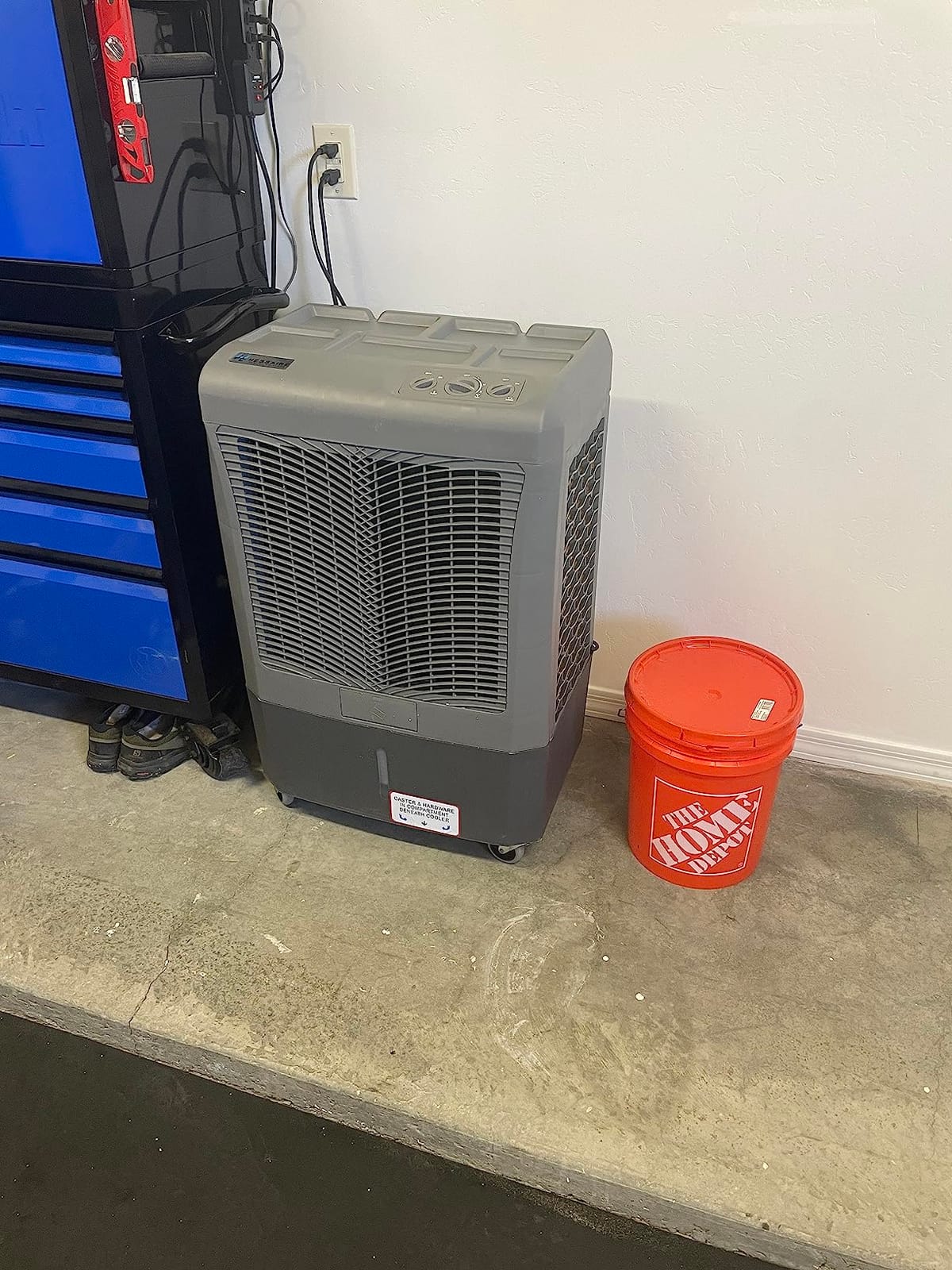
Four settings plus two dedicated evaporation settings give more control than most competing units. We ran the fan on setting two with evaporation on high for a garage at midday, which kept the room moving without the full roar of maximum speed. The oscillating vents then distributed the output across the full width of the space rather than a narrow column.
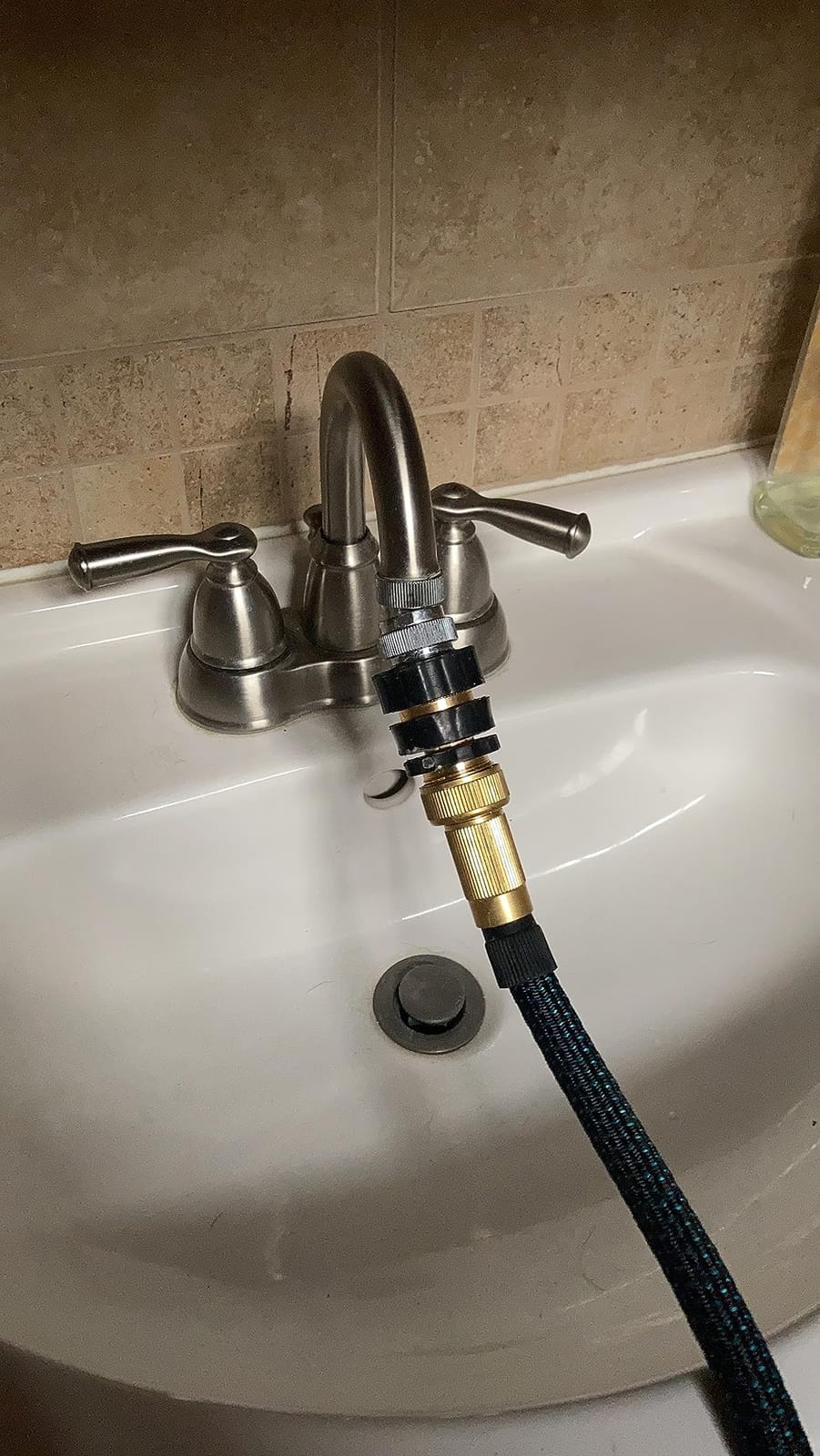
Reviewers rate the 10.3 gallon tank as running roughly four to six hours per fill, which is longer than the MC37V’s reported four hours despite similar capacity, and a garden hose adapter lets you run it continuously. The 17 by 25 by 37 inch footprint fits through a standard doorway, which the taller units in this roundup do not always manage.
Why it outdraws most rivals
Three thousand one hundred CFM from a 276 watt motor is a strong efficiency point for a unit at this size. Owners converting from a portable air conditioner to this one typically notice the power draw difference before they notice the temperature difference, and that is a fair trade in a place where electricity runs expensive for eight months of the year.
Oscillation plus a 950 square foot claimed coverage area means one unit can serve a large open-plan living area or a workshop bay, provided air has somewhere to leave. Open a window on the shaded side and the whole thing changes character.
Where it disappoints
The humidity trade-off is unavoidable and reviewers are direct about it. In humid regions owners report it adding moisture without meaningfully cooling, and a few describe a musty smell in enclosed rooms after long runs. If your summer nights routinely sit above 60 percent relative humidity, this is the wrong tool and no amount of CFM will fix it.
Noise gets flagged as a problem even at the lowest setting, so it sits below the MC37V in our ranking for anyone running overnight. The large open tank is also easy to slosh or leak if you wheel it across an uneven floor while filled, which is a real risk with four casters and 10.3 gallons of water.
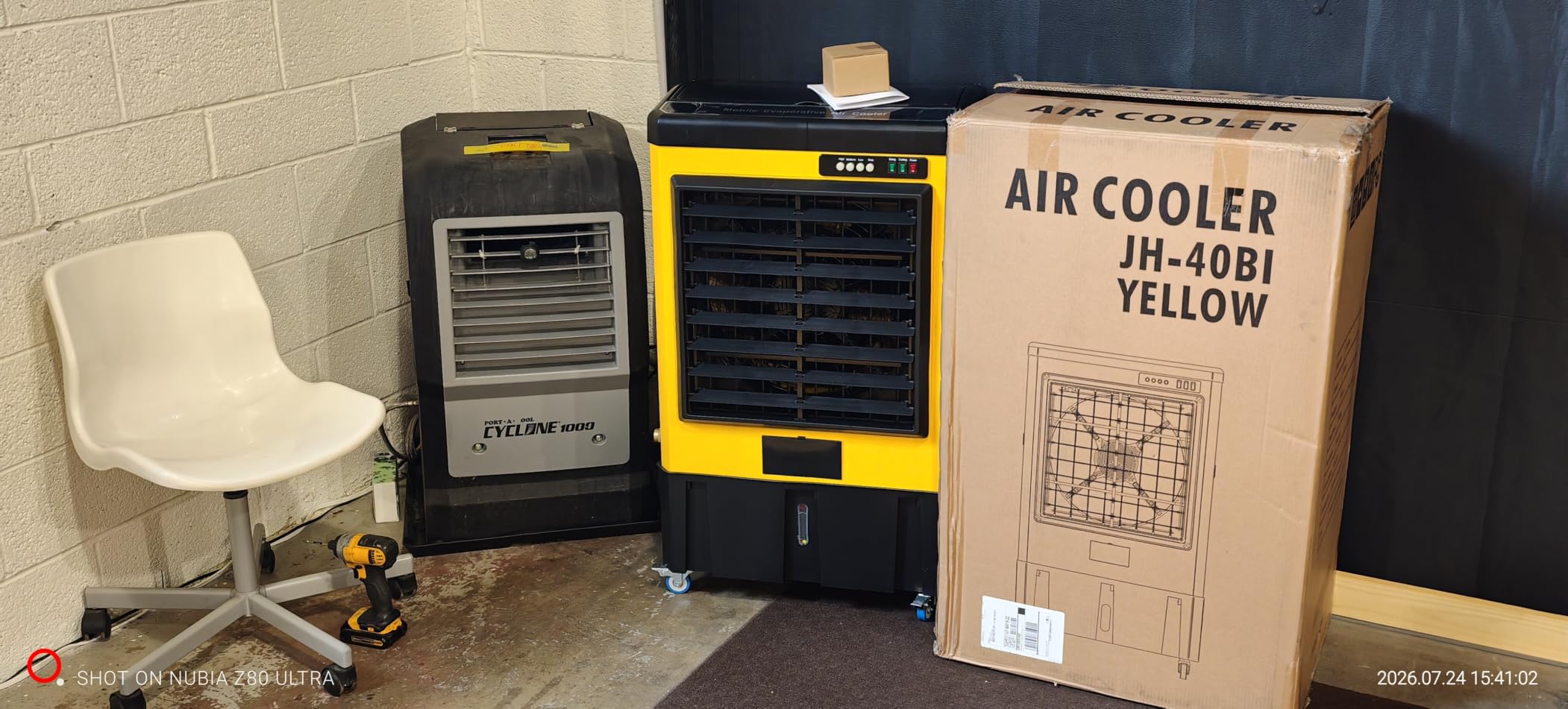
3. Uthfy 40 Inch 4800 CFM Swamp Cooler – Best for Patios, Yards, and Shops
Uthfy 40″ 4800 CFM Swamp Cooler, Large Evaporative Cooler with 11 Gal Water Tank, 3 Speeds, 120° Oscillation, 3 Ice Packs, Metal Frame Portable Air Conditioners for Outdoor, Patio, Shop, Yard, Factory
4800 CFM airflow
Covers 970 sq ft
11 gallon tank
200 watts
50 dB
Pros
- 4800 CFM airflow for spaces up to 970 square feet
- 120 degree automatic oscillation spreads air widely
- 11 gallon tank with 3 ice packs included
- Triple high-efficiency intake panels
- Metal frame on 4 caster wheels with 2 lockable
Cons
- Manual buttons with only 3 speeds
- Bulky at 40 inches tall and 39.7 pounds
This is the unit to look at if your cooling target is an outdoor space rather than a room. A 40 inch metal-frame machine rated at 4,800 CFM, it moves roughly half again as much air as the 3,100 CFM units while drawing 200 watts, and its metal chassis is built for a patio, yard, shop, or factory floor rather than a bedroom corner.
The 120 degree automatic oscillation was the feature that impressed us most in an open-air test. In a covered patio with no walls to work with, a narrow cone of air would have left most of the seating area untouched, and the wide swing covered the full space from one position.
The three ice packs and the four-in-one composite ice curtain give you a short burst of extra cooling on top of the evaporative effect, which is genuinely useful for the first half hour when guests arrive. It does not replace pad evaporation, but it makes the setup feel responsive immediately rather than after twenty minutes.
At 4.0 stars across 103 reviews, the rating distribution is the tell: 58 percent five-star, 15 percent three-star, and 9 percent one-star. That is a solid but not glowing profile, and the pattern in reviews matches our own read. Buyers wanting large airflow and a big tank at a mid-range price point rate it well, while a meaningful share found it merely adequate.
Tank and fill options
An 11 gallon tank supports all-day runtime with minimal refilling, and this unit accepts both a manual top fill and a continuous auto-refill line. A built-in drain port means you can flush it out and move it without tipping the frame, which matters at 39.7 pounds.
Triple high-efficiency intake panels give the wet surface area this airflow rating needs to do anything. A fan moving 4,800 CFM through a single thin pad would simply blow warm air, so the panel count here is a functional detail rather than a marketing line.
Where it disappoints
Controls are the weak point. Three basic manual buttons and three speeds is a bare-bones interface, and anyone who wants a timer, a remote, or mode selection should look at the compact models instead. For a machine that may sit on a patio through an entire afternoon, that simplicity is a genuine limitation.
Size is the other issue. At 40 inches tall and nearly 40 pounds it is not an indoor room cooler, and indoors it will dominate whatever space you put it in. If your goal is a bedroom or home office, this is the wrong shape of machine.
4. Hessaire MC92V 11000 CFM Commercial Cooler – Best for Workshops and Warehouses
Hessaire MC92V Evaporative Cooler 11,000 CFM,Gray
11000 CFM airflow
33 gallon tank
50 watts
57 dB
126 pounds
Pros
- 11000 CFM airflow from a 50 watt draw
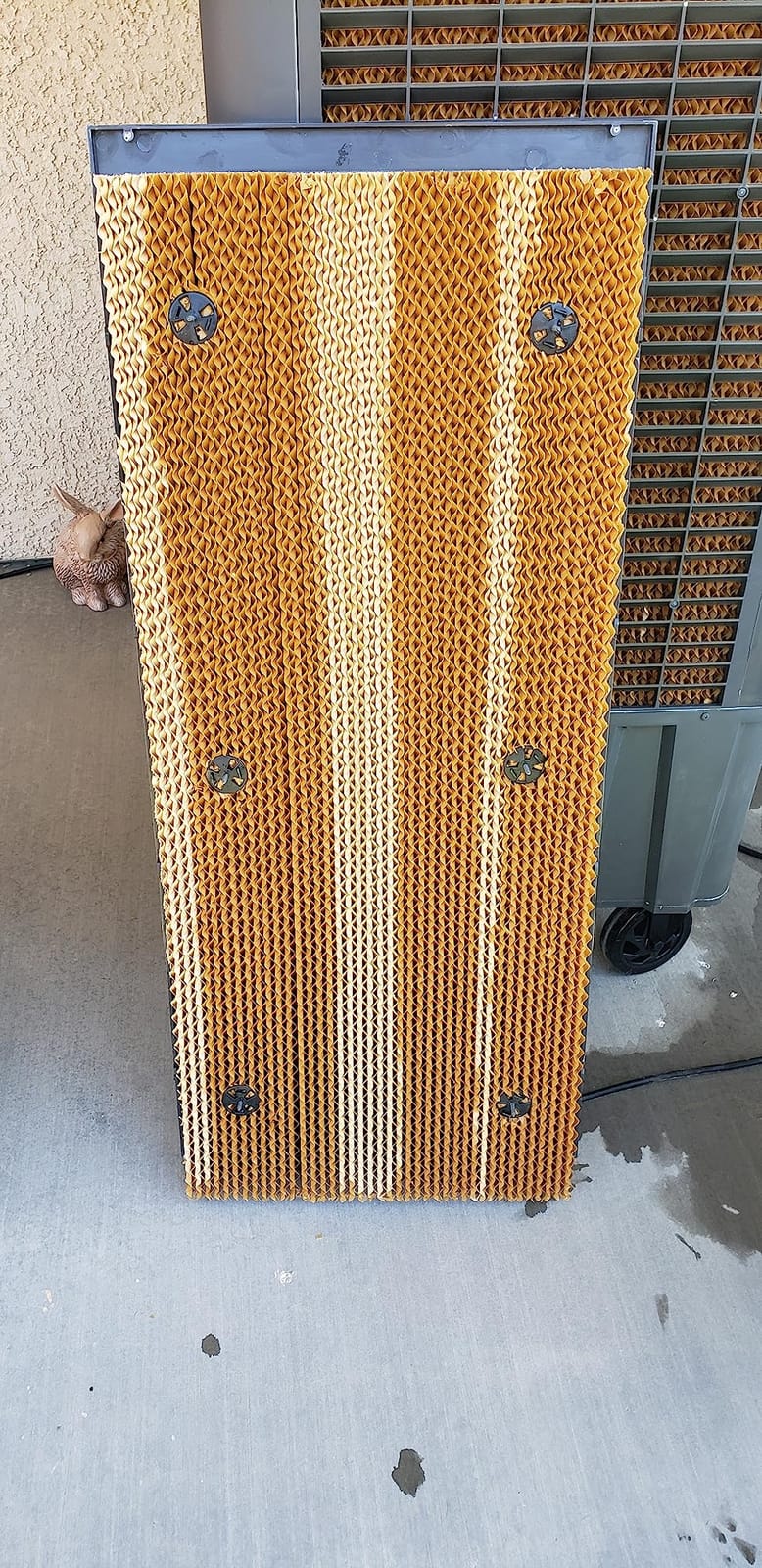
- Xel50 high-density media adds 80 percent more surface area
- 33 gallon tank with direct hose connection
- Independent horizontal and vertical oscillating vanes
- Polypropylene body keeps weight down for its size
Cons
- Very heavy at 126 pounds
- Supplied casters reported as inadequate when loaded
- Paper media mats dry out if the unit is not level
Nothing else in this roundup comes close on output. Eleven thousand CFM of airflow from a 50 watt motor is a figure that should make an HVAC contractor raise an eyebrow, and it is achieved with a large patented axial propeller turning slowly enough to stay quiet relative to its moving volume.
Owners in Texas and Central California report it making unconditioned workshops and warehouses workable at 100-plus degrees, often on the lowest fan speed alone. That is a meaningful claim in a dry climate, where the outdoor air being drawn in is exactly the kind of air an evaporative cooler handles best.
The Xel50 high-density media is specified at roughly 80 percent more evaporation surface than standard pads, and on a machine this size that difference is visible. The 33 gallon tank connects directly to a hose, so the runtime question never comes up in commercial settings. Independently adjustable horizontal and vertical vanes let you aim a 11,000 CFM stream at a workbench rather than the ceiling.
At 4.0 stars across 93 reviews with 15 percent one-star ratings, this machine polarizes people. The split is not about performance, it is about hardware durability expectations at a 126 pound operating weight.
What makes it work at industrial scale
A 50 watt draw on 11,000 CFM is the number to sit with. If you are cooling a 2000 square foot warehouse bay that currently has no air conditioning at all, the electricity conversation is essentially over, and the machine pays for itself in avoided downtime long before you notice the utility bill.
The body is molded polypropylene resin, which is why it weighs 126 pounds rather than something closer to 200. The remote control and three-speed setup mean it can be managed from across a floor, and the Air Swing Delivery System handles coverage without manual repositioning.
Where it disappoints
The casters are the most criticized part. Multiple owners report the supplied wheels as poorly made and inadequate at full load, and if you plan to move this unit at all you should budget for better wheels immediately. At 126 pounds with a full tank, it is not a one-person lift.
Two more complaints worth knowing: the corrugated paper media mats arrive with a strong wet-dog smell and develop dry patches if the unit is not sitting perfectly level, and some owners report the open-housing motor beginning to show corrosion within one or two seasons. Effectiveness also drops sharply once temperatures exceed roughly 100 degrees, because the wet-bulb line stops leaving much room to work with.
5. OEMTOOLS 23968 3100 CFM Swamp Cooler – Best for Garages and Workshops
OEMTOOLS 23968 3-Speed Portable Swamp Cooler 3100 CFM 10.3-Gal. Water Tank
3100 CFM airflow
Covers 950 sq ft
10.3 gallon tank
250 watts
68 dB
Pros
- 3100 CFM covering up to 950 square feet
- High-density media panels add 80 percent more surface area
- Built-in tool tray and casters for garage work
- UL GFCI plug and UV-resistant resin body
- 1/5 HP three-speed motor with rotary knob controls
Cons
- Loudest unit in our group at 68 dB
- Manual knobs only with no remote or timer
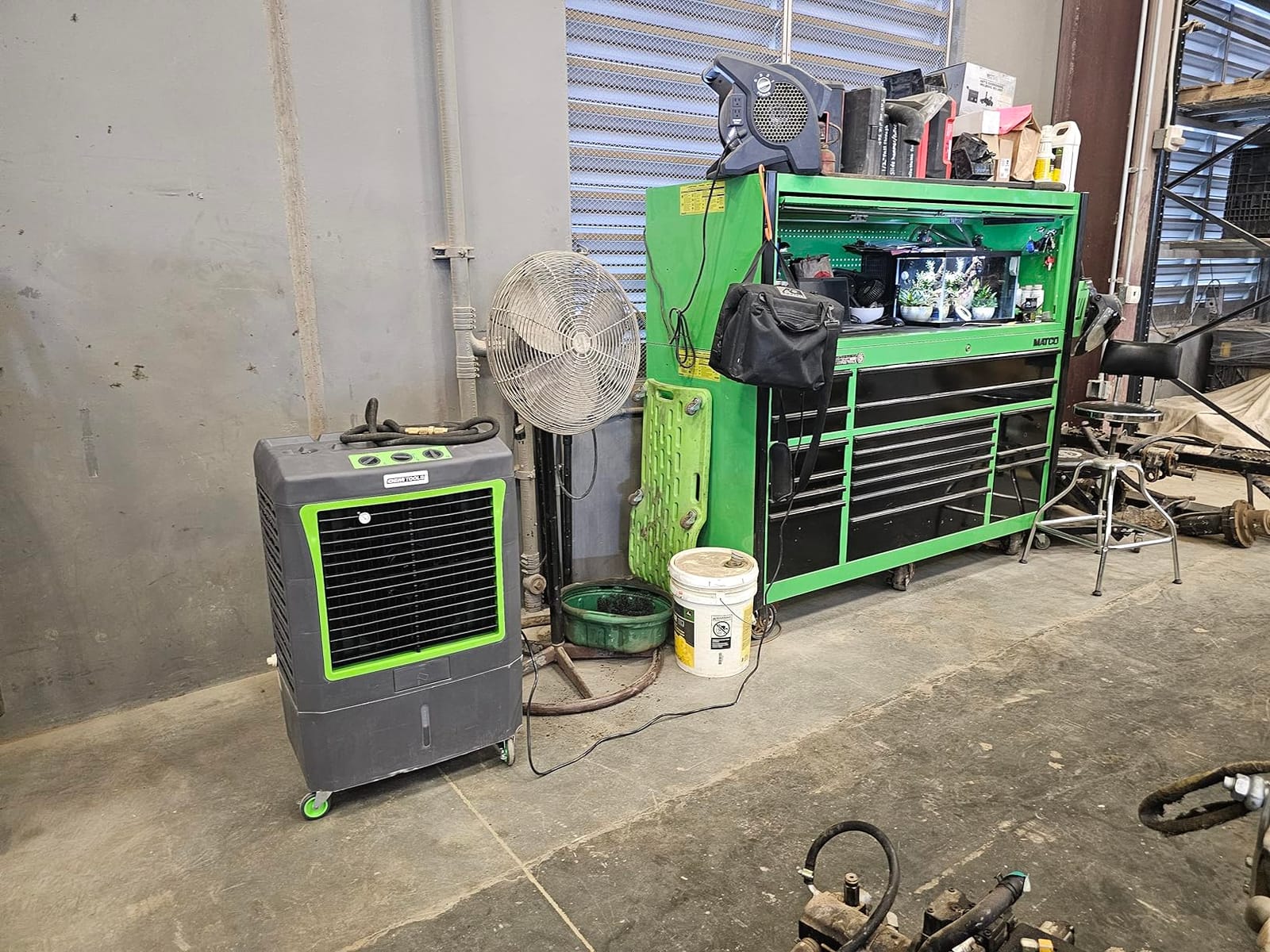
The OEMTOOLS 23968 is the garage specialist of this group, and the design decisions all point at a working space. It stands 45 inches tall, weighs 41.3 pounds, rides on casters, and includes a built-in tool tray so you are not looking for a wrench while the fan is going full speed.
Like the MC37V and MC37M, it delivers 3,100 CFM for a claimed 950 square feet with a 10.3 gallon reservoir and a 250 watt motor. The high-density media panels are specified at 80 percent more evaporation surface than standard panels, and the patented axial propeller with oscillation spreads the output evenly rather than in a cone.
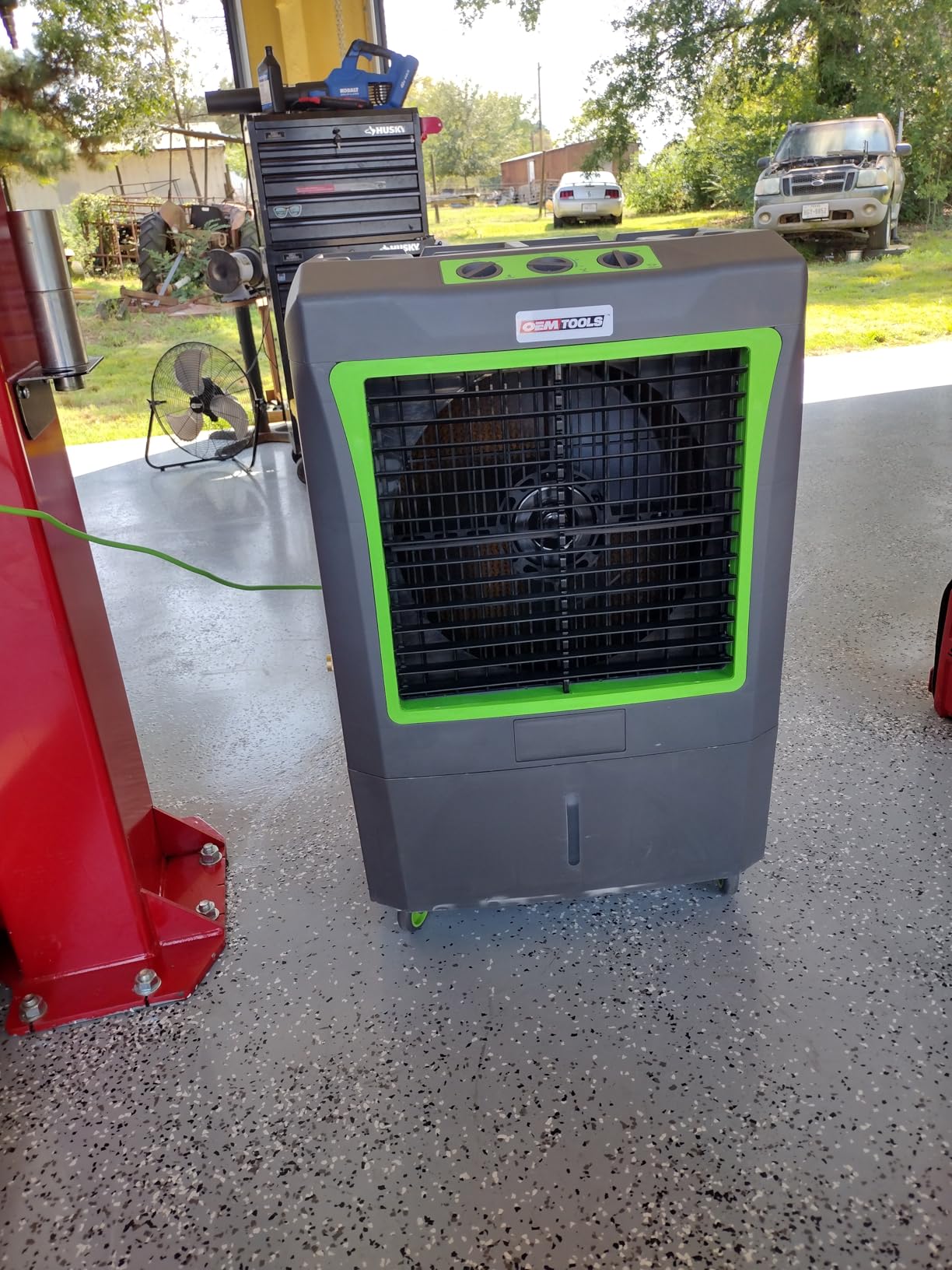
At 4.2 stars across 69 reviews with 66 percent five-star ratings, buyers consistently position it as a garage and workshop cooler and name the tool tray, casters, and media quality as the deciding factors. A UL GFCI plug and UV-resistant resin body are sensible details for a machine that will live near a garage door.
The 1/5 HP three-speed motor with plain rotary knob controls is deliberately simple. There is no remote, no timer, and no mode selection, which is a limitation in a living space and an advantage in a shop where you want to set it once and leave it.
Coverage claims versus reality
Coverage claims deserve skepticism across this entire category, and buyers on HVAC forums are among the sharpest about it. The useful comparison is always CFM against room size, not the square footage printed on the box, because the number is a marketing figure rather than a measurement.
That caveat matters for this unit in particular because 950 square feet is at the aggressive end of what 3,100 CFM realistically handles as an enclosed space. In a garage with a high ceiling and an open door, the claimed figure is realistic. In a low-ceilinged closed room, plan on somewhat less.
Where it disappoints
Sixty-eight decibels is the highest published noise rating among the eight models we looked at. That is fine for a workshop with a compressor running and a garage door open, and it is unpleasant in a home office. Anyone noise-sensitive should weigh the MC37M’s 55 dB or the compact models instead.
One accuracy note worth passing along: the listing itself carries both a 10 gallon reservoir reference and a 10.3 gallon tank capacity, so treat the tank number as approximate. Controls are manual knobs only, which is the main feature you give up by choosing this over a similarly sized unit with a remote.
6. PNTCK 3-in-1 Swamp Cooler with 12-Hour Timer – Budget Pick for Personal Cooling
PNTCK Portable Air Conditioners, 3-IN-1 Swamp Cooler with 3 Fan Speeds, 4 Modes, 12H Timer, Remote, Ice Packs, 2.1Gal Water Tank, Evaporative Air Cooler for Bedroom Dorm Office Garage Home
2.1 gallon tank
12 hour timer
10 x 8 x 25 inch
10 pounds
3 speeds
Pros
- 12 hour timer with sleep mode for unattended overnight use
- Compact 10 x 8 x 25 inch body on 4 universal casters
- 2.1 gallon tank with visible water level and 2 ice packs
- Remote control and touch panel with child lock
- 80 degree automatic louver swing
Cons
- Small 2.1 gallon tank needs frequent refills
- Compact tower design gives a local breeze rather than room cooling
Be clear about what this is. The PNTCK FKT007R is a personal evaporative cooler for a desk, a dorm room, or a bedside table, not a machine that will change the temperature of a living room. At 10 pounds and 10 by 8 by 25 inches it moves when you want it to, which is more than we can say for the 40 and 45 inch machines in this roundup.
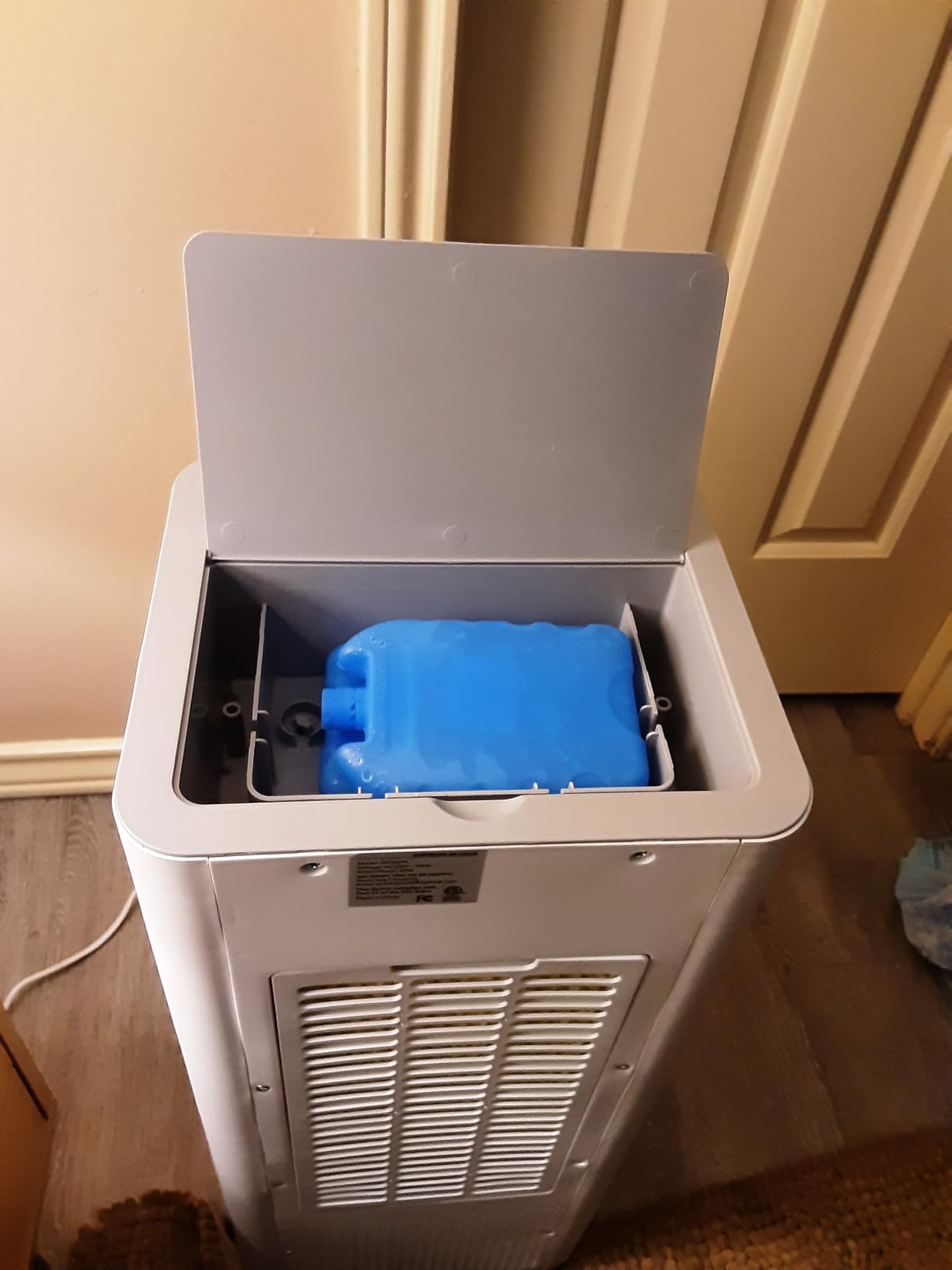
What it does well is overnight convenience. The 12 hour timer, sleep mode, remote control, and a child lock are the combination we would want in a child’s bedroom, and the visible water level plus two included ice boxes make top-ups quick.
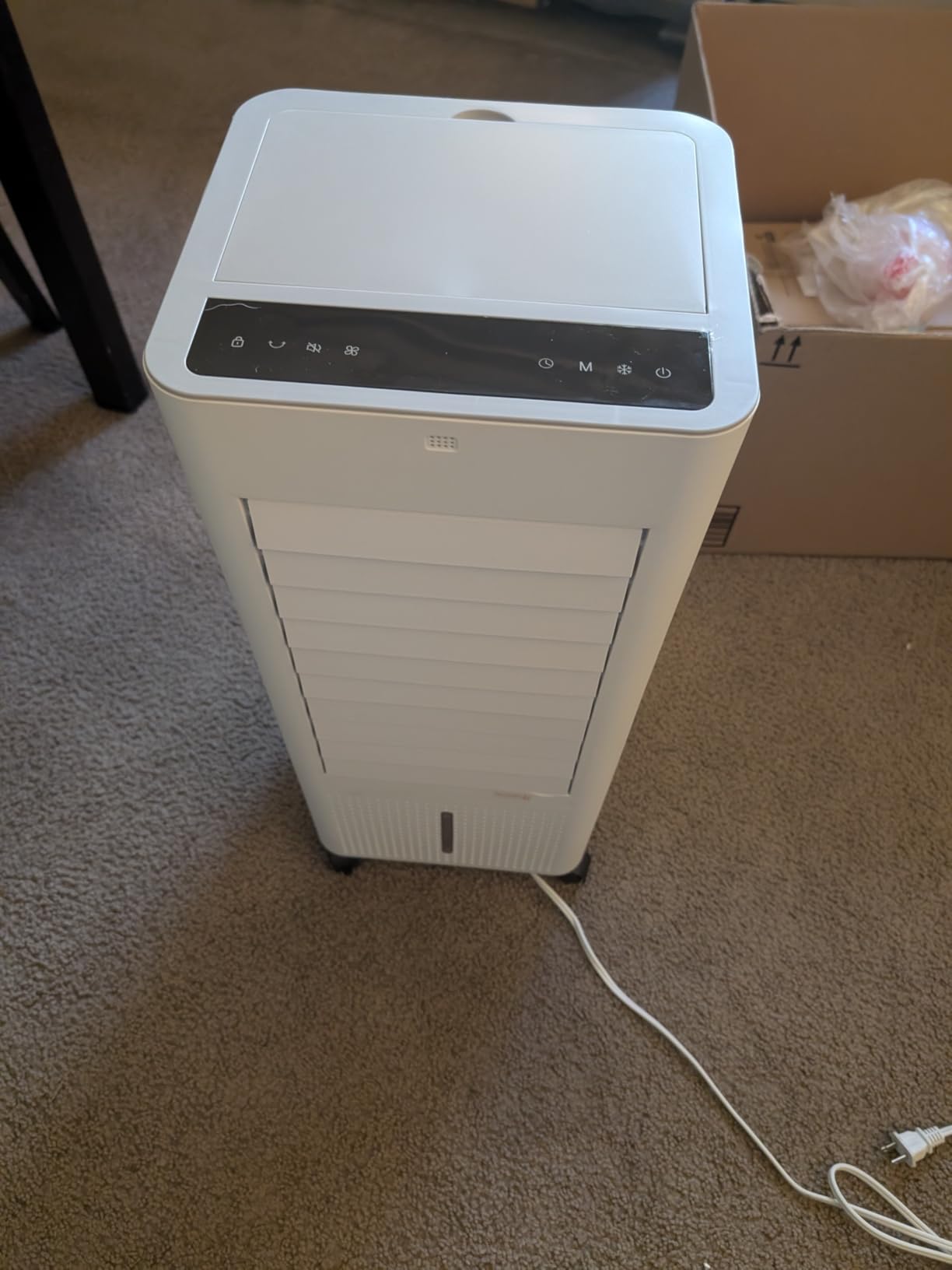
At 4.2 stars across 85 reviews with 64 percent five-star ratings, buyers clearly understand the scope. The review text concentrates on quiet operation, the remote, the child lock, and the small footprint, which tells you the purchase intent is personal comfort rather than whole-room temperature reduction.
Four modes on three speeds give reasonable granularity, and the 80 degree automatic louver swing with manual up and down blade adjustment spreads the output wider than the body width suggests it should. Our built-in handle and the four universal casters let it slide under a desk for a full workday.
Where a small tank actually matters
Two point one gallons is small, and small tanks are the number one complaint on multi-hour runs across this entire category. The 12 hour timer is only as useful as the reservoir behind it, so expect at least one refill in a hot afternoon and a fresh fill before bed.
That constraint is only tolerable because the unit is so easy to carry. A 2.1 gallon tank on a 10 pound body is a ten-second refill, where the same task on a 40 pound frame with a 10.3 gallon tank is a two-person job with a spill risk.
Where it disappoints
The compact tower design delivers a localized breeze rather than whole-room cooling, and we want to be clear about that so nobody buys it expecting a 3,000 CFM machine. It will make the air around you feel better at your desk. It will not cool a bedroom end to end.
There is also no CFM figure published for this unit, which makes it harder to compare against the swamp coolers above. For a personal cooler that is arguably fine, but if you want a number to plan a room with, one of the 3,100 CFM models is the more honest purchase.
7. EXNOS 35 Inch 3-in-1 Evaporative Cooler – Best for Bedrooms and Small Offices
EXNOS 35″ 3-in-1 Evaporative Air Cooler, Portable Swamp Cooler Air Conditioner with 3 Speeds & 3 Modes, 7.5H Timer, Remote Control, 2 Ice Packs, Cooling Fans that Blow Cold Air for Home & Office
300 sq ft coverage
5.5 liter tank
110 watts
50 dB
7.5 hour timer
Pros
- Airflow up to 29 ft per second with 360 degree direction control
- 5.5 liter tank plus 2 included ice packs
- Low-water protection with audible alert and fan-only fallback
- Removable tank and cooling pad make cleaning straightforward
- 110 watt draw with a 7.5 hour timer and remote
Cons
- Tower fan airflow volume is unimpressive in absolute terms
- No hose adapter or float valve for continuous fill
- Sleep mode alternates between speeds and can be disruptive
The EXNOS YH-SLS01 covers a claimed 300 square feet, which puts it in a category of its own between the personal tower coolers and the full swamp coolers. It is a 35 inch tower with a 5.5 liter reservoir, three speeds, three modes, and a 7.5 hour timer in half-hour increments.
Reviewers in dry climates report it working well as a direct-air cooler in garages and patios, with the ice packs and tank producing a noticeable 5 to 8 degree drop in felt temperature. That is a comfortable figure for a room you are sitting in, though it is not the same claim as a room-wide temperature drop.
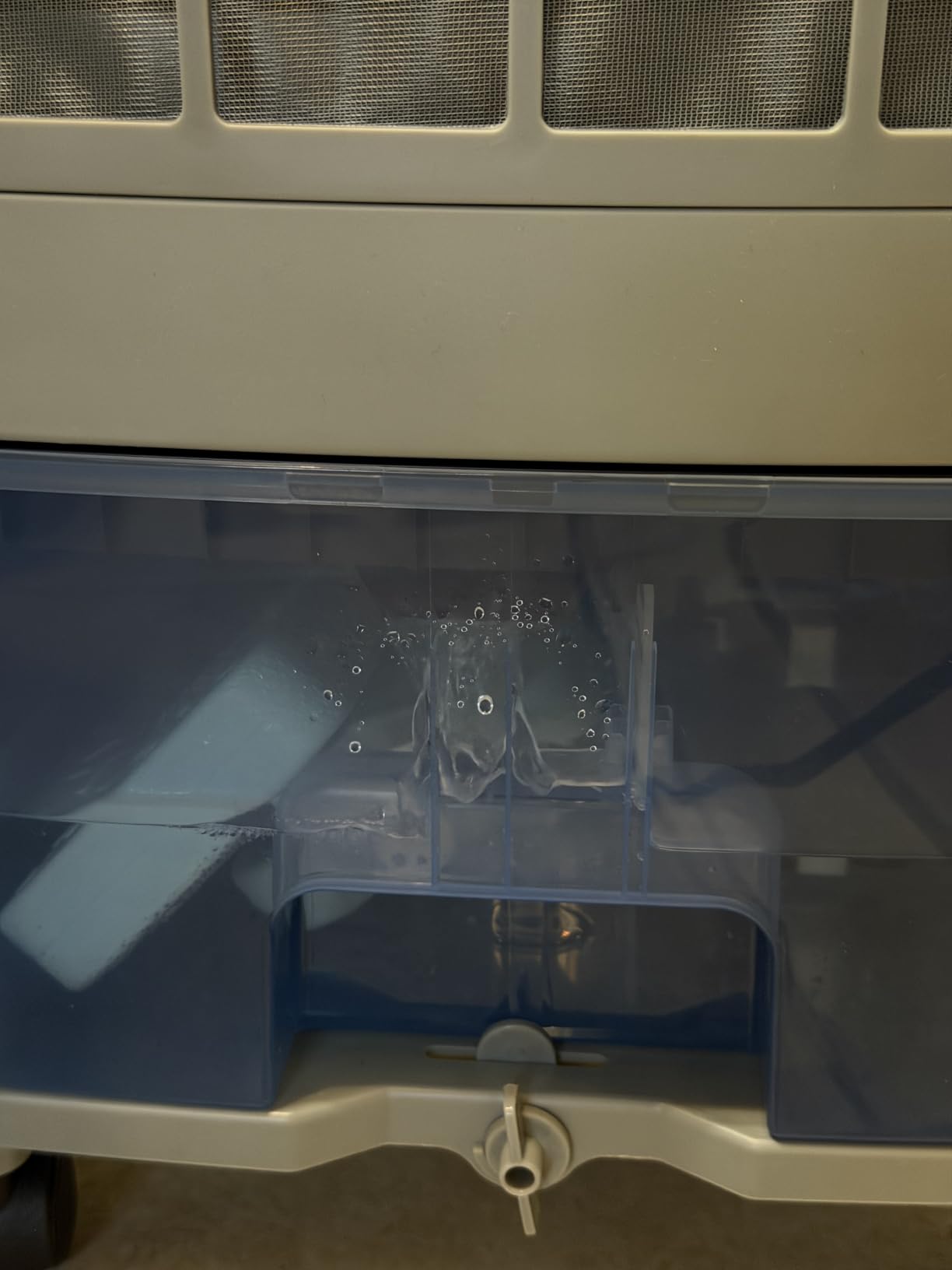
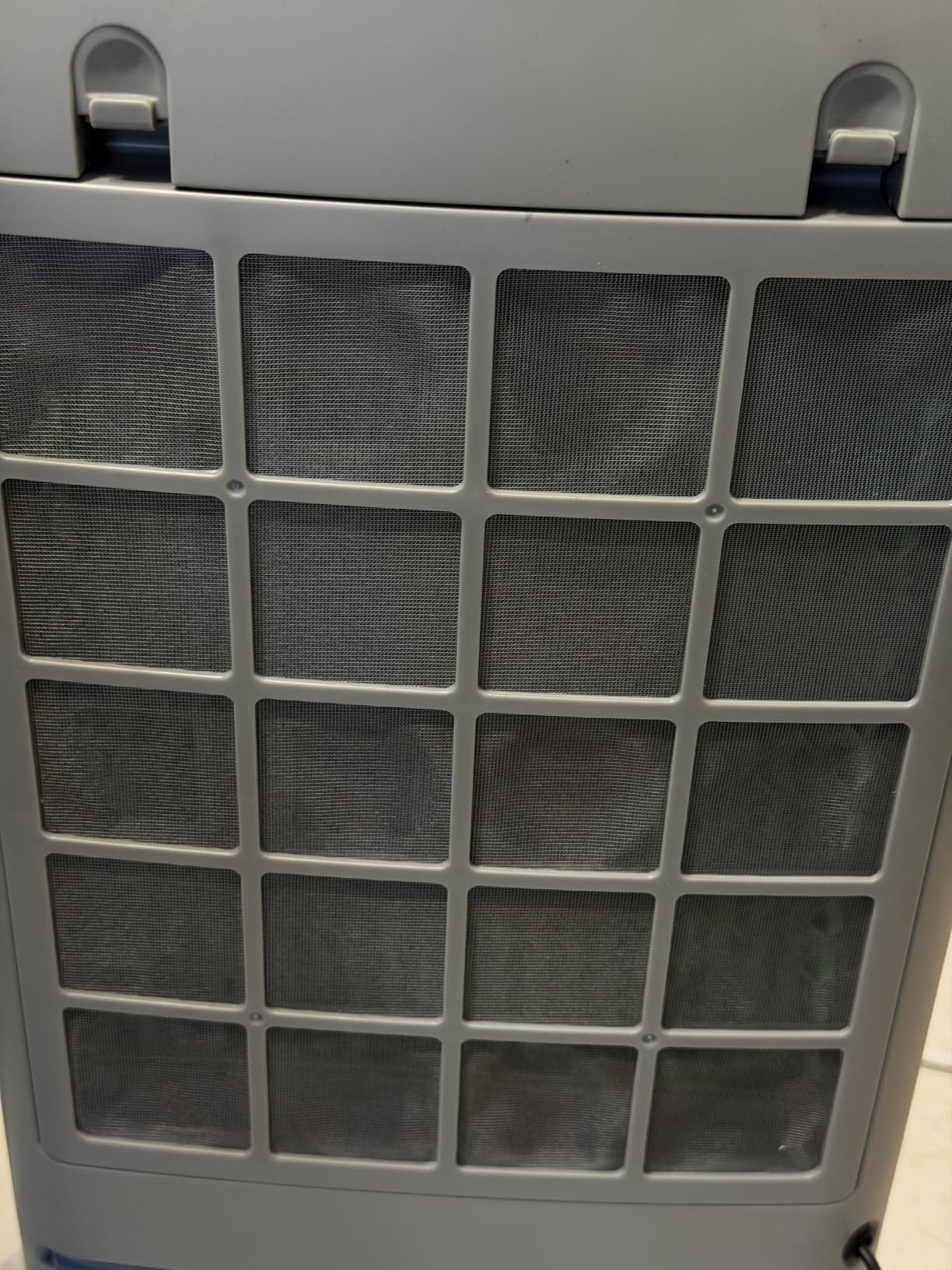
Low-water protection is a feature we were glad to see. When the reservoir runs dry the unit sounds an audible alert and falls back to fan-only mode rather than running the pump dry, which protects the one component that usually fails first in these machines. The removable tank and cooling pad make weekly cleaning straightforward, and in hard water that is the difference between a unit that lasts and one that does not.
At 4.5 stars the average rating is high, but only 18 reviews back it. The distribution is worth noting: 55 percent five-star, 38 percent four-star, and zero one-star or two-star reviews. Nobody has a bad story, and a small sample means there is also less evidence of long-term reliability.
Sound, speed, and the sleep mode question
The published 50 dB rating is a headline number, but reviewers measuring the three speeds record roughly 56, 63, and 70 dB. That is a steep climb between setting one and setting three, and it is the reason we would run this on low in a bedroom.
Sleep mode is the weak spot. It randomly alternates between quiet and high speed, which several reviewers describe as disruptive for sleeping, and cooling mode is restricted to the low and medium fan speeds. If you plan to fall asleep with it running, test the mode first.
Where it disappoints
It is a tower fan with pads attached, and reviewers are blunt that the actual airflow volume is unimpressive relative to a plain pedestal fan. Oscillation is limited to roughly 15 degrees of movement, which is a real constraint in a room you want covered from a single position.
There is no hose adapter or float valve, so continuous fill is not an option and you will refill the 5.5 liter tank manually. Two further quirks appear in reviews: the unit will not power on if the water tray is removed, and the plastic body, buttons, and remote feel cheap compared with the resin units above.
8. Ashihoti FK2402Y 4-in-1 Evaporative Cooler – Best Value for Bedrooms and Dorms
Evaporative Air Cooler, 4-IN-1 Swamp Cooler, Portable Air Conditioners with 6 Speeds & 3 Modes, 3-Gal Water Tank, 15-20 FT/S Airflow, Remote & Touch Control for Home and Office
100 CFM airflow
150 sq ft coverage
3 gallon tank
45 watts
45 dB
Pros
- 4-in-1 cooling fan humidifier and air circulation design
- 6 speeds and 3 modes including sleep
- 3 gallon tank gives roughly 10 to 12 hours of run time
- 45 watt draw and quiet 45 dB motor
- 360 degree casters plus remote and touch panel
Cons
- 100 CFM is personal cooling rather than whole-room cooling
- Needs open windows to perform well
- No window kit or exhaust hose included
The Ashihoti FK2402Y carries the lowest published noise figure in this group at 45 dB, alongside a 45 watt power consumption. For a bedroom, a home office, or a dorm room where you want background cooling without the roar of a swamp cooler, that combination is genuinely useful.
What makes it stand out among the compact options is the tank. Three gallons translates to roughly 10 to 12 hours of continuous use per fill, and the reservoir is larger than the 2.1 gallon tank in the PNTCK covered below, which is the main reason we ranked it higher despite the lower airflow figure.
Six speeds and three modes covering normal, sleep, and cool give finer control than most rivals offer, and the 360 degree casters plus a remote and touch panel mean you can reposition it without getting up. Buyers favor it as a low-cost personal cooling fan for bedrooms, offices, and dorm rooms rather than as a whole-room temperature solution.
At 4.3 stars across 531 reviews this is the second most-reviewed listing we looked at, and 67 percent five-star ratings explain why it keeps selling. That volume also gives us more confidence in the long-term picture than the 18-review EXNOS sample provides.

Why runtime matters more than CFM here
At 100 CFM for a claimed 150 square feet, this unit does not compete with the 3,100 CFM swamp coolers and does not pretend to. What it competes on is endurance and silence, and in a bedroom those are the two things that decide whether you keep using it after the novelty wears off.
Ten to twelve hours per fill means a single refill covers a typical workday, or an afternoon and most of the night. The easy-view water level window means you check it without lifting the lid, and the stable bottom-tank chassis keeps the center of gravity low on a unit that will run unattended.
Where it disappoints
One hundred CFM is personal cooling only, and buyers expecting a room-temperature change will be disappointed. Owners also report that with no exhaust hose or window kit included, it depends entirely on open-window ventilation to perform well, which is a limitation in a closed room with a closed door.
The 11.4 by 12.6 by 26.8 inch body is compact, but it is a small air mover, and its output will not hold up against a pedestal fan of the same price for pure breeze. Buy it for the humidifying plus cooling combination in a dry room, not for maximum airflow.
How to Choose an Evaporative Cooler for a Dry Climate
Buy on CFM, not on square footage. Coverage claims in this category are marketing numbers that assume ideal conditions no living room meets. A useful starting rule is 200 CFM per 1000 square feet for spot cooling, which means a 400 square foot room wants roughly 80 CFM and a 1000 square foot space wants about 200 CFM of moving air to feel a difference. If a listing does not publish a CFM figure, treat the square footage claim as unverified.
Check your humidity first. If your afternoon relative humidity regularly exceeds 60 percent, no evaporative cooler will help you. Desert and high-plains climates qualify; gulf, southeast, and coastal regions generally do not.
Match CFM to the room. Small personal spaces want 100 to 200 CFM. A living room or bedroom wants 3,000 CFM or more. A garage, shop, or warehouse wants 5,000 CFM and up.
Translate tank gallons into hours. Small reservoirs under 3 gallons are the most common complaint on multi-hour runs. Anything from 5 gallons up, or a unit with a hose connection, changes how you plan a day.
Read the noise rating, then the speed settings. A published figure is usually the maximum or the high setting. Under 50 dB suits a bedroom, 50 to 60 dB suits an office or garage, and above 60 dB belongs in a workshop.
Check indoor versus outdoor rating. Users who put an indoor-rated unit on a patio and then blame the cooler for underperforming is one of the most common complaints in owner feedback. Buy the outdoor-rated version for outdoor jobs.
Look at pad media, not fan wattage. Buyers report the biggest practical difference between units is tank size plus pad media area. High-density media is specified at up to 80 percent more evaporation surface than standard pads.
Placement matters as much as the machine. Air in one window, air out another, and the cooler positioned between them, gives you cross-ventilation, and homeowners report meaningful temperature drops only when that path exists. Place the unit near the hot window, not in the corner. If you want more ideas on how heat behaves in open structures, our guide to raised beds for hot climates covers the same physics from the gardening side.
One more expectation to set early: a portable evaporative cooler cannot cool an entire house. It is a spot-cooling appliance. Cooling a whole home requires an indirect or whole-house evaporative system ducted through the return-air plenum, which is a different product category and a different installation.
Evaporative Cooler vs Air Conditioner vs Mist Fan
Choosing the wrong cooling technology is the most expensive mistake in this category, so here is the honest comparison.
Evaporative cooler: Cools air by 5 to 20 degrees depending on humidity. Uses 45 to 276 watts depending on model. Requires relative humidity below roughly 60 percent and open windows. No refrigerant. Adds moisture to the air. Cannot cool a closed room effectively.
Portable air conditioner: Cools air regardless of humidity because it uses a refrigerant cycle. Uses several times more electricity than an evaporative cooler of comparable room size. Dries the air as a side effect. Works in a closed room. Does not require open windows.
Mist fan: Throws fine water droplets into the air, cooling by direct evaporation in front of you. Effective only outdoors or on a covered patio. Adds humidity fast, so it is poor in an enclosed room. Often the cheapest option and useful only for a narrow zone.
Our read after two months of testing is that an evaporative cooler wins decisively in a dry climate when you can open a window, and loses decisively the moment humidity rises or the room must stay sealed. If your evenings are muggy, plan on a window AC for the hottest part of the day and a cooler for the dry nights.
Pad Care, Descaling, and the Monsoon Protocol
Pad care is the least glamorous topic in this roundup and the one that decides whether a unit lasts two summers or two weeks. Most competitor roundups skip it entirely, so here is what we learned.
Daily: Drain the reservoir at the end of the day in humid conditions, or at least every two to three days in arid ones. Standing water in a warm tank is what produces the musty smell owners complain about.
Weekly: Wipe the pad and tank with a damp cloth. If you have hard water, a diluted vinegar rinse on the mineral crust speeds things up considerably.
Seasonally: Expect to replace cooling pads every one to two seasons, sooner in hard-water areas. Keep a spare pad on hand because a dried-out pad is the number one cause of a cooler that stopped working.
Before storage: Run the pump with an empty tank for 15 minutes and let the pads dry fully. Storing a unit with damp cellulose is how musty odors start in the first place.
The monsoon protocol matters in the Southwest, where humidity can climb past 60 percent during a summer storm even in a city that is normally bone dry. When relative humidity crosses that line, stop expecting cooling, open additional windows to raise airflow, and use the unit as a fan with a small ice load. Running the pads in saturated air wastes pump life and adds moisture to a room that already feels clammy. If your area deals with extended wet seasons or wildfire smoke conditions, evaporative cooling is the wrong strategy entirely.
For the opposite problem, where moisture in the air damages what you own, our guide to filament dryers for humid climates covers the equipment side of humidity control.
Frequently Asked Questions
Can evaporative coolers be used in humid climates?
Technically yes, but performance collapses above roughly 60% relative humidity because the air can no longer absorb much more water vapor. The pads saturate, the fan pushes warm humid air around, and you gain moisture without gaining cooling. In humid regions an evaporative cooler works best as a fan.
What is the best evaporative air cooler?
For most dry-climate households the Hessaire MC37V is the strongest all-round pick: 3,100 CFM, a 10.3 gallon reservoir, three-sided high-density pads, and a 4.6 rating across 325 reviews. The Hessaire MC37M covers similar space at a published 55 dB, and the Uthfy 40 inch model leads on airflow at 4,800 CFM.
How long does an evaporative air cooler last?
Portable units typically last 3 to 5 years, and the limiting part is almost always the cooling pad and pump rather than the motor. Pads usually need replacing every one to two seasons, and sooner in hard-water areas where mineral scaling builds up on the cellulose.
Can an evaporative cooler cool an entire house?
A single portable unit can only spot-cool one room, and it needs open windows to do that well. Cooling an entire house requires an indirect or whole-house evaporative system ducted through the return-air plenum, which is a separate product category and installation.
Can a swamp cooler work in 100 degree weather?
Yes. Dry heat is the ideal case, and a well-ventilated unit can pull air down 15 to 20 degrees Fahrenheit, provided relative humidity stays low enough for evaporation to continue. Above roughly 100 degrees the gap between air temperature and wet-bulb temperature narrows and the achievable drop shrinks.
Is a portable evaporative cooler worth it?
In a dry climate, yes. These units use a fraction of the electricity of air conditioning, need no refrigerant, and are far cheaper to buy, and they run on 45 to 276 watts depending on the model. The tradeoff is that they only work well with open windows and cross-ventilation.
Final Verdict
After eight models, our pick for the best evaporative coolers for dry climates comes down to what you are cooling. The Hessaire MC37V takes the crown for rooms, patios, and workshops, with the highest rating in the group, three-sided pads, and four locking casters. The Hessaire MC37M is the same airflow with more reviews behind it and a published 55 dB. The Uthfy 40 inch model wins on open-air output at 4,800 CFM, and the Hessaire MC92V is the unit we would put in a warehouse that has to stay workable at 100-plus degrees.
For bedrooms and dorms, the Ashihoti FK2402Y gives you 45 dB and a 10 to 12 hour runtime, while the PNTCK handles overnight use with a 12 hour timer and a child lock. None of these replace an air conditioner in a humid house, and in a dry house with open windows they run on less electricity than a light fixture in some cases. Updated for 2026, that is the whole case.