
Most people shopping for a lathe dust collector want a big number on the box. Horsepower, CFM, brand name. Here is the thing almost nobody tells you before you buy: a lathe dust collector is a fine-dust tool, not a chip tool. Shavings and chips get swept or vacuumed up by hand. What a collector is actually for is the airborne fines that come off a spinning workpiece when you sand it, especially the fine, light dust that stays suspended for hours after you stop.
That reframe changes the whole shopping list. You do not need the biggest machine on the market. You need enough airflow to pull a hood within a few inches of a turning bowl without sucking the air out of the room, a filter fine enough to hold that dust, and a cyclone in front of the filter so chips never reach the impeller. Get those three right and almost any setup in this guide will do the job beautifully.
We spent October 2026 comparing the eight collectors, cyclones, and lathe-mounted hoods that turners actually buy, and we leaned hard on what owners report back after months of use rather than what the spec sheet promises. Our picks cover four distinct jobs: a cyclone pre-filter for a shop vac, a turn-key portable cyclone, dedicated single-stage collectors, and the hoods and scoops that attach right to the lathe. Last updated for 2026.
Table of Contents
- Top 3 Picks for Best Dust Collectors for Lathe Work (October 2026)
- Best Dust Collectors for Lathe Work at a Glance in 2026
- 1. Mullet Cyclone Dust Collector: Best Overall for Lathe Work
- 2. Oneida Dust Deputy DIY: Best Value Cyclone Separator
- 3. WEN 660 CFM Rolling Dust Collector: Best Budget Dedicated Collector
- 4. Oneida Dust Deputy 2.5 Deluxe 5-Gal: Best Turn-Key Portable Cyclone
- 5. POWERTEC DC5372 1 HP 560 CFM Collector: Best for 1-Micron Filtration
- 6. Rockler Dust Right Lathe System: Best for Mini and Midi Lathes
- 7. PSI Clear Wood Lathe Dust Hood: Best for Bowl Turners
- 8. PSI Pen Makers Dust Trap: Best for Pen Work
- How Many CFM Do You Need for a Lathe?
- Shop Vac vs Dust Collector: What Each One Is Actually For
- How to Choose a Dust Collector for Lathe Work
- Frequently Asked Questions
- Final Verdict: The Best Dust Collectors for Lathe Work
Top 3 Picks for Best Dust Collectors for Lathe Work (October 2026)

Mullet Cyclone Dust Collector
- Parabolic one-piece body
- Pre-separates over 99% of debris
- Cut-to-fit rigid PVC airtight seal

Oneida Dust Deputy DIY
- Captures up to 99.9% of dust
- Anti-static construction
- Works with any wet/dry vac

WEN 660 CFM Rolling Dust…
- 660 CFM from a 5.7-amp motor
- 12-gallon 5-micron bag
- Lockable swivel casters
Best Dust Collectors for Lathe Work at a Glance in 2026
This table is the fast version. Each pick fills a different gap, so read the “best for” column before you fall in love with a CFM number.
| Product | Specs | Action |
|---|---|---|
| Mullet Cyclone Dust Collector |
|
Check Latest Price |
| Oneida Dust Deputy DIY |
|
Check Latest Price |
| WEN 660 CFM Rolling Dust Collector |
|
Check Latest Price |
 Oneida Dust Deputy 2.5 Deluxe 5-Gal Oneida Dust Deputy 2.5 Deluxe 5-Gal |
|
Check Latest Price |
 POWERTEC DC5372 1 HP 560 CFM POWERTEC DC5372 1 HP 560 CFM |
|
Check Latest Price |
 Rockler Dust Right Lathe System Rockler Dust Right Lathe System |
|
Check Latest Price |
 PSI Clear Wood Lathe Dust Hood PSI Clear Wood Lathe Dust Hood |
|
Check Latest Price |
 PSI Pen Makers Dust Trap PSI Pen Makers Dust Trap |
|
Check Latest Price |
1. Mullet Cyclone Dust Collector: Best Overall for Lathe Work
Mullet Cyclone Dust Collector, High-Speed Separator for Shop Vac
72 dB
Parabolic one-piece body
Over 99% debris pre-separation
7.5 lb
Pros
- Separates over 99% of debris before it reaches the vac filter
- Seamless one-piece parabolic body with no seams to leak
- Cut-to-fit rigid PVC connection makes a genuinely airtight seal
- Hose adapters fit virtually any wet/dry shop vac
Cons
- Costs more than bucket-style separators
- Needs a shop vac or dust extractor to run
- Not a standalone collector so it needs a second machine
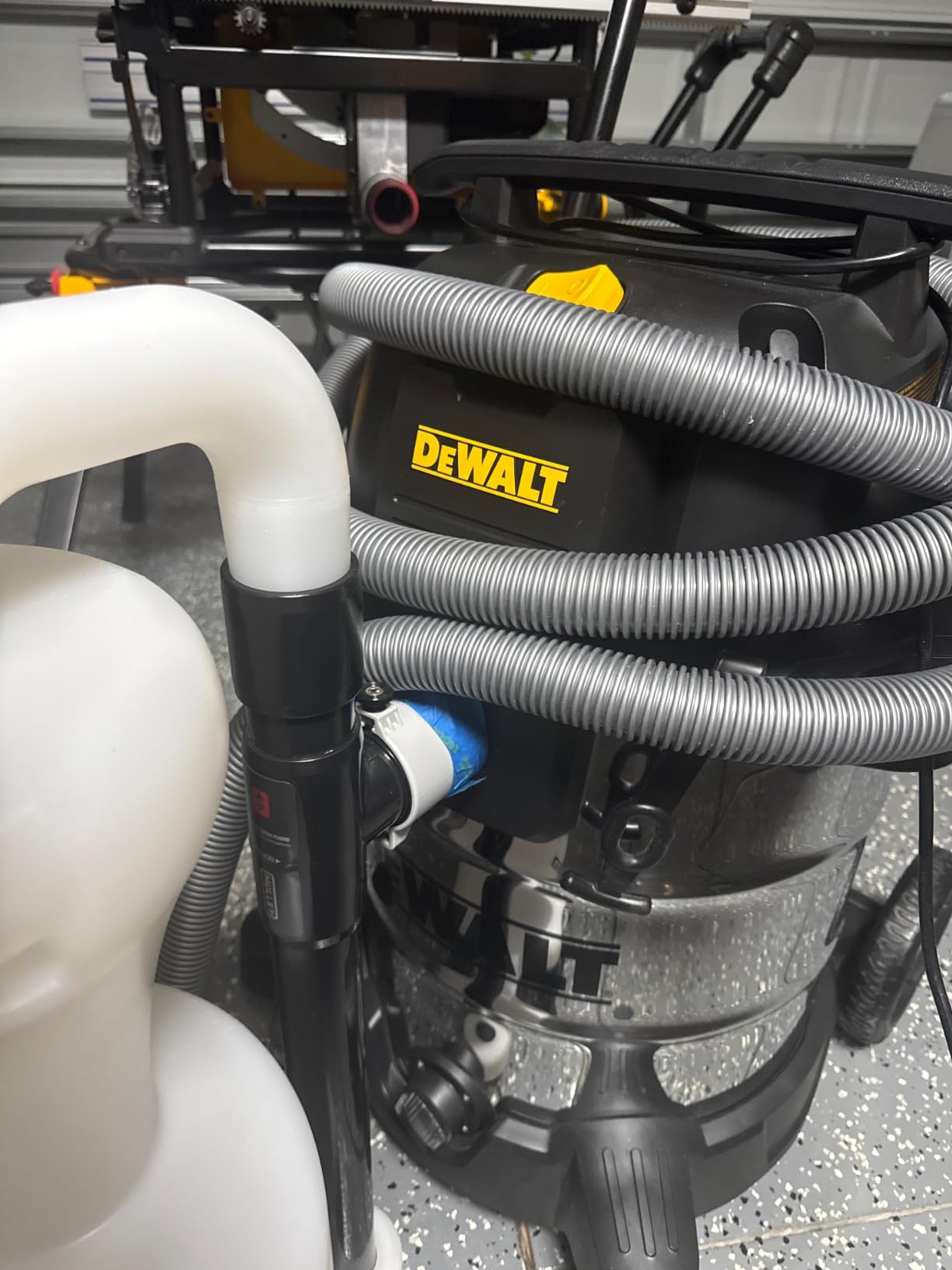
This is the one we kept coming back to. The Mullet is not a collector on its own; it is a high-speed separator that bolts onto the intake of a shop vac and does the job a cyclone does in a big metal machine. Owners rate it at 4.8 out of 5 across 288 reviews, and the consistent theme in that feedback is that fines simply stop reaching the vacuum’s filter.
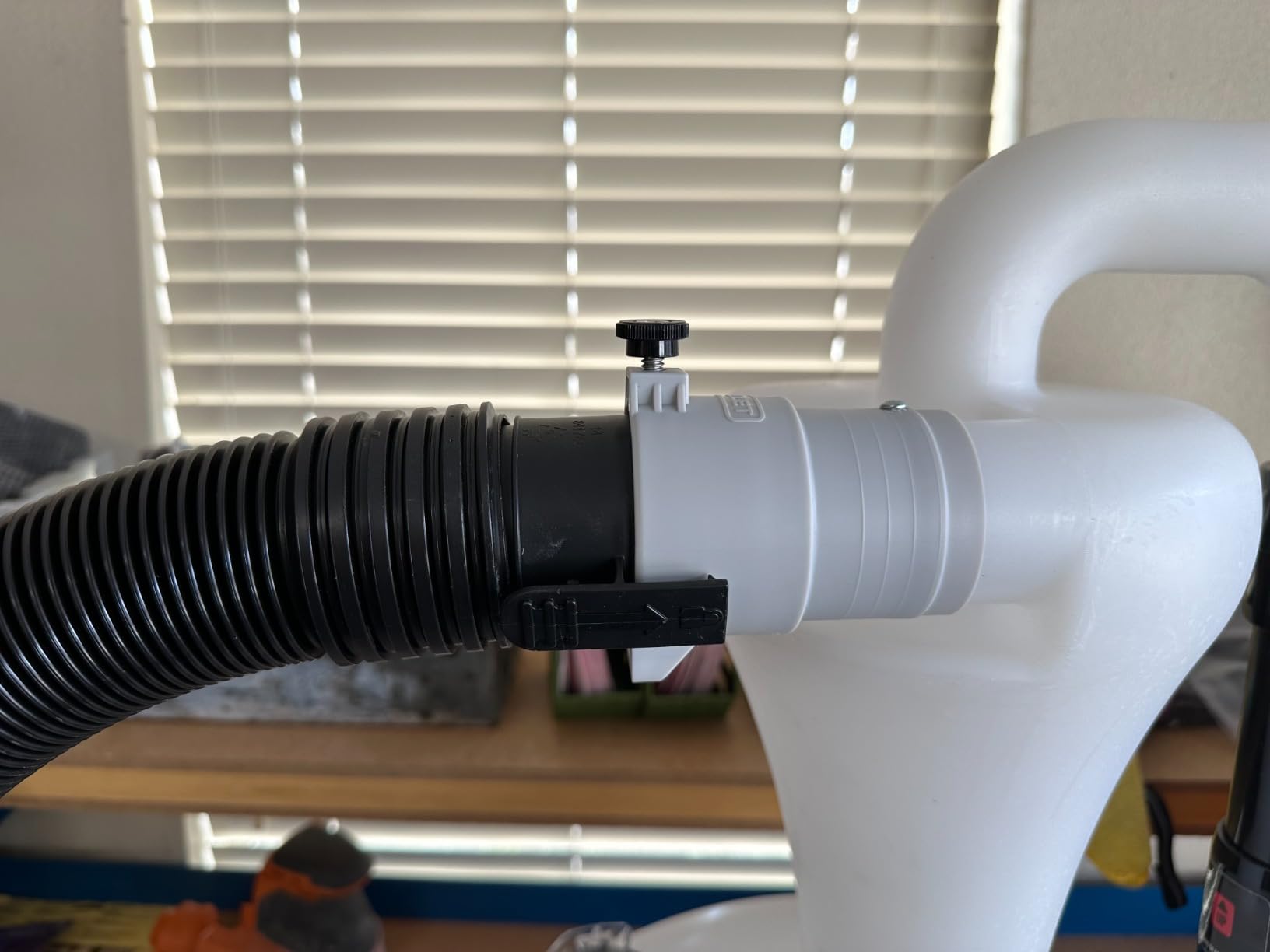
What sets it apart from the bucket-and-lid separators is the geometry. The body is a single seamless parabolic piece rather than a cone screwed or glued onto a funnel, which is exactly the joint that owners of other brands report cracking open within months. There is no seam there to fail, and there is no bucket to collapse when suction spikes.
The rigid PVC connection is the other quiet win. It is cut to fit your hose and pushed on snug, so you get an airtight seal without hose clamps, and the included adapters cover the usual shop vac fitting sizes. That matters on a lathe because a leaky connection at the hood is suction you simply do not have at the workpiece.
We also like that the published sound level is 72 dB. That is a real number you can plan around rather than a vague claim, and for a separator that is genuinely toward the quieter end of what a shop vac setup produces. If your lathe shares a wall with living space, that number is worth more than another two hundred CFM nobody can use.
How it performs on fine sanding dust at the lathe
This is where the design earns its rating. Because it pre-separates the bulk of the debris before the air ever reaches your vacuum, the vacuum’s filter stays clean, which means the vacuum keeps its suction through a long sanding session instead of choking after ten minutes. For a turner power-sanding a bowl for an hour, that consistency is the whole ballgame.
The 99-plus percent separation figure is for debris in general, and heavier sanding dust is easier to spin out than the very finest particles. What is left for the vacuum to deal with is the light fraction, and a shop vac fitted with a pleated cartridge or a fine bag handles that well. Owners running this arrangement on a lathe report the room stays visibly clear through a full sanding session.
Where it is the wrong choice
It is the wrong choice if you do not already own a shop vac, because you will need one to drive it. It is also the wrong choice for a small shop where floor space is already tight and a 12-gallon canister sits on the same shelf, and it is overkill if your turning is pen work with a small trap and a short hose.
Cost is the other factor. Among bucket-style separators this sits well above the entry tier, so if you want the cheapest path to cyclone separation and you are comfortable supplying your own container, the Oneida DIY kit below does the same job for a fraction of the outlay. The trade is build quality and a seal that does not need thinking about.
2. Oneida Dust Deputy DIY: Best Value Cyclone Separator
Oneida Air Systems Dust Deputy DIY Anti-Static Retrofit Cyclone Separator for Wet/Dry Shop Vacuums (DD DIY)
Up to 99.9% dust capture
Anti-static DIY kit
15.5 x 9.3 x 7.4 in
0.8 oz
Pros
- Highest review count in the class at more than 4200 ratings
- Neutral vane technology rated 20 percent more efficient
- Captures up to 99.9% of dust before the vacuum filter
- Made in the USA with anti-static construction
Cons
- You supply the waste container and hose
- Tapered 2.0-inch ports may need adapters
- Bare kit with no bucket or casters
This is among the most proven separators available, carrying a 4.6 rating across more than 4200 reviews, and that volume of long-term owner feedback is worth more to a buyer than any spec claim. Owners describe a simple design with no moving parts to break, which is a fair description of something that is mostly a lid and a set of tapered vanes.
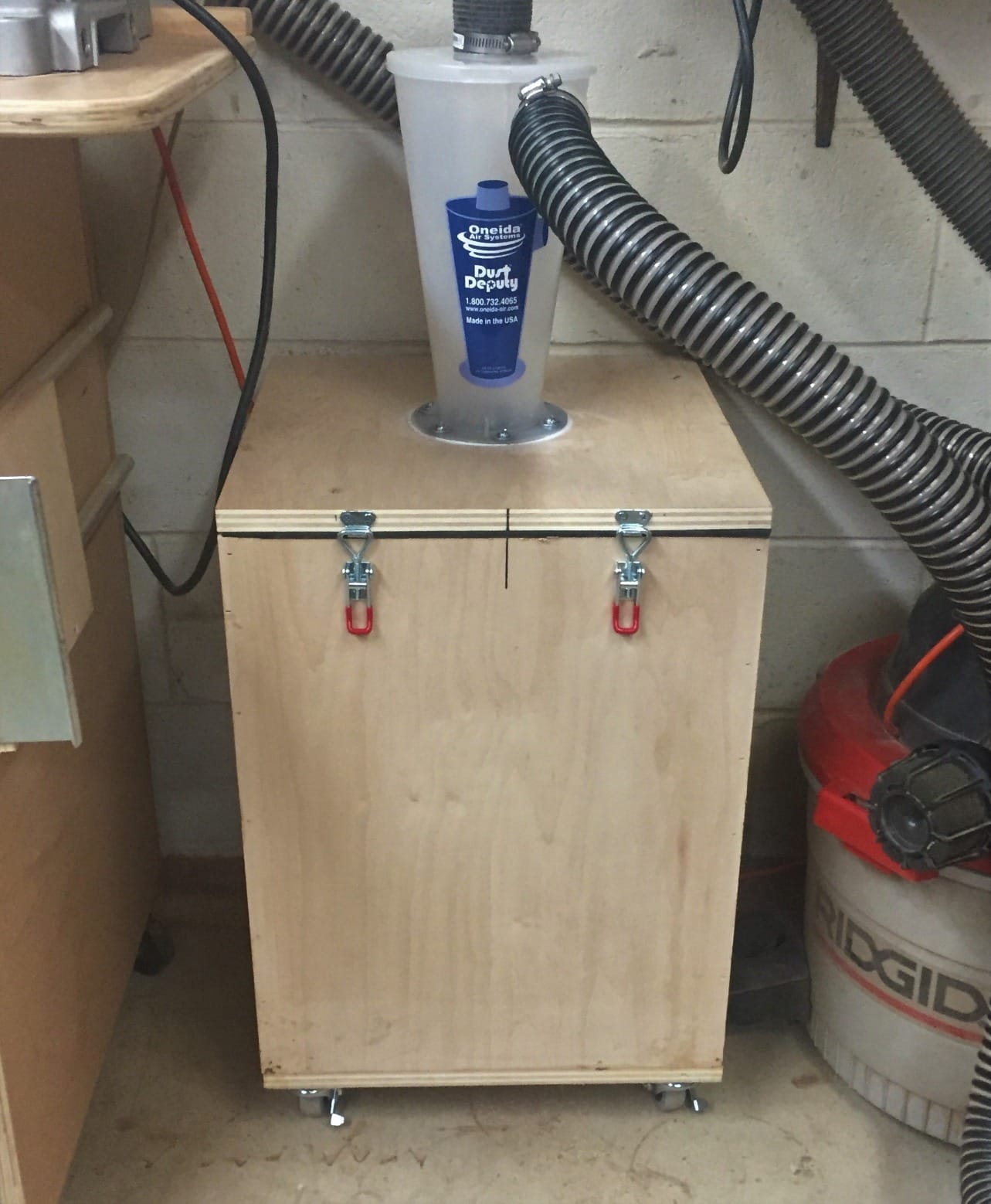
The anti-static construction is a detail that gets overlooked and it matters. Wood dust is abrasive and can carry a charge, and a grounded anti-static body is the safer choice when you are handling dry fines in a small shop. The neutral vane design is rated to capture up to 99.9% of dust and debris before anything reaches your vacuum filter.
Because it works with any wet or dry vacuum, this is the flexible option in a changing shop. One turner described running it to two lathes and two bandsaws on blast gates, which is the pattern most home shops end up with once they add a second machine. The unit itself is small at 15.5 by 9.3 by 7.4 inches, so it mounts anywhere you have a shelf and a bucket.
The honest drawback is that it is a kit. You bring the waste container, the hose, and the mounting hardware beyond what is included, and you assemble it. That is a real trade for some people and a bonus for others who would rather build their own cart or drum setup. It is also the cheapest way to add cyclone separation to a shop you already have.
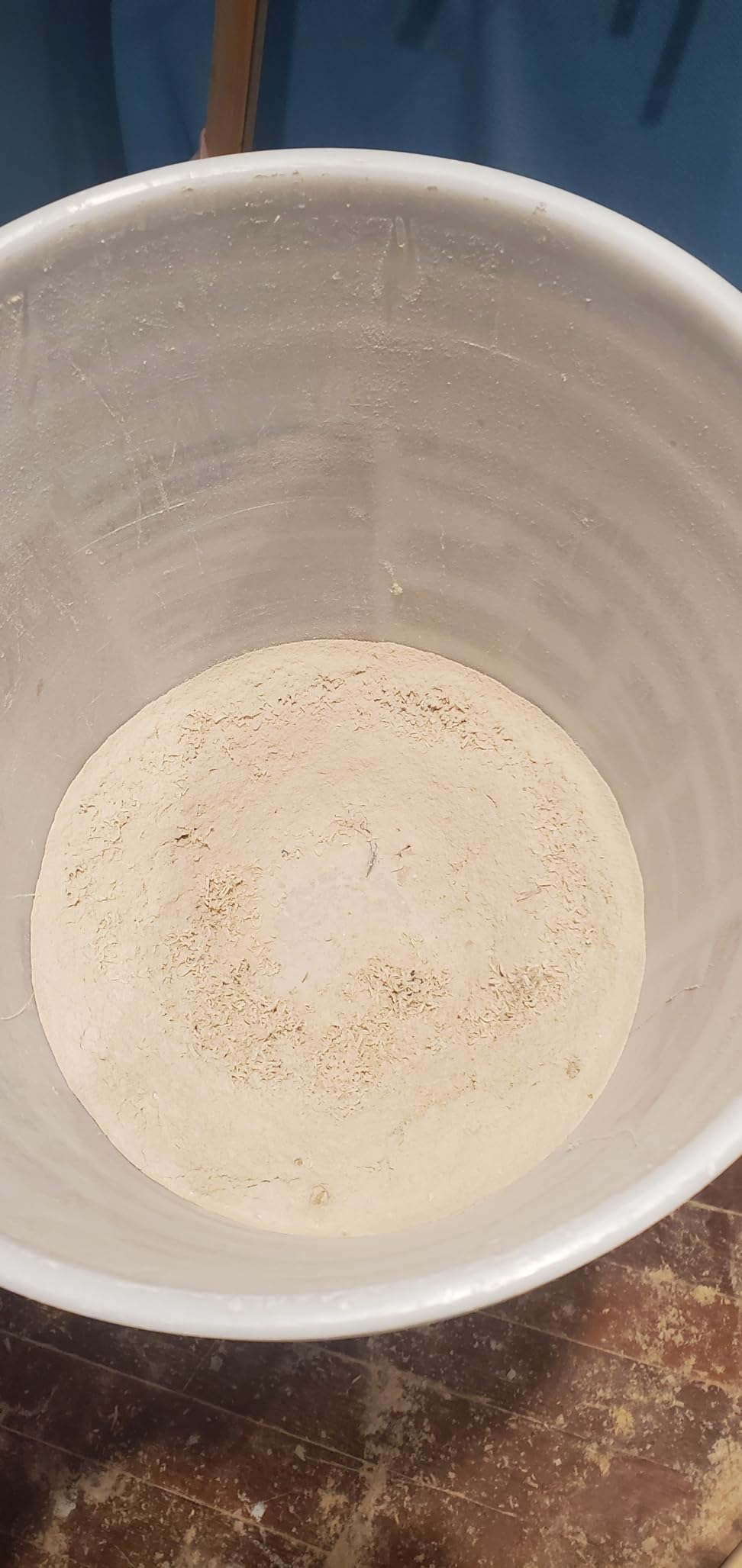
How to mount it so it does not fail in three months
Owners of this and every similar bucket separator report the same two failure modes, and both are avoidable. First, the container can collapse inward under strong suction, so nest a second container inside the first or use a metal drum instead of a single plastic bucket. Second, the whole assembly can tip, so put it on a proper cart or weight it down rather than balancing it on a shelf.
The other recurring complaint is the lid seal letting go when a hose pulls off-centre. Fit the hose so it enters straight rather than at an angle, and if the connection will not hold on its own, add your own clamp. Turners who have made those two small fixes generally report the separator running indefinitely.
Best used for a single lathe on a shoestring
This is the pick if you have one lathe, a shop vac, and a small shop where a full collector will not fit. Add a hood or scoop at the lathe and you have a complete fine-dust setup for the least money on this list. It is the configuration most home turners end up with, and the feedback supports it.
It is less suited to someone who wants zero assembly, or who plans to duct a fixed system to a table saw and a planer as well. In that case the turn-key version below saves you the build and gives you a container and casters that are already sized to hold up.
3. WEN 660 CFM Rolling Dust Collector: Best Budget Dedicated Collector
WEN Woodworking Dust Collector, 5.7-Amp Motor with 12-Gallon Bag, Mobile Base, and Optional Wall Mount (DC3401)
660 CFM
12-gallon 5-micron bag
4-inch port
17 lb with casters
Pros
- 660 CFM from a 5.7-amp brushed motor
- Large 12-gallon bag means infrequent emptying
- Lockable swivel casters and a two-year warranty
- Optional wall mount for a fixed corner of the shop
Cons
- 5-micron bag lets finer dust through than a 1-micron bag
- Brushed motor is louder than an induction motor
- Plastic impeller may wear sooner than metal
If you want a dedicated collector rather than a separator on a shop vac, this is the pick. Among the standalone machines here it carries 674 ratings, far more owner history than the other dedicated collectors, and the reason is straightforward. It puts out 660 CFM, which sits right at the minimum we would want behind a proper lathe hood, and it does it from a 5.7-amp brushed motor in a body you can wheel across the floor.
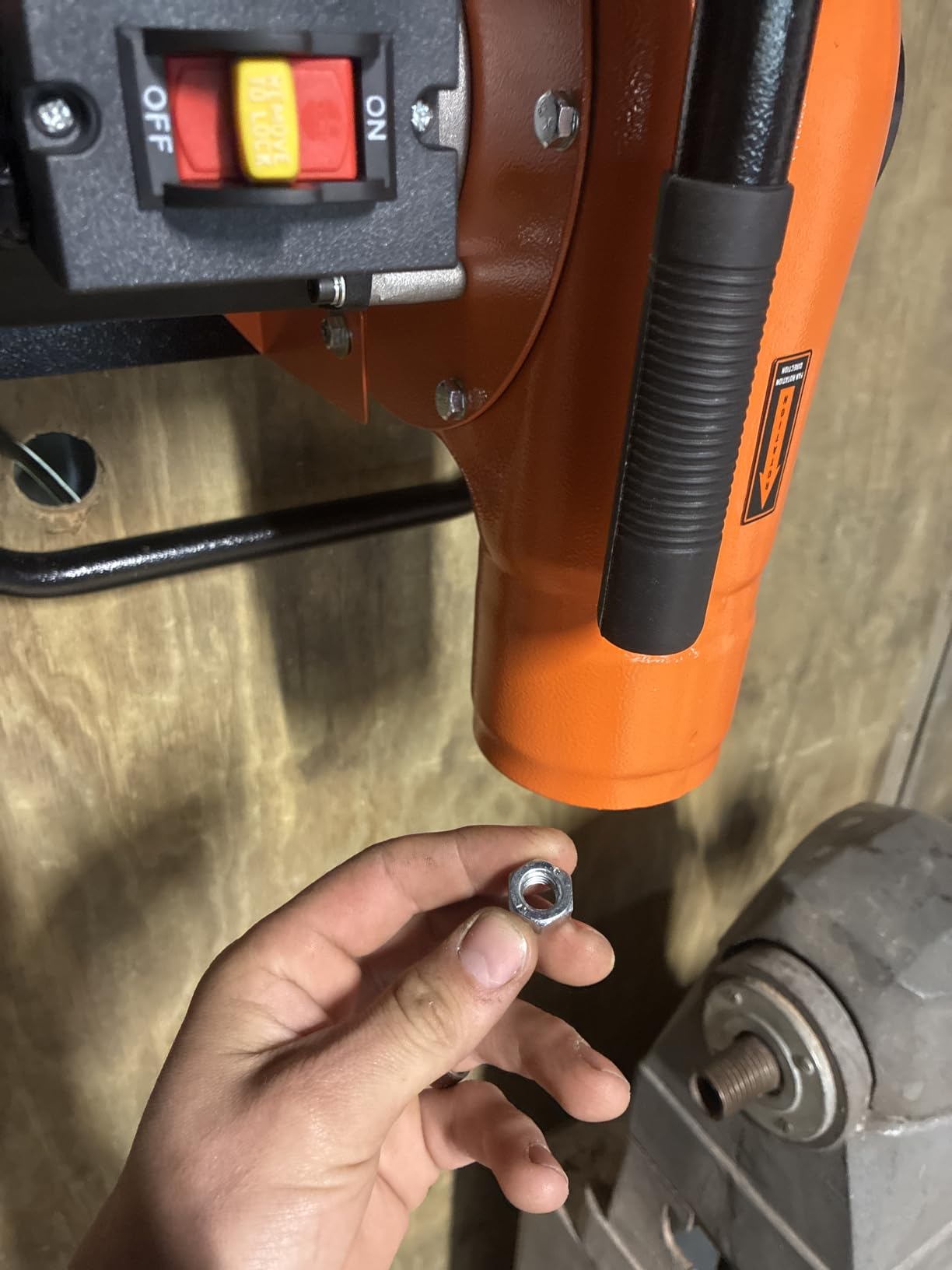
Mobility is the underrated feature here. The lockable swivel casters mean you can pull it to whichever machine you are working on and lock it in place, and the onboard carrying handle makes that a one-hand job. For a shop where the lathe, the bandsaw, and the sander all move around, that flexibility is worth as much as the airflow number.
The 12-gallon zippered bag is also larger than what most collectors in this class carry, so you are not emptying it every ten minutes of sanding. Owners consistently call the value strong when compared to larger machines, and the optional wall mount is a nice touch if you eventually want to fix it in a corner instead.
Be clear-eyed about the two compromises. The supplied 5-micron bag is coarser than the 1-micron filtration most experienced turners end up wanting, and a brushed motor is louder and shorter-lived than an induction motor. Neither is a dealbreaker for most shops; both are worth planning around.
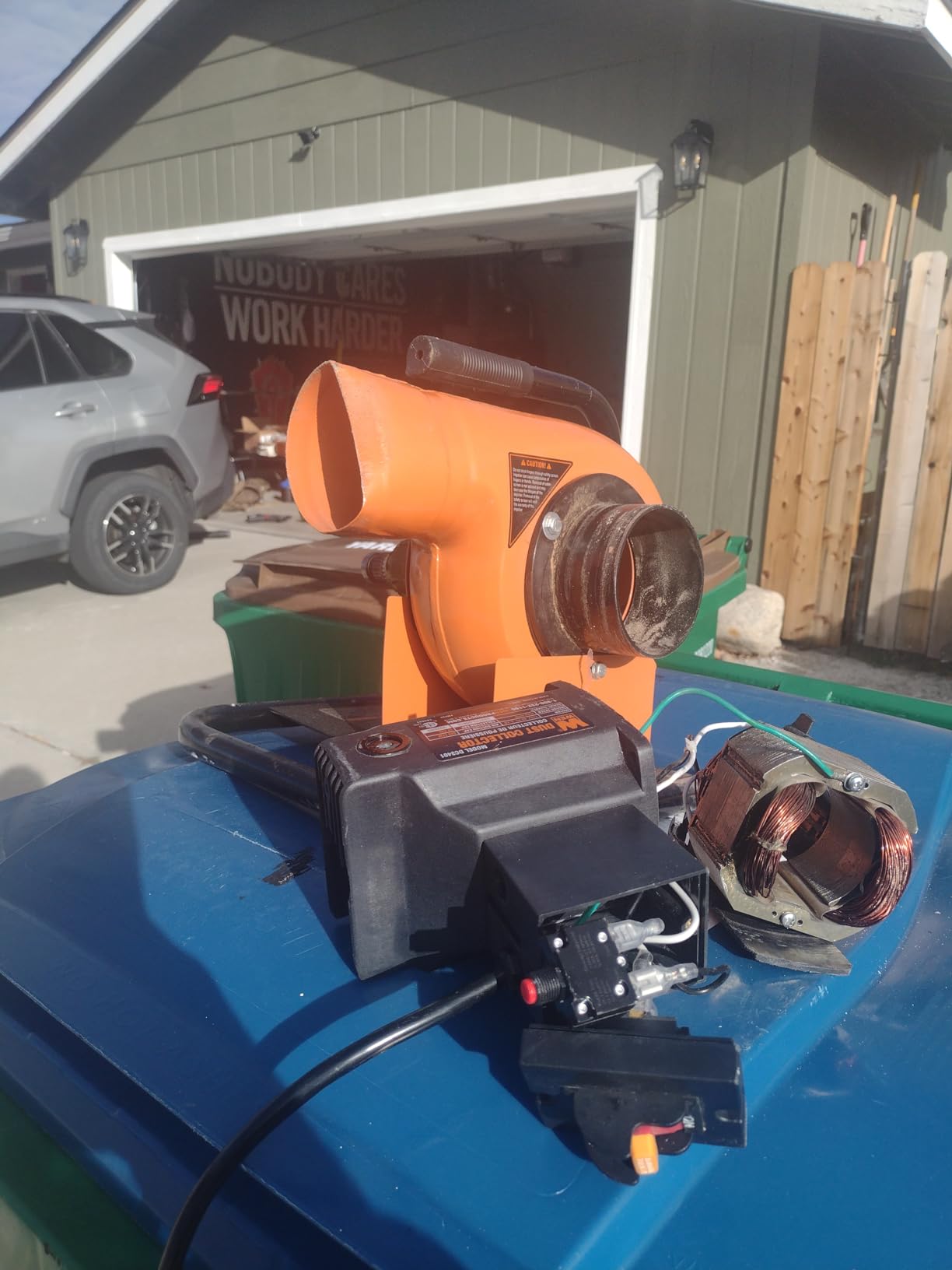
Is 660 CFM enough at the lathe?
It is enough for a hood positioned close to the workpiece, and that positioning is the variable most people get wrong. The same 660 CFM through a twenty-foot run of undersized hose with three elbows is effectively a much smaller number at the tool. Keep the hose run short and the hood close, and this machine keeps up with a sanding session on a bowl or spindle work.
Turners running mostly pen work will find it more than sufficient. For heavy sanding of large bowls with a wide-open hood, you are at the bottom of the acceptable range rather than comfortable in it, which is the main argument for stepping up to the POWERTEC or a cyclone-backed setup.
Where this collector will disappoint you
The 5-micron bag is the one to plan around. It will hold the coarse dust but lets the finest fraction through, and fines that escape are exactly what you were trying to capture. Upgrading to a finer bag is the single cheapest upgrade available on this machine and is worth doing before you judge the collector itself.
The other gripe owners report is that the bag zipper gets awkward to work when the bag is full, so plan to empty it before it is packed solid. A few buyers also report vibration and note the plastic impeller is not as durable as a metal one, so treat it as a machine for a home shop rather than a commercial one.
4. Oneida Dust Deputy 2.5 Deluxe 5-Gal: Best Turn-Key Portable Cyclone
Oneida Air Systems Dust Collector & Cyclone Separator Kit w/ Clear Bucket, 2.5 Deluxe 5-Gal – Portable Cyclone Machine for Wet and Dry Shop Vacuums
5-gallon collapse-proof bucket
2.5-inch hose
Neutral-vane separation
Four casters included
Pros
- Turn-key: bucket
- casters
- hose
- and tether kit all included
- Neutral-vane technology rated 20 percent better separation
- Translucent bucket lets you watch the fill level
- Works with any shop vacuum with 2.5-inch fittings
Cons
- 2.5-inch hose is narrow and chokes airflow
- Included double-sided caster tape fails over time
- Bucket seal can fail if the hose pulls off-centre
The Deluxe version solves the two things most people dislike about the DIY kit. It ships with the bucket, four casters, a 2.5-inch hose, and a vacuum tether, so you can have working cyclone separation without building a cart first. That convenience is why this is the pick for anyone who wants separation without a project.
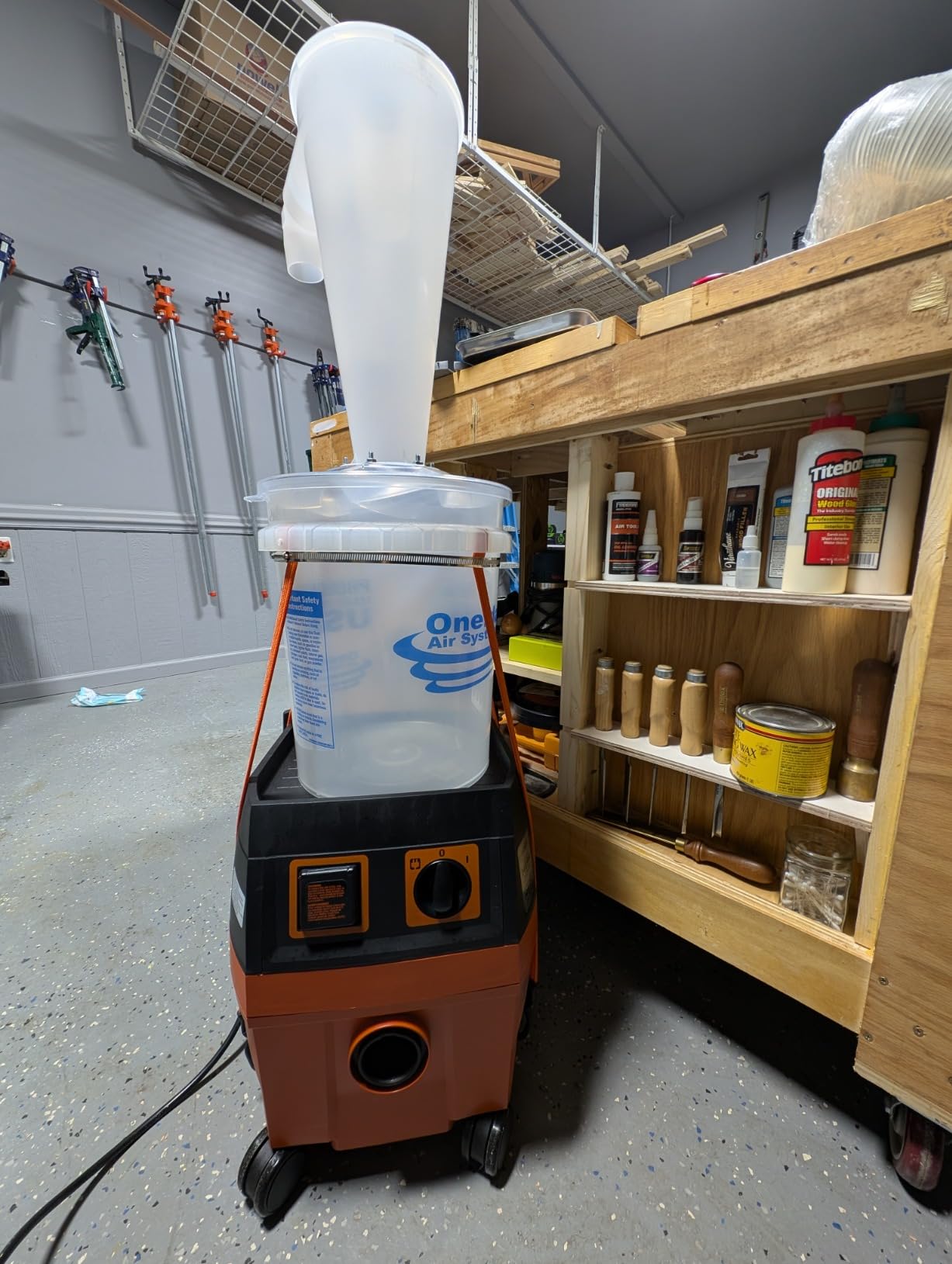
Neutral-vane technology is the upgrade over the older design, rated by the manufacturer at roughly 20 percent better separation efficiency, and the spec sheet claims 99 percent of dust and debris is captured before it reaches the vacuum filter. The translucent bucket is a genuinely useful touch because you can see the fill level instead of opening the lid to check.
Owners report that it keeps their shop vac filters clean and their suction strong, and that setup is simple enough that the compatibility question rarely comes up. It works with any shop vac that has 2.5-inch hose fittings and includes swivel cuffs, so it pairs easily with the PSI hoods in this guide that use a similar connection.
The recurring complaint is the hose. At 2.5 inches it is narrower than the 4-inch duct a dedicated collector would use, and owners say it restricts airflow. The other common note is that the double-sided tape holding the casters on gives out, so a few screws or better casters are a worthwhile first-hour upgrade.
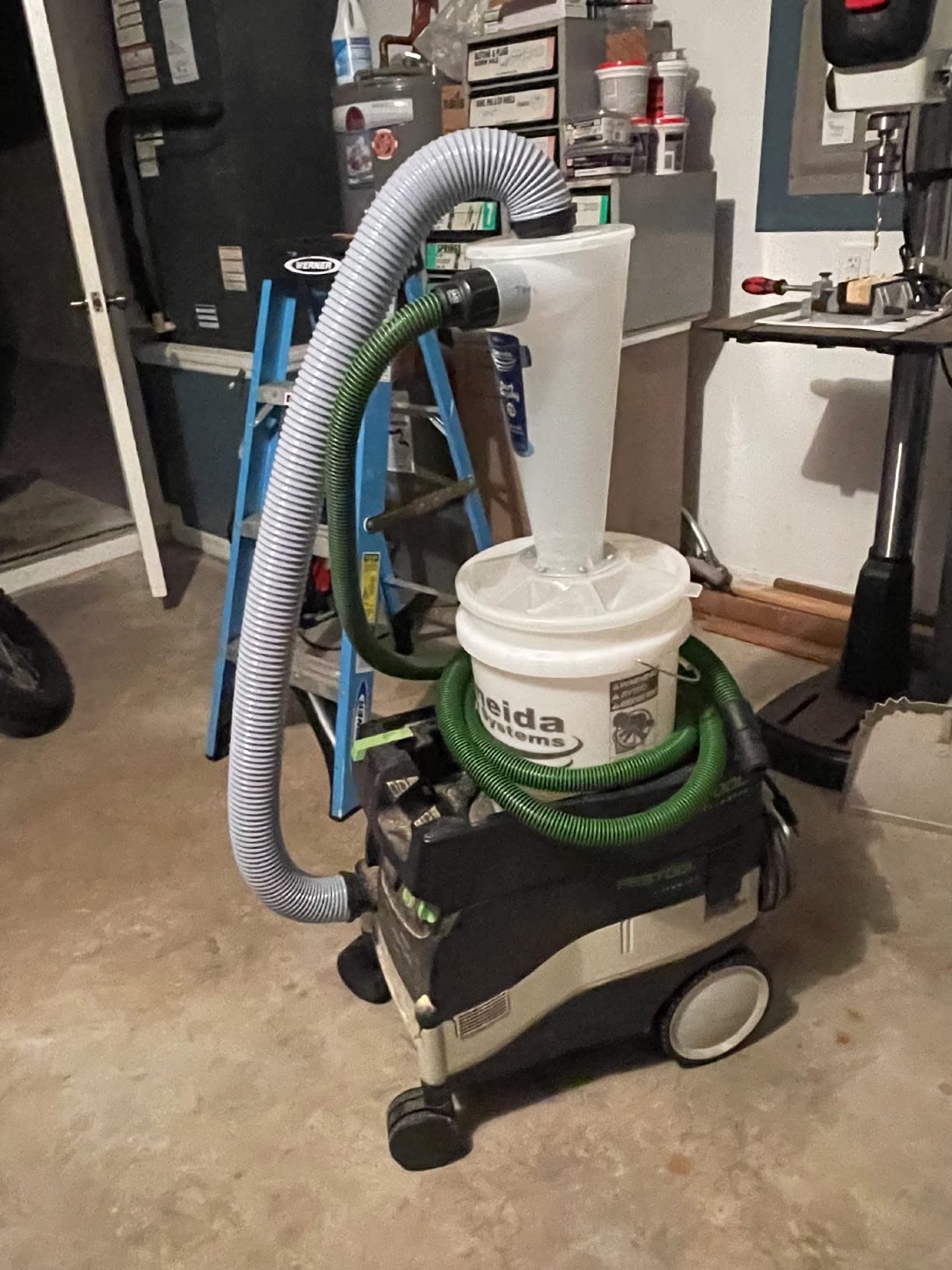
How it fits a one-car-garage shop
It fits well. The whole assembly rolls, so you can park it beside the lathe while you sand and wheel it to the bandsaw when you switch jobs, and it does not need a 55-gallon drum taking up a wall. That is the recurring constraint from turners with small shops, and a machine they have to drag between machines ends up unused.
The practical advice is to treat the 2.5-inch hose as part of the system rather than an afterthought. Keep the run short, avoid sharp bends, and connect it to the lathe hood so the airflow path is as direct as possible. Owners who have done this report the combination out-pulls a bare shop vac by a wide margin.
Best for anyone who wants a cyclone without building one
Pick this if you read the DIY kit’s assembly requirements and thought no. It is assembled, it rolls, it fits a small shop, and it ships with everything needed to connect a shop vac. The price step over the bare kit buys you the container, the casters, and the peace of mind.
Leave it on the shelf if you plan to run a fixed ducted system, or if you already have a genuinely large hose you would rather not downsize. In those cases a real collector with a 4-inch port is the better partner for the hoods further down this list.
5. POWERTEC DC5372 1 HP 560 CFM Collector: Best for 1-Micron Filtration
POWERTEC 1 HP, 560 CFM Portable Dust Collector with 1 Micron Dust Collector Bags, Dust Collectors for Woodworking Dust Collection System (DC5372)
560 CFM
1-micron bag
1 HP 120V/240V dual voltage
43.6 lb
Pros
- Ships with a 1-micron filter bag rather than a 5-micron cloth bag
- 560 CFM from a 1 HP induction motor runs quietly
- Dual voltage 120V and 240V for shop flexibility
- Bag has a viewing window and zipper disposal
Cons
- Below the 600 CFM comfort line for a wide hood
- Casters have no wheel locks
- 4-inch port grate collects debris
This is the pick when filtration quality matters more than raw airflow. The DC5372 comes with a 1-micron filter bag as standard, and that single fact separates it from every other collector in this guide that ships with cloth or 5-micron media. Experienced turners upgrading from a factory cloth bag typically see the biggest improvement here.
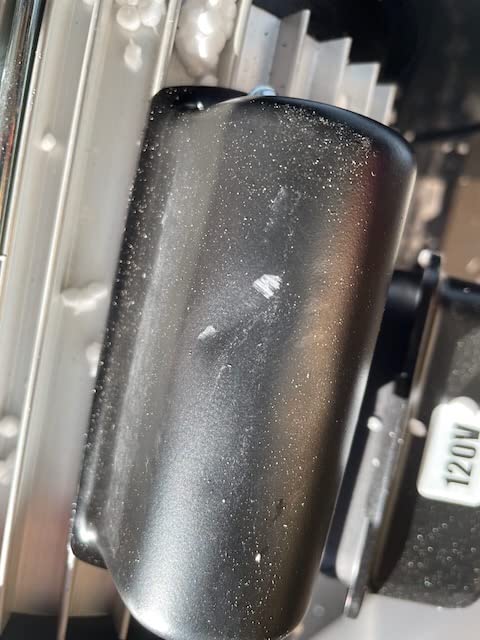
The 1 HP induction motor is worth noting too. Induction motors run quieter and last longer than brushed motors of similar output, and owners specifically call this machine quieter than a shop vac of comparable suction. At 43.6 pounds it is a real piece of equipment, but the casters make it manageable.
Dual voltage is unusual at this level and genuinely useful if you want to run it on a 240V circuit, which matters if you are adding a lathe, a planer, and a saw to the same shop. Owners also like the bag’s viewing window and zipper disposal, which take some of the mess out of emptying.
The honest limit is airflow. At 560 CFM this sits just below the 600 CFM we treat as the floor for a standard hood, so on a wide bowl with the hood held open you will feel the difference against a larger machine. The vortex base design is rated to claw back about 10 percent efficiency, which helps but does not close the gap.
Who benefits most from 1-micron filtration
Turners with any respiratory sensitivity, and anyone who turns woods that produce heavy, sticky fines rather than clean shavings. If you spend time spraying finish or working with CA glue at the lathe, capturing the finest fraction is the point of the whole exercise, and a 5-micron bag will let much of it back into the room.
A long-serving member of the American Association of Woodturners who runs a 3 HP collector while turning reports rarely needing a respirator, and the common thread in that kind of report is fine filtration rather than sheer horsepower. The bag here does that job out of the box, which is why it earns its place despite the airflow ceiling.
What to watch out for
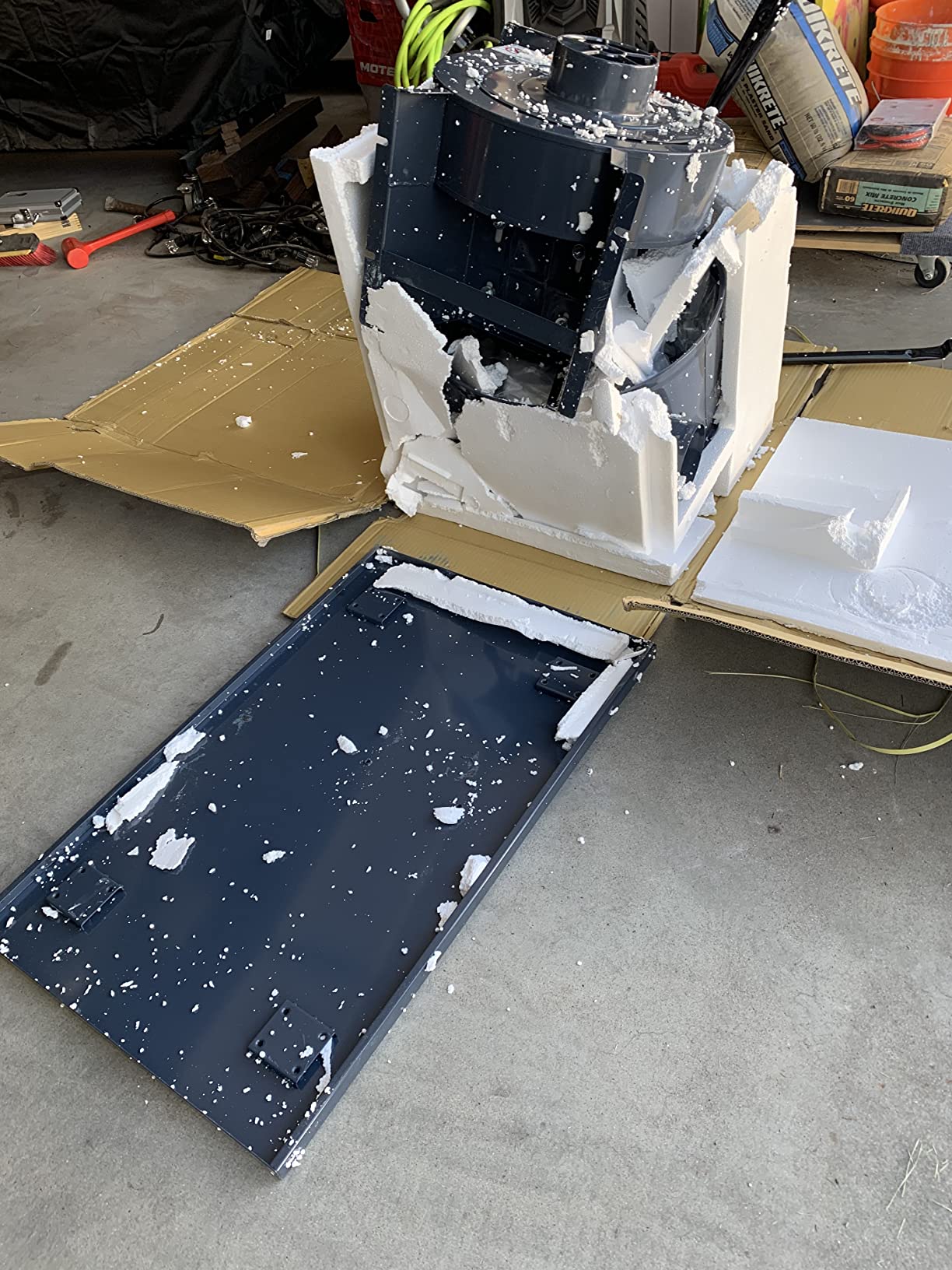
The casters have no wheel locks, and on a smooth shop floor a wheeled collector that drifts while you sand is an annoyance and a trip hazard. Owners also note the support sheet metal can arrive bent and that packaging sometimes gets damaged in transit, so inspect the cabinet before you power it up.
Run it on a dedicated circuit if you can. At 12 amps on 120V, sharing a circuit with a high-draw tool can trip the breaker mid-sanding, and the 4-inch port grate is also a known debris trap that is worth cleaning regularly to hold onto the rated airflow.
6. Rockler Dust Right Lathe System: Best for Mini and Midi Lathes
Rockler Dust Right Lathe Dust Collection System w/ 9″ Dust Scoop & Boom Arm
9-inch C-shaped dust scoop
Adjustable steel boom arm
Fits most lathes
5.96 lb
Pros
- C-shaped scoop wraps around spindle and pen turnings
- Adjustable steel boom arm holds the scoop where you put it
- Works with benchtop
- midi
- and VSR lathes
- Steel construction feels durable in hand
Cons
- Included hose may need an adapter for a shop vac connection
- Mounting to the bed eats into banjo space
- Does not capture larger chips
This is the whole lathe-side of the system in one box. You get a 9-inch C-shaped dust scoop, an adjustable steel boom arm, a vertical mounting post, a flex-form hose, and the hardware to put it on a lathe. The C shape is the important part: it wraps around spindle work so the opening stays aimed at the cut regardless of the tool rest position.
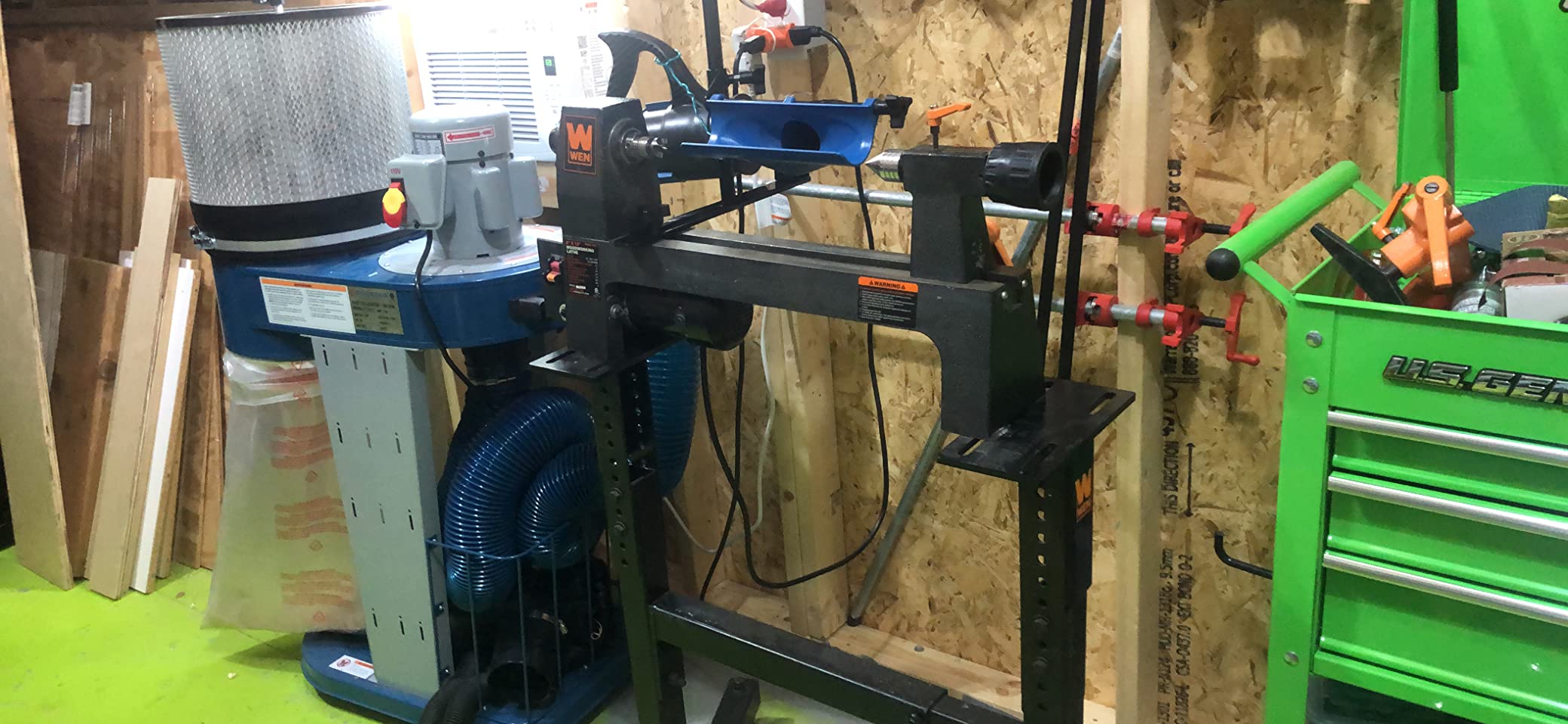
Owners rate the build quality highly, and the steel boom arm is the reason this lasts where plastic mounts do not. The scoop holds its position while you work instead of drifting, and turners report that the arm is simple to reposition when they move between projects. At 5.96 pounds it is a light addition to a small lathe.
The fit is broad. It is listed as compatible with benchtop wood lathes, woodturning lathes, and VSR lathes, and owners with both mini and midi machines report it working out of the box. That is exactly the use case for a collector you cannot duct into a central system, because it captures at the source instead.
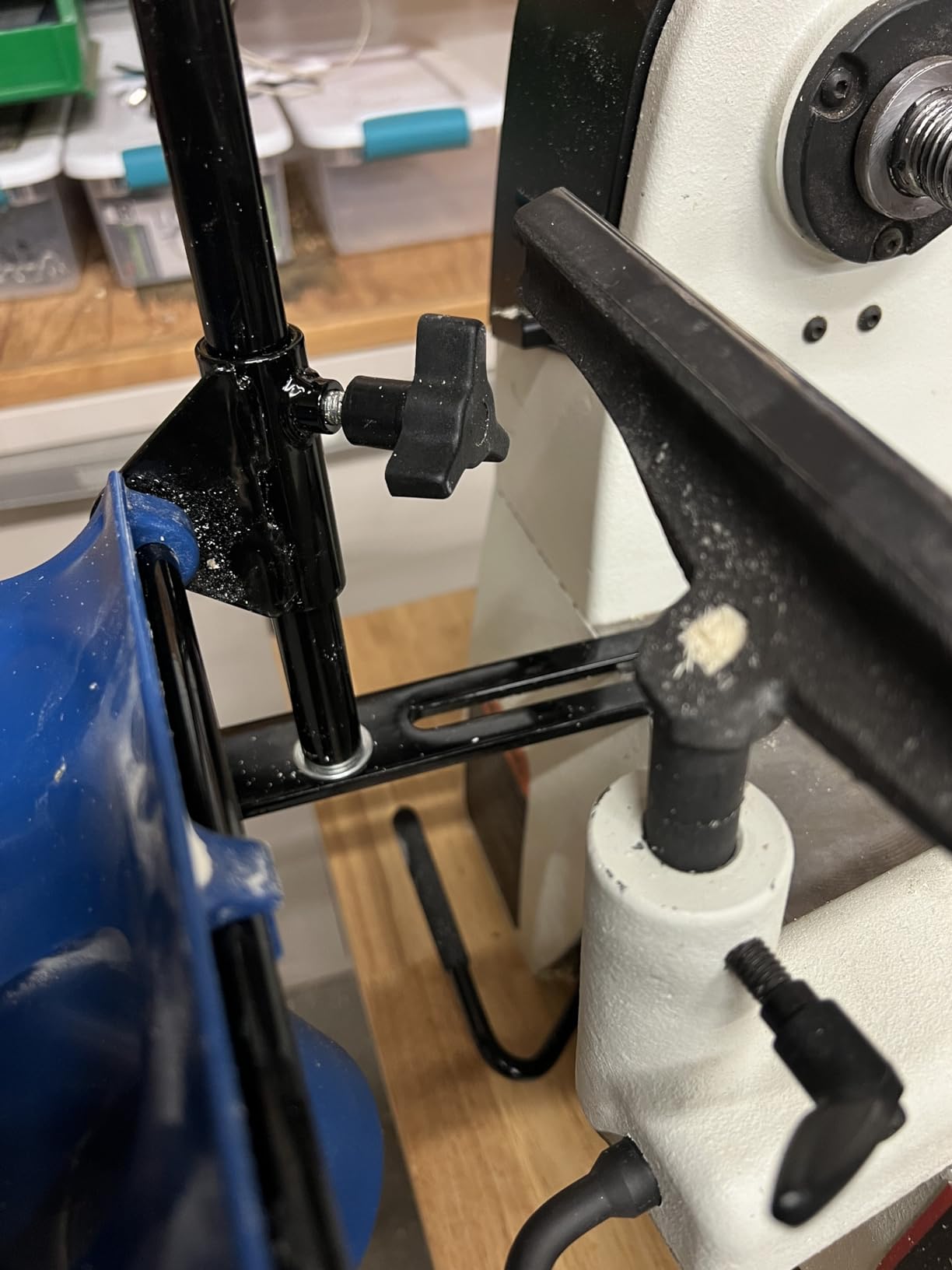
The limitation owners flag most is the included hose. It is a flex-form hose rather than standard 4-inch duct, so connecting it to a shop vac may require an adapter. Plan for that before the order arrives and the whole thing goes together in an afternoon.
Will it fit on a small lathe?
Usually, with one caveat. The vertical post mounts to the lathe bed, and on a compact lathe that post can occupy part of the banjo space, which is the area the tool rest swings through. Owners with small machines report it works but need to check the swing clearance for their favorite cuts before committing to a mounting position.
The boom arm is adjustable enough to swing the scoop out of the way for large bowl work and back in for spindles and pens. Treat that as the intended use rather than a limitation, because a scoop that follows the work is worth the small trade in clearance.
Best for pen and spindle work with a movable setup
This is the right pick when your machines get moved around, because it does not require a single piece of fixed ducting. Plug the hose into a shop vac, or into one of the cyclone options in this guide for better filter life, and you have a complete capture point that follows the lathe rather than the room.
It is less suited to bowl turning, where the workpiece is too large for a 9-inch scoop to enclose and the dust is thrown from a wider area. For bowl work the enclosed magnetic hood below is a better capture device, and for a ducted shop either is a fine add-on drop.
7. PSI Clear Wood Lathe Dust Hood: Best for Bowl Turners
PSI Woodworking DLHOODC2 Clear Wood Lathe Dust Hood With Magnetic Mounting Clamp
6-by-9-inch clear opening
4-inch hose flange
Magnetic clamp
2-year warranty
Pros
- Enclosed hood pulls dust in rather than letting it fly
- Strong magnets hold it firmly on an iron bed
- Clear body lets light through so you keep sight of the cut
- Flip-down screen for checking the workpiece
Cons
- Weak against a shop vac because airflow is too low
- Magnets cannot support heavy rigid ducting
- Can interfere with tool rest positioning
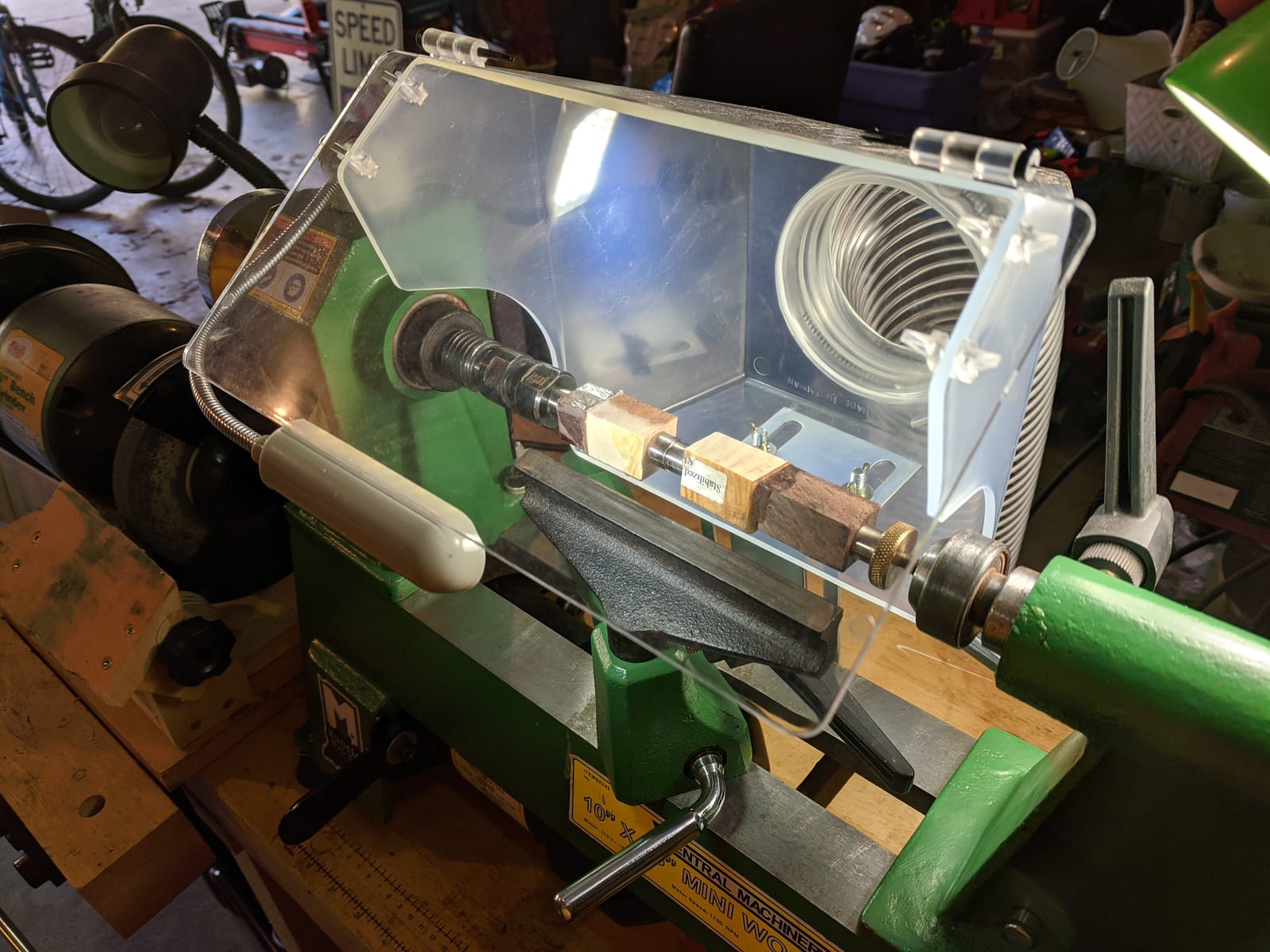
The difference between this hood and a scoop is enclosure. A scoop sits near the workpiece and pulls dust toward it. This hood wraps a 6-by-9-inch opening around the turning area and pulls the dust inside, which on bowl work makes a measurable difference because a wide bowl throws fines from every direction as the tool cuts.
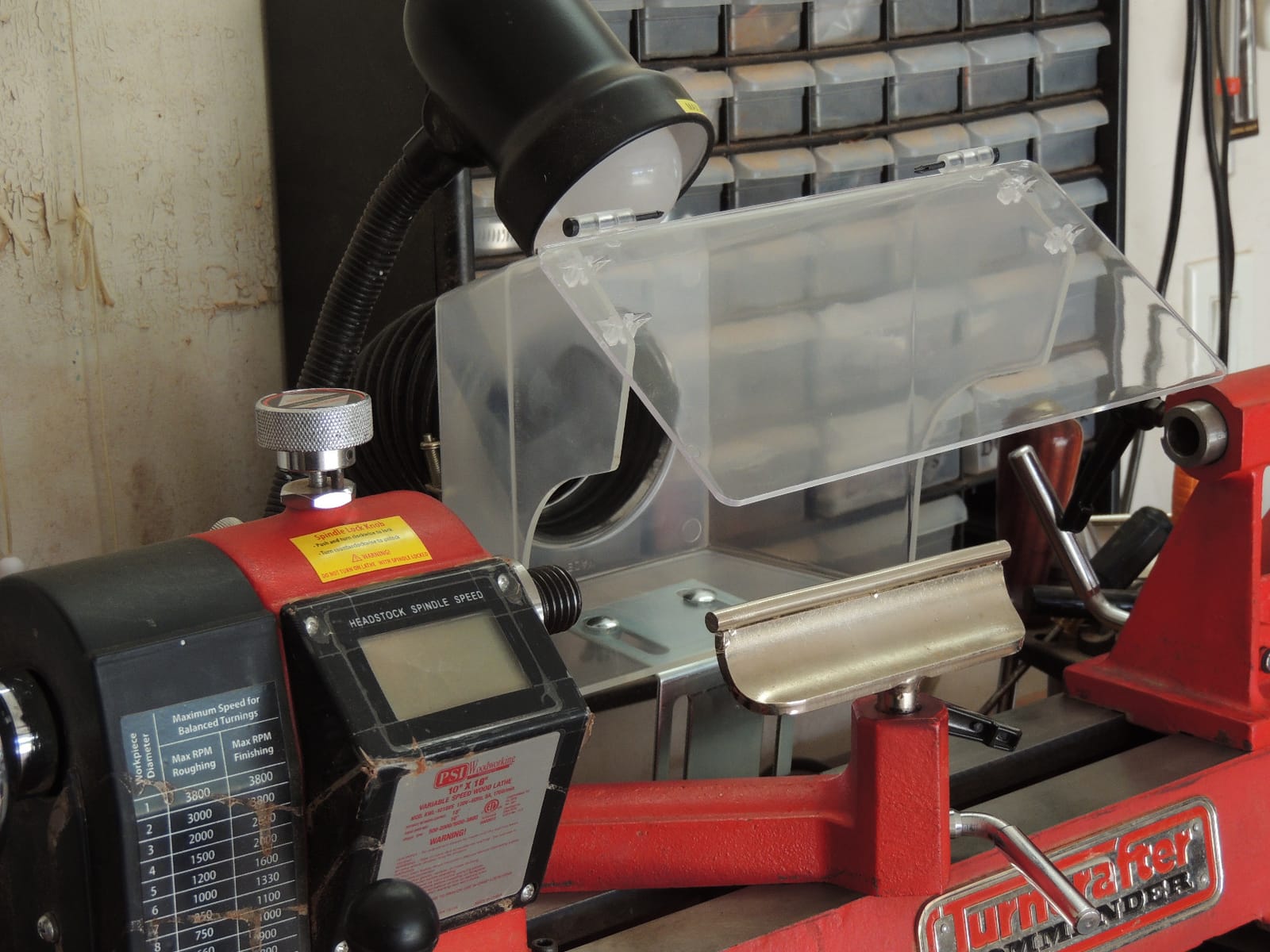
The magnetic mounting clamp is what makes it usable day to day. It snaps onto mini and midi lathes with iron beds and holds firmly enough that owners describe the hood as staying put during turning. Because it is magnetic, you can also pull it off in seconds for a cut that needs the space, then put it back.
The clear body is a genuinely useful design choice rather than a gimmick. Light passes through the hood so you can still see the tool and the wall of the bowl, and the flip-down viewing screen gives you a second way to check the workpiece without reaching in. That visibility matters when you are cutting a hollow form blind.
Two limits to know before you buy. The magnets are not designed to support the weight of heavy rigid or flexible duct hose, so support the duct yourself or use a light hose. And the hood needs a real source of airflow, because a shop vacuum simply does not move enough air to keep the hood drawing dust in.
Pairing it with the right collector
This hood has a standard 4-inch male dust collector hose flange, which is the connection size most mid-size collectors and cyclone adapters expect. Pair it with a collector that delivers at least 600 CFM and the hood does exactly what it is designed to do, holding the dust plume inside the enclosure instead of letting it settle on the lathe bed and your hands.
Owners report the hood working well for pen turning and small projects too, though it is at its best on bowls where the enclosure earns its keep. The flip-down screen is convenient for checking work without breaking the seal, which is a small thing that adds up over a long session.
Best for bowl work, worst for shop vacs
Choose it if you turn bowls regularly and you already have a collector with real airflow. Enclosure is the correct strategy for a large, fast-moving workpiece, and there is no cheap substitute for it when you are hollowing a wide bowl with a sanding disc.
Skip it if your only option is a shop vac. Owners are candid that a shop vac does not provide enough airflow for this hood, and a hood that cannot draw will simply trap dust until it settles back onto the workpiece. In that situation, the scoop in the previous pick is the more honest accessory.
8. PSI Pen Makers Dust Trap: Best for Pen Work
PSI Woodworking PKDTRAP Pen Makers Dust Trap
3-inch clear opening
Mounts to the banjo
Fits 10 and 12 inch swings
2.36 lb
Pros
- Follows the tool rest as you move it
- Adjusts in three directions so it tracks the workpiece
- Compact enough for benchtop lathes
- All mounting hardware and an Allen key included
Cons
- Thin PVC shroud cracks at the screw holes
- Cannot support the weight of a vacuum hose
- Fit depends on banjo style and may need a custom bracket
Pen turning produces an enormous amount of fine dust relative to the size of the work, and this trap is designed for exactly that. The circular 3-inch shroud mounts to the tool rest banjo with the included U-bracket, so it moves with the tool rest and stays centred on the workpiece as you work along its length.
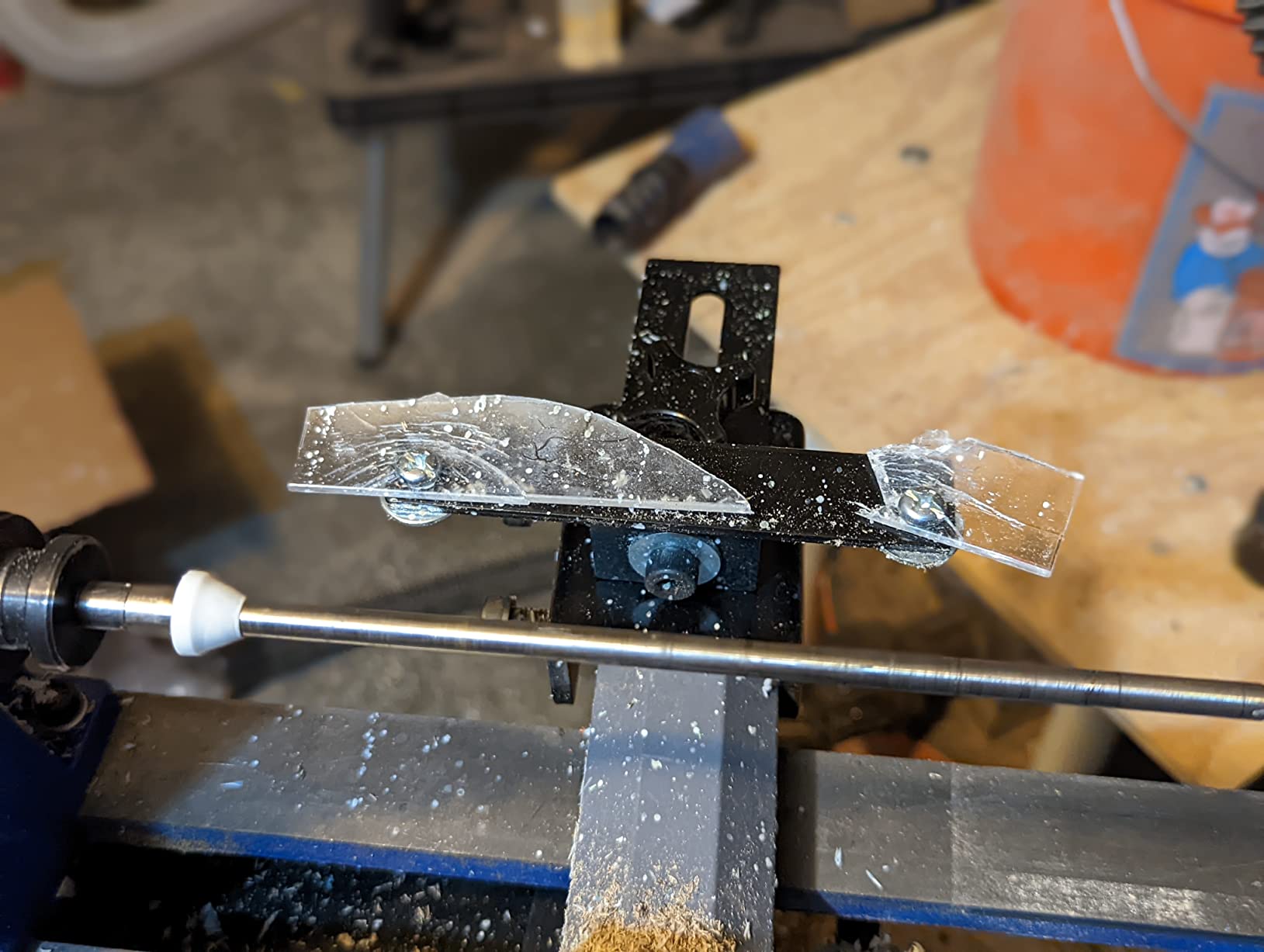
Three-direction adjustment, front to back, side to side, and up and down, is the feature that makes it useful rather than decorative. You can set the opening once for a batch of similar blanks and then move it only when the geometry changes, which is a real time saver when you are turning forty pens in a row.
It fits most mini and midi lathes with 10-inch or 12-inch swings, and the clear PVC lets light through so you can still see the pen blank. The 2.5-inch hose outlet accepts common fittings, and the package includes every bracket plus a 6mm Allen key, so there is no separate hardware run.
The weakness is material, and owners are blunt about it. The shroud is thin and brittle plastic, and multiple reviewers report cracking at the screw holes, sometimes on first use. Fit is also banjo-dependent, and some users needed a custom bracket on larger or non-standard banjo styles.
Support the hose, or the shroud will crack
The single most common complaint is the shroud breaking where the screws pass through it, and the fix is consistent: do not let the weight of the vacuum hose hang on the trap itself. Support the hose on a stand or clamp so the shroud only ever handles airflow, not load, and you remove the most common failure from the equation.
Check your banjo style before you order. It works best with square, Powermatic-style banjo mounting, and turners with other setups sometimes fabricate their own bracket. If your banjo is wider than two inches, the fit is another thing to verify first.
Best for dedicated pen and small spindle work
Pick it if pens and small spindles are what you make and your lathe has a compatible banjo. Following the tool rest is the right behaviour for this kind of small work, and a 3-inch opening is proportioned to a pen blank rather than a bowl wall.
Pass on it if you are roughing large stock or turning bowls, where the trap is simply too small for the job, or if you have already had trouble with thin plastic mounts. For bigger work go up to the boom arm scoop or the enclosed hood, both of which are built for larger diameters.
How Many CFM Do You Need for a Lathe?
You need at least 600 CFM with a standard dust hood, and 800 to 1000 CFM is preferable. That figure comes from experienced turners rather than from a manufacturer spec sheet, and it is the number to shop against.
Here is the part that changes how you compare machines: airflow is set by impeller diameter, not by horsepower. A motor’s power tells you how hard it can push air, but a large fan wheel moves far more of it. A 3 HP motor spinning a 12-inch impeller moves about the same volume of air as a 1.5 HP motor spinning the same 12-inch impeller, and both move less than a smaller motor spinning a 14-inch wheel.
The Sawmill Creek figure that circulates in woodworking circles puts a 12-inch impeller at roughly 600 CFM at 3450 RPM and a 14-inch impeller at about 1400 CFM under the same conditions. Impeller size is the single most useful number on a dust collector spec page, and it is almost never the number printed on the box.
For reference, common machines sit in predictable places. A 1 HP collector with a 9.5-inch impeller lands around 400 to 500 CFM. A 1.5 HP unit with an 11-inch impeller reaches roughly 550 to 650. The POWERTEC DC5372 in this guide is rated at 560 CFM, and the WEN is rated at 660 with a 6-inch impeller and a brushed motor.
One more caution on quoted numbers. Advertised CFM is measured on a bare machine with a paper element, and real output drops once a proper filter is fitted. A widely repeated example is a collector advertised at 1600 CFM that delivers closer to 1200 CFM with a canister filter installed. Treat the box number as a ceiling and buy for the number you need at the tool, not the number on the carton.
Shop Vac vs Dust Collector: What Each One Is Actually For
A shop vacuum with a pleated filter and a cyclone pre-filter is a genuine substitute for a dedicated collector when you have one lathe and one sander. Hold the hose close to the cut, keep the run under about six feet, and add a fine bag, and it will capture the dust you care about for a fraction of the outlay.
Where a shop vac falls short is endurance. Turners report bagging up and clogging within minutes of lathe sanding dust, with suction collapsing and fines blowing back into the room. That is the experience that pushes most people to buy something dedicated, and it is the honest test: if you are bagging out every fifteen minutes, the shop vac is not winning.
A dedicated collector wins on three specific things. Filter capacity, so you can work for an hour without stopping. Motor durability, since collectors use induction motors rated for far longer duty cycles than a shop vac. And predictability, because the airflow at the tool stays roughly the same in month six as it did on day one.
A cyclone is the piece that sits between the two. It does not replace the vacuum; it protects it. The bulk of the debris drops out before the air reaches the filter, which is why owners of separator setups consistently report that their vacuum filters last far longer and their suction holds up. For a single lathe, a cyclone on a shop vac is the best value in this entire guide.
Worth separating from both: an overhead air cleaner. It filters the air already in the room, which helps with the dust you have already made, but it does nothing for the dust at the workpiece. A collector captures before it becomes a housekeeping problem, which is a different job.
And the floor of the hierarchy is worth stating plainly. A broom, a dustpan, and a respirator is a legitimate setup if you rough-turn with sharp tools and rarely sand. You do not need any of this equipment to make a bowl. You need it once you start power-sanding at the lathe.
How to Choose a Dust Collector for Lathe Work
Match the capture device to the type of turning you do
Pen and spindle work on mini and midi lathes: a toolrest-mounted trap or a boom arm scoop. These are sized to small diameters and stay with the work as the tool rest moves. A 2.5-inch hose outlet is typical and matches small shop vac connections.
Bowl turning: an enclosed magnetic hood. The workpiece is large and fast, so dust comes from every direction and only an enclosure that surrounds the cut will hold it. Budget for a 4-inch connection and a collector with real airflow behind it.
Mixed turning and sanding: both. Many turners keep a small trap permanently mounted for detail work and bring in a hood or scoop when they sand. That is a normal setup, not a compromise.
Check impeller diameter before horsepower
Read the impeller diameter first, then the airflow claim, and only then the motor. As the numbers above show, a bigger wheel in a smaller motor can beat a big motor with a small wheel, and a brushed motor in a plastic housing will not last like an induction motor in steel. If a listing does not state impeller size, treat the CFM figure with suspicion.
Filter media decides what escapes
A factory cloth or felt bag is roughly 5 micron and is the baseline every collector ships with. A 1-micron aftermarket bag is the common upgrade and is what most experienced turners move to. A pleated cartridge has far more surface area than a bag of the same footprint, which is why it restores airflow as well as filtering well. HEPA is sub-micron and worth it if you have respiratory sensitivity, but costs more and moves less air, so pair it with a cyclone.
Whatever you choose, a collector with a shaker or removable bag can be maintained with compressed air instead of constant replacement. One long-term owner reports running a collector for nineteen years and never replacing the filter, only blowing it out. That is the low-cost ownership model.
Plan the duct, not just the machine
Friction is where most setups quietly lose their airflow. Every elbow and every extra foot of hose costs you static pressure, and 4-inch hose that is crushed or kinked costs you a lot. Keep runs short, use the largest hose the machine can accept, avoid tight 90-degree bends, and add a blast gate at the machine so the others stay closed when you are not using them.
If you already run a central ducted system, adding a lathe is a matter of a Y-inlet and a blast gate rather than a second machine. A Shop Fox owner who split a 4-inch Y-inlet with a blast gate on each side and reduced the lathe branch reports it works very well, and that is the pattern most multi-machine shops end up copying.
Account for noise, floor space, and layout
Noise is a top-tier concern for home shops and it is under-discussed. Shop vacs and small brushed-motor collectors are loud in a way that makes a lathe unusable in a space attached to a house. Induction motors and high-speed separators publish lower sound levels, and where a published figure exists it is worth trusting over a vague quiet claim.
Floor space matters just as much. If a collector has to be dragged from machine to machine it ends up unused, and that is the single most common regret reported in turning forums. Casters, lockable wheels, and a footprint that fits beside the machine beat a bigger unit you cannot move. A dedicated work surface and stable bench under the lathe also matter more than most buyers expect, and our guides to tested work tables and stainless steel work tables cover how to choose a base that will not wobble while you turn.
Finally, remember what no collector does for you. It does not collect chips and shavings, and it does not clear finish odour unless the air is actually exhausted outside. Sweep the chips, run the collector for the sanding, and treat collection as a complement to a respirator rather than a replacement for one.
Frequently Asked Questions
How much CFM do I need for a wood lathe?
At least 600 CFM when you use a standard dust hood, and 800 to 1000 CFM is preferable. Impeller diameter drives airflow, not horsepower, so check the impeller size on the spec page before you compare CFM claims across models.
Do I need a cyclone separator for lathe dust?
For most turners, yes, for two reasons. A cyclone keeps chips and shavings out of the impeller, which jams quickly without one, and it removes the bulk of the debris before the air reaches the filter, which extends filter and bag life dramatically. A drum or barrel separator, or a DIY Thien-style build, is the budget route to the same result.
Can a shop vac replace a dust collector for lathe sanding?
For a single lathe, yes, with a pleated cartridge or 1-micron bag and a cyclone pre-filter in front of it. Keep the hose run under about six feet and hold the nozzle close to the cut. Without those two things the bag clogs within minutes, suction collapses, and fine dust blows back into the room.
What kind of hood does a wood lathe need?
Bowl turning needs an enclosed hood that can sit close to the spinning workpiece. Pen and spindle work need only a hose end or a small scoop that follows the tool rest. Most accessories use a 4-inch spigot or a 2.5-inch hose outlet, so match the connection to your collector port rather than the other way round.
Are HEPA dust collectors worth it for woodturning?
They are worth it if you have respiratory sensitivity, work with woods that produce heavy fines, or run the collector in an enclosed space. Expect to pay more and move less air, so pair a HEPA unit with a cyclone to keep the airflow usable. For ordinary turning, a 1-micron bag captures most of what you need at lower cost.
Are Harbor Freight dust collectors any good?
For the money, generally yes, and they are popular in small shops for a reason. The catch is that advertised airflow figures are optimistic and drop once a real filter is fitted, and the impeller is often smaller than a comparable machine elsewhere. Judge any collector on impeller diameter and real output rather than the number on the box.
Final Verdict: The Best Dust Collectors for Lathe Work
The Mullet Cyclone is our pick for the best dust collectors for lathe work because it solves the problem that actually matters: it keeps fine dust out of your vacuum filter so suction holds steady through a long sanding session. It is sealed, it rolls, and it does not have the cone-to-funnel joint that owners of cheaper separators report cracking open. Pair it with a hood or scoop at the lathe and you have a complete setup.
On a tighter budget, the Oneida Dust Deputy DIY is the smartest entry point, with the deepest owner feedback base in the class, and the WEN 660 CFM rolling collector is the better buy if you want a standalone machine rather than a separator. For filtration specifically, the POWERTEC DC5372 is the one that ships with 1-micron media already fitted.
Whatever you choose, remember the two numbers: at least 600 CFM behind a proper hood, and impeller diameter rather than horsepower on the spec page. Add the hood that matches the work you actually do, keep the hose run short, and sweep the chips yourself. That is a dust collection setup that will still be running years from now.