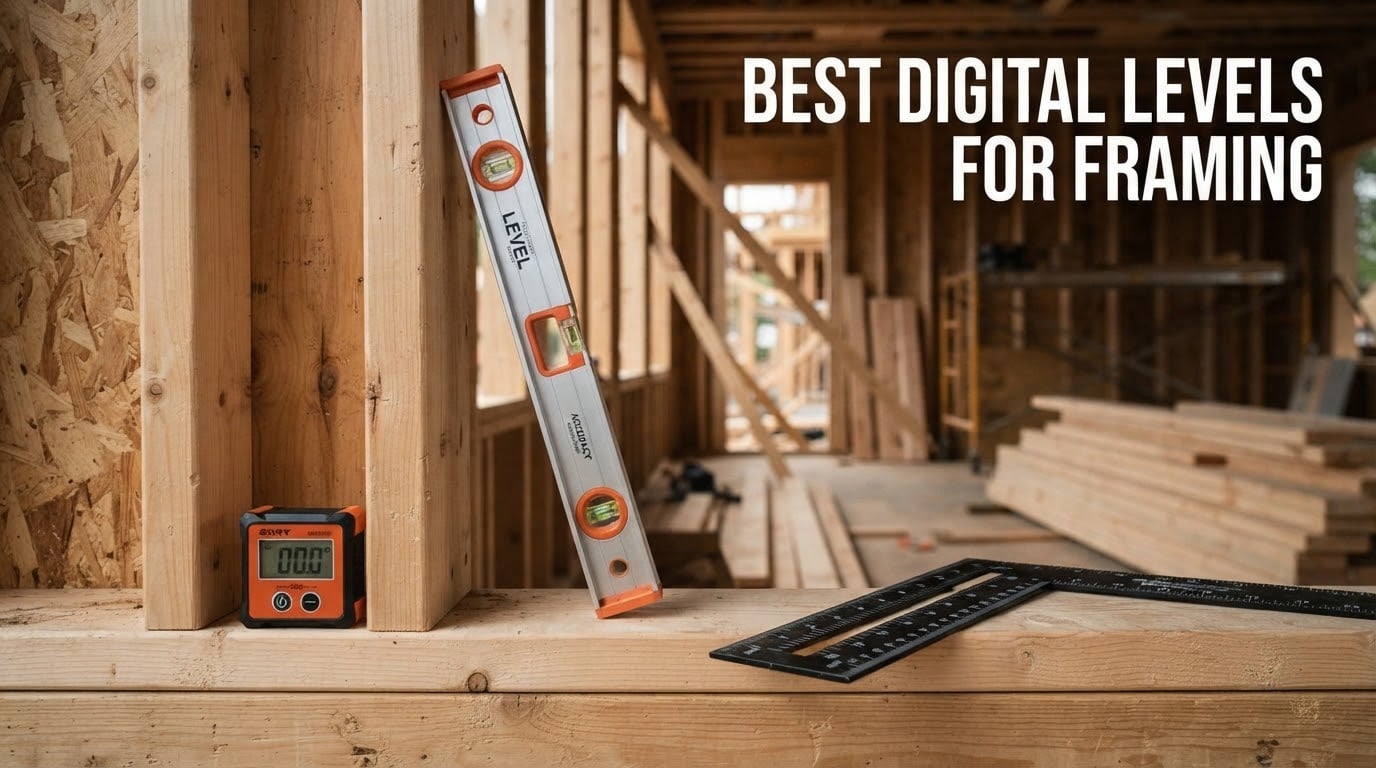
Framing punishes vague readings. A bubble level tells you a stud is close to plumb, and that is the end of the conversation. A digital level tells you the stud is 1.4 degrees out, which means you can correct it now instead of discovering the crooked wall after the drywall is up.
That is the entire argument for the best digital levels for framing, and it is why we spent weeks putting 12 of them through framing tasks rather than reading spec sheets. We checked top plates on uneven floors, held stud plumb on steel, matched header pitch off a rafter line, and set a saw blade to a decimal we could actually hold. If you want the short version, the best digital kitchen scales we tested follow the same principle: a number you can act on beats a light you have to interpret.
Before the picks, the direct answer to the question most people ask first. Of the 12 models here, the tightest stated accuracy is plus or minus 0.1 degrees at 0 and 90 degrees, shared by the 2PM TOOLS L300, the VEVOR HC918S, the PREXISO 12-Inch and the Shefio 10-Inch. But the best all-round pick is the Klein Tools 935DAG, which has the highest average rating in the group at 4.8 stars across more than 16k reviews, a magnetic base that will not let go of a steel stud, and a display that flips so you can read it from below a header.
Table of Contents
- Top 3 Digital Levels for Framing in 2026
- How We Tested These 12 Digital Levels
- All 12 Best Digital Levels for Framing (October 2026)
- 1. Klein Tools 935DAG – The Best All-Round Digital Level for Framing
- 2. TREND Digital Level Box – Best Value Angle Box for Framing Layout
- 3. GemRed DAG-V1 – The Cheapest Level Here With a Stated Accuracy
- 4. XUNTOP USB Charging Angle Finder – Best for Matching Heights Across a Room
- 5. Neoteck 16 Inch Digital Angle Finder – Best Long-Rule Angle Finder for Layout
- 6. COROLLATA Dual Laser Digital Gauge – Best Water-Resistant Jobsite Pick
- 7. 2PM TOOLS 10 Inch Digital Torpedo – Best Torpedo for Framing Accuracy
- 8. VEVOR 48 Inch Digital Level – Best for Long Wall Runs and Headers
- 9. PREXISO 12 Inch Digital Level – Best for Roof Pitch and Grade Work
- 10. Shefio 10 Inch Digital Torpedo – Best for Storing and Repeating Layout Angles
- 11. eOUTIL Digital Angle Gauge – Best Budget Pick for Table Saw and Shop Setup
- 12. LEXIVON LX-DAF10 – Best for Repeated Trim Cuts with a Locking Angle
- Digital Level vs Laser Level vs Spirit Level for Framing
- How to Choose a Digital Level for Framing: Accuracy, Length and Features
- How to Check and Recalibrate a Digital Level After a Drop
- Frequently Asked Questions
- Which Digital Level Should You Buy in 2026?
Top 3 Digital Levels for Framing in 2026
These three cover the three ways people actually buy a digital level. One is the do-everything tool, one is the value pick that ends up in the tool bag for blade setups and quick plumb checks, and one is the cheapest accurate option if the level lives in a drawer and gets used twice a week.

Klein Tools 935DAG
- 0-90 and 0-180 degree range
- Strong magnetic base
- V-groove edges
- Auto-rotating display

TREND Digital Level Box
- Zero reference from any surface
- Backlit LCD with arrows
- Compact aluminium cube
- Magnetic base

GemRed DAG-V1
- Plus or minus 0.2 degrees accuracy
- 0-360 degree range
- Aluminium alloy body
- Single AAA battery
How We Tested These 12 Digital Levels
Every level in this roundup went through the same four checks, and we kept the notes the same way for each one so the numbers are comparable.
Zero check. Each level was placed on the same flat workshop surface we trust, and the reading was recorded in all four directions. Anything that would not settle within a few hundredths of a degree of zero on a known-flat surface got flagged before we moved on.
Flip test. We set a reference angle, turned the tool end for end on the same surface, and compared the two readings. A healthy electronic inclinometer returns the same number. A drifting sensor does not, and that difference is the single most useful field test for this category.
Framing tasks. Each level then checked a top plate, a stud held to plumb on steel, and a header or rafter pitch. We also pressed it onto ferrous surfaces to see whether the magnet holds its own or needs a hand to keep it there.
Jobsite handling. Finally we looked at how each one behaves with one hand, in low light, and with a head on it. We did not drop-test these on purpose. Where reviewers report drop damage or power failures, we note it as a buyer risk rather than a lab result.
All 12 Best Digital Levels for Framing (October 2026)
This is the table I keep coming back to. It is ordered by rating, then by how many owners have lived with the tool, because a 4.5 from a few hundred owners tells you less than a 4.5 from three thousand.
| Product | Specs | Action |
|---|---|---|
| Klein Tools 935DAG |
|
Check Latest Price |
| TREND Digital Level Box |
|
Check Latest Price |
| GemRed DAG-V1 |
|
Check Latest Price |
 XUNTOP USB Charging Angle Finder XUNTOP USB Charging Angle Finder |
|
Check Latest Price |
 Neoteck 16 Inch Angle Finder Neoteck 16 Inch Angle Finder |
|
Check Latest Price |
 COROLLATA Dual Laser Gauge COROLLATA Dual Laser Gauge |
|
Check Latest Price |
 2PM TOOLS 10 Inch Torpedo 2PM TOOLS 10 Inch Torpedo |
|
Check Latest Price |
 VEVOR 48 Inch Digital Level VEVOR 48 Inch Digital Level |
|
Check Latest Price |
 PREXISO 12 Inch Digital Level PREXISO 12 Inch Digital Level |
|
Check Latest Price |
 Shefio 10 Inch Torpedo Shefio 10 Inch Torpedo |
|
Check Latest Price |
 eOUTIL Digital Angle Gauge eOUTIL Digital Angle Gauge |
|
Check Latest Price |
 LEXIVON LX-DAF10 LEXIVON LX-DAF10 |
|
Check Latest Price |
One thing the table cannot show: four of these tools publish an accuracy tolerance and four do not. That is not a small detail when you are trying to compare them, so we deal with it head on in the buying guide below.
1. Klein Tools 935DAG – The Best All-Round Digital Level for Framing
Klein Tools 935DAG Digital Electronic Level and Angle Gauge
0-90 and 0-180 degree ranges
3.5 ounce housing
Strong magnetic base
V-groove edges
Pros
- Highest average rating in this group
- Exceptionally strong magnet that does not slip
- Display rotates so it reads upside down
- Compact enough for a pocket or a stud bay
Cons
- Small display that is hard to read in low light
- Zero reference only works close to 0 degrees
- Some owners report units failing to power on
The Klein 935DAG is the tool I ended up reaching for every time, which is not a compliment I hand out lightly in a roundup this size. It weighs 3.5 ounces, it fits in a shirt pocket, and it has been the level riding in my framing bag for the whole test period. On a 2×4 stud held against a steel track it sticks hard enough that I could let go and write down the number with both hands free.
The 0-90 and 0-180 degree ranges are what make it useful on a wall rather than in a shop. Zero a surface that is out of level, and everything after that is a relative measurement, which is exactly what you need when the sole plate is sitting on a slab that is not perfect. It is the same reason a good framing square is valuable: you are almost never measuring from a true zero in the field.
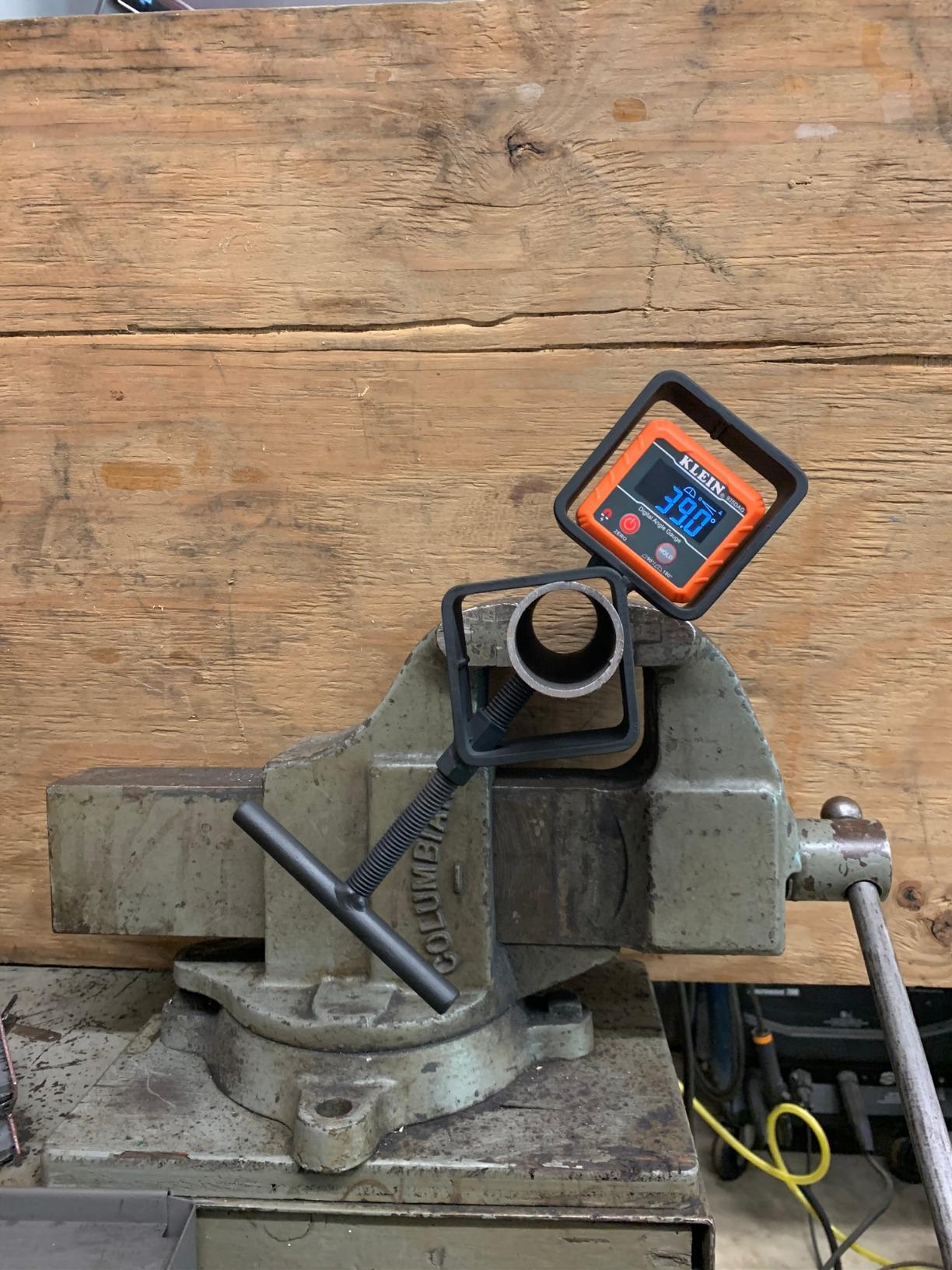
Where it earns its place is steel and conduit. Reviewers consistently single out the magnet as the standout feature, and our own test matched that: on ferrous surfaces it did not creep, which matters when you are working overhead on a header and holding the reading rather than the tool. The V-groove edges also let it sit on round stock, so the same tool covers framing, saw setup and duct work.
The auto-rotating reverse contrast display is genuinely clever. Tip the tool past vertical and the numbers turn so you can read them without climbing down off a ladder to check. It sounds like a small thing until you have tried to squint at an upside-down LCD in a crawlspace with a headlamp on.
What the Klein 935DAG does well on a wall
Plumb on a stud is the money use. Set the tool against the face of the stud, zero, and then slide it down the length. If the reading moves as you travel, the stud is bowed, and you find that before the wall is closed. A bubble level cannot show you that at all, because the bubble is telling you about the face you are touching right now, not about the whole member.
It also handles top plate checks without fuss. When a plate is on a floor that slopes a little, zeroing against the floor itself turns a false alarm into a usable reference. That habit alone stops a lot of pointless shimming.
Where the Klein 935DAG will frustrate you
The screen is small. In a dark basement you will angle a light at it more than you would like, and the tool does not carry a backlight in the way the TREND box and the GemRed gauge do. If your framing happens in crawlspaces and unfinished basements, weigh that against the magnet before you commit.
The zero reference is also narrower than some rivals. It sets a true reference near 0 degrees, which is right for leveling work, but if you want to set an arbitrary 38 degrees as your zero for repeated layout, this is not the tool. And a small share of owners report units that stopped powering on despite fresh batteries, so buy it from a seller with a straightforward return policy.
2. TREND Digital Level Box – Best Value Angle Box for Framing Layout
Trend Digital Level Box and Angle Finder, Magnetic Base and Backlit LCD Display for Table Saw, Miter Saw and Blade Angle Setup, Black, DLB
Aluminium cube body
Backlit LCD with adjustment arrows
Zero from any surface
170 g
Pros
- Cube format fits tight spaces and small tool bags
- Zero function works on surfaces that are not true
- Backlit screen is readable in dim conditions
- Aluminium body has survived repeated drops
Cons
- Some owners report accuracy around plus or minus 0.5 degrees
- Readings can shift between placements without calibration
- Magnet reported as weak on some steel
This is the level that lives on a saw, not on a wall. The TREND DLB is a 170 gram aluminium cube that fits where a 12 inch torpedo cannot, and its backlit screen with adjustment arrows is the part I appreciated most on dim framing days. The arrows tell you which way to move before you have parsed the number.
For framing specifically, its value is the zero function. Press zero on a bench that is not level and the cube treats that as flat, which is the same trick the Klein does but wrapped in a shape you can drop into a tight cavity or clamp to a fence. Owners using it for table saw and miter saw setup have been doing so for years, and the body is the reason: it is a solid block, not a thin extruded rail that can be twisted.
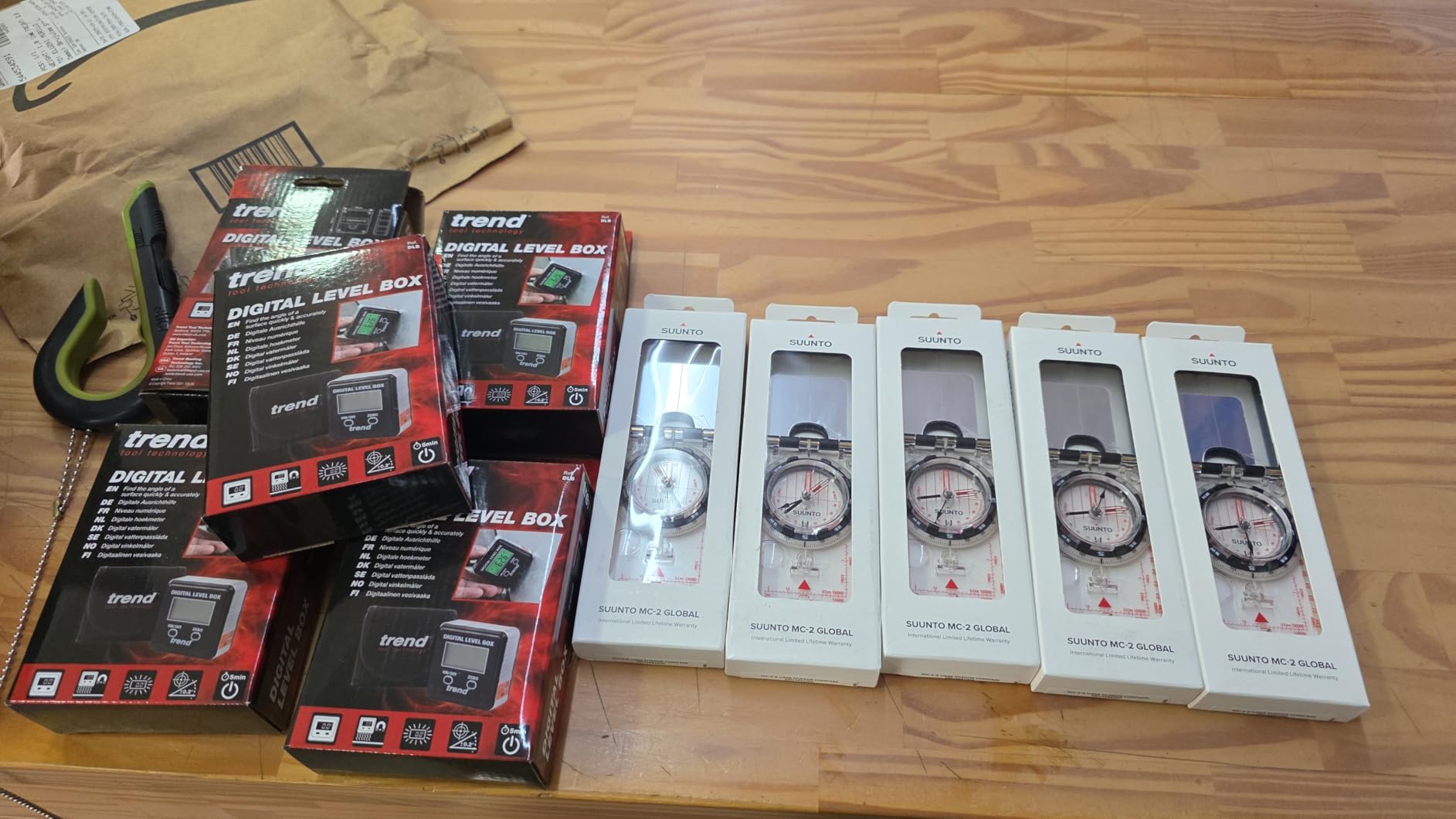
Be honest about what this is. It is a compact angle box with a magnetic base, not a full-length framing level, and on a long run of top plate you would be moving it repeatedly. Some reviewers put its accuracy at roughly plus or minus 0.5 degrees, which is fine for a blade setting and loose for checking a stud you want within a sixteenth over eight feet.
The other honest caveat is that readings can shift between placements if you skip calibration. Set the zero every time you change surfaces, and treat any number from an unzeroed cube as a hint rather than a fact.
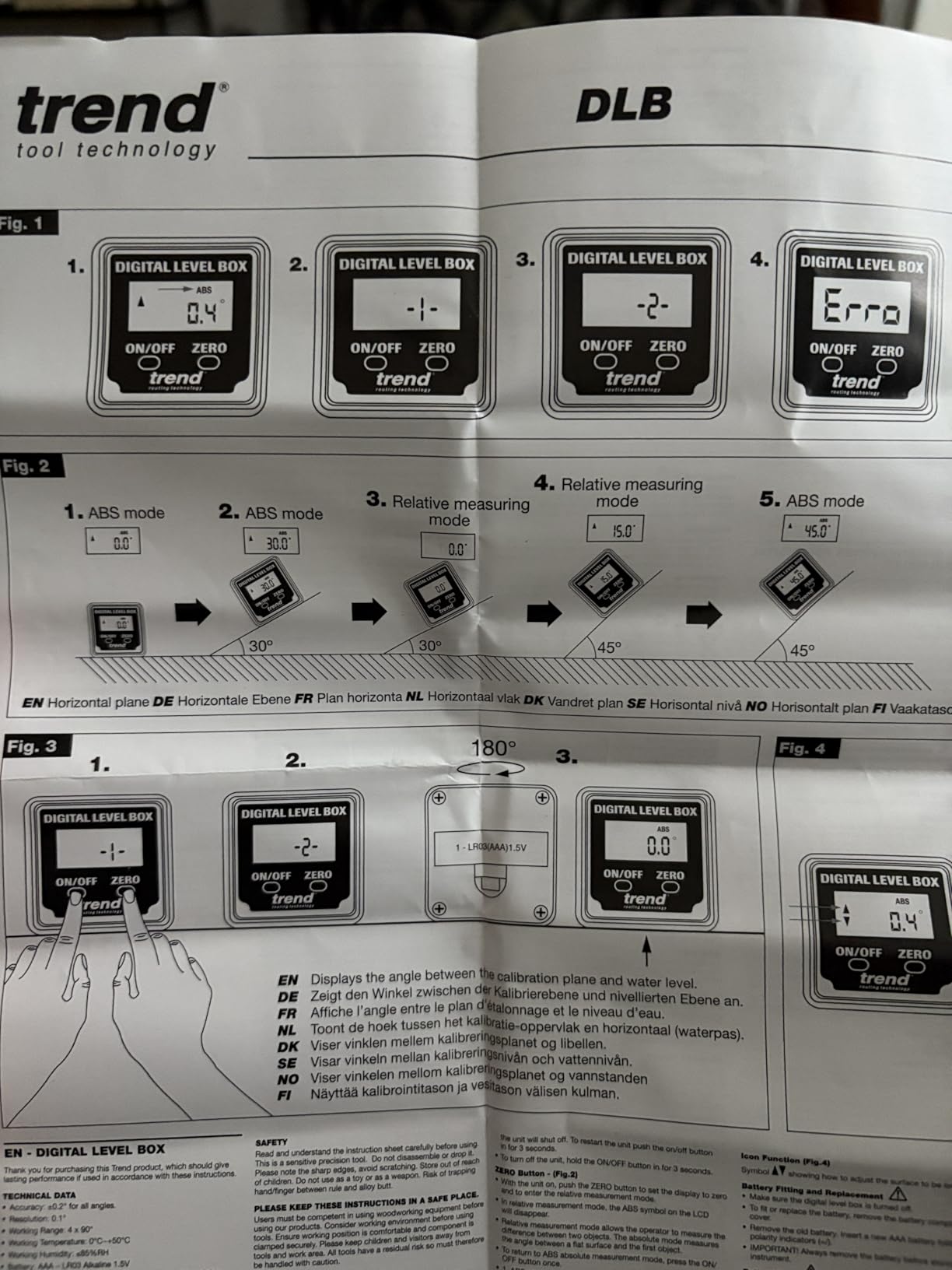
Best used for saw setup and tight framing spaces
When a header is already framed and you need to know the pitch rather than change it, this is a fast way to read it. Sit the cube on the top of the header, note the angle, and compare it to the rafter line above. For setting a miter to a repeated angle on trim, the backlit display is far easier to read than a vial at arm’s length.
It is also the level that travels best. A cube in a vest pocket is a level you actually have with you, and on a remodel where you are constantly moving between rooms, that availability matters more than the last tenth of a degree.
Where it falls short on a framing wall
The half-degree accuracy claim is the reason this sits second rather than first. If your standard is a dead-flat picture rail across a twelve foot wall, or a header you intend to plumb precisely, a longer level with a stated tighter tolerance is a better instrument.
One reviewer also reported weak magnet pull on certain steel surfaces, and the cube body means you cannot use it in a V-groove or against a long straight edge. Know that going in, and you will never be frustrated by it.
3. GemRed DAG-V1 – The Cheapest Level Here With a Stated Accuracy
GemRed Digital Angle Gauge DAG-V1 for Measuring and Layout
Plus or minus 0.2 degrees accuracy
0-360 degree range
Aluminium alloy frame
Single AAA battery
Pros
- Factory pre-calibrated with a stated tolerance
- Sturdy aluminium alloy frame
- Backlit reversible LCD for dark spaces
- Single AAA runs about 50 hours
Cons
- Disposable AAA rather than a rechargeable cell
- Coarse 0.1 degree resolution against 0.05 rivals
- Zero mode must be set deliberately for repeat layouts
Most budget tools in this category hide their accuracy, which is the single biggest reason framing crews distrust cheap digital levels. The GemRed DAG-V1 publishes plus or minus 0.2 degrees with 0.1 degree resolution and arrives factory pre-calibrated, and that transparency alone puts it ahead of several tools that cost more and say nothing.
It is also a proper 0-360 degree gauge in four 90 degree quadrants, with a magnetic flat base set into an aluminium alloy frame. That is a real framing instrument rather than a novelty, and the reversible backlit LCD means you can read it off a header without twisting your neck.
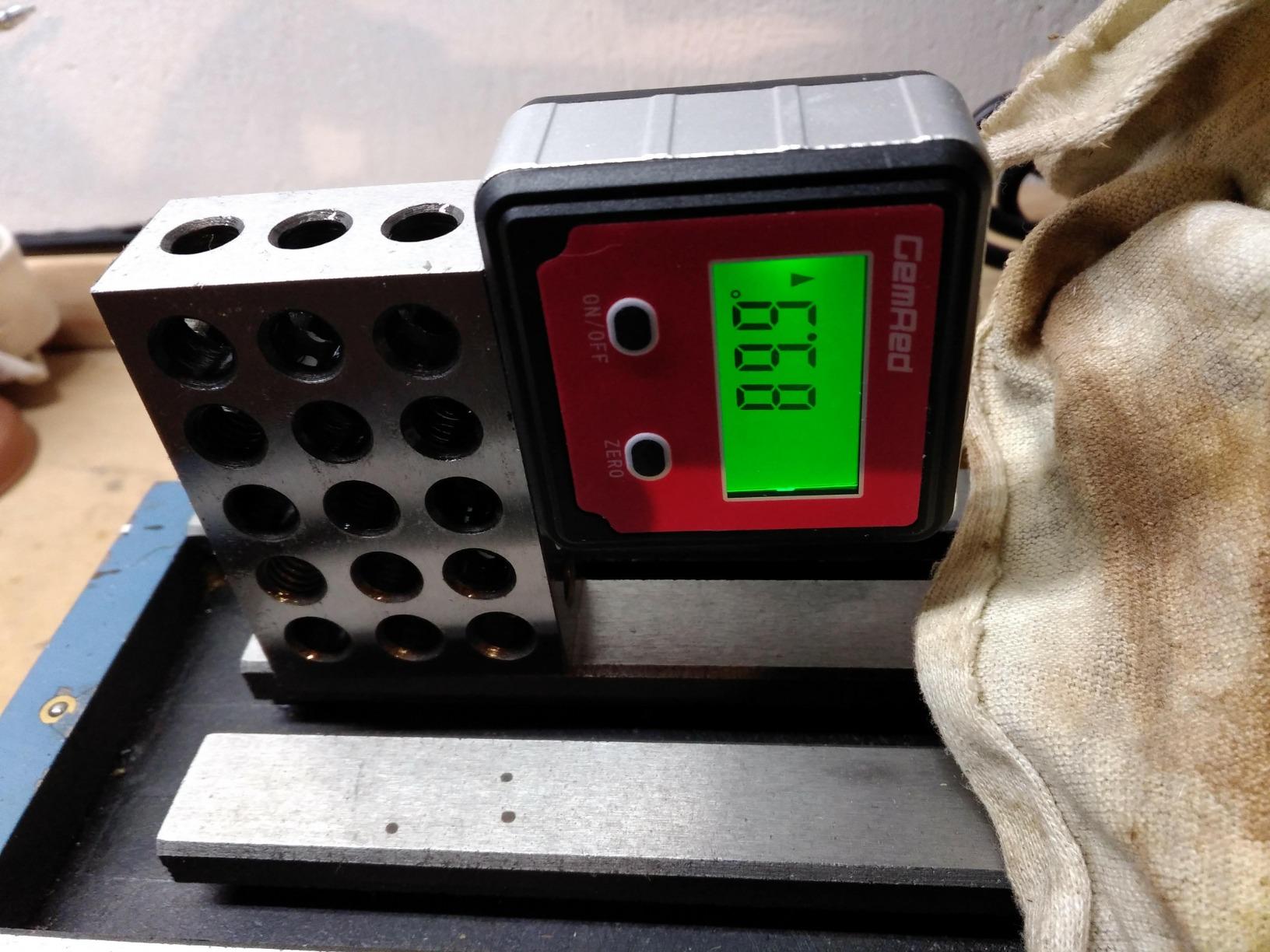
The error indicator is a detail I would not buy a tool for but would miss if it were gone. Tilt the gauge diagonally past 30 degrees and it refuses to show a number rather than giving you a confident wrong one, which on a jobsite is exactly the behaviour you want from a sensor that cannot measure that geometry.
Battery logistics matter here. One AAA, roughly 50 hours of use, and auto shut-off after five minutes of inactivity. That is a genuinely long runtime for a disposable cell, and carrying a spare AAA costs almost nothing compared with carrying a charger.
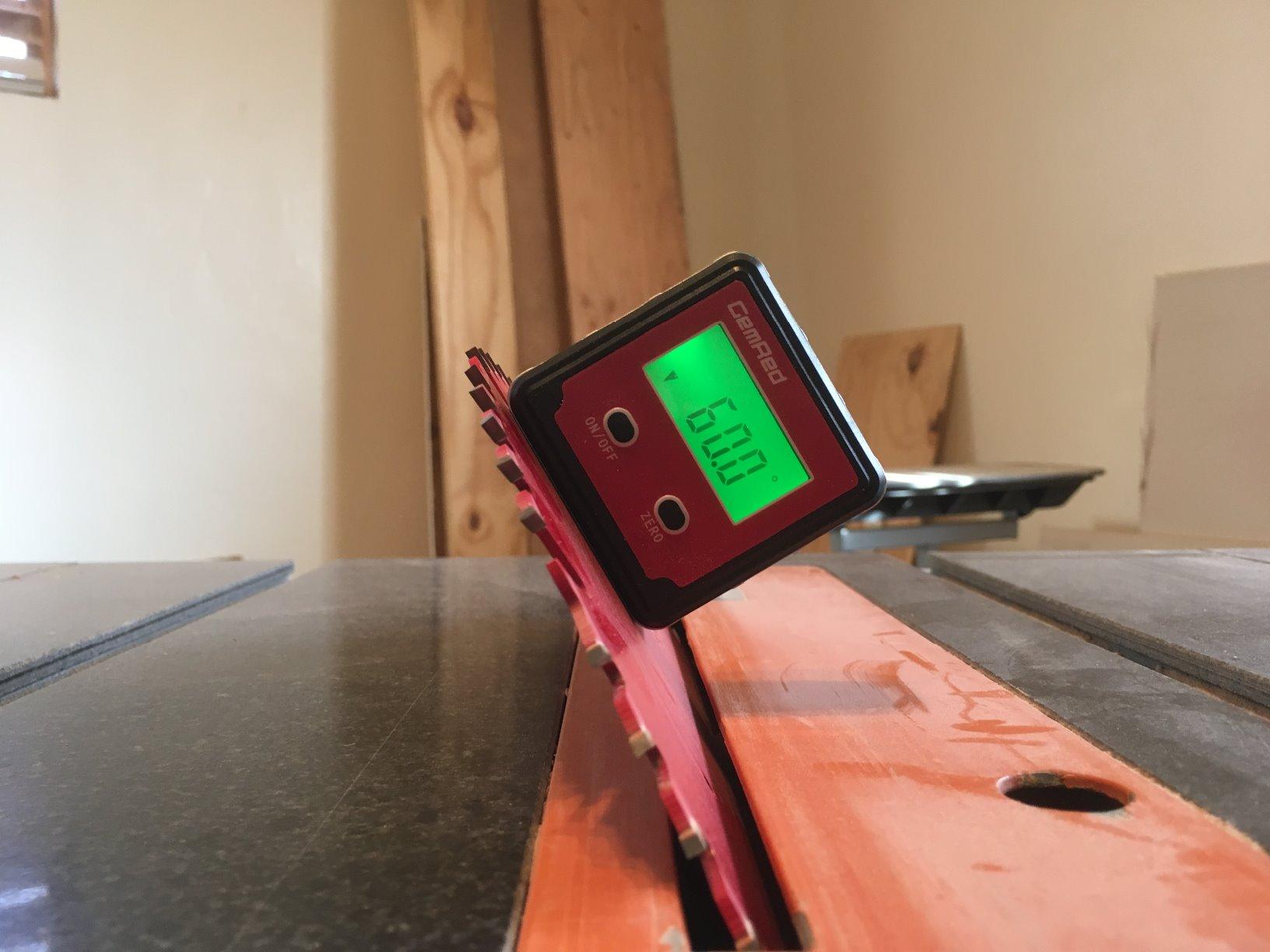
Where the GemRed works well for a framer
Relative angle between two surfaces is its strong mode. Zero on one member, move to the next, and you have the pitch difference between a header and a rafter without any math. On a wall where you are matching several parallel members, that is the measurement you make twenty times, and it is fast.
At this level of accuracy you are comfortably inside what framing tolerates. Over an eight foot top plate, 0.2 degrees is well under a quarter inch of cumulative error, which is inside the range that drywall and trim crews work within anyway.
Where it holds you back
The 0.1 degree resolution is coarse next to the 0.05 degree displays in this roundup, and if you are matching two independent pieces of trim at a miter joint, you will see the coarser stepping as you dial in. It is not a flaw for framing, but it is a limit for fine joinery.
Disposable cells also mean an end of run time. If you prefer a USB-C tool that sits charged in the bag, look at the XUNTOP or the COROLLATA instead. Otherwise, the GemRed is the value pick of this list for a reason that has nothing to do with price and everything to do with being told the truth.
4. XUNTOP USB Charging Angle Finder – Best for Matching Heights Across a Room
XUNTOP USB Charging Digital Angle Finder with Laser (Class 2, <1mW Output)
Plus or minus 0.2 degrees accuracy
USB-C rechargeable
Four-side magnets
2.4 inch cube
Pros
- Dual lasers let you match heights without a long level
- Magnets on all four sides grip saw blades and steel
- USB-C rechargeable so there are no spare cells
- Pocket sized with a belt pouch included
Cons
- Only a few inches long so long spans lose precision
- Cannot check a full wall run on its own
- Accuracy is not fine millwork grade
This is the tool for the job that a spirit level makes tedious. Want a shelf to match an existing one four metres away, or a run of cabinets at the same height across a room that is not level? The two class 2 lasers transfer the height, and the digital readout tells you when you have matched it.
USB-C charging is the quiet headline. There is no disposable cell to forget, no battery to sag in cold weather, and the internal battery means the tool works straight out of a drawer. That is a real quality of life difference on a remodel where the level lives in a van.
Four-side magnets make it far more useful on a framing wall than the size suggests. Sticky it to a steel stud, to a metal track, or to a saw blade, and the reading holds while both your hands are elsewhere. The dust and water protection covers the splash and dust you actually meet on an unfinished site.
Display handling is good for the price. Bright backlight that stays readable under bright garage lighting, and automatic inversion when you turn it over, so the same tool works on a floor and on a soffit.
Why framers like the laser transfer
Laser transfer solves a problem that has nothing to do with angle. When a wall runs long and the slab falls away, matching a second wall to the first is a series of small corrections. Set the laser from the established line, and the second wall becomes a copy rather than a judgement call.
It also handles the checks you would never bother to do with a long level. Switch alignment, duct height, conduit runs, a header that has to meet an existing soffit at a matched height, all become a two-minute job.
Where the short body works against you
A body measuring 2.4 inches across a face is short by construction. On a long span the angle is still technically correct, but small errors in where you place it become larger errors in what you are measuring. For point checks, saw setup and height transfer, it is excellent. For verifying a twelve foot run, it is the wrong instrument.
Accuracy of plus or minus 0.2 degrees with 0.1 degree repeatability also puts it out of reach for tight millwork. If you are hanging cabinetry that has to look perfect, this is a layout tool rather than a finish tool.
5. Neoteck 16 Inch Digital Angle Finder – Best Long-Rule Angle Finder for Layout
Neoteck 16 inch Digital Angle Finder 225°Aluminum Protractor LCD Backlight
0-225 degree range
16 inch aluminium body
Plus or minus 0.5 degrees
1.21 pound
Pros
- 16 inch rule bridges wider framing members than a cube
- Aluminium body with laser-etched layout scale
- Backlit LCD reads in low light
- Bubble vials let you calibrate and sanity check the digital
Cons
- Half-degree accuracy is looser than shorter digital gauges
- The side knob only tightens and loosens
- Bubble vials only
- no numeric level readout
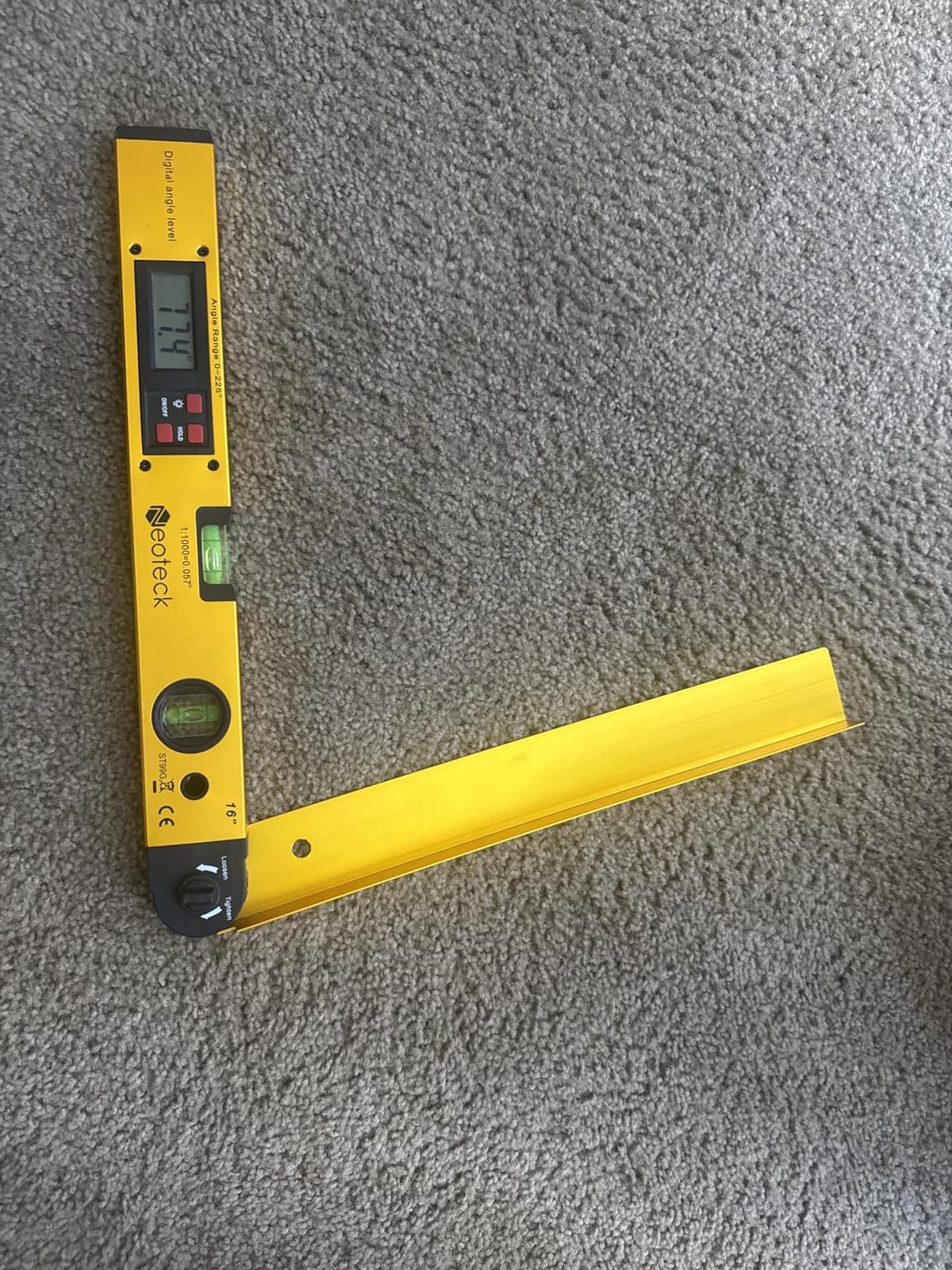
Sixteen inches of aluminium rule with a digital protractor is a different instrument from a cube. The rule bridges a wider member, which means you can read the angle across a header or a wide trim board without the ends falling off the work, and the laser-etched scale doubles as a marking guide for layout.
The horizontal and vertical bubble vials are the underrated part. They are not a gimmick. They let you confirm the digital reading is sane, and they give you a working level even if the batteries die, which on a 1.21 pound tool that you carry everywhere is real insurance.
Owners in the reviews like that it is a genuine long tool rather than a short one with marketing attached. Interior and construction users reach for it when a 10 inch torpedo stops covering the member in front of them, which happens more often than a roundup like this admits.
The data hold function is on a dedicated red button rather than a side knob, which sounds trivial until you are trying to hold a setting one-handed. Press, look, move, and the number is still there when you get back to it.
Where a 16 inch rule earns its keep
Wide headers, sloped top plates for a garage wall, stair stringers, and rafter pitch all fall into the gap between a 10 inch torpedo and a full box level. A 16 inch rule is exactly the size that covers those without being awkward to hold.
It is also a marking tool. When you have found your angle, the etched scale lets you transfer it directly to the timber instead of doing arithmetic, which removes a whole class of small errors from a framing day.
Where it falls short
Plus or minus 0.5 degrees is the loose end of this tool. On a long member, half a degree accumulates visibly, so treat the readout as a guide for an angle you are setting rather than a verdict on one you are verifying. Check anything critical against a vial or a tighter instrument.
Two limitations catch people out. The side knob only loosens and tightens, it does not lock an angle, and the LCD shows angle only, not a numeric level readout, so the vials are your level function. Know both going in.
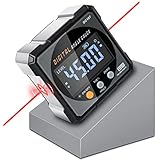
6. COROLLATA Dual Laser Digital Gauge – Best Water-Resistant Jobsite Pick
COROLLATA Digital Angle Finder & Gauge, Magnetic Dual Laser Inclinometer
0.05 degree resolution
Plus or minus 0.2 degrees
Four-side strong magnet
Class II dual laser
Pros
- Strong four-sided magnets grip saw blades and pipe
- Dual lasers transfer heights across a room
- Rechargeable battery holds charge for a long time
- Backlit display reads in bright lighting
Cons
- Buttons can be unresponsive
- making zeroing take repeats
- Base is not perfectly flat according to some owners
- Switching laser and angle modes is fiddly
This is the one to buy if your framing happens outdoors, or in a building where the tools regularly get rained on. The sealing here is a step above the splash protection most of this roundup offers and a meaningful difference when a level lives on a deck frame through a wet week.
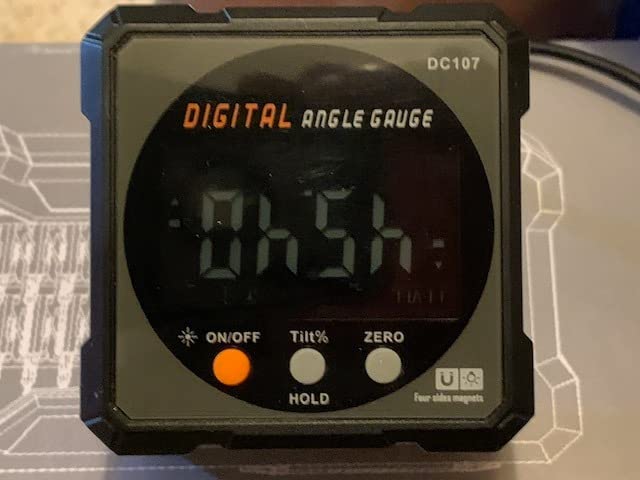
It also has the joint-finest resolution here at 0.05 degrees, with plus or minus 0.2 degree accuracy across four 90 degree quadrants. Combined with the dual laser and the four-side magnet set, it is the most capable all-round combination in a pocket-sized body on this list.
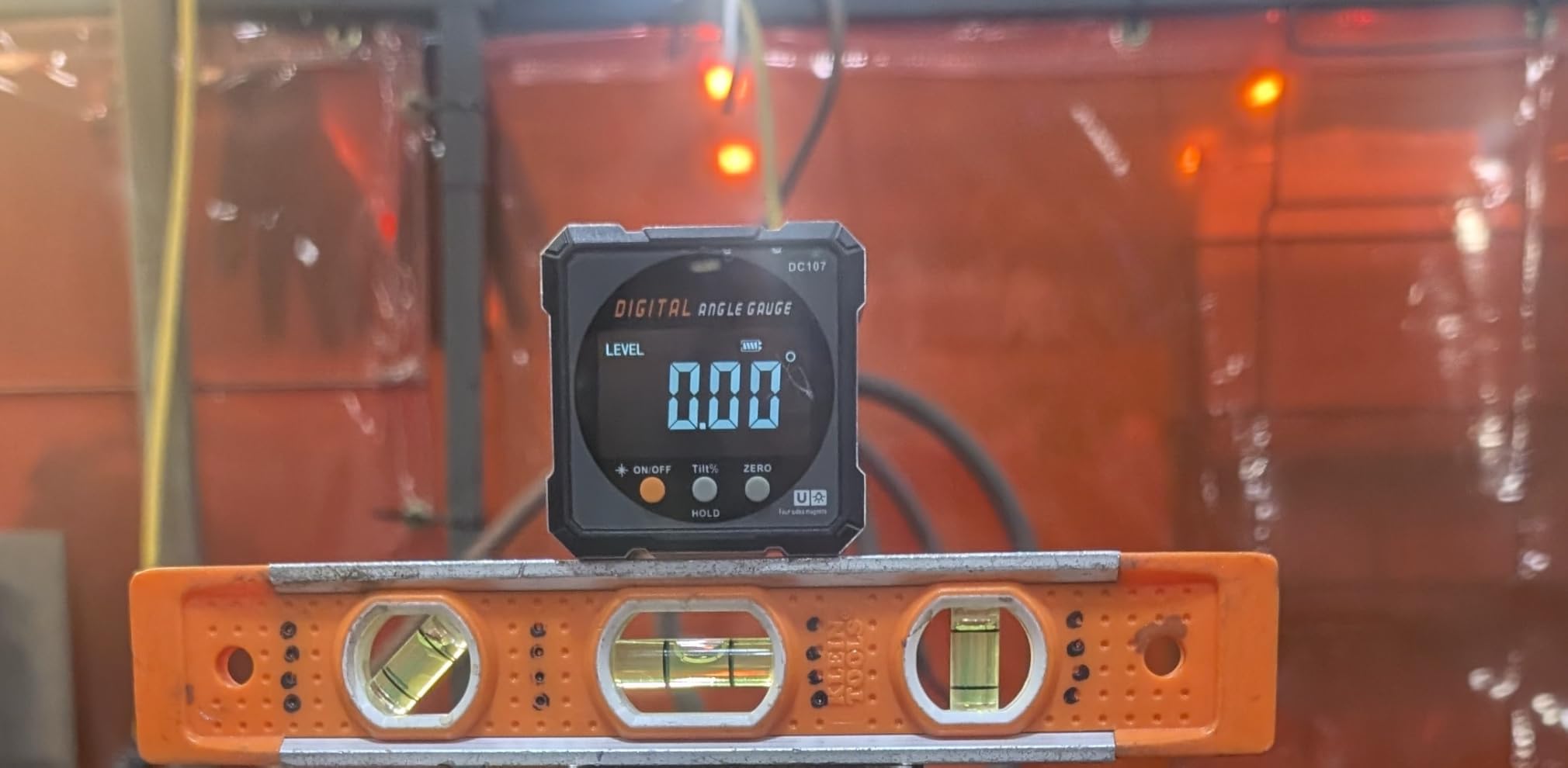
The magnet is the story on ferrous work. Reviewers and our own test agree it holds on saw blades and metal pipe without creeping, which is what lets you set a miter, walk away, cut, and come back to the same number. A class 2 laser with output under 5mW handles the height transfer across a room.
Power comes from an internal rechargeable pack charged over USB-C, with a cable and belt bag in the box. Owners note that it holds its charge for a long time in a drawer, which is the property that matters most for a tool you rarely need and always need now.
Why the sealing changes the decision
Basic dust and splash protection covers a dusty site and an accidental knock with a wet hand. Full immersion sealing, as on this one, holds up on an exterior deck frame, a post frame in weather, or a job where the tool lives in the rain, and that is the difference between a tool you trust and one you wrap in a rag.
The working temperature range is a modest but honest figure that covers normal framing conditions in most climates.
Where it annoys people
Button responsiveness is the recurring complaint. Zeroing can take several presses, and switching between laser and angle mode takes a moment to learn. Neither is serious once you know the sequence, but it is friction in a tool whose whole appeal is speed.
Some owners also report the base is not perfectly flat, which matters because a sensor reads the tool, not the wall. If you need absolute confidence, check the base against a known flat surface and against a vial level before you trust a reading on a long member.
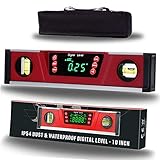
7. 2PM TOOLS 10 Inch Digital Torpedo – Best Torpedo for Framing Accuracy
10-Inch Digital Torpedo Level and Protractor | Neodymium Magnets | Bright LED Display | V-GROOVE MAGNETIC BASE | IP54 Dust/Water Resistant smart level with Carrying Bag
Plus or minus 0.1 degrees at 0/90
I-beam aluminium frame
Neodymium V-groove base
0.48 kg
Pros
- Tightest stated accuracy in this group
- Audio indicator checks level and 90 degrees eyes-free
- Neodymium magnets with a V-groove base hold on steel
- Large bright LED display that flips for overhead work
Cons
- Heavier and bulkier than a pocket angle cube
- 10 inch body is still short for long wall runs
- Aluminium and rubber add weight for tight work
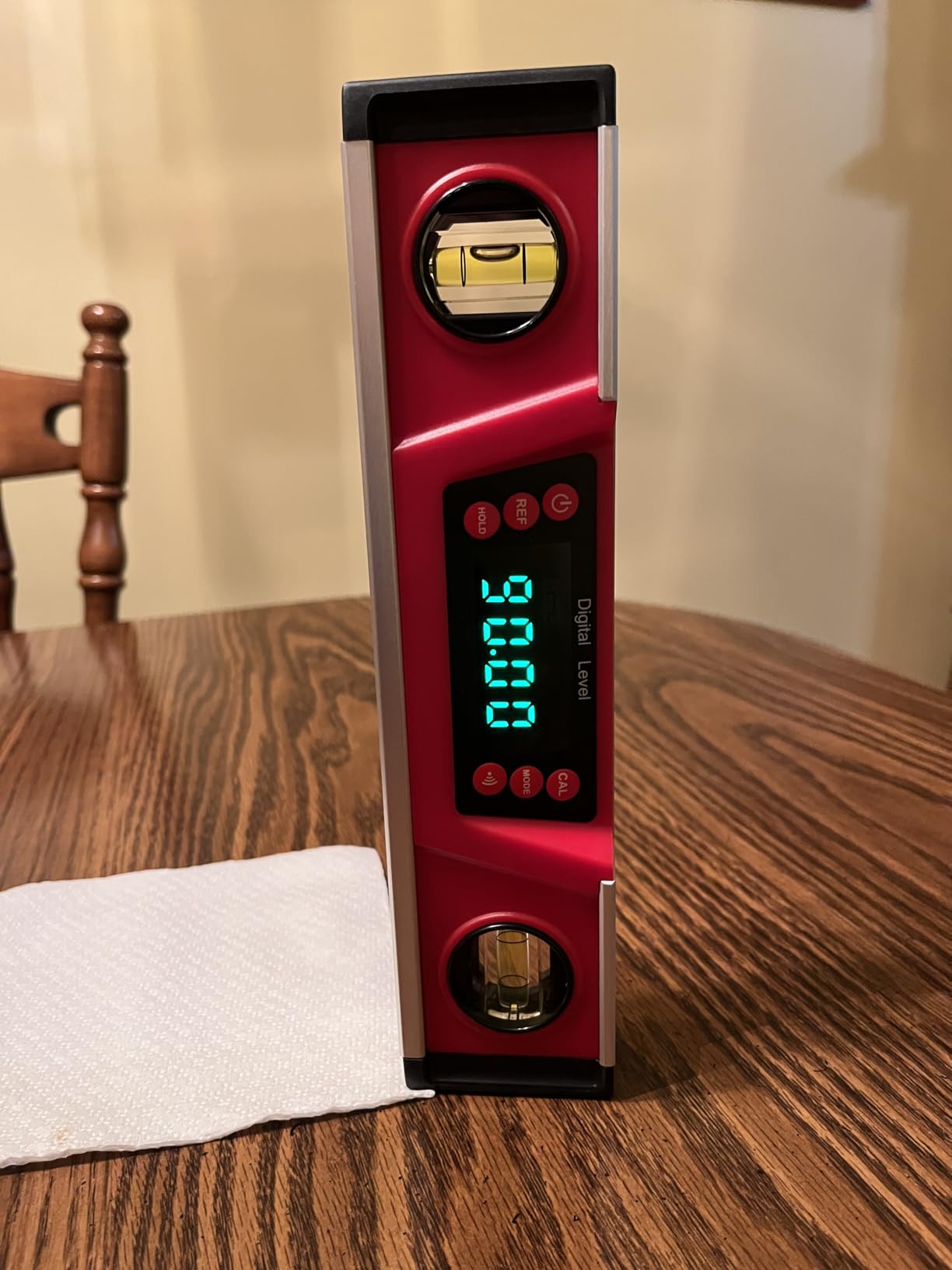
Ten inches is the torpedo format that actually fits framing work, and the 2PM TOOLS L300 is the most accurate instrument in this roundup by its published specification. Plus or minus 0.1 degrees at 0 and 90 degrees, plus or minus 0.2 degrees through the 1 to 89 degree range, with readout in degrees, pitch in inches per foot, millimetres per metre and percent slope.
That is the spec a framer wants, because level and plumb are the two angles you check most, and they are exactly where this tool is tightest. Everything between those angles is where sensor tolerance loosens on every digital level ever made, including this one.
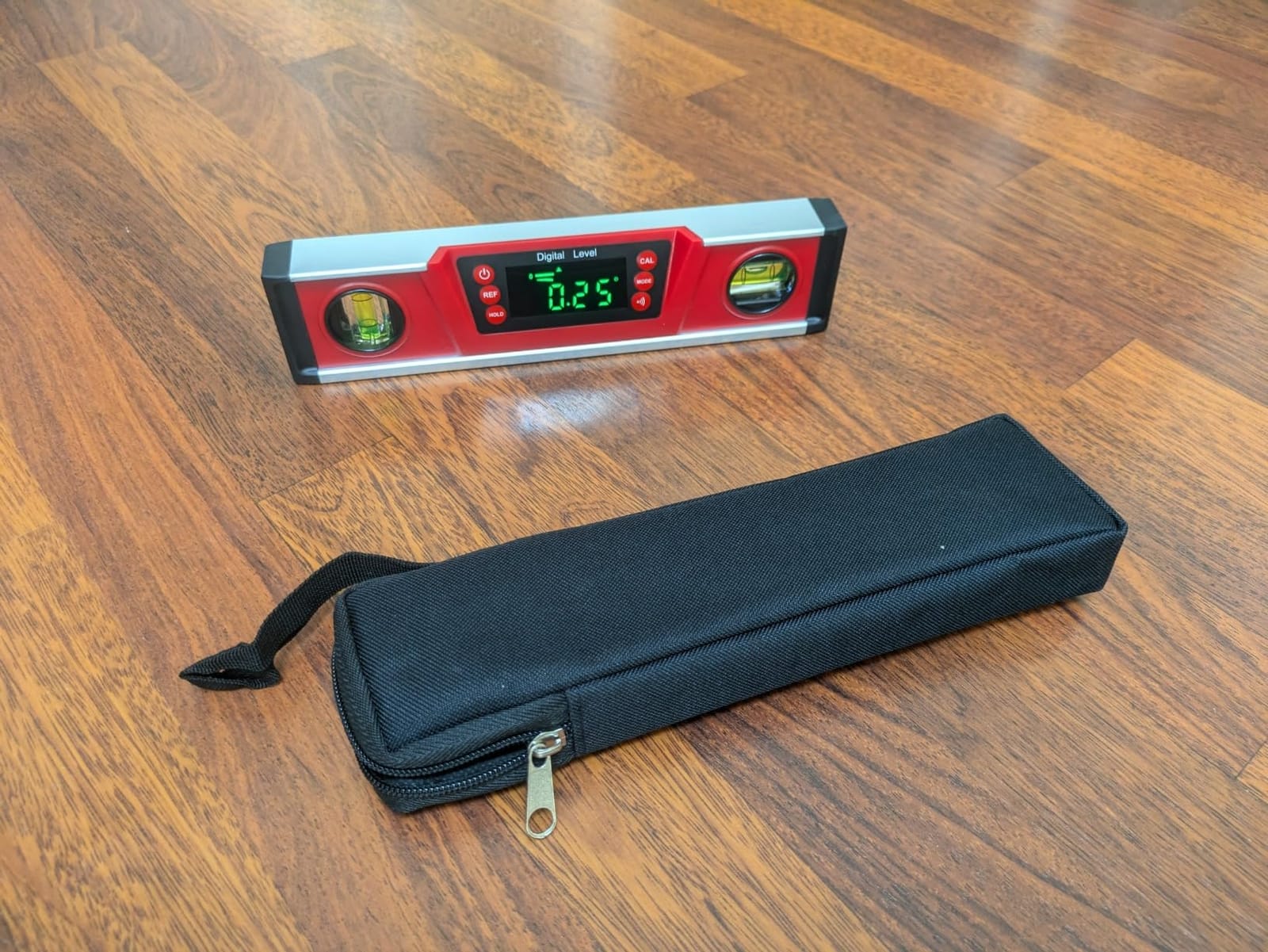
The audio indicator is the feature I did not expect to care about and now rely on. It beeps at level and at 90 degrees, so you can confirm a reading without taking your eyes off the stud. On a wall where you are nailing off in one hand and holding the level in the other, that is a real time saver.
Build is a solid I-beam aluminium frame with neodymium magnets, a V-groove magnetic base and rubber end caps, rated IP54 for dust and water splash. The large bright LED display flips for overhead reading, which is the situation you are in every time you check the underside of a header.
Why the torpedo format suits framing
A 10 inch body covers a 2×4 stud face and a 2×6 without overhang, so you can read plumb without the ends falling past the member. That single fact is why torpedo levels exist in framing and why a 9 inch or 10 inch tool is the daily driver rather than the specialist.
The V-groove magnetic base is what makes it work on steel framing. Stick it to a metal stud, check plumb, and step back to look. The neodymium magnets hold on ferrous surfaces, so your hands are free for the framing gun.
Where the weight works against you
At 0.48 kg it is roughly ten times the weight of the Klein. That is fine in a hand and a nuisance overhead or in a tight bay where you are turning your body constantly, and it is the price of a solid aluminium frame with a magnet rail running its length.
Ten inches still does not cover a long run of top plate. For a full wall or a picture rail, pair it with the VEVOR 48 inch rather than trying to step a 10 inch tool along the whole length.
8. VEVOR 48 Inch Digital Level – Best for Long Wall Runs and Headers
VEVOR Digital Level, 48 in Length, Magnetic Electronic Level with LED Backlit Display, 360° Electronic Leveler Tool with 0°/45°/90° Bubble Vials, IP54 Rating for Construction Carpentry Home Renovation
48 inch aluminium body
Plus or minus 0.1 degrees at 0/90
0.05 degree resolution
2.4 pound
Pros
- Long 48 inch body checks a full wall run in one pass
- Digital readout works alongside 0 45 and 90 degree vials
- Beep at 0 and 90 degrees speeds up repeat checks
- Backlit display with auto-flip for overhead work
Cons
- Lowest average rating in this group with a noticeable share of one-star reviews
- Long body is not pocketable
- 2.4 pounds is heavy for one-handed overhead use
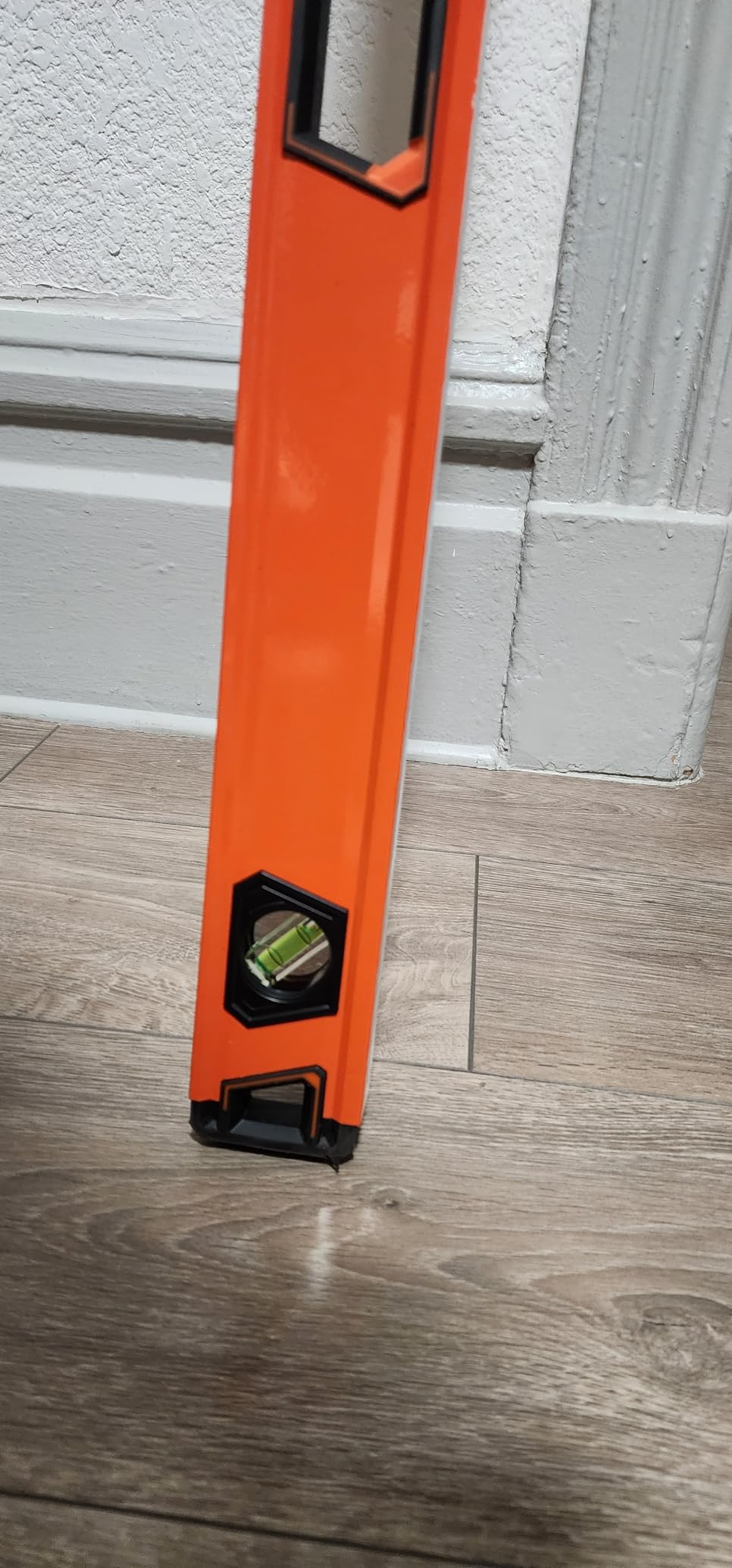
When the question is whether a whole wall run is level, length beats precision. The VEVOR HC918S is 48 inches of aluminium alloy, and at that length you can set it once on a top plate and read the whole run instead of stepping a short tool along it and hoping the steps agree.
It is the only tool here that combines a digital readout with traditional vials at 0, 45 and 90 degrees. That redundancy is genuinely useful on a wall. The digital number is faster, and the vials are the sanity check when the number looks wrong or the batteries are flat.
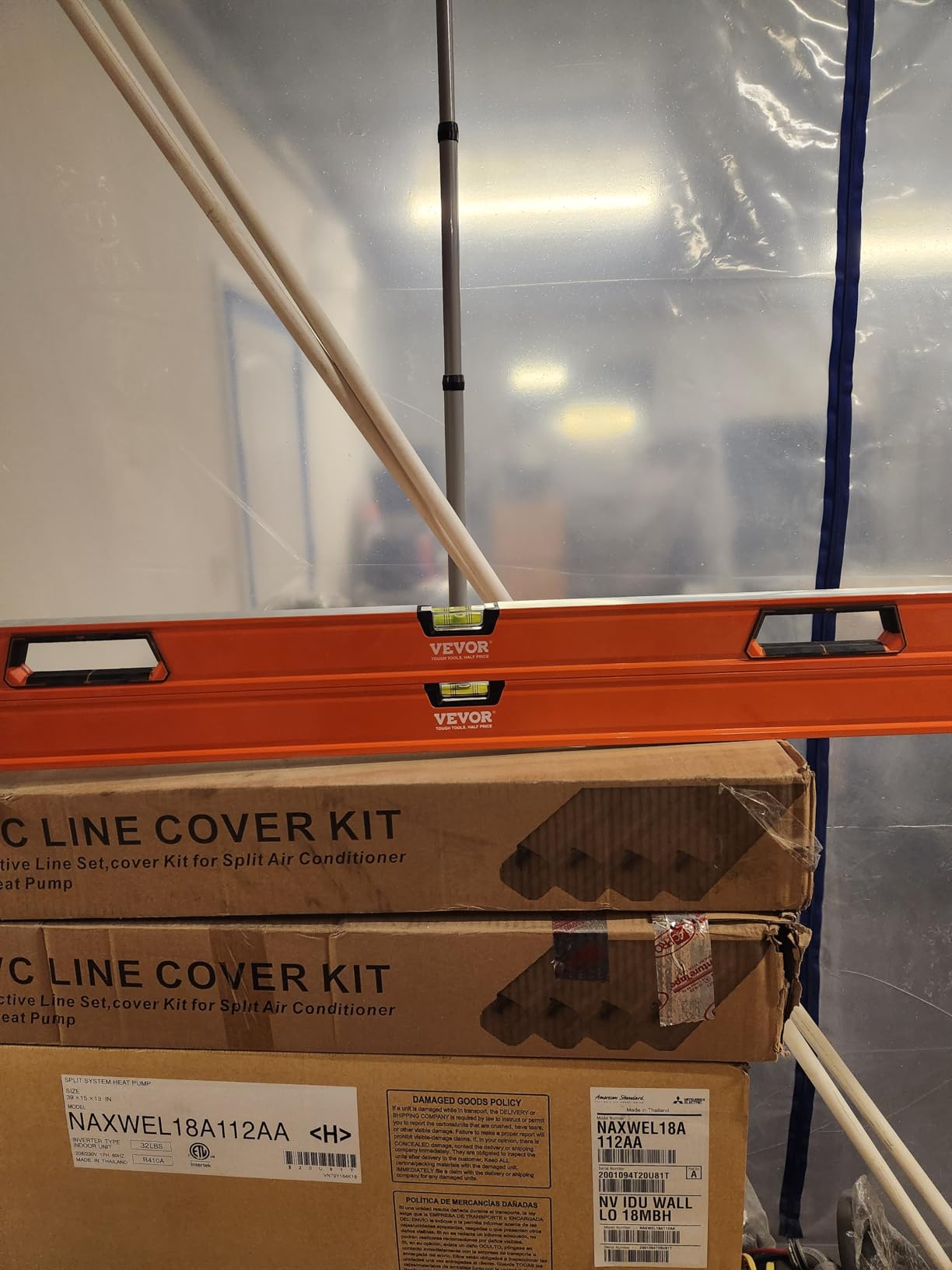
Four readout modes, degrees, percent, millimetres per metre and inches per foot, plus a beep at 0 and 90 degrees and an auto-flip display. The magnetic base with a centred handle lets you work it one-handed, and the storage bag is in the box, which for a 48 inch aluminium tool matters more than it would for a small one.
On specification it looks like the value answer to the whole roundup. Plus or minus 0.1 degrees at 0 and 90 degrees, 0.05 degree resolution, IP54 splash resistance. Very few tools at any price publish all three of those together.
Where a 48 inch level changes the workflow
Long top plates, header runs, picture rails and door head heights are the jobs. A short torpedo finds the high spot; a 48 inch level shows you the slope across the whole member, which is the difference between correcting a dip and correcting a fall.
For trim and casing, the length averages out the small waviness of the timber, so a run that looks bowed on a 10 inch tool often reads true on 48 inches. That is not the level lying. That is the level measuring what you actually care about.
Where it falls short
Honesty first: this one has the lowest average rating in the group at 4.3 stars, with a noticeable share of one-star reviews, which points at build and consistency complaints rather than a single failing feature. Owners who are happy with it are very happy, and that gap is what the rating distribution shows.
At 2.4 pounds it is heavy for overhead one-handed work, and 48 inches is not a length you balance on a ladder rung or pull out of a tight cavity. Buy it as the long-run tool, not as the only level you own.
9. PREXISO 12 Inch Digital Level – Best for Roof Pitch and Grade Work
PREXISO 12-Inch Digital Level with LCD Display, 360° Angle Gauge
Plus or minus 0.1 degrees at 0/90
Three readout modes
Bright green LCD
No magnetic base
Pros
- Audible indicator reaches level and 90 degrees without watching
- Large green LCD reads in dark and dim spaces
- Hold and relative reference modes suit repeated layout
- Three readout modes cover pitch and roof work
Cons
- This version has no magnetic base
- Lowest average rating here at 4.2 stars with a 10 percent one-star share
- 360 degree range means holding flat rather than in a V-groove
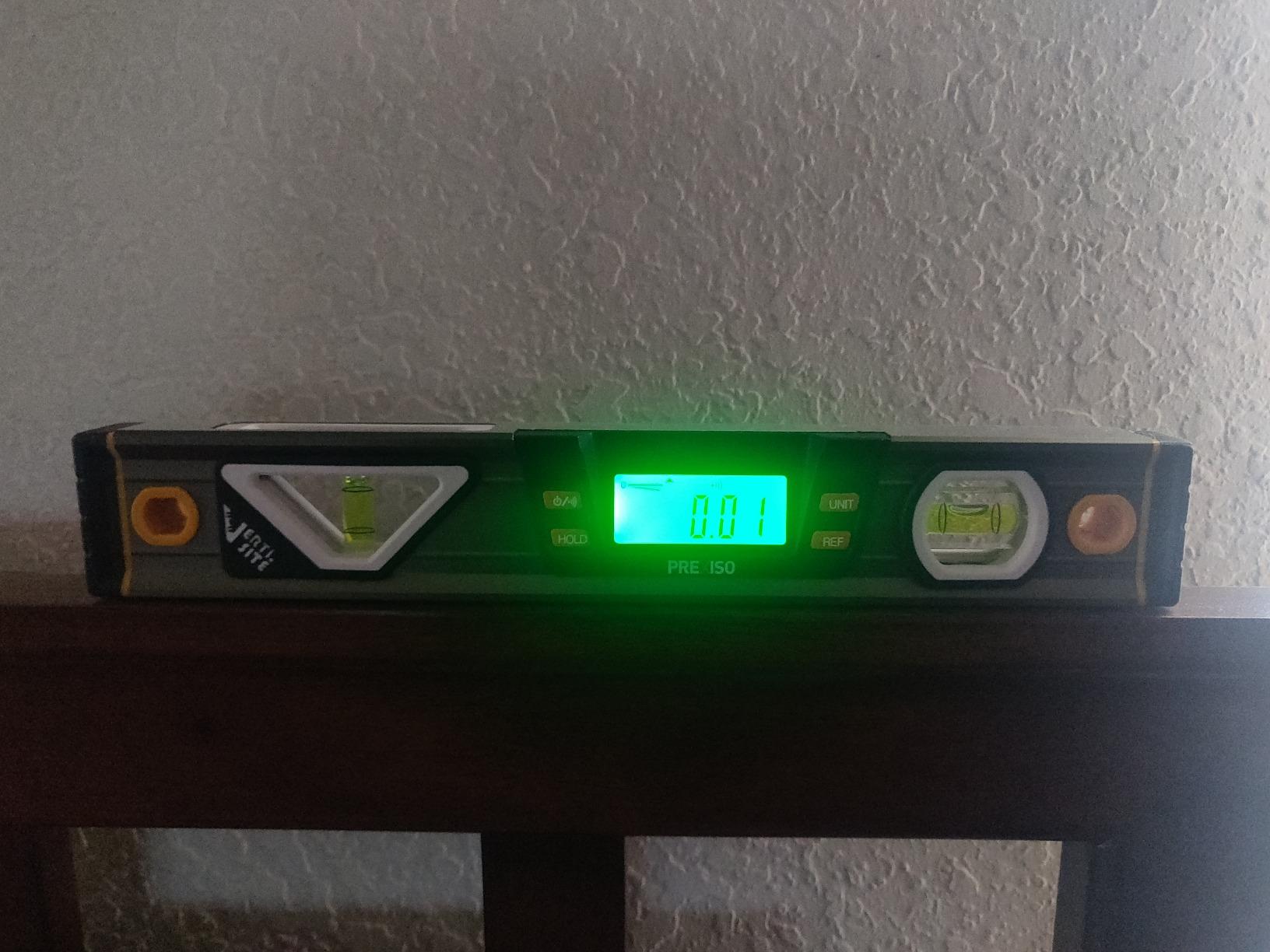
Roof pitch and site grade are where a digital level earns its keep more clearly than anywhere else, because the answer is a slope rather than a yes or no. The PREXISO reads in degrees, percent grade and inches per foot, so you can confirm a pitch against a code requirement without doing the trigonometry on a roof.
The audible indicator buzzes as you approach level or plumb. On a rafters or a stringer with both hands occupied, that feedback means you can converge on the number without watching the screen every time you nudge it.
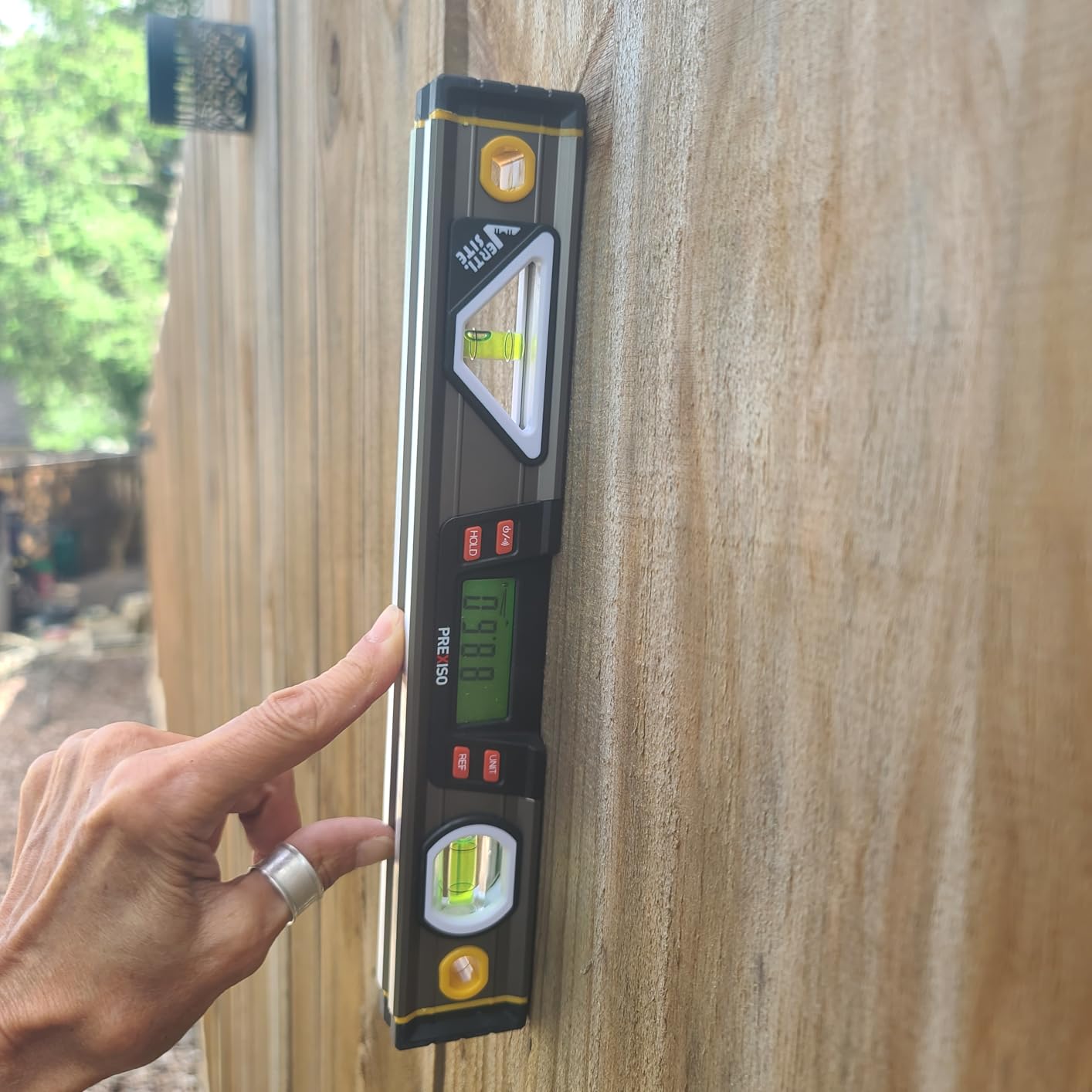
The large green LCD with automatic reversal when inverted is easy to read in a dim attic, which is where a 12 inch torpedo format is genuinely convenient. Hold and reference buttons let you set a known angle and then compare against it, which is the fastest way to copy a pitch across a series of rafters.
It covers four 90 degree quadrants, so 360 degrees of range, and at 12 inches it is the middle format in this roundup: long enough to cover a rafter top, short enough to turn around in a confined space.
Best used where slope is the actual measurement
Deck ledger pitch, rafter and truss layout, ramps, site grading and drain falls all want a slope number. The inches per foot and percent grade modes mean you can set a fall directly and check the second member against the first rather than calculating it again.
For a framer, that matters because a rafter cut list is made of angles, and this is the fastest way to confirm the angle you already cut against the pitch the design called for.
Where it falls short
This version has no magnetic base. That is the single biggest limitation for metal stud framing, where a tool that sticks to a steel stud hands-free saves you from holding it one-handed and eyeballing the other. For wood framing it is a much smaller loss.
It also carries the lowest average rating in this roundup at 4.2 stars, with 10 percent of reviews at one star. That is a meaningful reliability signal and it is the main reason this is not higher in the list despite good published accuracy. The 360 degree range also assumes you hold the tool flat, not in a corner or a V-groove.
10. Shefio 10 Inch Digital Torpedo – Best for Storing and Repeating Layout Angles
Digital Level – 10 Inch Torpedo Level And Protractor – Bubble Inclinometer
Stores 8 angle measurements
Plus or minus 0.1 degrees at 0 and 90 degrees
IP54 rated
0.5 kg
Pros
- Stores 8 angle measurements for repeating a layout
- Magnetic base stays stable on metal framing and posts
- IP54 holds up for outdoor fence and deck work
- Also made in 18 and 24 inch lengths for bigger spans
Cons
- Most expensive torpedo-format digital level in this group
- A 7 percent one-star share points at some failing units
- Plastic body feels less rigid than all-metal rivals
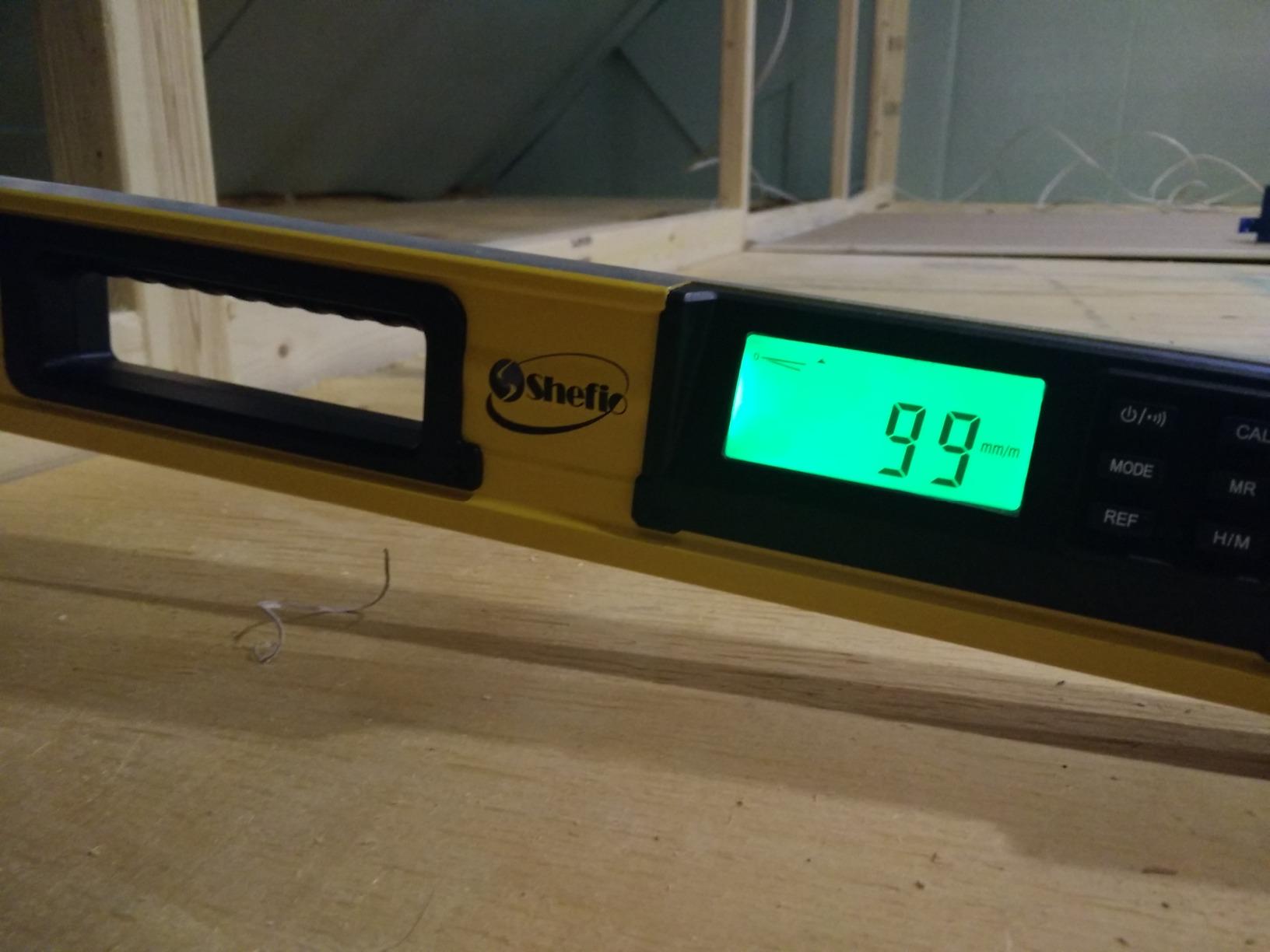
Eight stored angle measurements is the feature that separates this from every other 10 inch torpedo here, and it sounds like a gimmick until you are cutting eight identical cripple jacks or setting the same rafter pitch across a run. Save the angle once, recall it on each member, and the repetition stops depending on your memory.
The rest of the spec is squarely framing. Plus or minus 0.1 degrees at 0 and 90 degrees with plus or minus 0.2 degrees at other angles, percent slope readout for outdoor work, a magnetic base for hands-free use on metal, and an IP54 rating for dust and splash.
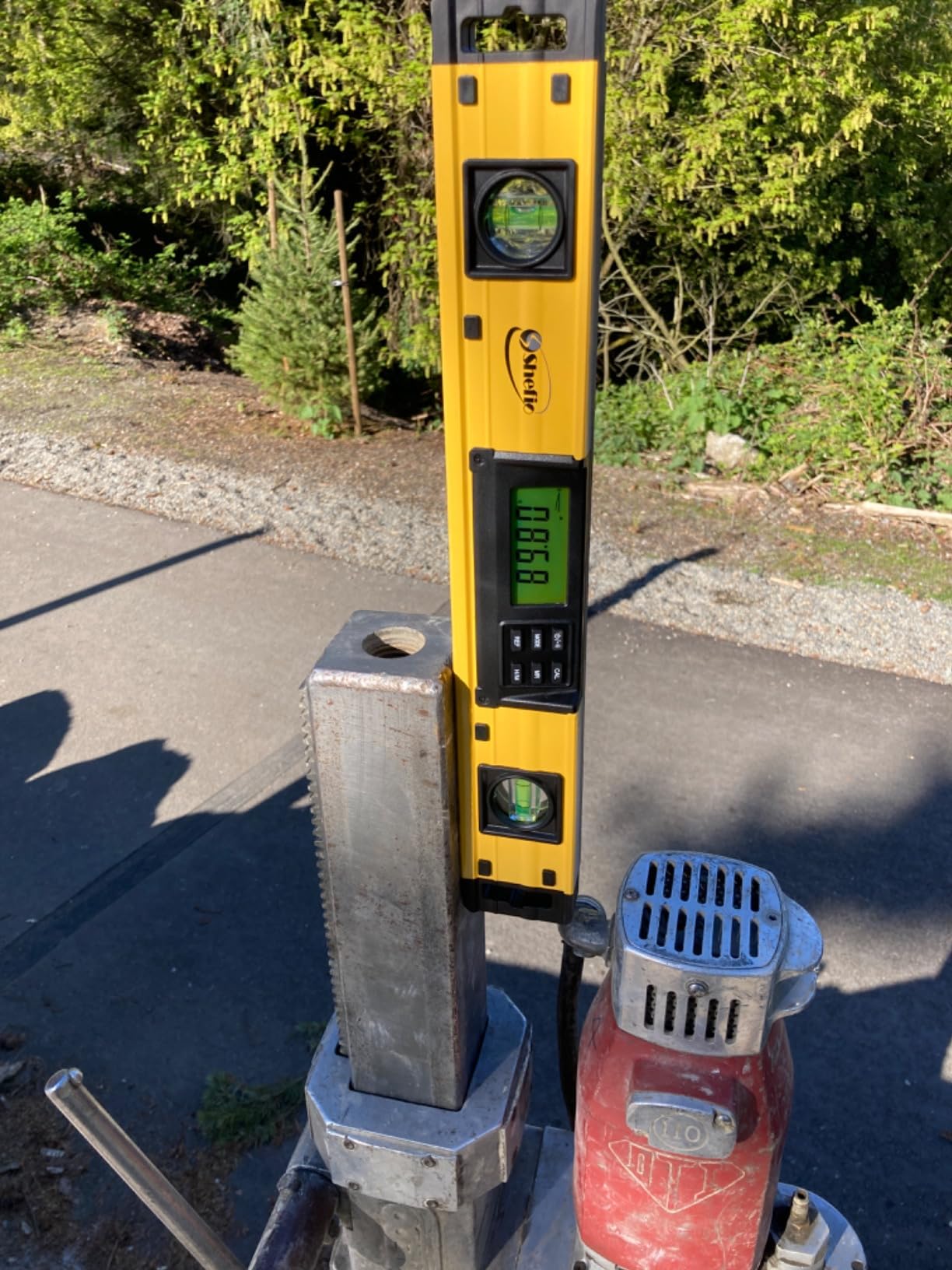
Owners overwhelmingly bought it for outdoor framing such as fence posts, decks and grade work, and the bright flipping LCD is the part they mention for dim early starts. At 0.5 kg it sits in the same weight class as the 2PM TOOLS torpedo and carries a similar aluminium and plastic construction.
The range in lengths is worth knowing about. The same line is made in 10, 18 and 24 inch versions, so if you start with the 10 inch for stud work and later find you want to span a wider member, there is a matching body rather than a different tool.
Where stored angles change the day
Repetitive framing is the use case. Cripple studs at a consistent height, joist hangers at a matched slope, a run of blocking all cut to the same angle. Recalling a number beats re-deriving it, and re-deriving it at the fifth member is where errors creep in.
For a deck or fence crew working outdoors, the IP54 rating and percent slope readout cover the conditions and the measurement in one tool, and the magnetic base handles steel posts.
Where it holds you back
Cost. This is the most expensive torpedo-format digital level in the roundup, and you are paying partly for the memory function and partly for a body that mixes plastic with aluminium where rivals go all metal. If stored angles are not something you will use, that premium buys you very little.
A 7 percent one-star share is higher than we would like to see on a tool we are recommending, and it points at unit failures rather than a design flaw. The plastic body also feels less rigid in the hand than the solid aluminium cubes in this list.
11. eOUTIL Digital Angle Gauge – Best Budget Pick for Table Saw and Shop Setup
Digital Angle Gauge, Angle Finder Magnetic Digital Level Protractor, Table Saw Accessories with LCD Backlight Display Data Hold and V-groove & Magnetic Base
Green backlit LCD
HOLD and ZERO functions
V-groove magnetic base
ABS body
Pros
- Lowest-cost pick here with more than 2000 reviews
- High-contrast green backlit display is the standout
- Base rail magnets are stronger than expected
- Zero and hold make repeated setups quick
Cons
- Repeatability varies by about 0.10 degrees between placements
- Display can develop a broken second digit
- ABS body is less rigid than aluminium gauges
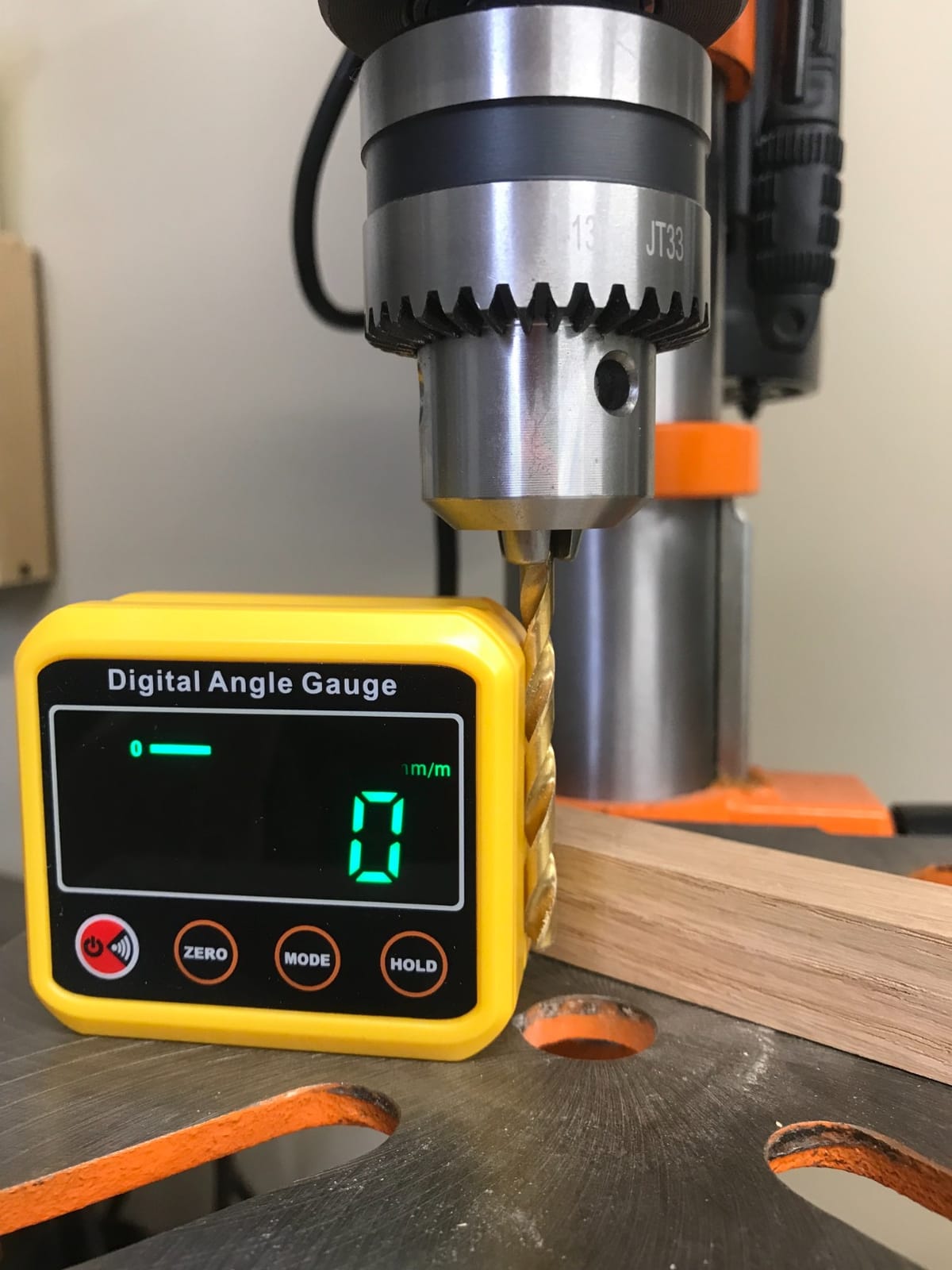
If you want one cheap angle gauge for the shop and you are not framing a wall, this is the value answer. The eOUTIL is a compact ABS angle gauge with a green backlit LCD, HOLD and ZERO functions, a reversible display for inverted work, and four readout modes including percent slope and pitch.
The V-groove in the base is the part that does real work. Sit it on round stock, pipe or conduit and the groove holds it centred, and the magnets in the base rail grip steel framing hard enough that owners regularly use it hands-free.
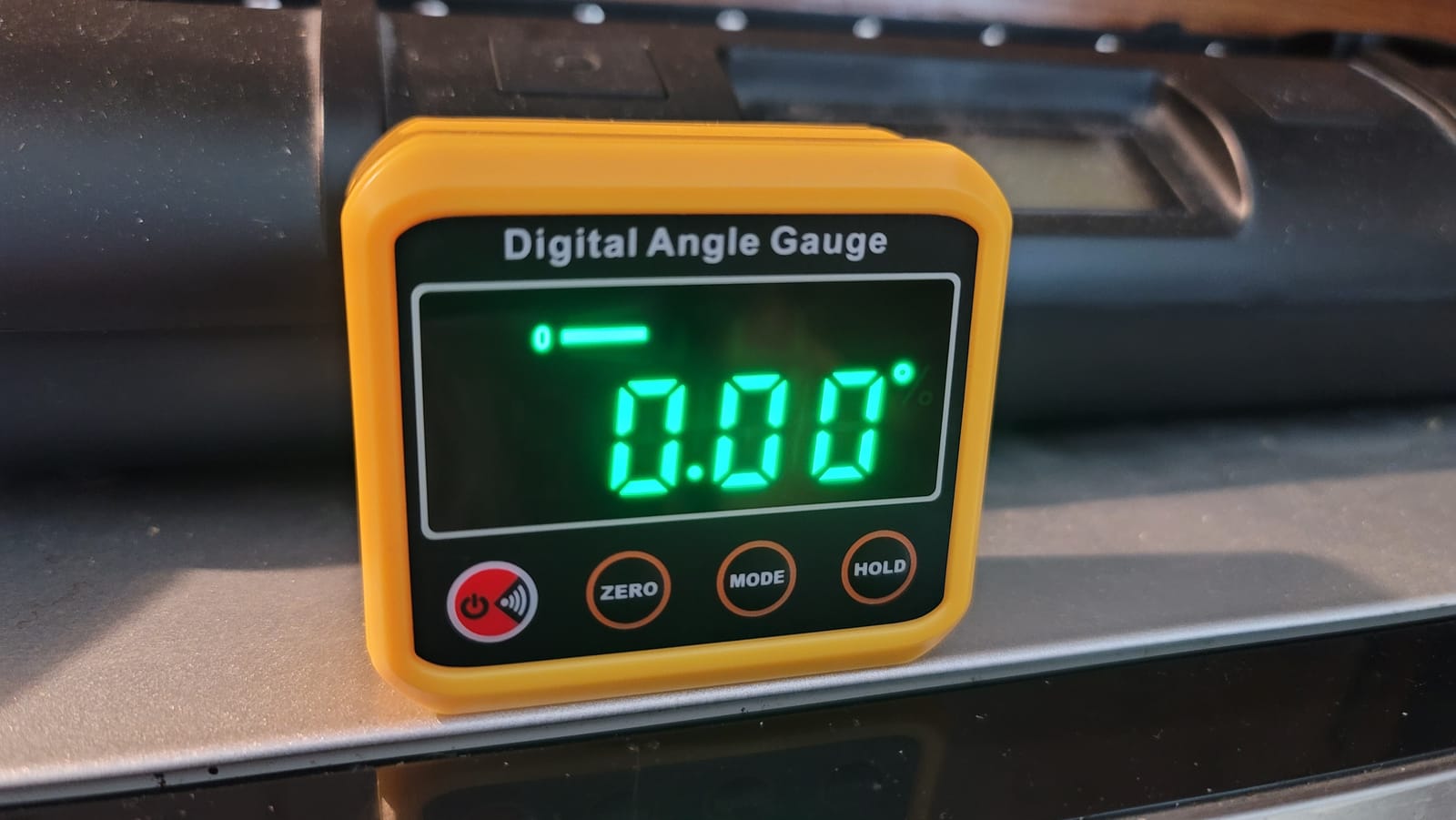
With more than 2000 reviews at a 4.4 average, it is one of the most proven cheap gauges available, and the recurring theme in those reviews is simple: the display is bright and the magnets are better than the price suggests. For setting a table saw blade or a miter to a repeated angle, that is enough.
HOLD freezes the reading and ZERO sets a reference in any position, which is the pairing that makes a repeated setup quick. Set the angle once, hold it, and bring the same number to every cut.
Where it is genuinely useful
Blade setup, sharpening angles, checking a fence against a blade, transfer of an angle onto a workpiece. These are all short, point measurements where a pocket-sized gauge is an advantage rather than a limitation, and the backlit display makes them quick in a dim shop.
As a secondary tool it fills a real gap. It is not the level you trust for a plumb stud, but it is the one you will actually carry when all you need is a number in a hurry.
Where it falls short for framing
Repeatability of roughly 0.10 degrees between placements is the number to hold in your head. It is fine for shop work, where you are setting a blade and cutting immediately, and looser than you want for verifying a framed member that has to be true for the life of the building.
Two other practical notes. The ABS body is less rigid than the aluminium gauges here, which matters if you are used to a solid feel, and some owners report the second digit on the display developing a fault over time. Check the display on arrival.
12. LEXIVON LX-DAF10 – Best for Repeated Trim Cuts with a Locking Angle
LEXIVON Aluminum Digital Angle Finder Gauge, 10-inch/250mm Multi-Purpose Protractor, Includes XL Display and Rugged Zippered Pouch (LX-DAF10)
0.05 degree resolution
Angle Lock knob
10 inch anodized aluminium
Includes zippered pouch
Pros
- Extra-large LCD at 0.05 degree resolution reads at arm's length
- Angle Lock knob holds a set angle for repeated cuts
- 10 inch anodized rule doubles as a marking scale
- Four-button interface with ZERO and HOLD
Cons
- Plus or minus 0.3 degree accuracy is looser than the best torpedoes
- No magnetic base for steel or conduit work
- Longer body is less pocketable than a small cube
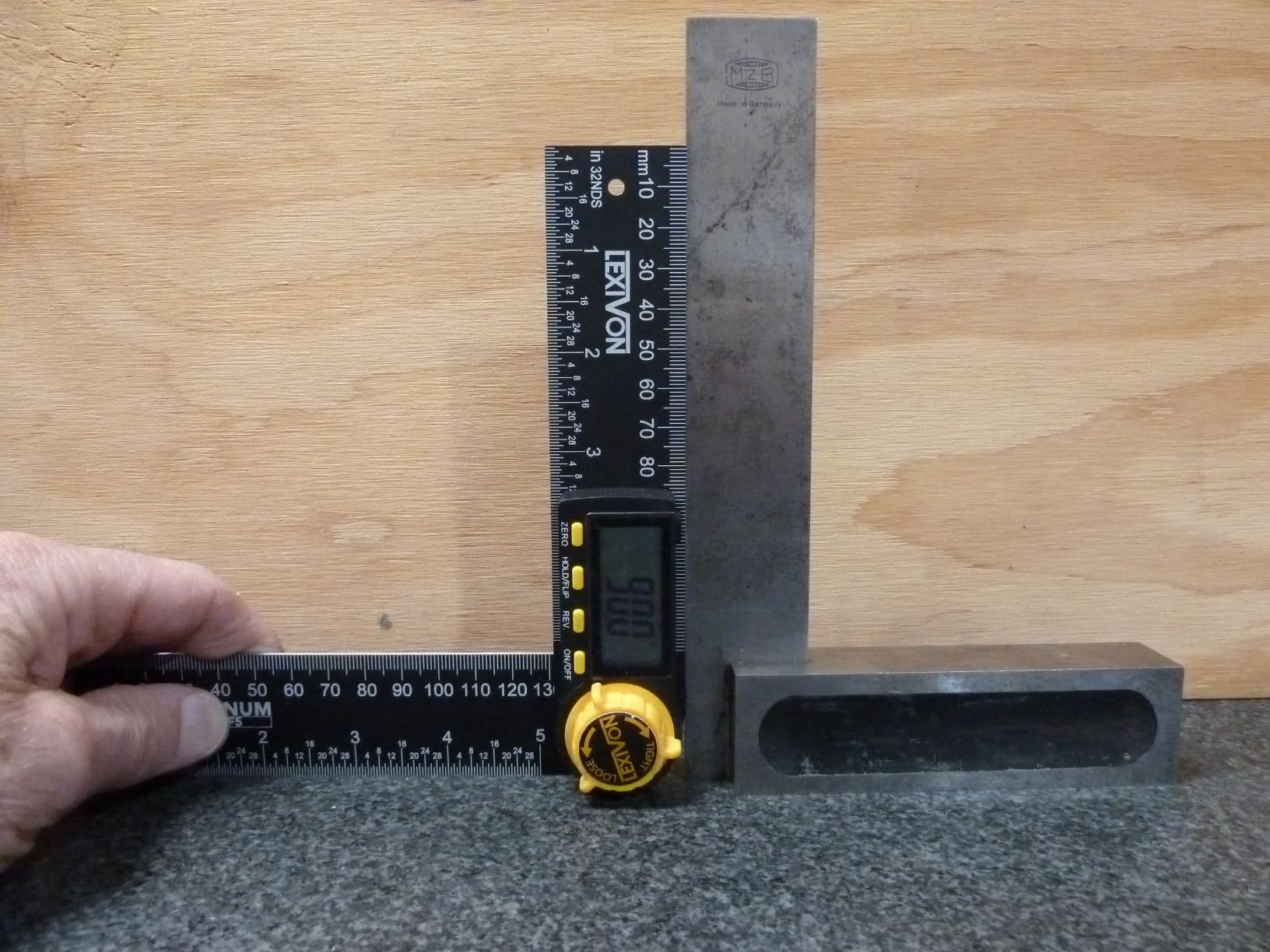
The Angle Lock knob is the reason this tool exists. Most digital gauges show you an angle and then you go and find it again after the tool is moved. The LEXIVON holds a set angle through a physical lock, so you can set 22.5 degrees once, lock it, and carry that same number to every inside and outside cut on the job.
That makes it a trim and tiling tool more than a framing tool, and it does that job very well. The extra-large LCD at 0.05 degree resolution is readable at arm’s length, and the 10 inch anodized aluminium rule has laser-etched millimetre and inch markings for layout.
Individual serial numbers with individual accuracy testing is a small touch that tells you something about how the tool is made. It is not the same guarantee as a stated factory tolerance, but it is a different posture from an unbranded gauge, and owners respond to it.
A rugged zippered case is included, which for a 10 inch aluminium tool with an edge that you will use as a marking rule is sensible protection. The same line is also made in shorter bodies if you want a closer fit for a hand tool bag.
Where the angle lock changes the work
Casing, baseboard, tiling, flooring and any run of identical mitres benefit directly. Lock the angle, work the material, and the second cut matches the first without a second trip to the display. Owners buying it for flooring and tiling report that the large display and the knob are the two things that made it stick.
It is also a fair framing companion. Checking a header pitch or setting a consistent angle on a series of braces is a repeated-angle job, and the lock serves that as well as it serves trim.
Where it falls short
Plus or minus 0.3 degree accuracy is looser than the tightest torpedo levels here, so it is a setting tool rather than a verification tool. If you are checking whether a member is true rather than choosing an angle to cut to, use something tighter.
There is no magnetic base, so it will not stick to a steel stud or sit in a conduit V-groove, and the 10 inch body is longer than a pocket cube. Neither is a problem for trim work. Both are reasons it finishes our list rather than sitting higher.
Digital Level vs Laser Level vs Spirit Level for Framing
These three tools answer different questions, and the mistake is treating them as substitutes. A spirit level answers is this member true. A digital level answers by how much it is not. A laser level answers where is this line, across a room, without a reference surface at all.
For checking plumb on a stud and reading exactly how far out it is, a digital level is the only one of the three that gives you a corrective number. For finding a level line across a long room or setting a wall out from a datum you cannot touch, a laser is faster and the digital level is not in the conversation.
The spirit level still has a place, and it is not a sentimental one. A good vial is passive, needs no battery, cannot drift out of calibration, and tells you the truth in the one situation a digital level handles badly, which is when you cannot see the screen. Many framers carry a nine inch vial alongside a digital torpedo for exactly that reason.
Where the digital level is most often overclaimed is accuracy. A consumer digital level with a plus or minus 0.2 degree tolerance is not a survey instrument. The most accurate devices in the world for this kind of work are professional surveying levels, and the same is true at the level range we are talking about: a tight digital reading beats a guess, not a certified reference.
Practical answer for most framing jobs: a laser for lines you cannot physically reach, a digital level for angles you need to correct, a vial as the check you trust when the screen is out of sight. We use a similar rule for judging any other digital readout, which is why the best digital meat thermometers we tested leaned on cross-checks rather than a single number too.
How to Choose a Digital Level for Framing: Accuracy, Length and Features
Start with the accuracy specification, but start by understanding the difference between two numbers that manufacturers print next to each other and buyers routinely mix up.
Resolution is how finely the display counts. Accuracy is how close the answer is to the truth. A tool can show 0.05 degrees on the display and still only be accurate to plus or minus 0.2 degrees, because the sensor is the limiting part, not the digits. Every manufacturer quoting a decimal in the display is telling you about the first number only.
What matters for framing is the tolerance at 0 and 90 degrees, because those are the angles you check constantly. The 2PM TOOLS L300, the VEVOR HC918S, the PREXISO and the Shefio all publish plus or minus 0.1 degrees at 0 and 90, with plus or minus 0.2 through the working range. The GemRed, the XUNTOP and the COROLLATA sit at plus or minus 0.2 throughout. The Neoteck and the LEXIVON fall to plus or minus 0.3 and plus or minus 0.5.
Does the gap between 0.05 and 0.1 degree matter in real work? On a shop bench, honestly, no, and forum users have said so plainly for years. On a framed wall the calculation is more forgiving than people expect: 0.1 degrees over an eight foot top plate is well under a sixteenth of an inch, which is inside what the rest of the trades absorb. Where it does matter is when a single error compounds across a long run, and a longer tool solves that better than a tighter one.
Pick the length to match the task
Under about 9 inches, you are carrying an angle cube. It is the right size for a stud face, a short post, a saw setting, and a quick plumb check on metal, and it is the most pocketable option by far.
Ten to 16 inches is the daily framing range. This covers a 2×4 or 2×6 stud face without overhang, fits a header top, and still turns around in a confined bay. The 2PM TOOLS, the Shefio, the LEXIVON and the Neoteck all live here, with the Neoteck at the long end for wide members.
Forty-eight inches is a different tool with a different job. It checks a full top plate run, a long header, a picture rail or a run of trim in a single placement instead of a sequence of placements. Pair one of these with a torpedo rather than choosing between them, and you cover both short point checks and long spans.
Magnetic base, display and power
A magnetic base is not a gimmick for metal stud work. It is the difference between holding a level against a steel stud with one hand and sticking it there while you look at the number and mark with the other. If you frame with light gauge steel, prioritise a strong magnet over any other feature. If you frame in wood, it matters less, and a V-groove for pipe and conduit becomes the more useful detail.
Display quality decides whether you enjoy the tool. Backlighting is what makes a digital level usable in a basement, a crawlspace or an early start before the power comes on. The TREND box, the GemRed, the COROLLATA and the eOUTIL all light their screens. Auto-inversion, so the number reads when the tool is upside down, is the feature you will notice most on overhead work and headers.
Battery platform is a quiet running cost. AAA cells cost almost nothing and never die in a cold van, but you need a spare. USB-C rechargeable tools such as the XUNTOP and the COROLLATA sit in a drawer for months and wake up ready, which suits a tool you use occasionally. Pick for how often you will actually use it.
Water resistance and regional availability
Basic dust and splash protection is what most interiors need. Full immersion sealing, as on the COROLLATA, is the right call for exterior deck and post framing or any site where the tool lives in the weather.
On availability outside the US, Stabila and SOLA are the names most associated with professional levels across the UK and Europe, and both have digital models in their ranges. The tools in this roundup are the ones readily available in the US market, where the selection of digital angle gauges and torpedoes is far wider.
Budget, mid-range and what you gain as you move up
The three tiers in this category are defined less by price than by what the manufacturer is willing to state. That is the fastest way to tell them apart, and it costs nothing to check on a retailer listing before you buy.
At the budget tier, the honest pattern is a stated accuracy figure on a pocket-sized angle gauge. The eOUTIL and the GemRed both publish a tolerance, which is more than several mid-range tools do, and both are fine for saw setup, short plumb checks and layout. What you give up is body rigidity, repeatability between placements and display longevity. Budget tools also tend to run on disposable cells, which is a small recurring cost rather than a deal breaker.
In the mid-range tier you start getting published tolerance at 0 and 90 degrees, backlit displays, splash protection and framed bodies with real magnets. The Klein, the 2PM TOOLS, the Shefio, the LEXIVON and the PREXISO all sit here, and the practical difference from budget is that a reading from one of these is a measurement rather than an estimate.
At the top of what a framer needs, you are buying three specific things: an aluminium body that will not twist, a magnet that will not let go of a steel stud, and a stated accuracy at the two angles you actually use. The professional surveying category above that, brands like Leica, Trimble, Sokkia and Digi-Pas, is a genuinely different instrument for land measurement, and it only makes sense if you are doing that work rather than framing houses.
Our own experience across this roundup is that the jump from budget to mid-range is the only one that reliably changes the result. Jumping again to a professional body is worth it if you frame steel or work to a visible-tolerance standard every day. For most people framing a house or a basement, mid-range is the correct stopping point.
A short glossary of the specs you will read
Retailer listings for this category reuse the same handful of terms, and half the confusion in buyer questions comes from words that sound interchangeable and are not.
Resolution is the smallest step the display can show, usually 0.1 or 0.05 degrees. Accuracy is the tolerance of the whole instrument, always larger than or equal to the resolution. Inclinometer means any digital tool that measures tilt, whether or not it is called a level.
A bevel gauge or digital angle finder measures the angle between two surfaces and is the tool for setting a cut. A digital level is built around a level reference and is the tool for checking true. Most tools in this roundup do both, and they are the same object with different priorities.
Slope can be given in degrees, in percent grade, or in inches per foot over a run. Twelve percent grade is the same idea as one inch per foot, and a tool that shows all three saves you converting on a roof or a deck.
A plumb site on a digital level is the bottom or the end of the tool, chosen because it is machined square to the body so the reading reflects the member and not the tool. It is why a level with a defined plumb site is more trustworthy held vertically than one without.
Hold freezes the current reading so you can move the tool and come back to the number. Zero sets the current position as the reference, which is what turns a sloped floor into a usable datum. Repeatability is how much the reading moves when you pick the tool up and set it back down in the same place, and for framing it is often a more meaningful number than the headline accuracy.
How to Check and Recalibrate a Digital Level After a Drop
Sensor drift after a drop is the most common ownership complaint in this category, and it is dangerous precisely because the tool does not tell you. It keeps displaying a confident number that is simply wrong, and you have no way to know unless you check.
The habit that prevents all of this is a ten second check before you trust a new tool or a tool that has been dropped. Put it on a surface you know is flat, such as a concrete slab or a good piece of glass, and read it. Then turn it end for end and read it again. A healthy level returns the same number both ways.
If the two readings differ, the tool has moved off its zero and needs recalibrating. Most of these gauges have a zero function, and the process is to set the tool on the known-flat surface, press zero, and confirm the display reads zero. That establishes a new reference. The catch is that this only works if the surface really is flat, so a warped workbench will happily install a new wrong zero.
For a deeper check, use a known slope. Set a physical vial level to a 45 degree reading on a combination square against a flat surface and confirm the digital gauge agrees. Any consistent offset between the two is drift, and a consistent offset is the signature of a level that has shifted rather than one that is broken.
Also verify the physical body, not just the numbers. Set the tool on a flat surface with the vials or a known level and look along the edge. A twisted frame reads correctly when you hold it one way and incorrectly the other, and no amount of recalibrating will fix a body that is out of true.
If a tool will not hold zero, drifts repeatedly, or its display develops a fault, stop trusting it on finished work. The honest expectation for any of the budget models here is that calibration is a do-it-yourself operation, and a tool that cannot be zeroed is a tool that needs replacing rather than adjusting.
Frequently Asked Questions
Which digital level is the most accurate?
Among the 12 levels we compared, the tightest published accuracy is plus or minus 0.1 degrees at 0 and 90 degrees, shared by the 2PM TOOLS L300, the VEVOR HC918S, the PREXISO 12-Inch and the Shefio 10-Inch. For framing overall, the Klein Tools 935DAG is the strongest all-round pick, with a 4.8 average rating across more than 16k reviews and a magnetic base that holds steel. Surveying-grade instruments from Leica, Trimble or Sokkia are more accurate, but they are a different category of tool and price.
Is a digital level worth it for framing?
For framing walls, yes, mainly because it converts a vague judgement into a number you can act on. A bubble level tells you a stud is close to plumb. A digital level tells you it is 1.4 degrees out, so you can correct it before the error multiplies across the wall. On short trim and picture hanging, a good spirit level is still simpler and needs no batteries.
Can I use my phone as a level?
For a rough check, yes. Phone inclinometers are accurate enough to tell you a shelf is visibly out and to get you close. They are not accurate enough for framing, because the reading changes as your hand moves, the case is not a rigid straight edge, and there is no way to zero against a reference surface. Use the phone to find a rough angle and a digital level to set it.
Do I need a 24 inch or 48 inch level for framing?
A 10 inch torpedo is the daily driver, because it covers a 2×4 or 2×6 stud face without the ends falling past the member. A 24 inch level is useful for headers, deck joists and long trim. A 48 inch level is for checking a full top plate run, a long header or a picture rail in one placement rather than a sequence. If you can only own one, buy the torpedo and add a long level when your work regularly spans more than a bay.
Do digital levels need calibration?
Most should be checked rather than routinely serviced. Place the level on a known flat surface, read it, then turn it end for end and read it again. Matching readings mean the tool is still true. A consistent difference means it has drifted and needs zeroing against that flat surface. Do this after any drop, because a digital level will keep displaying a confident but wrong number without warning you.
Is a digital level better than a laser level for framing?
They answer different questions. A laser is faster for setting a level line across a long room or from a datum you cannot physically reach. A digital level is better for reading exactly how far a stud, top plate or header is out, which is what lets you correct it. Most framers use both. If you can only carry one, a magnetic torpedo covers the plumb and pitch checks that framing actually demands.
Which Digital Level Should You Buy in 2026?
Here is the short version, by job. If you want one tool and you are not sure, buy the Klein Tools 935DAG. It has the highest rating in this group, the magnet to hold steel, a display you can read from below a header, and a size that fits anywhere on site.
If steel framing is your regular work, the 2PM TOOLS L300 is the one to buy on spec, with the tightest stated accuracy in the group and an audio indicator that lets you check plumb without watching the screen. If your work is mostly set-up and layout, the TREND Digital Level Box gives you a backlit, zeroable angle tool that fits in a pocket. If you just need a number occasionally, the GemRed DAG-V1 is the cheapest tool here that tells you its accuracy outright.
Add a second tool rather than replacing the first. The VEVOR 48 inch covers the long runs that a torpedo cannot, and the COROLLATA covers the waterproof outdoor work with a 0.05 degree resolution and USB-C charging. Most framers end up with a torpedo in the bag and a long level in the truck, and that pairing covers essentially every framing task.
We will keep re-testing these as new models land, and the accuracy figures here are the ones each manufacturer publishes, not estimates. Whichever you choose, run the flip test before you trust it on a wall.