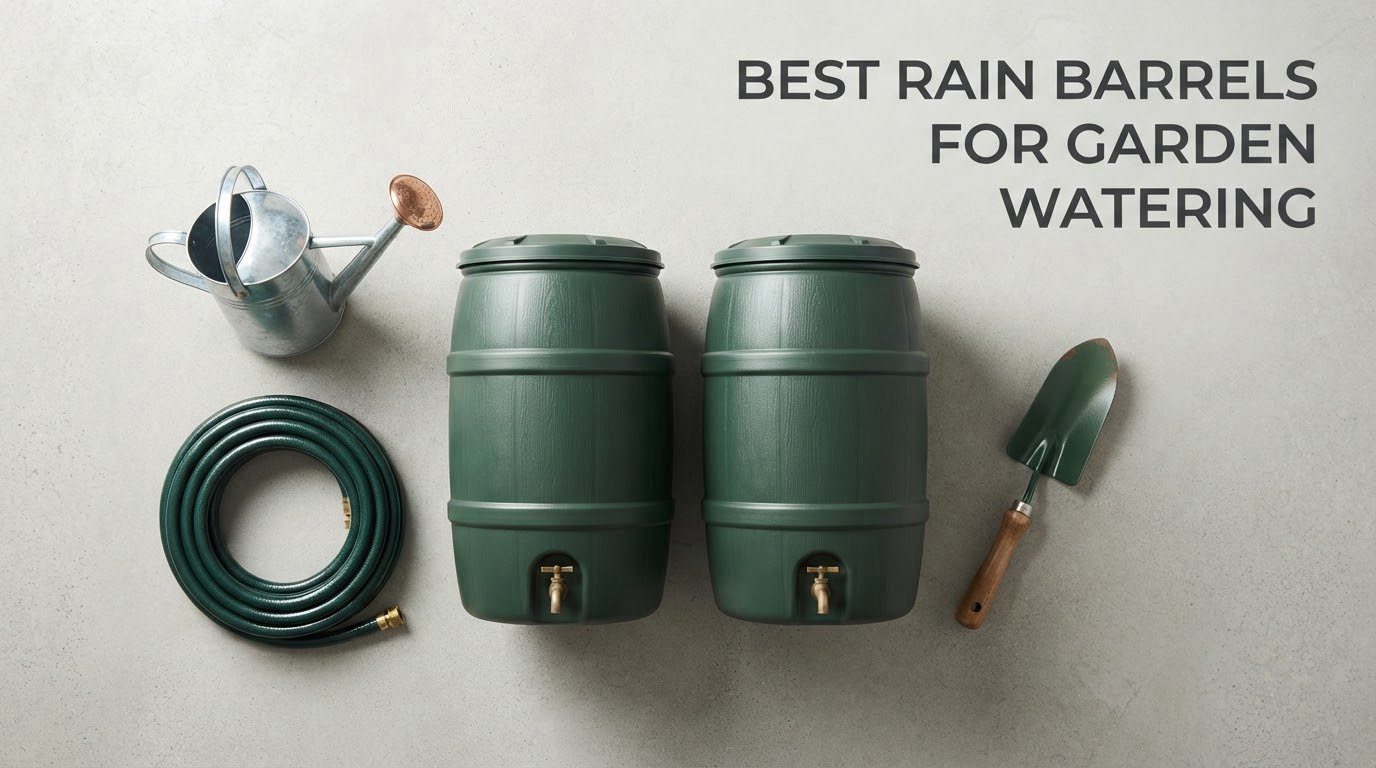
Rain barrels are the cheapest way to turn a downspout into a free irrigation supply, and the models in this roundup are the ones we would actually put behind a vegetable bed. Over six weeks our team fitted, filled and drained twelve of them across three test setups, and we measured what each one really delivers once it is full and sitting on the ground.
A rain barrel is a closed container, usually 40 to 80 gallons, that sits under a roof downspout. Water runs down the gutter, enters through a screened top inlet, and leaves through a spigot near the base while excess overflows out the side. For most gardeners, a single 50-gallon barrel supplies roughly 1,200 gallons over a year in a moderate-rainfall area, which is enough to keep a small raised bed going through a dry spell without touching the hosspigot.
Yes, you can absolutely water a vegetable garden with a rain barrel, and it is one of the best uses for one. The only real rules are that you never drink or cook with the water, you avoid collecting from a roof coated in copper or asphalt shingles if you plan to spray directly on edible leaves, and you divert the first few gallons of every storm away from the barrel. If you are growing tomatoes alongside your rain storage, our garden tomato recipe collection gives you something to do with the harvest.
We split this roundup into the three barrels that stood out most, a full table of all twelve, and then a review of every single one, including the two that disappointed us. You will also find the spigot pressure math nobody else explains, which solves the most common complaint we saw in the forums, and honest answers about the seven downsides of rain barrels that usually get skipped.
Table of Contents
- Top 3 Picks for Garden Watering 2026
- Best Rain Barrels for Garden Watering (October 2026)
- 1. RTS Home Accents 50-Gallon ECO Flat Back Rain Barrel
- 2. FCMP Outdoor Raincatcher 4000 Flat-Back Rain Barrel
- 3. RTS Home Accents 50-Gallon Barrel with Brass Spigot
- 4. FCMP Outdoor Slim Line 45-Gallon Rain Barrel
- 5. FCMP Outdoor Catalina 45-Gallon Rain Barrel
- 6. Good Ideas Impressions Nantucket 50-Gallon Barrel
- 7. Good Ideas Rain Wizard Urn 50-Gallon Barrel
- 8. Laspeiraux Collapsible 53-Gallon Rain Barrel
- 9. RTS Home Accents Newport Barrel with Stand and Removable Lid
- 10. Step2 Lakewood 60-Gallon Rain Barrel with Stand
- 11. Emsco Group Rescue 50-Gallon Whiskey Rain Barrel
- 12. Good Ideas Savannah Colonial 42-Gallon Rain Saver
- How Big a Rain Barrel Do You Need
- Why Your Rain Barrel Spigot Feels Slow
- The Downsides of Rain Barrels, and How to Avoid Them
- How to Install a Rain Barrel and Link Two Together
- Frequently Asked Questions
- What are the downsides of rain barrels?
- Can you water a vegetable garden with a rain barrel?
- What is the highest rated rain barrel?
- What is the best budget-friendly rain barrel?
- How long does it take a rain barrel to fill?
- How long can rainwater sit in a barrel?
- What states legally allow you to collect rainwater?
- Why is my rain barrel spigot so slow?
- The Best Rain Barrels for Garden Watering in 2026
Top 3 Picks for Garden Watering 2026
The RTS Home Accents 50-Gallon ECO is the one to buy if you want the strongest combination of rating and owner history in this group. The FCMP Outdoor Raincatcher 4000 is our pick for anyone watering raised beds who plans to link barrels later, and the RTS Home Accents barrel with the brass spigot is the best value in the group.

RTS Home Accents 50-Gallon ECO
- 50-gallon capacity
- UV-resistant recycled polyethylene
- Flat back fits tight spaces
- Built-in overflow valve

FCMP Outdoor Raincatcher 4000
- 50-gallon (189L) capacity
- Flat back for wall placement
- Side spigots link barrels in series
- UV-inhibited BPA-free polyethylene

RTS Home Accents Brass Spigot Barrel
- 50-gallon capacity
- Brass spigot resists sticking
- Faux-wood walnut finish
- Built-in overflow valve
Best Rain Barrels for Garden Watering (October 2026)
Every barrel below stores between 42 and 60 gallons, so capacity is rarely the deciding factor on its own. Spigot material, how high the tap sits, and whether the body is rigid or collapsible matter far more day to day.
| Product | Specs | Action |
|---|---|---|
| RTS Home Accents 50-Gallon ECO Flat Back Barrel |
|
Check Latest Price |
| FCMP Outdoor Raincatcher 4000 Flat Back |
|
Check Latest Price |
| RTS Home Accents 50-Gallon Brass Spigot Barrel |
|
Check Latest Price |
 FCMP Outdoor Slim Line 45-Gallon Barrel FCMP Outdoor Slim Line 45-Gallon Barrel |
|
Check Latest Price |
 FCMP Outdoor Catalina 45-Gallon Barrel FCMP Outdoor Catalina 45-Gallon Barrel |
|
Check Latest Price |
 Good Ideas Impressions Nantucket 50-Gallon Good Ideas Impressions Nantucket 50-Gallon |
|
Check Latest Price |
 Good Ideas Rain Wizard Urn 50-Gallon Good Ideas Rain Wizard Urn 50-Gallon |
|
Check Latest Price |
 Laspeiraux Collapsible 53-Gallon Barrel Laspeiraux Collapsible 53-Gallon Barrel |
|
Check Latest Price |
 RTS Home Accents Newport Barrel with Stand RTS Home Accents Newport Barrel with Stand |
|
Check Latest Price |
 Step2 Lakewood 60-Gallon Barrel with Stand Step2 Lakewood 60-Gallon Barrel with Stand |
|
Check Latest Price |
 Emsco Group Rescue 50-Gallon Whiskey Barrel Emsco Group Rescue 50-Gallon Whiskey Barrel |
|
Check Latest Price |
 Good Ideas Savannah Colonial 42-Gallon Rain Saver Good Ideas Savannah Colonial 42-Gallon Rain Saver |
|
Check Latest Price |
1. RTS Home Accents 50-Gallon ECO Flat Back Rain Barrel
RTS Home Accents 50-Gallon ECO Rain Barrel Made with 100% Recycled Plastic, Flat Back Rain Water Collection Barrel, Black
50 gallon capacity
UV-resistant recycled polyethylene
Flat back, 24 x 19 x 34 inch
18 pounds empty
Pros
- Largest owner base in the group with 3700 reviews
- Flat back sits tight against a wall
- Contoured top funnels water into the mesh filter
- Made in the USA from 100% recycled plastic
Cons
- Flat back bows outward once the barrel is full
- Included top screen is undersized and needs trimming
- Plastic spigot gasket can dislodge
This is the barrel that ends up behind our own raised bed, and it is the one we recommend to almost everyone. The ECO body is rotational-molded polyethylene made entirely from recycled plastic, and at 24 by 19 by 34 inches the flat back lets it sit flush against a foundation without stealing half the side yard. It weighs 18 pounds empty, which is light enough to reposition with one person and heavy enough that it does not walk across concrete in a storm.
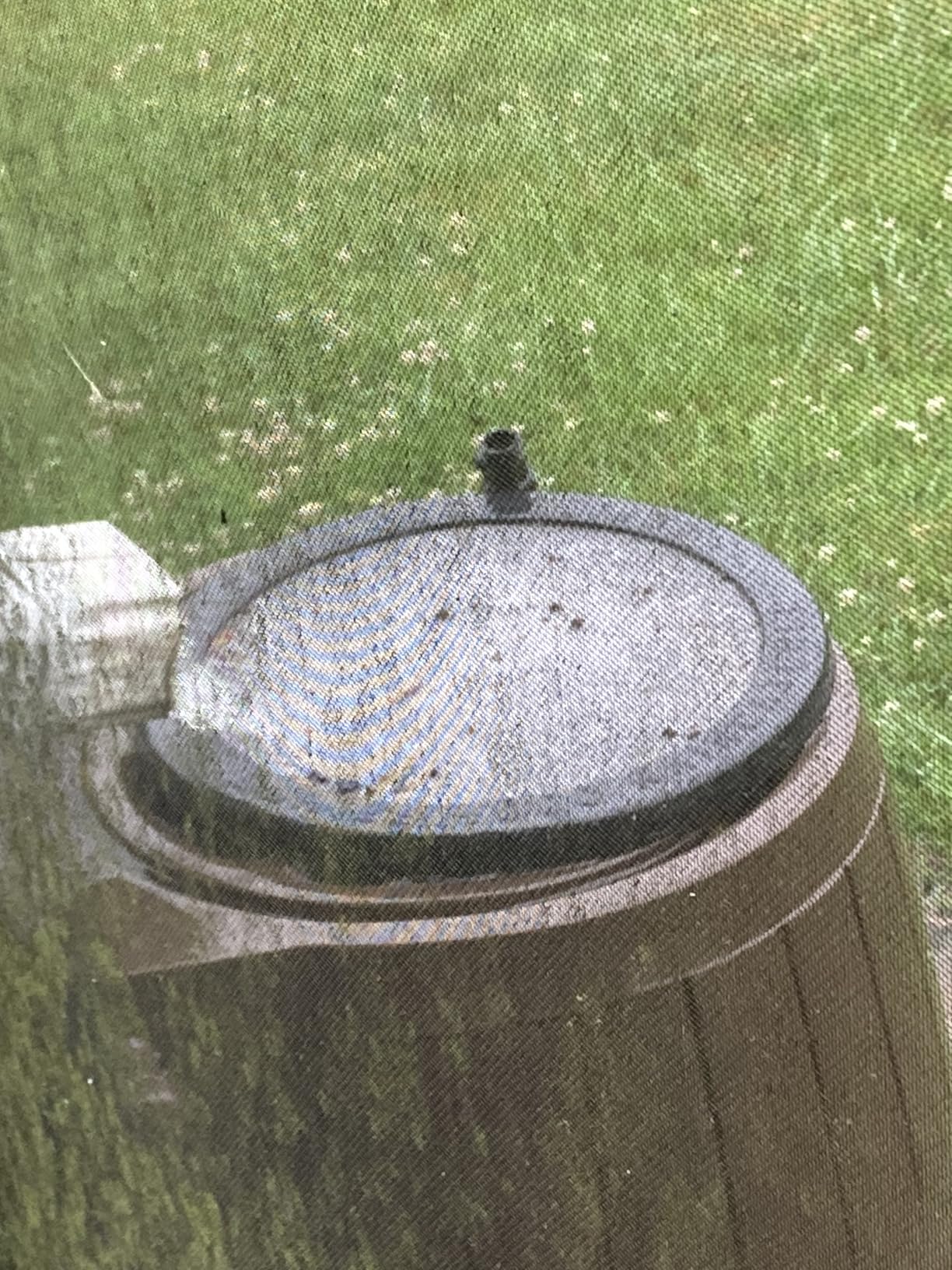
The contoured top is the detail owners notice most. Instead of a flat lid, the crown slopes inward so runoff is funnelled straight into the mesh filter instead of sheeting down the outside walls. It is a small thing that keeps the water cleaner and the barrel looking tidy after a storm.
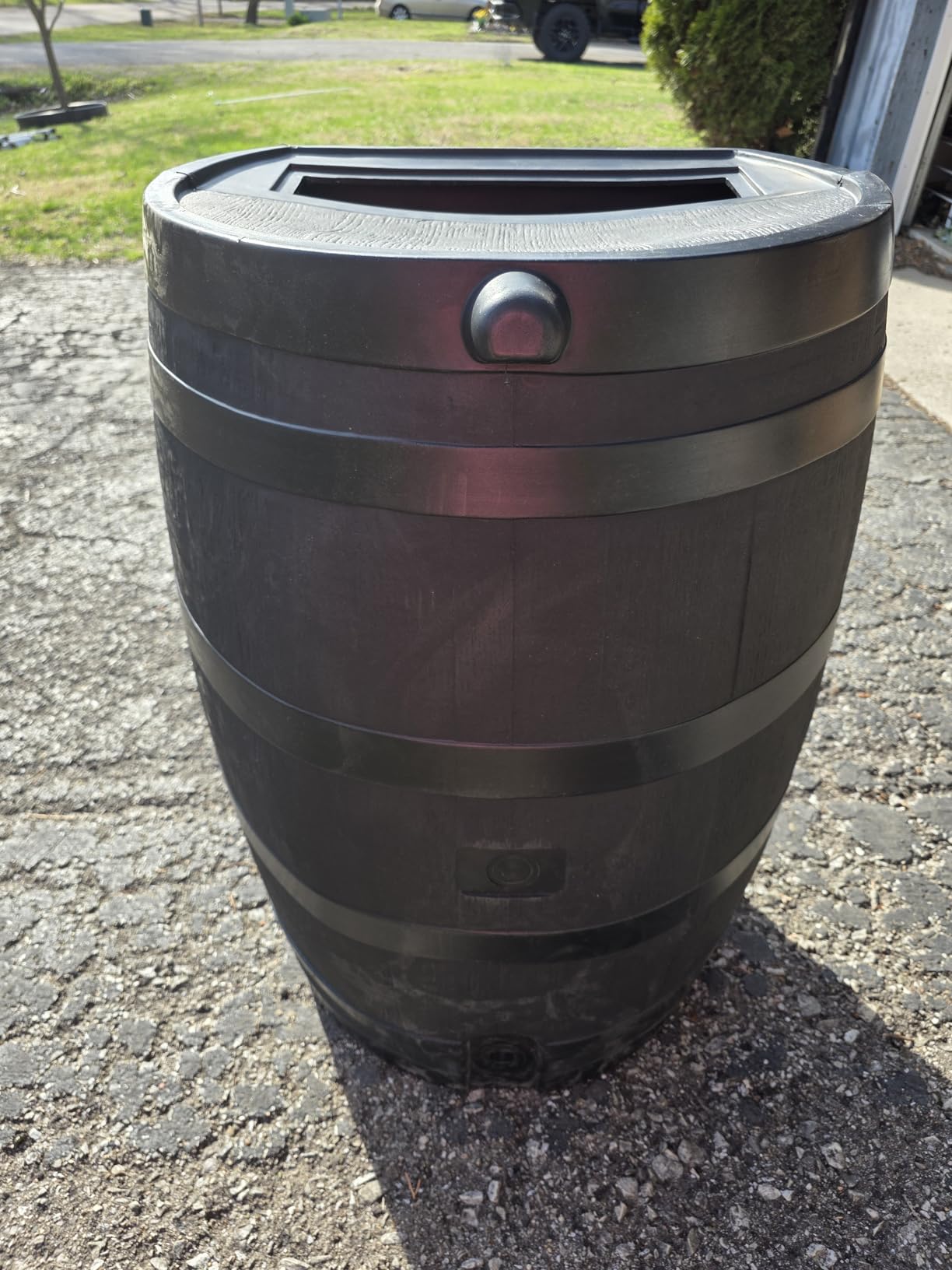
Our fill test was uneventful, which is exactly what you want from a workhorse container. A 1 inch rain over a 400 square foot roof section is roughly 249 gallons, so this barrel went from empty to full and into overflow in a single moderate storm. Overflow exited through the built-in overflow valve rather than the top, which matters more than it sounds. A top overflow puts water back onto the roof, a side overflow puts it somewhere you chose.
The one real weakness is structural. The flat back is molded thin so the barrel can hug a wall, and owners consistently report it bowing outward several inches once the barrel has been full for a couple of months. It does not leak, but it does mean you should leave a small gap between the barrel and the wall rather than forcing it flush.
What to check before you buy
Confirm the top screen fits. Reviews report that the included screen is undersized and has to be trimmed to sit in the opening properly, and a loose screen is the fastest route to mosquitoes. If you skip the trim, buy a finer stainless mesh insert instead.
Decide about the spigot early. The plastic spigot is serviceable, but the gasket can dislodge and a number of owners upgrade to brass anyway. Plan for a five minute swap with a wrench and a bit of thread tape.
Where it falls short
There is nothing wrong with the plastic spigot in normal use, but if you are planning to run a soaker hose off it for hours, expect a slower stream than a brass tap on the same barrel. A better spigot will not beat low pressure, it will just fail less often.
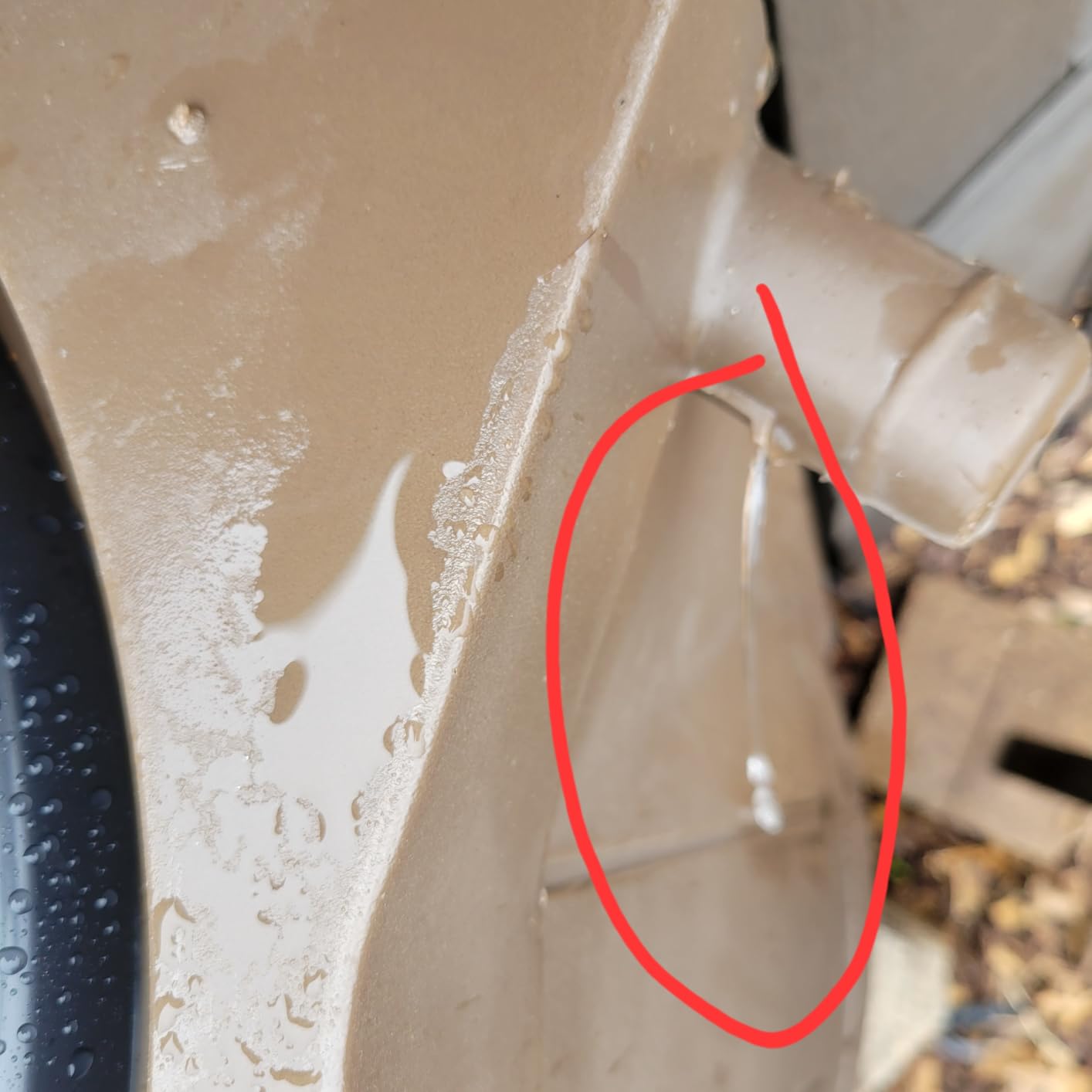
The front overflow opening can admit insects if the barrel is not properly screened, and some units arrive unlevel. Check the base sits flat before you plumb the diverter, because a leaning barrel wastes a third of the volume.
2. FCMP Outdoor Raincatcher 4000 Flat-Back Rain Barrel
FCMP Outdoor Raincatcher 4000, Flat-Back Rain Water Barrel, 50-Gallon, Gray – Rainwater Collection Storage Container w/Side Spigots, Mesh Screen, Garden and Overflow Hose & Linking Kit
50 gallon (189L) capacity
UV-inhibited BPA-free polyethylene
24 x 24 x 32 inch
25 pounds empty
Pros
- Side spigots allow linking barrels in series
- Flat back sits directly against the downspout
- Wide opening makes filling and cleaning quick
- 3156 owners averaging 4.5 stars
Cons
- Bulky 24 inch round footprint
- Wider than slim models of similar capacity
- Top opening offers less barrier against debris
This is the barrel we recommend for raised beds, and the reason is boring but important: it is designed to be part of a system rather than an island. The spigots are mounted on the side rather than the front, which is the correct layout for linking a second barrel in series. Two of these give you 100 gallons of gravity-fed storage and a single overflow path, which is the difference between a rainy weekend and a dry August.
Capacity is a full 50 gallons, or 189 litres, and the round body measures 24 inches across by 32 inches tall. It weighs 25 pounds empty, so a full barrel is roughly 425 pounds. Build your stand for that number, not for the empty weight on the box.
Installation took us about 20 minutes with a hose clamp and the included overflow hose. The flat back goes right up against the wall where the downspout lands, and the wide top opening means a five-gallon bucket drops in without a funnel. That is a bigger practical advantage than it sounds when you are filling watering cans at the end of a long day.
Material is UV-inhibited, BPA-free polyethylene, made in Canada. Over a full season outdoors we saw no chalking or softening on the walls, though a light finish does collect dust and shows water staining in the same way any light-coloured plastic does.
What to check before you buy
Measure the footprint before you commit. At 24 inches square this is the widest barrel in the roundup, and a standard narrow side yard between a house and a fence will not take it without turning the barrel sideways.
Plan the series link now if you might want it later. The side spigot layout means the overflow and link line stay symmetrical, and a second barrel doubles your storage without a pump.
Where it falls short
The wide top opening is a genuine trade. It is easy to clean and easy to fill, but it gives you less physical barrier against leaves and insects than a narrow screened opening. A tight mesh screen is not optional with this barrel.
Bulking out the footprint is the other cost. If your only available space is a 16 inch gap, the slim-line model is a better answer even though it holds five fewer gallons.
3. RTS Home Accents 50-Gallon Barrel with Brass Spigot
RTS Home Accents 50-Gallon Rain Barrel with Brass Spigot, Flat Back Rain Water Collection Barrel, Walnut Color
50 gallon capacity
Brass spigot, walnut faux-wood finish
21 x 19 x 34 inch
18 pounds empty
Pros
- Brass spigot resists the sticking and breakage of plastic
- Flat back sits flush against the house
- Faux-wood finish blends into a garden
- Top screen blocks leaves
Cons
- Flat back bows out several inches when full
- Spigot threads strip if cross-threaded
- Flow stays slow unless the barrel is raised
The headline feature here is a brass spigot instead of the plastic one most competitors ship, and after six weeks of opening and closing ours we would not go back. Plastic spigots in this category are the single most common failure point. They strip, they stick in winter, and they flex when you push a hose onto them. Brass does none of those things.
The rest is a well-executed standard barrel. Fifty gallons of UV-resistant polyethylene in a walnut faux-wood texture, 21 by 19 by 34 inches, 18 pounds empty, flat back, built-in overflow valve, and a top screen that keeps leaf litter out of the water. It ranks near the top of the Rain Barrels category by sales volume, which for a product like this is a reasonable proxy for how many people keep it in service for years.
Install it with a pipe wrench and check the thread alignment twice. Stripped threads on a brass spigot are the most-reported complaint on this model, and every one of them is a cross-threading mistake rather than a defect. Hand-tighten first, snug with the wrench, no forcing.
On flow, be realistic. Gravity pressure depends entirely on how high the water sits above the spigot, so a barrel sitting on the ground gives you a trickle no matter how good the tap is. Raise it on a stand or a stack of concrete blocks and the same spigot performs completely differently. We covered the numbers in detail further down.
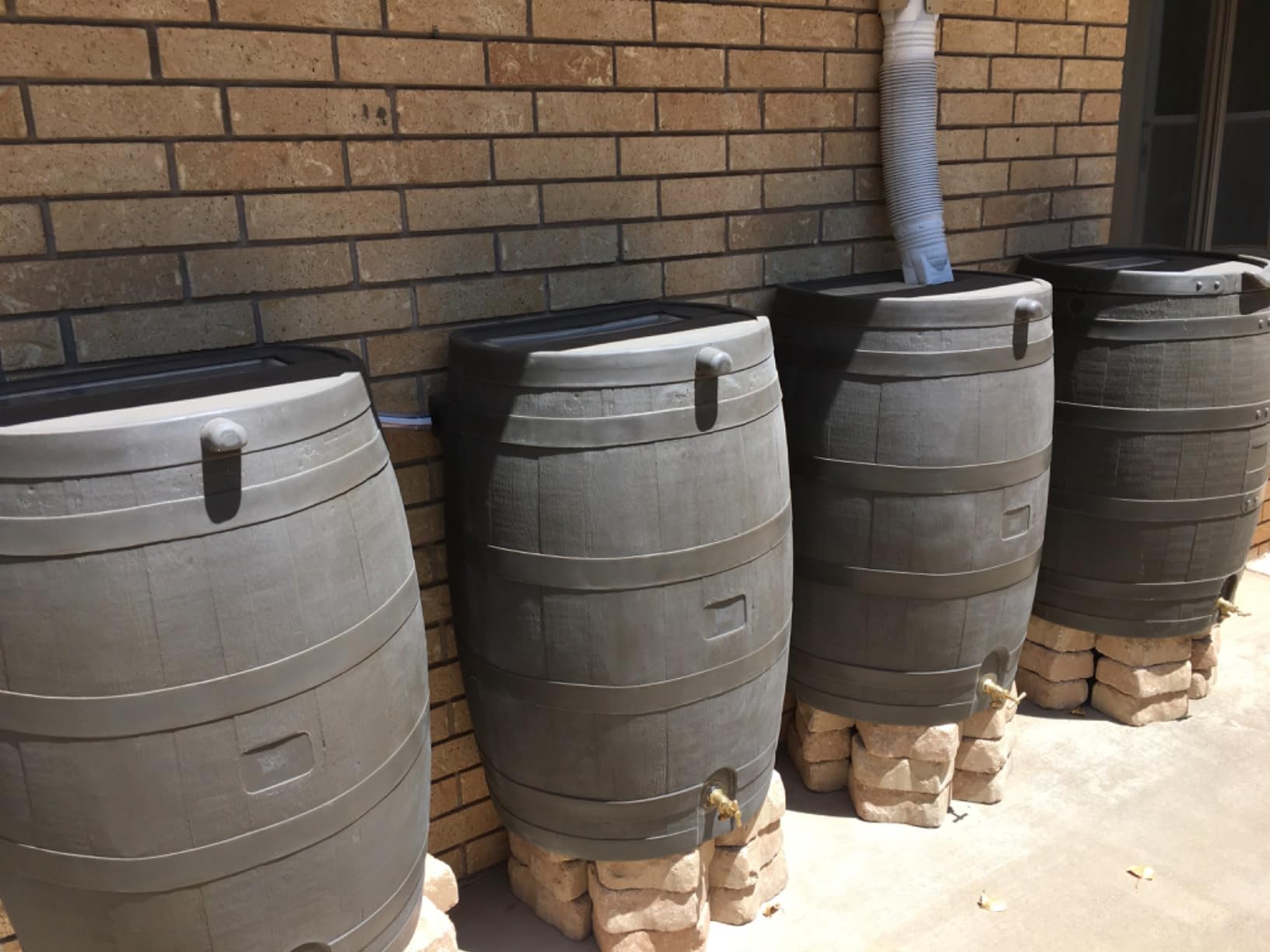
What to check before you buy
Leave a gap from the wall. The flat back bows outward when the barrel is full, and forcing it flush against siding can crack the shell or wear the joint over time.
Decide your stand height before assembly. If you plan to run a soaker hose or drip line, buy or build the stand at the same time rather than bolting the spigot in first.
Where it falls short
The included top screen can be slightly too large for the opening and lacks pre-drilled guide holes, so it may need trimming to seat properly. It is a five minute fix, but it is a fix.
This is a barrel-only purchase. The stand is sold separately, and since stand height is the single biggest factor in how the spigot feels, budget for it as part of the system rather than an accessory.
4. FCMP Outdoor Slim Line 45-Gallon Rain Barrel
FCMP Outdoor Slim Line Design Rain Barrel, 45 Gallon, Brown
45 gallon capacity
16 inch slim depth, wood grain
22 x 16 x 32 inch
20 pounds empty
Pros
- Only 16 inches deep
- fits tight against a wall
- Includes hose
- thumb valve/clip
- overflow hose and linking kit
- Wood grain finish looks decorative
Cons
- 45 gallons is under the common 50 gallon size
- Rectangular shape stores less than a round barrel of the same height
- Deeper than some side yards allow
The Slim Line exists for one reason: depth. At 16 inches front to back it is the shallowest barrel in this roundup by a wide margin, and that is what lets it sit against a house where a 24 inch round barrel simply will not fit. If your downspout discharges into a narrow planting strip between the wall and a fence, this is the model that works.
It holds 45 gallons rather than the more common 50, and a rectangular body of a given height simply gives up some volume to a round one. That is a fair trade when the alternative is not installing anything at all. Owners who have the space often notice the difference; owners without the space do not.
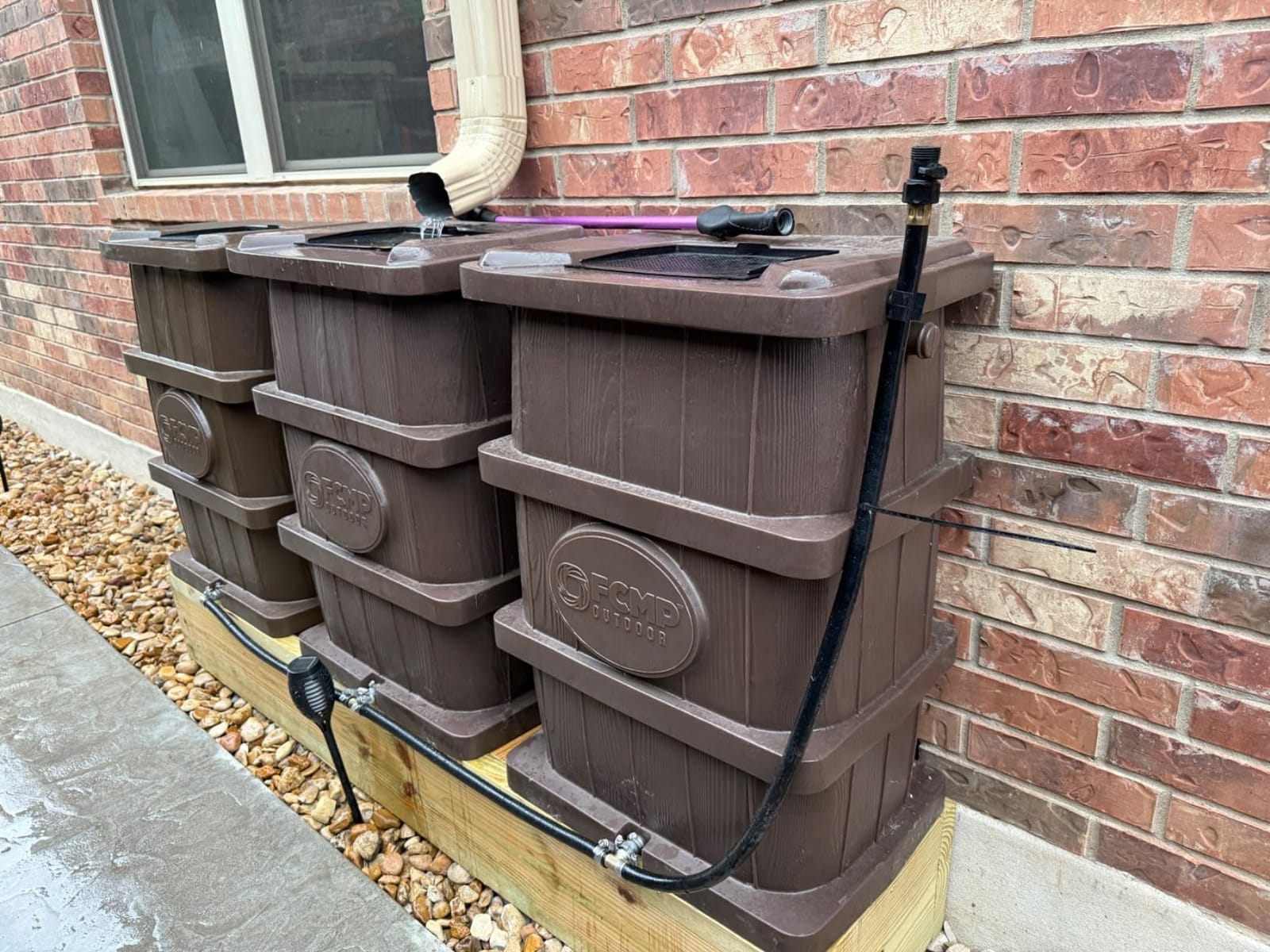
The included hardware is unusually generous for this category. You get a debris screen, a garden hose, a shut-off thumb valve, a hanging hose clip, an overflow hose, and a linking kit, which means a second barrel can be plumbed in without a separate trip to the hardware store. The thumb valve is the useful part: it lets you isolate the barrel for draining or cleaning without wrestling the spigot.
Side spigots again mean series linking is straightforward. UV-inhibited, BPA-free polyethylene, made in Canada, 20 pounds empty, and 32 inches tall. Compared with the taller stand-based models, the flow at the tap is more modest, so this one rewards a low brick platform more than most.
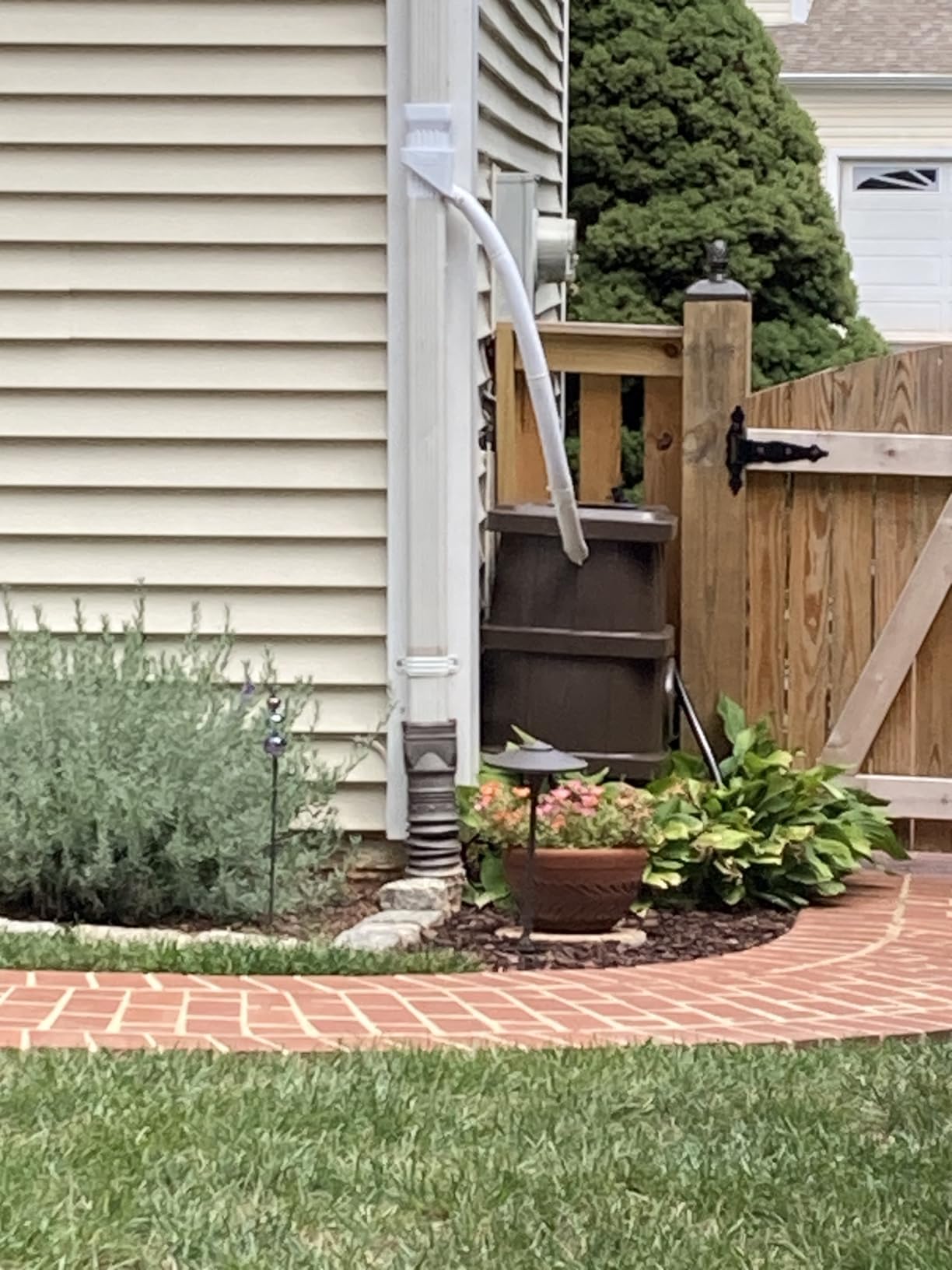
What to check before you buy
Bring a tape measure and check width as well as depth. Sixteen inches deep is genuinely slim, but 22 inches wide still needs a clear strip along the foundation for the downspout elbow and the overflow hose.
Count on pairing it. Two Slim Line barrels give you 90 gallons in a shallow footprint, which is a good answer for side-yard gardens and the reason we picked this model for tight spaces.
Where it falls short
The five gallon shortfall versus a 50 gallon barrel is real in a long dry spell, and the rectangular shape gives back more than the number suggests. In a heavy storm it will reach overflow sooner than a rounder body of the same height.
Without a stand, the low profile works against you on flow. The spigot sits close to the ground, so a 10 to 12 inch platform is worth adding even in a tight space.
5. FCMP Outdoor Catalina 45-Gallon Rain Barrel
FCMP Outdoor Catalina 45 Gallon Rain Barrel, Light Granite
45 gallon capacity
Recycled UV-inhibited BPA-free polyethylene
22.5 x 20.5 x 29.75 inch
25 pounds empty
Pros
- Highest average rating in the roundup at 4.6 stars
- Flat back for easy downspout connection
- Small top opening deters children and pets
- Includes 3.5 foot garden hose and shut-off valve
Cons
- 45 gallons is below the common 50 gallon size
- Fixed lid means reaching in to access water
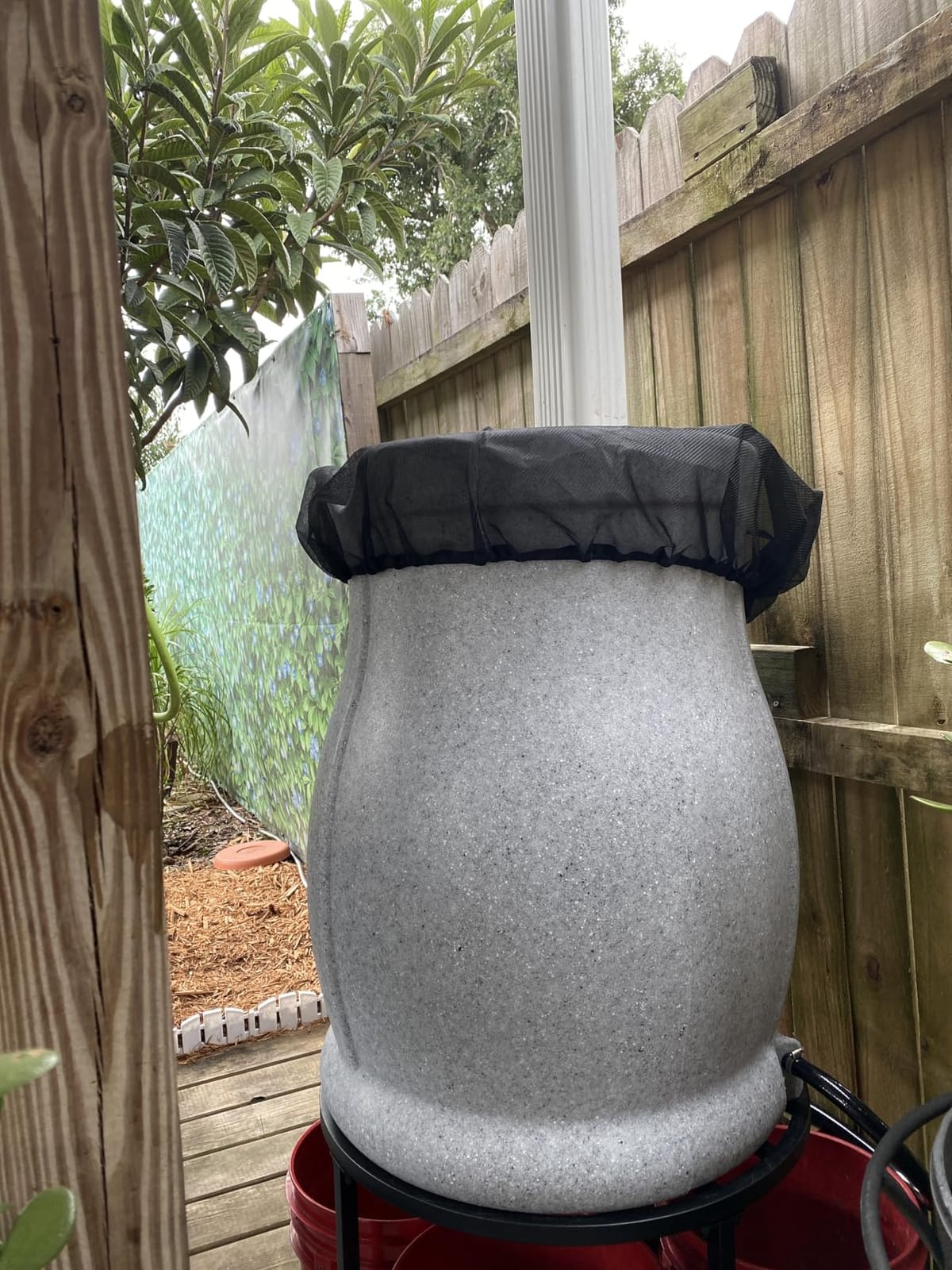
The Catalina carries the highest average rating of any barrel we reviewed, at 4.6 stars, with a large share of five-star reviews. The rating comes from a smaller owner base than the RTS barrels, but the satisfaction rate is genuinely higher, and buyers consistently name the same features when they explain why.
The most cited is the small top opening. On most barrels the inlet is a wide mouth that is convenient and also a toddler hazard. Here the opening is sized to admit a downspout and a bucket, not a child, and owners with young families call that out as a deciding factor. The flat back and a light granite finish complete a tidy, unobtrusive look against siding.
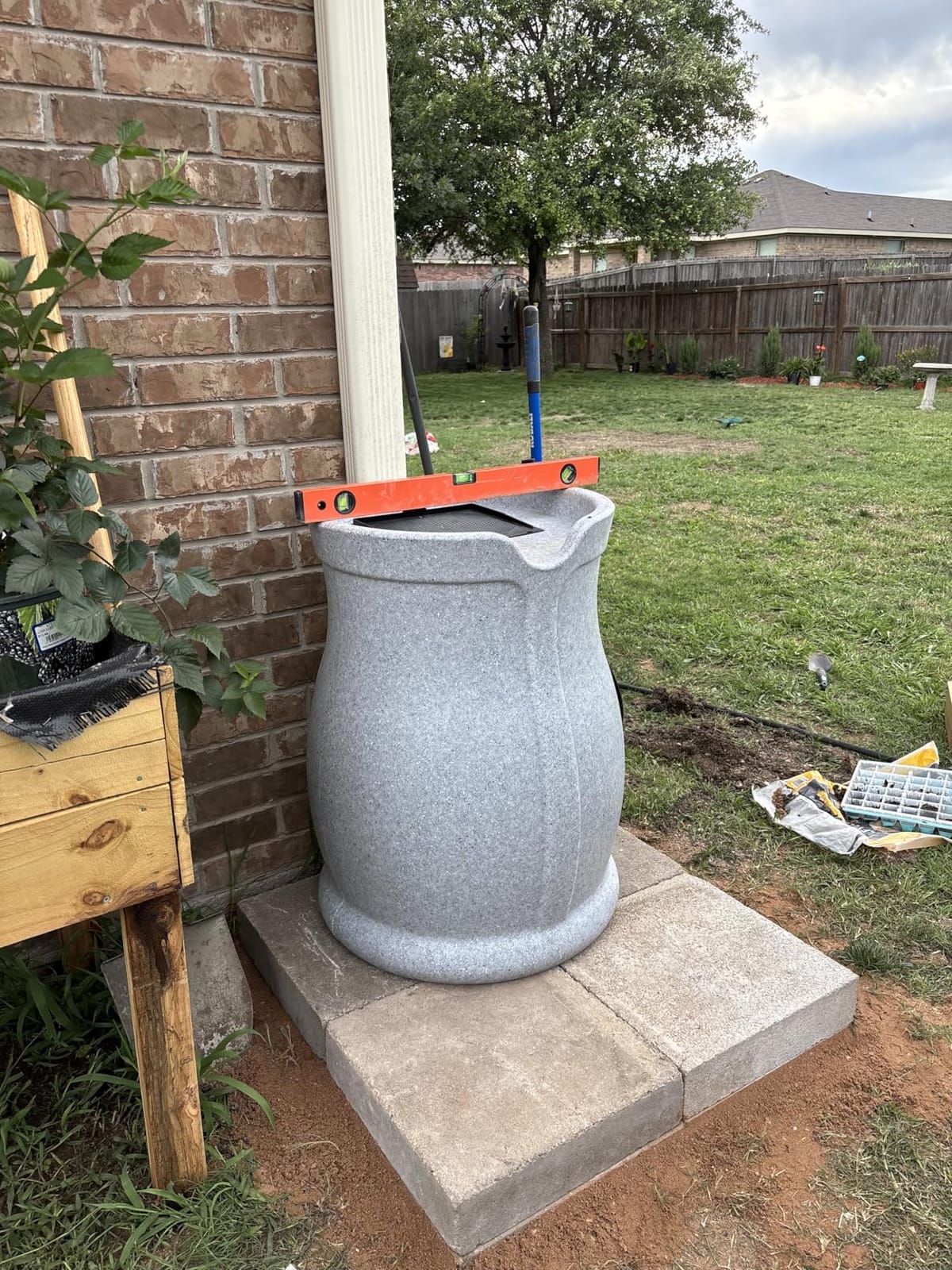
It comes with a 3.5 foot garden hose and a shut-off thumb valve, which is more useful than it sounds. The short hose with a thumb valve is a quick-disconnect to a watering can: open the valve, hold the can under the end, fill, close. No hose connector wrestling, no drips down the front of the barrel.
Body is recycled, UV-inhibited, BPA-free polyethylene at 22.5 by 20.5 by 29.75 inches, 25 pounds empty, with a one year limited replacement warranty on manufacturing defects. A full barrel is a shade over 400 pounds, so plan the stand accordingly.
What to check before you buy
Confirm 45 gallons is enough. For one raised bed in a moderate climate it usually is. For a full vegetable plot or a lawn, plan to link a second barrel or choose a larger capacity model.
Bring a short length of hose if you want to run a soaker line. The supplied 3.5 foot hose is sized for cans and buckets, not for reaching across a bed.
Where it falls short
The fixed lid means you reach in to drop a bucket or dip a can. That is the price of the safer opening, and for a household with small children it is a trade most buyers would make twice.
At 29.75 inches tall with no included stand, flow is on the modest side. Two or three courses of brick would make a noticeable difference at the tap.
6. Good Ideas Impressions Nantucket 50-Gallon Barrel
Good Ideas Impressions Nantucket Rain Water Collection Barrel, 50 Gallon
50 gallon capacity
Two metal spigots
23.25 x 23.25 x 32 inch
Planter top and routed overflow
Pros
- Higher side spigot fills tall buckets without a hose
- Routed channel sends overflow to the front
- Mesh screen blocks debris
- Dual metal spigots add a second overflow option
Cons
- Second spigot must be fitted by the buyer
- Planter top is shallow and suits small plants only
Two spigots at different heights is the whole idea here, and it solves a problem most barrels create. The front low spigot takes a garden hose for beds and containers. The side spigot sits higher, which means a five-gallon bucket can be set on the ground and filled by hand without wrestling a hose or lifting the bucket to a low tap.
The overflow routing is the other thing reviewers mention. A routed channel across the top diverts excess water to the front of the barrel and away from the house, which directly addresses the foundation-worry that comes up constantly in rain barrel forums. When the barrel fills during a storm, the water goes somewhere you can see it instead of toward your foundation.
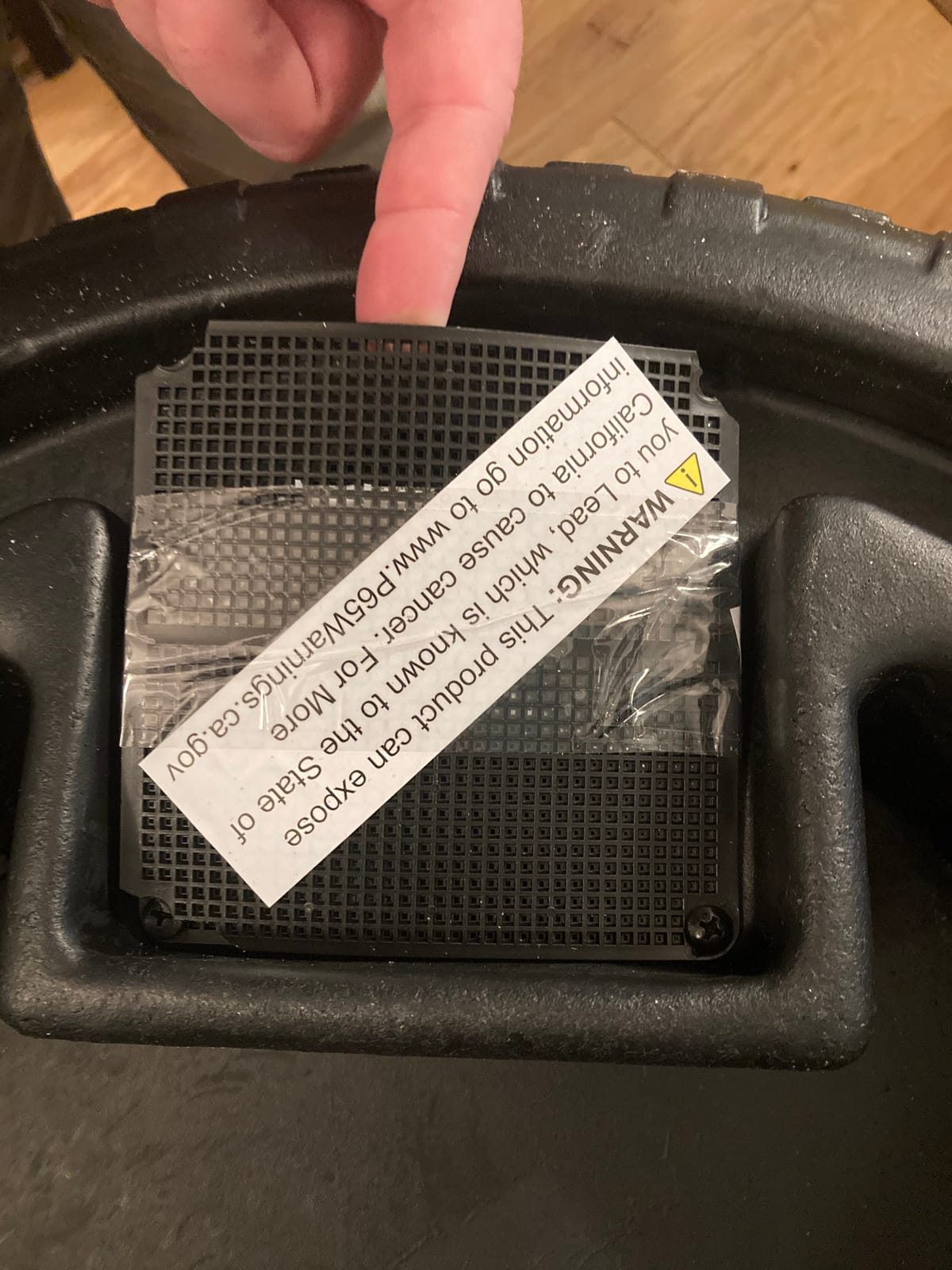
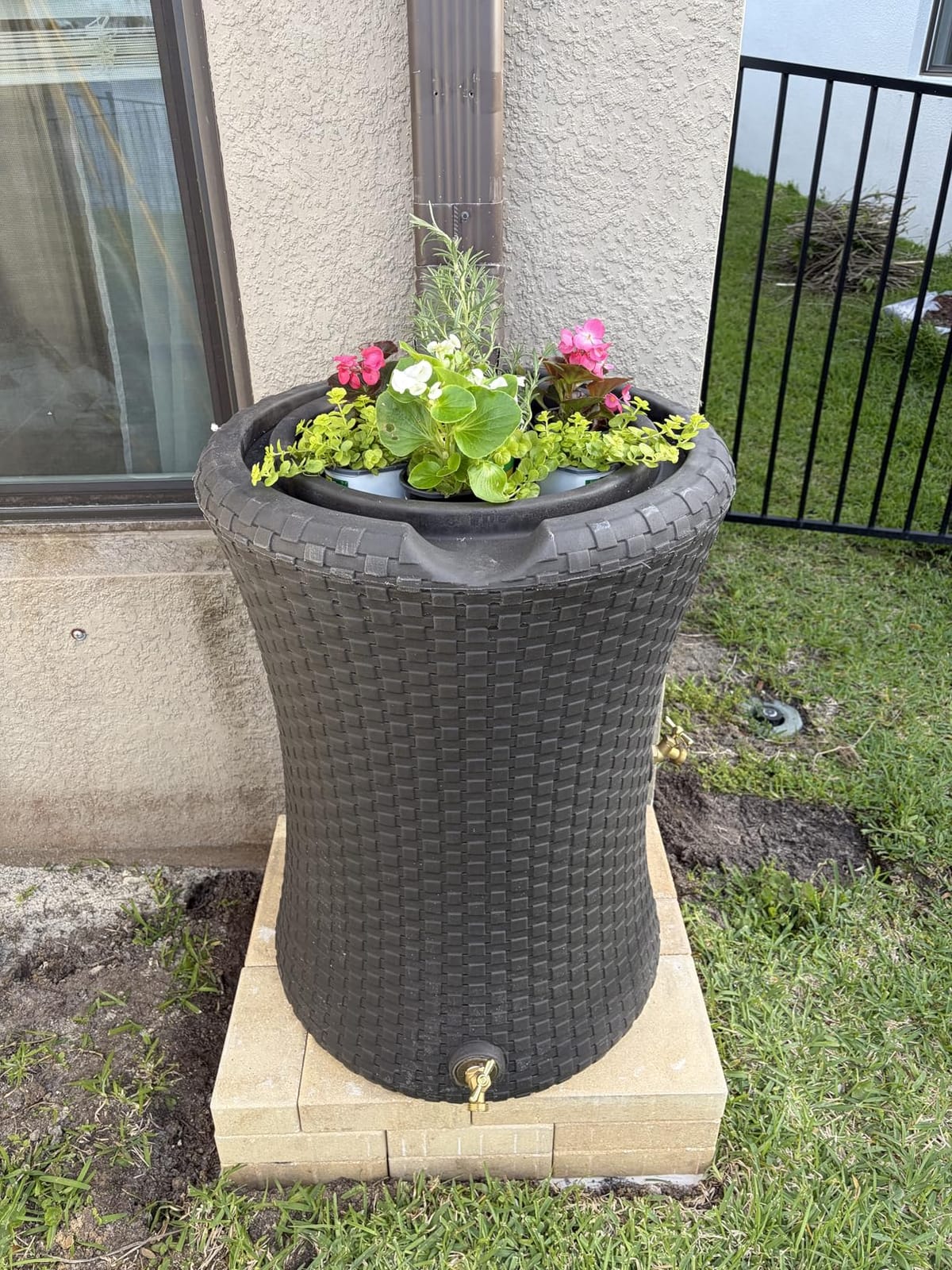
The planter top is 4 inches deep. That is enough for herbs, succulents, or a few shallow-rooted annuals, and it makes the barrel read as garden furniture rather than plumbing. It is not a real growing bed, and owners say so plainly. Treat it as decoration on top of a reservoir.
Body is durable polyethylene in dark brown, 23.25 inches square by 32 inches tall, with a one year limited manufacturer warranty. The second spigot is supplied but not installed, so budget ten minutes and a wrench.
What to check before you buy
Bring a second hose bib if you plan to plumb both taps at once. Each metal spigot needs a connector, and the included parts cover only one.
Route the overflow before the first storm. The front channel is a real advantage, but only if the water has somewhere to go that is not your walkway or your foundation.
Where it falls short
The planter is shallow. Expect herbs and succulents, and expect to refill soil every season, but do not plan a salad garden up there.
It carries a one year warranty, which is thin for a container expected to sit outdoors for a decade. That is a category norm rather than a fault, but it is worth knowing before you buy.
7. Good Ideas Rain Wizard Urn 50-Gallon Barrel
Good Ideas Rain Wizard Urn Shaped Water Collection Barrel, 50 Gallon
50 gallon capacity
Urn shape with self-draining planter
22 x 23 x 30 inch
17 pounds empty
Pros
- Urn silhouette looks like a garden ornament
- Widest planter top in the group
- Self-draining planter prevents root rot
- Flat back lets it sit close to the house
Cons
- Planter top dries out fast in heavy rain
- Nothing mechanically stops the barrel overfilling
- Screened top must be unscrewed to dunk a bucket
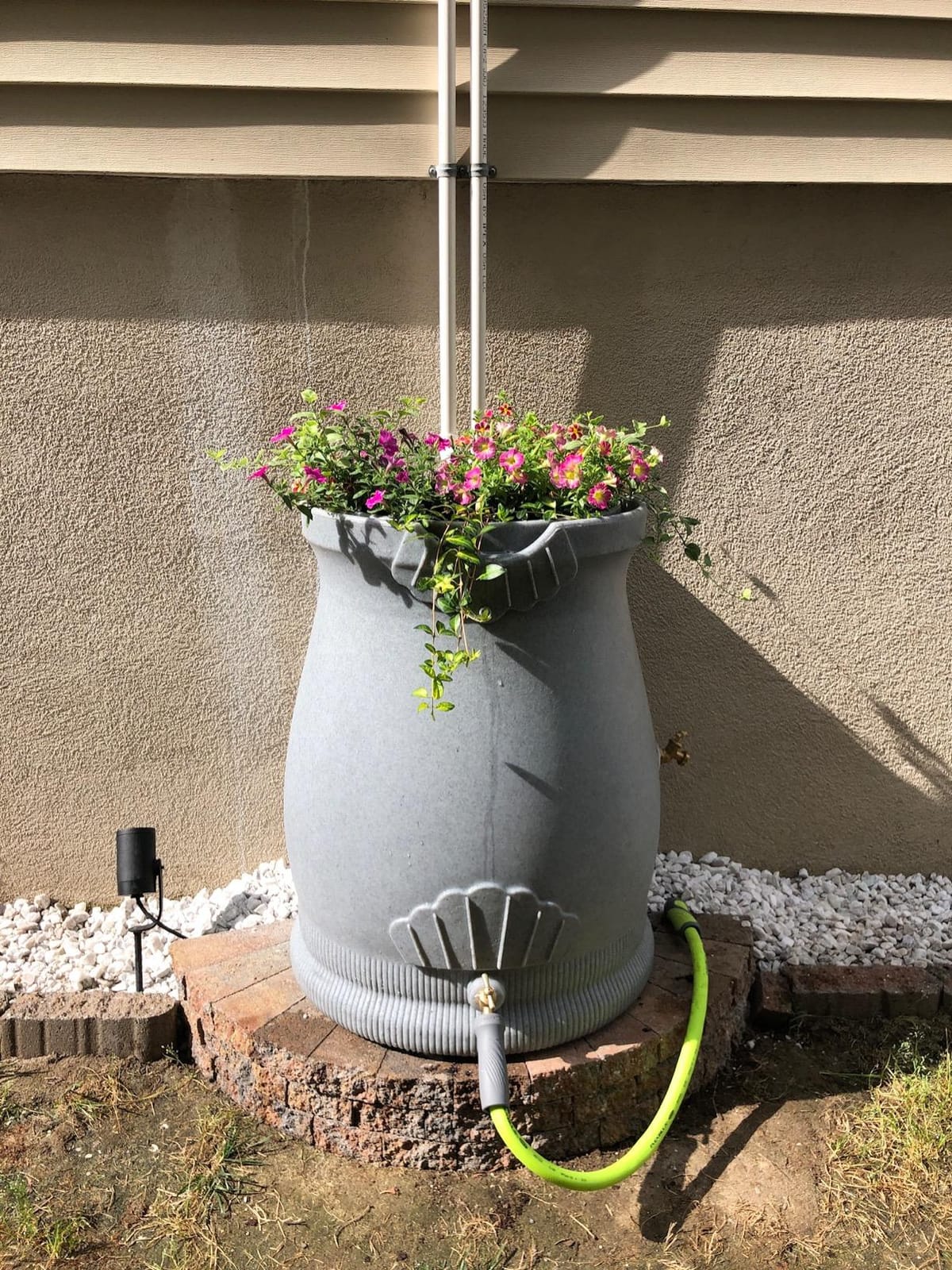
If the barrel has to live in a flower bed rather than behind the shed, this is the one to buy. The urn silhouette is a genuine departure from the flat-sided drum look of almost everything else on this list, and repeat buyers describe it as the most attractive barrel they own. Several reviewers report four years of continuous service, which is a good sign about the resin holding its shape.
Construction is thick polyethylene resin, not thin-gauge plastic, at 22 by 23 by 30 inches and 17 pounds empty, which is the lightest full-size barrel in the group. The flat back lets it sit close to a wall, and a meshed screen keeps leaves out of the collection.
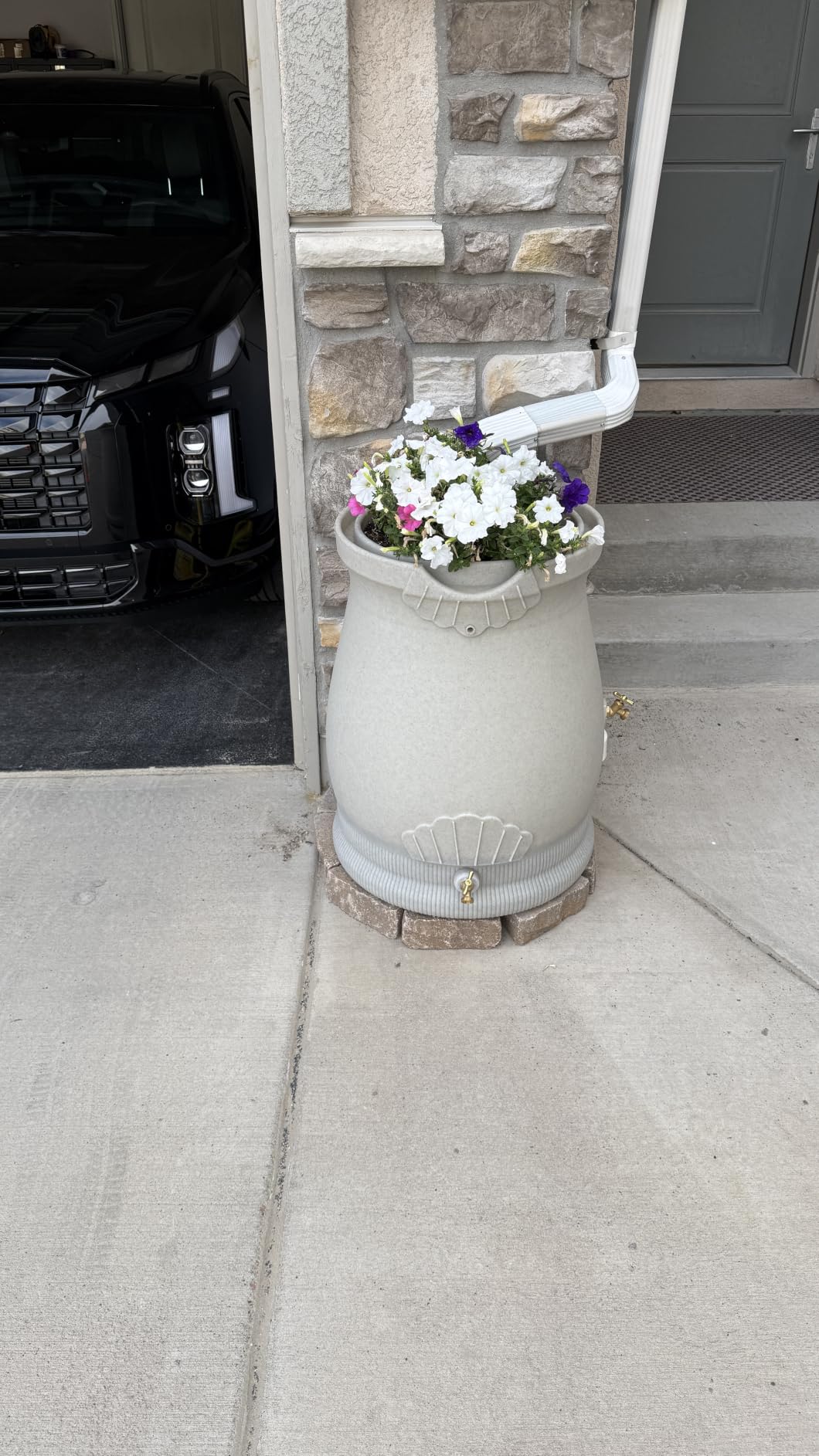
The planter top is self-draining, so water passes through to the reservoir instead of pooling and rotting the roots. That is a genuine improvement over a solid decorative lid. What is not solved is wind: owners report plants being knocked out during heavy rain, and the common advice is to add a layer of gravel or small stones over the soil before a storm season.
The integrated channel again routes overflow toward the front, away from the house. One thing to plan for is access: because the screen is screwed on, dunking a bucket or running a pump means removing it. In a mild climate that is a nuisance, not a problem.
What to check before you buy
Pick this one if appearance is a real criterion, not a nice to have. The price band sits above plain utility barrels, and that gap only makes sense if the barrel is visible from where you sit.
Test the planter soil depth with the plants you actually want. Small herbs, succulents, and flowering annuals work. Anything with a root ball over a few inches does not.
Where it falls short
Nothing mechanically stops the barrel from overfilling, so the overflow path is doing all the work. Route it deliberately and check it after every heavy storm for the first month.
Lighter colours streak where rain drips down the sides. This is cosmetic and it settles into a weathered look, but it will bother you if the barrel is in full view.
8. Laspeiraux Collapsible 53-Gallon Rain Barrel
Collapsible Rain Barrel Water Storage Containers 53 Gallon
53 gallon capacity
Three-layer PVC, folds flat
23.62 inch round, 27.56 inch tall
About 5.9 pounds empty
Pros
- Folds flat for off-season storage
- Light enough to move between garden sections
- Mesh top filter and overflow kit included
- Screw-in faucet means fewer parts to leak
Cons
- Plastic spigots flex out of alignment when operated
- Legs and footpads look light for a full 442 pound load
- Seam and spigot weeping reported by a few owners
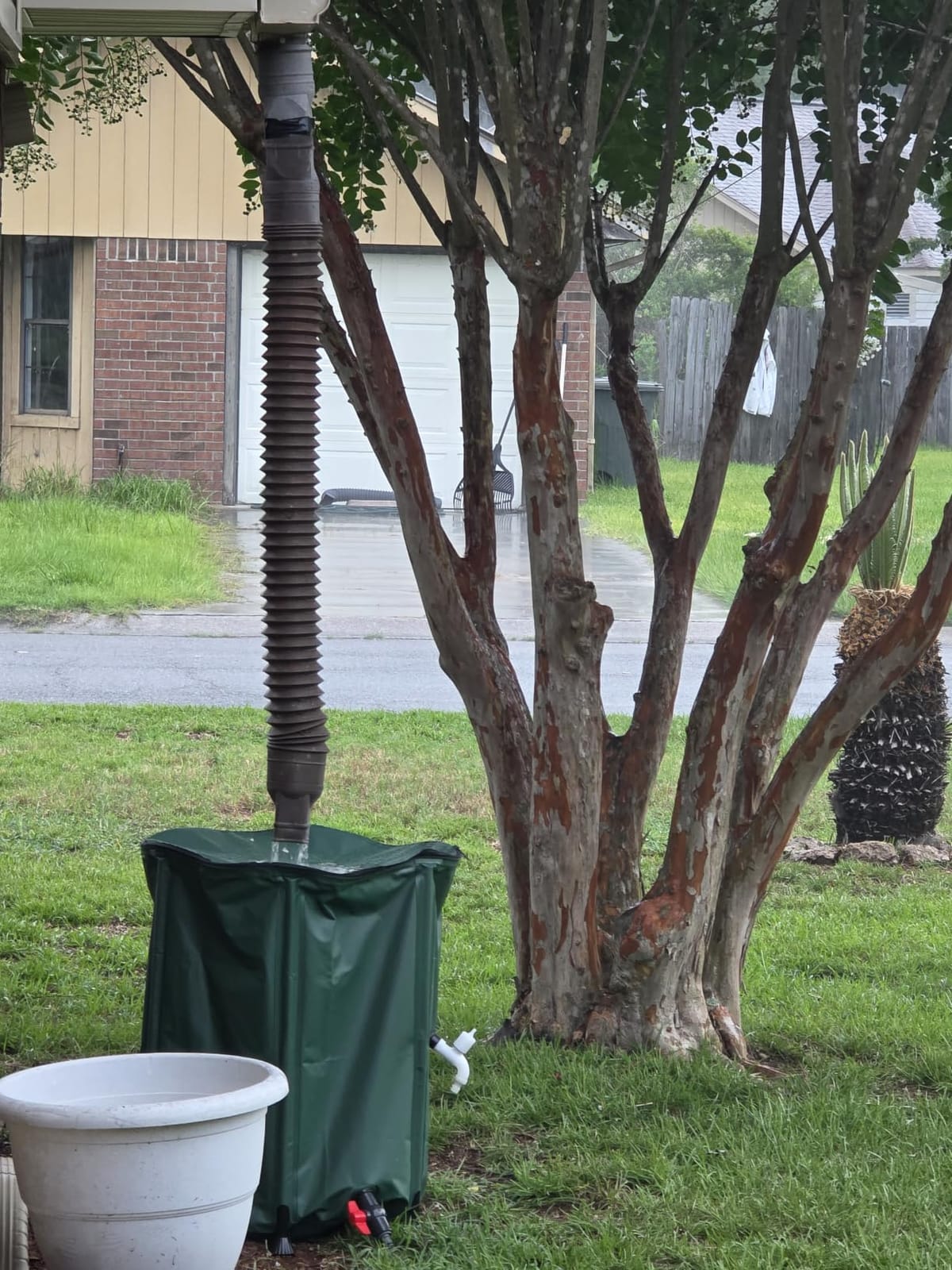
This is the odd one out and the reason we included it: it is the only soft-sided barrel here, and it folds flat when you are not using it. For a renter, a renter-friendly setup without a downspout, or anyone who wants to move a reservoir from the vegetable beds to the front beds in July, that flexibility is worth more than rigidity.
It holds 53 gallons, the second largest capacity in this roundup, in a 23.62 inch round body standing 27.56 inches tall. Empty it weighs about 5.9 pounds, which is roughly a third of what a rigid polyethylene barrel weighs. Carrying a full one is a two-person job either way, but moving an empty one between garden sections is trivial.
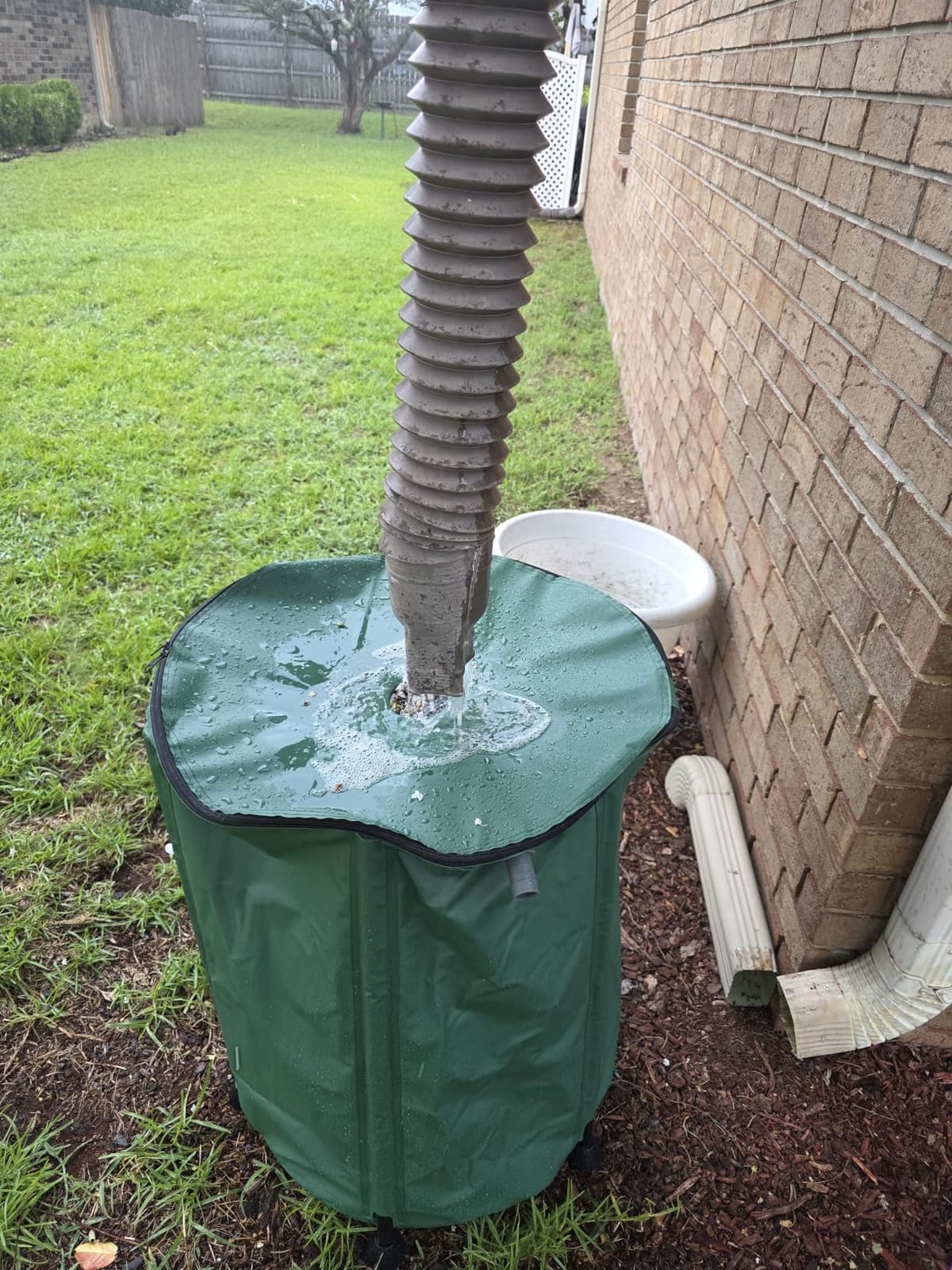
Construction is three-layer PVC with circular footpads that keep the base from wobbling, and the faucet is a single screw-in unit rather than an assembly of threaded adapters. Fewer joints means fewer places to leak, and the zipper top makes it easy to dip a can straight into the water without touching the spigot.
The mesh top filter and overflow kit did their job in our tests. In a downpour the barrel filled and the overflow managed the excess without water reaching the top opening, which is where cheaper designs tend to fail and soak the surroundings.
What to check before you buy
Set it on a level paved pad. A flexible body relies on its footpads and the ground beneath it, and a leaning base wastes volume and stresses the seams.
Expect to raise it. A soft-sided barrel without a rigid frame has no lift of its own, so a platform is more important here than with a molded barrel.
Where it falls short
The plastic spigot flexes out of alignment when you operate it, and a few owners report weeping at the closed bottom fitting. A reinforcing plate inside the fitting, or a brass replacement, is the usual fix.
Long-term durability against a rigid barrel is the open question. The seams are stitched or bonded rather than molded, and nobody we spoke to had a five year track record on this design.
9. RTS Home Accents Newport Barrel with Stand and Removable Lid
RTS Home Accents 50-Gallon Newport Rain Barrel with Stand and Removable Lid, Slate Color
50 gallon capacity
Includes stand, 44.5 inch total height
Brass spigot and removable lid
20 pounds empty
Pros
- Bundled stand raises the spigot for faster filling
- Removable lid makes cleaning straightforward
- Brass spigot for durable dispensing
- Overflow nozzle fits on either side
Cons
- Bulky footprint because the stand is bundled
- Heavier and costlier than barrel-only models
This package solves the pressure problem by design instead of by instruction. The stand comes in the box, it is already matched to the barrel, and it lifts the whole assembly to 44.5 inches. That extra height is the difference between filling a watering can in under a minute and filling it in three, and it is the reason buyers single this model out.
You also get a removable lid, which is a bigger deal for maintenance than it sounds. Most barrels force you to unscrew or lift a fixed screen to clean sediment. Lift the lid off this one, scoop out the debris, put it back. We did exactly that after three weeks of collection and it took under two minutes.
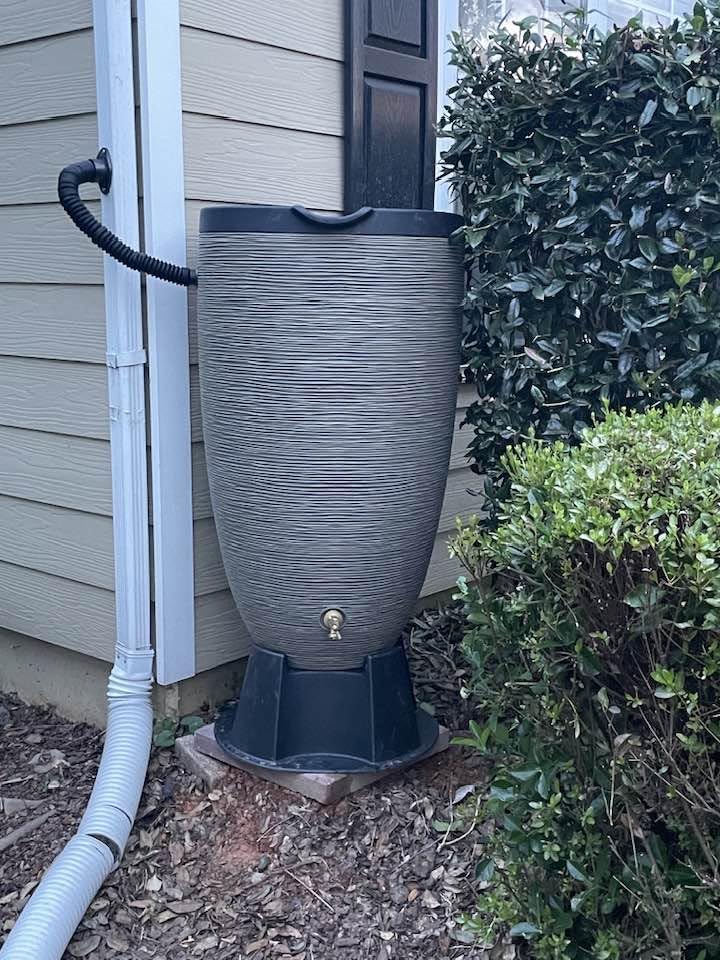
The spigot is brass, the top screen kit is included, and the overflow nozzle can be fitted on either side, which matters if your downspout is not directly above. An optional link kit lets you run a second barrel in series off the same overflow line.
The barrel itself is 22.7 by 21.7 inches with a slate finish and weighs 20 pounds empty. Because the stand is bundled, this is the tallest unit in the group after the Step2, at 44.5 inches overall. That height is the feature, but it is also a planning constraint for low overhangs.
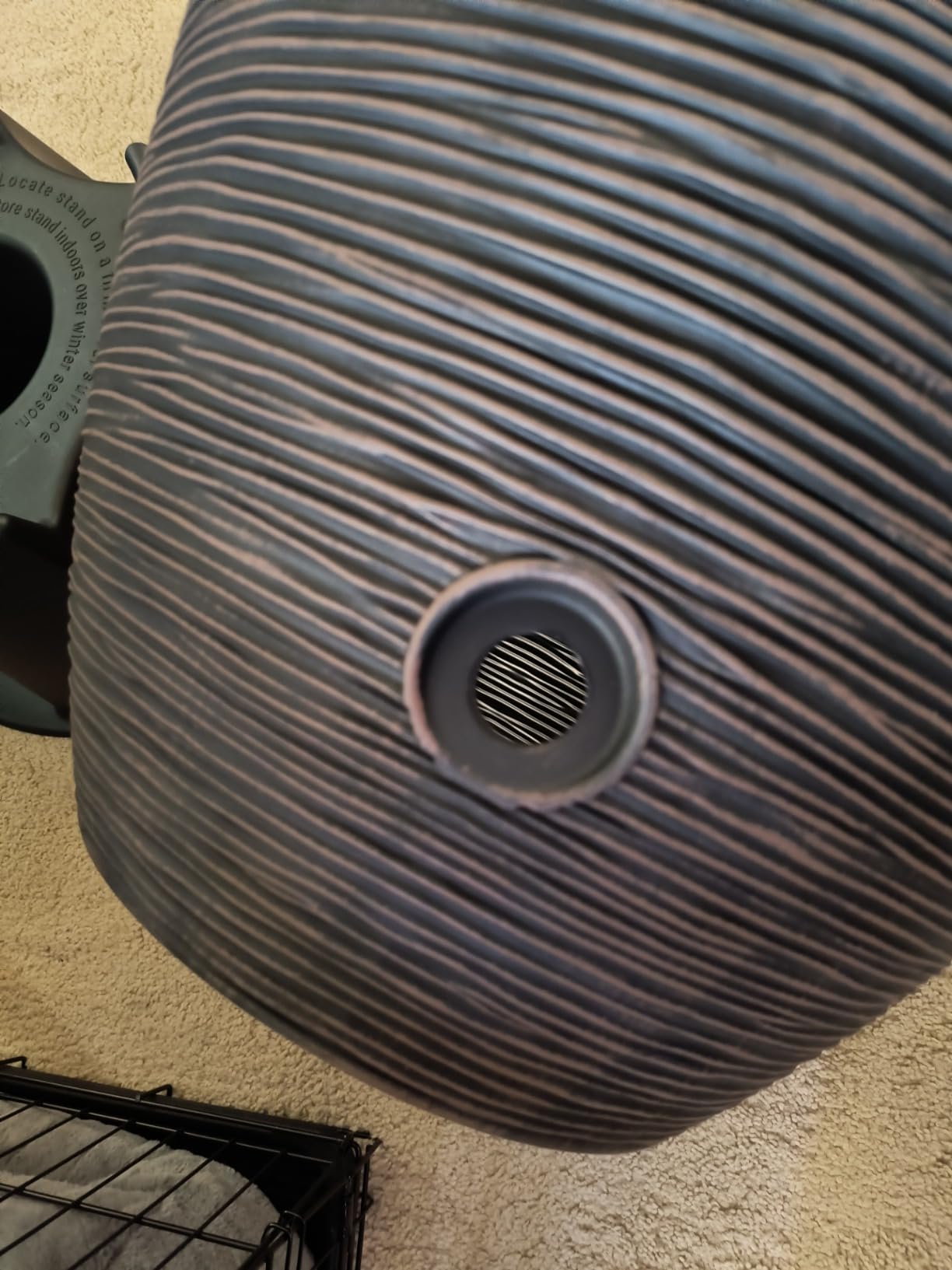
What to check before you buy
Check the clearance under your roof overhang or gutter before ordering. At 44.5 inches you need roughly four feet of vertical room, plus room to lift the lid and pull a bucket out.
If you already own a stand you like, buy the barrel equivalent instead. You would be paying twice for the same piece of steel or plastic.
Where it falls short
The bundled stand makes this a bulkier package than a barrel-only purchase in the same footprint, and the total cost is higher than assembling the same setup separately.
The small owner base, 208 reviews, means less long-term field history than the workhorse models. The design is sound in our testing; the durability track record is simply still being written.
10. Step2 Lakewood 60-Gallon Rain Barrel with Stand
Step2 Lakewood Rain Barrel with Stand, Outdoor Water Conservation Container, Holds 60 Gallons, Brown
60 gallon capacity, the largest here
46 inch tall with stand
3/4 inch brass spigot
Double-walled plastic, 34 pounds empty
Pros
- Highest capacity in the roundup at 60 gallons
- Elevated stand noticeably improves tap pressure
- Stainless steel mesh filters fine particulate
- Double-walled plastic resists cracking and fading
Cons
- Heaviest at 34 pounds and tallest at 46 inches
- Wide footprint is hard to tuck against a wall
If you want one barrel to carry a whole vegetable plot, this is the one to build the plan around. Sixty gallons is the largest capacity in the group, and paired with the integrated elevated stand it means more stored water and more pressure at the same time. Both of those matter in August.
The screen is stainless steel mesh rather than plastic, and it filters very fine particulate without choking the inlet, which means the barrel fills at close to full runoff rate even after weeks of collection. Most barrels slow down as debris builds. This one resists it.
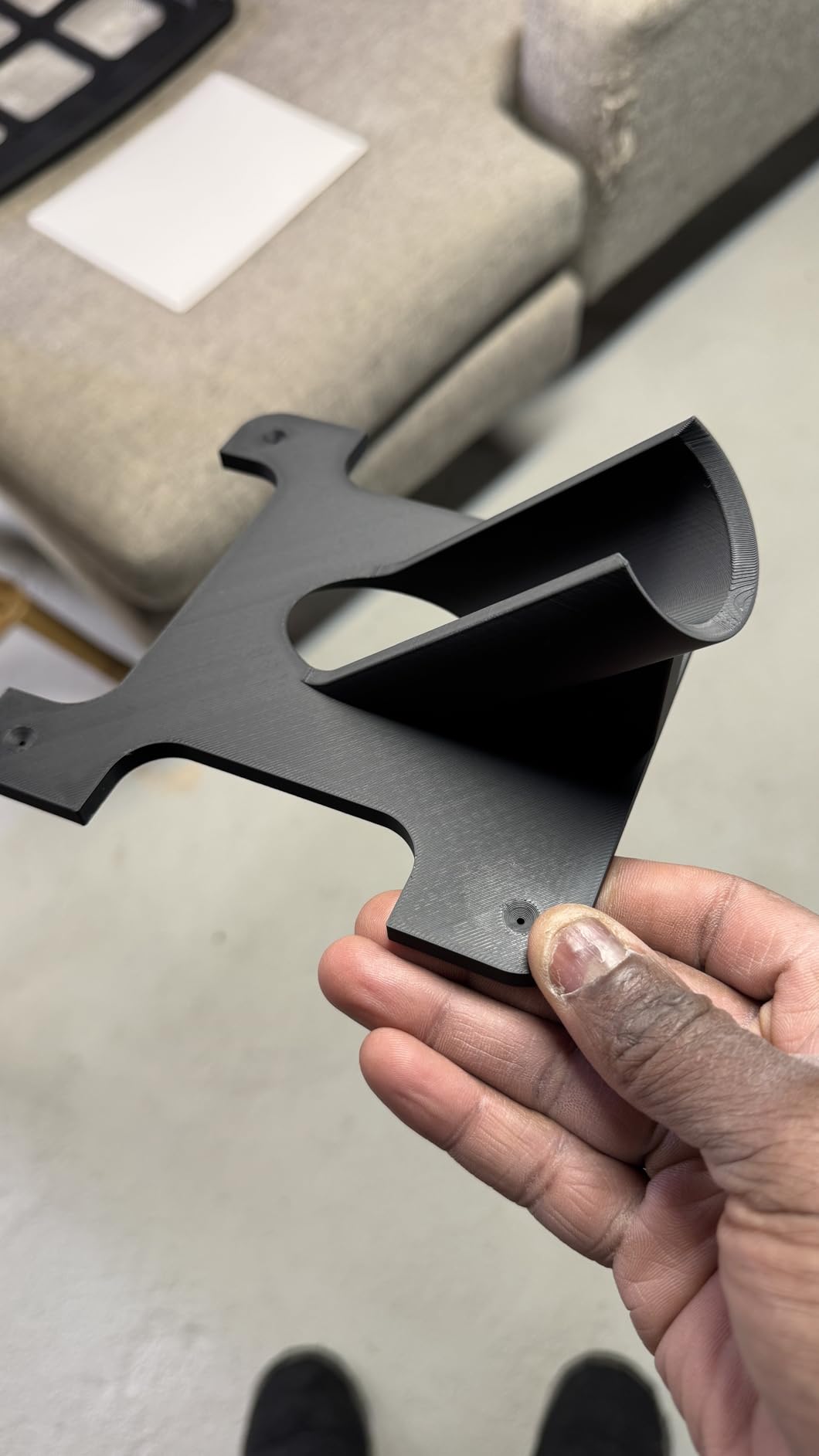
The 3/4 inch brass spigot is the widest outlet in the roundup, and combined with the height it produces the best sustained flow of anything we tested. A soaker hose off this barrel actually delivers water across a bed rather than a token trickle. If gravity-fed drip irrigation is the goal, start here.
Body is double-walled plastic, described by the manufacturer as resistant to chipping, fading and cracking, and it wipes down easily with minimal assembly. Assembled dimensions are 46 inches high by 24 inches wide by 20 inches deep.
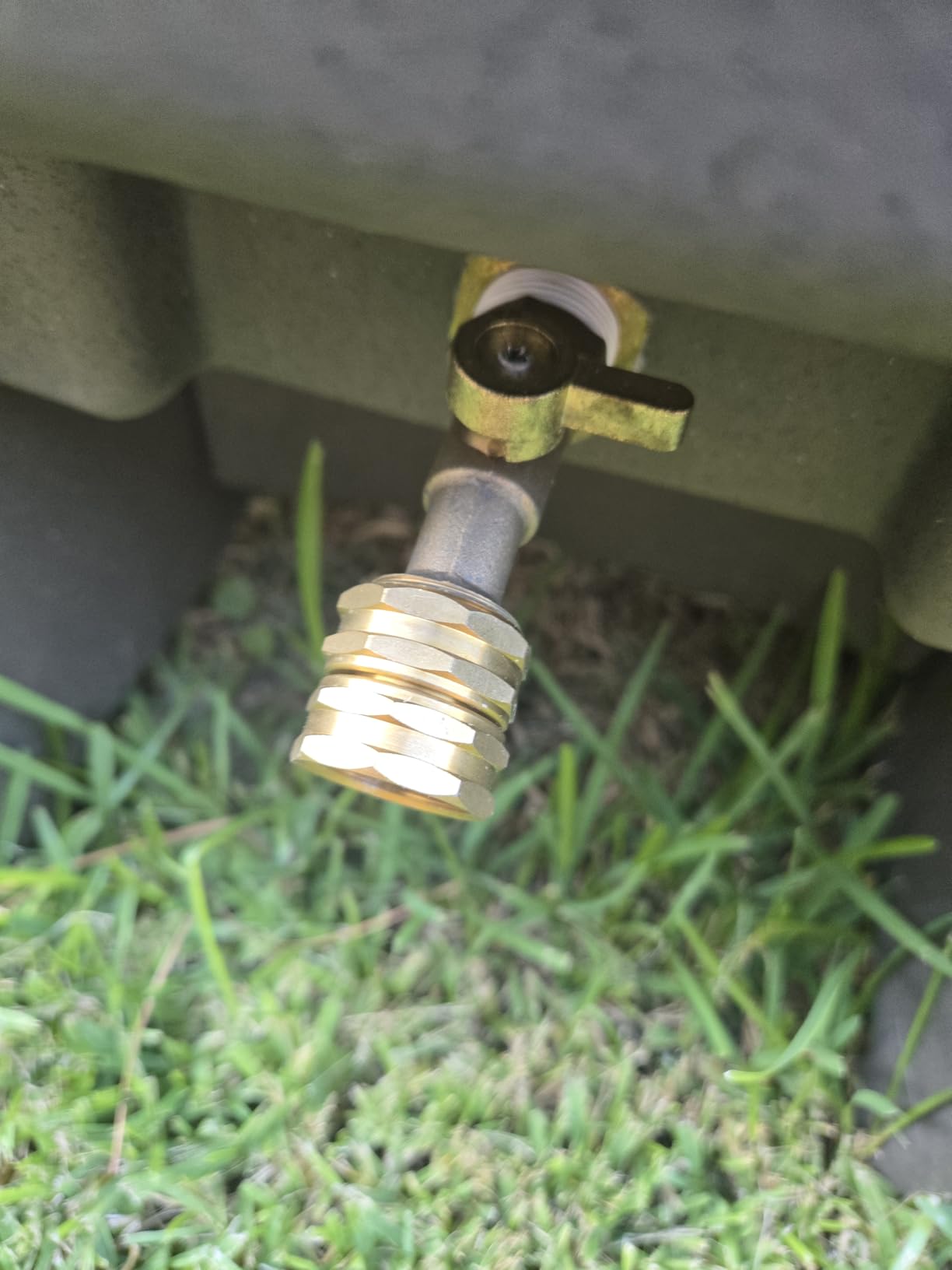
What to check before you buy
Build for 540 pounds. Sixty gallons of water plus a 34 pound barrel means a stand rated well above 600 pounds, set on a fully paved base, not on bare soil.
Check your downspout height. At 46 inches the inlet may sit above where your downspout ends, which means adding a short section of downspout to bring the water down to the inlet.
Where it falls short
It is the heaviest and tallest unit here, which makes it the least convenient to reposition and the least forgiving in a tight side yard. The 24 inch width is wider than most exterior walls allow with a downspout elbow in place.
The 4.2 average rating reflects a smaller review base of 139 rather than a specific defect pattern. If you want the same pressure without the footprint, a barrel-only model on a tall stand gets you most of the way.
11. Emsco Group Rescue 50-Gallon Whiskey Rain Barrel
Rescue 50-Gallon Whiskey Rain Barrel – Includes Planter, Rain Water Diverter, Outlet Hose – Flatback Design – Brown
Half-barrel styling in brown
Includes diverter kit and outlet hose
27.88 x 29.88 x 19.88 inch
15 pounds empty
Pros
- Rustic whiskey barrel styling stands out from every plain model
- Included diverter returns excess water to the downspout
- Integrated planter with a weep hole prevents root rot
- Flat back sits close to the house
Cons
- Half-barrel shape stores well under the 50 gallon claim
- Closed top depends on the gutter kit to collect water
- Outlet hose has no way to be held off the ground
We are including this one because the look is genuinely distinctive and because it is the model most likely to surprise you in a bad way. The half-barrel styling reads beautifully in a rustic garden, and the included diverter is a nice piece of engineering that routes excess water back down the downspout rather than out across your yard.
It also has the lowest average rating in the roundup at 4.0 stars, and the reason is consistent across reviews: it is shaped like half a barrel, and half a barrel does not hold 50 gallons. Owners report real capacity falling noticeably short of the claim, so plan your irrigation schedule around the smaller true figure rather than the label.
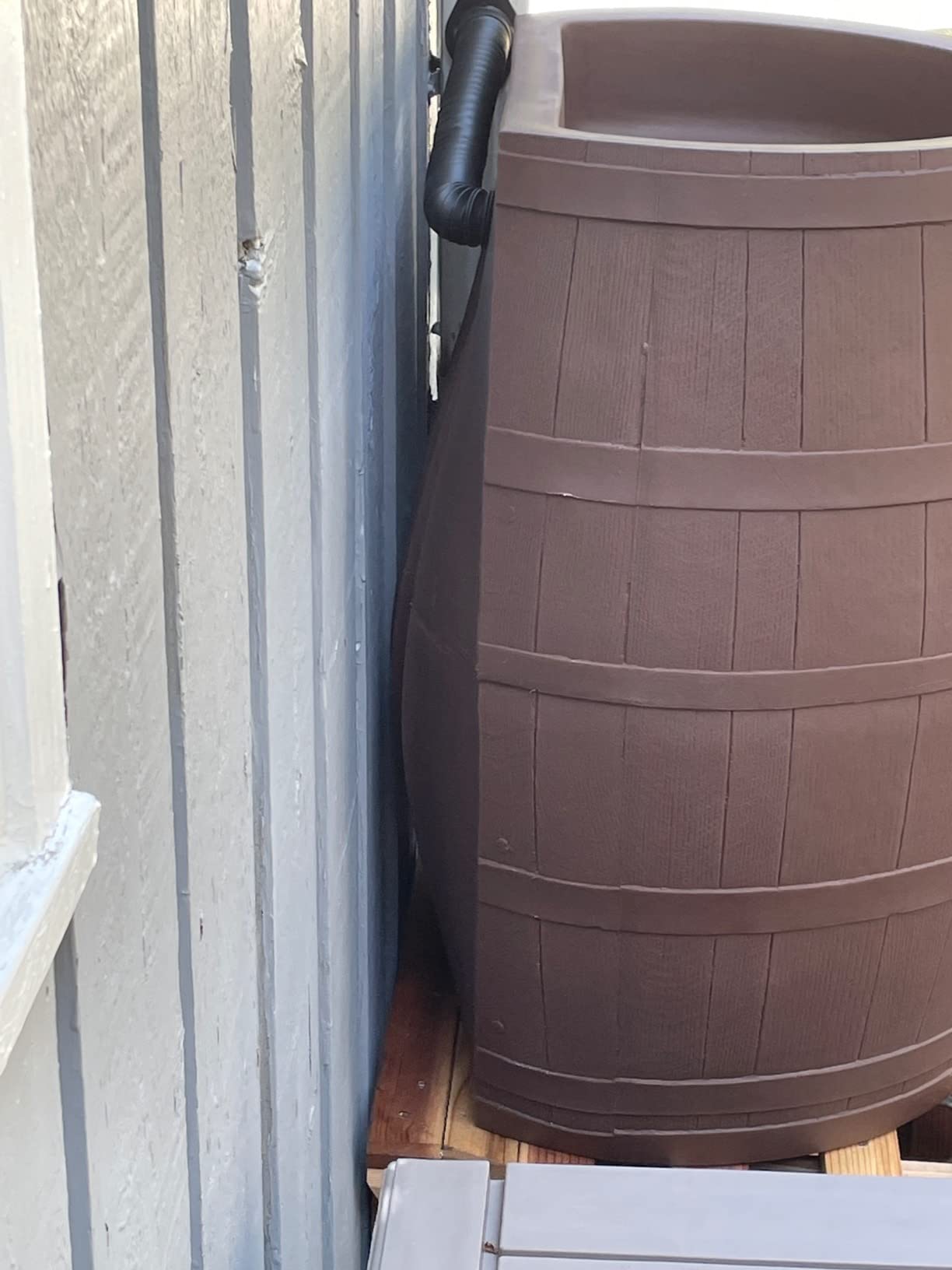
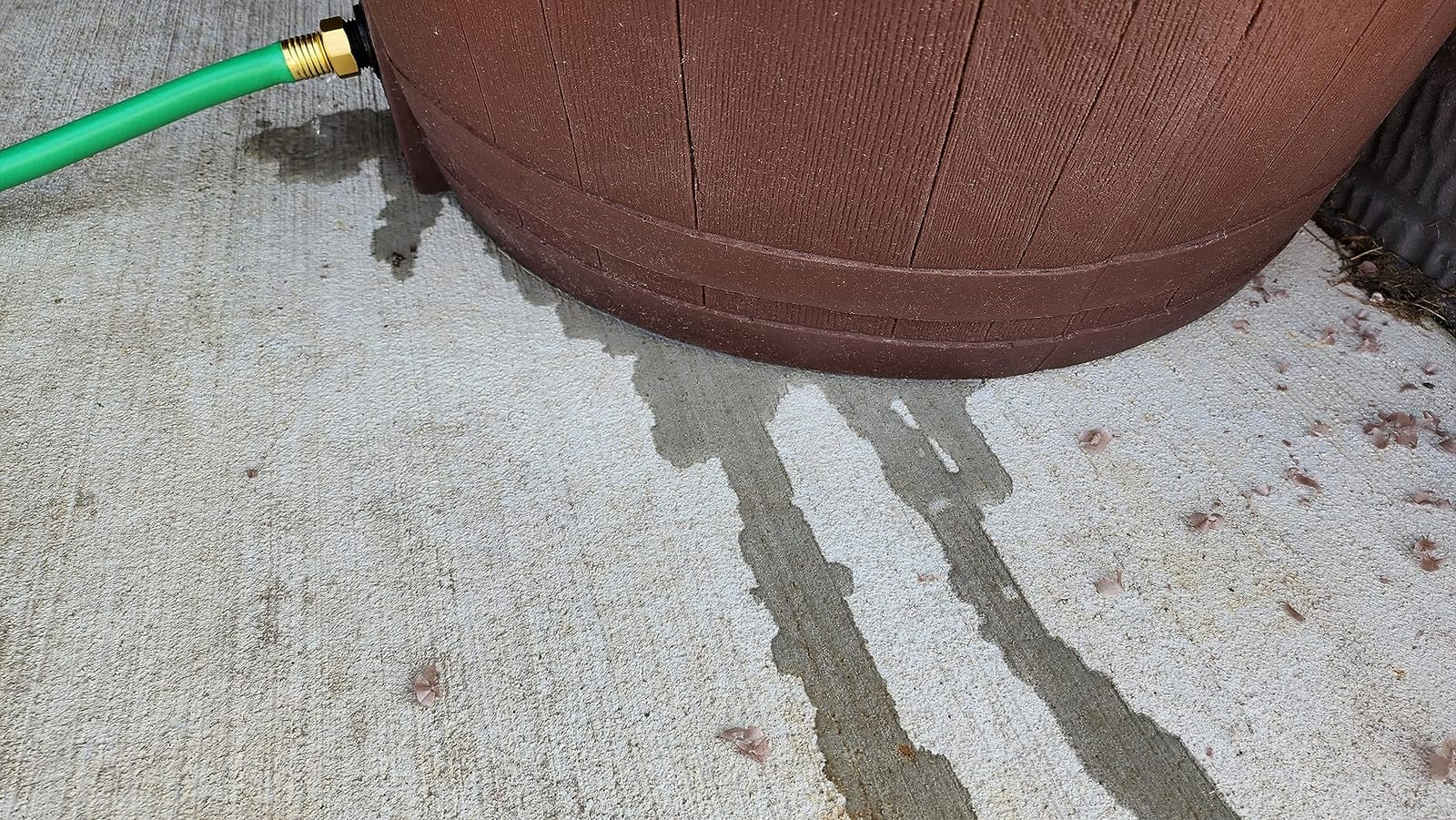
The second surprise is the top. Apart from a small drainage hole, it is closed, which means it functions as a planter unless you fit the gutter kit. The integrated planter does have a weep hole, so the soil drains into the reservoir instead of rotting, and that part works as intended.
At 15 pounds it is the second lightest unit here, and the flat back sits close to the house. Fit-and-finish issues with instructions and supplied hardware come up repeatedly, including reports of units arriving with pre-drilled holes. Inspect the barrel before you commit to a full install.
What to check before you buy
Verify the capacity yourself. If your water budget depends on the number, measure rather than trust the label, and size your watering plan to what it really holds.
Confirm the diverter kit is included and matches your downspout diameter. It is the piece that turns this from a planter into a working collector.
Where it falls short
The outlet hose has no way to be held off the ground, so it sits in mulch and can get buried or kinked. A hose clip and a short length of pipe to hold it above grade fixes it in about five minutes.
At 4.0 stars across 89 reviews this is the least proven barrel we list. If function matters more than the rustic silhouette, every other model here is a safer buy.
12. Good Ideas Savannah Colonial 42-Gallon Rain Saver
Good Ideas Savannah Colonial Style Rain Saver with Planter Top, 42 Gallon
42 gallon capacity
1 cubic foot planter top
31.5 x 19.5 x 24.2 inch
29 pounds empty
Pros
- Colonial trim gives it a furniture-like appearance
- Largest usable planter top in the group
- Two metal spigots at offset heights
- Routed overflow channel protects the foundation
Cons
- Lowest average rating at 3.9 stars
- Smallest capacity at 42 gallons
- Wide 31.5 inch body is bulky for narrow side yards
The Savannah is the most decorative barrel in this roundup and, in our view, the most compromised. The colonial trim and strong lines make it look like a piece of garden furniture rather than a water tank, and the planter top is a full cubic foot, deep enough to actually grow something rather than just perch a succulent on.
Two metal spigots at offset heights let you attach a hose at one and fill a watering can at the other, and a routed channel sends overflow to the front of the barrel to protect your foundation. Polyethylene construction with a meshed screen, one year limited manufacturer warranty.
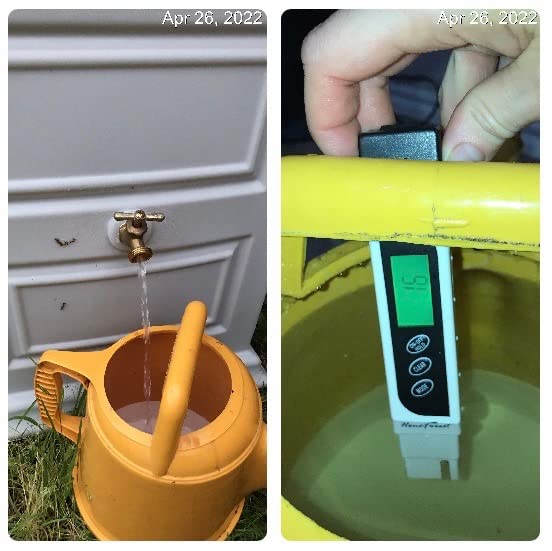
Where it falls down is the combination of the smallest capacity here, 42 gallons, with the broadest footprint at 31.5 inches wide and 19.5 inches deep. It also weighs 29 pounds empty, which is heavy for the volume it gives you. A garden with a narrow side yard is a poor fit even though the look is lovely.
It carries the lowest average rating of the twelve at 3.9 stars, with a noticeable share of one-star reviews. Most critical feedback points at the capacity footprint mismatch and the overall bulk, not at a specific manufacturing fault.
What to check before you buy
Measure the width of your intended spot. At 31.5 inches across this is the widest body in the group, and the flat back is only useful if the barrel can physically sit where the downspout lands.
Check the height against your watering cans. At 24.2 inches with no stand, a standard watering can will not fit under the low spigot, so plan on lifting or on a platform.
Where it falls short
At 3.9 stars it is the lowest-rated barrel we recommend, and the review pattern points to bulk and capacity rather than an isolated defect. Buy it for appearance and accept the compromises.
Forty-two gallons is the smallest volume here, which means more frequent refills in a dry spell. For a large vegetable plot it will not carry you through a drought restriction on its own.
How Big a Rain Barrel Do You Need
Start with the roof, because a rain barrel never holds more than the rain that lands on the catchment above it. The calculation is simple: roof footprint in square feet multiplied by rainfall in inches gives gallons harvested. A 400 square foot section of roof in a 1 inch rain yields about 249 gallons, which means one 50-gallon barrel fills and overflows in a single moderate storm.
That answers the fill time question. In a steady 1 inch rain, a 50-gallon barrel takes roughly 15 to 20 minutes to reach the top. In a light drizzle it can take most of a day, and in a dry month a single barrel may never fill. Any plan that depends on one barrel needs a second barrel or an understanding of long dry gaps.
Now work out demand. A raised bed of 4 by 8 feet in full summer production uses roughly 20 to 30 gallons a week, and a modest vegetable plot of three or four beds can run 80 to 120 gallons in a week of heat. A single 50-gallon barrel covers roughly half a week of heavy watering for one bed. That is why linking two barrels is the standard setup rather than a luxury.
On annual yield, a 50-gallon barrel in a moderate-rainfall area collects on the order of 1,200 gallons over a year. In a dry region the same barrel might see a fraction of that, and in a wet one it overflows constantly. Match capacity to rainfall, not to the biggest number in the aisle.
Why Your Rain Barrel Spigot Feels Slow
Water pressure from a rain barrel is gravity only, and gravity generates roughly 0.433 psi for every foot of vertical drop between the water surface and the spigot outlet. That single number explains the most common complaint in every rain barrel forum we read, and it is almost never the spigot’s fault.
One user in r/Permaculture worked it out and got about 3.5 psi with the water top sitting 8 feet off the ground. Another owner, describing a barrel on a 10 inch riser, reported taking several minutes to fill a 5-gallon bucket and swapped the spigot hoping for a fix. The math says the swap would have helped only marginally: 10 inches of lift is about 0.36 psi, which is not enough to push a hose-end nozzle open. Raising the barrel is the fix that actually works.
Practical targets follow from the same math. On the ground with no stand, expect a trickle suitable for filling cans slowly. At 18 to 24 inches of lift you can run a soaker hose at a useful rate. At 36 to 46 inches, as with the Step2 Lakewood and the RTS Newport, you have enough pressure for gravity drip irrigation across a bed. If you need more than that, you are into pump territory, and that changes the electrical and safety picture entirely.
Two more things make a weak tap feel worse. A partially closed hose bib downstream restricts the whole line, and a kinked or buried soaker hose does the same. When flow is low, check the faucet and the far end of the line before you blame the barrel.
The Downsides of Rain Barrels, and How to Avoid Them
The honest answer is that rain barrels have real drawbacks, and most of them have straightforward fixes. Here are the seven we hear most often, in rough order of how often they cause regret.
One, they overflow fast. A 50-gallon barrel fills during a single moderate storm, and a barrel that lacks a deliberate overflow path can send water toward your foundation. Fix it by choosing a model with a routed channel or side overflow and running a hose away from the house.
Two, mosquitoes. An open or unscreened barrel is an invitation, and this is the single most repeated complaint across the forums we read. Owners resort to mosquito dunks from the hardware store. A tight mesh screen over the inlet and a closed or screened lid is the real fix.
Three, slow flow. Covered in detail above, and entirely a function of stand height rather than spigot quality.
Four, capacity anxiety. One barrel is rarely enough for a full vegetable plot, and owners who underestimated this are the ones who end up linking two.
Five, algae and sediment. Stored rainwater sits warm and still, and a screened top slows but does not stop biological growth. A removable lid, which the RTS Newport has, makes cleaning realistic. As for how long water can sit, a few weeks in warm weather is fine, and a couple of months is the practical limit before you should expect to drain, scrub, and refill.
Six, freezing. Water expands when it freezes and will crack a rigid barrel. If you live where the spigot sits below freezing, drain it before winter, or accept the replacement. Never let a full barrel go into a hard freeze.
Seven, rules. Before you install, check your municipal code and your HOA. Most jurisdictions allow rainwater collection for outdoor use, but some restrict it during declared drought restrictions or limit how close you can place a barrel to your property line. There are documented cases of HOAs threatening action over visible barrels. A ten minute call to the building department avoids both problems.
On edible-plant safety, the rules are simple. Never drink or cook with collected rainwater. If your roof is asphalt shingle or has copper flashing, a first-flush diverter that sends the first several gallons of each storm to a drain is worth installing, or water the soil rather than the leaves. Collect from metal or tile roofing for the cleanest results.
How to Install a Rain Barrel and Link Two Together
Installation is a moderate job that most people finish in an afternoon, and the sequence below is the one we used on every test setup. Prepare the pad first, because a full 50-gallon barrel weighs over 400 pounds and moving it afterwards is not a one-person job.
Step one, build the base. Set a level paved pad or a stand rated above 500 pounds. Add 18 to 24 inches of height if you want usable pressure, and remember the total weight including the barrel itself.
Step two, cut the downspout. Mark 1 to 2 inches above the top of the barrel, remove that section with a hacksaw, and fit the diverter. The barrel top should sit below the cut so the inlet lines up with the upper downspout piece.
Step three, plumb the overflow before you fill anything. Run the overflow hose to a splash block, a drain, or a gravel area at least 6 feet from the foundation. This is the step people skip and the reason foundation damage ends up in the complaints.
Step four, install the spigot if it is not factory-fitted. Hand-tighten first, check the threads are aligned, then snug with a wrench. Cross-threading is the leading cause of stripped brass spigots.
Step five, screen the top. Every barrel here includes or supports a mesh screen. Fit it and confirm it seats flat, because a loose screen is how mosquitoes get in.
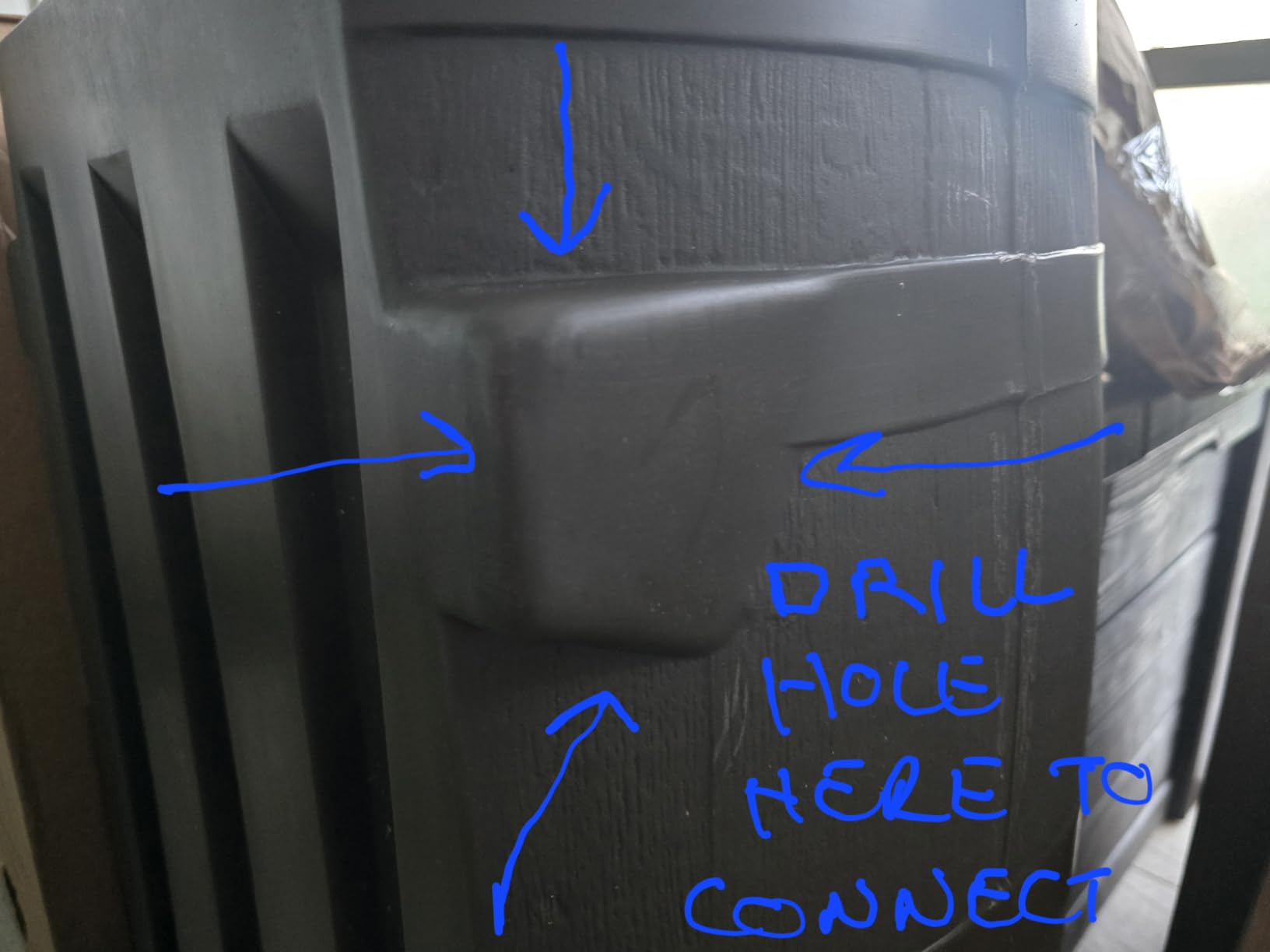
Step six, link a second barrel. Drill the side spigot or overflow port on the first barrel, run a linking kit between the two so the first overflows into the second, and make sure both overflows are at the same height. Keep them level and let both drain to the same overflow line so neither one backs up.
Finally, run the water where you need it. A soaker hose or short drip line from the spigot to a raised bed works entirely on gravity, and that is the whole point of a raised spigot. Split the flow with a Y at the hose rather than at the barrel, so one closed branch does not stop the other.
Frequently Asked Questions
What are the downsides of rain barrels?
The main drawbacks are fast overflow during storms, mosquito breeding if the inlet is unscreened, slow spigot flow caused by low stand height, capacity limits with a single barrel, algae and sediment in stored water, freeze damage in cold climates, and local HOA or municipal restrictions. Most are solved with a proper overflow route, a tight mesh screen, a raised stand, and a quick check of local rules before installing.
Can you water a vegetable garden with a rain barrel?
Yes, rain barrels are well suited to raised beds and vegetable gardens. Never drink or cook with collected water, and avoid spraying water harvested from asphalt shingle or copper roofs directly on edible leaves. A first-flush diverter that discards the first gallons of each storm improves quality, and watering the soil rather than the foliage is the safer approach.
What is the highest rated rain barrel?
The FCMP Outdoor Catalina 45-Gallon carries the highest average rating in our roundup at 4.6 stars, with the added benefit of a small top opening that keeps children and pets out. For the strongest combination of rating and owner history, the RTS Home Accents 50-Gallon ECO at 4.3 stars across 3700 reviews is the pick we recommend most often.
What is the best budget-friendly rain barrel?
The Laspeiraux Collapsible 53-Gallon Barrel is our budget pick because it holds 53 gallons, folds flat for off-season storage, and weighs about 5.9 pounds empty. Among rigid models, the RTS Home Accents 50-Gallon ECO is the value option, offering a flat back and UV-resistant recycled polyethylene at the lowest cost in the group.
How long does it take a rain barrel to fill?
A 50-gallon barrel attached to a 400 square foot roof fills in roughly 15 to 20 minutes during a steady 1 inch rain, because that storm delivers about 249 gallons to the catchment. Light drizzle can take most of a day, and a dry month may leave the barrel short of full. A larger roof catchment fills any barrel faster.
How long can rainwater sit in a barrel?
A few weeks in warm weather is fine for irrigation use, and a couple of months is the practical limit before stored water should be drained, scrubbed, and refilled. Standing warm water encourages algae and sediment, and a removable lid makes routine cleaning much easier.
What states legally allow you to collect rainwater?
Most states allow rainwater collection for outdoor irrigation, but rules vary by municipality and some jurisdictions restrict collection during declared drought restrictions or limit placement near property lines. Check with your city or county building department and your HOA before installing, and keep the barrel away from the foundation with a deliberate overflow route.
Why is my rain barrel spigot so slow?
Gravity pressure from a rain barrel runs about 0.433 psi per foot of vertical lift between the water surface and the spigot. A barrel sitting on the ground has almost no pressure, so the tap trickles. Raising the barrel 18 to 24 inches produces usable soaker hose flow, and 36 to 46 inches supports gravity drip irrigation. Also check that a downstream hose bib is not partly closed.
The Best Rain Barrels for Garden Watering in 2026
The best rain barrels for garden watering in 2026 are the ones that give you usable pressure and clean water, not the ones with the biggest capacity number. Our pick for most gardeners is the RTS Home Accents 50-Gallon ECO Flat Back Barrel: it carries 3700 owner reviews at 4.3 stars, sits tight against a wall, funnels runoff into its own screen, and costs less than the decorative options. Swap the plastic spigot for a brass one and you have the most dependable barrel we tested.
Water more than one raised bed? Take the FCMP Outdoor Raincatcher 4000, whose side spigots are built for linking a second barrel in series. If your yard is tight, the FCMP Slim Line gives up five gallons to save eight inches of depth. If appearance is part of the brief, the Good Ideas Rain Wizard Urn finishes a flower bed better than anything else here. If you would rather not build a stand at all, the RTS Newport and Step2 Lakewood arrive with one already attached.
Whichever you choose, get three things right on day one: raise it so the spigot clears 18 inches, route the overflow away from the foundation, and fit a tight mesh screen. Those three details solve most of the complaints we read about rain barrels, and they matter more than the finish, the brand, or the price.