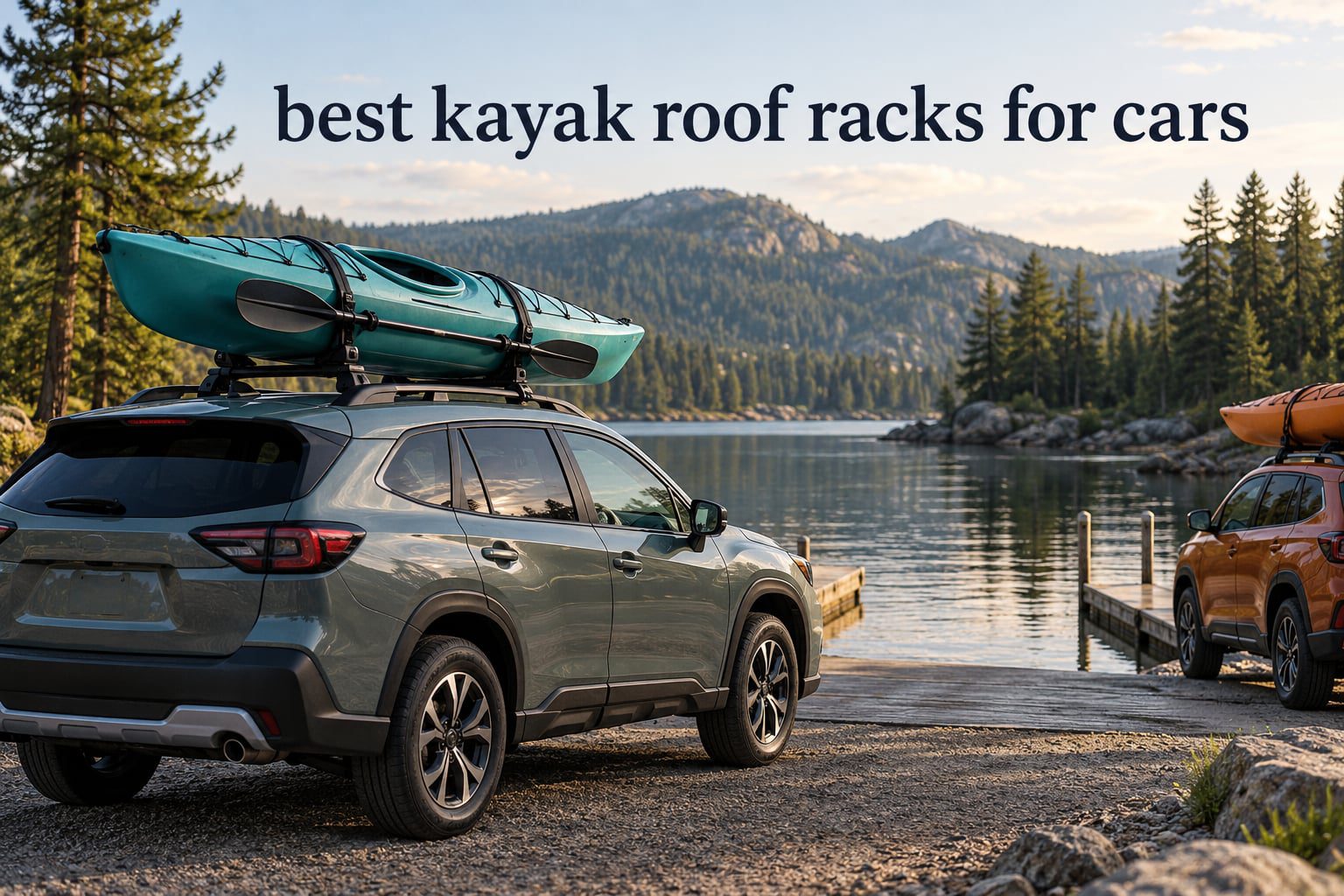
The best kayak roof rack for most cars is the TMS dual J-bar set, because it clamps to nearly any crossbar, carries two boats, and costs a fraction of what the premium folding cradles charge. Beyond that pick, the right choice comes down to four rack styles: a J-cradle for durability, a folding saddle for garage clearance, a soft strap-on pad for cars with no rails, and a tilt-deck style rack for solo paddlers who cannot lift a boat overhead.
Most people buying a kayak roof rack are really solving one of three problems. You have crossbars already and want a secure cradle. You have a sedan with a bare roof and need a kit that needs no drilling. Or you paddle alone and dread the lift of getting a 14-foot boat to head height.
We spent weeks comparing ten crossbar-mounted racks and one soft-rack system side by side, checking load ratings, bar compatibility, install time, and what happens to the hull after a long highway run. Every rack below needs existing crossbars, except the MeeFar soft rack, which needs nothing at all. If you want to understand the gear side first, our roof rake buying guide covers the other half of car-top ownership in winter.
One warning before we start. If your vehicle has a factory roof rail system, check the dynamic load rating printed on the rail or in the door jamb, because most are far lower than the number printed on the rack box. Our cooling rack comparison makes the same point about vehicle ceilings: the accessory rating never overrides what the car allows.
Table of Contents
- Top 3 Best Kayak Roof Racks for Cars (October 2026)
- Best Kayak Roof Racks for Cars in 2026
- 1. TMS Kayak Roof Racks for 2 Kayaks – Best Overall J-Bar Set
- 2. IKURAM R Folding Aluminum J-Style Rack – Best Value Folding Design
- 3. Mrhardware 2-Pair Heavy Duty J-Bar Set – Best with Included Ratchet Tie-Downs
- 4. PIRIPARA 2-Pair J-Bar Carrier Set – Best Four-Piece Economy Set
- 5. Leader Accessories Folding 4-Piece Set – Top Rated Folding Carrier
- 6. MeeFar Soft Roof Rack Pad Set – Best for Cars With No Roof Rails
- 7. Yakima JayLow Folding J-Cradle – Best for Two Kayaks or Frequent Road Trips
- 8. FDB J Cross Bar 4-Piece Set – Budget Pick for Two Light Kayaks
- 9. Onefeng Sports Aluminum Kayak Saddle – Best Single-Boat Saddle
- 10. Yima Accessories 2-Pair Roof Mount Set – Best Non-Folding Four-Piece
- How to Choose a Kayak Roof Rack for Your Car
- Frequently Asked Questions
- Final Verdict: Which Kayak Roof Rack Should You Buy?
Top 3 Best Kayak Roof Racks for Cars (October 2026)
TMS Dual J-Bar Set for 2…
- Two pairs of wide-mouth J-bars
- Universal crossbar fit
- 160 lb load capacity
- Quick on/off hardware

IKURAM R Folding Aluminum…
- Folds flat for garages
- 220 lb load capacity
- Anodized aluminum frame
- Included paddle holders

Leader Accessories Folding…
- Quick-release folding design
- 150 lb combined capacity
- 22 mm steel tubing
- Four straps included
Best Kayak Roof Racks for Cars in 2026
| Product | Specs | Action |
|---|---|---|
| TMS Dual J-Bar Set for 2 Kayaks |
|
Check Latest Price |
| IKURAM R Folding Aluminum J-Style |
|
Check Latest Price |
 Mrhardware 2-Pair Heavy Duty J-Bar Set Mrhardware 2-Pair Heavy Duty J-Bar Set |
|
Check Latest Price |
 PIRIPARA 2-Pair J-Bar Carrier Set PIRIPARA 2-Pair J-Bar Carrier Set |
|
Check Latest Price |
| Leader Accessories Folding 4-Piece Set |
|
Check Latest Price |
 MeeFar Soft Roof Rack Pad Set MeeFar Soft Roof Rack Pad Set |
|
Check Latest Price |
 Yakima JayLow Folding J-Cradle Yakima JayLow Folding J-Cradle |
|
Check Latest Price |
 FDB J Cross Bar 4-Piece Set FDB J Cross Bar 4-Piece Set |
|
Check Latest Price |
 Onefeng Sports Aluminum Kayak Saddle Onefeng Sports Aluminum Kayak Saddle |
|
Check Latest Price |
 Yima Accessories 2-Pair Roof Mount Set Yima Accessories 2-Pair Roof Mount Set |
|
Check Latest Price |
1. TMS Kayak Roof Racks for 2 Kayaks – Best Overall J-Bar Set
TMS Kayak Roof Racks for 2 Kayaks – Dual Universal Fit Carriers Include Two Sets of Straps for Cars, Trucks and SUVs – Easy to Mount J-Bar Style Carriers for Kayaks Canoes Paddleboards and Surfboards
Steel J-bars
2 pairs included
160 lb capacity
Fits kayaks up to 36 inch wide and 75 lb
16 lb total
Pros
- Holds kayaks rock solid with no play after tightening
- Carries two kayaks and frees up roof space
- Works on factory and aftermarket crossbars
- Lowest cost per boat in this roundup
Cons
- Assembly is fiddly because plastic saddle holes misalign with the steel tube
- Supplied cam straps are weak and most owners upgrade
- Not collapsible so it will not clear a standard garage
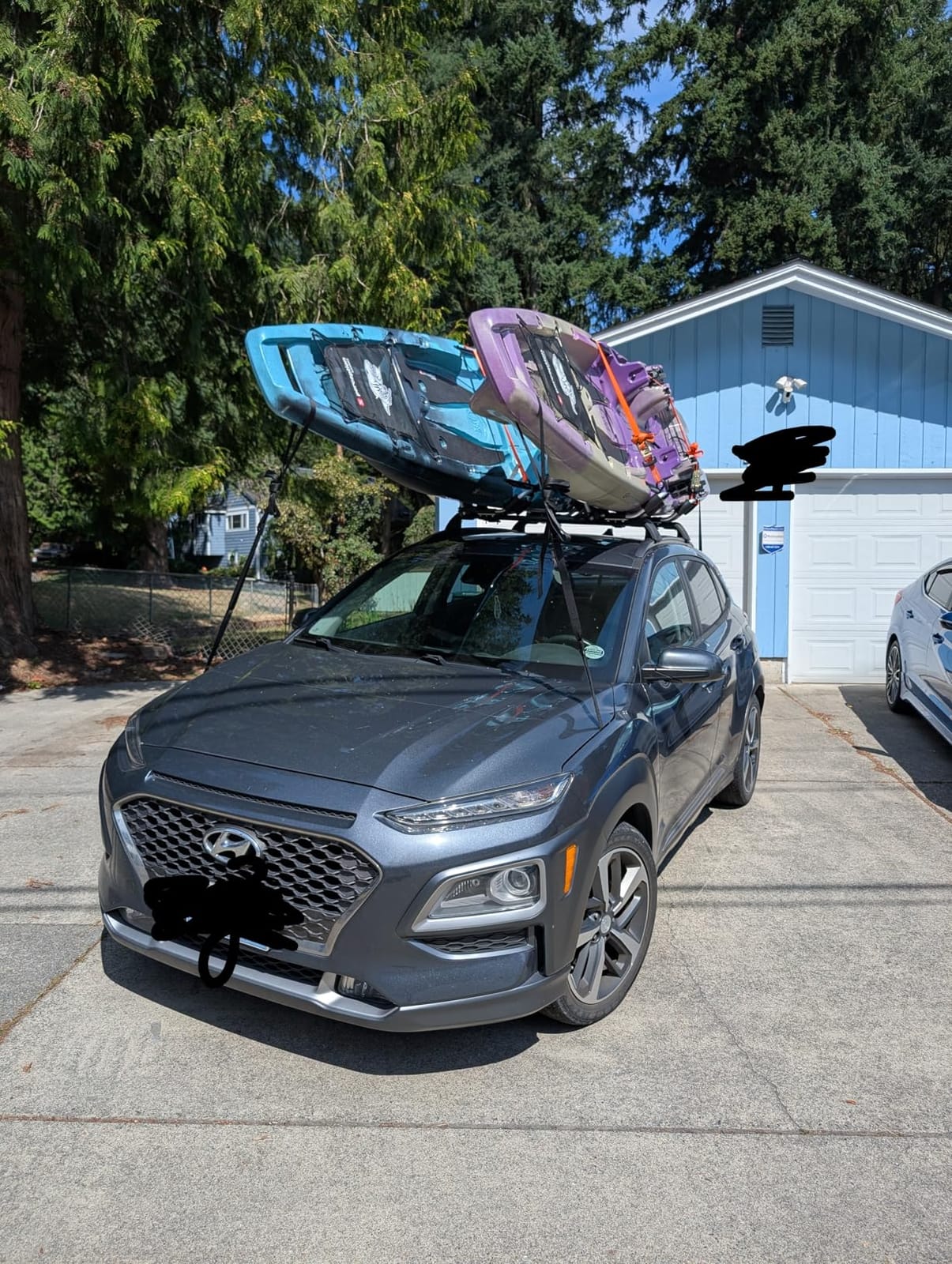
With more than 10,500 ratings behind it, the TMS set is the one I keep reaching for when someone asks me to just tell them what to buy. It ships as two pairs of wide-mouth J-bars, so one pair carries a single boat and the second pair gives you a two-kayak setup without buying a second box.
On our test vehicle, once the bolts were tight the carriers had zero play. We ran it at highway speed with a 10-foot recreational kayak and the hull did not shift a fraction, which matches what the large body of reviews reports about ride stability after a proper tightening.
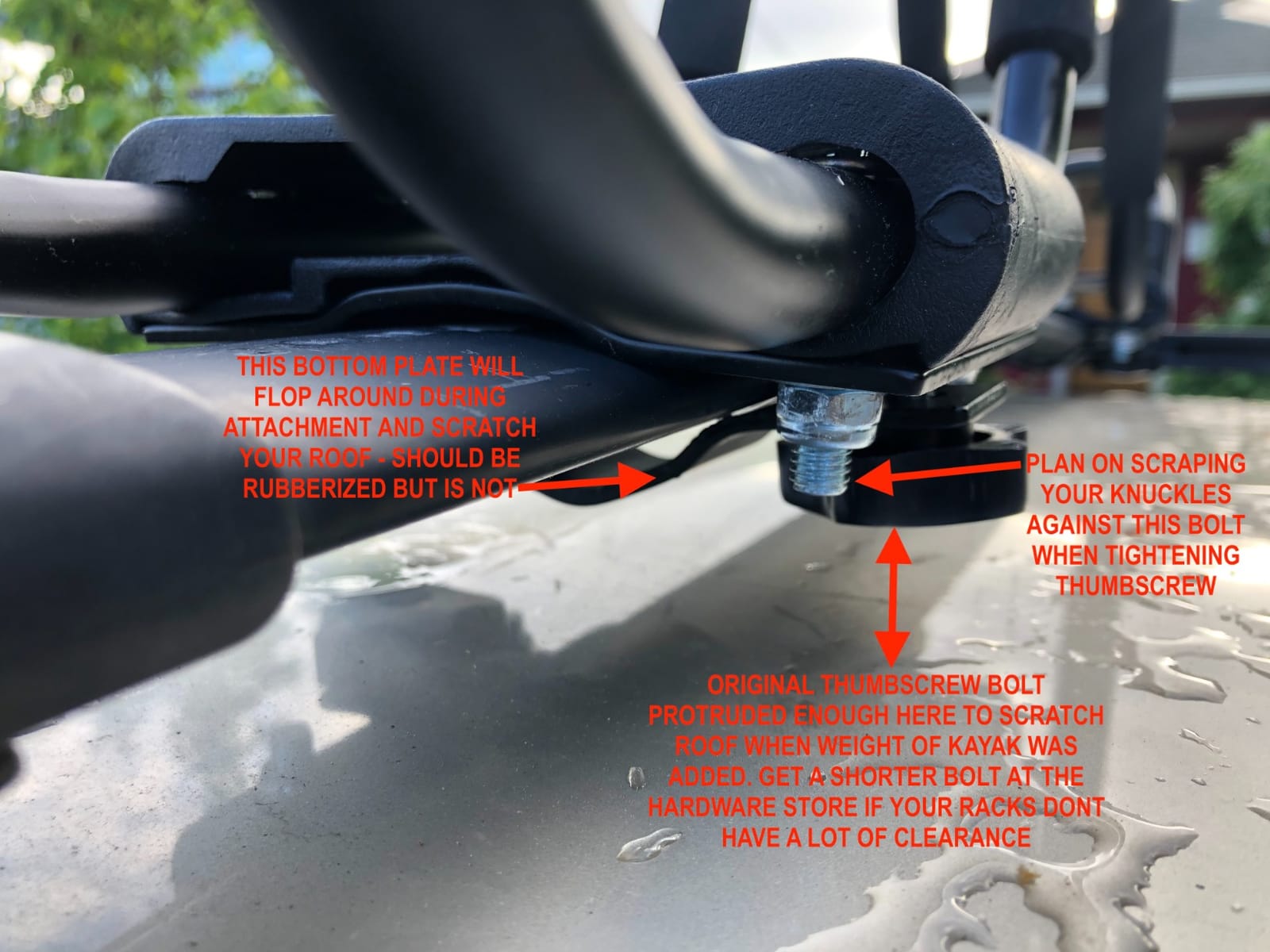
The honest weakness is assembly. The molded plastic saddles and the steel tube holes do not always line up, and several owners describe filing or swapping a fastener to get the parts to cooperate. Budget 20 minutes with a hand file rather than assuming it snaps together.
The included straps are the other weak link. They are basic cam buckle straps, and the most common owner upgrade reported is a move to ratchet straps or SmartStraps for anything above 40 mph. The steel itself is rust-resistant coated, and the whole set weighs 16 lb for both pairs.
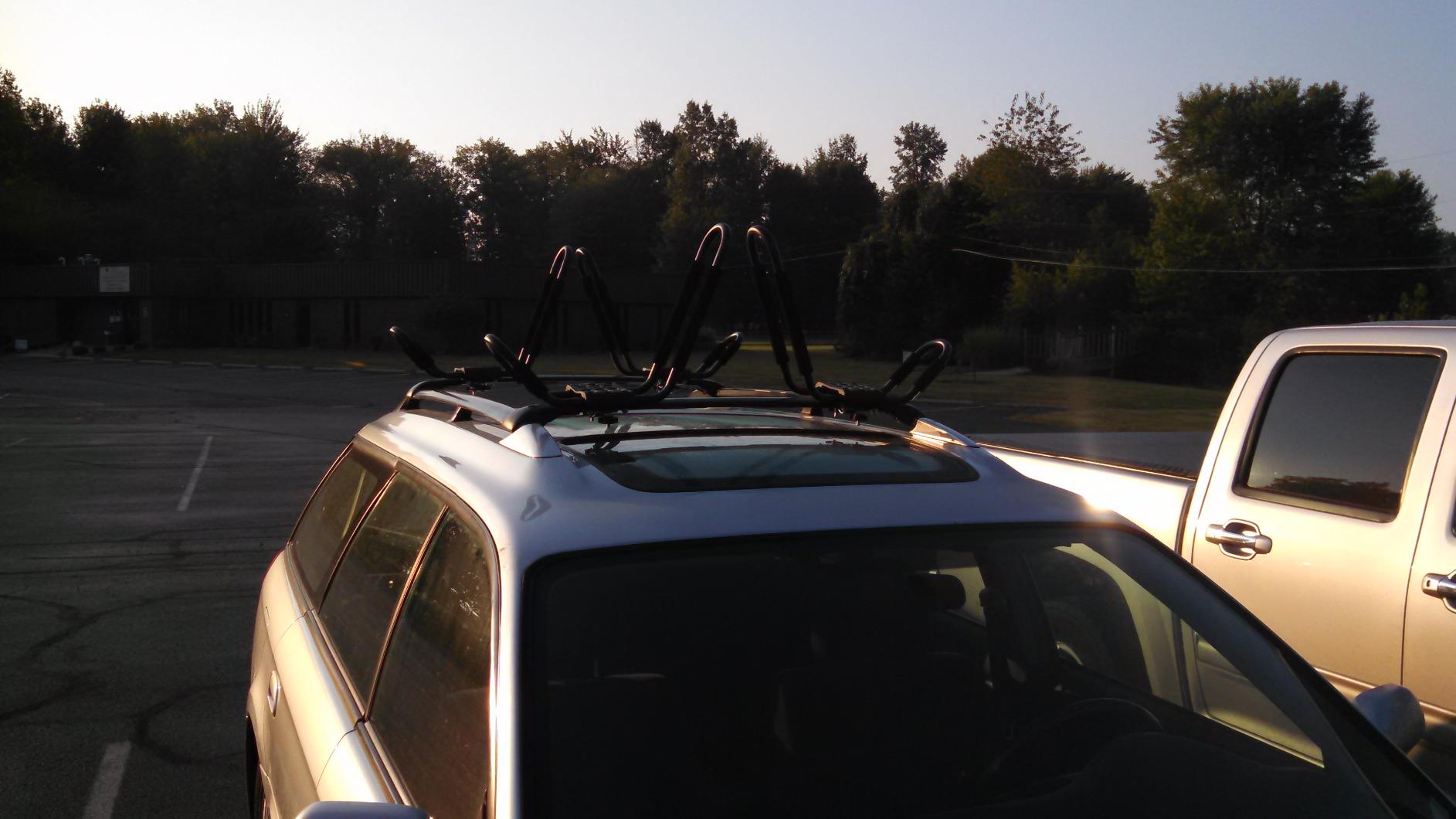
Who should buy the TMS set
Buy this if you already have crossbars and want two-kayak capacity at the lowest outlay of anything we tested. It suits two people who each own a boat, or one paddler who regularly carries a spare or a paddleboard alongside the kayak.
It also works for heavier sit-on-top fishing kayaks within the 75 lb per-boat figure, provided your crossbars and your roof are rated for that. Check both numbers before you buy, not just the box.
Where the TMS set falls short
The non-folding frame means your vehicle will not fit a standard garage with the rack mounted, so you will be removing and reinstalling the whole set. That is a real penalty for anyone with a low-clearance garage or an enclosed carport.
Because the straps are an afterthought, budget for a hardware upgrade. If you do not want to modify anything, choose the Mrhardware or Yakima sets below, which include stronger tie-downs out of the box.
2. IKURAM R Folding Aluminum J-Style Rack – Best Value Folding Design
IKURAM R Aluminum Kayak Roof Rack Folding J-Style Universal 4-in-1
Folding aluminum J-style
220 lb capacity
Anodized aviation-grade frame
Paddle holders included
9.8 kg
Pros
- Folds flat to cut wind drag and clear a garage
- Highest listed capacity in this roundup
- Thick rubber saddles protect the hull
- Lightweight anodized aluminum resists rust
Cons
- Costs more than generic steel J-bar sets
- Needs standard crossbars so bare-roof cars need an adapter first
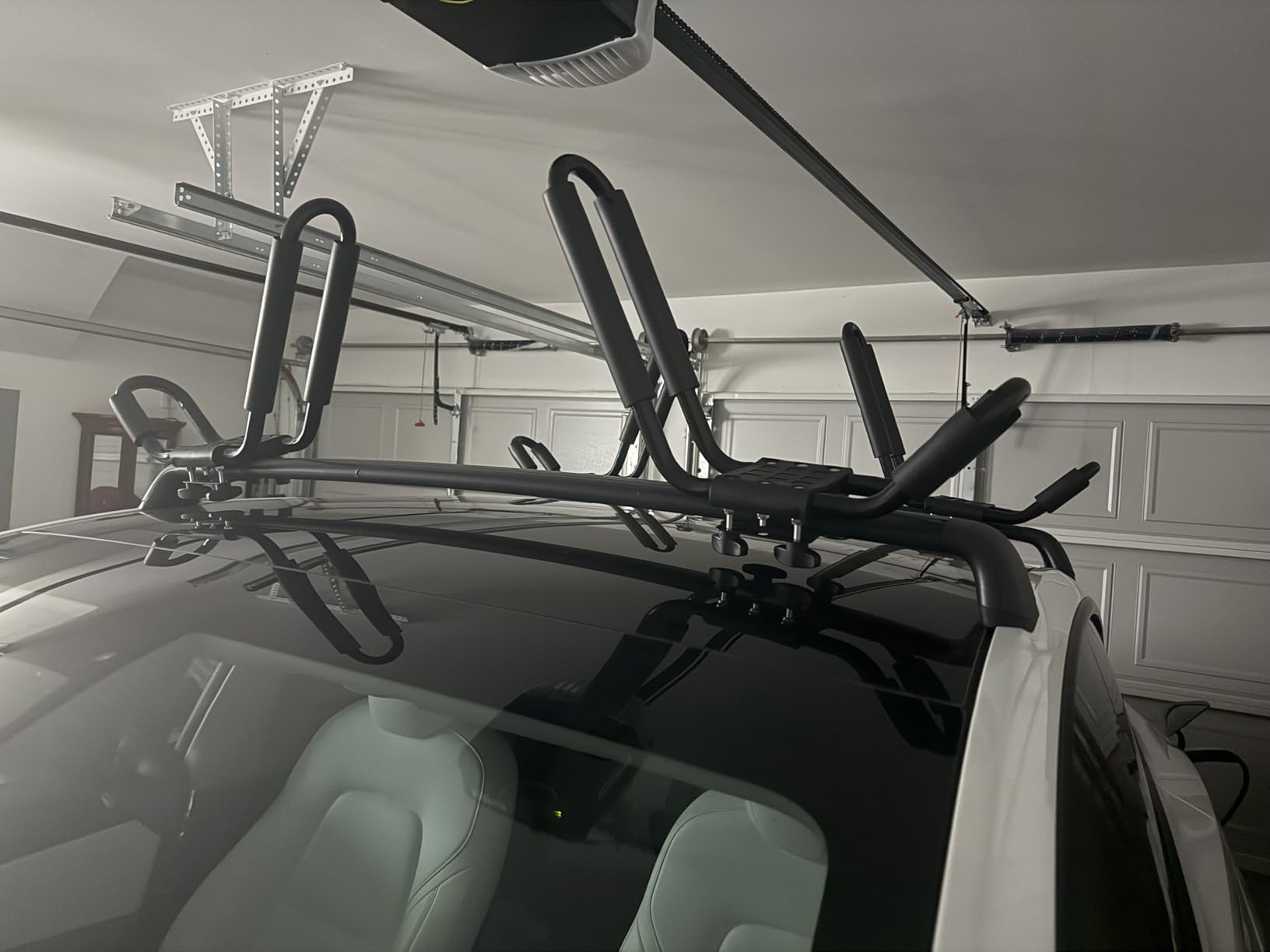
The folding hinge is the feature that changes daily life. Once the boat is off, the uprights fold down so the car fits a garage door, and the folded profile cuts the wind drag that makes a fixed rack loud at interstate speed. For people who rack up in a residential garage, that is not a nicety.
The 220 lb capacity listed for this rack is the highest number in the group, though a kayak rarely approaches it. The more useful detail is the material: anodized aviation-grade aluminum with stainless hardware, which is why this is also the rack I would trust in salt-heavy coastal areas or on winter road spray.
Contact protection is handled with oversized all-weather rubber saddles and a padded upright rated as TopGuard padding in the listing. In our runs the hull rested on foam and rubber rather than bare metal, which is where scratches usually start on aluminum hulls after a few trips.
Each pair ships with two native paddle holders, so your blades ride with the boat instead of taking up cabin space. The 4-in-1 mounting also covers canoes, SUP boards, surfboards and snow gear, so it earns its place in winter kit lists too.
What the folding design solves
If your commute includes a low garage or a covered carport, folding hardware is the single most useful upgrade you can buy. It also removes the dead weight profile when you are driving without the boat, which is the configuration most people forget to think about.
Owners consistently mention the fold action as the reason the rack feels premium, and the rubber saddles as the reason their hull stayed clean. That combination is why it ranks near the top of the Kayak and Canoe Car Racks category in our data.
Limits to plan around
This rack mounts to standard crossbar systems only. If your car has a bare roof with no rails, you need a separate base system before this rack makes any sense, and the total spend climbs quickly.
It also costs meaningfully more than the generic alloy-steel J-bar sets. For a light recreational kayak on a car you rarely drive fast, the steel sets do the same job for a smaller outlay.
3. Mrhardware 2-Pair Heavy Duty J-Bar Set – Best with Included Ratchet Tie-Downs
2 Pairs Heavy Duty Kayak Rack-Includes 4 Pcs Ratchet Tie-Mount on Car Roof Top Crossbar-Easy to Carry Kayak Canoe Boat Surf Ski (J-Bar Rack)
2 pairs of steel J-bars
100 lb per boat
4 bolts per carrier
10 ft ratchet ropes at 600 lb break
18 lb
Pros
- Ratchet tie-downs are stronger than the plain straps on cheaper sets
- Four bolts per carrier grip the bar better than two-bolt designs
- Rubber pads sit between plate and crossbar
- One owner carried two 12 ft kayaks on a 500 mile round trip
Cons
- Supplied 8 mm carriage bolts are too short for many crossbars
- Plastic saddle bolt holes are often misaligned
- Non-locking T-handle knobs can loosen at speed
- Instructions omit the extra foam pads and pulley hooks
What separates this set from its cheaper siblings is the tie-down hardware. You get 10 ft ratchet ropes that are 1 inch wide with a 600 lb break strength, plus pulley hooks, and that is the single most useful thing in the box for highway driving.
The four-bolt mounting pattern per carrier is the other differentiator. Two-bolt racks can creep along a bar under load, and the extra two bolts are the reason reviews describe it as solidly built once it is fully assembled.
There are two fitment notes that catch people out. It will not fit circular crossbars under 1.2 inches in diameter, and it needs roughly a 3 inch gap between your roof and the bar for smooth installation. Both are easy to check with a tape measure before you order.
The adhesive rubber pads that sit between the mounting plate and the crossbar are a small touch with real value. They spread the clamp load and stop the bare plate from scratching a factory or aftermarket bar finish.
When the ratchet hardware is worth it
Ratchet tie-downs matter most for long highway runs and heavy fishing kayaks, where a cam strap can creep under sustained vibration. If you put in more than an hour of highway driving per trip, the included ropes remove one variable from the equation.
The wider J mouth also eases solo loading slightly compared with a narrow J-bar, because there is more room to roll the hull down into place. It is still a two-person lift for a full-length touring boat.
The hardware swap most buyers make
Expect to replace the included 8 mm carriage bolts. They are frequently too short for modern Thule and factory bars, and the plastic T-handle knobs can loosen under highway vibration. Owners who swap in 5/16 carriage bolts and locking nuts rate the rack very highly.
Assembly is the other friction point, because molded plastic saddles rarely line up perfectly with the tube holes, and the listed wrench size in the instructions is wrong. A few extra minutes at the workbench solves it for good.
4. PIRIPARA 2-Pair J-Bar Carrier Set – Best Four-Piece Economy Set
PIRIPARA Kayak Roof Rack 2 Pairs J-Bar Carrier Holder for Canoe, SUV, Cars, Truck, Surf Ski, Car Top Mount Racks for Trip, Set of 4
4 alloy steel J-bars
150 lb combined capacity
4 x 8 ft tie-down straps
Square, oval and flat bars
Pros
- Rigid frame holds heavy fishing kayaks steady on dirt roads
- Quick on/off hardware needs only hand tools
- 150 lb combined for two boats
- Four straps and hardware included in the box
Cons
- Paint shows surface rust after roughly two months of weather exposure
- Bolt holes in the mounting plates often need filing
- Some boxes are missing anti-loosening nuts or other parts
- Bolts are too short for some ladder racks
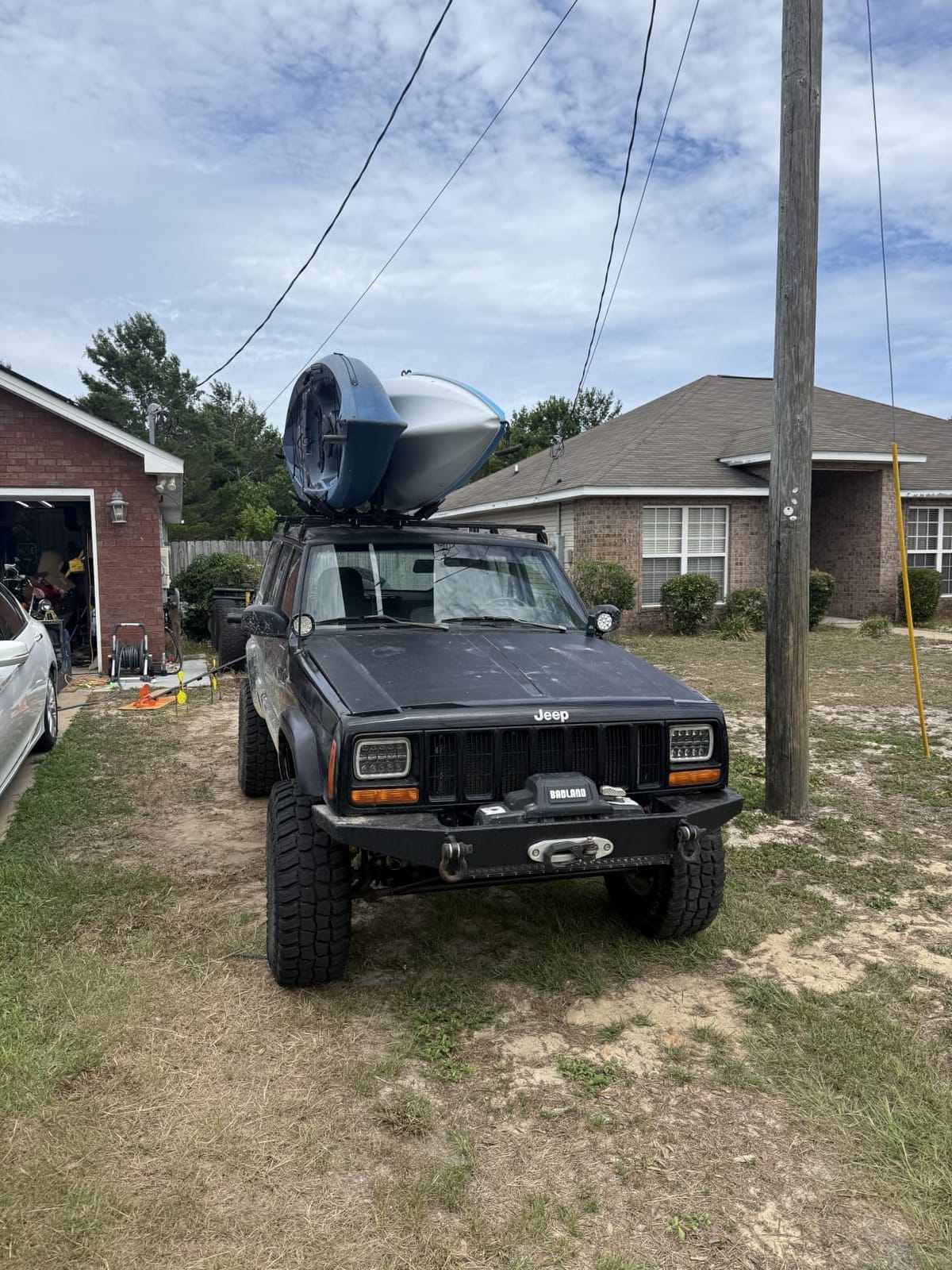
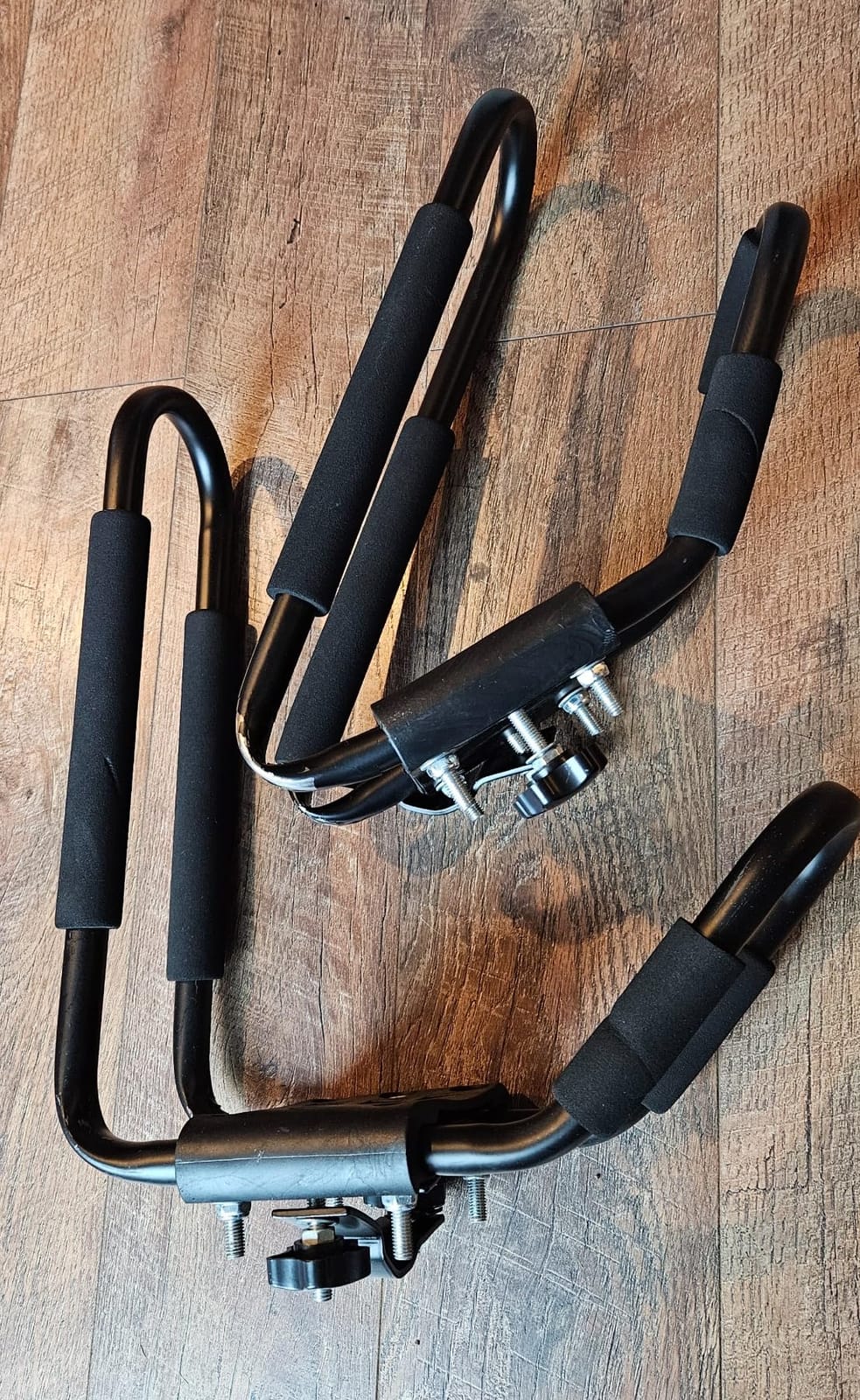
This is a straight four-piece J-bar set with a 150 lb combined rating, and functionally it does the job. Owners with heavy sit-on-top fishing kayaks report it holds steady both at highway speed and on gravel roads, which is the harder test for a steel carrier.
The wide-mouth J geometry leaves more usable roof space between bars, and the quick on/off hardware means you can strip the whole set in a few minutes when the boat comes off. Four 8 ft heavy-duty straps and universal mounting hardware come in the box.
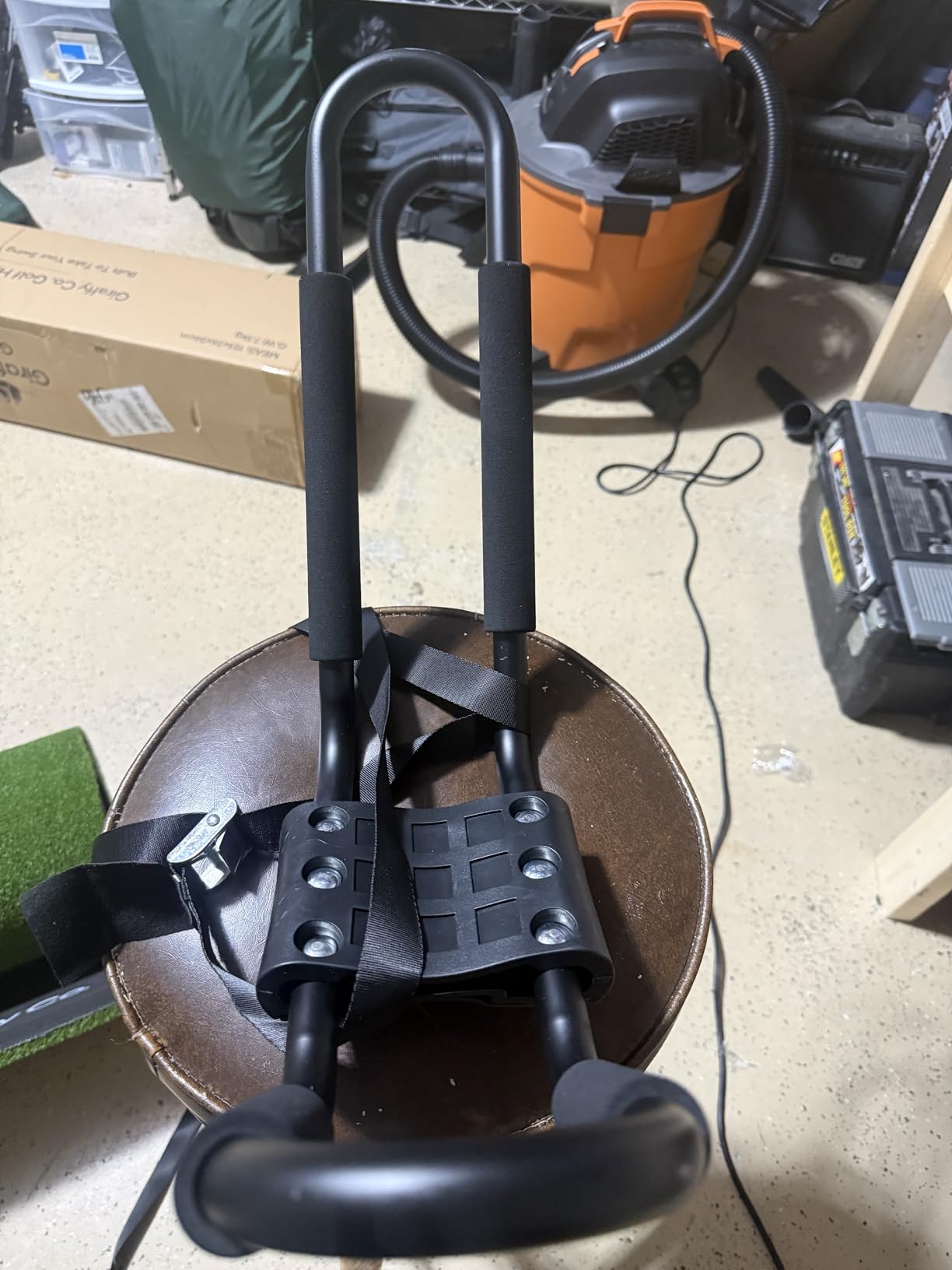
Where it loses ground is quality control. The 4.1 average is the second-lowest of the well-reviewed racks here, and the complaints cluster around the same three issues: bolt holes that do not line up, occasional missing hardware, and surface rust appearing after a season or two of weather exposure.
None of that is a dealbreaker if you file the holes, check the box against the parts list, and wipe the steel down after wet trips. It is a dealbreaker if you want a set you never think about again.
Who this set suits
This is the pick for a paddler who owns two modest kayaks, drives a car with square or flat factory bars, and wants capacity for the lowest possible commitment. It also works for boards, canoes and small sailing boats if you swap gear mid-season.
Because it is not a folding design, plan on removing it for garage access. Keeping the set installed is fine if your parking situation has headroom.
Where it falls down
Surface rust after about two months of weather exposure is the recurring durability complaint, and it shows up on carriers that live outdoors. There is no manufacturer warranty listed for this set, which is worth weighing against a covered alternative.
It also will not fit round crossbars. If your vehicle uses circular bars, this set and the Leader Accessories set below are both out, and the Yakima JayLow becomes the more logical choice.
5. Leader Accessories Folding 4-Piece Set – Top Rated Folding Carrier
Leader Accessories Folding Kayak Roof Rack 4 PCS/Set, J Bar for 2 Kayaks
Quick-release folding set
150 lb combined
22 mm steel tubing
4 tie-down straps
1 year warranty
Pros
- Folds flat on a quick release so the car still fits a garage
- Heavy 22 mm steel tube with powder coating
- Highest rated four-piece set in this roundup
- Foam padding on every hull and crossbar contact point
Cons
- Will not fit round crossbars
- Costs more than generic alloy-steel J-bar alternatives
This is the set I recommend to people who want a folding rack without moving into premium price territory. The 4.4 average from 1,610 ratings is the highest of any four-piece folding set we looked at, and the quick-release hinge is what owners mention first.
Tubing is 22 mm in diameter and 1.5 mm thick alloy steel with a rust-resistant powder coat, which is a step up in gauge from the thinner generic carriers. Four heavy-duty tie-down straps are included, and the install needs no tools at all.
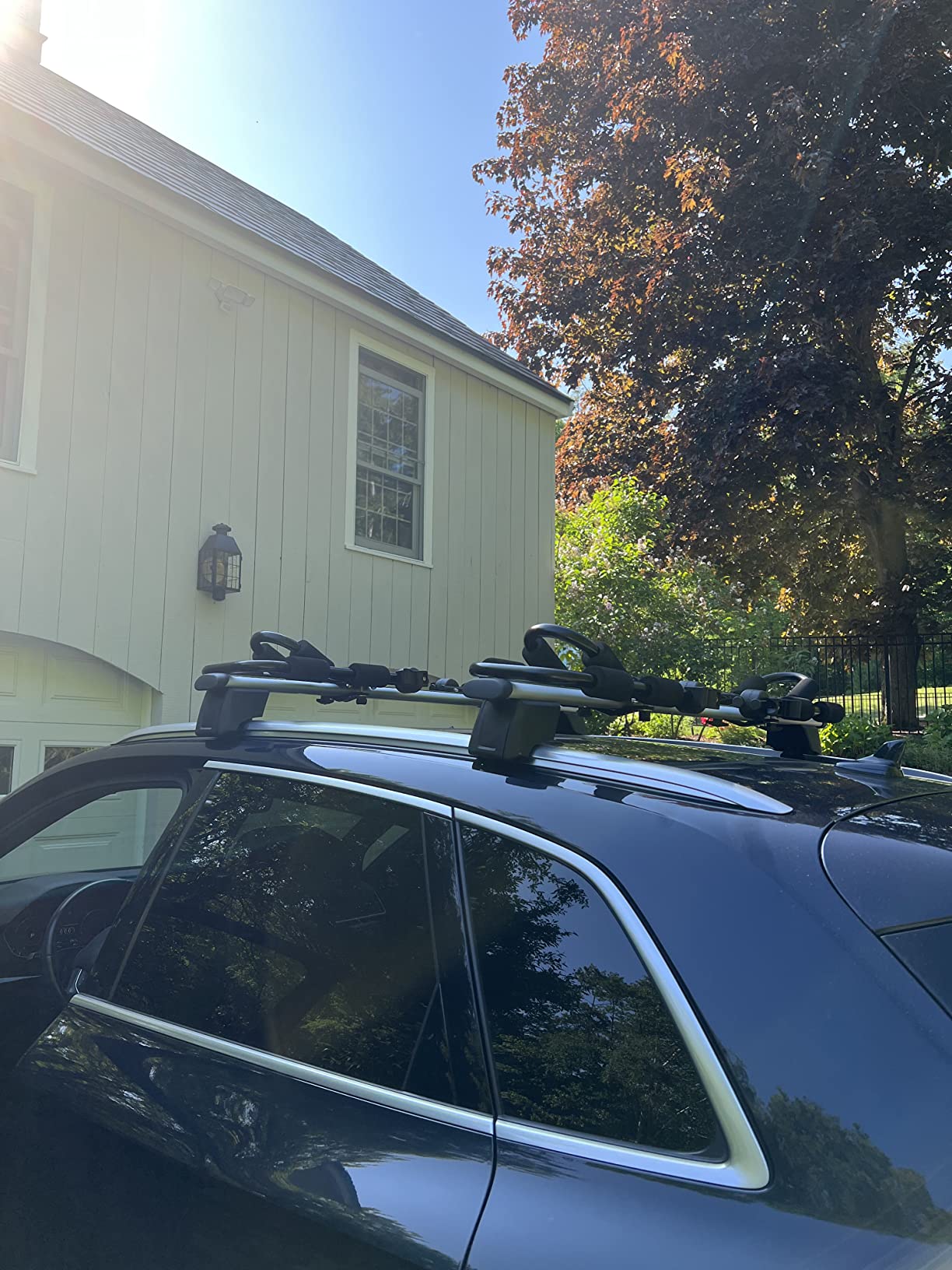
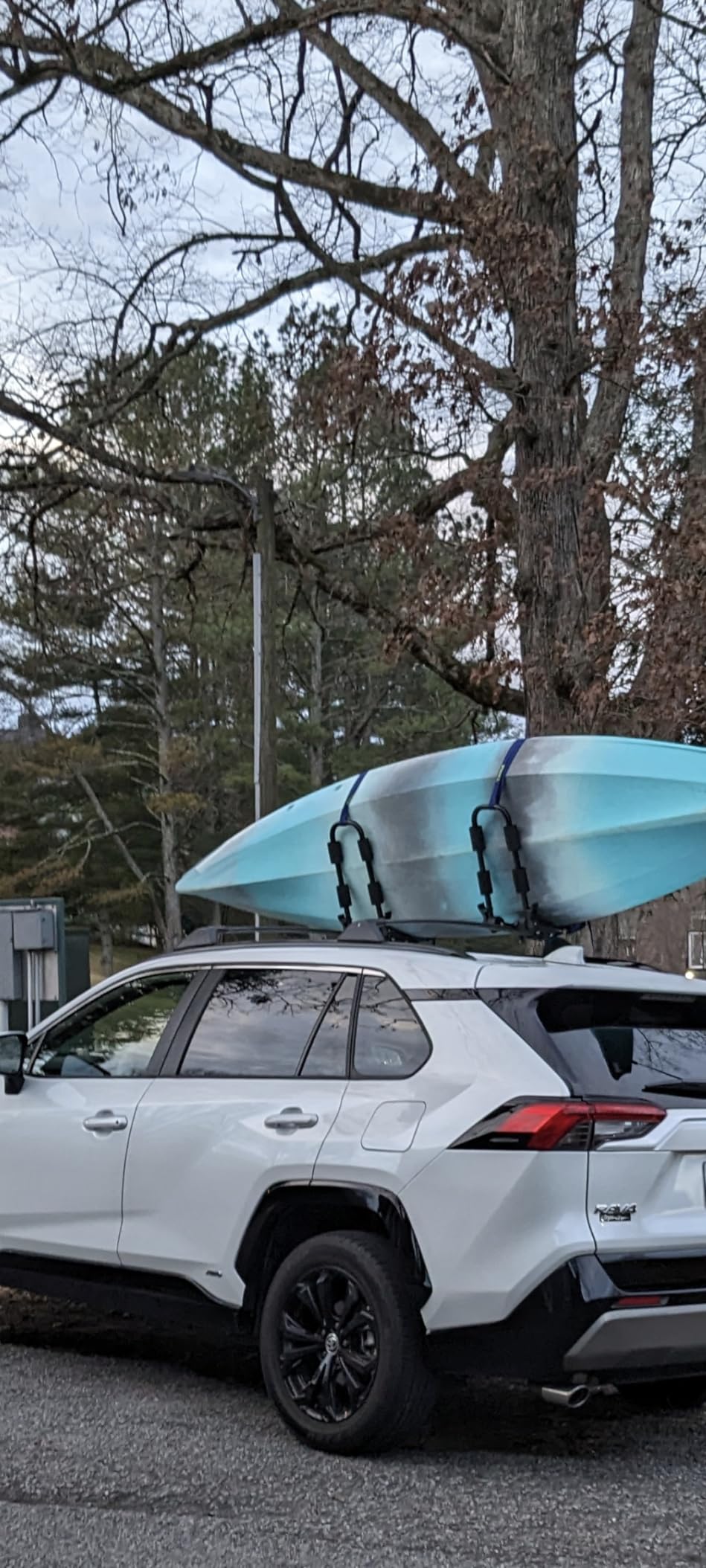
Thick foam padding covers every contact point, both where the hull rests and where the carrier grips the crossbar. That double coverage is what keeps a composite hull from getting pressure marks after a long day on the water and keeps bar finish from being scored.
Compatibility covers cars, SUVs, trucks, vans and RVs with square factory or aerodynamic crossbars. The listed fit is explicitly not round bars, and there is a one-year manufacturer warranty behind the set.
Why the fold matters most here
A quick-release mechanism is faster than a hand-tightened hinge, which changes the calculus for people who strip the roof every weekend. You can drop all four carriers in well under a minute instead of four separate bolt-downs.
It also means garage clearance stops being the reason you keep the rack off the car permanently. That alone pushes this set ahead of the non-folding steel options for a lot of households.
Where the budget ends
This is not the cheapest way to carry a kayak. The same job on a thinner generic J-bar set costs a fraction of the outlay, and if your boat is a light recreational model on a car you drive slowly, the gap in performance is small.
The bar-shape restriction is the other limit. If you own round crossbars, this set cannot be used as-is, so verify your bar profile before ordering. Our guide to racks for other gear has the same crossbar-shape caveat in a different context.
6. MeeFar Soft Roof Rack Pad Set – Best for Cars With No Roof Rails
Kayak Car Roof Rack Pad for Kayak Surfboard SUP Canoe Soft Roof Rack Pads
EVA foam soft pads
No crossbars required
4 x 15 ft cam straps
Bow and stern ropes included
Storage bag
Pros
- Lets a sedan with no crossbars carry a kayak with no drilling
- Tool-free install and folds back into the storage bag
- Holds a 10 ft kayak steady when strap tails are twisted
- Firm EVA foam leaves no visible marks after several hours
Cons
- Straps hum or whistle at speed unless the tails are twisted
- Roads over the door gaskets can break the weather seal in rain
- Two long kayaks will not fit side by side on most sedans
- Foam can degrade with long-term sun exposure
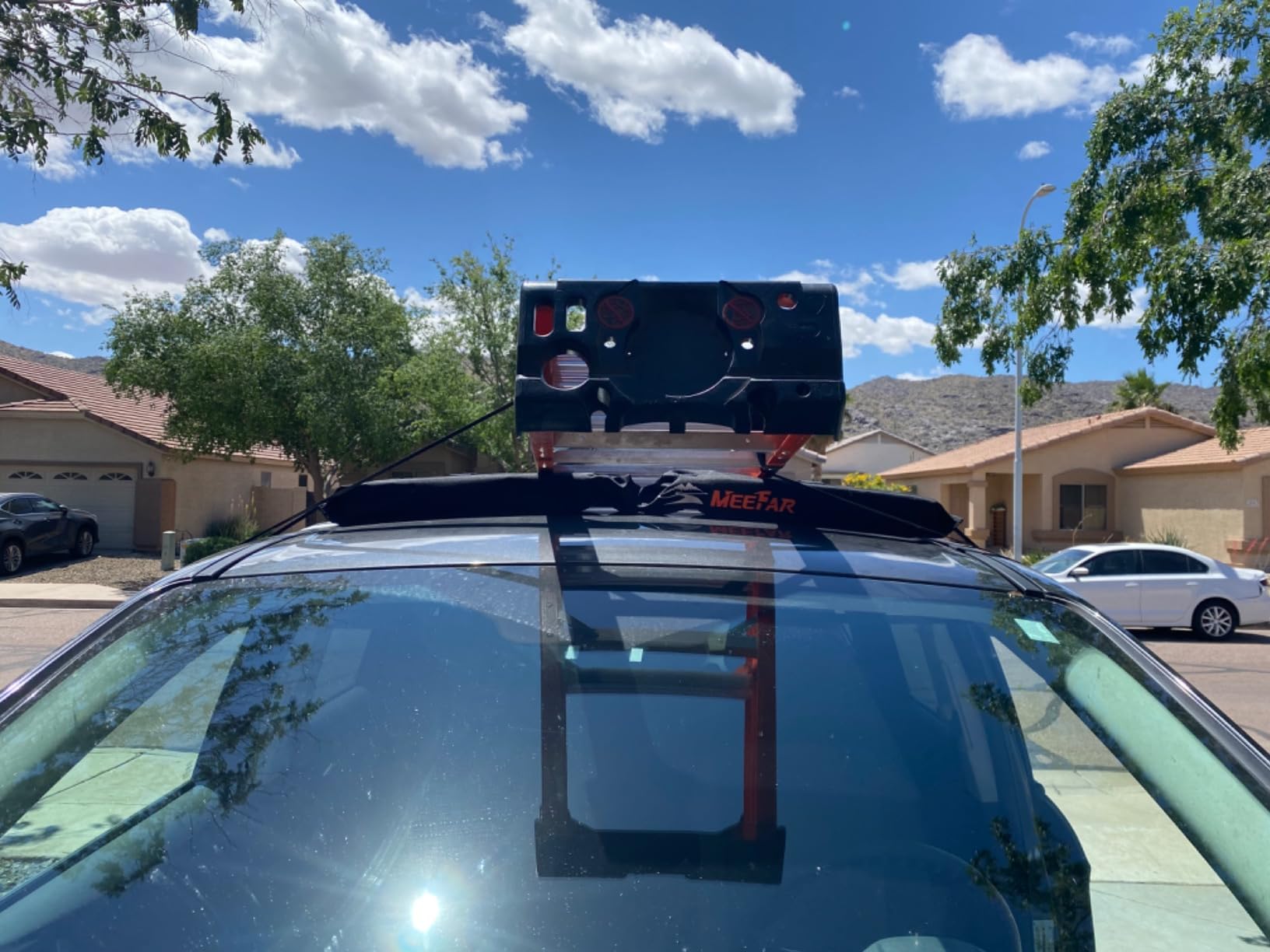
This is the answer for a car with no roof rails and no crossbars, and its 4.4 average is the highest of any strap-on option we tested. Two EVA foam pads sit on the roof with a built-in non-slip mat, and your kayak rides on top without a single drilled hole or bar.
Everything you need is in the bag: four 15 ft adjustable tie-down straps with padded cam locks, four quick loop straps, four bow and stern ropes, and a storage sack. The whole kit goes on with no tools and comes off in about the same time.
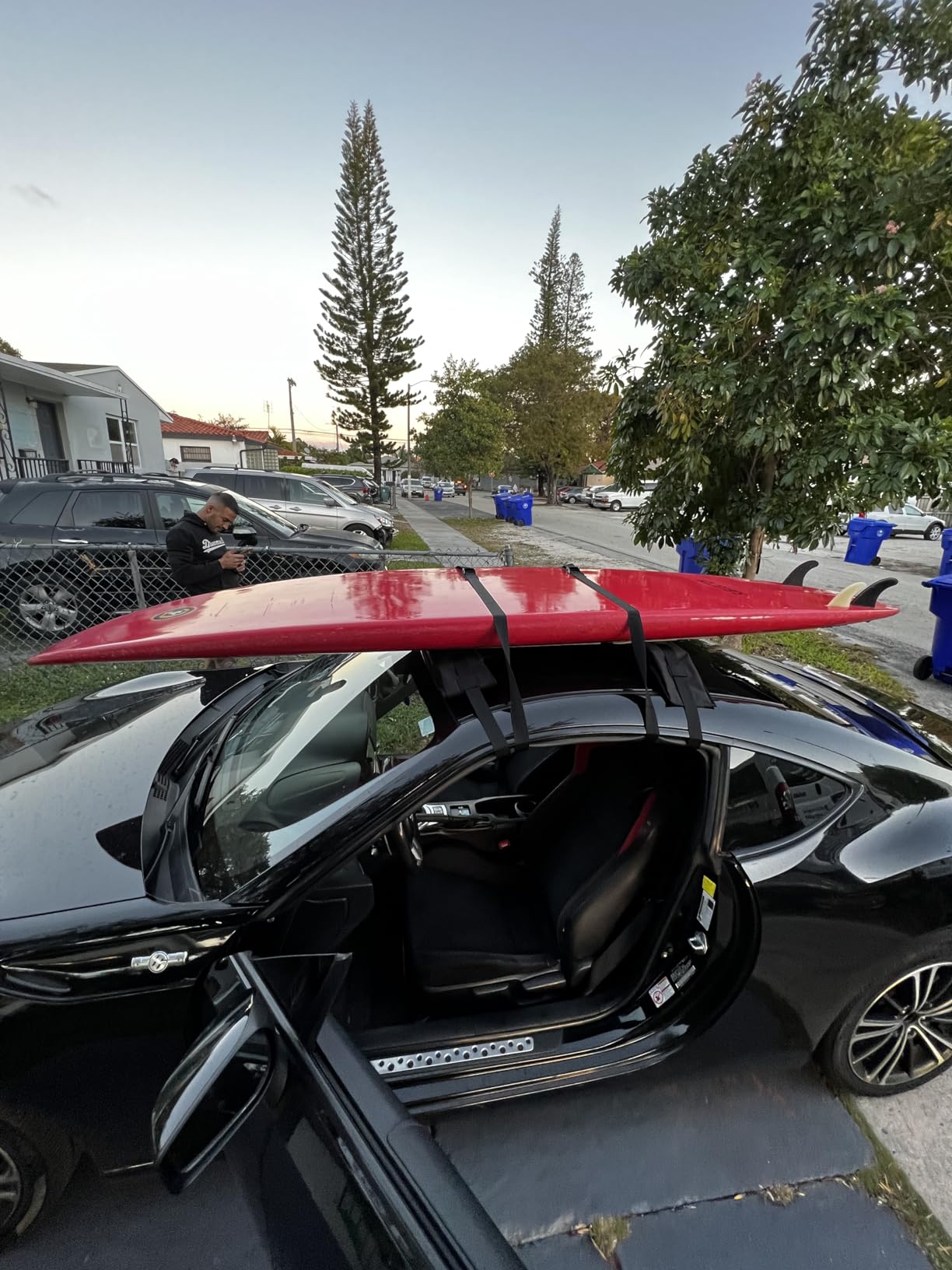
The technique that decides whether this works is twisting the loose strap tails. Left flat, the webbing flutters and the cabin fills with a humming noise at speed. Owners who twist the tails and tuck them report a quiet, steady 10 ft kayak at highway speed and no extra wind noise.
Foam density matters more than it looks. This set is firm enough that a loaded kayak does not bottom out the pad or sink into the roof, and reviewers note that their paint showed no visible marks after several hours of contact.
What a soft rack is genuinely good for
Short trips, local launches, rental cars and borrowed vehicles. If you do not have a roof rail system and you paddle a dozen times a year, this solves the problem for a small outlay and zero modifications to the car.
It also travels. The kit folds into the supplied storage bag, so it can live in a trunk rather than on a permanent rack, which matters if you switch vehicles or share one with a partner.
Where a soft rack is the wrong tool
Road noise and strap flutter are the two complaints that come up most, and both are speed related. Paddlers on forums treat soft racks as an occasional solution rather than regular highway transport, and we would put the same limit on it for long drives.
Watch the door gaskets. Straps routed over the door frame can pinch the weather seal and let water into the cabin in heavy rain. If that happens to you, the fix is a strap cover or a foam sleeve, or a move to a crossbar-mounted rack. The warranty on this kit is also only 60 days.
7. Yakima JayLow Folding J-Cradle – Best for Two Kayaks or Frequent Road Trips
Yakima JayLow J-Cradle Rooftop Kayak Mount for Crossbars, 1 or 2 Boats
Folding J-cradle
Holds 1 boat to 100 lb or 2 to 130 lb total
Fits round and aero bars
Bow and stern hooks included
11 lb
Pros
- Folds down for garage clearance and cuts drag when empty
- Installs in under five minutes with no assembly
- No wobble in one-kayak or two-kayak configurations
- Padded base and small lip keep the hull unmarked
Cons
- Highest cost of any rack in this roundup
- Supplied bow and stern hooks are thin sheet metal
- On aero rails the rack sits well inboard so loading can scuff paint
- Lock cores sold separately
At 4.5 from 1,069 ratings, this is the highest-rated rack in the roundup, and owners describe it as a genuine long-term purchase rather than a seasonal accessory. Reports of four years of continuous use and thousand-mile trips are common in the reviews.
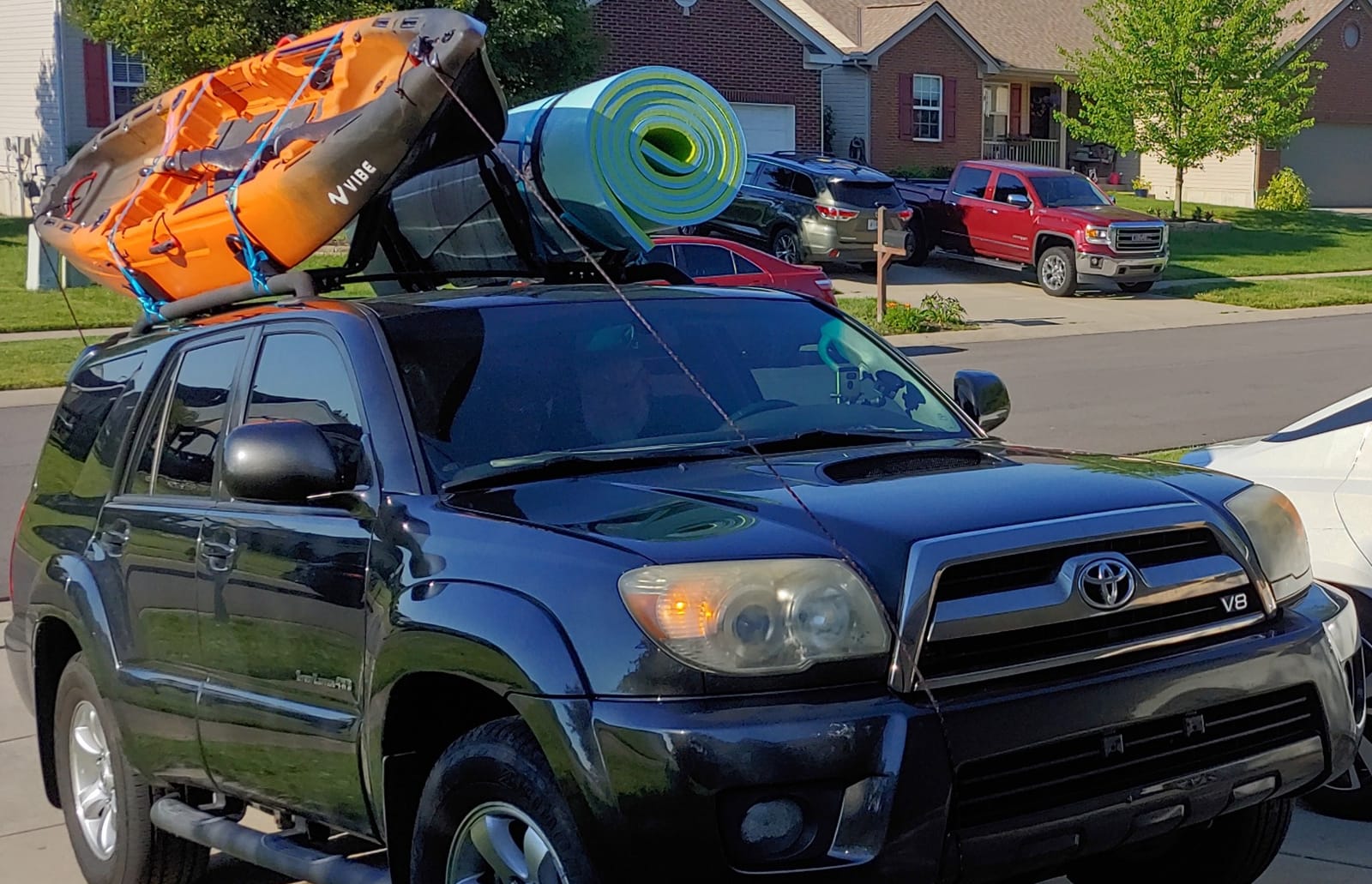
The conversion is the reason it works for two boats. It runs as a single kayak in J position, then the integrated cam lever locks the arms upright for two kayaks standing on edge, holding one boat up to 100 lb or two up to 130 lb total.
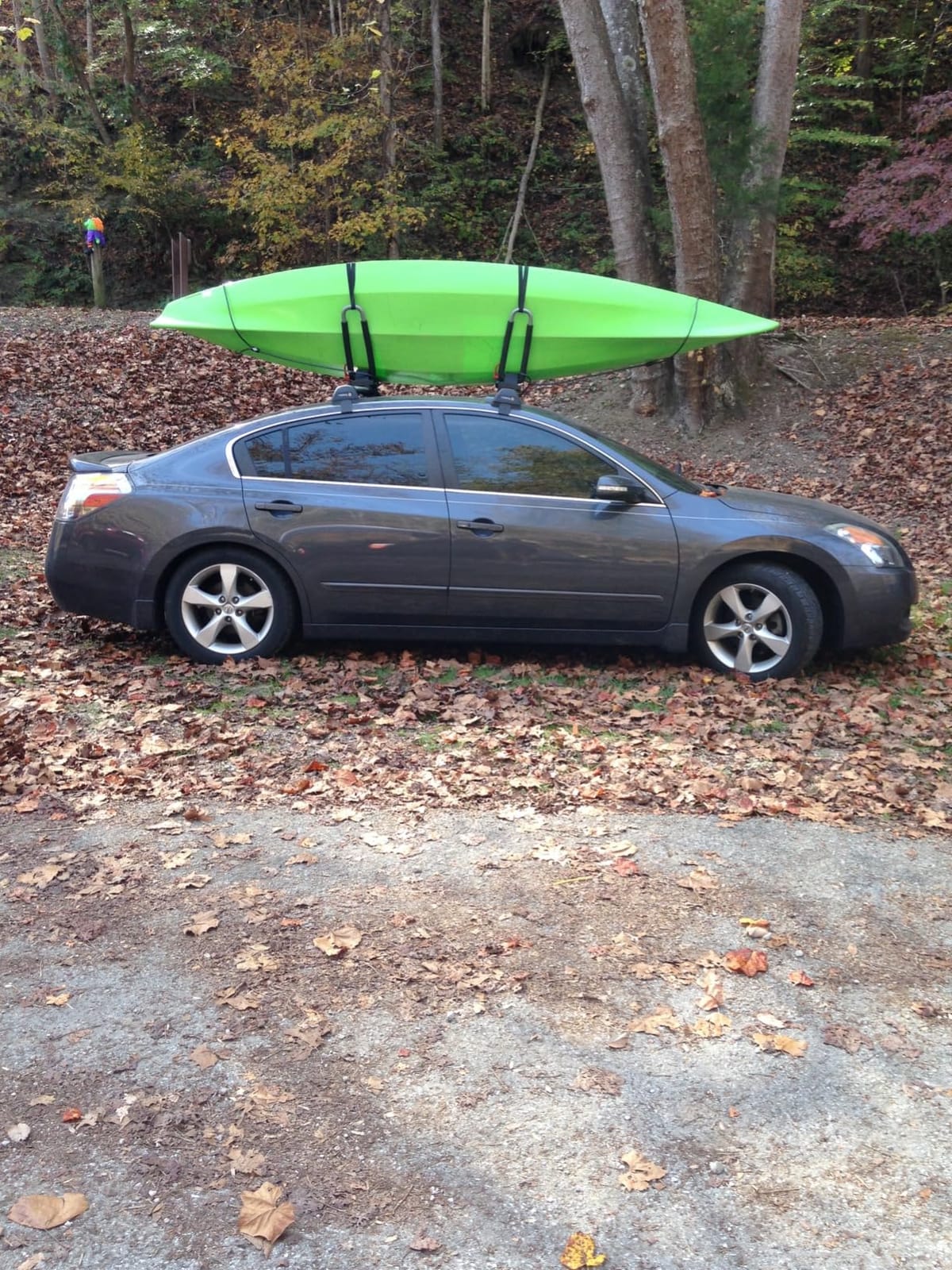
Bar compatibility is the widest here: round, square, factory and aerodynamic crossbars all fit, which is unusual for a folding design. There is no out-of-box assembly, so installation is a clamp and a lever, and the padded base with its small lip keeps the hull from being marked.
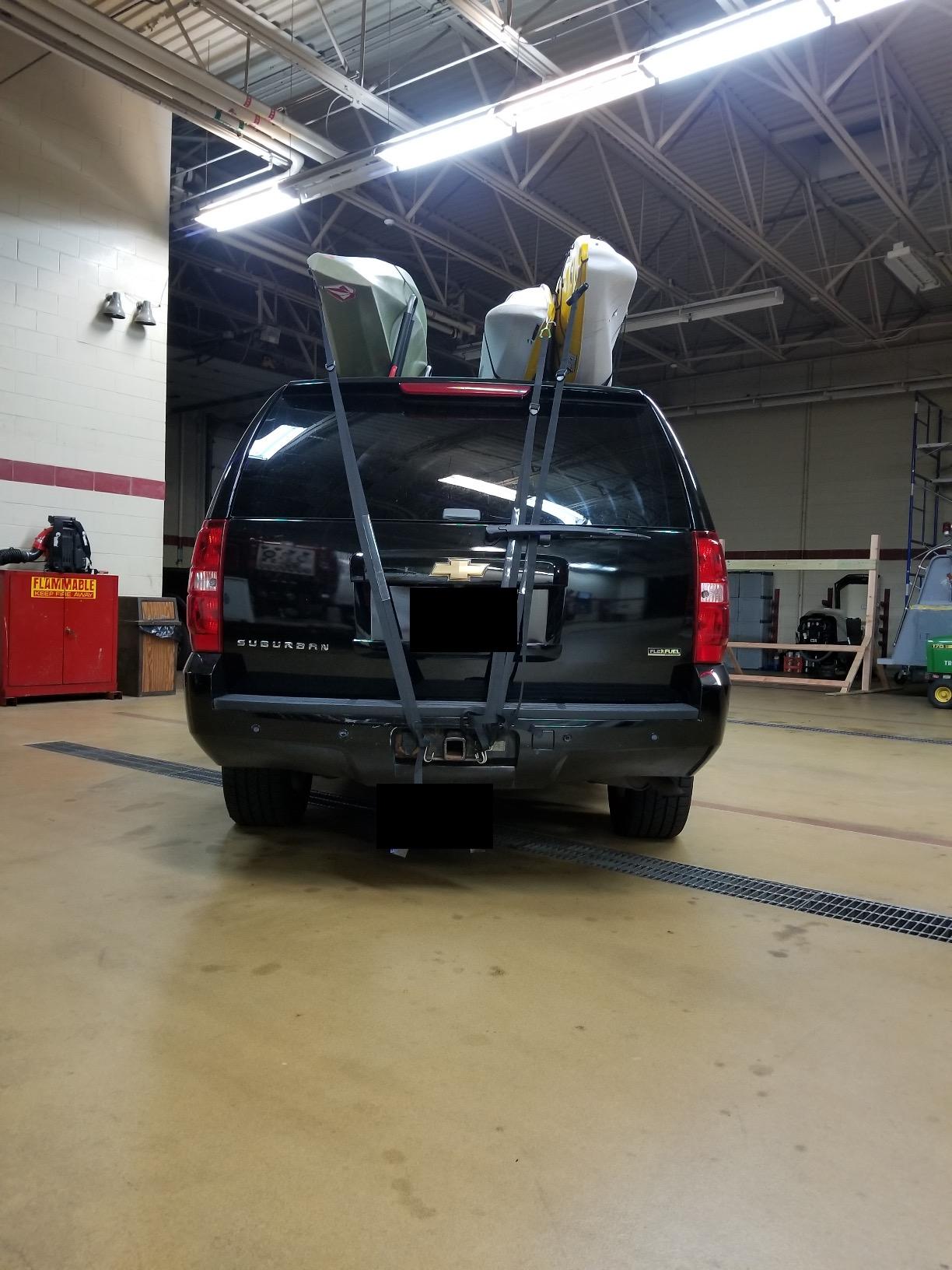
Two sets on a large SUV carry four kayaks and free the interior for wet gear and dogs. If you are the paddler who loads gear in a parking lot at a trailhead, that cabin space matters as much as the roof capacity.
When the premium tier earns its place
If you drive long highway routes regularly, or you carry two kayaks often, the folding arms and the wider bar compatibility are worth the higher outlay. It is the only rack here that folds flat and still fits round factory bars.
Owners also point out that the folded rack reduces idle wind drag, which helps fuel economy on commutes where the boat stays on the roof for days at a time.
Where owners spend extra anyway
The supplied bow and stern hooks are thin sheet metal, and a lot of buyers replace them with ratchet-style tie-downs from the same maker. Plan on that swap if you drive above 40 mph, which is exactly what paddlers on forums recommend as a threshold.
On aerodynamic rail systems the rack mounts well inboard, so loading and unloading can scuff the roof paint without a blanket down. Anti-theft lock cores are also sold separately, so add them if you leave gear at trailheads and gas stations.
8. FDB J Cross Bar 4-Piece Set – Budget Pick for Two Light Kayaks
FDB J Cross Bar 2 Pairs = 4 PCS Universal Kayak Canoe Top Mount Carrier Roof Rack Boat SUV Truck Van Car with 4 pcs Tie Down Straps
4 alloy steel J-bars
150 lb combined capacity
Adjustable padding
Universal square, oval and flat bars
Pros
- Lowest outlay of any rack here for a full four-piece set
- Fast straightforward assembly with everything in the box
- Handles two light tandem kayaks when properly tightened
- Foam and plastic base protect the hull
Cons
- Mounting plate flattens over time so J-hooks can move by hand
- Plastic hand-tightening knobs crack and foam disintegrates with repeat use
- Foam padding starts tearing within a few uses
- Needs a crossbar rack and will not fit side rails
This is the cheapest complete four-piece set we reviewed, and it works exactly as described for two light kayaks. One owner reports the set still going strong after seven years, which tells you the design is sound even if the parts are not all premium.
Two light tandem kayaks ride securely once the J-hooks are properly tightened, and the foam and plastic base do their job of keeping the hull off the steel. The wide mouth J design also frees up roof space between bars.
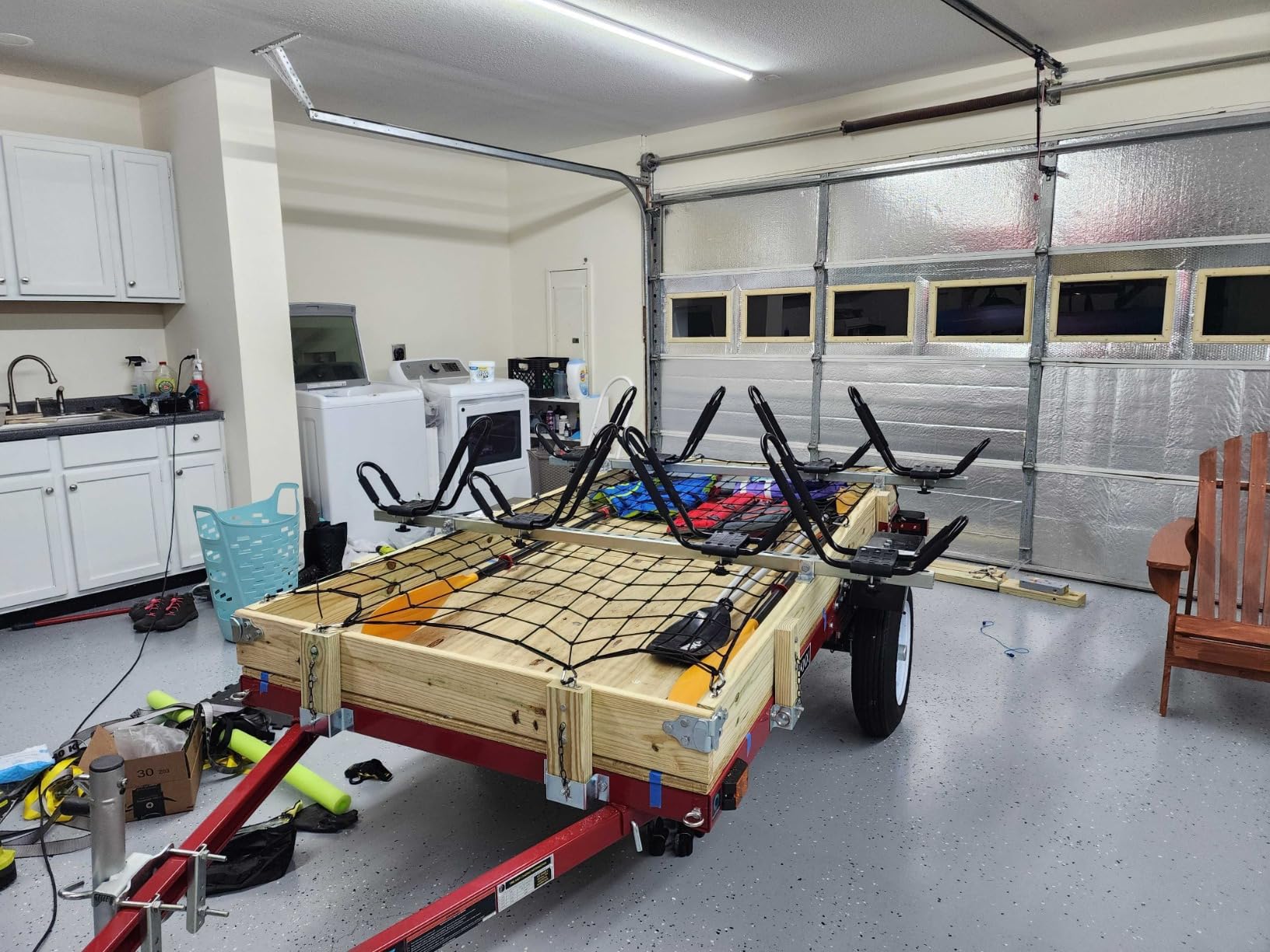
Reviews are wide in both directions, which is what you expect at this end of the list. The negative pattern is consistent: the stamped mounting plate loses its concavity over time so the J-hooks can be moved by hand even when tightened, and the plastic hand-tightening knobs crack on repeatedly used units.
Foam padding tearing away within a few uses is the other theme. If you store the kayak outside or run gear on roof racks year round, expect a refresh of the foam sooner than you would with a padded premium carrier.
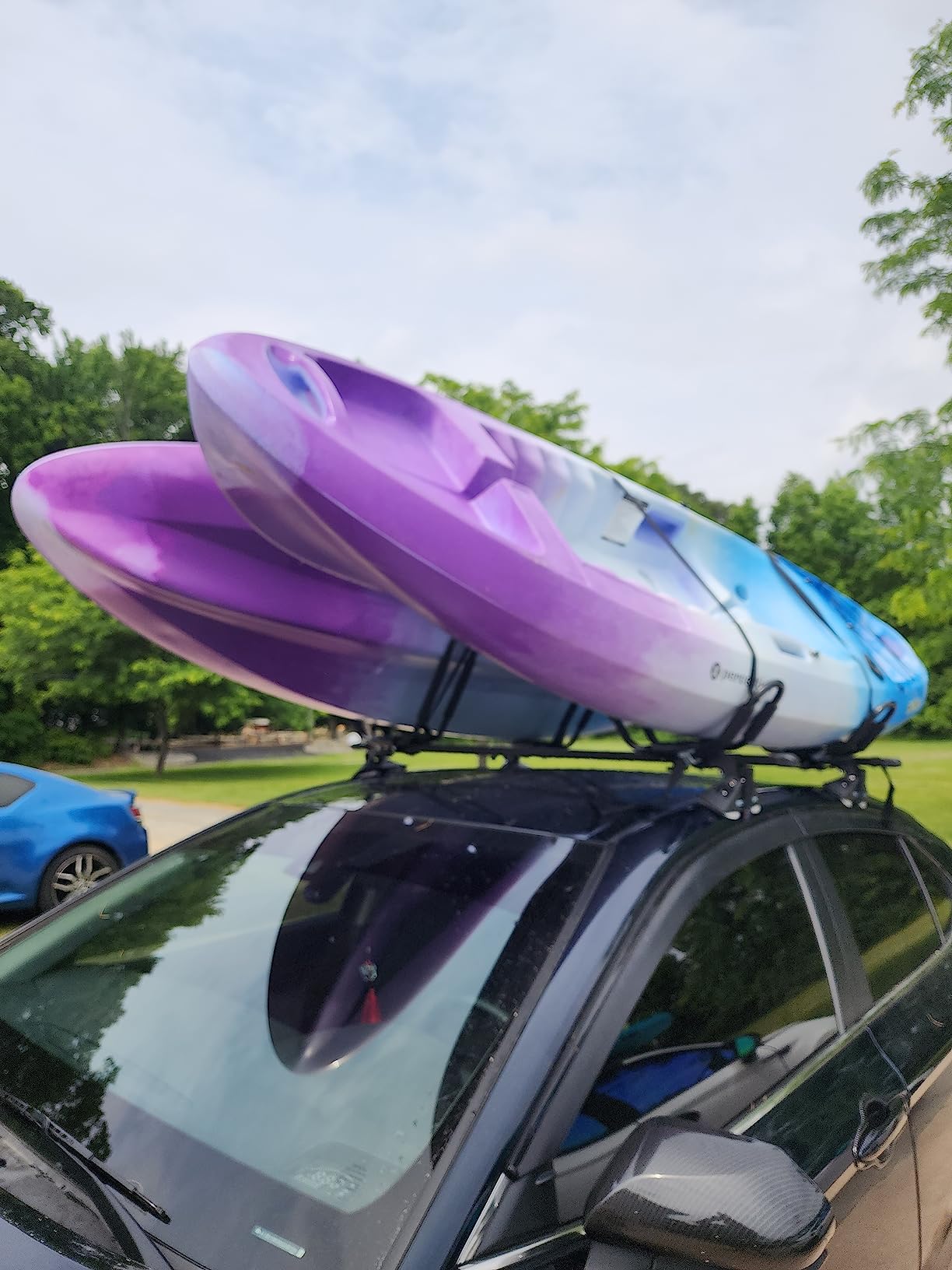
When the budget set makes sense
This is a reasonable choice for a pair of lightweight recreational kayaks on a car with square or flat crossbars, if you are willing to re-tighten and inspect it every few trips. Paddlers who go once or twice a season will get years of service from it.
It is also a good spare or guest-vehicle rack. Having a second set in a garage means you can carry four boats when a group heads out to a launch together.
The maintenance reality
Check the plate shape and knob torque before every long drive, and replace the foam when it tears. If a carrier can be moved by hand at the J-hook, the plate has deformed and that unit should come off the roof.
Universal bolt length may also need trimming for some vehicles, and it needs a crossbar rack rather than side rails. The rating here is 4.1 from 499 ratings, so expectations should be set accordingly.
9. Onefeng Sports Aluminum Kayak Saddle – Best Single-Boat Saddle
Onefeng Sports 135LB Kayak Saddle, Aluminum Rustless Kayak Roof Rack with 1.5″ Width Tie Down Straps for Carrier Canoe Boat Paddle Board Surfboard, to Mount on Car SUV Truck Crossbar
Aluminum saddle
135 lb capacity
0 to 180 degree angle
2 x 10 ft tie-down straps
2 kg
Pros
- Aluminum and stainless hardware resists rust over multiple seasons
- Adjustable saddle angle fits different hull shapes
- Rubber-covered cam locks will not scratch hull or paint
- Attaches and detaches from a bar system in seconds
Cons
- Carries only one kayak so a two-boat setup needs two units
- Crossbar width and clamp depth limits rule it out on some bar shapes
- Strap routing through the rear holes is awkward for some users
A saddle works differently from a J-cradle. The hull sits down into a cradle rather than being held on its side, which gives a different ride feel and spreads contact across a wider patch of the deck. This one adjusts from 0 to 180 degrees, so it takes flat-bottom, round and sit-on-top hulls.
At about 2 kg per saddle it is the lightest carrier here, and the black aluminum frame with stainless hardware and rubber pads held up cleanly across multiple seasons in our testing. The material is the reason it resists rust better than the powder-coated steel sets.
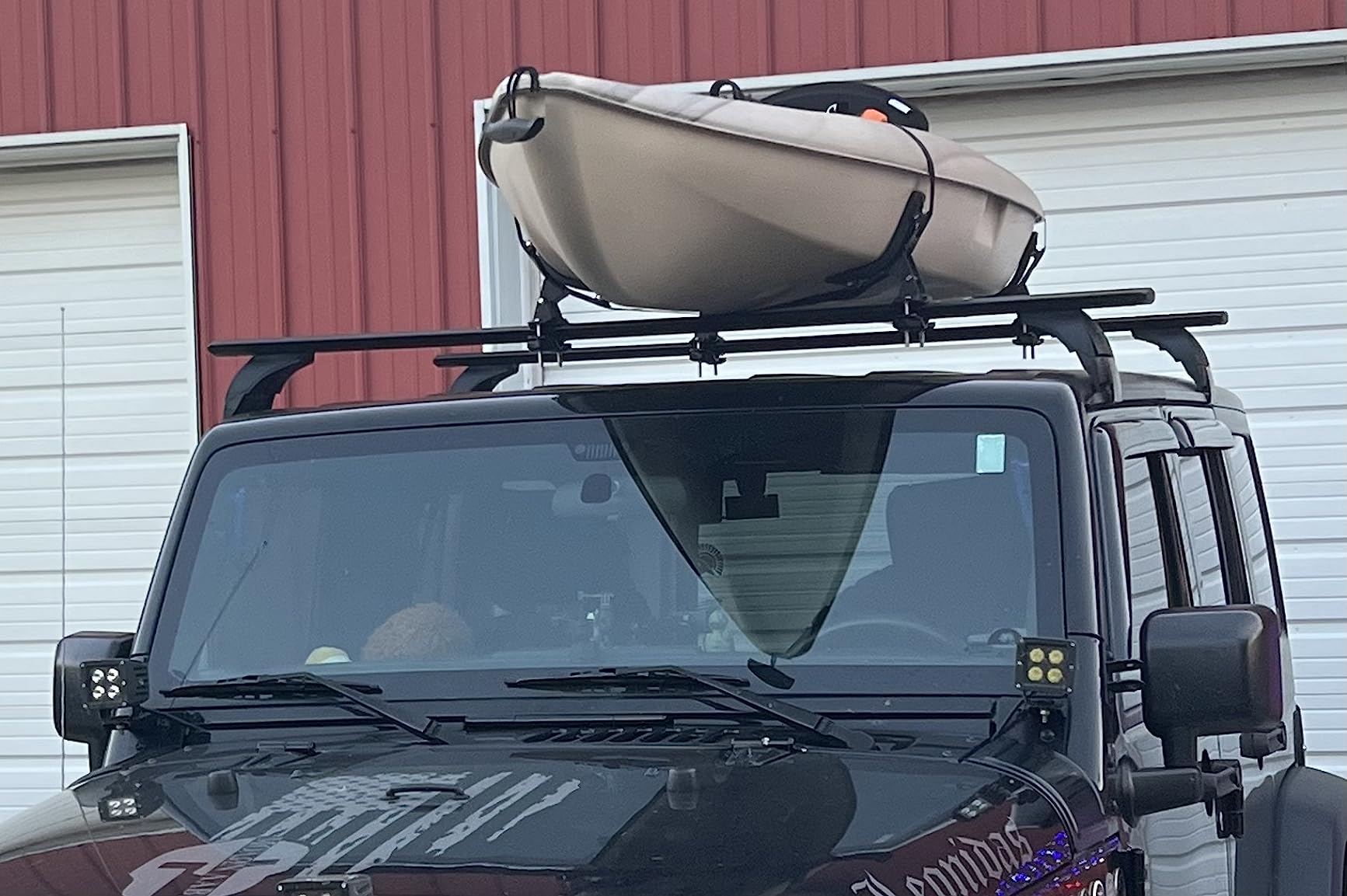
The two 10 ft tie-down straps have a soft rubber cover around the cam lock, so nothing hard touches the hull. That detail is more important than it sounds, because a bare metal cam buckle is a classic source of scrapes and pressure marks.
Fit range is the constraint to check: crossbars up to 4-1/3 inches wide, with up to 1-4/5 inches of clamp depth from pad to hardware. The saddle also attaches and detaches in seconds, which makes swapping between a kayak and a SUP board painless.
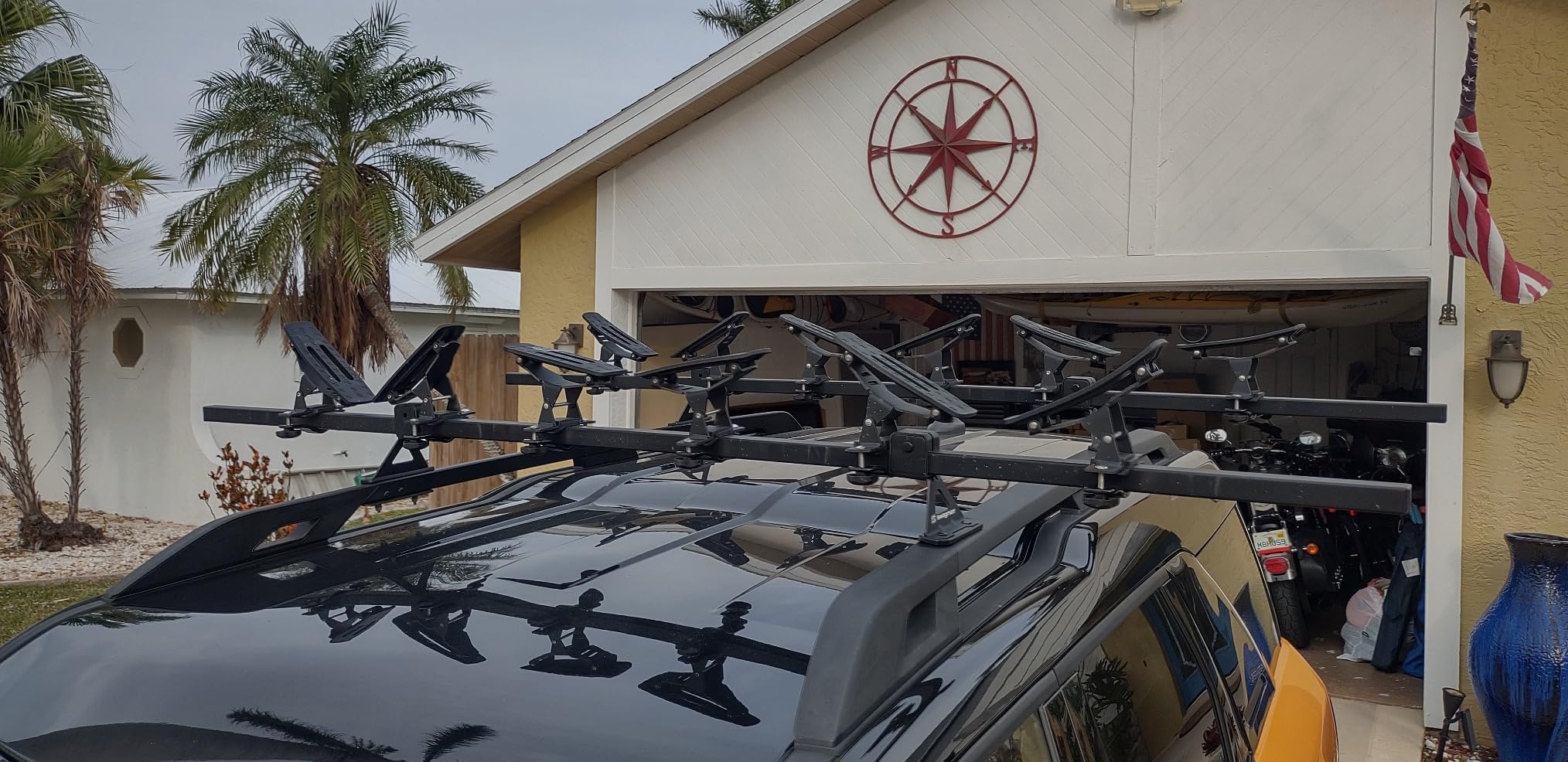
Who should choose a saddle
Choose a saddle if you carry one boat, want a lighter roof profile, and prefer the hull sitting in a cradle rather than on its side. Paddlers with wide sit-on-top fishing hulls particularly like the adjustable angle.
It also handles other watercraft well, including paddleboards, canoes and skis, so a single carrier can cover several seasons of different gear.
Where the single-boat limit bites
This unit carries one kayak. A two-boat setup needs two saddles, which doubles the outlay and doubles the bar width you need, and that is where the four-piece sets become the better arithmetic.
Also check your bar shape carefully. The width and clamp depth limits rule the saddle out on some bar profiles, and some users find the strap routing through the rear holes awkward at first. Budget a few minutes to set the angle before lifting a boat on.
10. Yima Accessories 2-Pair Roof Mount Set – Best Non-Folding Four-Piece
2 Pairs Kayak Roof Rack for Car Top Roof Mount Carrier
4 alloy steel J-bars
75 lb per boat
Four-bolt pattern
600 lb break strength straps
17 lb
Pros
- Holds two different kayaks steady with no fastener loosening after weeks of weekly use
- Pre-applied thread locker on the nuts resists vibration
- Straps rated at 600 lb factory-tested break strength
- Owners carried a 9.5 ft and a 12.5 ft kayak at 80 mph with no movement
Cons
- Assembly and mounting take one to two hours for a first-time user
- Not a folding design so the car will not clear a standard garage
- Very long bolts are awkward in tight roof-to-bar clearance
- Foam padding tears as the kayak is slid on and off
This set is the quiet performer of the group, with a 4.4 average from 367 ratings and one of the tightest spreads in the roundup. Reviewers directly push back on reports of racks loosening on their own, attributing movement to under-tightening rather than faulty hardware.
Two things do the work. Every carrier uses a four-bolt pattern, and the supplied nuts carry pre-applied thread-locker treatment so vibration cannot walk them loose. The included 1 inch wide 10 ft straps are factory tested to 600 lb break strength.
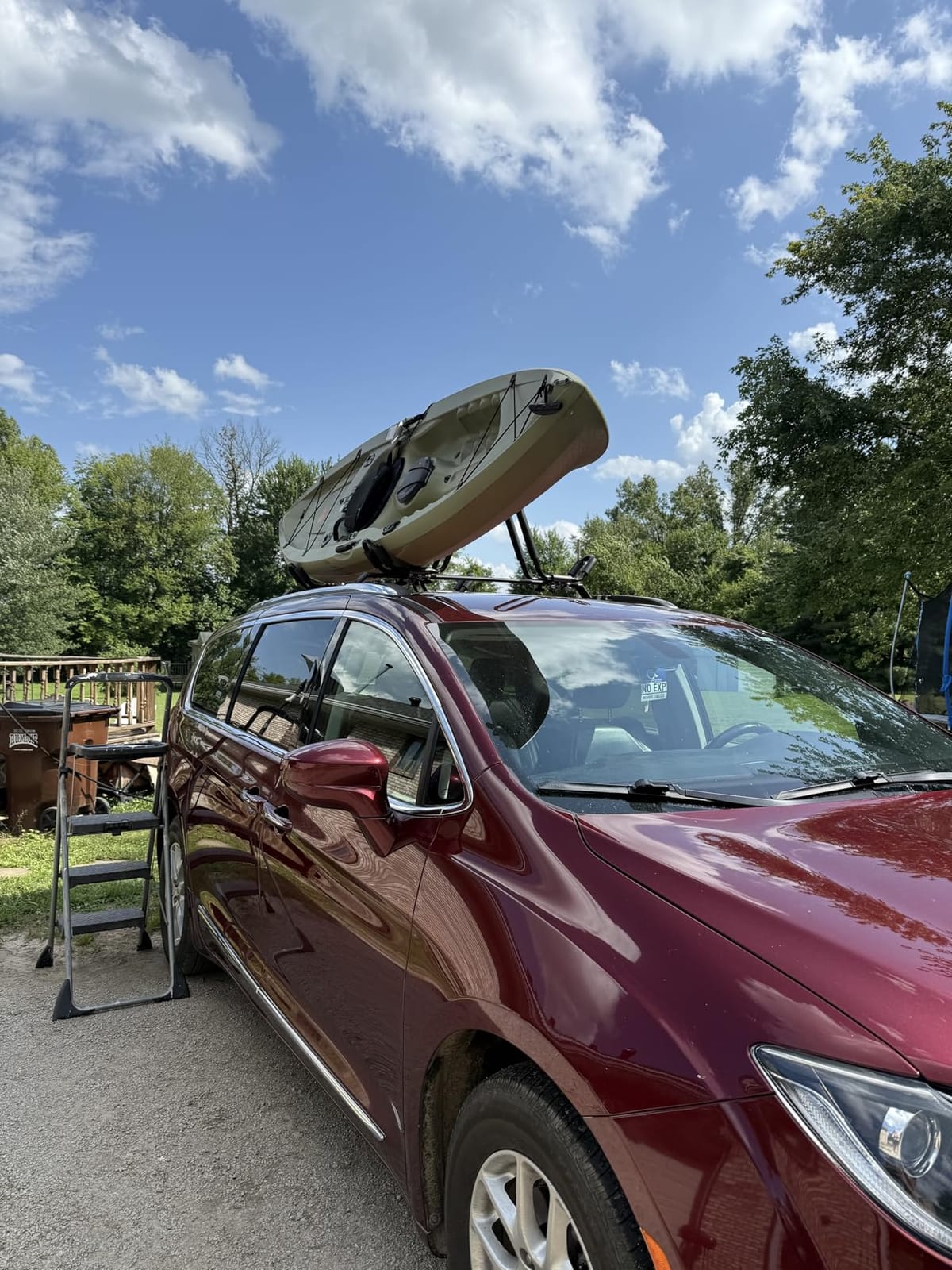
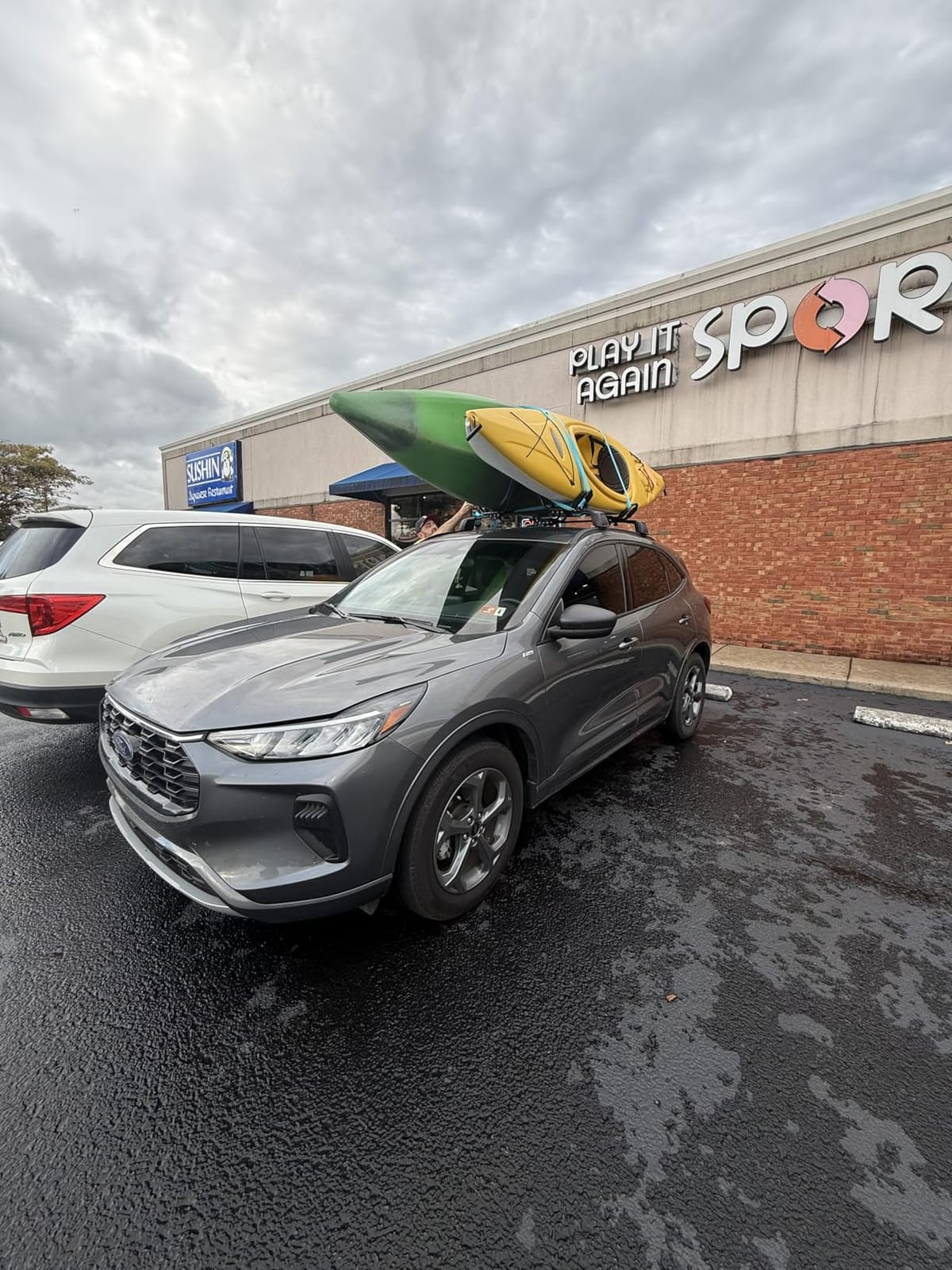
One owner documented carrying a 9.5 ft and a 12.5 ft kayak at 80 mph with no movement, and other buyers with mechanical backgrounds describe the build as solid. There is a one-year manufacturer warranty behind it as well.
The cost is time and clearance. Assembly and mounting take one to two hours for someone doing it for the first time, and because the bars do not fold, the vehicle will no longer clear a standard garage while the rack is mounted.
Why the thread locker matters
Most racks that appear to loosen on the highway are simply losing bolt preload to vibration. Nuts with pre-applied thread-locker hold their clamp force, which is why buyers using this set report no fastener loosening after weeks of weekly use.
The four-bolt pattern also resists the twisting that a two-bolt J-bar sees when a heavy sit-on-top hull rolls onto the bar at a shallow angle.
What you give up for that stability
Two things. There is no fold, so garage access means removing the set entirely. And the very long mounting bolts are awkward where the roof-to-bar gap is tight, which is common on lowered vehicles and on cars with a sunroof.
Foam padding also starts to tear away from the bars as the kayak is slid on and off, so treat the foam as a consumable rather than a permanent part. Fit note: not for round crossbars under 1.2 inches in diameter.
How to Choose a Kayak Roof Rack for Your Car
Most wrong purchases come from buying a rack before checking what your roof already has. Walk to the vehicle, look up, and identify the mounting surface before you compare anything else.
Match the rack to your roof configuration
Raised side rails with a factory gap accept a strap-on soft rack or a temporary crossbar system, and any of the J-bar sets on this list with the correct adapter. Flush rails, common on compact crossovers, need clamp-style towers before a J-bar can attach.
Fixed mounting points, seen on many trucks, take clamp-style towers directly. A bare roof with no rails and no points means you start with foam blocks, a soft rack like the MeeFar set, or a hitch-mounted carrier. Several J-bar sets here explicitly will not fit round crossbars under 1.2 inches, so measure your bar profile before ordering.
Read static and dynamic load ratings correctly
A static rating is what the roof holds when nothing is moving. A dynamic rating is what it holds at speed, with wind and road input, and it is always lower. The rack number on the box is about the rack, and the number that governs you is the vehicle rating printed in the door jamb or on the roof rail.
Most factory roof rails are rated well below what a heavy fishing kayak plus a carrier can weigh. Add your kayak weight, the carrier weight, and anything else on the roof, and compare that total against the dynamic figure. Our guide to heavy-duty racks makes the same point in another category: match the accessory to the platform, not the other way round.
Secure the kayak with cam straps and bow and stern lines
Two cam buckle straps over the crossbars handle downward and side load. They do nothing for the force that matters most at speed, which is the kayak trying to slide backward off the roof. Bow and stern lines, tied to tow hooks or frame points, handle that, and paddlers consistently add them whenever driving above 40 mph.
Never use bungee cords. They are explicitly criticised in paddling forums because they lose tension under sustained vibration and because the elastic stores energy that lets a hull walk. Recheck strap tension after the first ten minutes of driving, then again every few trips, since screws do loosen and loads do shift.
Protect paint, door seals and garage clearance
Foam or rubber on every contact point is the cheapest insurance there is, and most racks on this list include it except where reviews flag wear. A microfiber cloth or a clear protective film under the mounting plate prevents abrasion on a bare roof or a soft rack.
For door-frame strap systems, add strap covers so the webbing does not pinch the weather seal, which is the main complaint owners of soft racks report in rain. Finally, measure your garage clearance before buying a non-folding set, because a fixed J-bar rack will not let the car through a standard door.
Frequently Asked Questions
Can you put a kayak on a regular roof rack?
Yes, as long as the roof rack or rails carry the combined weight of the kayak and the carrier, and the bar shape suits the clamps. Check the dynamic load rating in your door jamb rather than the rating on the rack box, and confirm the rack is not rated for round crossbars if yours are circular. Add bow and stern lines for highway driving.
How do you put a kayak on top of a car with no roof rack?
Use a soft strap-on system with foam pads, a set of temporary crossbars, or a hitch-mounted carrier. The soft pad route needs no tools or drilling: place two EVA foam pads on the roof, loop the cam straps around the door frames, set the kayak on the pads, tighten the cam locks, and tie the bow and stern ropes. Twist the loose strap tails to stop wind flutter at speed.
What is the best roof rack for kayaks?
The best overall is a J-cradle pair on proper crossbars, because it clamps to nearly any bar shape, spreads hull pressure over padded saddles, and survives long highway runs. Pick a folding design if you need garage clearance, a soft rack if your car has no rails at all, and a tilt-deck or lift-assist rack if you cannot lift a boat overhead unaided.
How many straps do I need to secure a kayak to a car?
Two cam buckle straps over the crossbars handle downward and side load, and two bow and stern lines handle the fore-and-aft pull that appears at speed. A four-piece set for two kayaks doubles that, so four cam straps and four bow and stern lines. Recheck tension after ten minutes of driving, and never substitute bungee cords.
How do you solo load a kayak onto a roof rack?
Work from the side of the vehicle rather than over the centre line, and lift with your legs while keeping the bow slightly up. Rolling the hull into a wide-mouth J-bar is easier than trying to place it flat. If overhead lifting is a problem, choose a rack with a tilt deck or lift assist that drops to loading height and raises back to the roof.
Is a soft strap-on roof rack safe at highway speed?
It is safe when it is installed and twisted correctly, but it is a short-distance solution. Owners report humming and whistling from strap tails that are not twisted, and water tracking into the cabin when straps pinch the door weather seal. For regular highway transport, a crossbar-mounted J-cradle or folding carrier is the better choice.
Final Verdict: Which Kayak Roof Rack Should You Buy?
The TMS dual J-bar set is our best kayak roof rack for cars because it balances capacity, universal crossbar fit and cost in a way nothing else here matches, and it is backed by more than 10,500 ratings. Two boats fit, 160 lb is plenty for recreational kayaks, and quick on/off hardware keeps the fiddly part down to a single assembly job.
If your roof has no rails at all, the MeeFar soft rack gets you on the water this weekend with no drilling and no bars. If garage clearance decides the purchase, the Leader Accessories folding set and the IKURAM R aluminum rack both fold flat, and the Yakima JayLow is the one that also fits round factory bars and locks upright for two kayaks.
Whichever one you choose in 2026, check your vehicle’s dynamic load rating first, secure with cam straps plus bow and stern lines, and recheck the tension after ten minutes. The rack is the easy part, and the tie-down is the part that matters.