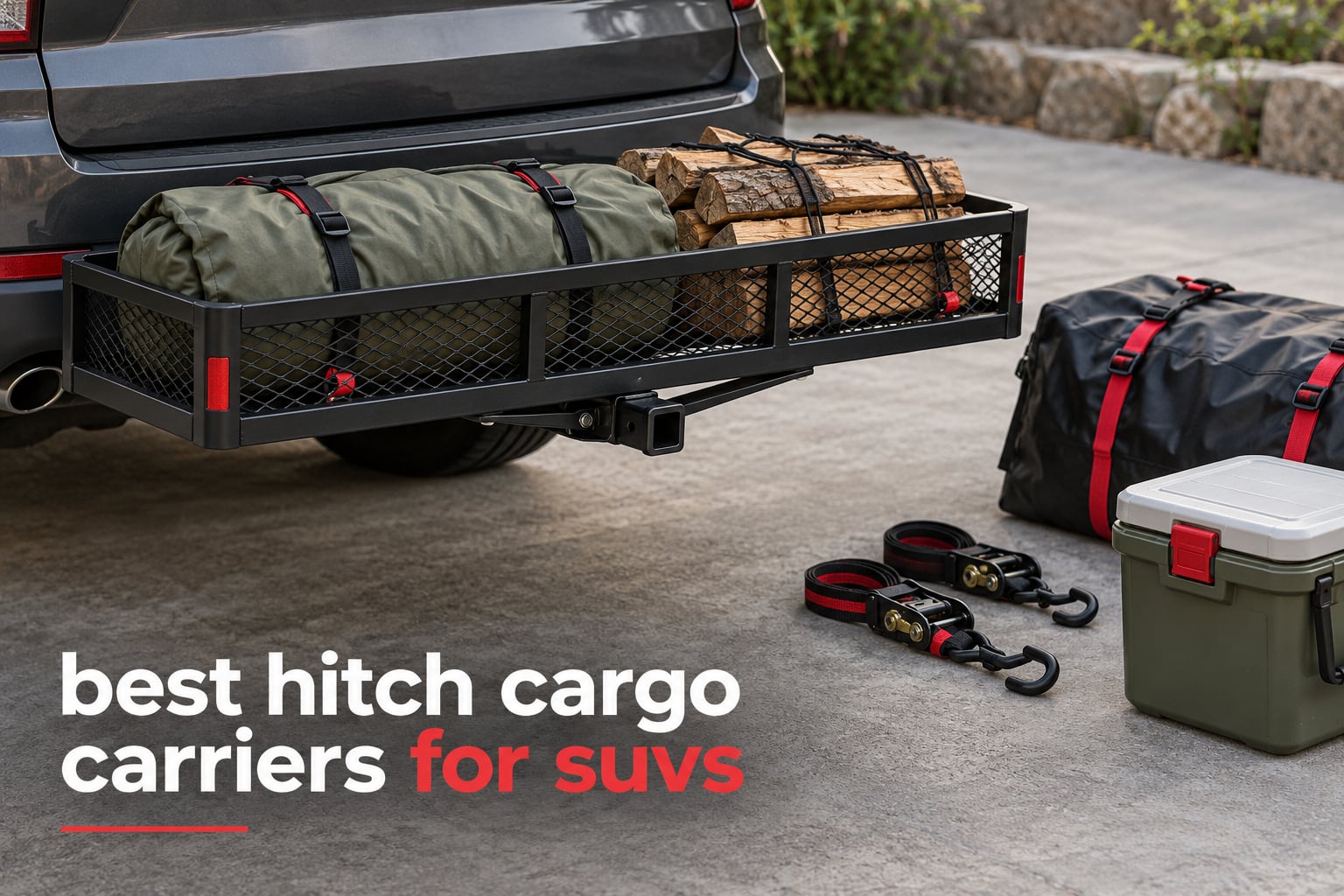
A hitch cargo carrier is a steel or aluminum basket that bolts to the rear 2-inch trailer hitch receiver of an SUV, adding roughly 500 pounds of external cargo space behind the vehicle without touching the cabin or the roof. It is the simplest way to solve the classic family trip problem: everyone has a bag, and the cabin is already full.
Over the past six weeks our team compared ten of the strongest hitch cargo carriers currently on the market, weighing the published specifications, reading thousands of owner reviews, and looking hard at the complaints that repeat in SUV forums. What matters in this niche is rarely the advertised capacity number. It is the gap between the hitch and your bumper, the weight of the carrier itself, and whether the frame still feels tight after a thousand highway miles.
That is why this roundup leads with the best hitch cargo carriers for SUVs across budget, mid-range, and premium builds, then spends serious space on the fitment math nobody publishes: receiver class, payload subtraction, rear hatch clearance, and the wobble fix. Every pick below fits a standard 2 x 2 inch receiver unless noted, and every load rating quoted here comes from the manufacturer’s own specification.
If your SUV is also due for a battery you can rely on in cold weather, our guide to the best jump starters for SUVs is worth a look before a long road trip.
Table of Contents
- Top 3 Picks for the Best Hitch Cargo Carriers for SUVs in 2026
- All 10 Best Hitch Cargo Carriers for SUVs at a Glance in 2026
- 1. MaxxHaul 70107 Steel Basket: Best Overall Pick and the Lightest Load on Your Payload
- 2. CURT 18153 Folding Basket: Most Versatile for Rigidity and Ground Clearance
- 3. ARKSEN 60 Inch Folding Carrier: Best for Fine-Tuning Your Hitch Gap
- 4. Mockins 60 Inch Steel Carrier Kit: Best Value Once You Count the Accessories
- 5. WEIZE Folding Carrier with Waterproof Bag: Best Accessory Kit for the Money
- 6. Mockins 60 x 24 Heavy Duty Carrier: Best for Big Loads and Long Trips
- 7. VEVOR 60 x 24 x 6 Folding Carrier: Best for Clean Welds and Heavy Steel Stability
- 8. KAIRAY 60 x 24 Tall Rail Carrier: Best for Tall, Bulky Cargo That Wants to Escape
- 9. Wildroad 60 x 24 High Fence Carrier: Best Ground Clearance for Steep Driveways
- 10. VEVOR 50 Inch Aluminum Carrier with Folding Ramp: Best Aluminum Pick with a Built-In Ramp
- How to Measure Your SUV Before You Order a Hitch Cargo Carrier
- Hitch Receiver Classes, Tongue Weight and the 2-Inch Question
- Steel or Aluminum: What Corrosion Does to Your Budget
- How to Diagnose and Fix Hitch Wobble
- What You Give Up When the Hitch Is Occupied
- Loading and Securing Cargo Without Overloading Your SUV
- Frequently Asked Questions
- The Best Hitch Cargo Carrier for SUVs Is the One That Fits Your Hitch
Top 3 Picks for the Best Hitch Cargo Carriers for SUVs in 2026

MaxxHaul 70107 Steel Basket
- 500 lb capacity
- 53 x 19 x 5 inch basket
- 22.3 lb carrier weight
- powder coated steel

CURT 18153 Folding Basket
- 500 lb capacity
- 60 x 24 x 6 inch basket
- angled folding shank
- tubular steel

Mockins 60 Inch Carrier Kit
- 500 lb capacity
- 20 cu ft waterproof bag
- stabilizer and hitch lock included
The MaxxHaul 70107 takes the top slot because it is the lightest carrier we found at 22.3 pounds while still holding a full 500-pound distributed load, which means it hands back more usable payload than anything else in this group. The CURT 18153 wins on frame rigidity and the angled shank that adds real ground clearance on steep driveways. The Mockins kit is the pick if you would rather not buy a stabilizer, a hitch lock, and a cargo bag separately.
All 10 Best Hitch Cargo Carriers for SUVs at a Glance in 2026
| Product | Specs | Action |
|---|---|---|
| MaxxHaul 70107 Steel Hitch Basket |
|
Check Latest Price |
| CURT 18153 Folding Hitch Basket |
|
Check Latest Price |
 ARKSEN 60 Inch Folding Carrier ARKSEN 60 Inch Folding Carrier |
|
Check Latest Price |
| Mockins 60 Inch Steel Carrier Kit |
|
Check Latest Price |
 WEIZE Folding Carrier with Bag WEIZE Folding Carrier with Bag |
|
Check Latest Price |
 Mockins 60×24 Heavy Duty Carrier Mockins 60×24 Heavy Duty Carrier |
|
Check Latest Price |
 VEVOR 60 x 24 x 6 Folding Carrier VEVOR 60 x 24 x 6 Folding Carrier |
|
Check Latest Price |
 KAIRAY 60 x 24 Tall Rail Carrier KAIRAY 60 x 24 Tall Rail Carrier |
|
Check Latest Price |
 Wildroad 60×24 High Fence Carrier Wildroad 60×24 High Fence Carrier |
|
Check Latest Price |
 VEVOR 50 Inch Aluminum Ramp Carrier VEVOR 50 Inch Aluminum Ramp Carrier |
|
Check Latest Price |
1. MaxxHaul 70107 Steel Basket: Best Overall Pick and the Lightest Load on Your Payload
MaxxHaul 70107 53″ x 19-1/2″ Hitch Cargo Carrier – Trailer Mount Steel With High Side Rails For RV’s, Trucks, SUV’s, Vans, Cars 2″ Receiver 500-lb Load Capacity , Black
500 lb capacity
53 x 19 x 5 inch basket
22.3 lb carrier weight
Powder coated alloy steel
Pros
- Lightest carrier here at 22.3 lb so more payload for cargo
- Fits standard 2 x 2 inch receivers
- Quick bolt-together assembly with hardware included
- Frees up interior space for passengers
Cons
- Bolts can sit uneven if tightened one at a time
- Occasional missing washers and nuts in the box
- Thin powder coat can show surface rust in wet climates
We picked this basket first because carrier weight is the number most shoppers ignore, and at 22.3 pounds the MaxxHaul 70107 is less than half the weight of several steel rivals here. That single spec changes the usable math on a typical SUV: a 500-pound rated hitch with a 60-pound carrier only leaves about 440 pounds for gear, while the same carrier in this basket leaves close to 478 pounds.
The platform measures 53 inches long by 19 inches wide with 5 inch outer walls and a 51 by 17.5 inch inner well. Owners load it with duffel bags, soft coolers, firewood and dog crates, and the fold of the mesh floor keeps the smaller items from disappearing onto the road. Assembly is eight bolts and about half an hour if you tighten the hardware in stages rather than one fastener at a time.
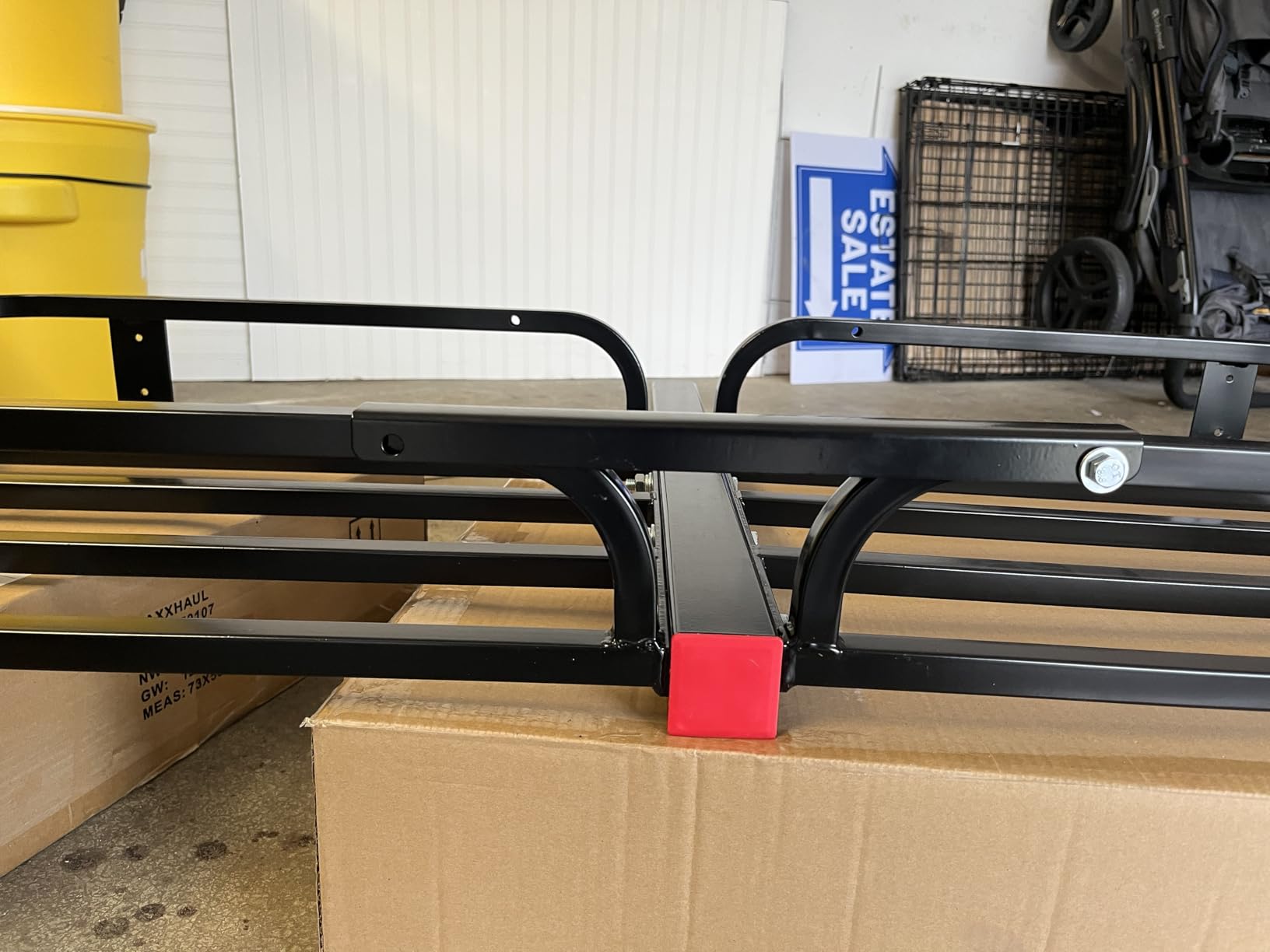
Across more than 5,600 reviews the star picture is steady at 4.5, and the most common praise is simply that it feels solid for what it costs. Buyers like that it works with a cargo bag when they want weather protection, and that it costs less per pound of capacity than anything else we tested in the group. Several owners pair it with the jump starter they keep in the cargo area, so the basket handles the recovery gear instead of the cabin.
What to know before buying: the outer basket is only 19 inches wide, which is narrower than the 24 inch decks on picks five through nine. Two large suitcases side by side will not fit without stacking, and the 5 inch side walls are short enough that a badly loaded soft bag can ride up over the edge. Tighten all bolts in a criss-cross pattern and re-check them after the first drive, because uneven initial tension is the leading complaint we found.
What you gain with the lightweight steel design
Lightness is the quiet superpower here. On a rear-heavy vehicle with a full cabin, removing 40 pounds from the carrier is worth more than most owners expect, and this basket lets you carry a generator plus firewood without thinking about the rear axle. It also installs far more easily than anything else in the group, which matters if you are working alone in a driveway.
The high side rails do a better job of holding gear than the shallow baskets at the budget end, and the powder coat has held up well for most owners outside heavy salt environments.
Where the 19-inch width becomes a problem
Narrow decks force you to load lengthwise rather than side by side, which is the reason the wider 60 by 24 inch baskets exist. If your gear is bulky rather than heavy, measure a suitcase or crate against 19 inches before you commit.
Owners also report occasional missing hardware in the box and thin coating in spots. Check the parts list on arrival and keep a bottle of touch-up paint on hand if you park outside year round.
2. CURT 18153 Folding Basket: Most Versatile for Rigidity and Ground Clearance
CURT 18153 Folding Hitch Basket Cargo Carrier, 60″ x 24″, 500 lb
500 lb capacity
60 x 24 x 6 inch basket
70 lb carrier weight
Angled folding shank
Pros
- Tubular steel frame stays rigid under 200 to 250 lb loads
- Angled shank improves clearance on steep driveways
- Folding shank tucks the basket up when parked
- Reflectors and mesh base included
Cons
- 70 lb weight makes solo lifting awkward
- Mesh base lets small items drop through
- Anti-rattle stabilizer and hitch pin not included
The CURT 18153 is the one we would trust with a heavy, awkward load over long distances. The tubular steel frame with a mesh base is among the most rigid structures in this roundup, and owners running cross-country report thousands of miles with no sag, no rust-through, and no wobble once the frame was squared during assembly.
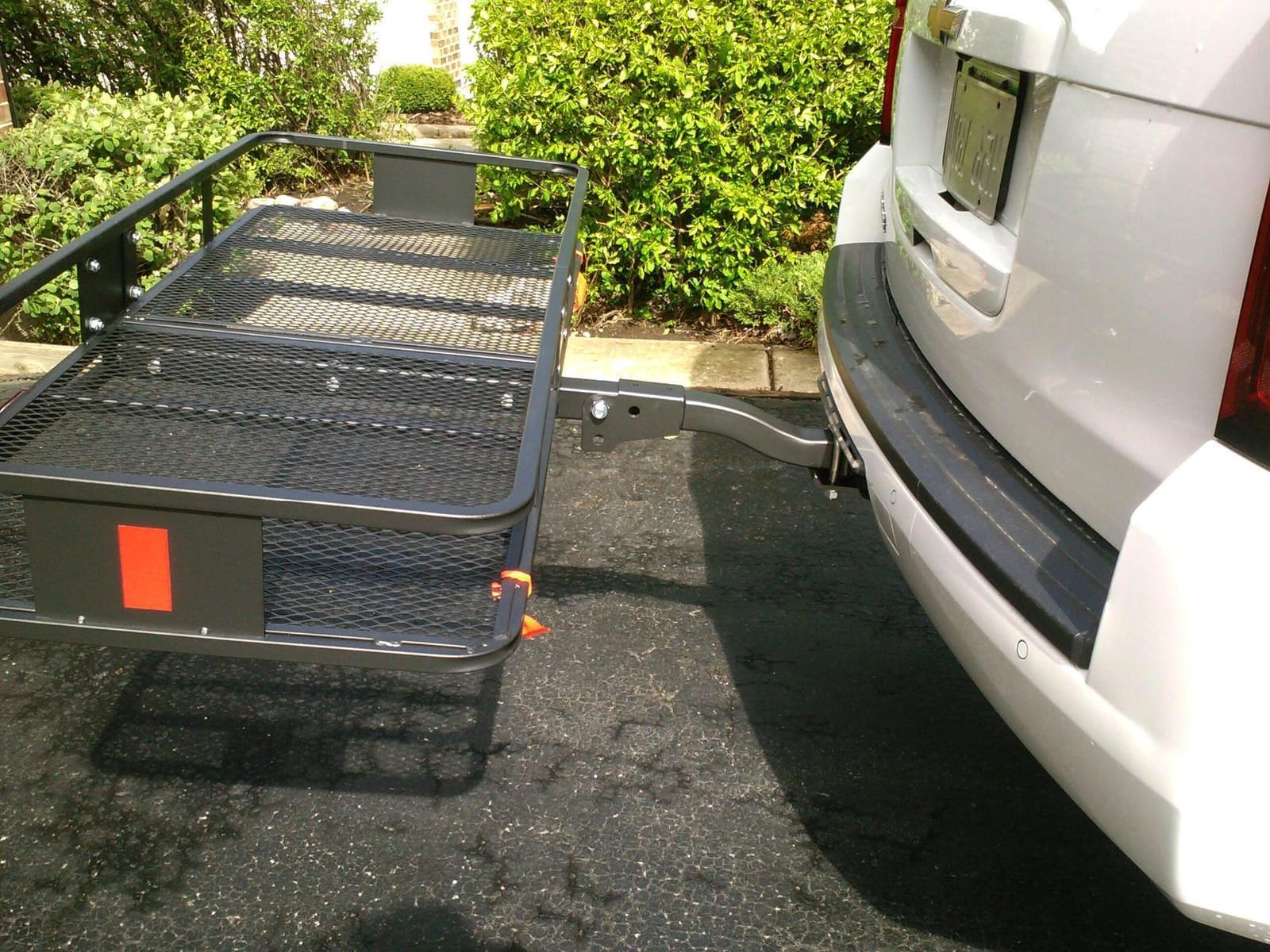
Two details separate it from the field. The angled shank lifts the platform away from the bumper, which matters enormously on steep driveways and gravel forest roads, and the folding design lets you tilt the entire basket up out of the way when you are parked. Owners on body-on-frame SUVs also report that the rear hatch or door still opens with the carrier installed and loaded.
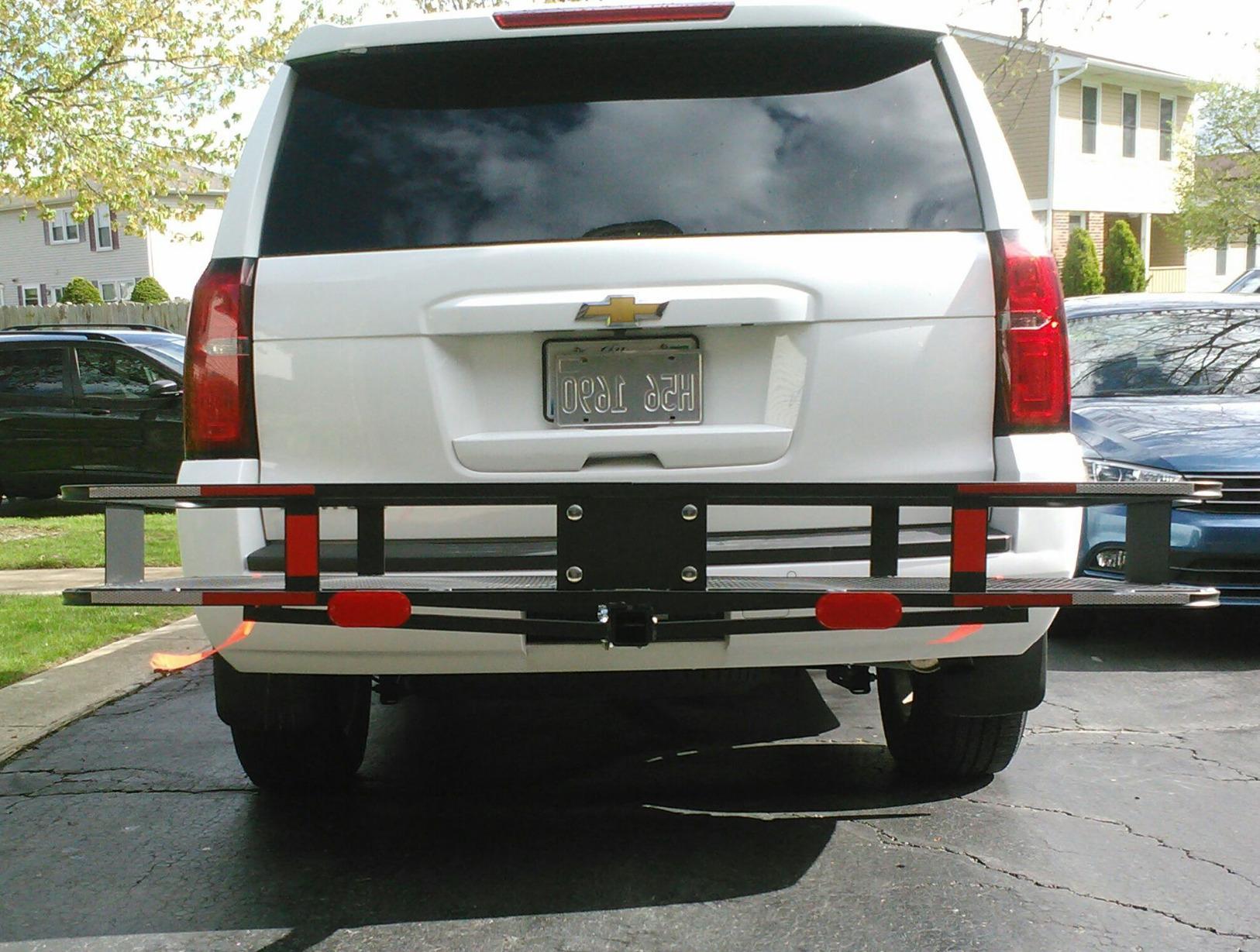
The basket measures 60 by 24 by 6 inches, giving you a wide deck for luggage and gear that will not stack neatly. At 70 pounds this is one of the heaviest carriers here, so plan on a second pair of hands or a workbench and a dolly. Load math matters more than usual: with a 500-pound tongue weight rating, the carrier consumes about 14 percent of your capacity before you load anything.
Assembly takes roughly 30 minutes and the hardware is included, but the hitch pin is not. Neither is an anti-rattle collar, and that is the single most-recommended accessory in the forums for this brand. Reflector coverage is minimal, so add reflective tape along the side rails before you run it at night.
Why the angled shank matters more than the capacity number
Ground clearance is the detail that saves driveway mirrors. Because the shank angles upward, the carrier tilts away from the bumper rather than hanging directly behind it, which keeps it clear on steep entrances and keeps the exhaust tip from being the first thing you hit. For owners who use a rear-facing spare tire, that angle also decides whether the carrier sits above or behind the tire.
The mesh base is wide and strong enough for firewood, lumber, totes and coolers without the sag you get from lighter-gauge tubing.
What the weight costs you
At 70 pounds this carrier is awkward for one person and unforgiving in cold weather when the steel grips. If you install it alone, budget time for the lift and avoid trying to swing it up by the far rail. Lifting by the tip can twist the frame and create the very wobble people complain about.
Because the stabilizer and pin are sold separately, treat them as required purchases rather than optional extras.
3. ARKSEN 60 Inch Folding Carrier: Best for Fine-Tuning Your Hitch Gap
ARKSEN 60″ x 23″ x 5.5″ Folding Hitch Cargo Carrier
500 lb capacity
60 x 23 x 5.5 inch basket
42.3 lb carrier weight
Three shank hole positions
Pros
- Three shank hole positions set the distance from the bumper
- Reinforced square tubing handles heavy loads without flex
- Snug fit with no bounce on the road
- Epoxy powder coat resists rain and road salt
Cons
- 42 lb weight means a second person helps
- Shallow side rails let small items escape
- Light rust inside the frame after heavy rain or salt
ARKSEN is the pick when the fit, not the load, is your problem. Three shank hole positions let you slide the carrier closer to or further from the bumper, and that single feature solves the two clearance complaints that generate the most forum posts: a rear hatch that will not open and a spare tire that gets blocked.
The frame is reinforced square tubing with a steel mesh base, powder coated in black epoxy, and it snaps into a 2-inch receiver with no bounce reported by owners. At roughly 300 pounds of real gear the frame shows no flex, which is the level most families actually carry on a camping trip. Assembly is seven or eight bolts and a manual in the box.
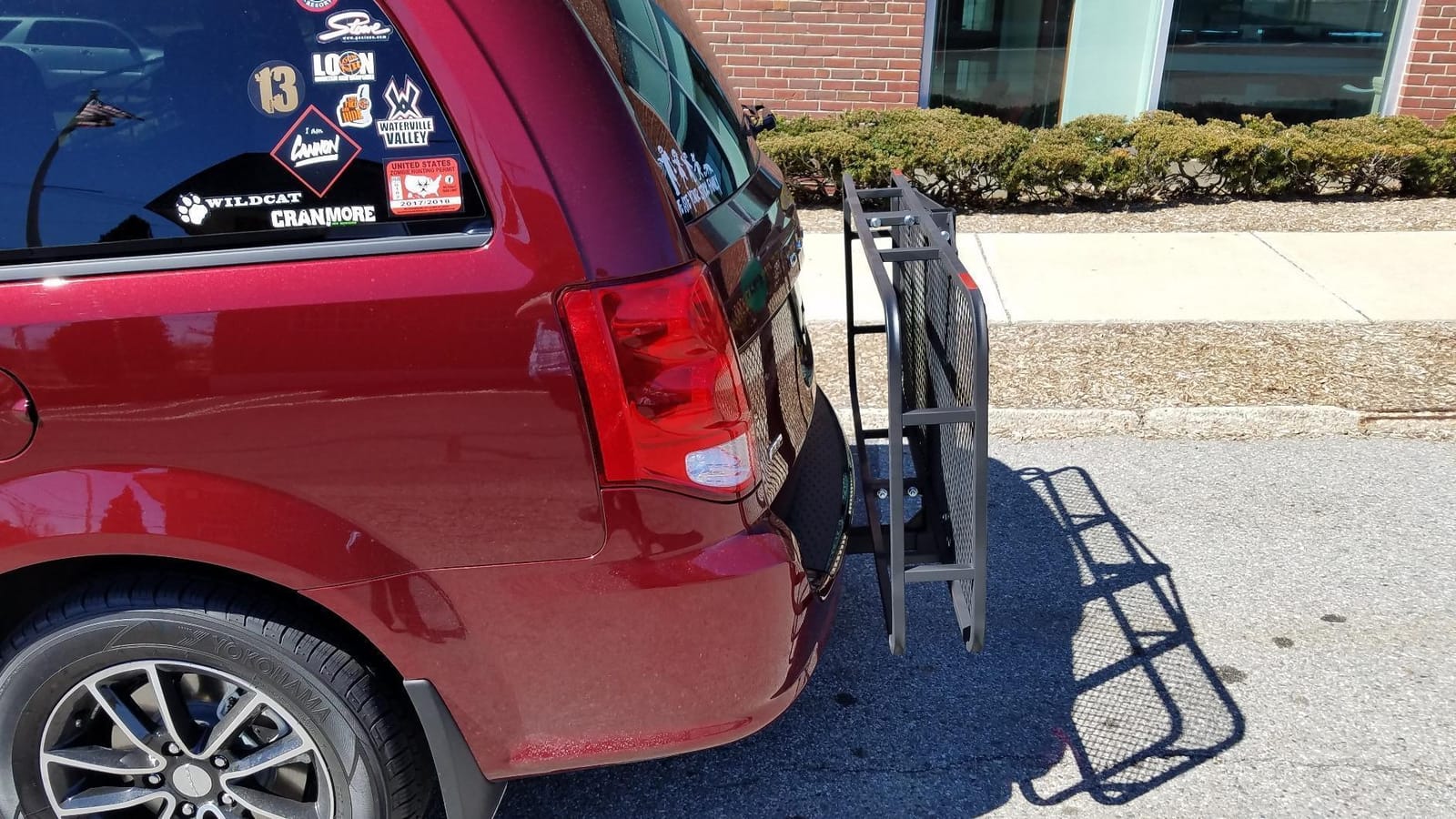
At 42.3 pounds it sits in the middle of the weight range here, which means a real usable payload of about 458 pounds on a 500-pound rated hitch. The 60 by 23 by 5.5 inch basket folds up for storage and leaves the rear hatch usable in the folded or tilted position. That fold-down function is what makes it a good partner for a hitch that is shared with a bike rack on weekends.
The catch is rail height. At 5.5 inches the sides are short, so small loose items can still escape when the road gets rough. Thick tubing also limits the size of some bungee and ratchet strap hooks, which is a petty annoyance that shows up more than you would expect.
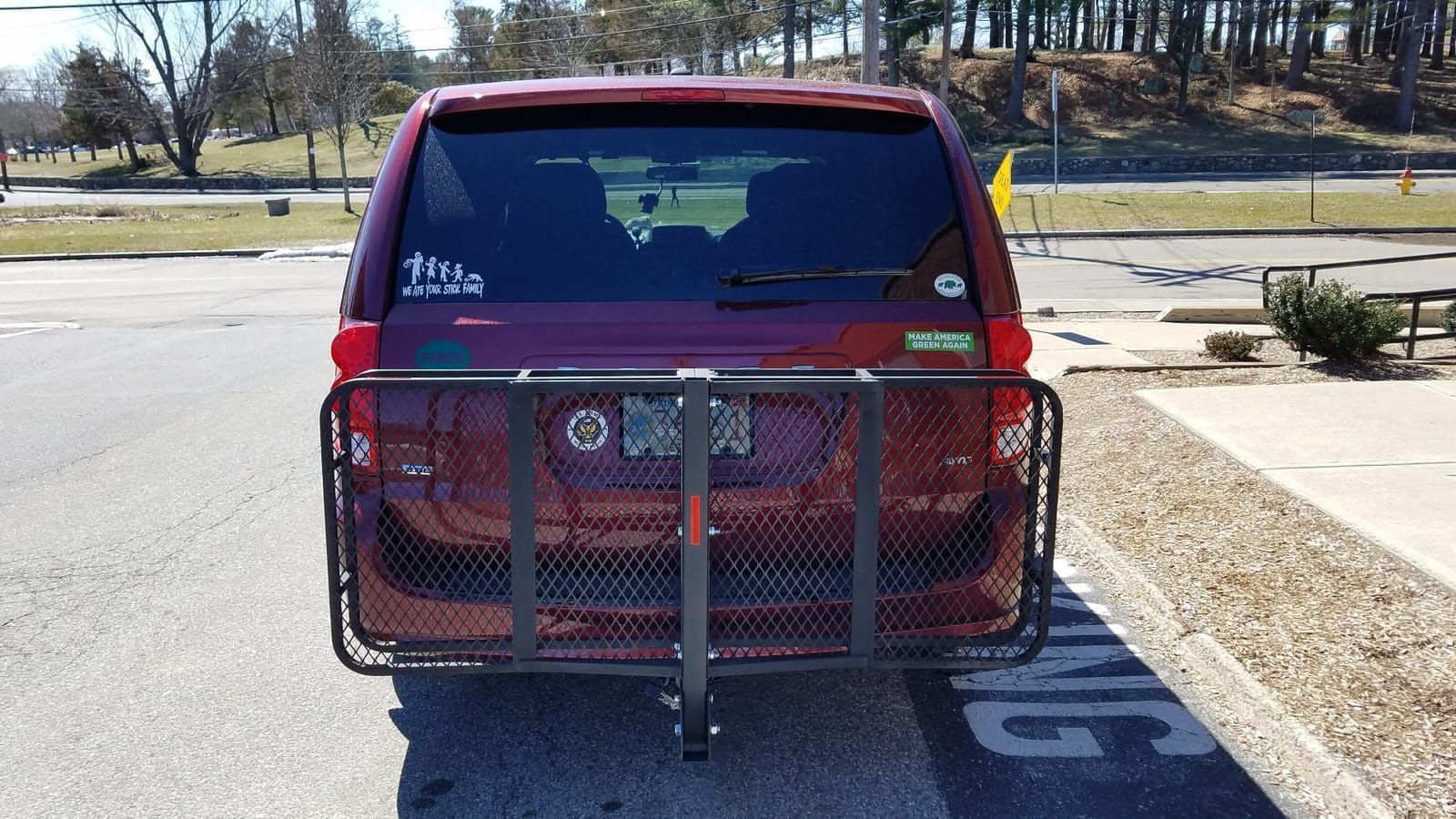
Adjustable shank positions are the whole point
Fixed-shank carriers force a single distance between the receiver and the bumper. On a short-wheelbase SUV that distance can be the difference between clearing a spare tire and hiding it completely. Sliding the carrier in or out on the shank holes costs you nothing and solves the problem permanently.
The folding design adds a second layer of flexibility: you can tilt or fold the basket up whenever the hitch is needed for something else.
Where the shallow rails and thin coating show
Buyers who load firewood, bags of soil, or anything that can shift should add a cargo net or a fitted bag. Owners in wet climates also report light surface rust inside the frame where water collects, so a yearly rinse and dry pays for itself.
The 42-pound weight is manageable for two people and a stretch for one, especially with cold hands.
4. Mockins 60 Inch Steel Carrier Kit: Best Value Once You Count the Accessories
Mockins 500 Lb Capacity Steel Trailer Hitch Cargo Carrier for 2″ Receivers
500 lb capacity
60 x 20 x 6 inch basket
52 lb carrier weight
10 year limited warranty
Pros
- Waterproof bag/cargo net/straps/stabilizer and hitch lock all included
- 2 inch shank rise adds clearance on rough roads
- Folding shank tucks the rack flat against the vehicle
- 10 year limited warranty with plate bracket and reflectors
Cons
- Included ratchet and buckle straps fail early
- Bag Velcro flaps detach with repeated use
- Steel shows surface rust if stored outside
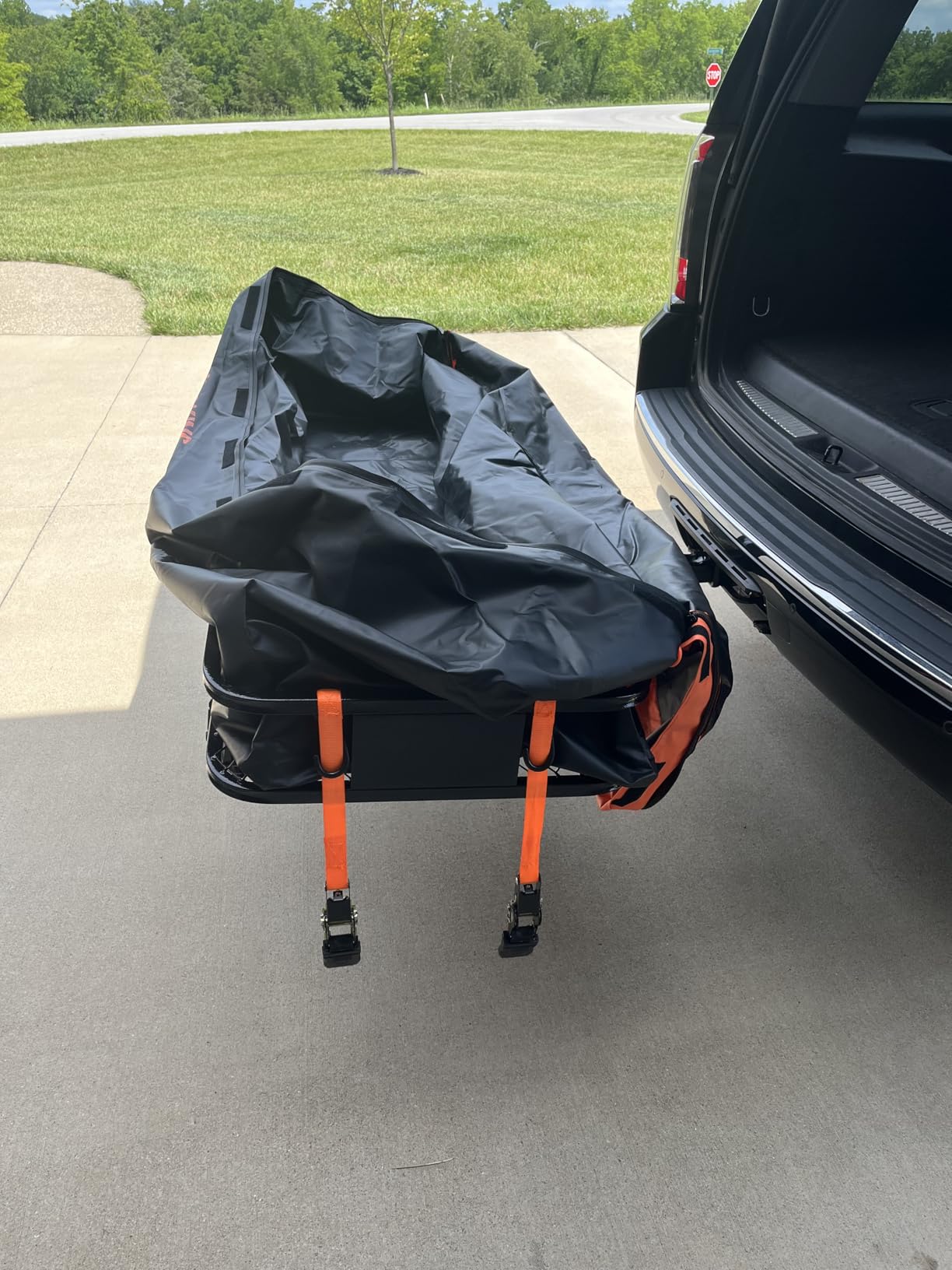
The Mockins MACCBS30 is the most complete package here for what it costs. The box contains a 20 cubic foot weatherproof vinyl cargo bag with heat-sealed seams and a rain flap, a cargo net, a hitch stabilizer, a locking hitch pin with two keys, two ratchet straps, three buckle straps, and an integrated license plate bracket. Owners buying those pieces separately routinely spend more than the carrier itself.
The basket is 60 by 20 by 6 inches of steel with a 2-inch shank rise, which is a genuine clearance upgrade over the flat-shank designs at the budget end. It folds up against the vehicle when empty and has held up through multi-thousand-mile trips in sun, rain, and snow. The 10-year limited warranty is the longest in this group and owners mention replacement support as a reason for the repeat purchase.
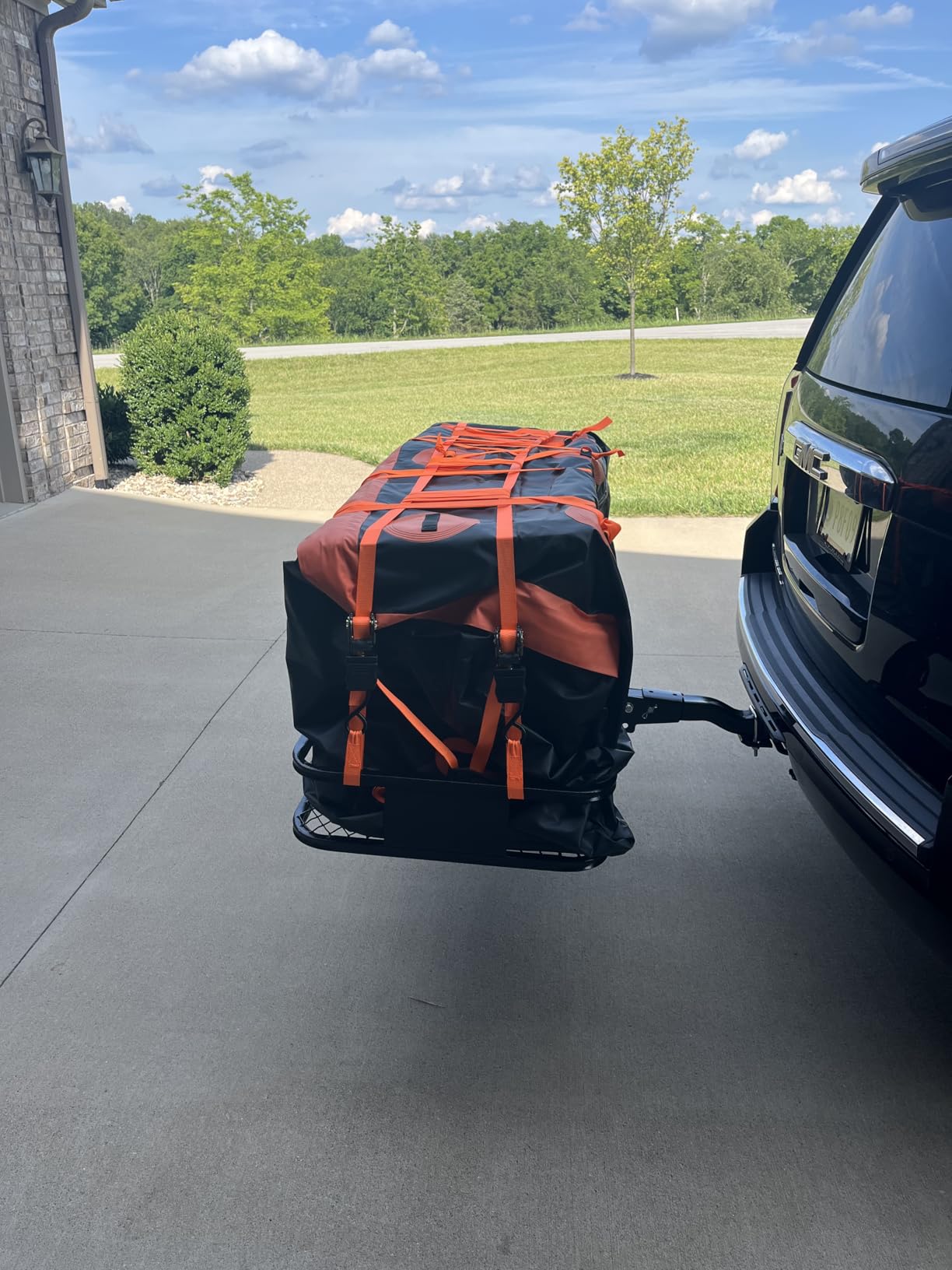
At 52 pounds, the usable payload on a 500-pound tongue weight rating is around 448 pounds before you add people. The folding arm tucks the rack flat against the bumper when parked, which helps in tight garages and keeps the rear hatch clear. High-visibility reflectors and the plate bracket cover the road-compliance details that cheaper baskets leave to you.
Two honest drawbacks. The supplied ratchet and buckle straps are the weak link in the kit, and several owners replaced them with quality straps before loading anything heavy. The bag’s Velcro flaps wear out with repeated use even though the zipper keeps working, so treat the Velcro as a rain flap rather than a seal.
Why the included kit changes the value calculation
An anti-rattle stabilizer and a locking hitch pin are the two accessories owners recommend most, and both are already in the box. That removes the single most common reason a new carrier rattles, and it removes a round of decision fatigue about which pin fits your receiver.
The license plate bracket also solves a small but annoying problem: with a carrier filling the space behind the bumper, your plate needs somewhere to live.
Watch the straps and the steel finish
Buy better straps. The kit straps are the first thing to fail under a load that feels safe, and a strap failure at highway speed is the failure mode you cannot afford on this category.
If you store it outdoors year round, expect surface rust without occasional touch-up paint, and keep an eye on the bag Velcro in wet seasons.
5. WEIZE Folding Carrier with Waterproof Bag: Best Accessory Kit for the Money
WEIZE Folding Hitch Mount Cargo Carrier Basket 60″ x 20″ x 6″ with Waterproof Bag, Net, Strap, 2-Inch Folding Shank, 500 lbs Capacity Hitch Rack, Steel Construction
500 lb capacity
60 x 20 x 6 inch basket
66.5 lb carrier weight
Folding 2 inch shank
Pros
- Most complete accessory bundle at this tier
- Waterproof bag survived long wet road trips
- Powder coat held up well with no rust through storm season
- Ten square feet of added cargo space
Cons
- No lock washers or threadlocker so fasteners loosen
- Gap at the center extension joint on some variants
- Only three reflectors
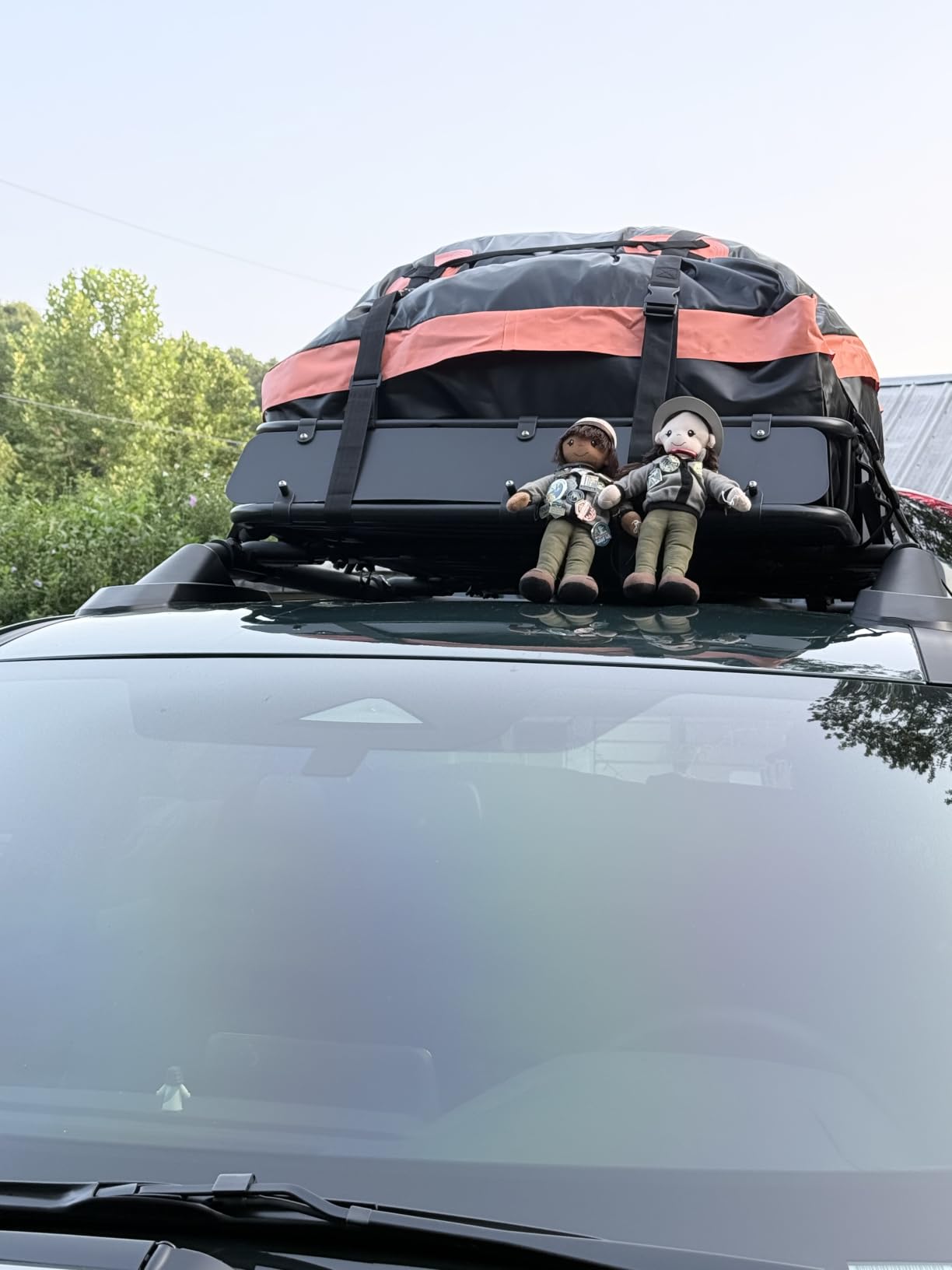
The WEIZE CCB-1037 wins on what arrives in the box. Alongside the 60 by 20 by 6 inch steel basket you get a waterproof cargo bag, a 36 by 60 inch cargo net, two 12-foot 2200-pound tie-down straps, and a stabilizer, which is a fuller kit than several more expensive racks in this roundup. It sits at the number one position in the vehicle cargo basket category, which tells you how many people are using it the same way you plan to.
Owners report the waterproof bag keeping contents dry across multi-thousand-mile trips in heavy rain, and many report no rust after a full season of coastal weather. The folding shank and mid-height basket make loading easier than a roof box because you are working at waist level rather than overhead, which is the practical argument for hitch mounting in general.
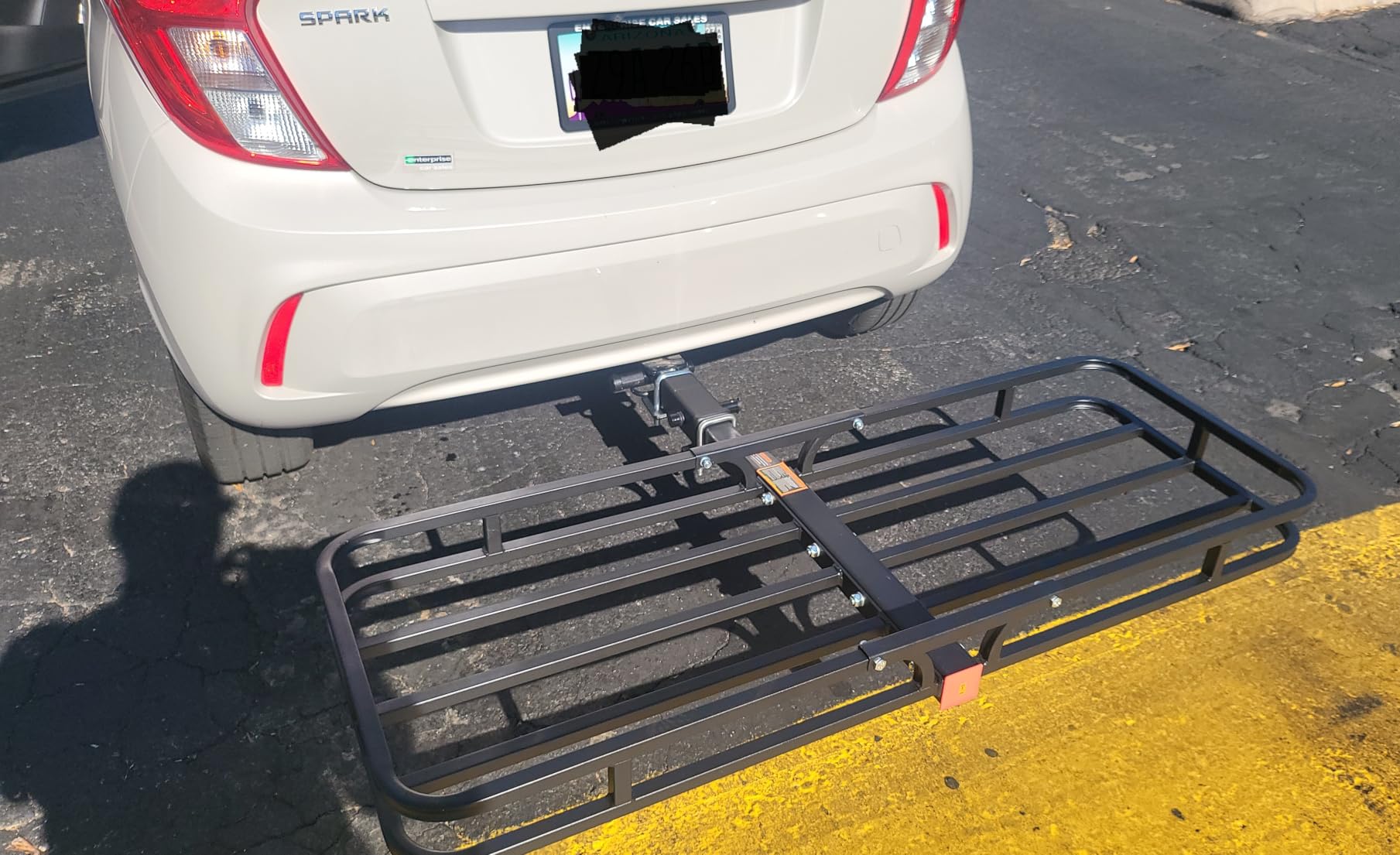
At 66.5 pounds this is a heavy carrier to lift, so do the payload subtraction before you load it. On a 500-pound tongue weight rating you have roughly 433 pounds of cargo capacity, which is enough for two adults and their luggage plus a cooler, but not much more. The welded frame arrives in four sections and assembles without specialist tools.
There are real quality signals to note. No lock washers or threadlocker are included, so fasteners can loosen if you remove and reinstall the rack often, and some variants show a visible gap at the center extension joint that owners say slightly reduces rigidity. It is also loud at highway speed when empty, which disappears once it is weighted down. Only three reflectors are fitted, and some adhesive types do not stick well.
Loading at waist height is the underrated advantage
Owners consistently mention that loading at waist level beats a roof box, especially with heavy coolers and cases that have to be lifted twice. If your trip involves a lot of loading and unloading rather than one long haul, that difference matters more than the steel gauge.
The bag and net combination means a mixed load of soft gear and hard cases can share one platform without a fight.
Fasteners and noise are the trade-offs
Add a threadlocker or lock washers the first time you install it. The absence is the most common reason owners report a carrier starting to rattle after a season of removal and reinstallation.
The center joint gap and the wind noise on an empty rack are worth checking on arrival, because neither is a safety problem but both are daily annoyances.
6. Mockins 60 x 24 Heavy Duty Carrier: Best for Big Loads and Long Trips
Mockins 60″x24″x6″ Heavy Duty Steel Folding Trailer Hitch Cargo Carrier
500 lb capacity
60 x 24 x 6 inch basket
64 lb carrier weight
25 cu ft waterproof bag
Pros
- Wide deck fits two oversized suitcases with room to spare
- Rigid under 250 to 400 lb loads over long trips
- 25 cu ft bag with welded seams kept gear dry
- Folds upright and stays clear of the hatch when folded
Cons
- Lock bolt holes can misalign when folded and need filing
- Paint is uneven so welds can rust near the coast
- Supplied straps and buckles are low quality
The wide-deck option. At 60 by 24 by 6 inches the Mockins MA-CC-BNS-LRG-BLU-77 has one of the largest usable platforms in the group, and owners use it for two oversized suitcases plus overflow gear without stacking. Cross-country families report it staying rigid at 250 to 400 pounds and not developing a wobble after long days on the interstate.
The bundled 25 cubic foot soft-shell waterproof bag measures 60 by 24 by 31 inches and has welded seams plus Velcro zipper flaps, and owners in wet climates say it kept gear dry through heavy rain with no leakage. The kit also includes a 36 by 20 inch bungee net, a hitch stabilizer, a locking hitch pin with two keys, ratchet and buckle straps, and an integrated license plate bracket with reflectors. That is a complete setup from one box.
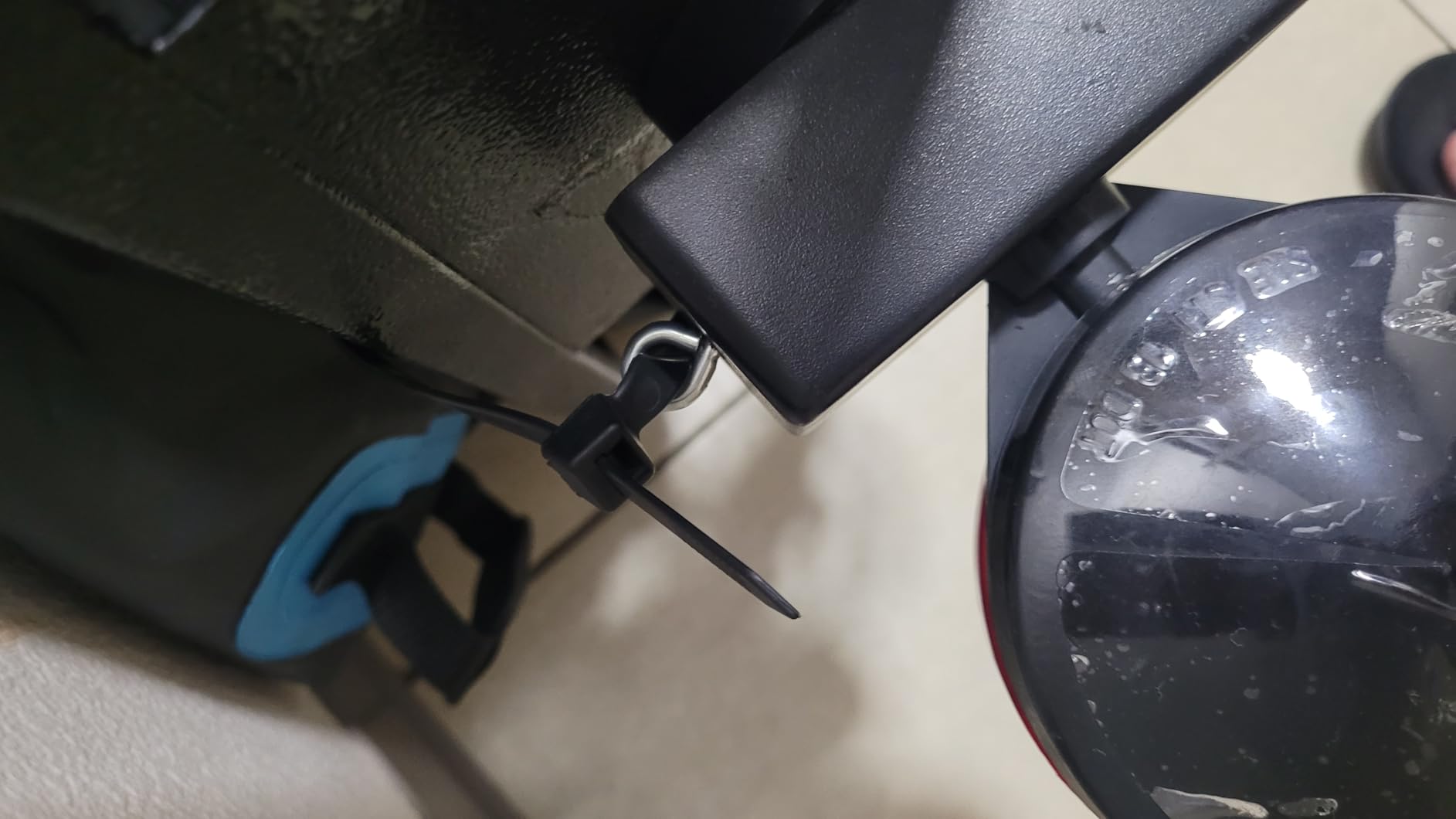
The 10-year limited warranty is among the longest terms in this roundup, and spare parts are listed as available for ten years, which is unusual in a category where carriers get retired rather than repaired. The folding shank tilts the rack upright for parking and keeps it clear of the rear hatch in the folded position, which owners with liftgates appreciate.
Watch three things. Locking bolt holes can end up misaligned when the carrier is folded, and owners fix them by filing. The paint coverage is not perfectly uniform, so rust can start at weld joints after beach trips or a winter of road salt. And a 24-inch-wide carrier sitting 14 inches behind your bumper will obstruct rear sensors and the backup camera on many SUVs, which is a real safety and convenience trade.
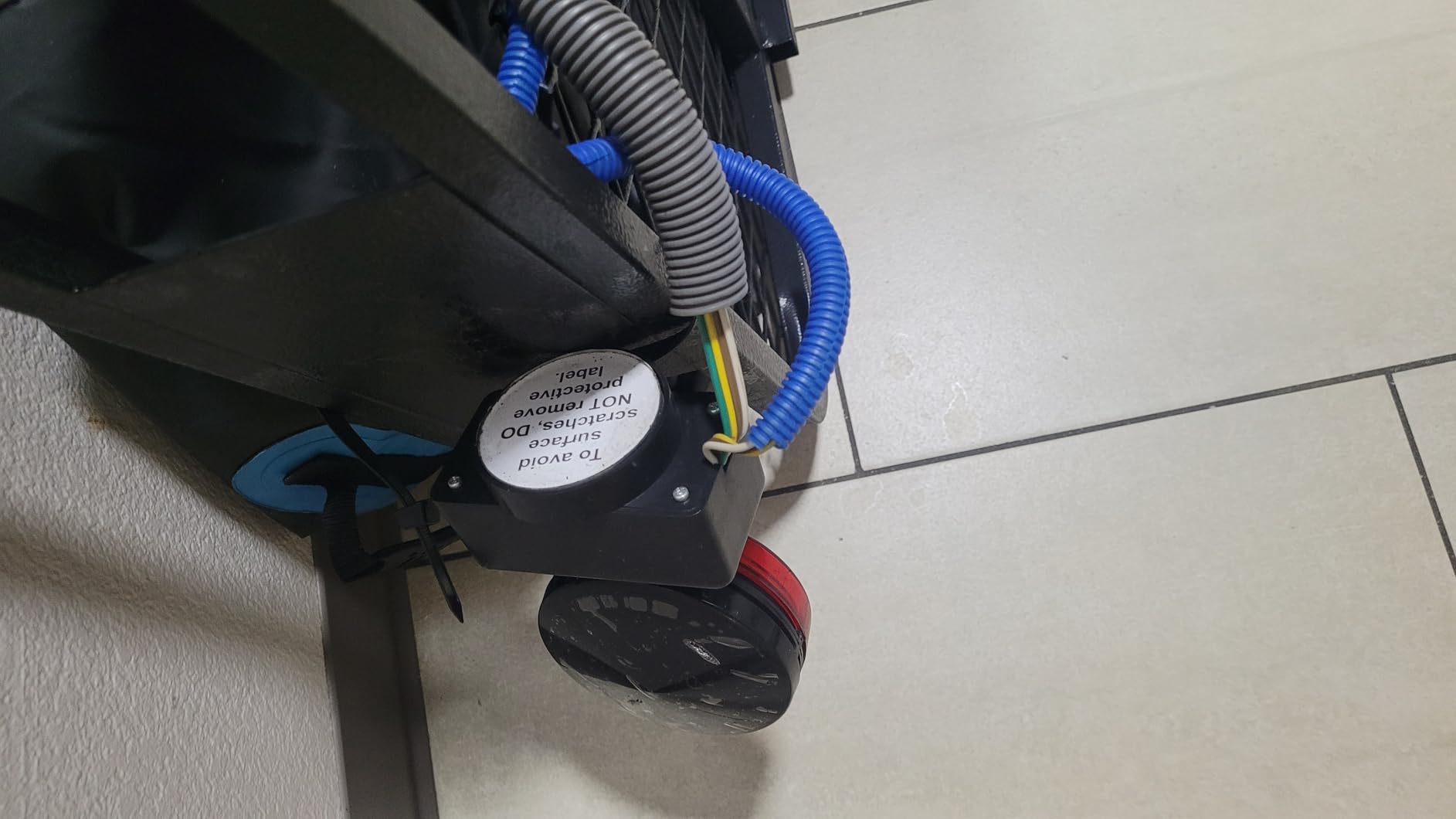
Wide deck for people who pack like they are moving
A 24-inch width is the difference between one suitcase and two. For family trips, moving apartments, or anyone hauling gear for two, the extra 5 inches of width removes most of the stacking and strapping that turns loading into a puzzle.
The high-capacity bag also means you can carry soft, light, rain-sensitive gear without a separate tarp or rooftop box.
Where the extra size costs you
Depth behind the bumper is the trade. A wider, loaded carrier sits further into your rear camera view, and on vehicles with parking sensors it will trigger them constantly. Check the camera sightline before you buy.
Replace the kit straps with quality ones, and check the folded lock holes before the first long drive rather than halfway through it.
7. VEVOR 60 x 24 x 6 Folding Carrier: Best for Clean Welds and Heavy Steel Stability
VEVOR 60 x 24 x 6 in Folding Hitch Cargo Carrier 500lbs Capacity
500 lb capacity
60 x 24 x 6 inch basket
Upgraded 5mm tubing
Hook stabilizer included
Pros
- Smooth clean welds with no missed points or sharp edges
- Stable with about 350 lb of luggage over 1000 miles
- Waterproof bag kept contents dry in heavy rain
- Two stabilizer mounting positions for tailgate clearance
Cons
- Instructions do not show where the horseshoe bolt goes
- Some shipments arrive missing the lock or a pin
- Bolts need rechecking for tightness after use
The VEVOR stands out on build quality detail. Owners repeatedly mention smooth, clean welds with no missed points and no sharp edges, which sounds minor until you have loaded a carrier with sharp-cornered bins and did not cut your hands. The frame uses upgraded 5mm supporting tubes in Q235B steel, powder coated black against rust and corrosion, and it held about 350 pounds of luggage steady across a 1,000 mile trip.
What makes this useful is the hook stabilizer in the box and the fact that it mounts in two positions, so you can choose how the carrier sits relative to the tailgate. That is a small design choice that decides whether your liftgate opens with the carrier installed, and it is the kind of thing that gets ignored until it stops you.
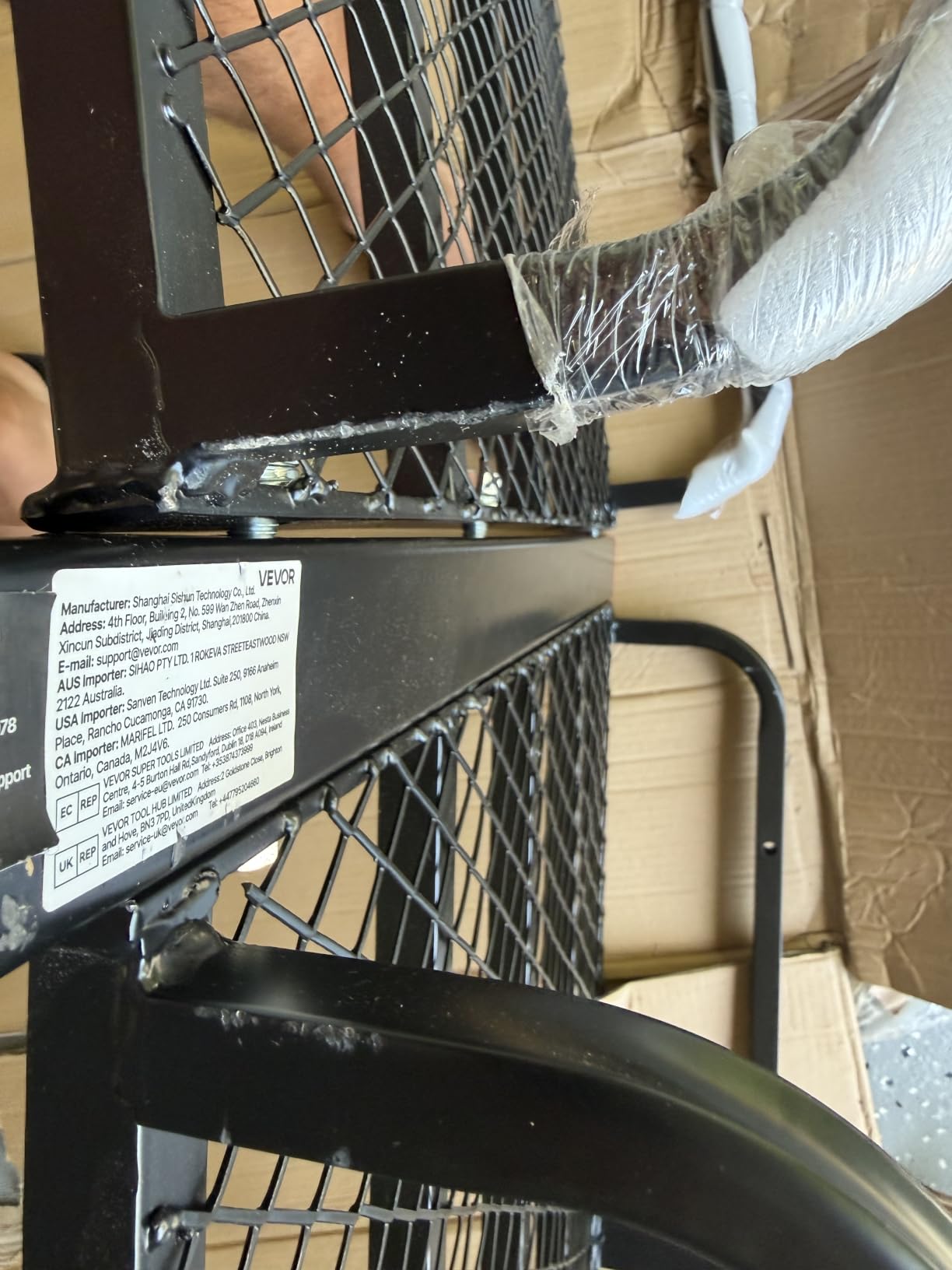
The kit is also unusually complete: a cargo accessory bag, assembly hardware, a hook stabilizer, a cargo net, two ratchet straps, a waterproof cargo bag, a cargo padlock, four reflective plates, and six cargo attachment straps. The rack breaks back down for compact storage, which no other carrier in this group really offers.
The complaints cluster around documentation and small hardware. Owners report that the instructions do not explain where the included horseshoe bolt and steel plate go, some shipments arrive without the lock or a locking pin, and the lock nuts do not hold as firmly as people would like. Manufacturer weight is not stated, so budget conservatively for lifting this one solo. Four reflective plates give decent night visibility for a basket this size.
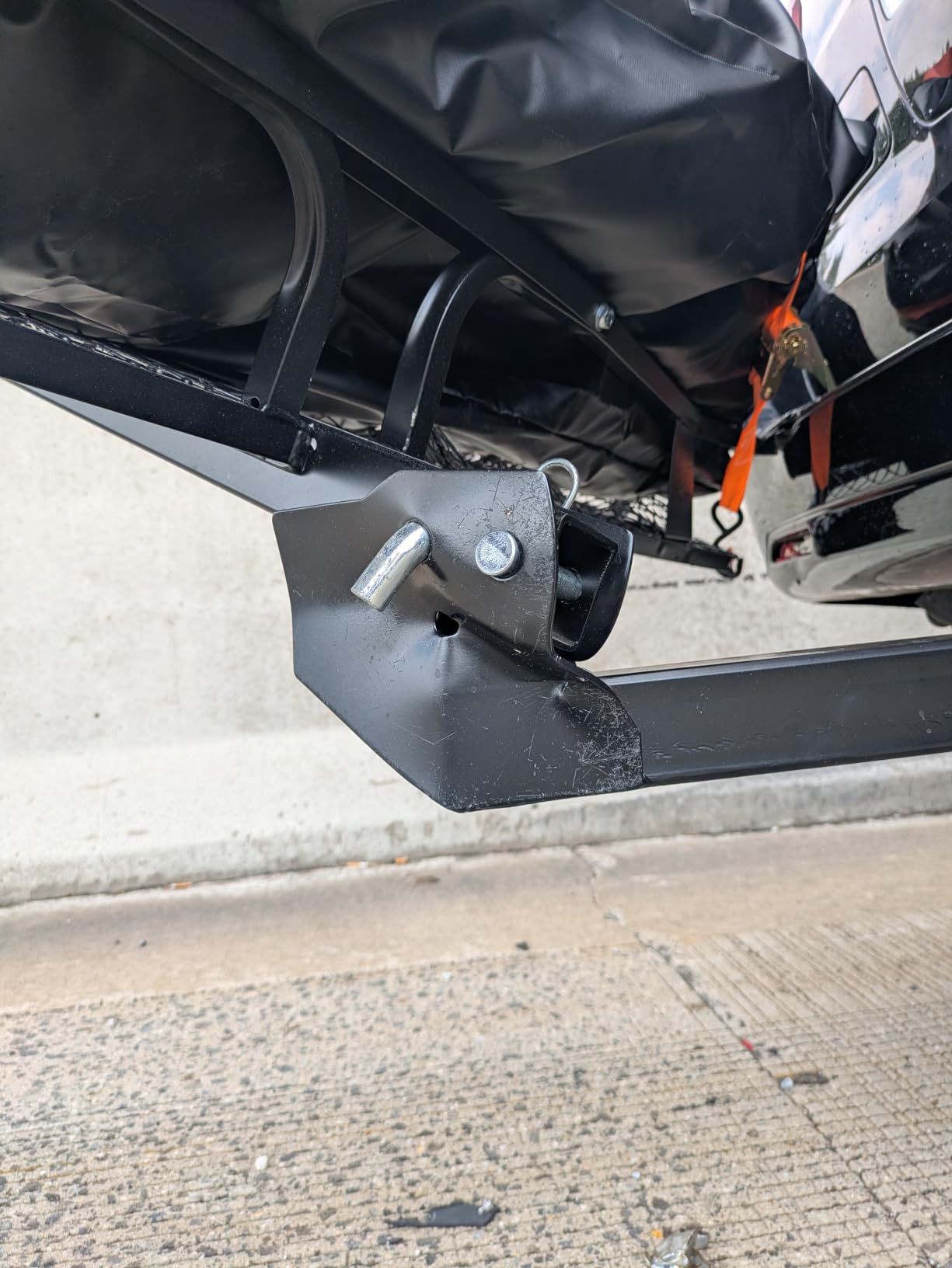
Two stabilizer positions solve the tailgate problem
Most baskets are rigid about where they sit. Mounting the stabilizer in one position or the other changes the carrier’s height and rearward reach, which is often the difference between a liftgate that opens and one that does not. It is an inexpensive clearance fix.
Welded finish quality also pays off long term, since a smooth seam is a seam that does not trap dirt and start a rust cycle.
Plan around the manual, not the marketing
Read the manual before assembly and expect to look up the horseshoe bolt placement. If the lock or a pin is missing in the box, treat that as a stop until you have it, not an afterthought.
Because the carrier weight is not published, plan for a two-person install and re-torque the bolts after the first trip.
8. KAIRAY 60 x 24 Tall Rail Carrier: Best for Tall, Bulky Cargo That Wants to Escape
KAIRAY 500 Lbs Heavy Duty Hitch Mount Cargo Carrier 60″x24″x14.4″ Folding Rear Luggage Rack Basket Fits 2″ Receiver for Car SUV Camping Traveling with Stablizer Waterproof Bag Net Ratchet Straps Lock
500 lb capacity
14.4 inch side rails
Folds to 3.2 inches
One piece powder coated steel
Pros
- 14.4 inch rails keep bulky and irregular cargo contained
- Folds flat to 3.2 inches for storage
- One piece steel construction resists rust and scratches
- Bundle includes a 20 cu ft bag plus net and stabilizer
Cons
- Deep 14.4 inch profile blocks the rear view
- Heavy at roughly 68 pounds so two person install
- One year warranty
Most of the carriers in this roundup have walls between 5.5 and 8.7 inches tall. The KAIRAY has 14.4 inch tubular side rails that fold down to 3.2 inches, and that height is the reason to buy it if you haul firewood, tall cases, camping gear or anything that does not stack neatly. Owners load tall and awkward loads that would ride straight over the rails on a conventional basket.
Construction is one piece, matte black powder-coated alloy steel, with a mesh surface that stops smaller objects from falling through. It folds flat for storage, which partly offsets the fact that you have to unfold it to reach your cargo. The kit includes a 20 cubic foot waterproof bag with a storage bag, an outdoor combination lock, a cargo net, a hitch stabilizer, and two ratchet straps.

At roughly 68 pounds this is a two-person install, and the 14.4-inch depth extends well behind the vehicle. That is the central compromise: tall rails solve containment and cost you rearward visibility. Two red reflectors are the only lighting hardware fitted, which is thin coverage for a basket this deep at highway speed.
The one-year warranty is the shortest we saw among the kits in this roundup, and it is worth weighing if you intend to keep the carrier outdoors through salt seasons. Powder coating on the one-piece frame otherwise holds up well against rust and scratches.
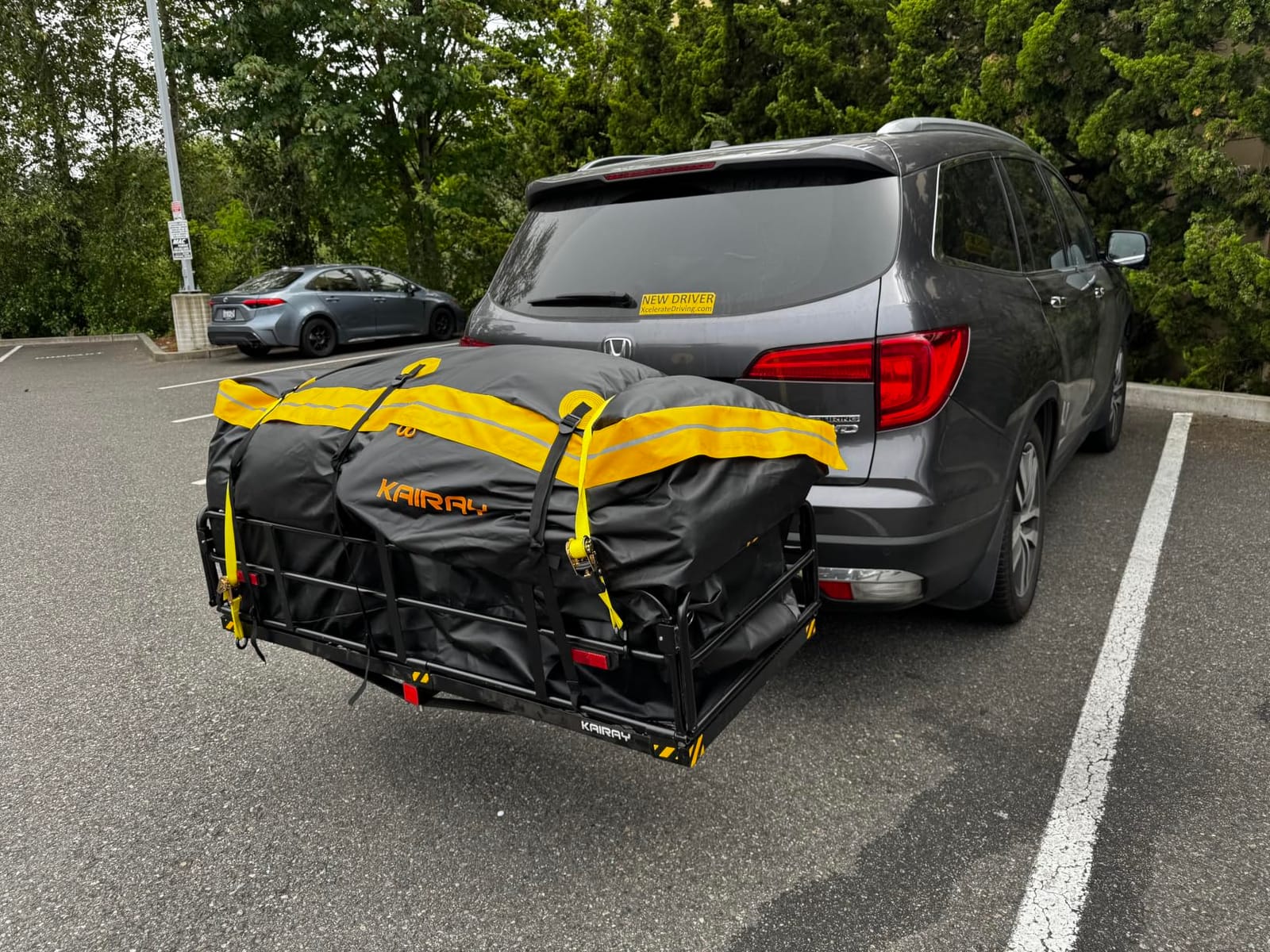
When tall rails beat a wide flat deck
Containment beats capacity when the load does not behave. Firewood, buckets, tall dry bags and irregular gear stay where you put them, and the mesh base stops smaller pieces dropping into the road. That makes this a good pick for firewood runs and for anyone moving bulky household items rather than luggage.
Folding the rails down to 3.2 inches means you can still store it against a wall between trips.
The rear view cost is real
A 14-inch-deep profile behind the bumper sits squarely in your backup camera view and can obstruct rear sensors. If reversing in tight spaces is a daily task, measure before you order.
Weight and warranty are the other two trade-offs: heavy to lift, short coverage if anything fails.
9. Wildroad 60 x 24 High Fence Carrier: Best Ground Clearance for Steep Driveways
Wildroad 60″x24″x14″ Hitch Cargo Carrier, Fits 2″ Receiver – Cargo Bag Set
500 lb capacity
13.8 inch fence
Shank angled 5 degrees
80 lb carrier weight
Pros
- 13.8 inch fence contains bulky camping gear and firewood
- Shank angled 5 degrees adds clearance and exhaust separation
- 500D PVC bag is fully waterproof with welded seams
- Multiple spindle holes allow a stable hitch connection
Cons
- Heaviest carrier here at 80 lb so two people are needed
- Deep 14 inch profile blocks rearward visibility
- One year warranty is shorter than rivals
The Wildroad solves clearance in a way nothing else here does. Its shank is angled 5 degrees above the horizon, which lifts the basket away from the bumper, adds ground clearance on steep entrances, and keeps the exhaust from sitting directly under your cargo. On a truck or body-on-frame SUV with a low rear bumper, that angle is the difference between a carrier that survives the driveway and one that scrapes it every time.
The fence stands 13.8 inches tall, close to the tallest in this group, and reviewers single it out for holding bulky camping gear and firewood in place. The bag is 500D PVC with welded seams and a protective flap, described as fully waterproof. Multiple spindle holes let you position the carrier at different distances for a more stable connection.
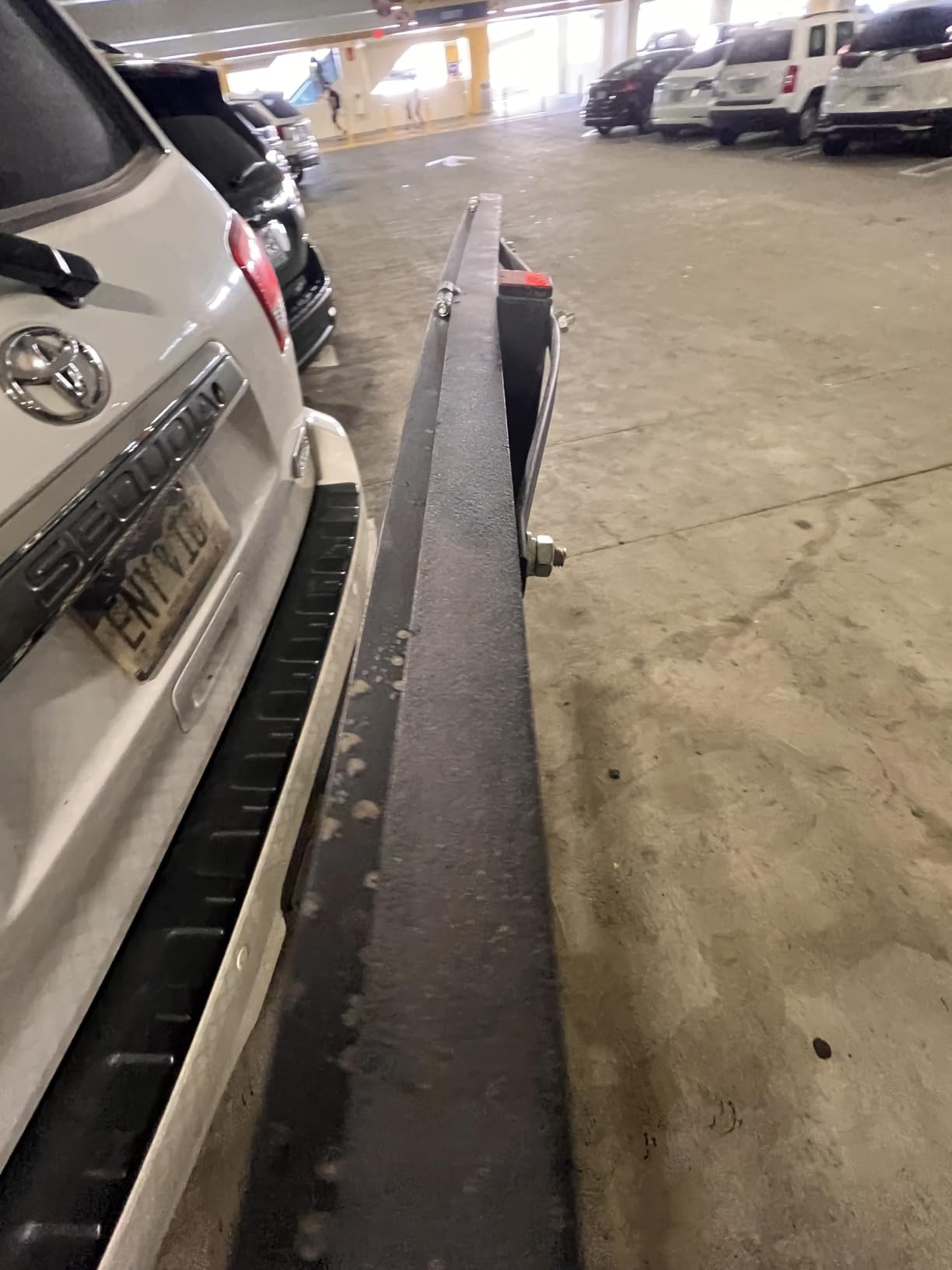
At 80 pounds this is the heaviest carrier we tested, and two people are needed to install it. That matters beyond convenience: an 80-pound carrier plus a 500-pound tongue weight rating leaves about 420 pounds of cargo capacity before passengers and gear inside the cabin are counted. Do that subtraction before you buy, not at the first load.
The 14-inch depth blocks rearward visibility, and the folding design means you have to unfold the carrier to reach the cargo area, so the storage benefit is smaller than it sounds. The one-year warranty is also shorter than the Mockins options.
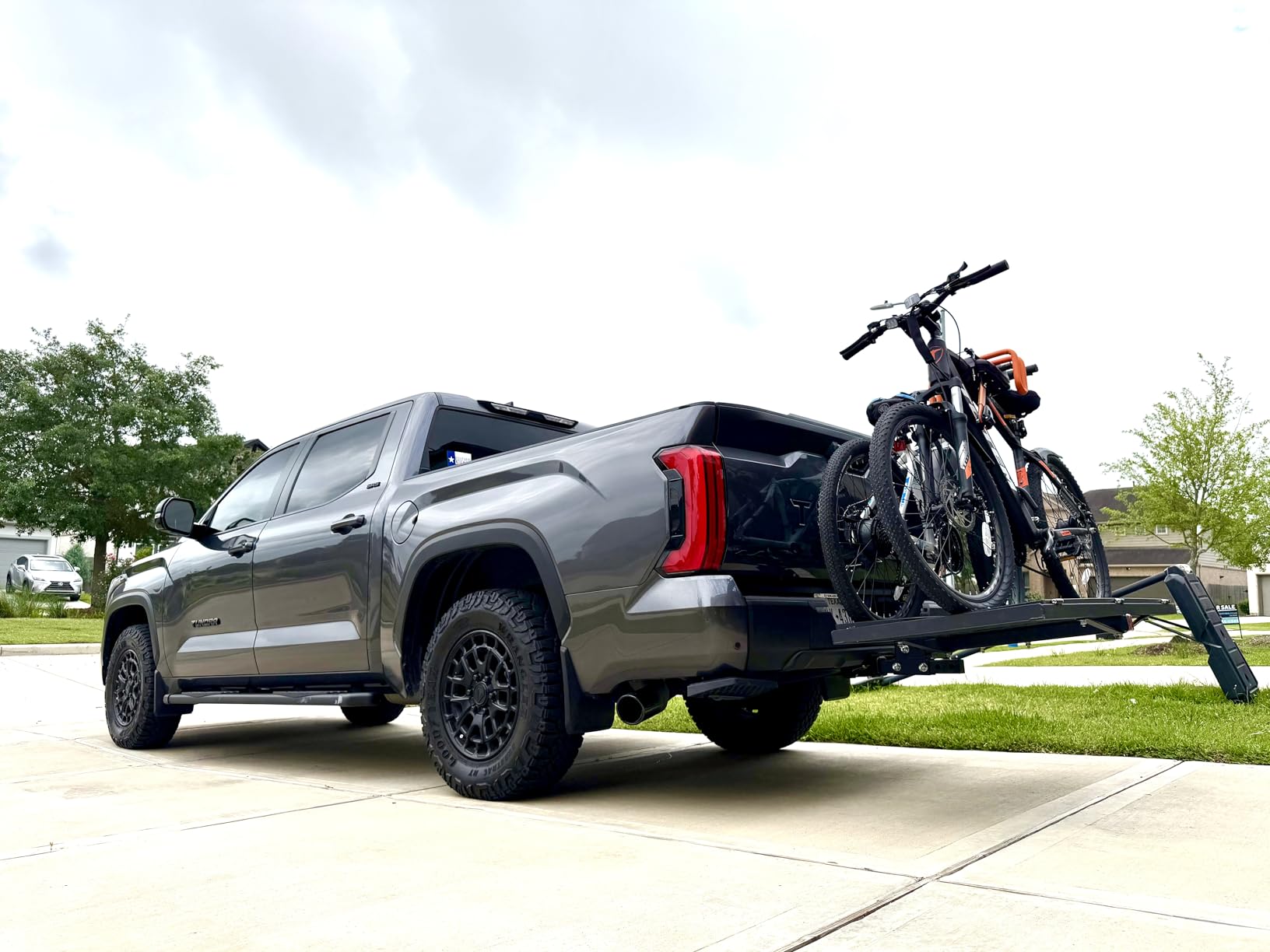
Why a 5-degree shank angle is worth paying weight for
Ground clearance on a hitch carrier is set by the shank, not the basket. A 5-degree lift moves the front edge of the platform up and away, which protects the carrier on steep driveways, over speed bumps, and on rutted forest roads. Owners on gravel and trail routes call it the feature that ends the scraping.
The same angle separates the cargo from exhaust fumes, which is a comfort on long idling trips.
Weight is the price of that angle
Eighty pounds is a two-person job and it eats 16 percent of a 500-pound tongue weight rating before you load anything. If your trips are light and your SUV is not heavy, a lighter design will serve you better.
Deep profile, limited rear visibility, and a short warranty complete the list of trade-offs.
10. VEVOR 50 Inch Aluminum Carrier with Folding Ramp: Best Aluminum Pick with a Built-In Ramp
VEVOR 50 x 29.5 x 8.7 Hitch Cargo Carrier 500LBS with Folding Ramp for SUV
500 lb capacity
50 x 29.5 x 8.7 inch basket
Anodized aluminum
41.5 inch folding ramp
Pros
- Aluminum is noticeably lighter to lift than comparable steel baskets
- Anodized surface resists rust and wipes clean
- 41.5 inch ramp makes loading wheeled equipment easy
- Wide 29.5 inch deck suits bulky cargo
Cons
- Lowest average rating here at 4.0 with 10 percent one star reviews
- Aluminum can dent under heavy point loads
- Folding ramp adds bulk when not in use
- Reflector coverage limited to two plates
This is the only aluminum carrier in the group, and it answers the folding aluminum question directly: yes, they exist, and this one includes a ramp. The frame is anodized aluminum alloy rated to 500 pounds at 42 pounds of carrier weight, which puts roughly 458 pounds of cargo capacity on a 500-pound tongue weight rating. The anodized surface resists rust, wear, and dirt, and wipes clean, which is the argument for aluminum in coastal and road-salt regions.
The 41.5 inch foldable ramp with a latch mechanism makes loading wheelchairs, mobility scooters, lawn equipment, and other wheeled gear straightforward, and the deck expands to add roughly 9 square feet of cargo space. At 50 by 29.5 by 8.7 inches the platform is wide and shallow, which suits bulky, awkwardly shaped cargo better than a long narrow basket.
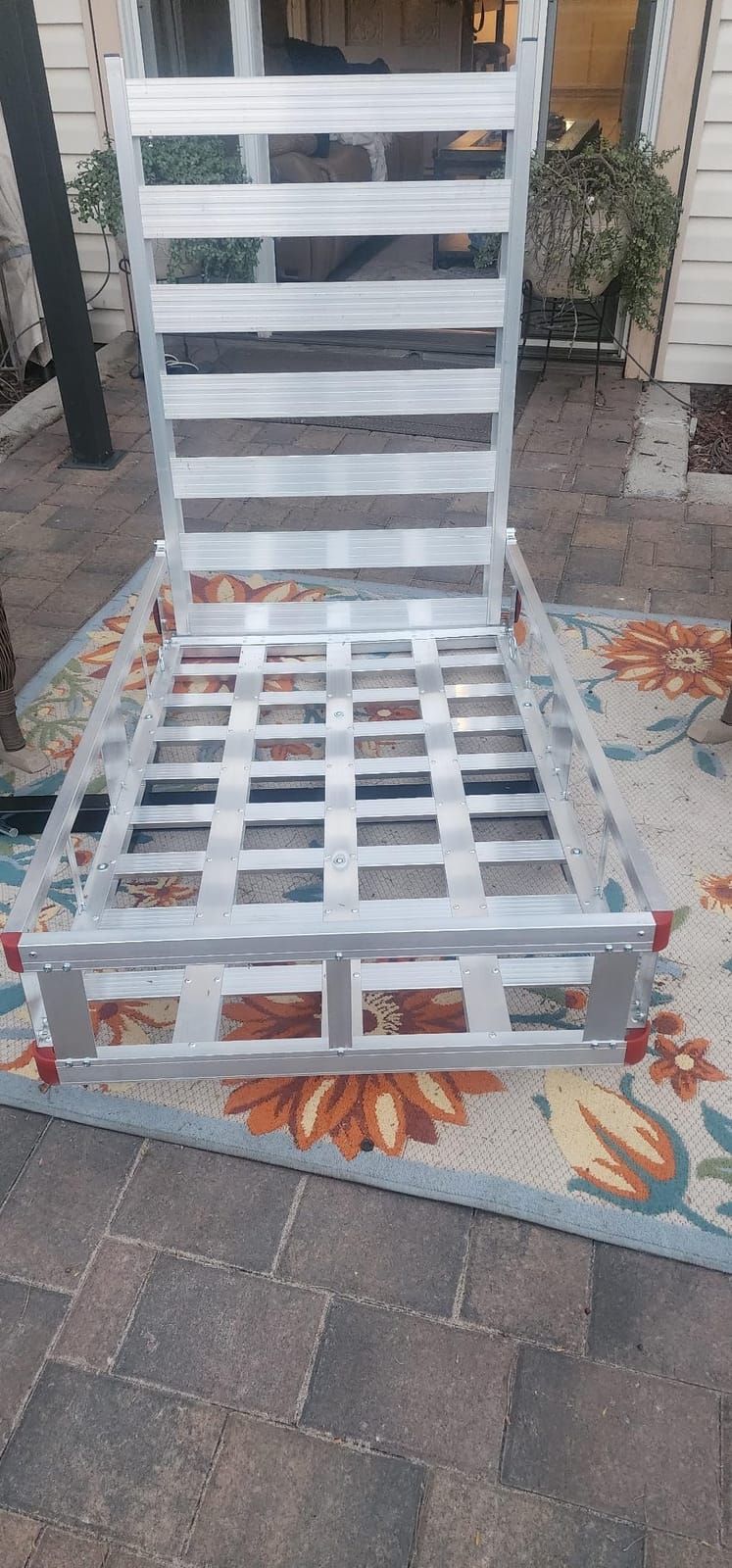
Be realistic about the trade. Aluminum carries less punishment than steel under heavy point loads, so a dropped toolbox or a stack of concrete blocks will dent it in a way that would not dent a steel basket. Two reflective plates are the only lighting hardware, which is thin for a carrier this wide.
It also carries the lowest star rating in this roundup at 4.0 across 247 reviews, with about 10 percent one-star ratings. Owners using it for its intended purpose like the light frame and the ramp, but the lower scores come from durability expectations set by the steel options here. If you plan to haul firewood or scrap metal rather than wheeled gear, choose steel instead.
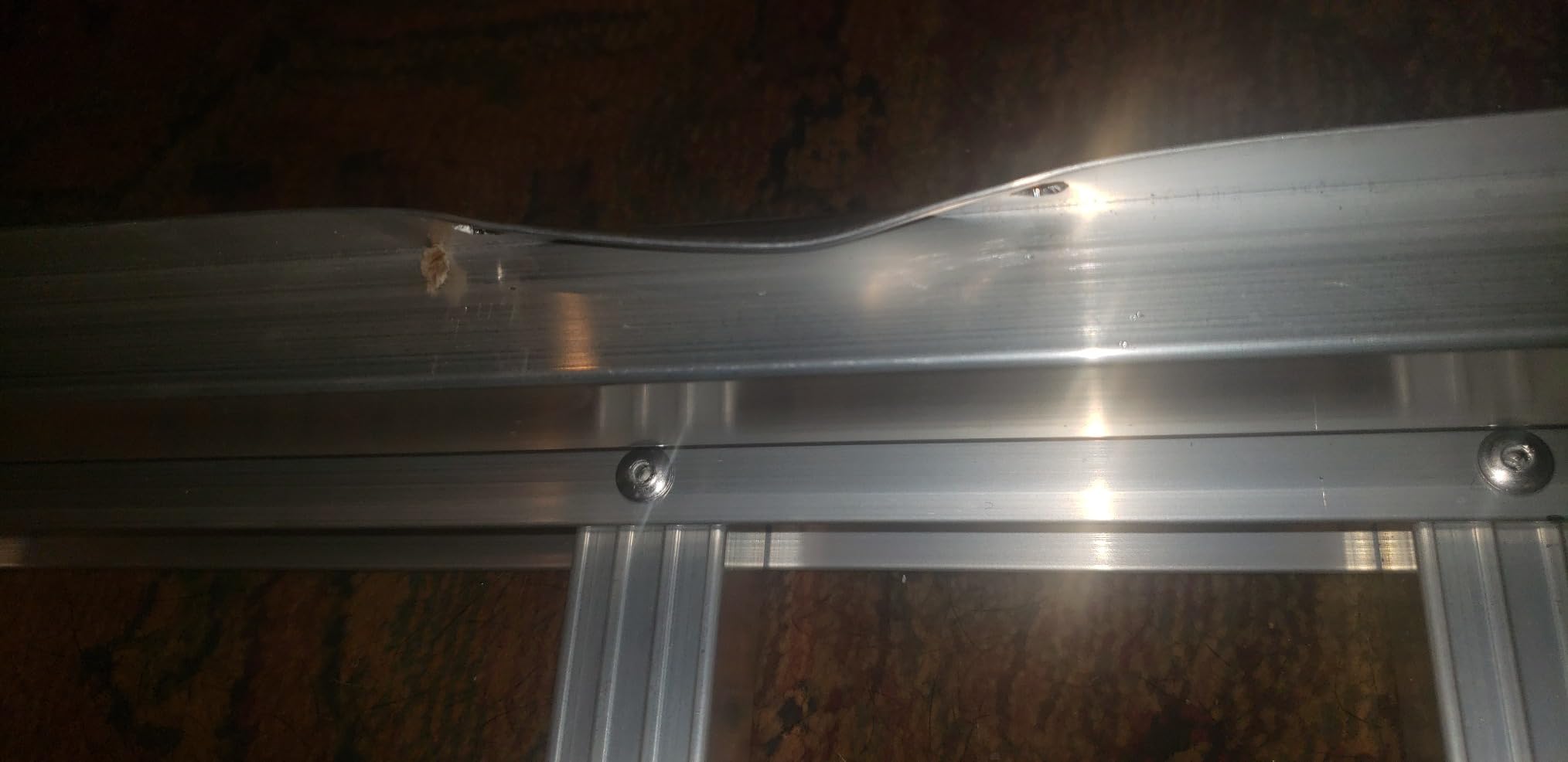
Aluminum earns its place at the coast and in snow
Salt air and road salt are what destroy exposed steel carriers, and owners in those regions typically move to aluminum after a single bad season of surface rust. An anodized finish simply has no coating to break down, and the frame wipes clean after a beach run.
At 42 pounds it is also noticeably lighter to lift than the steel baskets here, which matters for the ramp use case where you are loading and unloading repeatedly.
Where aluminum disappoints
Aluminum is softer than steel. Point loads, scrap, and firewood with embedded metal will leave dents that never come out, and the frame will not return to shape the way steel does.
The rating tells the story: this is a capable carrier that buyers judge against steel options it cannot quite beat on toughness.
How to Measure Your SUV Before You Order a Hitch Cargo Carrier
Measure the distance from the hitch pin to the rear bumper, from the hitch pin to the closed tailgate, and from the hitch pin to the lowest point of your spare tire. Those three numbers predict whether a carrier blocks your hatch, your camera, or your tire. Most fitment problems in this niche are a clearance problem that could have been measured in five minutes.
Open the tailgate fully and check where the carrier’s front edge sits relative to it. If you use a rear-mounted spare tire, note whether the carrier sits above it, in front of it, or behind it, because a 24-inch-wide basket can fully hide a rear camera. Owners on body-on-frame SUVs with a center exhaust should know that the exhaust occupies the exact position a 2-inch carrier needs, so confirm your receiver is accessible before anything else.
Hitch Receiver Classes, Tongue Weight and the 2-Inch Question
Every carrier in this roundup fits a standard 2 x 2 inch receiver, which is what you will find on Class III and Class IV hitches. Class III receivers on most SUVs are rated for 3,500 pounds of gross trailer weight with 350 pounds of tongue weight, and Class IV steps up from there. Class I and Class II receivers use a 1.25-inch opening, and none of these ten carriers will fit one.
Tongue weight is the number to respect. A carrier is not rated at the SUV’s towing capacity; it hangs off the hitch, and everything in it counts as tongue weight. Curt, etrailer, and the manufacturers in this group all publish the same guidance in different words: subtract the carrier weight from your hitch’s tongue weight rating before you decide how much gear to load.
For the brands people ask about most, Curt, etrailer, Yakima, Thule, and MaxxHaul all build to the same 2-inch standard, so the receiver is rarely what distinguishes them. Class I hitches on small cars and crossovers are the exception, and there you need a purpose-built 1.25-inch adapter or a different product entirely.
Steel or Aluminum: What Corrosion Does to Your Budget
Powder-coated steel wins on strength and cost, and it is the right choice for firewood, lumber, scrap, and anything with sharp or heavy edges. Aluminum wins on weight, corrosion resistance, and cleanability, which makes it the better pick near salt water, on salted winter roads, and for mobility equipment you load in wet conditions.
The honest framing from owners in coastal and snow regions is that steel carriers need occasional touch-up paint to stay presentable, and aluminum carriers never need it. The trade is that aluminum dents instead of flexing, so match the material to the cargo rather than to the weather alone.
Every steel carrier in this roundup uses a powder coat, and the most common durability complaint in reviews is uneven coverage at weld joints. If you buy steel, inspect the welds on arrival and keep touch-up paint for the first year.
How to Diagnose and Fix Hitch Wobble
Wobble is the single most repeated ownership complaint about hitch cargo carriers, and the fix follows a fixed order. Work through it in this sequence rather than buying parts at random, because the causes run from free to expensive.
Check the pin. A loose hitch pin is the most common cause. Re-seat it fully and torque it to specification.
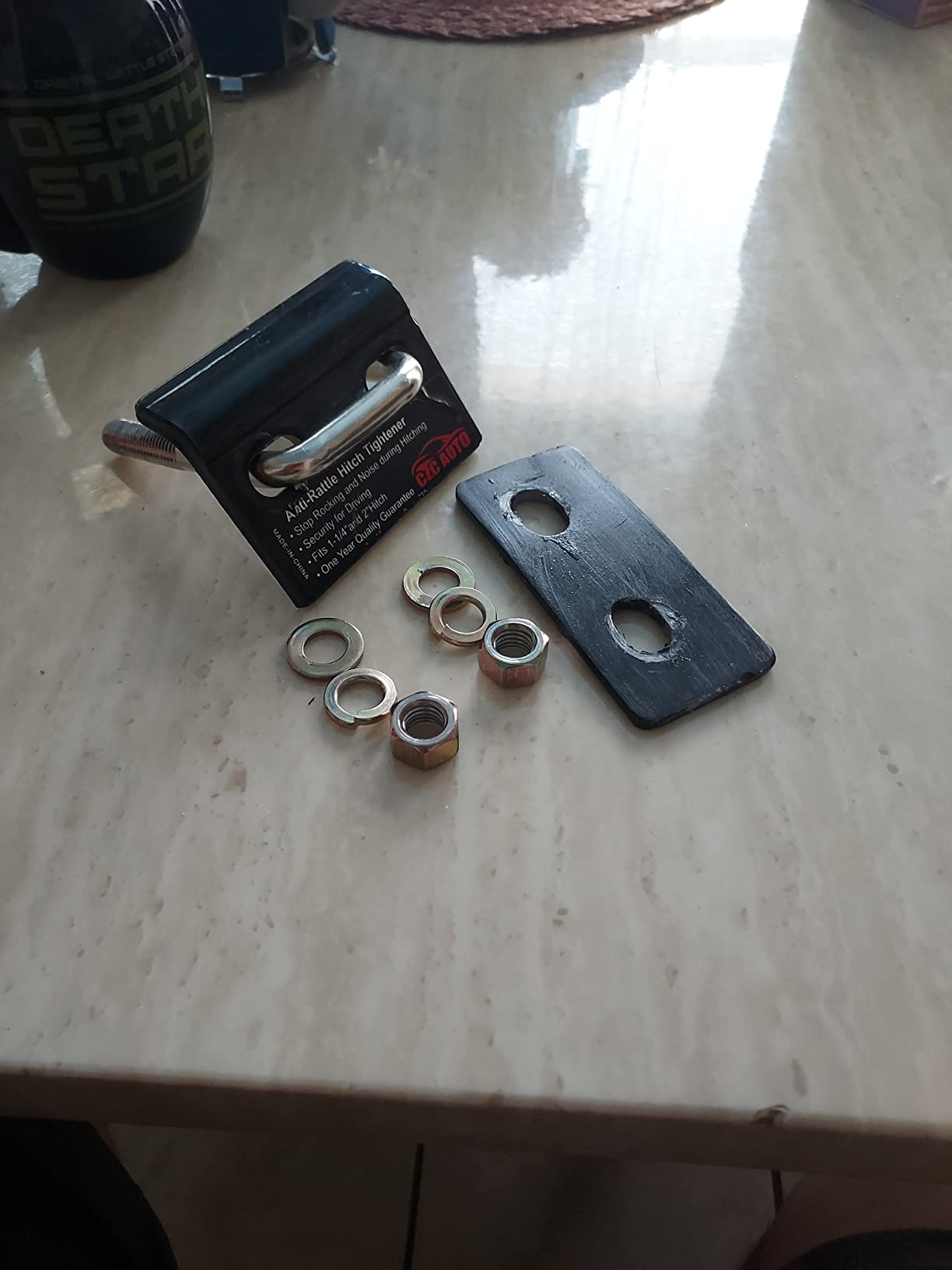
Add a hitch collar. A collar fills the gap between the shank and the receiver wall and takes out lateral play for very little money.
Install an anti-rattle device or stabilizer. These use friction or a spring to damp the forward and backward pivot. Several kits in this roundup include one.
Use a locking hitch pin. Beyond theft deterrence, a properly sized pin with a tight fit stops the carrier shifting.
Check tire pressure and re-torque bolts. Underinflated tires amplify every joint, and fasteners that were tightened one at a time during assembly will loosen.
If wobble persists after all five steps, the frame itself may be the cause. Folding carriers lose rigidity as the folding members wear, which is why owners running thousands of miles report that a fixed frame eventually feels tighter.
What You Give Up When the Hitch Is Occupied
A cargo carrier takes the hitch, and that means no bike rack, no ball mount, and no tow ball accessory at the same time. This is the question that comes up constantly in camping forums, and the practical answer from experienced owners is that a single rear hitch cannot carry both. If you need a bike rack and a carrier on the same vehicle, the realistic options are a small sport trailer or a roof basket for the bulkier load.
That trade is worth planning for rather than discovering. If your weekends are split between bikes and gear, an adjustable-shank carrier such as the ARKSEN folds up and frees the receiver quickly, which is closer to sharing than most fixed designs get.
Loading and Securing Cargo Without Overloading Your SUV
Do the subtraction before the first load: carrier weight plus cargo weight plus passengers plus pets must stay under the payload rating on the door jamb sticker, and the load behind the bumper must stay under your hitch’s tongue weight rating. Then distribute the cargo evenly across the basket and low to the floor, because a heavy item over the axle affects handling more than its weight alone suggests.
Weigh the carrier, or use the published weight, and subtract it from your tongue weight rating.
Add the intended cargo weight and compare the total against the door-jamb payload sticker.
Place heavy items centered and low, over or just behind the axle line rather than at the far edge.
Secure with rated ratchet straps to the tie-down points, not just to the bag handles.
Replace any supplied straps that look thin, and check the knots and buckles before you pull away.
Re-check the hitch pin and re-torque the mounting bolts after the first 50 miles.
Owners have been burned by adding a large generator or cooler on top of a full cabin of passengers, and the rear axle does not negotiate. If the math is tight, the carrier is the wrong size rather than the wrong brand.
Frequently Asked Questions
Are hitch cargo carriers any good?
Yes, when the carrier fits your hitch and your load stays inside both the carrier rating and your vehicle’s tongue weight limit. A 500-pound capacity rating assumes the weight is spread across the whole platform and that the carrier itself weighs 22 to 80 pounds, so real cargo capacity is closer to 420 to 478 pounds. Steel carriers outperform aluminum for firewood and sharp loads, and aluminum resists salt-air corrosion better. Match the form factor to the cargo and the carrier works well.
Are cargo hitch carriers safe?
They are safe within their rated limits. The load must be distributed, tied down with rated straps, and kept under both the carrier’s capacity and your hitch’s tongue weight rating, and the whole assembly still has to fall inside the payload rating on the door jamb sticker. Re-check the hitch pin and mounting bolts after the first 50 miles, and remember the carrier blocks part of your rear camera view.
What is the best hitch cargo carrier?
The MaxxHaul 70107 is our top pick because at 22.3 pounds it is the lightest carrier in this roundup, which leaves the most payload for actual cargo while still holding a 500-pound distributed load. The CURT 18153 is the stronger, more rigid frame with an angled shank for ground clearance, and the Mockins kit is a very complete package with a bag, net, stabilizer, and locking hitch pin included.
Do any models fit Class I hitches?
None of the ten carriers in this roundup fit a Class I or Class II hitch, because those receivers use a 1.25-inch opening and all of these carriers are built for a standard 2 x 2 inch receiver. Class III and Class IV hitches on most SUVs are the 2-inch size, so if you have one of those you are fine. On a Class I vehicle you need a purpose-built 1.25-inch carrier or an adapter.
Can I leave the carrier attached to my vehicle overnight?
Yes, and most owners do. Use a locking anti-rattle hitch pin rather than a standard pin, re-check that the load is still secured, and check the carrier for movement in the morning before driving. If it is empty and fitted with a locking pin, leaving it on is fine. Folding carriers should be folded upright when parked, and etrailer experts caution against using folding carriers behind an RV because the folding frame does not handle the extra stress.
Is it safe to use the ramp in wet conditions?
A folding ramp on an aluminum or steel basket is safe in wet conditions as long as you load slowly, keep the weight centered, and secure the equipment with rated straps before driving. Wet grass, mud, and smooth steel are slippery, so treat a wet ramp as a loading surface rather than a walkway. The included 41.5 inch ramp on the VEVOR aluminum carrier has a latch to hold it in the deployed position.
The Best Hitch Cargo Carrier for SUVs Is the One That Fits Your Hitch
After comparing all ten, the best hitch cargo carriers for SUVs split cleanly into three groups. The MaxxHaul 70107 is the overall winner because at 22.3 pounds it hands back the most usable payload of any carrier here, and it is the easiest to install alone. Buyers who want the most rigid frame and real ground clearance should pay the weight for the CURT 18153 with its angled shank. And anyone who would rather not shop for a stabilizer, a hitch lock, and a cargo bag separately gets a very complete package in the Mockins kit.
Whichever one you choose, measure your hitch-to-bumper and hitch-to-spare-tire gaps before you order, subtract the carrier weight from your tongue weight rating, and buy a locking anti-rattle hitch pin in the same order. Those three steps prevent almost every complaint we read in more than 20,000 owner reviews, and they take less time than a single return trip would.