Most parents searching for the best booster seats for 4 year olds are asking the wrong question first. A booster does not restrain your child. It positions the vehicle’s own three-point belt so the lap portion sits low across the hips and the shoulder portion crosses the middle of the chest, which is the geometry that keeps a small body out of the injury pattern a loose belt creates. That only works once your child is physically big enough and mature enough to hold that position for the entire drive.
We spent weeks going through the specs, manuals, and owner feedback for eight belt-positioning boosters to work out which ones actually suit a four-year-old rather than a seven-year-old. Two of the eight in this list keep a five-point harness mode, which matters more than most roundups admit because a 4-year-old under 40 pounds is not legally eligible for a booster in most states. We also flag which seats here are a poor fit at this age, and why.
A quick note before we start: the links below are affiliate links, and we may earn a commission if you buy through them at no extra cost to you. We did not crash test any of these seats ourselves, so every performance claim in this guide comes from published specifications, manufacturer manuals, and the pattern in thousands of owner reviews.
Table of Contents
- Is Your 4-Year-Old Actually Ready for a Booster?
- Top 3 Booster Seats for 4-Year-Olds (September 2026)
- Quick Picks: The 8 Best Booster Seats for 4-Year-Olds in 2026
- The 8 Best Booster Seats for 4-Year-Olds
- 1. Graco TurboBooster 2.0 Highback and Backless – the one we recommend most often
- Graco TurboBooster 2.0 Highback & Backless Booster Booster Car Seat, Freya
- When it suits a four-year-old
- When to skip it
- 2. Chicco KidFit ClearTex Plus 2-in-1 – 10 headrest positions and washable ClearTex fabrics
- Chicco KidFit ClearTex Plus 2-in-1 Belt-Positioning Booster Car Seat
- When it suits a four-year-old
- When to skip it
- 3. Britax Skyline 2-Stage – 40-120 lb and up to 63 inches tall
- Britax Skyline 2-Stage Belt-Positioning Booster Car Seat, Dusk – Highback and Backless Seat
- When it suits a four-year-old
- When to skip it
- 4. Diono Cambria 2 XL – a wide, deeply padded shell for long trips
- Diono Cambria 2 XL, Dual Latch Connectors, 2-in-1 Belt Positioning Booster Seat, High-Back to Backless Booster, Space and Room to Grow, 7 Headrest Positions, 8 Years 1 Booster Seat, Black
- When it suits a four-year-old
- When to skip it
- 5. Safety 1st Grand 2-in-1 – a five-point harness to 65 lb, then belt mode
- Safety 1st Grand 2-in-1 Booster Car Seat, Converts from High Back to Belt-Positioning Booster, High Back Seat for Kids 40-65, and Belt-Positioning 40-100 Pounds, Old Soul
- When it suits a four-year-old
- When to skip it
- 6. Graco Tranzitions 3-in-1 – a harness to 65 lb for a child who should wait
- Graco Tranzitions 3-in-1 Harness Booster Car Seat, Proof
- When it suits a four-year-old
- When to skip it
- 7. Safety 1st Grow and Go 2-in-1 – 19 inches wide, built for three across
- Safety 1st Grow and Go 2-in-1 Booster Car Seat with ComfortWings, Converts High-Back to Backless, 19″ Wide, Slim Design, Lightweight, Foldable, Easy-Clean, Cup Holders, 40-100 lbs, Crushed Grape
- When it suits a four-year-old
- When to skip it
- 8. Diono Everett NXT – the best with rigid LATCH
- Diono Everett NXT High Back Booster Car Seat with Rigid Latch, Lightweight Slim Fit Design, 8 Years 1 Booster Seat, Black
- When it suits a four-year-old
- When to skip it
- Highback, Backless, or Combination: Which Type a 4-Year-Old Needs
- How to Choose a Booster Seat: 7 Criteria That Matter
- Check Your Car Before You Check the Reviews
- Why There Is No Booster Crash-Test Scoreboard
- When Does Your Child Stop Needing a Booster?
- Frequently Asked Questions
- What booster seat should a 4 year old be in?
- What car seat should I use for a 4 year old?
- Can a 40 lb 4 year old sit in a booster seat?
- Should a 4 year old still be in a 5-point harness?
- Is there a booster seat with a harness for a 4-year-old child?
- Can a 4 year old go in a backless booster?
- Do booster seats have expiration dates?
- When can my child stop using a booster seat?
- Bottom Line
Is Your 4-Year-Old Actually Ready for a Booster?
Most boosters in this roundup start at 40 pounds, and the ones that publish a height floor ask for 43.4 inches or more of seated height. If your child is under 40 pounds, the answer is that a booster is not for them yet, and no seat on this list changes that.
The second gate is maturity. A booster child has to sit upright without slouching, without sliding forward to read the shoulder belt off their shoulder, and without fiddling with the buckle for the first ten minutes. The most common version of this mistake comes up constantly in parent forums: the child felt squished in the forward-facing seat, so they moved up a stage. Commenters push back hard, and they are right, because every step from rear-facing to forward-facing harness to booster to seat belt alone reduces protection. Waiting is the safer direction.
State law is the third gate, and it varies. Many states require a child to be at least 4 years old and at least 40 pounds before a booster is legal, and parents who have checked cite state minimums that pair age and weight, sometimes with a height condition as well. Check your own state’s numbers before you buy, because a seat that is not legal for your child in your car is a bad purchase no matter how well it fits.
So who is ready? A child who is at least 4, at least 40 pounds, tall enough to look past the vehicle head restraint, and who can and does sit properly. If the answer is no to any of those, read the combination harness seats in this list first. Two of the eight keep a child in a five-point harness to 65 pounds, which is where a lot of four-year-olds are still sitting.
Top 3 Booster Seats for 4-Year-Olds (September 2026)
These are the three that cover the widest range of four-year-old situations, from a small child still in a harness to a tall one who will grow out of a booster in a year.

Graco TurboBooster 2.0
- 2-in-1 highback to backless
- Adjustable armrests
- Hide-away cup holders
- Open-loop belt guides
Chicco KidFit ClearTex Plus
- 10-position headrest
- SuperCinch LATCH
- ClearTex fabrics
- Backrest removes for backless

Britax Skyline 2-Stage
- 40-120 lb and up to 63 inches
- 10-position headrest
- Color-coded belt guides
- Removable cover
Quick Picks: The 8 Best Booster Seats for 4-Year-Olds in 2026
Every row below carries the weight range, the mode, and the LATCH situation, because those three facts decide whether a booster suits a four-year-old at all.
| Product | Specs | Action |
|---|---|---|
| Graco TurboBooster 2.0 Highback and Backless |
|
Check Latest Price |
| Chicco KidFit ClearTex Plus 2-in-1 |
|
Check Latest Price |
| Britax Skyline 2-Stage |
|
Check Latest Price |
 Diono Cambria 2 XL Diono Cambria 2 XL |
|
Check Latest Price |
 Safety 1st Grand 2-in-1 Safety 1st Grand 2-in-1 |
|
Check Latest Price |
 Graco Tranzitions 3-in-1 Graco Tranzitions 3-in-1 |
|
Check Latest Price |
 Safety 1st Grow and Go 2-in-1 Safety 1st Grow and Go 2-in-1 |
|
Check Latest Price |
 Diono Everett NXT Diono Everett NXT |
|
Check Latest Price |
Two of these eight are combination harness seats, meaning your child can stay buckled into a five-point harness until 65 pounds and only then move to belt mode. If your four-year-old is under 40 pounds or just barely over it, those two are your shortlist.
The 8 Best Booster Seats for 4-Year-Olds
1. Graco TurboBooster 2.0 Highback and Backless – the one we recommend most often
Graco TurboBooster 2.0 Highback & Backless Booster Booster Car Seat, Freya
2-in-1 highback to backless
Adjustable armrests
Open-loop belt guides
Hide-away cup holders
Pros
- Converts from highback to backless
- Light enough to move between vehicles every day
- Open-loop belt guides let kids self-buckle
- Retractable cup holders hold drinks and snacks
- Plenty of recline for a sleeping head
Cons
- Not anchored to the vehicle in any way
- Padding is thin for chunkier children
- Buckle reach can be a problem in cars with a deeply recessed buckle
With 5149 owner reviews and a 4.7 rating, this is the most thoroughly owner-tested booster in our group, and the pattern across those reviews is remarkably consistent. People praise the setup, the light weight, the correct belt positioning, and the cup holders. Reviewers also describe it as a low-cost option within the category, which matters when you are buying a seat your child may sit in for years.
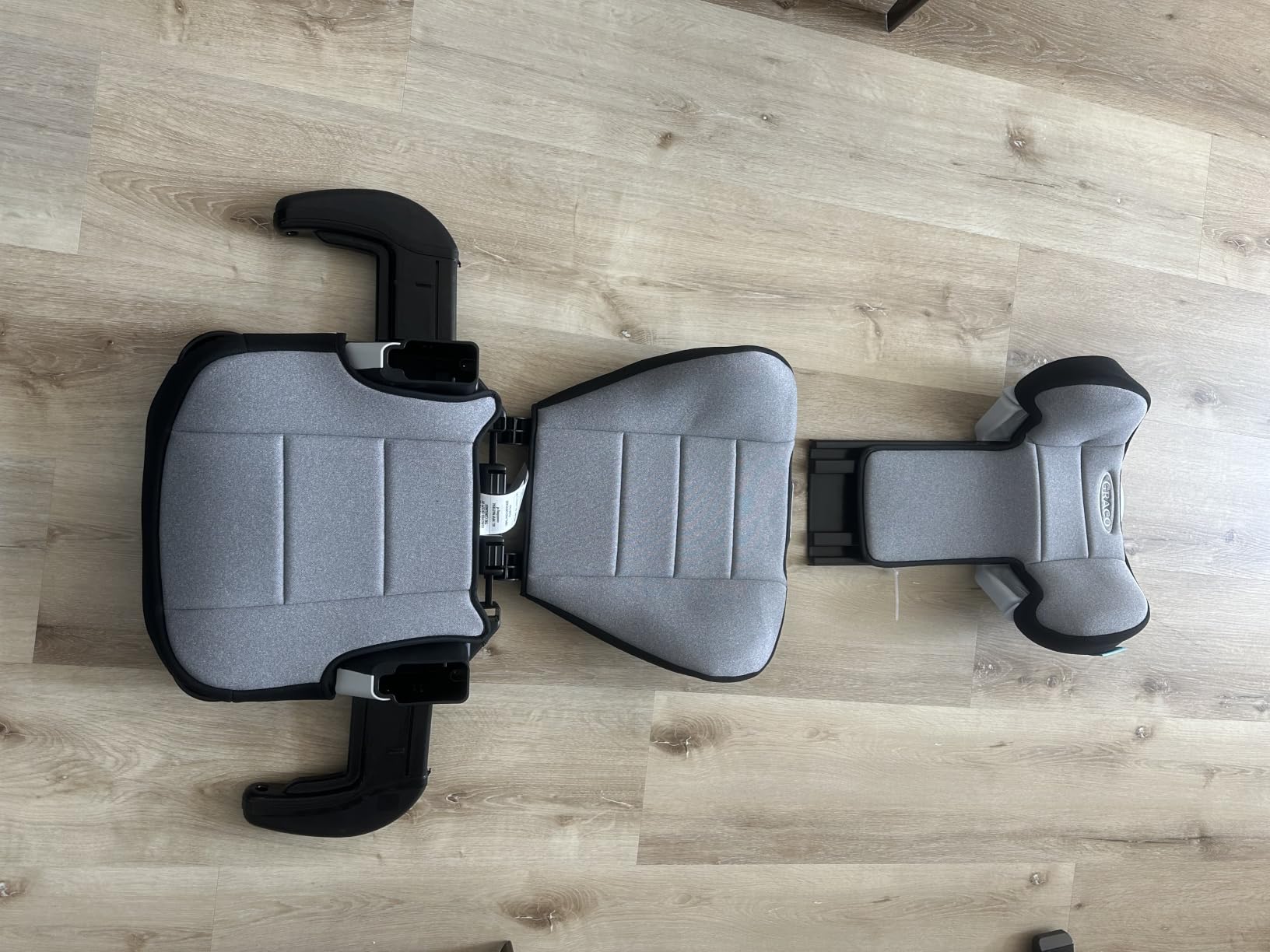
What we liked in the spec sheet is the open-loop belt guide design. Rather than a closed channel that swallows the belt, the guide is open, which means a child can reach the vehicle buckle and start buckling themselves instead of waiting for an adult in a parking lot. The adjustable armrests and head support grow with the child, and the whole thing converts to a backless booster with a single motion once the child is tall enough.
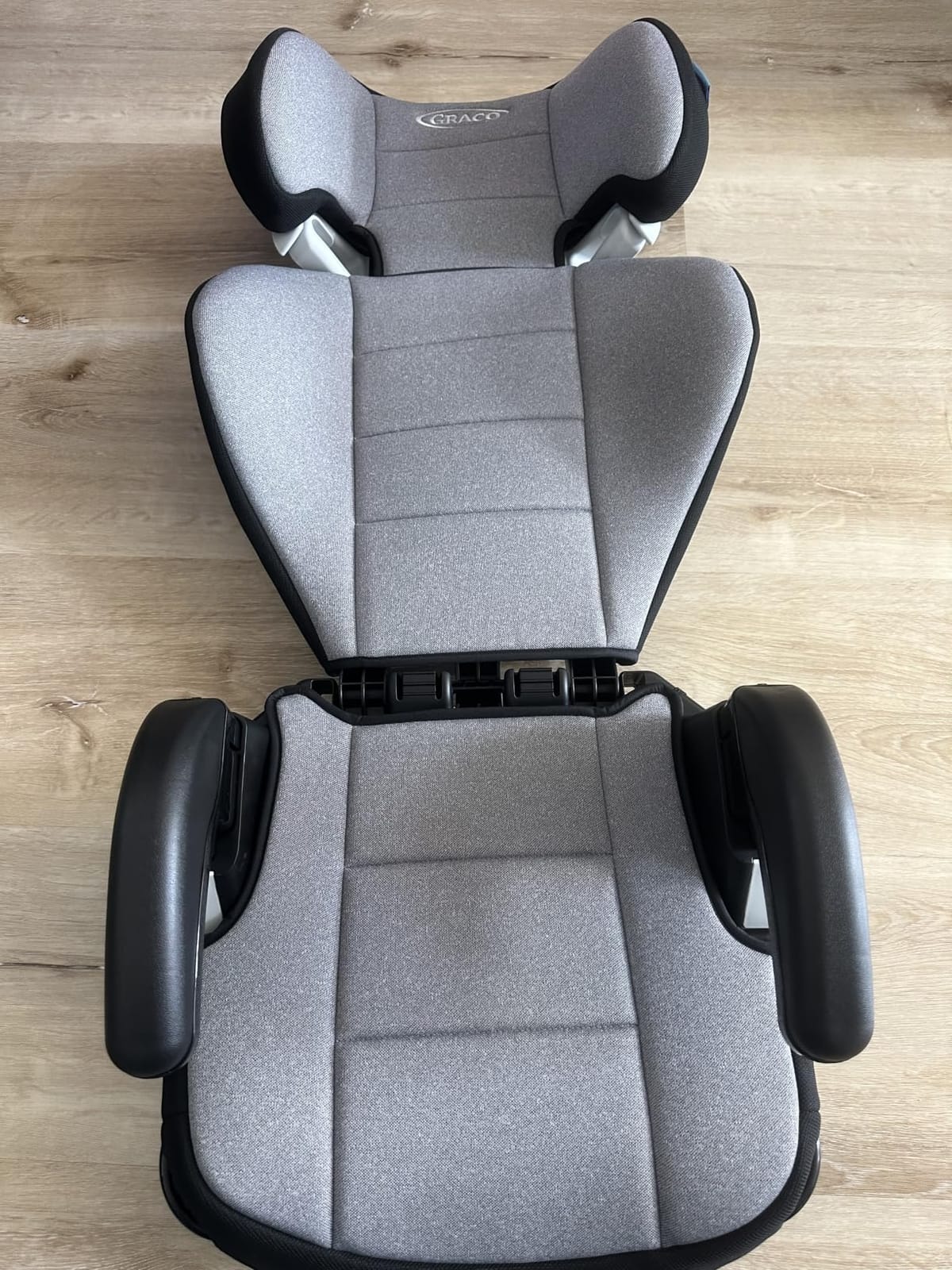
The engineering claim here is Graco ProtectPlus, which the manufacturer describes as crash tested against frontal, rear, and rollover crashes. The hide-away cup holders retract into the armrests so they do not add width in a tight back seat, and reviewers note the top of the belt stays well away from a child’s neck once the guide is used correctly.
The one detail that surprised us is the recline. Reviewers report enough recline for a child’s head to rest on a long drive, which matters more than it sounds for a four-year-old who is still napping in the car. For road trips we pair it with a small bag of snacks rather than a pile of wrappers; our go-to list is in 17 trendy recipes everyone is talking about this year, and most of them survive a car seat tray.
When it suits a four-year-old
It suits a four-year-old who is at least 40 pounds, is riding in a car where an unanchored seat is acceptable, and who will be riding daily in a seat that is light enough to move. For families with two cars, a carpool rotation, or a grandparent who helps out, the weight is the deciding factor more than any other spec.
It also suits a child who needs a seat they can manage themselves. The open-loop belt guides and the adjustable head support go a long way toward ending the daily back-seat struggle that parents on r/Preschoolers describe.
When to skip it
Skip it if your child is under 40 pounds and still small, because there is no harness mode to fall back on. A combination seat keeps them buckled until 65 pounds. Skip it too if you want the booster anchored to the vehicle, since this one attaches with the belt only and reviewers note it can slide around an empty back seat.
2. Chicco KidFit ClearTex Plus 2-in-1 – 10 headrest positions and washable ClearTex fabrics
Chicco KidFit ClearTex Plus 2-in-1 Belt-Positioning Booster Car Seat
10-position headrest adjustment
SuperCinch LATCH
ClearTex flame retardant-free fabrics
2-position recline backrest
Pros
- Very light and easy to move between vehicles
- 10-position headrest adjusted from the waist
- Quick-release LATCH removes with one hand
- Machine washable fabrics including the armrests
- Contoured double foam padding suits long rides
Cons
- Quick-release LATCH strap is not adjustable and can pop when the base is pulled
- No harness mode so the child must already meet the 40 lb minimum
- No published weight or height range in the listing data
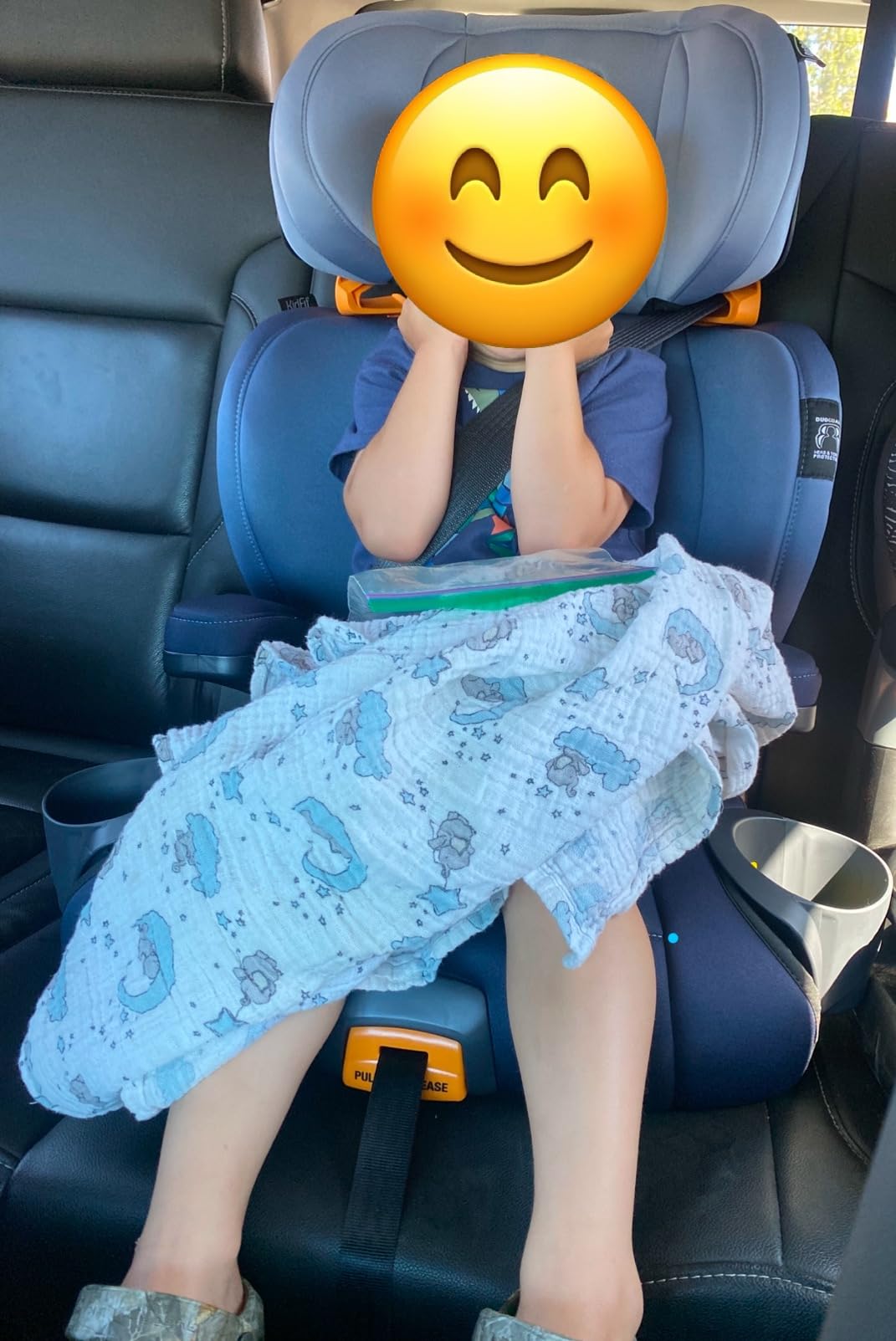
The reason parents keep circling back to this model is the DuoGuard head and torso support with 10 height positions that adjust from the waist rather than the top of the seat. At four years old, a child can grow several inches in a year, and a headrest that tracks upward in small increments means the shoulder belt keeps landing in the right place instead of creeping toward the ear.
The SuperCinch one-pull LATCH tightener is the part parents notice first. You cinch the whole system with a single strap, which is simpler than the hook-and-hook systems that need both connectors tightened separately. The quick-release LATCH then removes the seat with one hand, and reviewers consistently describe the whole install and removal process as quick and simple.
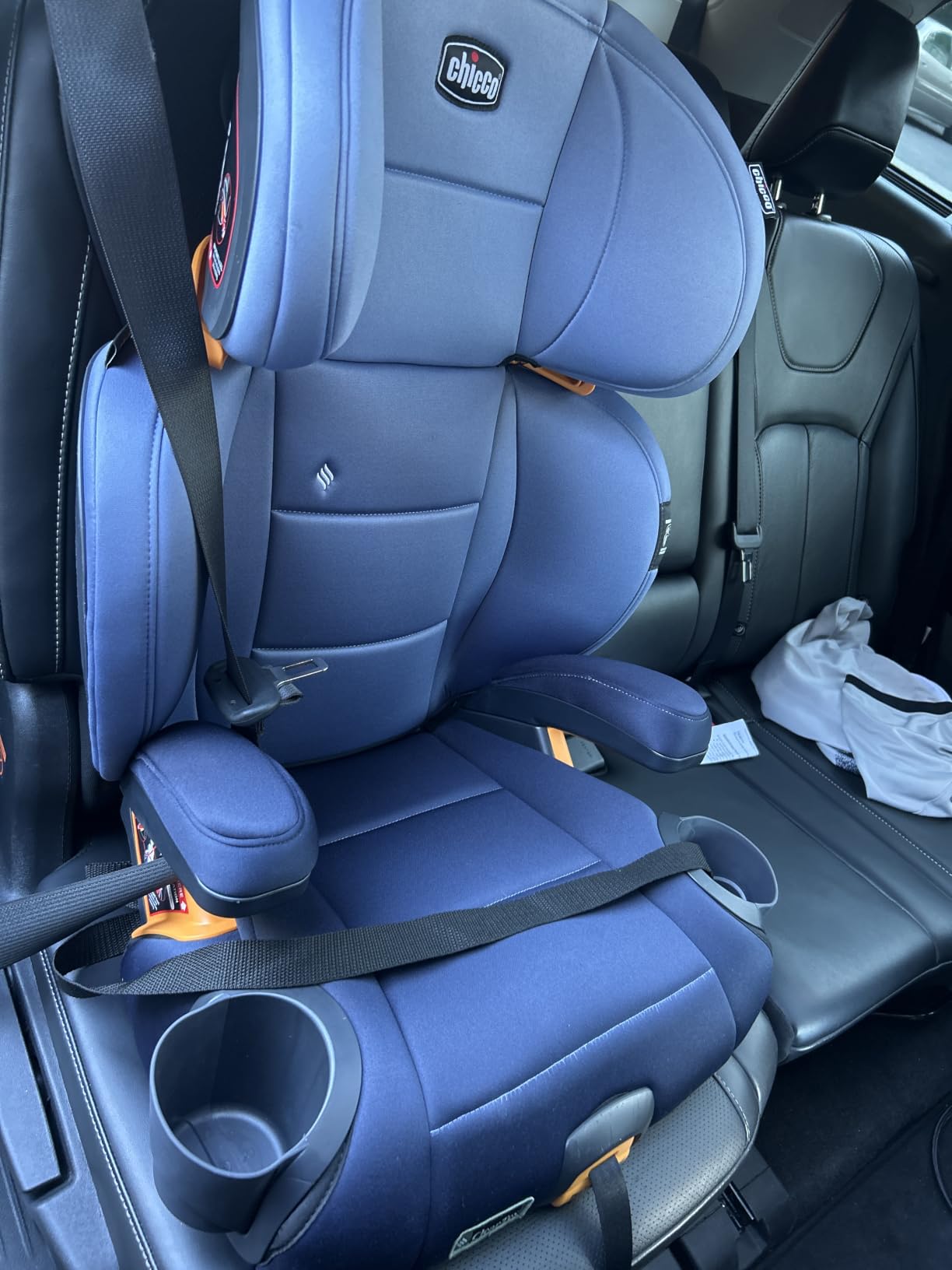
The ClearTex fabric is the quiet differentiator. The cover is made without added flame retardant chemicals while still meeting federal flammability standards, and every fabric including the armrests comes off for machine washing. In a seat that a four-year-old will eat in, that is worth more than another cup holder.
The backrest unhooks to create a backless booster, and the two-position recline gives a little more slack for a sleepy head. Two dishwasher-safe cup folders fold flat when empty, which is the detail that keeps the profile slim in a crowded back seat.
When it suits a four-year-old
It suits a four-year-old who has already outgrown the harness of their current seat and is comfortably over 40 pounds, and whose family wants a seat they will keep for the full booster years. Ten headrest positions means you are not replacing it in a year, which is the honest argument for paying a little more for the wider adjustment.
It also suits families who move seats between vehicles constantly. Light weight and one-hand LATCH release mean a single car seat travels between the family car, a second car, and a grandparent’s house without a fight.
When to skip it
Skip it for a child who is not yet ready for a booster, because there is no harness fallback. If your child is 38 pounds and impatient, they need one of the combination seats further down this list rather than a shorter jump to belt mode.
The listed product data gives no weight or height range for this model, so check the label on the seat itself or the manual before you buy. Some buyers also report the quick-release LATCH strap releasing unintentionally when the base is pulled out, which is a small thing to know about if you carry the seat by the base.
3. Britax Skyline 2-Stage – 40-120 lb and up to 63 inches tall
Britax Skyline 2-Stage Belt-Positioning Booster Car Seat, Dusk – Highback and Backless Seat
40-120 lb and up to 63 inches
10-position one-hand headrest
Color-coded belt guides
Removable cover
Pros
- Rated 40-120 lb and up to 63 inches
- 10-position headrest adjusted with one hand
- Color-coded belt guides reduce belt errors
- Compact for its size range
- Cover removes for cleaning
Cons
- Seat cushion is thin on long journeys
- Less plush padding than higher-priced boosters
- Cup holders are removable rather than integrated
The reason to look at the Skyline is the range printed on the label: 40 to 120 pounds and up to 63 inches. Of the eight seats in this guide, only three publish a height ceiling, and 63 inches is the tallest of them. That number is the one that matters if your four-year-old is a late four-year-old standing 49 inches with a growth spurt coming.
Buyers like the compact footprint for the size of the range, describing it as comparable in size to more expensive boosters while covering more growth. The 10-position headrest operates with one hand, so you can raise it as the child grows without taking both hands off the wheel in a parking lot.

Color-coded belt guides are an underrated safety feature. They mark the correct path in a different color from the release buttons, which directly addresses one of the recurring problems parents report: the shoulder belt slipping out of the guide during normal use. The protective seat shell and foam-lined headrest are the seat’s energy management story, and the cover comes off entirely for cleaning.
Two removable dishwasher-safe cup holders sit in the base. Reviewers say the cup holders are less capable than those on premium boosters, and that the padding is less plush, which are fair complaints if your child is sensitive to a thin cushion over a long drive.

When it suits a four-year-old
It suits a four-year-old on the taller or heavier side, particularly one who is already near 45 inches. One parent we read about has a four-and-a-half-year-old still in a five-point harness at 46 inches and 60 pounds, which tells you how much variation sits inside the word four.
It suits families who want a single seat to cover the whole booster stretch rather than planning a swap at 100 pounds.
When to skip it
Skip it if your child is small. A 40-pound, 41-inch four-year-old will be sitting far forward in this shell with the headrest at its lowest position, and the comfort complaints about the thin cushion get worse in that position.
Skip it if your child falls asleep on every drive and cushion comfort is the priority. The Skyline is a solid long-term fit, and cushion comfort is not where it shines.
4. Diono Cambria 2 XL – a wide, deeply padded shell for long trips
Diono Cambria 2 XL, Dual Latch Connectors, 2-in-1 Belt Positioning Booster Seat, High-Back to Backless Booster, Space and Room to Grow, 7 Headrest Positions, 8 Years 1 Booster Seat, Black
40-120 lb capacity
6-position headrest
XL wide padded seat
Retractable cup holder and snack tray
Pros
- XL wide shell gives growing children room
- Deep cushioning and padded armrests
- Retractable two-in-one cup holder and snack tray
- Covers are removable and machine washable
- Dual LATCH connectors add stability
Cons
- Bulkier footprint than slim boosters
- 6-position headrest is fewer adjustments than some rivals
- Retractable tray is one more moving part to clean
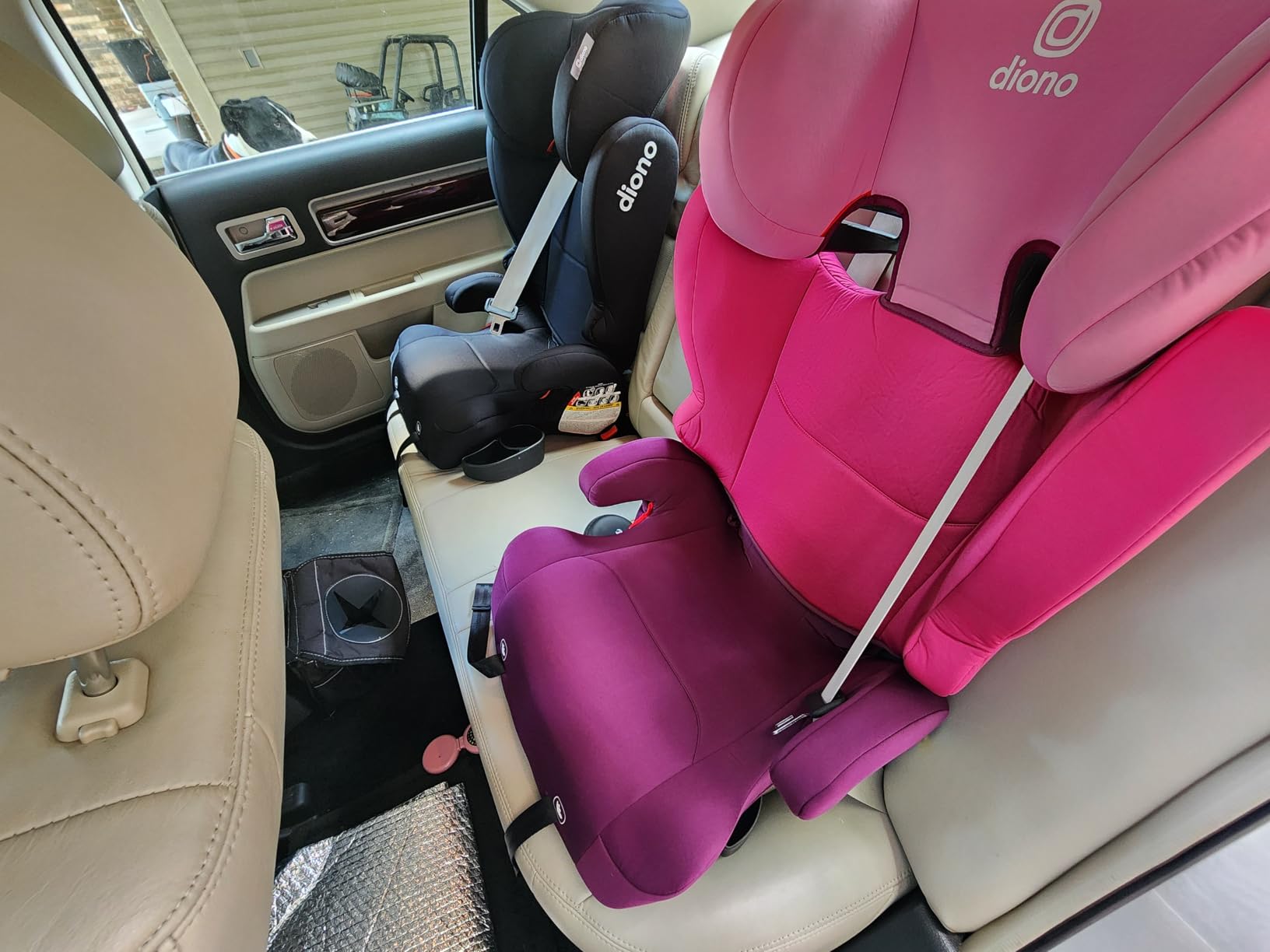
Everything about the Cambria 2 XL is built around space. The XL shell is wider than a typical booster, the armrests are built in and padded, and the seat cushion carries deep layered foam. The listed capacity runs from 40 to 120 pounds, so it covers the same weight span as the Britax with a different emphasis: how the child feels sitting in it.
The headrest is listed at six positions with two layers of side impact protection, and the product name advertises seven headrest positions. Either way, it is fewer increments than the ten-position headrests on the Graco and Chicco seats, so this is the seat to pick for comfort rather than for fine-grained growth tracking.
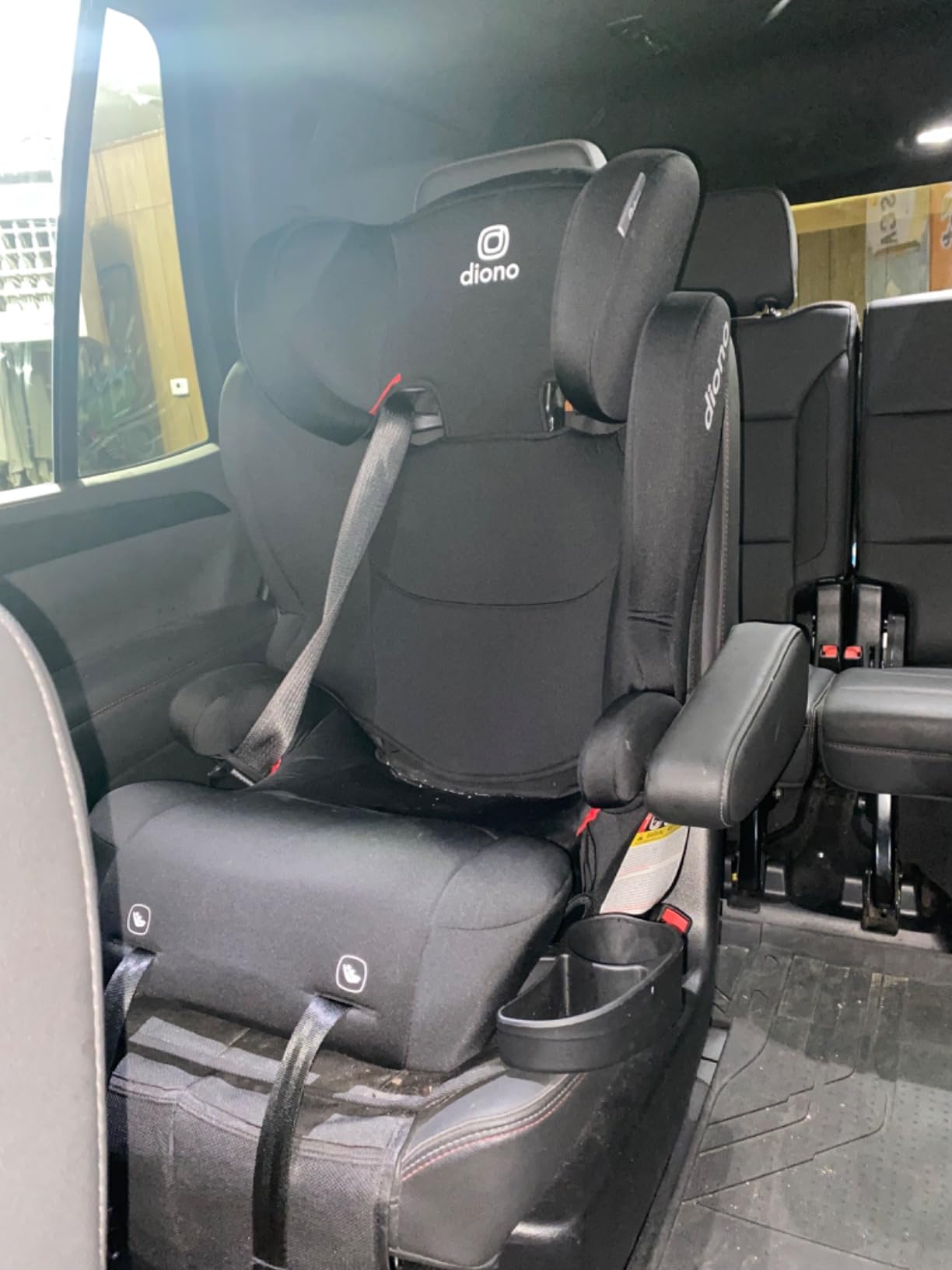
The retractable two-in-one cup holder and snack tray is the feature families mention most. On a booster that is wide to begin with, hiding the tray inside the base keeps the usable width down when the tray is not needed, and it gives a four-year-old somewhere to put a cracker during a 40-minute drive.
Dual LATCH connectors are a departure from the belt-only approach of the Graco TurboBooster 2.0. Reviewers say they add stability, which is useful for a child who squirms. The contoured fabrics with layered foam come off for machine washing.
When it suits a four-year-old
It suits a four-year-old who is wide for their age, who complains about hard seats, or who spends a lot of time in the car. Deep padding and padded armrests are the whole point of this shell, and a child who is uncomfortable in a booster will slouch, which defeats the belt positioning the seat exists to provide.
It also suits a car with a wide back seat where three-across is not the goal. The extra width costs you nothing when the middle seat is empty.
When to skip it
Skip it in a compact car or if you need three seats across. Owners consistently note that this is a bulkier seat than slim-fit boosters, and the wide shell is the reason it is not our three-across recommendation.
Skip it if you move seats between cars daily. A wide, heavily padded shell is not a seat you want to lift twice a day, and the listed product data does not describe it as a lightweight portable model.
5. Safety 1st Grand 2-in-1 – a five-point harness to 65 lb, then belt mode
Safety 1st Grand 2-in-1 Booster Car Seat, Converts from High Back to Belt-Positioning Booster, High Back Seat for Kids 40-65, and Belt-Positioning 40-100 Pounds, Old Soul
Harness mode 40-65 lb
Belt mode 40-100 lb
Slim three-across design
Adjustable headrest
Pros
- Five-point harness holds a child to 65 lb
- Converts to a high back belt booster to 100 lb
- Slim design fits three across
- Lightweight and easy to move between vehicles
- Machine washable dryer-safe pad
Cons
- Height minimums run 43.4 inches in both modes
- Shallow cup holders that let cups tip
- Less padding than some seats in the group
This is the seat for a four-year-old who has just turned four and is not in a hurry. In harness mode the Grand carries a forward-facing five-point harness from 40 to 65 pounds with a height range of 43.4 to 49 inches. In belt mode it becomes a high back belt-positioning booster from 40 to 100 pounds and 43.4 to 52 inches tall.
That two-stage structure is the answer to the most common question we found in parent forums, which is whether there is a booster seat with a harness for a four-year-old. Yes, and the practical benefit is that you buy once and skip the second purchase. One parent asked for exactly this recommendation for a child at 41.3 inches and around 42 pounds, which is squarely inside this seat’s harness range.
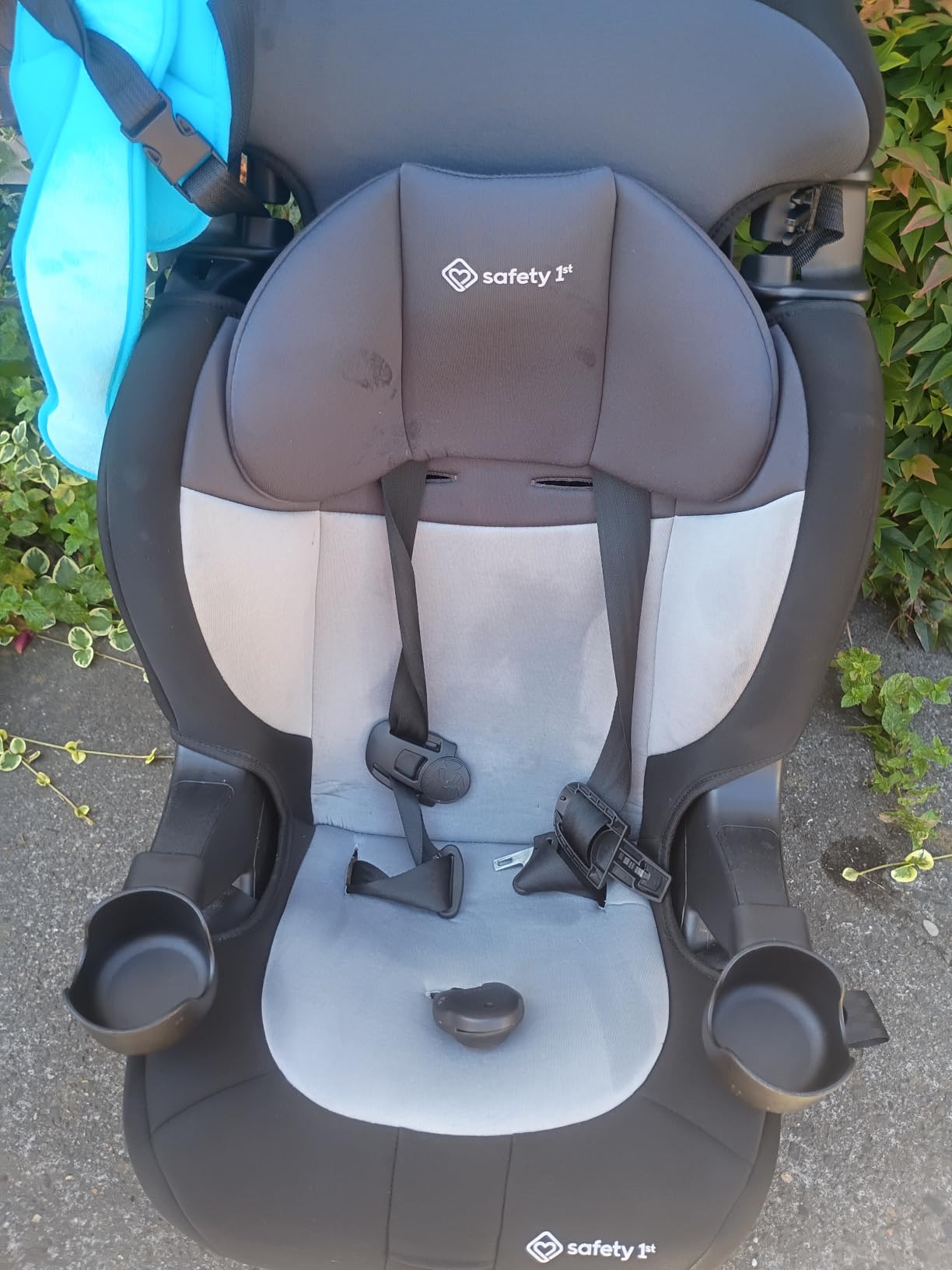
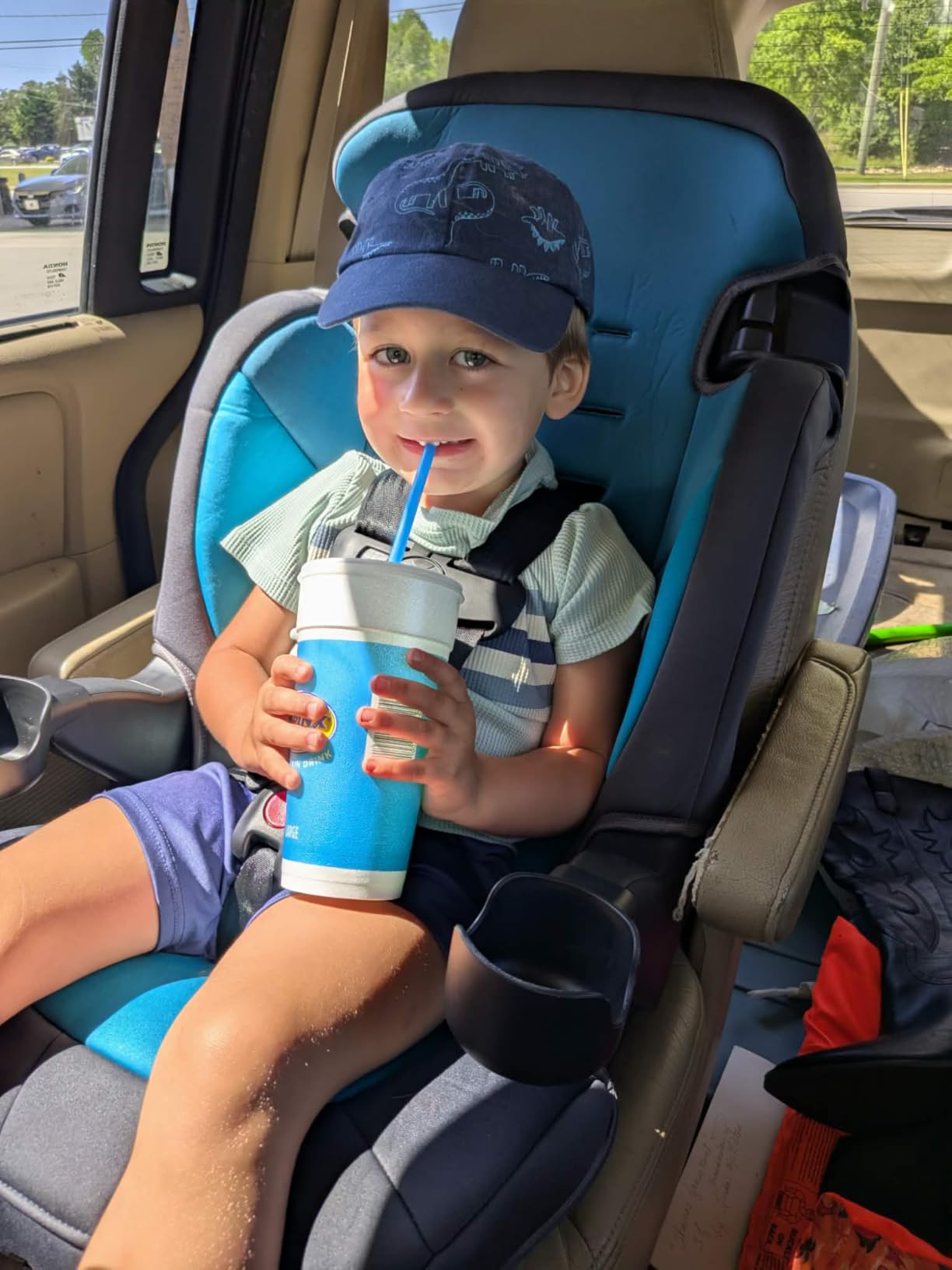
The slim footprint does real work here. Owners highlight that it fits three across the back seat of most vehicles, and that the whole seat is light enough to move between cars, which is useful for a family sharing one booster between a carpool car and a second vehicle. The adjustable headrest lets you tailor support as the child grows, and the pad is machine washable and dryer safe.
Two removable dishwasher-safe cup holders come with it. They draw the most complaints, because they are shallow and cups can tip, and some buyers wanted more padding than the seat provides. Both are fair to weigh against the harness-to-booster range this seat gives you in one purchase.
When it suits a four-year-old
It suits a four-year-old between 40 and 65 pounds who is not physically ready to give up a harness, and whose family wants to avoid buying two seats in three years. The 65-pound harness ceiling covers most children who are still four when they turn five.
It also suits large families. Between the slim footprint and the light weight, this is a practical pick for a back seat that already has another child’s seat in it.
When to skip it
Skip it if your child is under 43.4 inches tall. The Safety 1st Grow and Go shares the same 43.4-inch floor, so if height is the issue, both need to be checked against your child rather than assumed to fit.
Skip it if your child insists on a cup that will not tip. The shallow holders are the single most repeated complaint in the reviews.
6. Graco Tranzitions 3-in-1 – a harness to 65 lb for a child who should wait
Graco Tranzitions 3-in-1 Harness Booster Car Seat, Proof
Harness 26.5-65 lb
Booster modes 40-100 lb
No-rethread harness
One-hand 9-position headrest
Pros
- Harness stage runs to 65 lb so the child can wait
- No-rethread harness adjusts headrest and harness together
- Three stages in one seat from toddler to youth
- Lightweight and portable
- One-hand 9-position headrest adjustment
Cons
- No published height range in the listing data
- Booster modes stop at 100 lb rather than 120
- Three stages means more parts to keep clean
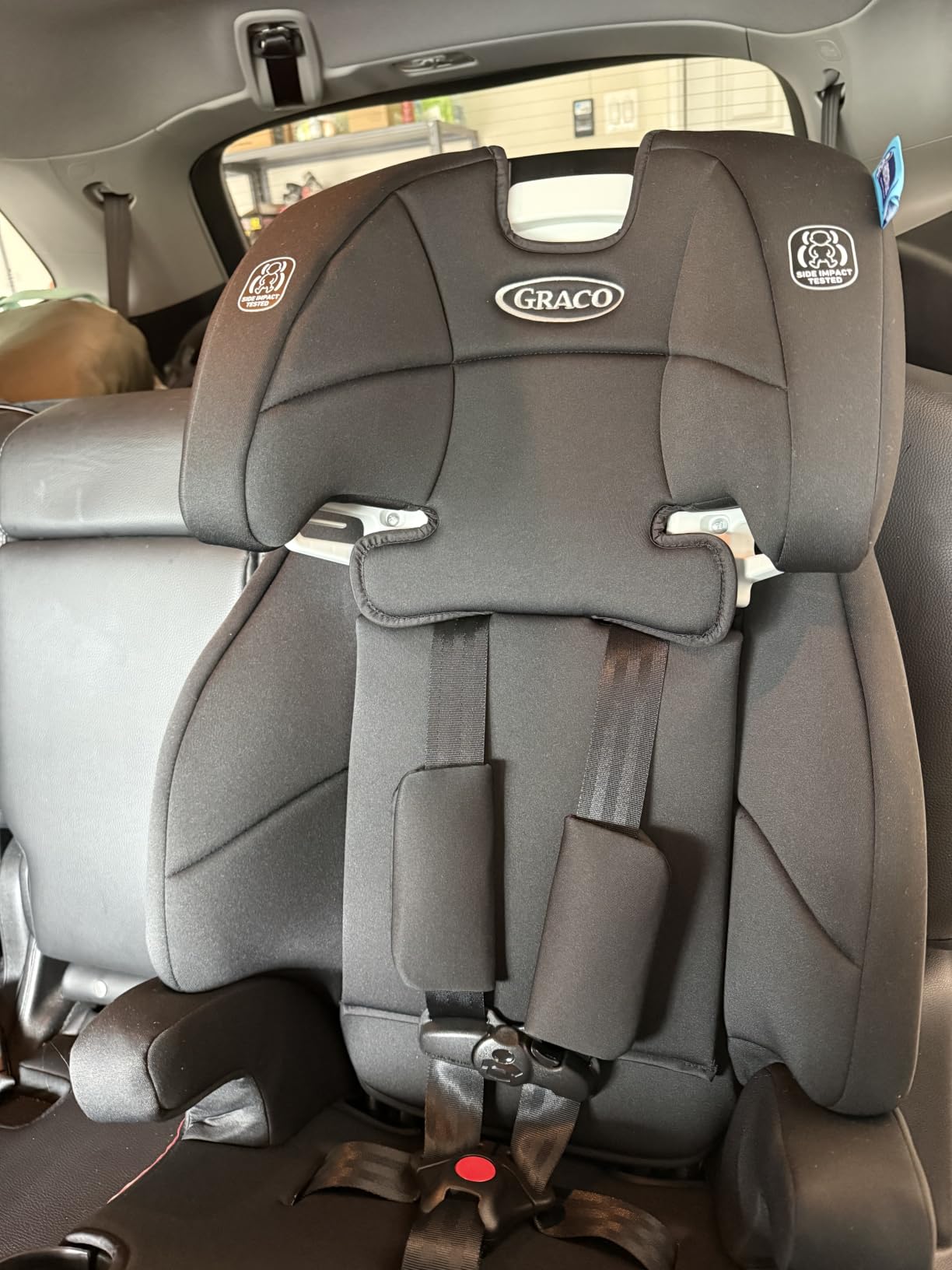
The Tranzitions is the seat to buy if you think your child might be a year or two away from a booster. The forward-facing harness runs from 26.5 to 65 pounds, and the same seat then converts to a high back booster and a backless booster for 40 to 100 pounds. That is a full run from toddler to youth in one shell, though the weight ceiling of 100 pounds in the booster stages is lower than several other seats here.
The No-Rethread Simply Safe harness is the part that changes daily life. The headrest and the harness straps adjust together in one motion, so growing a child out of one height and refitting the harness is a single pull rather than a sequence of steps. For a family that is already tired of daily harness adjustments, reviewers repeatedly call this simple and fast.
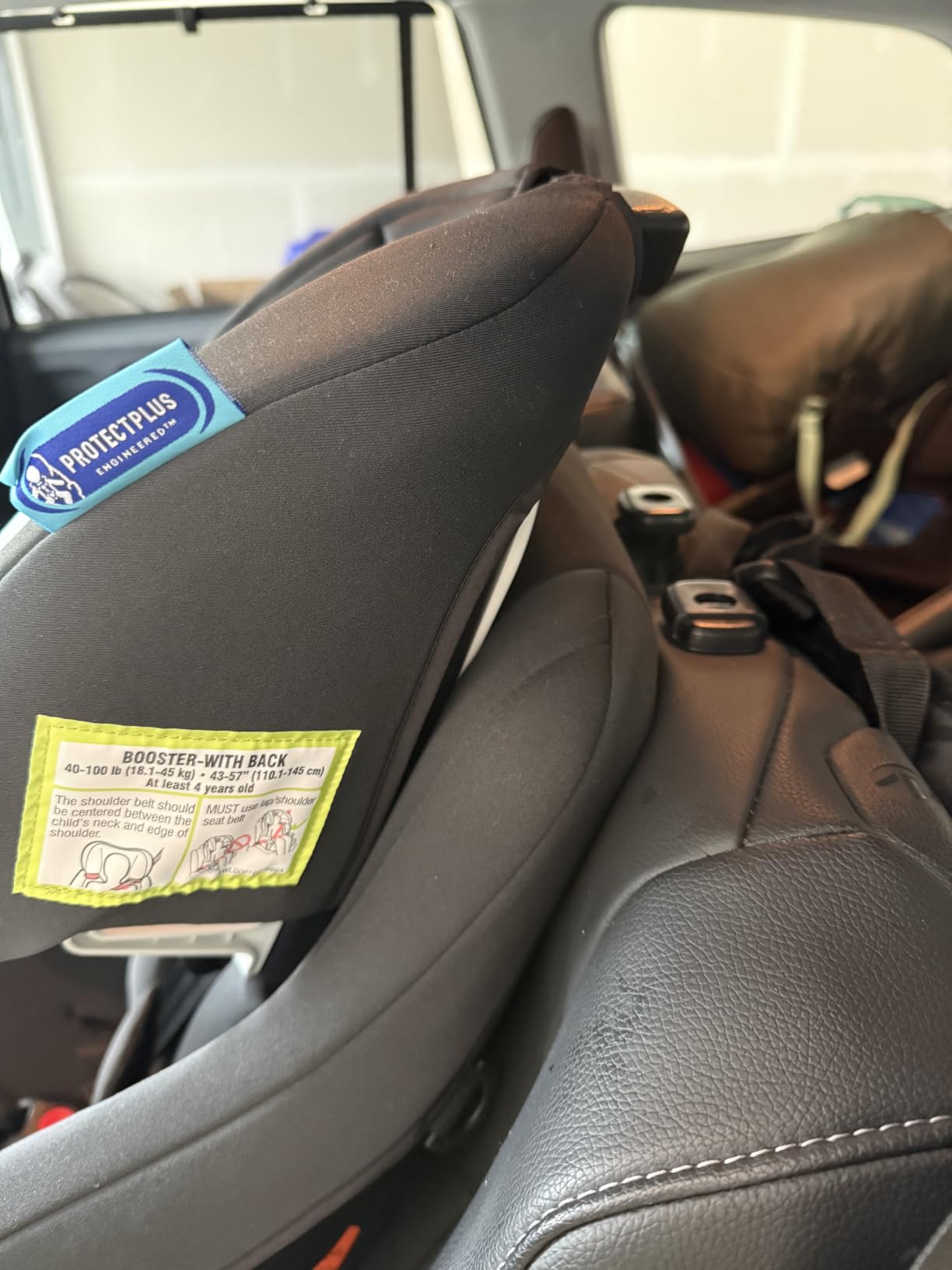
Worth knowing: the minimum weight for the booster stages was raised from 30 pounds to 40 pounds, which the manufacturer states was done to keep meeting industry standards for booster mode. For a small four-year-old, the practical effect is that the harness stage really is the stage to use now.
The nine-position headrest adjusts with one hand, and the seat is described as lightweight and portable, which suits families rotating one seat through several vehicles. The listed product data gives no height range, so confirm that against the label before purchase.
When it suits a four-year-old
It suits a four-year-old at or near 40 pounds who should stay in a harness for another year or two, and whose parents would rather not buy a booster yet. The 65-pound harness ceiling means you are not shopping again at 50 pounds.
It also suits families who want one seat for a second child to use later, since the same shell that fits a 40-pound four-year-old in harness mode will fit a much older child in backless mode.
When to skip it
Skip it if your child is heavy or tall and will burn through the harness stage quickly. The booster modes here stop at 100 pounds rather than 120, so a large child would outgrow the whole seat sooner.
Skip it if you want a published height range to plan against, or if you need the three-across slimness of a narrower design. The listed data does not describe this model as a narrow three-across seat.
7. Safety 1st Grow and Go 2-in-1 – 19 inches wide, built for three across
Safety 1st Grow and Go 2-in-1 Booster Car Seat with ComfortWings, Converts High-Back to Backless, 19″ Wide, Slim Design, Lightweight, Foldable, Easy-Clean, Cup Holders, 40-100 lbs, Crushed Grape
40-100 lb and 43.4-57 inches
19 inch width with ComfortWings
Narrow foldable design
10-position headrest
Pros
- Narrow 19 inch width leaves more back seat room
- Foldable and light for moving between cars
- ComfortWings expand as the child grows
- Shoulder and lap belt guides help self-buckling
- Machine washable pad
Cons
- Fold-flat design takes practice to set up repeatedly
- Fewer reviews than the leaders in this list
- Backless mode is included but premature at this age
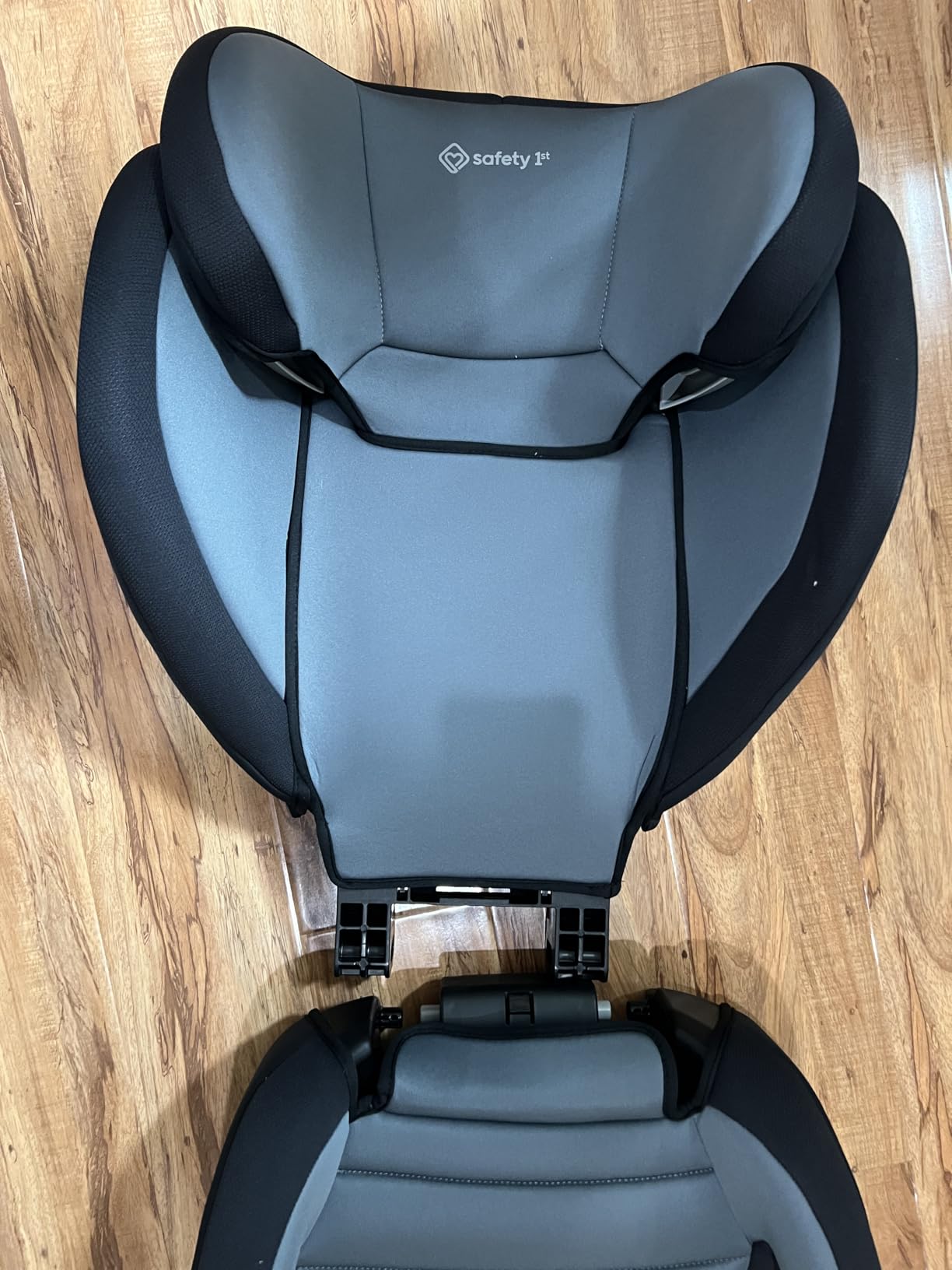
If three seats across is the requirement, the Grow and Go is built for it. The listed dimensions give a 19 inch total seat width with the ComfortWings expanded, and the shell is described as narrow, foldable, and lightweight. Reviewers single out the narrow footprint as the reason they bought it.
It covers 40 to 100 pounds and 43.4 to 57 inches tall, which is a useful range for a four-year-old who is tall for their weight. The 10-position headrest and the expanding ComfortWings grow with the child, and the shoulder and lap belt guides are there to help a small child reach the buckle and thread the belt correctly.
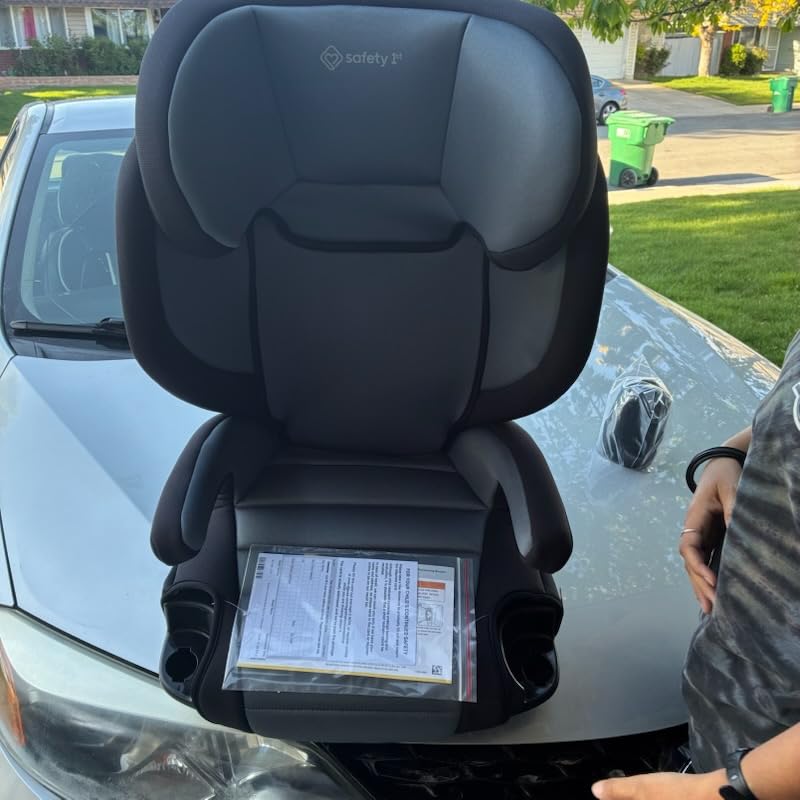
The foldable design is genuinely practical when a seat lives in a trunk or a second car, and it is also the one thing some users find awkward. A few report the fold-flat setup takes a bit of practice to repeat, so if you fold and unfold it daily, test it in the store first.
The seat pad is machine washable and dryer safe, and the two cup holders are removable and dishwasher safe. At 471 reviews the feedback pool here is smaller than for the four seats above it, so we would weight the spec sheet more heavily than the review averages.
When it suits a four-year-old
It suits a four-year-old in a compact car, a three-child back seat, or any situation where every inch of width matters. Folding the seat flat also suits a carpool where the booster needs to live in the trunk between trips.
It suits a child who self-buckles, because the shoulder and lap belt guides are positioned to make that possible rather than requiring an adult to thread the belt every time.
When to skip it
Skip it if you need a heavier build or a weight ceiling above 100 pounds. The 100-pound limit is lower than the 120-pound seats in this roundup, and children differ a lot at four.
Skip it if you fold the seat constantly and want zero assembly steps. The design is unusual enough that a few owners needed to get used to it.
8. Diono Everett NXT – the best with rigid LATCH
Diono Everett NXT High Back Booster Car Seat with Rigid Latch, Lightweight Slim Fit Design, 8 Years 1 Booster Seat, Black
40-120 lb
Steel rigid LATCH, no tightening
7-position headrest
Open loop belt guides
Pros
- Steel rigid LATCH clamps on with no tightening
- Easy for anyone with limited dexterity to operate
- Slim fit allows three across in a large SUV
- Sturdy build that still moves between cars
- Open loop belt guides keep the belt reachable
Cons
- Curved headrest wings can dig into small shoulders
- Cup holders mount on a small plastic stem and can loosen
- Very heavy sturdy build to lift
Most boosters attach with the vehicle belt alone, and the ones that add LATCH use the flexible hook-and-strap system that parents describe as a nuisance to reach behind a vehicle seat. The Everett NXT uses automotive steel rigid LATCH connectors instead, which clamp onto the anchors directly with no tightening strap at all.
That single change is the reason this seat exists. Reviewers note that the clamps are easy for grandparents or anyone with limited dexterity to operate, and that the booster still slides easily between vehicles despite a very heavy and sturdy build. One buyer reports fitting three across in a Volvo XC90.
When it suits a four-year-old
It suits a four-year-old whose family wants the booster physically anchored to the car, and whose adult caregivers are not going to wrestle with hook-style connectors. The listed range runs 40 to 120 pounds, which is the higher end of the weight limits on this list.
It also suits a family that buys in multiples. Several owners report buying more than one so each car has a booster, and the rigid LATCH is a low-effort way to install in a second vehicle.
When to skip it
Skip it if you move the seat between cars every day and weight matters. The build is described as very heavy, and a heavy seat plus rigid LATCH means more lifting and more install work per trip.
Skip it if your child is small in the shoulders. Reviewers report the curved headrest wings pressing into a child’s shoulders when set to the position in the manual, and the cup holders, which press in on a small plastic stem, can work loose or need replacement over time.
Highback, Backless, or Combination: Which Type a 4-Year-Old Needs
The short answer for a four-year-old is that backless is the wrong answer. Backless boosters exist to serve children whose vehicle shoulder belt already fits them properly, and a four-year-old almost never gets there.
Think about what each type actually does. A highback booster is a seat back with a raised seat pan that routes the shoulder belt to a guide at the child’s shoulder and the lap belt low across the thighs. A backless booster is a raised seat pan with armrests and no back, used when the child’s head already clears the vehicle head restraint and the shoulder belt lands correctly without help. A combination harness booster starts as a real car seat with a five-point harness and converts to a belt-positioning booster later.
At age four the height and maturity bar for backless is almost never met. Parents in car seat forums consistently answer the question the same way: no. A backless booster for a four-year-old is legal only in the sense that a seat exists, and it removes the shoulder belt guide, the head support, and the side-impact structure in one move. That is a downgrade with no upside at this age.
Combination seats are the category most roundups skip, and they are the one that matches what parents with a small four-year-old are actually asking for. If your child is under 40 pounds, the honest answer is not a different booster but a different stage: stay in the harness, and choose a seat whose harness runs to 65 pounds so you are not shopping again next year.
How to Choose a Booster Seat: 7 Criteria That Matter
Once the readiness gate is passed, seven numbers and features decide the fit. We would check them in this order.
1. Weight and height range against your child. Not the headline number, the full range and the minimum. The seats here run from a 40-pound floor to a 120-pound ceiling, but their height floors vary: the Safety 1st Grand and the Safety 1st Grow and Go both list 43.4 inches as the shortest seated height, and the Britax Skyline reaches 63 inches, the tallest ceiling among the eight seats here that publish one.
2. Headrest adjustment range. More positions means the shoulder belt keeps landing correctly through a growth spurt. The Chicco KidFit and the Safety 1st Grow and Go each offer 10 positions, the Graco Tranzitions offers 9, and the Diono seats in this list offer 6 to 7.
3. Whether the shoulder belt guide is open or closed. An open-loop guide lets a child reach the buckle and start buckling themselves. Parents report difficulty getting children to buckle in wider boosters where the base covers the buckle slot, and open guides on the Graco TurboBooster 2.0 and the Diono Everett NXT are the direct answer to that.
4. LATCH type, and whether there is one. This is a topic worth its own paragraph. On a booster, LATCH anchors the seat to the car, not the child to the seat. The child is restrained by the vehicle belt either way. An anchored booster is more stable and less likely to slide around an empty back seat, and it is genuinely useful for a carpool or a second car, but it does not make a child safer in a crash than a belt-only booster.
5. Lap belt geometry. The lap belt must sit low on the thighs, below the belly. A booster with narrow armrests and a contoured seat pan guides the belt into that position; a wide flat base can let it ride up. Sit the child in the seat in your own car and check before you commit.
6. Convertibility. A highback that removes to become a backless booster extends the life of the purchase. Both the Chicco KidFit and the Graco TurboBooster 2.0 do this with the backrest, and the Britax Skyline, Diono Cambria 2 XL, and Safety 1st Grow and Go all convert as complete units.
7. Materials, cleaning, and the expiration date. Every booster has a manufacture date sticker, usually on the shell or under the cover, and a service life of roughly six to ten years depending on the model. Read the sticker before you buy, not after. Removable machine washable covers matter more than any feature on this list at four years old, and a seat bought second-hand may be years into its life or past it entirely.
Check Your Car Before You Check the Reviews
A booster only works if your vehicle lets it work. Three checks in the driveway will tell you more than any product review.
Does the position have a usable head restraint? A child who cannot rest their head against something will slouch, and a slouching child cannot hold a belt fit. This is the whole reason backless boosters are a later-stage product, and the reason an out-of-position head in a slouched four-year-old is a real problem.
Does the belt geometry cooperate? A booster cannot be used on a lap-only belt. With a lap-and-shoulder belt, check that the shoulder belt reaches the guide at the booster’s headrest without twisting and that the lap belt sits low. In a car with a deeply recessed buckle, a child may not be able to reach and latch it, which is a problem that wide boosters make worse.
Does the width work? Measure the gap in your back seat for the position you plan to use. A narrow seat is what makes three-across possible, and a wide seat eats a whole row.
Two more vehicle facts are worth knowing. Seat-belt pretensioners and force limiters change how the belt behaves in a crash, and not every car has them in every position. And a booster belongs in the back seat, not the front, because the front seat is where airbags deploy and where a child that size has no business sitting.
One last point on a booster that a lot of roundups skip: it is not a travel seat. A booster depends on a vehicle seat belt, so it cannot be used on an airplane or anywhere the child would ride lap-only. Plan a separate travel solution for flights.
Why There Is No Booster Crash-Test Scoreboard
If you go looking for a booster crash-test badge, you will not find a current one, and it is not because the testing was abandoned for safety reasons. The Institute for Highway Safety stopped rating booster seats because nearly every model on the market earned the top mark, which made the rating useless as a differentiator.
That has a practical consequence: many retail listings still display an old BEST BET badge from a grading system that no longer runs. Treat those as expired information rather than as a current verdict. What you can still evaluate is whether the seat meets the federal standard for belt-positioning boosters, FMVSS 213, and whether its belt guides, head support, and LATCH system are built the way the manufacturer describes.
We did not crash test any of the seats in this guide, and we would rather say that plainly than imply otherwise. Every number above comes from the manufacturer’s listed specifications and from what owners report in their reviews.
When Does Your Child Stop Needing a Booster?
The answer is not an age, it is a fit, and you test it in the car rather than on a birthday. In most states the legal endpoint is a combination of 4 feet 9 inches, usually somewhere between ages 8 and 12, and passing the seat belt’s own five-step fit test.
The five steps, all at once, on a real drive: the child’s back is against the vehicle seat back, the knees bend naturally at the front edge of the seat, the lap belt sits low across the hips and thighs, the shoulder belt crosses the middle of the shoulder and chest, and the child can hold that position for the whole trip without slouching or fidgeting.
If any one of those fails, they stay in the booster. Plenty of tall kids fail on the shoulder belt, and plenty of short kids pass on height but fail on the ability to sit still for 30 minutes.
Frequently Asked Questions
What booster seat should a 4 year old be in?
A highback belt-positioning booster is the right default for a four-year-old, and a combination harness-to-booster seat is right if your child is under 40 pounds or not yet ready to give up a harness. In this roundup the Graco Tranzitions 3-in-1 and the Safety 1st Grand 2-in-1 both hold a child in a five-point harness to 65 pounds before converting. Backless boosters are almost never appropriate at this age.
What car seat should I use for a 4 year old?
If your child still fits the harness of their current forward-facing seat, keep using it. Moving to a booster is a step down in restraint, not up, so the safest answer is the most protective seat your child has not yet outgrown. A four-year-old who is under 40 pounds is not eligible for a booster in most states, and a combination harness-to-booster seat lets you delay that step without buying two seats.
Can a 40 lb 4 year old sit in a booster seat?
At 40 pounds your child meets the weight minimum on most boosters, but the height minimum is the deciding factor. Seats here start at 43.4 inches, so a 40-pound child under that height is legally eligible yet physically too small. Check both numbers against the label, and confirm your own state’s minimums, since many require 4 years and 40 pounds together.
Should a 4 year old still be in a 5-point harness?
If your child fits within the height and weight limits of their current seat’s harness, yes. Most forward-facing harnesses run to 65 pounds, and a four-year-old at 45 pounds with room to grow should stay buckled. Only move to a booster when the harness is outgrown, and only then if your child can sit upright and hold the position for the whole drive.
Is there a booster seat with a harness for a 4-year-old child?
Yes, and it is usually the right answer for a four-year-old. The Graco Tranzitions 3-in-1 runs a forward-facing five-point harness from 26.5 to 65 pounds before converting to highback and backless booster modes at 40 to 100 pounds. The Safety 1st Grand 2-in-1 harnesses from 40 to 65 pounds and then runs belt mode to 100 pounds. Both let you buy one seat instead of two.
Can a 4 year old go in a backless booster?
Almost never, and we would not recommend it. A backless booster has no head support and no shoulder belt guide, so it only works when the vehicle belt already fits a child properly, which a four-year-old’s does not. Backless boosters are a later-stage option for children whose head clears the vehicle head restraint and who can sit correctly without help. At age four, a highback is the minimum.
Do booster seats have expiration dates?
They have a manufacture date rather than a printed expiry, usually on a sticker on the shell or under the cover, and a service life of roughly six to ten years depending on the model. Check the sticker, keep the instruction manual and registration card, and register the seat so recall notices reach you. Avoid buying a booster second-hand, since you cannot confirm its age or crash history.
When can my child stop using a booster seat?
When they pass the five-step seat belt fit test: back against the vehicle seat, knees bending naturally, lap belt low on the hips and thighs, shoulder belt across the middle of the shoulder and chest, and able to hold that position for an entire drive. Most states set the legal endpoint at 4 feet 9 inches, typically between ages 8 and 12, but the fit test is the real answer.
Bottom Line
Plenty of four-year-olds are not ready for a booster at all, and for those families the best move is a combination harness seat rather than a booster. If your child is over 40 pounds, tall enough for the seat’s height minimum, and can sit upright for the whole drive, the Graco TurboBooster 2.0 is the one we reach for most, with 5149 owner reviews behind it and a light build that moves between cars without ceremony. The Chicco KidFit ClearTex Plus is the upgrade for a child who will use one seat for the entire booster stretch, and the Britax Skyline covers the taller four-year-olds with its 63-inch ceiling.
For a child who is small or not ready, the Safety 1st Grand and the Graco Tranzitions both keep a five-point harness on until 65 pounds, and either one removes the need to buy a second seat next year. For a back seat that needs three seats across, the Safety 1st Grow and Go at 19 inches wide is the one that fits.
Before you buy, measure the width of the position you plan to use, check the belt path in your own car with the child sitting in the seat, and read the manufacture date sticker. Those three checks will rule out more wrong answers than any rating on a list, and they are the same checks we applied when ranking the best booster seats for 4 year olds here.
For snack ideas that actually survive a booster cup holder, our go-to list is 17 seasonal recipes to enjoy fresh flavors all year. Updated for 2026.