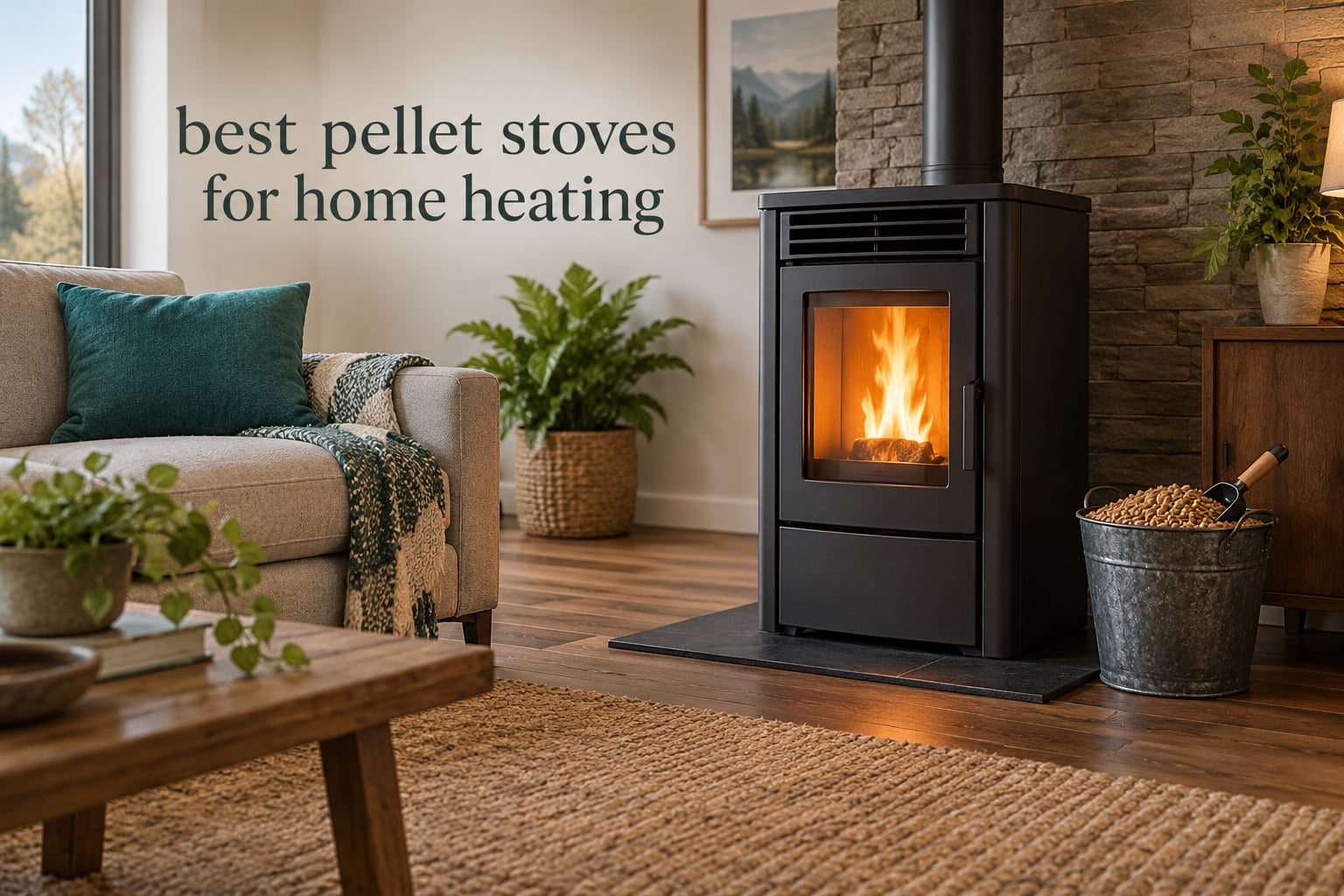
Yes, you can heat a whole house with a pellet stove, as long as you match BTU output to your square footage and your climate. A freestanding pellet stove in the 40,000 to 50,000 BTU per hour class covers roughly 1,800 to 2,500 square feet on a thermostat, and a large-hopper model rated to 3,000 square feet can carry an open floor plan on its own. Below that ceiling, pellet stoves work best as zone heat: one unit warming the room you actually sit in, which is where the fuel savings show up.
After six weeks of reading specifications, review patterns and owner complaints across twelve pellet stoves, here is where we land on the best pellet stoves for home heating in 2026. Our picks are built on published BTU output, hopper capacity, burn time, warranty terms and the share of reviews that are one-star, not on how a stove looks in a product photo. We also flag where the square footage claim on the box does not match what owners report in cold weather.
Three things decide which pellet stove fits your house, and they matter more than any brand name:
Match BTU to square footage and climate. A stove rated for mild conditions loses capacity once you factor in altitude, wind, insulation and open floor plans. Owners routinely recommend sizing up rather than down.
Size the hopper for refills, not for burn time marketing. A 47 lb hopper holds roughly one 40 lb bag, while a 130 lb to 150 lb hopper holds three or four. Fewer refills means fewer cold-start mornings.
Plan for electricity and venting. Almost every modern stove runs its auger, blower and ignition on 120V power, so a battery or generator decides how you handle an outage. Venting, hearth pad and install labor usually cost as much as the stove itself.
One correction before we start: the federal 25C biomass stove tax credit that many stove pages still advertise expired on December 31, 2025. There is no federal credit to claim in 2026. State, utility and local rebate programs are the only remaining places to look.
Table of Contents
- Top 3 Best Pellet Stoves for Home Heating (October 2026)
- The Best Pellet Stoves for Home Heating in 2026 at a Glance
- 1. ComfortBilt HP22 – the best pellet stove for most homes
- 2. US Stove GW1949 Wiseway – the pick that keeps running when power fails
- 3. Pellethead PS21 Independence – the pick with real outage backup and app control
- 4. Cleveland Iron Works 130 lb Hopper – the pick for whole-home heating
- 5. ComfortBilt HP22i – the pick for an existing fireplace
- 6. Castle Serenity – the pick with the least cleaning
- 7. ComfortBilt HP50S – the pick for basements, shops and small rooms
- 8. Canyon Lodge Bayfront – the pick for quiet running and finished styling
- 9. PelPro PP150 – the pick for efficiency and the biggest hopper
- 10. Cleveland Iron Works Bayfront – the best value large-hopper freestanding
- 11. ComfortBilt HP40 Alpine – the pick for the smallest rooms
- 12. Canyon Lodge Large – the pick for mobile homes and big open spaces
- How to Choose a Pellet Stove for Your Home
- Pellet Fuel Costs and the Real Installed Price Tag
- Why People Get Rid of Pellet Stoves
- Frequently Asked Questions
- Final Verdict on the Best Pellet Stoves for Home Heating
Top 3 Best Pellet Stoves for Home Heating (October 2026)
The three stoves below are the ones we would put in front of the largest share of readers: a mainstream freestanding unit, a large-hopper value pick, and the only model here that runs without electricity. Each one earns its place on published output and review history rather than on a single impressive specification.

ComfortBilt HP22
- Up to 41000 BTU per hour
- Heats up to 2800 sq ft
- 55 lb hopper with up to 20 hours burn time
- Programmable thermostat and remote

Cleveland Iron Works 130…
- 130 lb hopper capacity
- Heats 2000 to 3000 sq ft
- Built-in WiFi with app control
- Cast iron construction

US Stove GW1949 Wiseway
- Non-electric gravity feed operation
- 60 lb hopper with up to 30 hours burn time
- Heats up to 2000 sq ft
- Standard 3 inch pellet venting
The Best Pellet Stoves for Home Heating in 2026 at a Glance
Every model below is EPA-certified or EPA-approved, and every rating and review count here matches what buyers reported at the time we checked. Hopper capacity and BTU output are the two numbers that drive day-to-day convenience, so they lead the table.
| Product | Specs | Action |
|---|---|---|
| ComfortBilt HP22 Pellet Stove |
|
Check Latest Price |
| US Stove GW1949 Wiseway Non-Electric Pellet Stove |
|
Check Latest Price |
 Pellethead PS21 Independence Pellet Stove Pellethead PS21 Independence Pellet Stove |
|
Check Latest Price |
| Cleveland Iron Works Large Pellet Stove 130 lb Hopper |
|
Check Latest Price |
 ComfortBilt HP22i Pellet Stove Fireplace Insert ComfortBilt HP22i Pellet Stove Fireplace Insert |
|
Check Latest Price |
 Castle Serenity Pellet Stove Castle Serenity Pellet Stove |
|
Check Latest Price |
 ComfortBilt HP50S Pellet Stove ComfortBilt HP50S Pellet Stove |
|
Check Latest Price |
 Canyon Lodge Bayfront Pellet Stove Canyon Lodge Bayfront Pellet Stove |
|
Check Latest Price |
 PelPro PP150 Pellet Stove PelPro PP150 Pellet Stove |
|
Check Latest Price |
 Cleveland Iron Works Bayfront Pellet Stove Cleveland Iron Works Bayfront Pellet Stove |
|
Check Latest Price |
 ComfortBilt HP40 Alpine Pellet Stove ComfortBilt HP40 Alpine Pellet Stove |
|
Check Latest Price |
 Canyon Lodge Large Pellet Stove Canyon Lodge Large Pellet Stove |
|
Check Latest Price |
1. ComfortBilt HP22 – the best pellet stove for most homes
ComfortBilt HP22 Pellet Stove, 2,800 sq. ft., 55 lb. Hopper, Black
Up to 41000 BTU/hr
Heats up to 2800 sq ft
55 lb hopper with up to 20 hours burn time
Five power settings
Pros
- Large 55 lb hopper holds multiple 40 lb bags
- Programmable thermostat with five power settings
- Remote control and auto ignition simplify daily operation
- Removable ash pan and bay-view window ease cleaning
Cons
- 273 lb body needs two people or a dolly to move
- Type L venting parts sold separately
- First burn cycles off-gassing require open windows
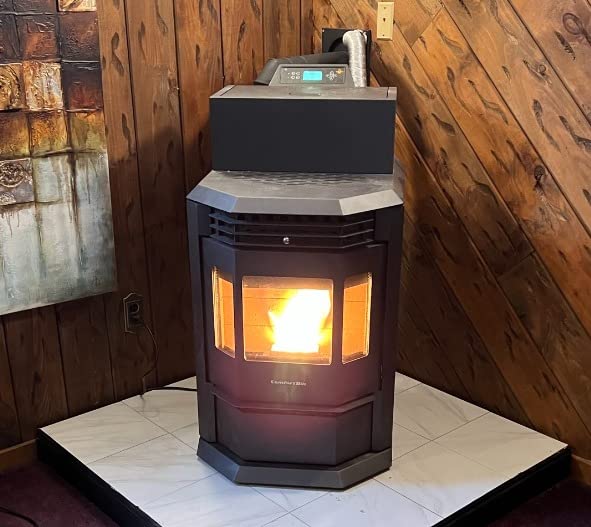
The HP22 is the stove most buyers end up with, and the reason is simple: it does the ordinary things well. It puts out up to 41,000 BTU per hour, covers up to 2,800 square feet under mild conditions, and carries a 55 lb hopper that takes several standard 40 lb bags at once. Five power settings and a programmable thermostat give you the same control package you would find on models costing considerably more.
Owner feedback lines up with the spec sheet. People living in open floor plans report that it holds temperature without cycling hard, and the bay-view window plus room blower push heat across a large space rather than straight up. The 73 percent five-star share in the ratings distribution is the strongest consensus of any high-volume stove we looked at.
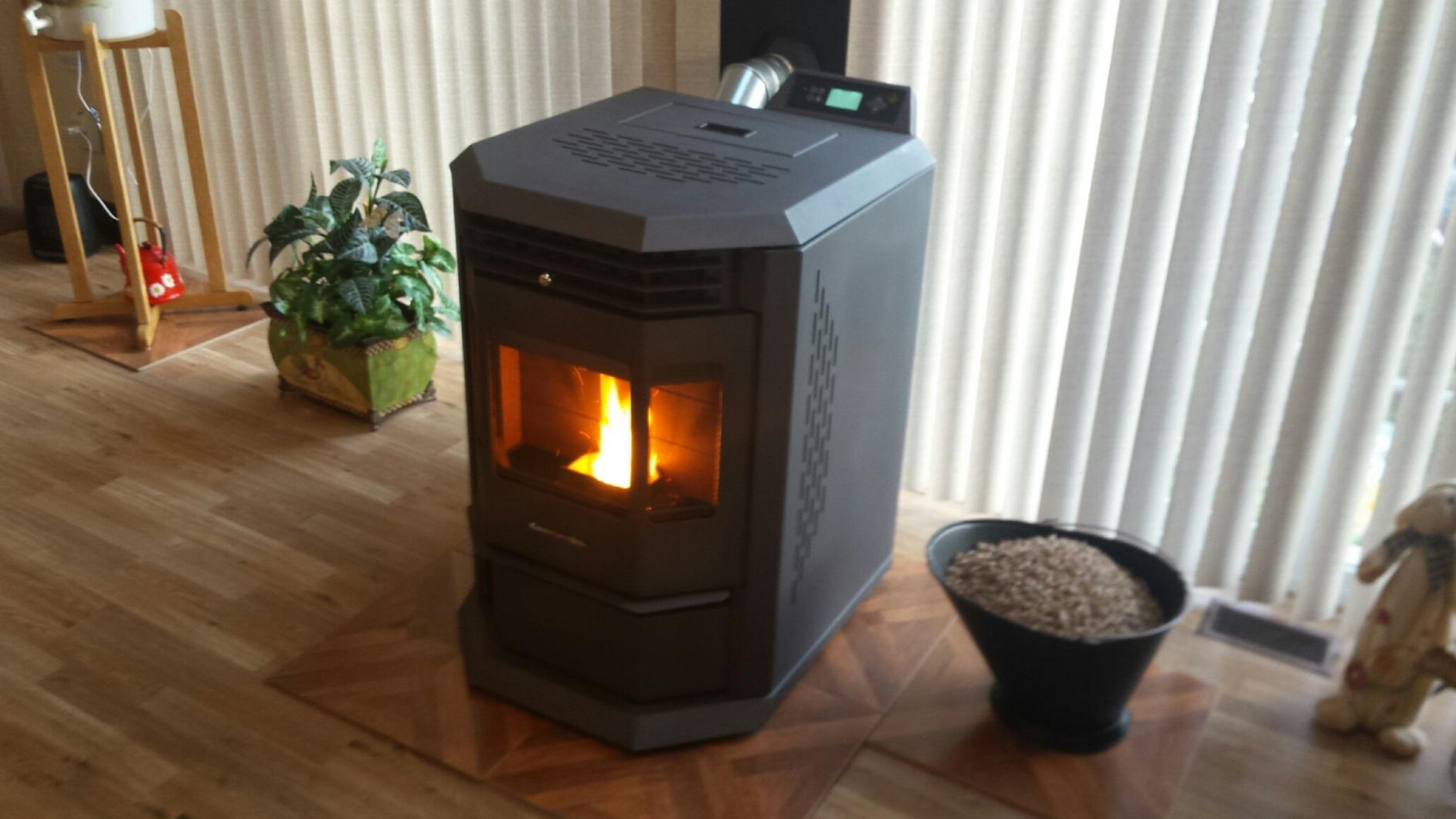
The honest drawback is weight. At 273 lb, this is not a two-person carry job unless you plan ahead with a dolly. The second practical issue is venting: this model uses Type L vent components, and those parts are not in the box, so budget for them separately along with a hearth pad.
Expect a paint-curing period too. Owners report noticeable odor during the first few burn cycles while the exterior finish cures, so run the stove with windows open until that fades. After that first week, the maintenance rhythm is a daily burn pot scrape, a weekly ash pan dump and a monthly burner and vent check.
Who the HP22 suits best
This is the right stove for a 1,500 to 2,200 square foot home that needs one reliable unit for the main living space, and for anyone who wants remote and thermostat control without fussing with a feed screw. If you have a masonry fireplace you want to keep, the insert version below covers that instead.
If your home is drafty, very tall-ceilinged or above about 1,500 feet of elevation, treat the 2,800 square foot figure as optimistic. Owners in those conditions recommend the large 130 lb models further down this list.
Where the HP22 falls short
The claimed coverage assumes mild conditions and a home that holds heat. In genuinely cold weather or in an open plan with a two-story ceiling, the same stove that satisfies a 1,800 square foot home leaves a 2,800 square foot house short, and the thermostat will fight you for it.
There is also no battery backup in the box. During an outage the auger stops feeding within minutes, and a cooling stove sitting full of pellets is the most common complaint we found on forum threads. A small UPS unit or generator solves it.
2. US Stove GW1949 Wiseway – the pick that keeps running when power fails
US Stove GW1949 Wiseway Non-Electric Pellet Stove
40000 BTU/hr
Heats up to 2000 sq ft
60 lb hopper with up to 30 hours burn time
Non-electric gravity feed
Pros
- Runs without electricity on a natural gravity feed
- 60 lb hopper gives up to 30 hours per fill
- Lightest body in the group at 131 lb
- Uses standard 3 inch venting
- Silent operation
Cons
- Lowest average rating here at 3.5 stars
- Roughly one in five reviewers gives it a single star
- Gravity feed is less consistent than auger-driven models
- 52 inch height limits placement
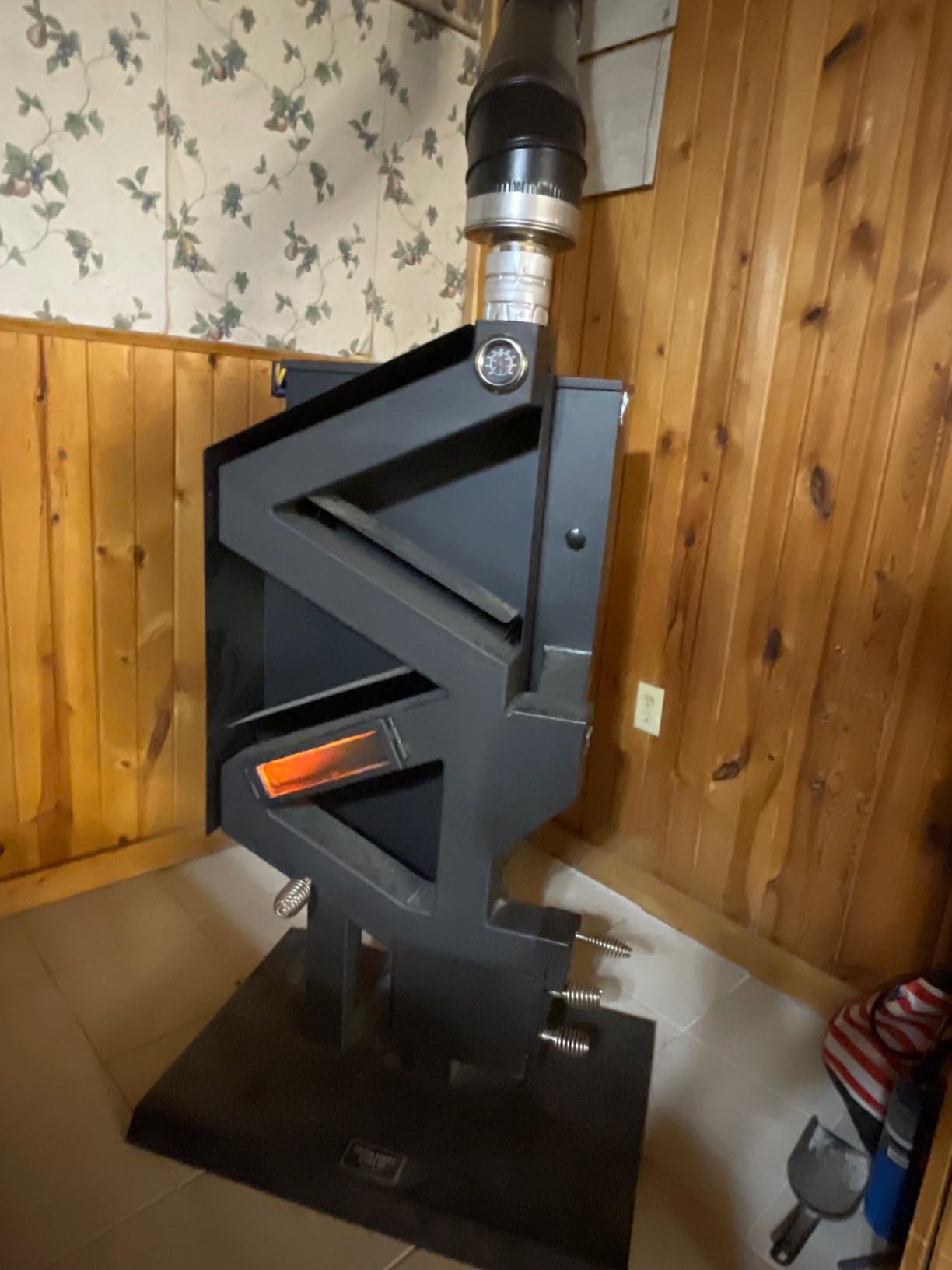
Exactly one stove in this roundup does not need electricity, and it is the GW1949. Pellets fall by gravity into the burn pot instead of being pushed by an electric auger, so an outage changes nothing about whether the stove keeps heating. For a cabin, a storm-prone rural house or a home that has already dealt with frozen pipes during a power cut, that single design choice can outweigh everything else on the spec sheet.
The hopper is generous for a non-electric unit at 60 lb, which works out to as much as 30 hours of burn time. Output is 40,000 BTU per hour for spaces up to 2,000 square feet. The body is also the lightest here at 131 lb and only 24 by 15 inches, so it fits tight rooms and second homes where a 200 lb stove will not.
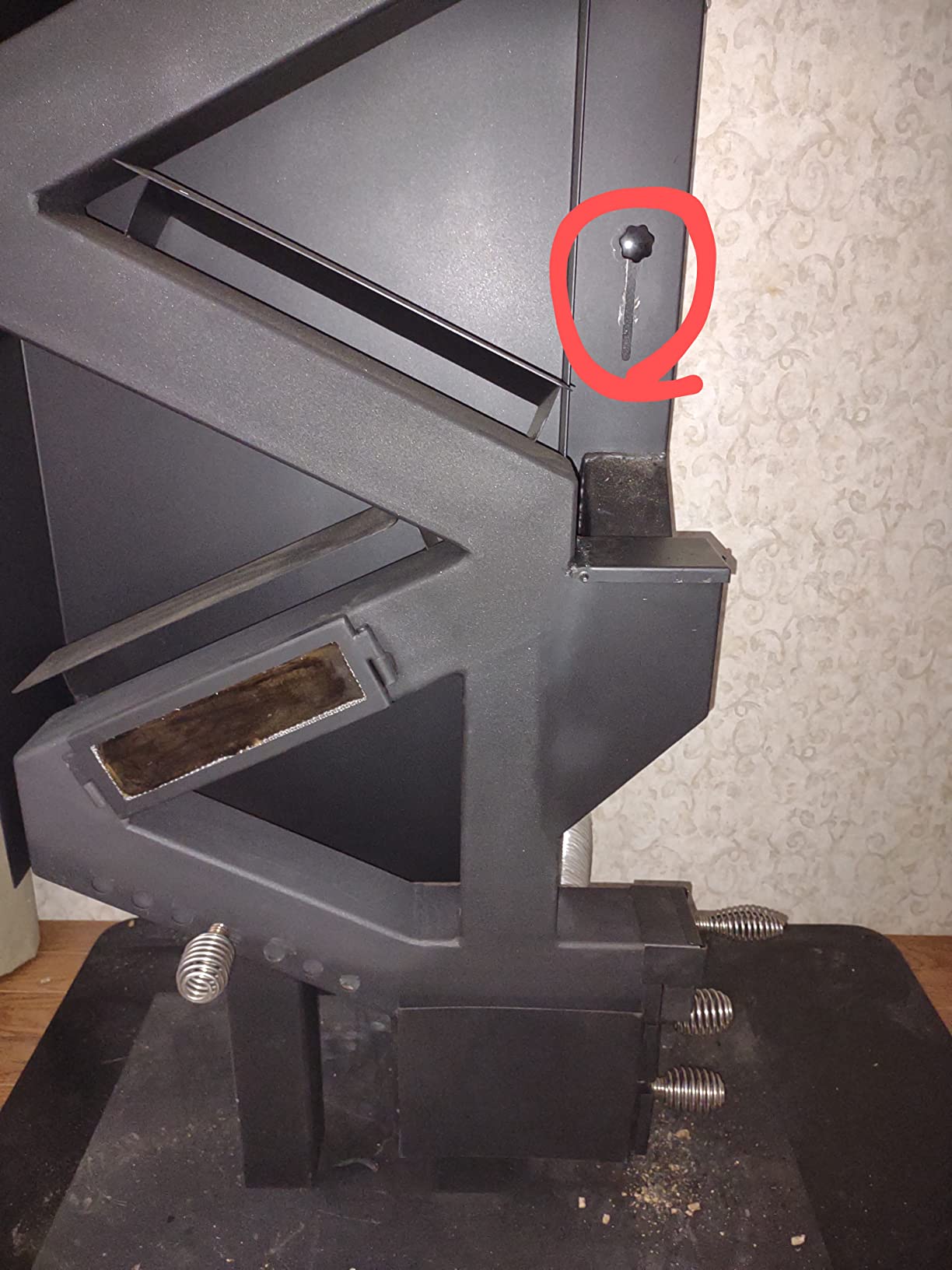
The 3.5 star average is not a mystery, and we would rather explain it than bury it. Nineteen percent of reviews are one-star, the highest share of any stove analyzed. The recurring theme is inconsistent pellet feeding. Gravity feed responds to pellet condition rather than a metered auger, so soft or swollen pellets can starve the burn pot or push past it.
A second theme is heat output below expectation for the stated square footage, particularly in cold weather when feed rate becomes critical. If your climate is harsh, this stove is a backup heat source rather than a primary one, and you should expect to refill the hopper more often than the 30 hour figure suggests.
Who the Wiseway suits best
Choose it when power reliability is your biggest concern: off-grid homes, cabins, basements and second homes in areas with frequent outages. The 3 inch venting also means you avoid the more expensive Type L pipe that several competitors require, which quietly simplifies installation.
Its size also works in tight spots. At 24 inches deep and 15 inches wide, it clears closets, utility rooms and small sunrooms where a freestanding cabinet stove simply will not fit.
Where the Wiseway falls short
Consistency is the weakness. Auger-driven stoves meter fuel exactly; gravity feed does not, and the reviews bear that out. Owners who switched from an electric model report having to tune and monitor feed behaviour more often than they expected.
The warranty is also thinner than most: three years on the firebox and one year on the cabinet. A 52 inch tall body means the hopper sits at head height, so a full refill means lifting a 60 lb bag up and over the lip, which is awkward in a small room.
3. Pellethead PS21 Independence – the pick with real outage backup and app control
Freedom Stoves Freestanding Independence PS21 Pellet Stove with Battery Backup, Wi-Fi Capability, and Removable Legs – Heats up to 1800 sq ft. (Sandstone Grey)
Up to 34700 BTU output
Heats 800 to 1800 sq ft
Battery backup over 40 hours
WiFi app with touchscreen
Pros
- Battery system delivers over 40 hours of runtime during outages
- Touchscreen plus app plus remote gives the deepest control suite
- Swappable side panels accept standard 12 by 12 tile
- Five-year limited warranty with US-based support
- Stacked tube heat exchanger supports higher efficiency
Cons
- Smallest heating capacity here at 800 to 1800 sq ft
- Backup batteries are sold separately
- Newer brand with a shorter reliability record
- Vent-free setup limits where it can be installed
The PS21 is the only stove here with a factory-designed battery system rather than a bolt-on UPS. Two 12V batteries on a 24V DC system carry the stove for more than 40 hours, which covers a multi-day outage with room to spare. The batteries are not included, so treat them as part of the purchase rather than an accessory.
Controls are the other headline. A touchscreen panel, a mobile app and a handheld remote all reach the same settings, and scheduling works from any of them. Owners single out the app as the best control suite in this group, which matters if you want to warm the house before you get home from work.
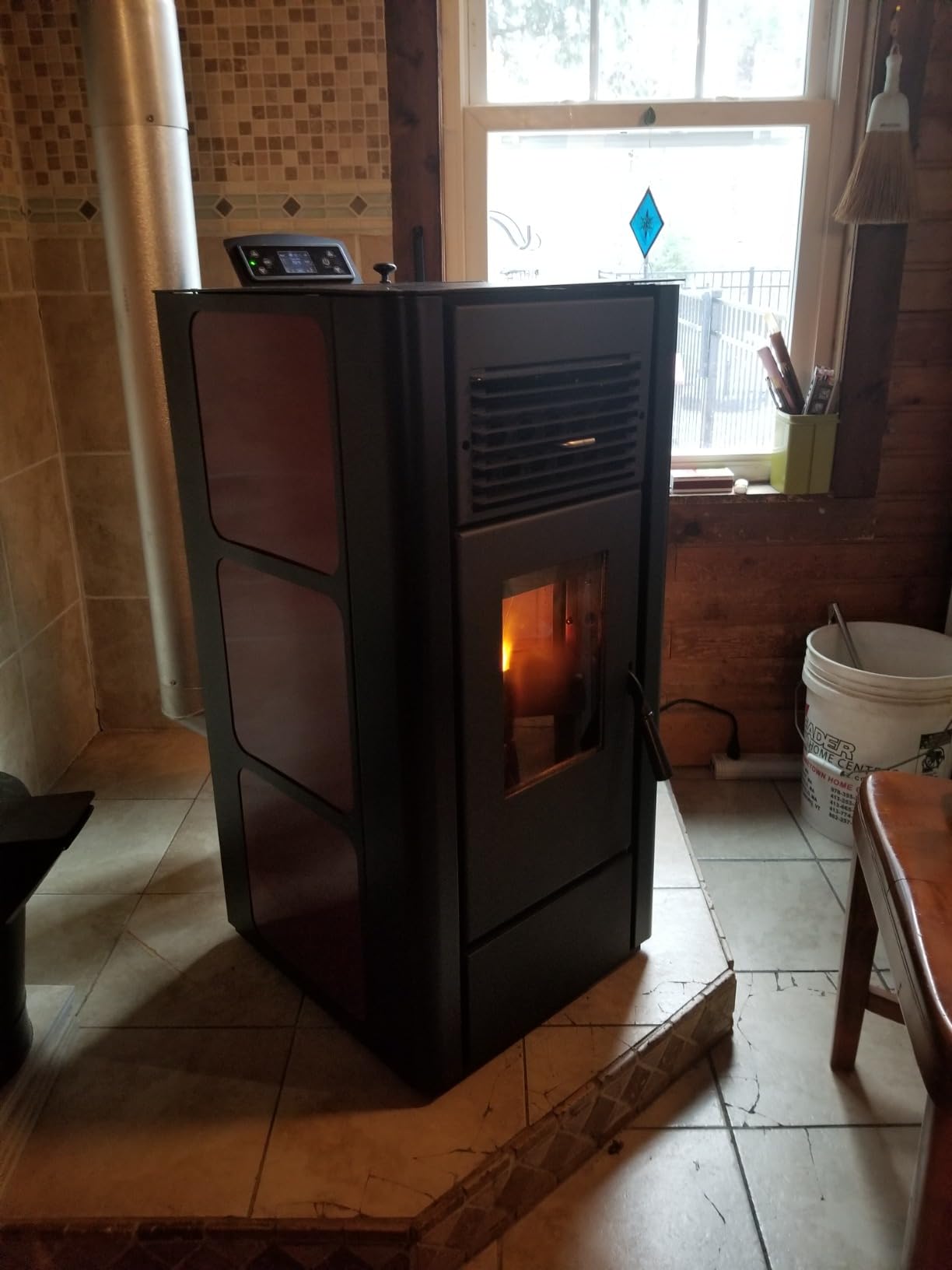
Output is 34,700 BTU per hour through a stacked tube heat exchanger, covering 800 to 1,800 square feet. That makes it a zone heater by design: a finished basement, a main-floor family room or a cottage. It is not the model for a 2,500 square foot open plan, and the lowest number in that range is 800 square feet.
Two build details stand out. The side panels are swappable and accept standard 12 by 12 tile, so you can match a kitchen or bathroom without custom fabrication. The company also backs it with a five-year limited warranty and US-based support, a longer term than most value-tier stoves in this list carry.
Who the PS21 suits best
It fits households that want app control and real battery runtime without hiring an electrician to wire a generator transfer switch. It also suits anyone who cares about how the stove looks, since the tileable sides let it blend into a finished room rather than read as a box.
Owners running it in smaller homes report steady results, and the efficiency-oriented hardware pays off in pellet consumption compared with simpler units in the same class.
Where the PS21 falls short
Capacity is the limit. At up to 1,800 square feet in mild conditions, it will not carry a medium-size house on its own, and pairing two units to cover a larger home doubles the maintenance load. Vent-free installation also narrows where you can legally place it.
As a newer brand, it has a shorter field history than established names, and a five-year warranty is only as good as the parts supply behind it. Confirm local service support before committing in a remote area.
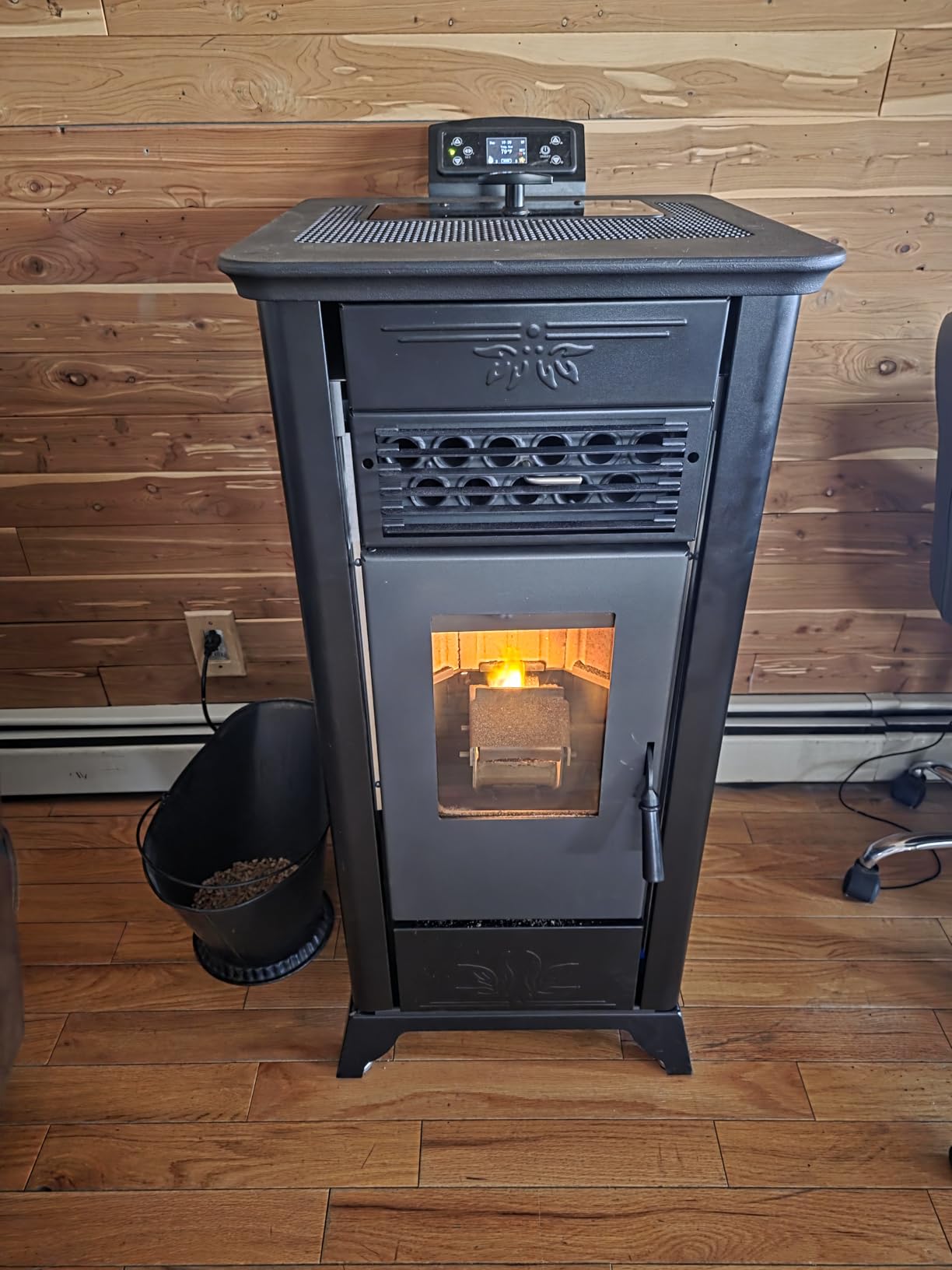
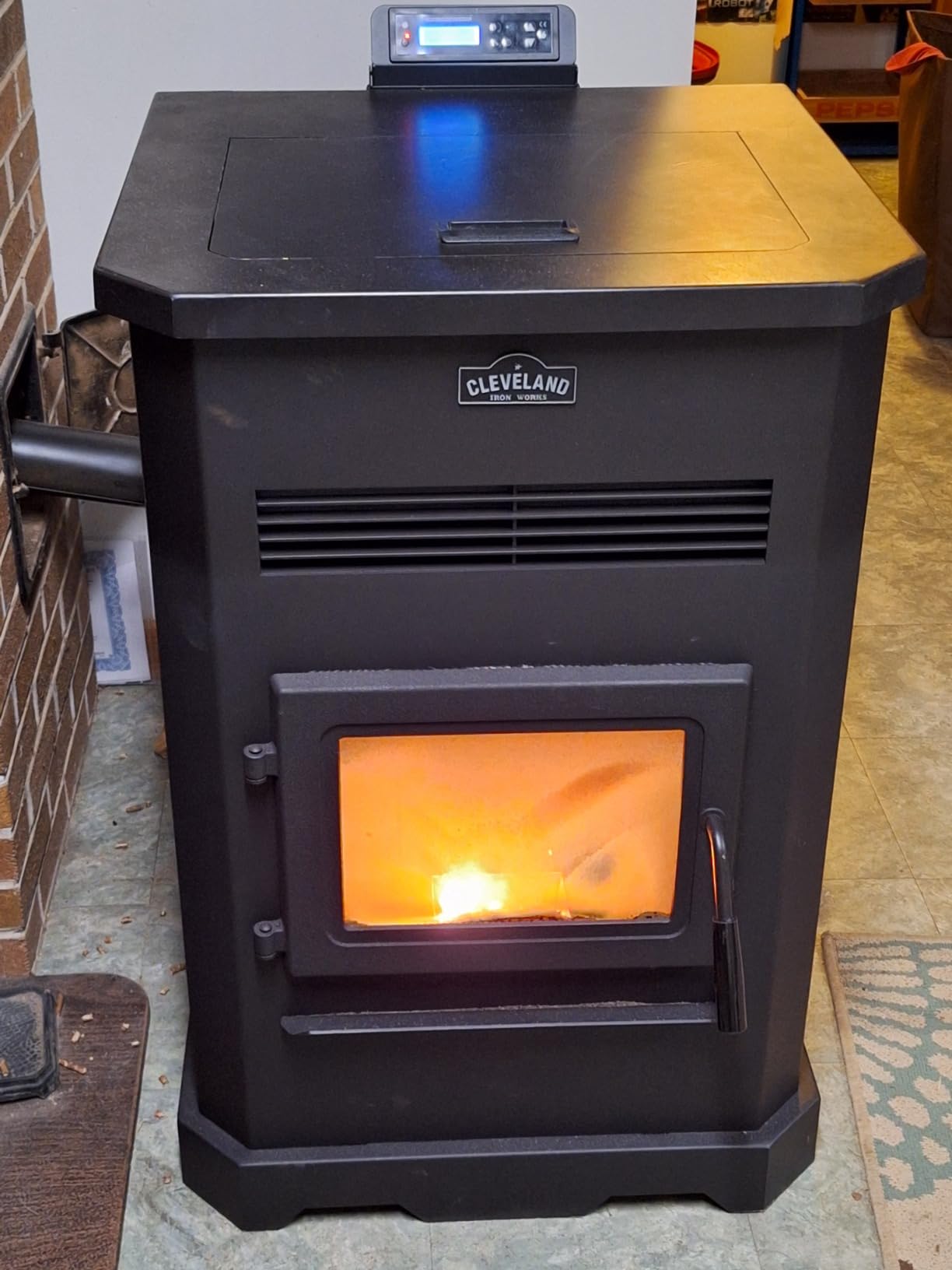
4. Cleveland Iron Works 130 lb Hopper – the pick for whole-home heating
Cleveland Iron Works Large Pellet Stove – 130lb Hopper
130 lb hopper capacity
Heats 2000 to 3000 sq ft
Cast iron construction
Built-in WiFi with app control
Pros
- Largest hopper among the value models at 130 lb cuts refills to about three bags
- Built-in WiFi with app control and six programmable timers
- Holds set temperature without overheating
- Window stays clear with less soot than older stoves
- Owners report simple daily cleaning
Cons
- Real-world fill is closer to 115 lb than the advertised 130 lb
- Control panel and manual confuse many owners
- Blower motor and error-code failures reported in a later season
- Only a one-year warranty leaves parts thinly covered
When a stove has to run overnight or through a work day without attention, hopper capacity stops being a convenience and becomes the whole design. This model holds 130 lb, which is roughly three 40 lb bags, and pairs that with a heating range of 2,000 to 3,000 square feet. It is the model we would look at first for a main-floor whole-home heat source.
App control comes with six programmable timers, so you can run a low burn while you are away and a higher setting before you arrive. Owners report the thermostat holds set temperature without the cycling and overheating they experienced with older electric-fed models, and the glass stays clearer with less soot build-up.
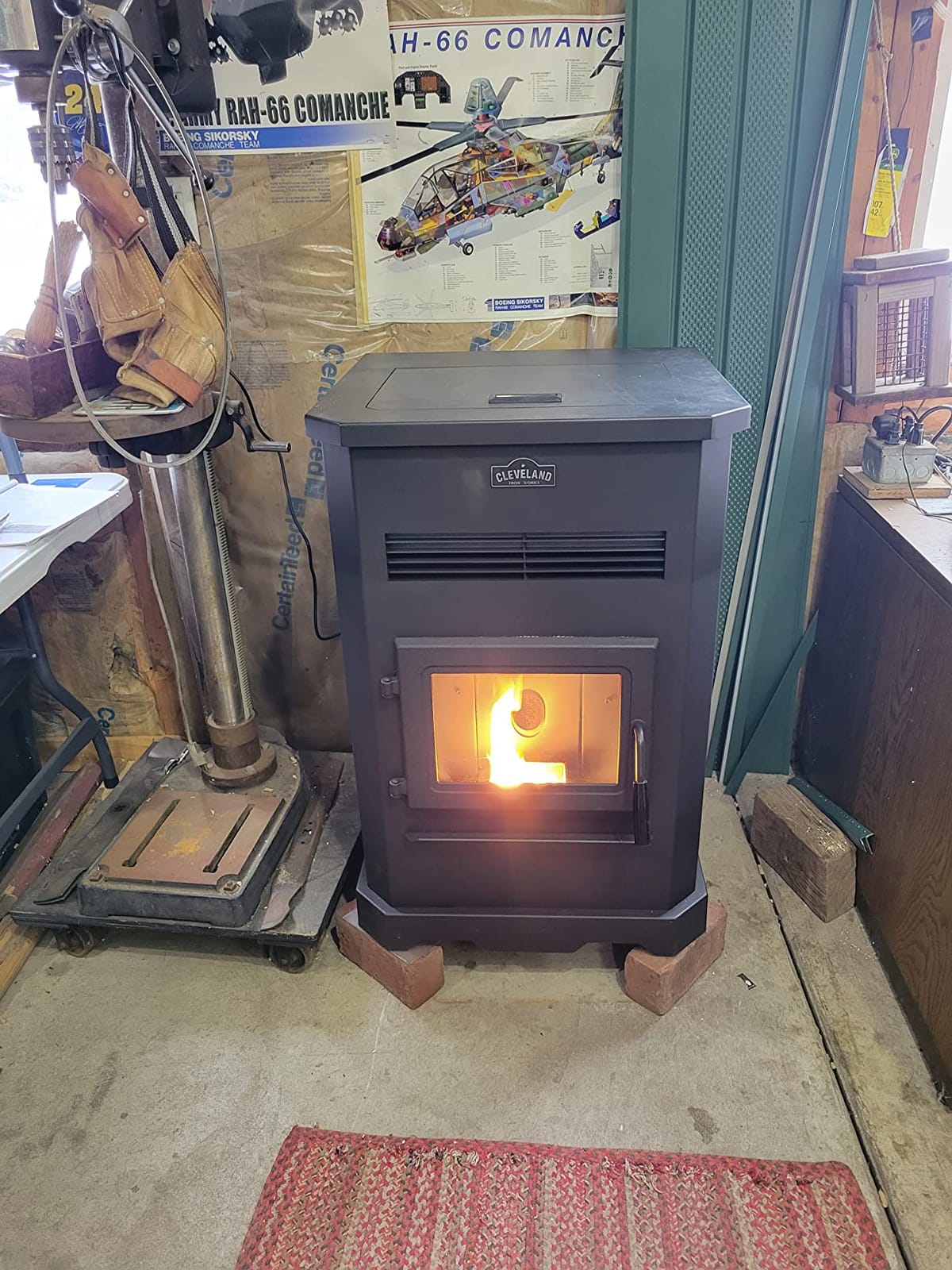
Two practical notes. The 130 lb figure is a nameplate number: owners report a usable fill closer to 115 lb, which still works out to multiple days of low burn. And the body is 209.4 lb with a 27.6 inch depth, so plan your floor space and your moving help before delivery day.
Reliability feedback is where the caution goes. Some owners report blower motor or error-code failures appearing in their second heating season, and the warranty is one year limited, which covers far less than the five-year steel terms offered by a few competitors. Ask your dealer to confirm parts sourcing before you commit.
Who this Cleveland Iron Works suits best
It suits households in cold regions heating 2,000 to 3,000 square feet who would rather not refill a hopper every night or every other day. It also fits anyone who wants app-based scheduling without moving up to a premium brand.
Owners report that it heats a whole home quickly after cold start, which is the main reason it appears high on this list rather than in the value section.
Where it falls short
The one-year warranty is the biggest risk. Blower motors, auger motors and control boards are the parts most likely to fail, and a short term leaves that cost with you. The 29,501 BTU figure is also modest next to models near 50,000 BTU, so the top end of the claimed range depends on weather being kind.
Documentation is another weak point, with several owners citing a confusing control panel and an inadequate manual as first-week frustrations. Budget time for a call with a dealer or installer to get the timer settings right.
5. ComfortBilt HP22i – the pick for an existing fireplace
ComfortBilt HP22i Pellet Stove Fireplace Insert, 2,800 sq. ft., 47 lb. Hopper, Black
Zero-clearance insert design
Heats up to 2800 sq ft
47 lb hopper with 18 hour burn time
Shroud and ash vacuum included
Pros
- Insert format fits an existing masonry fireplace opening
- Highest five-star share in this group at 77 percent
- Remote/thermostat/auto ignition and shroud included
- Trim and ash vacuum ship in the box
- Shroud gives a finished built-in look
Cons
- 47 lb hopper is smaller than the freestanding HP22
- 273 lb weight makes installation a two-person job
- Needs proper hearth clearances and dedicated venting
- Direct vent design needs a proper flue run
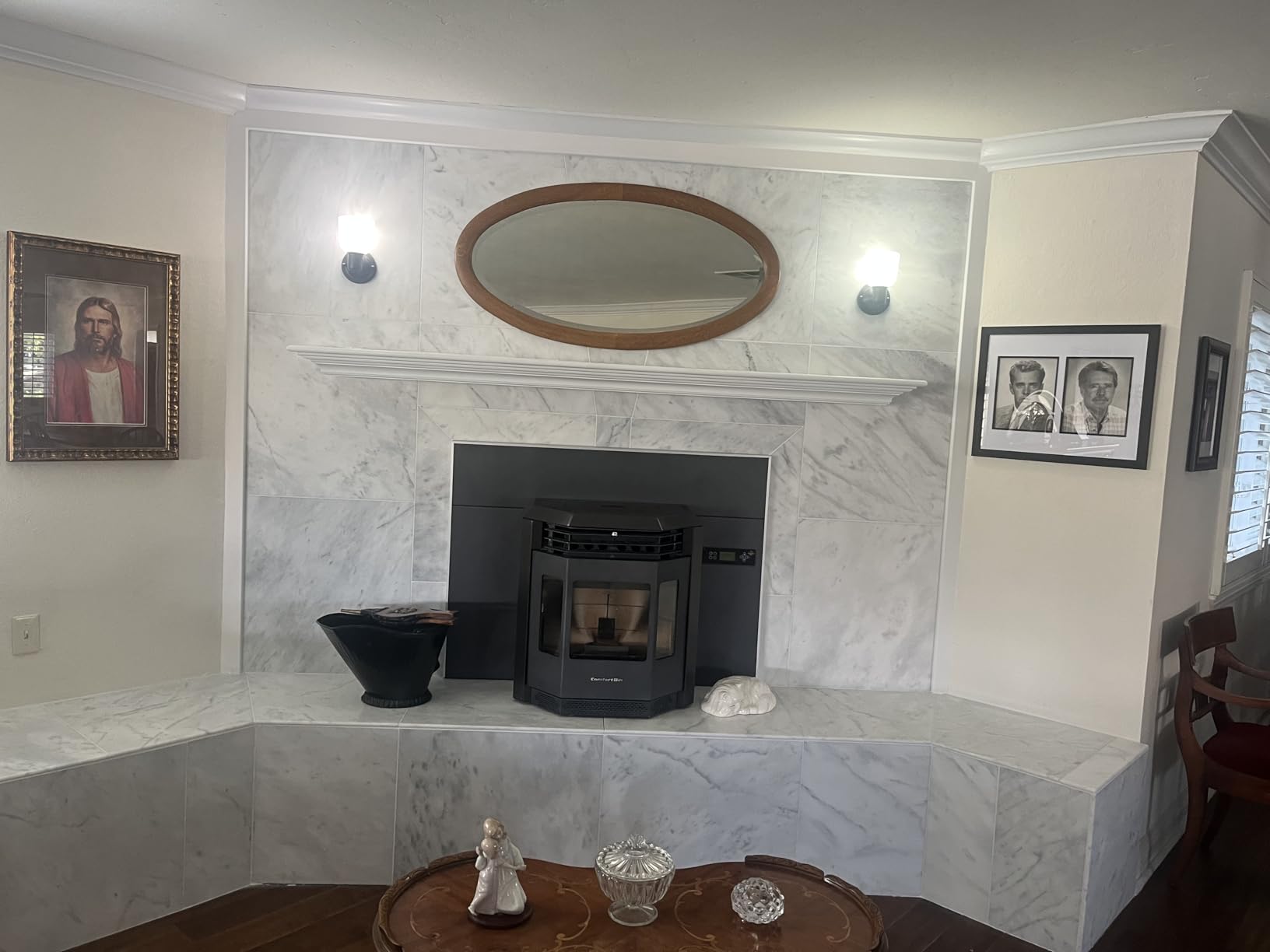
If you already have a masonry fireplace, an insert avoids the two biggest costs of a freestanding installation: you reuse the existing chimney and you reclaim floor space. The HP22i drops into the opening, delivers up to 41,000 BTU per hour and covers up to 2,800 square feet under mild conditions, which puts its heating capacity on par with the freestanding HP22.
The box is unusually complete for an insert. A finishing shroud, an ash vacuum and a remote all ship with the unit, and the shroud covers the surround so the stove reads as built-in rather than dropped in. That is why this model posts the highest five-star share in the group at 77 percent.
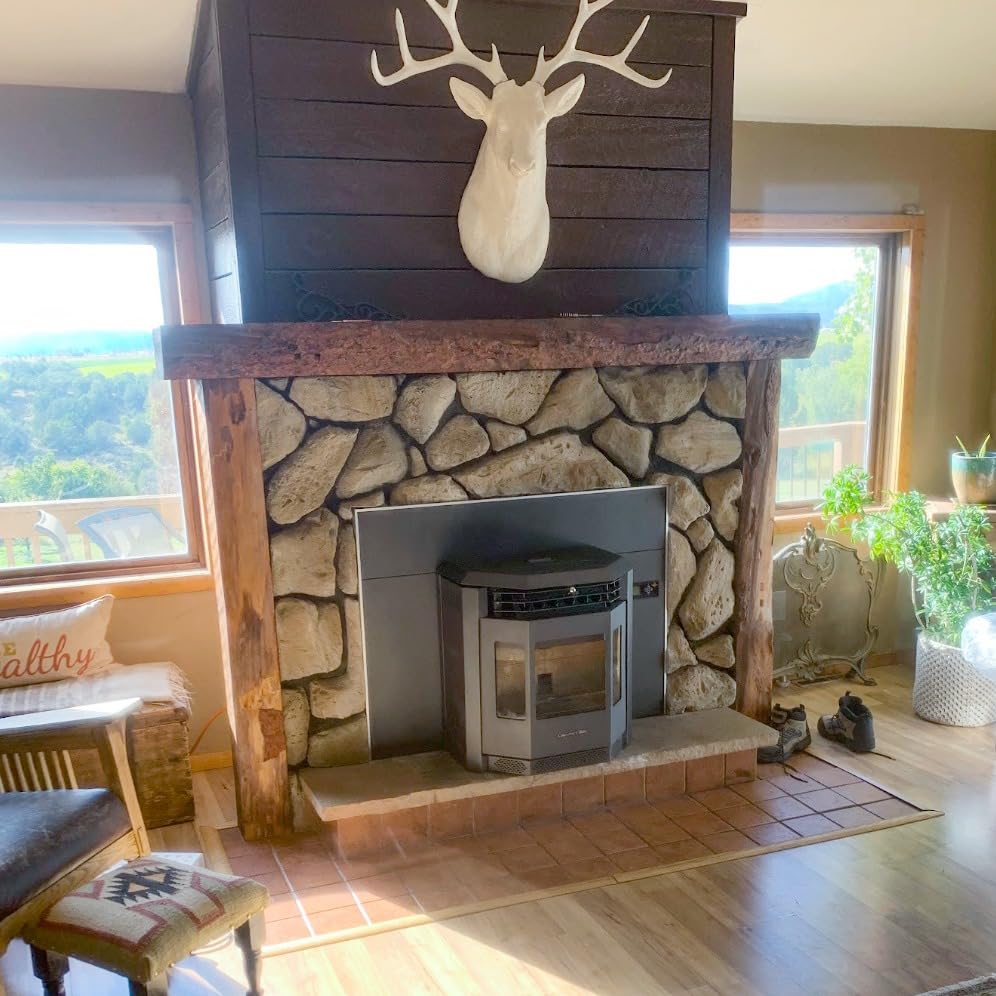
You trade hopper size for the install convenience. At 47 lb with up to 18 hours of burn time, it runs shorter between refills than the freestanding HP22’s 55 lb hopper, and considerably shorter than the 130 lb models. That is a reasonable trade if you are already committed to a fireplace location.
The installation itself is the hard part. The unit weighs 273 lb, so it needs two people and a plan for getting it into the firebox. It also requires correct hearth clearances and a dedicated flue run, and a direct vent design gives you no flexibility on the vent path.
Who the HP22i suits best
It suits homeowners with an existing masonry fireplace who want automatic, thermostat-controlled heat without giving up the appearance of a traditional hearth. If you rent or expect to move, an insert is harder to relocate than a freestanding cabinet stove.
Buyers installing into an existing opening generally report a finished look that satisfied them and a straightforward control layout once set.
Where the HP22i falls short
It is the least flexible of the group in terms of placement. Zero-clearance designation still carries clearance requirements, and the direct vent design means your chimney needs to be lined and routed correctly rather than adapted.
At 18 hours per full hopper, the frequent-refill question is real for households that do not want to refill in the evening. The included ash vacuum helps with the cleanup side, but it does not change the refill cadence.
6. Castle Serenity – the pick with the least cleaning
Castle 41278 Serenity Pellet Stove, 1,500 square ft. Heating Capability, Smart Controller Features Manual, Weekly, Thermostat and Eco Operating Modes, 40lb Hopper Capacity, Easy Clean Design, Black
1500 sq ft at 32000 BTU
40 lb hopper
Tube-free easy clean design
Smart controller with four modes
Pros
- Tube-free design leaves far fewer surfaces to clean and ash can be vacuumed every other day
- Lighter body at 186 lb makes placement easy
- Smart controller runs manual/thermostat
- weekly and eco modes with remote programming
- Self-diagnostic mode helps identify faults
- Owners report meaningful savings against propane and gas
Cons
- Smallest capacity here at 1500 sq ft and 32000 BTU
- Smallest hopper at 40 lb needs frequent refills
- Auger and vacuum switch need routine cleaning and lubing
- Reports of dead augers
- exhaust motors and control boards
- 17 percent one-star rating
Maintenance is the thing pellet stove buyers underestimate, and the Serenity attacks it directly. There are no tubes, no corrugations and no hidden chambers in the heat path, so an ash vacuum handles cleanup on an every-other-day rhythm rather than the daily scraping routine that heavier heat exchangers demand. At 186 lb it is also one of the easier bodies to reposition.
The controller is genuinely capable for the tier. Manual, thermostat, weekly and eco modes are all programmable from the included remote, and a self-diagnostic mode identifies faults instead of leaving you guessing. Owners also report noticeable savings against propane, which fits how most people actually run a pellet stove: as the primary heat for one or two rooms.
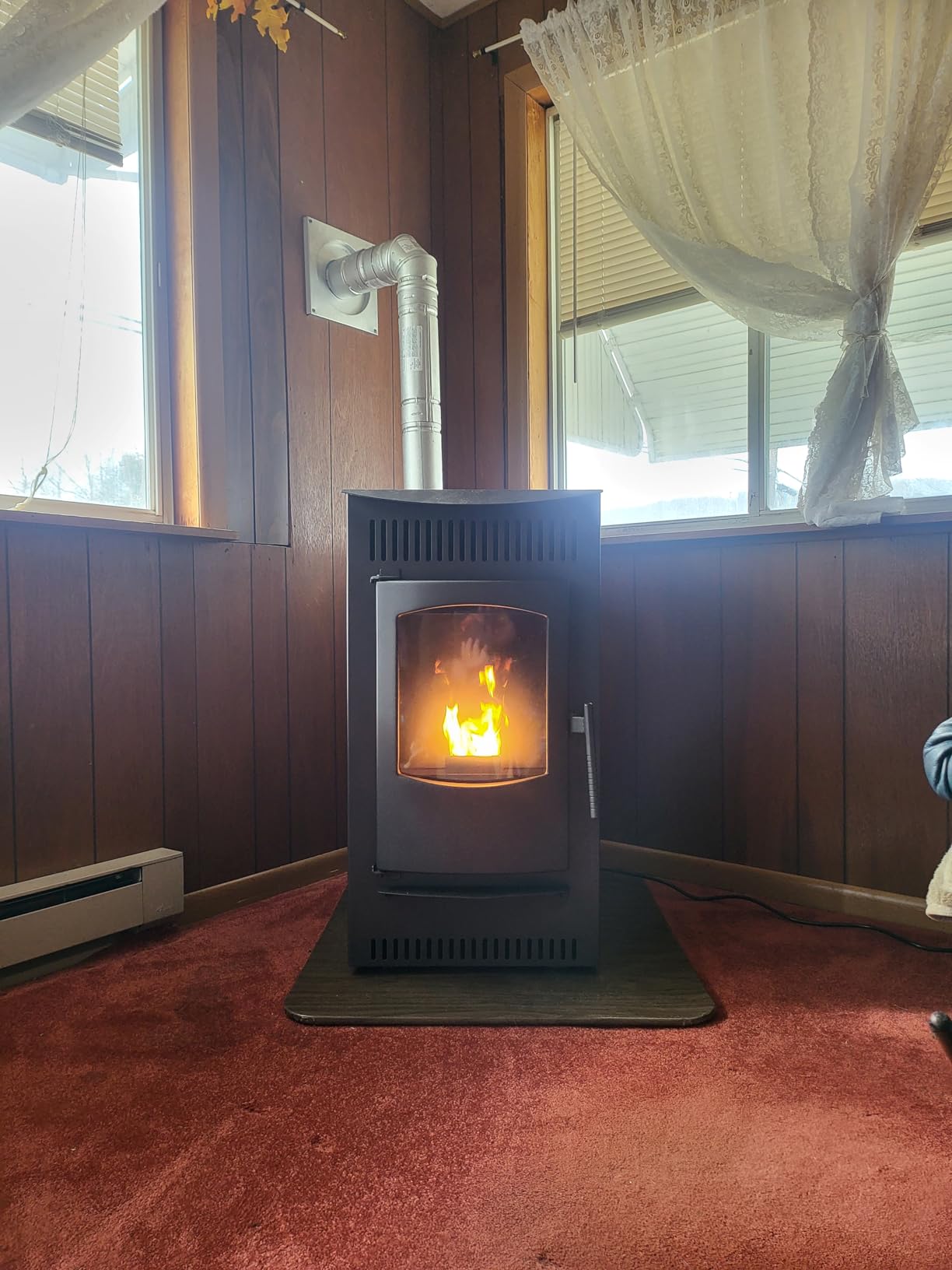
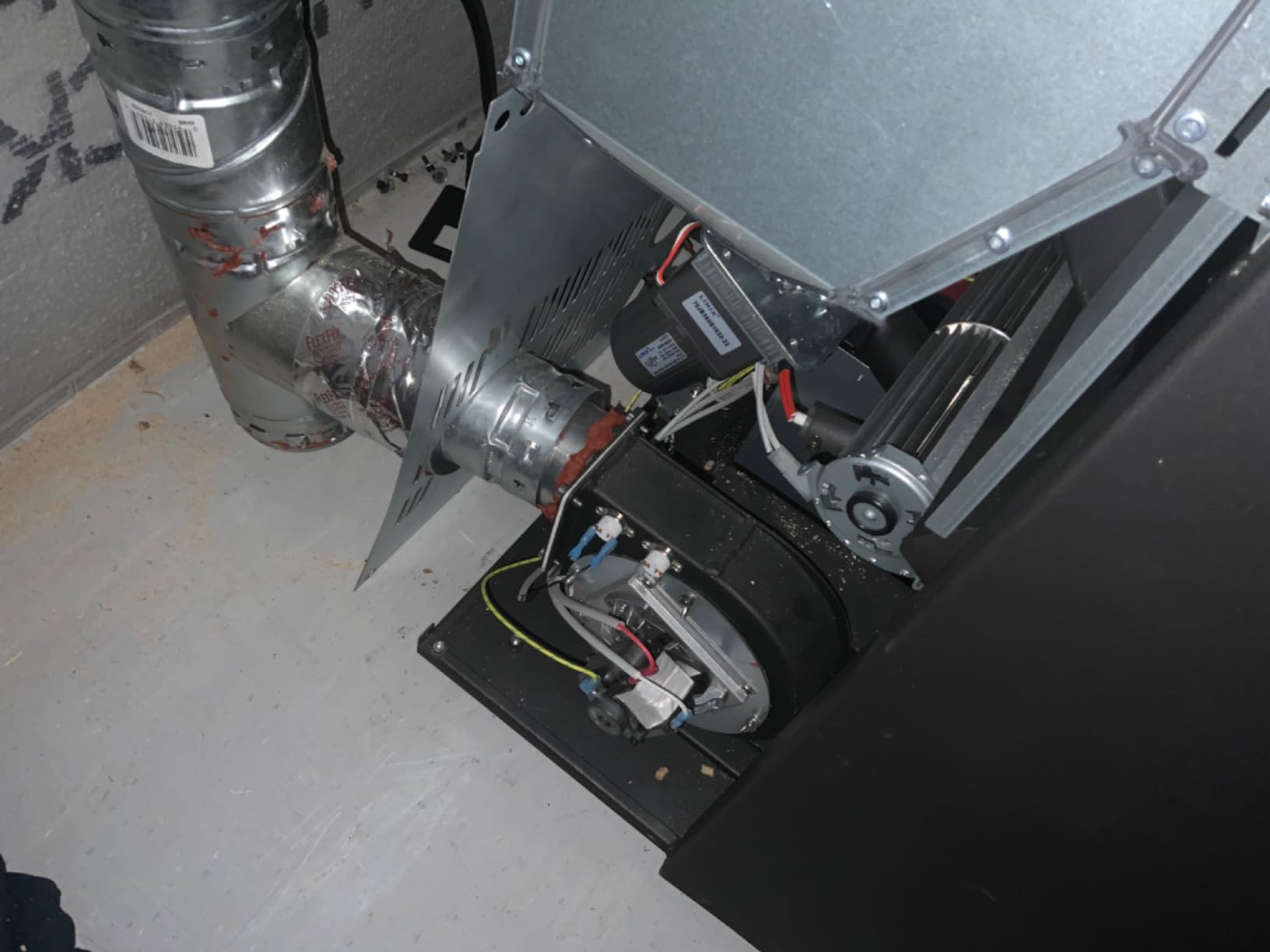
Spec-wise it is the smallest high-efficiency unit here: 1,500 square feet, 32,000 BTU and a 40 lb hopper. Installation also needs a 2 inch outside air vent tube and a 4 inch exhaust vent, plus 77 watts of 120V power for the blower and controls.
The 3.9 star average reflects real complaints, not noise. Several reviews describe augers, exhaust motors or control boards that failed and customer service could not resolve, and a 17 percent one-star share is the second highest here. Before you buy, confirm that a serviceable dealer is within reach of your home.
Who the Serenity suits best
It suits people who dislike daily hands-on maintenance, older adults, and anyone who wants a stove that can be vacuumed rather than scraped. It also works well as the heater for a den, a basement suite or a converted garage.
The eco mode is useful if you are supplementing another heat source and want the stove to hold a room temperature without burning continuously.
Where the Serenity falls short
The 40 lb hopper is the smallest here, and in cold weather it fills quickly. Owners flag this directly, so treat it as a frequent-refill stove and set your refill habit before the first cold week rather than after it.
Reliability reports around the auger, the exhaust motor and the control board are the deciding factor for anyone planning to rely on this stove as primary heat. The one-year limited warranty offers little protection, so a nearby dealer with parts access matters more here than the sticker does.
7. ComfortBilt HP50S – the pick for basements, shops and small rooms
ComfortBilt HP50S Pellet Stove, 2,200 sq. ft., 47 lb. Hopper, Black
Heats up to 2200 sq ft
47 lb hopper with 23 hour burn time
Slim body at 28 by 21 by 36 inches
Removable ash pan
Pros
- Slim 28 by 21 by 36 inch body fits basements
- shops and tight rooms
- Owners report raising a home from 54 to 64 degrees in three hours
- Sides come off for direct access to fans
- gaskets and auger bearing
- Customer service sent replacement door glass quickly
- Runs roughly 20 to 23 hours per 40 lb bag on low
Cons
- Single-speed blower is noticeably loud
- Front glass clouds with ash within 6 to 8 hours
- Uses more pellets than comparable stoves for equal heat
- Reported auger feed failure that parts swaps did not fix
- No in-depth service manual with numbered parts
The HP50S solves a space problem. At 28 by 21 by 36 inches it is a narrow body that fits along a basement wall, in a workshop or in a small room where a square cabinet stove would eat floor space. It delivers up to 41,000 BTU per hour, covers up to 2,200 square feet, and its 47 lb hopper runs up to 23 hours per fill.
Long-term owners describe it as well built with strong output for what it costs, and the service layout is unusually good: the side panels come off to give direct access to the fans, gaskets and the auger bearing. One owner reported raising a home from 54 to 64 degrees in three hours on low and in about 45 minutes on high.
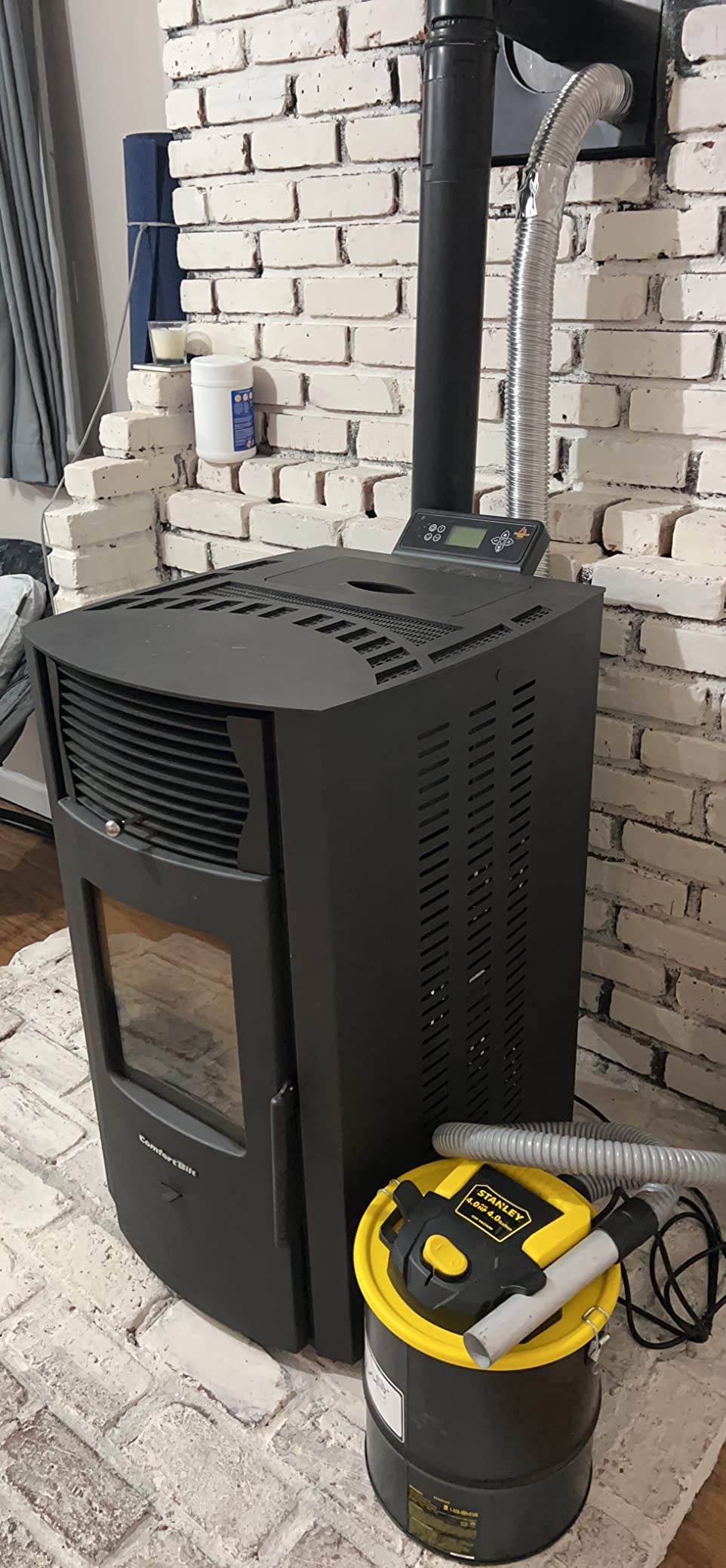
The trade-off is noise and glass. The blower is single-speed, which is the most common comfort complaint for people who plan to run a pellet stove in a living room, and the front glass clouds with ash within six to eight hours of burning.
There is also a pellet consumption complaint worth taking seriously: owners report using more pellets than comparable stoves for the same heat. And one durability report describes an auger feed failure that a motor swap, fuse swap, capacitor swap and board swap did not fix. With a 4.0 average, this is a capable unit with a specific set of weaknesses rather than a problem child.
Who the HP50S suits best
It suits anyone heating a basement, garage, shop, sunroom or single room where width matters more than styling. Owners also like it as a secondary heat source in a home that already has a primary furnace or heat pump.
If you are willing to clean the glass often, the quick heat response and the serviceable layout make it a practical pick for outbuildings and workshops.
Where the HP50S falls short
A single-speed blower is the main one. In a quiet living room at night it is audible, and there is no low setting to soften it. Buyers who want the appliance to disappear into a finished space should look at a model with a variable-speed blower.
The auger feed complaint and the absence of an in-depth service manual with numbered parts are the two practical worries. If you are comfortable with basic appliance work and can source parts, that is manageable. If not, confirm dealer support first.
8. Canyon Lodge Bayfront – the pick for quiet running and finished styling
Canyon Lodge Bayfront Pellet Stove
Heats 1800 to 2500 sq ft
66 lb hopper
Cast iron fire pot
Whisper Quiet blower with fresh air kit
Pros
- Highest average rating here at 4.8 with no ratings below three stars
- Cast iron fire pot outlasts stamped steel fireboxes
- Whisper Quiet blower technology keeps noise low
- 66 lb hopper plus fresh air kit and mobile home approval
- App control for iOS and Android
- Air wash system keeps the large viewing glass clearer
Cons
- Smallest review base here at 10 ratings so long-term history is thin
- Hopper is well below the 130 lb and 150 lb models
- 30173 BTU is the lowest output among the higher-capacity models
- Vent-free setup restricts placement options
The Bayfront answers the question about which brand looks best, and it is not close. A large viewing glass with an air wash system keeps the window clearer for longer, and the bayfront styling reads like a finished fireplace rather than a utility appliance. If aesthetics matter in the room where you will actually sit, this is the one.
Underneath the styling it is a competent heater. It covers 1,800 to 2,500 square feet, holds a 66 lb hopper and includes a cast iron fire pot, which is a harder-wearing part than the stamped steel fireboxes used by many value stoves. Owners also point to Whisper Quiet blower technology and iOS and Android app control.
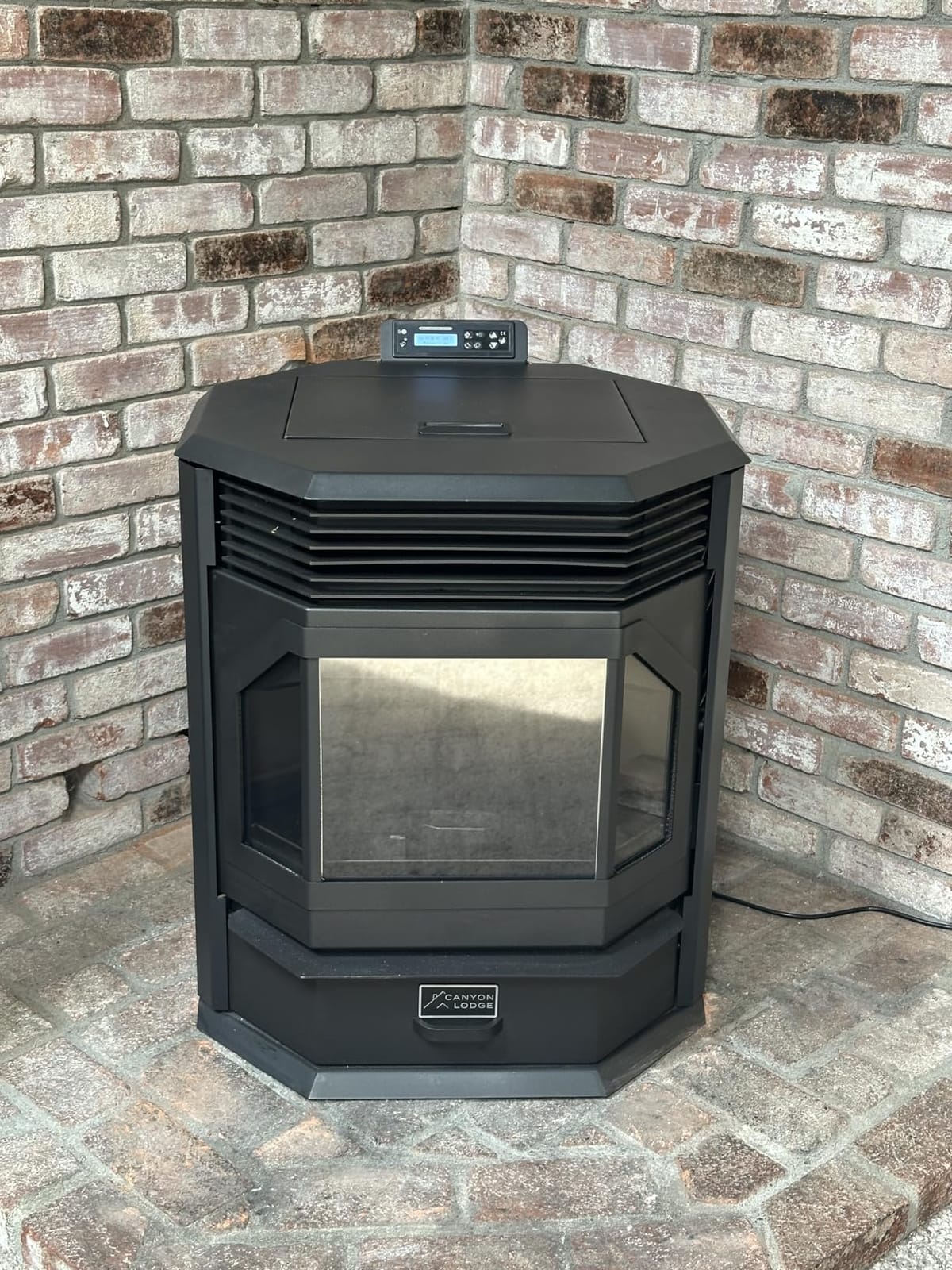
The 4.8 star rating is real but thin. It comes from ten reviews, which is the smallest evidence base in this roundup, and it means most feedback is recent rather than long-term. We weight it as a good sign on build and finish, not as proof of five-year durability.
Output of 30,173 BTU is the lowest among the higher-capacity models here, so the top of that square footage range depends on climate and insulation. A fresh air kit is included and the unit is mobile home approved, which is unusual and useful, but the vent-free design limits where it can legally be installed.
Who the Bayfront suits best
It suits people who want the stove to look like part of the room, and who run it in a living room where blower noise would normally be a dealbreaker. The Whisper Quiet blower is the reason it works there.
Mobile home and manufactured housing owners get an approved unit with a fresh air kit already in the box, which removes one of the usual approval hurdles.
Where the Bayfront falls short
Capacity and hopper size are the limits. At 30,173 BTU and a 66 lb hopper, it needs more attention overnight than a 130 lb or 150 lb model and will not carry a large open plan as a primary heat source.
Thin review history is the other caution. A 4.8 average across ten ratings tells you the early owners are happy, not that the auger motor will still be running in year six. Ask a dealer about parts availability and warranty service before settling on it.
9. PelPro PP150 – the pick for efficiency and the biggest hopper
PelPro PP150 Pellet Stove for Home Heating – 150 lb Hopper, 49,200 BTU Heats up to 2,500 Sq. Ft., Easy-Dial Temp Control, Built-in Thermostat with Auto-Ignition, Powerful & Quiet 265CFM Blower
150 lb hopper extendable to 350 lb
Up to 49200 BTU
EPA certified 87.5 percent efficiency
265 CFM blower
Pros
- Largest hopper here at 150 lb holding about four days of fuel
- Highest EPA-certified efficiency in the group at 87.5 percent
- Quiet 265 CFM blower with easy-dial thermostat and ten heat settings
- Made in the USA with a five-year steel parts warranty
- Thermostat shuts the stove down cleanly at temperature
Cons
- Only 9 ratings and no customer photos so the evidence base is thin
- Long-term owners of a sibling model report annual auger motor replacement
- Vent-free design limits installation options
- Hopper extension sold separately for the 350 lb total
The PP150 is the efficiency and convenience outlier. It is EPA-certified at 87.5 percent, the highest published figure in this group, and it pairs that with the largest hopper at 150 lb, which the manufacturer rates at up to four days of fuel. An optional hopper extension takes total capacity to 350 lb for people who refuse to refill at all.
Output is 49,200 BTU per hour for up to 2,500 square feet, driven by a quiet 265 CFM blower and a simple easy-dial thermostat with ten variable heat settings. The five-year steel parts warranty is the longest mechanical term here, and the unit is made in the USA, which usually means easier parts sourcing over time.
Being honest about the evidence matters with this one: nine ratings and no customer photos is the thinnest record in the roundup. The 4.7 average is excellent but early. Nothing here tells you how the stove performs in its eighth heating season.
The one substantive negative voice is a long-term PelPro owner who reports replacing the auger motor annually and the heating element every 18 months on a sibling model. That is a parts-cost warning worth factoring into your total cost of ownership, not a reason to skip the model. The vent-free design also narrows installation options, and the hopper extension is a separate purchase.
Who the PP150 suits best
It suits households that want to load fuel once and leave it alone for days, and those who care most about getting the most heat out of every pound of pellets. Long burn times also mean fewer cold starts, which is where pellet stoves lose efficiency.
The ten heat settings and the dial control make it approachable if you have never run one, and the clean shutdown at temperature reduces the ash build-up that causes restart problems.
Where the PP150 falls short
The review base is the first caution. With nine ratings, you are an early adopter rather than a confirmed buyer, and the fresh air kit and mobile home suitability are advantages only if you have the space and the approval.
The annual auger motor and heating element reports on a related model are the deciding consideration for anyone planning to keep this stove for a decade. Factor those parts into your running cost, and buy from a dealer who can supply them.
10. Cleveland Iron Works Bayfront – the best value large-hopper freestanding
Cleveland Iron Works Bayfront Pellet Stove – 66lb Hopper
Heats 1800 to 2500 sq ft
66 lb hopper
Direct vent venting
Cast iron with built-in WiFi
Pros
- 66 lb hopper cuts refill frequency across a full season
- Heating range of 1800 to 2500 sq ft suits most homes
- Built-in WiFi smart home control from a phone
- Cast iron construction adds thermal mass and durability
- Eight-year steel parts warranty with one year on electrical
Cons
- Rating distribution includes 21 percent one-star reviews
- 231.5 lb body is difficult to move or reposition
- Ratings are split with 60 percent five-star against 21 percent one-star
- Mixed overall score of 3.8
This Bayfront gets included because it is the clearest example of why review counts matter. Ninety-seven ratings at a 3.8 average split the crowd: 60 percent five-star and 21 percent one-star. That is a genuinely divided owner base, and we would rather show you the split than bury it behind an average.
What the happy majority praises is straightforward. The 66 lb hopper stretches the time between refills, the 1,800 to 2,500 square foot range covers most homes, and the built-in WiFi lets you schedule heat from a phone. Cast iron construction gives it real thermal mass, so it holds heat after the fire dies down.
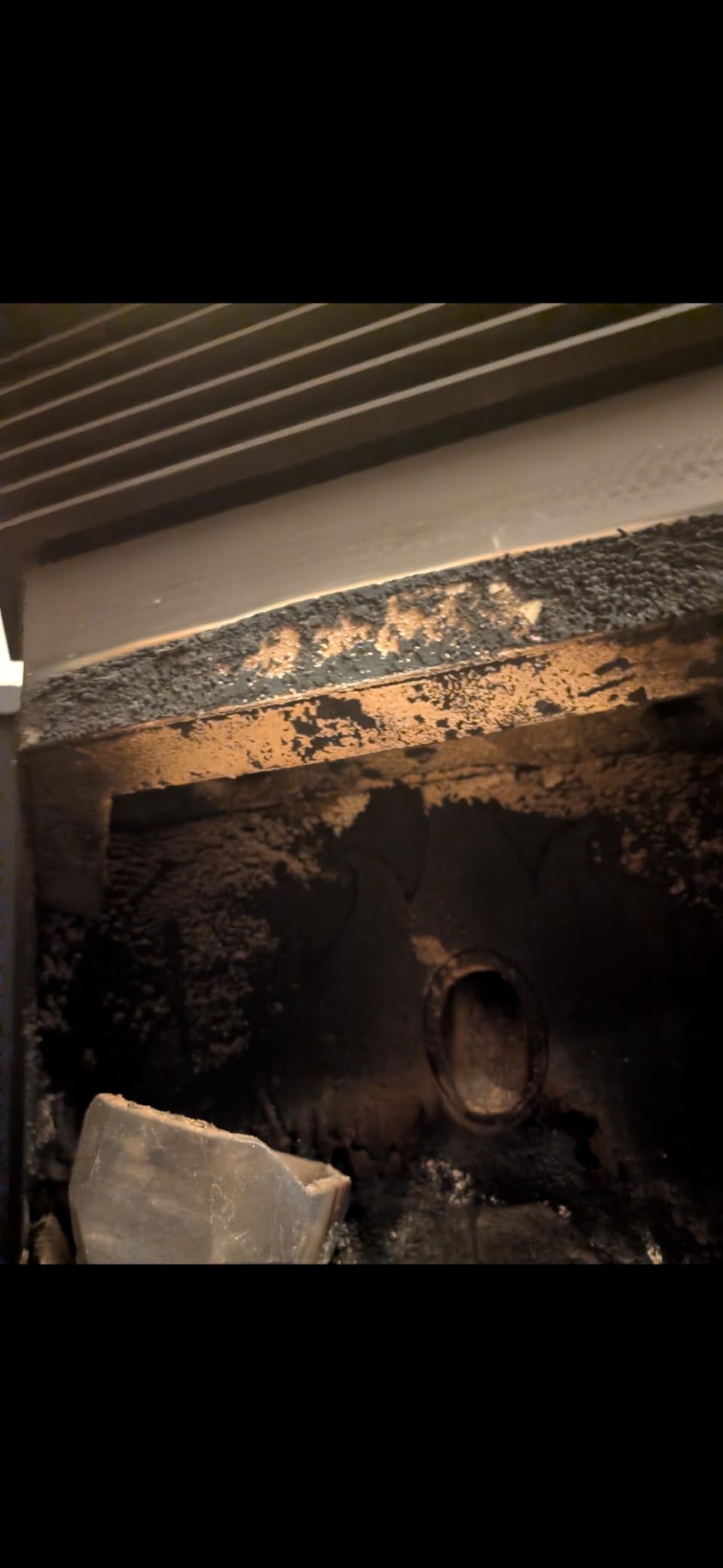
The warranty is a genuine strength. Eight years on steel parts with one year on electrical is far better coverage than the one-year terms offered by several competitors in this list, and that difference shows up exactly when blower and auger parts start failing.
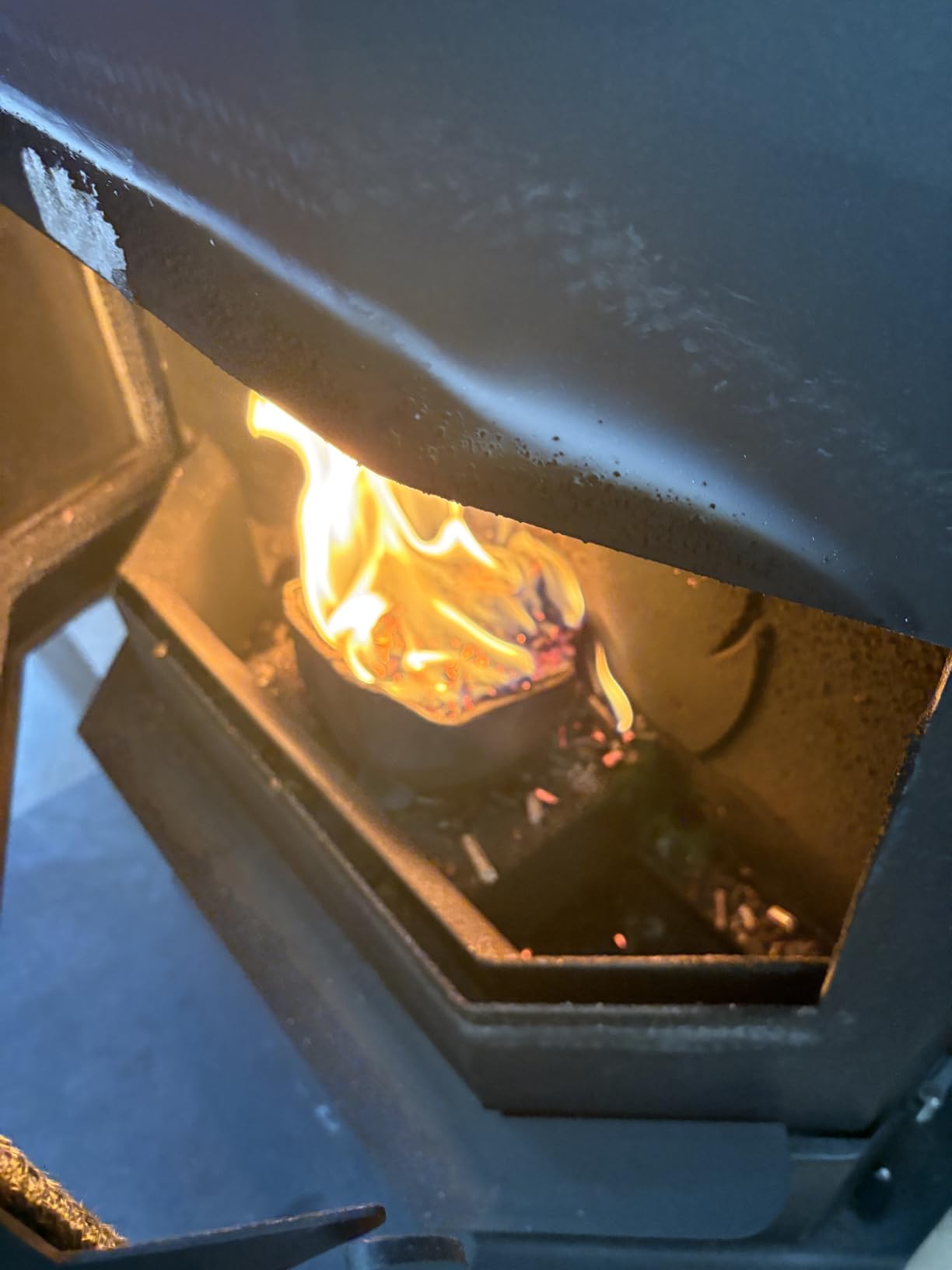
The complaint that repeats across the negative reviews is weight, at 231.5 lb. Combined with direct vent venting, which needs a proper flue run, this is a two-person install. Plan the placement, the hearth pad and the vent path before the unit arrives.
Who this Bayfront suits best
It suits a household heating 1,800 to 2,500 square feet that wants app control and a long warranty without moving to a premium dealer brand. The eight-year steel terms make it a sensible pick for anyone who intends to keep a stove for a long time.
If you want a phone app and cast iron durability in a straightforward freestanding package, the feature set here is more complete than the price tier suggests.
Where it falls short
That 3.8 average is the reason this sits at number 10 rather than higher. A 21 percent one-star share means a meaningful minority had a bad experience, and in a category where failures often involve electrical parts, that is not a trivial number.
Ask a dealer which specific failure modes those reviews describe, and check whether the eight-year steel terms actually apply to the parts most likely to fail on your unit. The weight and the direct vent requirement are fixed costs of the design.
11. ComfortBilt HP40 Alpine – the pick for the smallest rooms
ComfortBilt HP40 Alpine Pellet Stove, 1,500 sq. ft., 25 lb. Hopper, Black
Heats up to 1500 sq ft
26224 BTU per hour
25 lb hopper
Compact 21 by 17 by 30 inch body
Pros
- Compact footprint suits cabins/sunrooms/garages and workshops
- Easy to vacuum and maintain at 167 lb
- Five heat settings with programmable thermostat and remote
- Owners report strong supplemental heating in greenhouses and basements
- Customer service described as responsive and helpful
Cons
- Blower and feed system are noticeably loud
- Some owners report output below the advertised 1500 sq ft
- Limited control over feed screw and blower speed with pellets blowing out of the burn cup
- Eco mode cycling can wear out the igniter early
- Pellets can hang up in the hopper
- No factory gasket available
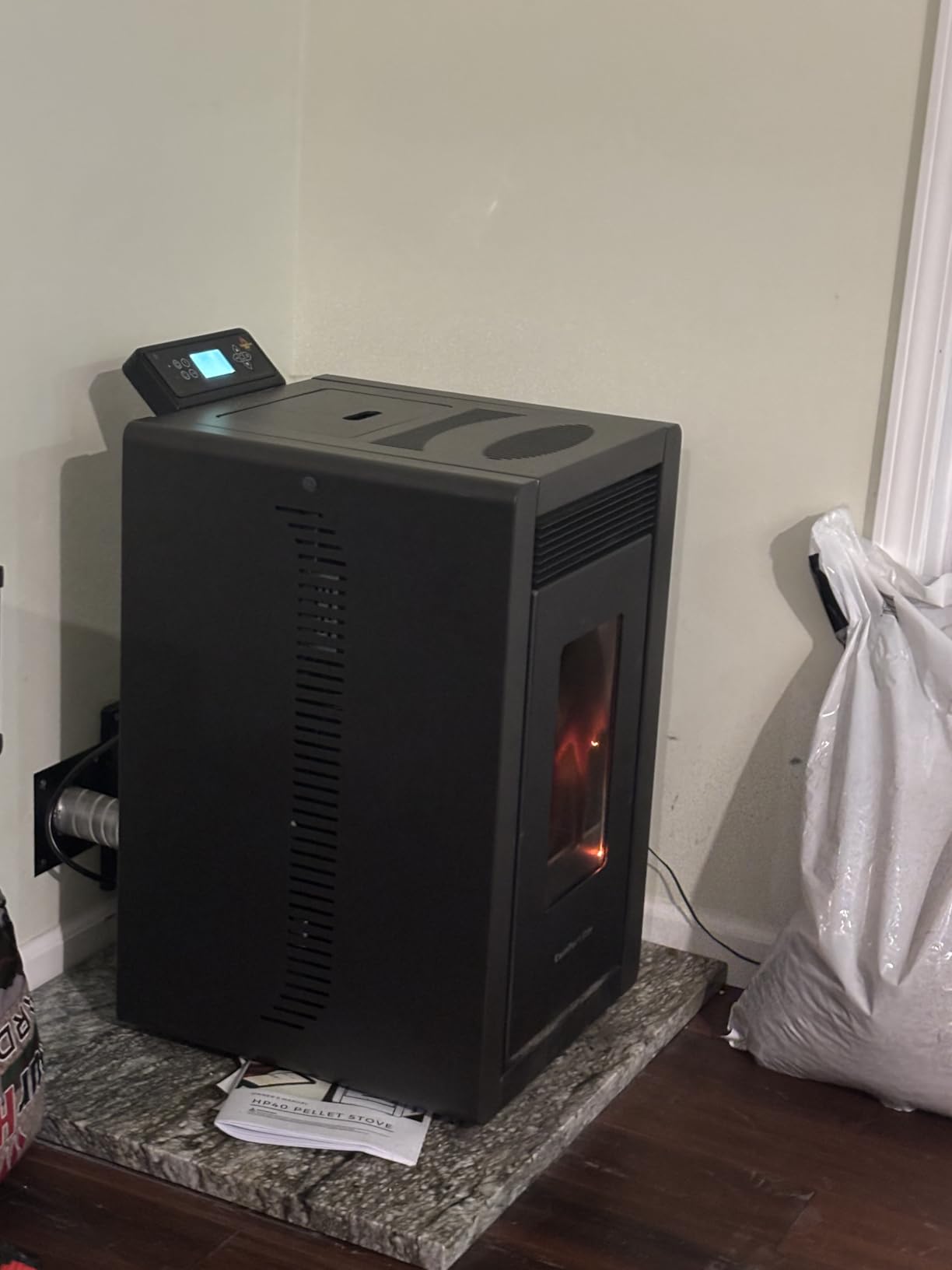
The HP40 Alpine is the smallest capable unit we included, and small is the point. At 21 by 17 by 30 inches and 167 lb, it fits a sunroom, a cabin, a garage, a greenhouse or a workshop where a 200 lb cabinet stove has no business sitting. Output is 26,224 BTU per hour for up to 1,500 square feet, at a listed 81 percent efficiency.
Owners use it as a supplemental heater more than a primary one, and they report it doing that job well. The advice that shows up repeatedly in reviews is to run it in manual mode on a low setting, then tune the feed rate, intake air and blower voltage to match your pellet brand before relying on the thermostat.
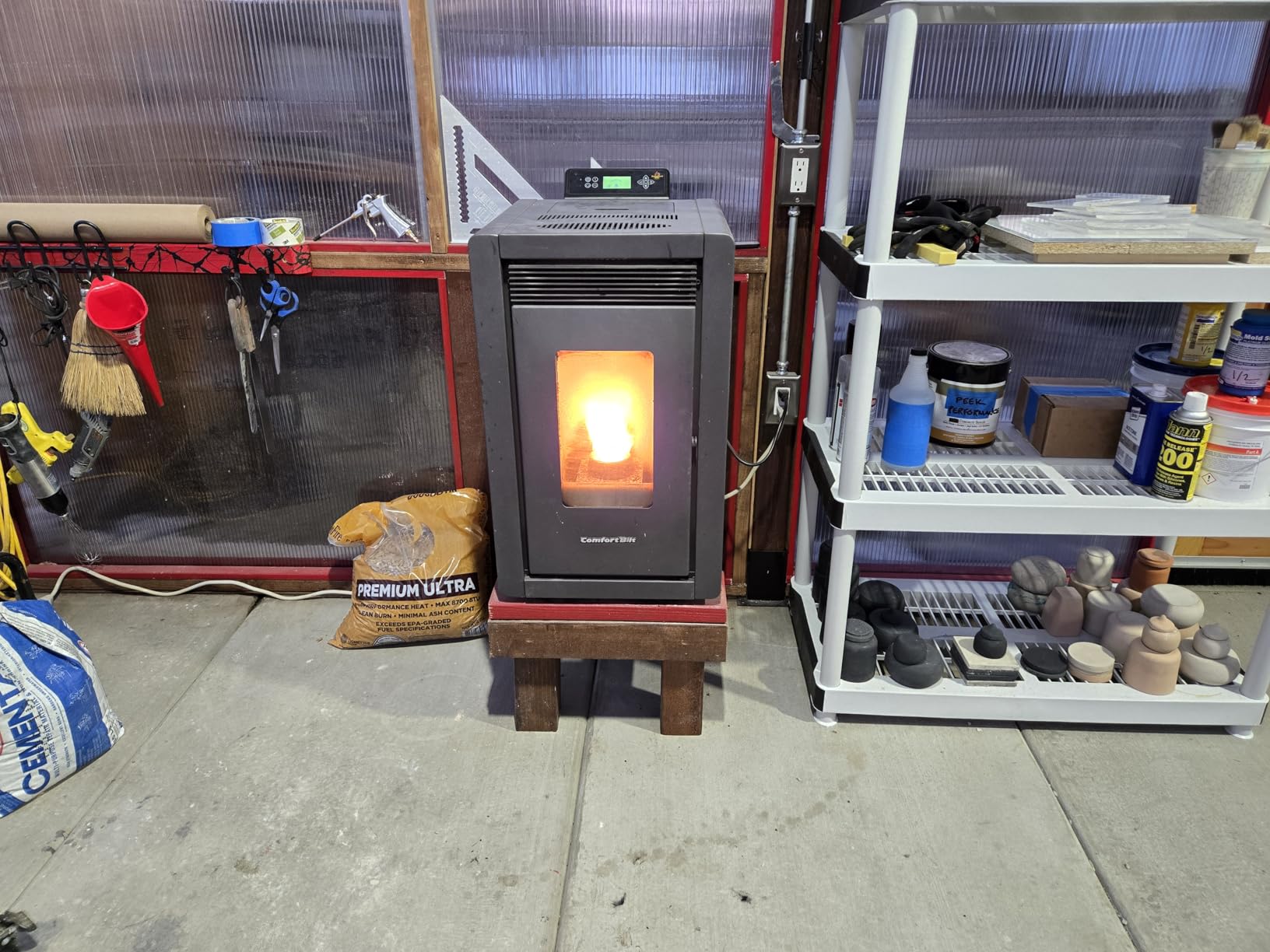
The 25 lb hopper is the smallest here, which in practice means frequent refills. It holds a partial bag, so if you are topping it up more than twice a week, the larger hoppers will serve you better even in a small space.
Noise is the most consistent complaint. Owners describe both the blower and the feed system as noticeably loud, which makes it a poor choice for a bedroom or a quiet living room. Several reviewers also report output below the advertised 1,500 square feet, so size this one conservatively.
Who the HP40 Alpine suits best
It suits people heating one defined space: a workshop, a detached garage, a basement corner, a small cabin or a sunroom. The light 167 lb body also means one person can reposition it, which none of the 200 lb-plus units here allow.
For greenhouses and similar spaces, owners report it delivering real supplemental heat on a budget. Removable ash pan and a small body make daily cleaning quick.
Where the Alpine falls short
Control granularity is weak. There is limited adjustment over the feeder screw and blower speed, pellets can blow out of the burn cup, and pellets can hang up in the hopper. Those are tuning problems, but they add up for anyone without prior experience.
Two smaller issues worth knowing: eco mode cycling can wear out the igniter sooner than continuous low burn, and no factory replacement gasket is listed for this model. If you are sensitive to noise, pick a different unit.
12. Canyon Lodge Large – the pick for mobile homes and big open spaces
Canyon Lodge Large Pellet Stove
Heats up to 3000 sq ft
130 lb hopper
Vent-free with fresh air kit included
Mobile home approved and EPA approved
Pros
- Extra-large 130 lb hopper gives long burn times between refills
- Heating capacity up to 3000 sq ft suits large homes and open areas
- Vent-free setup simplifies installation and a fresh air kit is included
- Whisper Quiet blower technology reduces noise
- Smart Home Technology app control
- Mobile home approved and EPA approved
Cons
- Only 17 customer reviews so reliability feedback is limited
- Rating distribution includes 13 percent one-star reviews
- 209.4 lb body needs planned moving help
- Steel fire pot rather than cast iron on the smaller Bayfront
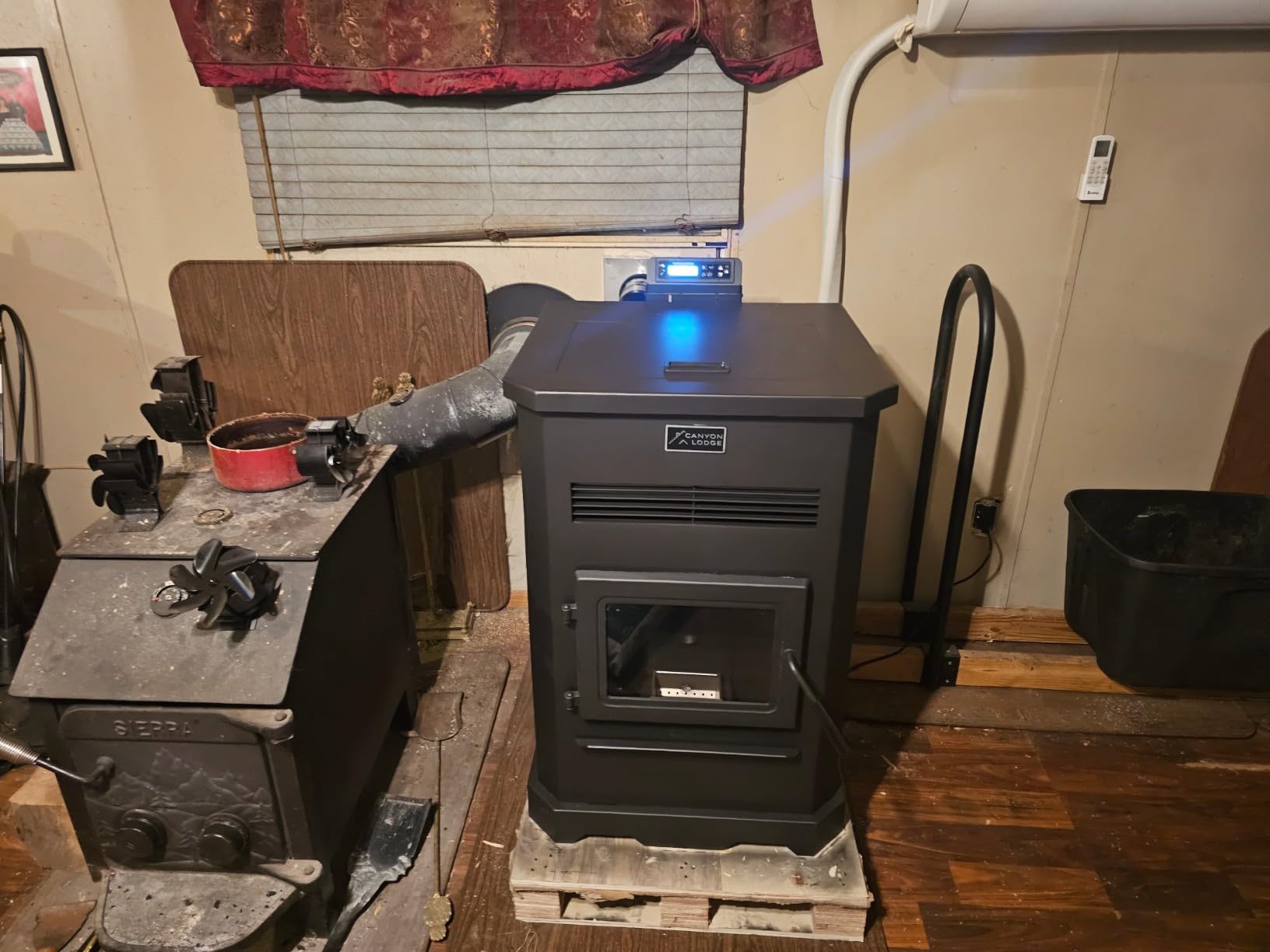
This is the model to shortlist for a manufactured home, where approval and vent-free installation matter more than anything else. It carries explicit mobile home approval, includes a fresh air kit in the box and needs no external vent run, which removes several of the steps that trip up first-time installers.
Capacity is the draw for everyone else. It heats up to 3,000 square feet and carries a 130 lb hopper, so it is one of the few units here that can plausibly serve a large open plan without a second stove. The Whisper Quiet blower and app-based Smart Home Technology control round out a well-equipped package.
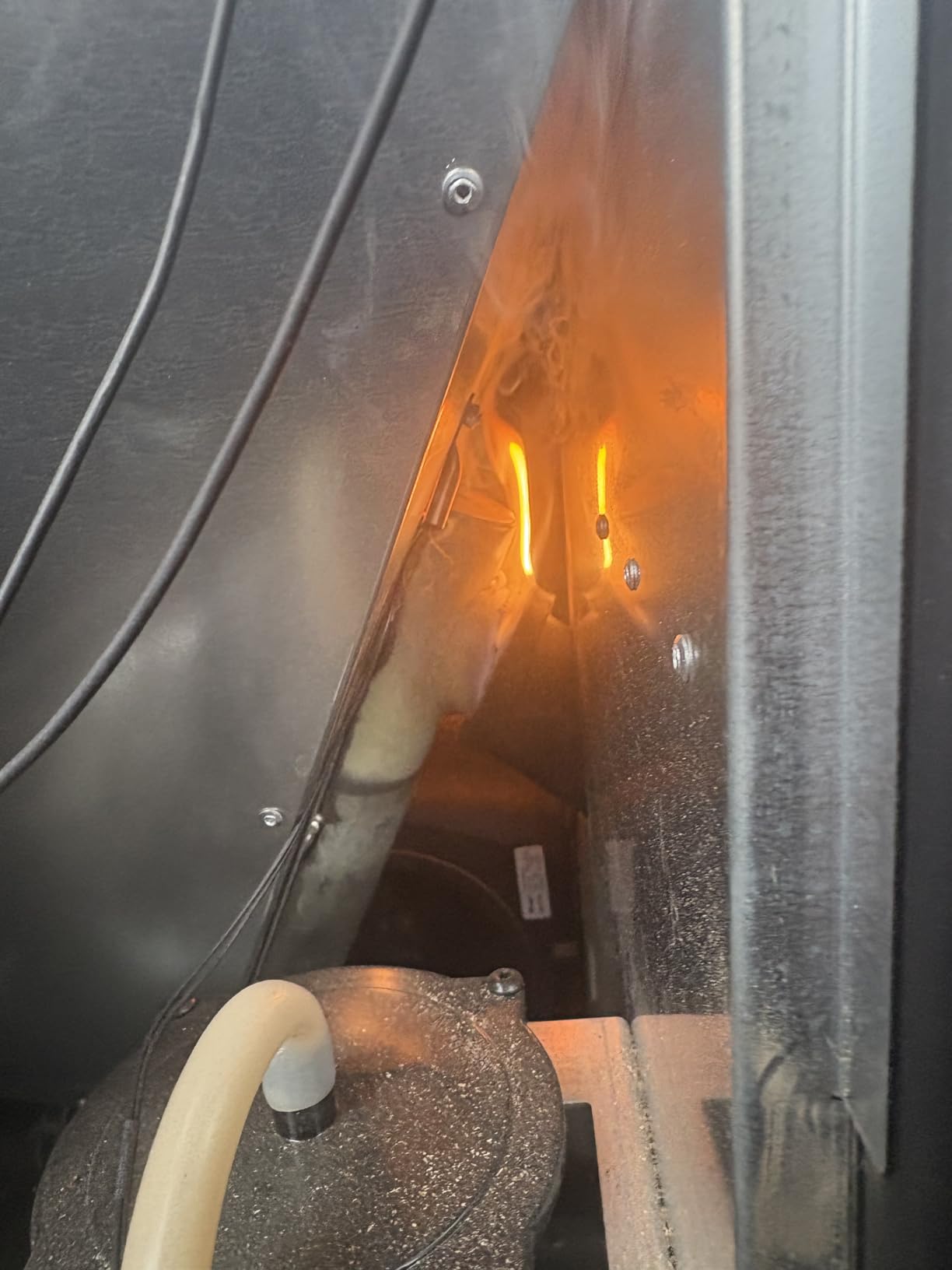
The fire pot is stamped steel rather than the cast iron pot used on the smaller Canyon Lodge Bayfront, and output is 29,501 BTU. That is fine for a well-insulated home and less convincing in a cold one, which is worth testing if your winters are severe.
Seventeen reviews is a small base, with 13 percent one-star among them. Treat that as an early read rather than a settled reputation, and ask a dealer about warranty service, which is listed generically for this line.
Who the Canyon Lodge Large suits best
It suits manufactured housing owners and anyone in a region where venting is complicated or prohibited. It also suits large open floor plans where a single unit needs to cover 2,000 to 3,000 square feet without constant refills.
The included fresh air kit means you are not hunting down a separate part before the first burn, which is a common overshoot for new owners.
Where it falls short
Steel construction at 209.4 lb is a middle ground rather than a premium build, and the fire pot is the first part we would expect to need replacing over a long life. Plan for that cost.
The thin review history is the deciding factor for anyone thinking of this as a primary heat source. If you can find a dealer who stocks parts for the line locally, that outweighs the small evidence base. If you cannot, one of the models with a longer warranty record is the safer buy.
How to Choose a Pellet Stove for Your Home
Match BTU output to square footage first, then adjust for climate. Manufacturers rate coverage under mild conditions, and real capacity drops with altitude, wind, insulation quality and ceiling height. Owners on forum threads almost universally recommend sizing up for drafty houses or open plans, and that advice holds up.
Next, size the hopper around your routine rather than the advertised burn time. Burn time depends on pellet quality, stove condition and the setting you run. A 47 lb hopper is one bag; a 130 lb to 150 lb hopper is three to four, and an optional extension can push that further. Fewer refills also mean fewer cold starts, which is where efficiency is lost.
Efficiency claims need translating. EPA-certified HHV efficiency is measured under laboratory conditions and is the number worth comparing across models. Manufacturer “optimum” figures often reflect a favourable test rather than a season’s average, and the gap between the two is where running-cost expectations get disappointed.
Vent and hearth requirements come before model selection, not after. Some units need Type L venting components sold separately, others use standard 3 inch pellet vent, and inserts need a lined flue. A non-combustible hearth pad is required in most cases, and a fresh air kit is mandatory for mobile home installation. Budget these as part of the stove, not as an afterthought.
Electricity and outages decide your comfort more than any feature list. Nearly every stove with an auger, a blower and auto ignition needs 120V power continuously. Options range from a UPS-style battery backup on models designed for it, to a small generator for the whole house. Ask how long backup lasts at a low setting.
Finally, read warranty terms as carefully as specifications. Three years on the firebox and one year on the cabinet is a common tier. A five-year steel parts warranty, as offered by the PelPro, or eight years on steel parts, as offered by one Cleveland Iron Works model, materially changes the multi-year cost of ownership when an auger motor or blower fails.
Pellet fuel itself works the same way across these appliances, which is why the same bags that feed our pellet grill picks also fuel a heating stove. If you are new to pellet fuel, our beginner’s guide to pellet grills covers the basics of pellet storage and feeding that carry over directly.
Pellet Fuel Costs and the Real Installed Price Tag
Running cost is a function of BTU output, efficiency and pellet prices, which move through the season. A stove burning a 47 lb hopper over roughly 20 to 23 hours at low setting gives you a direct way to estimate your own weekly consumption: measure the bags you use over a cold month and multiply by the season length.
Most households that save money run the stove as zone heat. Heating the rooms they occupy, rather than the whole envelope, is what produces the reduction in the heating bill. Running a pellet stove as sole heat for a poorly insulated large house is the scenario where savings are least certain.
The installed cost is where budgets get surprised. The stove is one line among several: Type L or 3 inch vent components, a hearth pad, a fresh air kit where required, a chimney liner for an insert installation, and the labour to do it. Freight delivery of a 200 lb-plus appliance is another line that catches people off guard.
One more line item people forget: parts. A control board, auger motor, blower motor or igniter is a normal part of pellet stove ownership over ten years. Models with three to five year mechanical warranties shift some of that cost to the manufacturer, and in practice that difference compounds.
If you also cook outdoors on the same fuel, the hopper sizes and auger handling carry straight over. Our budget pellet grill roundup covers the cheaper end of the market, and our pellet smoker guide for beginners walks through the same ignition and feeding basics.
Why People Get Rid of Pellet Stoves
This is the question owners ask most often, and the honest answer is that the machines are rarely the problem. The reasons people walk away come down to expectations versus daily reality, and you can defuse most of them before you buy.
Maintenance fatigue. Burn pot scraping, ash disposal and glass cleaning are daily or near-daily tasks. Tube-free designs and larger burn pots reduce it, but nobody has eliminated it.
Electricity dependence. Stoves without a battery or generator stop feeding during an outage, which is exactly when you want heat most.
Sizing mistakes. A stove advertised for 2,800 square feet that underperforms in a drafty or tall-ceilinged house produces the fastest refund of all.
Refill habits. A 25 lb or 40 lb hopper fills fast in cold weather, and owners who dislike carrying bags upstairs tend to give up fastest.
Failed parts and thin warranties. Auger motors and control boards on one-year-warranty stoves are the most common reason a working stove gets replaced.
Noise in living spaces. A single-speed blower in a quiet room is a daily irritation that owners mention more than almost anything else.
Every complaint we saw in forum discussions mapped back to a spec decision you can make differently: a larger hopper, a variable-speed blower, a battery backup, a longer warranty, or sizing up one step. That is the practical reason to buy deliberately rather than by coverage number alone.
Frequently Asked Questions
Can you heat your whole house with a pellet stove?
Yes, if you size it correctly. A freestanding stove in the 40,000 to 50,000 BTU per hour range covers roughly 1,800 to 2,500 square feet, and 130 lb to 150 lb hopper models rated to 3,000 square feet can carry an open floor plan. Below that, pellet stoves work best as zone heat for the rooms you use most, which is also where fuel savings are largest.
What is the best pellet stove according to reviews?
The ComfortBilt HP22 is our pick for most homes, with up to 41,000 BTU per hour, a 55 lb hopper and up to 20 hours of burn time, supported by 291 owner ratings averaging 4.4 stars. For large homes the Cleveland Iron Works 130 lb hopper model offers the biggest hopper at a value tier, and for outages the US Stove GW1949 Wiseway runs without electricity.
Is it cheaper to heat your home with a pellet stove?
Usually, when you use it as zone heat. Running one stove for the rooms you occupy costs far less than heating an entire envelope, and EPA-certified models in this roundup range from 81 percent to 87.5 percent efficiency. Pellets are widely available in 40 lb bags, and measuring your own weekly bag consumption is the only reliable way to project a season.
Why are people getting rid of their pellet stoves?
Usually for reasons that have nothing to do with the fire. Daily burn pot and ash maintenance, electricity dependence during outages, sizing mistakes in drafty or open-plan homes, frequent refills from small hoppers, noisy single-speed blowers in living rooms, and auger or control board failures on one-year-warranty models are the most cited reasons. Each one can be avoided with a deliberate spec choice.
Do pellet stoves need electricity?
Most do, because the auger, blower and auto ignition all need 120V power continuously. A power cut stops pellet feeding within minutes. Two options solve it: the US Stove GW1949 Wiseway uses a gravity feed system and runs non-electric, or you add battery backup, as offered on the Pellethead PS21, or use a generator.
Is there still a tax credit for pellet stoves?
No federal credit is available. The 25C biomass stove tax credit expired on December 31, 2025, and many stove retailer pages still advertise it. State, utility and local rebate programs are the only remaining options, so check your state energy office and your utility before assuming anything is available.
Final Verdict on the Best Pellet Stoves for Home Heating
The ComfortBilt HP22 is the best pellet stove for most homes in 2026, pairing up to 41,000 BTU per hour with a 55 lb hopper and the largest owner rating base in this group. Heat a large open plan and the Cleveland Iron Works 130 lb hopper model gives you fewer refills; lose power often and the US Stove GW1949 Wiseway keeps running without electricity; want app control and real outage runtime and the Pellethead PS21 covers both.
Whichever you choose, size up for your climate, budget for venting and the hearth pad, and settle the electricity question before delivery day. Those three decisions prevent almost every regret we read about in owner threads.