The failure mode nobody warns you about is not a dead plant. It is a dead plant and a soaked yard at the same time, because a hose timer that keeps running after a kinked line or a popped sprinkler head does not stop when you are not there to see it. Every pick in this roundup of the best garden hose timers for vacations was judged on one question first: will it still be running the right schedule on day seven, with nobody home to fix it?
We ranked ten hose end timers on the things that decide whether a vacation goes quietly. That means stored programming that survives a power cut, rain delay long enough to cover a wet week, enough water pressure headroom for the line you are feeding, and connection hardware that does not weep at the spigot on day ten. Feature lists are easy to write; keeping a valve closed for eleven days is not.
The short version for most homes: the Orbit 62061 single-outlet digital timer is the best overall pick because it combines the widest review history in the category with dial programming you can finish in two minutes, and it keeps running its stored program without an app, an account or a hub. If you want no batteries at all, the Orbit 62034 mechanical timer cannot lose power. If you have a lawn and a bed with different needs, step up to a two-zone or four-zone unit.
One thing to settle before you read further. A hose timer is a hose bib device, not an irrigation controller, and it only works properly if the spigot valve behind it is turned to the open position and stays there. That single rule prevents most of the problems people describe in gardening forums, and we cover it in detail in the pre-departure checklist below.
We also use the word unattended a lot here. For this article it means one thing: nobody is available to reset a stuck valve, swap dead batteries or push a manual override button for the length of the trip. If you are travelling three hours away rather than three thousand miles, you can relax several of these constraints. The further you go, the more the picks below tilt toward durability and away from app features.
Table of Contents
- Top 3 Picks for Best Garden Hose Timers for Vacations in 2026
- All 10 Garden Hose Timers Compared in 2026
- 1. Orbit 62061 Programmable Digital Hose Watering Timer
- 2. Orbit 62034 Battery-Free Mechanical Water Timer
- 3. RAINPOINT Programmable Sprinkler Timer
- 4. RAINPOINT Two-Zone Sprinkler and Water Timer
- 5. Insoma Programmable Water Timer
- 6. Melnor 65138AMZ AquaTimer Digital Hose Timer
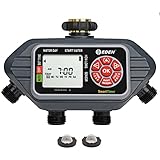
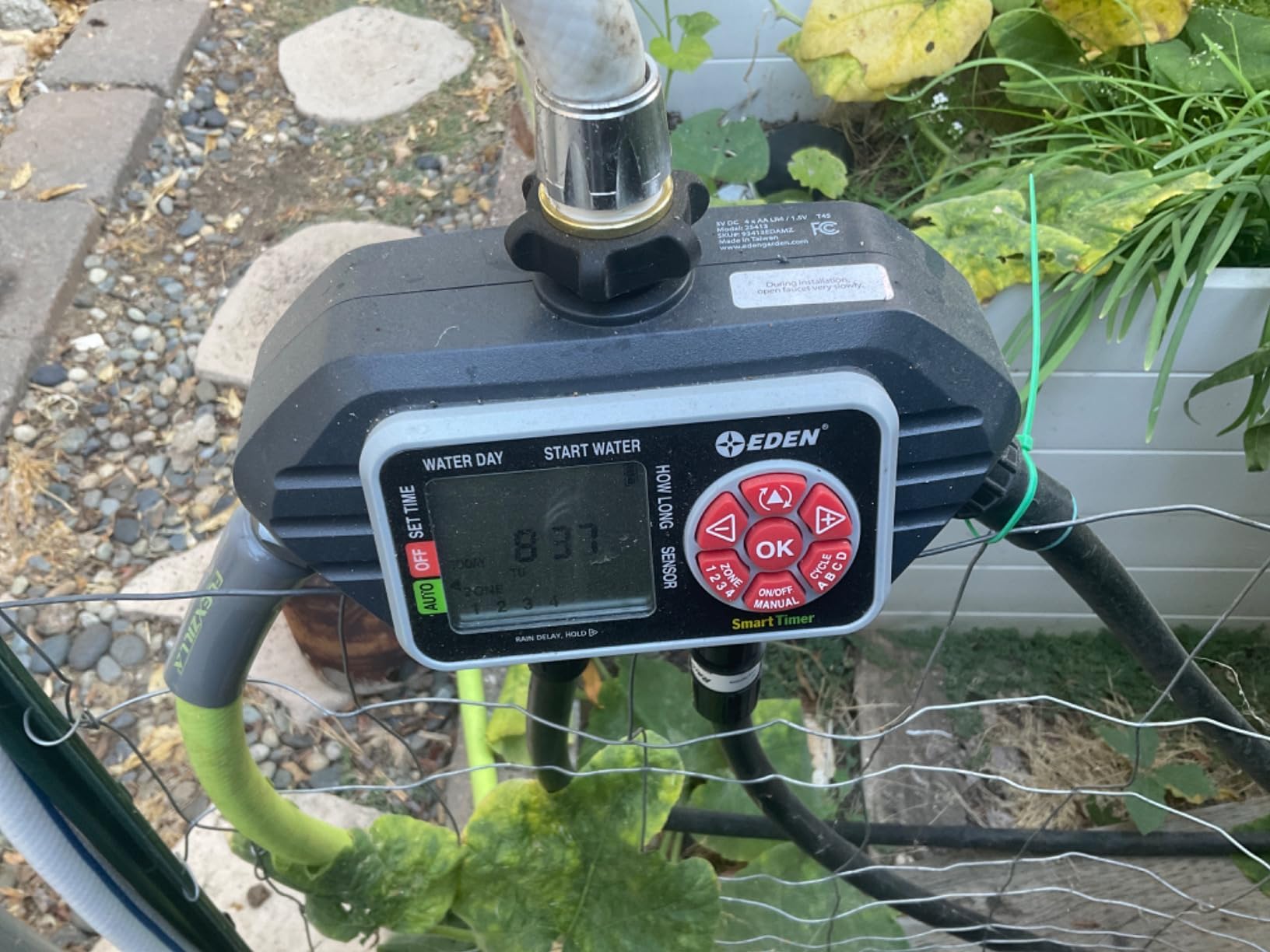
- 7. Eden 93413 Four-Zone Programmable Water Timer
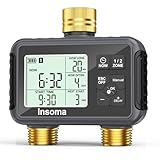
- 8. Insoma Two-Zone Timer with Brass Inlet and Outlet
- 9. Orbit 62056 One Outlet Single-Dial Hose Faucet Timer
- 10. RAINPOINT Brass Inlet and Outlet Hose Timer
- How to Set Up a Hose Timer Before You Leave in 2026
- What to Look for in a Hose Timer for Long Absences
- Which Timer Matches Your Trip Length
- Frequently Asked Questions
- The Best Garden Hose Timer for Vacations in 2026
Top 3 Picks for Best Garden Hose Timers for Vacations in 2026

Orbit 62061 Digital Timer
- Single outlet
- Built-in rain delay
- 2 inch LCD dial programming
- Water-resistant housing

RAINPOINT Digital Timer
- 1 min to 3h59m runs
- Hourly to weekly frequency
- 24/48/72 hour rain delay
- Manual mode to 8 hours

Orbit 62056 Single-Dial
- Fastest dial programming
- Brass swivel connection
- Large LCD
- 6 year warranty
Those three cover the three real use cases. The Orbit 62061 wins on proven dependability and simple programming. The RAINPOINT single-zone digital timer wins on scheduling range, because a 3 hour 59 minute run window combined with hourly to weekly frequency covers almost every vacation schedule. The Orbit 62056 is the fastest to configure and has a brass swivel connection that holds up better than molded plastic fittings.
All 10 Garden Hose Timers Compared in 2026
| Product | Specs | Action |
|---|---|---|
| Orbit 62061 Digital Hose Timer |
|
Check Latest Price |
 Orbit 62034 Mechanical Timer Orbit 62034 Mechanical Timer |
|
Check Latest Price |
| RAINPOINT Digital Timer |
|
Check Latest Price |
 RAINPOINT 2-Zone Timer RAINPOINT 2-Zone Timer |
|
Check Latest Price |
 Insoma Programmable Timer Insoma Programmable Timer |
|
Check Latest Price |
 Melnor 65138AMZ AquaTimer Melnor 65138AMZ AquaTimer |
|
Check Latest Price |
 Eden 93413 Four-Zone Timer Eden 93413 Four-Zone Timer |
|
Check Latest Price |
 Insoma Brass Two-Zone Timer Insoma Brass Two-Zone Timer |
|
Check Latest Price |
| Orbit 62056 Single-Dial Timer |
|
Check Latest Price |
 RAINPOINT Brass Hose Timer RAINPOINT Brass Hose Timer |
|
Check Latest Price |
Two columns in that list deserve a note. Run time is the single longest cycle the timer will hold the valve open, and anything over four hours usually means you are feeding drip irrigation rather than a sprinkler. Frequency is how often the cycle repeats, which is the number that matters for a two-week trip. A timer that waters once a week for six hours is a very different machine from one that runs twenty minutes every morning.
1. Orbit 62061 Programmable Digital Hose Watering Timer
Orbit Programmable Digital Hose Watering Timer – 1 Outlet – Battery Powered – with LCD Screen – Built-in Rain Delay – Water-Resistant – 62061
Single outlet
Built-in rain delay
2 inch LCD screen
Water-resistant housing
Pros
- Dial programming needs almost no instructions
- Large legible readout
- Settings retained when switched off
- Dependable across multiple seasons
Cons
- Only one start time per day
- Some bodies leak or fail their seals
- Not fully waterproof in prolonged wet exposure
Yes, the Orbit 62061 is the one to buy if you want a single hose end timer that simply holds its schedule. The programming is driven by a physical dial with a 2 inch LCD readout, and that matters more for a vacation than it does on a normal weekend. There is no app to log in to, no hub to pair, and nothing to update on a server while you are offline.
Reviewers consistently single out three things: the dial text is large enough to read in direct sun, the settings survive being switched off, and people who own several Orbit controllers across seasons report they keep working year to year. The 2 inch screen is one of the larger displays in this group, which sounds minor until you are squinting at a spigot in July sun trying to confirm the start time.
The honest weakness is water. This housing is water-resistant rather than waterproof, and a recurring minority of reviews report leaking at the seals or a unit that stops working once water gets inside. That is a quality-control spread rather than a design flaw, but it is worth weighing if your spigot is in a low, shaded corner that stays damp.
There is also a hard limit of one start time per day. If your lawn and your raised beds need different schedules, one outlet will not do it, and you would need a second timer on a splitter rather than a smarter program. For a single line of soaker hose or one sprinkler zone, that limit rarely comes up.
One practical note for anyone pairing it with a second timer. If you split a spigot with a Y-splitter to run two of these at once, each unit sees the same pressure but half the total flow, so shorten run times accordingly. A nozzle on the end of the line is also worth adding, because an unconstrained timer cycle can push more water through a sprinkler than the pipe was designed to carry.
What this model handles best over an absence
It is the safest pick for a trip of a week or two with one watering zone. Six years of warranty coverage means a failure inside the first season is somebody else’s problem, and the review volume behind it means replacement parts and known failure patterns are well documented. The 47,600-plus ratings here are the deepest history of any timer in the category.
Where it will disappoint you
It will not handle a lawn and a flower bed on separate schedules, and it will not skip a cycle based on a rain forecast, only on a fixed built-in delay. If your spigot sits where spray hits it directly, consider a model with a higher ingress rating instead.
2. Orbit 62034 Battery-Free Mechanical Water Timer
Orbit Mechanical Water Timer – Adjustable Irrigation Shutoff for Lawn & Garden Watering – Battery-Free Clockwork Hose Faucet Timer with Easy Grip Dial & Manual Bypass – 62034
Battery-free clockwork
15 to 120 minute range
Manual bypass
Oversized dial
Pros
- No batteries to fail
- Clockwork mechanism is dependable
- Large dial works in rain or with gloves
- Manual bypass for on-demand water
Cons
- Only one fixed start time per cycle
- 15 to 120 minute range is narrow
- Plastic housing degrades with prolonged sun
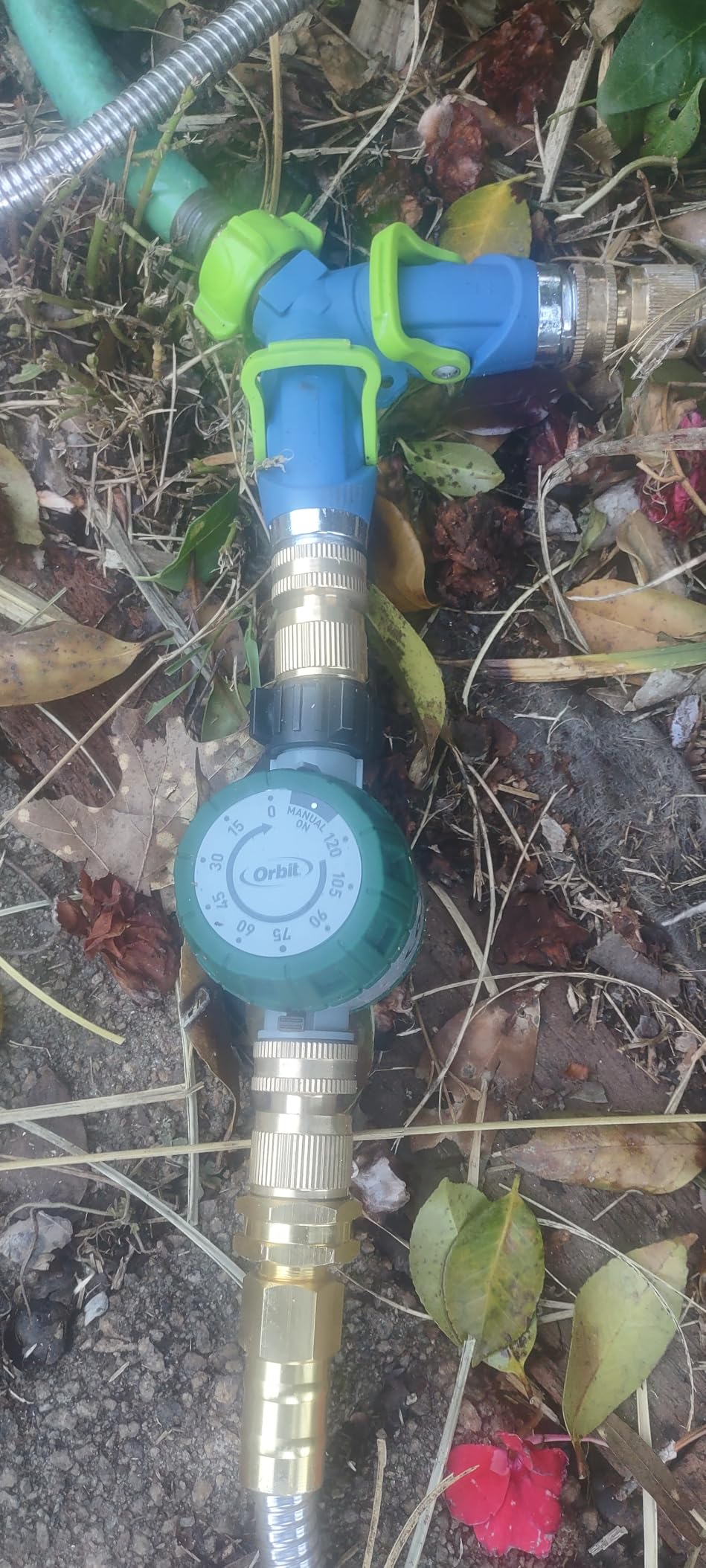
A mechanical clockwork timer removes every battery and electronics failure from the equation, and that is why the Orbit 62034 earns a place on this list despite being the least feature-rich unit in it. It has no batteries, no electronics and no display. You set a start time, turn the dial to a watering duration between 15 and 120 minutes, and a spring-wound mechanism closes the valve when the countdown ends.
That is the whole argument for this model on a three-week trip. Reviewers on lawn and garden forums describe mechanical timers as very reliable and some report decades of continuous use with an Orbit unit. Battery anxiety, the single most common vacation worry, simply does not apply here.
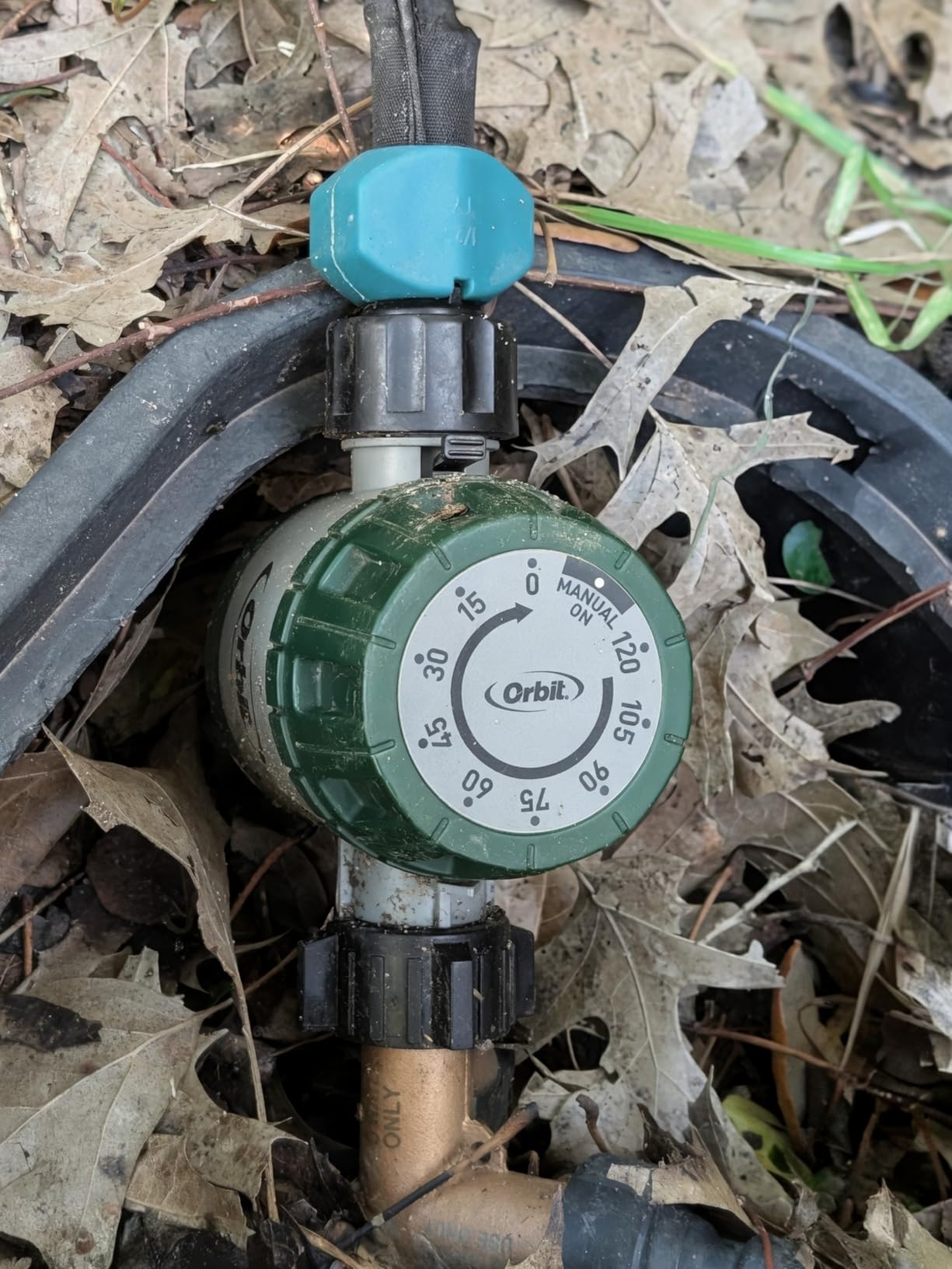
The trade-offs are scheduling flexibility and weather exposure. One start time per cycle means it repeats on a fixed interval rather than on selected days, so a weekly deep soak and a daily light drink run on the same dial. The 15 to 120 minute range is also narrower than any digital model here, which matters if you want to run drip line for four hours.
The plastic housing is the other long-term concern. In full sun through a hot season, plastic timers stiffen and the dial gets harder to turn, and there is no gasket sealing an electronics bay because there is no electronics bay. That trade is usually worth it, but store it indoors between trips rather than leaving it on the spigot year round.
A mechanical timer also has no failure mode that presents as a surprise. A digital unit that loses its clock or its battery can resume mid-cycle or not at all, and you find out on day nine. A clockwork timer either wound and running or visibly not wound, and you can see which before you close the door.
Who should choose the no-battery route
Anyone going somewhere with no reliable mobile coverage, or whose household power is unreliable, should look here first. It is also the natural choice for a simple drip line that needs the same long soak on a fixed schedule, and the manual bypass means you can water by hand without disturbing the timer.
What you give up for that reliability
You give up day-of-week selection, hour-long run times, rain delay and any read-out that tells you the timer is still alive. If you want a timer that can skip a cycle because it rained, this is not it. The oversized dial is genuinely easy to use with wet or gloved hands, which is more than most digital buttons can claim.
3. RAINPOINT Programmable Sprinkler Timer
RAINPOINT Sprinkler Timer, Programmable Water Timer for Garden Hose, Outdoor Soaker Hose Timed with Rain Delay/Manual/Automatic Watering System, Digital Irrigation for Yard, Lawn, 1 Outlet
1 min to 3h59m run time
Hourly to weekly frequency
24/48/72 hour rain delay
Manual mode to 8 hours
Pros
- Run time up to 3h59m with hourly to weekly frequency
- Rain delay with automatic resume
- Large readable LCD
- Works with soaker hose and drip line
Cons
- Batteries not included
- Dial and on-screen programming is fiddly at first
- Fit issues on older worn spigot threads
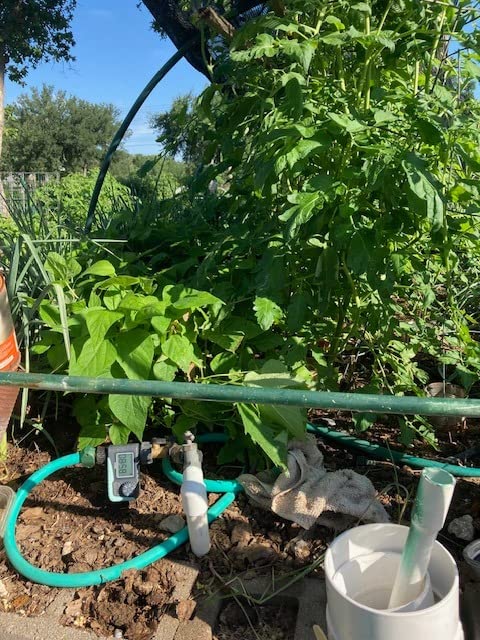
For most vacation watering, this RAINPOINT single-zone digital timer is the one we would put on the spigot and forget. It runs from 1 minute to 3 hours 59 minutes, repeats from every hour up to every 12 hours or from every day up to every 7 days, and it holds a 24, 48 or 72 hour rain delay that resumes automatically. That combination covers almost every schedule a two-week trip needs.
The manual mode is the underrated part. You can run water for 1 minute to 8 hours on demand without interrupting the stored program, which means the timer stays useful for you and not just for the plants. For a raised bed that needs a long weekend soak and a container row that needs a daily drink, that flexibility is worth more than a second outlet would be.
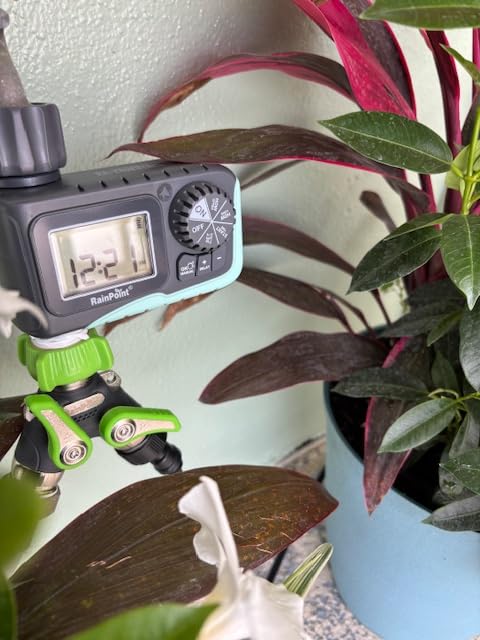
Two practical notes. The unit runs on 2 AA alkaline batteries and they are not included, which is a small trap on the morning you leave. And the fit on a worn or older spigot thread is occasionally reported as tight, so wrap the threads in plumber’s tape and hand-tighten rather than forcing it.
The 4.4 average across more than 11,000 ratings reflects broad satisfaction with schedule range and rain delay rather than excitement about anything clever. Programming takes a few minutes longer than the Orbit single-dial models because there are more options, and the small 0.75 inch screen needs a close look in bright sun. The one-year warranty is much shorter than the longer coverage on the Orbit and Melnor models, which is the main reason this sits second overall rather than first.
Worth noting for anyone feeding a raised bed: this timer is commonly paired with a soaker hose, and soaker lines need a lower flow than a sprinkler. If your line is a long run of porous tubing, use the shorter end of the run-time range rather than the maximum, and set the frequency to daily rather than hourly.
What this model handles best over an absence
It handles long and short cycles on the same unit, and it is the pick if your vacation falls in a wet season. A 72 hour rain delay with automatic resume means three days of downpour do not have to be watered off a deficit afterwards, and the schedule resumes exactly where it stopped without you touching anything.
Where it will disappoint you
Single outlet only, so a lawn and a bed with genuinely different needs will need a second device on a splitter. The screen is small for reading at a crouch beside a hot wall, and the one-year warranty offers no help if a valve fails in week two of a long trip.
4. RAINPOINT Two-Zone Sprinkler and Water Timer
RAINPOINT Water Timer for Garden Hose – 2 Zone Sprinkler Timer with Rain Delay/Manual Watering/Automatic Irrigation for Yard Lawn
Two independent zones
1 min to 3h59m each
24/48/72 hour rain delay
IP65 screen structure
Pros
- Two independent schedules from one faucet
- Low-battery warning closes the valve
- Large display with one-click setup
- Valves cut flow resistance
Cons
- 3/4 inch connection only
- Leaks possible on corroded pipe threads
- Bulkier and heavier than single-zone timers
Two zones is the sweet spot for most gardens, because a lawn and a flower bed almost never want the same schedule. This RAINPOINT runs two independently programmable zones from one faucet, each with its own start time and its own duration, and each can be set from 1 minute to 3 hours 59 minutes on hourly or daily-to-weekly frequency. The two-zone design is what stops one schedule from being wrong for everything at once.
The safety feature that matters most when you are 2000 miles away is the low-battery warning. When the cells get low the unit closes the valve automatically rather than letting a dying battery hold the valve open, and the 2.5 inch LED display is large enough to check the status in daylight.
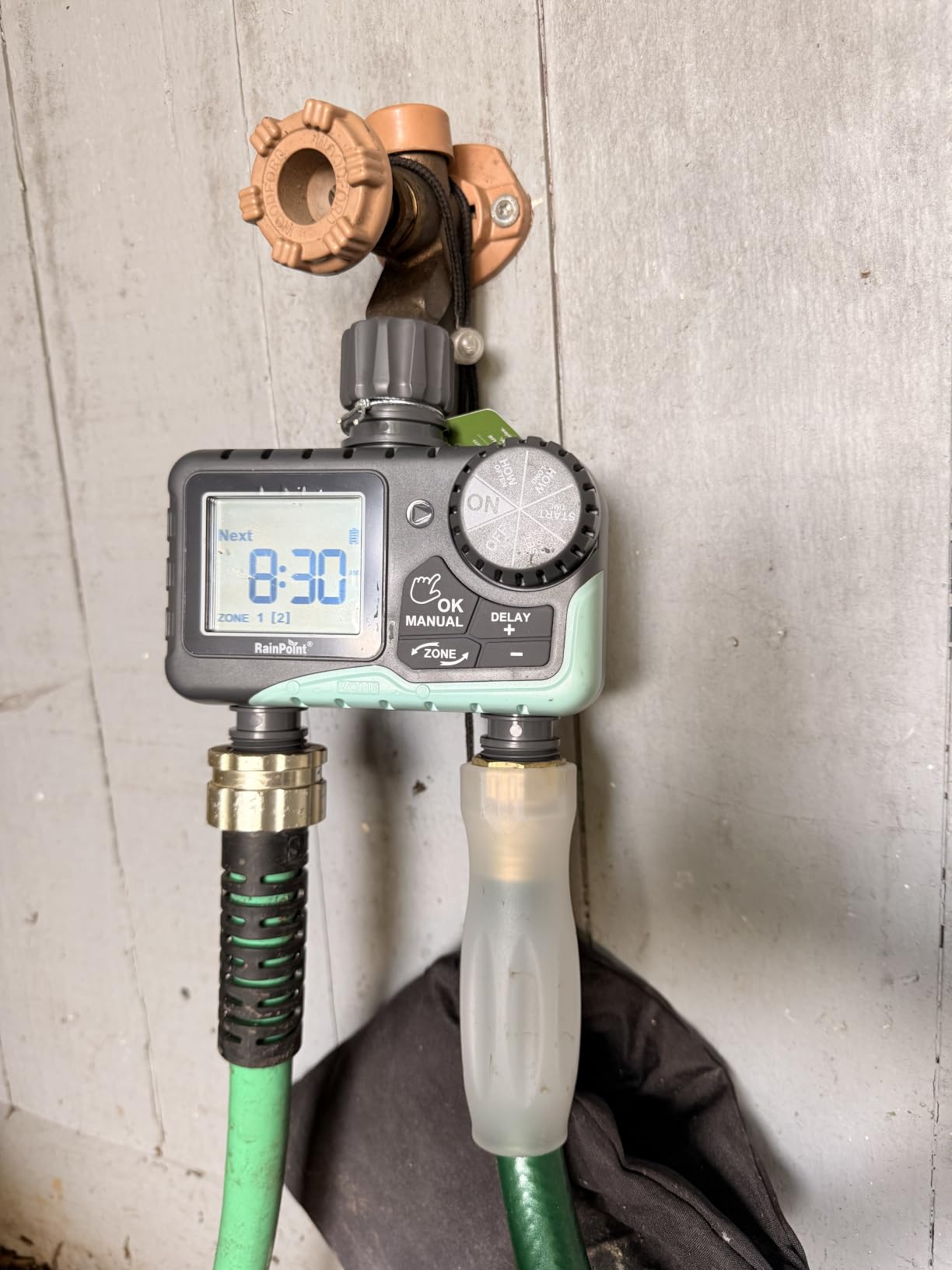
The mechanical design is a genuine upgrade for weather. The IP65 screen structure and upgraded valves that cut flow resistance by 40 percent mean this unit moves more water with less pressure drop, which matters if you are feeding two soaker lines at once. The 3/4 inch connection is a real compatibility question, so measure your spigot thread before you commit.
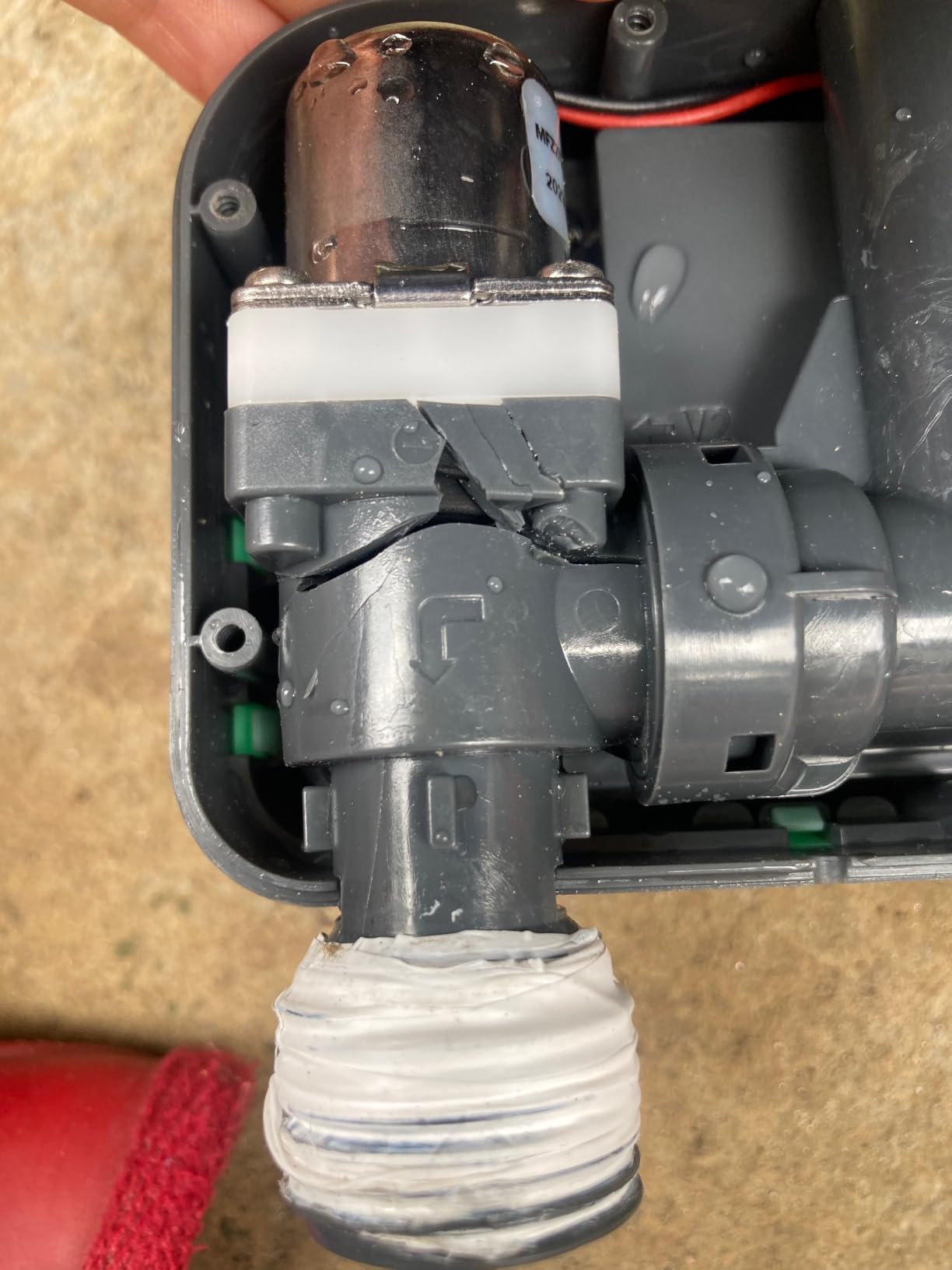
Weight is the other drawback. At roughly half a kilo this is one of the heavier timers in the group, and it is awkward to reposition one-handed. On corroded or galvanized pipe threads, tightening hard enough to stop a weep is how you strip a faucet, so use washers and tape rather than force.
If your spigot turns out to be half-inch, the fix is a reducing bushing rather than a different timer, and several of the models in this roundup include one in the box. Add that to the pre-departure run, because discovering the mismatch the morning you leave is a common and avoidable scramble.
What this model handles best over an absence
It handles two genuinely different watering needs from a single spigot, which removes the complaint gardeners raise most often: beds underwatered because the lawn schedule is louder. Three manual modes let you run zone one, zone two or both at once without touching the stored programs.
Where it will disappoint you
It will not fit a half-inch faucet, which rules it out for many older bibs. The 3/4 inch interface is also the reason leaks show up on worn pipe, and there is no way to add a third zone later without replacing the unit or stacking a splitter.
5. Insoma Programmable Water Timer
Outdoor Garden Hose Faucet Timers, Programmable Water Sprinkler Timer with Rain Delay/Manual/Automatic Drip Irrigation and Lawn Watering System for Yard, 1 Outlet
1 to 7 day rain delay
Child lock
Auto, manual and rain modes
1 min to 23h59m range
Pros
- Rain delay up to a full week
- Child lock blocks accidental changes
- Large LCD readout
- Auto/manual and rain delay modes
Cons
- 23h59m programming range is confusing
- Child lock adds a step
- Less long-term track record
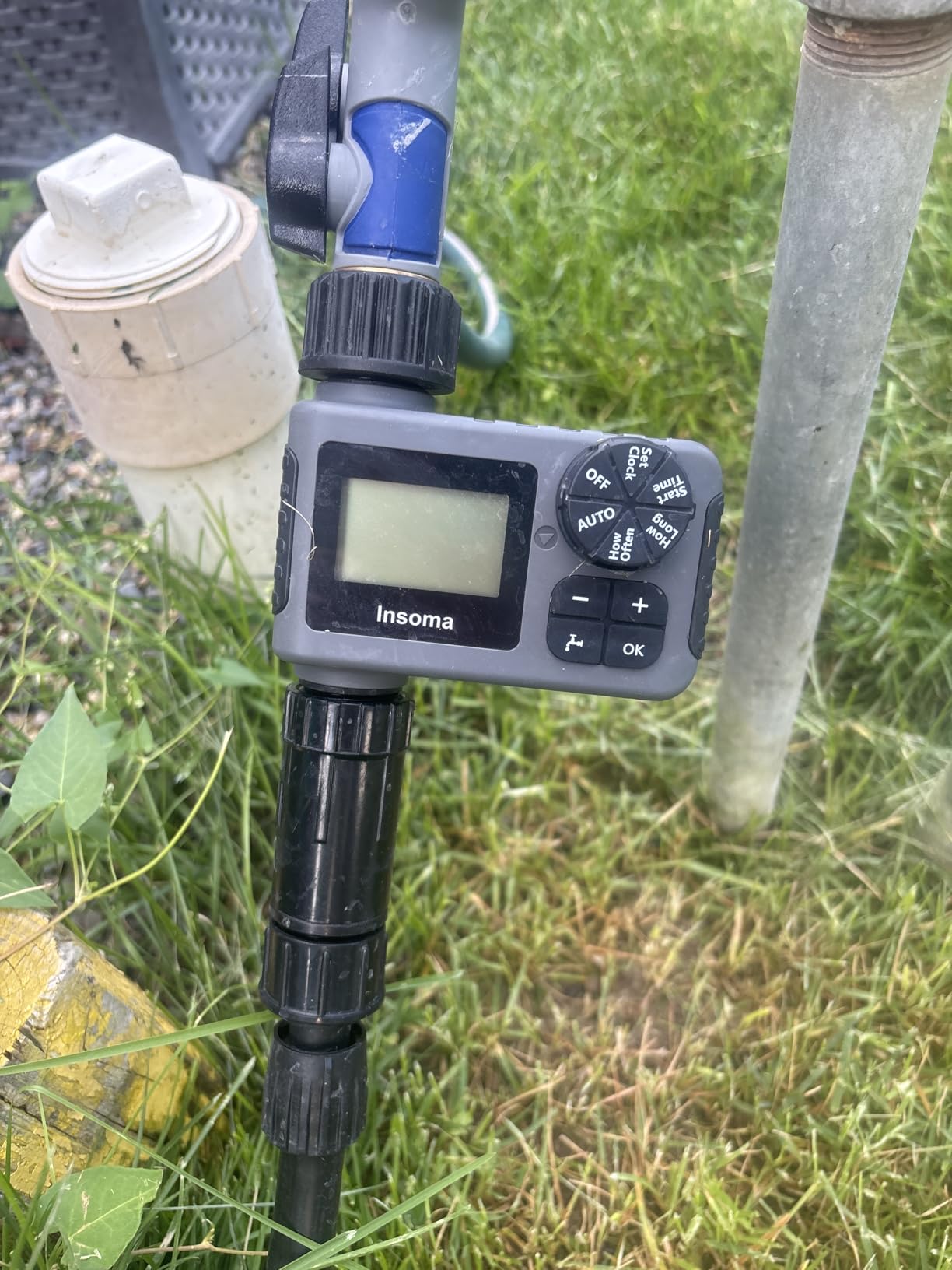
The distinguishing feature here is a rain delay of one to seven days with automatic resume. The other digital single-outlet timers in this roundup offer 24, 48 or 72 hours of pause, and the mechanical model has no rain logic at all. If you are leaving during a wet season where a single storm front can sit over your garden for most of a week, that extra reach is the difference between a schedule that keeps up and one that overwaters badly.
The child lock is more useful than it sounds for a vacation timer. It stops a curious neighbour, a dog, or a garden hose snagged by a mower from pushing a button and wipe the program on the same afternoon you departed. Battery life is rated at over six months on 2 AA cells, so a two-week trip is nowhere near the limit.
The programming range deserves a note. Watering frequency and duration both run from 1 minute up to 23 hours 59 minutes, which sounds generous but produces a menu that first-time users find confusing. Budget ten careful minutes at the spigot rather than expecting a two-minute setup like the Orbit dial models.
Pressure is the one thing you do not have to worry about here. The connector is rated to a wide 7.25 to 116 psi range, so almost any household tap falls comfortably inside it, and the auto, manual and rain delay modes cover the three ways you will want to override the stored program.
The extra reach is not just a bigger number. A seven-day delay is the setting that lets you leave knowing a whole wet week will be skipped automatically, which on a digital timer capped at 72 hours would mean reprogramming from a hotel lobby. That single feature removes the most common reason a vacation watering plan has to be touched mid-trip.
What this model handles best over an absence
It handles wet-season travel and accidental interference at the same time, which is a rare pairing. With auto, manual and rain delay modes, a 1 to 7 day pause, and a child lock, the timer keeps its program through weather and through other people being near it.
Where it will disappoint you
The 23-hour programming range is a genuine learning curve, and the child lock has to be released before any change, so re-programming mid-trip is a two-step job. The brand has a shorter service history than Orbit, RAINPOINT or Melnor, which is a fair question to ask before trusting it for three weeks.
6. Melnor 65138AMZ AquaTimer Digital Hose Timer
Melnor 65138AMZ AquaTimer Digital Hose Timer, 1-Zone Timer, QuickConnect Bundle, Black, Yellow
Hourly to weekly schedule
1 min to 6 hour runs
Manual faucet access
QuickConnect bundle
Pros
- Programs without any app or Wi-Fi
- Manual option gives instant faucet access
- Reliable over multiple seasons with fresh batteries
Cons
- Valves can stick open on weak batteries
- Zones may leak at the tap joint over time
- US 3/4 inch thread needs an adapter elsewhere
The Melnor AquaTimer carries a long warranty term, and owners repeatedly mention that Melnor’s warranty service actually resolved defects. For a device you are going to leave sitting on a spigot for weeks at a stretch, that is not a small detail. It is the difference between a failed timer and a replaced timer.
Scheduling runs from as often as every hour, up to 24 hours a day, down to as little as once a week, and automatic watering runs from 1 minute to 6 hours. That range covers drip line and sprinkler heads on the same unit, and the simple manual option gives you on-demand faucet access without reprogramming anything.
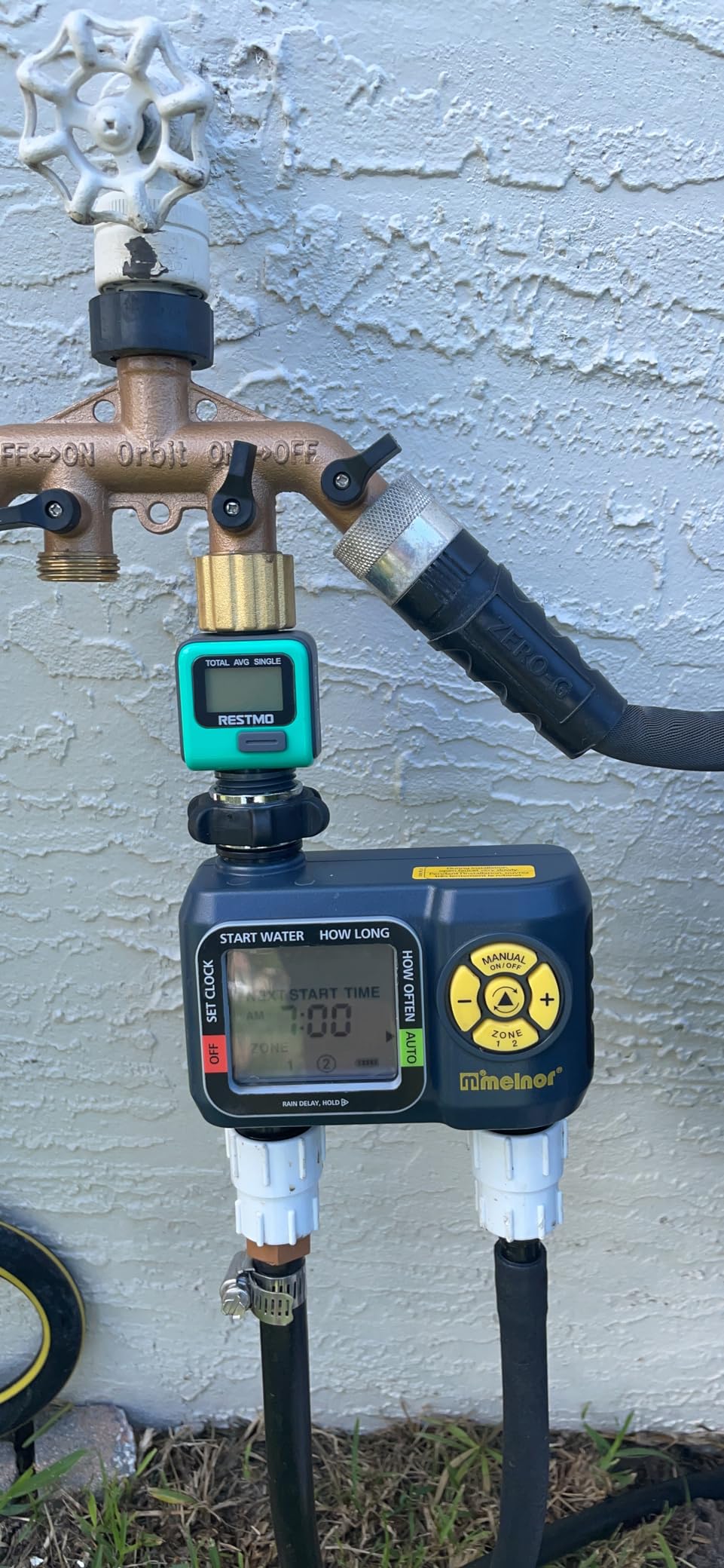
There is a real battery failure mode here that you should plan around. Reviewers report valves sticking open when batteries are weak, which is the worst possible outcome because it means continuous flow. Treat fresh alkaline cells as part of the pre-departure routine, not an afterthought, and the manual option is a good sanity check that the valve is seating.
Two other notes. The QuickConnect bundle includes hose connection fittings, which is helpful if you want to keep using the same hose by hand afterwards. The thread is US 3/4 inch, so outside North America you will need an adapter, and some newer production runs changed the programming model and removed day-of-week selection.
On the trip-length question, the hourly-to-weekly range is the quiet strength. A trip of ten days can run a two-hour soak every second day, or a six-hour deep water every week for a newly planted tree, without anyone touching the dial in between. That range is what lets a long absence be a single programming session instead of a recurring chore.
What this model handles best over an absence
It handles long absences with a warranty that covers you, and it handles users who do not want an app. Programming is entirely on the unit, so there is no account, no firmware update and no notification that could fail while you are unreachable. The 1 minute to 6 hour run range is the widest useful window among the single-zone digital models here.
Where it will disappoint you
It will punish you if you leave old batteries in it, because a weak cell can hold the valve open. Leaks at the tap connection show up over time on older units, and the QuickConnect fittings are not a cure for a worn spigot washer.
7. Eden 93413 Four-Zone Programmable Water Timer
Eden 93413 Programmable Digital Water Timer 4-Zone, Compatible with Wireless Soil Moisture Sensor
Four independent valves
Day-of-week selection
1 min to 6 hour runs
Zinc inlet with filter
Pros
- Four independent zones from one tap
- LCD with raised buttons is easy to program
- Accepts a soil moisture sensor
- Specific-day and multi-start scheduling
Cons
- Soil sensor sold separately
- Heaviest and bulkiest unit here
- Programming has a learning curve
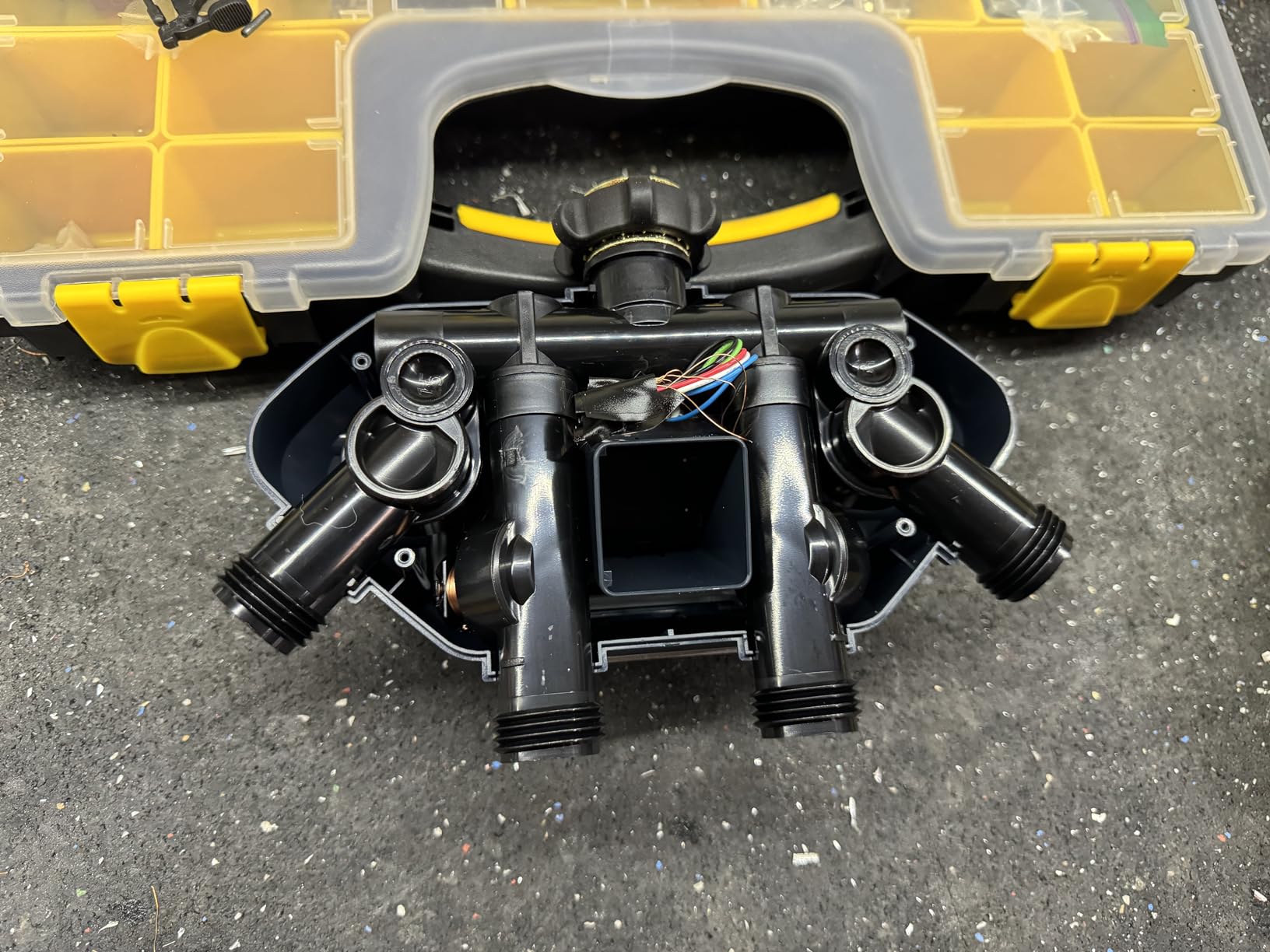
Four zones is more watering flexibility than any other unit here offers, and the Eden 93413 delivers it with four valves that operate as genuinely independent timers. Each zone can be set to specific days of the week, with multiple start times and runs from 1 minute to 6 hours.
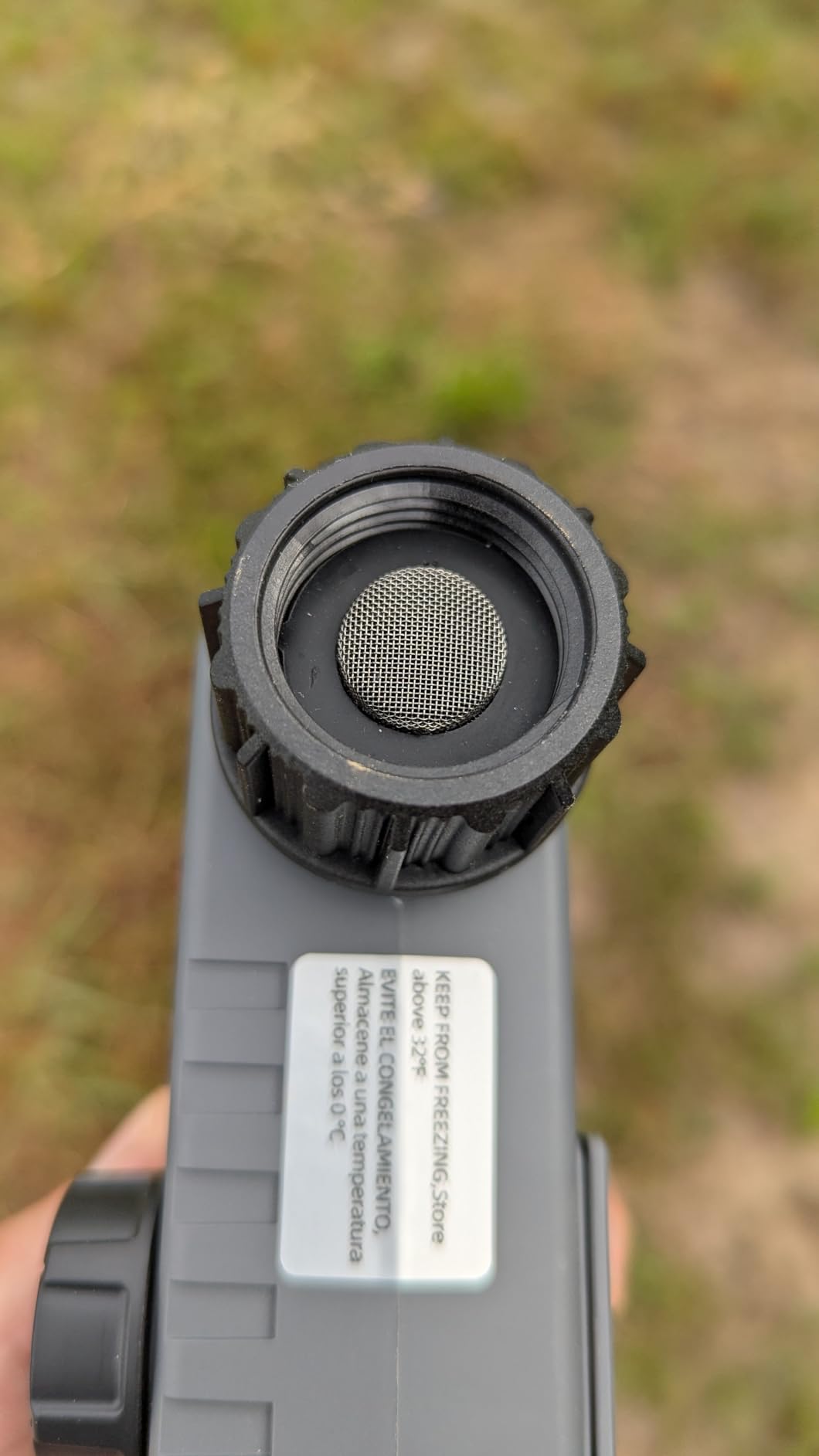
The build is more serious than plastic-only competitors. The inlet is pure zinc with a TPR tap connector and a built-in metal filter, and metal is the right material for a part that sits under pressure for eleven days straight. The filter also keeps sediment out of drip emitters, which is the quiet cause of most blocked drip lines.
The soil moisture compatibility is the feature that changes behaviour rather than just convenience. When paired with the matching sensor, the timer can skip a cycle because the ground is already wet instead of because a clock said so, which is a much smarter response to an unexpected downpour. The sensor is sold separately, so budget for that if you want it.
At 1.2 pounds it is among the heaviest and most bulky units here, and the 8.46 inch width means it needs a genuinely open spigot to hang on. Its 4.0 average and short warranty term are both among the weakest here, so it earns its place on zone count and hardware rather than on ratings.
One more thing to check before departure: with four valves drawing from one faucet, the flow to the furthest zone drops. If your longest run is the one that feeds the fruit trees, schedule that zone on its own rather than alongside the others.
What this model handles best over an absence
It handles a large property with mixed planting from one faucet. Fruit trees, a lawn, a vegetable bed and a row of containers can each run on their own days and durations, and the manual mode waters on the spot without interrupting the programmed settings.
Where it will disappoint you
It is bulky at a spigot, and the total cost climbs once you add the optional moisture sensor. The warranty term is short for a device that will run unattended for weeks, and first-time users should expect a slower setup than a single-dial model demands.
8. Insoma Two-Zone Timer with Brass Inlet and Outlet
Insoma Water Timer with Brass Inlet & Outlet, 2 Independent Zones Outdoor Hose Timer for Garden Faucet with Auto/Manual/Rain Delay Mode, Sprinkler Irrigation Controller for Yard Lawn
Brass inlet and outlet
Two independent zones
1 to 15 day rain delay
1 to 360 minute runs
Pros
- Brass resists corrosion over long unattended use
- Two zones run separately or together
- 15 day rain delay
- IPX5 with anti-UV materials
Cons
- Heavier than plastic single-zone timers
- 23 hour and 15 day range takes practice
- Zone button is easy to press by accident
Brass is the material argument for this one, and it is a real argument rather than a marketing one. Both the inlet and outlet are brass rated to 116 psi with a built-in metal filter, and brass does not crack, deform or thread-strip the way plastic couplers do after a season of sun and pressure cycles. It is the hardware you want on a spigot you will not touch for three weeks.
The scheduling range is the widest in the roundup. Frequency runs from every hour to every 23 hours or from every day to every 15 days, duration runs from 1 minute to 360 minutes, and rain delay runs from 1 to 15 days with automatic resume. Two zones can be run separately or simultaneously from the zone button.
Battery life is quoted at about 180 days on AA alkaline cells, which puts a two-week trip at roughly a tenth of the stated capacity. That figure is generous by manufacturer standards and worth relying on only if you start with fresh cells, which is another reason the pre-departure checklist below starts with batteries.
The 15-day rain delay is the feature that separates this from every other two-zone unit here. The others top out at 72 hours, which covers a storm but not a stalled front, and a stalled front during a three-week absence is exactly when a fixed program does the most damage.
A brass body also ages better. Metal threads stay round and metal seals stay tight across a summer of thermal cycling, so a unit you install once and leave through several trips keeps sealing properly on the last one, which is not something a plastic coupler reliably does.
What this model handles best over an absence
It handles long gaps between waterings, which is exactly the situation a vacation creates. A once-every-15-days schedule suits deep-drinking fruit trees and new saplings, and the 15 day rain delay means a month-long wet season does not destroy the program.
Where it will disappoint you
It is heavier than plastic single-zone timers and the extended ranges are easy to mis-set. Two independent zones also assume you can split the flow, and if both are running at once on a long line you may see lower pressure at the far end.
9. Orbit 62056 One Outlet Single-Dial Hose Faucet Timer
Orbit One Outlet Single-Dial Hose Faucet Timer – Easy Programmable – For Garden Watering System – LCD Hose Timer with Adjustable Watering Schedule – 62056
Single-dial programming
Brass swivel connection
Large LCD
Single outlet
Pros
- Fastest programming of the Orbit models
- Large LCD is easy to read
- Brass swivel outlasts plastic fittings
- Adjustable schedule suits vacation planning
Cons
- Single outlet only
- Less granular than multi-zone controllers
- Battery compartment needs care in heavy rain
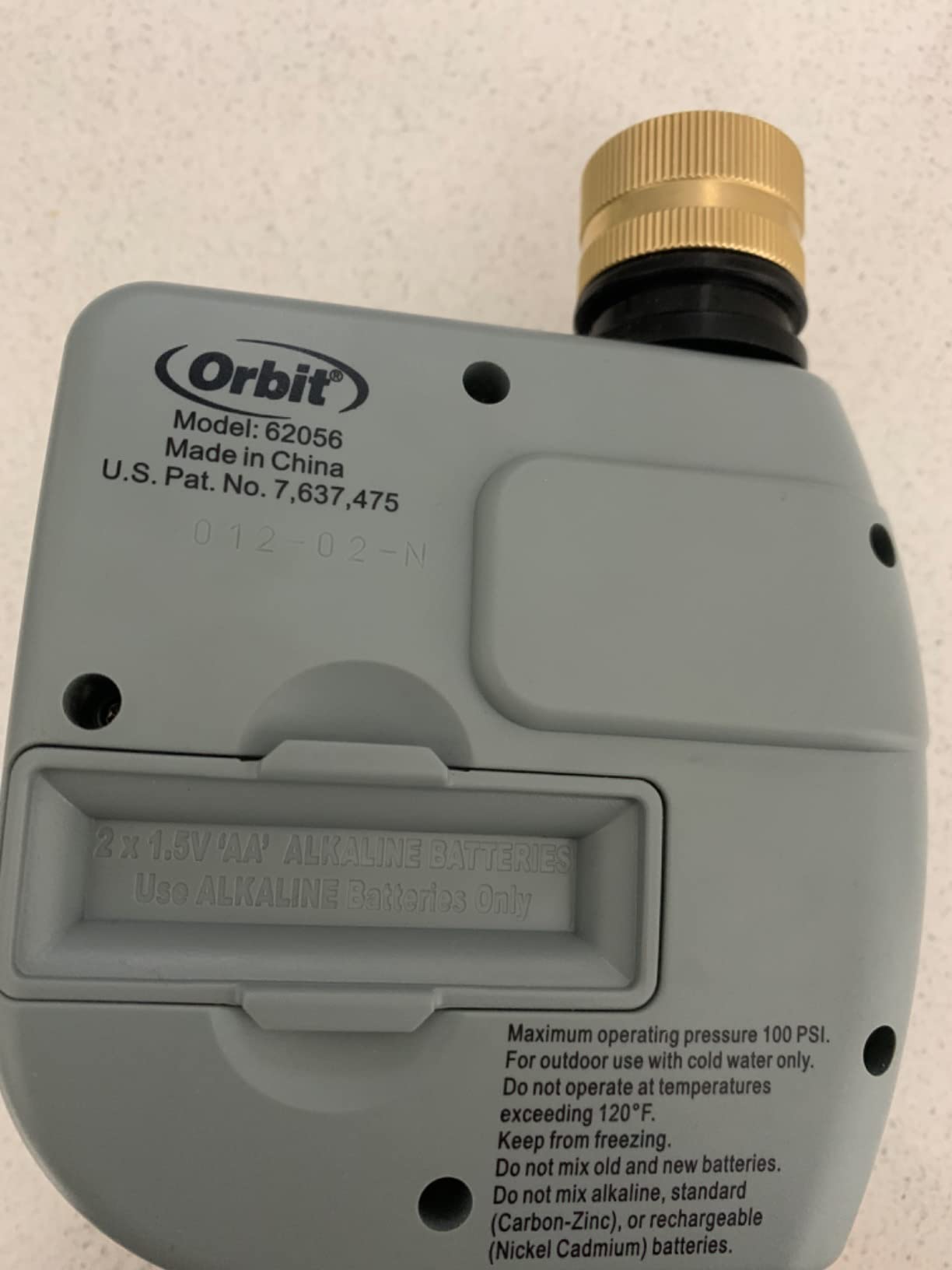
The Orbit 62056 is the fastest of the Orbit digital models to set up, and speed is underrated when you are programming at 9pm the night before a flight. One dial handles the schedule and the display confirms it, which removes the button-by-button process that makes some digital timers a ten-minute job with a manual open on the patio table.
It also holds a 4.4 average across more than 8,000 ratings, with roughly three quarters of those at five stars. The brass swivel connection separates it from the plastic couplers on cheaper models, and reviewers consistently note that it produces a far better seal at the spigot over time.
The limitation is zones. One outlet means one schedule, so a property with a lawn and a vegetable bed needs either a second timer on a Y-splitter or a move to a multi-zone unit. The schedule is adjustable rather than programmable, which is simpler but coarser than a controller with day-of-week selection.
As with any battery-powered unit, the compartment needs protection in prolonged heavy rain. The unit is AA powered, and the swivel connection is what keeps water out of the spigot joint, not the battery bay. Keep the tap end pointing slightly downward so water runs away from the housing.
The brass swivel is the detail that matters most for a vacation, incidentally. It rotates to accommodate an angled or awkward spigot without fighting the fitting, which means a tight, sealed connection on the first attempt rather than a leak that develops on day three.
What this model handles best over an absence
It handles a single watering zone with a schedule you can set in under five minutes and confirm at a glance. The brass swivel connection and long warranty term are both built for repeated seasons of installation, and the rating history suggests fewer problems than most in this group.
Where it will disappoint you
It will not run two schedules, and it will not tell you much beyond the current program. If your garden has genuinely different needs on different lines, the extra ten minutes of programming on a two-zone model will save you a dead bed.
10. RAINPOINT Brass Inlet and Outlet Hose Timer
RAINPOINT Sprinkler Timer with Brass Inlet & Outlet, Programmable Hose Timer for Garden Soaker Hose, Watering Timer with Rain Delay/Manual Watering System, Digital Drip Irrigation for Yard, Lawn
Brass inlet and outlet
1 min to 3h59m runs
Hourly to weekly
24/48/72 hour rain delay
Pros
- Brass resists corrosion over long absences
- Metal filter gaskets keep drip lines clear
- Hourly frequency for containers
- Large LCD readable in the field
Cons
- Single outlet only
- Batteries not included
- Brass body is heavy to reposition
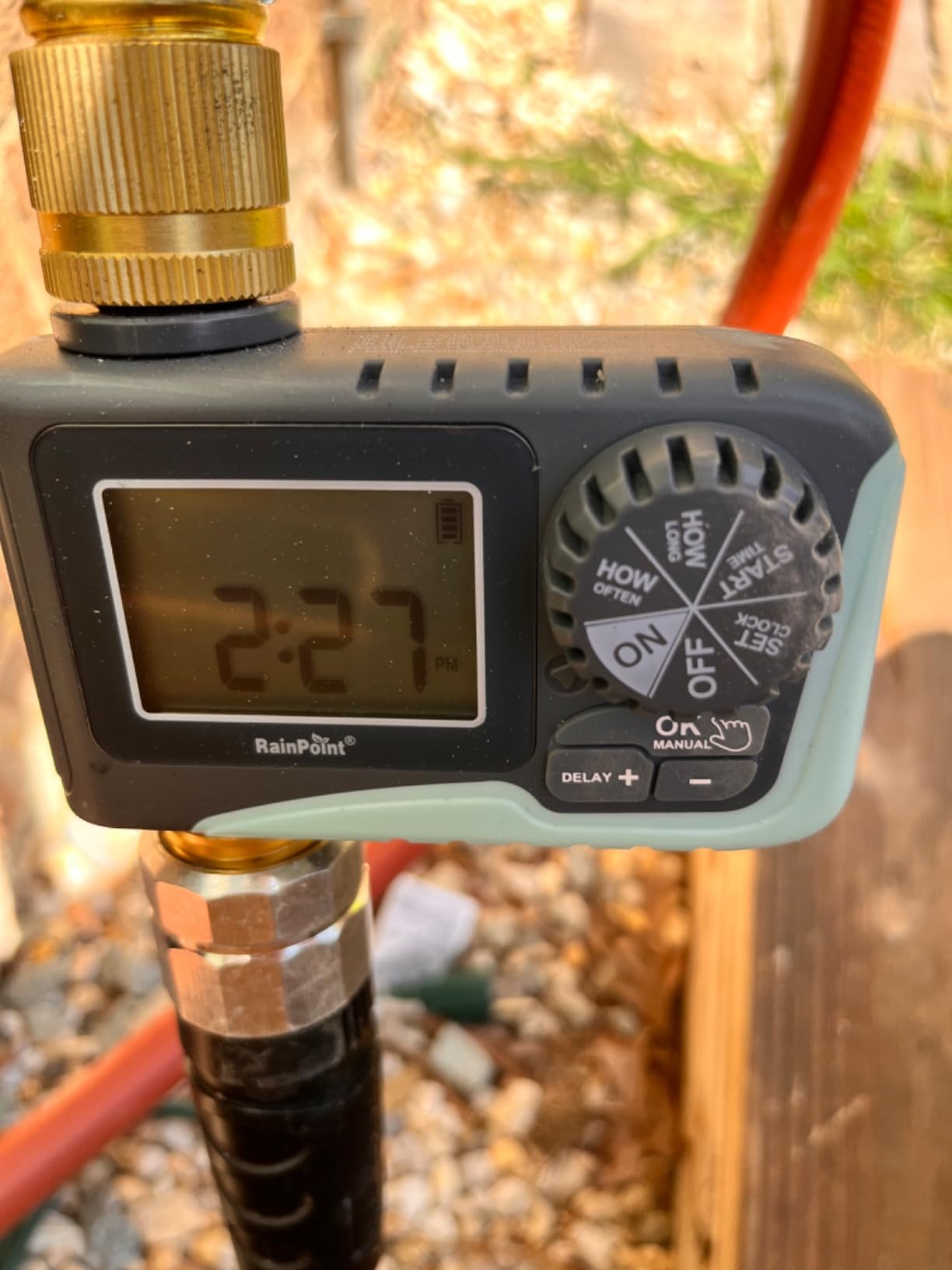
This is the drip irrigation pick. The pure brass inlet and outlet are rated to 116 psi with built-in metal filter gaskets, and that filter is the part that matters. Drip lines fail from sediment, and a brass body with a metal screen keeps more of it out of the emitters over a long absence than a plastic housing with a plastic strainer.
Scheduling is the same flexible RAINPOINT formula that works well on a vacation: 1 minute to 3 hours 59 minutes of run time, frequency from every hour to every 12 hours or every day to every 7 days, plus a 24, 48 or 72 hour rain delay with automatic resume and a manual mode up to 8 hours that does not disturb the stored program.
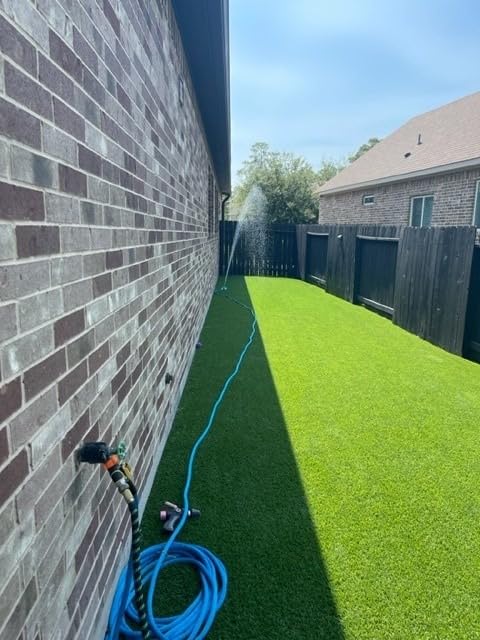
Keep the drip line itself under control, though. Gardeners on irrigation forums warn that running half-inch drip tubing from a timer puts the tubing under constant pressure and it can fail at a fitting, and a 116 psi rated timer does not help if the line downstream blows off its barb. Secure every emitter and cap the far end before you leave.
Two smaller notes. Batteries are not included, and brass is heavy, so repositioning this unit is a two-handed job. Review volume is lower than the plastic-bodied RAINPOINT models, so there is less long-term field data behind it, though the 4.4 average is among the highest here.
The hourly frequency option is what makes this useful for containers, which dry out faster than beds and need a short drink more than once a day. Set the duration short, the frequency to every few hours, and the unit will keep a row of pots alive through a hot fortnight without any adjustment from you.
What this model handles best over an absence
It handles long soaker runs and container rows that need frequent short drinks, with hourly frequency options that a once-a-day timer cannot offer. The weatherproof shell and brass hardware are built for a season of direct sun with no maintenance.
Where it will disappoint you
It will not manage more than one line, so a drip zone and a sprinkler zone means two devices. The heavy brass body is awkward on a high or awkward spigot, and you will need to supply your own batteries on a day when you are trying to leave.
How to Set Up a Hose Timer Before You Leave in 2026
Most of the vacation horror stories we found in gardening forums are not timer failures. They are installation failures that a timer simply made visible. This protocol takes about twenty minutes and removes the recurring complaints: leaks at the spigot, flat batteries on day four, and schedules that were never actually tested.
1. Turn the spigot valve to the open position and confirm it. This is the rule most first-timers miss, and the timer cannot open a closed valve. If the shutoff is inside the house, leave that interior handle open and post a note for anyone who might use the sink.
2. Fit fresh alkaline batteries. Even if the old ones worked, a timer that has been sitting in a shed over winter is a coin flip. Budget the cost of a spare set and leave them taped inside the timer housing so the person you are relying on does not have to think about it.
3. Wrap the spigot threads in plumber’s tape. It is the cheapest insurance in this entire article, and it is the specific fix for the weeping connection that forum users describe over and over. Do not overtighten; hand pressure plus tape is enough.
4. Attach a short flexible connector between the spigot and the timer, then the hose or drip line after the timer. A flexible metal or heavy-garden connector absorbs the strain of a hose that settles over days and takes the pressure off the timer body itself.
5. Program the schedule, then run a manual cycle end to end. Watch the water reach the last emitter on the line. A timer that opens and closes correctly while the line is disconnected tells you nothing about a kink two metres away, and this is the step people skip.
6. Check the manual override. Confirm you can start water without wiping the program, and confirm you can stop it. On a trip of a week or more, that button is the only lever you have if a schedule needs to change and you cannot reach the dial in the dark.
7. Photograph the setup from two angles and set a phone reminder on the day you land. A photo lets a neighbour, a house-sitter or a plant sitter reset the timer correctly, and a reminder on your return date is the difference between catching a problem and discovering one.
8. Add a second layer if the trip is three weeks or longer. A neighbour with a key who knows where the timer is, or a plant-sitter who visits twice, turns an unattended single point of failure into a monitored one. This costs one conversation and no equipment.
9. If the forecast shows hard frost while you are away, drain and remove the timer rather than leaving water in the housing. Freeze damage to a plastic body is permanent, and a timer is cheap to replace but not cheap to come home to cracked.
What to Look for in a Hose Timer for Long Absences
Timer type and unattended reliability
Mechanical, analog, digital and smart timers behave very differently when nobody is watching. A mechanical clockwork timer has nothing to fail electronically and cannot lose a schedule, so it is the most dependable option for a three-week trip. A digital timer stores its program in memory and keeps running it through a power cut, so it is nearly as safe and far more flexible. A smart timer adds a phone app, a hub and a Wi-Fi dependency, which is one more thing that can fail silently from another continent.
Our honest verdict on smart timers for travel: the app is worth having if you want rain-skip from a forecast or usage history, and it is worth skipping if your spigot is far from your router or you will be on a plane for the whole trip. Every timer in this roundup keeps its stored program locally, so a Wi-Fi drop does not stop watering. The risk is a smart unit whose schedule lives only in the cloud, and those do exist, so check before you buy.
Zones, water needs and split schedules
A zone is one independently scheduled outlet, and mixing plants with different water needs on one zone is the most common way a vacation watering plan fails. A lawn and a succulent bed should never share a line, because the setting that keeps the lawn alive will drown the succulents. One zone is enough for a single soaker line or a single sprinkler circuit. Two zones cover a lawn plus a bed, which is most gardens. Four zones cover a property with fruit trees, a lawn, vegetables and containers.
Also consider flow. Feeding two zones at once splits the available water, so a long run to the far end of the garden can lose pressure and reduce output. A timer with lower flow resistance, or a schedule that runs the zones at different times rather than simultaneously, avoids that problem entirely.
Power source and battery life
Battery claims in this category are optimistic across the board, so treat them as a ceiling rather than a promise. Most of the digital models here run on 2 AA cells, and the manufacturer figures range from about six months to roughly 180 days depending on how often the valve opens. A two-week trip is a small fraction of any of those numbers, which is good news, as long as you start with fresh alkaline cells rather than whatever was in the drawer.
Outage behaviour is the detail that separates the categories. A digital timer runs from stored memory, so it resumes its program rather than waiting for anything external, and the two-zone RAINPOINT goes further by closing the valve automatically on a low-battery warning instead of letting a dying battery hold it open. A mechanical timer has no batteries at all, so it is immune to the entire category of problem. There is no mains-powered hose timer worth recommending for vacation duty, and a battery unit screwed to a spigot beats a plug-in unit every time.
Rain delay, weather sealing and water pressure
Rain delay and rain sensing are two different features sold under similar names. Rain delay is a fixed pause you set in advance, and on the models here it ranges from 24 to 72 hours, with two reaching 7 and 15 days. Rain sensing requires a separate sensor and reacting to actual moisture. For vacation duty, a long fixed delay is usually enough and costs nothing extra.
On weather sealing, IP55 and IP65 are the ratings you will see. IP55 protects against dust and water jets, and IP65 adds protection against water ingress from powerful jets, so IP65 is the better choice for a timer that will sit in an exposed yard through a storm. Neither rating means submersible, and neither stops a leak at the spigot thread, which is a plumbing problem rather than a housing problem.
Pressure matters too. Most household taps sit comfortably inside the range these units tolerate, and the brass models here are rated to 116 psi. The number to respect is the low end: very low pressure starves a long drip line and leaves the far emitters dry, which looks like a timer failure but is not one.
Wi-Fi, hub and outage behaviour
Nothing in this roundup needs a hub or an app, and that is a deliberate choice for a vacation article. The commonest complaint about smart timers in forums is losing connection while away, and a timer that requires a phone to keep watering is the wrong dependency for someone who cannot fix it remotely. If you buy a smart timer anyway, confirm two things: that the schedule is stored on the device, and that it resumes the stored schedule rather than waiting for a connection.
Bluetooth-only units are worth avoiding for this use case entirely. Without a hub or a Wi-Fi bridge, range is short and you cannot reach the timer from a different room, let alone another city. Hub-based Wi-Fi is the only version of smart watering worth considering when you are travelling.
Which Timer Matches Your Trip Length
Matching the timer to the absence is the part nobody writes down. A long trip needs a timer that can repeat its schedule many times without intervention, which rules out anything with a maximum cycle shorter than your plants’ actual need. It also raises the value of features that stop waste, since rain delay and a shutoff on low battery both prevent a bad outcome rather than a merely dry one.
For 3 to 4 days, a single-zone digital timer such as the Orbit 62061 or the Orbit 62056 is plenty, and a neighbour with a key is a better backup layer than a more capable timer. For 1 to 2 weeks, use a programmable unit with a real rain delay such as the RAINPOINT single-zone digital timer, put in fresh batteries, and set a schedule that repeats at least daily so a single missed cycle is not fatal.
For 3 weeks or longer, the priorities shift. Choose hardware over features: a mechanical timer for absolute simplicity, or a brass-bodied two-zone unit such as the Insoma two-zone brass model if you want scheduling without plastic fittings. Battery life stops being a concern, and connection reliability stops mattering because nothing here needs a connection. Add the human layer, because at that length something eventually goes wrong and the only real repair is a person with a key.
One related task: if you are away long enough to plan it, check whether your area is under watering restrictions while you travel. A timer that runs a fixed schedule does not know about a local ban, and a smart timer that can read local weather rules is more likely to stay inside them.
Frequently Asked Questions
Can I leave a hose timer on while I am on vacation?
Yes, that is exactly what a hose timer is for. Leave the spigot valve in the open position, set the start time, run duration and frequency, and the internal valve opens and closes for you. What matters is that the schedule is tested end to end, the batteries are fresh and the spigot connection is sealed with plumber’s tape before you go.
Do smart hose timers work without Wi-Fi?
The models in this roundup keep their stored schedule on the device, so watering continues even if Wi-Fi or the app is unavailable. The difference is convenience rather than survival: without a connection you lose remote changes, usage history and forecast-based rain skip. A timer whose schedule exists only in an app is the one to avoid before a long trip.
How long do hose timer batteries last?
Manufacturer claims for the 2 AA models here run from about six months to roughly 180 days of standby, and actual life depends on how often the valve opens. A two-week vacation uses a small fraction of that, so fresh alkaline cells at departure are enough. Check the low-battery warning before you leave, and replace them at the start of each season rather than waiting for a failure.
Should I use a mechanical or digital hose timer?
Choose mechanical for the longest absences and zero maintenance, because a clockwork timer has no batteries to fail and cannot lose its schedule. Choose digital for flexibility, since it offers longer run times, day-of-week scheduling and rain delay. For trips of two weeks or less, digital is the better all-round choice; beyond three weeks, mechanical or brass-bodied hardware is harder to argue with.
How many hours can a hose timer run at once?
It depends on the model. The mechanical Orbit 62034 runs 15 to 120 minutes, the Melnor AquaTimer and the Eden four-zone unit run 1 minute to 6 hours, and the RAINPOINT and Insoma digital models reach 3 hours 59 minutes, with the Insoma brass unit reaching 360 minutes. Longer run times matter mainly when you are feeding drip irrigation rather than a sprinkler head.
Are hose timers waterproof?
Most are water-resistant or rated to an ingress standard such as IP55 or IP65, which covers rain and jet spray but not submersion. The two brass-bodied models here add anti-UV and anti-rust materials for long sun exposure, and the two-zone RAINPOINT carries an IP65 screen structure. None of them protects against a leak at the spigot thread, so plumber’s tape matters more than the rating.
The Best Garden Hose Timer for Vacations in 2026
For most people leaving home for a week or two with a single watering zone, the Orbit 62061 is the best garden hose timer for vacations we tested, because a physical dial and a large display get programmed correctly on a busy night and the schedule then runs without anything to log in to. If your garden needs two schedules, the RAINPOINT single-zone digital timer gives you the widest run time and frequency range in this group, and the RAINPOINT two-zone model is the step up when the lawn and the beds genuinely disagree.
If you are going somewhere far enough that you cannot fix a problem, favour hardware over features. The Orbit 62034 removes batteries from the equation entirely, and the Insoma two-zone brass model puts metal fittings and a fifteen-day rain delay on the spigot. Then work through the pre-departure checklist, and if you are growing anything you would rather not lose, add a person with a key as your second layer.
While you are packing, it is worth remembering that whatever you plant alongside all this hardware is going to end up on your table. We have a good starting point in our garden tomato recipes collection, and a raised bed that is still producing at the end of the trip is the real proof that the timer did its job.