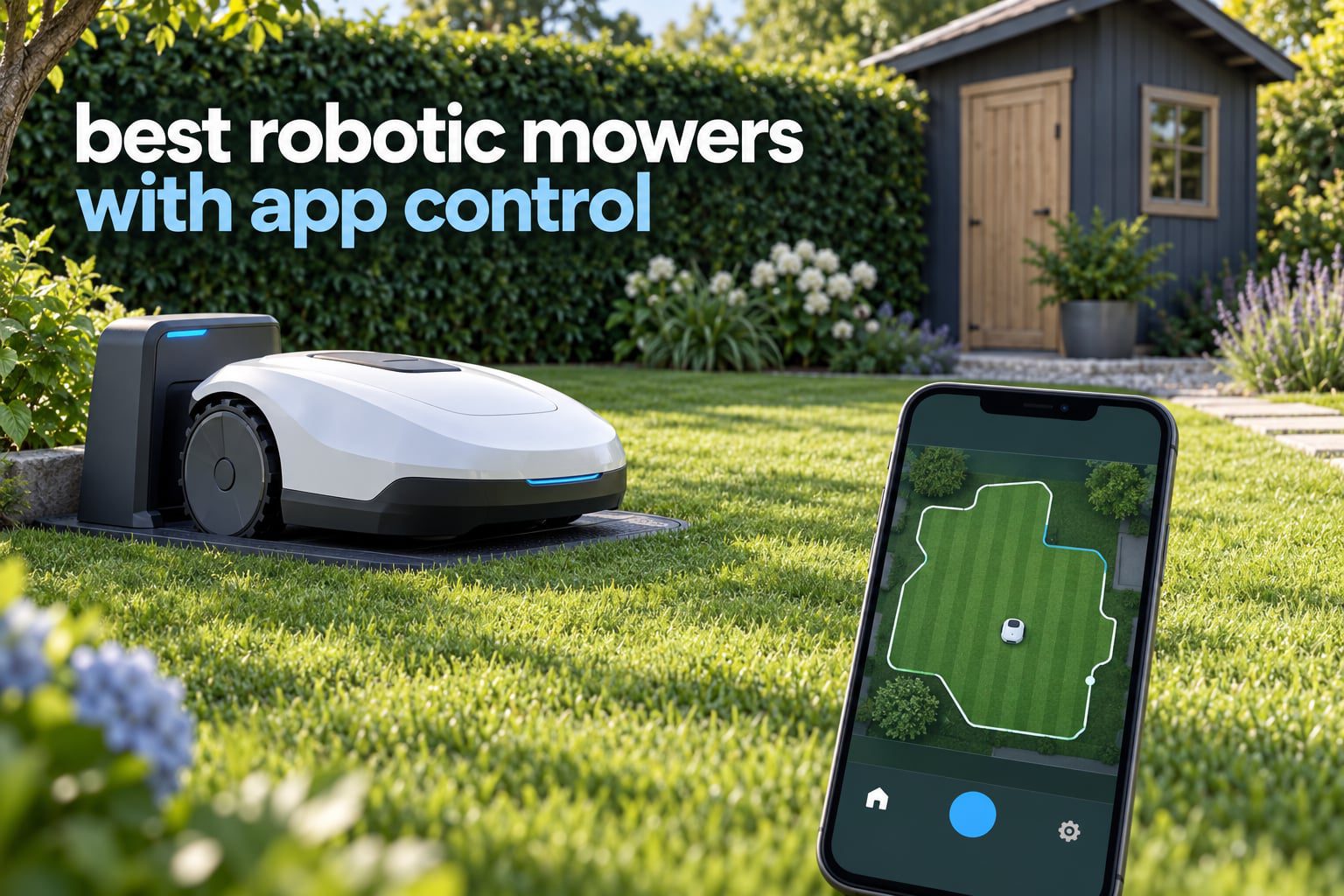
App control on a robotic mower means one thing: you never touch the machine. You draw the boundary on a phone screen, set a schedule, and the mower cuts your lawn on its own and returns to the dock when it is done. That is the whole promise, and it is the reason the best robotic mowers with app control now cost as much as a small used car. The quality of that phone app – not the cutting deck – is what separates a budget machine from a premium one in 2026.
We spent weeks reading owner reviews, comparing mapping workflows and checking what each app lets you do once the mower is out on the grass. Scheduling depth, how easily you can redraw a boundary, whether remote driving actually works, what the notifications say, and whether a cellular plan is required after the trial all turned out to matter more than headline wattage. We also tracked the two failure modes that decide real satisfaction: whether the mower can be rescued from the app when it gets stuck, and whether it still finishes the job when a scheduled run is blocked by rain.
Every mower below manages its schedule, map and zones from a phone app, which is why all ten made this list. They differ enormously in how gracefully they do it. This roundup was updated in September 2026, and we only include models we could find consistent owner feedback on. We earn a commission when you buy through our links, at no extra cost to you, and it does not change the order of these picks.
Table of Contents
- Top 3 Picks for Best Robotic Mowers With App Control (September 2026)
- All 10 Picks at a Glance 2026
- How We Scored the Apps
- 1. Mammotion LUBA 2 AWD 3000X: Best Overall for App Control
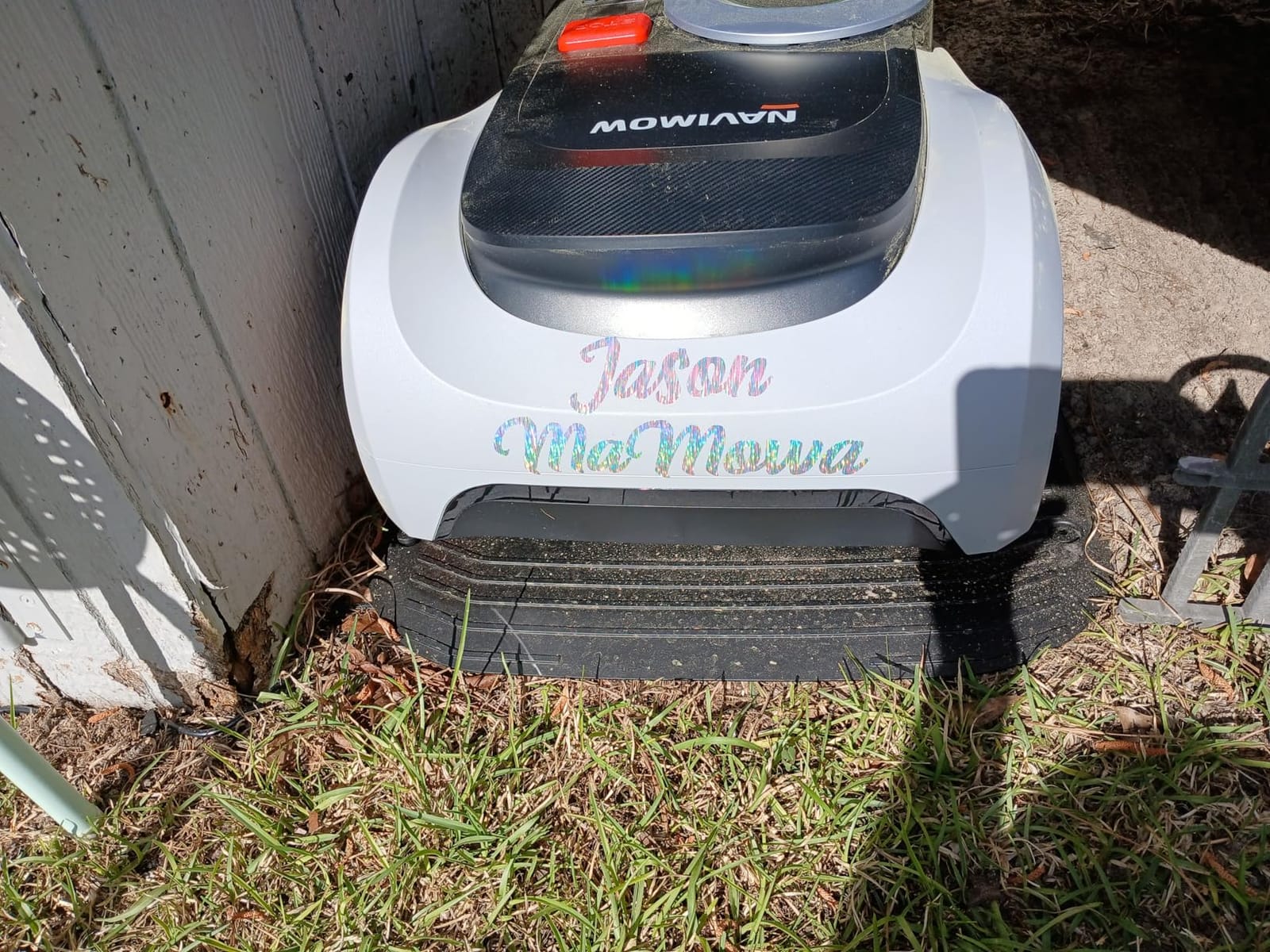
- 2. Segway Navimow i105N: Best Value Wire-Free Mower for Small Yards
- 3. ANTHBOT M5: Best App-First Choice for Small to Medium Lawns
- 4. Gardena SILENO Life: Best for Quiet, Wired Reliability With No Subscription
- 5. Mammotion LUBA mini 2 AWD 1500H: Most Versatile for Steep Side Yards
- 6. Mammotion LUBA 3 AWD 3000: Best for Big, Complicated Lawns
- 7. ECOVACS GOAT O1000 LiDAR PRO: Best Edge Cutter That Does Not Need the Cloud
- 8. eufy E15: Best for Yards With No WiFi or Cell Signal
- 9. MOVA LiDAX Ultra 1000: Best for Yards That Need Lots of Zones
- 10. Segway Navimow i215 LiDAR: Best for Yards Where Night Mowing Matters
- What to Check Before You Buy
- Frequently Asked Questions
- What is the absolute best robot lawn mower?
- Which robotic lawn mower did Consumer Reports recommend?
- What are the downsides of using a robotic lawn mower?
- Can I use Home Assistant to control my robot lawn mower?
- What is the life expectancy of a robotic lawn mower?
- Is Mammotion a Chinese company?
- Do robot lawn mowers work without Wi-Fi?
- Why does my robot lawn mower stop in the same spot?
- The Bottom Line
Top 3 Picks for Best Robotic Mowers With App Control (September 2026)
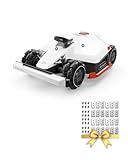
Mammotion LUBA 2 AWD 3000X
- 80% slope capability
- RTK plus AI vision
- 30 mowing zones
- 4G plus WiFi
The LUBA 2 AWD 3000X takes the top slot because it is the only machine in this group that pairs a genuinely capable app with 30-zone management, 200-plus object recognition and a four-wheel drive chassis that owners routinely use on side-yard slopes. The Navimow i105N wins on value and quietness. The LUBA mini 2 wins on terrain and finish quality for medium yards.
All 10 Picks at a Glance 2026
| Product | Specs | Action |
|---|---|---|
| Mammotion LUBA 2 AWD 3000X |
|
Check Latest Price |
 Segway Navimow i105N Segway Navimow i105N |
|
Check Latest Price |
 ANTHBOT M5 ANTHBOT M5 |
|
Check Latest Price |
 Gardena SILENO Life Gardena SILENO Life |
|
Check Latest Price |
 Mammotion LUBA mini 2 1500H Mammotion LUBA mini 2 1500H |
|
Check Latest Price |
 Mammotion LUBA 3 AWD 3000 Mammotion LUBA 3 AWD 3000 |
|
Check Latest Price |
 ECOVACS GOAT O1000 LiDAR PRO ECOVACS GOAT O1000 LiDAR PRO |
|
Check Latest Price |
 eufy E15 eufy E15 |
|
Check Latest Price |
 MOVA LiDAX Ultra 1000 MOVA LiDAX Ultra 1000 |
|
Check Latest Price |
 Segway Navimow i215 LiDAR Segway Navimow i215 LiDAR |
|
Check Latest Price |
Read the coverage numbers before anything else. A mower rated for a quarter acre that you push to half an acre will not finish in one session, and the difference shows up in cut quality. Coverage claims are the single most quoted spec and the single most abused one.
How We Scored the Apps
Most roundups mention the app in one sentence per product. That is exactly backwards for this topic, so we scored every app on five criteria and weighted them equally: scheduling depth, map editing, remote control, notification usefulness, and the cost of keeping the app running. Here is what those five criteria actually mean in practice.
Scheduling depth is whether you can run different plans for different days, separate mowing and edge-only passes, and set the mower to return to the dock partway through a large lawn. A schedule buried three menus deep is a schedule you will stop using. Multi-zone support is the tell – machines advertising 20 to 150 managed zones let you split the lawn so the front yard gets cut on Monday and Thursday while the back gets the weekend.
Map editing is the make-or-break feature. On a good app you can drag a boundary corner, drop a no-go zone around a flower bed, and have the mower accept the change on its next run. On a poor app, every small adjustment means driving the mower around the yard with an on-screen joystick to re-record the edge, which is the exact chore you bought the machine to avoid.
Remote control means steering from the phone to a specific spot for a touch-up cut, ideally with a live camera view. Mammotion, eufy, ECOVACS and MOVA all ship a usable joystick; the Gardena’s Bluetooth app configures and schedules but does not drive the mower over distance.
Notifications is where a mower tells you it is stuck, blocked, low on battery, or finished. A notification that only says task complete is fine. A notification that says mower blocked at zone 3 lets you fix the problem from the couch, and that difference decides how often you walk across the lawn.
Cost of running the app covers the recurring cellular plan after the trial period, and whether the app upsells you constantly. Mowers that ship with a 4G module usually charge for service once the included period ends – on the LUBA 2 that starts after the first year. Bluetooth-only machines have no recurring cost at all, which is a real advantage for anyone with a small lawn and no interest in a subscription.
How the ten score against those five: the Mammotion apps are the most capable and the most in need of polish, with deep zone and pattern control and an occasional glitch that owners mention repeatedly. The Segway Navimow app is the cleanest of the LiDAR-equipped options, with one-tap auto mapping and up to 20 editable zones, though theft location on the i105N needs a separate module. ANTHBOT’s app does the essentials – zones, no-go areas, scheduling – quickly and without clutter. Gardena’s Bluetooth app is deliberately simple and genuinely works without WiFi, but it has no remote control and no cloud features at all. The ECOVACS and MOVA apps expose the most hardware capability, and the eufy app is the most fun to drive with its joystick camera view. The weak spot across the category is map editing under bright daylight, which owners of the LUBA 3 specifically call out.
It is worth reading our smart air purifiers with app control tested if you want the same treatment applied to a different category, because the evaluation habits transfer directly: score the app, not just the machine.
1. Mammotion LUBA 2 AWD 3000X: Best Overall for App Control
Mammotion LUBA 2 AWD 3000X Robot Lawn Mower with 4G, 80% Slope, 0.75Acre
Covers 0.75 acre
15.7 inch cut
80 percent slope
41 pounds
4G plus WiFi
Pros
- Handles 80 percent slopes on four-wheel drive
- RTK plus AI vision mows under tree cover
- 30 zones with no-go areas and 200 plus object recognition
- Quiet enough for night mowing
- App striping and checkerboard patterns
Cons
- Narrow cut makes large lawns slow
- 4G cellular plan applies after the first year
- Owners describe the app as clunky at times
Six months is what it took for this to become the machine we recommend to almost anyone asking about robotic mowers with app control. The LUBA 2 AWD 3000X is not the newest machine on the market, but with 481 owner reviews averaging 4.3 stars it is the one with the deepest, most consistent body of real-world feedback behind it, and that matters more than a release date.
The hardware is unusually serious for the money. Four-wheel drive with 165W motors climbs 80 percent slopes, which is the number that shows up again and again in owner reports about side yards that other mowers could not handle. UltraSense AI vision works alongside RTK positioning, so it keeps cutting under a heavy tree canopy where a satellite-only machine would simply stop. The 15.8 inch dual-blade disk and four cutting-height positions from 1.0 to 2.7 inches produce the sharp striping owners photograph.
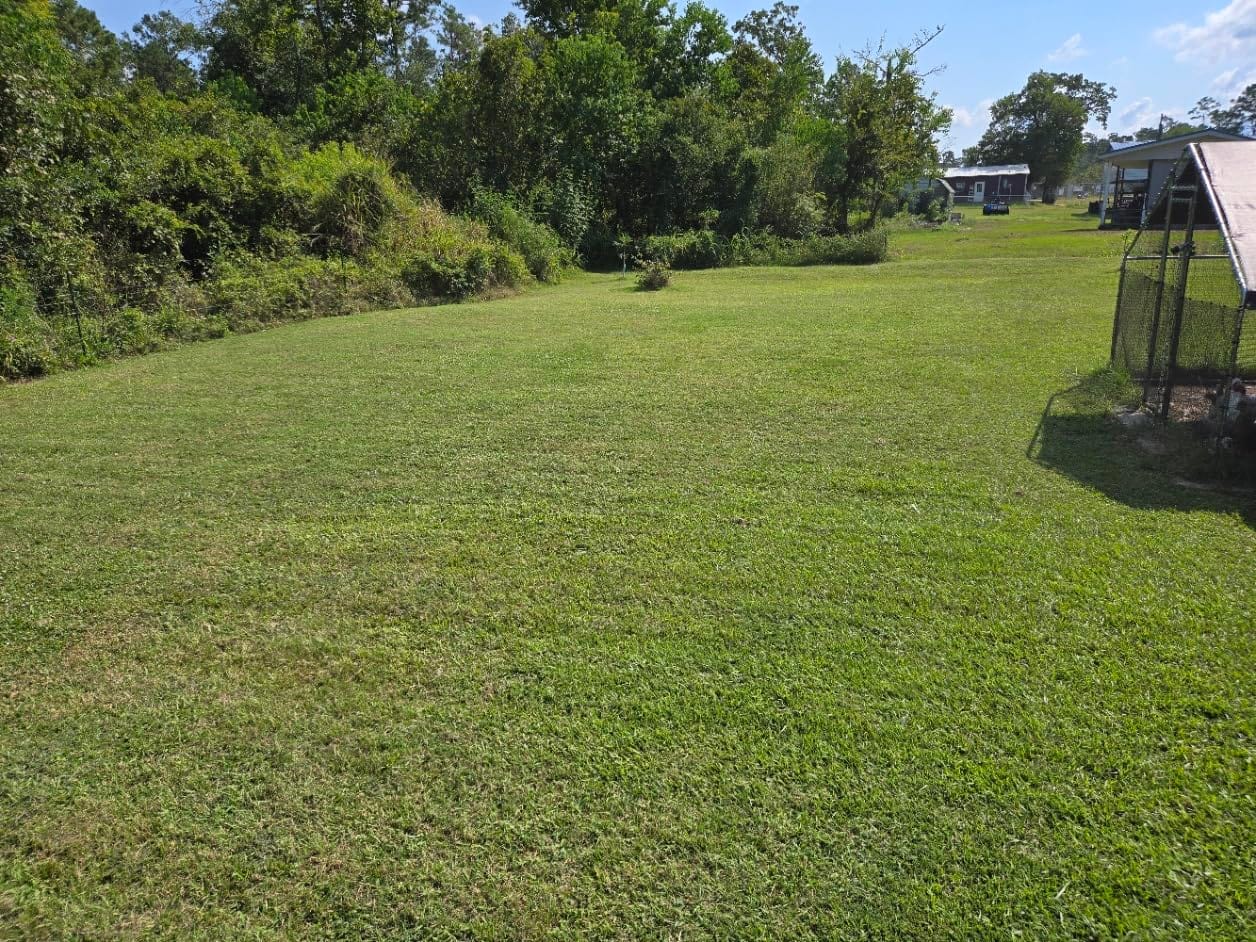
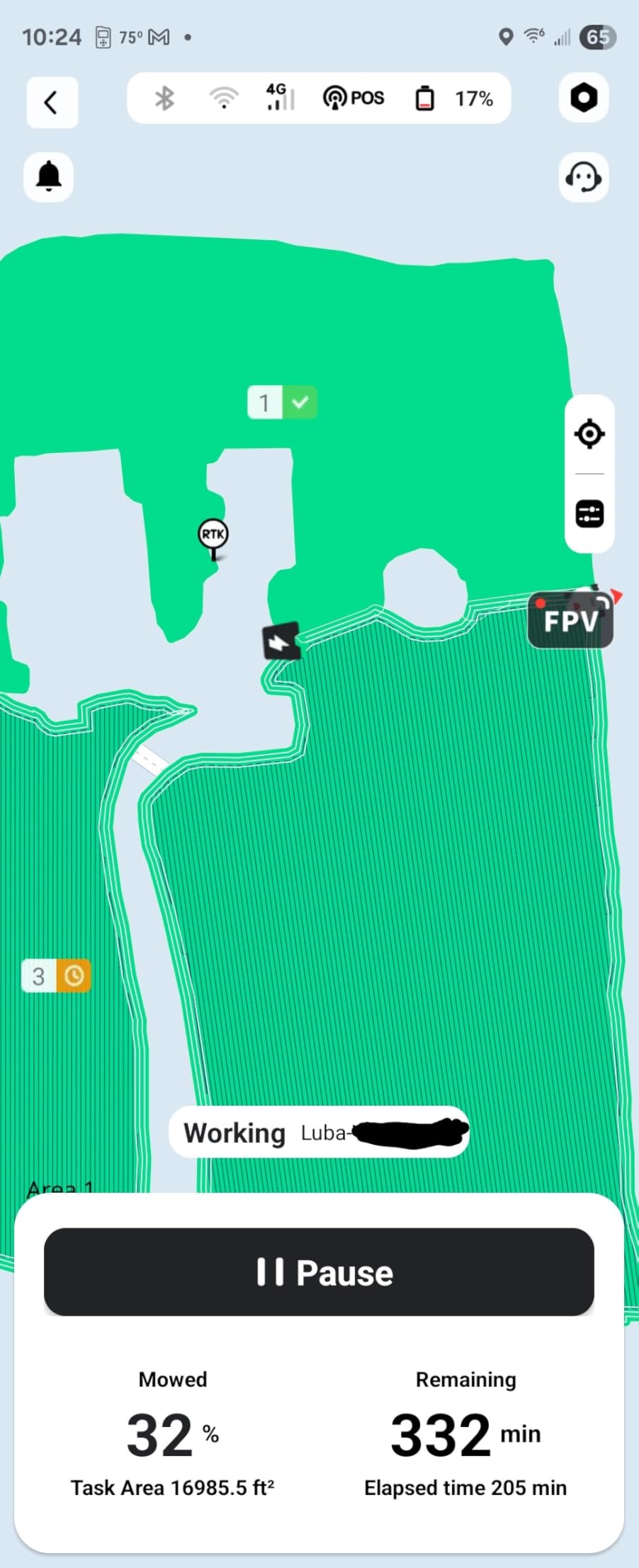
The app is the real differentiator. Thirty independently manageable zones, including separate plans for front and back yards, no-go zones you drag in place, and mowing patterns including checkerboard and diamond layouts. It also carries GPS tracking with an anti-theft lost mode, so if the mower disappears you get its location rather than a phone call. This is the deepest app feature set we found at this tier, and it is why this sits at the top of our list of the best robotic mowers with app control.
The trade-offs are real. At 15.8 inches the cut is narrow for the coverage, so large lawns take most of a day. It does not mulch leaves, which means autumn means a manual pass regardless of what the schedule says. The 4G cellular subscription kicks in after the first year, and a few owners describe the app as needing polish. Support response quality also varies widely across reviews, which is the most common complaint we could not engineer away.
What the LUBA 2 AWD 3000X does better than the rest
Zone management at this depth is unmatched in our lineup. Thirty zones with no-go areas means a property with a pool, a vegetable patch and a dog run can all run on their own schedule from one map. The four-wheel drive plus AI vision combination is the only pairing here that owners consistently report working on both steep side-yard slopes and shaded tree cover.
For anyone whose real problem is app control rather than raw cutting speed, this is the machine where scheduling and map editing stop being chores.
Where the LUBA 2 AWD 3000X falls short
Slow cutting on anything over a quarter acre, no leaf mulching, and a recurring cellular charge after year one. If your lawn is a quarter acre or smaller and flat, the LUBA mini 2 or the Navimow i105N will finish the job faster and cost less. If you want zero recurring cost, the Bluetooth-only Gardena is the only pick here with nothing to pay after purchase.
2. Segway Navimow i105N: Best Value Wire-Free Mower for Small Yards
Segway Navimow i105N Robot Lawn Mower Perimeter Wire Free 1/8 Acre RTK+Vision Robotic Lawnmower, AI-Assisted Mapping, Virtual Boundary, APP Control, 58dB(A) Quiet, Multi-Zone Management
Mows 0.125 acre
7.1 inch cut
58 dB(A)
24 pounds
RTK plus vision
Pros
- RTK plus vision works under heavy tree cover
- Very quiet at 58 dB(A) with sharp striping
- App supports multi-zone editing and remote control
- Strong value in the wire-free class
Cons
- Included wheels lack traction on slopes and mulch
- Vision Fence misses some obstacles and reports phantom objects
- Mapping is clunky and small edits require driving the mower
If your lawn is a fifth of an acre or smaller and you want wire-free setup with a competent app, the i105N is the most sensible entry point. It ranks fifth in the robotic lawn mower category on Amazon with 391 reviews, and at 4.1 stars the feedback is honest rather than glowing.
Navigation is the strong part. RTK plus vision, marketed as EFLS 2.0, gives centimeter-level positioning, and the 140 degree camera detects more than 150 obstacle types. Owners running it under mature trees report that it keeps working when GPS-only machines quit. At 58 dB(A) it is quiet enough to run while you are outside, and it lays clean parallel stripes.
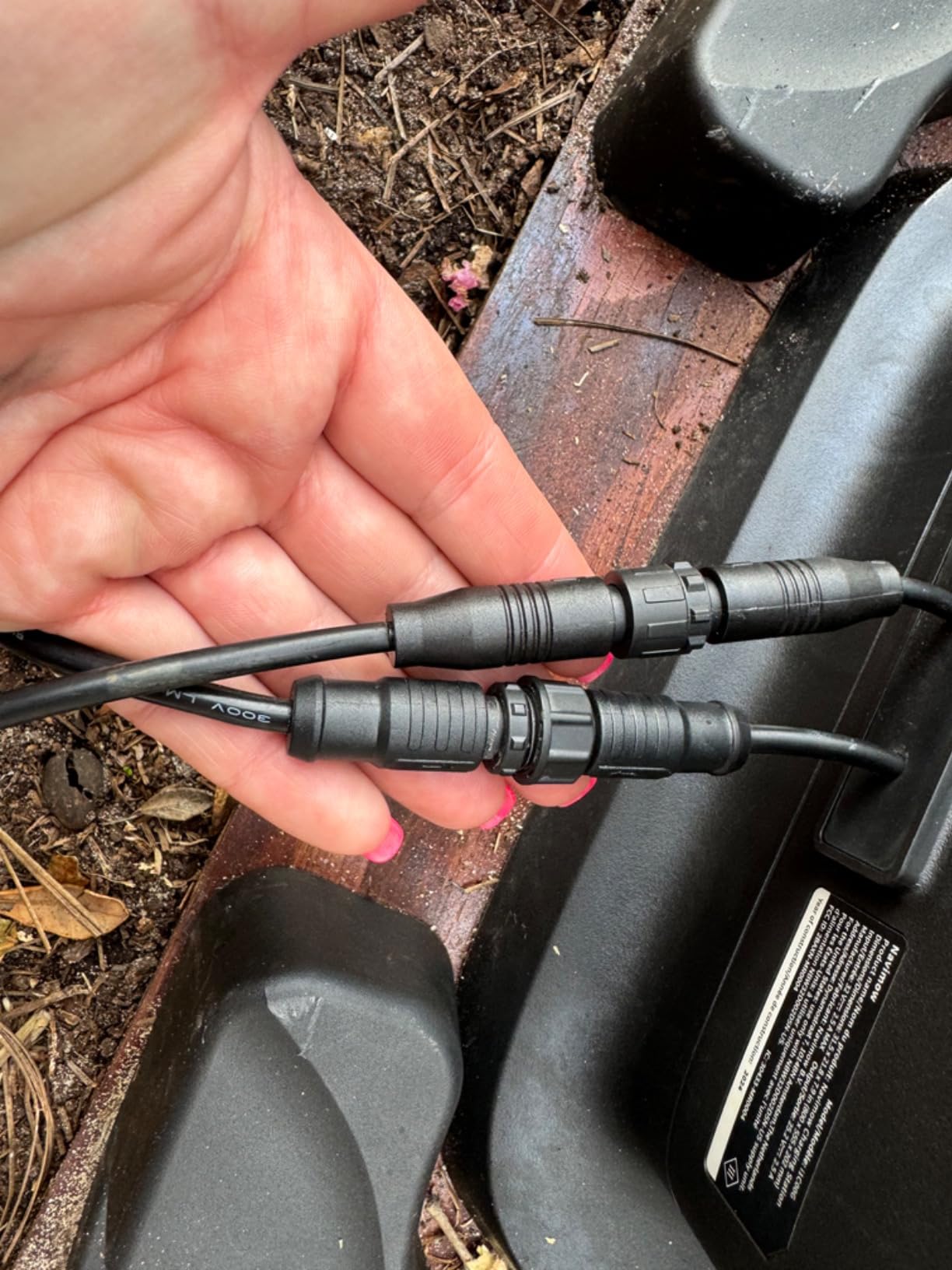
The app is well regarded. Reviewers single out multi-zone editing – up to 12 zones – along with remote control and progress tracking as the parts that make this feel like a modern machine rather than a converted boundary-wire mower. The theft location feature is there too, but only if you add the optional 4G module, which is worth budgeting for if the mower lives out of sight from the house.
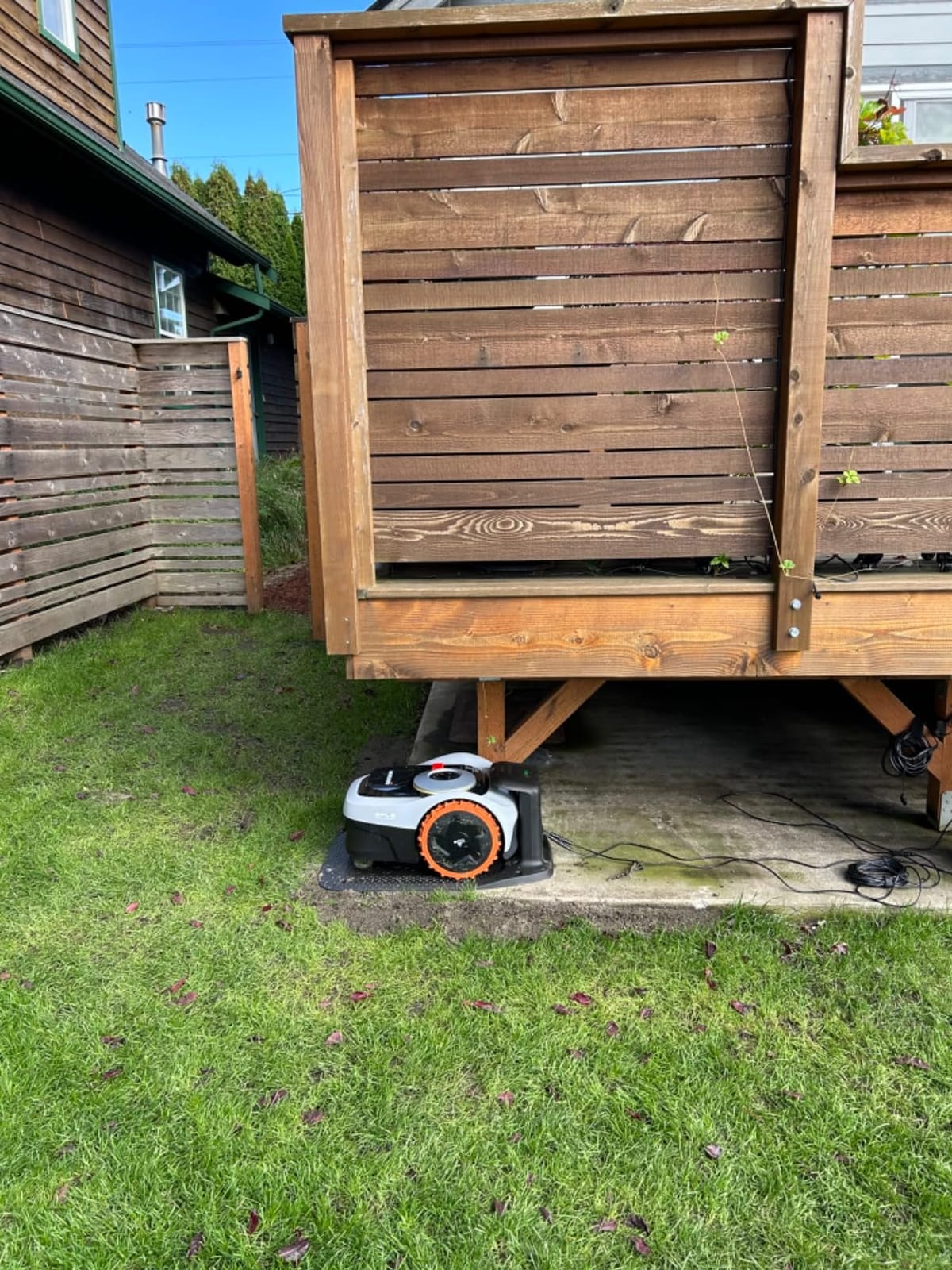
The weak points are physical rather than digital. The included wheels have poor traction and the machine gets stuck on slopes and in mulch beds. Vision Fence misses some obstacles – mailboxes, gates, hoses – and occasionally reports phantom objects that are not there. Most annoying for app users, mapping is clunky, and small boundary or no-go adjustments require physically driving the mower with the joystick to re-record the edge.
Why the Navimow i105N earns its spot
It does the two things that matter most in a small yard – it finds its way without a boundary wire, and it lets you manage that yard properly from your phone – at a price that leaves room in the budget for the 4G anti-theft module. For a straightforward suburban lot, that combination is hard to beat.
Who should pass on the i105N
Anyone with a slope, a mulched bed or an irregular edge with loose gravel should look at the four-wheel drive machines instead. It is also not a mulcher, so clippings sit on the surface, and several owners describe it as an addition to a regular mower rather than a replacement for one. If you need more than a fifth of an acre, step up to the i215 LiDAR or a Mammotion.
3. ANTHBOT M5: Best App-First Choice for Small to Medium Lawns
ANTHBOT M5 Robot Lawn Mower 1/8 Acre with Garage, Dual Vision+Full-Band NRTK Robotic Lawnmower, No Perimeter Wire, App Control Obstacle Avoidance, 45% Slope, Cutting Height, Multi-Zone Mapping
0.125 acre
7.9 inch cut
45 percent slope
21.6 pounds
Garage included
Pros
- No boundary wire and automatic map creation in about 10 minutes
- RTK plus dual camera vision navigates around toys and beds
- Very quiet at under 58 dB
- App handles zones and no-go areas without clutter
Cons
- 7.9 inch cut means many passes and frequent recharging
- Not suited to overgrown or very uneven ground
- RTK station needs a clear view of the sky
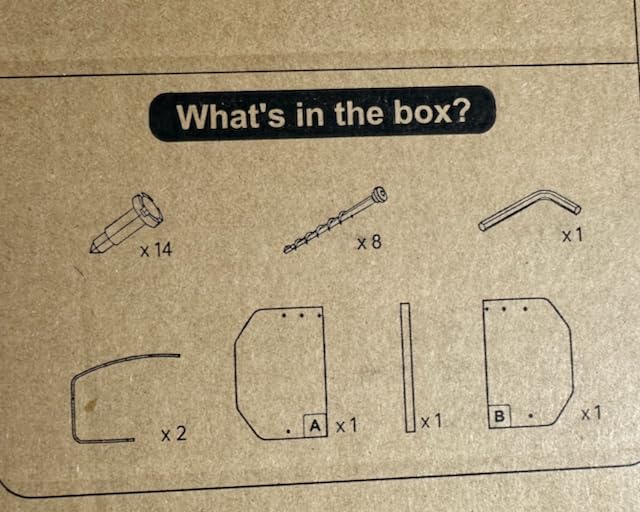
The M5 is the mower we recommend to someone who has never owned a robotic mower and is intimidated by setup. It includes a garage, a charging base and an RTK reference station in the box, and it builds its own map in roughly ten minutes without you driving the boundary.
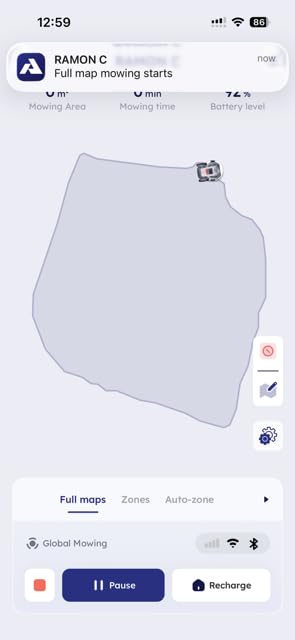
Positioning is full-band NRTK backed by dual 150 degree HDR cameras that the company says recognize more than 1,000 obstacle types. The app supports up to 20 work zones with custom no-go areas, and the interface is described as straightforward – exactly what you want from a first machine. At under 58 dB it is among the quietest here, and it copes fine with moderate slopes up to 45 percent gradient.
Owners are broadly satisfied with reliability and commissioning speed. The recurring theme in reviews is not software quality but throughput: a 7.9 inch cutting width on a quarter acre means multiple passes and several charge cycles in a day. It is not well suited to overgrown or very uneven ground, because a narrow blade path on rough terrain produces a patchy result.
The other caveat is placement. The RTK reference station needs a clear view of the sky, and the antenna has to be positioned carefully. That is a real constraint for a suburban backyard hemmed in by trees and two-story houses – if your sky view is limited, a LiDAR or pure-vision machine is a better fit.
Where the ANTHBOT M5 wins
First-time setup and a clean, uncluttered app. If you want boundaries and no-go zones drawn on a phone in one sitting, with a garage included and no wire to bury, this is the least intimidating package in our lineup. It is also one of the lightest machines here at 21.6 pounds, which matters if you will be carrying it to a repair bench.
Where it does not fit
Hills are the deal-breaker for some owners, who report the machine unable to manage slopes and returned units over slope performance. A 7.9 inch cut also makes it a poor match for anyone who wants a quarter acre finished before lunch. Skip it if your yard is rough, overgrown, or sits under heavy tree cover that blocks the reference station.
4. Gardena SILENO Life: Best for Quiet, Wired Reliability With No Subscription
GARDENA 15101-20 SILENO Life – Automatic Robotic Lawn Mower, with Bluetooth app and Boundary Wire, one of The quietest in its Class, for lawns up to 8100 Sq Ft, Made in Europe, Grey
8100 sq ft
6.3 inch cut
57 dB(A)
7 kg
Bluetooth app
Pros
- Among the quietest in class at 57 dB(A) and mows at night
- Cuts evenly and handles slopes up to 35 percent
- Bluetooth app covers configuration and scheduling with no WiFi needed
- Multi-area mowing once the boundary wire is laid
Cons
- Boundary wire must be hand installed
- Leaves a roughly 15 cm unmown strip at the perimeter
- Several owners report error states and weak support
The SILENO Life is the odd one out in this list, and that is exactly why it is here. It is the only pick driven entirely over Bluetooth with a boundary wire, which makes it the only machine in the group with nothing recurring to pay once it is set up: no cellular plan, no cloud account, no subscription.
The Bluetooth EasyApp handles configuration and scheduling, and because it talks directly to the mower it works with no WiFi in the picture at all. At 57 dB(A) it is among the quietest robotic mowers sold, and it will happily mow at night. It cuts evenly, handles slopes up to 35 percent, mows in rain, and covers lawns up to 8,100 square feet.
This is a long-standing platform, and owners with years of use praise the durability of the underlying Husqvarna-derived hardware. It is a machine you can forget about, which is a form of app control that newer models chase with software.
What you gain by going wired
Total cost of ownership. There is no cellular subscription after a trial period because there is no cellular radio. The boundary wire is immune to tree cover, satellite shadow and router settings, and once it is in the ground it keeps working through firmware updates without reconfiguration. Multi-area mowing works as soon as the wire is laid.
It is also the lightest machine here at 7 kg, so lifting it to clear a blockage is a one-hand job rather than a carry across the garden.
Why you might not want it
The wire. Owners consistently describe installation as tedious, especially on large or irregular yards, and it is a weekend project before you ever press start. Expect a roughly 15 cm unmown band at the perimeter because of the centrally mounted deck, which means a trimmer pass. Several owners also report error states and weak manufacturer support. Choose it if silence and zero running cost matter most; choose anything else here if you would rather not dig a trench.
5. Mammotion LUBA mini 2 AWD 1500H: Most Versatile for Steep Side Yards
(2026 NEW) Mammotion LUBA mini 2 AWD 1500H Robot Lawn Mower with Garage, for 0.37 Acres, 360° LiDAR+Dual-Camera AI Vision, 80% Slope, DropMow, 20 Multi-Zone Management
0.37 acre
360 degree LiDAR
80 percent slope
DropMow mode
20 zones
Pros
- Excellent on steep rough lawns with 80 percent climbing and independent suspension
- 360 degree LiDAR plus dual camera vision needs no GPS tower
- Cut quality and programmable cross-hatch patterns are praised
- DropMow mode mows one-off areas with no mapping
Cons
- 0.37 acre mapping cap cannot be extended
- Narrow cut makes a quarter acre take half a day
- Map editing is limited and boundary accuracy is unforgiving
The highest-rated machine in our lineup at 4.4 stars, and the one owners most often describe as transforming a lawn they disliked mowing. The LUBA mini 2 is built around independent suspension and dual 88W motors with 80 percent climbing ability and 45 mm step-over clearance, which is why it keeps appearing in owner accounts of steep side-yard slopes.
Navigation needs no satellite tower or RTK antenna. A 360 by 45 degree LiDAR field of view plus dual-camera AI vision builds the map itself, so tree cover and buildings are far less of an obstacle than on a GPS-only machine. Cut quality and striping are praised, and you can program cross-hatch patterns from the app. DropMow mode is a genuinely useful feature: you drive it to a patch that needs cutting and it mows that area with no map at all.
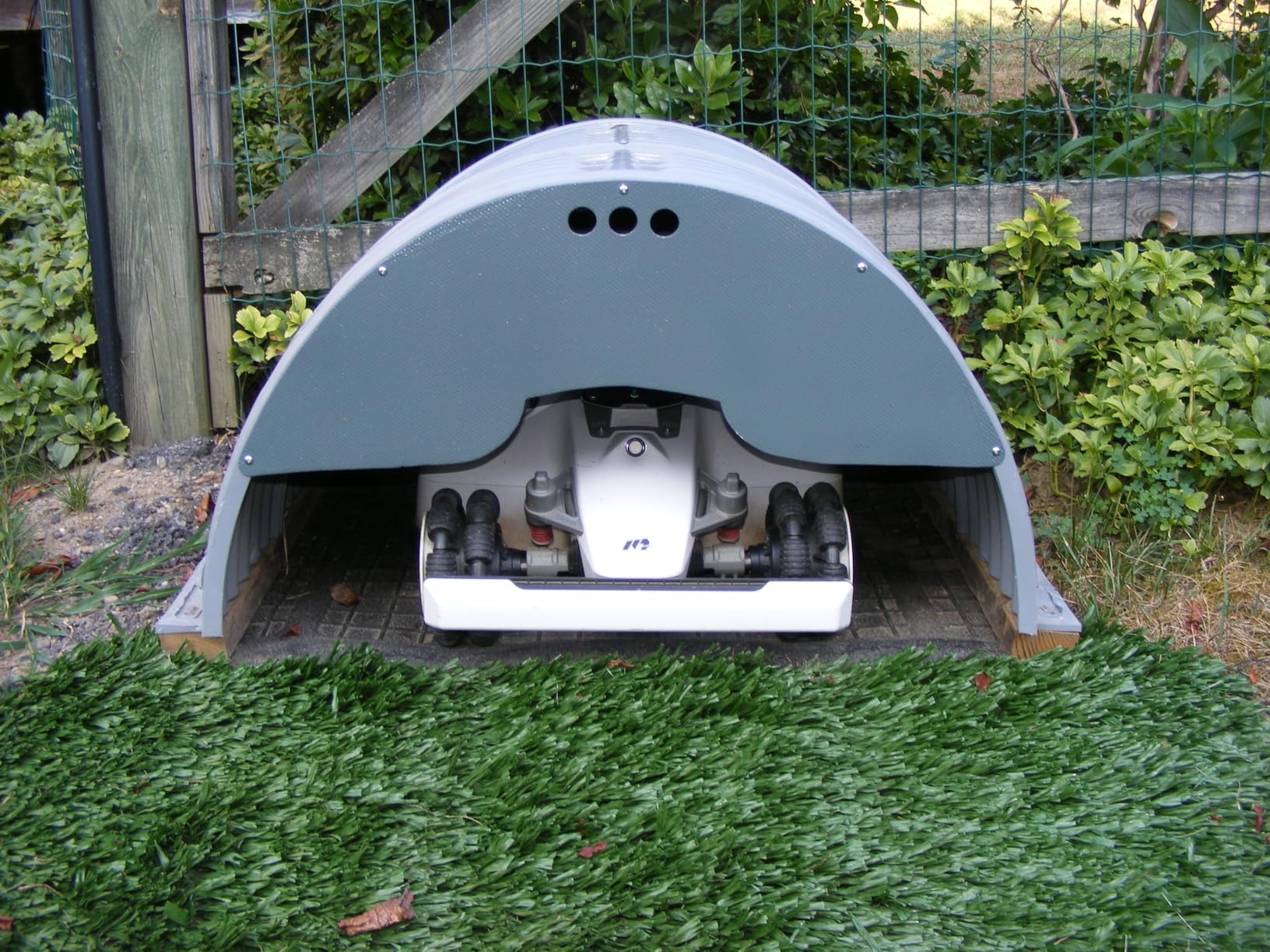
The app covers 20 independent zones, adjustable charge limits, off-peak charging scheduling and cutting height from 2.2 to 4 inches. That last figure matters more than it looks – a taller range than anything else here, which suits cool-season lawns that get away from you in July.
Now the limits. The 0.37 acre mapping cap cannot be extended, so a larger property genuinely needs a bigger model. The blade cut is narrow relative to that area, so even a quarter acre can take half a day. Charging from 13 percent to full can run two to three hours. And map editing is limited, with unforgiving boundary accuracy – which is the one place this otherwise excellent app disappoints.
Why owners rate this one highest
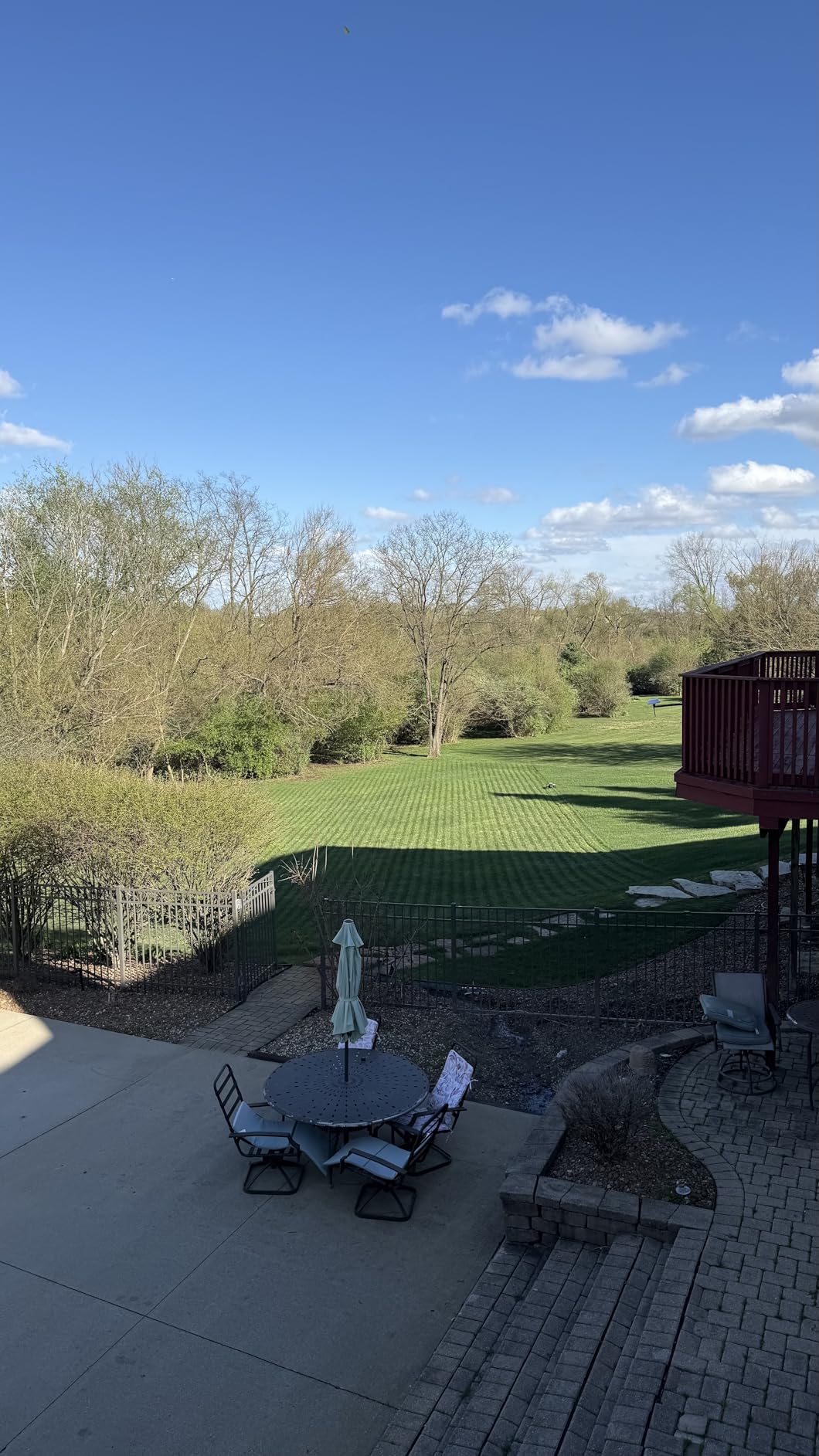
Terrain handling combined with finish quality. It is the only pick in the group that owners describe as confidently mowing a slope they had given up on, and it does so quietly. If your yard is under half an acre with any incline to it, this is the one to buy for the mowing itself.
Where it falls down
It is a small-yard machine with a hard ceiling, and trying to cover more than a third of an acre is the single most common regret pattern. Narrow cut width plus a two-to-three-hour recharge means you plan sessions around the battery rather than the other way around. If your lawn is a third of an acre or larger, or if you want a lot of no-go zones, look at the LUBA 2 or LUBA 3 instead.
6. Mammotion LUBA 3 AWD 3000: Best for Big, Complicated Lawns
Mammotion LUBA 3 AWD 3000 Robot Lawn Mower with Cleaning Stand (Ship Separately), 360° LiDAR+NetRTK+AI Vision, AWD for 80% Slopes, 5400 sq.ft/h, Cutting Height 1.0″-2.7″
15.7 inch cut
Tri-fusion navigation
80 percent slope
30 zones
up to 30 mowing zones
Pros
- Tri-fusion LiDAR plus NetRTK plus AI vision works with no RTK antenna installed
- All-wheel drive handles 80 percent slopes and 50 mm step-over obstacles
- Identifies 300 plus obstacle types and avoids them reliably
- Very quiet with pennies-level running cost
Cons
- Battery may not finish a quarter acre on one charge at aggressive settings
- No lifting action so long grass is pushed over rather than cut
- App mapping is hard to use in bright daylight
For a large property with complicated boundaries, the LUBA 3 is the machine built for the job. The 15.7 inch deck is the widest in this roundup, and the tri-fusion navigation stack – 360 degree LiDAR, NetRTK and dual-camera AI vision – means you do not install an RTK antenna at all. LiDAR range reaches 230 feet with a 59 degree vertical sweep.
All-wheel drive with four independent motors and omni-wheel pivoting handles 80 percent slopes and 50 mm step-over obstacles, and the vision system recognizes more than 300 obstacle types. Coverage is up to 500 square meters per hour from two 165W motors driving six-blade discs. The app supports up to 30 zones with perimeter-only, zigzag, checkerboard and adaptive patterns.
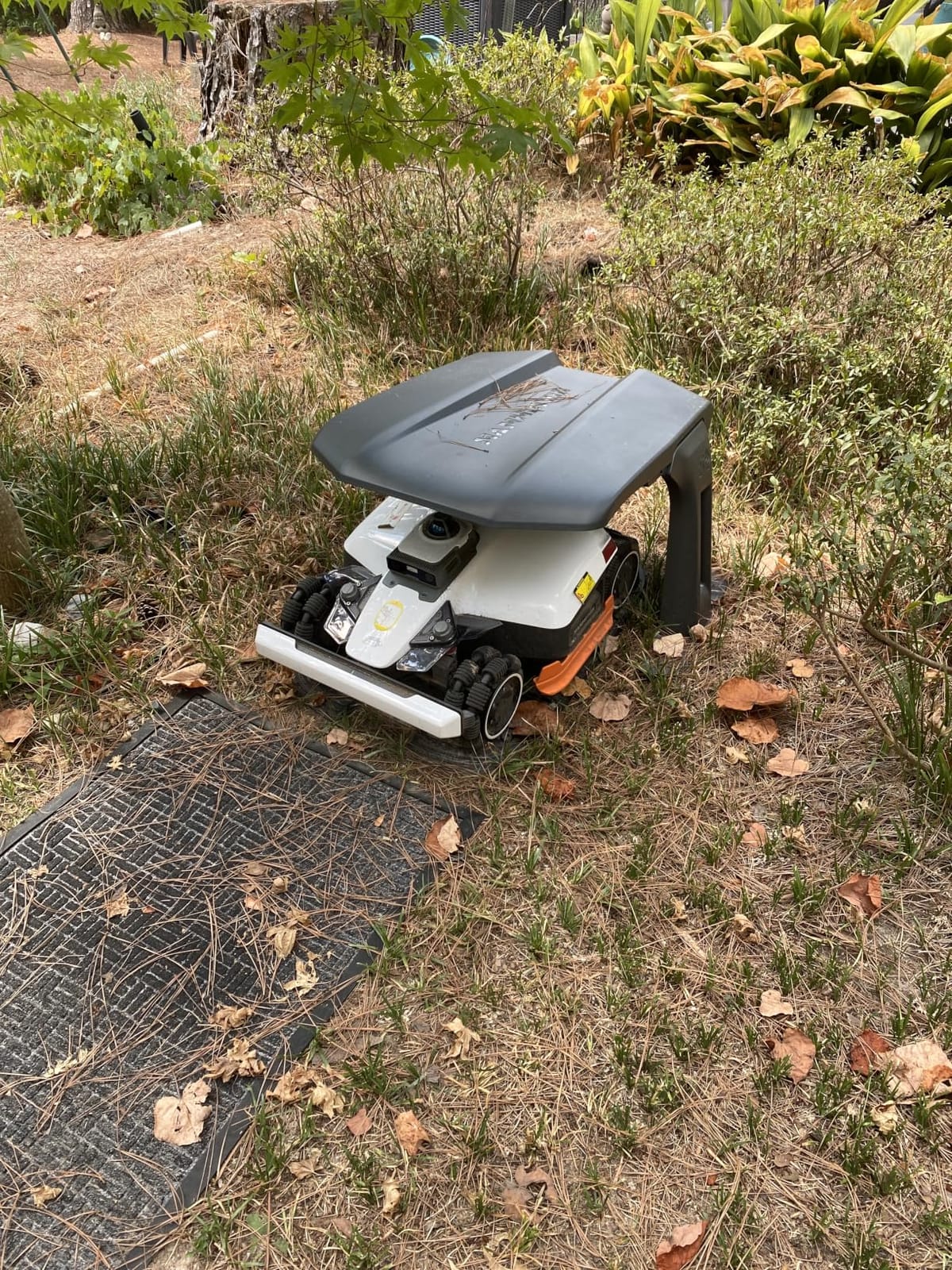
Owners consistently mention quietness and the running cost, which is pennies per mow for a quarter acre. The security and zone features are the deepest in the Mammotion range, and the cleaning stand accessory is a nice touch for a machine that lives outdoors.
The complaints cluster around endurance and consistency. The battery, rated up to 175 minutes per charge on a 12Ah pack, may not finish a quarter acre on a single charge at aggressive settings. There is no lifting action, so long grass is pushed over rather than cut evenly, and the wide wheels can mat the lawn and produce uneven striping. For app users specifically, mapping is hard to work with in bright daylight and the online manual is thin.
Where the LUBA 3 AWD 3000 earns its place
It is the only machine here that treats a large, feature-heavy property as the normal case rather than the exception. Thirty zones, 300-plus obstacle classes, a 500 square meter per hour rate and a deck that can cut wide strips all matter when you are trying to finish two acres without babysitting.
LiDAR-first navigation also means no base station to mount and no cable run, which removes the single most common installation failure we see reported.
Who should skip it
Anyone with a quarter acre or less, because the extra deck width and battery are wasted on a small lawn. If your grass gets long between visits, the lack of a lift will disappoint you every single cut. It is also the heaviest-duty, highest-commitment machine here, and the app needs work in daylight. For medium yards the LUBA mini 2 gives you most of the terrain capability at a much smaller footprint.
7. ECOVACS GOAT O1000 LiDAR PRO: Best Edge Cutter That Does Not Need the Cloud
ECOVACS Goat O1000 LiDAR PRO Robot Lawn Mower, Wire-Free Mapping with LiDAR Navigation, AI Obstacle Avoidance, Smart Edge Mowing, App Control, for Lawns Up to 1/4 Acre
Quarter acre
8.66 inch cut
dual LiDAR
built-in TruEdge trimmer
0.8 m body
Pros
- LiDAR maps stored locally so the mower does not depend on cloud servers
- Integrated TruEdge string trimmer cuts close to driveways and beds
- Very quiet and handles bumpy lawns with protruding roots
- IP water rated so the underside can be rinsed off
Cons
- Manual mapping joystick is hard to control and produces zig-zag boundaries
- Fails to trim along fence lines and leaves a sawtooth edge
- Max cut height of about 3.2 inches is low for tall-grass lawns
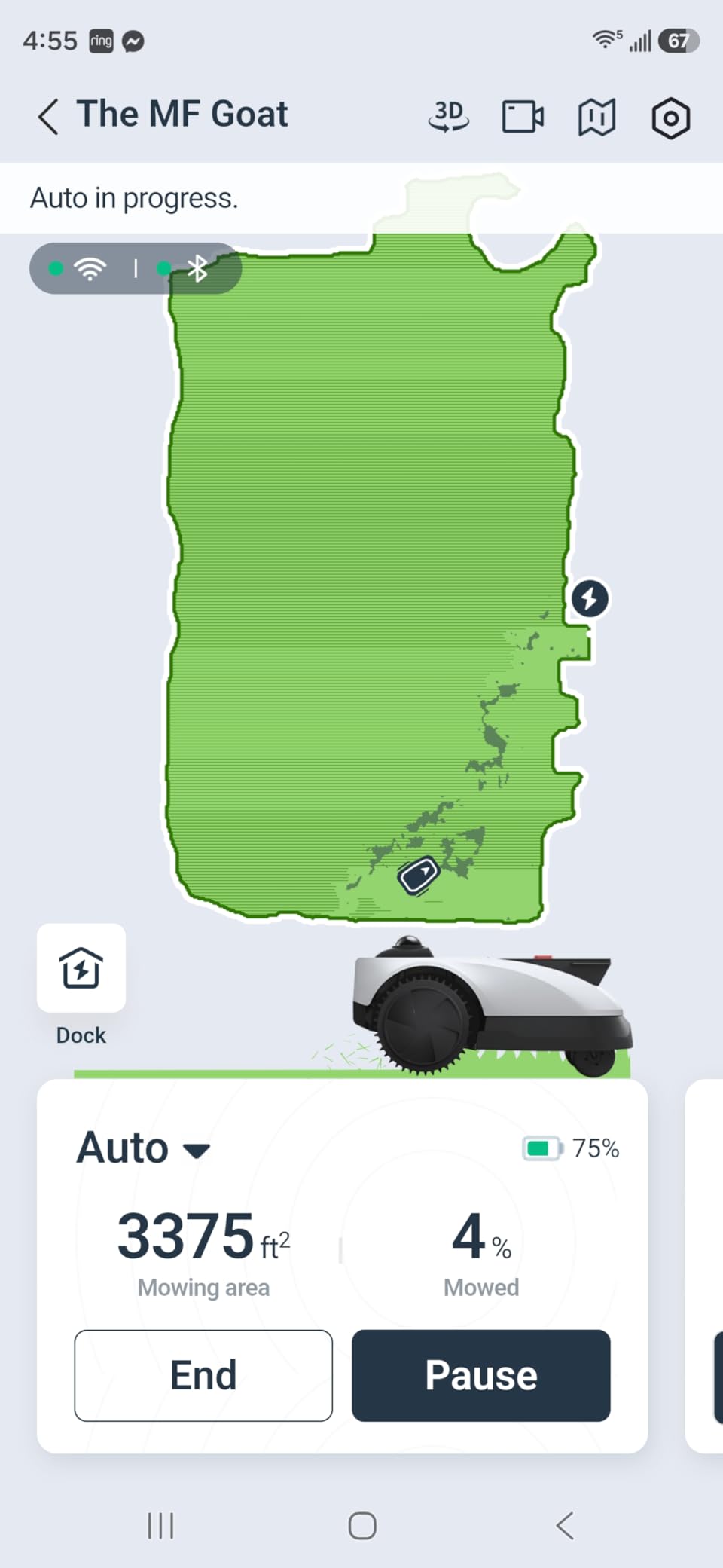
The GOAT O1000 LiDAR PRO does something no other pick in this list does: it keeps the map on the machine. HoloScope 360 degree dual-LiDAR with 2 cm positioning accuracy stores maps locally, so the mower does not depend on cloud servers to know where your lawn is. That is a genuine engineering choice, not a feature-sheet line, and it is the first thing we would mention to anyone worried about a device that lives on their property.
The TruEdge integrated trimmer is the other headline. A string trimmer arm that swings out to cut against driveways, beds and borders addresses the complaint we hear from nearly every robotic mower owner – that a robot still leaves a strip you have to hand-trim. The app handles zones, schedules and no-go areas, and vision plus 3D time-of-flight LiDAR detects 200-plus obstacle types at 5 cm precision.
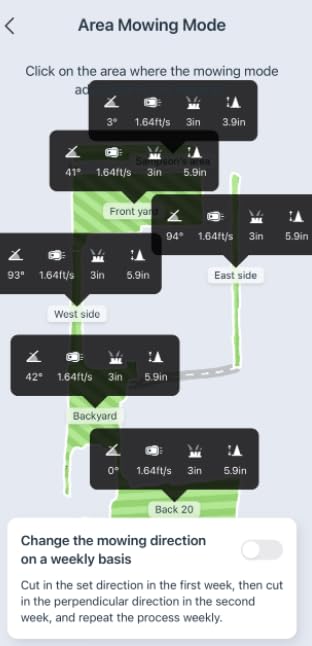
Other things owners like: it is very quiet, it copes with bumpy lawns and protruding roots, and the IP water rating means you can rinse the underside off without worrying. The 0.8 m body width passes through corridors most competitors cannot, which matters for split yards with a gate or a path between them.
The complaints are concentrated and worth stating plainly. The manual mapping joystick is difficult to control and produces zig-zag boundaries, which is frustrating in an app-centric product. It fails to trim along fence lines because it treats the fence as an obstacle, cutting a sawtooth edge – the opposite of what you would hope from a machine with a built-in trimmer. The small front caster wheels struggle with curbs and tall grass, and the maximum cut height of roughly 3.2 inches is low if you have cool-season tall-grass lawns.
Why this one is different technically
Local map storage and no RTK antenna mean setup is wire-free, tower-free and cloud-independent. That is rare at this level, and it is the reason we would trust this mower to keep working if a vendor changes its software policy or a server goes down. Pair that with the narrow body and you have the best fit in the list for split or awkward-shaped yards.
Where it frustrates owners
The app experience does not match the hardware. If you dislike drawing a boundary with a laggy joystick, this is not the machine for you, and the fence-line sawtooth edge undercuts the trimmer feature in exactly the situation the trimmer was sold for. It also cannot be set taller than about 3.2 inches. Buyers who want a large lawn or very long grass should look elsewhere.
8. eufy E15: Best for Yards With No WiFi or Cell Signal
eufy Robot Lawn Mower E15, Auto Mapping, Pure Vision Navigation
0.2 acre
8 inch cut
under 54 dB
28 pounds
pure vision navigation
Pros
- Auto mapping with no wire to bury and no RTK antenna to install
- Whisper quiet at under 54 dB with clean parallel lines
- App joystick camera view makes manual driving genuinely fun
- Works in yards with no WiFi or cellular signal
- Rain detection reliably keeps it docked in wet weather
Cons
- Vision navigation only works in daylight so there is no night mowing
- Auto mapping struggles on sparse or sandy lawns
- No spot cleaning mode it mows the whole mapped area
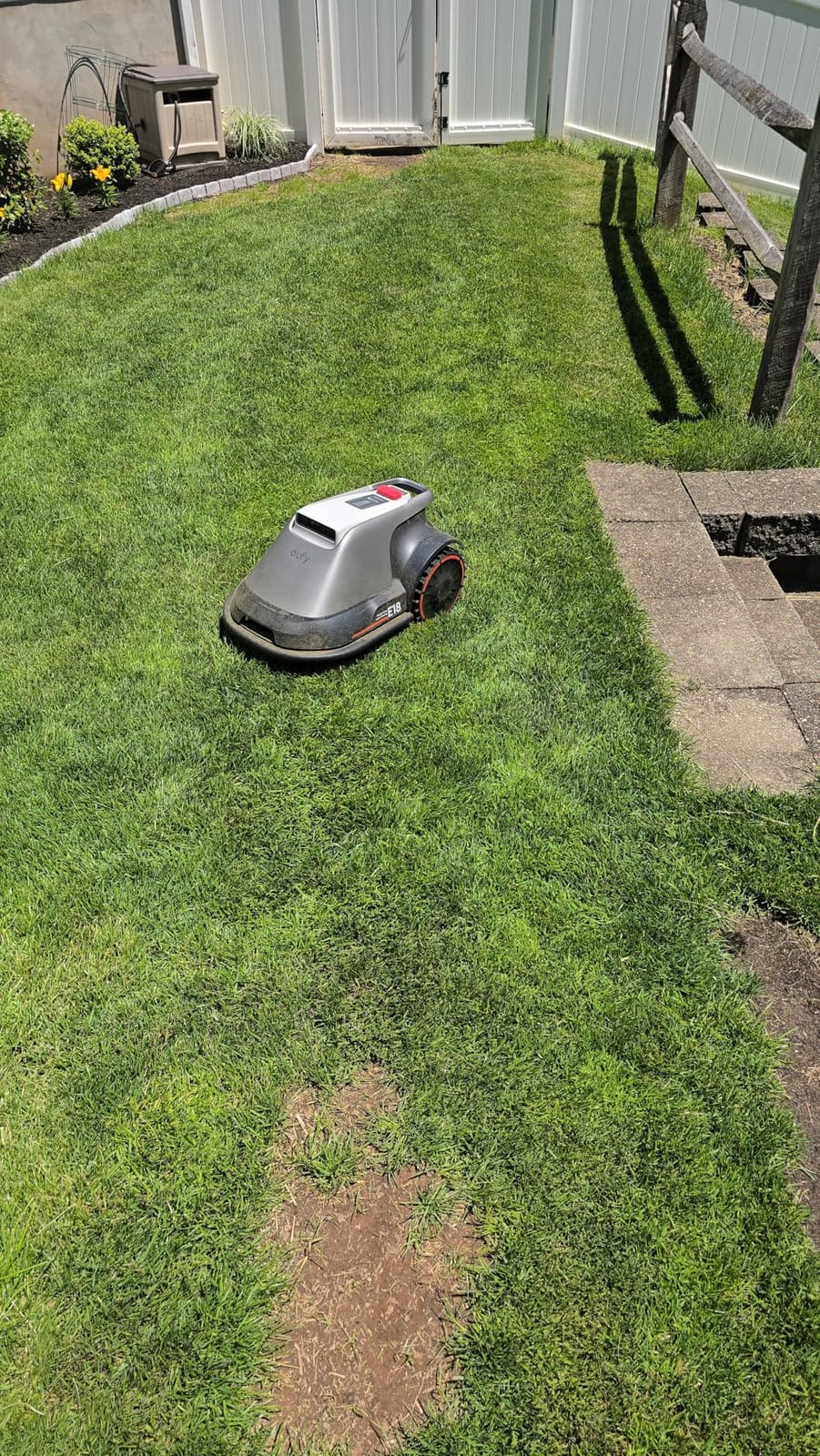
The eufy E15 is the most unusual recommendation here, and it fits a specific problem better than anything else in the list. It uses pure vision navigation – stereo cameras with Vision SLAM, no RTK, no boundary wire – and it will work in a yard with no usable WiFi or cell signal. For a property at the end of a lane, or a neighbor with a metal building that kills the router, that is decisive.
Setup is quick because there is nothing to install. Auto mapping handles the boundaries, 0.2 m virtual walls and multi-zone management are set in the app, and Ride-on Edge technology plus automatic re-mow of missed spots handle the strip near borders. Cut height runs 1 to 3 inches. GPS anti-theft, rain recall and low-light auto-recall are built in.
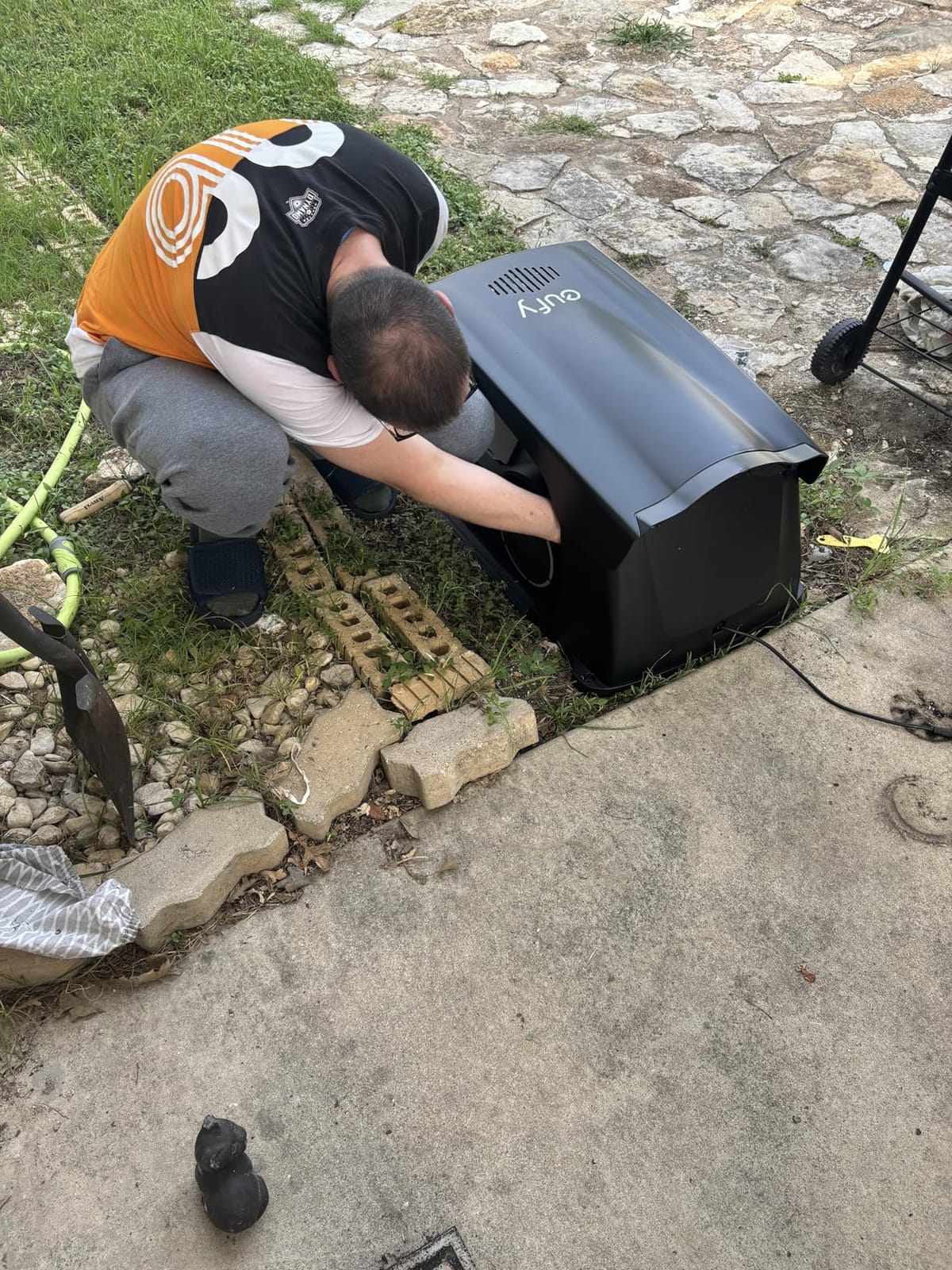
Owners consistently praise the quietness – under 54 dB makes it the quietest machine here – and the clean parallel lines it leaves. The app joystick with a camera view turns manual driving into something people actually enjoy rather than a chore, and rain detection reliably keeps it docked in wet weather. Several owners with thick, well-defined lawns describe the setup as finished in an afternoon.
The trade-off is that pure vision only works in daylight. If you plan evening mowing, this machine physically cannot do it, and any evening schedule you set will silently never run. Auto mapping also struggles on sparse or sandy lawns with bare patches, which is the most common complaint from buyers in exactly the conditions where they expected it to shine. The wheels can mat long grass into uncut stripes, and there is no spot-cleaning mode – it mows the whole mapped area every run.
Why the eufy E15 is worth the compromise
It removes the two most common causes of robotic mower disappointment: installation and connectivity. Nothing to bury, nothing to mount, no router settings, no subscription. If you want mowing that simply happens on a lawn with poor signal, nothing else in this list does it as cleanly.
It is also the quietest machine in the group, measuring under 54 dB, and it handles rain without you thinking about it.
Where it is the wrong choice
Night mowing is out entirely, and sandy or patchy lawns break the mapping. It is not suitable for St. Augustine or dense Zoysia grass, and the lack of a spot mode means every run covers everything. If you want evening cuts or you have a thin, dry yard, pick a LiDAR machine such as the MOVA LiDAX Ultra 1000 or the Navimow i215.
9. MOVA LiDAX Ultra 1000: Best for Yards That Need Lots of Zones
MOVA LiDAX Ultra 1000 Robot Lawn Mower Wire Free for 1/4 Acre, RTK-Free+360° 3D LiDAR+AI Vision Auto Mapping, Zero-Edge Cutting, Cutting Height 1.2″-3.9″, 45% Slope, Up to 150 Managed Zones Dual Maps
Quarter acre
8 inch cut
360 degree 3D LiDAR
150 zones
45 percent slope
Pros
- RTK-free 360 degree 3D LiDAR plus AI vision auto-maps the yard accurately
- UltraTrim 1.0 movable disc cuts within 2 inches of walls and hedges
- Recognizes 300 plus obstacle types from 3D point cloud data
- 45 percent slope with off-road wheels and 23.6 inch path handling
Cons
- Listed battery average life is around 60 minutes so larger yards need multiple cycles
- 34 inch listed dimensions make it bulky for narrow side-yard access
- Newer listing with a small review base so durability is unproven
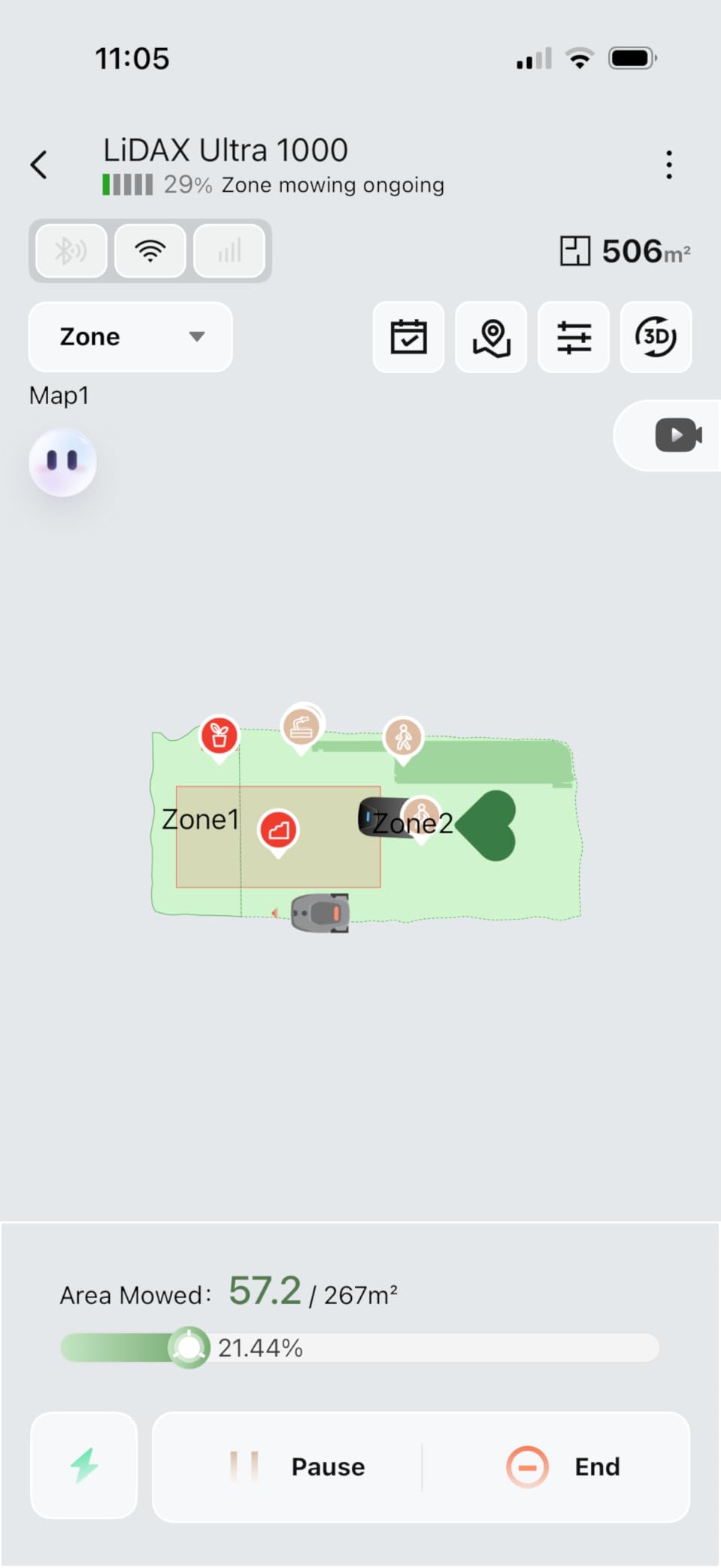
The MOVA LiDAX Ultra 1000 has the most granular zone system we found. Up to 150 managed zones across two independent maps, which means genuinely separate front and back yard mowing plans on one machine. If your property is chopped into distinct areas – a courtyard, a side yard, a back lawn with different growth rates – nothing else in this roundup lets you schedule them separately.
Navigation is RTK-free. A 360 degree 3D LiDAR array with AI-assisted auto mapping builds the map, and the vision system reads a 3D point cloud to detect more than 300 obstacle types. The UltraTrim 1.0 movable disc is the interesting engineering: it shifts to cut within 2 inches of walls, hedges and raised edges, which is a different approach to edging than the string-trimmer arm on the ECOVACS.
It also handles 45 percent slopes with off-road wheels and can pass 23.6 inch paths, and the cutting height range of 1.2 to 3.9 inches is the widest here. A three-year manufacturer warranty is included.
Be realistic about the rest. The listed battery average life is around 60 minutes, so anything approaching its quarter-acre rating will need several charge cycles. The listed dimensions of 34 by 20 by 16 inches make it bulky for narrow side-yard access, which is a strange limitation for a machine otherwise aimed at narrow paths. It is also a newer listing with a 74-review base, so long-term durability is genuinely unproven. Anti-theft tracking and instant alerts require an additional link module, which is a real cost once you factor in the platform.
What makes the LiDAX Ultra 1000 different
Zone granularity and edge reach. One hundred and fifty managed zones sound like a spec-sheet flourish, but with dual maps they are a genuine scheduling tool for complex properties, and the movable edge disc gets closer to walls and hedges than a fixed deck can. Owners who have fine edging needs rate the result highly.
Where caution is warranted
This is a young listing, and buying the newest model in a category means accepting an unproven reliability record. Add the 60-minute battery cycle, the bulky footprint for tight access and the extra link module for security, and this is a machine for buyers who specifically need multi-zone scheduling. If you want a proven platform with strong owner feedback, the Navimow i215 or the LUBA 2 are safer buys.
10. Segway Navimow i215 LiDAR: Best for Yards Where Night Mowing Matters
Segway Navimow i215 LiDAR Robot Lawn Mower, Wire Free Robotic Lawn Mower for 0.37 Acre, LiDAR & Vision Dual Fusion, Auto Mapping, Off-Road Wheels for 45% Slopes, Quiet 59 dB(A) Mowing
0.37 acre
8.66 inch cut
LiDAR plus vision
45 percent slope
59 dB(A)
Pros
- Solid-state LiDAR with vision fusion gives satellite-free navigation day or night
- Off-road wheels and stability control handle 45 percent slopes
- One-tap auto mapping and Drop and Mow mode make setup fast
- Security suite with geo-fence lift detection and Apple Find My alerts
Cons
- Only a small number of customer reviews so long-term experience is limited
- VisionFence edge accuracy of 0.4 inch may leave a trim line along some borders
- 7.1 inch cutting width keeps cut times long
The i215 LiDAR solves the single most frustrating limitation of pure-vision machines. Solid-state LiDAR fused with vision gives satellite-free navigation that works day or night, so you can schedule quiet evening mowing without the schedule silently failing at dusk. At 59 dB(A) it is quiet enough to run at that hour.
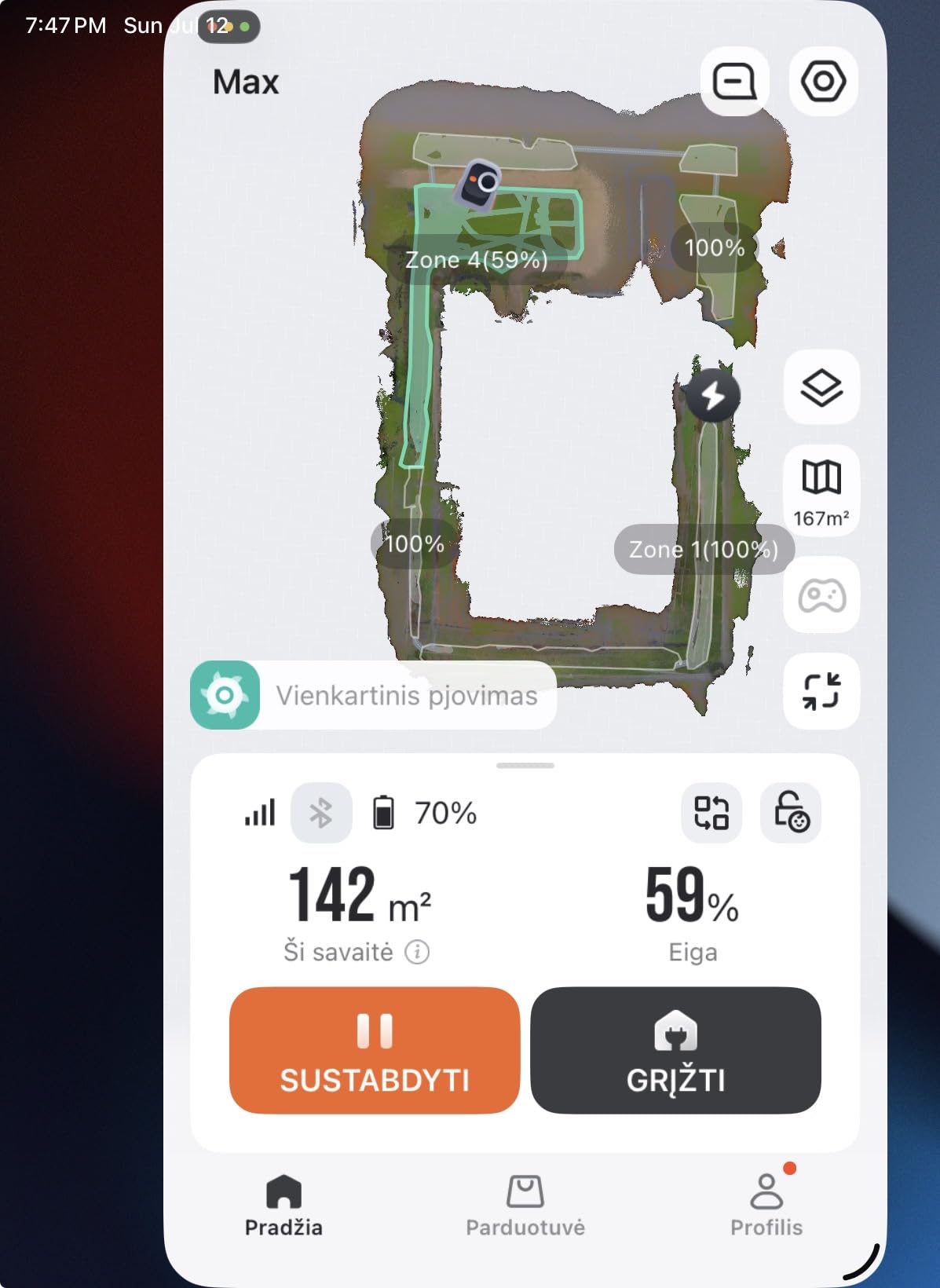
It also brings genuine all-terrain hardware: off-road wheels with electronic stability control for 45 percent slopes. Setup is fast, with one-tap auto mapping and a true Drop and Mow mode for jobs that do not need a map at all. Up to 20 zones are editable, cutting height runs 2 to 4 inches, and AI VisionFence with GeoSketch holds 0.4 inch accuracy across 200-plus obstacle types.
The security suite is unusually thorough for the category: geo-fencing, lift detection and Apple Find My alerts. It is also the only pick here with Alexa and Google Home voice control, which is a genuine app-control feature in the broadest sense – you can start a zone without opening a screen.
Two caveats, and both are real. The review base is small at 46 reviews, so while the 4.4 average is encouraging, long-term experience is limited and you are buying early on a new listing. And with a 7.1 inch cutting width on a third-of-an-acre rating, cut times stay long. VisionFence accuracy of 0.4 inch may also leave a trim line along some borders.
Where the i215 LiDAR is the right answer
Night scheduling and satellite-free reliability. If you want the lawn cut after dinner, or you have heavy tree cover that defeats GPS, this machine does the job where the eufy E15 cannot. Voice control support means app control extends to your existing smart home setup rather than living only on a phone.
It is also a better-built machine than its small review count suggests, with 32.4 pounds of chassis and stability control for real terrain.
Where you should wait
Only 46 owner reviews is a thin evidence base for a machine that stays outside in all weather. If you prefer proven history, choose a model with hundreds of reviews even if it costs more. And if your priority is finishing a third of an acre quickly, the narrow 7.1 inch cut will frustrate you – look at the LUBA 3 or the LUBA mini 2 instead.
What to Check Before You Buy
Connectivity decides more than people expect. There are four kinds, and each one shapes what the app can do. WiFi-only machines need your router, which means a 2.4GHz band and a signal that reaches the lawn – the single most common cause of failed setups. Bluetooth-only machines like the Gardena pair directly with your phone and need nothing else, but they offer no remote access when you are away from home. Cellular machines with a 4G module work anywhere but usually charge a subscription once the included period ends, as on the LUBA 2. RTK-based machines depend on a base station and, in some designs, a beacon that has to be sited with a clear view of the sky.
Lawn size should be matched conservatively. Coverage figures describe ideal conditions on level, short grass, and a machine run at its own pace. If your lawn is at the top of a machine’s rating, assume multiple sessions. Check the cutting width alongside the area figure, because a 7 inch deck on a third of an acre means a long day.
Navigation technology has shifted. GPS and RTK with boundary beacons dominated for years, and LiDAR and vision have largely displaced them as the setup pain point. A vision-only machine needs no antenna and no wire, but a few cannot mow at night at all. LiDAR-first machines handle trees, buildings and night hours without a base station, and that is why most of our top picks moved in that direction.
Smart-home integration is worth asking about. There is an active community project, Mammotion-HA, that exposes a Mammotion mower to Home Assistant over the local network. Owners running a Luba 2 AWD 3000HX report it can operate entirely over Bluetooth on an isolated IoT VLAN with no internet access, which is useful if you want local control. The trade-off is real: without a cloud connection, cloud scheduling silently fails, so the Home Assistant route suits people who want local control and are willing to build the schedule themselves.
If your app connection is failing, work through this list before assuming the mower is faulty. First, split your router band or enable a 2.4GHz-only network, since 5GHz-only routers are a top cause of setup failure. Second, confirm the mower has a usable signal where it actually sits, not where your phone reports signal. Third, check that an RTK base station or antenna has a clear view of the sky. Fourth, remember that Bluetooth-only fallback will connect the app but not the internet, so schedules will quietly not run. Fifth, if a firmware update breaks a working mower, do not keep retrying the update – contact support, because owners report updates rendering previously functional machines unusable. We covered similar reliability triage in our indoor grill testing roundup, where the same pattern of firmware and connectivity issues showed up.
Maintenance is light but not zero. Expect to swap blades every few months on a busy season, rinse the underside, keep the sensors clean, and keep firmware current. Battery and blade replacement are the two costs that matter most over a machine’s life.
Finally, know when to skip a robot entirely. If your lawn is very small – under a fifth of an acre – a good manual mower costs a fraction of the money and needs no setup weekend. If your yard is mostly steep banks, thin patches or rough brush, a robot will disappoint you. If you rely on the grass to catch leaf litter, most of these machines will not deliver. And if you plan to mow at night, rule out every vision-only model. A robot mower also does not edge your beds properly, and most owners keep a string trimmer for that.
Frequently Asked Questions
What is the absolute best robot lawn mower?
Among the mowers we rated for app control, the Mammotion LUBA 2 AWD 3000X is the strongest all-round choice. It pairs 30-zone scheduling, no-go zones and 200-plus obstacle recognition with four-wheel drive that handles 80 percent slopes, and it has the deepest owner review base at 481 reviews. If your lawn is a third of an acre or smaller, the LUBA mini 2 rates highest on terrain and finish quality.
Which robotic lawn mower did Consumer Reports recommend?
We do not attribute specific recommendations to Consumer Reports, because we could not verify them from a primary source. Instead, every pick in this roundup is based on published owner feedback, published specifications and manufacturer documentation, and we have linked each one so you can read the underlying reviews yourself. Our own top pick for app control is the Mammotion LUBA 2 AWD 3000X.
What are the downsides of using a robotic lawn mower?
The honest list: edging still needs a trimmer because most machines leave a narrow strip at borders, and some cut a sawtooth line against fences. Long grass is often pushed flat rather than cut, vision-only models cannot mow at night, and GPS-based models can stall under heavy tree cover. Add a possible cellular subscription after the trial period, a steep learning curve for map editing, and the fact that a stuck mower sometimes still has to be carried to its dock.
Can I use Home Assistant to control my robot lawn mower?
Yes, but it depends on the brand. An active community integration, Mammotion-HA, exposes supported Mammotion mowers to Home Assistant over the local network, and owners report running a Luba 2 AWD 3000HX entirely over Bluetooth on an isolated IoT VLAN with no internet access. The catch is that without a cloud connection, cloud-based scheduling stops working, so you build the schedule inside Home Assistant yourself.
What is the life expectancy of a robotic lawn mower?
A well-maintained machine in a moderate climate typically runs for well over a decade, and the most common early failures are consumables rather than the chassis. Blades need regular replacement, especially with rocky or sandy lawns, and the battery is usually the first major part to degrade. Keeping the underside and sensors clean, storing the machine dry over winter, and keeping firmware current all extend its life.
Is Mammotion a Chinese company?
Yes. Mammotion is a China-based manufacturer of robotic lawn mowers, and it is one of several brands in this roundup built in China, including Segway Navimow, MOVA, ANTHBOT, ECOVACS and eufy. Buyers should know that several of these machines are built by the same contract manufacturers, which is why visually similar models with very different apps appear side by side. Buying direct from the manufacturer generally gives better support access than buying through a marketplace.
Do robot lawn mowers work without Wi-Fi?
It depends on connectivity type. Bluetooth-only machines like the Gardena SILENO Life configure and schedule entirely over Bluetooth with no WiFi at all. Pure-vision machines such as the eufy E15 map and mow on-device with no network connection. WiFi-only machines need a 2.4GHz band, and cellular machines work anywhere with a plan after the trial period. Note that Bluetooth-only operation breaks cloud scheduling, so a mower may be controllable but not automatic.
Why does my robot lawn mower stop in the same spot?
The usual causes are local, not broken. Check for a root, a hole, a brick border or a garden hose at that exact spot, and look for mud or clippings that have built up there. Tree roots and ruts are the most reported trap for owners of wheeled mowers. In the app, add a no-go zone over the area and let the mower route around it, and if the machine is genuinely stuck, most apps let you send it back to the dock without going to fetch it.
The Bottom Line
If we had to pick one machine from the ten we rated, the Mammotion LUBA 2 AWD 3000X is the best robotic mower with app control for most people. Thirty zones, no-go zones, 200-plus object recognition, four-wheel drive and a 481-review owner record make it the pick we would install on our own lawn. Buyers on a smaller budget and a smaller yard should take the Segway Navimow i105N, and anyone whose problem is steep ground rather than acreage should start with the LUBA mini 2.
The common thread across all ten is that the app decides whether you enjoy the machine or fight it. Check the connectivity type against your router and your sky view before you buy, and give the map editing a workout during the return window.