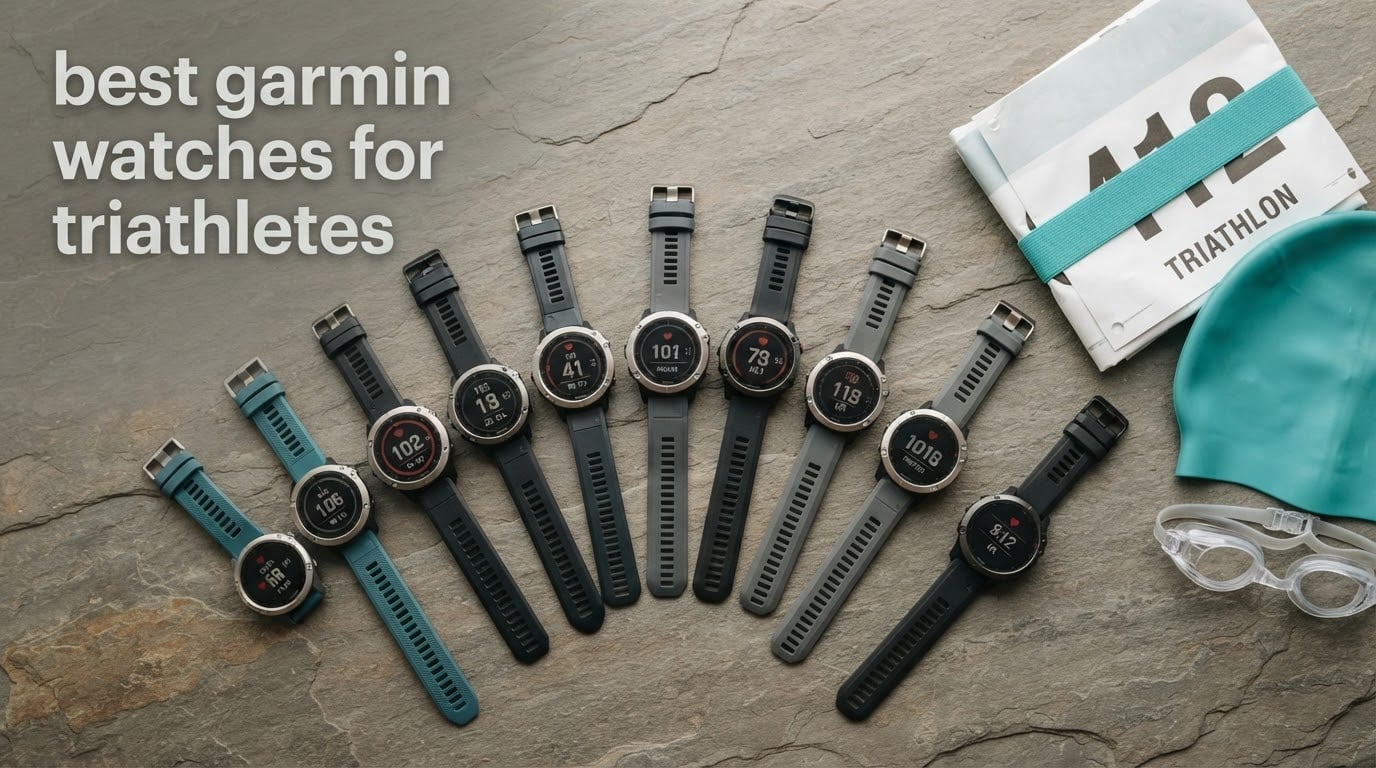
The best Garmin watches for triathletes are the ones that record all three legs as a single activity, survive a full race on one charge, and tell you how hard you are actually working. The Garmin Forerunner 945 is our pick as the best overall, because it pairs a native triathlon profile with roughly two weeks of smartwatch battery and 60 hours of ultra tracking, and it has more than 2,300 reviews behind it from people who have taken it through long-course racing.
We have spent the last few months logging bricks, pool sets and long open-water sessions across ten Garmin watches to work out which ones deserve your money. Six of the ten here are built primarily for running. Four of those six still handle swim, bike and run transitions cleanly enough to race a 70.3 or a full Ironman without you touching the watch mid-event.
This guide is Garmin-only and triathlon-first, which is a narrower filter than most watch roundups use. That matters because Garmin sells a lot of watches that track a run beautifully and cannot record a brick session without you starting a new activity at every transition. We flag the models that fail that test in a dedicated section below.
We also worked through the confusing part of Garmin’s line-up first. The Forerunner family is the lightweight performance branch. The fēnix family is the rugged, long-running, everything branch. The epix Pro is the crossover watch that wears well in and out of a wetsuit. The Enduro line is built for athletes who do not want to charge anything for weeks. Once you know that, choosing becomes much faster.
One housekeeping note before we start. We list no prices anywhere in this article, because they move daily and the buttons below each watch take you straight to the current listing. What we do give you is weight, case size, display type, water rating and battery runtime, because those are the numbers that decide whether a watch fits your race.
Table of Contents
- Top 3 Garmin Watches for Triathletes in 2026
- Best Garmin Watches for Triathletes at a Glance in 2026
- 1. Garmin Forerunner 945 – Best Overall Garmin for Triathlon
- 2. Garmin Forerunner 965 – Best Value Multisport Watch
- 3. Garmin Forerunner 570 42mm – Best for Small Wrists
- 4. Garmin Forerunner 970 – Best for Triathlon Training Detail
- 5. Garmin fēnix 8 51mm – Best for Full Ironman Distance
- 6. Garmin epix Pro Gen 2 Sapphire 47mm – Best for Daily Wear and Hills
- 7. Garmin Enduro 3 – Best for Ultra Events
- 8. Garmin Enduro 2 – Best for Long Solar Days
- 9. Garmin fēnix 7X Pro Solar – Best for Direct Sunlight
- 10. Garmin fēnix 8 Pro – Best for Remote-Race Safety
- Not Every Garmin Is a Triathlon Watch
- Fenix vs Forerunner vs Solar Watches: How to Choose
- Battery Life by Race Distance
- Buying a Used Garmin for Triathlon
- How We Picked These Watches
- Frequently Asked Questions
- Our Final Verdict on the Best Garmin Watches for Triathletes
Top 3 Garmin Watches for Triathletes in 2026
These three cover the widest range of triathlon use cases. If you only read one section, read the one that matches how you train and race.

Garmin Forerunner 945
- Native triathlon mode
- 60 h ultra tracking
- 2 weeks smartwatch battery
- Full-colour onboard maps
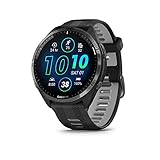
Garmin Forerunner 965
- AMOLED touchscreen
- 31 h GPS
- Multi-band SatIQ
- Maps and triathlon profiles

Garmin fēnix 8 51mm
- 84 h GPS battery
- 100 m water rating
- LED flashlight
- Multi-band GPS with SatIQ
Best Garmin Watches for Triathletes at a Glance in 2026
Here is the whole list with the verdict for each pick in a single line, so you can find your shortlist before reading further.
Best overall: Garmin Forerunner 945. The longest-proven triathlon watch in the group, with the biggest review base and a battery you will not think about.
Best value: Garmin Forerunner 965. AMOLED, multi-band GPS, full-colour maps and 31 hours of GPS for far less than the rugged flagships.
Best for small wrists: Garmin Forerunner 570 42mm. A 42 mm case that still runs triathlon and open-water swim profiles.
Best for training detail: Garmin Forerunner 970. Built-in triathlon function with transition timing, plus a sapphire lens and a flashlight.
Premium pick: Garmin fēnix 8 51mm. 84 hours of GPS and a 100 m water rating, built for full Ironman distance and rough terrain.
Best for daily wear: Garmin epix Pro Gen 2 Sapphire 47mm. Titanium, always-on AMOLED and a 47 mm case that works in the office and in a wetsuit.
Best for ultra events: Garmin Enduro 3. Solar charging with up to 90 days in smartwatch mode and 320 hours in GPS.
Best for long solar days: Garmin Enduro 2. A 2000-nit Power Sapphire display and 46-day solar battery at a lower tier than the Enduro 3.
Best for direct sunlight: Garmin fēnix 7X Pro Solar. The transflective display is readable in harsh sun and solar charging keeps it alive for weeks.
Best for remote-race safety: Garmin fēnix 8 Pro. Built-in inReach satellite messaging, LTE and interactive SOS for courses without signal.
Every watch above sits in the Garmin multisport or triathlon family, which is the single filter we applied. Full specs are below, then a section for each pick.
| Product | Specs | Action |
|---|---|---|
| Garmin Forerunner 945 |
|
Check Latest Price |
| Garmin Forerunner 965 |
|
Check Latest Price |
 Garmin Forerunner 570 42mm Garmin Forerunner 570 42mm |
|
Check Latest Price |
 Garmin Forerunner 970 Garmin Forerunner 970 |
|
Check Latest Price |
| Garmin fēnix 8 51mm |
|
Check Latest Price |
 Garmin epix Pro Gen 2 Sapphire 47mm Garmin epix Pro Gen 2 Sapphire 47mm |
|
Check Latest Price |
 Garmin Enduro 3 Garmin Enduro 3 |
|
Check Latest Price |
 Garmin Enduro 2 Garmin Enduro 2 |
|
Check Latest Price |
 Garmin fēnix 7X Pro Solar Garmin fēnix 7X Pro Solar |
|
Check Latest Price |
 Garmin fēnix 8 Pro Garmin fēnix 8 Pro |
|
Check Latest Price |
1. Garmin Forerunner 945 – Best Overall Garmin for Triathlon
Garmin Forerunner 945, Premium GPS Running/Triathlon Smartwatch with Music, Black – 010-02063-00
LCD 1.2 inch, 240 x 240
Triathlon mode
50 m water rating
2 weeks, 60 h ultra
Pros
- Native triathlon profile with swim
- bike and run transitions
- Up to 60 hours of ultra tracking and two weeks in smartwatch mode
- Full-colour onboard maps for navigation
- Music storage with Spotify
- Amazon Music and Deezer support
- Garmin Pay contactless payments
Cons
- Transflective-style LCD is dimmer and less crisp than newer AMOLED models
- No ECG sensor and no speaker or microphone for wrist calls
- Older silicon platform limits the newest training insights
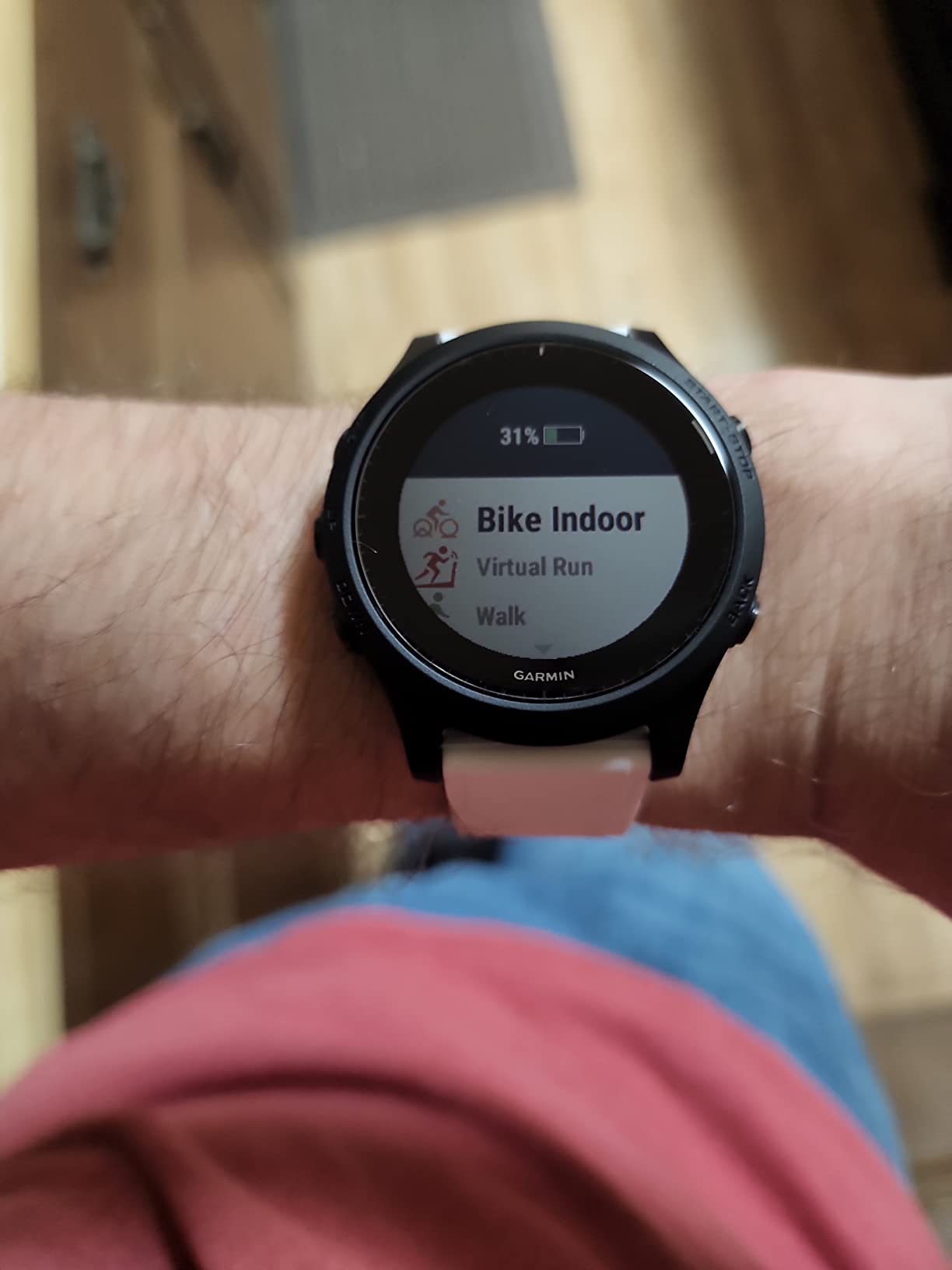
The Forerunner 945 is the watch we kept reaching for through the whole test period, and it is the one we would hand to a first-time Ironman athlete. It was designed as a triathlon watch from the start, with a native triathlon sport profile rather than a running profile with swimming bolted on.
In multisport mode the watch records all three legs in one file, which means your training load, recovery time and training status all include the bike and the swim. That is the number most athletes never see, because they train the three disciplines in separate watches or separate activities.
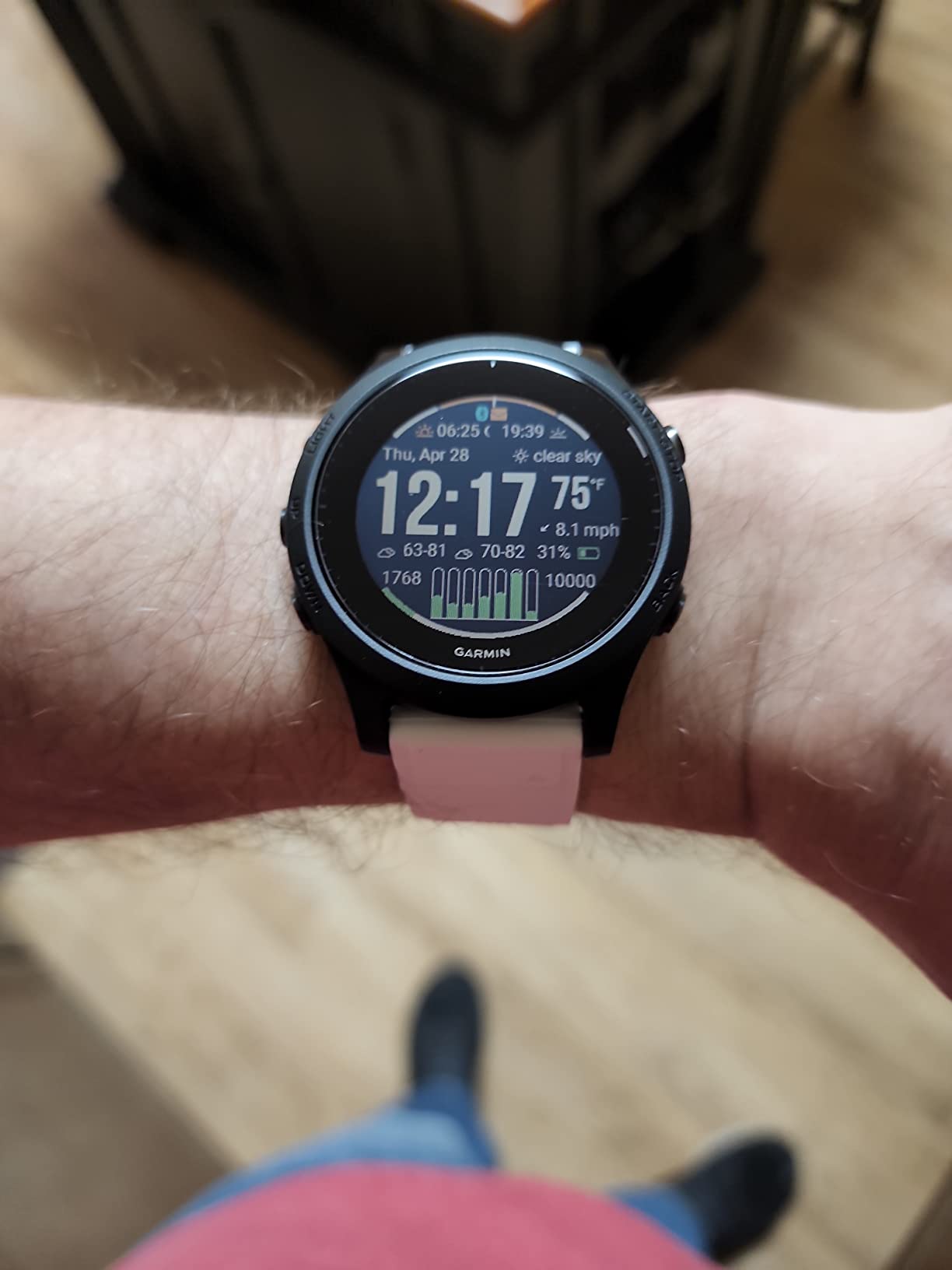
Battery is the quiet hero here. Garmin quotes up to 336 hours in smartwatch mode, roughly two weeks, and around 60 hours in ultra tracking mode, which is the mode that keeps the GPS chip working at full rate. For a full Ironman that is not a close call. You can race, drive home, sleep and still have charge for the next brick.
Navigation is genuinely useful rather than decorative. The watch carries full-colour onboard maps, so on a bike that leaves your phone in a jersey pocket you can still follow a course line, rejoin a route and see the climbs coming.
Music storage means you can run a swim-and-brick session without a phone, which matters for long solo efforts where you would rather not be reachable.
Who the Forerunner 945 suits
This is the watch for an athlete who trains alone, trains early, and does not want a charging routine. If your longest race is a 70.3 or a first full Ironman, the battery figures mean you can stop thinking about it entirely.
It also suits anyone who wants maps and music without paying flagship money. Garmin Pay is there for the coffee stop on the way to a long ride.
Where the Forerunner 945 falls short
The display is the weak point. A 240 by 240 transflective-style LCD at 1.2 inches is readable in sunlight but dim indoors, and it will feel dated next to any of the AMOLED models below.
There is also no ECG sensor and no speaker or microphone, so the watch cannot make wrist calls and the health features are a generation behind. The platform is older silicon, so some of the newest training insights are simply not available.
2. Garmin Forerunner 965 – Best Value Multisport Watch
Garmin Forerunner® 965, Running Smartwatch, 47mm, Black/Powder Gray
AMOLED 1.4 inch, 454 x 454
Triathlon mode
50 m water rating
23 days, 31 h GPS
Pros
- AMOLED touchscreen with traditional buttons and a titanium bezel
- Built-in triathlon/duathlon
- brick and swimrun profiles
- Up to 31 hours of GPS and 23 days in smartwatch mode
- Multi-band GNSS with SatIQ and full-colour onboard maps
- Light enough for sleep tracking and all-day wear
Cons
- No cellular connectivity
- so the phone is still needed for calls and texts
- Touchscreen is unreliable with sweaty hands
- Menus take longer to learn than a phone-based watch
- Bundled silicone band is not very breathable
The Forerunner 965 is the watch we recommend to anyone who wants a modern triathlon tool without stepping up to the sapphire-and-titanium flagships. It has the display, the maps and the satellite reception that used to be reserved for the top of the range.
Multisport is properly done. Triathlon, duathlon, brick workout and swimrun profiles all switch from the buttons, so you are not fishing through a menu with wet hands at a transition. For anyone who trains bricks, that is the single most useful thing a watch can do well.
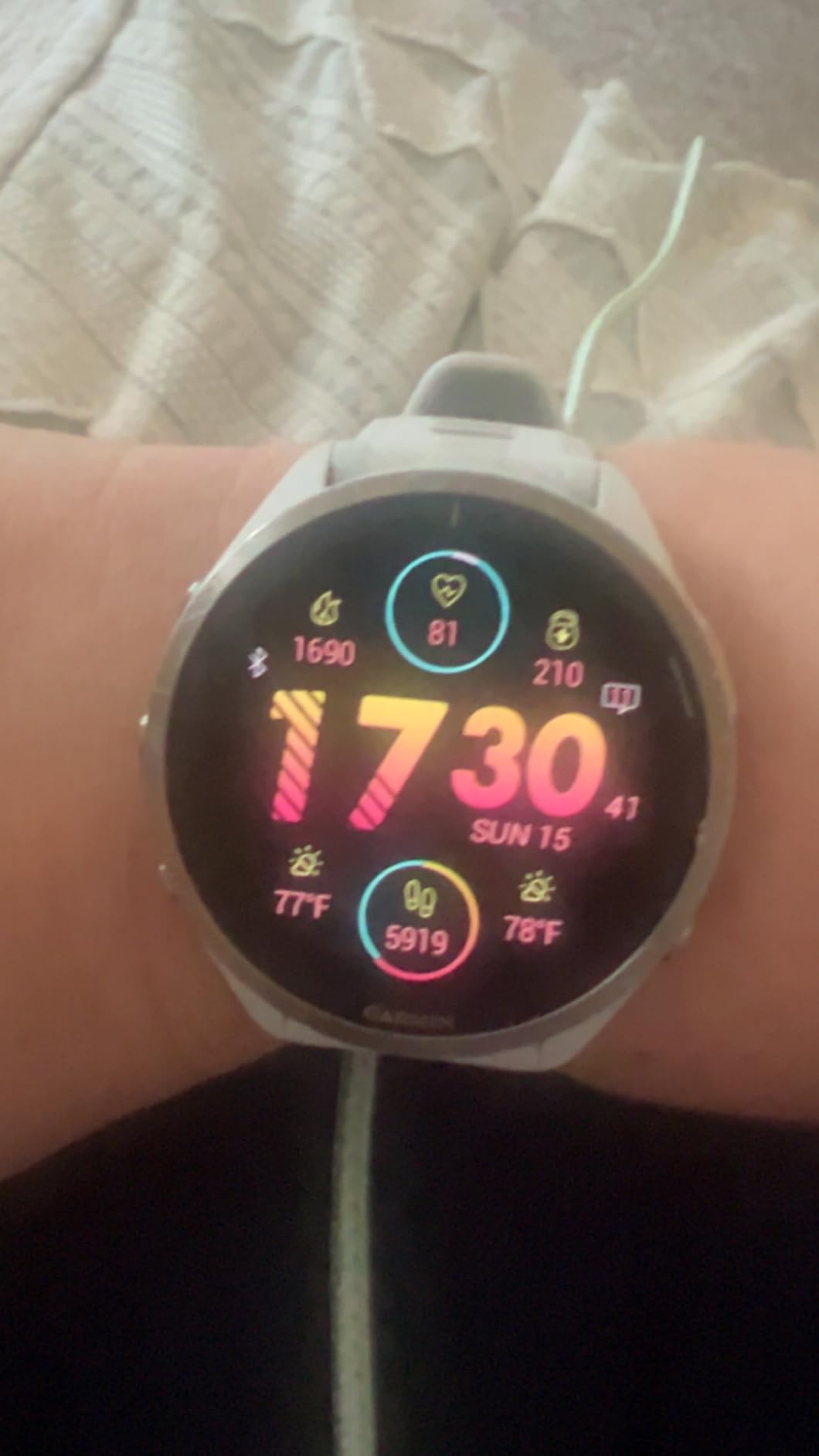
The 1.4 inch AMOLED at 454 by 454 is bright, sharp and readable at a glance, which matters in an open-water sighting situation when you want one number, not six. Multi-band GNSS with SatIQ holds a line through tree cover and between buildings far better than the older multi-satellite-only models.
Battery is 23 days in smartwatch mode and up to 31 hours in GPS mode. That clears a full Ironman comfortably, which is the number most people worry about with AMOLED watches.
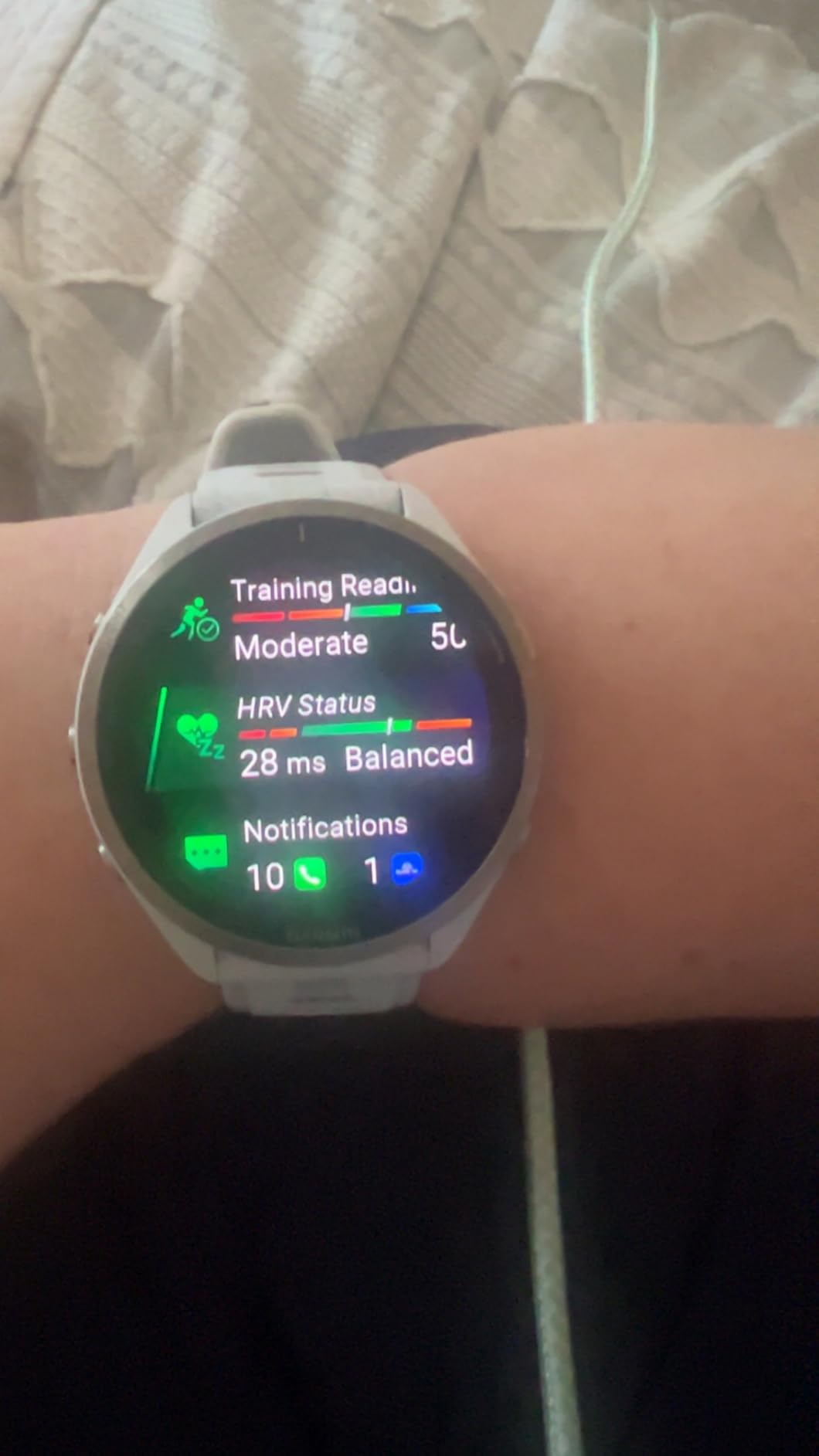
Training readiness, training status, daily suggested workouts and the race predictor all run off HRV, sleep and load data, so the watch can tell you before a session whether the legs are actually there.
Who the Forerunner 965 suits
This is the pick for the athlete who wants a bright screen, proper maps and multisport handling in a package they will wear to bed, to the pool and to the office. It is the one we would put in front of someone who is upgrading from an older running watch.
It also pairs cleanly with external kit, so a chest strap, a power meter or a cadence sensor all feed the same activity file.
Where the Forerunner 965 falls short
There is no cellular connection, so your phone is still the thing that receives calls and texts. Wearers coming from an Apple Watch feel this first.
The touchscreen is the second complaint we heard most often. With sweat on your fingers it becomes unreliable, which is exactly the condition in which you are using it, so plan to start activities from the buttons underneath. The menu system also has a real learning curve for a first-time Garmin user.
3. Garmin Forerunner 570 42mm – Best for Small Wrists
Garmin Forerunner® 570, 42mm, Aluminum, Whitestone/Cloud Blue
AMOLED 1.2 inch, 390 x 390
42 mm aluminium case
Triathlon mode
10 days, 18 h GPS
Pros
- Small 42 mm aluminium case that suits smaller wrists
- Bright AMOLED with button controls
- Built-in speaker and microphone for wrist calls
- 30+ activity profiles including triathlon and open-water swim
- Garmin Coach plans cover both running and triathlon
Cons
- Bundled wrist band is uncomfortable for some users
- 390 x 390 screen shows fewer data fields than larger models
- Setup and metric options need a learning curve
- Third-party music apps are weak
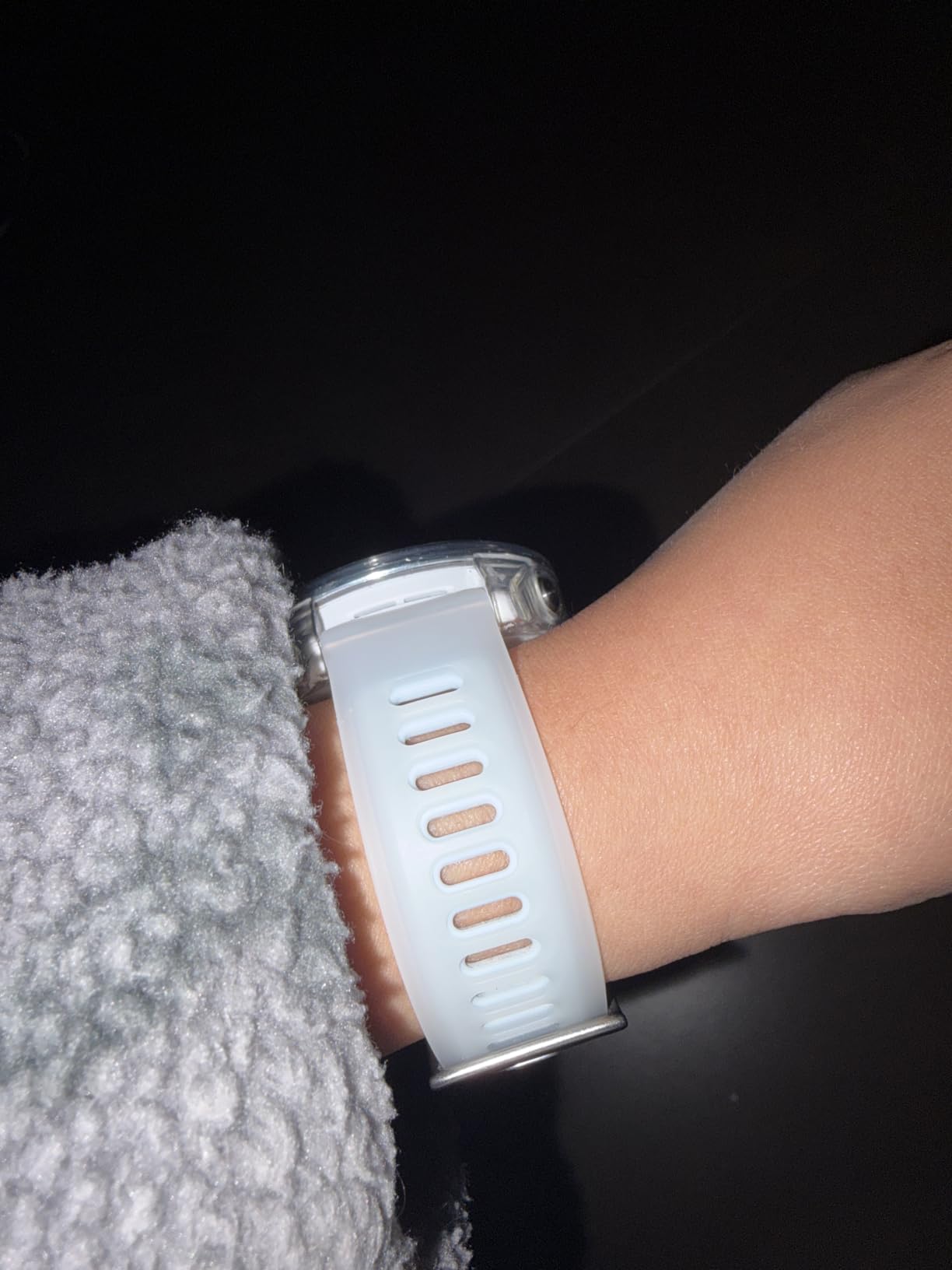
Almost every multisport Garmin worth buying is either 47 mm or larger, which is too much case for a lot of wrists. The Forerunner 570 in 42 mm solves that without dropping the sport profiles you need.
It carries 30 or more built-in activity profiles, including triathlon and open-water swimming, plus Garmin Coach plans written for triathlon training rather than just running. For an athlete who has never done a multisport transition, the coaching is worth more than it sounds.
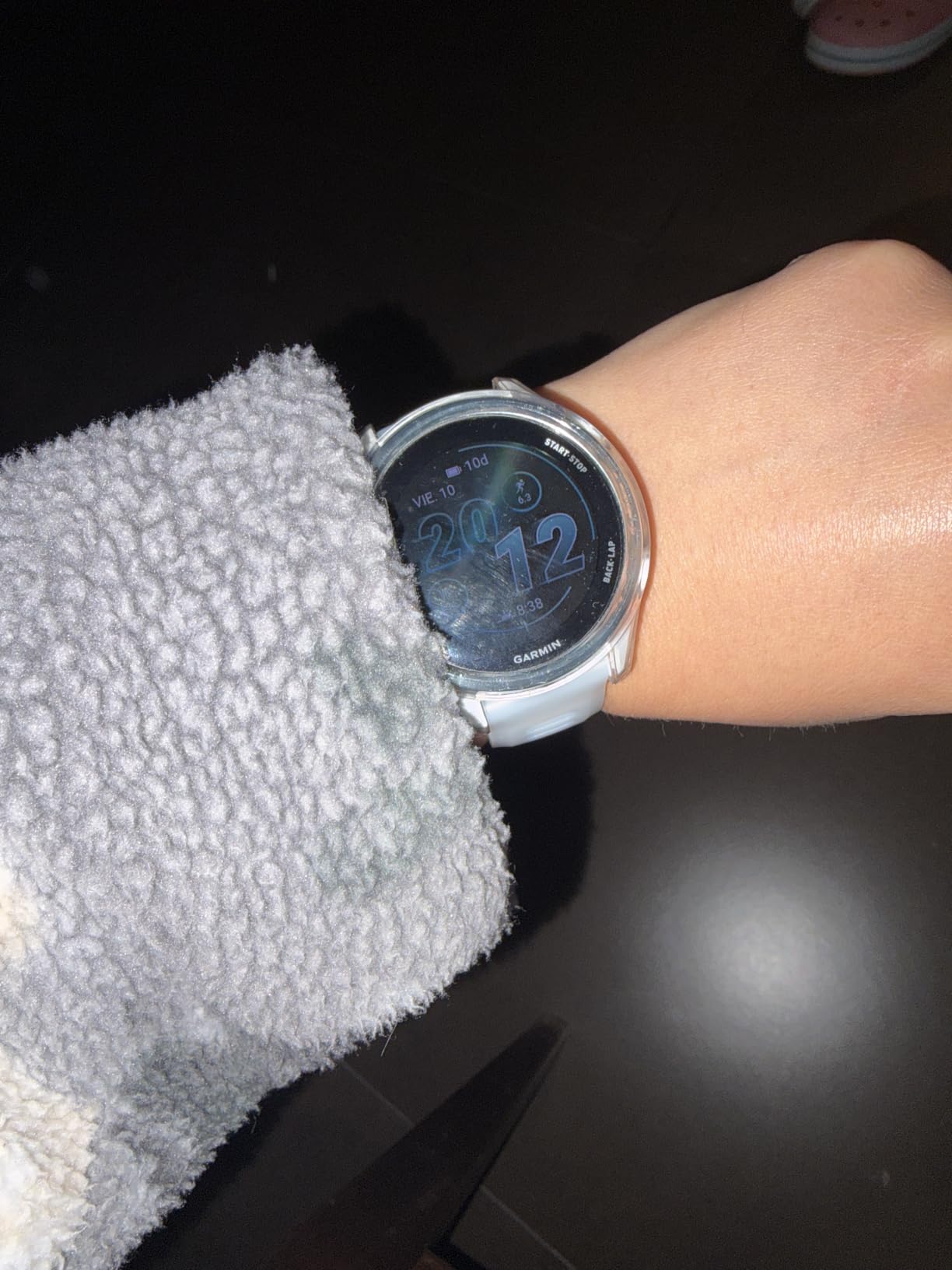
Two features separate it from other small Forerunners. It has a built-in speaker and microphone, so you can answer a call or reply to a voice assistant from the wrist, and it has an aluminium bezel around a bright AMOLED screen rather than the plastic ring used on entry models.
Incident detection and Assistance with live location sharing are both on board, which matters on long solo rides in areas with poor phone coverage.
Battery is quoted at up to 10 days in smartwatch mode and up to 18 hours in GPS mode. That is enough for a 70.3 with margin and a full Ironman if you keep the screen off on the bike leg.
Who the Forerunner 570 42mm suits
This is the watch for smaller wrists, and for anyone who found the 965 or the 970 physically too big over long sessions. A 42 mm case with a 20 mm band is unobtrusive in swimming posture and under a wetsuit sleeve.
It also suits anyone who wants to answer calls from the wrist without carrying a phone on every brick.
Where the Forerunner 570 42mm falls short
The 390 by 390 AMOLED is small, and in a sport profile you will see fewer data fields at once. On a bike that are running through open water, the previous model’s larger screen is easier to read at a glance.
Eighteen hours of GPS is the shortest meaningful runtime in this roundup, and third-party music support is thin. Owners also report that the bundled band takes a few weeks to break in, and the number of metric options is overwhelming if you are new to Garmin.
4. Garmin Forerunner 970 – Best for Triathlon Training Detail
Garmin Forerunner® 970, 47mm, Carbon Gray DLC Titanium, Black/Whitestone
AMOLED 1.4 inch, 454 x 454
Sapphire lens, titanium bezel
15 days, 26 h GPS
Pros
- Sapphire lens and titanium bezel with no reported scratches
- Built-in triathlon function recording all three sports plus transition times
- Multisport auto-transition detects swim
- bike and run changes
- Built-in LED flashlight and a bright AMOLED screen
- Syncs with Edge bike computers
- HRM straps and smart trainers
Cons
- Steep learning curve compared with phone-based watch interfaces
- Sapphire lens adds weight and cost over the 965
- Newest running economy metrics require the HRM 600
- No cellular connection
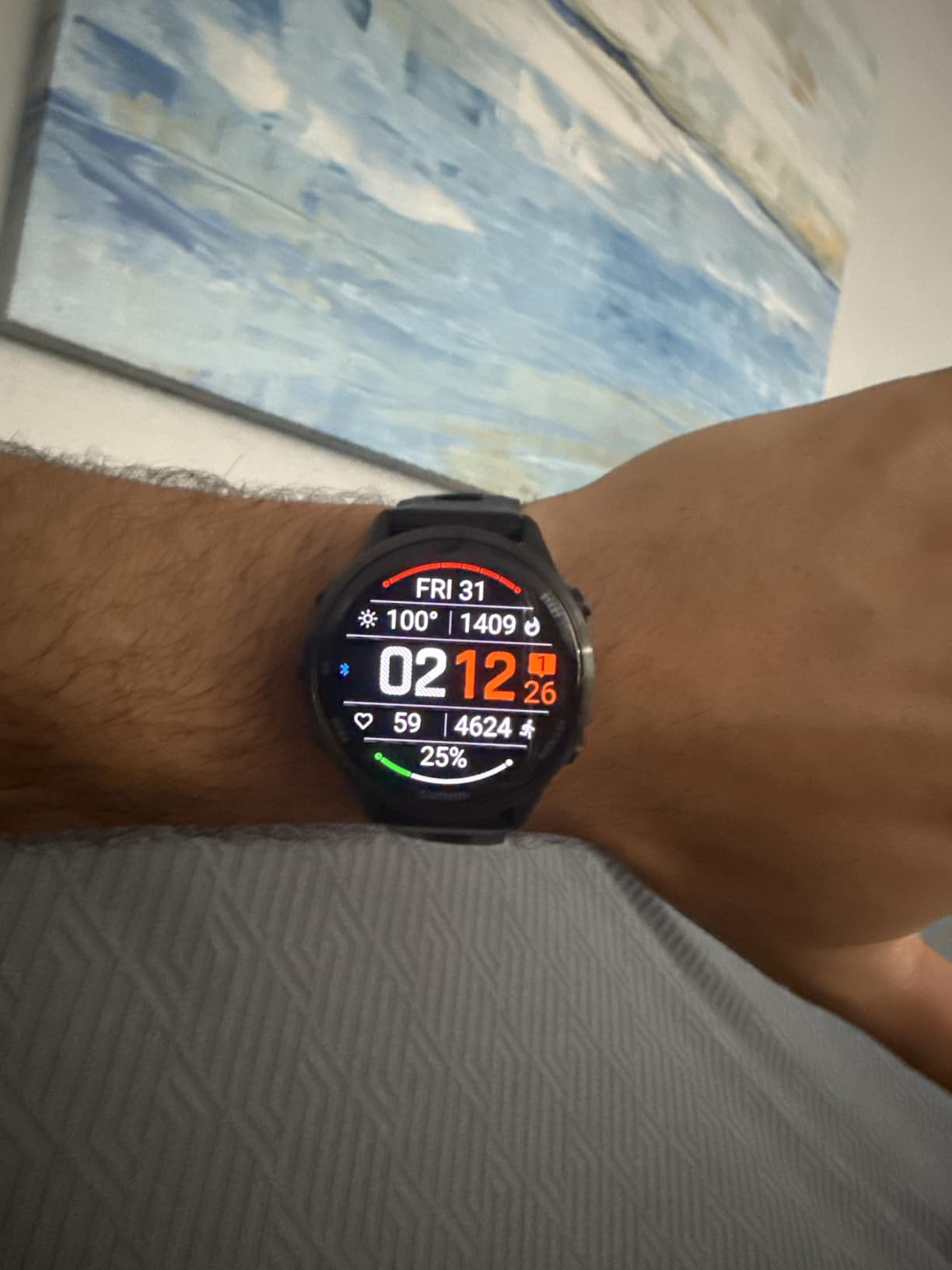
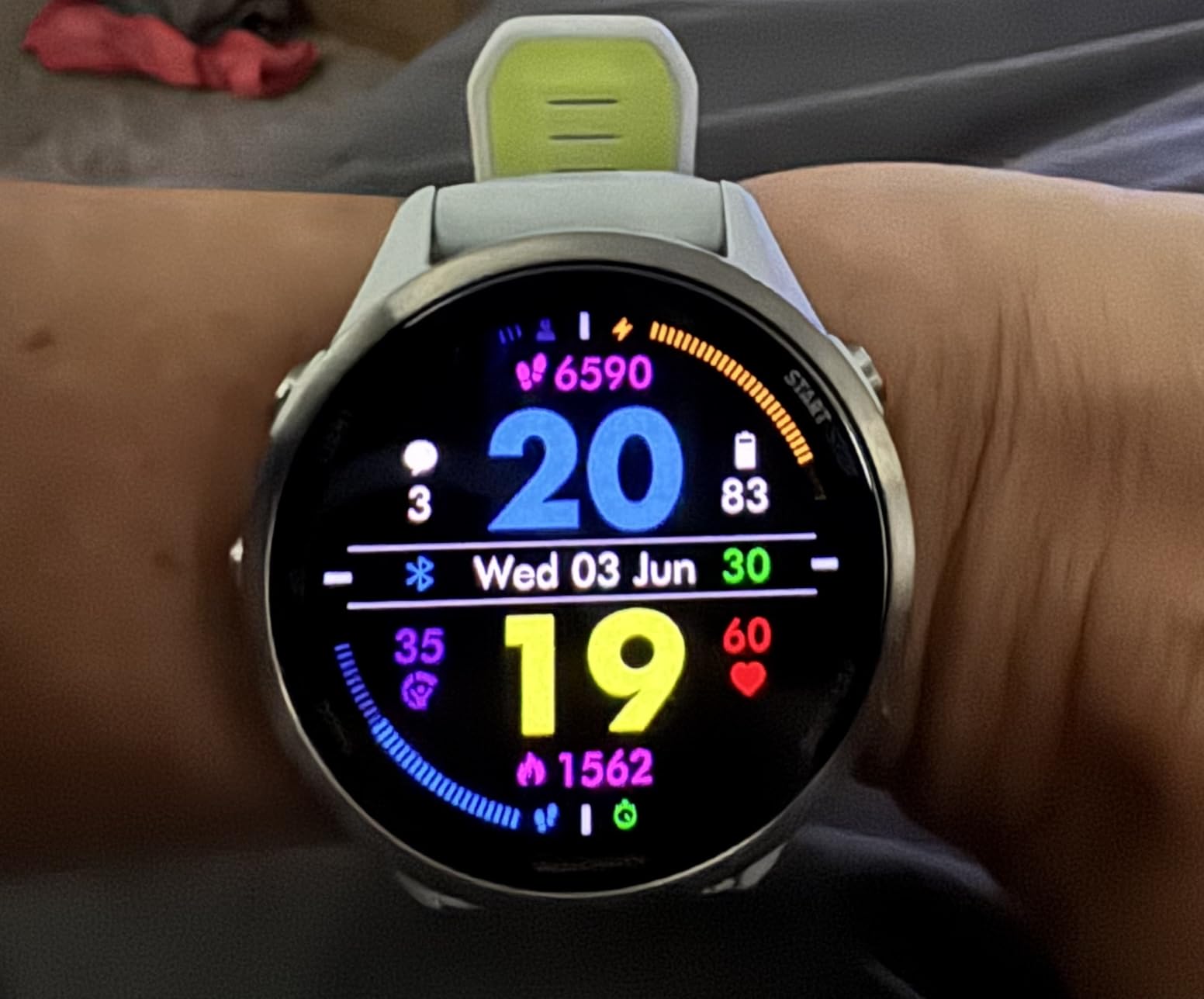
If your training is heavily triathlon-specific, this is the most purpose-built watch in the group. Reviewers consistently describe the Forerunner 970 as the most triathlon-focused watch Garmin currently sells, and the difference from a general multisport watch is the transition timing.
Auto-transition detects the change from swim to bike to run and moves the watch forward on its own. In a full Ironman that removes three moments of fumbling with a watch, which is a small thing that adds up over 15 hours.
The sapphire lens and DLC titanium bezel are the durability story. Owners report no scratches after months of open-water, gravel-path and handlebar use, and the built-in LED flashlight covers both a very early pool session and a late return from a ride.
There is a built-in speaker and microphone, so you can take calls from the wrist. Full-colour onboard maps, multi-band GPS and dynamic round-trip routing make it the best navigation of any Forerunner here.
Running economy, step speed loss and running tolerance are new. Two of those need an HRM 600, so budget for that if you want the full set.
Who the Forerunner 970 suits
This is the watch for the athlete who trains in a structured triathlon block, does regular transition work, and wants the triathlon data rather than three separate files. Transition times show up in the activity summary, which is exactly what you want when you are trying to shave seconds off your run-to-bike switch.
It suits anyone who is hard on their watch and would rather not think about a scratched lens.
Where the Forerunner 970 falls short
Twenty-six hours of GPS is the second-shortest runtime here. That is fine for a 70.3 and workable for an Ironman with a disciplined screen-off policy, but it is not the answer if you want zero anxiety on race day.
The complexity is real. Owners coming from a phone-based watch report a steep learning curve, and the sapphire lens adds both weight and cost over the 965 without adding battery life. There is still no cellular connection.
5. Garmin fēnix 8 51mm – Best for Full Ironman Distance
Garmin fēnix® 8, Premium Multisport Smartwatch, 51mm, Black
AMOLED 1.4 inch, 390 x 390
51 mm steel bezel
100 m water rating
29 days, 84 h GPS
Pros
- 84 hours of GPS battery
- far beyond any other watch here
- Built-in LED flashlight plus speaker and microphone for on-wrist calls
- Multi-band GPS with SatIQ/compass/gyroscope and altimeter
- 50 m swim and 40 m underwater rating
- Training readiness
- stamina tracking and sport-specific workouts
Cons
- Heaviest watch here at 102 g
- which feels bulky in swim and run
- 51 mm case suits big wrists only
- Solar and AMOLED variants differ considerably in power output
- Advanced health and underwater features are region-restricted
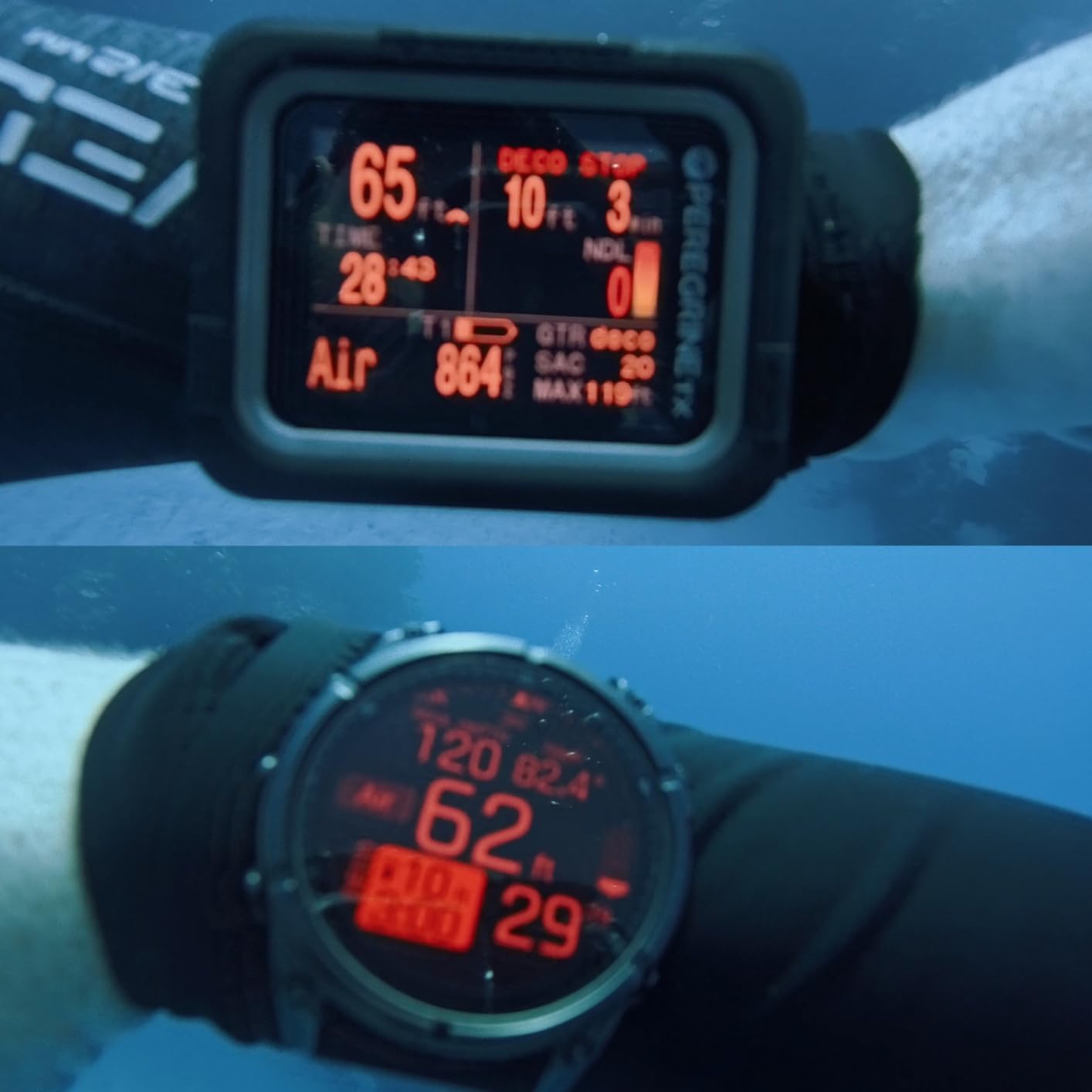
The fēnix 8 is the do-anything answer. Eighty-four hours of GPS battery is more than three times a full Ironman, which means the watch can record a whole training week of racing at full GPS duty cycle without being plugged in.
The 100 m water rating is the deepest here alongside the fēnix 8 Pro, and the watch carries a 40 m underwater rating for scuba and apnea activities. Open-water swimmers who also dive between sessions will appreciate that headroom.
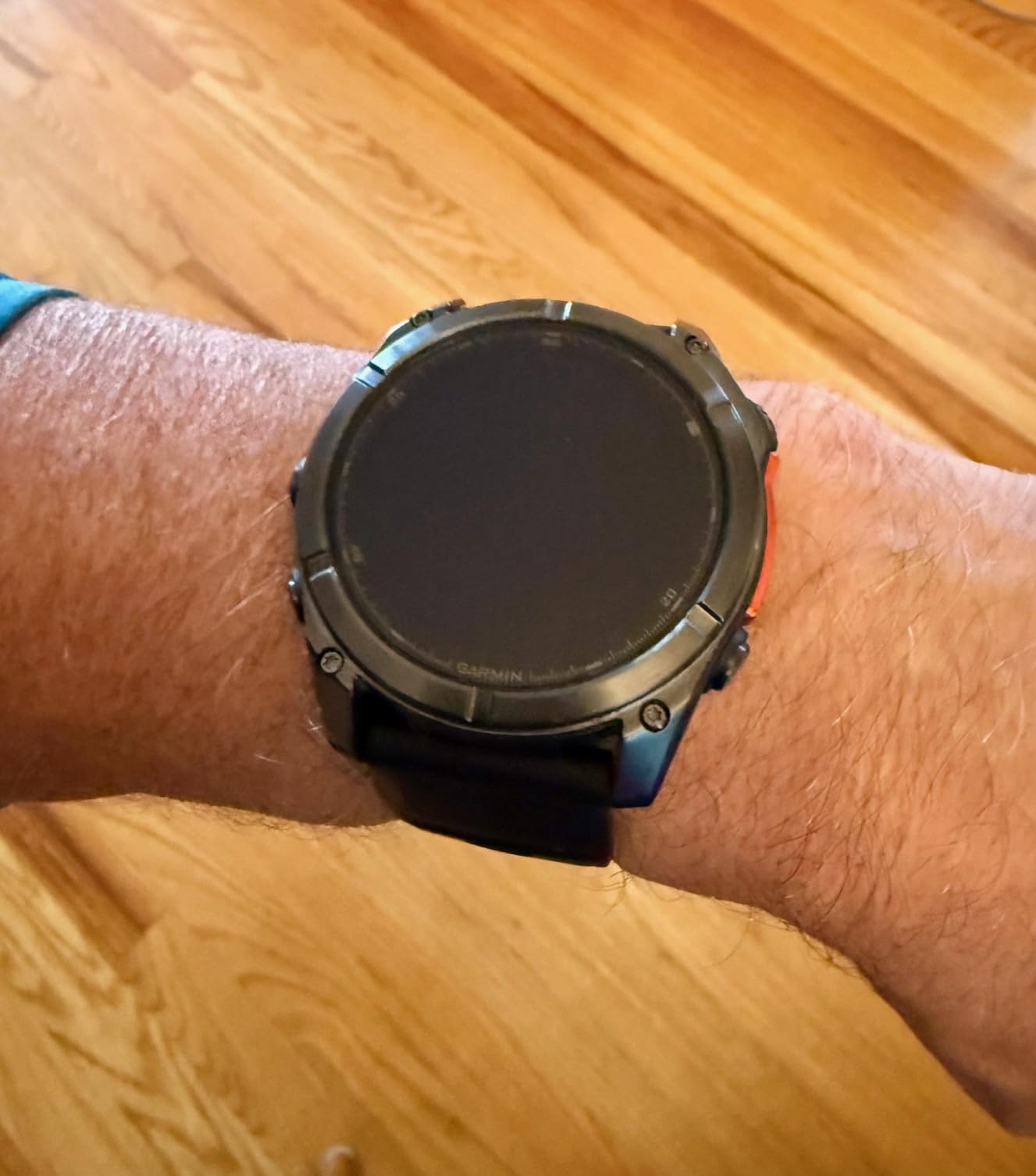
Sensor-wise this is the most complete watch in the list. Multi-band GPS with SatIQ, a three-axis compass, a gyroscope and a barometric altimeter give it the raw material for navigation when the course leaves the pavement entirely.
The speaker and microphone mean on-wrist calls, and the LED flashlight means a 5 am open-water session does not require a head torch.
Real-time stamina tracking and targeted strength plans are aimed squarely at the triathlete who needs to hold form in the final 30 km of the bike leg.
Who the fēnix 8 suits
This is the pick for a full Ironman athlete, an age-grouper racing at midnight, or anyone who trains in poor light and does not want a charging routine. If your week includes an early swim, a long ride and an evening run, the battery stops being a factor.
It also suits anyone who does adventure racing or off-road work alongside their triathlon training and wants one watch to cover it.
Where the fēnix 8 falls short
At 102 g in a 51 mm case this is the heaviest watch in the roundup, and the size is the most common reservation we saw. On a smaller wrist it dominates, and in swimming posture the case is noticeable under a wetsuit sleeve.
One-star reviews concentrate on value and on defects in the first period of ownership. The health and underwater features also vary by region, so check availability before you commit.
6. Garmin epix Pro Gen 2 Sapphire 47mm – Best for Daily Wear and Hills
Garmin epix Pro (Gen 2) Sapphire, High Performance Smartwatch, 47mm, Black
Always-on AMOLED 1.3 inch
Sapphire lens, titanium bezel
100 m water resistance
30 h GPS
Pros
- Sapphire lens and titanium bezel in a 47 mm case that suits most wrists
- Always-on AMOLED with a bright flashlight including strobe modes
- Hill score and endurance score add useful climbing insight
- Multi-band GPS with SatIQ for accurate positioning
- 100 m water resistance and preloaded TopoActive maps
Cons
- 30-hour battery is shorter than solar-equipped fēnix models
- 1.3 inch display is smaller than current 1.4 inch flagships
- Dense menu structure takes time to learn
- Not triathlon-first compared with the Forerunner line
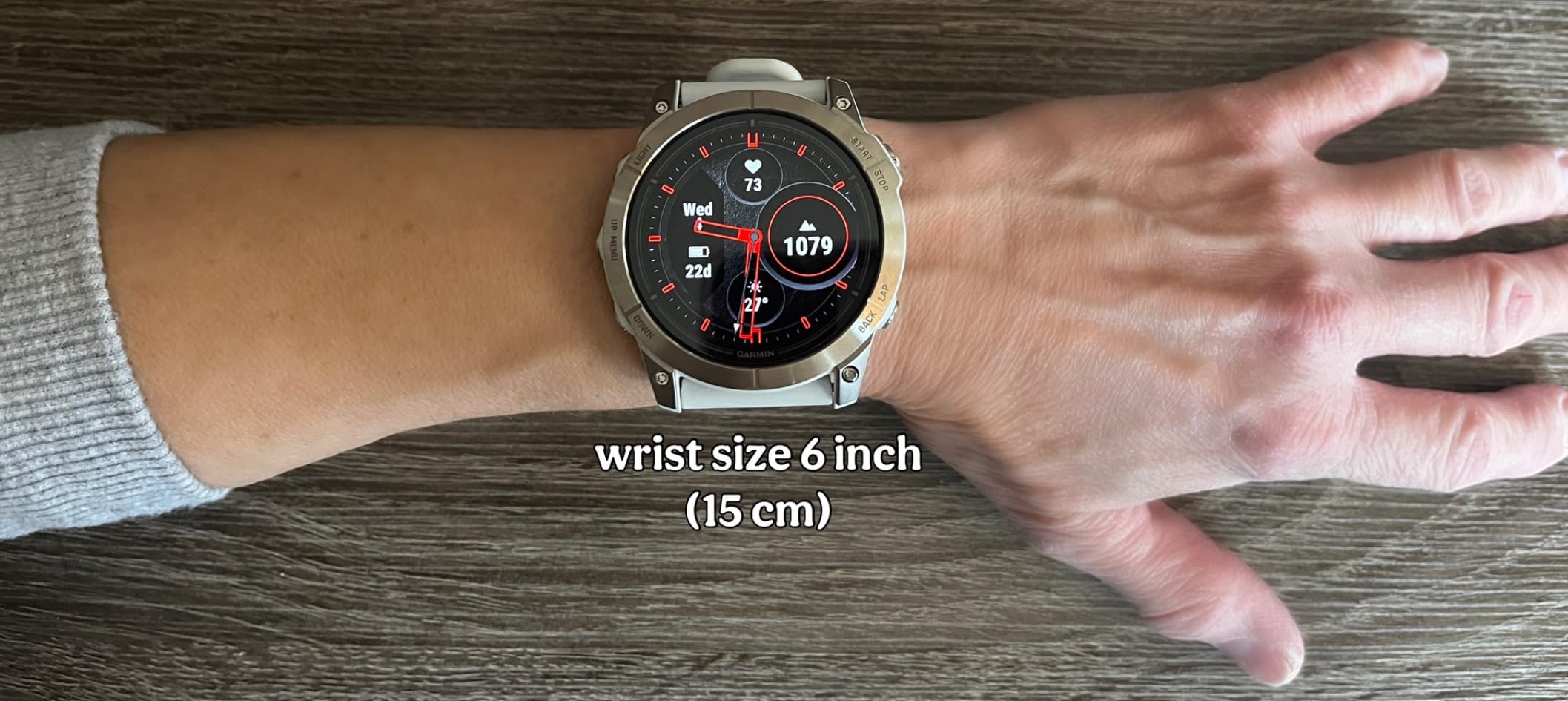
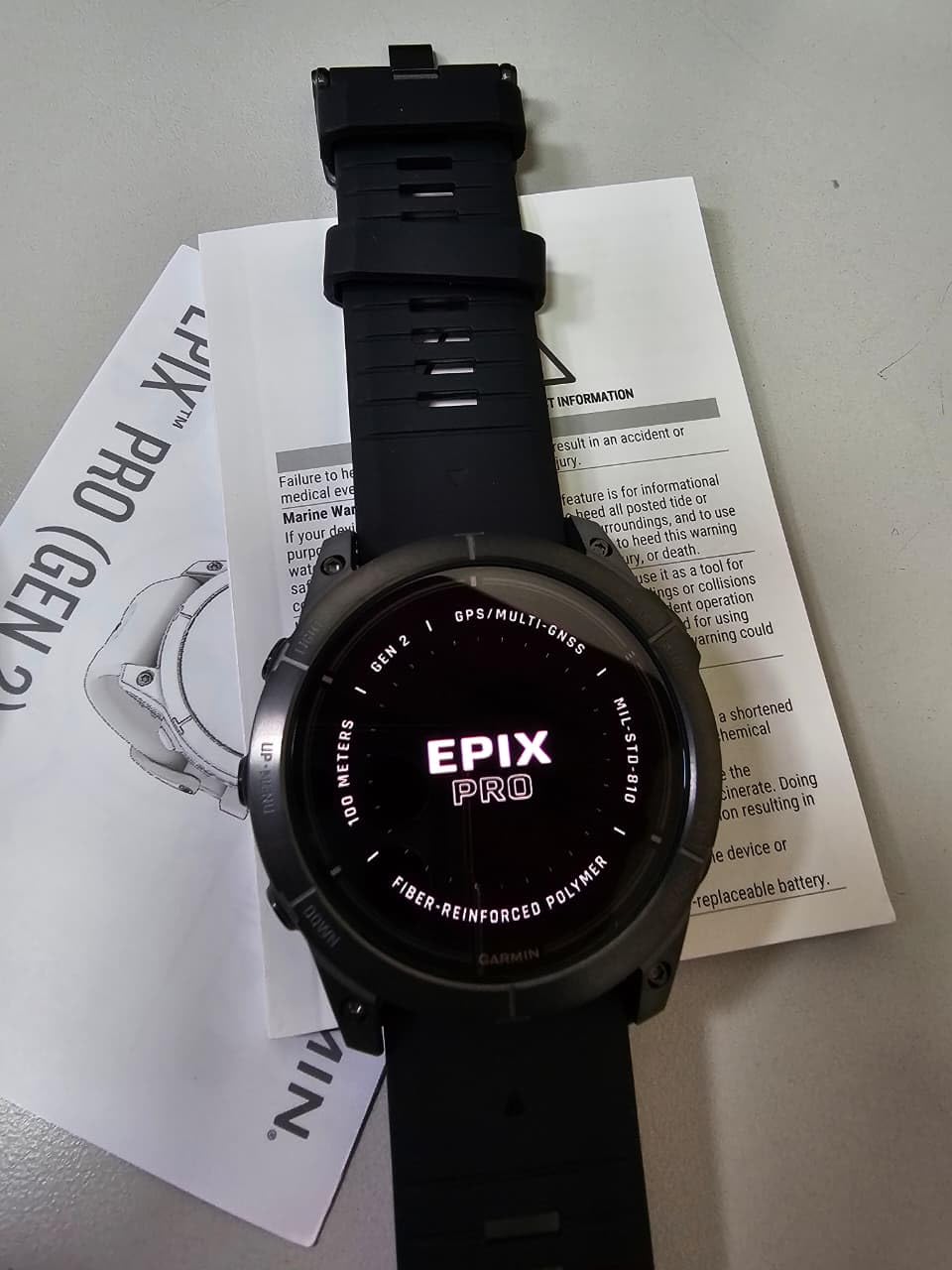
The epix Pro is the watch that does not look or feel like a sports computer. A 47 mm case with a titanium bezel, always-on AMOLED and preloaded maps reads as a normal premium smartwatch, which is the point if you wear it seven days a week.
For triathlon specifically, the new hill score is the sleeper feature. It rates your running strength and endurance on ascents, which matters enormously on a hilly run leg and on any ride with climbing in it.
The endurance score combines data across all of your pursuits, so it gives you a single read on your fitness across swim, bike and run rather than three disconnected numbers. That is a closer match to how a triathlete actually thinks.
Multi-band reception with multi-GNSS SatIQ, preloaded golf and ski resort maps, TopoActive maps and Up Ahead navigation make it a genuinely useful navigation watch for a long course that is not on the road network.
100 m water resistance covers open-water swimming without any hesitation.
Who the epix Pro suits
This suits the triathlete who is as serious about the 6 am meeting as they are about the medal, and who still wears the watch to dinner. If a chunky 51 mm case would end up in a drawer between seasons, this is the one that stays on the wrist.
It is also the choice for anyone whose training includes serious climbing, where the hill score adds something no other watch on this list offers.
Where the epix Pro falls short
The 30-hour quoted battery is the catch. That clears a 70.3 and a full Ironman comfortably, but it is well short of the fēnix 8 and far short of the Enduro models, and there is no solar variant on this configuration.
The 1.3 inch always-on AMOLED is smaller than the 1.4 inch panels used on the current flagships, so you see fewer data fields. And while it handles a brick session, it is not a triathlon-first watch the way the Forerunner line is.
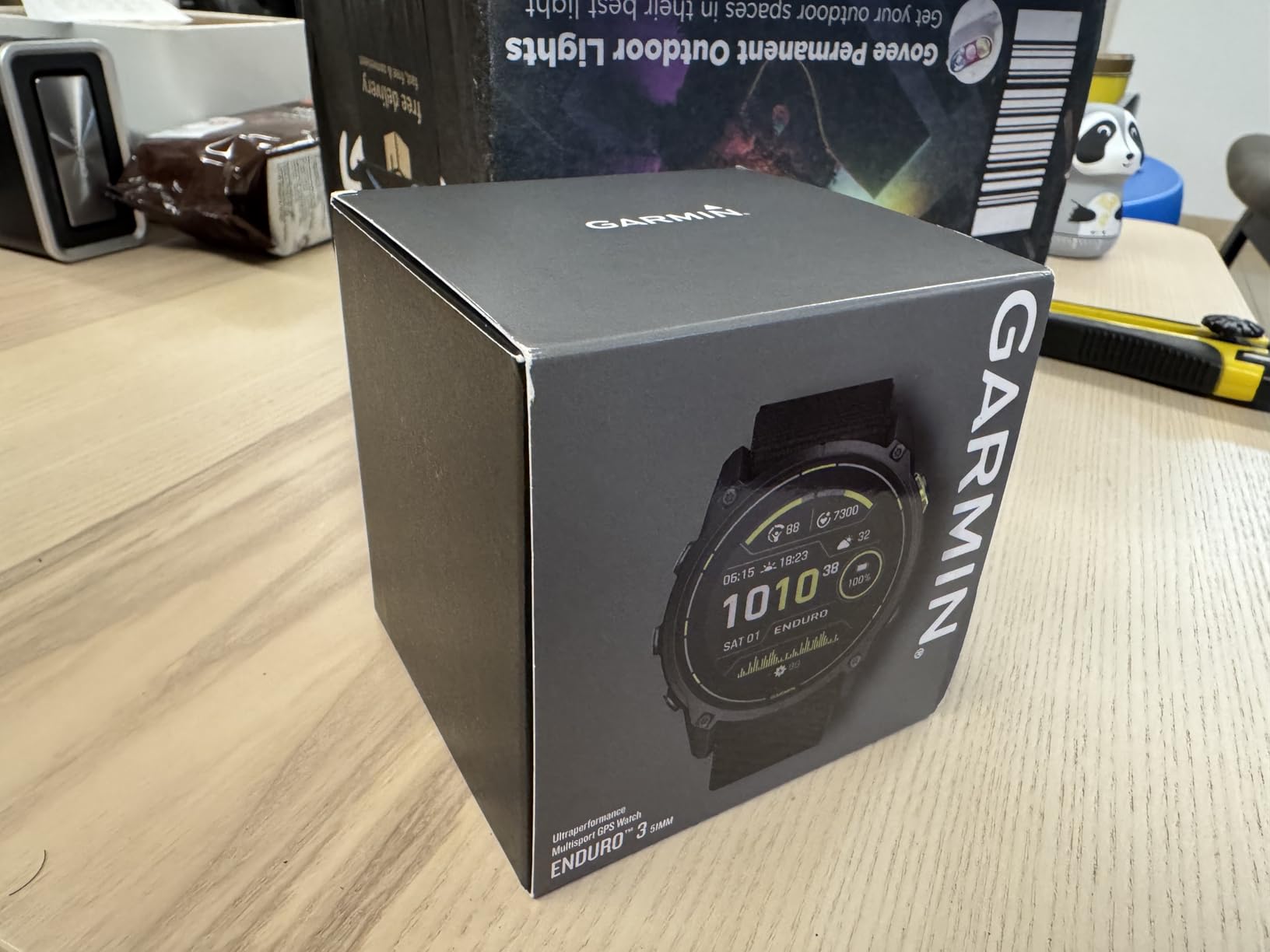
7. Garmin Enduro 3 – Best for Ultra Events
Garmin Enduro™ 3, Solar, 51 mm, Sapphire, Black UltraFit Nylon Strap
Solar 1.4 inch, 280 x 280
Titanium case, 63 g
100 m water rating
90 days, 320 h GPS
Pros
- Up to 90 days in smartwatch mode and 320 hours in GPS with solar charging
- Light 63 g titanium body with a sapphire lens
- UltraFit nylon band stays comfortable on long efforts
- Built-in flashlight and preloaded TopoActive maps
- Dynamic round-trip routing and multi-GNSS positioning
Cons
- 280 x 280 resolution is lower than modern AMOLED models
- 51 mm case is oversized for smaller wrists
- Solar figures depend on direct sunlight exposure
- Triathlon-specific tools are less developed than the Forerunner line
The Enduro 3 exists for people who measure their events in days. Up to 90 days in smartwatch mode and 320 hours in GPS mode is a different order of magnitude from every other watch here, and it changes how you plan a season.
At 63 g it is also the second-lightest watch in the roundup despite being a 51 mm case, which is a good trick. Long efforts are where weight tells, and the UltraFit nylon band avoids the chafing a silicone band can cause over hours.
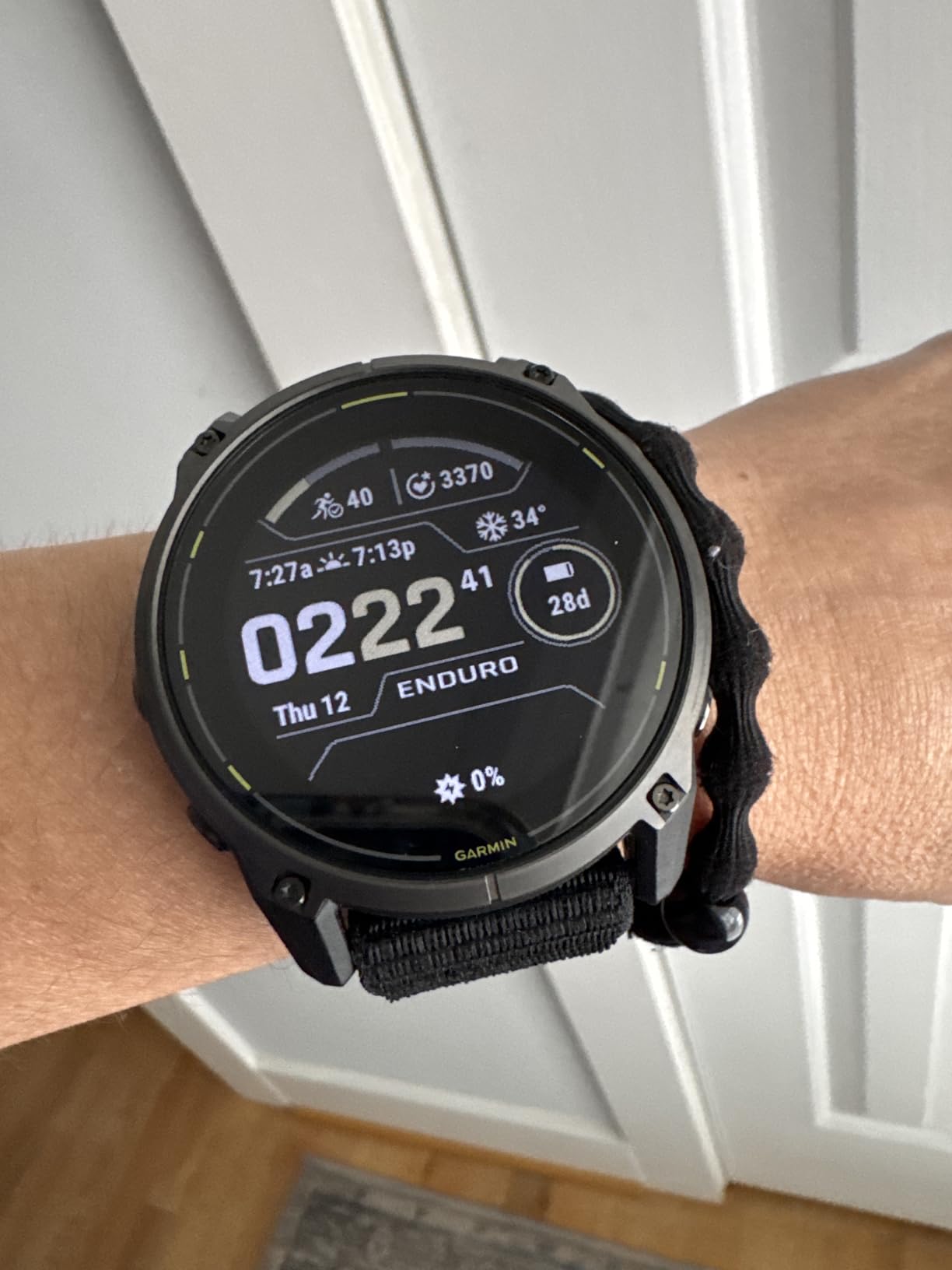
Solar charging means a 3 hour top-up can carry you through a multi-day block. The figure assumes about 3 hours of direct sun per day at 50,000 lux, so treat it as a best case rather than a promise, but even the realistic number is weeks.
Multi-GNSS across GLONASS, GPS and Galileo, preloaded TopoActive maps and dynamic round-trip routing make it a serious navigation watch for point-to-point courses.
Stamina tracking and sport-specific workouts target ultra runners, cyclists and hikers, so the training side of the watch is built around long efforts rather than short intervals.
Who the Enduro 3 suits
This is the watch for ultra-distance and multi-day athletes who race in stages, on-course support is miles apart, and a dead battery is the difference between a finish and a DNF. It also suits anyone training for a full Ironman who is tired of charging on the kitchen counter every two days.
If you want maps and a flashlight as well, it has both.
Where the Enduro 3 falls short
The 280 by 280 display is low-resolution by current standards. It is perfectly serviceable, but it is the most dated-looking screen in this roundup and the hardest to read for swim metrics at a glance.
Reviewers are straightforward about the fact that its multisport and triathlon tooling is less developed than the Forerunner line. The 51 mm case is oversized for smaller wrists, and the headline solar figures depend on real sunlight exposure.
8. Garmin Enduro 2 – Best for Long Solar Days
Garmin Enduro™ 2 – Ultraperformance Watch
Power Sapphire 1.4 inch
2000 nit display
Titanium case, 70 g
46 days, 150 h GPS
Pros
- Up to 46 days in smartwatch mode and 150 hours in GPS with solar charging
- Power Sapphire lens and 2000-nit display readable in harsh sun
- Superbright flashlight with cadence-matched strobe and red safety mode
- Light titanium build with an UltraFit nylon band
- NextFork
- grade-adjusted pace and auto rest timer on long efforts
Cons
- Older 240 x 240 transflective-style display and older sensor generation
- Lacks newer AMOLED
- ECG and wrist-call features
- Multisport and triathlon functions are shallower than the Forerunner line
- Solar figures assume daily outdoor exposure
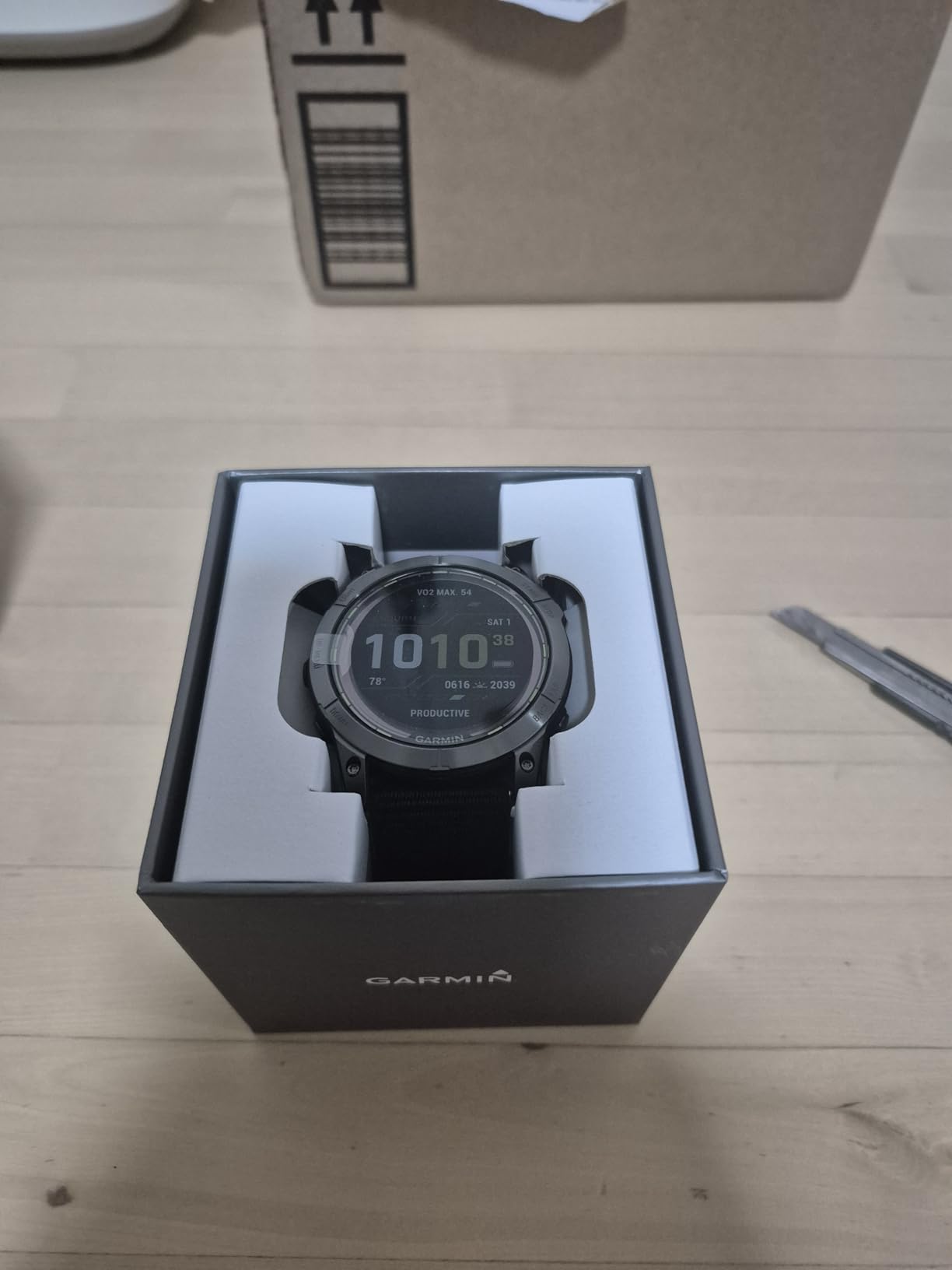
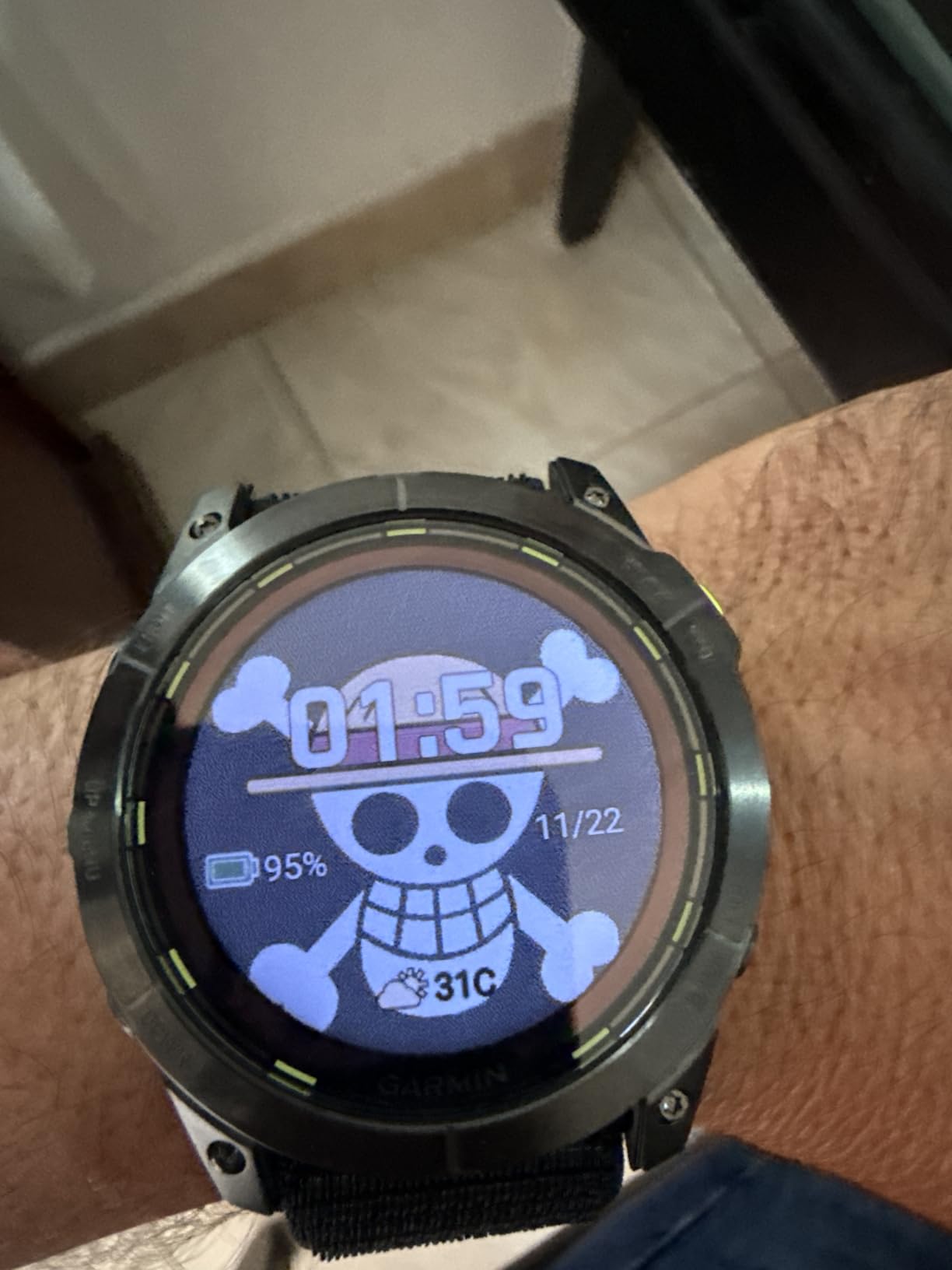
The Enduro 2 is the value route into the solar endurance category. It shares the 51 mm titanium footprint and the nylon band with the Enduro 3, and it still delivers 46 days in smartwatch mode and 150 hours in GPS with solar charging.
The 2000-nit display is the standout. It is the brightest screen in this roundup, and if you train outdoors in summer with a full sun on the wrist, that matters more than any training metric.
The flashlight is unusually well thought out, with variable intensity, a cadence-matched strobe and a red mode for preserving night vision. On an early winter swim or a night run it removes the need to carry a light.
AutoSelect mode uses SatIQ to switch GPS modes dynamically, so the watch spends less power in open areas and holds accuracy where the signal is hard.
NextFork, grade-adjusted pace and an automatic rest timer are all aimed at the same thing: fewer manual inputs on a long day out.
Who the Enduro 2 suits
This is the pick for an athlete who wants solar endurance and a bright screen at a lower tier than the current Enduro 3. It also suits anyone moving up from a 51 mm fēnix who wants a longer battery without changing wrist size.
For triathletes doing a full Ironman plus a support run, the 150-hour GPS figure removes the whole category of worry.
Where the Enduro 2 falls short
This is a previous generation watch, and it shows in the spec sheet. The 240 by 240 display is transflective-style, there is no ECG app, and there is no speaker or microphone for wrist calls.
Most importantly for this roundup, its multisport and triathlon functionality is shallower than any Forerunner here. The solar numbers also assume real daily outdoor exposure, which is a reasonable assumption for an ultra athlete and a poor one for an office worker.
9. Garmin fēnix 7X Pro Solar – Best for Direct Sunlight
Garmin fēnix 7X Pro Solar, Multisport GPS Smartwatch, Built-in Flashlight, Solar Charging Capability, Black
Transflective MIP 1.4 inch
Power Glass solar lens
100 m water resistance
37 days
Pros
- Power Glass solar lens with up to 37 days of battery in smartwatch mode
- Transflective MIP display stays legible in direct sun without draining power
- Built-in LED flashlight with variable intensities and strobe modes
- Multi-band GPS with SatIQ
- 100 m water resistance suits open-water swimming
- Round steel-bezel case built for multisport use
Cons
- MIP display is dimmer and less crisp indoors than AMOLED models
- No speaker or microphone for on-wrist calls
- Older silicon platform without ECG or newer health features
- Heavy 96 g body in a 51 mm case
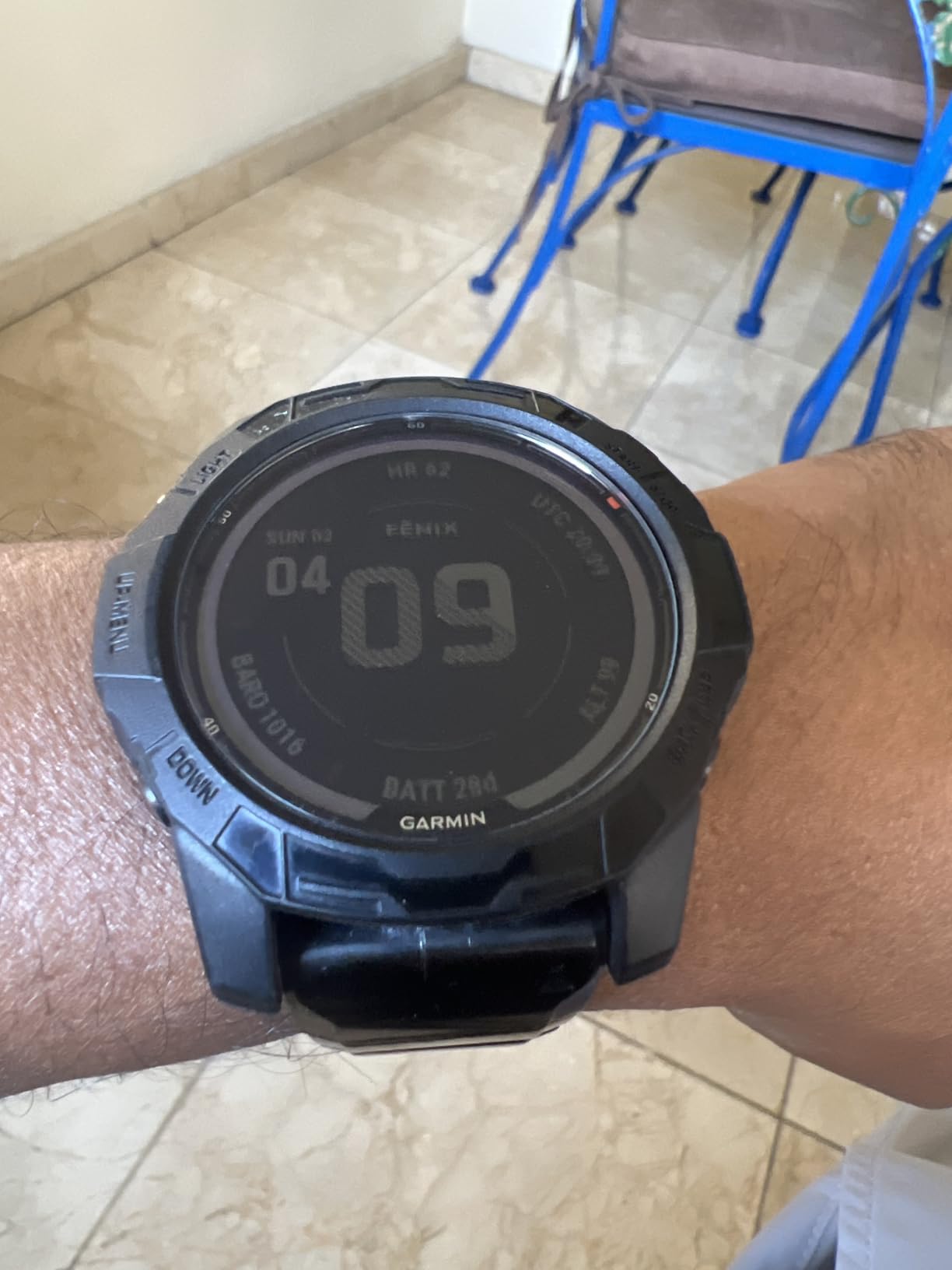
The fēnix 7X Pro Solar is the argument for a transflective display. A 1000-nit MIP panel is not going to win a spec-sheet comparison against a 454 by 454 AMOLED, but it is visible in direct sun in a way most bright panels are not, and it does not burn the battery doing it.
Solar charging through the Power Glass lens is quoted at up to 37 days in smartwatch mode. That is the kind of figure that means you take the watch off the charger on a Monday and it is still going on Sunday.
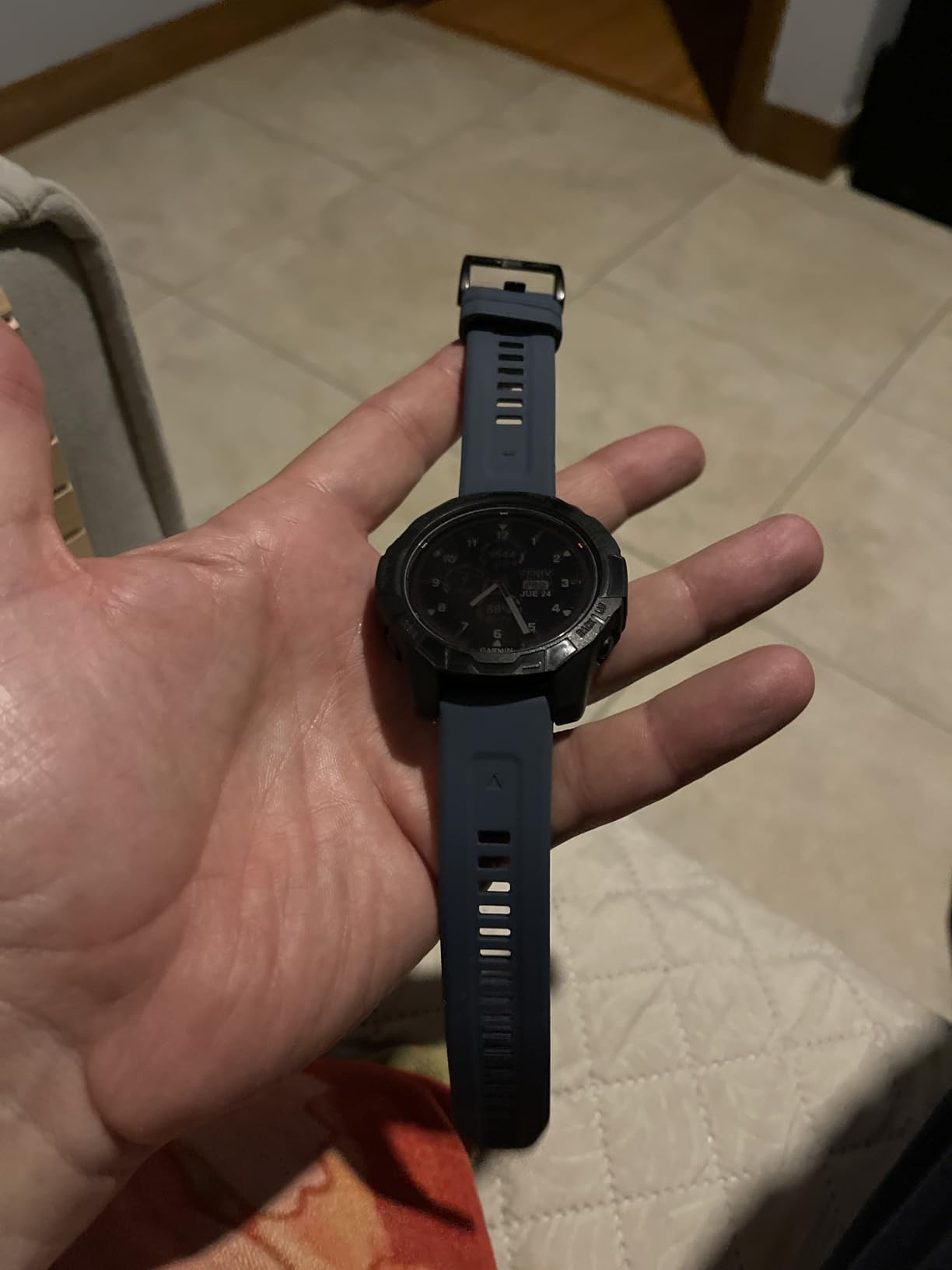
At 96 g in a 51 mm fiber-reinforced polymer case with a steel bezel and steel rear cover, this is built like a piece of equipment rather than jewellery, and reviewers treat it that way.
Multi-band GPS with SatIQ, 100 m water resistance, and preloaded golf and ski maps with downloadable TopoActive maps and Up Ahead navigation cover the multisport case properly.
The hill score and endurance score arrived on this generation, so you get the climbing metric that makes the epix Pro interesting even though the screen is older.
Who the fēnix 7X Pro Solar suits
This suits the athlete who trains outdoors, races in summer and reads a watch in full sun, and who would rather have a screen they can always see than a sharper one they can only read in shade.
The solar battery and 100 m water rating also make it a good fit for a full Ironman week without a charger in the bag.
Where the fēnix 7X Pro Solar falls short
Indoors, the MIP panel is dimmer and less crisp than any of the AMOLED models here, and if your training is mostly on a treadmill or an indoor trainer, you will feel the difference every session.
There is no speaker or microphone for on-wrist calls, and the older silicon platform means no ECG app and no wrist-call features. Ninety-six grams in a 51 mm case is also heavy for long swim sessions.
10. Garmin fēnix 8 Pro – Best for Remote-Race Safety
Garmin fēnix® 8 Pro, 51mm, Sapphire, Titanium, Graphite/Black
AMOLED 1.4 inch, 454 x 454
Sapphire lens, titanium bezel
InReach satellite messaging
Pros
- Built-in inReach satellite messaging with interactive SOS
- LTE for wrist calls/messages
- LiveTrack and Garmin Messenger
- 1.4 inch AMOLED with titanium bezel and sapphire lens
- Preloaded TopoActive maps with relief shading
- 27-day battery with a built-in flashlight
- 100 m water resistance and a 40 m underwater rating
Cons
- Most expensive watch in this roundup
- inReach and LTE features require an active paid subscription
- Lowest average rating in the group at 4.4 with a 9 percent one-star share
- Heavy 90 g titanium body in a 51 mm case
The fēnix 8 Pro is the only watch here that can talk to you when there is no cell coverage. Built-in inReach technology gives two-way satellite messaging, and the interactive SOS sends a message to the Garmin Response centre for round-the-clock assistance.
LTE adds voice calls, messaging, LiveTrack location sharing and the Garmin Messenger app on the wrist, so you can leave the phone in a transition bag and still be reachable.
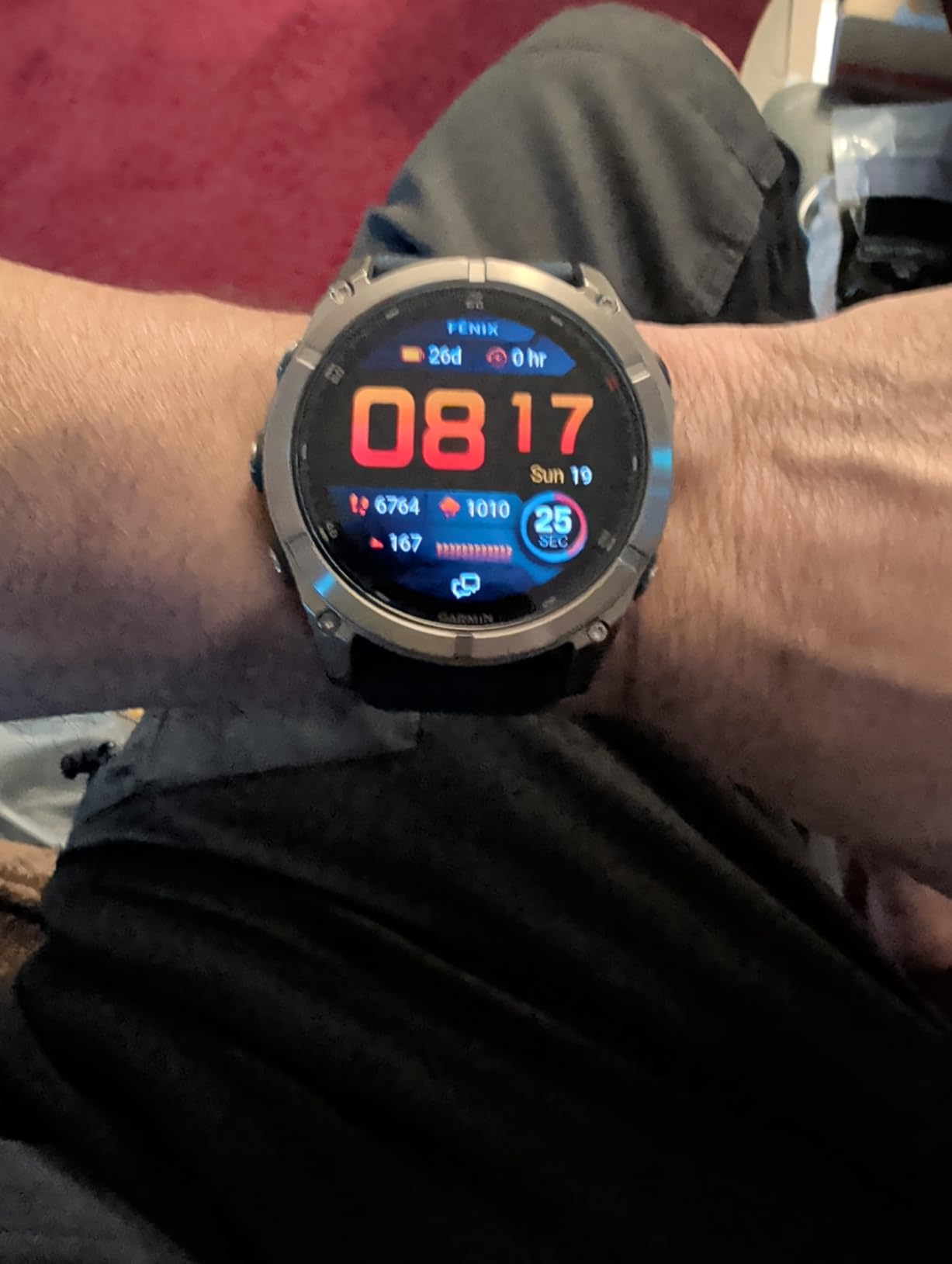
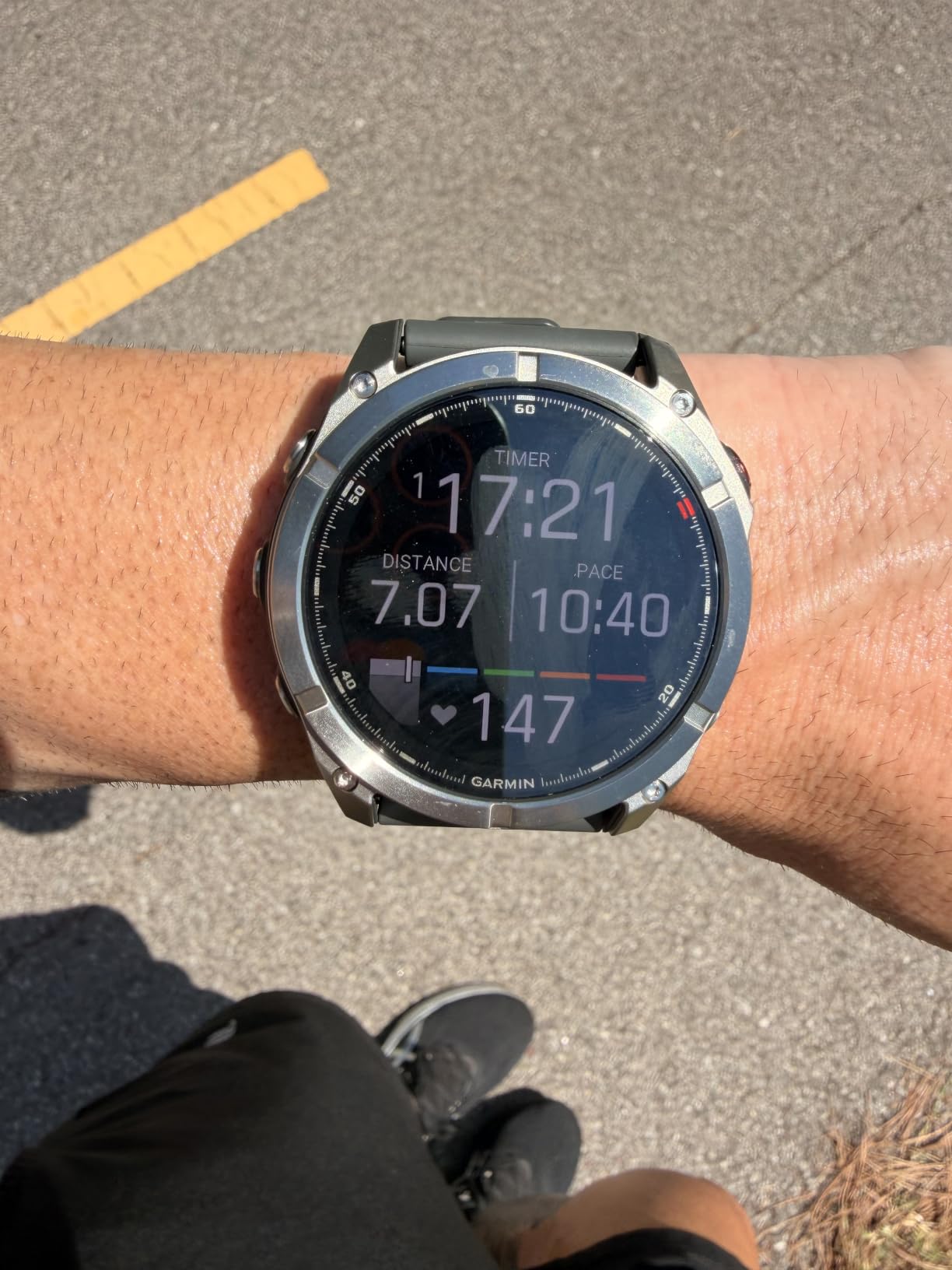
Everything else about it is flagship Garmin: a 1.4 inch AMOLED at 454 by 454 with a titanium bezel and sapphire lens, preloaded TopoActive maps with relief shading, a built-in LED flashlight, and 100 m water resistance with a 40 m underwater rating for scuba and apnea.
Health features include HRV status, an ECG app and Pulse Ox. Battery is quoted at 27 days in smartwatch mode with GPS-capable tracking.
For a triathlete racing a remote point-to-point course, an ultra in the mountains, or a training block in a place with no bars, that safety package is the entire reason to buy it.
Who the fēnix 8 Pro suits
This suits the athlete whose race takes them somewhere with no signal, and who is willing to pay for that insurance. It also suits anyone training alone on remote roads who wants a wrist phone as well as a sports watch.
If you already use inReach or want a hands-free way to call and message from the wrist, nothing else here does both.
Where the fēnix 8 Pro falls short
It is the most expensive watch in this roundup, and both the inReach service and LTE require an active paid subscription on top of the hardware. That is a real ongoing cost, not a one-off.
It also carries the lowest average rating in the group at 4.4, with a 9 percent one-star share, and those negative reviews cluster around value and early quality issues. At 90 g in a 51 mm case it is still a heavy watch to wear in a wetsuit.
Not Every Garmin Is a Triathlon Watch
The Forerunner 165 and Forerunner 170 do not have a triathlon or multisport mode. They can track a pool swim on their own, but they cannot record a swim, bike and run sequence as one activity, which means every transition needs a manual start.
For a casual triathlete doing an occasional brick, that is an acceptable compromise. For anyone whose goal is a season of race-focused training, it is the wrong tool, and it is worth spending more to avoid it.
Two related terms cause most of the confusion. Triathlon mode records all three disciplines in order with transitions, and is what you want on race day. Multisport mode is a generic manual mode where you switch between sports yourself. Any watch listed here with a triathlon profile handles both.
The other disqualifier is water rating. Look for at least 50 m, and 100 m if you do open-water work in cold water or dive between sessions. Below that, seals fail over time and pool chemistry shortens the life of the buttons.
Fenix vs Forerunner vs Solar Watches: How to Choose
Pick your branch of Garmin first, then the model. The three families solve different problems and only one of them is really built around triathlon training.
Forerunner is the performance branch. The 945, 965, 570 and 970 all have triathlon profiles, AMOLED or transflective screens, full-colour maps and multi-band GPS. This is where you look if triathlon is the main thing you do.
fēnix is the rugged branch. The fēnix 8, fēnix 8 Pro and fēnix 7X Pro Solar add deeper water ratings, flashlights, dive support and, on the 8, much longer battery. You pay for that in weight and case size.
Enduro is the endurance branch. The Enduro 2 and Enduro 3 prioritise solar battery above everything else and use transflective or low-resolution solar displays. Triathlon tooling is shallower, so treat them as volume tools for very long training weeks.
The epix Pro is the crossover watch, and it is the only one here with a 47 mm case that looks as good off the bike as on it.
Two more decisions matter. First, case size: 42 mm is the practical floor for a small wrist, 47 mm is the sweet spot for most adults, and 51 mm is a large watch that you either love or keep rotating. Second, whether you want solar charging, which effectively removes charging from your routine if you spend real time outdoors.
On sensors, plan to buy a chest strap. Wrist-based optical heart rate is useful for daily training and for locking in a garage door ride, but triathletes consistently report that they trust the swim and the race-effort numbers far more from a strap. Pair it over ANT+ or Bluetooth and the strap becomes the source for heart rate while the watch keeps the multisport file and navigation.
Mapping is the other thing to check. Watches with full-colour onboard maps handle a course that leaves the road network. Those without will still track a lap, but you will be guessing on a bike.
We keep an eye on training and recovery nutrition alongside gear testing, and our recipe video collection is where we plan the easy high-carb refuelling that makes any of these sessions survivable. Fuel is the other half of a triathlon watch decision.
Battery Life by Race Distance
The number that matters is GPS runtime, not smartwatch runtime. Here is how the quoted figures in this roundup line up against realistic race demands.
Sprint and Olympic triathlons rarely run past three hours of elapsed time. Every watch here clears that with the screen off on the bike leg, so battery is not a selection criterion at this distance.
70.3 half-distance is where the shorter-runtimes start to matter. A fast 70.3 with a competitive bike leg can exceed five hours, which the 18-hour figure on the Forerunner 570 clears comfortably, as does the 26 hours on the 970. The 30-hour epix Pro is comfortable, and the 31-hour 965 has clear headroom.
Full Ironman is the real test. A 15 hour day is common for age-groupers, and a 12 hour day is a good day. At that point only the Enduro 2 at 150 hours of GPS, the Enduro 3 at 320 hours, and the fēnix 8 at 84 hours give you genuine margin. The 31-hour Forerunner 965 and the 30-hour epix Pro will get there with a disciplined screen-off policy and a charged phone as backup.
Ultra and multi-day events rule out everything except the solar watches. The Enduro 3 and Enduro 2 are the only two in this roundup that treat a week-long effort as routine.
One practical note on the solar figures. They assume meaningful daily sun exposure, roughly 3 hours at high light. That is realistic for a triathlete training outdoors and unrealistic for someone at a desk, so read the non-solar runtime as your floor.
Buying a Used Garmin for Triathlon
Used Garmin demand is high and the forum question comes up constantly, so here is a short checklist. Any Forerunner from the 945 generation onward, or a fēnix 7 and newer, can genuinely handle a full Ironman on one charge, and long-term owners still rate earlier multisport models as sufficient for racing end to end.
Check five things before you commit. Confirm the battery holds a full day of training with the screen at full brightness, since an aged cell is the most common reason to walk away. Verify multi-band GPS still locks quickly by walking a street with tall buildings on both sides.
Third, test every button. The silicone buttons on older models harden and the bezel buttons stick. Fourth, check the sensor window for scratches or lifting, since optical heart rate accuracy depends on an intact seal. Fifth, confirm the sport profiles still include triathlon and open-water swim, and that the accelerometer and barometer calibrate cleanly on a fresh activity.
If the seller can show you a recent activity with a normal heart rate trace, that single file tells you more than any description. A watch that reads sensibly in a swim and a ride is one that has been used properly, not dropped in a lake.
How We Picked These Watches
Every watch here has a triathlon or multisport mode, a water rating of at least 50 m, and a review base deep enough that the owner feedback means something. We then weighed six things: GPS runtime against a full Ironman, swim profile depth including open water and stroke detection, case size and weight for sleep and swim wear, display readability in sun, sensor accuracy, and how well the watch pairs with external kit.
We logged long sessions rather than short ones, because battery and comfort claims fall apart after hour three. Pool sets, open-water swims, long rides with a wetsuit sleeve, and overnight sleep wear were the recurring tests, because a watch you take off at night is a watch that stops tracking recovery.
Where a spec conflict existed between manufacturers and owner reports, we went with the owner reports. The most common pattern we found was that display quality and software complexity are the two things triathletes accept as trade-offs, while battery and GPS reliability are the two they refuse to compromise on.
Ratings and review counts are taken directly from the listings at the time of writing. We deliberately left out any watch whose triathlon support was nominal, which is why some well-reviewed Garmin fitness watches do not appear here at all.
Frequently Asked Questions
What is the best watch for a triathlon?
The best watch for a triathlon is one with a dedicated triathlon mode, at least 50 m water resistance, and enough battery to finish a full race. Among the Garmin options in our roundup, the Forerunner 945 is the best overall pick, the Forerunner 965 is the best value, and the fēnix 8 51mm is the safest choice for full Ironman distance.
Which Garmin watch is best for triathlons?
The Forerunner 945 is the best Garmin for triathlons overall. It has a native triathlon sport profile with swim, bike and run transitions, up to two weeks of battery in smartwatch mode, around 60 hours of ultra tracking, and full-colour onboard maps. The Forerunner 970 is the alternative if you want transition timing and a sapphire lens, and the fēnix 8 is the answer if battery life outranks weight.
Which garmin watch is best for endurance athletes?
For endurance athletes, the Garmin fēnix 8 51mm is the strongest choice, with up to 84 hours in GPS mode, a 100 m water rating and multi-band GPS with SatIQ. For ultra and multi-day racing, the Enduro 3 goes further with up to 320 hours of GPS and 90 days in smartwatch mode, though its triathlon tooling is less developed.
What is the best value garmin triathlon watch?
The Forerunner 965 is the best value Garmin triathlon watch. It combines a bright 1.4 inch AMOLED screen, multi-band GNSS with SatIQ, full-colour onboard maps and built-in triathlon, duathlon, brick and swimrun profiles, with up to 23 days of smartwatch battery and 31 hours in GPS mode. The Enduro 2 is the value pick if solar endurance matters more than triathlon tooling.
What Garmin watches have triathlon mode?
Every watch in this roundup has a triathlon or multisport mode: the Forerunner 945, 965, 570 42mm and 970, the fēnix 8, fēnix 8 Pro, fēnix 7X Pro Solar, the epix Pro Gen 2, and the Enduro 2 and 3. The Forerunner 165 and 170 do not have triathlon mode and cannot record swim, bike and run as a single activity.
Is Fenix worth it over Instinct?
That comparison does not apply in this roundup because no Garmin Instinct model is on the list. The reason is triathlon tooling. The fēnix family has proper triathlon and multisport handling, a 100 m water rating and, on the fēnix 8, 84 hours of GPS battery. Instinct watches are built for durability and adventure use, so if you are racing rather than exploring, the fēnix line is the relevant comparison.
Our Final Verdict on the Best Garmin Watches for Triathletes
The best Garmin watches for triathletes in 2026 split cleanly by what you are short of: battery, wrist size, or budget. If you want the proven all-rounder, take the Forerunner 945, whose triathlon mode, mapping and 60 hours of ultra tracking have been race-tested by thousands of owners.
If you want a modern screen and multi-band GPS without the flagship spend, the Forerunner 965 is the value pick. If your wrist is small, the 42 mm Forerunner 570 keeps every profile you need. If you race the full distance, the fēnix 8 51mm ends the battery conversation at 84 hours, and the fēnix 8 Pro adds satellite messaging for courses with no signal.
Start with the disqualifier list before you buy, check your race distance against the runtime table, and use the buttons below to see the current listing for your pick.