The best portable power station under 500 dollars overall is the Jackery Explorer 300, with 292 watt-hours, 300W of continuous AC output, 600W of surge and a 7.1 lb body you can actually carry. If your load is an appliance rather than a phone, the Jackery Explorer 1000 v2 is the right pick instead, with 1070Wh and 1500W of continuous output.
That two-part answer is the whole story of this budget. Capacity and output are different things. A unit can hold a full kilowatt-hour and still stall the moment a refrigerator compressor kicks in, or it can push 1800W while holding barely enough charge for one night.
We compared 10 stations that all fit inside this budget, sorted the manufacturer spec sheets against thousands of buyer reviews, and worked out the runtime maths for each capacity tier. Everything below is measured against nameplate capacity, not marketing copy. Prices move constantly in this category, so check the live price on any listing before you commit.
We also spent time with the gear rather than just the spec sheets, so the same buying logic still applies if you are outfitting a flat top grill on a tailgate, since both jobs need quiet power away from an outlet.
Table of Contents
- Top 3 Picks: Portable Power Stations Under $500 in 2026
- Quick Picks and the Full Comparison
- Best Portable Power Stations Under $500 (September 2026)
- 1. Jackery Explorer 300: The Portable One You Can Actually Carry
- 2. Jackery Explorer 500 v2: The Mid-Capacity Sweet Spot
- 3. Jackery Explorer 1000 v2: The 1kWh Pick for Fridges, Tools and Backup
- 4. BLUETTI AC180: More Power and More Capacity Than Anything Else Here
- 5. ALLWEI 500W: The Widest Port Mix at This Price
- 6. Anker SOLIX C1000: The Fastest Recharge in the Group
- 7. Anker SOLIX C300: A Quiet, Genuinely Portable 288Wh Unit
- 8. EcoFlow RIVER 2 Pro: A Strong Capacity-to-Weight Balance
- 9. Anker SOLIX C300 DC: USB-C-First Power With No AC Outlets
- 10. GRECELL 500W: Ten Outputs at the Best Cost Per Watt-Hour
- How to Choose a Portable Power Station Under 500
- 1. Watt-hours decide how long, watts decide whether
- 2. Surge is where budget units fail
- 3. Chemistry tells you the service life
- 4. Solar input decides whether you can recharge away from a wall
- 5. Weight is a real specification
- 6. UPS transfer time decides what stays online
- 7. Brand and warranty decide the downside
- Real Runtime: What the Watt-Hour Number Does Not Tell You
- What to Avoid in Cheap Power Stations
- Matching a Station to Your Use Case
- Frequently Asked Questions
- Can I get a 1kWh power station under 500?
- Is 500Wh enough for a refrigerator?
- Should I choose more watts or more watt-hours?
- Which is better, the Jackery Explorer 1000 v2 or the BLUETTI AC180?
- Does solar charging make sense under 500?
- What should I avoid in cheap power stations?
- Are portable power stations safe to use indoors?
- How long will a 1000Wh power station run a fridge?
- The Verdict: Our Top Portable Power Station Under 500
Top 3 Picks: Portable Power Stations Under $500 in 2026

Quick Picks and the Full Comparison
Ten units, all inside the budget. Each line gives you the number that decides the purchase.
Jackery Explorer 300 – 292Wh, 300W continuous, 600W surge, 7.1 lbs. Best for: day trips, CPAP and phone charging where weight matters more than capacity.
Jackery Explorer 500 v2 – 512Wh, 500W continuous, 1000W surge, 13.3 lbs, 10ms UPS. Best for: the mid-capacity sweet spot and a mini-fridge.
Jackery Explorer 1000 v2 – 1070Wh, 1500W continuous, 3000W surge, 23.8 lbs. Best for: full-size fridges, power tools and home backup.
BLUETTI AC180 – 1152Wh, 1800W continuous, 2700W app-boosted surge, 37.4 lbs. Best for: running several high-draw devices at once.
ALLWEI 500W – 512Wh, 500W continuous, 1000W surge, 13 lbs, seven port types. Best for: buyers who want more ports per dollar.
Anker SOLIX C1000 – 1056Wh, 1800W continuous, 2400W peak, 27.6 lbs, 600W solar input. Best for: fastest recharge and RV use.
Anker SOLIX C300 – 288Wh, 300W continuous, 600W surge, about 10 lbs, 25 dB. Best for: carry-on travel and quiet operation.
EcoFlow RIVER 2 Pro – 768Wh, 800W continuous, X-Boost to 1600W, 17.2 lbs. Best for: capacity-to-weight balance.
Anker SOLIX C300 DC – 288Wh, 300W, seven USB and car ports, no AC outlets. Best for: laptop, phone and drone charging on the road.
GRECELL 500W – 519Wh, 500W continuous, 1000W peak, 10 outputs. Best for: stretching the budget furthest.
Here is the same set in comparison form, so you can check capacity, output and chemistry side by side before you read the individual verdicts.
Best Portable Power Stations Under $500 (September 2026)
| Product | Specs | Action |
|---|---|---|
 Jackery Explorer 300 Jackery Explorer 300 |
|
Check Latest Price |
 Jackery Explorer 500 v2 Jackery Explorer 500 v2 |
|
Check Latest Price |
| Jackery Explorer 1000 v2 |
|
Check Latest Price |
 BLUETTI AC180 BLUETTI AC180 |
|
Check Latest Price |
 ALLWEI 500W ALLWEI 500W |
|
Check Latest Price |
 Anker SOLIX C1000 Anker SOLIX C1000 |
|
Check Latest Price |
 Anker SOLIX C300 Anker SOLIX C300 |
|
Check Latest Price |
 EcoFlow RIVER 2 Pro EcoFlow RIVER 2 Pro |
|
Check Latest Price |
 Anker SOLIX C300 DC Anker SOLIX C300 DC |
|
Check Latest Price |
 GRECELL 500W GRECELL 500W |
|
Check Latest Price |
1. Jackery Explorer 300: The Portable One You Can Actually Carry
Jackery Explorer 300 Portable Power Station,292Wh
292Wh
300W continuous
600W surge
7.1 lbs
LiFePO4 4000+ cycles
Pros
- Lightest unit here at 7.1 lbs
- Pure sine wave AC with USB-C PD
- USB-A and car port
- 4000+ cycle LiFePO4 cells
- Backlit LCD with live wattage readout
- Pass-through charging while running a load
Cons
- USB-C PD is output only and will not accept charge
- No built-in lantern
- 12V car port capped at 10A
- 300W ceiling will not run a fridge or air conditioner
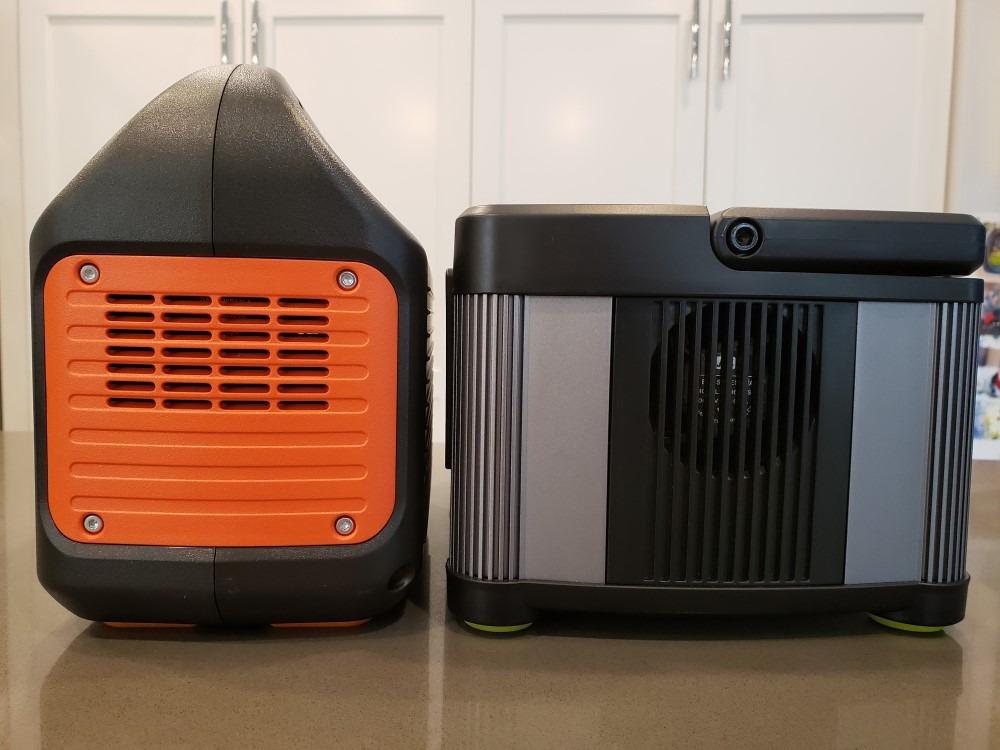
This is the unit we ended up carrying. At 7.1 lbs with an integrated handle, it is the lightest in this roundup, and after a few weeks of hauling it up and down stairs and into the car, that turned out to matter more than any spec line.
Owners consistently use it for the small electronics that actually go wrong during a storm: phones, cameras, LED lights, a fan, and CPAP machines. One CPAP blower-only ran about four nights from a single charge, reviewers report that a 20W LED bulb ran 12 to 14 hours from a full charge. Those are the workloads this size was designed for.
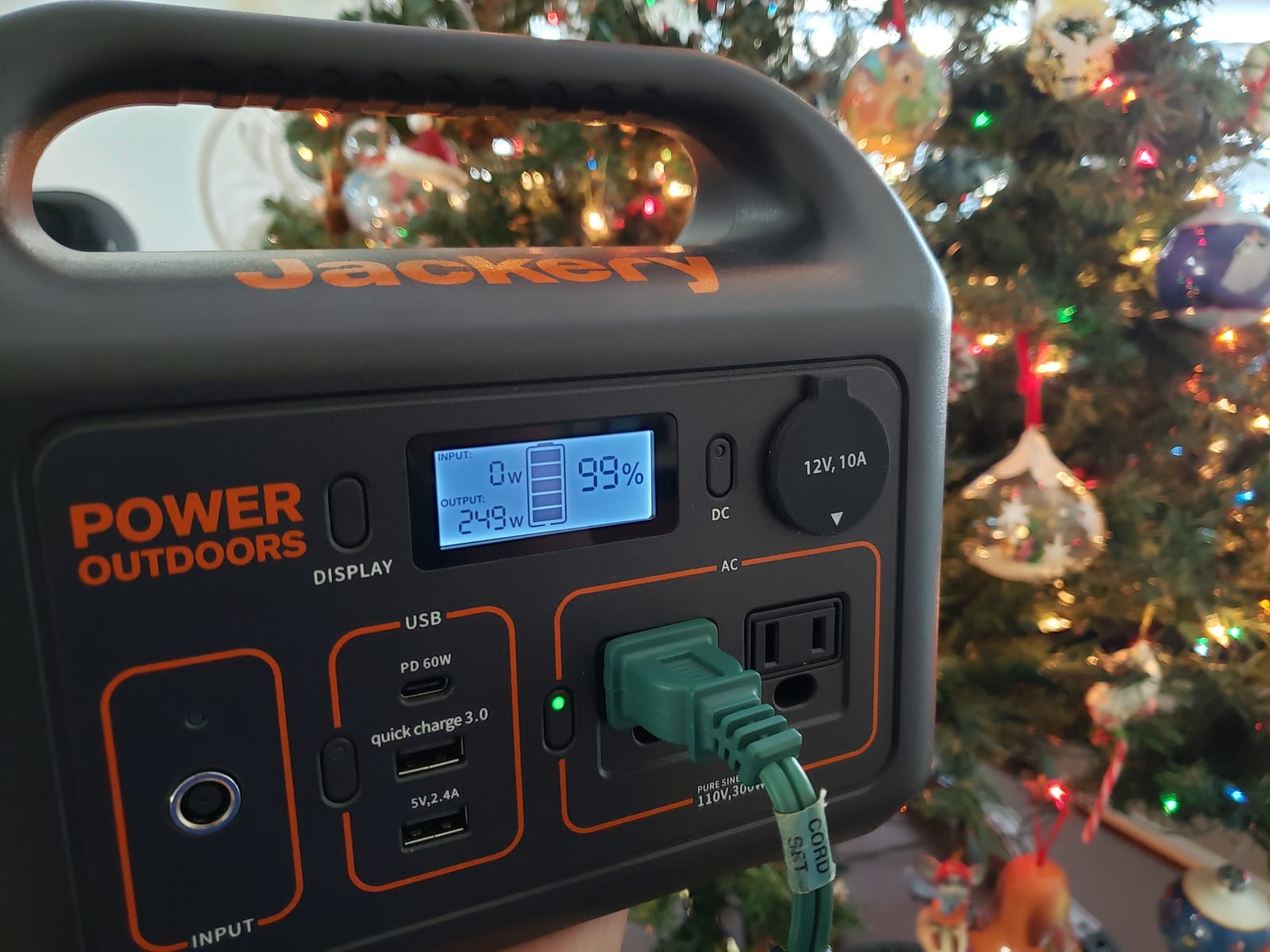
The 292Wh of storage sits behind a pure sine wave 300W inverter with 600W of surge, delivered through two AC outlets plus USB-C PD, two USB-A ports and a 120W car socket. MPPT solar charging takes it from 0 to 80 percent in about 2.8 hours with a 100W panel.
The chemistry is the quiet story here. LiFePO4 cells rated beyond 4000 cycles work out to more than a decade of service life, which is a genuine step up from the older lithium-ion packs still sold in discount listings. The backlit screen shows input and output wattage and warns you before the battery gets low.
Who the Explorer 300 suits
Buy this one if your load is electronics rather than appliances. Phones, tablets, laptops, cameras, drones, medical devices and lighting all fall inside the envelope, and the 292Wh figure is honest about that limit.
It is also the pick for anyone who plans to recharge from a second Jackery model, because pass-through charging is supported and it keeps running a load while it fills.
Where it falls short
The 300W ceiling is the whole story. A portable fridge, a CPAP with humidifier, a small air conditioner or a microwave will draw more than that, and the inverter will simply trip.
Two smaller annoyances: the USB-C port is output only, so you cannot charge the unit itself over it, and the 12V car socket is limited to 10A, which rules out higher-draw 12V gear. There is also no built-in light, which you will notice at 3am in a tent.
2. Jackery Explorer 500 v2: The Mid-Capacity Sweet Spot
Jackery Explorer 500 v2 Portable Power Station,512Wh,500W AC
512Wh
500W continuous
1000W surge
13.3 lbs
10ms UPS
Pros
- 512Wh with 500W rated and 1000W surge
- Light body for a 512Wh pack at about 14 lbs
- 6000 cycle battery with low self-discharge
- 0 to 80 percent in 52 minutes from a wall
- 10ms UPS mode and built-in LED light
Cons
- Solar panel sold separately
- 500W continuous ceiling limits heavier appliances
- No USB-C PD fast-charging port listed
If you only remember one number from this guide, remember 512Wh with 1000W of surge. That pairing covers most of what people actually try to run on a budget station, and the Explorer 500 v2 pairs it with a 10ms UPS transfer, which keeps a router or desktop alive through an outage without a manual restart.
Fast recharge is the quiet feature. Going from 0 to 80 percent in 52 minutes from a wall outlet means a unit you top up over lunch is ready for the evening. Add the foldable handle, the built-in LED light and noise as low as 28 dB, and this is the model we reach for when the plan is a weekend with a mini-fridge, a couple of laptops and a decent run of lights.
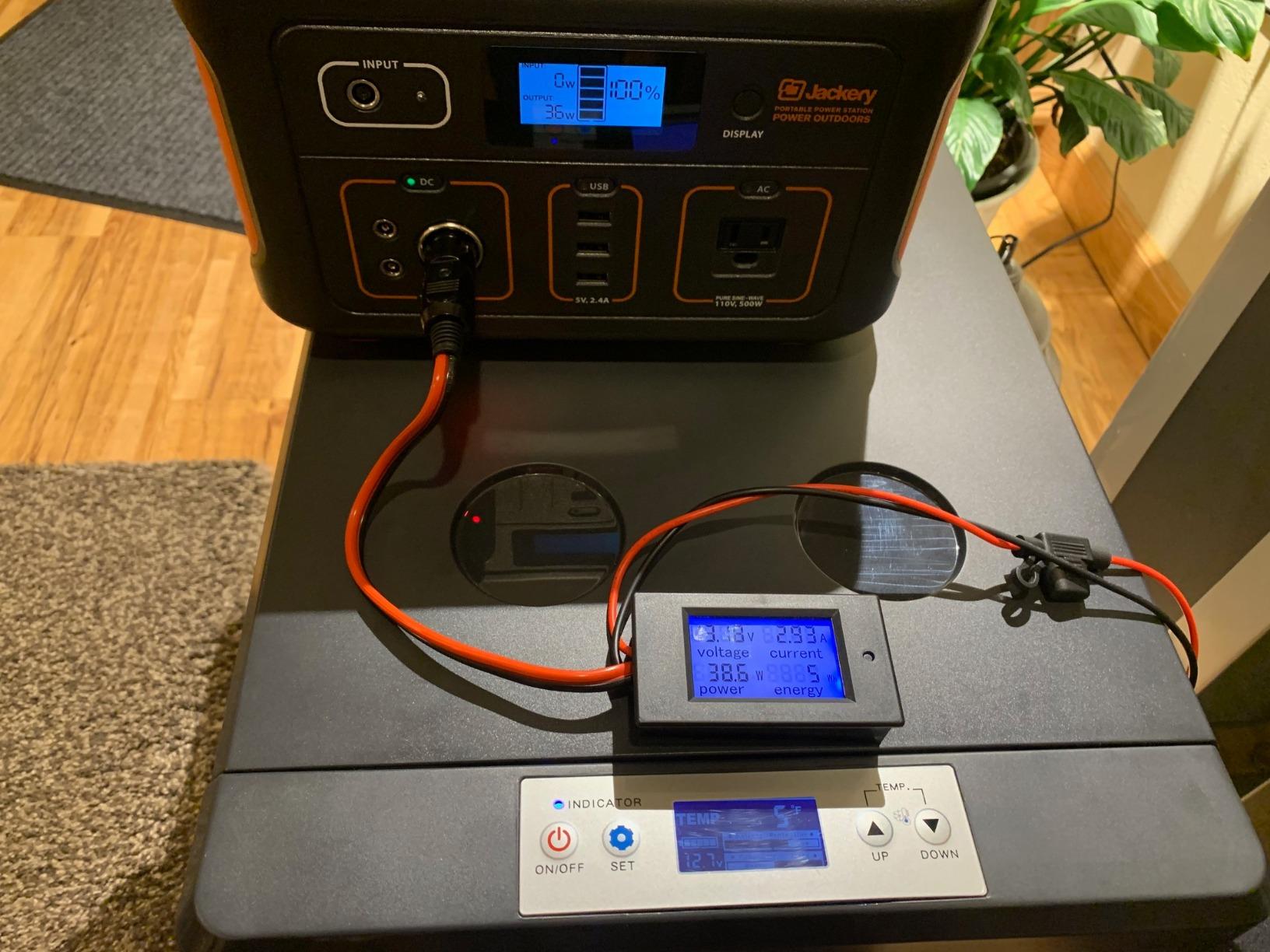
Reviewers treat it as the sensible step up from the smaller 300, and the fast AC recharge plus the built-in light come up again and again as the standouts. A 16.4 ft extension cable is in the box, which is more thoughtful than it sounds when your fridge is at the far end of the picnic table.
The battery is rated for 6000 cycles and holds about 95 percent of rated capacity after six months of storage, which matters if the unit lives in a garage between trips rather than in daily rotation.
Why this one earns its spot
The reason buyers like it is the balance. More capacity than a day-trip unit, more output headroom than a 300W model, and a weight most people can still lift with one hand into a trunk.
The 10ms UPS switchover is fast enough that a router or a desktop keeps running through an outage without a manual restart, which is the feature that turns a camping gadget into genuine backup power.
Where the ceiling bites
500W continuous is the limit. A full-size compressor fridge, a hair dryer, a space heater or most power tools will run it past its comfort zone or trip it entirely.
Two practical gaps: the solar panel is sold separately, so budget for that if you plan to recharge away from a wall, and there is no USB-C PD port listed, which means fast laptop charging happens through the AC inverter or a car socket instead of directly.
3. Jackery Explorer 1000 v2: The 1kWh Pick for Fridges, Tools and Backup
Jackery Explorer 1000 v2 Portable Power Station,1070Wh,1500W
1070Wh
1500W continuous
3000W surge
23.8 lbs
10ms UPS
Pros
- 1070Wh with 1500W output and 3000W surge
- 0 to 100 percent in one hour in emergency mode
- LFP battery holds over 70 percent after 4000 cycles
- 3 AC outlets plus 100W USB-C PD and car port
- App control with quiet and efficiency modes
Cons
- One-hour fast charge needs the Jackery app and is off by default
- 23.8 lbs is too heavy for through-hiking
- Will not run large saws or heavy appliances
- Solar input works only with Jackery panels
Everything in this roundup was measured against a single question: which unit can keep a household going through an evening. On that basis the Explorer 1000 v2 wins. It holds 1070Wh, pushes 1500W continuously and has 3000W of surge for the moment a compressor or a circular saw spins up.
It is also the station that gets recommended most often in the owner reviews we read, and comparison threads across the camping and van-living communities repeat the same verdict from actual buyers: more capacity, roughly three pounds lighter than the closest EcoFlow equivalent, front-mounted AC outlets, and a built-in lamp.
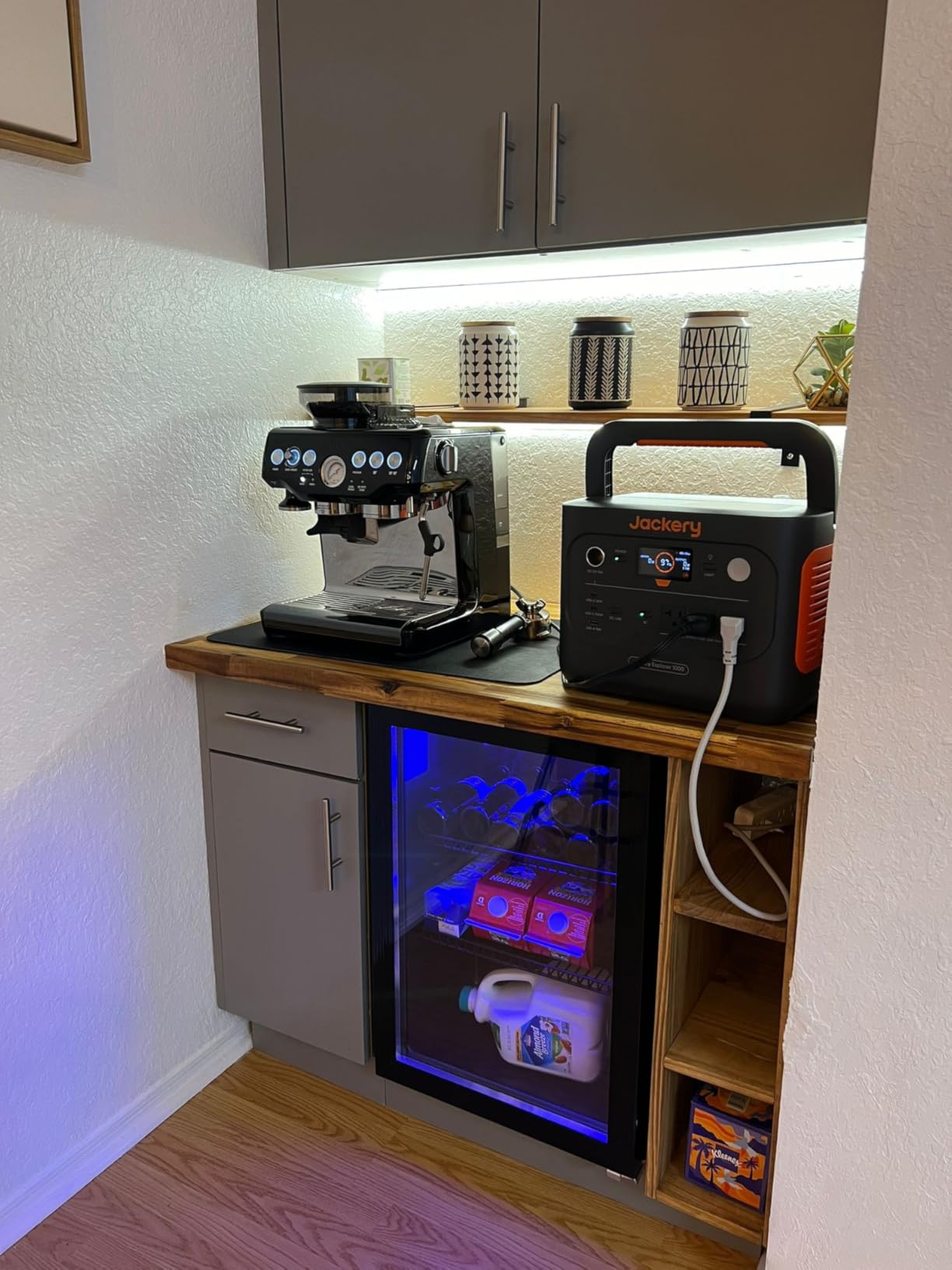
Output held steady in testing, never dropping below 119V on a 100W draw, which is the number that keeps sensitive electronics happy. Port mix is generous for a unit of this size: three pure sine wave AC outlets, two USB-C including 100W PD, one USB-A and a car port.
Recharge is the standout. Standard charging takes 1.7 hours, and the app-enabled emergency mode takes it from empty to full in one hour. The app also exposes a 30 dB quiet mode and an energy efficiency profile.
What makes it the strongest overall pick
It is the unit in this band that comfortably covers a full-size refrigerator, a CPAP with humidifier, a router, some lights and a laptop at the same time, and still has reserve the next morning. That combination of capacity and output is what people are actually shopping for when they search for portable power stations under 500.
The LFP pack holding over 70 percent of capacity after 4000 cycles works out to more than ten years of service, so the cost per year of ownership stays low even for someone who only uses it in storm season.
Where you should look elsewhere
At 23.8 lbs it is a two-hand load, and it is not a backpacking item by any stretch. If you need to hike with your power, that rules it out immediately.
Very high-draw saws and appliances are still out of reach, and solar charging works only with Jackery panels. The one-hour emergency charge also needs the app and is disabled by default, which trips up first-time owners every time.
4. BLUETTI AC180: More Power and More Capacity Than Anything Else Here
BLUETTI AC180 Portable Power Station 1152Wh 1800W LiFePO4 Solar Generator
1152Wh
1800W continuous
2700W surge
37.4 lbs
20ms UPS
Pros
- Largest capacity here at 1152Wh with 1800W output
- Full recharge in one hour at 1440W AC input
- 500W solar input
- 20ms UPS with 8 outlets and 11 ports
- Clear load and runtime display plus Bluetooth app
- 5-year warranty
Cons
- Heavy at about 37.4 lbs
- Self-consumes 15 to 20W with the inverter on
- Only 90 percent of rated capacity is usable
- Wireless charging pad is unreliable
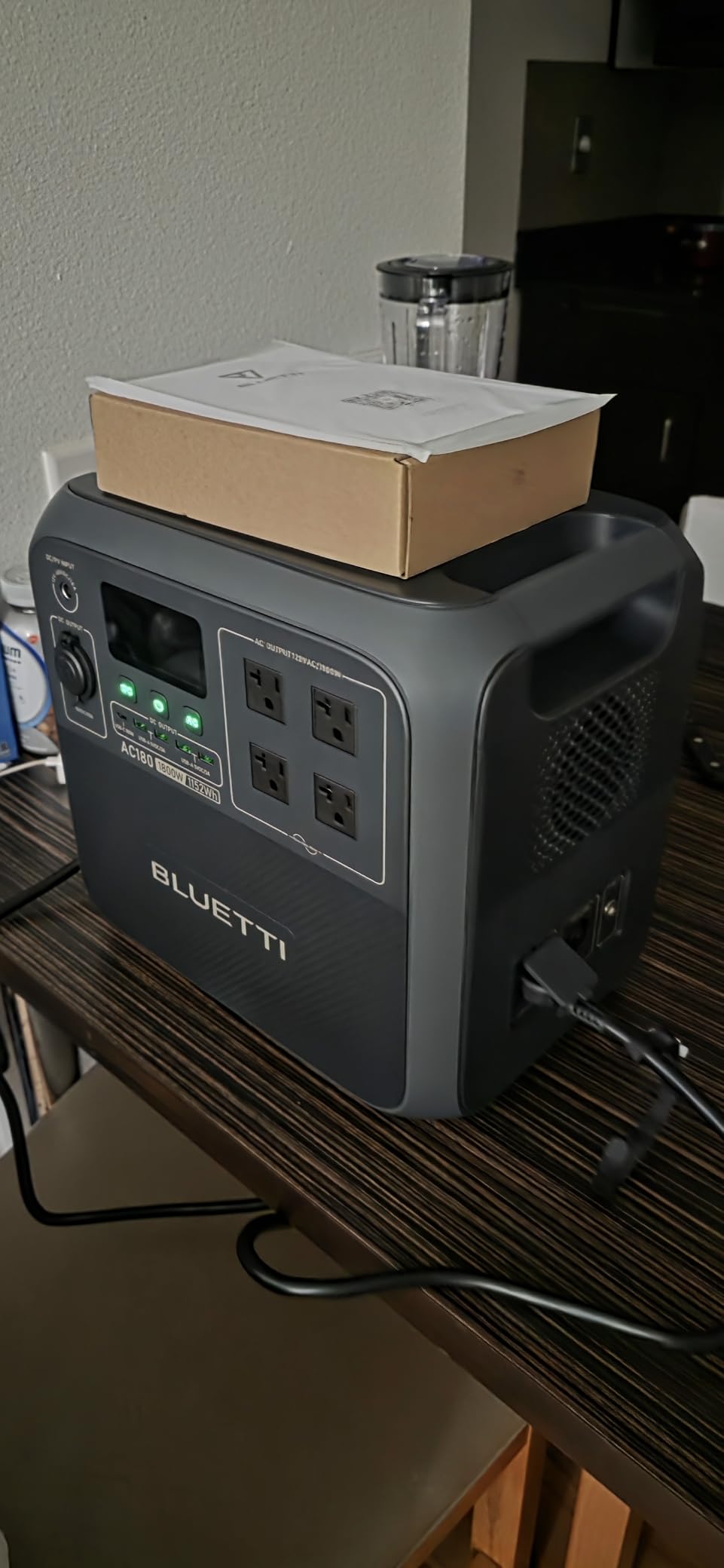
The AC180 holds the largest battery in this group at 1152Wh, and with 1800W of continuous output it is the reason this unit earns a place. When your load is a fridge plus a router plus lights plus a power tool, this is the one that does not flinch.
Recharge speed is the other headline. A full charge in one hour at 1440W AC input is among the fastest here, and 500W of solar input brings it to 80 percent in about 45 minutes.
Buyers running a 20ms UPS switchover keep routers and internet connections alive straight through an outage, and several owners reported a firmware update plus one full discharge cycle fixing early slow-charging behaviour.
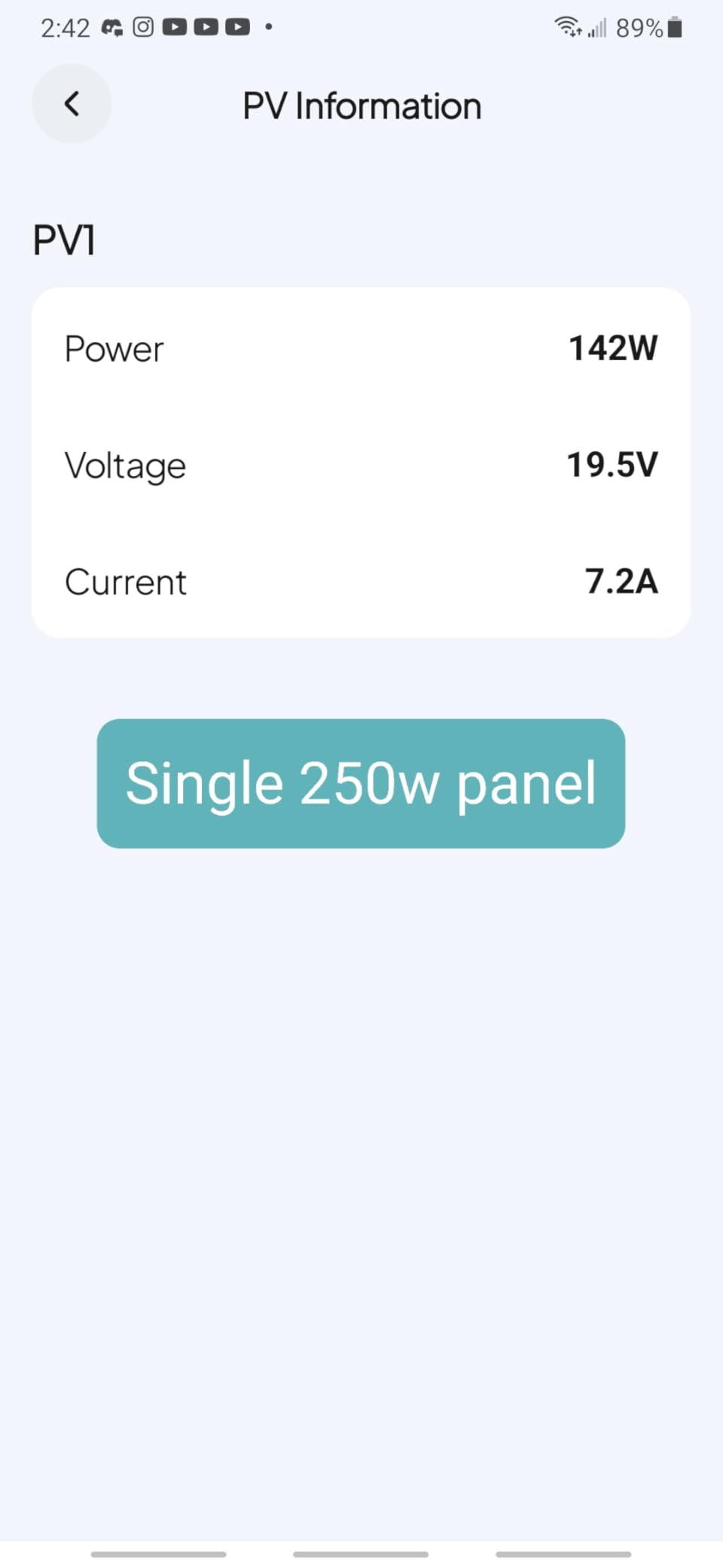
Eight AC outlets across 11 total ports, a display showing exact runtime and live load, and a 5-year warranty round out a package that feels a tier above the price band. Customer support is credited with arranging a direct exchange on a faulty unit.
Reviewers also single out the AC180 and the Jackery Explorer 1000 Plus as models with a 20ms UPS transfer, fast enough to keep computers running through an outage.
Who benefits from the extra power
Anyone running more than one high-draw device at a time. The headroom means a refrigerator compressor starting will not brown out a laptop, and the app can push output to 2700W in bursts when a tool needs it.
It also suits owners who already have panels, because 500W solar input absorbs a large portable array and refills the battery in an afternoon.
Why it is not the first recommendation
At 37.4 lbs, the AC180 is the heaviest unit here by a wide margin, and it is an awkward one-hand carry for most people. That matters more than any spec when the station lives in a vehicle rather than a cupboard.
There is also a hidden cost. It self-consumes 15 to 20W with the inverter running, and only about 90 percent of rated capacity is usable, so on a small overnight load the real figure is lower than 1152Wh suggests. The wireless charging pad on top is the most common disappointment, dropping connection repeatedly.
5. ALLWEI 500W: The Widest Port Mix at This Price
ALLWEI Portable Power Station 500W, 512Wh LiFePO4 Battery UPS Backup Power
512Wh
500W continuous
1000W surge
13 lbs
120W solar input
Pros
- Two 500W AC outlets with 1000W surge
- Full charge in about 2.5 hours in Q mode
- Broad port mix with 100W USB-C
- 36W USB-C and 2 DC 5521
- LiFePO4 with BMS and MPPT rated 3000 cycles
- Instant UPS transfer for desktops
Cons
- Solar input capped at 120W
- Centre power button only shuts off the display
- 2-year warranty is the shortest here
- Some models stopped holding charge within a year
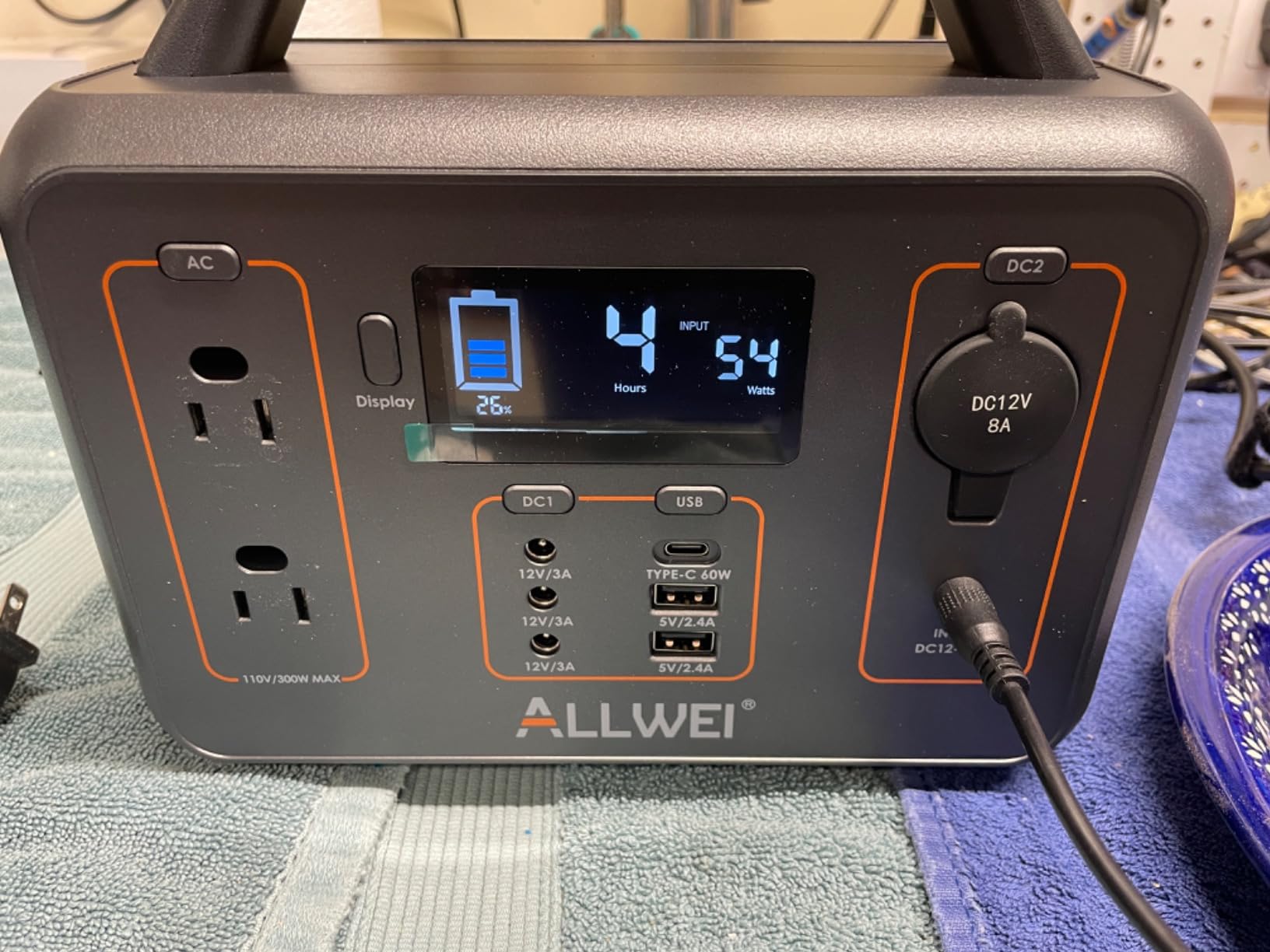
Count the ports. Two AC outlets, a 100W USB-C, a 36W USB-C, two USB-A, two DC 5521 barrel outputs and a car socket, all on a 512Wh LiFePO4 pack that weighs 13 lbs. Very few stations at this money give you that many connection types.
Reviewers describe it repeatedly as strong value that performs on par with the more expensive Jackery units, with owners running CPAP machines, refrigerators and chest freezers and reporting the battery holds its charge well through long idle storage. The instant UPS transfer is dependable enough to protect a desktop or a file server.
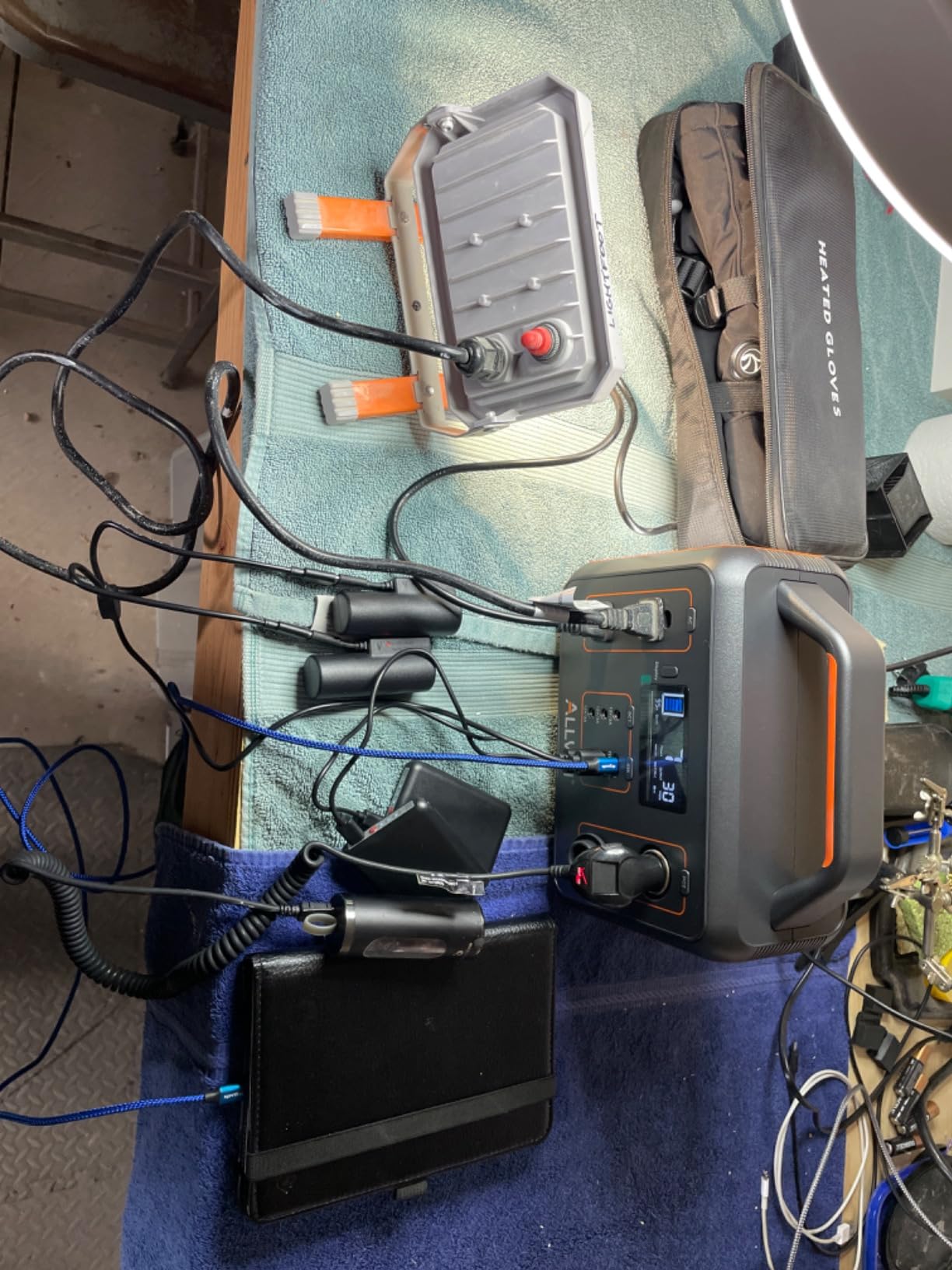
Recharge is 2.5 hours in Q mode from a wall outlet, or about 6.5 hours with a 100W panel. The display shows input and output watts, remaining time and an exact charge percentage, which is more detail than many rivals give you.
The BMS covers temperature, overvoltage, overcurrent and short circuit protection, and the cells are rated for 3000 cycles with a 10-year lifespan claim.
When this one makes sense
It is the pick for anyone whose devices are varied rather than large. Laptops, phones, cameras, a 12V accessory, a router and a small appliance can all be plugged in at once without a second box.
It also fits a desktop backup role well, because the instant UPS transfer is one of the more reliable ones we saw in owner reports for this capacity class.
What to watch out for
Solar input is capped at 120W, so a 200W panel is wasted money here. If you plan to live off panels for several days, this is the wrong box.
The 120W solar limit, the 2-year warranty and an 8 percent one-star share tell a story about consistency. The most common complaints concern models that stopped holding charge inside a year, plus a centre power button that only switches off the display and leaves the AC and DC outputs live, which confuses a lot of first-time owners.
6. Anker SOLIX C1000: The Fastest Recharge in the Group
Anker SOLIX C1000 Portable Power Station with Car Charging Cable, 1,056Wh
1056Wh
1800W output
2400W peak
27.6 lbs
600W solar input
Pros
- 1056Wh LiFePO4 rated 3000 cycles over 10 years
- 80 percent charge in 43 minutes
- 1800W output with 2400W SurgePad peak
- 600W solar input for a full charge in about 1.8 hours
- 15 percent smaller than comparable 1kWh units
- Anker app for custom speeds
Cons
- UltraFast mode needs the Anker app and a compatible phone
- 27.6 lbs is heavy for this capacity
- Solar panel not included
- Weakest sales rank in this group
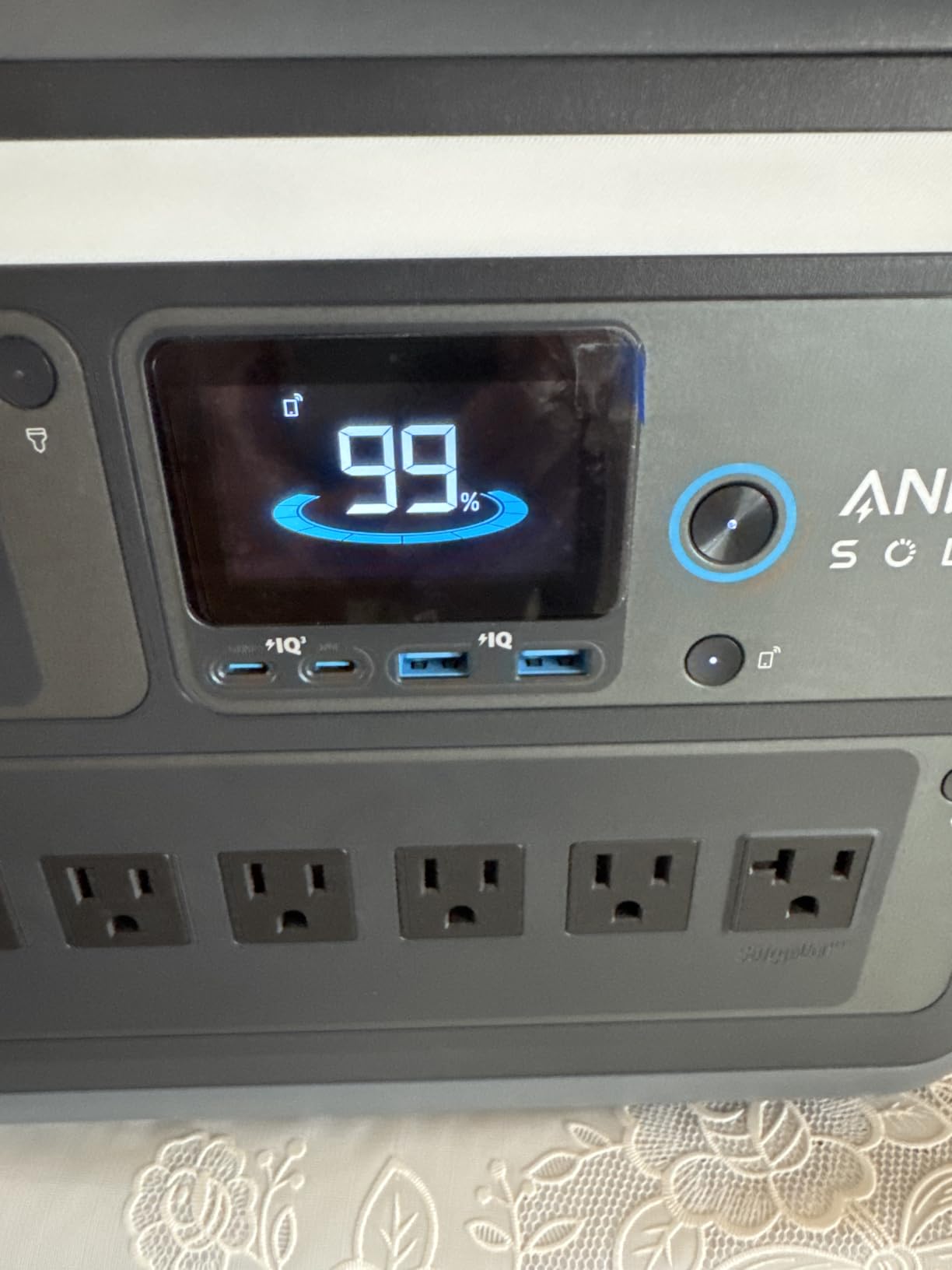
The C1000 exists for one reason: how fast it refills. It reaches 80 percent in 43 minutes and goes from empty to full in under an hour with the app-enabled UltraFast mode. In a storm scenario where the grid is intermittent, that is the difference between one good charge and three.
Underneath the speed, the numbers are strong. 1056Wh of LiFePO4 rated for 3000 cycles over a 10-year lifespan, 1800W of continuous output and 2400W through SurgePad, across 11 ports. Owners rate the 1,056Wh capacity as unusually honest for the class, and the footprint runs 15 percent smaller than comparable 1kWh units.
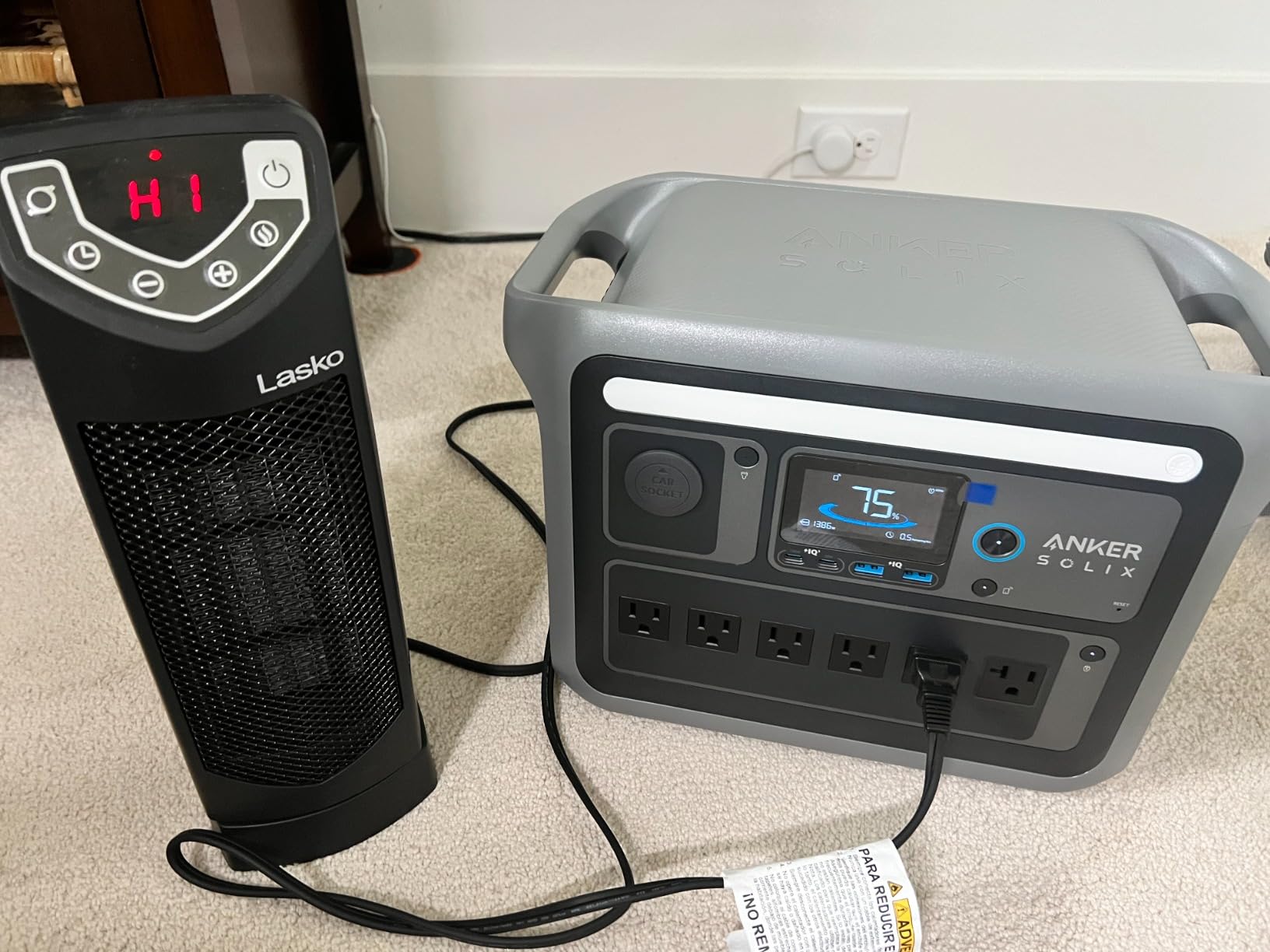
The 600W solar input is the highest here, refilling the pack in roughly 1.8 hours, which makes it the natural RV choice where roof space and panel output are not a problem.
Customers also praise the 5-year warranty, and 86 percent of its reviews are five-star, the strongest rating profile in this roundup.
Why it beats the alternatives for some buyers
If you charge from a wall, a car or panels between uses, recharge time is the metric that matters most, and this unit wins it outright. It is also the one to buy if you are running an RV and want the biggest solar intake in the set.
The 11-port layout means a whole campsite can charge at once without anyone hunting for a second cable.
The reasons to pass
UltraFast mode is locked behind the Anker app and a compatible smartphone, so the headline speed does not happen by default. Plan around 43 minutes to 80 percent from a normal wall charge if you skip the app.
At 27.6 lbs it is heavier than the Jackery equivalent while offering slightly less capacity, and no solar panel is included. Budget extra for panels if solar is part of the plan.
7. Anker SOLIX C300: A Quiet, Genuinely Portable 288Wh Unit
Anker SOLIX C300 Portable Power Station, 288Wh Solar Generator for Camping
288Wh
300W output
600W surge
about 10 lbs
25 dB
Pros
- About 10 lbs with 288Wh and 300W output
- Three AC outlets plus car socket and four USB ports
- 0 to 80 percent in about 50 minutes
- LiFePO4 rated 3000 cycles with 5-year warranty
- Three-level LED light bar with SOS mode
- 25 dB with no audible fan
Cons
- 288Wh is too small for appliances or long runtime
- USB-A port limited to 12W
- Shoulder strap not included
- Solar input will not accept PS30
- PS200 or PS400 panels
The C300 is built for travel rather than camping. At about 10 lbs, with a three-level LED light bar and 25 dB operation that produces no audible fan under normal load, it is a genuinely portable power source for a week away.
Owners supply real numbers: roughly 4 to 5 hours of laptop runtime and about 10 hours powering home network gear from a full charge. That is enough for a work trip with a laptop, a phone, cameras and lights, and it will sit in a cabin without anyone noticing it.
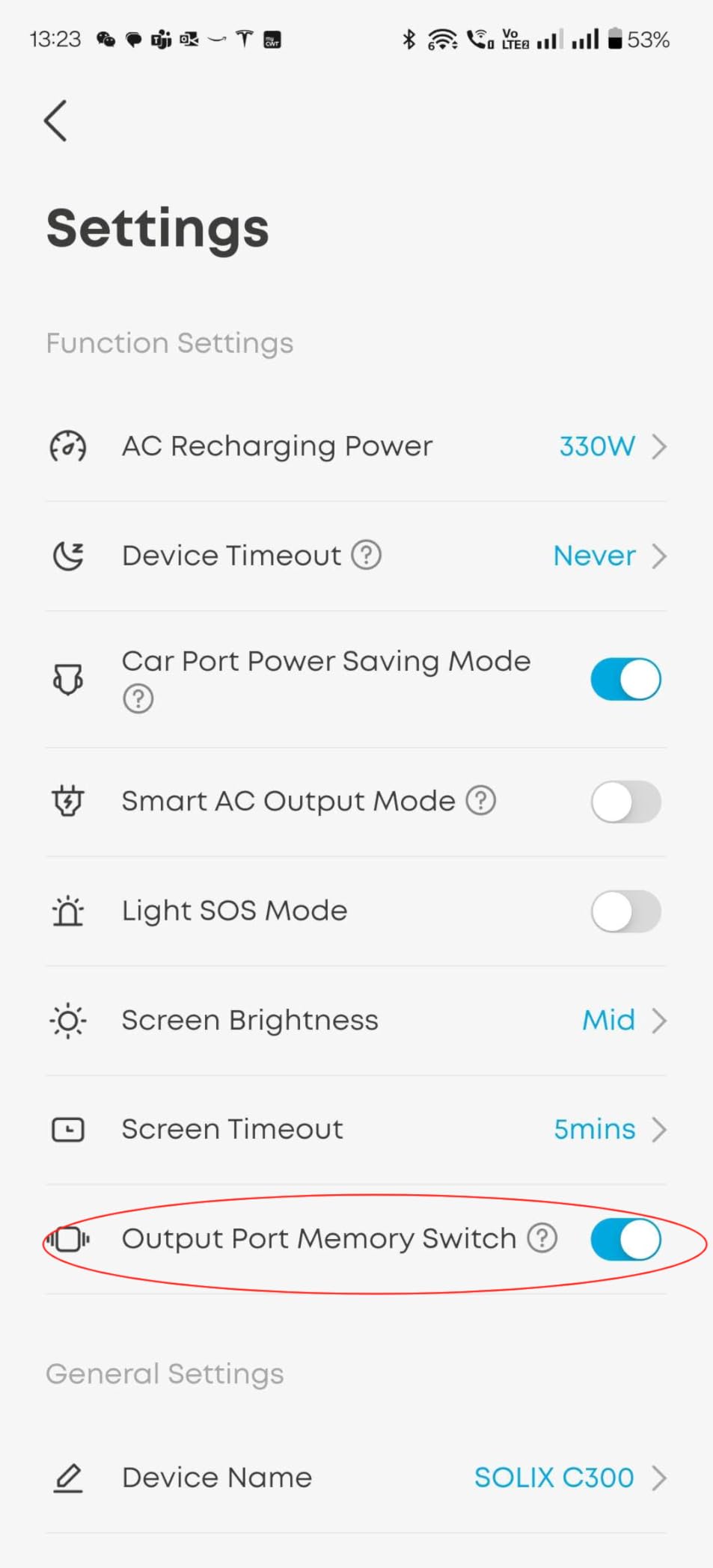
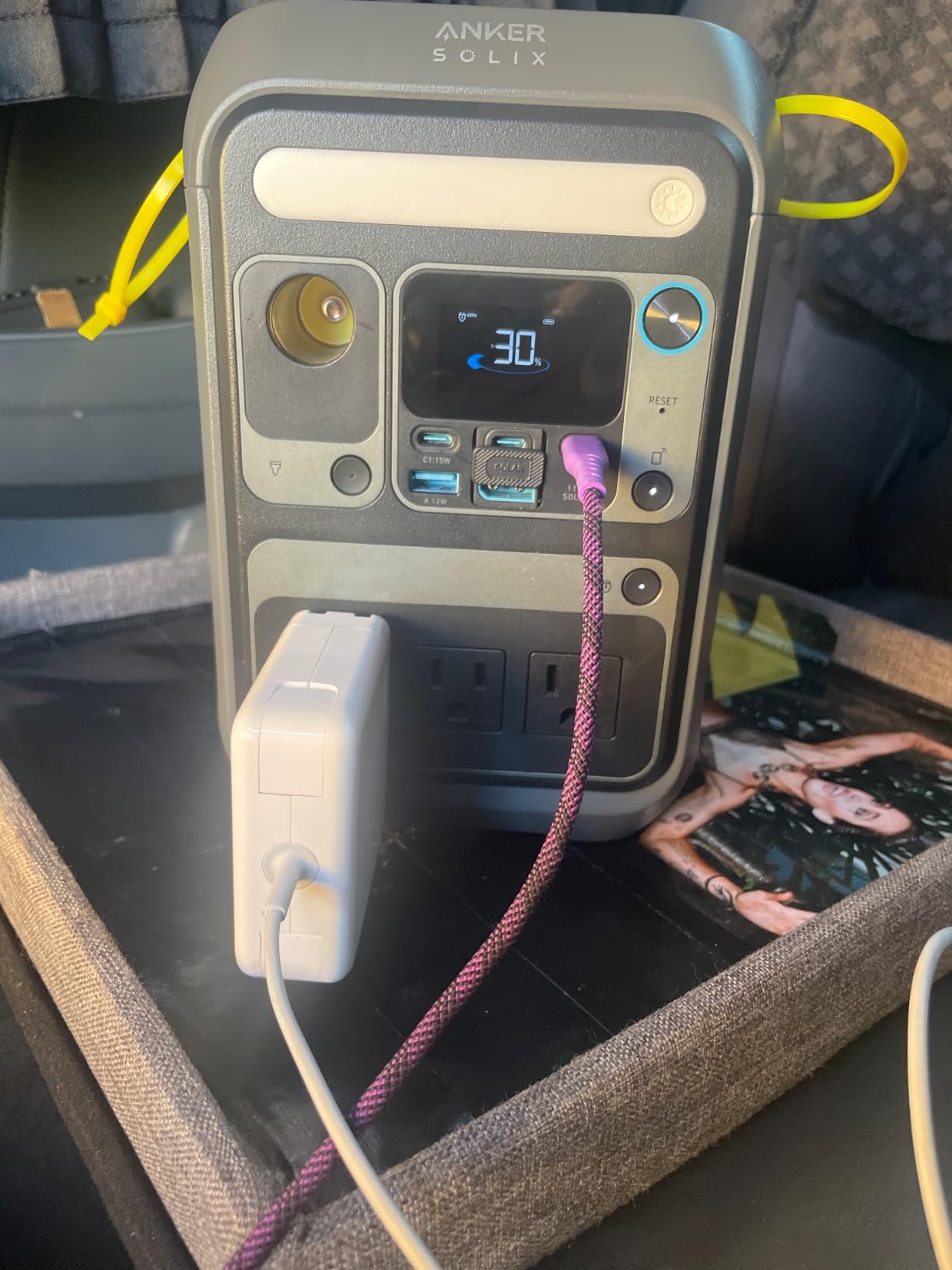
Port selection is generous for the size: three 120V AC outlets, a car socket, two USB-C at 140W each, one USB-C at 15W and a USB-A. Recharge hits 80 percent in about 50 minutes from a wall, and solar, car and PD 3.1 USB-C inputs all work.
The LiFePO4 pack is rated for 3000 cycles and carries a 5-year warranty, which outlasts the 2-year terms common on cheaper units in this list.
What it is actually good for
Phones, laptops, drones, small lights and network gear, where total energy rather than peak power is the requirement. The SOS blinking mode on the light bar is a small thing that matters when a campsite needs to be found after dark.
It also fits neatly as a UPS-style top-up for a router or network box, which is how most owners use it as a backup rather than as a primary power source.
Where it runs out
288Wh is the whole limitation. It will not run a fridge, a heater or a kettle, and on a heavy load the small capacity disappears quickly. Treat it as a top-up device, not a household backup.
The USB-A port is limited to 12W, no shoulder strap is included, and the solar input will not accept the common Anker PS30, PS200 or PS400 panels, which narrows your recharging options.
8. EcoFlow RIVER 2 Pro: A Strong Capacity-to-Weight Balance
EF ECOFLOW Portable Power Station RIVER 2 Pro, 768Wh 800W
768Wh
800W output
X-Boost to 1600W
17.2 lbs
220W solar
Pros
- 768Wh at only 17.2 lbs
- X-Stream full recharge in about 70 minutes
- X-Boost lifts output to 1600W
- 11 outlets including 800W AC and USB-C
- LFP cells rated 3000+ cycles
- 220W solar input for a full charge in 3.5 hours
Cons
- 800W base output is low next to 1800W rivals
- Wall charging is the fastest option
- No solar panel or car cable included
- Higher 1-star share than most rivals here
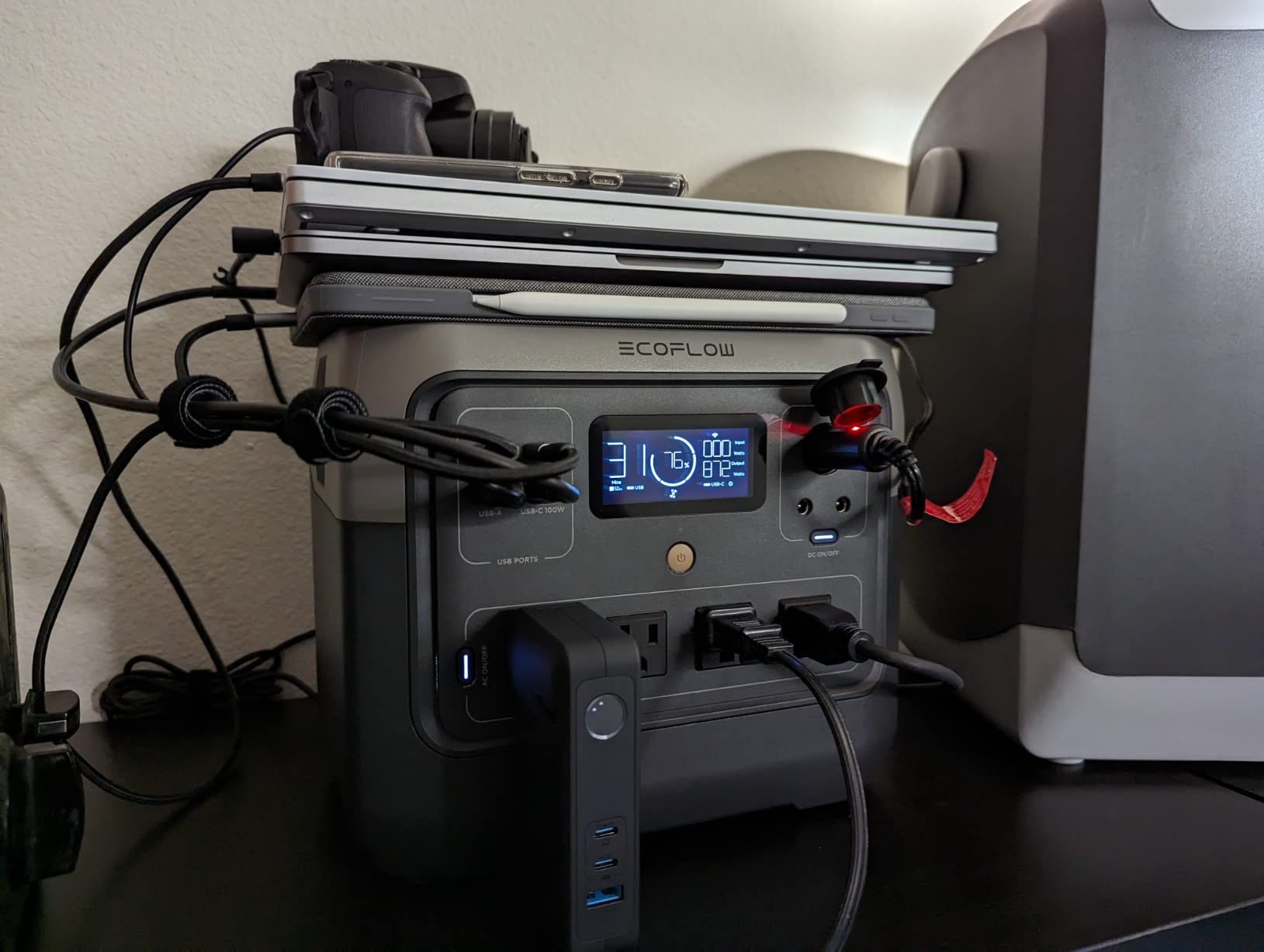
Put 768Wh into a 17.2 lb body and you have one of the strongest weight-to-energy figures here. That is what makes the RIVER 2 Pro the pick for anyone who wants real capacity without the 37 lb problem of the AC180.
EcoFlow’s X-Stream charging takes it from flat to full in about 70 minutes, and X-Boost lifts the 800W nameplate to 1600W for resistive loads, which owners credit with running more household appliances than the base rating suggests. The advanced BMS tracks voltage, current and temperature continuously.
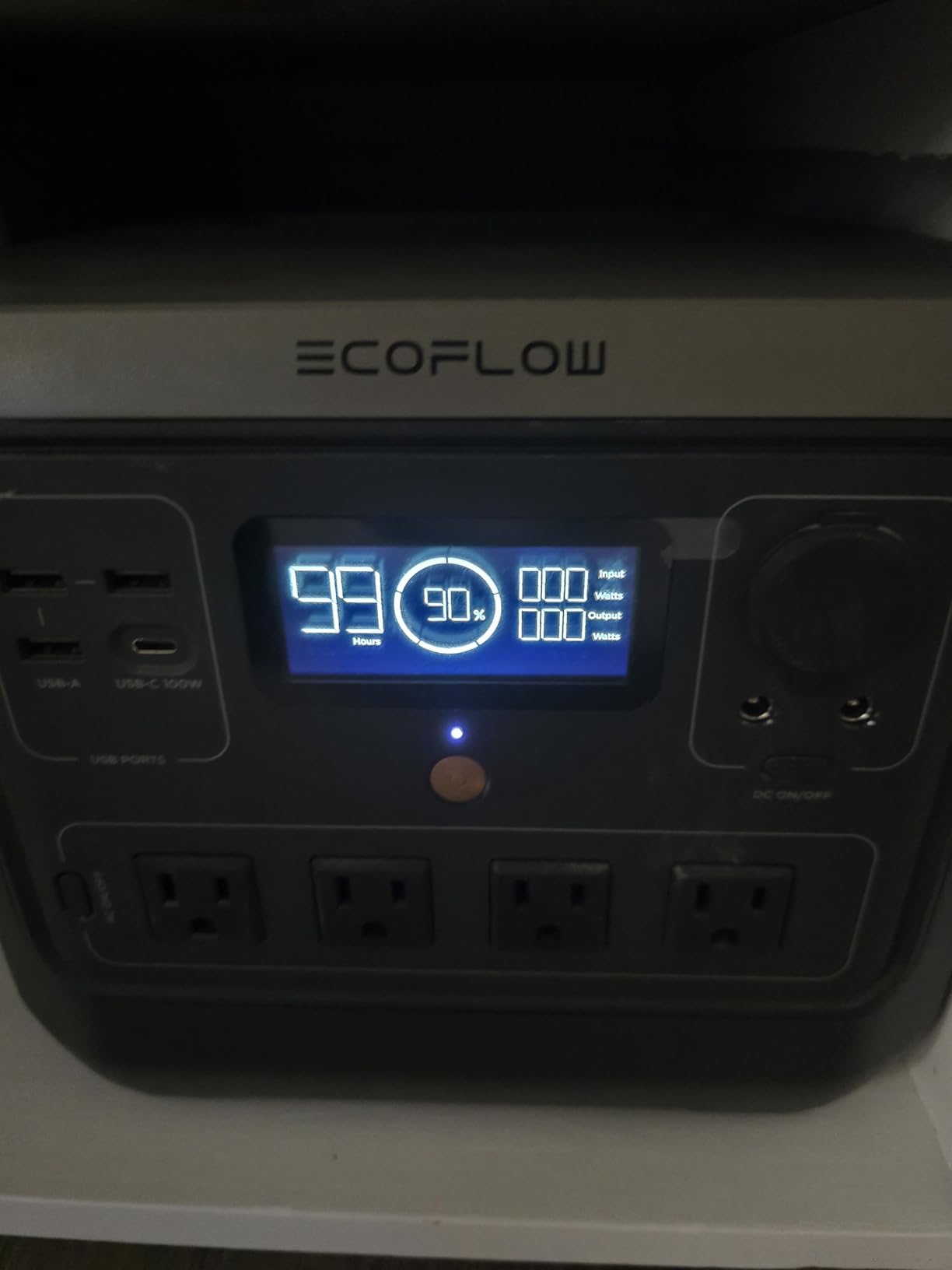
Eleven outlets cover the range: 800W AC sockets, USB-C and USB-A, which is enough to charge a whole camp table at once. LFP cells are rated beyond 3000 cycles before dropping to 80 percent, roughly a decade of use.
Reviewers consistently centre the same two strengths, a strong weight-to-capacity ratio and fast AC recharge, and the same reservation, average output for the money.
Where the balance works
Choose it when capacity per pound matters more than raw inverter strength. Van conversions, boat decks and long camping trips all reward 768Wh that one person can lift, and 220W solar input still refills it in about 3.5 hours.
It is also a good middle step for someone upgrading from a 300Wh unit who is not ready to carry 24 to 37 lbs.
Where the balance breaks
800W of base output is modest beside the 1800W-class units at similar prices. A power tool or a large fridge will reach that ceiling, and X-Boost is a software trick rather than extra inverter hardware.
Wall charging is the fastest path, since solar needs a panel bought separately and no car charging cable is included. The 7 percent one-star share is also the second highest here, mostly around weight and average power rather than defects.
9. Anker SOLIX C300 DC: USB-C-First Power With No AC Outlets
Anker SOLIX C300 DC Portable Power Station, 288Wh, 300W, Outdoor Camping
288Wh
300W output
7 USB and car ports
no AC outlets
2.8 kg
Pros
- 288Wh with 300W output in a 30 percent smaller design
- Seven ports including two 140W USB-C and one 100W USB-C
- 0 to 80 percent in about an hour on dual PD 3.1
- LiFePO4 cells with temperature control
- Top LED light with adjustable brightness
Cons
- No AC outlets
- so no 120V appliances
- No wall charger included
- Auto sleep mode looks like a fault
- 90000mAh rating is disputed by some owners
- 3-year warranty on this DC variant
This one is deliberately different. There is no AC inverter at all, just USB and 12V car output, and that single decision makes it an efficient option for USB-C devices because nothing routes through an inverter.
Owners document roughly seven full phone charges, more than a day of MacBook runtime, and successful runs of a Starlink unit and a 12V cooler. One reported test put a 12V cooler at 13 hours on fridge mode and over 23 hours on eco.
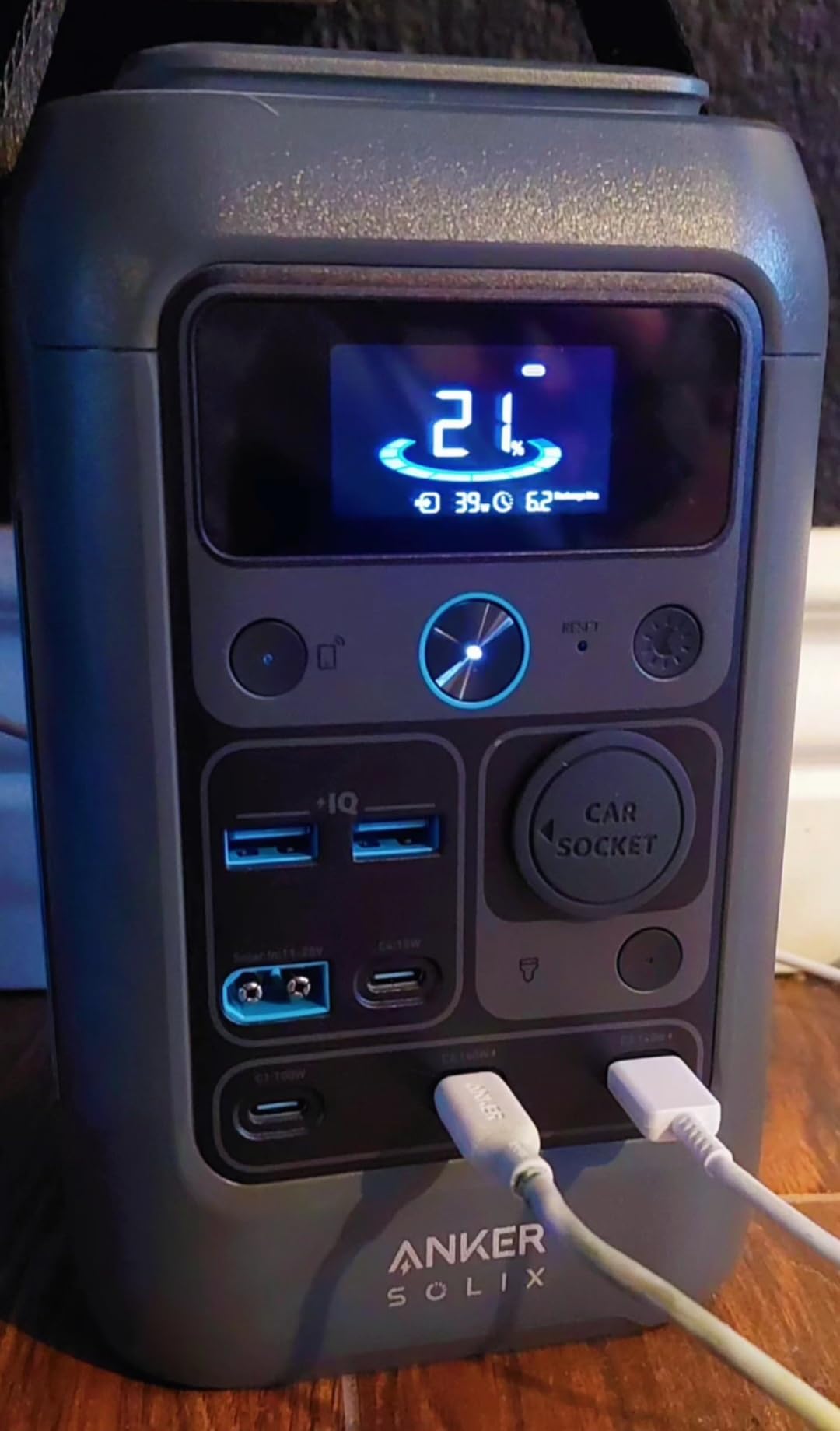
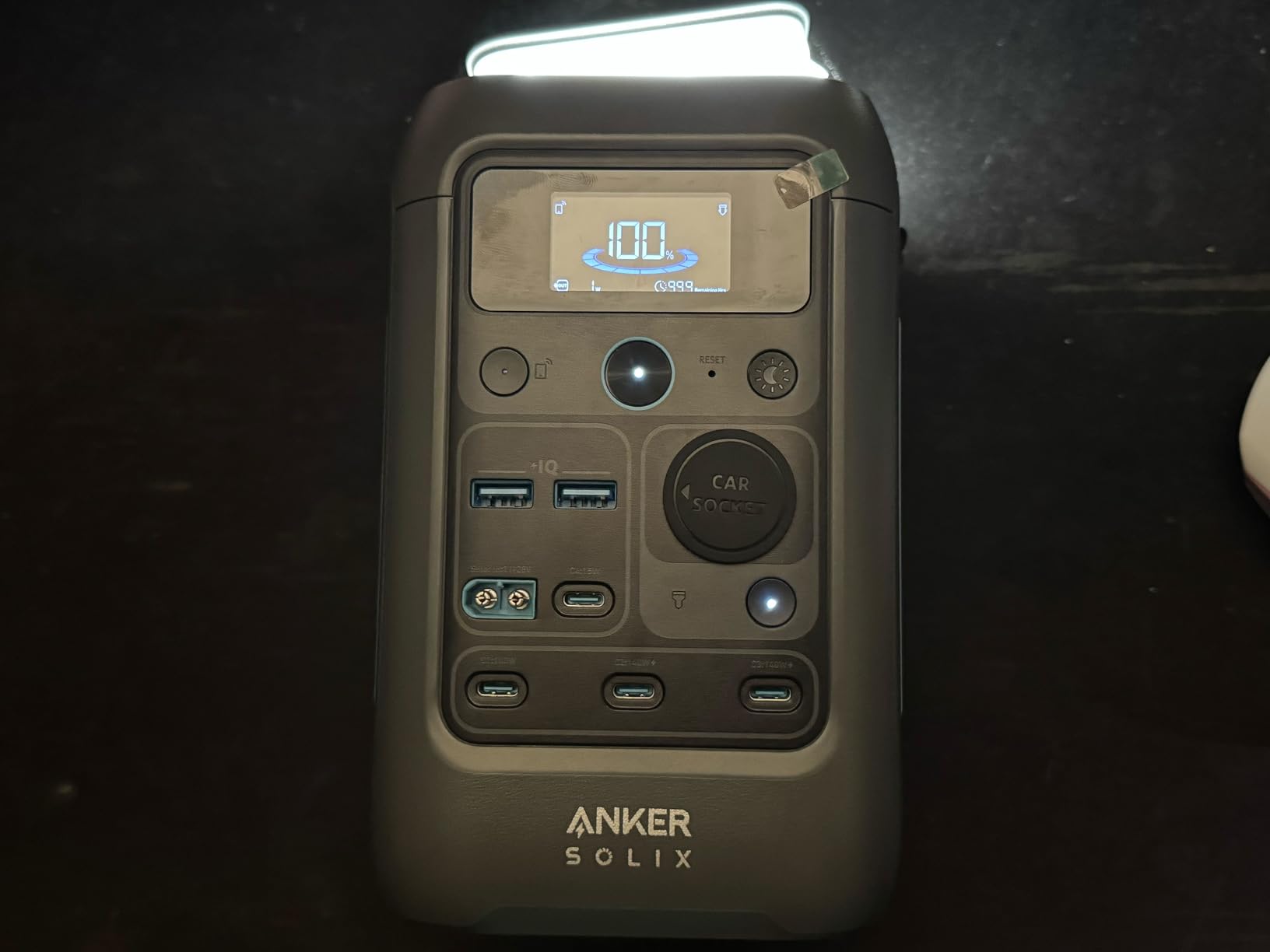
Seven ports means real flexibility: a 120W car socket, two USB-C at 140W, one at 100W, one at 15W and two USB-A at 12W. Solar charging tops out at 100W, and the top light has adjustable brightness.
At 2.8 kg and 30 percent smaller than comparable designs, it is among the most compact options here, and it fits comfortably in a small day bag alongside a laptop.
Who this is built for
Anyone whose devices are all USB-C. Two 140W ports can charge a laptop and a phone simultaneously at full speed, which no other model in this set does at this weight.
It is a strong match for travel, drone photography and remote work, where the load is a laptop, a router, cameras and lights rather than a household of appliances.
What you give up
No AC outlets means no kettle, no fan, no lamp, no fridge, no power tools. If there is any chance you need 120V, look elsewhere in this list.
You also have to bring your own 18W or higher USB-C wall charger, and the auto sleep mode can look like a broken unit until you disable it in the app or long-press the power button. The 90,000mAh rating on the label is disputed by some owners, who would rather see watt-hours.
10. GRECELL 500W: Ten Outputs at the Best Cost Per Watt-Hour
Grecell Portable Power Station 500W(Peak 1000W) 519Wh Outdoor Solar Generator Backup Battery Pack with 2 110V AC Outlets,10-Port Powerhouse for RV/Van Camping Fishing Climbing Road Trip Home Emergency
519Wh
500W output
1000W peak
14.1 lbs
10 outputs
Pros
- Lowest cost per watt-hour of anything in this roundup
- 10 simultaneous outputs including 2 pure sine wave AC
- Recharge by 100W or 200W solar
- car or wall
- Built-in flashlight with strobe and SOS
- Full BMS with temperature and short circuit control
- 14.1 lbs with a solid handle
Cons
- Uses older lithium-ion chemistry instead of LiFePO4
- Highest one-star share in this group at 11 percent
- Wireless charger is unreliable
- AC output must be switched off manually or it drains
- Recharge times are slow versus newer units
It is a genuine value entry. Ten outputs on a 519Wh pack, two of them pure sine wave AC at 500W, and it lands at the lowest cost per watt-hour of anything we looked at in this band. If the budget is the constraint rather than the specification, this is the shortlist.
The 10-output layout is genuinely unusual: two AC sockets, three USB-A with QC3.0, 60W USB-C PD, two DC barrel ports, a car socket and a 10W wireless charger. Owners use it for CPAP machines, car refrigerators, blenders, drones and projectors.
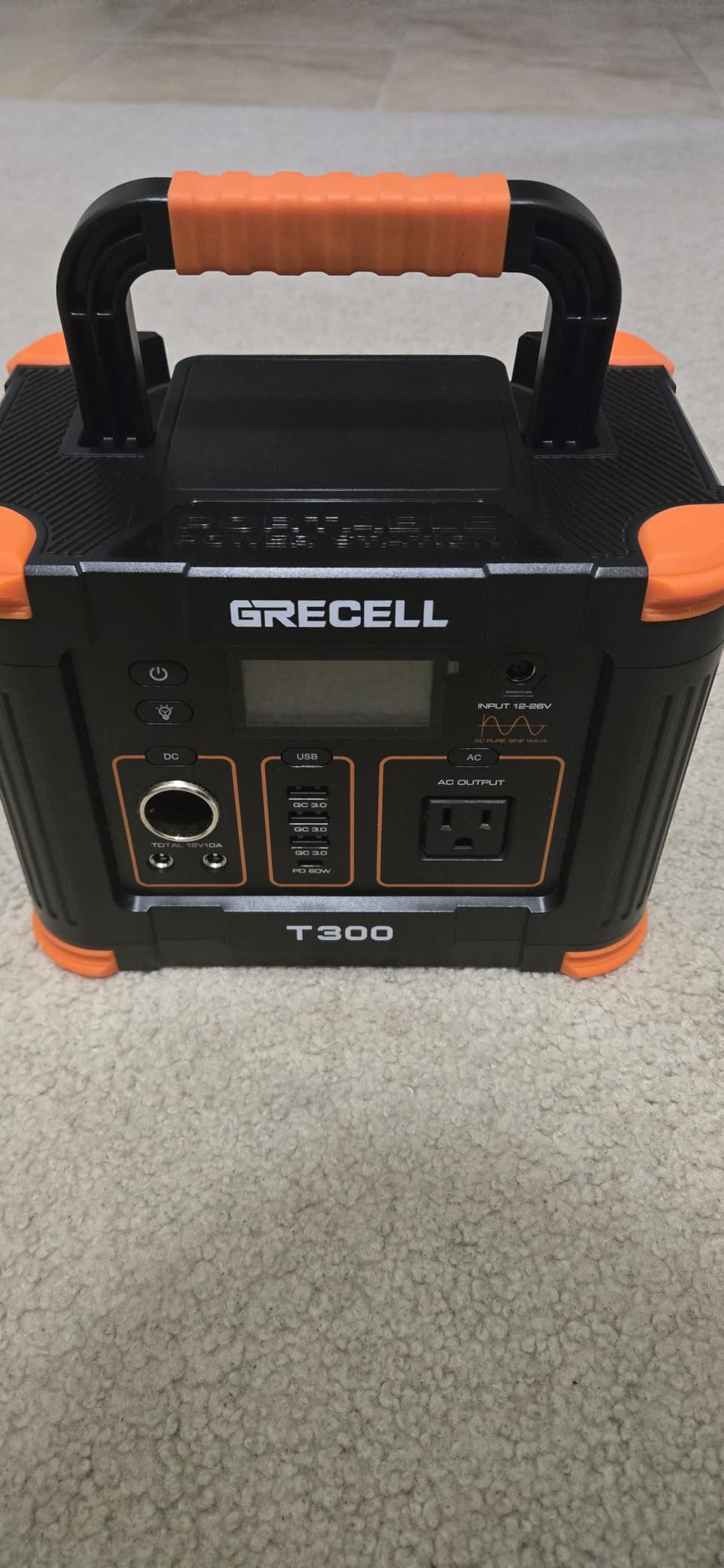
There are three ways to recharge, which is helpful: 100W or 200W solar in 6 to 9 hours, car in 7 to 8, or a wall outlet in 6 to 7. The BMS covers temperature, overvoltage, overcurrent and short circuit protection, and the built-in flashlight offers strobe and SOS modes.
At 14.1 lbs in an 11.6 by 7.9 by 7.9 inch footprint, it is compact for what it holds, and the handle is solid rather than decorative.
When the maths wins
Buy it when you want the most stored energy per unit of budget and you can tolerate older technology. For a second unit, a rental cabin backup or a gift, it is hard to argue with the numbers.
The ten outputs mean very few people need to choose between devices, which is unusual at this end of the price range.
Why the rating is the lowest here
The 4.3 average and 11 percent one-star share are the weakest in this group, and they point to cell ageing and reliability rather than missing features. The battery uses older lithium-ion chemistry rather than LiFePO4, so cycle life over the years is the concern.
Three smaller traps: the AC output has to be switched off manually or it drains the battery with no load attached, the wireless charger only engages after pressing the USB button, and the manufacturer advises using and recharging it at least once every three months.
How to Choose a Portable Power Station Under 500
Most mistakes in this category come from comparing one number when you should be comparing three. Here is the order we would work through, and the same budgeting discipline applies whether you are shopping for a charcoal grill under 500 or anything else you take outdoors.
1. Watt-hours decide how long, watts decide whether
Watt-hours are the fuel, watts are the tap size. A 1000Wh station with a 300W inverter will run a 300W load for roughly three hours, while a 300Wh station with a 1500W inverter will trip the moment you connect a kettle. For overnight use, capacity wins. For tools and appliances, output wins.
2. Surge is where budget units fail
Compressor fridges, water pumps, microwaves and circular saws all draw a spike of several times their running wattage at start. Look for at least double your load in surge. The Jackery Explorer 1000 v2 offers 3000W of surge against 1500W running, which is the kind of headroom that prevents mid-freezer shutoffs.
3. Chemistry tells you the service life
LiFePO4 packs are rated from 3000 to 6000 cycles here, which is roughly a decade of daily use. Older lithium-ion models like the GRECELL trade cycle life for a lower entry cost. Buyers consistently report the most reliable battery cycles in this budget tier coming from Jackery, BLUETTI and EcoFlow units.
4. Solar input decides whether you can recharge away from a wall
Input limits vary enormously in this band, from 100W on the Anker C300 DC to 600W on the C1000. A 120W cap, as on the ALLWEI, means a 200W panel is wasted money. If you plan multi-day off-grid use, treat solar input wattage as a primary spec, not an afterthought.
5. Weight is a real specification
This band spans 7.1 lbs to 37.4 lbs. Anything over 25 lbs changes the answer for anyone who carries gear any distance, and reviewers repeatedly describe 1kWh-class models as an awkward one-hand load. Buyers consistently single out the Jackery Explorer 1000 v2 as the easiest 1kWh unit to move.
6. UPS transfer time decides what stays online
UPS mode keeps sensitive electronics running through an outage. 10ms on the Jackery units and 20ms on the BLUETTI AC180 are both fast enough that a desktop, NAS or router does not restart. If you plan to leave a home office running, treat transfer time as a requirement.
7. Brand and warranty decide the downside
Warranty length in this set runs from 2 years to 5 years. Jackery, BLUETTI, EcoFlow and Anker SOLIX all carry 5-year terms on their larger models, and BLUETTI is credited in reviews with arranging a direct exchange when a model failed. Shorter 2-year terms on the GRECELL and ALLWEI are the main reason we placed them lower.
Real Runtime: What the Watt-Hour Number Does Not Tell You
Nameplate capacity is not usable capacity. Inverter conversion loses roughly 15 percent, and the battery reserves some charge to protect itself, so a fair estimate is usable watt-hours multiplied by 0.85, then divided by the load in watts.
292Wh unit, 60W fridge: about 4.1 hours
292Wh unit, 30W CPAP blower: about 8 hours, and around four nights on a 10W setting
512Wh unit, 60W fridge: about 7.2 hours, comfortably covering a night
768Wh unit, 60W fridge: about 10.8 hours
1070Wh unit, 60W fridge: about 15.1 hours
1070Wh unit, 150W load: about 6 hours
1152Wh unit, 60W fridge: about 16.3 hours, less the 15 to 20W the AC180 draws just to stay on
1056Wh unit, 300W load: about 2.9 hours
Two real-world corrections matter. Cold weather cuts usable capacity, so a winter storm outage delivers less than the same night in autumn. And a fridge compressor cycling on and off means the real draw is lower than the compressor’s peak rating, so the numbers above are conservative for a compressor load.
Owners posting in storm-season backup threads describe the same pattern we calculated: a small 300Wh-class station marketed for camping delivers a few hours overnight, not a whole night. That is arithmetic, not a fault.
What to Avoid in Cheap Power Stations
Some of the traps in this category are about the listing, not the hardware. These are the four we run into most.
Accessory-only listings. Buyers repeatedly land on expansion batteries, bare solar panels or carrying cases instead of the power station itself. Check that the product page title names the station model, and confirm the capacity figure belongs to the unit in the box rather than to a bundled add-on.
Capacity claims that are not watt-hours. A 90,000mAh figure on the Anker C300 DC is exactly that, and some owners consider it misleading because milliamp-hour ratings mean nothing without a voltage. Look for watt-hours.
Inverter output too small for the load. The single most common real failure is not a bad battery, it is a 300W inverter being asked to start a compressor fridge. Match surge to the largest motor you intend to run.
Solar input limits hidden in the fine print. A 100W or 120W cap means larger panels achieve nothing, and the cap is rarely in the headline spec.
Two more to keep in mind: draining a unit to zero because the AC output was still switched on, and buying a cheap lithium-ion pack that needs cycling every three months just to stay healthy. Both complaints appear repeatedly in owner reviews for the lowest-priced units here.
Matching a Station to Your Use Case
Weekend camping. The Jackery Explorer 500 v2 is the balance pick, giving 512Wh and 1000W of surge for a mini-fridge, lights and two laptops at 13.3 lbs.
Running a full-size refrigerator. The Jackery Explorer 1000 v2, with 1500W continuous and 3000W surge, is the one we would buy. At 1070Wh it holds a compressor for roughly 15 hours at a 60W average draw.
CPAP overnight. The Jackery Explorer 300 handles a blower-only machine for about four nights, and the ALLWEI 500W covers a unit with a humidifier. For a machine that must not fail, pair a station with a small backup battery rather than relying on one box.
Storm and emergency kit. Aim for 1000Wh or more so the router, lights, a radio and a fridge can run for a full night. The Anker SOLIX C1000 and the BLUETTI AC180 both clear that bar, and 20ms or 10ms UPS keeps a desktop alive.
Van life and RV. Weight per watt-hour matters most. The EcoFlow RIVER 2 Pro gives 768Wh at 17.2 lbs; the Anker C1000 adds 600W of solar input if you have roof space for panels.
Job site and tools. Output is the only thing that counts. The BLUETTI AC180 at 1800W continuous and 2700W app-boosted surge handles circular saws and a fridge compressor at the same time. Nothing in the 500W class will.
Travel and remote work. The Anker SOLIX C300 is carry-on friendly at about 10 lbs, while the C300 DC adds laptop-class 140W USB-C if you never need 120V.
Frequently Asked Questions
Can I get a 1kWh power station under 500?
Yes. Three of the stations here hold more than 1000Wh: the BLUETTI AC180 at 1152Wh, the Jackery Explorer 1000 v2 at 1070Wh and the Anker SOLIX C1000 at 1056Wh. The EcoFlow RIVER 2 Pro at 768Wh is the lighter alternative. Prices in this band move frequently during sales, so verify the current figure on the listing before buying.
Is 500Wh enough for a refrigerator?
For a small 12V compressor fridge running at roughly 60W, a 512Wh unit gives about 7.2 hours after inverter losses, which covers most nights. A 1070Wh unit stretches that to about 15 hours. Check the surge rating too, because a compressor draws several times its running wattage at start and a 500W inverter will trip without 1000W of surge.
Should I choose more watts or more watt-hours?
More watt-hours if you need longer runtime on small electronics, lights or a CPAP. More watts if you plan to run appliances, power tools or a full-size fridge. A station with a large inverter and a small battery trips or empties quickly, while a large battery behind a small inverter cannot run high-draw devices at all. Most buyers in this band are better served by capacity.
Which is better, the Jackery Explorer 1000 v2 or the BLUETTI AC180?
The Explorer 1000 v2 is lighter at 23.8 lbs, has 1070Wh with 1500W output, and a 10ms UPS transfer. The BLUETTI AC180 has more capacity at 1152Wh, more output at 1800W with 2700W of app-boosted surge, faster one-hour AC charging, but weighs 37.4 lbs. Choose Jackery for portability, BLUETTI for power.
Does solar charging make sense under 500?
It does, provided you match the panel to the input limit. The Anker SOLIX C1000 accepts 600W and refills in about 1.8 hours, while the BLUETTI AC180 takes 500W. Budget units are far weaker, with the ALLWEI capped at 120W and the Anker C300 DC at 100W, so a larger panel buys you nothing there.
What should I avoid in cheap power stations?
Avoid accessory-only listings where the page shows an expansion battery or a solar panel, capacity claims quoted in milliamp-hours instead of watt-hours, inverter ratings too small for the largest motor you plan to run, and hidden solar input limits. Cheap lithium-ion packs that need cycling every three months and units that must be switched off manually to stop draining are the other two common problems.
Are portable power stations safe to use indoors?
Yes, and they are safer indoors than a generator. A power station produces no exhaust, no carbon monoxide and no noise, so it can run in a closed room during an outage. Keep the vents clear, do not cover the unit, keep it away from water and follow the manufacturer’s instructions. A gas or fuel generator must never run indoors.
How long will a 1000Wh power station run a fridge?
A 12V compressor fridge at a 60W average draw will run for roughly 15 hours on a 1070Wh unit once inverter losses are accounted for, and about 15 hours on a 1152Wh unit. A larger compressor pulls more, so expect closer to 8 to 10 hours. Cold weather reduces usable capacity further during a winter outage.
The Verdict: Our Top Portable Power Station Under 500
For most people, the Jackery Explorer 300 is the right answer, and it is the unit we recommend first for anyone buying a portable power station under 500 in 2026. 292Wh, 300W continuous, 600W of surge and 7.1 lbs cover phones, laptops, cameras, lights and a CPAP blower for several nights, and the 4000+ cycle LiFePO4 pack means the battery outlives most owners’ plans.
When the load is an appliance rather than a gadget, step up to the Jackery Explorer 1000 v2, with 1070Wh, 1500W continuous, 3000W of surge, 10ms UPS and a battery that still holds most of its capacity a decade from now. For raw output when the load is genuinely heavy, the BLUETTI AC180 wins on power and pays for it in weight.
Two practical notes before you buy. First, prices in this category swing harder than almost anything else we cover, so treat any figure you see as a snapshot and re-check the live listing. Second, if your energy need sits above roughly 1kWh for a multi-day event, this budget is the wrong ceiling and a larger station or a generator will serve you better.
Our tested picks under 500 follow the same rule: match the tool to the job, and the job dictates the specification.