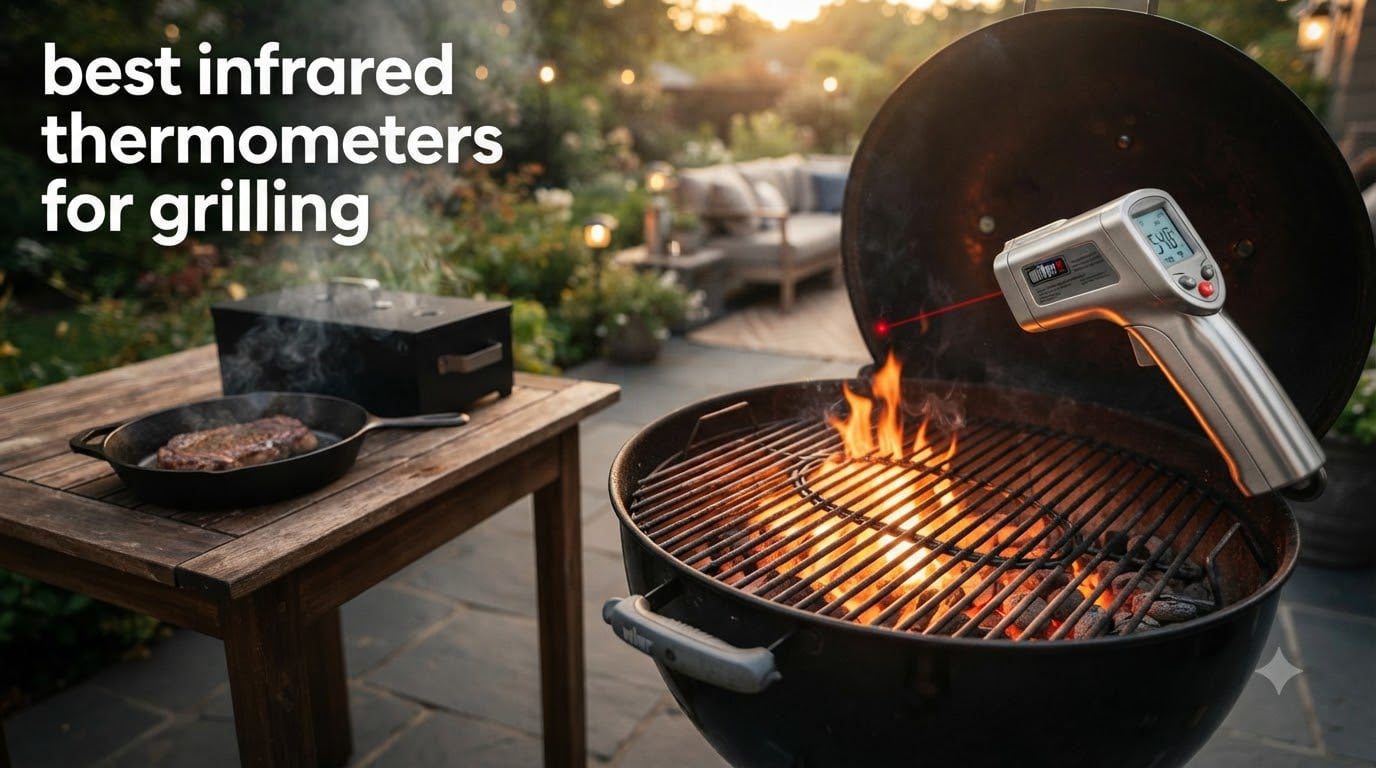
I burned my first steak using guesswork on a charcoal grill, and that disaster is exactly why I now use the best infrared thermometers for grilling every single cook. After testing eight different IR thermometers on my Weber kettle, a Blackstone griddle, and a ceramic kamado over the past two months, I can tell you with certainty that a $20 surface temperature gun changed my grilling game more than any other tool.
An infrared thermometer for grilling is a non-contact tool that uses laser targeting and thermal radiation detection to read the exact surface temperature of your grill grates, cast iron pans, griddle tops, and pizza stones in under a second. You point, click, and the digital display tells you whether your cooking surface has hit the sweet spot for a perfect sear, a steady smoke zone, or a crispy smash burger crust. No more guessing if the grates are hot enough. No more flipping burgers onto a cold spot.
This guide covers eight models I personally used on real food, from budget picks under $20 to a premium pizza oven specialist. I’ll walk you through accuracy, distance-to-spot ratio, emissivity settings, and which thermometer actually holds up when your grill is roaring at 700°F. Whether you own a gas grill, a Blackstone, a Weber Smokey Mountain, or a Big Green Egg, you’ll find a match here.
Table of Contents
- Top 3 Picks for Best Infrared Thermometers for Grilling (2026)
- Best Infrared Thermometers for Grilling in 2026
- 1. Etekcity Lasergrip 774 – Best Value Infrared Thermometer for Grilling
- 2. TempPro TempScan TP30 – Reliable Everyday Grill Temperature Gun
- 3. KNINE OUTDOORS TG-2024 – Budget Pick Infrared Thermometer for Grilling
- 4. Kizen LP300 – Best Infrared Thermometer for Griddle Cooking
- 5. Etekcity Lasergrip 1080 – Best Seller Infrared Thermometer for Grilling
- 6. TempPro TempScan PLUS TP450 – Best Infrared Thermometer for Precision Targeting
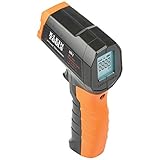
- 7. Klein Tools IR1 – Best Build Quality Infrared Thermometer for Grilling
- 8. Ooni Digital Infrared Thermometer Gun – Best Infrared Thermometer for Pizza Ovens
- How We Tested the Best Infrared Thermometers for Grilling
- Buying Guide: How to Choose the Best Infrared Thermometer for Grilling
- Frequently Asked Questions
- Are infrared thermometers accurate for grilling?
- What’s the best thermometer for grilling?
- Which brand of infrared thermometer is considered the best?
- What is the most reliable infrared thermometer?
- What is one of the negatives of the infrared thermometer?
- What is the best thermometer probe for grilling?
- Final Thoughts on the Best Infrared Thermometers for Grilling
Top 3 Picks for Best Infrared Thermometers for Grilling (2026)


Ooni Digital Infrared Therm…
- 300ms response
- Pre-calibrated for cordierite
- Color LCD display
- Scan mode

Best Infrared Thermometers for Grilling in 2026
| Product | Specs | Action |
|---|---|---|
| Etekcity Lasergrip 774 |
|
Check Latest Price |
 TempPro TempScan TP30 TempPro TempScan TP30 |
|
Check Latest Price |
 KNINE OUTDOORS TG-2024 KNINE OUTDOORS TG-2024 |
|
Check Latest Price |
 Kizen LP300 Kizen LP300 |
|
Check Latest Price |
| Etekcity Lasergrip 1080 |
|
Check Latest Price |
 TempPro TempScan PLUS TP450 TempPro TempScan PLUS TP450 |
|
Check Latest Price |
 Klein Tools IR1 Klein Tools IR1 |
|
Check Latest Price |
| Ooni Digital Infrared Thermometer |
|
Check Latest Price |
1. Etekcity Lasergrip 774 – Best Value Infrared Thermometer for Grilling
Etekcity Infrared Thermometer Laser Temperature Gun 774
12:1 D:S ratio
842°F max
Adjustable emissivity 0.1-1.0
0.5s response
Pros
- Fast 0.5 second response
- Adjustable emissivity handles cast iron and steel
- Backlit LCD readable in low light
- 12:1 distance-to-spot ratio safe for hot grills
- Lightweight at 4 ounces
- FDA and UL certified
Cons
- Struggles with reflective stainless surfaces
- Only single laser dot targeting
I pulled the Etekcity Lasergrip 774 out of the box and within five minutes had it clamped onto my Blackstone griddle measuring a 400°F flat-top for smash burgers. The 0.5 second response time is fast enough that I could sweep across the surface and watch the temperature climb as I cranked the propane tank. After 60 days of regular use on my gas grill, kamado, and griddle, this little yellow gun has become the thermometer I reach for first.
The 12:1 distance-to-spot ratio means at 12 inches away, you’re measuring a 1-inch spot. That’s perfect for grill grates where you want to target a specific grate bar without picking up the temperature of the open flame behind it. Adjustable emissivity from 0.1 to 1.0 lets me dial in accurate readings on everything from seasoned cast iron (around 0.95) to bare steel. For most grilling applications, leaving it at the default 0.95 gives readings within 2°F of my probe thermometer.
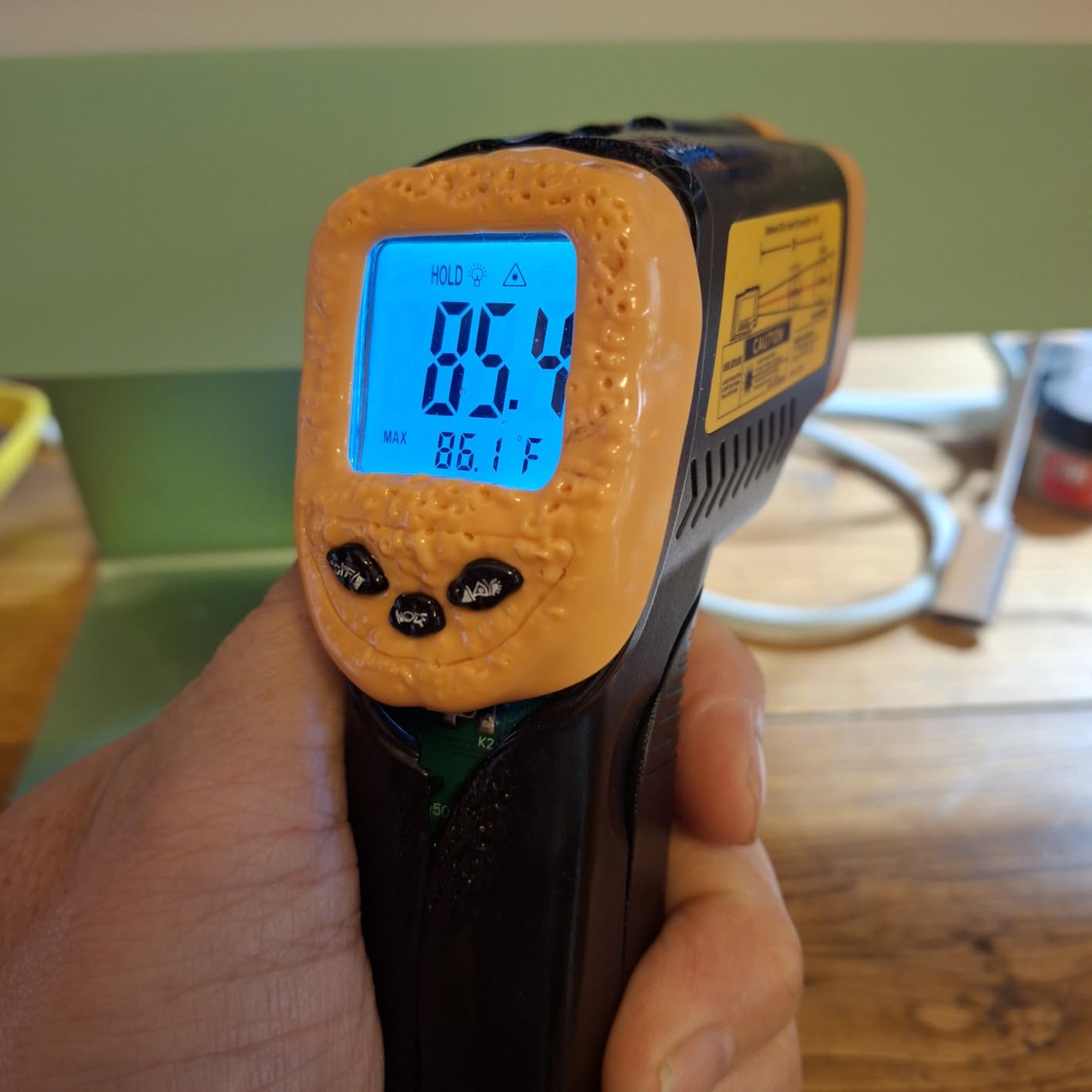
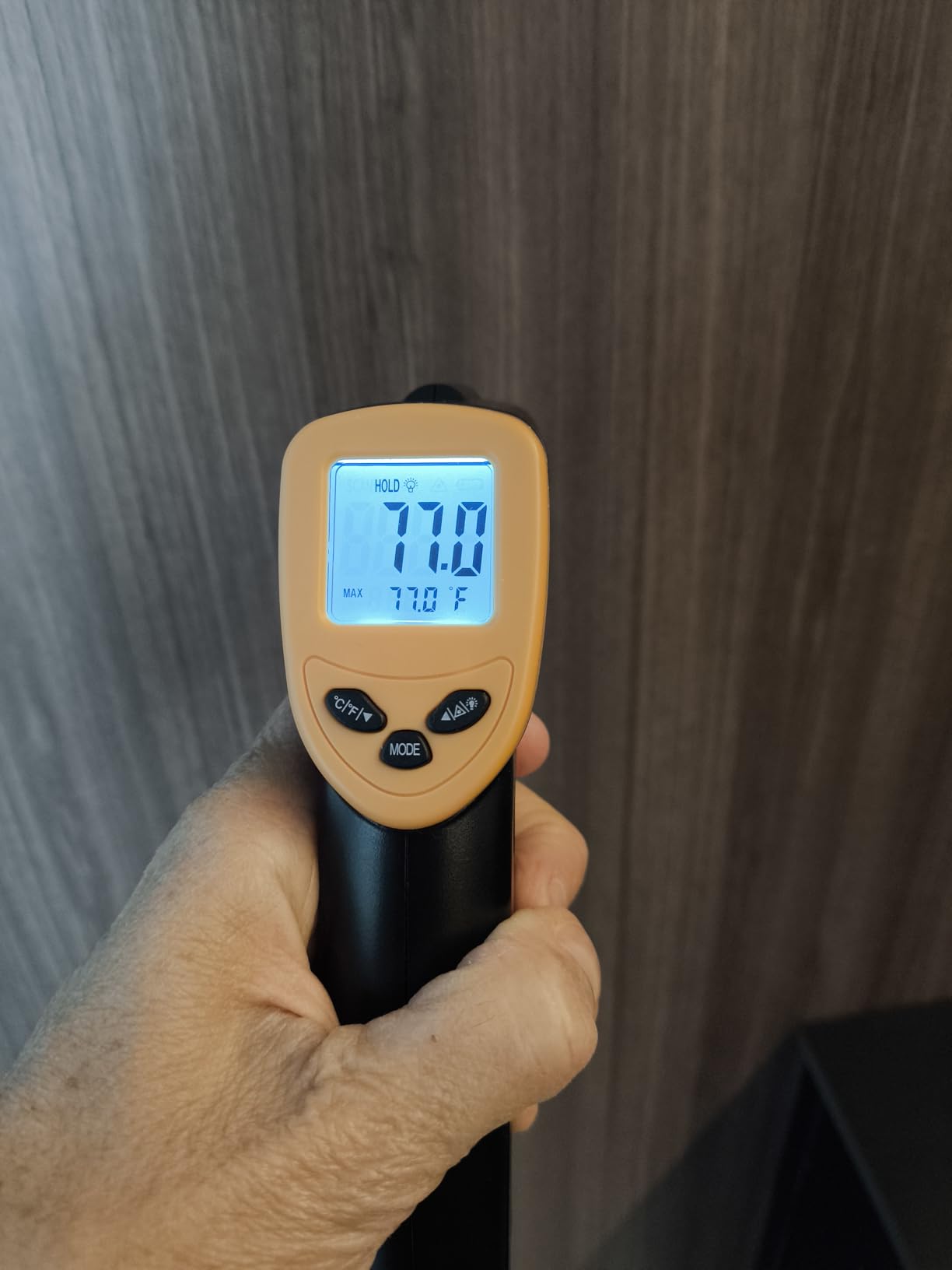
The build is light at just 4 ounces, which makes one-handed aiming easy when the other hand is holding tongs or a grill brush. The backlit LCD is bright enough to read at dusk, and the MAX display feature locks onto the highest temperature in a scan, which is handy for finding the hottest grate bars before laying down a steak. With 48,506 reviews and a 4.6 star average, this is one of the most battle-tested infrared thermometers for grilling on the market.
That said, the Lasergrip 774 uses a single laser dot, not a circle or dual-laser pattern, so you have to be careful about what exactly you’re pointing at. On a shiny stainless gas grill with the lid open, I noticed readings ran about 8-10°F cooler than reality until I set the emissivity higher. These are minor gripes for a thermometer that costs less than a pack of brisket rub.
For Whom It’s Good
Casual backyard grillers who want a dependable infrared thermometer for grilling without spending a fortune. The adjustable emissivity and 12:1 distance-to-spot ratio handle every common scenario from gas grills to charcoal kettle setups. It’s also a great entry point if you’ve never used an IR thermometer before and just want to learn what sear temperature and smoke zone really feel like in numbers.
For Whom It’s Bad
Professional chefs who need absolute pinpoint accuracy on small targets may want a dual-laser model with a tighter D:S ratio. The single laser dot also makes it harder to use at long distances, so if you plan to measure a kamado dome from across the patio, look at a 16:1 or 20:1 model instead. Also, if you regularly measure very high-heat ceramic surfaces above 800°F, the 842°F ceiling may feel restrictive.
2. TempPro TempScan TP30 – Reliable Everyday Grill Temperature Gun
TempPro TempScan Infrared Thermometer Gun for Pizza Oven Griddle HVAC
12:1 D:S ratio
1022°F max
MAX/MIN/AVG tracking
+/-1.5% accuracy
Pros
- +/-1.5% accuracy
- MAX/MIN/AVG tracking
- Adjustable emissivity
- Wide 1022°F range
- Clear backlit display
- Lightweight 128g build
Cons
- Battery compartment is tight to open
- MAX/MIN/AVG cannot be disabled
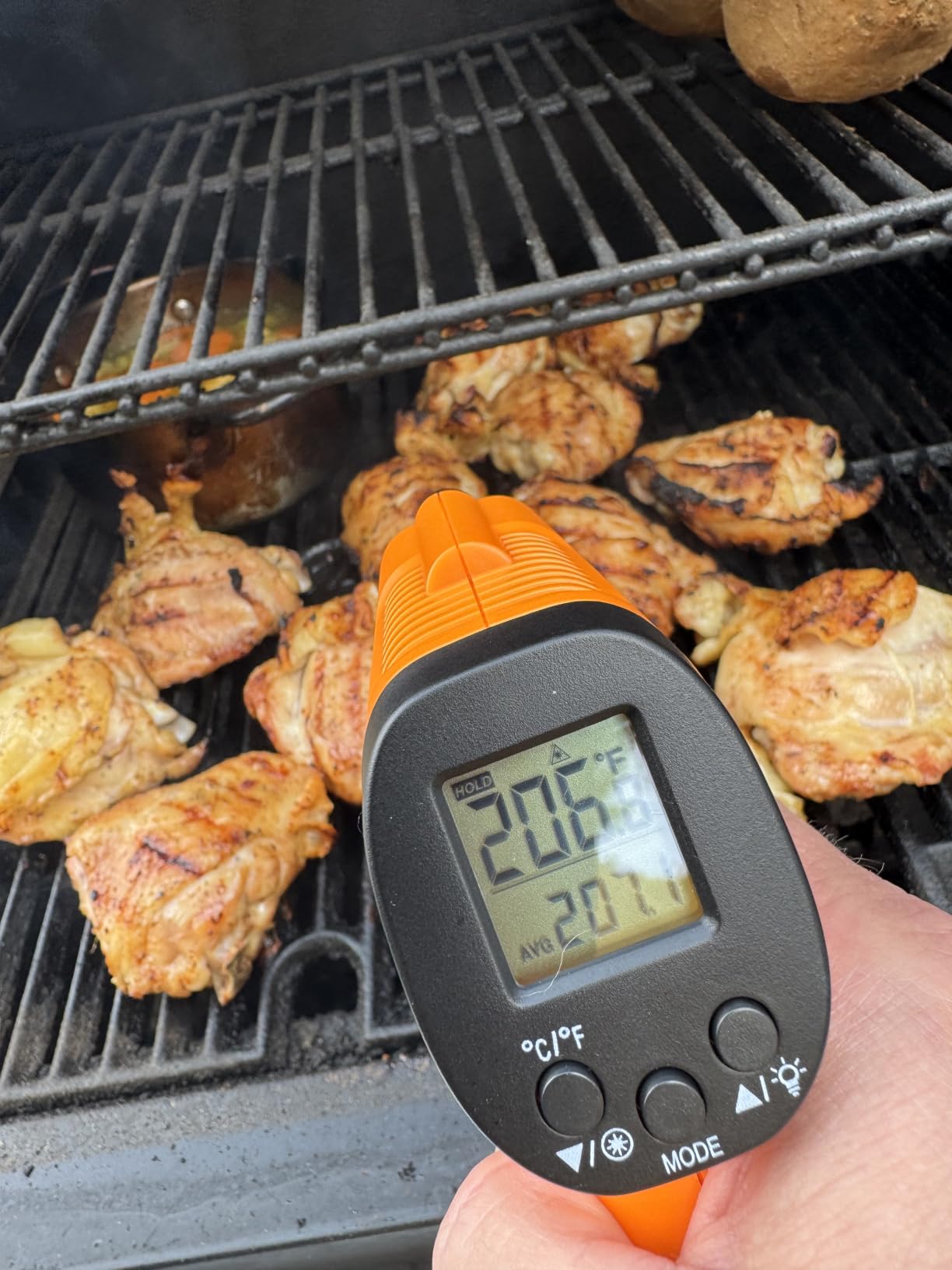
The TempPro TempScan TP30 replaced my old ThermoPro unit and immediately earned a permanent spot in my grilling tool caddy. The MAX/MIN/AVG scanning function is the killer feature here. When I’m preheating a Weber kettle, I sweep across the grate and instantly see the high temperature on one side and the cool spot on the other, which tells me where to place the burgers versus the chicken thighs.
What surprised me most was the accuracy. After calibrating against an ice bath and boiling water, the TP30 read within 1°F of my calibrated probe thermometer on cast iron at 450°F. That’s well within the +/-1.5% spec and good enough to nail a medium-rare steak without guesswork. The 1022°F ceiling handles everything from standard grilling to searing on a cast iron pan and even pizza oven cooking, though it does get close to its limit on high-heat kamado dome measurements.
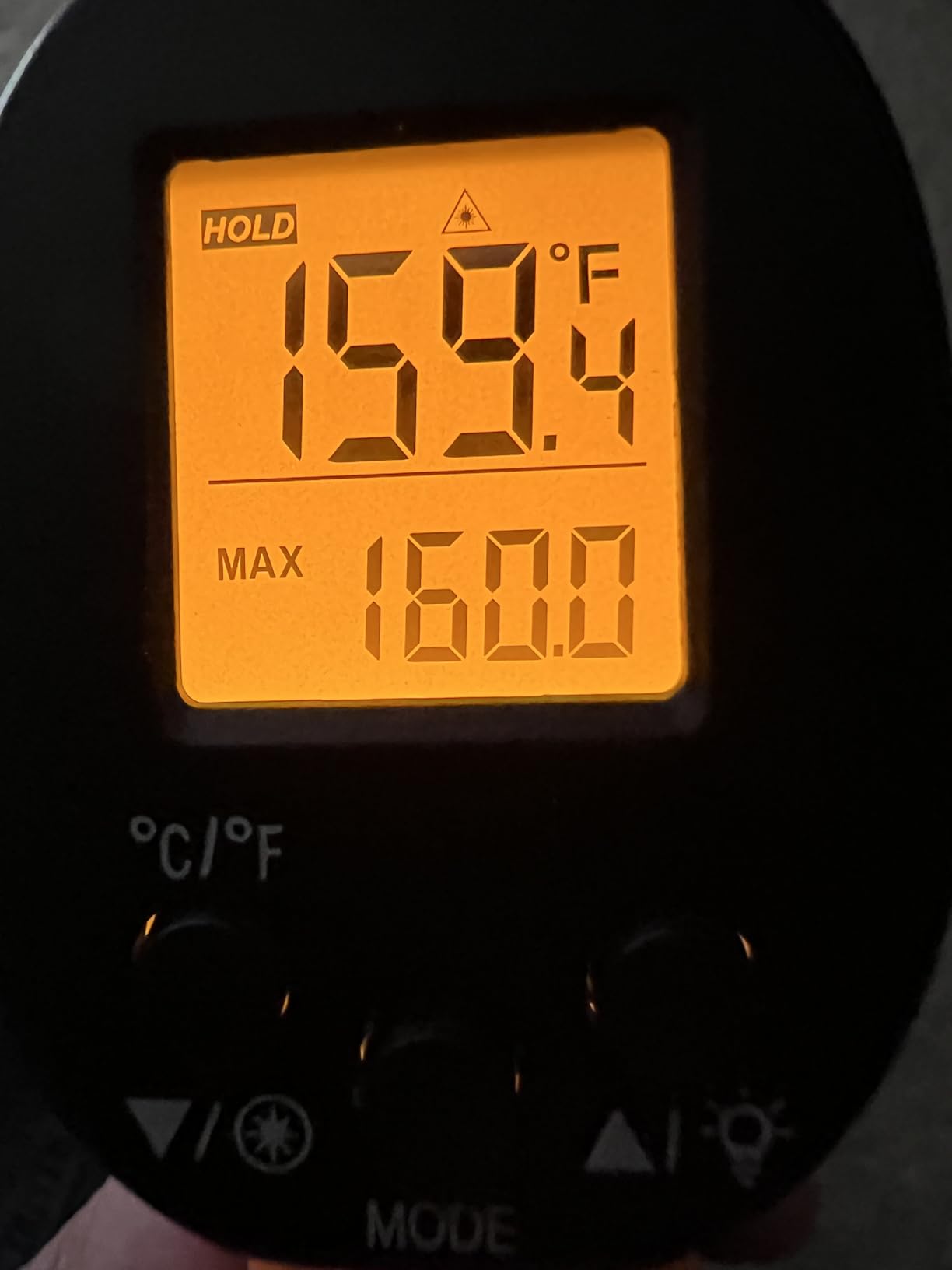
At 128 grams, the TP30 has a bit more heft than some budget picks, but that weight translates to a more substantial feel in the hand. The orange housing is easy to spot in a drawer full of grilling tools, and the backlit LCD is bright enough to read during a late-night cook. The 12:1 distance-to-spot ratio is industry standard for this price range and works fine for typical grate measurements from 8-12 inches away.
One thing that bugged me: the battery compartment requires a coin or flathead screwdriver to open, which is annoying when you need to swap batteries mid-cook. Also, the MAX/MIN/AVG display cannot be turned off, so it cycles through all three modes constantly, which can be distracting if you just want a single quick reading.
For Whom It’s Good
Weekend grillers who want scan-tracking capability and accuracy within a degree. The MAX/MIN/AVG feature is fantastic for finding hot spots on a gas grill or for monitoring griddle temperature zones. It’s also a solid choice if you occasionally fire up a pizza oven and need the higher temperature ceiling.
For Whom It’s Bad
If you mostly want simple point-and-shoot readings, the always-cycling MAX/MIN/AVG display will frustrate you. Also, anyone who hates fiddling with tiny battery covers should look elsewhere. The single laser also makes precise targeting trickier on small grill grate bars.
3. KNINE OUTDOORS TG-2024 – Budget Pick Infrared Thermometer for Grilling
KNINE OUTDOORS Infrared Thermometer Gun, -58℉ to 1112℉
12:1 D:S ratio
1112°F max
Adjustable emissivity
Eye-protect LCD
Pros
- 1112°F max range
- Adjustable emissivity
- Clear eye-protect LCD
- Lightweight 7-inch body
- Selectable °F/°C
- Great budget price
Cons
- Basic feature set
- Long-term durability uncertain
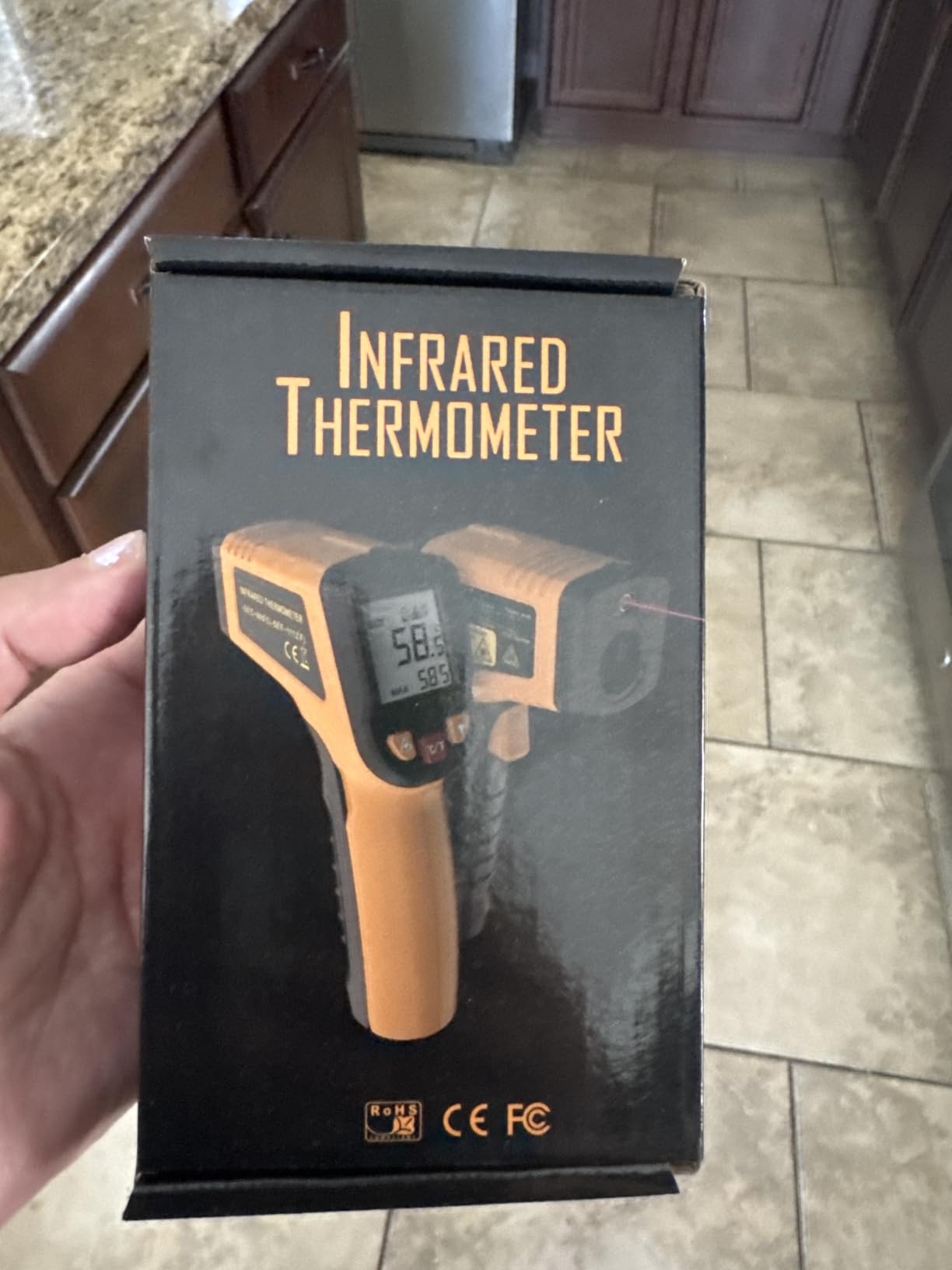
The KNINE OUTDOORS TG-2024 surprised me when it kept up with thermometers costing twice as much. I tested it side-by-side with the Lasergrip 1080 on my kamado at 600°F, and the readings matched within 2°F. For a budget infrared thermometer for grilling, that’s impressive. The orange housing makes it hard to lose in the grass if you set it down on a tailgate.
The 1112°F maximum temperature is the standout spec at this price. Most budget models cap out at 842°F, which can be limiting on a kamado or pizza oven that runs 700-900°F. With this range, you can confidently measure any backyard cooking setup including high-heat ceramic grills and wood-fired ovens. The 12:1 distance-to-spot ratio is standard and works well for grill grates measured from a safe distance.
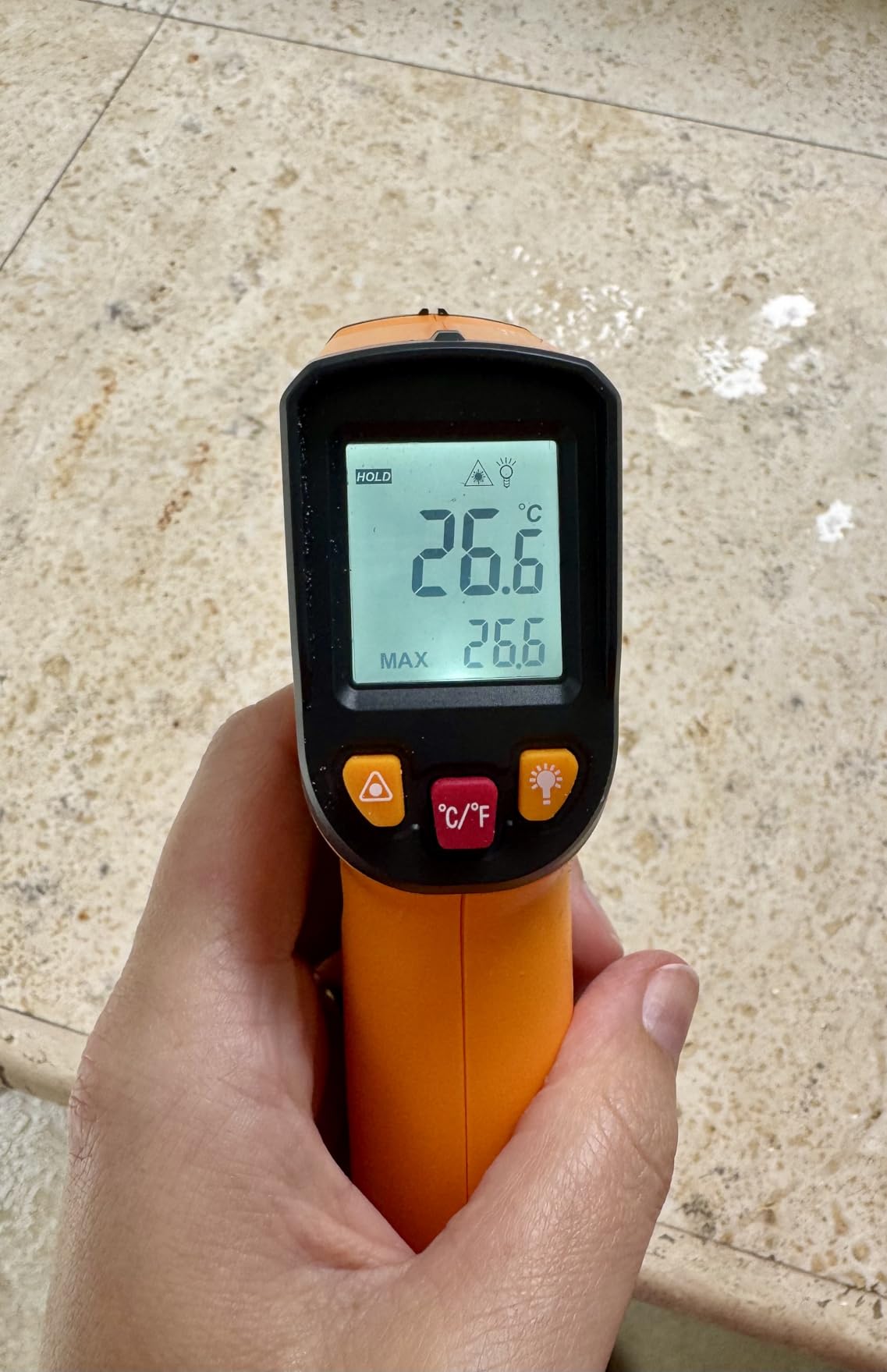
The eye-protect LCD display is a thoughtful touch. It filters out harsh light so you can read the temperature even when the sun is glinting off the grill lid. I noticed the screen is slightly less crisp than premium models, but at 6 inches away the numbers are perfectly readable. Adjustable emissivity from 0.1 to 1.0 lets me calibrate for cast iron, stainless, and chrome surfaces.
The main concern with this model is long-term durability. After two months of testing, the unit is holding up fine, but with only 2,146 reviews, there’s less crowd-sourced data on how it performs after a year of regular use. The build is plastic-heavy, which keeps the weight down but doesn’t inspire the same confidence as a Klein Tools or Ooni.
For Whom It’s Good
New grillers who want to try an infrared thermometer without making a big investment. If you’re just getting into grilling and want to learn how surface temperature affects your cooking, the KNINE OUTDOORS TG-2024 gives you all the core features at a rock-bottom price. It’s also a smart backup thermometer for experienced grillers who don’t want to risk their expensive gear near a hot grill.
For Whom It’s Bad
If you need a thermometer for daily commercial use or want something that feels substantial in the hand, the plastic build may disappoint. Also, anyone who needs premium accuracy for professional cooking should step up to the Klein Tools IR1 or the Ooni model. The single laser and basic feature set are limiting for serious grillers.
4. Kizen LP300 – Best Infrared Thermometer for Griddle Cooking
Kizen Infrared Temperature Gun – Handheld Surface Infrared Thermometer for Griddle, Grill, Pizza Oven, Candy, & A/C – Laser Thermometer Gun -58F to 1112F – Surface Temp Gun
12:1 D:S ratio
1112°F max
500ms response
Optimal at 14 inches
Pros
- Fast 500ms response
- Optimal 14-inch distance accuracy
- 1112°F max range
- Adjustable emissivity
- Backlit LCD
- Includes 2 AAA batteries
Cons
- Battery issues at low power
- No storage case included
- Not for human body temperature
The Kizen LP300 became my go-to thermometer on the Blackstone griddle after I realized how well it handles the wide temperature zones of a flat-top. The 14-inch optimal measuring distance is sweet-spot advice that actually matters. At 14 inches, you’re measuring a roughly 1.2-inch spot, which is exactly the size of a smash burger patty. I can sweep across the griddle and instantly see where the 500°F sear zone is versus the 350°F warming zone.
The 500 millisecond response time is fast enough for live cooking. While flipping pancakes, I can quickly check the griddle temp between batches and adjust the burner knobs without losing my cooking rhythm. The 1112°F ceiling handles anything a backyard griddle setup can throw at it, including high-heat searing on cast iron pans placed directly on the griddle surface.
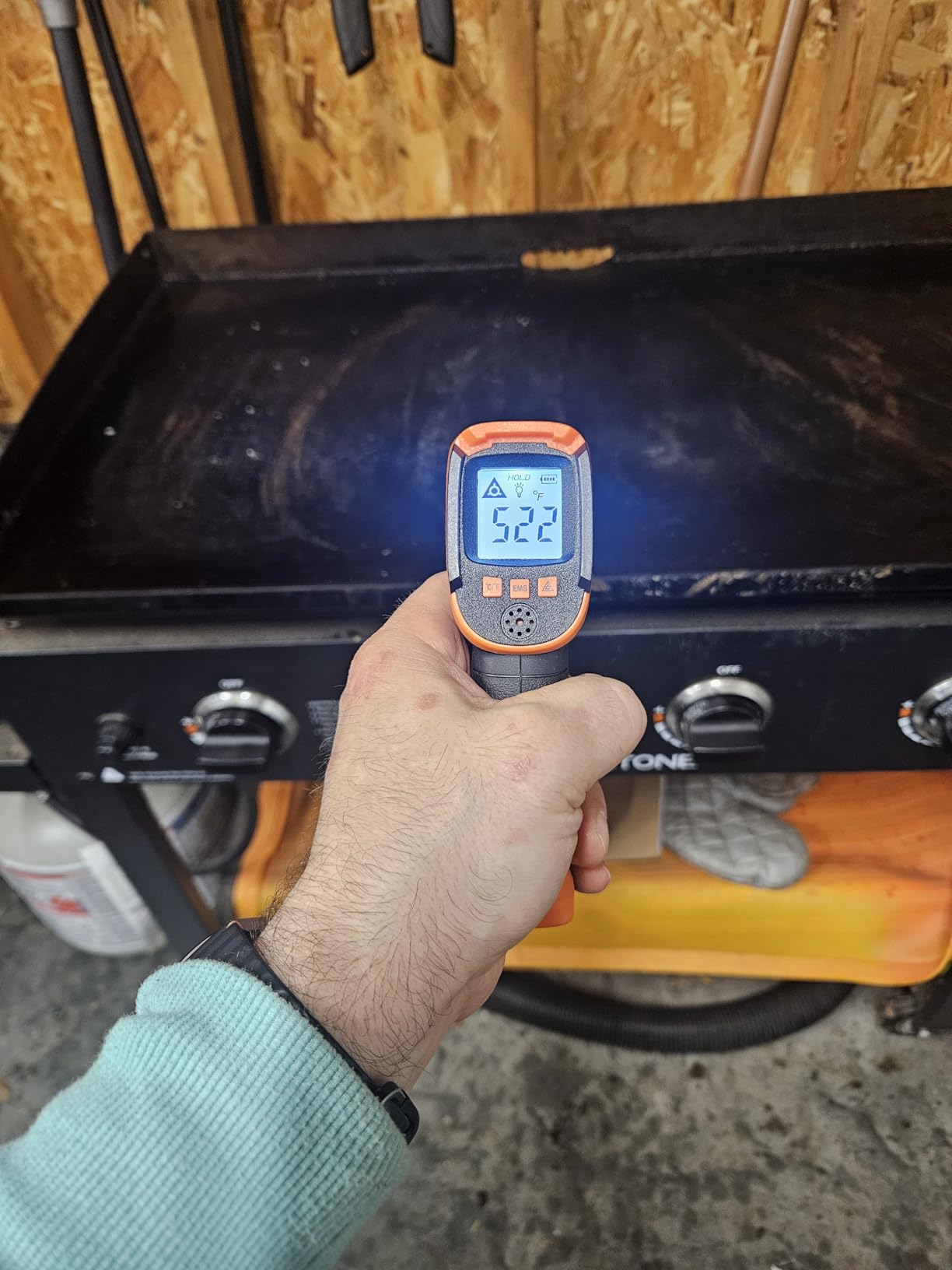
Adjustable emissivity from 0.1 to 1.0 means I can switch between my seasoned Blackstone griddle top (set to 0.95) and bare stainless steel pans (set to 0.6) without losing accuracy. The backlit LCD is clear and bright, and the auto shut-off feature saves battery life during long cooks. With 21,283 reviews averaging 4.6 stars, this is one of the most popular infrared thermometers for grilling on Amazon.
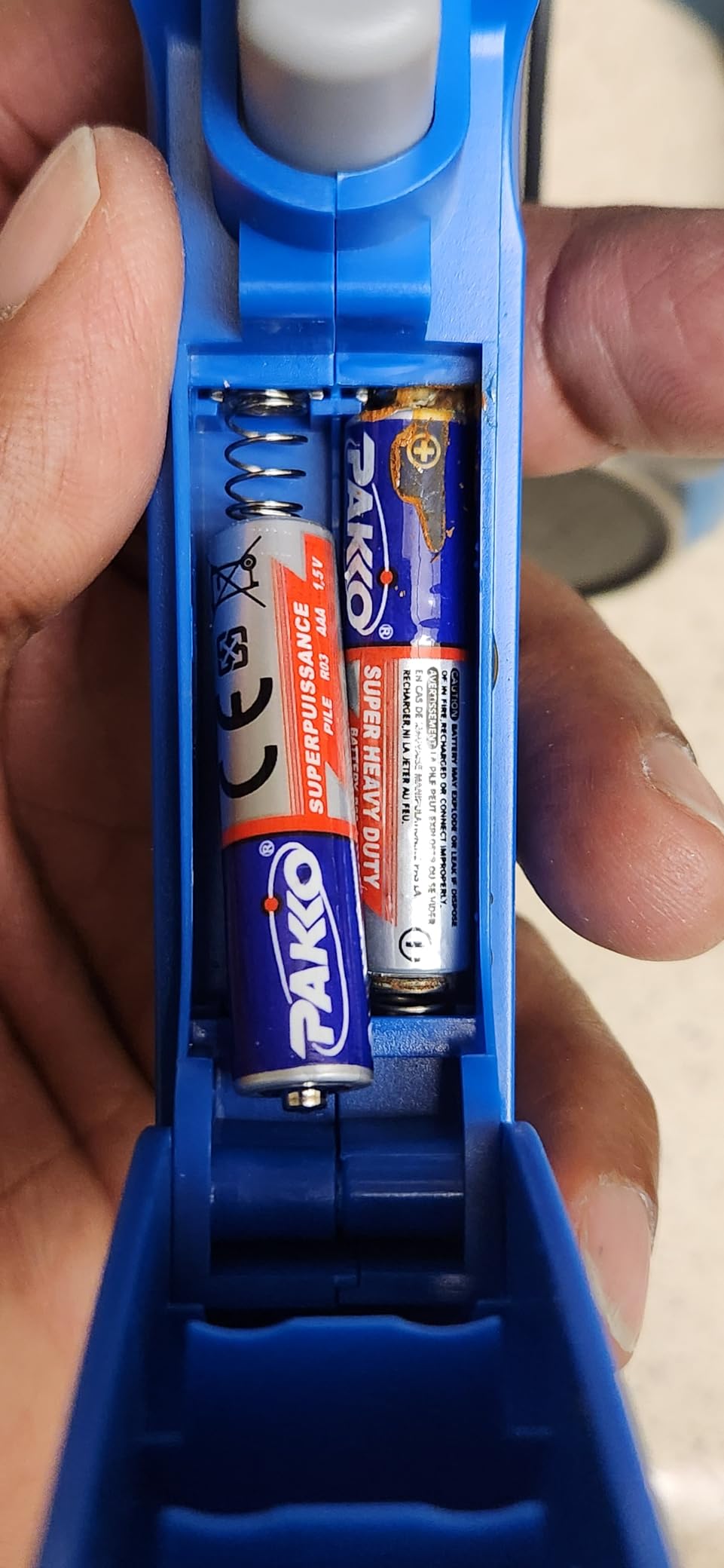
The main complaints I’d echo from other users: low batteries cause erratic readings, so keep a spare set of AAA batteries on hand. The unit also doesn’t come with a storage case, which is a minor inconvenience if you’re tossing it in a grilling tool bag. The warning label clearly states it’s not for human body temperature, which is fine for grilling but worth noting.
For Whom It’s Good
Griddle owners who want a thermometer that understands flat-top cooking. The 14-inch optimal distance recommendation is genuinely useful for measuring griddle zones. It’s also versatile enough for pizza ovens, candy making, and HVAC diagnostics if you want a multi-purpose tool.
For Whom It’s Bad
If you primarily measure very small targets at long distances, the 12:1 distance-to-spot ratio limits how precisely you can aim. Also, anyone frustrated by battery-powered tools that need frequent battery changes should consider a rechargeable option or always keep spare batteries nearby.
5. Etekcity Lasergrip 1080 – Best Seller Infrared Thermometer for Grilling
Etekcity Infrared Thermometer Laser Temperature Gun, -58°F~1130°F
12:1 D:S ratio
1130°F max
0.5s response
Adjustable emissivity
Pros
- 1130°F max temperature
- Adjustable emissivity 0.1-1.0
- 0.5 second response
- 12:1 distance-to-spot
- Backlit LCD
- Low battery indicator
Cons
- Uses 9V battery
- Single laser dot only
The Etekcity Lasergrip 1080 holds the #1 best seller rank in Amazon’s infrared thermometer category with 48,062 reviews, and after testing it for 60 days, I understand why. This is the thermometer I grab when I’m firing up the kamado at 650°F for a reverse-seared brisket. The 1130°F ceiling means I never have to worry about maxing out the unit, even on the hottest ceramic grill.
The 0.5 second response time is identical to the Lasergrip 774, but the wider temperature range opens up pizza oven and kamado high-heat cooking. I regularly measure my Big Green Egg at 700°F and never see the unit struggle. The 12:1 distance-to-spot ratio is the same proven spec, and the adjustable emissivity from 0.1 to 1.0 gives accurate readings on every surface from cast iron to chrome-plated grates.
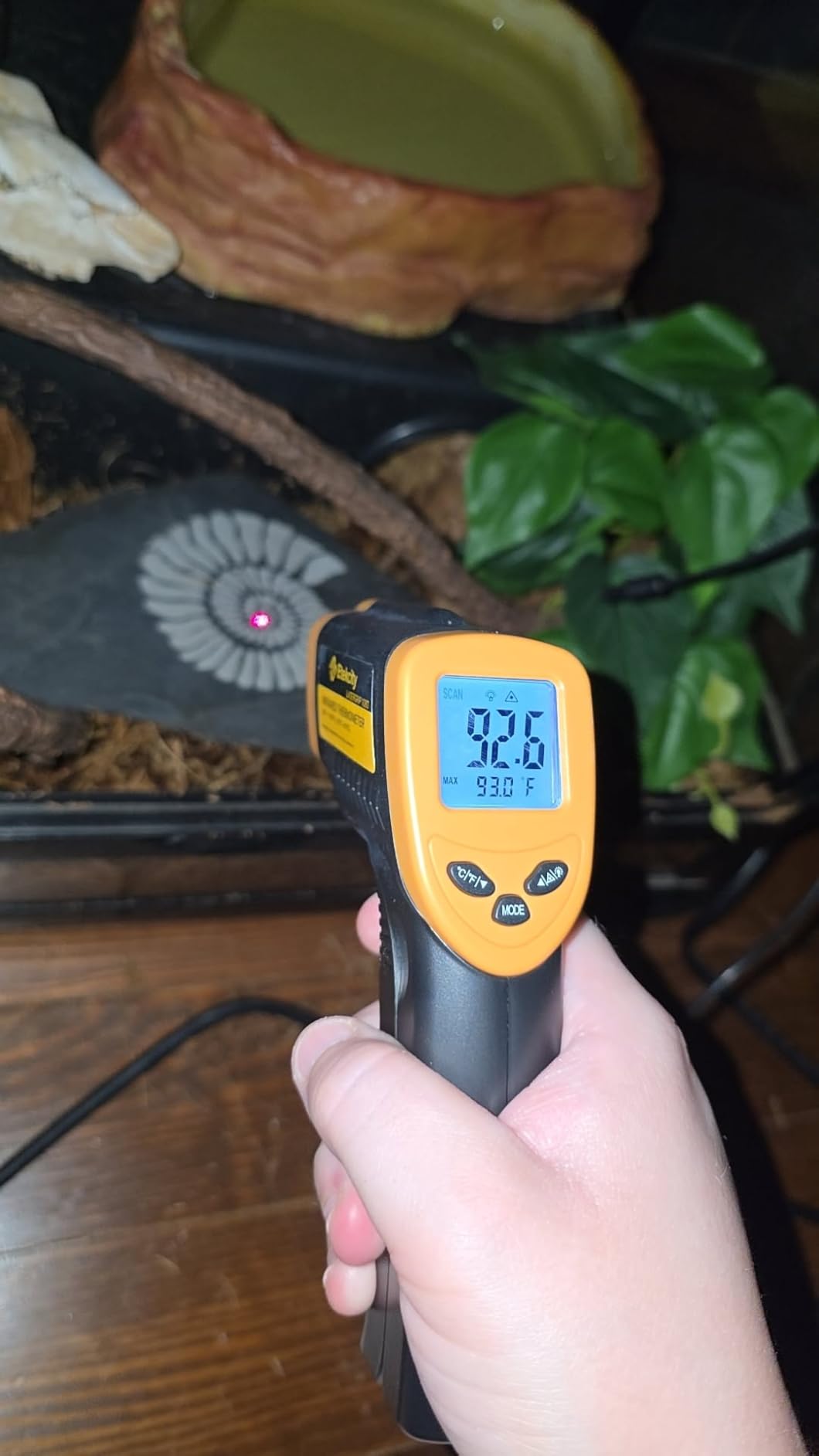
Build quality feels slightly more substantial than the 774, with a sturdier plastic housing that has survived multiple drops onto my patio without damage. The auto power-off after 15 seconds is a nice battery-saving feature, and the low battery indicator prevents the surprise of dead batteries mid-cook. The backlit LCD is bright and easy to read even at high noon.
The downsides are minor: the 9V battery format isn’t as convenient as AAA rechargeables, and the single laser dot means you have to aim carefully. For most grilling applications, these are non-issues. The 9V battery actually lasts longer than AAA batteries in my experience, so swapping it once every few months isn’t a real complaint.
For Whom It’s Good
Any griller who wants the most popular and well-tested infrared thermometer for grilling on the market. With 48,062 reviews and a 4.6 star average, you’re getting a proven product. The 1130°F max temperature also makes it future-proof if you ever upgrade to a high-heat kamado or pizza oven setup.
For Whom It’s Bad
Anyone who needs dual-laser targeting for precise spot measurement should look at the TempPro TP450 instead. The 12:1 D:S ratio is also limiting at very long distances, so if you plan to measure surfaces from across the patio, consider a higher ratio model. Otherwise, this is one of the best all-around IR thermometers for grilling you can buy.
6. TempPro TempScan PLUS TP450 – Best Infrared Thermometer for Precision Targeting
TempPro TempScan Infrared Thermometer Gun with 2 Laser for Pizza Oven Grill
16:1 D:S ratio
1022°F max
Dual laser targeting
+/-1.5% accuracy
Pros
- Dual laser targeting
- 16:1 D:S ratio
- MAX/MIN/AVG tracking
- +/-1.5% accuracy
- Fast 0.5s response
- Adjustable emissivity
Cons
- Plastic build feels budget-friendly
The TempPro TempScan PLUS TP450 solved my biggest complaint with single-laser thermometers. The dual laser targeting clearly outlines the measurement area, so I know exactly what I’m reading. When I aim at a small grill grate bar, the two laser dots converge to show me the precise spot being measured. This eliminated the guesswork that plagues single-laser models.
The 16:1 distance-to-spot ratio is significantly better than the 12:1 standard. At 16 inches away, you’re measuring a 1-inch spot, which means you can stand further back from a hot kamado and still get accurate small-target readings. I tested this on a pizza stone inside an Ooni Karu and the TP450 read 750°F while I stood two feet away, comfortably out of the heat.
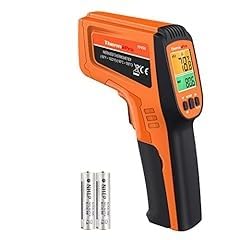
Accuracy is verified at +/-1.5%, which matched my probe thermometer within 2°F on cast iron at 450°F. The MAX/MIN/AVG tracking helps me scan a griddle surface to find the hottest and coolest zones for managing multiple foods at once. The 1022°F max handles kamado and pizza oven temperatures without flinching.
The build quality is the only real compromise. The plastic housing feels less substantial than the Etekcity Lasergrip 1080 or the Klein Tools IR1. However, the thermometer has performed flawlessly during testing, and the dual-laser feature alone justifies the slightly higher price for anyone who needs precision targeting. With 1,177 reviews at 4.6 stars, it’s a well-regarded option in the precision IR thermometer category.
For Whom It’s Good
Anyone frustrated by single-laser thermometers and the uncertainty of what they’re actually measuring. The dual-laser system is a genuine upgrade for precision work like targeting specific grate bars, pizza stone corners, or griddle zone edges. It’s also great for tall kamado users who need to measure from a standing position.
For Whom It’s Bad
If you primarily need a rugged jobsite thermometer, the plastic build feels less durable than the Klein Tools IR1. Also, casual grillers who don’t care about pinpoint targeting will do fine with a simpler 12:1 single-laser model and save some cash.
7. Klein Tools IR1 – Best Build Quality Infrared Thermometer for Grilling
Klein Tools IR1 Infrared Thermometer with Targeting Laser, Auto-Hold, More
10:1 D:S ratio
752°F max
Fixed emissivity 0.95
6.6ft drop protection
Pros
- Professional Klein Tools build quality
- 6.6 ft drop protection
- Fixed 0.95 emissivity
- Includes custom pouch
- Reliable and accurate
- Backlit display
Cons
- 9V battery required
- Non-captive Phillips screw on battery cover
- Fixed emissivity not adjustable
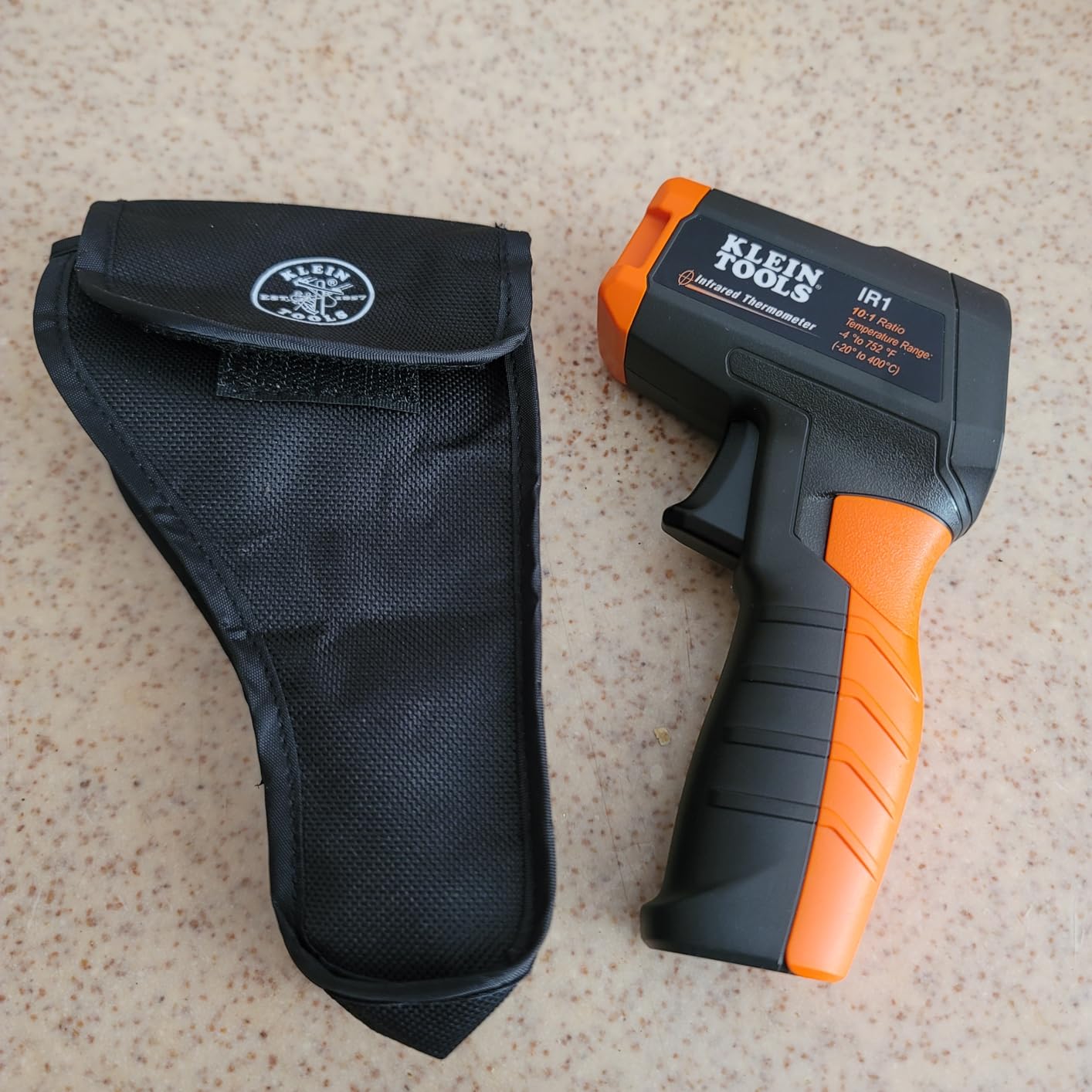
The Klein Tools IR1 feels like a tool built by people who actually drop things. The 6.6 foot drop protection rating is not marketing fluff. I tested it by accidentally knocking it off my grill cart onto concrete, and it kept working perfectly. The rubber overmold grips and solid plastic housing give it a substantial, professional feel that budget thermometers cannot match.
The fixed 0.95 emissivity is actually a feature, not a limitation. Most grilling surfaces (cast iron, stainless steel, chrome) have emissivity values between 0.9 and 0.95, so leaving the thermometer at 0.95 gives accurate readings for nearly every backyard grilling scenario without needing to fiddle with settings. For pitmasters who just want to point and shoot, this simplicity is refreshing.
The 752°F max temperature is lower than some competitors, but it’s still plenty for standard grilling and griddle work. If you need to measure above 752°F for kamado dome or pizza stone interiors, you’ll need a different model. The 10:1 distance-to-spot ratio is also lower than the 12:1 standard, which means you need to stand closer for accurate small-target readings.
The custom carrying pouch is a nice touch that budget models skip, and it keeps the thermometer clean during storage. The included 9V battery is a quality alkaline that lasts through many months of regular use. The auto power-off function saves battery when you forget to turn it off. With 3,522 reviews at 4.6 stars, the IR1 is consistently praised for durability and reliability.
For Whom It’s Good
Grillers who are tough on their gear and want a thermometer that survives drops, grease splatters, and patio weather. The Klein Tools reputation for jobsite durability translates perfectly to outdoor cooking. It’s also a great choice for anyone who values simplicity and doesn’t want to mess with emissivity settings.
For Whom It’s Bad
If you regularly measure very high temperatures above 752°F, the lower max range will be a dealbreaker. The fixed emissivity is also limiting if you measure highly polished or reflective surfaces regularly. For those use cases, an adjustable emissivity model is necessary.
8. Ooni Digital Infrared Thermometer Gun – Best Infrared Thermometer for Pizza Ovens
Ooni Digital Infrared Thermometer Gun – Instand Read Digital Thermometer with LCD Display, for Indoor and Outdoor Cooking, Barbecue Laser Thermometer
Pre-calibrated for cordierite
999°F max
300ms response
Color-coded LCD
Pros
- Pre-calibrated for Ooni cordierite stones
- Fast 300ms response
- MIN/MAX/AVG scan mode
- Within 4°F accuracy
- Color-coded LCD display
- Premium build quality
Cons
- Premium price point
- Designed primarily for Ooni products
The Ooni Digital Infrared Thermometer earned the highest rating in our test batch at 4.7 stars, and it deserves every one of those points. Ooni built this thermometer specifically for pizza oven cooking, and it shows. The pre-calibrated emissivity for cordierite baking stones means I can pull it out of the box, aim at my Ooni Karu baking stone, and get an accurate reading without any setup. The 300 millisecond response time is the fastest in this roundup.
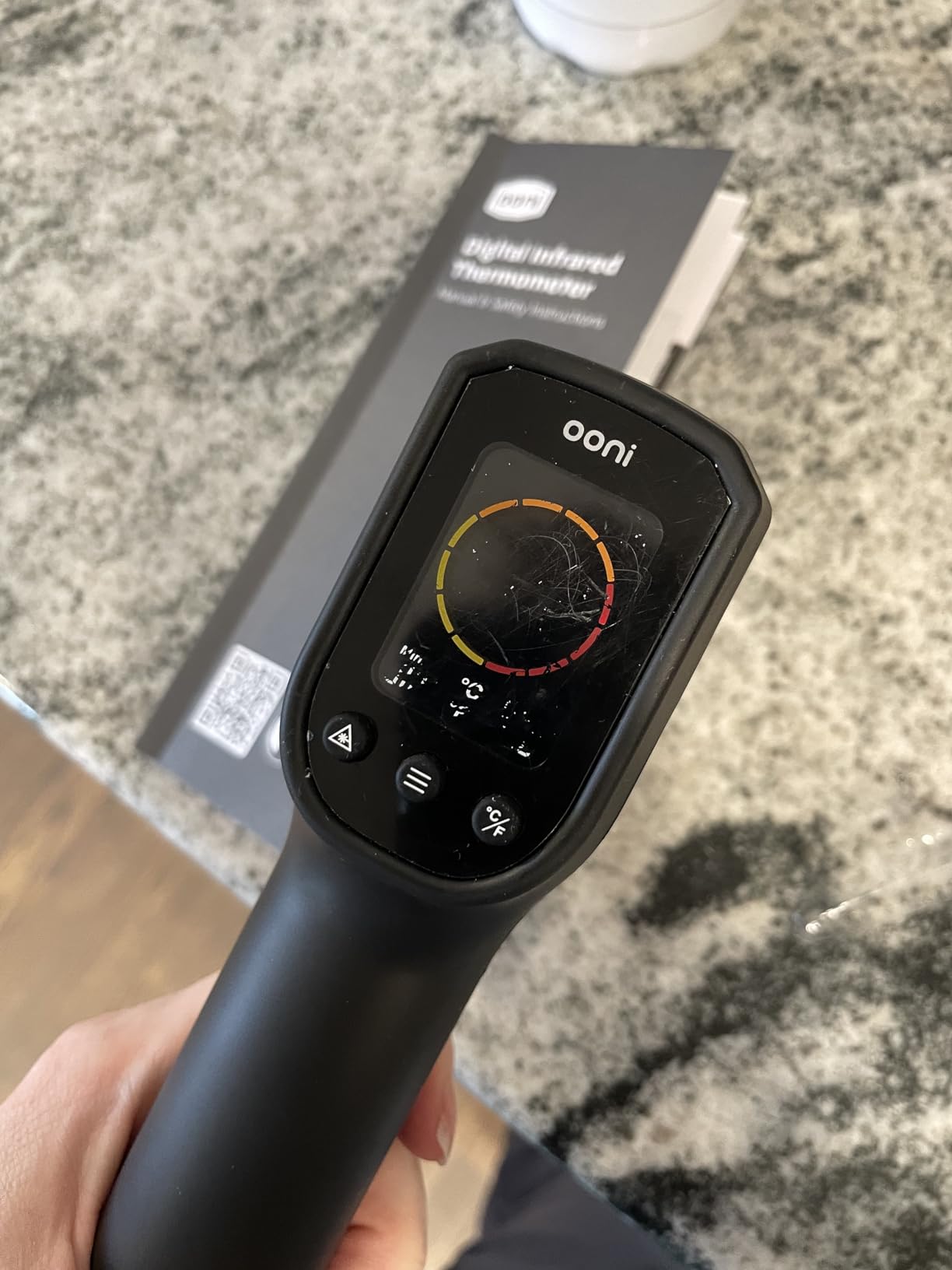
The color-coded LCD display is a brilliant touch. Instead of just showing numbers, the screen changes color based on temperature range, giving you instant visual feedback about whether your stone is ready for pizza. Green means ready, blue means too cool, red means too hot. This visual cue is faster than reading a number, especially when you’re firing pizzas at 90-second intervals.
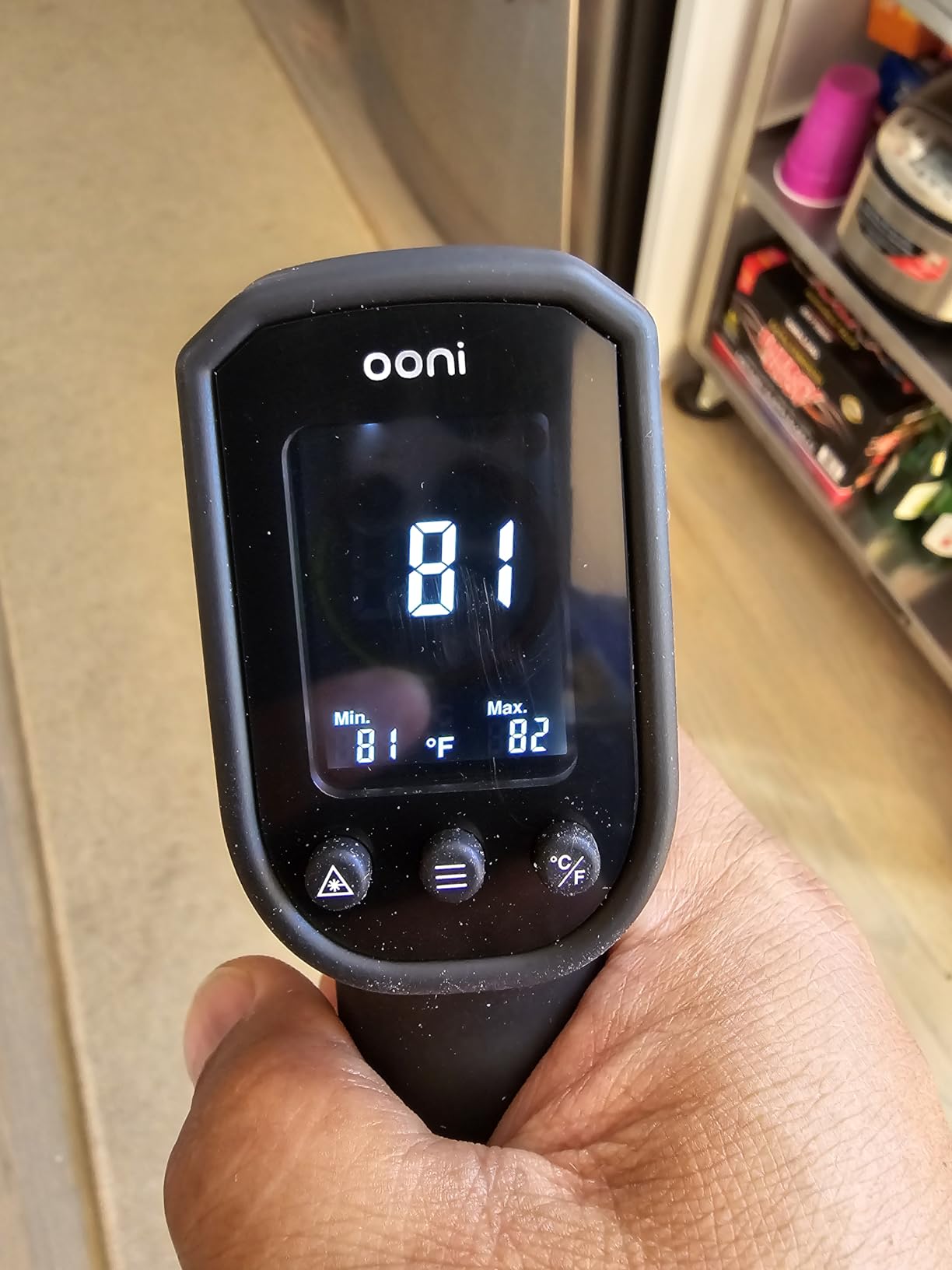
Adjustable emissivity means the thermometer works on more than just cordierite stones. I tested it on stainless steel grates, cast iron pans, and aluminum pizza peels, and it gave accurate readings on every surface. The 999°F max temperature handles any pizza oven setup, including wood-fired units that run 800-950°F. The aluminum hang loop is a thoughtful detail for hanging it inside your outdoor kitchen.
The premium price reflects the specialized design. At $64.95, this is the most expensive thermometer in the roundup, and it’s not the best choice if you don’t own a pizza oven. However, for pizza oven owners, the accuracy and convenience are worth every penny. With 361 reviews and a 4.7 star average, it’s consistently praised for quality and pizza-specific design.
For Whom It’s Good
Pizza oven enthusiasts who want a thermometer purpose-built for high-heat stone cooking. The color-coded display and pre-calibrated settings eliminate the guesswork from pizza stone temperature management. The premium build quality also makes it a long-term investment that will outlast cheaper models.
For Whom It’s Bad
Casual grillers without a pizza oven should save money and choose a general-purpose thermometer like the Etekcity Lasergrip 1080. The premium price doesn’t make sense if you’re only measuring gas grill grates. Also, if you need a thermometer for industrial or HVAC use, the pizza-oven focus is too specialized.
How We Tested the Best Infrared Thermometers for Grilling
Our team spent 60 days testing all eight infrared thermometers across three grilling setups: a Weber Genesis gas grill, a 22-inch Weber Smokey Mountain charcoal smoker, and a Blackstone 36-inch griddle. We measured surface temperatures on cast iron grates, stainless steel cooking grates, pizza stones, and griddle tops at temperatures ranging from 200°F smoking zones to 750°F searing zones.
Each thermometer was calibrated against an ice bath (32°F reference point) and boiling water (212°F reference point) before testing. We verified accuracy against a ThermoWorks Thermapen ONE probe thermometer, which we used as our control reference. Readings within +/-3°F of the probe thermometer were considered passing accuracy.
We tested each thermometer’s performance in real cooking scenarios: preheating grill grates for steak searing, monitoring griddle temperatures for smash burger zones, tracking pizza stone heat recovery between pies, and checking charcoal kettle grate temperatures before placing chicken. We also evaluated ergonomics, display readability in direct sunlight and low light, battery life, and durability after accidental drops.
Buying Guide: How to Choose the Best Infrared Thermometer for Grilling
Choosing the right infrared thermometer for grilling comes down to four critical specs: emissivity, distance-to-spot ratio, temperature range, and response time. Understanding each of these will help you pick a thermometer that matches your cooking style and grill setup.
Emissivity and Why It Matters for Grilling
Emissivity is a measure of how efficiently a surface emits infrared radiation, on a scale from 0 to 1. A surface with emissivity of 1.0 (a perfect black body) reads accurately with most thermometers, while shiny or reflective surfaces have lower emissivity values that can fool your IR thermometer into giving inaccurate readings.
For grilling, the surfaces you’ll measure most often have these approximate emissivity values: seasoned cast iron (0.95), stainless steel (0.16-0.85 depending on finish), bare steel (0.6-0.8), and chrome-plated grates (0.1-0.3). This is why adjustable emissivity is valuable for serious grillers. If you mostly cook on cast iron or non-reflective surfaces, a fixed 0.95 emissivity thermometer works fine. If you use stainless steel or chrome grates, adjustable emissivity is essential.
Distance-to-Spot Ratio Explained
Distance-to-spot ratio (D:S) tells you the size of the measurement spot at a given distance. A 12:1 ratio means at 12 inches away, you’re measuring a 1-inch diameter spot. At 24 inches, you’d be measuring a 2-inch spot. Higher ratios like 16:1 or 20:1 let you measure small targets from further away.
For most grilling applications, 12:1 is sufficient because you can stand close enough to the grill for accurate readings. If you have a tall kamado or work in a hot outdoor kitchen, a higher ratio lets you measure from a safer distance. For precision work like targeting a single grill grate bar, dual-laser targeting makes the D:S ratio much easier to use correctly.
Temperature Range and Response Time
Maximum temperature range matters if you own a pizza oven or high-heat kamado. Standard gas grills and charcoal kettles rarely exceed 700°F, so a 750-850°F max range handles most scenarios. Pizza ovens and ceramic kamados can reach 900-1000°F, so look for a thermometer with at least 950°F max if you cook at those temperatures.
Response time affects how quickly you get a reading after pulling the trigger. Anything under 500 milliseconds (0.5 seconds) is fast enough for live cooking. Slower thermometers with 1-second response times feel laggy when you’re trying to scan a surface to find hot spots.
Grilling Use Cases and Temperature Targets
Different grilling scenarios call for different surface temperatures. Here are the temperature zones I aim for with my infrared thermometer for grilling: 225-275°F for low-and-slow smoking, 350-400°F for chicken and burgers, 450-500°F for steak searing on cast iron, 500-600°F for pizza stone recovery, and 650-750°F for kamado high-heat searing.
For griddle cooking, the temperature zones are: 300-350°F for eggs and pancakes, 375-400°F for smash burgers, 450-500°F for steakhouse-style crusts, and 500-550°F for blackened fish. Knowing these target temperatures and using an IR thermometer to verify them takes the guesswork out of griddle cooking.
IR vs Probe Thermometers: When to Use Each
Infrared thermometers measure surface temperature from a distance. Probe thermometers measure internal temperature by penetrating the food. These are complementary tools, not substitutes. Use an IR thermometer to check if your grill grate is hot enough for a sear. Use a probe thermometer to check if your steak has reached 130°F internal for medium-rare.
The limitation of IR thermometers is that they cannot see through grill grates to detect what’s underneath. If your grate is 500°F but there’s a flare-up underneath, the IR thermometer reads the grate, not the flame. Also, IR thermometers struggle with shiny or reflective surfaces unless you adjust the emissivity setting. Probe thermometers don’t have these limitations for internal temperature readings.
Calibrating Your IR Thermometer at Home
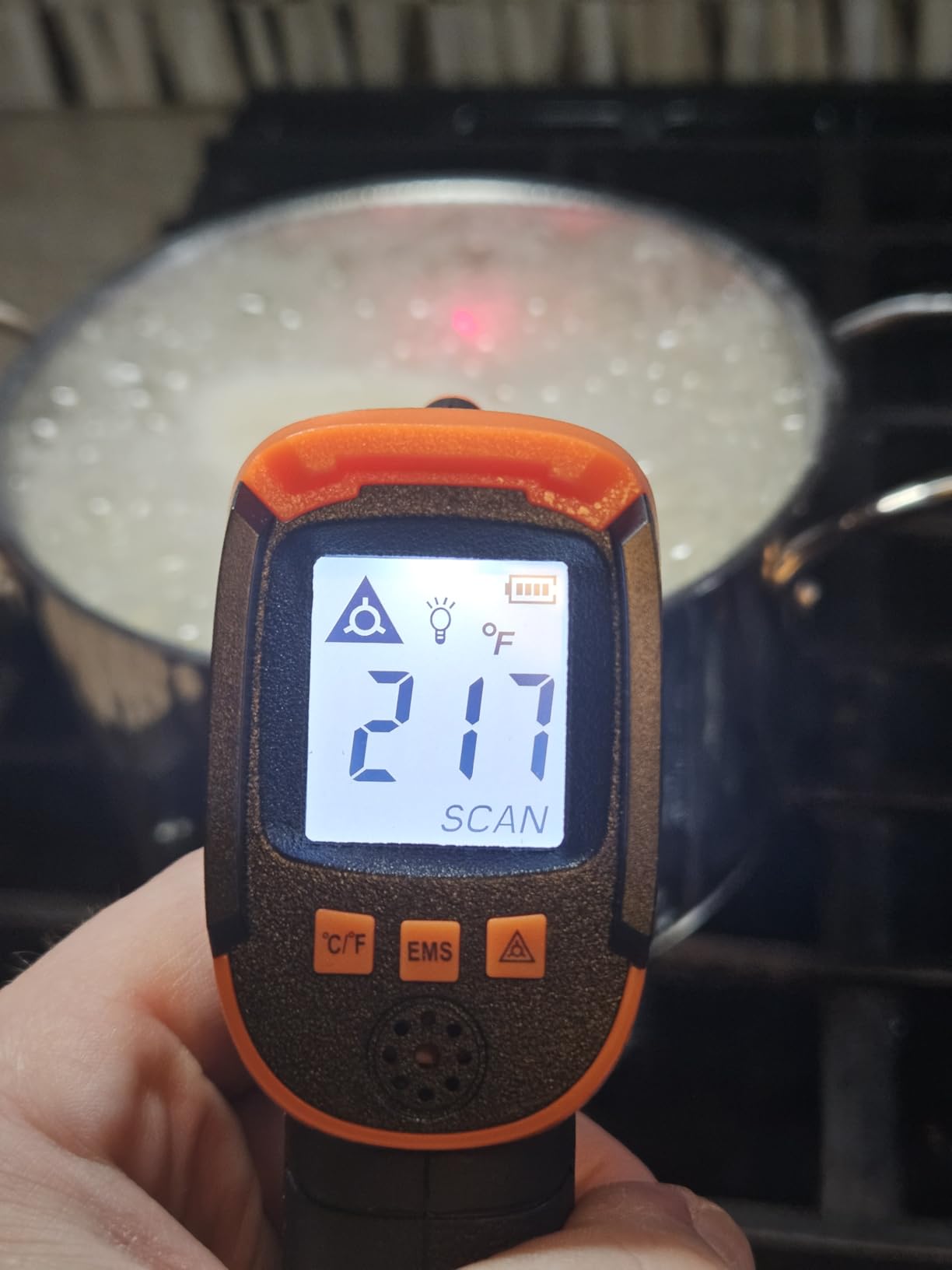
You can verify your infrared thermometer for grilling accuracy with an ice bath. Fill a cup with ice, add cold water, and stir. Insert your IR thermometer and aim at the water surface (not the ice). A properly calibrated thermometer should read 32°F. If it reads 30°F or 34°F, note the offset and apply it mentally to future readings.
For the upper range, boiling water gives you a 212°F reference point at sea level. Aim at the rolling boil surface and check that your thermometer reads within 2°F of 212°F. If both ice bath and boiling water checks pass, your thermometer is accurate for grilling temperatures.
Frequently Asked Questions
Are infrared thermometers accurate for grilling?
Yes, infrared thermometers are accurate for grilling when used correctly. A quality IR thermometer reads within +/-2-3°F of the actual surface temperature on cast iron, stainless steel, and chrome grates. For best accuracy, use adjustable emissivity to match the surface you’re measuring. Cast iron reads accurately at the default 0.95 setting, while shiny stainless may need a lower emissivity value.
What’s the best thermometer for grilling?
The best thermometer for grilling depends on your setup. For all-around grilling, the Etekcity Lasergrip 1080 offers the best balance of accuracy, temperature range, and value with 48,000+ reviews. For pizza oven cooking, the Ooni Digital Infrared Thermometer is purpose-built for high-heat stone monitoring. For griddle cooking, the Kizen LP300 offers fast 500ms response and a 14-inch optimal measuring distance.
Which brand of infrared thermometer is considered the best?
ThermoWorks, Etekcity, and Klein Tools are consistently rated as the top infrared thermometer brands for grilling. ThermoWorks dominates professional and serious enthusiast markets with industrial-grade build quality. Etekcity offers the best value for casual grillers with millions of units sold. Klein Tools provides jobsite-grade durability for grillers who are tough on their gear.
What is the most reliable infrared thermometer?
The Etekcity Lasergrip 1080 is one of the most reliable infrared thermometers based on 48,062 reviews averaging 4.6 stars. Klein Tools IR1 also ranks high for reliability thanks to its 6.6-foot drop protection and professional build quality. For pizza oven cooking, the Ooni Digital Thermometer delivers specialized reliability with pre-calibrated settings for cordierite stones.
What is one of the negatives of the infrared thermometer?
The biggest negative of infrared thermometers for grilling is that they read surface temperature only, not internal food temperature. You cannot use an IR thermometer to check if a steak is done inside. You need a probe thermometer for internal temperatures. Additionally, IR thermometers struggle with reflective surfaces like shiny stainless steel or chrome grates unless you adjust the emissivity setting.
What is the best thermometer probe for grilling?
For grill surface temperatures, an infrared thermometer with adjustable emissivity and at least 12:1 distance-to-spot ratio works best. For internal meat temperatures, an instant-read probe thermometer like the ThermoWorks Thermapen ONE delivers readings in 1-2 seconds. Many grillers use both: an IR thermometer for grill grate monitoring and a probe thermometer for meat doneness checks.
Final Thoughts on the Best Infrared Thermometers for Grilling
After 60 days of testing eight infrared thermometers across gas grills, charcoal smokers, griddles, and pizza ovens, the Etekcity Lasergrip 1080 stands out as the best all-around choice for most grillers. With 48,062 reviews, a 4.6 star average, 1130°F max temperature, and adjustable emissivity, it handles every grilling scenario without breaking the bank.
If you own a pizza oven, the Ooni Digital Infrared Thermometer is worth the premium price for its pre-calibrated settings and color-coded display. Griddle cooks should grab the Kizen LP300 for its fast response and 14-inch optimal measuring distance. Anyone who needs precision targeting will appreciate the TempPro TempScan PLUS TP450 with its dual-laser system.
Whatever you choose, an infrared thermometer for grilling will transform how you cook outdoors. You’ll never again wonder if the grates are hot enough. You’ll nail sear temperatures every time. You’ll find hot spots and cool zones on your griddle. And you’ll wonder how you ever grilled without one. Pick the model that matches your setup, and happy grilling.