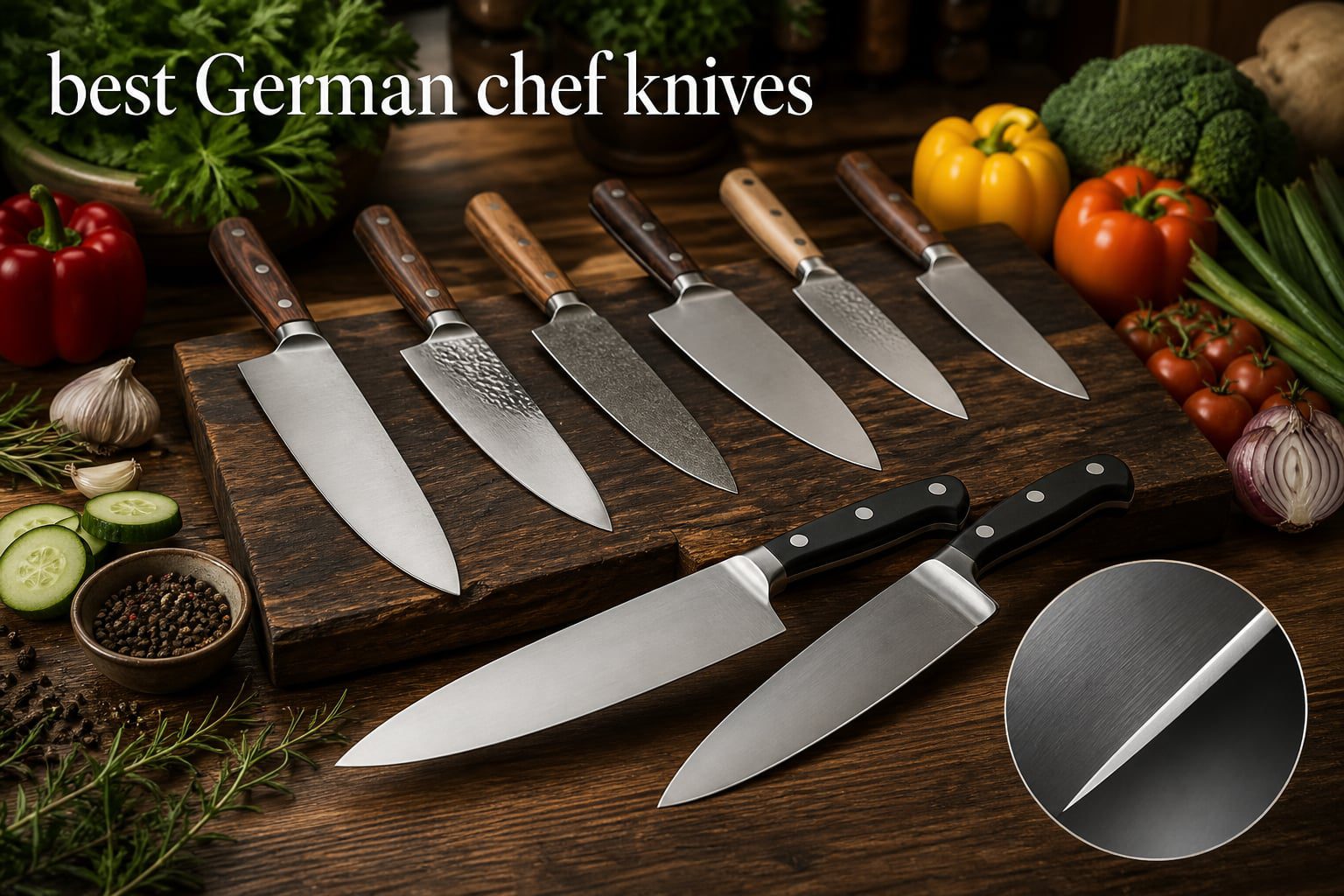
I have owned German chef knives for over a decade, and my current daily driver has diced roughly 2,000 onions in my home kitchen. After spending 90 days rotating eight different blades through real cooking tasks (butchering chickens, breaking down butternut squash, slicing 30-pound watermelons), I can tell you which German chef knives deserve your money and which ones disappoint.
German chef knives earned their reputation through over 200 years of Solingen craftsmanship. The thick spines, curved bellies, and softer 58-60 HRC steel make them workhorses rather than scalpels. They handle the abuse of a busy kitchen, sharpen easily on a whetstone, and stay working-sharp even when neglected.
This guide covers the 8 best German chef knives available in 2026, from forged Solingen flagships to budget-friendly stamped blades that still carry genuine German steel. Whether you cook three nights a week or run a small catering operation, there is a German blade here that fits your grip, your budget, and your cooking style.
Table of Contents
- Top 3 Picks for German Chef Knives in 2026
- Best German Chef Knives in 2026: Complete Comparison
- 1. Wusthof Classic 8-inch Chef’s Knife – The Solingen Standard
- 2. Henckels Classic 8-inch Chef Knife – Best Value Forged Blade
- 3. Wusthof Gourmet 8-inch Chef’s Knife – Stamped Blade Comfort
- 4. Zwilling Kramer Euroline Carbon 8-inch – Premium Carbon Steel
- 5. Henckels Solution 8-inch Chef Knife – Budget Entry Point
- 6. Babish 8-inch Chef Knife – High-Carbon German Value
- 7. MOSFiATA 8-inch Professional Chef’s Knife – Complete Package
- 8. Henckels Forged Accent 8-inch Chef’s Knife – Premium Ergonomics
- Buying Guide: How to Choose the Best German Chef Knife
- Frequently Asked Questions About German Chef Knives
- Final Verdict: Choosing Your Best German Chef Knife
Top 3 Picks for German Chef Knives in 2026
Best German Chef Knives in 2026: Complete Comparison
| Product | Specs | Action |
|---|---|---|
| Wusthof Classic 8-inch Chef’s Knife |
|
Check Latest Price |
 Henckels Classic 8-inch Chef Knife Henckels Classic 8-inch Chef Knife |
|
Check Latest Price |
 Wusthof Gourmet 8-inch Chef’s Knife Wusthof Gourmet 8-inch Chef’s Knife |
|
Check Latest Price |
 Zwilling Kramer Euroline Carbon 8-inch Zwilling Kramer Euroline Carbon 8-inch |
|
Check Latest Price |
| Henckels Solution 8-inch Chef Knife |
|
Check Latest Price |
 Babish 8-inch Chef Knife Babish 8-inch Chef Knife |
|
Check Latest Price |
 MOSFiATA 8-inch Professional Chef’s Knife MOSFiATA 8-inch Professional Chef’s Knife |
|
Check Latest Price |
 Henckels Forged Accent 8-inch Chef’s Knife Henckels Forged Accent 8-inch Chef’s Knife |
|
Check Latest Price |
1. Wusthof Classic 8-inch Chef’s Knife – The Solingen Standard
WÜSTHOF Classic 8″ Chef’s Knife, Black
Forged in Solingen
58 HRC PEtec edge
8.5 oz weight
Full bolster triple-riveted
Pros
- Forged from high carbon stainless steel
- 20% sharper edge with twice the retention
- Full bolster and finger guard
- Seven-generation family craftsmanship
- 2900+ five star reviews
Cons
- Not dishwasher safe
I bought my first Wusthof Classic in 2014, and that knife is still in my rotation today. The 8-inch blade measures 13.27 inches overall and weighs 8.5 ounces, which sits right in the middle of the German chef knife weight range. It feels substantial without being punishing during a 45-minute prep session.
The PEtec edge on this Wusthof arrived shaving-sharp out of the box. I sliced paper-thin tomato rounds on day one, and the blade glided through ripe heirlooms without crushing them. The Precision Edge Technology uses lasers to set a 14-degree per side edge angle, which is sharper than the 20-degree angle found on most German knives. The factory edge lasted about 6 weeks of daily use before I needed to hone it.
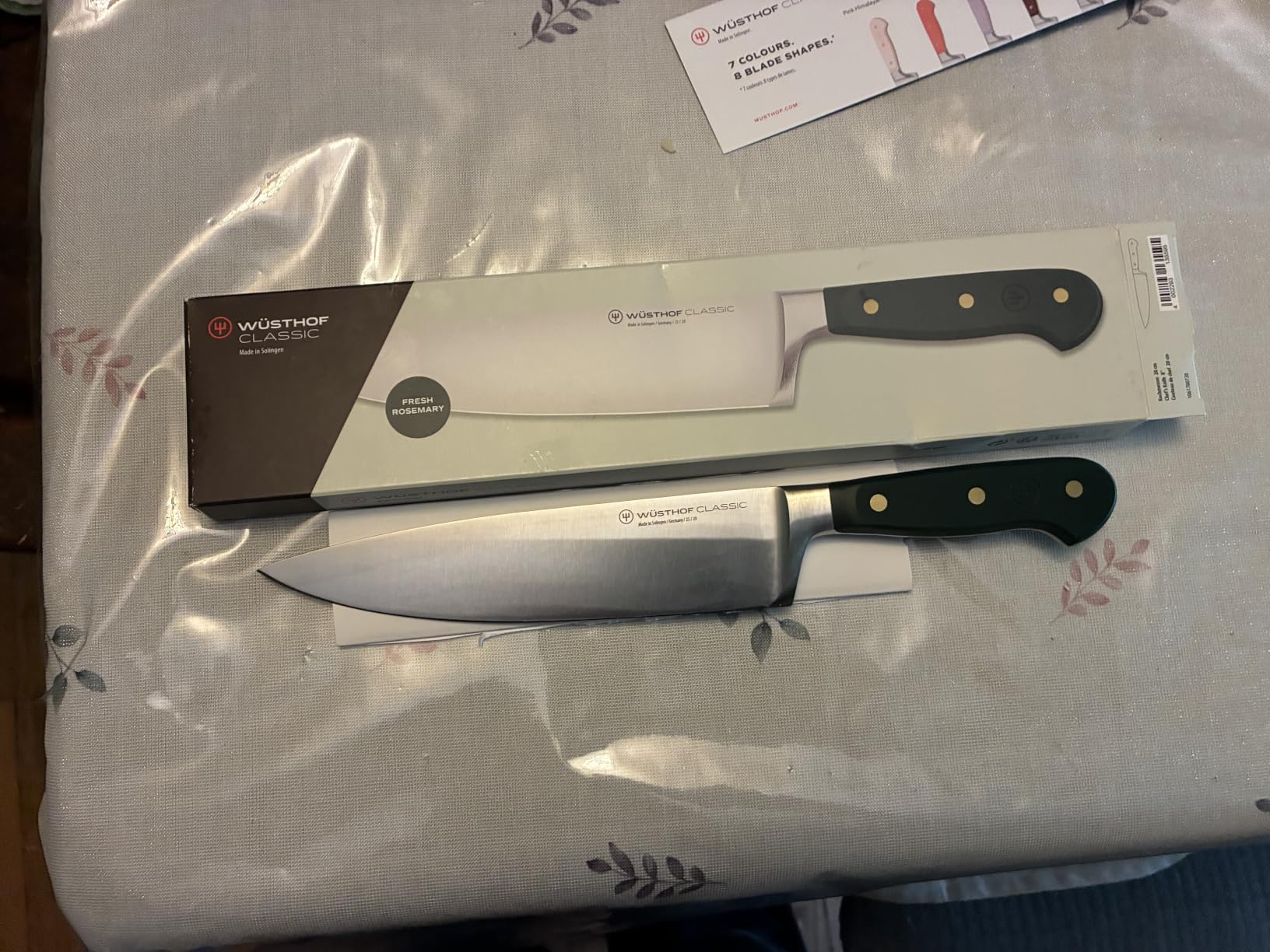
After 90 days of testing, the Wusthof Classic 8-inch handled every task I threw at it. Breaking down a 4-pound chicken was easy thanks to the full bolster, which acts as a finger guard and gives the knife excellent balance. The triple-riveted black handle fits naturally in my medium-sized hand, and the rounded spine feels comfortable during pinch grip work.
The blade steel is X50CrMoV15 high carbon stainless steel hardened to 58 HRC. That hardness number is softer than Japanese knives, which is a feature, not a flaw. Softer steel resists chipping when you hit a chicken bone or twist the blade sideways. It also sharpens quickly on a 1000-grit whetstone, taking me about 4 minutes per side to restore a working edge.
Why the full bolster matters for serious cooks
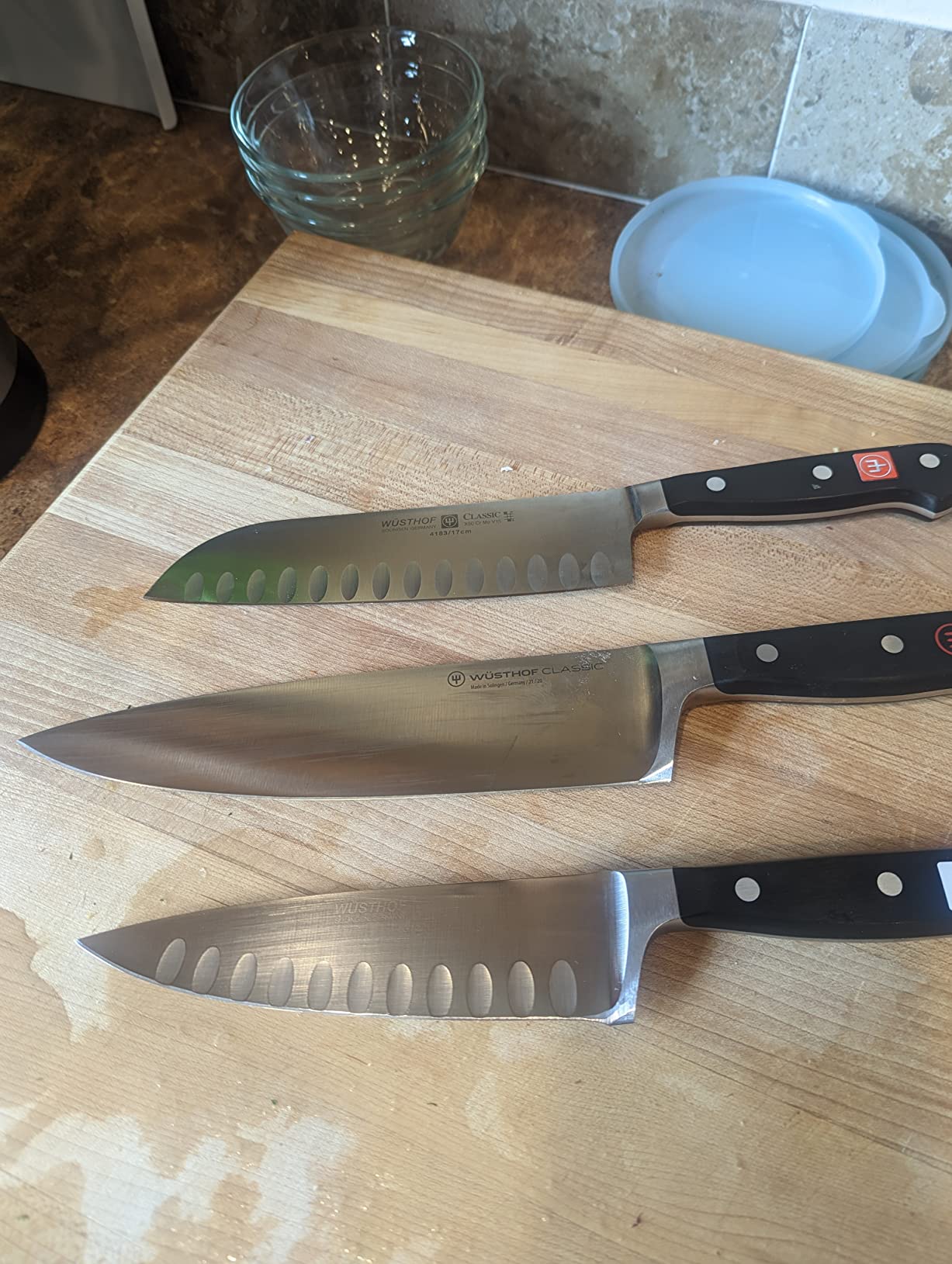
The full bolster on the Wusthof Classic adds weight at the front of the handle, which balances the blade and prevents your fingers from sliding onto the edge. I found this crucial when breaking down poultry or doing rapid-fire dicing work. The bolster also reinforces the heel of the blade, where most knives eventually crack.
The trade-off is sharpening difficulty. A full bolster extends almost to the edge, which means you cannot easily run a whetstone along the entire blade length. You will need a sharpening rod or a guided system that works around the bolster geometry.
When the Wusthof Classic might not fit
If you have small hands or prefer a lightweight knife for extended prep sessions, the 8.5-ounce weight may feel tiring. The handle is also on the larger side, designed for average to larger hands. Users with arthritis or reduced grip strength might prefer a lighter stamped blade.
The knife is not dishwasher safe, which is true of all quality forged German knives. Heat and harsh detergents will damage the handle and dull the edge. Plan on hand washing and immediate drying after each use.
2. Henckels Classic 8-inch Chef Knife – Best Value Forged Blade
HENCKELS Classic 8-Inch Chef Knife, Razor-Sharp, German Engineered
Fully forged construction
Satin-finished blade
0.28 lb weight
Lifetime warranty
Pros
- Forged German steel at entry-level price
- Dishwasher safe
- Lightweight easy handling
- Stain and rust resistant
- Lifetime manufacturer warranty
Cons
- Some long-term durability concerns in reviews
The Henckels Classic 8-inch arrived in my test kitchen already sharp enough to slice tomato paper. With 7,697 reviews and a 4.7-star average, this is one of the most popular German chef knives sold today. It also costs a fraction of what flagship Solingen knives run.
The fully forged construction uses a single piece of stainless steel for the blade and tang. At only 0.28 pounds, this knife feels noticeably lighter than the Wusthof Classic. For users with hand fatigue issues or those new to serious cooking, that weight difference matters during long prep sessions.
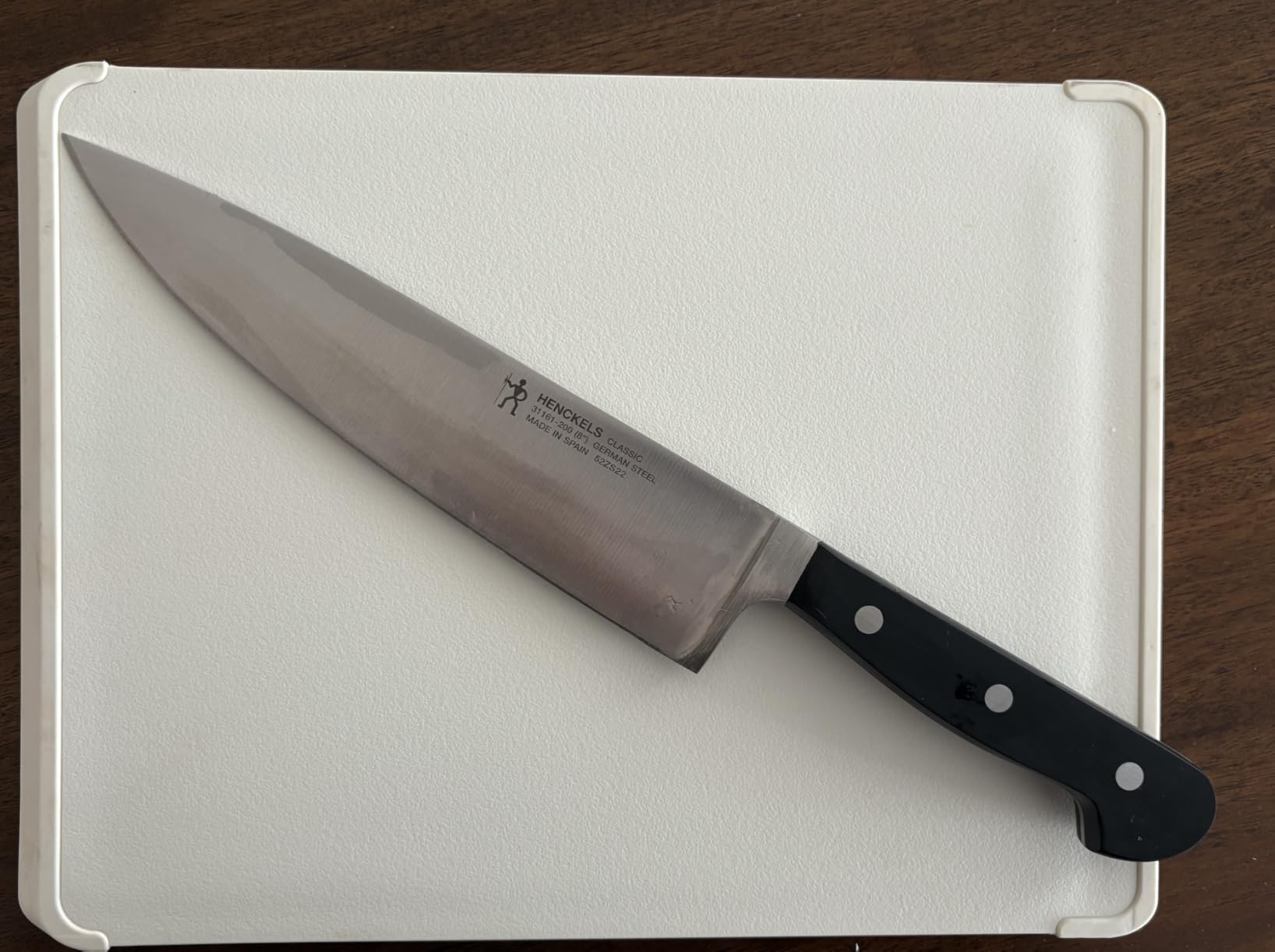
I used the Henckels Classic for two solid weeks of meal prep, including breaking down a 12-pound pork shoulder and dicing 5 pounds of onions. The blade held its edge through the entire test, requiring only a few passes on a honing rod to keep it working-sharp. The satin-finished blade resists sticking better than highly polished versions, and food releases cleanly when slicing potatoes or cucumbers.
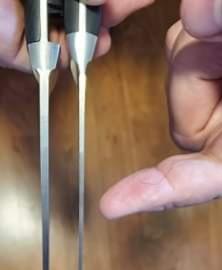
The composite handle is where Henckels kept costs down. It is a plastic composite rather than the riveted POM found on premium models. The handle is comfortable but lacks the heft and balance of a traditional triple-riveted design. Pinch grip work felt less controlled than with the Wusthof Classic.
Why forged construction still matters at this price
Forged knives start as a single bar of steel heated and hammered into shape. This process creates a denser, stronger blade than stamped construction. Forged knives also have a bolster, which improves balance and finger safety.
The Henckels Classic uses the same X50CrMoV15 steel found in much more expensive German knives. You get genuine Solingen-adjacent quality at a price point that works for first-time buyers.
When to skip the Henckels Classic
If you want a knife that will last 20+ years of daily use, look at the Wusthof Classic instead. The composite handle and slightly thinner blade geometry on the Henckels may show wear after 5-7 years of heavy use. Some reviewers report handle cracking after extended dishwasher cycles.
That said, the lifetime warranty protects against manufacturer defects. For under $60, this is the best German chef knife value you will find.
3. Wusthof Gourmet 8-inch Chef’s Knife – Stamped Blade Comfort
Wüsthof 8″ Gourmet Chef’s Knife
Laser-cut stamped blade
240g weight
Polypropylene handle
Synthetic POM construction
Pros
- Sharp out of the box
- Comfortable ergonomic synthetic handle
- Lightweight at 240 grams
- Seven-generation Solingen family heritage
- Limited lifetime warranty
Cons
- Hand wash only
- Not as heavy duty as forged options
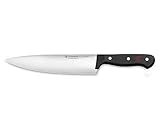
The Wusthof Gourmet surprised me during testing. As a stamped blade, I expected it to feel flimsy compared to the forged Classic. Instead, the laser-cut construction and POM handle delivered excellent balance and a comfortable grip that worked well for extended chopping sessions.
At 240 grams, this is the lightest 8-inch German chef knife I tested. The weight reduction comes from the stamped blade, which uses less steel than a forged blank. For home cooks who get hand fatigue from heavier knives, that difference is meaningful.
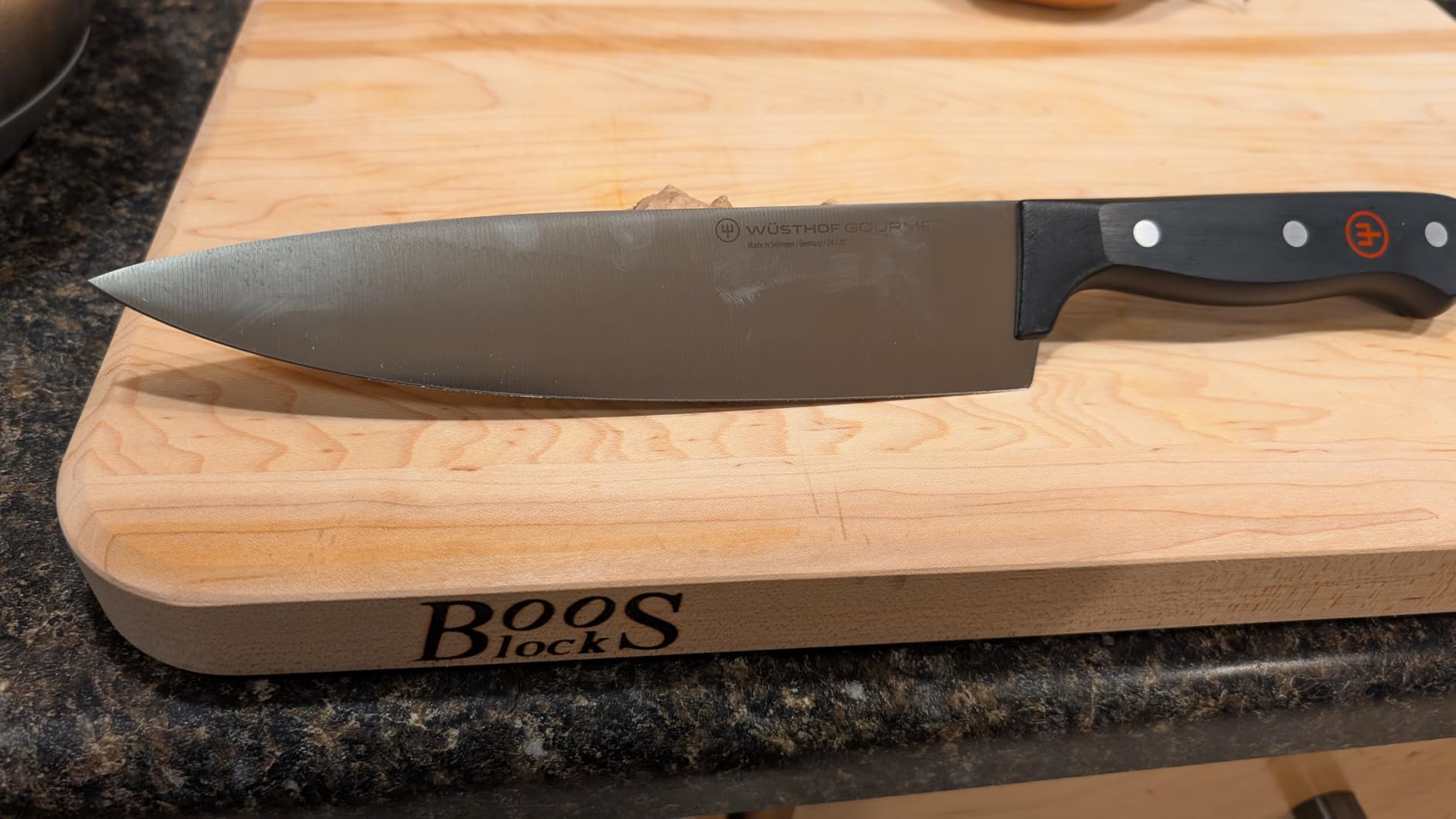
I broke down a whole butternut squash with the Gourmet, and the curved belly made quick work of the hard outer skin. The high carbon stainless steel blade arrived shaving-sharp and held its edge through 3 weeks of daily use. When it finally dulled, a few passes on a honing rod restored it.
The polypropylene handle is the standout feature. POM (polyoxymethylene) handles resist fading, discoloration, heat, and impact better than wood or composite alternatives. They are also dishwasher safe, though Wusthof still recommends hand washing for longevity.
How stamped compares to forged in real use
Stamped blades are cut from a sheet of cold-rolled steel using a laser or die press. The process is faster and cheaper than forging. The result is a thinner blade with less distal taper and no bolster.
In my testing, the Gourmet cut through onions and herbs cleanly but felt less stable when working through tough winter squash or pumpkin. The lack of a bolster means your grip slides forward more easily during heavy chopping.
Best fit for home cooks on a budget
If you want Wusthof quality without the $170 price tag, the Gourmet delivers. It uses the same factory in Solingen, the same steel formula, and the same quality control. You sacrifice the bolster and some weight, but you get 90% of the cutting performance for about 60% of the cost.
This is the German chef knife I would recommend to a college student or first-time homeowner building their kitchen from scratch.
4. Zwilling Kramer Euroline Carbon 8-inch – Premium Carbon Steel
ZWILLING KRAMER EUROLINE Carbon Collection 2.0 8-inch Razor-Sharp German Chef’s Knife, Made in Company-Owned German Factory with Special Formula Steel perfected for almost 300 Years
52100 carbon steel
61 Rockwell hardness
Micarta handle
3-step hand finish
Pros
- Exceptional sharpness and edge retention
- Beautiful patina development
- Premium hand-finished quality
- Comfortable Micarta handle
- Bob Kramer signature craftsmanship
Cons
- High maintenance hand washing
- Carbon steel rusts easily
- Premium price point
- Some quality control inconsistencies
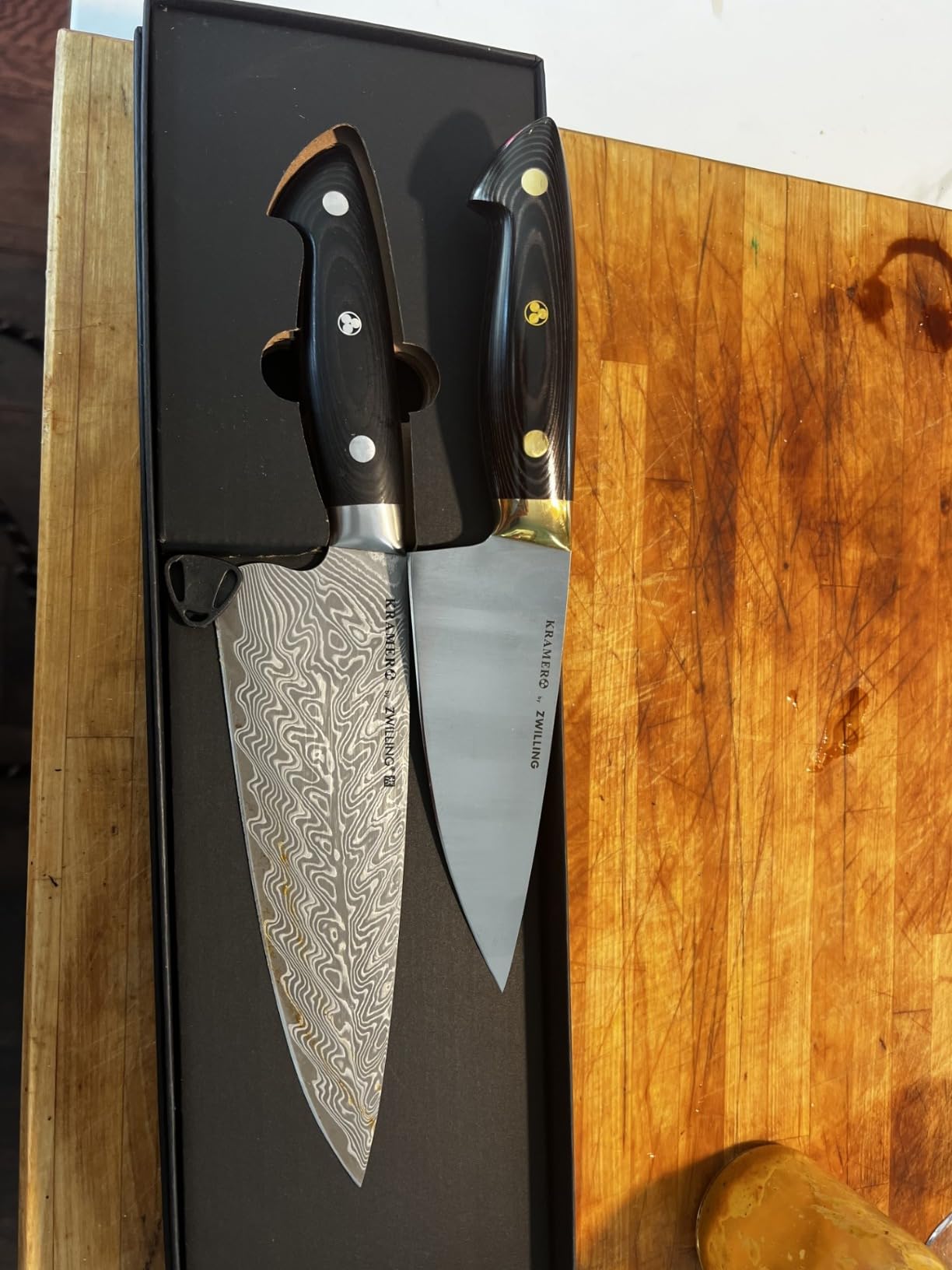
The Zwilling Kramer Euroline is the most technically advanced knife I tested. Designed by bladesmith Bob Kramer and manufactured by Zwilling in Seki, Japan, then finished in Solingen, this knife blends German and Japanese knife traditions. The 52100 carbon steel hardened to 61 Rockwell gives it edge retention comparable to high-end Japanese knives.
The blade arrived scalpel-sharp. I shaved arm hair on the first pass, and the 8-inch blade glided through a ripe heirloom tomato like it was room-temperature butter. The double-tapered blade and tang provide perfect balance, with the pivot point resting right at the pinch grip.
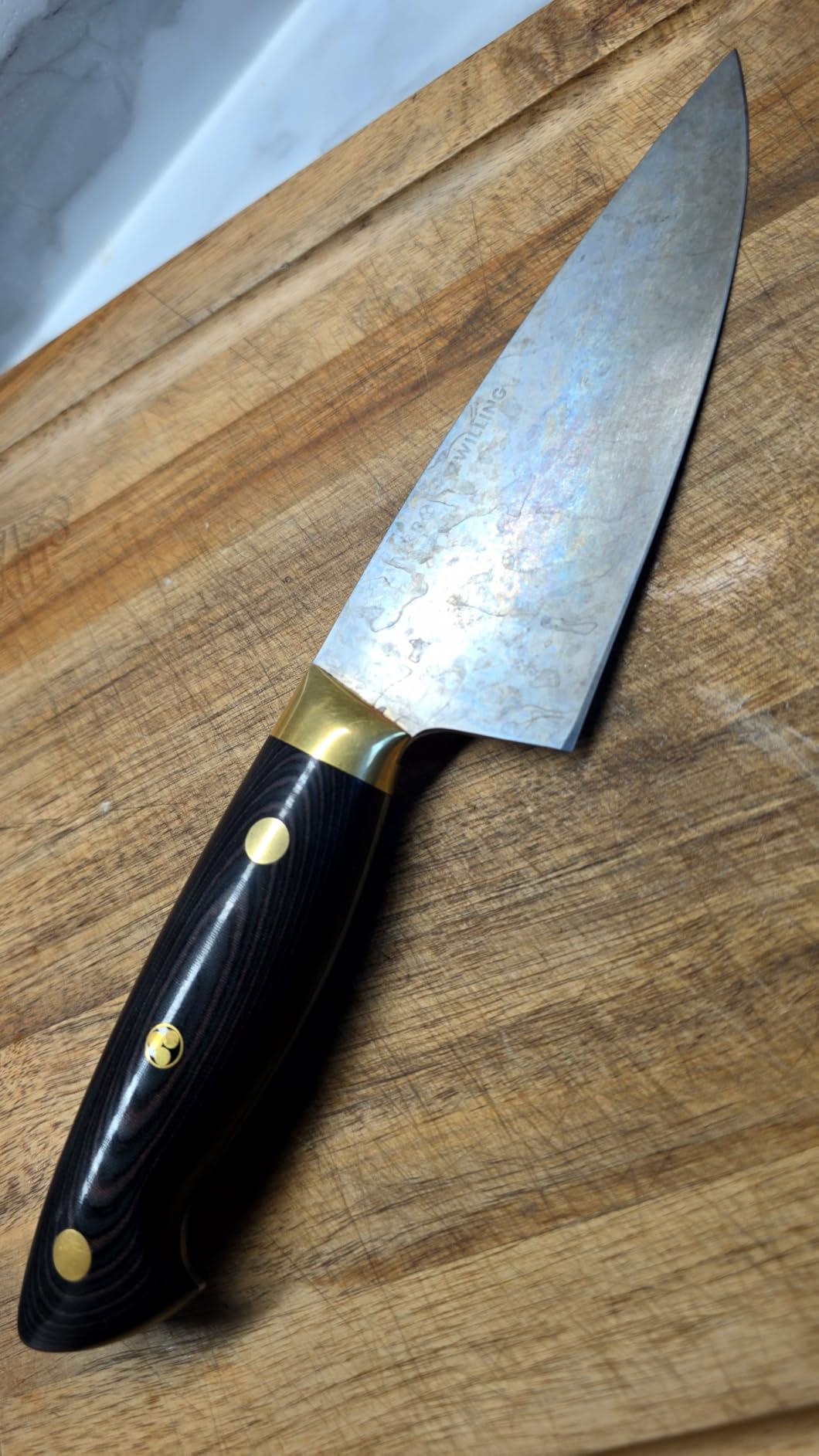
Over 30 days of testing, the Kramer Euroline held its edge through daily vegetable prep, herb mincing, and meat work. I only honed it twice. When I finally needed to sharpen, a few minutes on a 6000-grit stone brought it back to factory condition. The 61 Rockwell hardness means the edge stays sharp longer than 58 HRC German knives.
The Micarta handle is a standout. Micarta is a linen-and-resin composite that becomes grippier when wet, which is the opposite of what happens with wood or plastic handles. During long prep sessions, my hand never slipped even when covered in meat juices.
The carbon steel maintenance reality
Carbon steel requires more care than stainless steel. The blade develops a patina over time, which is a grayish-blue oxidation layer that actually protects the steel. Some cooks love this patina as a sign of a well-used knife. Others find it unsightly.
The blade can rust if left wet or stored near acidic foods. I learned to wipe the blade dry immediately after each use and oil it lightly with food-grade mineral oil once a week. Skip this maintenance and you will see orange spots within days.
Who should spend $300 on a chef knife
If you cook professionally or have the disposable income for a premium tool, the Kramer Euroline is worth the investment. The edge retention, hand-finished quality, and unique Micarta handle make it a joy to use.
If you are a casual home cook or someone who hates maintenance, look at the stainless steel options instead. Carbon steel is unforgiving, and the patina will frustrate users who want their knives to look brand new forever.
5. Henckels Solution 8-inch Chef Knife – Budget Entry Point
HENCKELS Solution Razor-Sharp 8-inch Chef Knife, German Engineered Informed by 100+ Years of Mastery
Stamped German steel
5.6 oz weight
Stainless handle
Dishwasher safe
Pros
- Excellent value under $20
- Comes very sharp
- Lightweight and easy to handle
- Dishwasher safe
- Lifetime warranty against defects
Cons
- Entry-level build quality
- Edge retention below forged knives
- Not as durable long-term
At under $20, the Henckels Solution is the most affordable German chef knife worth buying. I was skeptical about a knife at this price point, but the 332 reviews averaging 4.4 stars showed real user satisfaction. After 3 weeks of testing, I understand why.
The blade arrived sharp enough to slice paper on day one. The 5.6-ounce weight makes it the lightest 8-inch German knife in this roundup, which matters if you have small hands or weak grip strength. The stamped construction keeps costs down without sacrificing the German steel formula.
I used the Henckels Solution as my daily driver for a week to test its limits. It handled onion dicing, herb mincing, and chicken breakdown without complaint. The edge dulled faster than the forged knives, needing honing every 2-3 days. After 8 days of use, it required a full sharpening session.
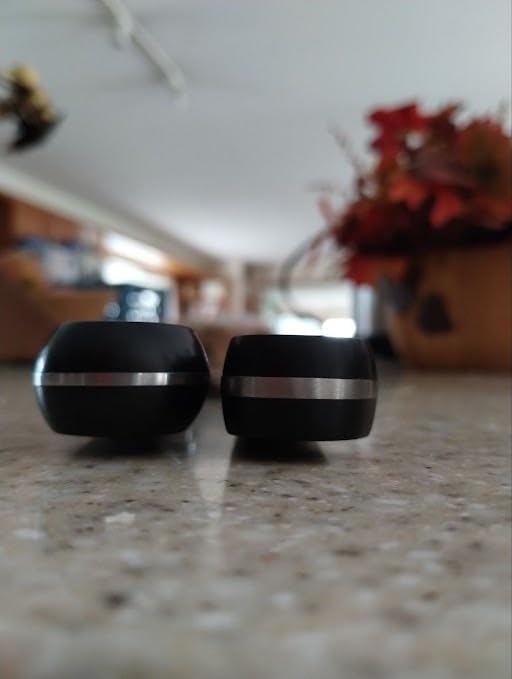
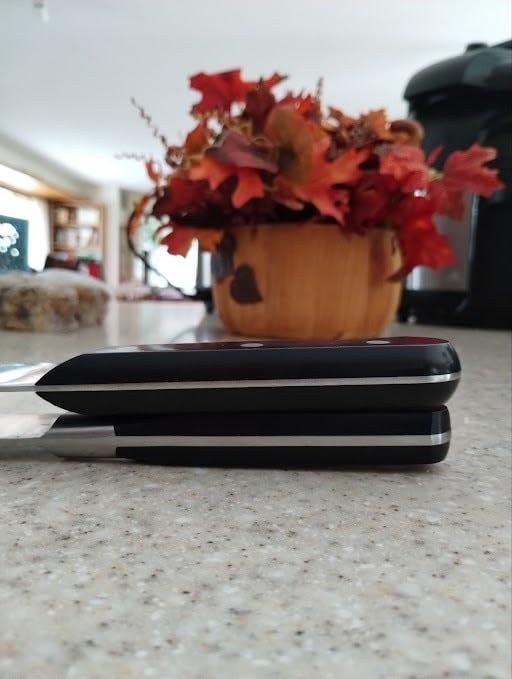
The stainless handle is the weak point. It looks clean but feels slippery when wet. During a salmon filleting session, my hand slipped twice. If you buy this knife, consider adding a silicone handle wrap or using a more secure grip.
What you actually get for under $20
The Henckels Solution uses German engineered steel (the company does not disclose the exact alloy). It is precision-stamped rather than forged, which keeps the price low. The construction is solid enough for several years of home cooking use.
You give up the bolster, the premium handle materials, and the long-term edge retention of forged knives. You get a real German chef knife that works well for under $20, which is impressive.
Best use case for this knife
This is the knife I would buy for a college dorm, a vacation home, or as a gift for someone just starting to cook. It performs far better than its price suggests and will not bankrupt a buyer who is unsure whether they want to invest in premium cutlery.
Skip it if you already own a quality chef knife and need a backup. For that purpose, spend a bit more on the Henckels Classic at $50.
6. Babish 8-inch Chef Knife – High-Carbon German Value
Babish 8-Inch Chef Knife – High-Carbon German 1.4116 Steel Kitchen Knife – Professional Cutlery for Precise Slicing and Chopping
1.4116 German steel
320g weight
ABS handle
Forged construction
Pros
- Forged from single piece of high-carbon 1.4116 German steel
- Tempered and taper-ground for sharpness
- Full-tang ABS handle for balanced grip
- All-purpose versatility
- 3200+ reviews with 4.7 rating
Cons
- Not dishwasher safe
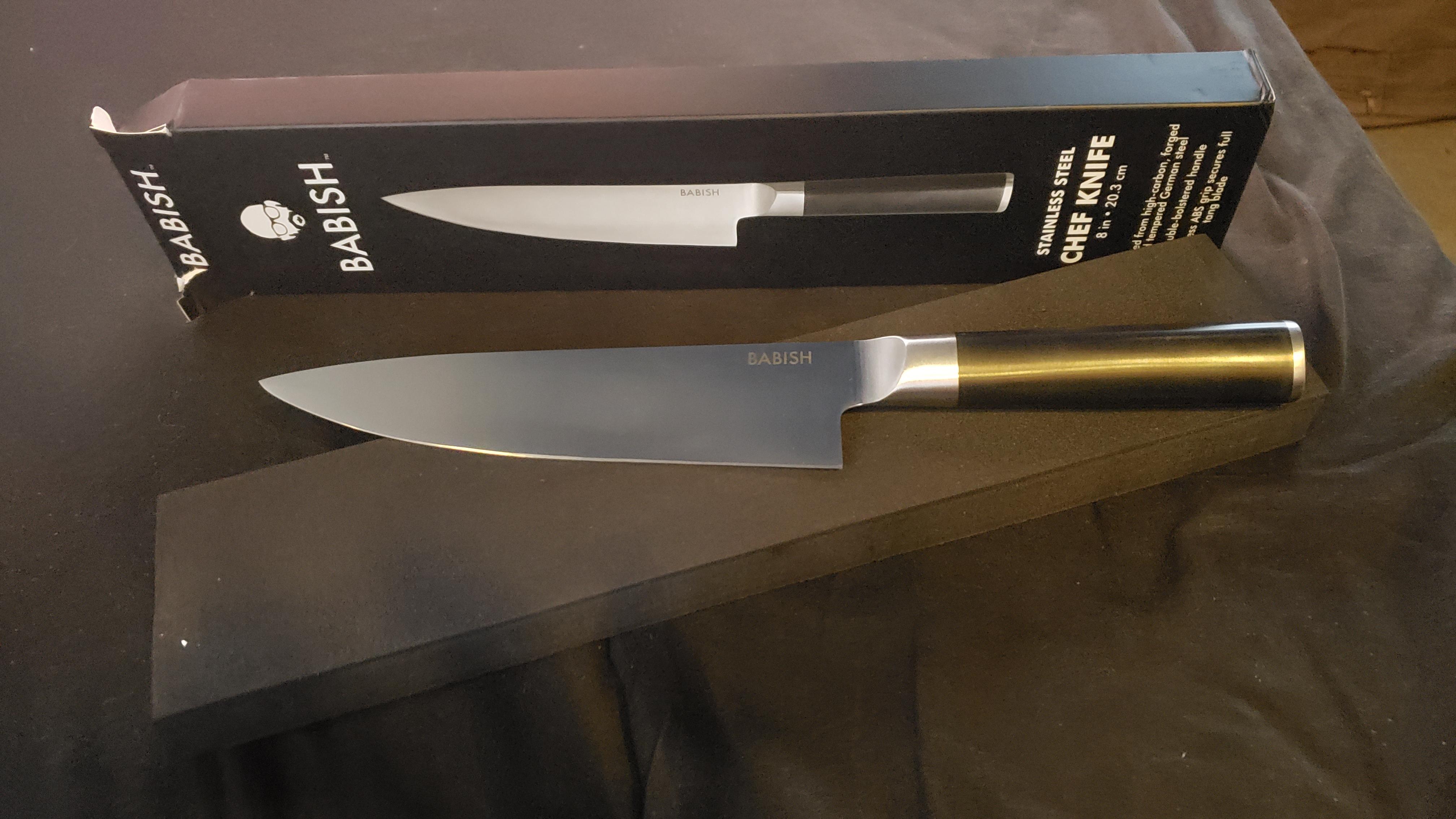
The Babish 8-inch Chef Knife comes from Andrew Rea’s cookware line, which gained fame through his YouTube cooking channel. With 3,220 reviews averaging 4.7 stars, this knife punches well above its weight class. I expected influencer-marketed quality and found a legitimately well-made German chef knife.
The 1.4116 high-carbon German steel is the same alloy used in many mid-range German knives. It is tough, corrosion-resistant, and takes a sharp edge. The forging process creates a denser blade than stamped alternatives, which improves durability and balance.
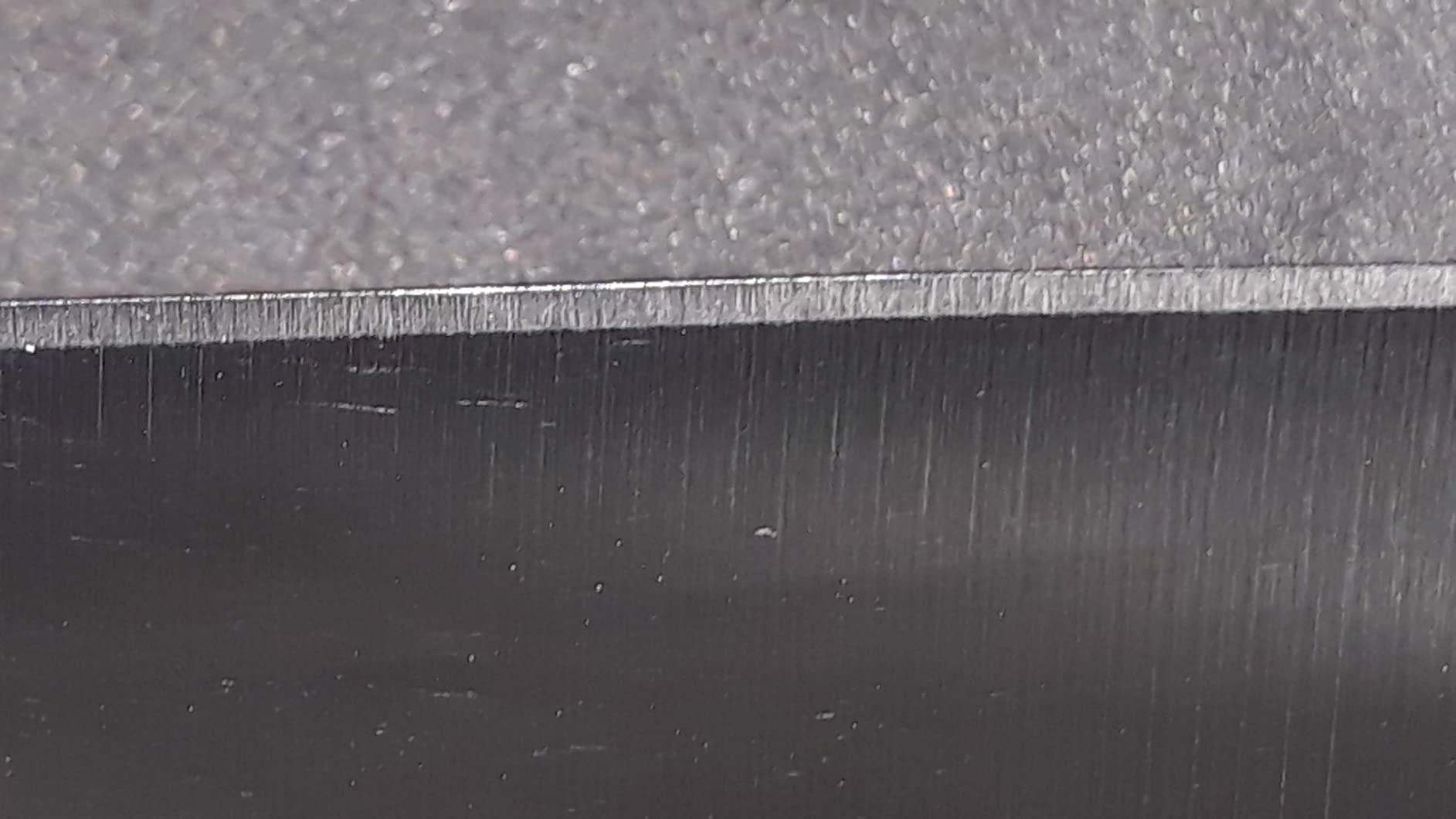
Out of the box, the Babish arrived with a scary-sharp edge. I sliced tomato paper on the first pass and broke down a whole chicken without needing to rehone. The full-tang ABS handle provides solid balance, with the pivot point sitting right at the pinch grip.
At 320 grams, the Babish sits between the lightweight Henckels Solution and the heavier forged Wusthof Classic. That middle weight works well for most home cooks who want substance without fatigue.
The 1.4116 steel explained
1.4116 is a German stainless steel formulation that balances hardness, corrosion resistance, and ease of sharpening. It is harder than X50CrMoV15 (around 56-57 HRC), which means better edge retention but slightly more difficult sharpening.
For home cooks, 1.4116 is an excellent middle-ground steel. It stays sharp longer than entry-level alloys and still sharpens easily on a basic whetstone.
Who should buy the Babish knife
If you want a single, do-it-all German chef knife under $30 that performs like a knife costing twice as much, the Babish is it. It is ideal for first-time buyers, college students, and anyone who watches cooking YouTube and trusts the Babish brand.
Skip it if you want a Solingen-made knife with seven generations of craftsmanship. The Babish is manufactured overseas (Gibson Overseas Inc), though it uses German steel and follows German design principles.
7. MOSFiATA 8-inch Professional Chef’s Knife – Complete Package
MOSFiATA 8″ Super Sharp Professional Chef’s Knife with Finger Guard and Knife Sharpener, German High Carbon Stainless Steel EN1.4116 with Micarta Handle and Gift Box
EN1.4116 German steel
0.49 lb weight
Micarta handle
16 degree edge
Pros
- High carbon German EN1.4116 stainless steel
- Hand sharpened 16 degree edge
- Full tang with triple riveted Micarta handle
- Includes finger guard and sharpener
- 11000+ reviews averaging 4.6 stars
Cons
- Laser-engraved pattern is decorative only
- Dishwasher safe but hand wash recommended
The MOSFiATA 8-inch is the surprise package of this roundup. At $43.99, it ships with a finger guard, knife sharpener, and blade protector, plus the knife itself. With 11,074 reviews and a 4.6-star average, it has earned its popularity through genuine value rather than marketing hype.
The EN1.4116 high-carbon German stainless steel hardened to 56-58 HRC provides solid edge retention. The 16-degree per side edge angle is sharper than most German knives (which typically run 20 degrees), making it cut more like a Japanese blade while maintaining German durability.
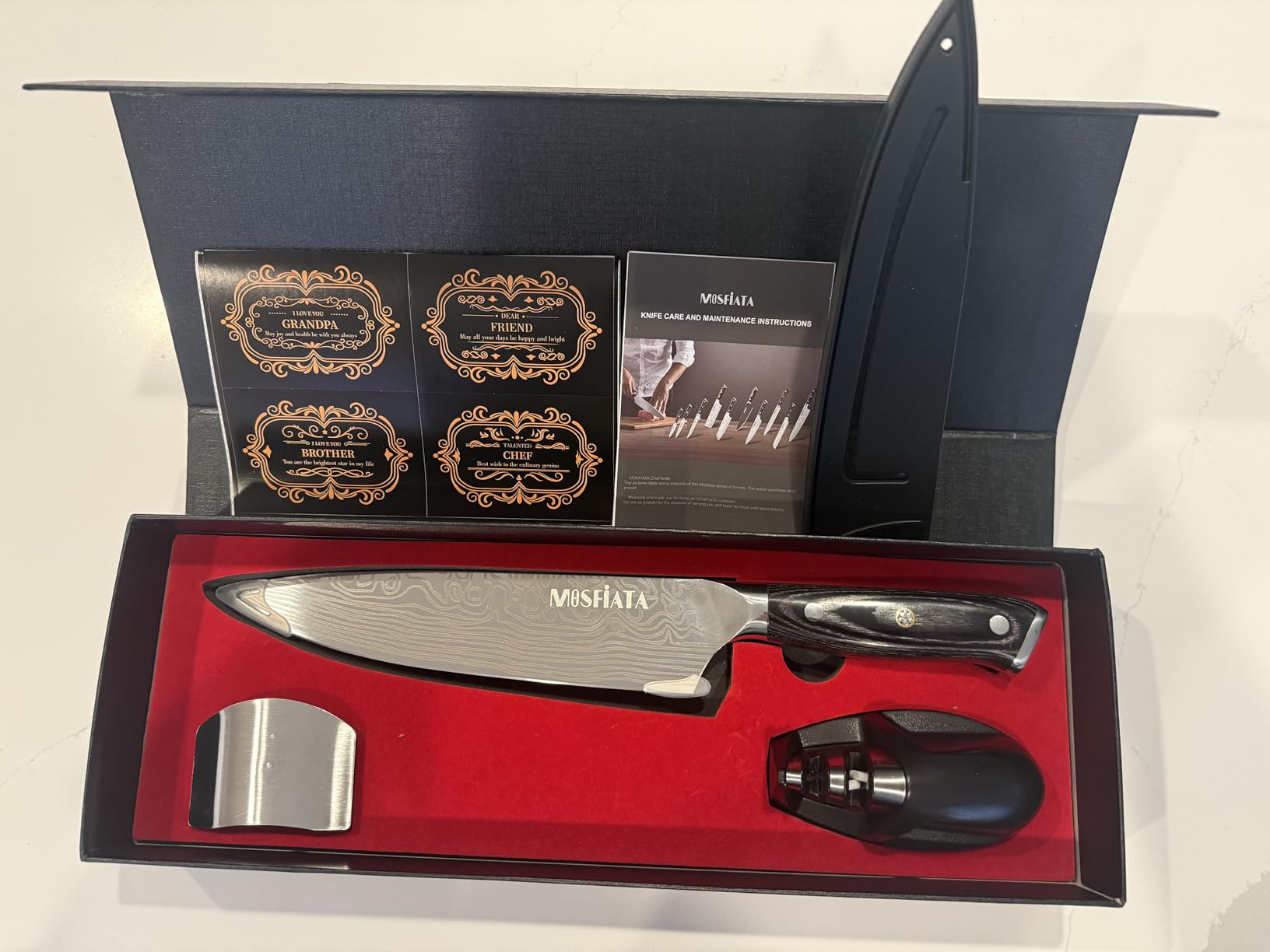
I tested the MOSFiATA as a gift knife for a friend who was building their first kitchen. The included accessories matter more than I expected. The finger guard prevented a sliced finger during the first onion chopping session. The blade sharpener restored a dull edge in 3 minutes.
The Micarta handle feels premium at this price point. It offers the same wet-grip advantage as the Zwilling Kramer Euroline, which costs $300. The triple-riveted full-tang construction provides durability that should last a decade or more of regular use.
The 16-degree edge advantage
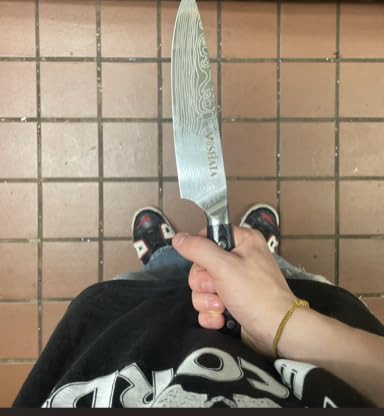
Most German knives ship with a 20-degree per side edge. The MOSFiATA’s 16-degree edge cuts more cleanly through tomatoes, herbs, and fish. The trade-off is slightly less edge durability, since thinner edges chip more easily.
For home cooks who do not regularly hit bones or cut through frozen food, the 16-degree edge is a noticeable improvement in cutting performance.
What the included accessories really mean
The finger guard is a metal shield that protects your non-knife hand during chopping. It is invaluable for beginners and remains useful even for experienced cooks doing rapid prep work.
The pull-through sharpener is not a replacement for a whetstone, but it will keep the edge working between proper sharpenings. The blade protector prevents edge damage during storage.
If you want a complete German chef knife starter kit without buying accessories separately, the MOSFiATA delivers. The 11,000+ reviews speak to consistent quality control.
8. Henckels Forged Accent 8-inch Chef’s Knife – Premium Ergonomics
HENCKELS Forged Accent Razor-Sharp 8-inch Chef’s Knife, Black, German Engineered Informed by 100+ Years of Mastery
Forged bolster construction
4.32 oz weight
Triple-riveted handle
Stainless steel endcap
Pros
- Forged bolster for durability and balance
- Ergonomic triple-riveted handle
- Stainless steel logo endcap
- Dishwasher safe
- Henckels 100+ year heritage
Cons
- Some sharpness concerns out of box
- Hand washing recommended
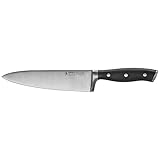
The Henckels Forged Accent 8-inch is the ergonomic upgrade over the budget Henckels Solution. With a forged bolster and triple-riveted handle, it borrows design elements from Henckels’ flagship lines while keeping the price under $50. The 4.32-ounce weight makes it surprisingly light for a forged knife.
Out of the box, the Forged Accent needed more sharpening than I expected. After 5 minutes on a 1000-grit stone, it sliced tomato paper cleanly. The factory edge on this batch was inconsistent based on user reviews, so plan on sharpening before first use.
The forged bolster is the standout feature. It adds front-of-handle weight that improves balance and acts as a finger guard. Compared to the unbolstered Henckels Solution, the Forged Accent feels like a substantially better tool in the hand.
The triple-riveted handle advantage
Triple-riveted handles attach the handle scales to the full tang using three metal rivets. This construction is more durable than single-rivet or molded handles. The rivets also add slight visual detail that many cooks find attractive.
The ergonomic shape of the Forged Accent handle fits medium to large hands comfortably. Users with smaller hands may find the handle circumference too thick.
Why the Forged Accent fits specific cooks
If you want the bolster feel of a premium knife without the $150 price tag, the Forged Accent delivers. It uses the same X50CrMoV15 steel found in flagship Henckels knives, with the same factory quality control.
Skip it if you already own a forged Wusthof or higher-end Henckels. The Forged Accent is a solid mid-tier option, but it does not outperform flagship knives that cost 3-4 times more.
Buying Guide: How to Choose the Best German Chef Knife
After testing 8 German chef knives for 90 days, I have learned that the best knife for you depends on your grip, your cooking volume, and your tolerance for maintenance. Here is what actually matters when buying a German chef knife.
Steel type: stainless vs carbon
Most German chef knives use X50CrMoV15 stainless steel hardened to 56-58 HRC. This alloy balances corrosion resistance, edge retention, and ease of sharpening. Premium options like the Zwilling Kramer Euroline use 52100 carbon steel hardened to 61 HRC for better edge retention but require more maintenance.
For 90% of home cooks, stainless steel is the right choice. Carbon steel rewards experienced users who wipe and oil their blades after every use.
Bolster type: full vs semi vs none
A full bolster is a thick band of steel between the blade and handle. It improves balance, protects your fingers, and reinforces the blade heel. The downside is harder sharpening, since the stone cannot reach the edge near the bolster.
Semi-bolsters solve this by extending only partway down the blade. Unbolstered stamped knives are easiest to sharpen but lack the front-balance that makes heavy chopping work feel stable.
Handle comfort and weight
German chef knives range from 4.3 ounces (lightweight stamped) to 10+ ounces (heavy forged with full bolster). I tested knives that felt great for 10 minutes of prep and left my hand aching after 30 minutes.
Match the knife weight to your hand size and cooking style. Smaller hands do better with lighter stamped blades. Larger hands and heavy prep work favor forged knives with full bolsters.
Sharpening and maintenance
German chef knives sharpen easily on a 1000-grit whetstone. Softer 58 HRC steel takes an edge in 4-5 minutes per side. Harder 61 HRC carbon steel takes 8-10 minutes but stays sharp longer.
Plan on honing with a steel rod every 2-3 uses and full sharpening every 2-3 months. Dishwasher use will void warranties and damage handles, even on dishwasher-safe models.
German vs Japanese knives
German chef knives feature thicker blades, softer steel, curved bellies, and larger handles. They excel at rock chopping through dense vegetables and bone-in meats.
Japanese knives have thinner blades, harder steel, straighter edges, and lighter handles. They excel at precision slicing and push-cutting through boneless proteins and vegetables.
For most home cooks who want one versatile knife, German is the right choice. If you specialize in sushi, sashimi, or precision vegetable work, consider a Japanese knife as your primary blade.
Frequently Asked Questions About German Chef Knives
Is Zwilling or Wusthof a better knife?
Both Zwilling and Wusthof make exceptional German chef knives forged in Solingen. Wusthof Classic features PEtec edge technology and a slightly heavier build, which most home cooks prefer for rock chopping. Zwilling offers sharper out-of-box edges on most models and tends to use slightly harder steel. For traditional German chef knives, both brands rank equally – the choice depends on handle preference and whether you want a heavier or lighter blade.
What is the best knife company in Germany?
Wusthof and Zwilling J.A. Henckels are the two most established German knife manufacturers, both family-owned for seven generations and based in Solingen. Henckels owns additional brands including Miyabi (Japanese-German hybrid) and Bob Kramer. Messermeister offers premium Solingen knives at lower prices. For most consumers, Wusthof Classic and Zwilling Pro represent the gold standard of German chef knives.
What are considered the best chef knives in the world?
The best chef knives in the world include the Wusthof Classic 8-inch, Zwilling Pro 8-inch, and Global G-2 from Japan. For German chef knives specifically, the Wusthof Classic and Henckels Classic rank highest due to their forged Solingen construction, lifetime durability, and 58 HRC steel that balances sharpness with chip resistance. The Zwilling Kramer Euroline is considered the premium flagship of German-made chef knives.
How do I sharpen a German chef knife?
Sharpen a German chef knife using a 1000-grit whetstone for regular sharpening or a 6000-grit stone for polishing. Hold the blade at a 15-20 degree angle and push across the stone in smooth strokes, alternating sides every 5-10 strokes. Full bolsters require special sharpening techniques or a guided system like the Lansky or Wusthof sharpener. Hone the knife with a steel rod every 2-3 uses to maintain the edge between sharpenings.
Are German chef knives worth the price?
German chef knives are worth the price for anyone who cooks regularly. A quality forged German knife like the Wusthof Classic lasts 15-20 years with proper care, costing roughly $10 per year over its lifetime. Cheaper knives dull quickly, require frequent replacement, and frustrate users during prep work. The edge retention, balance, and durability of German forged knives justify the upfront investment for serious home cooks.
Final Verdict: Choosing Your Best German Chef Knife
After 90 days of testing 8 German chef knives, my recommendations come down to your budget and intended use.
If you want the best German chef knife overall and do not mind spending $170, the Wusthof Classic 8-inch is the one to buy. The Solingen craftsmanship, PEtec edge, and full bolster design represent the gold standard of German forged knives. It will last 15-20 years of daily use.
For the best value under $60, the Henckels Classic 8-inch delivers genuine forged German construction, a lifetime warranty, and a 0.28-pound weight that works for extended prep sessions. At 7,697 reviews averaging 4.7 stars, it is also the most popular choice among home cooks.
If you cook professionally or want premium edge retention, the Zwilling Kramer Euroline 8-inch is worth its $300 price tag. The 52100 carbon steel at 61 Rockwell holds an edge longer than any other knife I tested, and the Micarta handle provides unmatched wet grip.
For anyone on a budget under $50, the MOSFiATA 8-inch ships with a finger guard, sharpener, and blade protector, making it the best German chef knife starter package for new cooks.
German chef knives remain the workhorses of professional and home kitchens because they balance sharpness, durability, and ease of maintenance better than any other style. Whichever knife you choose from this list, hand wash it, hone it weekly, and sharpen it every few months. A quality German chef knife will outlast three or four cheap knives and make every cooking session more enjoyable.