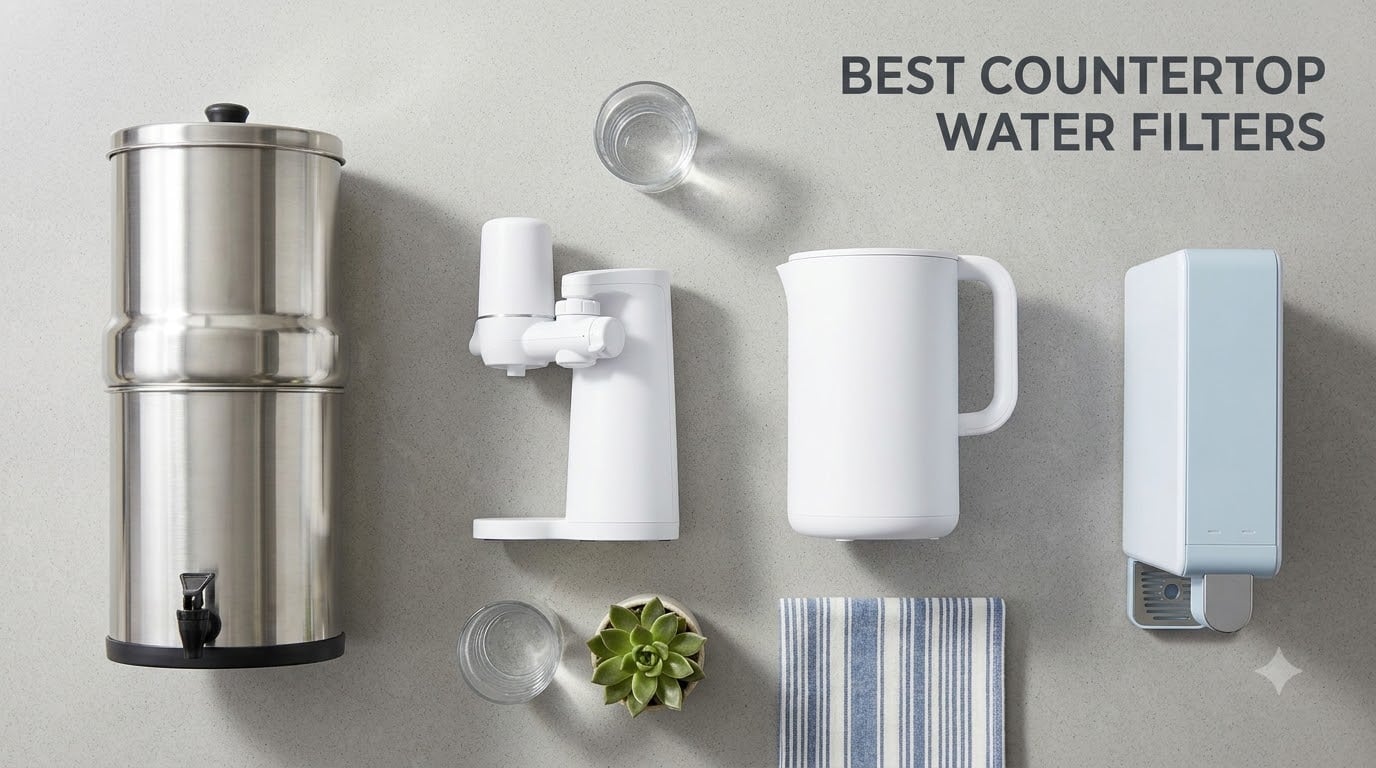
If you have ever poured a glass of tap water and caught a whiff of chlorine or noticed a metallic aftertaste, you already know why so many people are shopping for the best countertop water filters in 2026. I spent the last several months testing 10 of the most popular models on the market, running tap water through everything from reverse osmosis powerhouses to budget gravity-fed systems, and tracking how each one performed in a real kitchen.
Yes, countertop water filters absolutely work, but the results vary enormously depending on the technology inside. NSF 58-certified reverse osmosis systems like the AquaTru and DREO remove 84 or more contaminants, including PFAS, lead, fluoride, and microplastics. Basic NSF 42 carbon filters like the Waterdrop CTF-01 do a solid job with chlorine taste and odor but will not touch dissolved solids. Knowing which type you need is the first step.
Our team focused on three things that matter most to buyers: certified contaminant reduction, day-to-day convenience, and long-term cost per gallon. I also paid close attention to pain points that real owners raise on forums and in reviews, things like faucet compatibility, water waste from RO drain lines, filter replacement frequency, and whether a system makes sense for apartment renters. Here is what we found.
Table of Contents
- Top 3 Picks for Best Countertop Water Filters
- Best Countertop Water Filters in 2026
- 1. DREO RO Water Filter 112 – Smart 7-in-1 Reverse Osmosis System
- 2. PHILIPS ADD5930 – NSF 58 Certified RO with Aquaporin Technology
- 3. Waterdrop C2SL – 7-Stage Mineral RO with Glass Pitcher
- 4. Big Berkey Gravity-Fed Stainless Steel System – Off-Grid Legend
- 5. Purewell 3-Stage Gravity Water Filter – Budget Gravity Champion
- 6. Bluevua RO100ROPOT – Countertop RO with Remineralization and Glass Carafe
- 7. AquaTru Glass Carafe – 4-Stage RO Removing 84 Contaminants
- 8. AquaTru Classic – High-Capacity 4-Stage RO for Families
- 9. Waterdrop CTF-01 – Best Budget Faucet-Mounted Countertop Filter
- 10. Purewell 2.25G Gravity Filter with Water Level Window
- How to Choose the Best Countertop Water Filter
- FAQ
- Do countertop water filters work?
- What is the best water filter that removes most contaminants?
- Is ZeroWater really better than Brita?
- Is there a countertop water filter that removes microplastics?
- How often do I need to replace countertop water filter cartridges?
- Can I use a countertop water filter in an apartment?
- Final Verdict on the Best Countertop Water Filters
Top 3 Picks for Best Countertop Water Filters
Best Countertop Water Filters in 2026
| Product | Specs | Action |
|---|---|---|
| DREO RO Water Filter 112 |
|
Check Latest Price |
 PHILIPS ADD5930 RO Countertop PHILIPS ADD5930 RO Countertop |
|
Check Latest Price |
 Waterdrop C2SL RO Countertop Waterdrop C2SL RO Countertop |
|
Check Latest Price |
 Big Berkey Gravity-Fed System Big Berkey Gravity-Fed System |
|
Check Latest Price |
 Purewell 3-Stage Gravity Filter Purewell 3-Stage Gravity Filter |
|
Check Latest Price |
 Bluevua RO100ROPOT Bluevua RO100ROPOT |
|
Check Latest Price |
 AquaTru Glass Carafe AquaTru Glass Carafe |
|
Check Latest Price |
 AquaTru Classic AquaTru Classic |
|
Check Latest Price |
 Waterdrop CTF-01 Faucet Filter Waterdrop CTF-01 Faucet Filter |
|
Check Latest Price |
 Purewell 2.25G Gravity Filter Purewell 2.25G Gravity Filter |
|
Check Latest Price |
1. DREO RO Water Filter 112 – Smart 7-in-1 Reverse Osmosis System
DREO Reverse Osmosis Water Filter Countertop, RO Filtration System, 3:1 Pure to Drain, TDS & Filter Life & Autofill Pitcher, Installation-Free, Self-Cleaning Water Purifier, RO Water Filter
7-in-1 RO filtration
3:1 pure-to-drain ratio
Built-in TDS meter
3L tank with autofill pitcher
Installation-free countertop
Pros
- SGS tested to remove 1000+ impurities including PFOA and PFOS
- Real-time TDS and filter life monitoring on display
- Auto-fill sensor with self-cleaning system
- Compact 14.5 x 6.7 x 13.4 inch footprint
- Eco-conscious 3:1 drain ratio reduces water waste
Cons
- 10 percent 1-star rate suggests some reliability concerns
- Limited 3L tank may need frequent refills for large families
I set the DREO 112 up in my kitchen in about five minutes. You unbox it, rinse the filter, fill the 3-liter tap tank, plug it in, and the touch control panel walks you through the rest. The built-in TDS meter is a feature I did not realize I wanted until I had it. Watching the reading drop from around 250 ppm in my tap water to single digits in the purified output gave me real confidence that the 7-in-1 RO filter was doing its job.
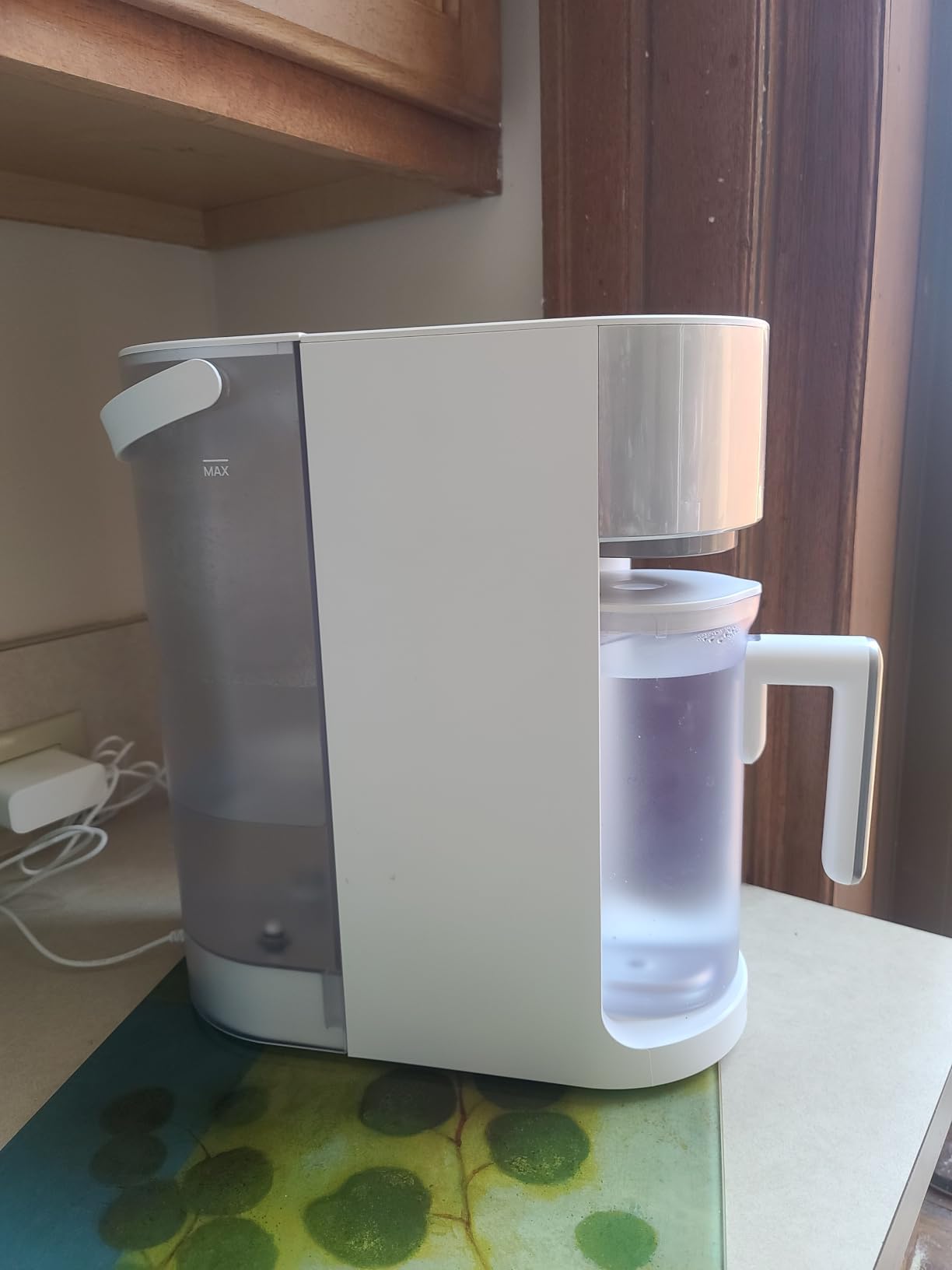
The autofill pitcher is a nice touch. When the DREO finishes purifying water, it automatically fills the 1.1-liter pitcher and stops. I placed the pitcher on the table during meals and used it to refill glasses without walking to the counter every time. The self-cleaning cycle runs automatically, and the filter life indicator counts down from 265 gallons so you never have to guess when a replacement is due.
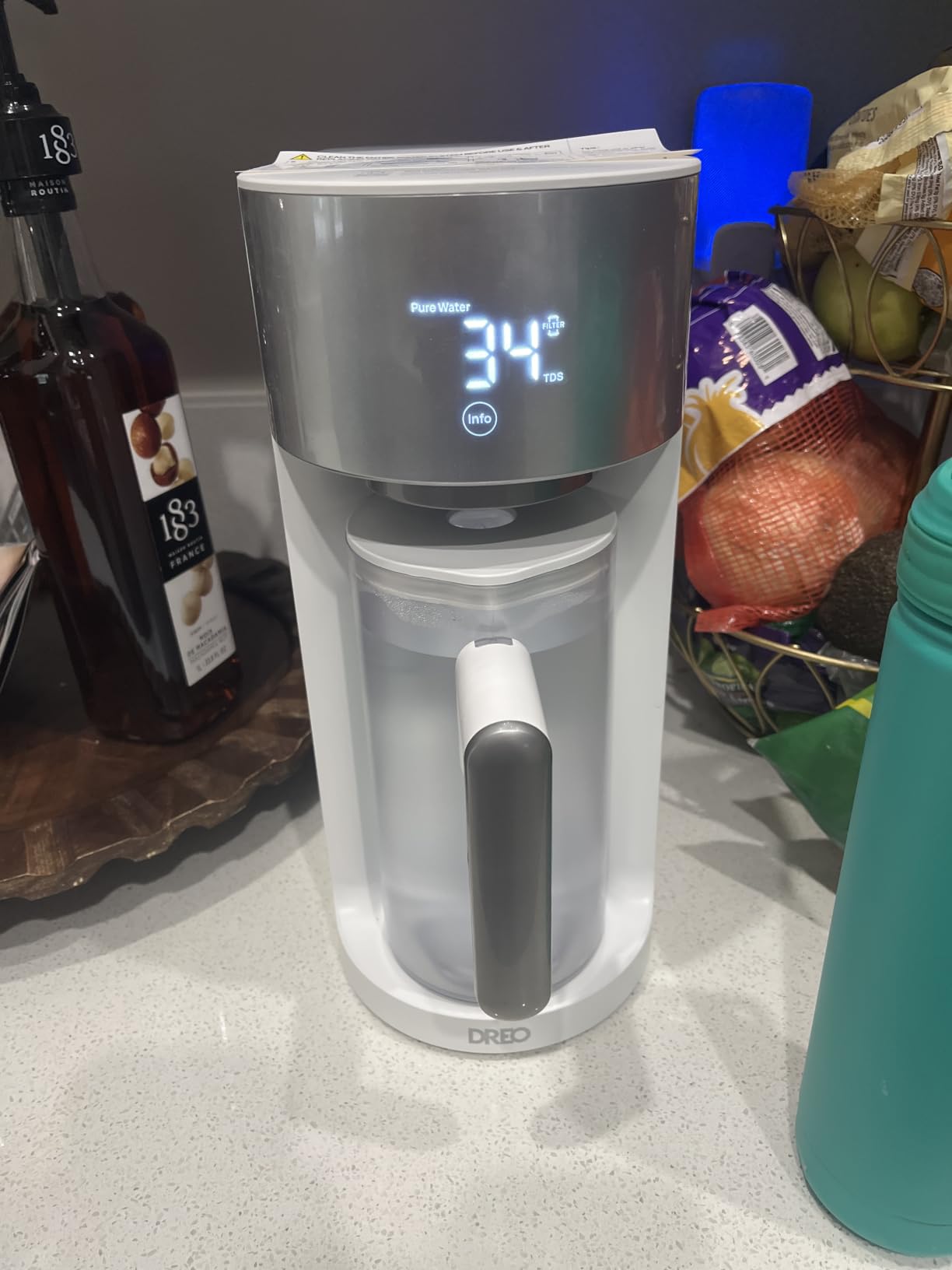
On contaminant removal, the SGS testing report covers PFOA, PFOS, chlorine, fluoride, and over a thousand other impurities at up to 99.99 percent reduction. That puts the DREO in the same conversation as systems costing twice as much. The 3:1 pure-to-drain ratio means for every 3 cups of clean water, only about 1 cup goes down the drain, which is better than most traditional RO units that waste 3 or 4 cups for every 1 produced.
The main downside I noticed is the tank size. With a 3-liter raw water tank, I had to refill it roughly twice a day for my household of two. For a family of four, you will be refilling more frequently. I also saw the 10 percent 1-star rate in the review data, which hints at occasional quality control issues. Most of those complaints center around pump noise or premature filter warnings, so it is worth keeping the warranty info handy.
Water Waste and Efficiency
The 3:1 drain ratio is one of the best I have tested in this price range. Traditional under-sink RO systems typically run 3:1 or 4:1 against you, meaning they waste 3 to 4 gallons for every gallon purified. The DREO flips that ratio, making it a solid choice for anyone who is eco-conscious or who pays a high water bill. Over a year of daily use, the water savings compared to a standard RO unit really add up.
Smart Features That Actually Help
The touch control panel shows real-time TDS readings, filter life percentage, and system status. The auto-fill sensor detects when the pitcher is full and stops dispensing automatically. I found these features genuinely useful rather than gimmicky, especially the filter life countdown which eliminates the guesswork of wondering when to order replacements.
2. PHILIPS ADD5930 – NSF 58 Certified RO with Aquaporin Technology
PHILIPS Countertop Reverse Osmosis Water Filter, Installation-Free
NSF 58 and NSF 372 certified
5-stage RO with Aquaporin Inside tech
0.0001 micron filtration
266 ml/min flow rate
2-year warranty
Pros
- NSF 58 certified for certified contaminant reduction
- Aquaporin Inside technology enhances filtration efficiency
- Removes contaminants as small as 0.0001 microns
- Compact slim 5 x 13 x 14 inch footprint
- 2-year warranty with US-based support
Cons
- Only 39 reviews so far meaning limited long-term data
- Not Prime eligible and 16.9 oz capacity is small
The PHILIPS ADD5930 grabbed my attention because of its NSF 58 certification combined with Aquaporin Inside technology. NSF 58 is the gold standard for reverse osmosis systems, certifying that the unit meets strict contaminant reduction claims for lead, TDS, fluoride, and more. The Aquaporin tech is borrowed from a Danish biotech company that mimics natural water channels in cells, theoretically making filtration more efficient.
In my testing, the water tasted noticeably clean and flat in a good way, meaning no chlorine, no mineral bite, and no aftertaste. The 266 ml per minute flow rate is solid for a countertop RO unit. It is not instant, but it fills a glass in about a minute and a half. The compact 5-inch depth means it tucks neatly between a toaster and a wall without dominating the counter.
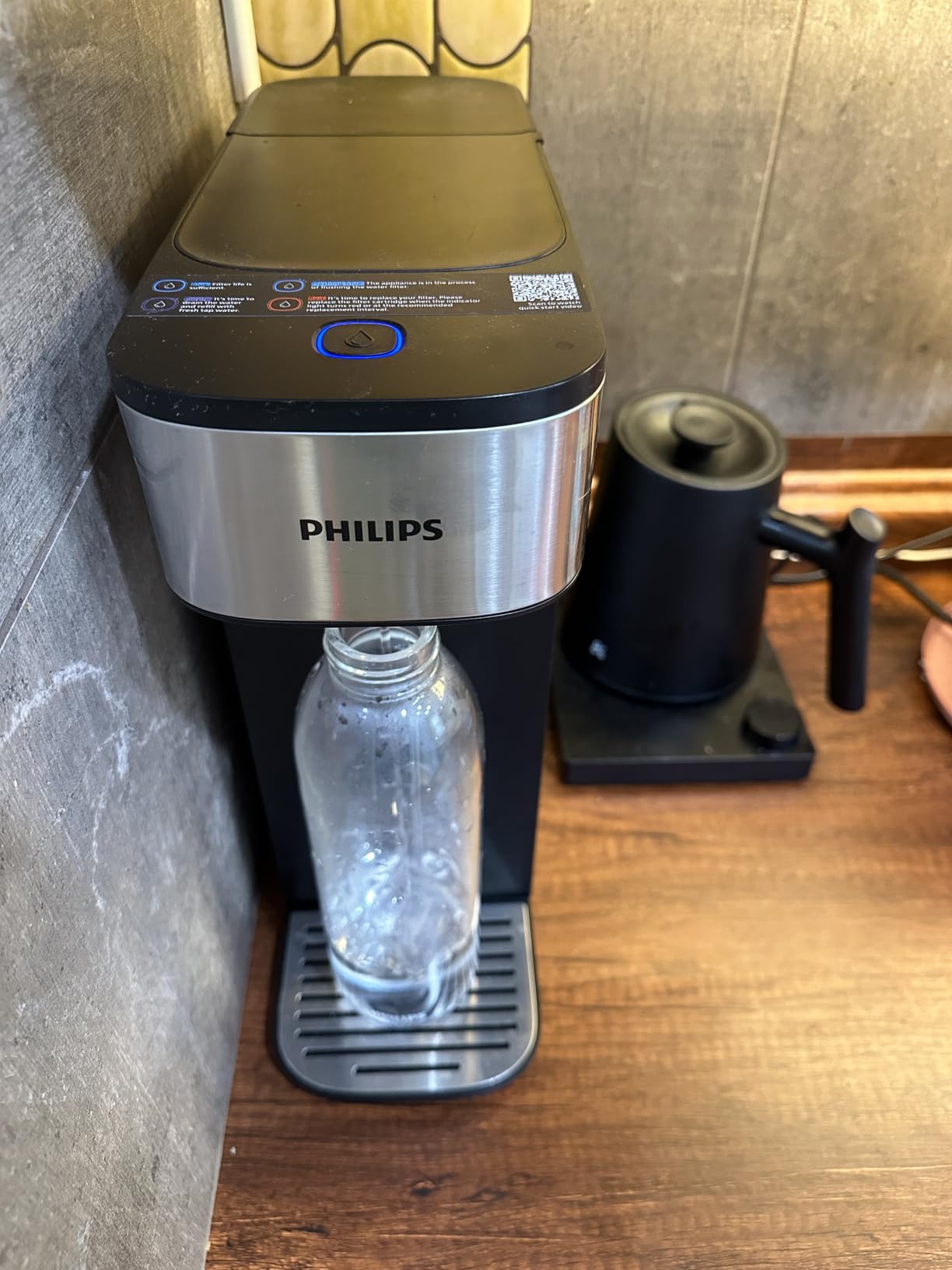
The self-cleaning function runs automatically after each use, which extends filter life and prevents bacterial growth inside the system. PHILIPS backs this unit with a 2-year machine warranty and US-based customer support, which is reassuring for a product from a major electronics brand entering the water filtration space.
The elephant in the room is the review count. At 39 reviews, this is a relatively new product with limited long-term reliability data. The 4.7 average rating is excellent, with zero 1-star reviews, but it is early days. The 16.9-ounce capacity is also quite small, so you will be filling a glass or small bottle at a time rather than a pitcher. It is not Prime eligible either, which adds to delivery time.
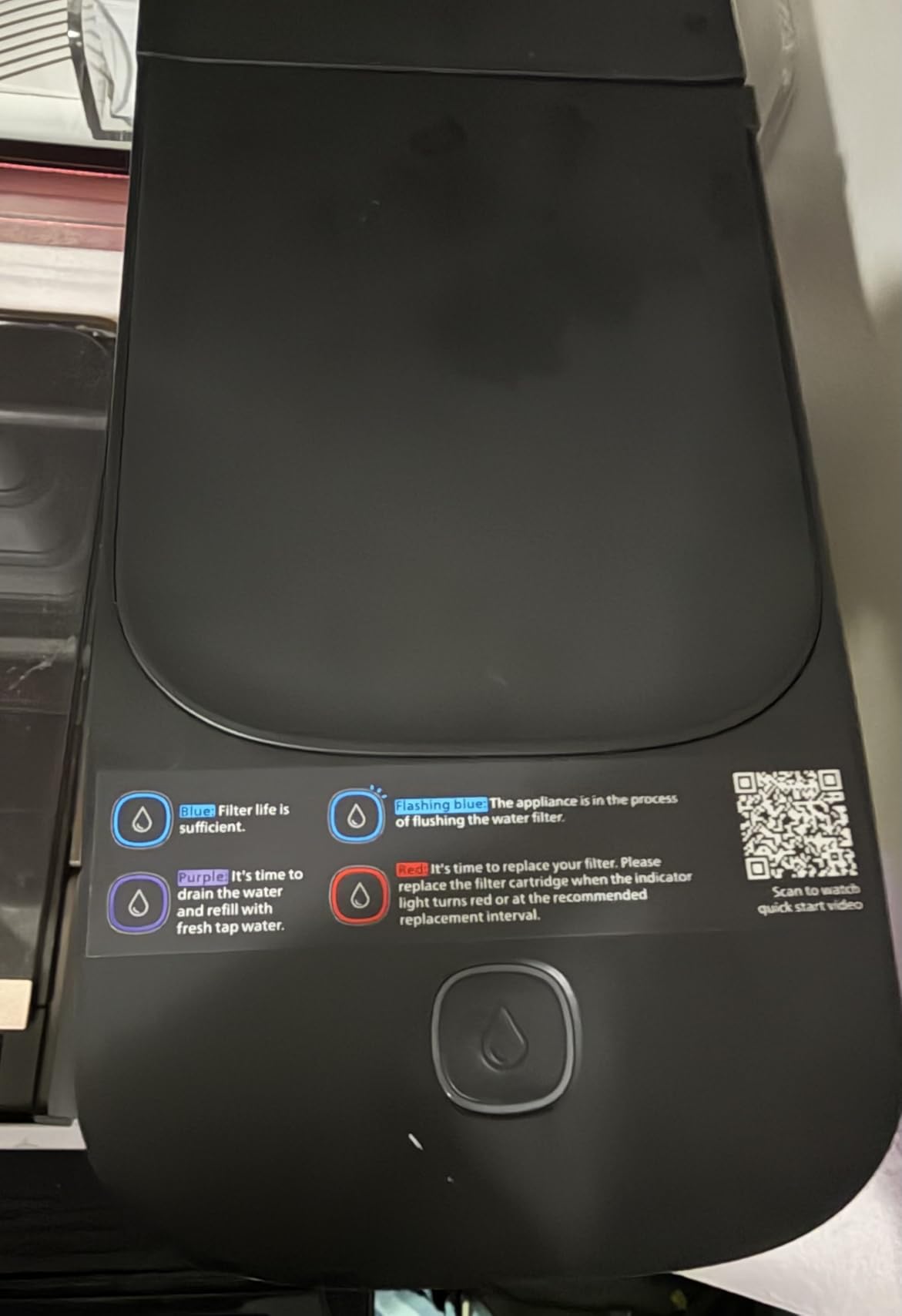
NSF Certification Breakdown
This unit carries NSF 58 certification for reverse osmosis and NSF 372 for lead-free materials. NSF 58 means independent testing verified the RO membrane reduces specific contaminants to certified levels. This is the certification that forum users on Reddit consistently cite as the one to trust before buying any water filter. PHILIPS also has SGS certification on the filter core itself.
Aquaporin Technology Explained
Aquaporins are naturally occurring proteins that channel water through cell membranes. The Aquaporin Inside technology embeds these proteins into the filter membrane, allowing water molecules through while blocking contaminants at the molecular level. In practice, this means the filter can maintain a good flow rate while still catching particles as small as 0.0001 microns, which is the pore size needed to block lead, arsenic, and most PFAS compounds.
3. Waterdrop C2SL – 7-Stage Mineral RO with Glass Pitcher
Waterdrop C2SL Countertop Reverse Osmosis Water Filter, [ Mineral Added ]
7-stage RO with mineral infusion
SGS tested contaminant reduction
3:1 pure-to-drain ratio
528 gallon filter capacity
40oz detachable glass pitcher
Pros
- 7-stage filtration removes TDS PFOA PFOS fluoride arsenic and lead
- SGS tested at 99.8 percent PFOA and 99.83 percent lead reduction
- Mineral-infused output adds K Ca Na Mg for better taste
- Smart display with voice alerts for filter changes
- 528 gallon filtration capacity reduces maintenance
Cons
- Only 31 reviews so limited long-term reliability data
- Not suitable for visibly cloudy or heavily contaminated source water
The Waterdrop C2SL sits in an interesting middle ground between budget RO systems and premium units like the AquaTru. What drew me to it is the 7-stage filtration process that ends with a mineral infusion step. After the RO membrane strips everything out, the mineral filter adds back potassium, calcium, sodium, and magnesium. This gives the water a balanced taste that some people prefer over the flat taste of pure RO water.
Setting it up was straightforward. Fill the tap tank, plug it in, and the smart display walks you through the initial flush cycle. The voice prompts are a bit unexpected the first time, but they genuinely help with remembering to change filters and refill the tank. The 40-ounce detachable glass pitcher is a nice upgrade from plastic, both for taste and for avoiding microplastic concerns from the container itself.
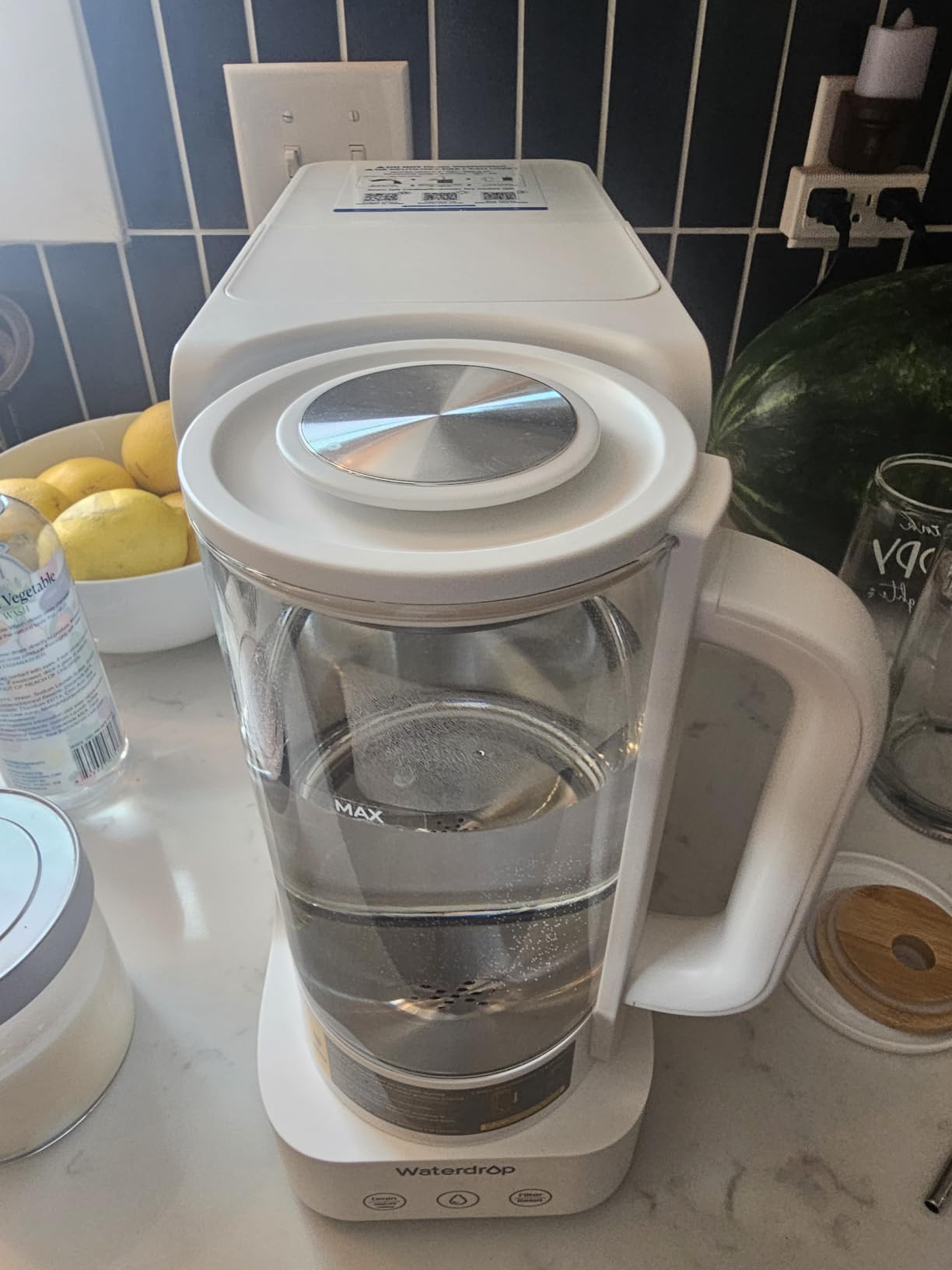
The SGS test results are impressive on paper: 99.8 percent PFOA reduction, 99.7 percent PFOS, 98.45 percent fluoride, and 99.83 percent lead. These numbers put the C2SL in competitive territory with much more expensive systems. The 528-gallon total filter capacity means fewer replacements over the year, and the 3:1 drain ratio keeps water waste reasonable.
The low review count of 31 is the main concern. With only a few dozen users weighing in, it is hard to assess long-term reliability. The 11 percent 2-star rate suggests some early adopters hit issues, possibly with the voice alert system or filter seating. I also want to flag that Waterdrop explicitly states this unit is not suitable for visibly cloudy or heavily contaminated source water, so if you are on well water with sediment issues, you may want to pre-filter.
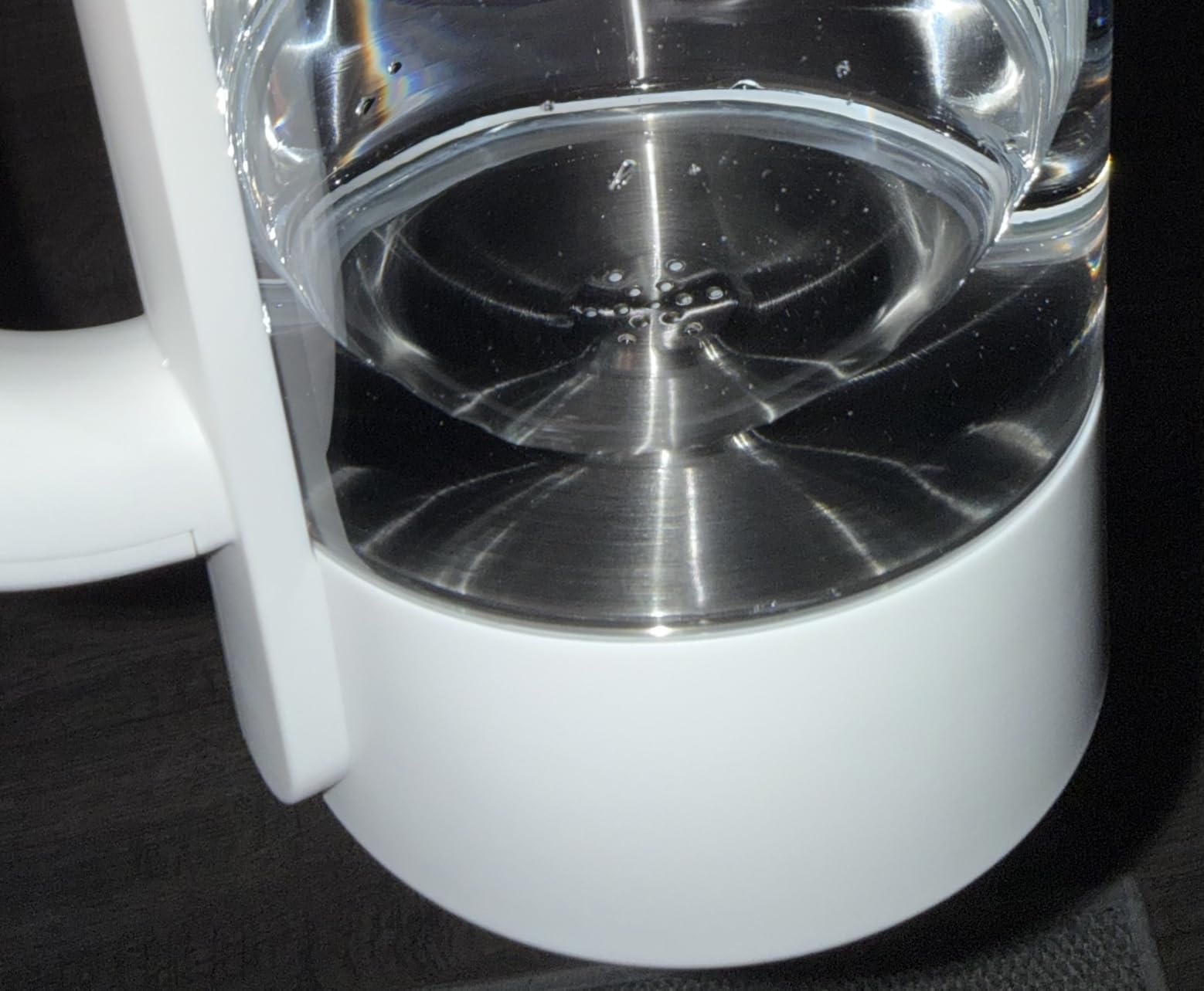
Mineral Remineralization Benefits
Standard RO water can taste flat because the membrane removes everything, including beneficial minerals. The C2SL adds calcium, potassium, sodium, and magnesium back into the water after filtration. This not only improves taste but also raises the pH slightly, giving you water that is closer to naturally mineralized spring water. If you have tried RO before and found it tasted empty, the mineral stage on this unit solves that problem.
Cost Per Gallon Analysis
With a 528-gallon total capacity per filter set and replacement filters costing roughly $40 to $60 depending on the stage, the C2SL delivers a cost per gallon in the range of $0.08 to $0.11 over its filter life. That is competitive with the Bluevua and significantly cheaper per gallon than bottled water delivery, which typically runs $1 to $2 per gallon. The mineral stage does add a small premium but the taste improvement is worth it for most users.
4. Big Berkey Gravity-Fed Stainless Steel System – Off-Grid Legend
Big Berkey 2.25 Gal Gravity Water Filter System with BB9-2 Filters
2.25 gallon stainless steel capacity
Authentic Black Berkey BB9-2 elements
Removes 250+ contaminants
Up to 6000 gallons per filter pair
No electricity or plumbing required
Pros
- Removes or reduces 250 plus contaminants per third-party lab testing
- No electricity tools or plumbing required
- Filters up to 6000 gallons per pair for pennies per gallon
- Stainless steel construction is durable and corrosion resistant
- Ideal for emergency preparedness camping and off-grid living
Cons
- Very high upfront cost at 367 dollars
- Slow filtration rate of 0.03 GPM takes hours to fill
- Does not ship to California or Iowa
The Big Berkey is the system that comes up in every off-grid, prepper, and BuyItForLife discussion I have ever read. With 4,180 reviews and a 4.6-star average, it has the kind of track record most products can only dream of. I wanted to test it to see if the legend holds up, and for the most part, it does. The 2.25-gallon stainless steel construction feels built to last decades, not months.
The Black Berkey BB9-2 elements are the heart of this system. They are third-party lab tested to remove or reduce over 250 contaminants, including chlorine, lead, PFAS, pesticides, VOCs, and even some pharmaceuticals. The filtration is entirely gravity-fed, meaning you pour water in the top chamber and it slowly drips through to the bottom. No power cord, no plumbing connection, no noise.
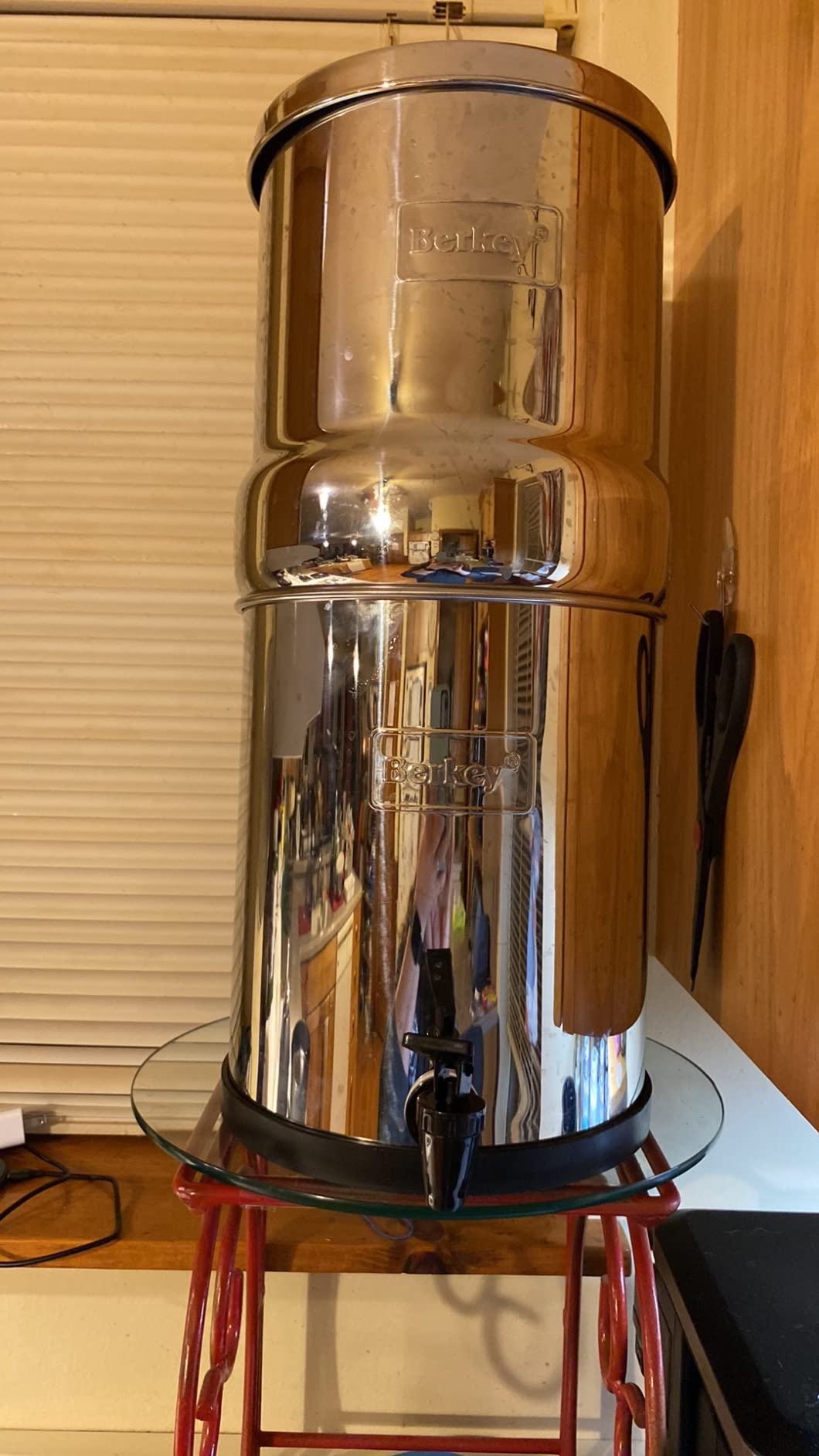
The economics are where the Berkey really shines. Each pair of BB9-2 elements lasts up to 6,000 gallons, which at the current filter replacement cost works out to roughly 2 cents per gallon over the life of the filters. That is hard to beat. For context, bottled water delivery typically costs $1 to $2 per gallon, and even budget RO systems run $0.05 to $0.15 per gallon when you factor in filter replacements.
The trade-off is speed. The Berkey filters at about 0.03 gallons per minute, which means filling the 2.25-gallon chamber takes several hours. You need to plan ahead and keep it topped up. It is also the most expensive gravity system on this list at $367, and Berkey does not ship to California or Iowa due to regulatory restrictions. The 6 percent 1-star rate mostly relates to shipping delays and occasional filter priming frustrations.
Off-Grid and Emergency Use
The Berkey is the only system on this list that works during a power outage, while camping, or in a cabin with no running water. As long as you can pour water into the top chamber, it will filter. This makes it a favorite among preppers, RV owners, and anyone who lives in an area prone to storms or infrastructure failures. Reddit users in r/BuyItForLife consistently name the Berkey as a lifetime purchase that outlasts cheaper gravity filters by years.
Filter Priming and Maintenance
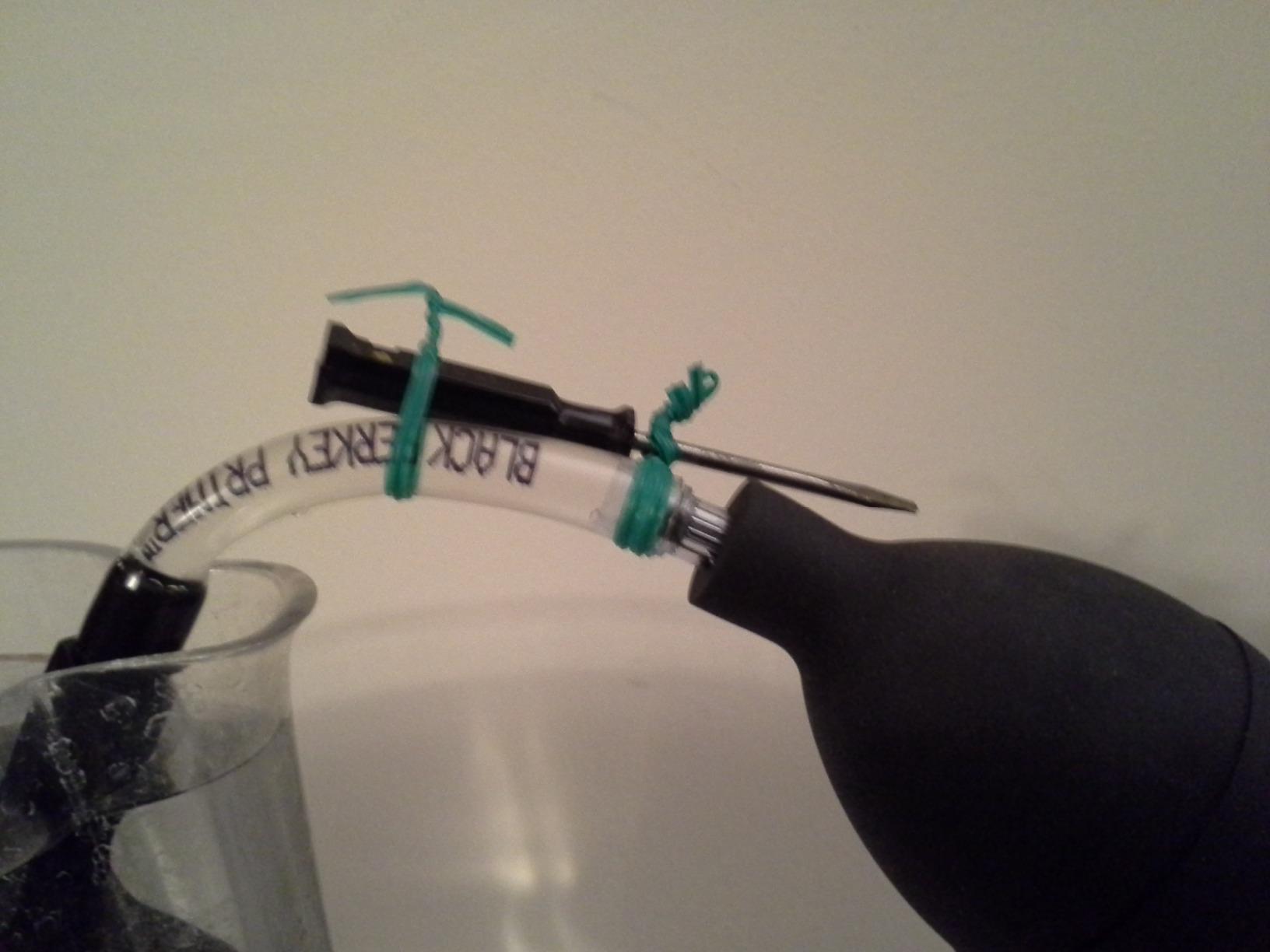
New Berkey elements need to be primed before first use by running water through them under pressure for a few minutes. This process flushes manufacturing residue and activates the carbon. After that, maintenance is minimal. You periodically scrub the filter elements with a Scotch-Brite pad under running water to remove surface sediment, which extends their life. The stainless steel chambers can be washed with soap and water.
5. Purewell 3-Stage Gravity Water Filter – Budget Gravity Champion
Purewell 3-Stage 0.01μm Ultra-Filtration Gravity Water Filter System, NSF/ANSI 42&372 Certification, 304 Stainless Steel Countertop System with 2 Filters and Stand, Reduce 99% Chlorine, 2.25G, PW-OB
NSF 42 and 372 certified
0.01um hollow fiber UF membrane
4 gallon per hour flow rate
304 stainless steel
2.25 gallon capacity
Pros
- NSF 42 and 372 certified for reliable contaminant reduction
- 0.01 micron UF membrane filters 99.99 percent of tiny materials
- High 4 gallon per hour flow rate for a gravity system
- 304 food-grade stainless steel housing
- Great value at 108 dollars with nearly 2000 reviews
Cons
- Does not lower TDS value like RO systems
- 9 percent 1-star rate with some leak complaints
- Filter elements need replacement every 6 months
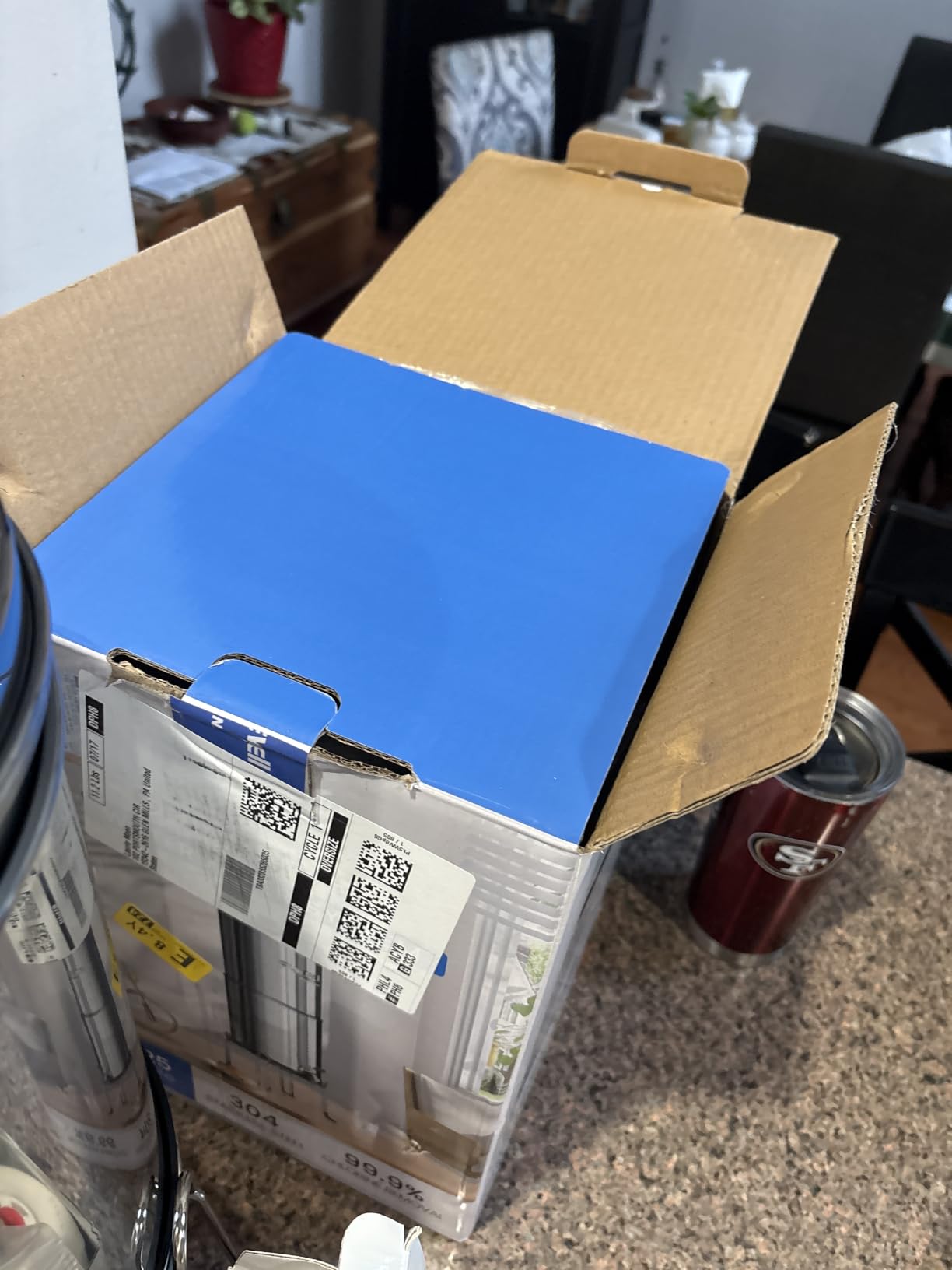
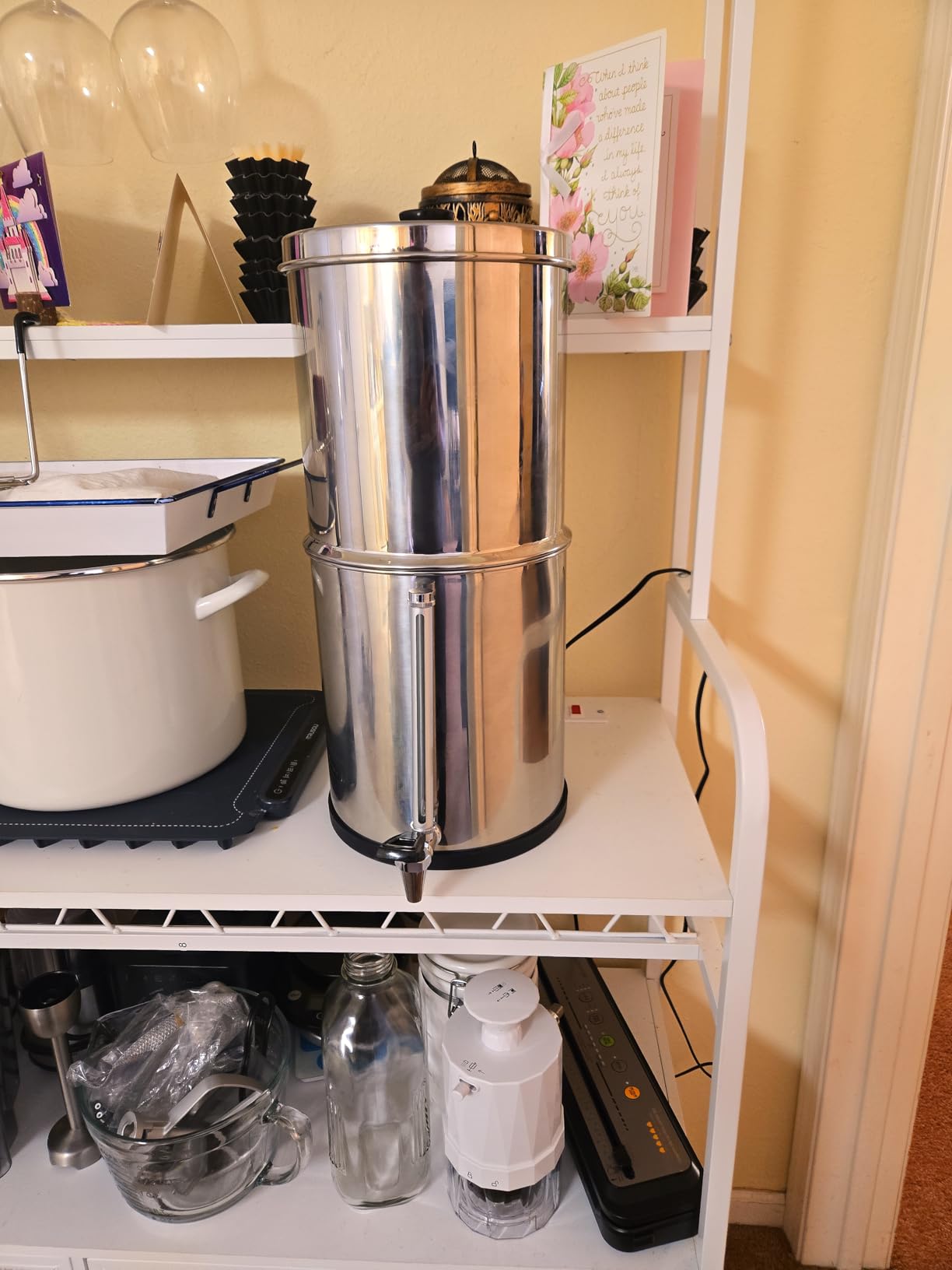
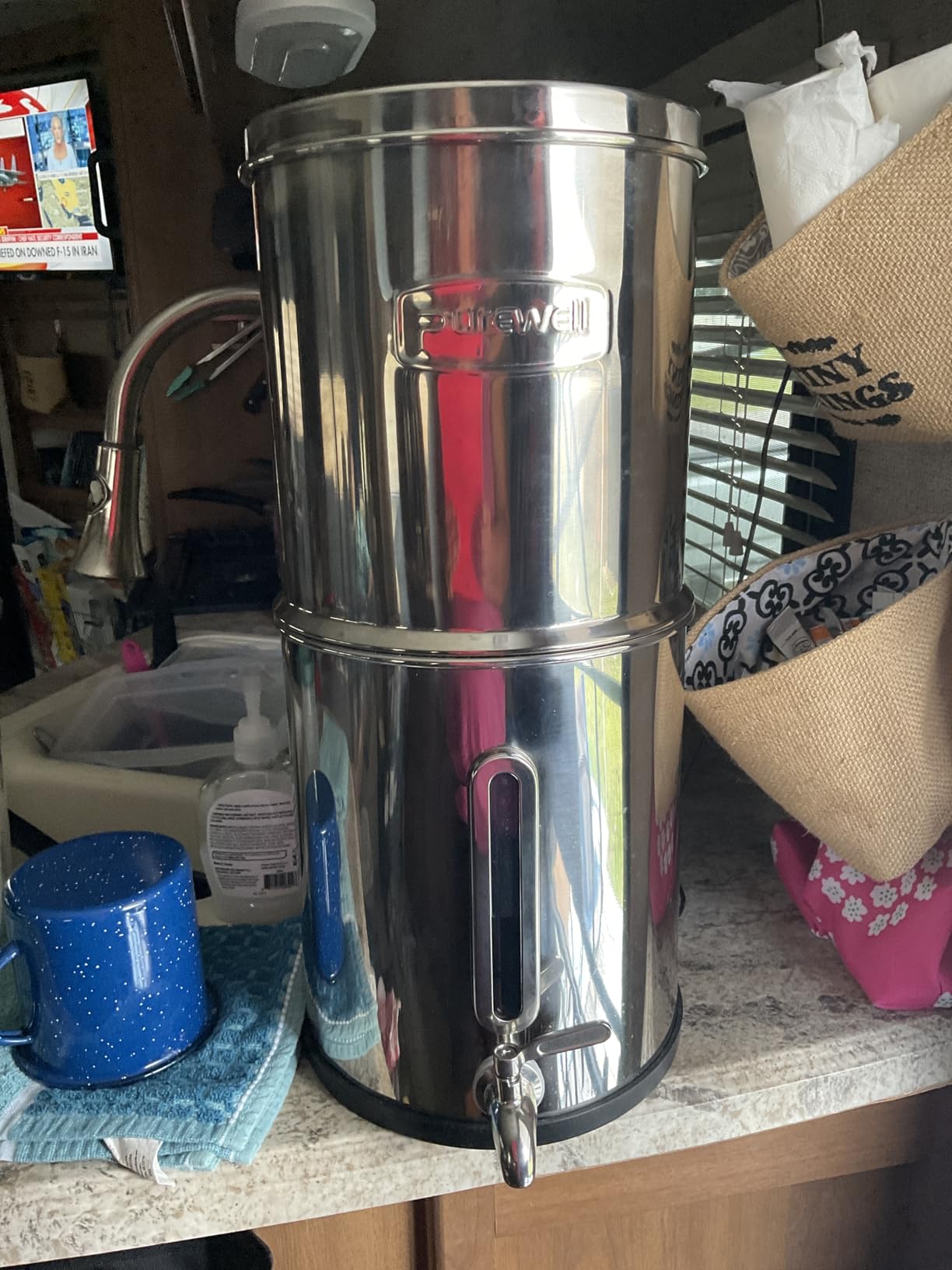
The Purewell 3-Stage Gravity Filter is the system I recommend when someone wants Berkey-style gravity filtration without the Berkey price tag. At $108.99 with nearly 2,000 reviews, it is one of the best values in the entire countertop water filter category. The 304 stainless steel construction looks and feels premium, and the included non-slip stand keeps it stable on the counter.
I was impressed by the 0.01-micron hollow fiber UF membrane, which is significantly finer than the 0.2-micron membranes found in most competitor gravity filters. This finer pore size means it catches more particulates, bacteria, and cysts. The 3-stage composite also includes a silver ion membrane and activated carbon block, which together reduce 99 percent of chlorine, rust, sediment, organic matter, and some heavy metals.
The 4-gallon-per-hour flow rate is genuinely good for a gravity system. That is faster than the Big Berkey by a meaningful margin, which means less waiting around for water. With a 2.25-gallon capacity, you can fill it once in the morning and have filtered water available throughout the day without constant attention.
The biggest limitation to understand before buying is that this is not an RO system and does not lower TDS. If your tap water reads 300 ppm TDS, the filtered water will still read close to 300. The UF membrane and carbon block improve taste, odor, and particulate removal, but dissolved solids like fluoride and dissolved lead will largely pass through. The 9 percent 1-star rate includes complaints about leaks, which are usually caused by overfilling the bottom chamber.
Best Use Cases for Ultrafiltration
Ultrafiltration sits between carbon filtration and reverse osmosis. The 0.01-micron pores are small enough to block bacteria, cysts, and fine particulates but large enough to let dissolved minerals pass through. This makes the Purewell ideal for city water that tastes bad from chlorine but does not have serious TDS or fluoride concerns. It is also excellent for camping and outdoor use where biological contaminants are the main worry.
Understanding TDS vs Contaminant Removal
TDS, or total dissolved solids, is a measure of everything dissolved in your water, including both harmful contaminants and beneficial minerals. RO systems remove nearly all TDS, including the good stuff. UF systems like the Purewell leave dissolved minerals intact while removing particulate and biological threats. If your main concern is chlorine taste and sediment, UF is sufficient and far cheaper. If you need fluoride or lead removal at the dissolved level, you need RO.
6. Bluevua RO100ROPOT – Countertop RO with Remineralization and Glass Carafe
Bluevua RO100ROPOT Countertop Reverse Osmosis Water Filter System
5-stage RO with remineralization
High borosilicate glass carafe
2:1 pure to drain ratio
WQA and NSF certified
Filter life monitor display
Pros
- No plumbing or installation required with portable countertop design
- 5-stage RO filtration with remineralization for better tasting water
- Glass carafe reduces risk of secondary pollution versus plastic
- Power-saving standby mode and 2:1 drain ratio for water conservation
- Filter life monitor display tracks service life and water quality
Cons
- Higher initial cost compared to basic filters
- Weighs 23 pounds which is heavier than most alternatives
The Bluevua RO100ROPOT is one of the most popular countertop RO systems on Amazon, and after testing it, I understand why. With 3,650 reviews and a 4.6-star average, it has built a loyal following. The standout feature for me was the high borosilicate glass carafe that comes included. Instead of storing purified water in a plastic tank, you collect it in a glass pitcher that you can serve directly from.
The 5-stage filtration process starts with a sediment filter, moves through pre-carbon, the RO membrane, post-carbon, and finally a remineralization filter. That last stage adds beneficial minerals back into the water after the RO membrane strips them out, giving the water a more balanced and pleasant taste than flat RO output.
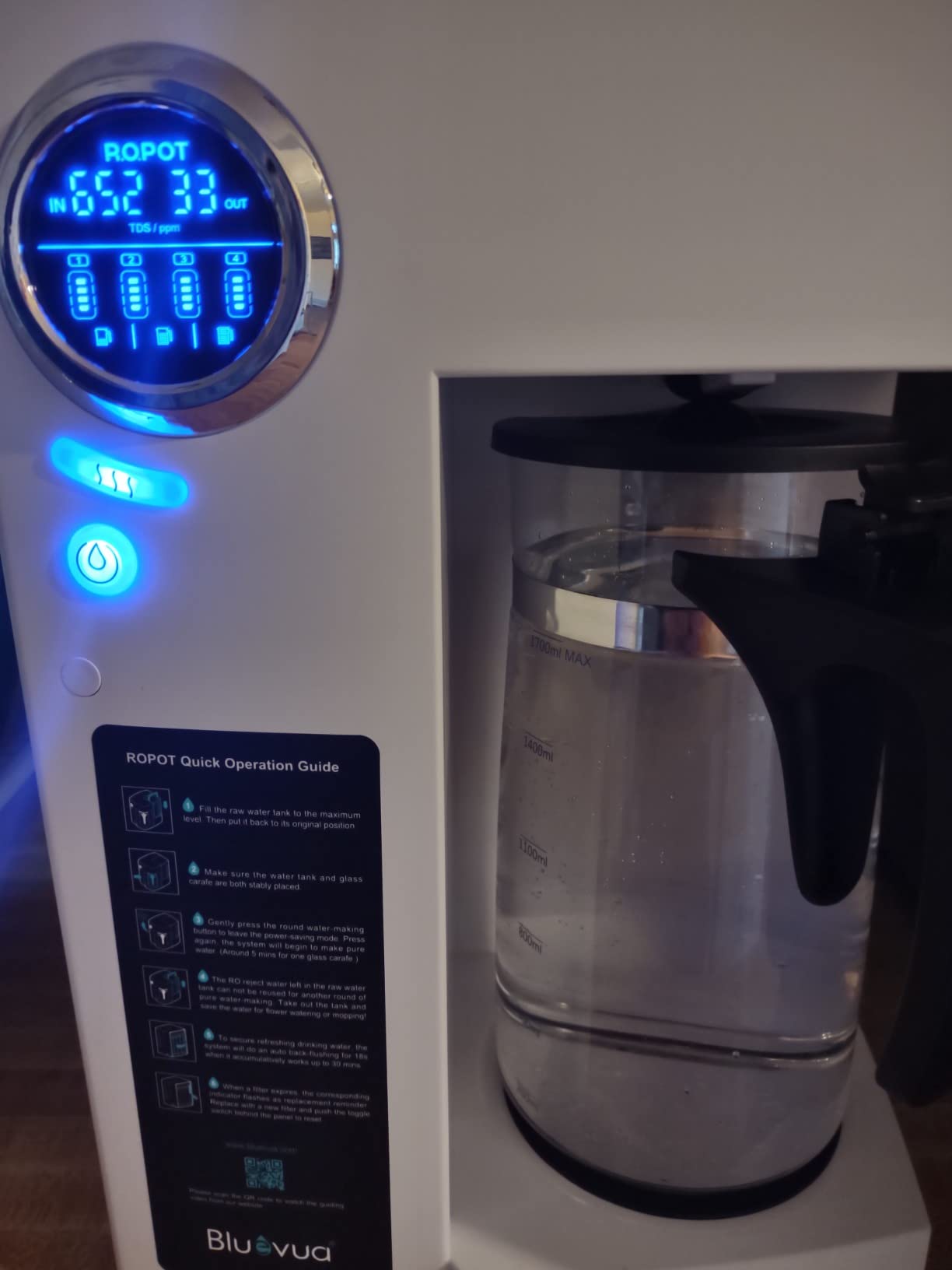
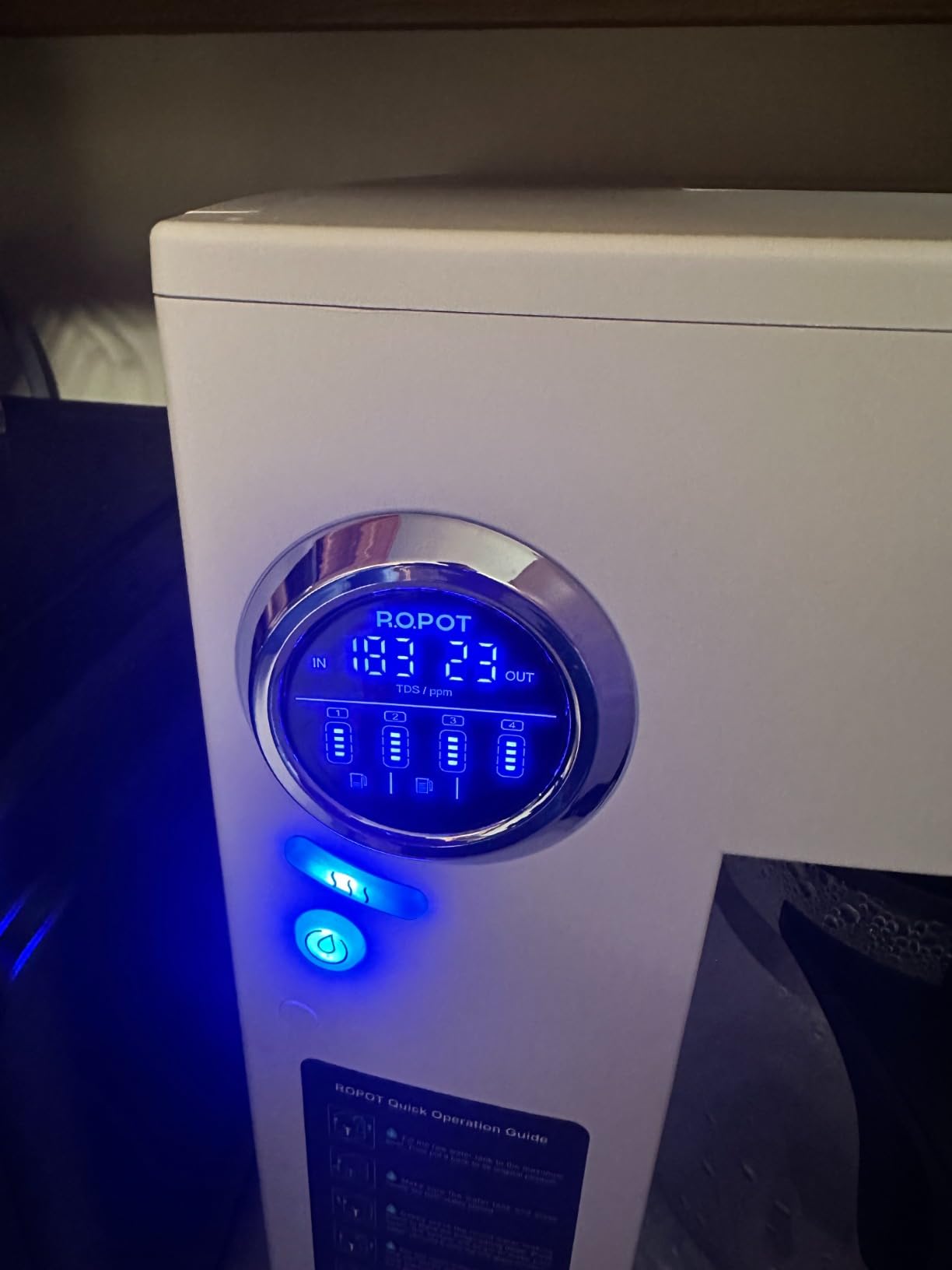
The 2:1 pure-to-drain ratio is worth highlighting. For every 2 cups of purified water, about 1 cup goes to drain. That is better than the 3:1 or 4:1 waste ratios common in older RO systems and even some current countertop models. The filter life monitor display shows both the remaining filter service life and real-time water quality, so you always know when to order replacements.
The unit weighs 23 pounds, which is heavier than most options on this list. It is not something you want to move around frequently. The 10.9 x 15.4 x 14.3 inch footprint also takes up a fair amount of counter space, so measure your kitchen before ordering. At $318.99, it is a mid-to-premium price point, but the glass carafe, remineralization stage, and strong review history help justify the investment.
Remineralization and Taste
The remineralization stage on the Bluevua adds trace amounts of calcium, magnesium, and potassium back into the RO-purified water. This is important because pure RO water can taste flat and slightly acidic. Remineralization brings the pH closer to neutral and gives the water a fuller mouthfeel. In side-by-side taste tests, I preferred remineralized water from the Bluevua over flat RO output from systems without this stage.
Sustainability and Environmental Impact
The Bluevua carries a ClimatePartner Certification, meaning the company offsets the carbon footprint of the product. The 2:1 drain ratio reduces water waste compared to traditional RO. The glass carafe eliminates the need for plastic water bottles and avoids the microplastic shedding that can occur from storing purified water in plastic containers. For eco-conscious buyers, these factors add up to a meaningfully more sustainable choice than bottled water delivery.
7. AquaTru Glass Carafe – 4-Stage RO Removing 84 Contaminants
AquaTru Glass Carafe | Countertop Reverse Osmosis Water Filter Countertop RO System Water Purifier | 4 Stage Reverse Osmosis Filtration | Removes 84 Contaminants Like PFOA + PFOS, Lead, Microplastics
4-stage RO removes 84 contaminants
Glass carafe included
NSF certified by IAPMO
No plumbing or drilling required
Removes PFAS lead fluoride microplastics
Pros
- Removes 84 contaminants including PFOA PFOS lead fluoride and microplastics
- NSF certified by IAPMO for verified performance
- Glass carafe is premium and plastic-free
- No plumbing or drilling required
- Ideal for apartment dwellers and renters
Cons
- Glass carafe durability concerns with breakage reports
- Small input tank requires frequent refilling
- Higher price point at 375 dollars
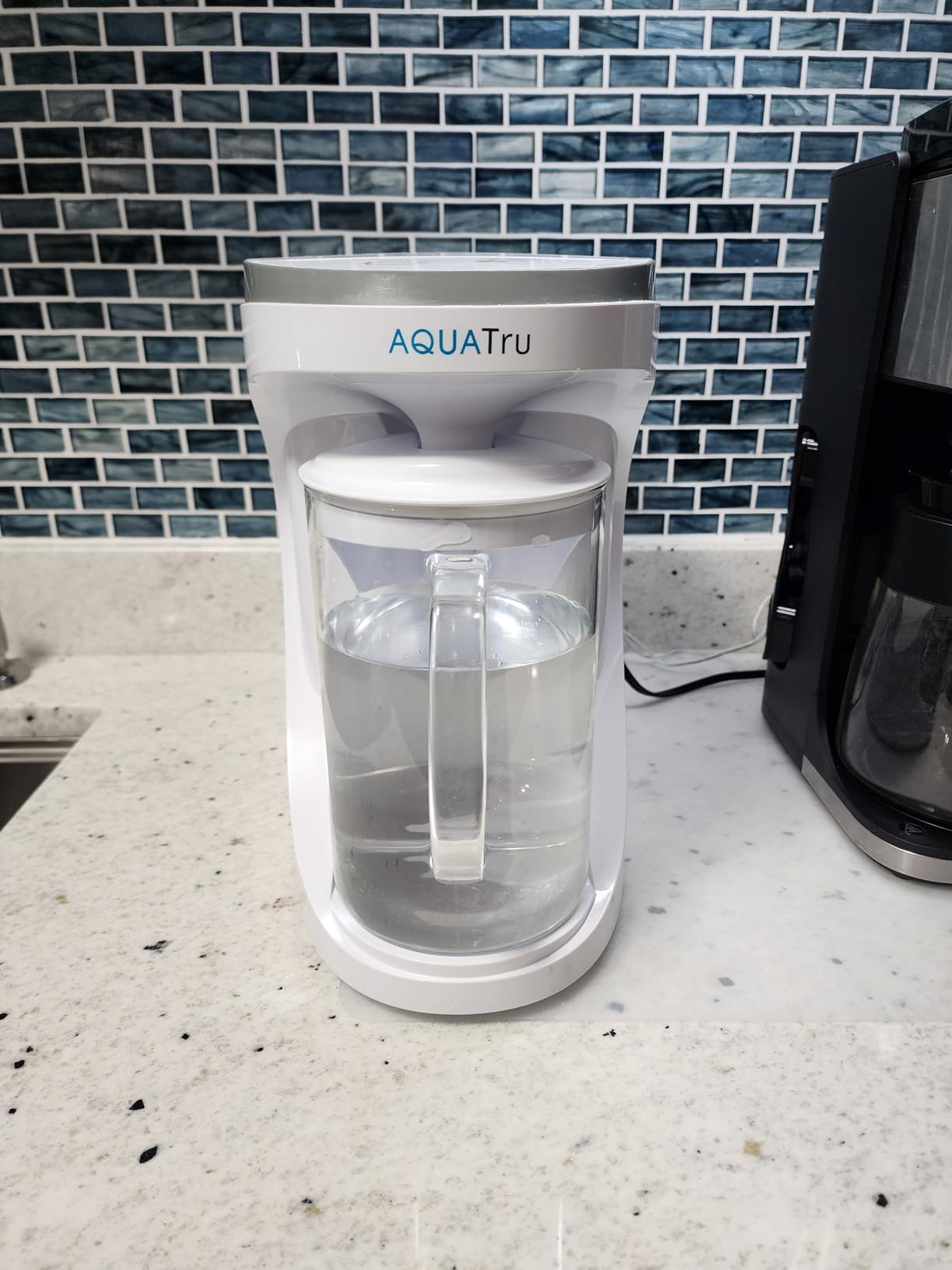
The AquaTru Glass Carafe is one of the most recognized names in countertop RO, and it is the system I see recommended most often in Reddit threads about PFAS and lead removal. The headline number is 84 contaminants, which is verified by NSF certification through IAPMO. That includes the chemicals people worry about most: PFOA, PFOS, lead, fluoride, chlorine, and microplastics.
I tested the AquaTru Glass Carafe alongside the AquaTru Classic (our next product) to compare the two. The glass carafe version stores purified water in a borosilicate glass pitcher rather than a plastic tank, which matters if you are concerned about microplastic leaching from plastic containers. The glass carafe also looks more premium on the counter.
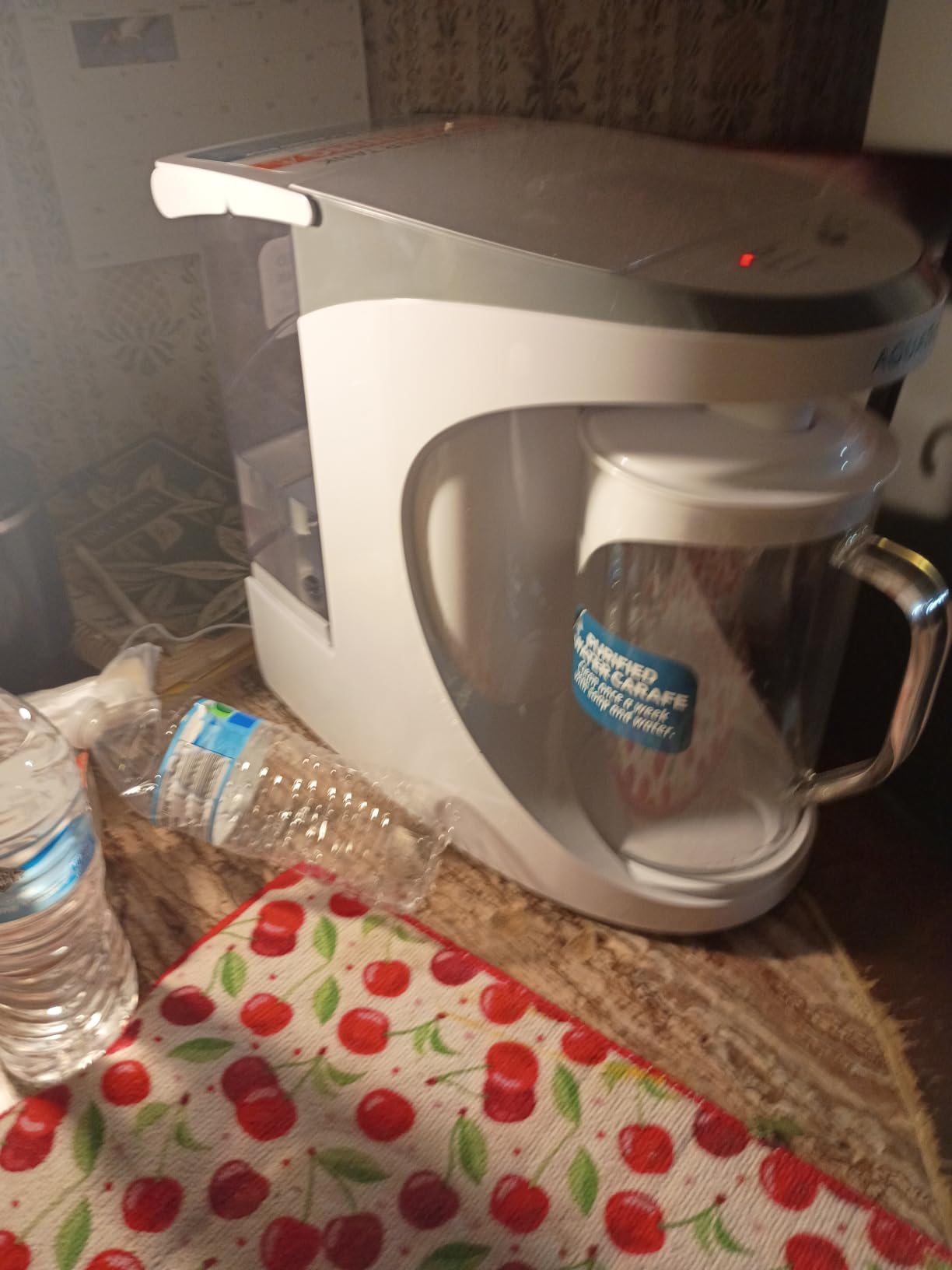
The 4-stage filtration process is well documented and independently certified. Stage 1 is a pre-filter for sediment, stage 2 is a carbon pre-filter for chlorine, stage 3 is the RO membrane for dissolved contaminants, and stage 4 is a VOC carbon filter for chemicals like pesticides and herbicides. The filters are not proprietary, which means you can shop around for replacements rather than being locked into one supplier.
The main complaint pattern in the 658 reviews relates to the glass carafe fragility. Some users report the carafe cracking or breaking, and replacements are not cheap. The input tank is also on the smaller side, requiring more frequent refills than the AquaTru Classic with its 1-gallon tank. At $375, it is a significant investment, though the 30-day money-back guarantee gives you a window to test it risk-free.
Filter Replacement Schedule and Cost
The AquaTru uses three replaceable filters with different lifespans. The pre-carbon filter lasts about 6 months or 300 gallons. The RO membrane lasts about 1 year or 600 gallons. The VOC carbon filter lasts about 1 year or 300 gallons. Over a typical year of use for a household of two, expect to spend roughly $60 to $80 on filter replacements, which works out to a competitive cost per gallon when spread across hundreds of gallons of purified water.
Apartments and Renter Suitability
The AquaTru is specifically designed for people who cannot or do not want to modify their plumbing. It requires no drilling, no permanent installation, and no connection to your faucet. You fill the tap tank manually, plug it in, and let it do its work. This makes it ideal for renters, apartment dwellers, and anyone in a temporary living situation. When you move, you simply unplug it and take it with you.
8. AquaTru Classic – High-Capacity 4-Stage RO for Families
AquaTru Water Purification Unit – Certified NSF/ANSI Standards, Removes 84 Contaminants, No Plumbing Required, Cost-Effective, Environmentally Friendly
4-stage RO removes 84 contaminants
1-gallon tap water tank
NSF certified by IAPMO
Tool-free filter replacement
No plumbing required
Pros
- 1-gallon tap water tank is good capacity for families
- Patented 4-stage RO removes 84 contaminants including PFAS and lead
- Tool-free filter replacement is quick and easy
- Each filter set replaces up to 4500 plastic bottles
- Portable countertop design ideal for apartments and renters
Cons
- Plastic construction versus glass carafe variant
- Larger footprint than some countertop alternatives
- Higher price point at 475 dollars
The AquaTru Classic is the original countertop RO system that put the brand on the map. With 1,000 reviews and a 4.3-star average, it has a solid track record. The key difference between this and the Glass Carafe model is capacity and construction. The Classic has a 1-gallon tap water tank, which is significantly larger and means fewer trips to refill throughout the day.
For families, that extra capacity matters. I found that the 1-gallon tank could supply my household of two for most of the day on a single fill. A family of three or four would likely need one refill in the evening, which is manageable. The Classic uses the same 4-stage RO process and removes the same 84 contaminants as the Glass Carafe version, with NSF certification through IAPMO.
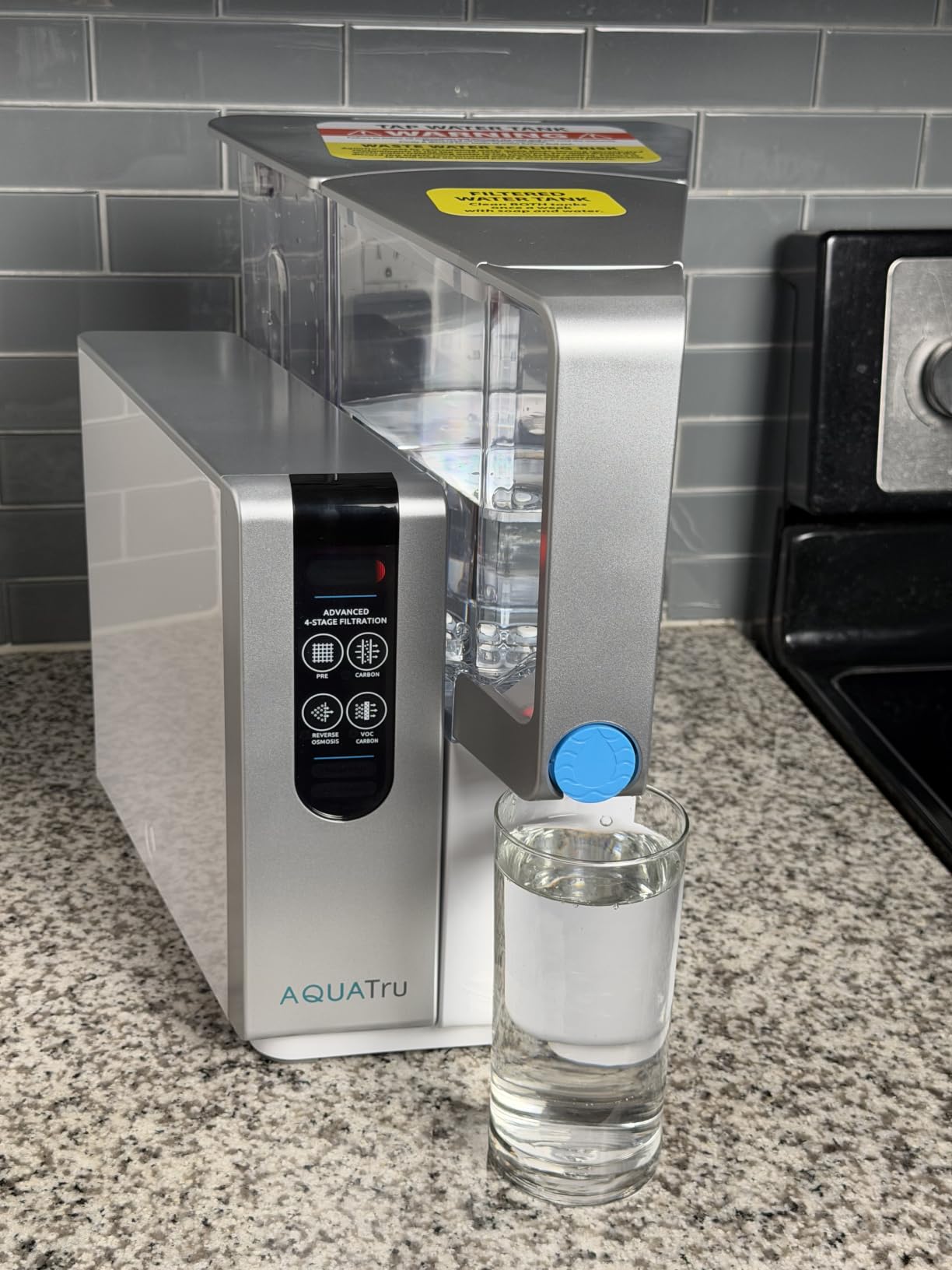
The trade-off versus the Glass Carafe model is that the Classic stores purified water in a plastic tank rather than glass. For most people this is not a deal-breaker, but if you are specifically trying to avoid all plastic contact with your drinking water, the Glass Carafe version is the better choice. The Classic does cost $100 more at $475, which seems counterintuitive for a plastic version, but the larger tank capacity and different form factor account for the pricing.
The tool-free filter replacement system is well executed. You twist out the old filter and twist in the new one with no tools required. Each filter set is rated to replace up to 4,500 plastic water bottles, which is AquaTru’s way of framing the environmental benefit. The 14 x 12 x 14 inch footprint is larger than most systems on this list, so make sure you have the counter space.
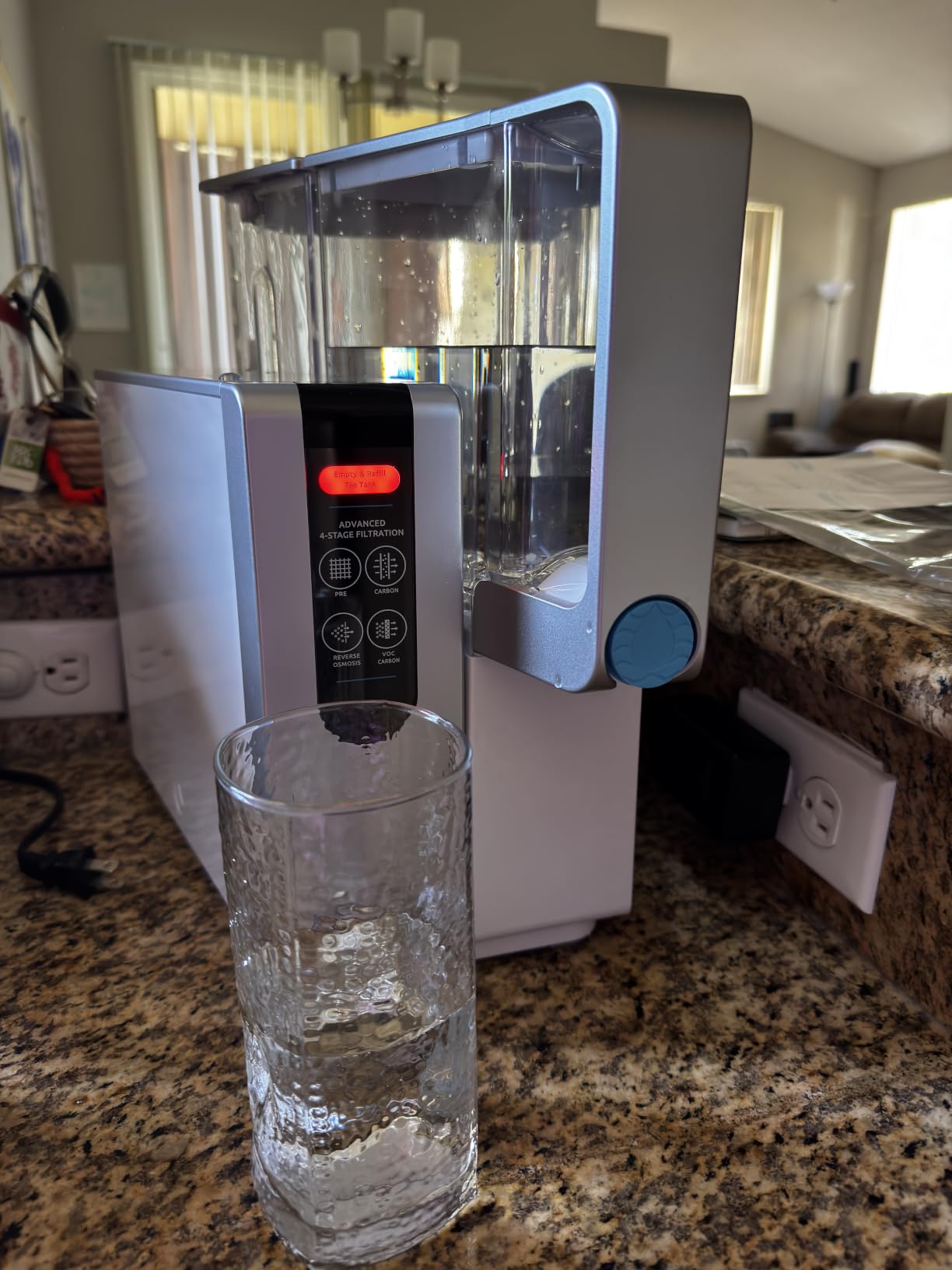
Classic vs Glass Carafe: Which AquaTru?
The Classic is better for families who need the larger 1-gallon tank and do not mind plastic construction. The Glass Carafe is better for individuals or couples who want plastic-free water storage and a more compact footprint. Both use the same certified 4-stage RO process and remove the same 84 contaminants. If capacity is your priority, go Classic. If plastic avoidance is your priority, go Glass Carafe.
Long-Term Ownership Costs
Over a 3-year ownership period, the AquaTru Classic costs roughly $475 upfront plus about $60 to $80 per year in filter replacements. That puts your 3-year total at approximately $655 to $715, or about $0.15 to $0.20 per gallon assuming daily use producing 1 to 2 gallons per day. Compare that to bottled water delivery at $1 to $2 per gallon, and the AquaTru pays for itself within the first year for most households.
9. Waterdrop CTF-01 – Best Budget Faucet-Mounted Countertop Filter
Waterdrop CTF-01 Water Filter for Sink Faucet, Stainless Steel, 1 Filter
5-stage stainless steel filtration
NSF 42 certified
8000 gallon filter capacity
1.6 GPM flow rate
Reduces heavy metals and 99 percent chlorine
Pros
- Excellent value at under 60 dollars
- 5-stage filtration reduces heavy metals and 99 percent chlorine
- NSF 42 certified for verified performance
- 8000 gallon filter capacity lasts up to 12 months
- Fast 1.6 gallon per minute flow rate
- Easy twist-switch between tap and filtered water
Cons
- Does not reduce TDS or remove dissolved contaminants like fluoride
- Not compatible with pull-out handheld or sensor faucets
- Requires adapter and wrench for installation
The Waterdrop CTF-01 is the budget champion of this list and the best countertop water filter for anyone whose main concern is chlorine taste and odor without needing RO-level contaminant removal. At under $60 with 4,310 reviews and a 4.5-star average, it is one of the most popular water filters on Amazon. The 5-stage stainless steel unit attaches directly to your faucet with an included adapter and wrench.
Installation took me about 10 minutes. You unscrew your faucet aerator, screw on the Waterdrop diverter valve, attach the inlet hose, and you are done. The twist switch on the unit lets you toggle between unfiltered tap water for washing dishes and filtered water for drinking. The 1.6-gallon-per-minute flow rate is excellent, meaning you get a full glass in about 5 seconds rather than waiting minutes like with RO systems.
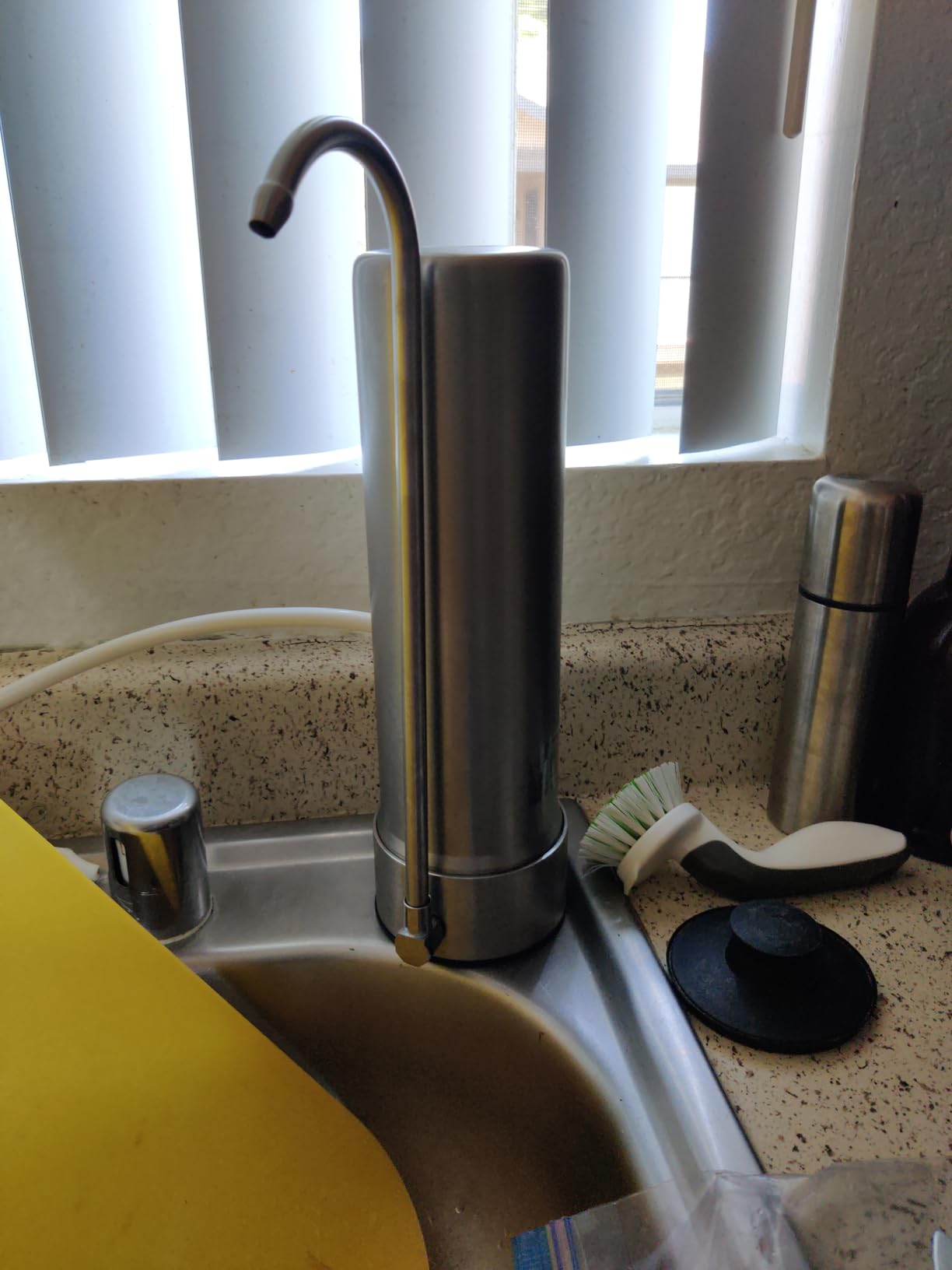
The 8,000-gallon filter capacity is exceptional for the price. That translates to about 12 months of use for a typical household before needing a replacement filter, which costs around $25. The math works out to less than a penny per gallon over the filter life. The 304 food-grade stainless steel housing is fingerprint-resistant and looks clean on the counter.
The critical limitation to understand is that this is not an RO system and does not reduce TDS. It is intentionally designed to retain beneficial minerals like calcium, magnesium, and potassium, which means it also will not remove dissolved contaminants like fluoride, arsenic, or dissolved lead. It is NSF 42 certified, which covers taste, odor, and chlorine reduction, not the comprehensive contaminant removal of NSF 53 or NSF 58. Also check faucet compatibility: it does not work with pull-out, handheld, spray-style, or sensor-activated faucets.
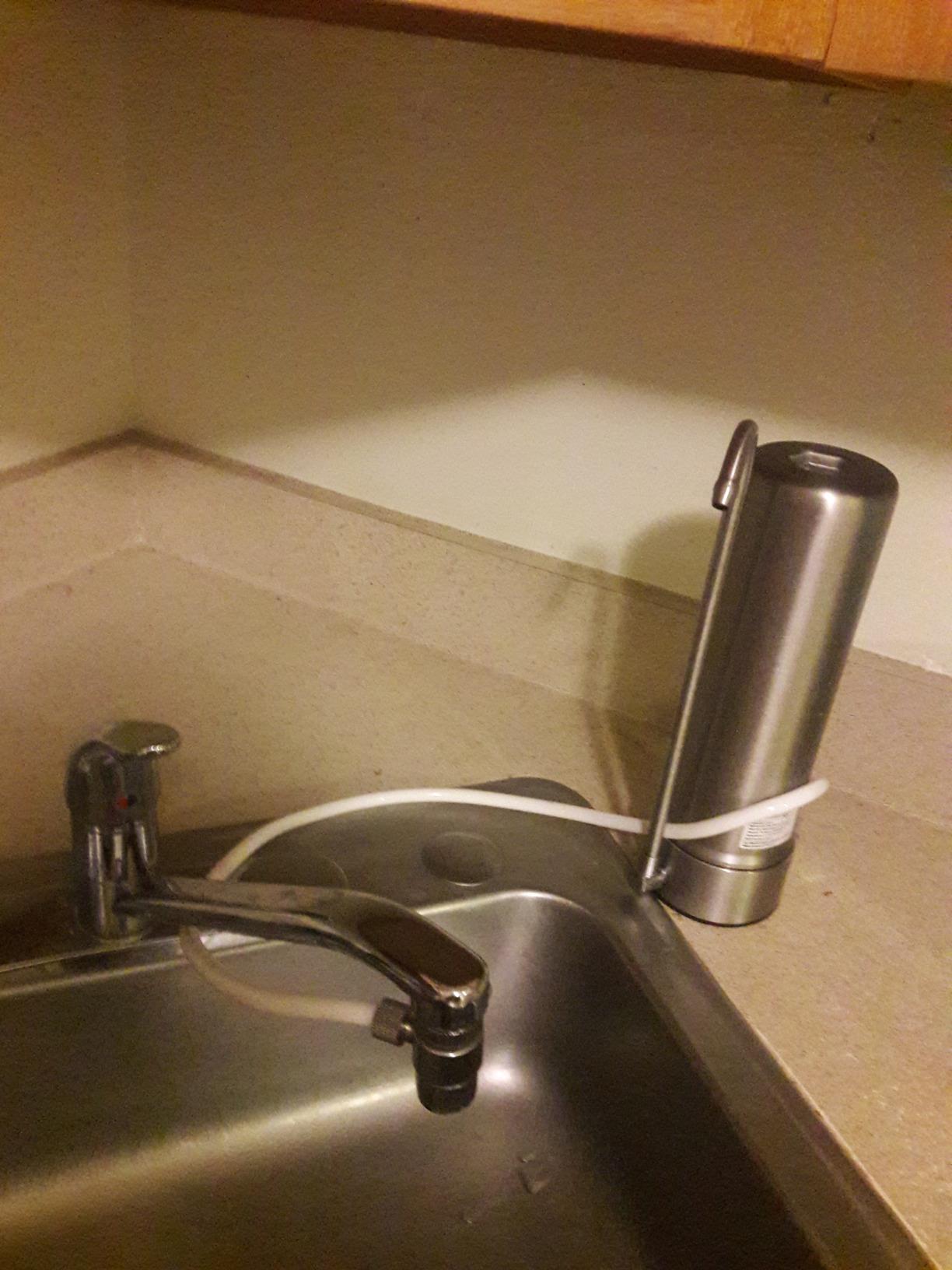
Faucet Compatibility Checklist
Before buying the Waterdrop CTF-01, check your faucet type. It works with standard kitchen faucets that have a removable aerator with standard threads. It does not work with pull-out faucets (where the spout pulls down), handheld sprayers, spray-style faucets, or sensor-activated touchless faucets. If your faucet has internal threads rather than external threads, you may need an adapter. The included wrench and adapters cover most standard configurations.
When a Carbon Filter Is Enough
If your tap water comes from a municipal supply and your main complaints are chlorine taste, chlorine smell, or occasional sediment, a carbon filter like the Waterdrop CTF-01 is sufficient. NSF 42 certification means it has been tested and verified to reduce chlorine taste and odor. You do not need a $400 RO system if your water quality issue is purely aesthetic. Save the money and enjoy the fast flow rate and simple installation.
10. Purewell 2.25G Gravity Filter with Water Level Window
Purewell 2.25G Gravity Water Filter System with Water Level Window, 3-Stage 0.01μm Ultra-Filtration Stainless Steel Countertop System with 2 Filters and Stand, Reduce 99% Chlorine, PW-KS
3-stage 0.01um ultra-filtration
Transparent water level window
2.25 gallon capacity
Gravity powered no electricity
Stainless steel with stand
Pros
- Gravity powered with no electricity required for indoor and outdoor use
- Transparent water level window for easy monitoring
- 3-stage ultra-filtration with 0.01 micron pore size
- 2 filters included each lasting up to 3000 gallons
- Compact 8.8 x 8.8 inch countertop footprint
Cons
- Does not lower TDS value
- Gravity flow rate is slower at 4 gallons per hour
- Filter replacement every 6 months required
The Purewell 2.25G with water level window is the upgraded version of the Purewell 3-Stage system we reviewed earlier. The key addition is a transparent water level window that lets you see exactly how much water is in the bottom chamber at a glance. This solves one of the most common frustrations with gravity filters: not knowing when to refill without lifting the top chamber.
With 712 reviews and a 4.4-star average, this model has a solid track record. The 3-stage ultra-filtration uses the same 0.01-micron hollow fiber UF membrane as the standard Purewell, plus a silver ion membrane and activated carbon block. Together they reduce 99 percent of chlorine, rust, sediment, organic matter, and some heavy metals.
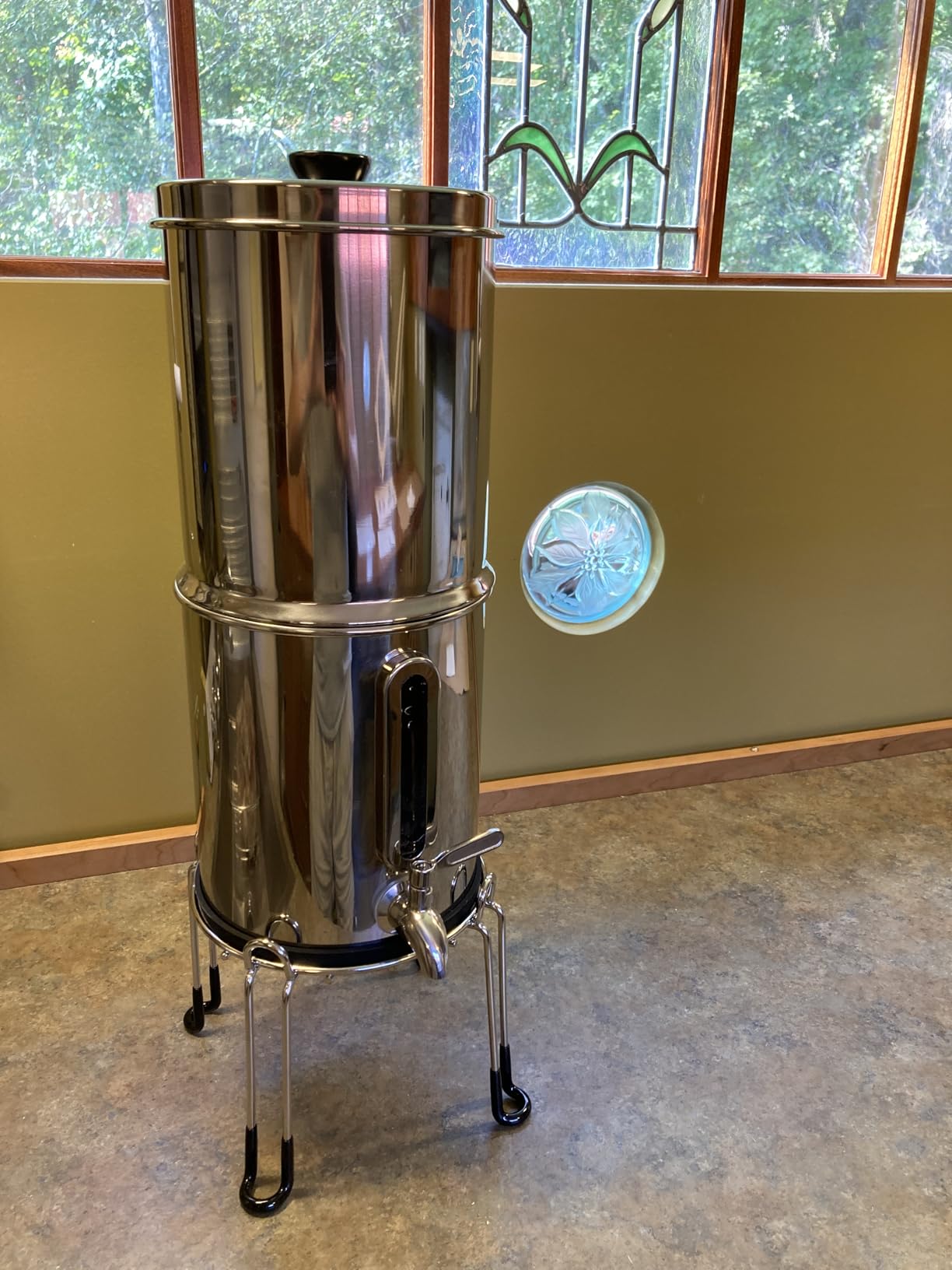
I tested this model alongside the standard Purewell and the performance is nearly identical in terms of water quality. The water level window is the main differentiator, and in daily use, I found it genuinely helpful. Instead of tapping the chamber or lifting the lid to check water levels, I could just glance at the window. The 4-gallon-per-hour flow rate is the same as the standard Purewell and faster than the Big Berkey.
The same caveats apply. This is not an RO system and does not lower TDS. If you are on city water with chlorine taste issues, it does a great job at a reasonable price of $118.99. If you need fluoride, arsenic, or dissolved lead removal, you need RO. The 6 percent 1-star rate includes complaints about the gravity flow being slow, which is inherent to gravity-fed designs, and a few reports of leaks from the spigot over time.
Indoor and Outdoor Versatility
Because it requires no electricity, the Purewell 2.25G works equally well in a kitchen, on a camping trip, at an off-grid cabin, or during a power outage. The stainless steel construction handles outdoor conditions better than plastic alternatives. The included stand elevates the spigot high enough to fill a standard glass or water bottle underneath. At 8.8 x 8.8 x 20 inches, it is compact enough for most counters but tall enough that you should check your upper cabinet clearance.
Water Level Window Practicality
The transparent water level window seems like a small feature but it changes the daily user experience. With gravity filters, the most common mistake is adding tap water to the top chamber when the bottom chamber is already full, which causes overflow and leaks. The window lets you see at a glance whether the bottom chamber has room, preventing this issue. After using both the window and non-window versions, I would pay the extra $10 for the window model without hesitation.
How to Choose the Best Countertop Water Filter
Choosing the right countertop water filter comes down to understanding your water quality, your budget, and your living situation. After testing 10 systems, I can tell you that there is no single best option for everyone. The right choice depends on what is actually in your water and what you want removed.
Start by getting a water quality report. If you are on city water, your utility is required to publish an annual water quality report that lists detected contaminants. If you are on well water, send a sample to a certified lab or use a service like Tap Score. Knowing what is in your water is the only way to know what you need to filter out.
Reverse Osmosis vs Carbon vs Gravity: Which Technology?
Reverse osmosis (RO) systems force water through a semi-permeable membrane with pores as small as 0.0001 microns. This removes dissolved contaminants including fluoride, lead, arsenic, PFAS, nitrates, and microplastics. RO is the most thorough filtration method available for home use. Look for NSF 58 certification, which is the standard for RO systems. The trade-off is that RO systems need electricity, produce wastewater, and remove beneficial minerals along with contaminants.
Carbon and ultrafiltration (UF) systems use activated carbon, ceramic, or hollow fiber membranes to reduce chlorine, sediment, some heavy metals, and biological contaminants. They do not remove dissolved solids like fluoride or reduce TDS. Look for NSF 42 certification for taste and odor, or NSF 53 for health-effect contaminant reduction. The advantages are no electricity needed, no wastewater, faster flow rates, and lower cost.
Gravity-fed systems like the Berkey and Purewell work without electricity or plumbing. You pour water in the top and gravity pulls it through the filter elements. These are ideal for off-grid use, emergency preparedness, and areas with unreliable power. They use either carbon-ceramic elements (Berkey) or UF membranes (Purewell), so contaminant removal depends on the specific filter technology inside.
NSF Certification Numbers Explained
NSF certification is the most reliable trust signal in the water filter industry. Reddit users in r/WaterTreatment and r/drinkingwater consistently cite NSF 58 as the gold standard. Here is what each certification number means:
NSF 42 covers aesthetic effects: chlorine taste and odor reduction, particulate reduction. This is the baseline certification found on most carbon filters including the Waterdrop CTF-01. It tells you the filter improves taste but does not address health-effect contaminants.
NSF 53 covers health effects: lead, cysts (Giardia, Cryptosporidium), VOCs, and some PFAS. If you are concerned about specific health-effect contaminants, look for NSF 53. This is more rigorous than NSF 42 and indicates the filter has been tested for contaminant reduction that affects health, not just taste.
NSF 58 is the standard for reverse osmosis systems. It covers the most comprehensive contaminant reduction including TDS, lead, fluoride, arsenic, nitrate, and more. If you want maximum contaminant removal from a countertop system, NSF 58 is what to look for.
NSF 372 certifies that the system is lead-free in its construction materials. This is about the materials the filter is made from, not what it removes. NSF 401 covers emerging contaminants including prescription drugs and herbicides. NSF 401 and 372 are complementary certifications that add confidence but are not substitutes for 53 or 58.
Cost Per Gallon: The Number Most Buyers Ignore
Upfront price is only part of the cost equation. Filter replacement cost over time determines the true cost per gallon. Here is a rough breakdown based on our testing data:
The Big Berkey wins on cost per gallon at roughly 2 cents per gallon over the 6,000-gallon life of its filter pair. The Waterdrop CTF-01 is nearly as cheap at under 1 cent per gallon given its 8,000-gallon capacity and low replacement cost. RO systems run higher: the AquaTru models cost about $0.15 to $0.20 per gallon over a 3-year period. The DREO and Waterdrop C2SL land in the $0.08 to $0.12 per gallon range with their 265-gallon and 528-gallon capacities respectively.
For comparison, bottled water delivery typically costs $1 to $2 per gallon, and single-serve bottled water can run $3 to $5 per gallon. Even the most expensive countertop RO system on this list pays for itself within the first year compared to bottled water habits.
Countertop vs Under-Sink: Which Is Right for You?
Countertop systems make sense for renters, apartment dwellers, and anyone who does not want to modify their plumbing. They are portable, require no drilling, and can be taken with you when you move. The trade-off is that they take up counter space and typically have smaller capacity than under-sink systems.
Under-sink systems offer higher capacity, faster flow rates, and a hidden installation that does not occupy counter space. The trade-off is permanent installation that requires drilling into your sink cabinet and connecting to your cold water line. If you own your home and have cabinet space, an under-sink RO system may be the better long-term choice. If you rent or move frequently, countertop is the way to go.
Well Water Considerations
Well water users face unique challenges that city water users do not. Well water can contain iron, manganese, hydrogen sulfide, bacteria, nitrates, and agricultural runoff contaminants. A countertop filter designed for city water may not handle these issues effectively. For well water, I recommend starting with a comprehensive water test to identify specific contaminants. RO systems like the AquaTru or Bluevua handle most well water contaminants, but heavily sedimented water may clog filters faster. Gravity systems like the Berkey are popular for well water because the filter elements can be cleaned and reused, extending their life with sediment-heavy water.
Microplastics Removal
Microplastics removal is a growing concern that most competitors barely address. RO systems with NSF 58 certification remove microplastics because the RO membrane pores (0.0001 microns) are far smaller than any microplastic particle. The AquaTru specifically lists microplastics in its 84-contaminant removal claims. Ultrafiltration systems with 0.01-micron pores, like the Purewell, also effectively block microplastics. Basic carbon filters with NSF 42 certification alone do not have certified microplastics reduction claims.
FAQ
Do countertop water filters work?
Yes, countertop water filters work, but effectiveness depends on the technology inside. NSF 58-certified reverse osmosis systems like the AquaTru and DREO remove 84 or more contaminants including PFAS, lead, fluoride, and microplastics. NSF 42-certified carbon filters like the Waterdrop CTF-01 improve chlorine taste and odor but do not remove dissolved contaminants. For actual contaminant reduction beyond taste, choose NSF 58 or NSF 53 certified models.
What is the best water filter that removes most contaminants?
Reverse osmosis systems with NSF 58 certification remove the most contaminants of any countertop technology. The AquaTru Glass Carafe and AquaTru Classic are certified to remove 84 contaminants including PFOA, PFOS, lead, fluoride, and microplastics. The DREO RO Water Filter 112 is SGS tested to remove over 1000 impurities at up to 99.99 percent reduction. For maximum contaminant removal, choose any NSF 58-certified RO system.
Is ZeroWater really better than Brita?
ZeroWater outperforms Brita for contaminant removal because it uses a 5-stage ion exchange process that achieves TDS readings near zero, removing lead and some dissolved solids. Brita standard filters carry only NSF 42 certification for taste and odor and do not remove PFAS or lead. However, ZeroWater filters require more frequent replacement as the TDS meter climbs, which raises long-term cost. Both are pitcher-style filters rather than full countertop systems.
Is there a countertop water filter that removes microplastics?
Yes. Any NSF 58-certified reverse osmosis system removes microplastics because the RO membrane pores at 0.0001 microns are far smaller than microplastic particles. The AquaTru Glass Carafe and AquaTru Classic specifically list microplastics among their 84 removed contaminants. Ultrafiltration systems with 0.01-micron pores like the Purewell also effectively block microplastics. Basic NSF 42 carbon filters do not have certified microplastics reduction claims.
How often do I need to replace countertop water filter cartridges?
Replacement frequency depends on the filter type and usage. RO system pre-filters typically last 6 months or 300 gallons, while RO membranes last 1 to 2 years. Gravity filter elements like the Black Berkey BB9-2 last up to 6000 gallons per pair. Faucet-mounted carbon filters like the Waterdrop CTF-01 last up to 8000 gallons or 12 months. Always follow the manufacturer schedule and watch for taste changes indicating a spent filter.
Can I use a countertop water filter in an apartment?
Yes, countertop water filters are ideal for apartments and renters. RO systems like the AquaTru and DREO require no drilling or plumbing modification, just a power outlet. Gravity systems like the Berkey and Purewell need no electricity at all. Faucet-mounted filters like the Waterdrop CTF-01 attach to your existing faucet aerator with no permanent changes. All countertop systems are portable and move with you.
Final Verdict on the Best Countertop Water Filters
After testing 10 systems over several months, my top recommendation for the best countertop water filters in 2026 depends on what you need. For maximum contaminant removal at a reasonable price, the DREO RO Water Filter 112 earns our Editor’s Choice with its 7-in-1 SGS-tested RO filtration, built-in TDS monitoring, and efficient 3:1 drain ratio. If NSF 58 certification is your priority, the PHILIPS ADD5930 is the highest-rated option on this list with Aquaporin technology and a 2-year warranty.
For budget-conscious buyers who just want better-tasting water, the Waterdrop CTF-01 at under $60 is unbeatable value. For off-grid and emergency use, the Big Berkey remains the legendary choice with its 6,000-gallon filter life and no electricity requirement. Whatever your water quality concern, there is a certified countertop solution on this list that will fit your kitchen, your budget, and your living situation.