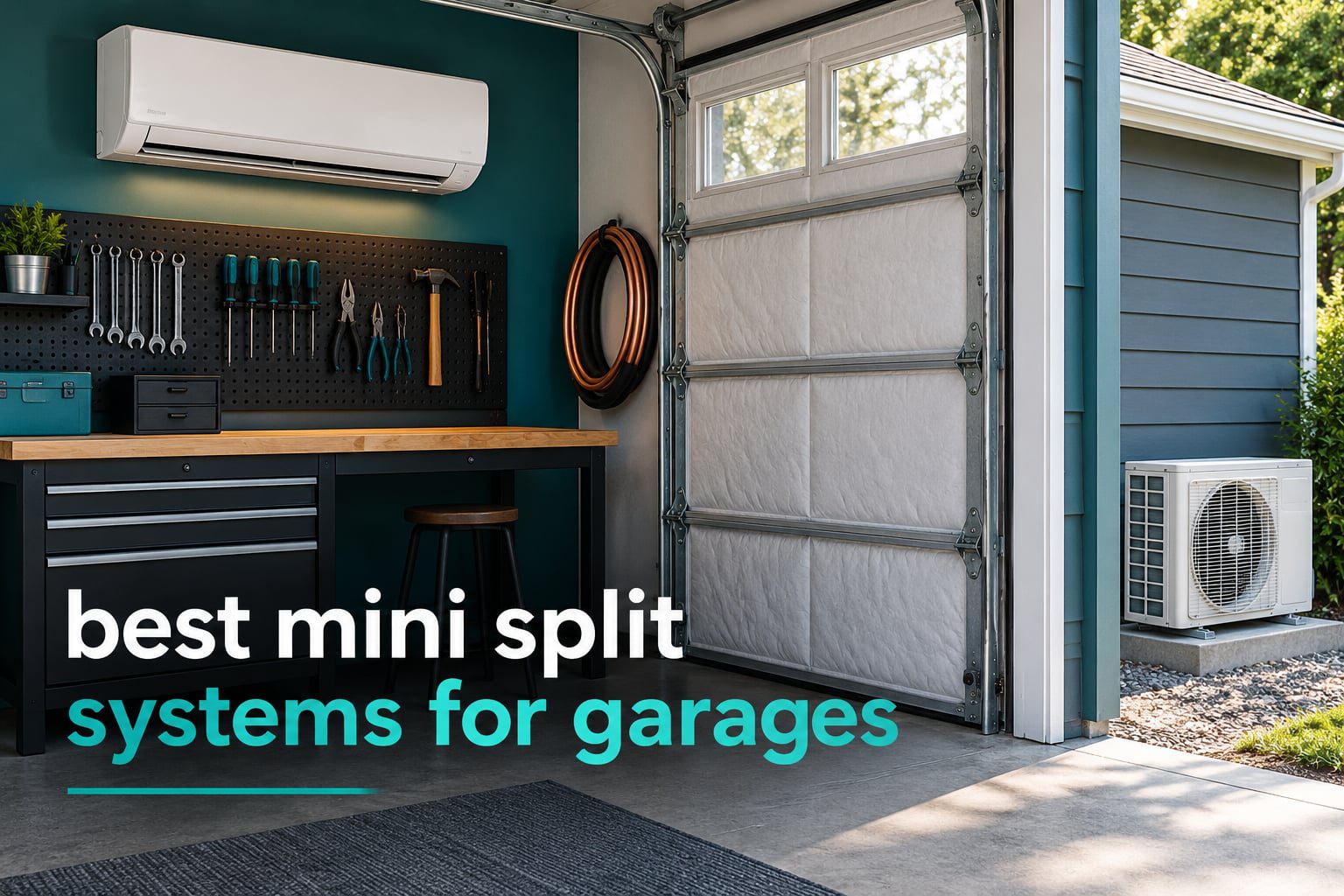
The best mini split systems for garages are the Senville LETO 24,000 BTU for most two-car bays, the Cooper and Hunter MIA 12,000 BTU if you want simple 115V power, and the DELLA Vario 12,000 BTU when efficiency and cold-weather heating matter most. I read the spec sheets and owner reviews on all 12 units in this roundup, then sorted them by the two things that decide a garage install: how much capacity you actually need, and whether the power and install path suit an uninsulated space.
A garage is the hardest room in most homes to condition. Concrete floor, wide swings in temperature, a door that opens onto 95 degree afternoons and lets winter straight in, and often no insulation in the walls or above the ceiling. A ducted system was never going to work there. A ductless mini split can, as long as you size it for a garage and not for a bedroom, and as long as you accept that the compressor is doing real work in a rough environment.
Here is the sizing rule I use, and it is the same rule the AI Overview keeps pulling from forum threads. Start at 20-30 BTU per square foot, then adjust for the building:
One-car garage, roughly 200-250 sq ft: a 9,000 BTU unit if the space is insulated and used lightly, a 12,000 BTU unit otherwise
Two-car garage, roughly 400-550 sq ft: 12,000 BTU if insulated, 18,000 BTU if not
Two-car garage with an open-plan workshop feel or a converted gym: 24,000 BTU
Three-car bay or full shop, 1,000 sq ft and up: 24,000 BTU minimum, 35,000 BTU for a metal building or ceiling above 10 feet
Uninsulated garage: size up 30-50% above the square-footage figure, because the load never drops the way it does in a conditioned house
Short cycling is the failure mode to avoid. An oversized unit bangs on and off in a space that cools down fast, wears the compressor out, spikes the power bill, and leaves the room uncomfortable anyway.
Table of Contents
- Top 3 Picks for Best Mini Split Systems for Garages in 2026
- Garage Mini Split Comparison Chart in 2026
- 1. Senville LETO 24,000 BTU – Best Overall for a Two-Car Garage
- 2. COSTWAY 12,000 BTU 115V – Best Value Heat Pump for a Garage
- 3. DELLA Vario 12,000 BTU 23 SEER2 – Best for Cold Garages and Low Running Cost
- 4. Cooper and Hunter MIA 12,000 BTU 115V – Easiest Install for a One-Car Garage
- 5. YITAHOME 24,000 BTU 21 SEER2 – Best App-Controlled 2-Ton System
- 6. ROVSUN 9,000 BTU 115V – Best for a Small Garage or Shed
- 7. Rellytech 18,000 BTU 19 SEER2 – Best Middle Ground for Two-Car Garages
- 8. DELLA Econo 35,000 BTU – Best for Three-Car Bays and Full Workshops
- 9. Albott 12,000 BTU 115V – Best for Low-Maintenance Upkeep
- 10. Cooper and Hunter 24,000 BTU 230V – Best for Quiet Two-Ton Shops
- 11. MRCOOL Advantage 24,000 BTU – Best for ENERGY STAR Savings
- 12. Temprium 12,000 BTU 22 SEER2 – Best 115V Efficiency
- How to Size a Mini Split for Your Garage
- Condenser Placement, Installation and Cost
- Garage Prep: Insulation, Dust and Drainage
- Frequently Asked Questions
- Conclusion
Top 3 Picks for Best Mini Split Systems for Garages in 2026
These three cover the most common garage situations. The Senville handles a standard two-car bay with the most owner history behind it, the Cooper and Hunter removes the electrical upgrade from the equation, and the DELLA Vario is the one to buy if your garage gets cold enough to need real heating.
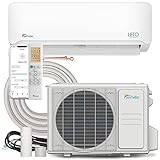
Senville LETO 24,000 BTU
- 24
- 000 BTU cooling and heating
- DC inverter compressor
- Heats down to 5F ambient
- 16 ft line set included

COSTWAY 12,000 BTU 115V
- 20 SEER2 efficiency
- 23 dB washable filter
- 115V plug-in power
- Five year parts warranty

DELLA Vario 12,000 BTU
- 23 SEER2 and 9.5 HSPF2
- Heating to -4F ambient
- App and Alexa control
- 16.4 ft install kit
Garage Mini Split Comparison Chart in 2026
Every unit below is a wall-mounted, single-zone ductless heat pump, which is the configuration that fits almost every garage. The capacity, efficiency and low-ambient figures are copied from the manufacturer listings so you can line them up against your own square footage.
| Product | Specs | Action |
|---|---|---|
| Senville LETO 24,000 BTU |
|
Check Latest Price |
| COSTWAY 12,000 BTU 115V |
|
Check Latest Price |
| DELLA Vario 12,000 BTU |
|
Check Latest Price |
 Cooper and Hunter MIA 12,000 BTU Cooper and Hunter MIA 12,000 BTU |
|
Check Latest Price |
 YITAHOME 24,000 BTU YITAHOME 24,000 BTU |
|
Check Latest Price |
 ROVSUN 9,000 BTU 115V ROVSUN 9,000 BTU 115V |
|
Check Latest Price |
 Rellytech 18,000 BTU Rellytech 18,000 BTU |
|
Check Latest Price |
 DELLA Econo 35,000 BTU DELLA Econo 35,000 BTU |
|
Check Latest Price |
 Albott 12,000 BTU 115V Albott 12,000 BTU 115V |
|
Check Latest Price |
| Cooper and Hunter 24,000 BTU |
|
Check Latest Price |
 MRCOOL Advantage 24,000 BTU MRCOOL Advantage 24,000 BTU |
|
Check Latest Price |
 Temprium 12,000 BTU 22 SEER2 Temprium 12,000 BTU 22 SEER2 |
|
Check Latest Price |
1. Senville LETO 24,000 BTU – Best Overall for a Two-Car Garage
Senville LETO Mini Split Air Conditioner, Heat Pump, White, 24000 BTU
24,000 BTU cooling and heating
DC inverter, 34 dB
Heats down to 5F
16 ft line set included
Pros
- Cools and heats a mid-size garage from one wall-mounted head
- DC inverter compressor ramps output instead of short cycling
- Heat pump mode holds capacity down to 5F ambient
- 16 ft copper line and communication cable included in the box
- App and Alexa scheduling for unattended shop hours
Cons
- Manufacturer requires professional installation
- Parts warranty excludes labor
- BEE star rating listed as not compliant for efficiency programs
This is the unit I keep coming back to for a standard two-car bay. It is rated for 24,000 BTU of cooling and 24,000 BTU of heating, and the manufacturer lists floor coverage of 1,250 square feet, which puts it well above what a two-car garage needs even with a size-up applied.
Nearly two thousand reviews sit behind it at a 4.5 star average, the largest sample of any unit in this roundup. Owners repeatedly describe steady summer cooling, quiet running and a wall unit that looks like it belongs in a finished room rather than a shop.
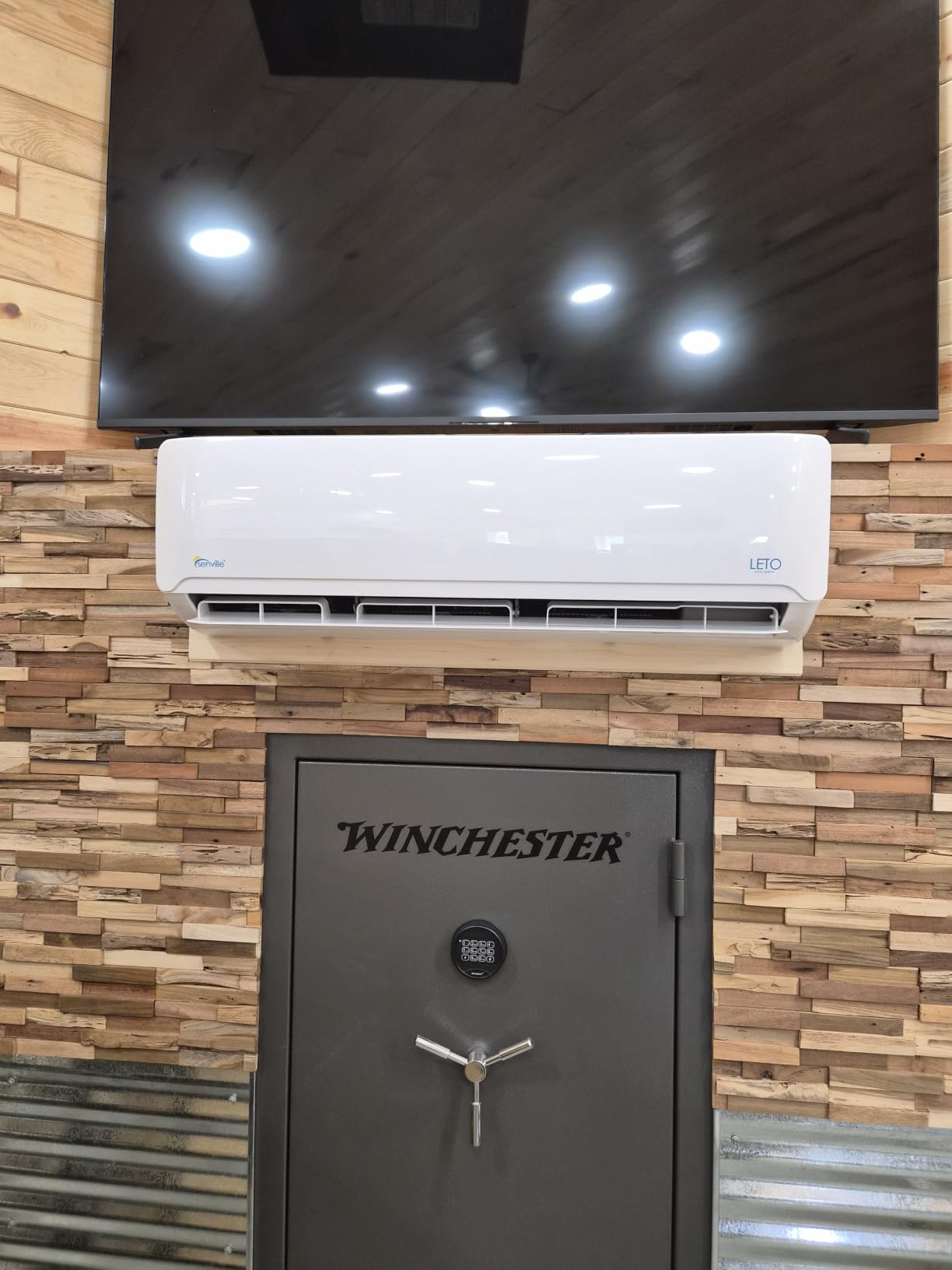
Two details stand out for garage use. The DC inverter compressor modulates output instead of switching hard, which is exactly what you want in a room that heats up fast when the door opens. And the heat pump function is rated down to 5F, so shoulder-season work in January stays comfortable without pulling in a separate heater.
The 34 dB noise figure is on the higher side of the group, but that is the indoor operating level and most owners still describe it as unobtrusive from across a two-car bay. It draws on 2,500 watts at full load, which is worth keeping in mind if you are putting it on a shared circuit.
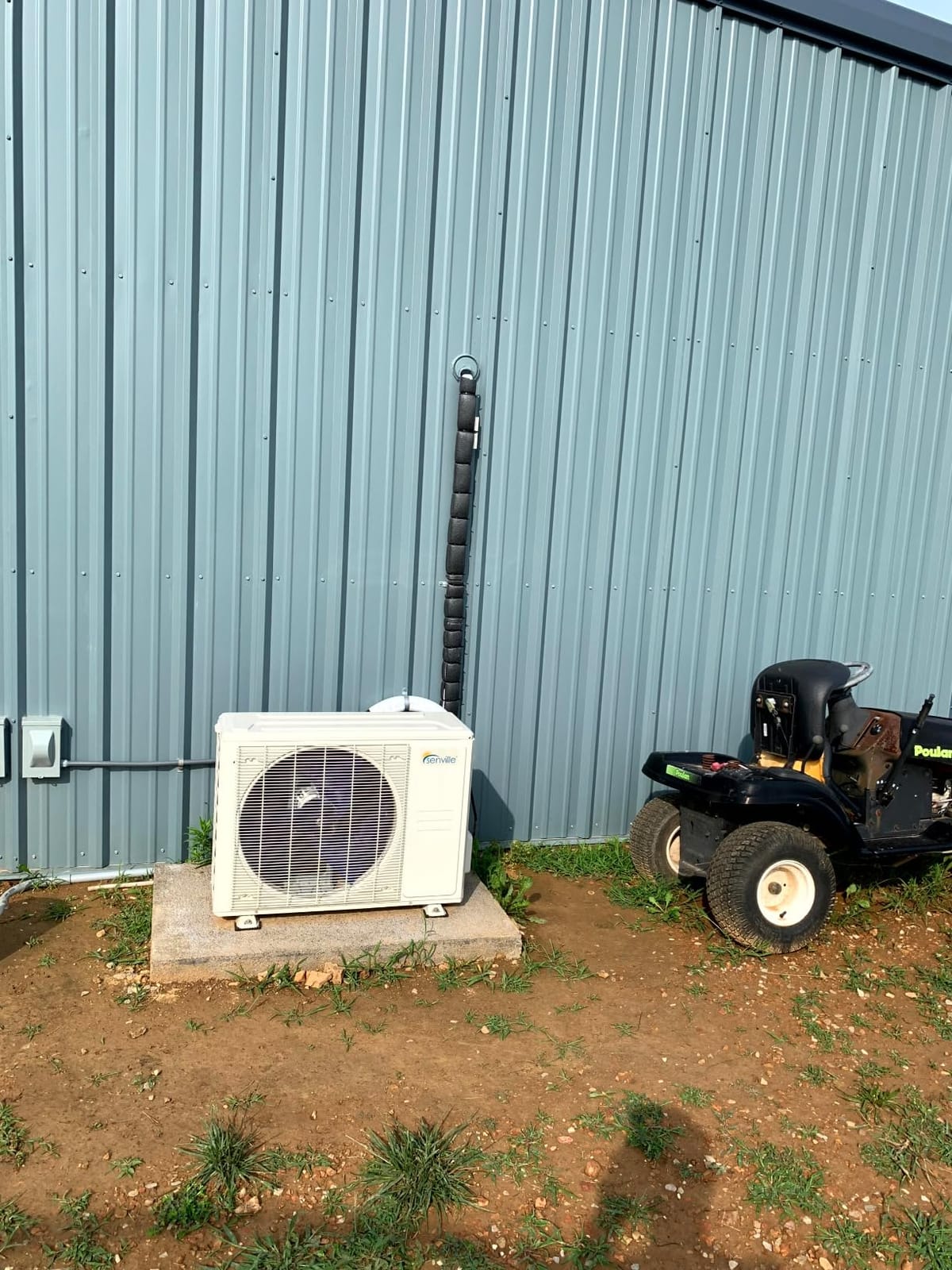
Where the LETO earns its spot
This is the pick when your garage sits somewhere between 400 and 700 square feet, has a concrete floor, and gets used year-round. The 24,000 BTU capacity gives you real headroom, so an open door on a July afternoon does not instantly overwhelm the system.
It also makes sense for a garage gym, where you want the room cooled while you are on it and not overheated when you walk in. The app and Alexa scheduling lets you start cooling before you get out there rather than sitting in a hot car waiting.
Where the LETO falls short
The manufacturer requires professional installation, so the equipment cost is only part of what you spend. The warranty runs five years on parts and the compressor, but labor is explicitly not covered, which matters if you have a two-car garage with a difficult mounting wall.
One more thing to know: the listing shows a BEE star rating of not compliant, so this system will not qualify for state efficiency rebate programs. If rebates matter to your decision, check your state utility before you commit.
2. COSTWAY 12,000 BTU 115V – Best Value Heat Pump for a Garage
COSTWAY 12000BTU Mini Split Air Conditioner& Heater
12,000 BTU cooling, 12,300 BTU heating
20 SEER2 on 115V
23 dB with washable filter
Self-clean and auto-defrost
Pros
- 23 dB operation keeps workshop conversation easy to hear
- 20 SEER2 efficiency on a standard 115V circuit
- Five modes and four fan speeds including sleep and ECO
- Self-cleaning high-temperature cycle plus washable filter
- Five year parts and eight year compressor warranty
Cons
- Licensed HVAC installation required
- Remote only with no app or voice control
- Remote display blanks after ten idle seconds
The COSTWAY is the value pick in this roundup, and for a one-car garage or a lightly used two-car bay it makes a lot of sense. It is a 1 ton, 12,000 BTU cooling and 12,300 BTU heating inverter heat pump with a listed 750 square foot coverage figure.
What stands out is the 23 dB noise level, which is one of the lowest published figures among the 12,000 BTU units here. For a garage gym or a workshop where you want the radio and a normal conversation, that number matters more than most people expect.
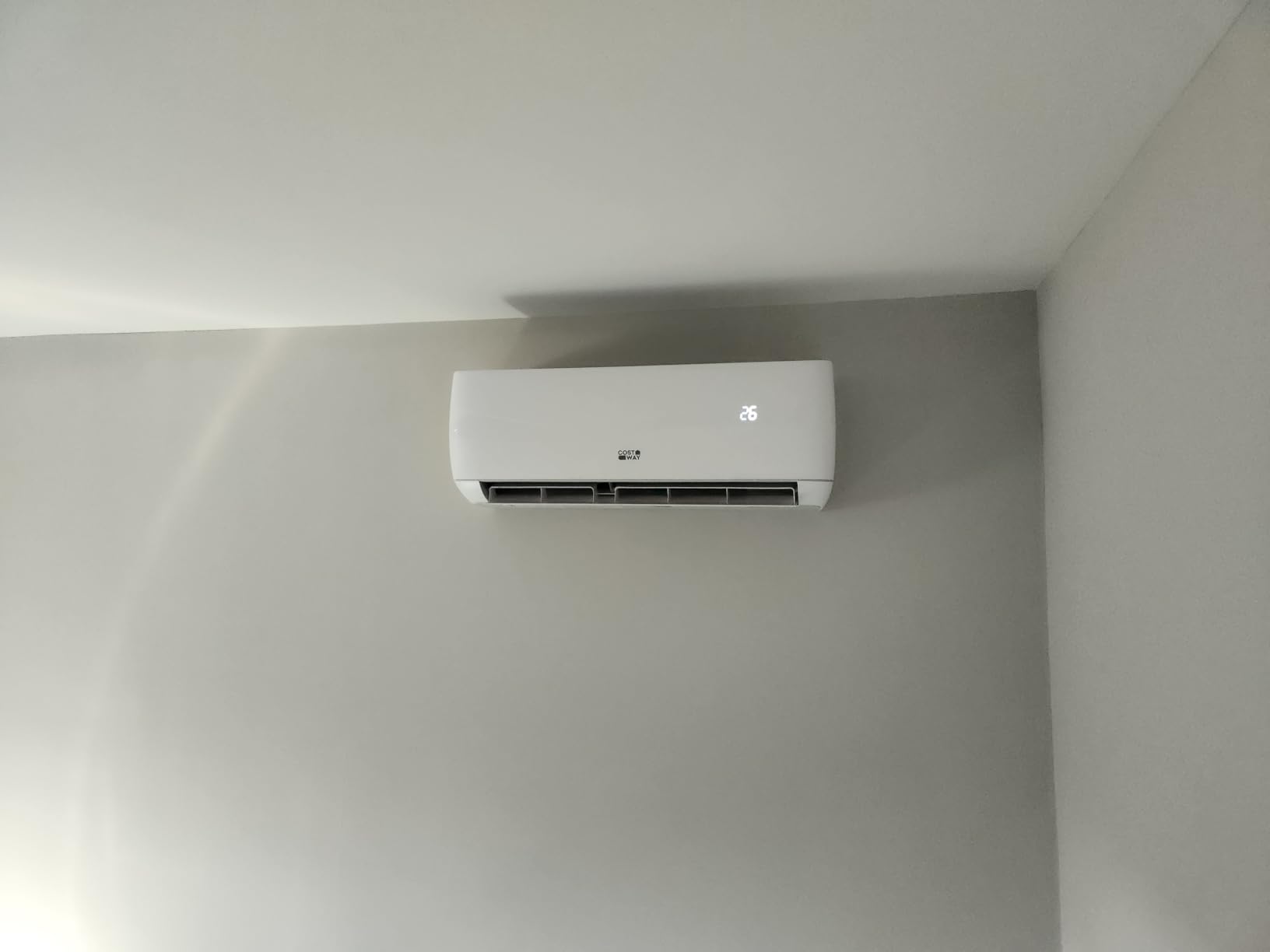
Running on 115 volts is the other headline. It means a standard household circuit, no 230V run and no panel work, which is often the difference between a simple install and a much larger project quote. The trade-off is that 12,000 BTU will not keep a 500 square foot uninsulated two-car garage comfortable in peak July.
Owners mention the washable filter and the self-cleaning cycle at 134.6F more than almost anything else, and both make sense in a space where the air is dusty. The outdoor unit has auto-defrost built in, which helps during cold shoulder months.
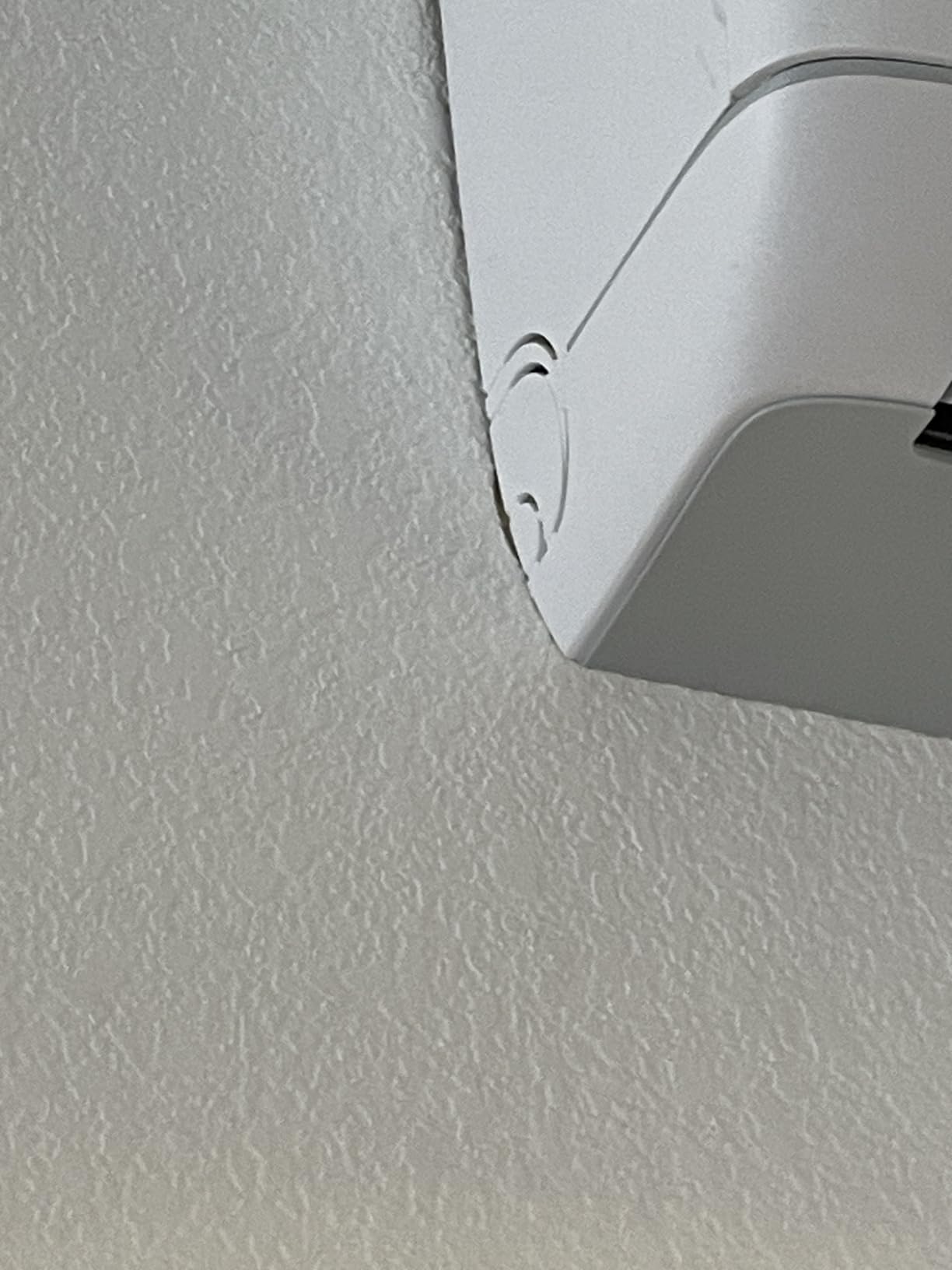
Where the COSTWAY earns its spot
This is the one to pick for a small, enclosed garage, a converted storage room, or a workshop where the door stays shut. At 23 dB and 20 SEER2, it is a genuinely efficient little unit that will not show up on your power bill in a way you notice.
The warranty is the strongest on any value unit in this list at five years parts and eight years compressor. That is a real difference when a compressor failure means a service visit plus parts.
Where the COSTWAY falls short
Control is remote only. There is no documented app or voice assistant integration, so scheduling a start time before you walk out to the shop means getting up to change the setpoint manually.
Installation still needs a licensed HVAC installer, and documentation focuses on the unit itself rather than the install process. Plan on spending time with your installer working out the run.
3. DELLA Vario 12,000 BTU 23 SEER2 – Best for Cold Garages and Low Running Cost
DELLA Vario Series 12000 BTU Mini Split Air Conditioner Work with Alexa with 1 Ton Pre-Charged Heat Pump Ductless Inverter System, 23 SEER2, Cools Up to 550 Sq. Ft,16.4ft Installation Kit Included
12,000 BTU at 23 SEER2 and 9.5 HSPF2
Heats to -4F ambient
App plus Alexa
16.4 ft install kit
Pros
- 23 SEER2 is the highest cooling efficiency among the 1 ton systems here
- Heating mode runs down to -4F for shoulder-season garages
- Phone app and Alexa integration for scheduling
- Remote sensor reads temperature at the handheld for I feel mode
- 16.4 ft line set installation kit included
Cons
- Professional installation and line set vacuuming required
- Remote uses unlabeled icons that need a reference
- Alexa skill for this series handles on and off only
The DELLA Vario is the one I recommend when the garage is used in winter. It runs 23 SEER2 cooling and 9.5 HSPF2 heating, and the heat pump is rated to operate down to -4F, which is colder than any other unit in this roundup.
That low-ambient figure is the whole story for a garage. A standard heat pump loses capacity as outdoor temperature drops and then shuts down entirely when the coils freeze. A unit rated to -4F keeps pulling heat in January, which is exactly when you want a workshop or a gym you can still use.
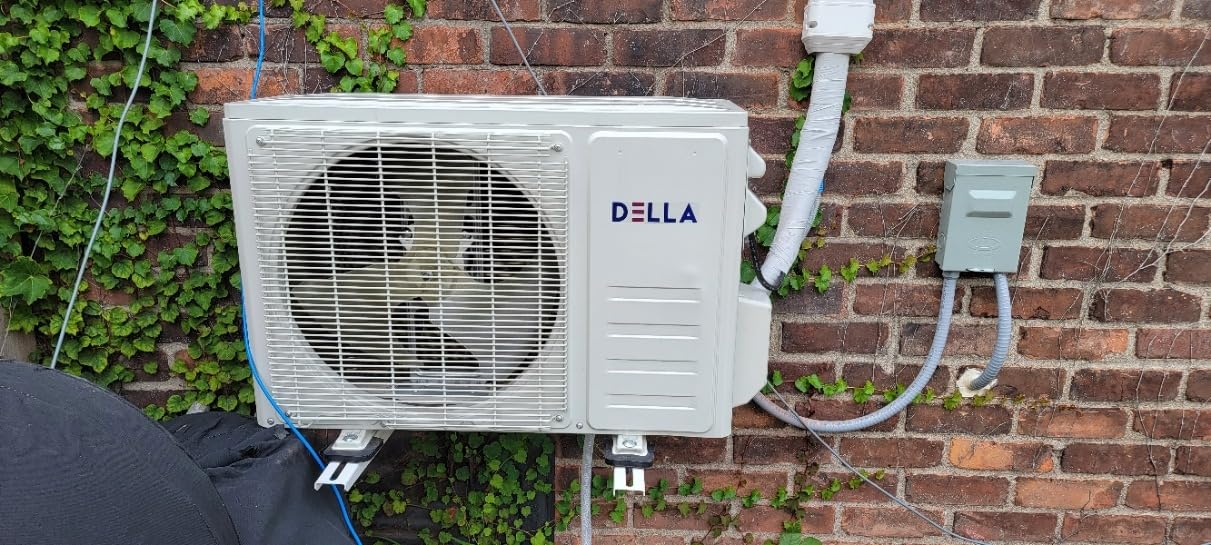
Owners describe near-silent running, which lines up with the 28 dBa indoor figure in the listing copy. They also report that it pulls a room down quickly, and that 23 SEER2 shows up as a noticeably lower summer bill in a space that gets hot all day.
The kit includes 16.4 feet of line set and a 78.7 inch drain pipe. The drain is the piece people forget about, so having it in the box removes one trip to the supply house.
Where the DELLA Vario earns its spot
Choose it for an insulated garage, a converted room over a garage, or any space where you want heat as well as cool. It is also the strongest choice here on pure efficiency, so a tightly insulated garage with a modest load will run very cheaply.
The I feel remote sensor is a small touch that makes a real difference in a room with high ceilings, because it reads temperature where you are instead of where the head is mounted.
Where the DELLA Vario falls short
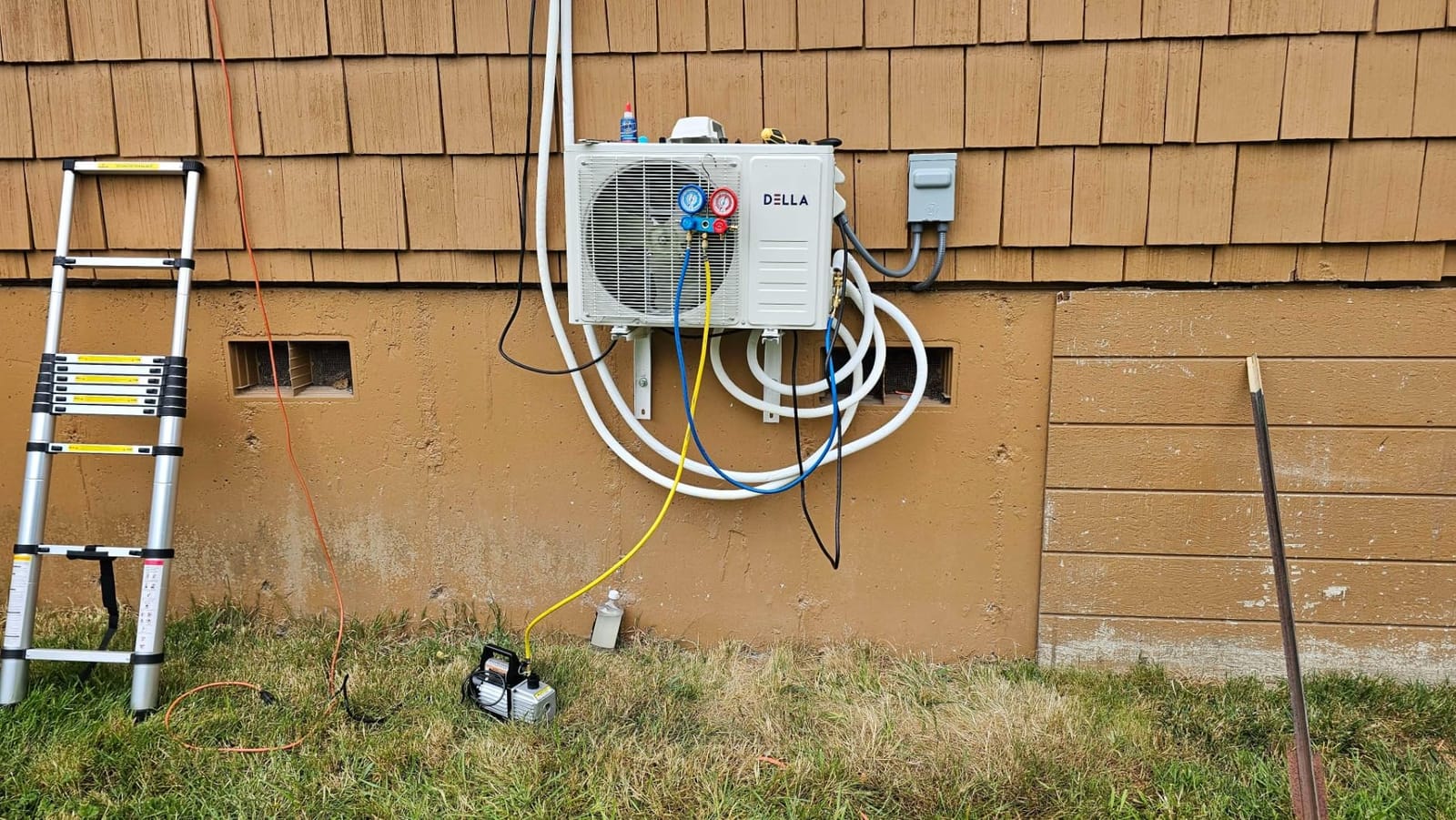
It needs professional installation and the line set has to be vacuumed, so this is not a self-install option despite the included kit. Several owners replace the supplied tape wrap because it does not fully cover the line set in a cold run.
Two smaller complaints come up repeatedly: the remote uses icon symbols with no labels, and the Alexa skill for this series turns the system on and off without temperature control. If voice control is central to how you want to run it, check that first.
4. Cooper and Hunter MIA 12,000 BTU 115V – Easiest Install for a One-Car Garage
Cooper & Hunter MIA 12,000 BTU 115V Wall Mount Mini Split AC, 21.2 SEER2
12,000 BTU 115V wall mount
21.2 SEER2 inverter
26 dB, heats to 5F
16 ft line set, wire and drain
Pros
- 115V power avoids a 230V circuit and extra electrical work
- 26 dB operation suits a shop near a bedroom wall
- 21.2 SEER2 inverter efficiency with app scheduling
- Includes 16 ft of pre-flared line set
- communication wire and drain extension
- Seven year compressor and five year parts warranty
Cons
- Professional install required to keep warranty coverage
- Some units arrive with a loose preinstalled drain clamp that can leak
- Warranty registration must be completed within 60 days
This is the Cooper and Hunter MIA, and the reason it makes the list is 115-volt power combined with a full parts package. You get 12,000 BTU of cooling, 21.2 SEER2 inverter efficiency and a 16 foot pre-flared insulated line set, 16 feet of communication wire and a 16 foot drain extension in the same box.
For a one-car garage, most of the friction in a mini split install is the electrical. A 115V unit can go on an existing circuit in most cases, which removes a permit, a panel upgrade and a lot of the labor that inflates the invoice.
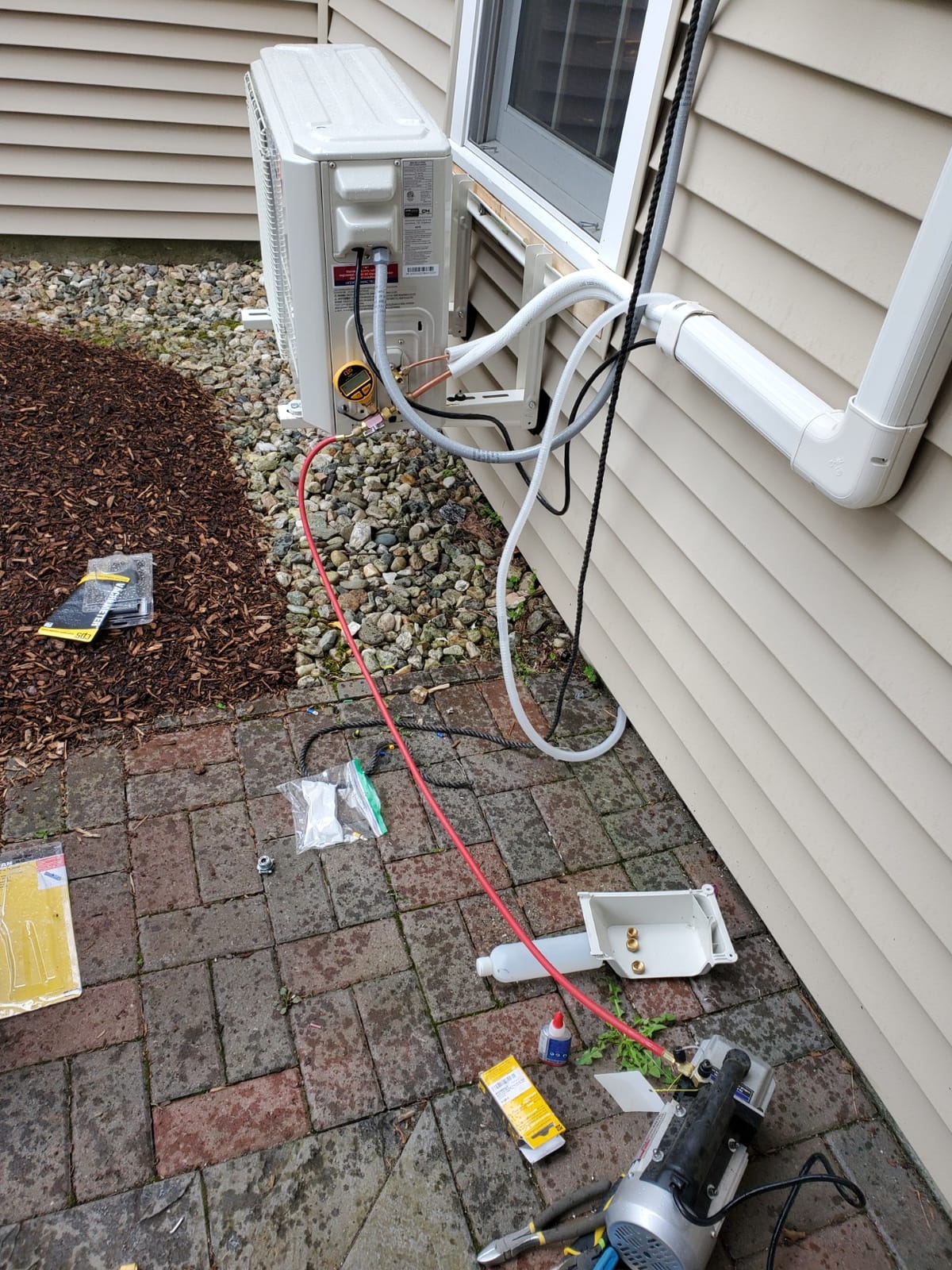
At 26 dB it is quiet enough for a garage attached to a house where you do not want the compressor audible in a bedroom. Owners running these in studios and workshops report strong cooling even in Texas heat, and the app scheduling is one of the more polished ones in this group.
Heating is rated to 5F ambient, so it handles spring and fall work in most climates without backup heat.
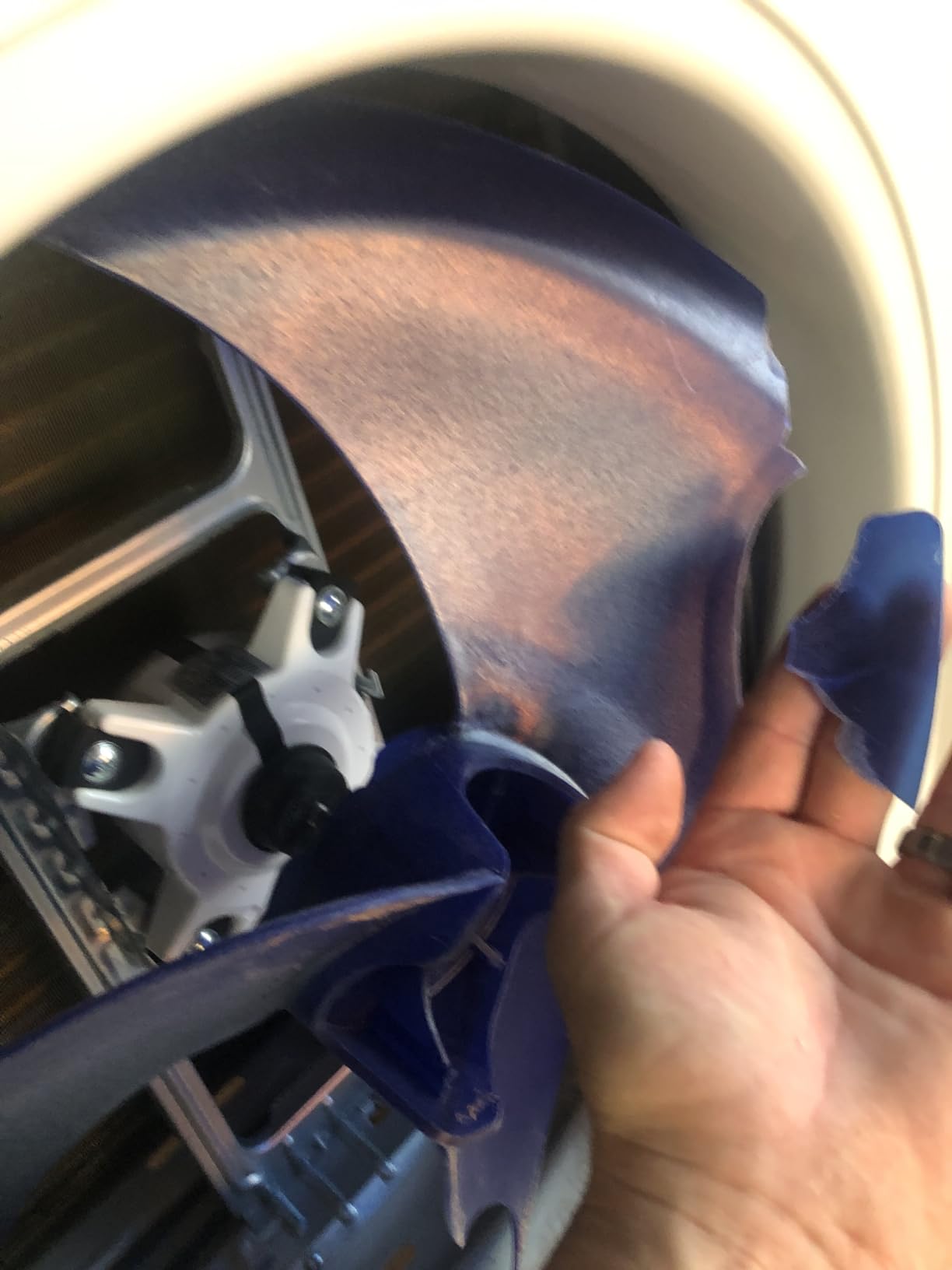
Where the MIA earns its spot
It is the most straightforward path to a conditioned one-car garage or a small shop. The included line set, wire and drain extension mean fewer decisions at install time, and the 115V requirement means your electrician’s scope stays small.
Seven years on the compressor and five on parts is a solid warranty, and support is US-based, which helps when you are sourcing a part for a unit that is five years old.
Where the MIA falls short
Professional installation is required to keep the warranty valid, and you have to complete warranty registration on the website within 60 days or lose that coverage. That is an easy step to miss.
The most common complaint in reviews is a preinstalled drain hose clamp that arrives loose and can leak. If you install it yourself or your installer does not check it, add two minutes and a wrench to the job. Parts service is also reported as slow after a failure.
5. YITAHOME 24,000 BTU 21 SEER2 – Best App-Controlled 2-Ton System
YITAHOME 24000 BTU Mini Split Air Conditioner Heat Pump System, 21 SEER2
24,000 BTU at 21 SEER2
Covers up to 1500 sq ft
5F to 118F operating range
WiFi and Alexa control
Pros
- 24000 BTU rated for spaces up to 1500 sq ft
- 21 SEER2 keeps summer cost down in a 230V install
- Five modes and four fan speeds with iFEEL
- sleep and timer settings
- 135F self-cleaning cycle with air purification filters
- Owners report it holding temperature in shops and sheds
Cons
- Written installation instructions are vague and generic
- App pairing can take repeated attempts
- Auto mode setpoints cannot be adjusted
The YITAHOME covers up to 1,500 square feet per the listing, which makes it one of the larger-capacity systems here relative to its physical size. At 21 SEER2 it also delivers real efficiency at the two-ton level, where many competitors drop to the high teens.
Several owners report running it successfully in shops and metal buildings, which is the use case that matters most for a garage. The operating range is listed at 5F to 118F, so it handles both a cold winter morning and a hot July afternoon.
Control is the strongest part of this package: app, remote and voice, with scheduling, timers and an air purification filter. The 135F self-cleaning cycle is genuinely useful in a shop, where the coil picks up dust faster than any wall unit in a living room would.
Warranty is five years parts and seven years compressor, which is among the longer commitments offered here.
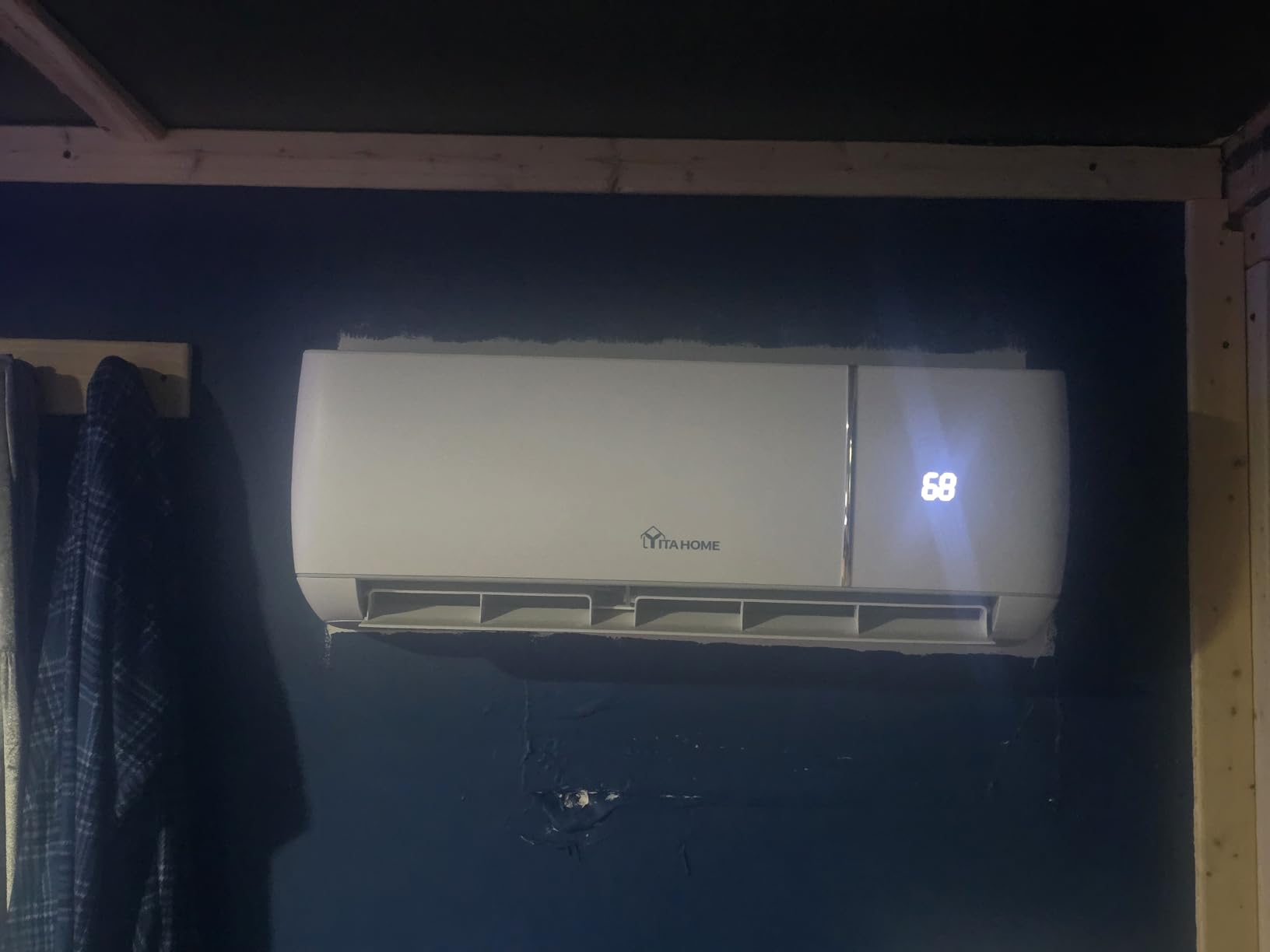
Where the YITAHOME earns its spot
It fits a two-car garage used as a workshop, a converted space that needs heat and cool, or a shop building that runs long hours. The efficiency at two tons means the summer cost stays reasonable even with the door open half the day.
If remote control over a phone is how you actually want to run it, this is the clearest implementation in the group.
Where the YITAHOME falls short
It carries the lowest average rating here at 4.0 stars from 444 reviews, and the feedback reflects that. Owners call the written installation instructions vague and generic, which means more time with your installer explaining the job.
App pairing is reported as unreliable and may take several attempts, and the auto mode setpoints cannot be adjusted, so once it decides on a temperature you override it manually. The brand is also a distributor rather than a manufacturer, which shows up in support.
6. ROVSUN 9,000 BTU 115V – Best for a Small Garage or Shed
ROVSUN 9000 BTU Wifi Enabled Mini Split Air Conditioner & Heater with Inverter, 20 SEER2 Energy Saving 115V Ductless Split AC Unit with Pre-Charged Condenser, Heat Pump & Installation Kit
9,000 BTU 115V inverter at 20 SEER2
Cools up to 450 sq ft
28 dB mute mode
WiFi, app and voice control
Pros
- Only a 20A 115V circuit is required for the whole system
- 28 dB in mute mode suits a small enclosed garage
- WiFi with Alexa and Google Assistant control
- Owners report it cooling a garage through high heat indexes
- 16.4 ft copper line set and signal cord included
Cons
- One year warranty is shorter than most rivals here
- Commissioning needs a vacuum pump and gauges or a paid technician
- Instructions skip the leak test step before startup
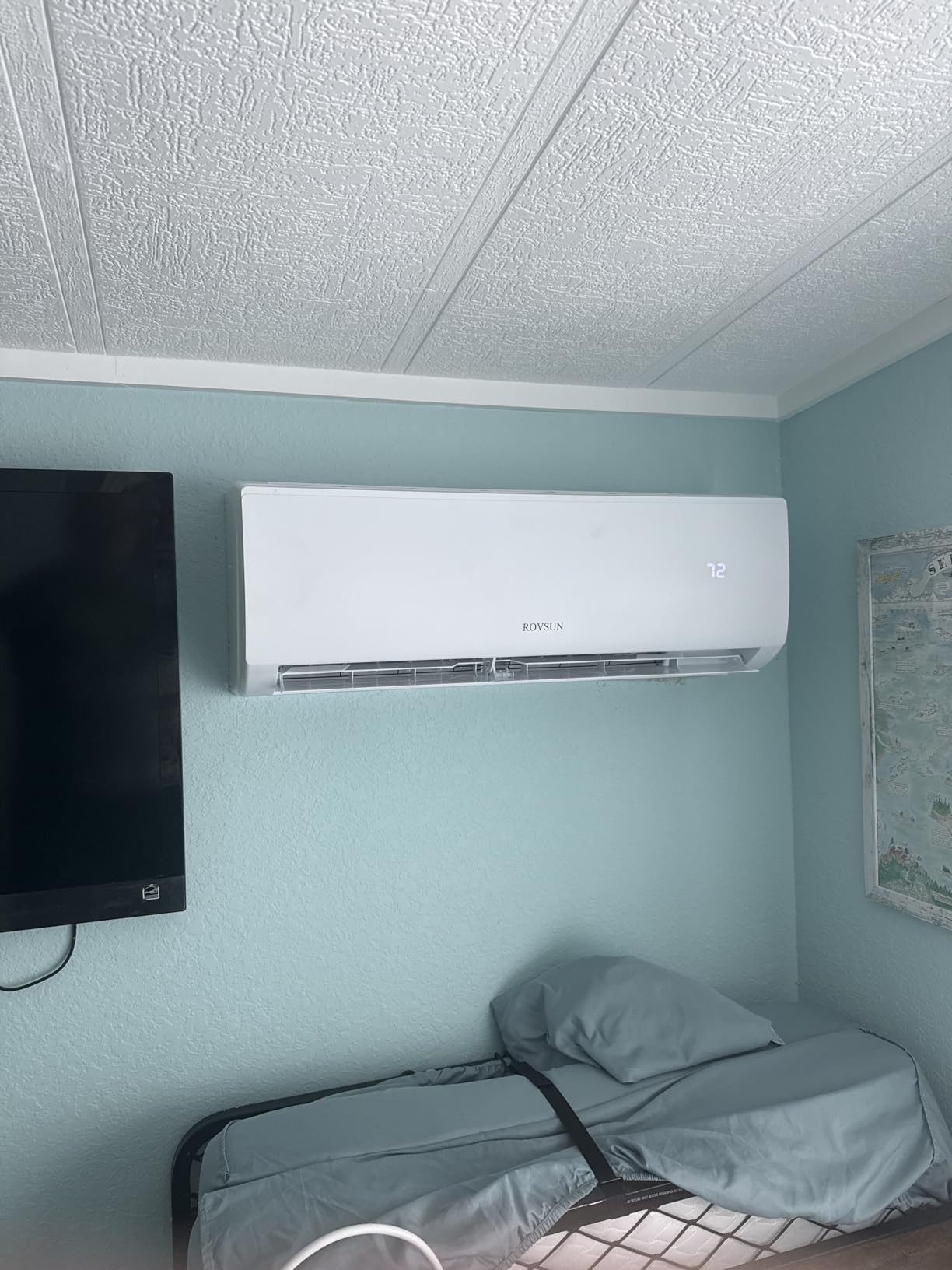
The ROVSUN is the smallest unit in the roundup at 9,000 BTU, rated for 450 square feet. That makes it a genuine fit for a one-car garage with good insulation, a detached workshop, or a shed you have converted into a gym, and it is the only unit here that still carries a 20 SEER2 rating on a 20-amp circuit.
Owners routinely use these in garages, and the reviews describe quiet 28 dB operation in mute mode, simple 115V power and noticeably lower running cost. The feature set, including app and voice control, rivals units costing considerably more.
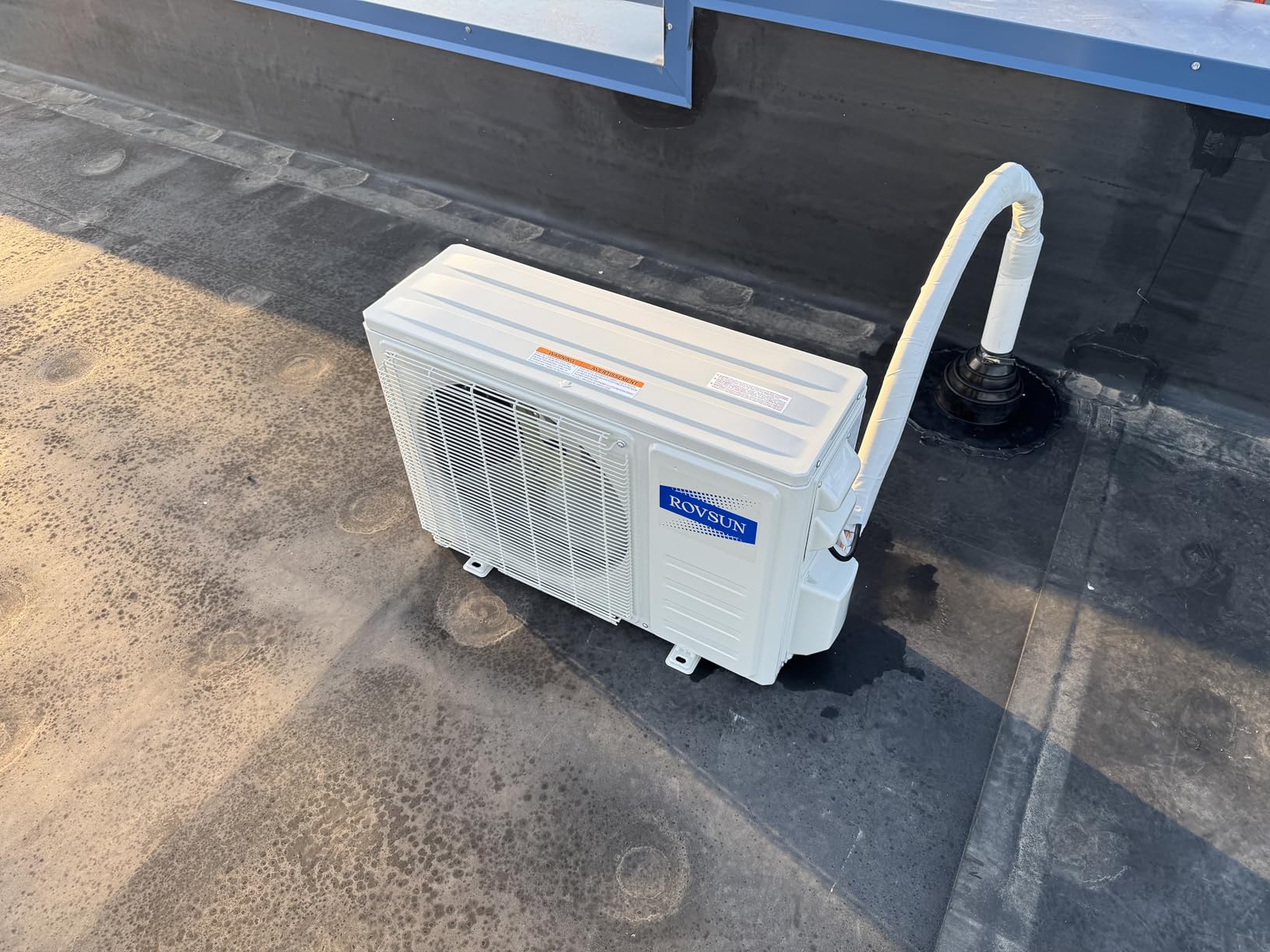
Heating is rated from 61F upward, so treat the heat pump mode as a shoulder-season and mild-winter feature rather than a primary heat source in a northern climate. For a garage in a mild region that is plenty.
The installation kit includes 16.4 feet of copper line and a signal cord. You will need to supply a power cord separately.
Where the ROVSUN earns its spot
It is the right call when the space is small and enclosed, when electrical work is the thing you most want to avoid, and when quiet operation matters more than raw capacity. A converted shed gym at under 400 square feet is the textbook use.
The app and voice control at this tier is unusual, and for a space you enter a few times a week, being able to start cooling remotely is a real convenience.
Where the ROVSUN falls short
The one year warranty is the shortest here, and that matters more than the headline features when a garage unit runs year-round. Commissioning also needs a vacuum pump and gauges, or a paid technician, so budget for the service call either way.
Owners report that the instructions skip the leak test step before startup, and the unit must stay upright for 24 hours before it is installed. Both are steps worth confirming with whoever does the work.
7. Rellytech 18,000 BTU 19 SEER2 – Best Middle Ground for Two-Car Garages
Rellytech Mini Split AC/Heating System, 18000 BTU, 19 SEER2 208-230V
18,000 BTU cooling, 18,400 BTU heating
19 SEER2 with 8.5 HSPF2
230V, four fan speeds
Remote with 90 degree swing
Pros
- 18000 BTU is the middle ground most two-car garages need
- 19 SEER2 with 8.5 HSPF2 balances cooling and heating well
- 90 degree vertical swing and four fan speeds spread air across the space
- Mounting hardware/line set and remote included
- Rated coverage up to 1250 sq ft
Cons
- One year manufacturer warranty only
- Remote control only with no app or voice assistant
- Needs a dedicated 230V circuit and professional installation
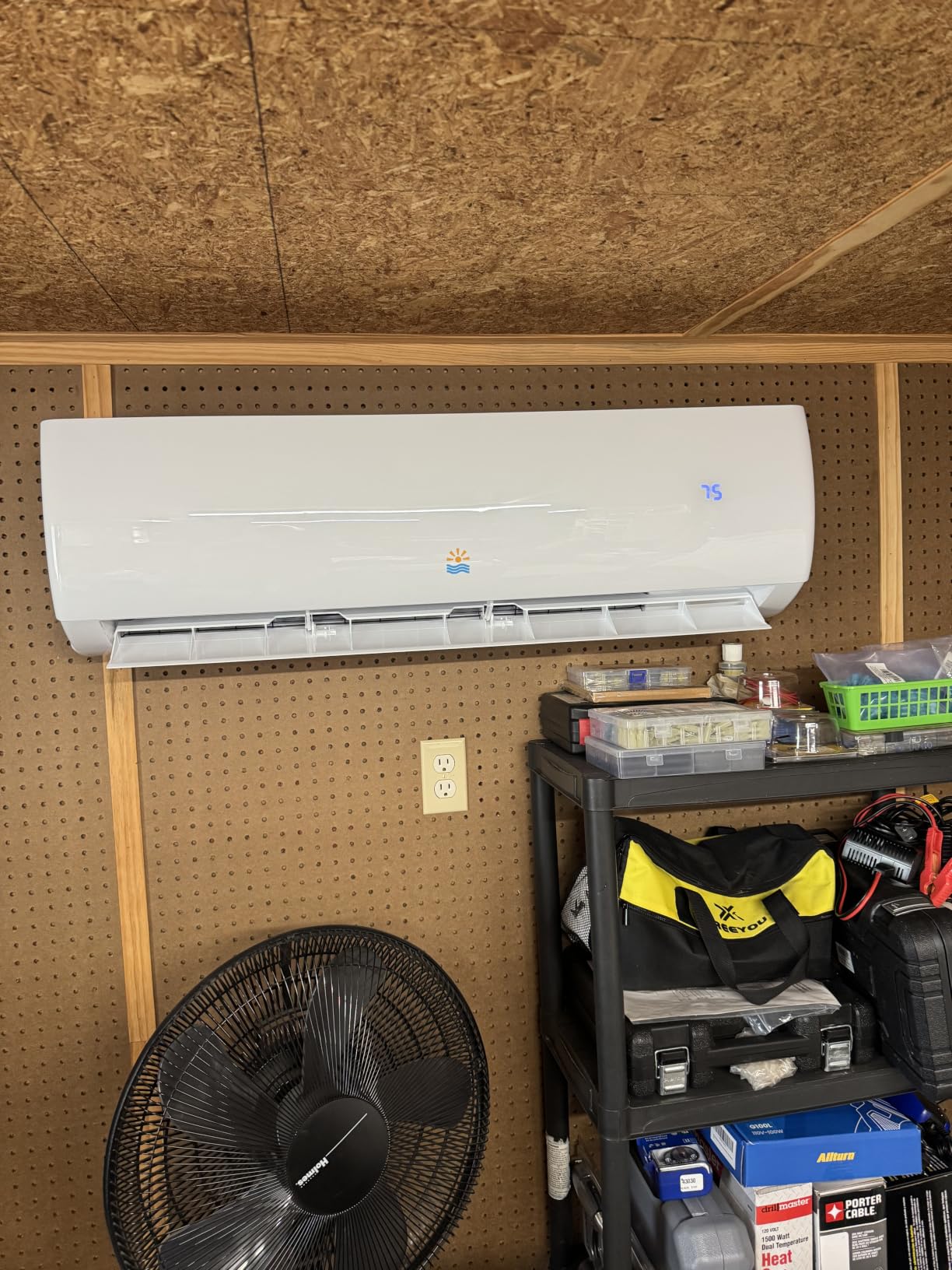
Most sizing debates online come down to 12,000 versus 18,000 versus 24,000 BTU, and the Rellytech sits exactly in the middle at 18,000 BTU cooling and 18,400 BTU heating. For a 400 to 550 square foot two-car garage with no insulation, that is the number most owners land on.
Efficiency is 19 SEER2 cooling and 8.5 HSPF2 heating, which is respectable for a 1.5 ton system and keeps the compressor from running continuously during long hot afternoons.
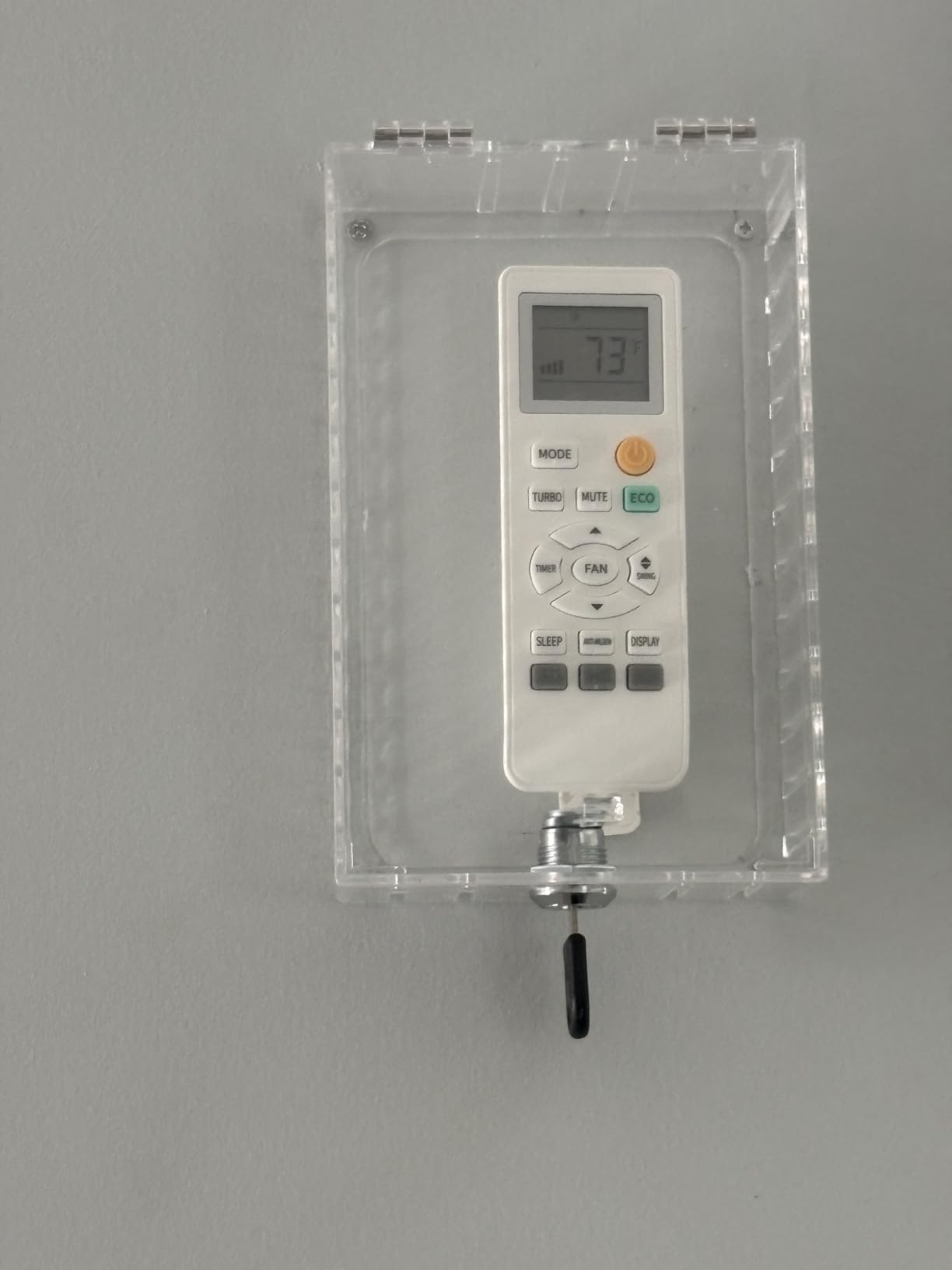
Airflow is the other strength. Four fan speeds and a 90 degree vertical swing do a better job of spreading conditioned air across a wide garage with a high ceiling than a narrow throw alone, and owners with square, open-plan spaces mention this specifically.
Mounting hardware and a line set come in the box, which is helpful if your installer is sourcing parts separately.
Where the Rellytech earns its spot
It is the capacity-matched choice for a standard two-car garage where a 12,000 BTU unit would run constantly and a 24,000 BTU unit would be oversized. The swing and fan speed range matter most when the head is mounted high and the working area is across the bay.
If your garage also serves as a home office or gym, the 18,400 BTU of heating covers the shoulder season without a separate unit.
Where the Rellytech falls short
The one year manufacturer warranty is the weakest commitment in the roundup alongside the ROVSUN, and this unit is heavier at 112 pounds, so a two-person install matters on a high wall. Installation documentation is also limited.
It runs on 230V, so a dedicated circuit is required, and control is remote only with no app or voice support.
8. DELLA Econo 35,000 BTU – Best for Three-Car Bays and Full Workshops
DELLA Econo Series 35000 BTU Mini Split Air Conditioner 17 SEER2, 230V Cools up to 2500 Sq. Ft, Compatible with Alexa and Wifi, Heater Ductless Inverter System with Heat Pump, 16.4ft Installation Kit
35,000 BTU for up to 2500 sq ft
17 SEER2 DC inverter
4D airflow with iFeel
Heats down to 5F
Pros
- The only unit here sized for a three-car bay or full workshop
- 35000 BTU covers up to 2500 sq ft per the rating
- 39 dBa operation indoors and outdoors
- 4D airflow circulates up/down and side to side
- 16.4 ft installation kit included in the box
Cons
- Professional installation is mandated by the manufacturer
- 17 SEER2 is modest next to 21 and 23 SEER2 rivals
- Supplied insulation tape does not cover a full 16 ft line set
- Instructions lack a mounting template and wire gauge guidance
When the roundup runs out of two-ton options, this is the answer. The DELLA Econo is a 35,000 BTU system rated for up to 2,500 square feet, and it is the only unit in this list that can properly condition a three-car bay or a shop with a ceiling above 10 feet.
Owners running it in shops and large detached spaces report strong airflow, quiet operation at 39 dBa and heat pump performance that handles shoulder seasons well. The 4D airflow pattern, which circulates up, down and side to side, is what makes a single head feel adequate in a space that size.
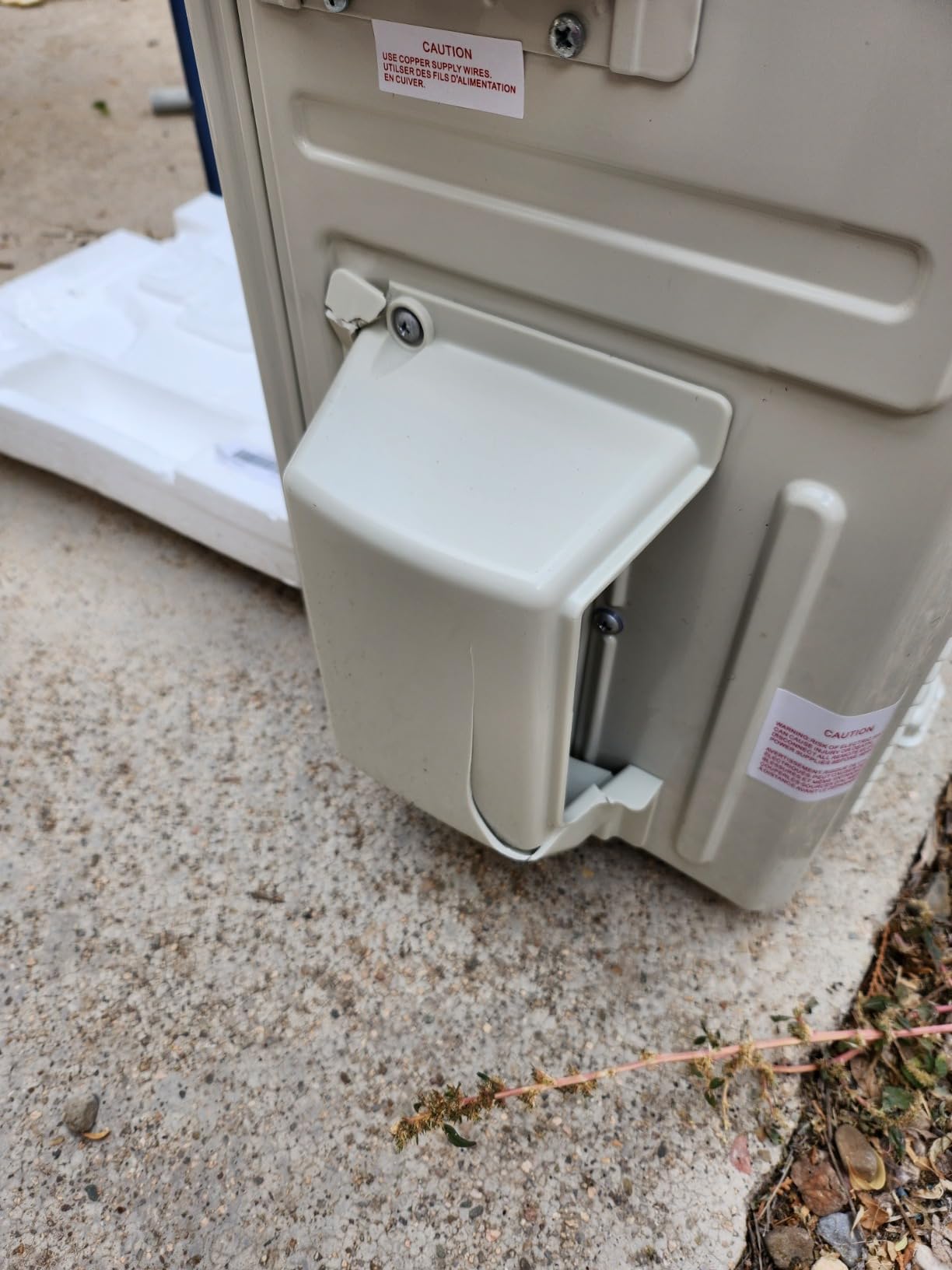
Two practical notes. The maximum fuse size is 35A, so confirm your electrical service can carry it before the installer arrives. And refrigerant adjustment is not needed under 25 feet of tubing, which covers most garage installs and means no extra charge for a long run.
There is also a 24-hour timer and iFeel remote sensing on the head, plus WiFi and Alexa compatibility.
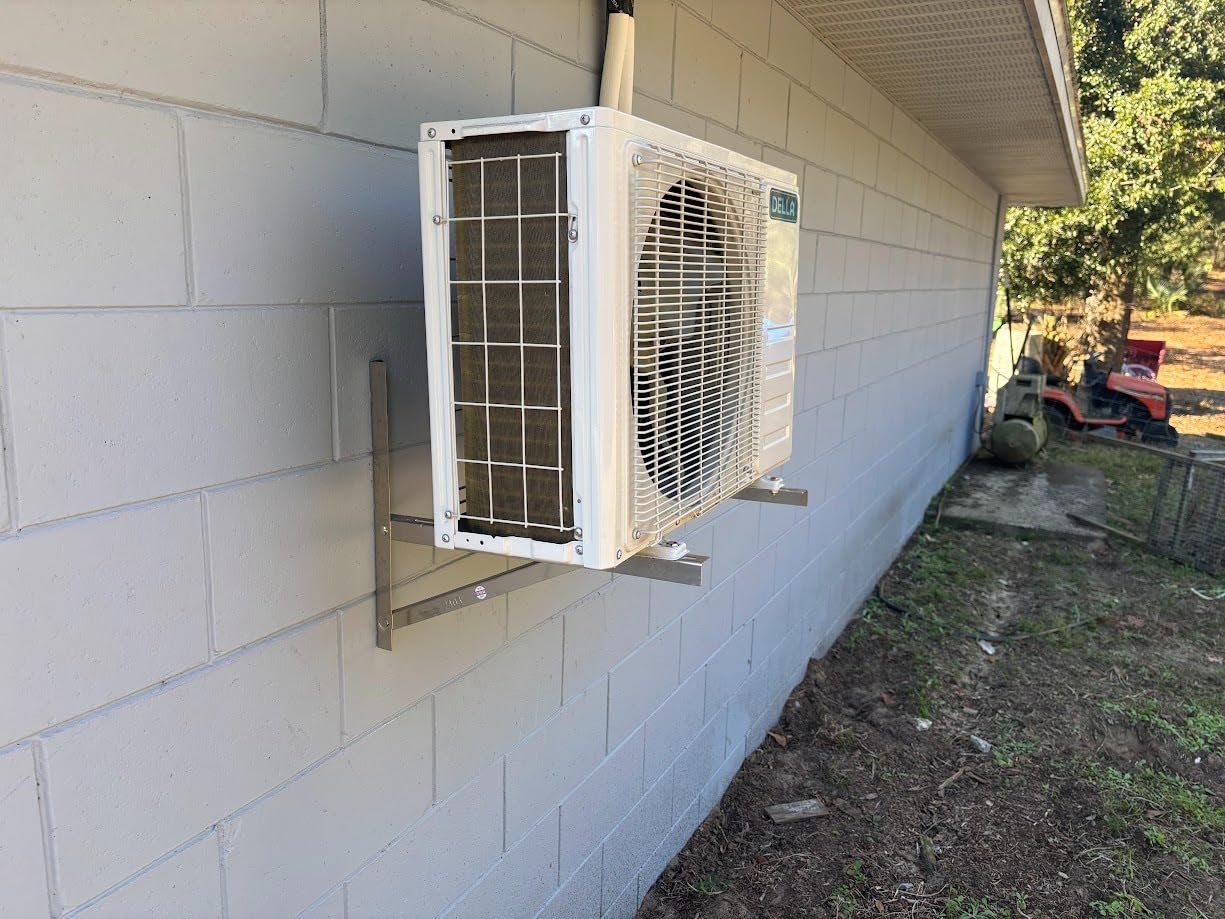
Where the DELLA Econo earns its spot
It is built for a workshop, a three-car garage, or a metal building where heat comes through the walls and never leaves. At 35,000 BTU you are not fighting the load, which is the point.
The DC inverter is rated for up to 30 percent power savings compared with a conventional compressor, so even at 17 SEER2 the running cost at this capacity stays manageable.
Where the DELLA Econo falls short
17 SEER2 is the second-lowest efficiency figure here, and at this capacity the summer bill is the biggest single running cost of any system on this list. If your shop is used heavily in summer, weigh that against the alternative of two smaller zones.
Documentation is thin, the supplied tape does not cover a full 16 foot line set, and getting replacement parts takes several phone calls. Professional installation is required.
9. Albott 12,000 BTU 115V – Best for Low-Maintenance Upkeep
Albott 12,000 BTU Mini Split Air Conditioner and Heater SEER2 18, 115V
12,000 BTU 115V inverter at 18 SEER2
29 dB, 5F to 122F range
Self-clean with removable filters
WiFi plus remote
Pros
- 115V power suits a detached workshop with basic wiring
- Self-cleaning function and removable filters cut upkeep time
- WiFi control alongside a remote with child lock
- 29 dB operation keeps noise low overnight
Cons
- Lowest average rating in this roundup at 4.1 stars
- 18 SEER2 is the lowest efficiency rating among these picks
- Mixed feedback on cooling consistency in very hot conditions
The Albott is built around maintenance, which is the right priority in a dusty garage. It has a high-temperature self-cleaning function, removable filters and air blades, and the operating range is listed at 5F to 122F, so it covers both ends of a typical garage year.
At 29 dB it is quiet, and 115V power means a detached workshop with basic wiring can be conditioned without a panel upgrade. WiFi control works alongside a remote that has a child lock, which is useful if the space doubles as a play area.
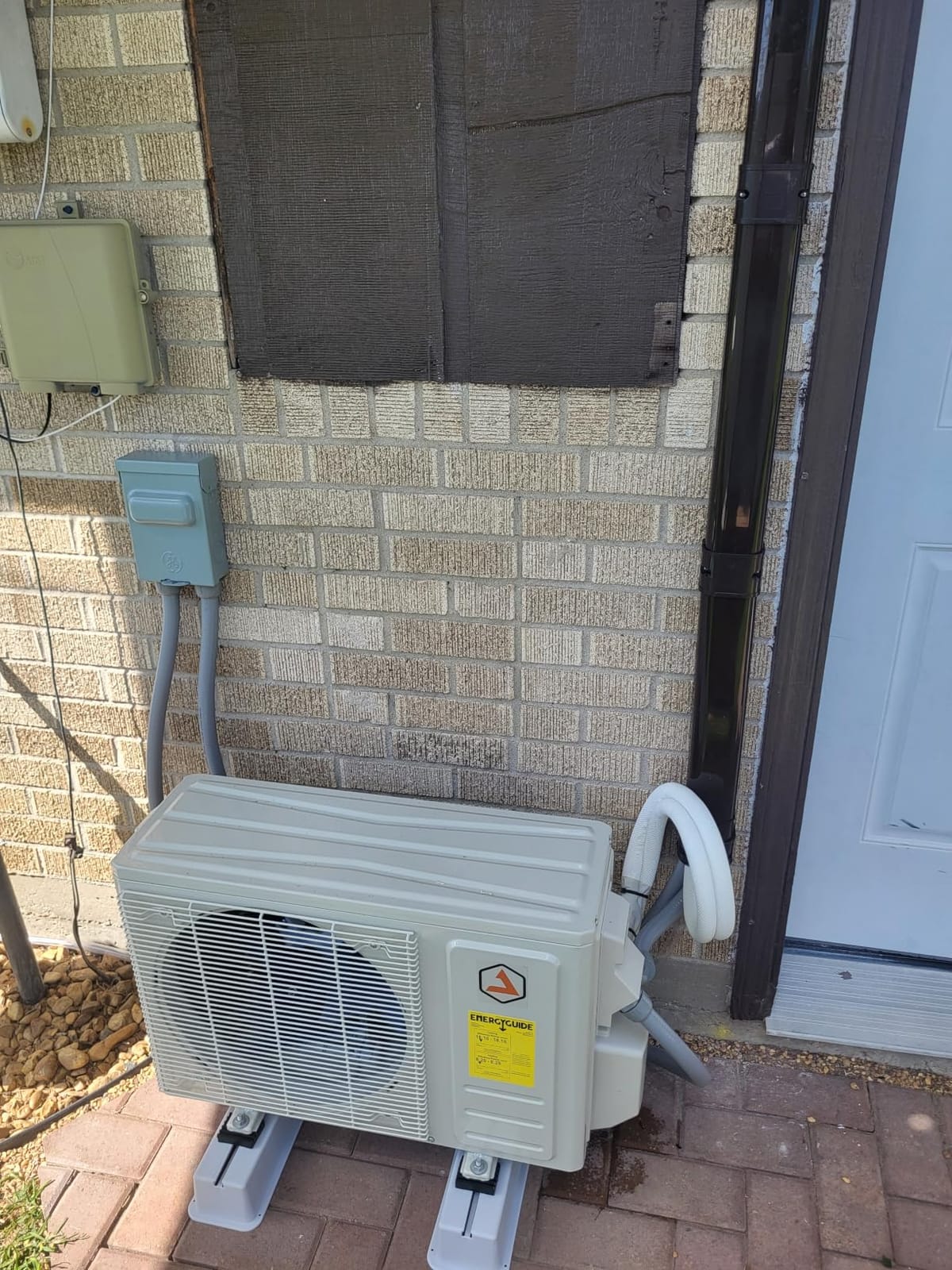
Owners like the self-cleaning cycle and the app support. They also point out that the 12,000 BTU capacity is a genuine limit in a space approaching 750 square feet, particularly with a low ceiling and west-facing glass.
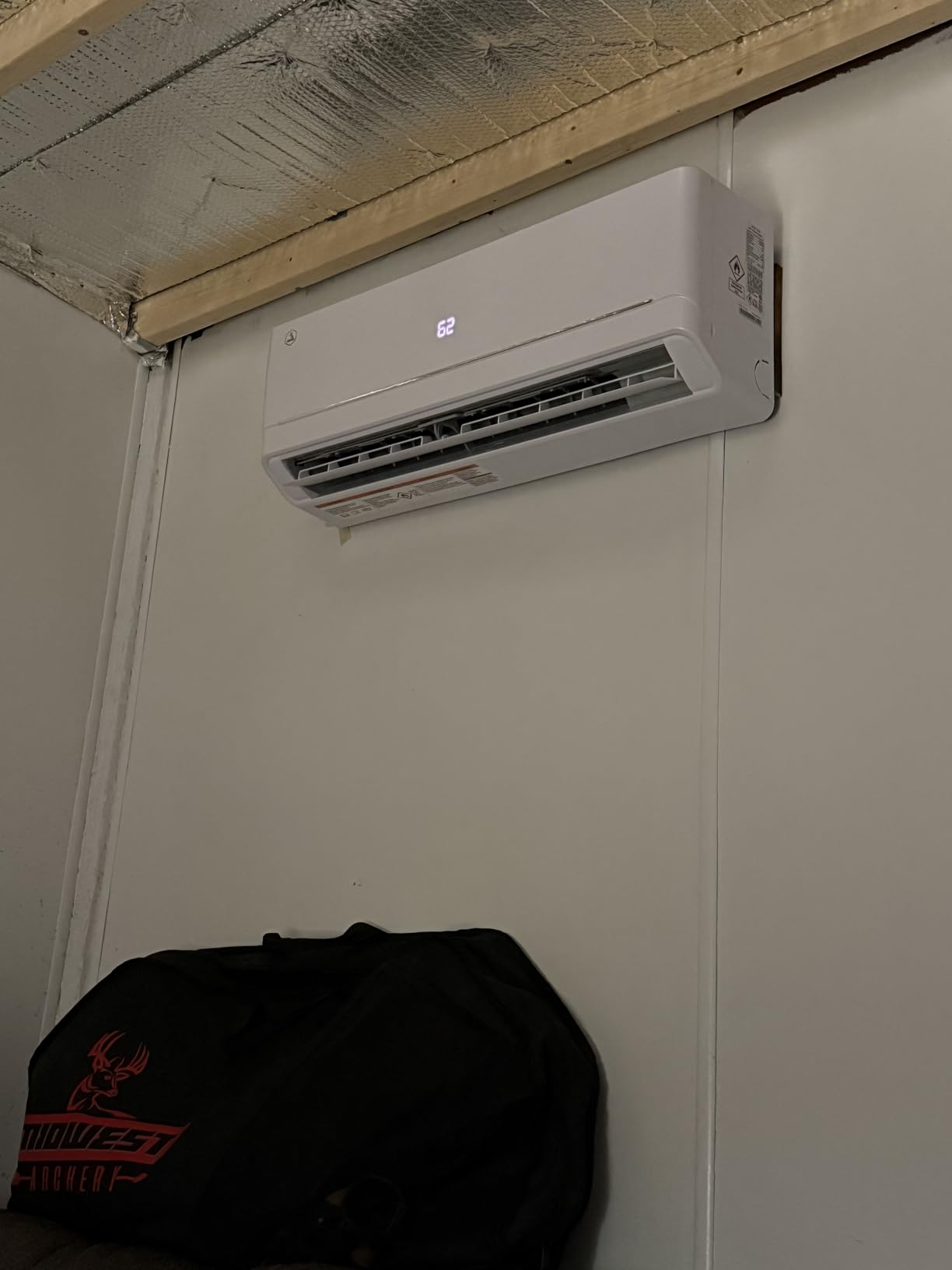
Where the Albott earns its spot
Pick it when filter upkeep is the thing you will actually neglect. In a shop with sawdust, a self-cleaning cycle and removable filters mean the indoor head stays clean without you scheduling it, which is the difference between a unit that works well and one that gets ignored.
It is also a reasonable choice for a garage being converted into a finished room, where the low noise and app control are worth more than peak capacity.
Where the Albott falls short
It carries the lowest average rating in this roundup at 4.1 stars, and the reviews reflect that. Several buyers report uneven cooling in very hot conditions, which is exactly the scenario a garage produces.
Efficiency is the lowest here at 18 SEER2, so summer running cost is higher than the 20-plus SEER2 units. It is also the heaviest listed item at 151 pounds, which makes handling the indoor and outdoor pair harder for a two-person crew.
10. Cooper and Hunter 24,000 BTU 230V – Best for Quiet Two-Ton Shops
Cooper & Hunter 24,000 BTU 230V Wall Mount Mini Split AC, 18.7 SEER2
24,000 BTU 2 ton at 18.7 SEER2
230V inverter, 35 dB
Heats to 5F ambient
16 ft line set and drain extension
Pros
- Two ton capacity handles garages
- shops and sunlit rooms
- Quiet indoor and outdoor operation at 35 dB
- Heating mode works well for shoulder seasons in older buildings
- Seven year compressor and five year parts warranty
- 16 ft pre-flared line set
- communication cable and drain extension included
Cons
- Requires 230V wiring and professional installation
- Warranty depends on certified technician installation
- One report of an indoor control board failure inside a year
This is the two-ton Cooper and Hunter, and it fills the gap between the 18,000 BTU middle ground and the 35,000 BTU shop unit. Owners in shops, upstairs garage rooms and sunlit homes report strong cooling, quietness and heating that is genuinely useful in spring and fall.
It runs at 18.7 SEER2 on 230 volts with a 35 dB noise rating, and the box includes 16 feet of pre-flared insulated line set, a communication cable and a drain extension. Support is US-based, which is a real advantage on a unit you may own for a decade.
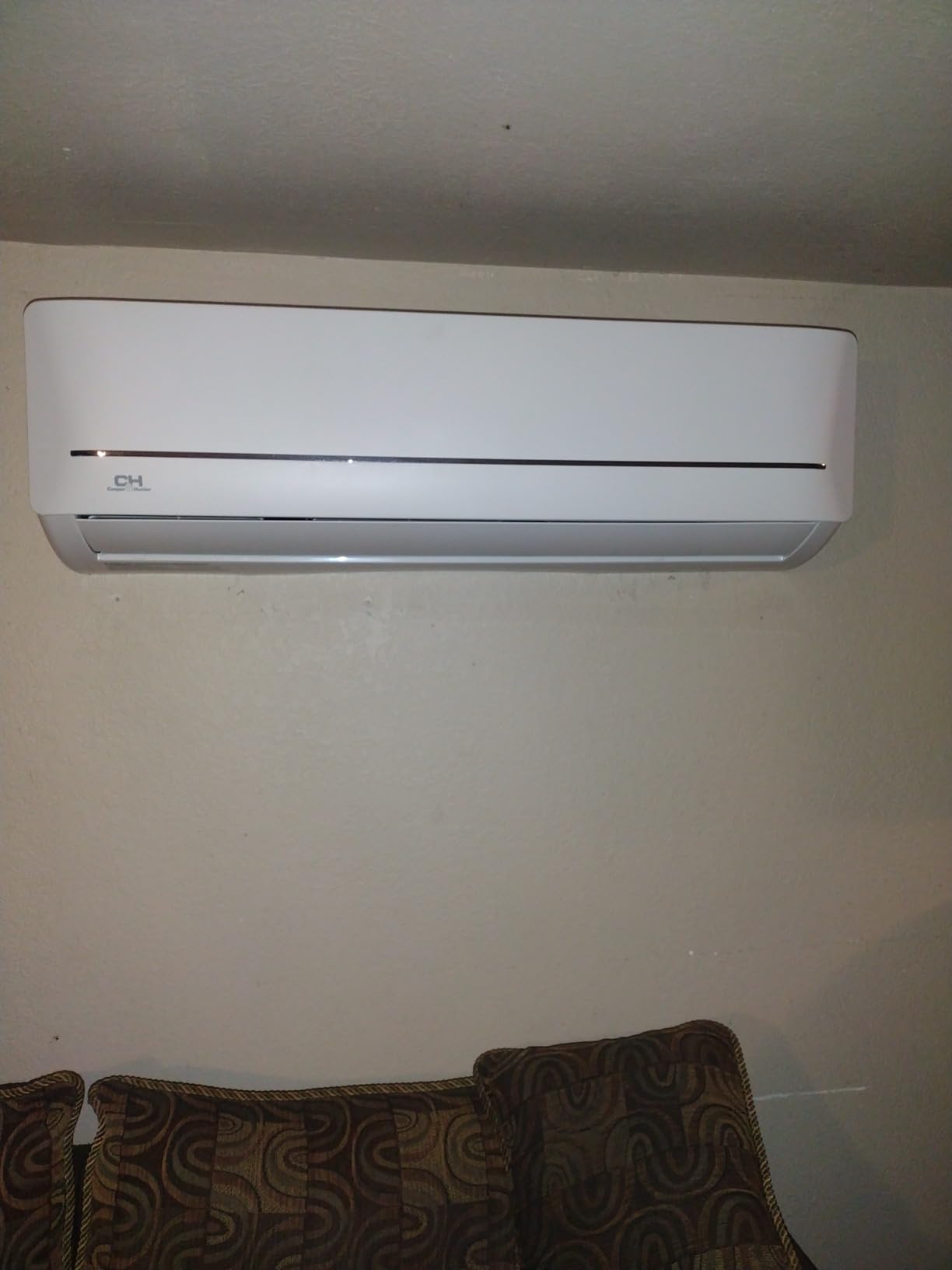
One thing worth knowing before you plan the install: this unit is heavy, listed at 165.1 pounds, so mounting the outdoor unit on a wall or a stand is a job for more than one person.
Heating is rated to 5F ambient, so it holds up through most shoulder seasons in temperate climates.
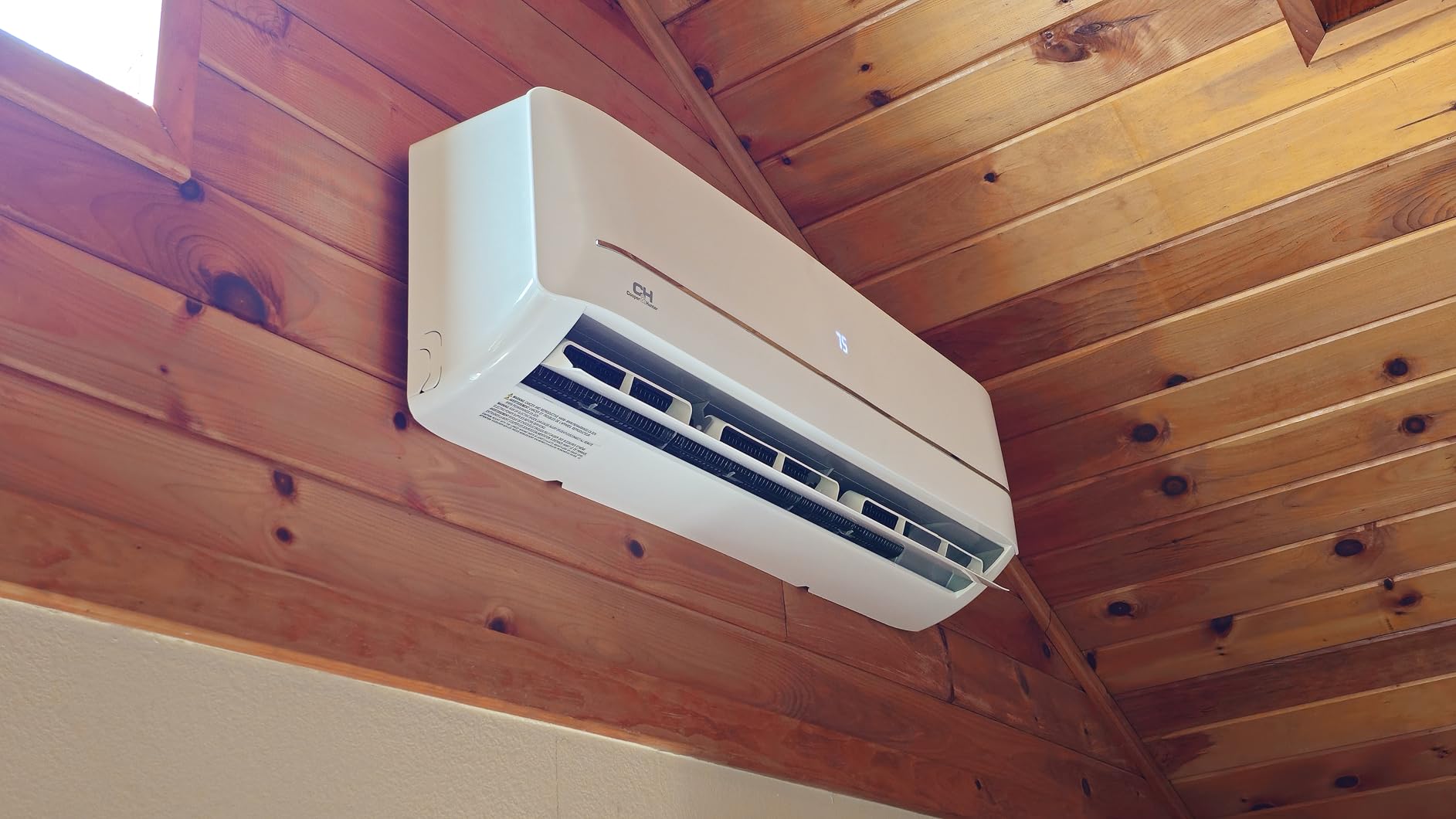
Where the Cooper and Hunter 2 ton earns its spot
It fits a two-car garage with a wide-open floor plan, a converted space above a garage, or a shop that needs both heat and cool. The 2 ton capacity is the standard match for a well-insulated 500 to 600 square foot garage, and it does not overshoot the way a 3 ton unit would.
Quiet operation at 35 dB makes it a good choice for a garage attached to a house where you run it while working in an adjacent room.
Where the Cooper and Hunter 2 ton falls short
It needs 230V wiring, and the warranty depends on installation by a certified technician, so a weekend shortcut voids your coverage. The installation directions do not specify wire-to-terminal color mapping, which adds a step for the installer.
At 18.7 SEER2 the efficiency is below the 21 and 23 SEER2 units in this roundup, so a heavily used summer shop will cost more to run. There is also at least one report of an indoor control board failure inside a year.
11. MRCOOL Advantage 24,000 BTU – Best for ENERGY STAR Savings
MRCOOL 24000 BTU 230V Ductless Inverter Mini Split Air Conditioner & Heat Pump System, Advantage Series – Wall-Mounted AC Unit w/Heating and Cooling for Home, Office & Commercial Space
24,000 BTU 2 ton inverter
Energy Star certified
17 efficiency rating
Washable filter wall mount
Pros
- Recognizable ductless brand with a long service history
- Energy Star certified for lower operating cost
- 24000 BTU rated for spaces up to 1000 sq ft
- Washable air filter you can rinse in a shop sink
- Wall-mounted head blends into a finished room
Cons
- 17 SEER is the lowest efficiency rating in this roundup
- Remote only with no documented app integration
- Fewer owner reviews than the value brands listed here
MRCOOL is the most established ductless brand on this list, and the Advantage series is its straightforward wall-mounted 2 ton system. It is rated at 24,000 BTU and ENERGY STAR certified, with coverage listed for spaces up to 1,000 square feet.
Owners value the brand reputation, the clean wall-mounted design and the ENERGY STAR efficiency. The washable air filter is the practical feature for a garage, since it can be rinsed at a utility sink rather than replaced.
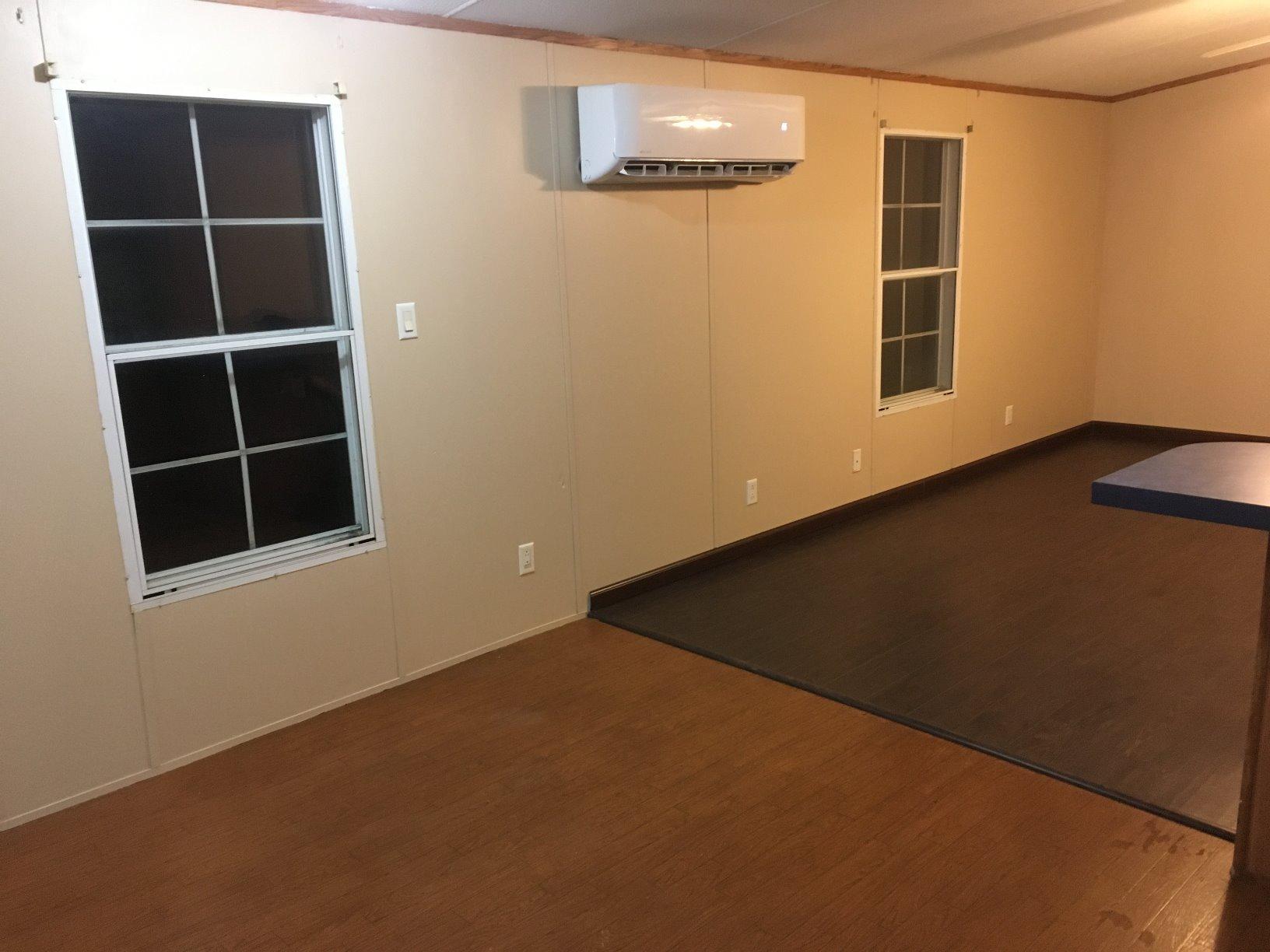
Two cautions. The efficiency rating is 17, the lowest in this roundup, so while the unit carries ENERGY STAR certification for a 2 ton class, the seasonal number is modest and summer running cost will be higher than a 21 SEER2 system of the same capacity.
It runs on 230 volts with a listed 5,750 watt draw, so confirm the circuit before you commit.
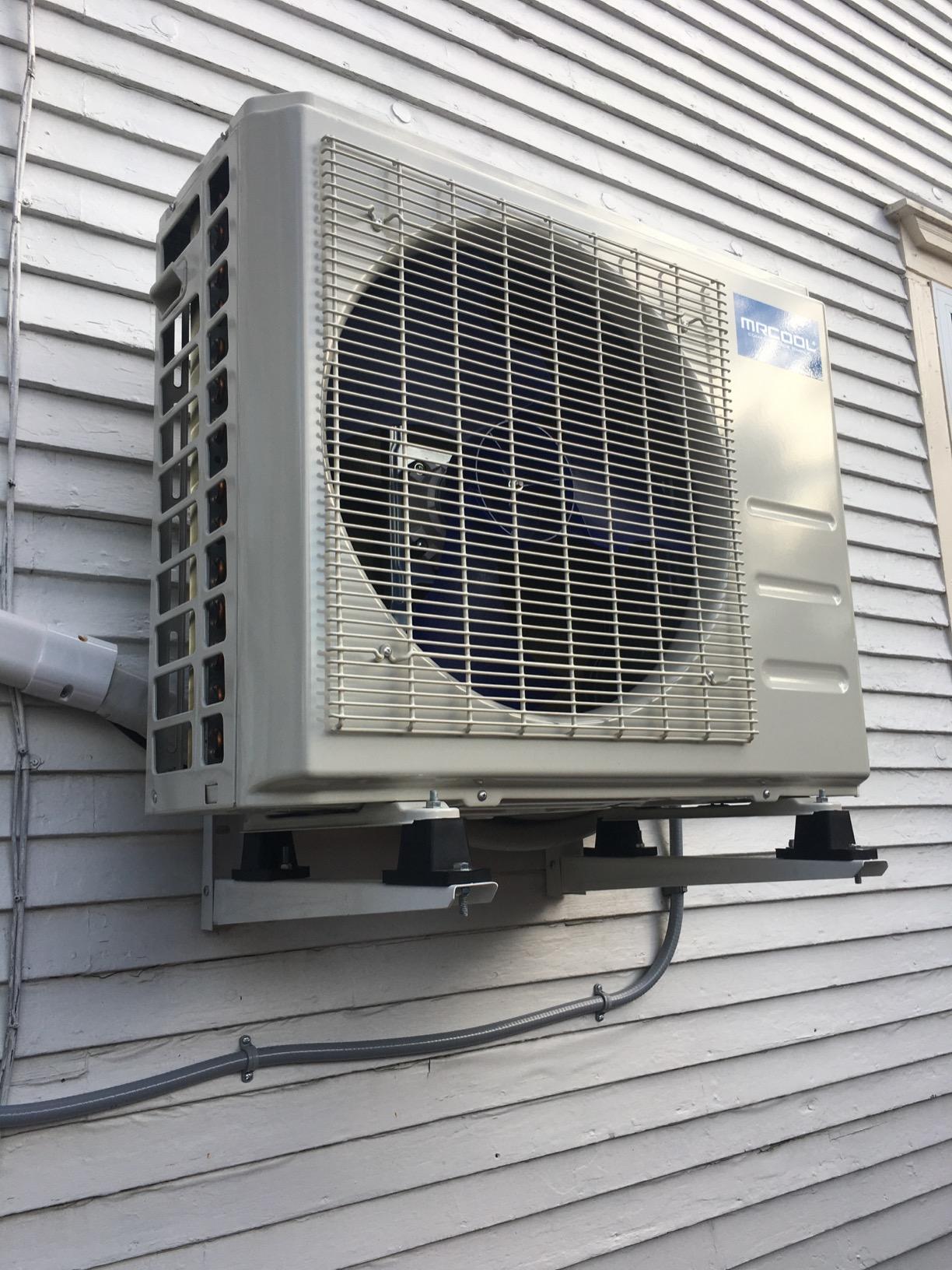
Where the MRCOOL earns its spot
It is the pick if parts availability and brand longevity matter to you more than the seasonal efficiency number. A garage unit runs year-round in a harsh environment, and a compressor that a technician can source parts for in ten years is worth something.
The ENERGY STAR certification can also make you eligible for state or utility rebate programs, which several of the other systems here cannot offer.
Where the MRCOOL falls short
The 17 efficiency rating is the lowest here, and on a two-ton unit that runs hard through summer the difference shows up over years. There is no documented app integration, so scheduling means picking up the remote.
It also carries the smallest review base in the roundup at 148 reviews, which means less owner history to lean on, and installation is still best handled by a technician.
12. Temprium 12,000 BTU 22 SEER2 – Best 115V Efficiency
Temprium 12000 BTU Mini Split Air Conditioner, 115V 22 SEER2 AC & Heat Pump
12,000 BTU 115V at 22 SEER2
23 dB, 5F to 122F range
Seven modes, seven fan speeds
App, Alexa and Google Assistant
Pros
- 22 SEER2 efficiency on a standard 115V circuit
- 23 dB is among the lowest published figures here
- WiFi app plus Alexa and Google Assistant voice control
- Seven modes and seven fan speeds give fine-grained control
- High-temperature self-clean function and washable filter
Cons
- One year manufacturer warranty only
- Professional installation required for the sealed pre-charged system
- Documentation is limited relative to the feature list
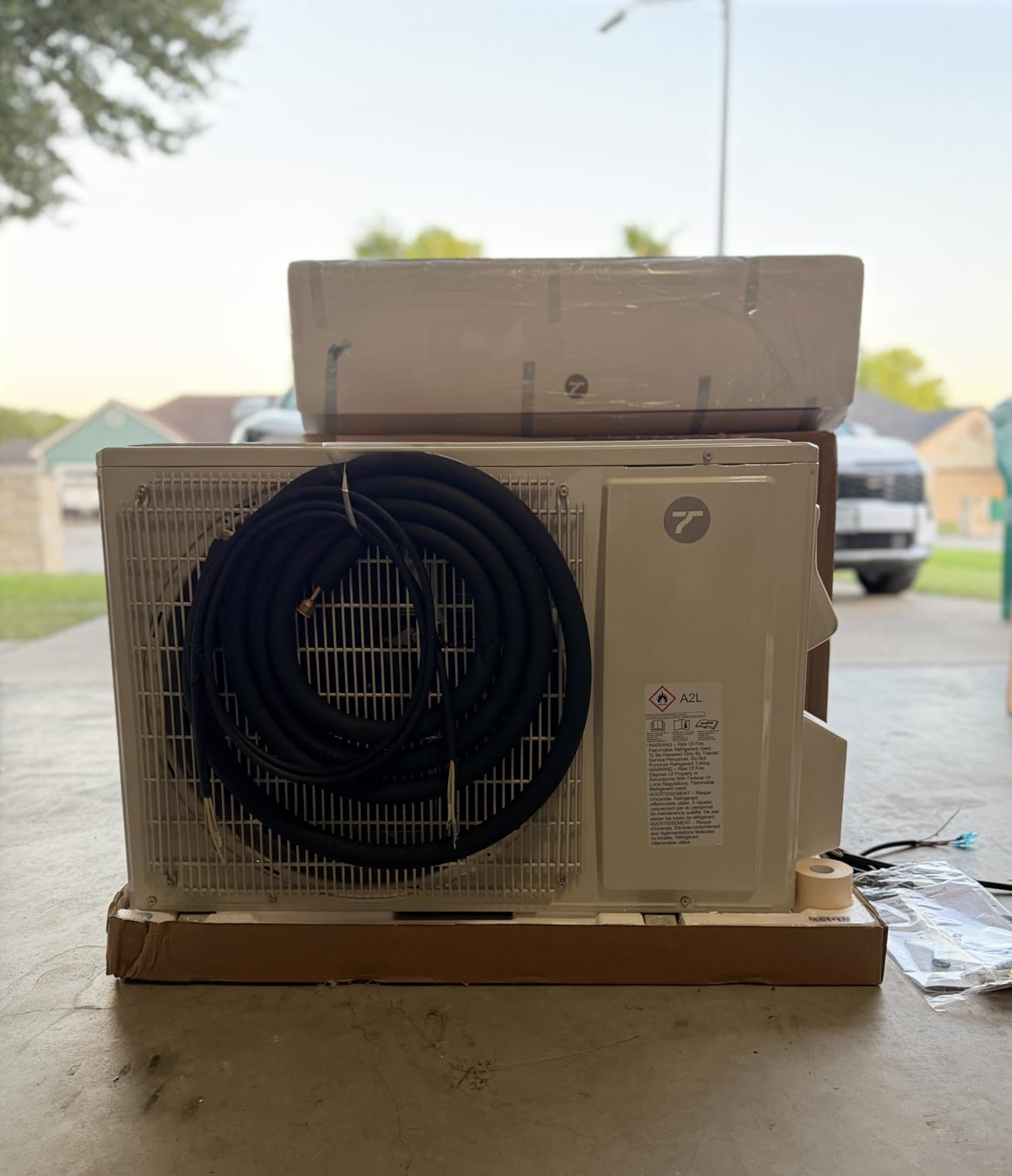
The Temprium is the rare 115-volt unit that does not ask you to give up efficiency. It delivers 12,000 BTU of cooling and 12,300 BTU of heating at 22 SEER2, which is the highest cooling efficiency in the roundup, and it still runs on a standard household circuit.
That combination is what makes it interesting for a garage. You get the electrical simplicity of a 115V install with an efficiency number most 230V units in this list cannot match. The listing even names garage as a target room type.
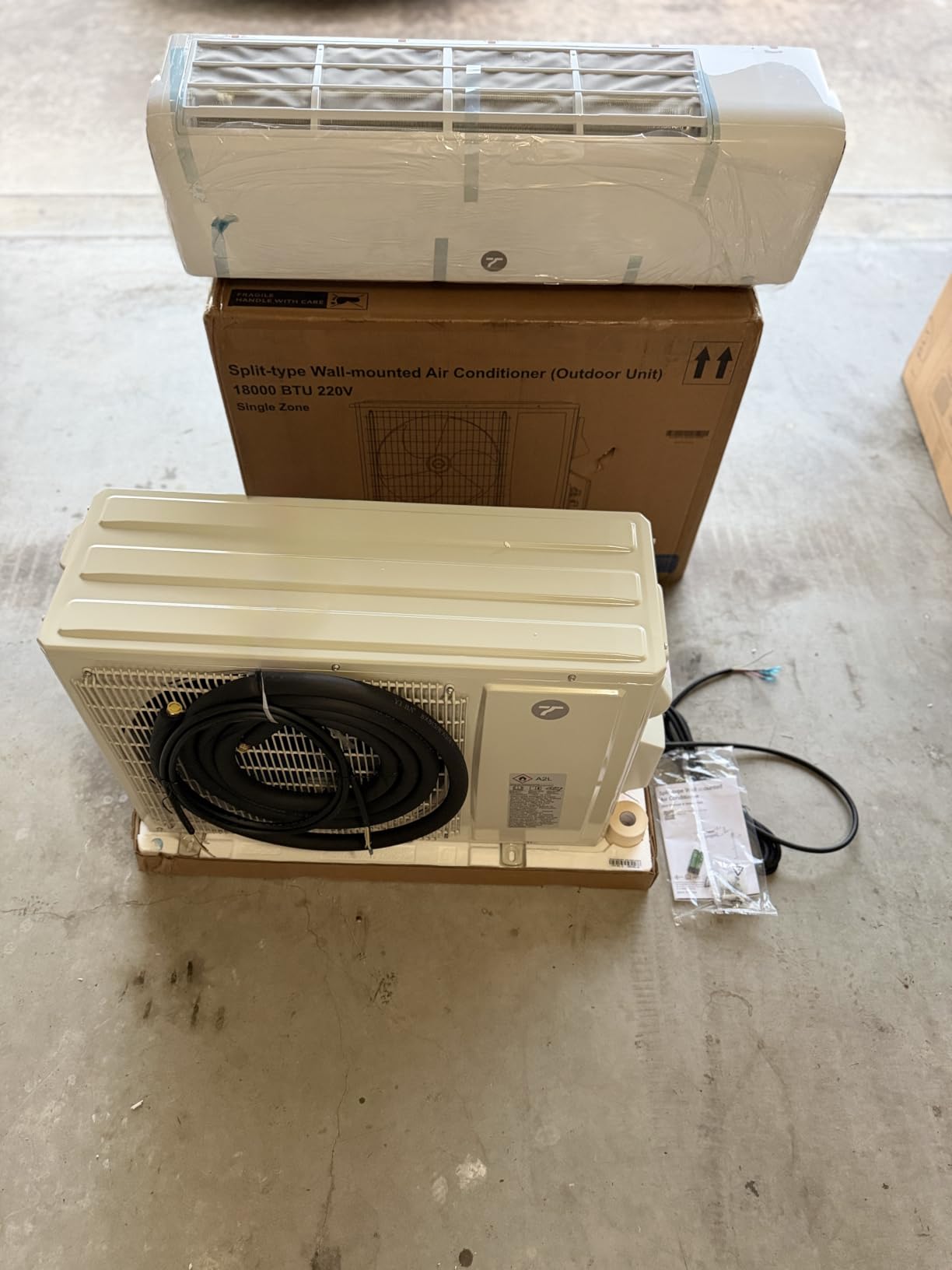
At 23 dB it is tied for the quietest figure here, and the control set is unusually granular: seven operating modes, seven fan speeds, 4D swing and an I Feel function. The operating range of 5F heating to 122F cooling covers most of what a garage experiences.
The washable filter and high-temperature self-clean cycle are useful additions for a workshop.
Where the Temprium earns its spot
It is the pick for an insulated one-car garage or a converted room where you want a low power draw, high seasonal efficiency and near-silent operation. At 12,000 BTU it will not condition a large two-car bay, so match it to the room rather than to the building.
App, remote and voice control with a full feature set at this level is unusual, and for a space you enter intermittently, being able to check and change the setpoint from your phone is worth a lot.
Where the Temprium falls short
The one year manufacturer warranty is the biggest gap. The unit itself is well specified, but a compressor is a five-figure part and a one year commitment changes how you feel about buying it for a space that runs year-round.
It also needs professional installation because the system is pre-charged and sealed, and the documentation is thin relative to the long feature list, so expect to spend time working out the install with whoever does it.
How to Size a Mini Split for Your Garage
Square footage alone gets you close, but a garage is a different animal from a bedroom. Start with 20-30 BTU per square foot, then apply the corrections below.
A one-car garage at 200-250 square feet with insulated walls and a sealed door lands at a 9,000 BTU unit. Add 30-50% and you are at 12,000 BTU, which is where most installers end up. A two-car garage at 400-550 square feet needs 12,000 BTU insulated and 18,000 BTU bare.
Three things push the number higher than the math suggests. Ceiling height above 10 feet adds volume the system has to condition. West-facing windows or a door that sits in direct afternoon sun add a solar load that does not exist in a north-facing bedroom. And a concrete floor with no vapor barrier holds moisture that makes summer humidity feel worse than the thermostat number suggests.
One thing pushes it lower. If you insulate the garage door, the ceiling, and the wall the head is mounted on before the install, you can often size down one step and still keep up. Owners on the home improvement forums report noticing both better comfort and a lower bill after insulating, which is consistent with a smaller compressor running less often.
For anything above 1,000 square feet, or any metal building, ask for a Manual J load calculation. An oversized unit in a space that cools quickly will short cycle, and that is the single most common complaint in the reviews here. Short cycling wears the compressor, spikes the power bill and leaves the room uncomfortable anyway.
Condenser Placement, Installation and Cost
Where you put the outdoor unit is the question that comes up most on garage forums, and it is worth answering before you buy anything. It needs airflow on two sides, clearance from obstructions per the manufacturer spec, and protection from direct contact with the ground or standing water.
A side wall, elevated on a stand, away from an overhang and clear of a window works well. Many owners also ask whether the unit can go inside the garage or in an attic. It should not go in an unconditioned attic, where winter temperatures defeat the compressor, and running it indoors means exhausting the heat and noise back into the space you are trying to condition.
Line set length is the constraint people miss. Most of these systems ship pre-charged for roughly 16 feet, and several require a refrigerant adjustment beyond that. Measure the run from the head location to the condenser location before you order, and plan a 240 volt circuit for anything above 15,000 BTU.
On cost, the equipment is the smallest part of the number. Forum threads about garage installs commonly quote 1,500 to 3,000 dollars per zone for professional labor, which is why the DIY pre-charged route is so popular. The line set, a disconnect, the electrical circuit and any sheet metal work all add to the total, and the brands that require professional installation keep the warranty intact while the ones sold for self-install ask you to buy a vacuum pump and gauges.
One more financial note: the federal Section 25C energy credit expired on December 31, 2025, so do not build it into your math. State utility rebates and ENERGY STAR programs are still worth checking, and only some of the units on this list qualify.
Garage Prep: Insulation, Dust and Drainage
Insulation is the cheapest efficiency gain available. Reflectix-backed or foam-board garage door kits, a layer of insulation above the ceiling joists, and sealing the bottom of the door with a vinyl kit will all cut the compressor load, and they add up to more than most people expect.
Dust is the other garage reality. Most indoor heads here use a washable mesh pre-filter that you pull out and rinse, and the self-cleaning cycles on several models run a high-temperature pass over the coil. In a shop with sawdust, expect to clean filters every few weeks during heavy work rather than on a monthly schedule.
Condensate is the piece that causes the most callbacks. In cooling season the indoor head drains several liters a day, and in a freezing garage the defrost cycle releases water as ice on the outdoor coil that later melts. Route the drain line to a floor drain or an outside approved point, insulate it, and confirm the fall is continuous before you close the wall.
Finally, plan for two zones if you might want them later. Several of these indoor heads can be paired with a second zone, and running the lines while the garage is accessible is far cheaper than reopening a finished wall after a few years.
Frequently Asked Questions
Would a mini split work in a garage?
Yes, and a ductless mini split is one of the few systems that makes sense there. Garages have no ductwork, swing widely in temperature and are often uninsulated, which is exactly where a single-zone ductless heat pump works well. The two requirements are correct sizing for a garage rather than a bedroom, and a condenser mounted outside with proper airflow.
What size mini split do I need for a 2 car garage?
For a 400 to 550 square foot two-car garage, a 12,000 BTU unit is right if the garage is insulated. If it is uninsulated, step up to an 18,000 BTU system, and go to 24,000 BTU if the space is open-plan or being used as a gym.
Do mini splits freeze up in cold weather?
Standard heat pumps lose capacity as outdoor temperature drops and shut down when the outdoor coil freezes. Most systems in this roundup are rated to 5F, and the DELLA Vario is rated to -4F, so they keep heating through most winter conditions. Defrost cycles handle the coil, and the drain line needs a continuous fall so melt water does not back up.
Are mini splits easy to install?
Not for most people, even with a pre-charged line set. Flaring copper, brazing, pressure testing, evacuating the system with a vacuum pump and gauges, and running a new circuit all require skill, and several manufacturers require professional installation to keep the warranty valid. A licensed HVAC installer is the right call unless you have done this work before.
How often do filters need changing in a dusty garage?
In a normal house, a washable mesh filter needs a rinse every few weeks. In a garage workshop with sawdust, clean it every one to two weeks during heavy work, and use the self-cleaning high-temperature cycle where the unit has one. Several models here also take a purification filter that needs replacing on its own schedule.
Conclusion
After working through all 12, the Senville LETO 24,000 BTU is the best mini split system for garages overall, because 24,000 BTU is the capacity that actually keeps a two-car bay comfortable, and it has more owner history than anything else here. If electrical simplicity matters more, the Cooper and Hunter MIA 12,000 BTU runs on 115V. If the garage gets used in winter, the DELLA Vario keeps heating down to -4F.
For a one-car bay on a small budget, the COSTWAY 12,000 BTU and the Temprium 22 SEER2 both do the job quietly and efficiently. For a shop above 1,000 square feet, the DELLA Econo 35,000 BTU is the only one in this roundup with the capacity, and you will plan the 240 volt circuit early.
Size it for the room you have, mount the condenser outside with airflow, insulate the door and ceiling first, and clean the filter every week or two in a dusty shop. That is what makes 2026 garage cool and comfortable for years rather than a season.