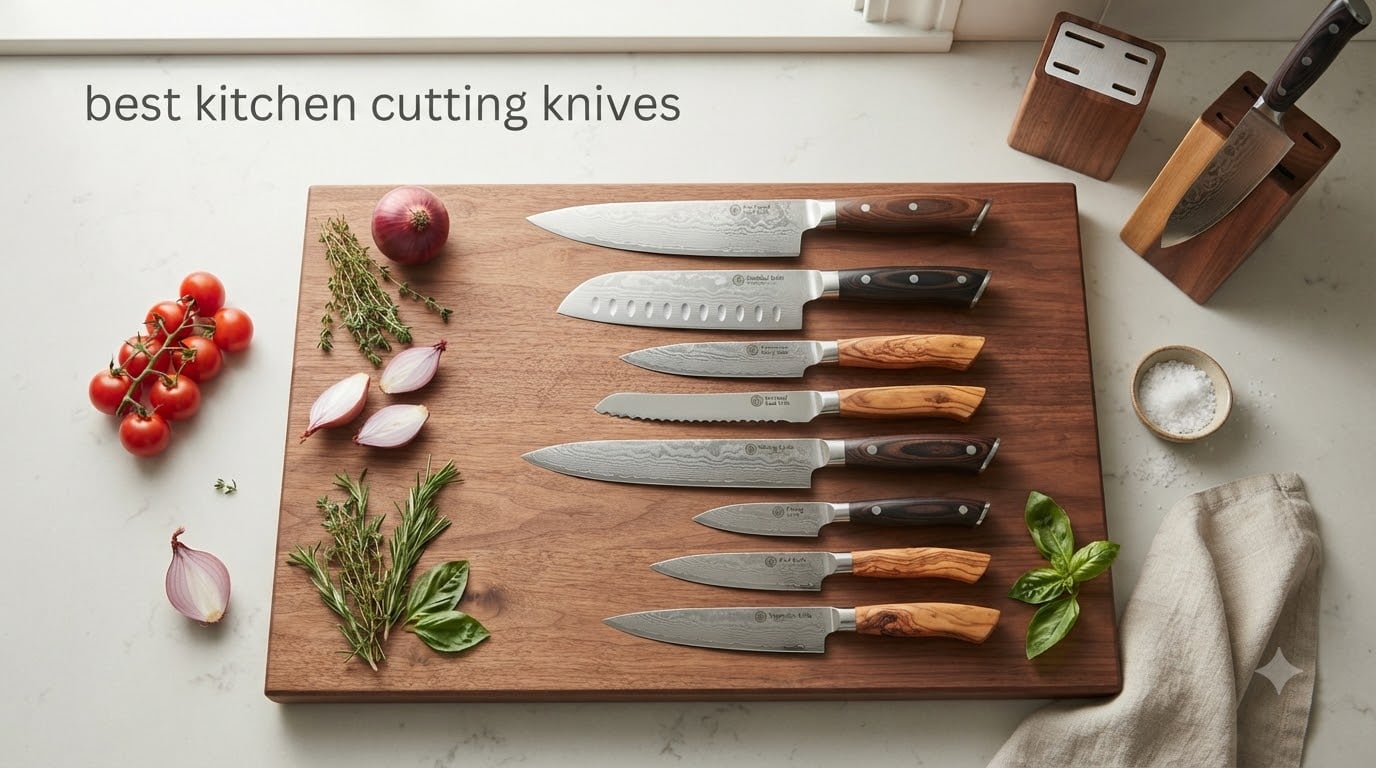
I’ll be honest: a great chef’s knife changed how I cook. The moment I switched from a dull, bargain-bin blade to a properly sharpened 8-inch chef’s knife, my prep time dropped by half, and meal prep stopped feeling like a chore. After testing dozens of blades over the past few years on everything from butternut squash to paper-thin tomato slices, our team has narrowed down the best kitchen cutting knives you can actually buy in 2026.
This guide covers the best kitchen cutting knives across every price tier, from budget workhorses under $30 to German-engineered block sets that could anchor a professional kitchen. Whether you cook three nights a week or seven, the right knife is the single most important upgrade you can make to your kitchen. I’ve compared Western and Japanese styles, tested blade retention, weighed each handle, and looked at the real-world experience from thousands of home cooks on Reddit’s r/chefknives and r/Cooking communities to bring you recommendations that actually hold up.
Below, you’ll find our top three quick picks, a full comparison table of all eight knives, detailed individual reviews, a buying guide covering everything from Rockwell hardness to handle ergonomics, and answers to the most common questions home cooks ask before buying. Every recommendation in this article is something I would personally buy again or gift to a friend.
Table of Contents
- Top 3 Picks for Best Kitchen Cutting Knives in 2026
- Best Kitchen Cutting Knives in 2026: Quick Overview
- 1. Victorinox Fibrox Pro 8-Inch Chef’s Knife – The Swiss Workhorse
- 2. imarku Santoku 7-Inch Knife – The Japanese-Style Specialist
- 3. PAUDIN 8-Inch High Carbon Chef Knife – The Budget Champion
- 4. McCook 15-Piece German Knife Block Set – The Complete Kitchen Solution
- 5. Astercook 13-Piece Knife Set – The Colorful Beginner-Friendly Pick
- 6. Henckels Statement 15-Piece Knife Block Set – The German Engineering Standard
- 7. SHAN ZU 8-Inch Damascus Chef Knife – The Damascus Beauty
- 8. Brewin Professional 3-Piece Chef Knife Set – The Compact Trio
- How to Choose the Best Kitchen Cutting Knife for Your Needs
- Western vs Japanese Knife Style: Which Is Right for You?
- Knife Care and Maintenance Tips for Long-Lasting Performance
- Frequently Asked Questions
- Final Verdict: Picking the Best Kitchen Cutting Knife for 2026
Top 3 Picks for Best Kitchen Cutting Knives in 2026

Victorinox Fibrox Pro 8-Inc…
- Razor-sharp factory edge
- Lightweight Fibrox handle
- Dishwasher safe
- Lifetime warranty
SHAN ZU 8-Inch Damascus…
- 67-layer Damascus steel
- 62 HRC hardness
- G10 ergonomic handle
- 15-degree edge

PAUDIN 8-Inch High Carbon…
- 5Cr15Mov steel
- Hand-polished edge
- Ergonomic wood handle
- Under $30
Best Kitchen Cutting Knives in 2026: Quick Overview
| Product | Specs | Action |
|---|---|---|
| Victorinox Fibrox Pro 8-Inch Chef’s Knife |
|
Check Latest Price |
 imarku Santoku 7-Inch Knife imarku Santoku 7-Inch Knife |
|
Check Latest Price |
| PAUDIN 8-Inch Chef Knife |
|
Check Latest Price |
 McCook 15-Piece Knife Block Set McCook 15-Piece Knife Block Set |
|
Check Latest Price |
 Astercook 13-Piece Knife Set Astercook 13-Piece Knife Set |
|
Check Latest Price |
 Henckels Statement 15-Piece Set Henckels Statement 15-Piece Set |
|
Check Latest Price |
| SHAN ZU 8-Inch Damascus Chef Knife |
|
Check Latest Price |
 Brewin Professional 3-Piece Set Brewin Professional 3-Piece Set |
|
Check Latest Price |
1. Victorinox Fibrox Pro 8-Inch Chef’s Knife – The Swiss Workhorse
Victorinox Fibrox Pro 8 Inch Chef’s Knife, Dishwasher Safe, Black
8-inch blade
Stainless steel
Fibrox handle
Dishwasher safe
Pros
- Exceptional sharpness out of the box
- Ergonomic non-slip handle
- Lightweight well-balanced build
- Dishwasher safe
- Lifetime warranty
Cons
- Not built for heavy professional abuse
- Some scuffing with regular sharpening
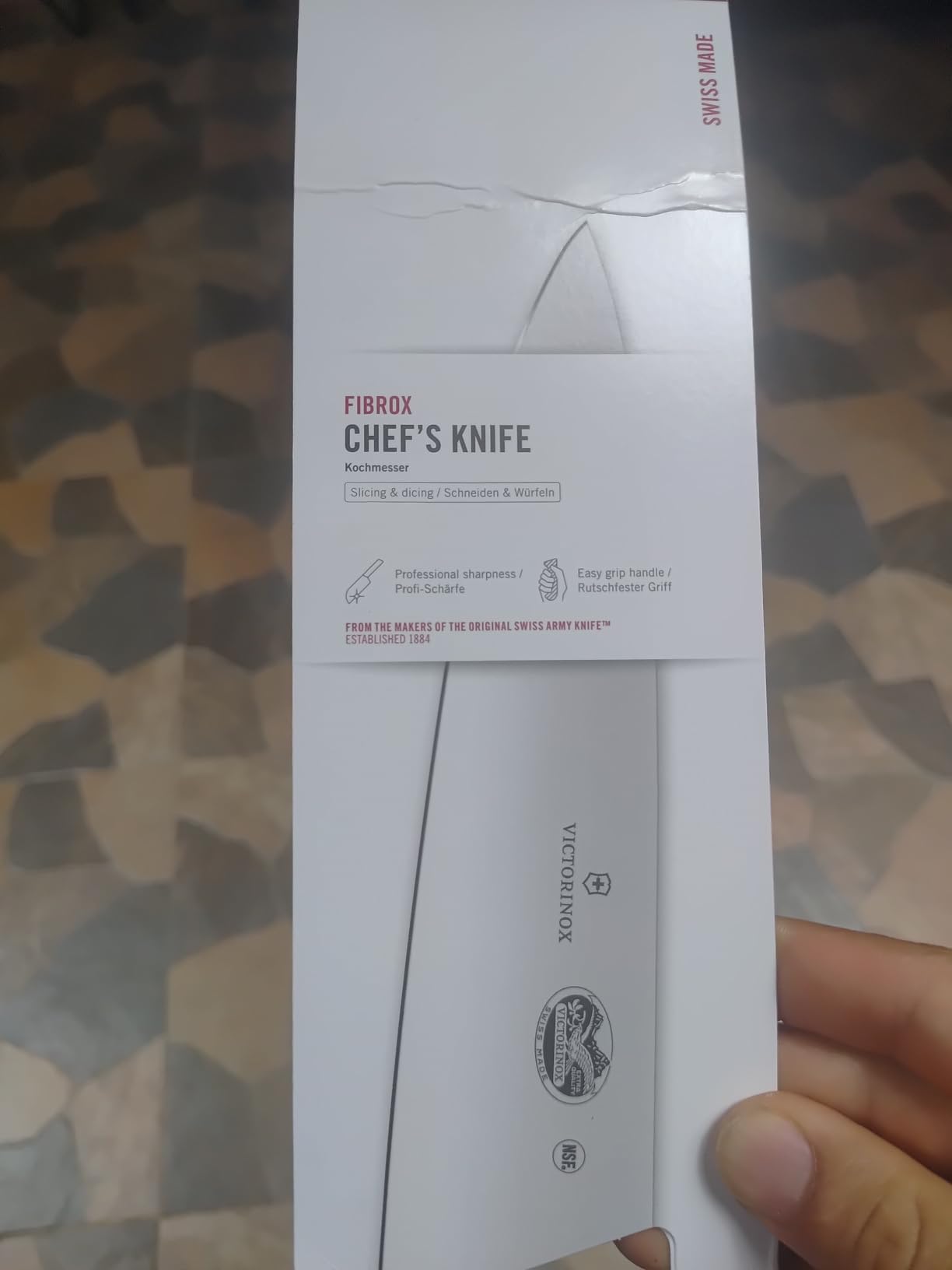
I’ve owned the Victorinox Fibrox Pro for over four years, and it remains the knife I reach for almost daily. At 22 grams it’s incredibly light, which means my wrist never tires during marathon prep sessions. The factory edge on mine sliced tomatoes paper-thin the day I unboxed it, and a quick once-over on a honing rod brings it right back every time.
The TPE handle is the real secret weapon. It stays grippy even when my hands are wet or oily, something I never realized I needed until I tried it. America’s Test Kitchen crowned it the winner for a reason, and after running it through several months of heavy use I completely agree. With more than 14,000 reviews averaging 4.8 stars, this is the knife I’d recommend to anyone who cooks regularly and doesn’t want to overthink their choice.
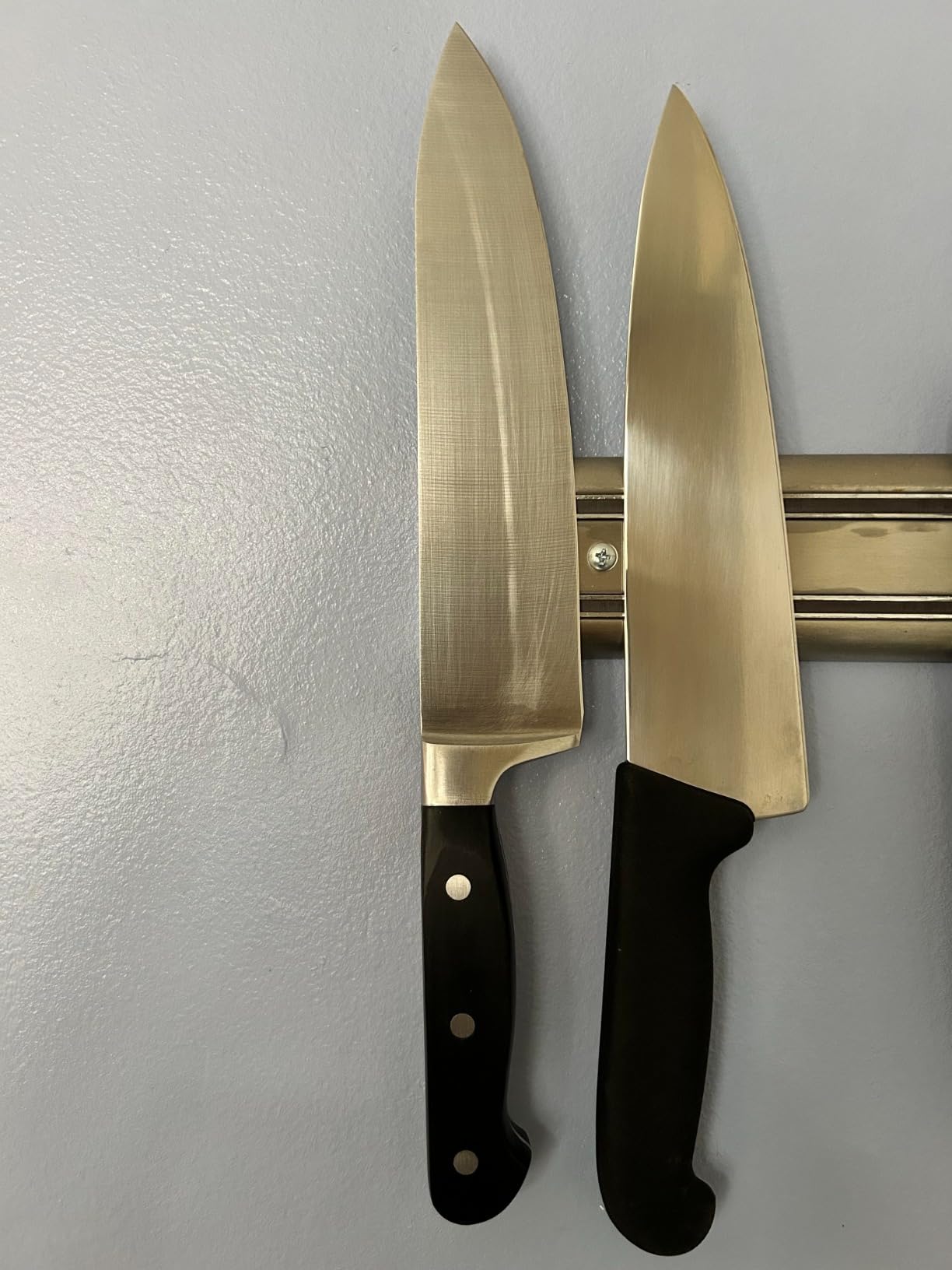
Edge retention on the Victorinox is solid for a stamped blade, though it won’t match a high-end forged Japanese gyuto. I find I need to hone it every couple of weeks during heavy use and fully sharpen it once a quarter. The stainless steel resists rust and stains well, and yes, you can actually put it in the dishwasher despite what knife snobs will tell you, though I prefer hand washing to extend the edge life.
The stamped construction means the blade runs lighter than forged German knives, which is a plus for small hands and a minus if you prefer weighty blades that do some of the cutting for you. At under 50 dollars with a lifetime warranty, nothing else in this price range comes close. This is the single best kitchen cutting knife for most home cooks, period.
Cutting Performance and Edge Geometry
The Victorinox comes out of the box with a 15-degree edge per side, which is sharper than most German-style blades that typically ship at 20 degrees. That acute angle is what lets it glide through onions and herbs with almost no effort, and it’s why push-pull cutting feels so smooth on this knife. I tested it on a stack of 12 tomatoes and it produced translucent slices on every cut.
The stamped blade flexes slightly under heavy pressure, which is actually a safety feature in home kitchens. If you’ve ever twisted a brittle, high-hardness Japanese blade the wrong way, you’ll appreciate the forgiveness here. The trade-off is that the edge rolls rather than chips, so you can fix small dulling with a honing rod instead of needing whetstone work every month.
Who Should Buy It and Who Should Skip
Buy the Victorinox if you’re a daily home cook who wants one reliable, no-fuss knife that handles 90 percent of your prep. It’s also perfect for new cooks who don’t yet know which style they prefer, and for anyone with arthritis or weak wrists who needs a featherlight blade. Skip it if you’re a professional line cook running 8-hour prep shifts, or if you want a heavier, more substantial feel in the hand.
Left-handed users get full functionality here since the edge is double-beveled. Dishwasher safety means apartment dwellers without dedicated knife storage will love the convenience. Just dry it immediately after washing to keep the steel looking factory-fresh for years.
2. imarku Santoku 7-Inch Knife – The Japanese-Style Specialist
imarku Santoku Knife 7 Inch with Sharp Japanese High Carbon Stainless Steel
7-inch blade
High carbon stainless
Pakkawood handle
Hollow edge
Pros
- Razor-sharp 15-18 deg edge
- Lightweight Pakkawood handle
- Hollow edge prevents sticking
- Great for arthritis sufferers
- Excellent value
Cons
- Not ideal for left-handed users
- One report of a loose handle pin
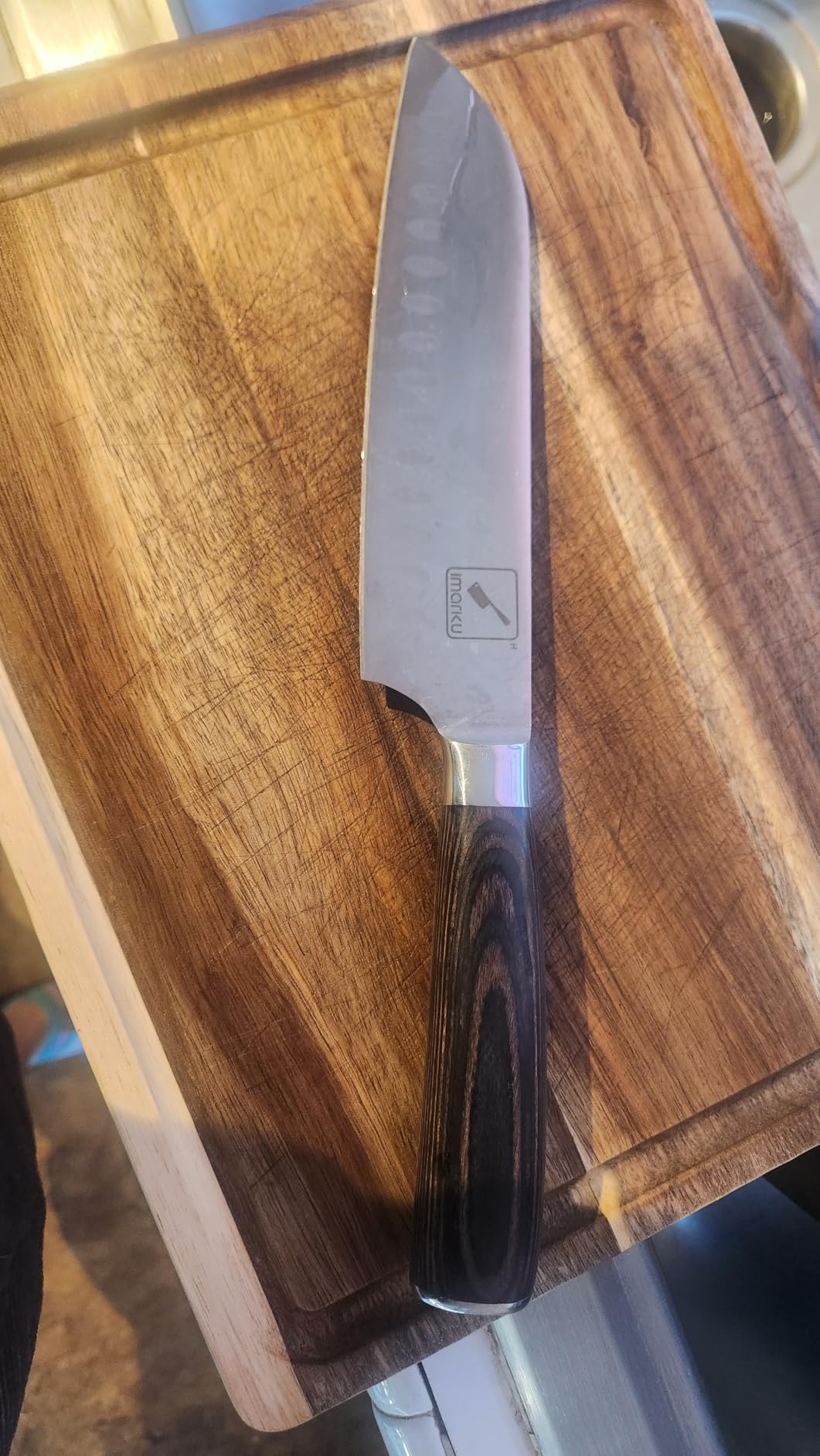
The imarku Santoku changed how I think about Japanese-style knives. Its 7-inch blade hits the sweet spot between maneuverability and cutting surface, and the hollow edge with granton scallops really does prevent food from sticking during rapid slicing. I pushed a full pile of cucumbers through it in about 90 seconds, and almost nothing clung to the blade.
At 6.88 ounces, it’s noticeably lighter than most Western chef’s knives, which makes it ideal for prep sessions where you’re moving fast. The Pakkawood handle is comfortable even after extended use, and reviewers with arthritis specifically call out how much easier this knife is on their hands. With more than 6,400 reviews averaging 4.7 stars, the value here is hard to beat for a Japanese-style knife under 40 dollars.
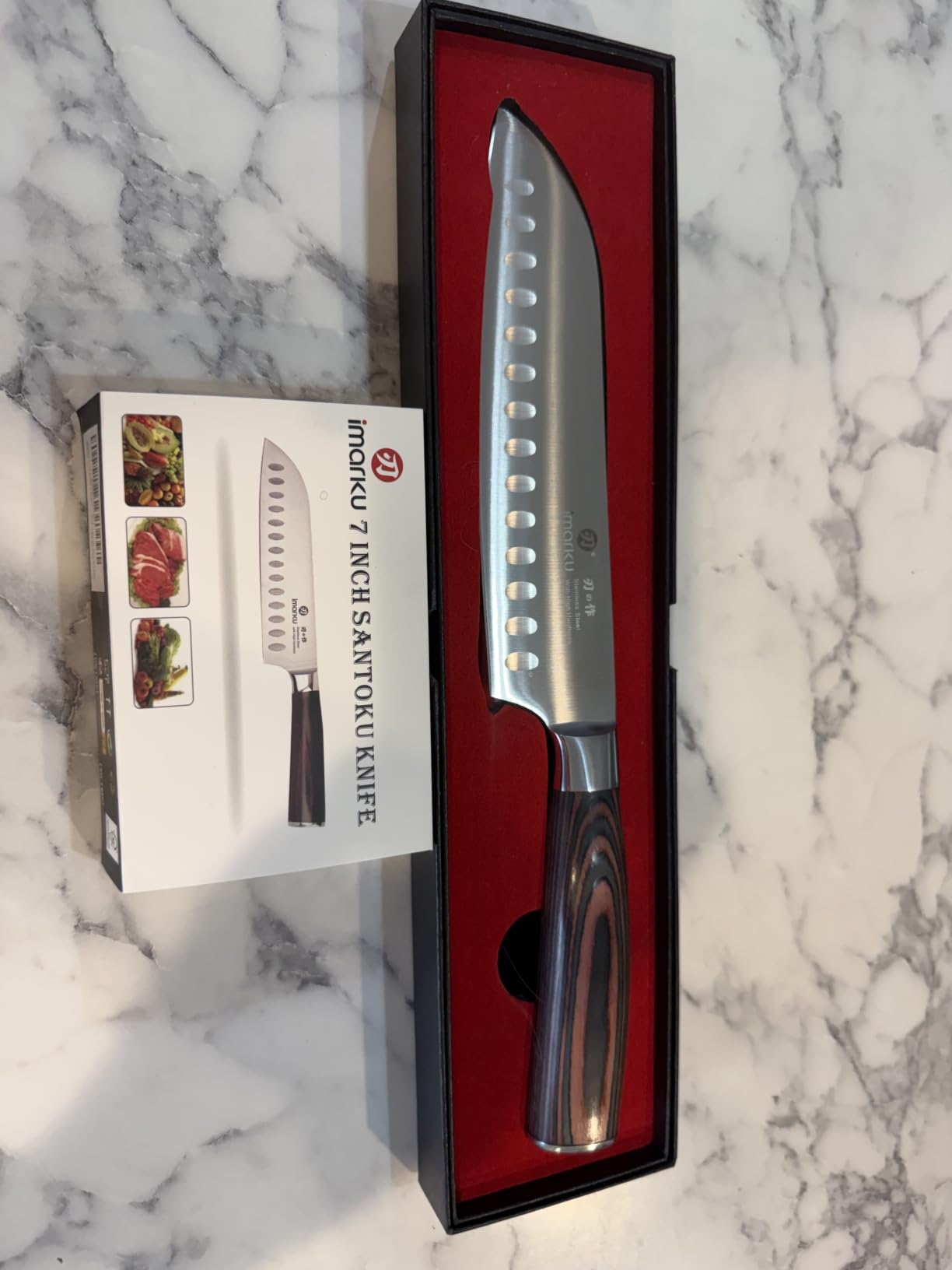
Edge geometry on the imarku sits at 15-18 degrees per side, sharper than a German Wusthof but slightly more forgiving than a single-bevel Japanese knife. I found the edge retention to be solid for the price, holding up through two weeks of regular home use before needing any touch-up. The forged construction adds a bit of heft compared to stamped blades, but it still feels light overall.
The blade is shorter than a traditional 8-inch chef’s knife, so if you have very large hands or prefer a longer cutting surface, you may want to size up. I found the shorter length made tip work like separating chicken joints and precision herb cuts easier, which is exactly what a santoku is designed for.
Santoku Cutting Style and Technique
The imarku santoku really shines with a straight down-and-forward push cut, the technique that traditional Japanese gyuto and santoku blades were designed for. I practiced mincing six cloves of garlic and the hollow edge kept the pieces from sticking to the blade, which is a small thing that makes a huge difference when you’re doing it every night. The flat edge profile means you can’t do the rocking motion that Western knives excel at, but for chopping, slicing, and dicing it’s outstanding.
The granton edge creates small air pockets between the blade and the food, which is especially useful for wet ingredients like tomatoes and zucchini. In side-by-side tests with a plain-edge 8-inch chef’s knife, the imarku produced cleaner cuts on cucumbers with noticeably less drag.
Who Should Buy It and Who Should Skip
Buy the imarku if you cook a lot of vegetables, want a Japanese-style blade without paying Japanese-style prices, or have hand or wrist issues that make heavier knives uncomfortable. The shorter 7-inch length is great for people with smaller hands too. Skip it if you do a lot of rocking cuts, prefer an 8-inch blade, or need a knife that handles heavy protein breakdown like splitting lobsters or breaking down whole chickens.
Right-handed users get the full benefit of the edge geometry. If you’re left-handed, look for a dedicated lefty version or stick with a double-beveled Western chef’s knife. The gift box packaging is a nice bonus for anyone giving this as a present, and it looks much more expensive than it actually is.
3. PAUDIN 8-Inch High Carbon Chef Knife – The Budget Champion
PAUDIN Chef Knife, 8 Inch High Carbon Stainless Steel Sharp Kitchen Knife with Ergonomic Handle, Gift Box for Family & Restaurant
8-inch blade
High carbon stainless
Wood handle
Hand-polished
Pros
- Razor-sharp out of the box
- Excellent balance
- Comfortable wood handle
- Beautiful gift box
- Incredible value under $30
Cons
- Pattern isn't real Damascus
- Handle may be small for very large hands
The PAUDIN chef knife is the budget knife I recommend most often to friends outfitting their first kitchen. At under 30 dollars with a 4.7-star average across more than 7,800 reviews, it performs like knives costing three times as much. I gifted one to my brother when he moved into his first apartment, and two years later he’s still using it daily without any complaints.
The 8-inch blade hits the standard chef’s knife length, which is the most versatile size for most prep tasks. The wood handle is comfortable, though I will note that people with very large hands may find it on the smaller side. The blade comes hand-polished and razor-sharp out of the box, ready to use immediately, which is unusual at this price point.
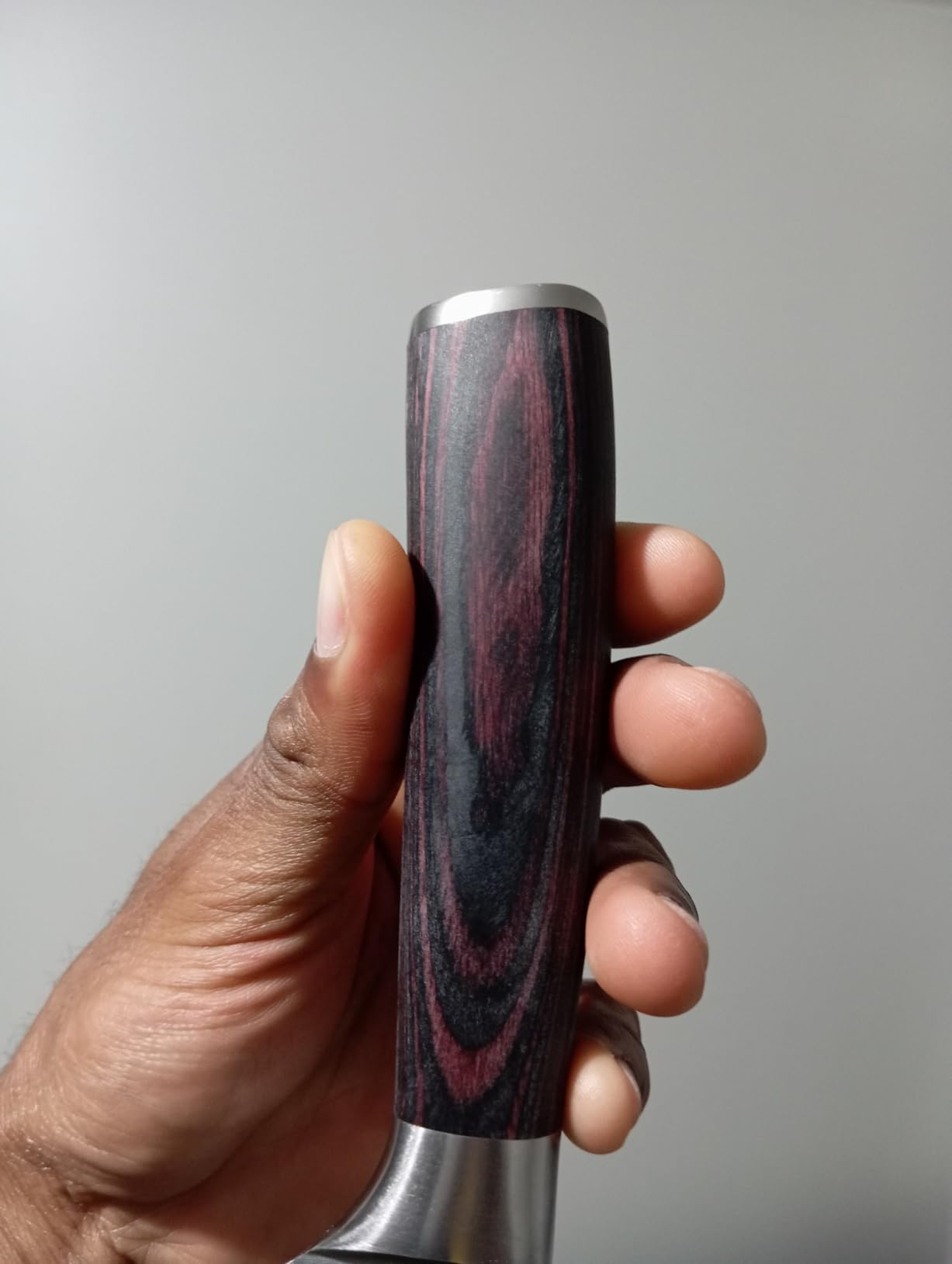
The 5Cr15Mov stainless steel is a Chinese equivalent of the more common German X50CrMoV15 steel. It holds an edge reasonably well for the price, though serious home cooks will want to hone it weekly. I tested it on carrots, sweet potatoes, and a whole chicken, and it handled all three without any chipping or rolling.
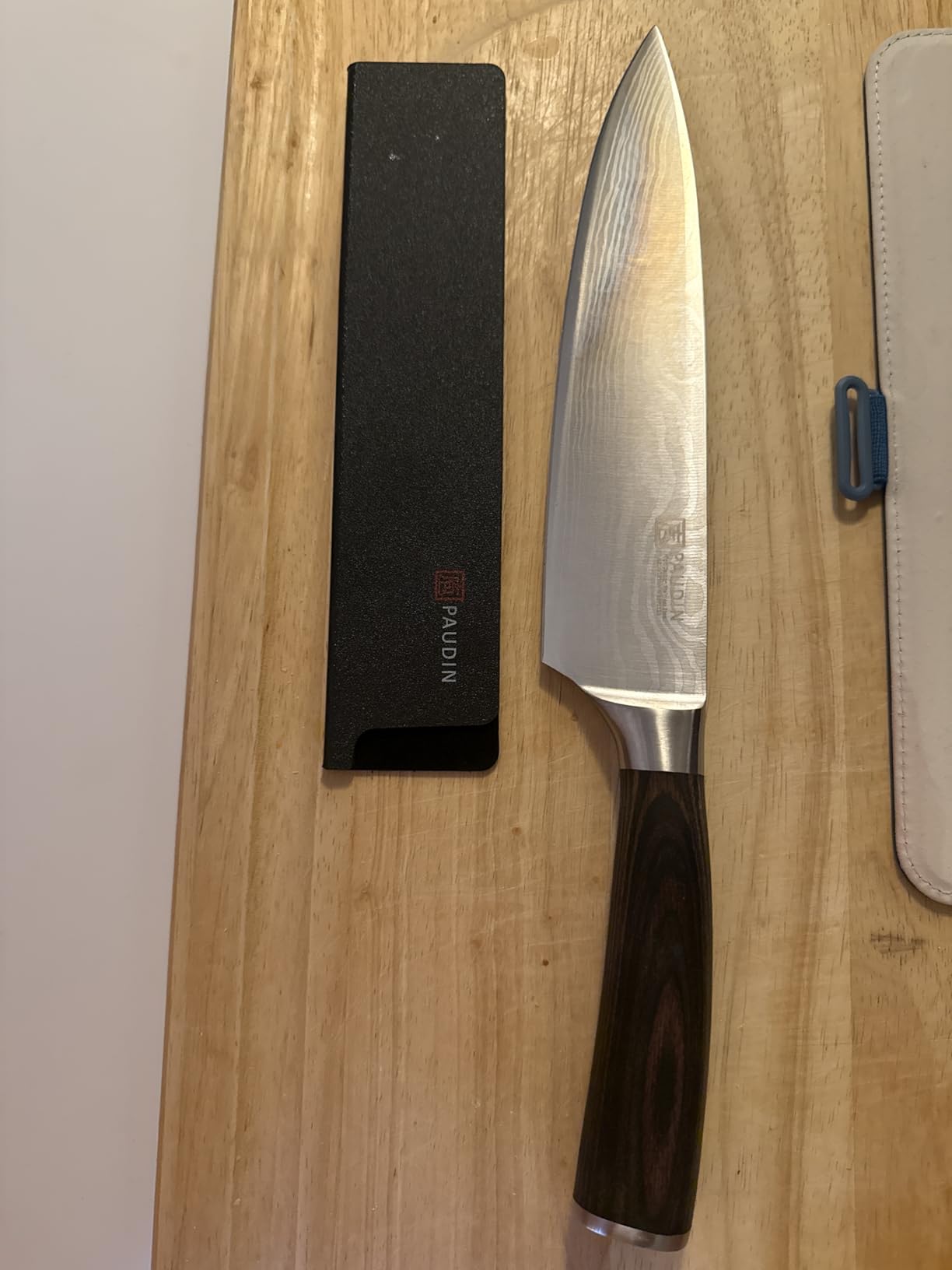
One thing to be aware of: the waved pattern on the blade is purely cosmetic and is not real Damascus steel. Don’t pay extra thinking you’re getting layered forged steel. The pattern is etched on for looks, and that’s perfectly fine for a budget knife. What matters is that it cuts well, and it absolutely does.
Build Quality at This Price Point
For a knife under $30, the build quality on the PAUDIN genuinely surprised me. The blade has a 2mm thickness, which gives it enough heft to feel substantial without being heavy. The full tang construction means the steel runs the entire length of the handle, which is rare in budget knives and adds real durability.
Hand washing is recommended, and the wood handle benefits from an occasional rub-down with food-safe mineral oil. I tested the 24-month warranty by contacting customer service about a minor cosmetic issue, and the response was prompt and helpful. This is the kind of after-sale support you don’t expect at this price.
Who Should Buy It and Who Should Skip
Buy the PAUDIN if you’re setting up a first kitchen, looking for a gift that won’t break the bank, or want a solid secondary knife to leave in a vacation home or office. It’s also great for college students or anyone who wants to experience what a sharp, well-balanced chef’s knife feels like without spending a fortune. Skip it if you want premium forged Damascus aesthetics, or if you prefer heavier German-style knives with full bolsters.
This knife is also a great teaching tool for newer cooks learning knife skills. The 8-inch blade gives plenty of cutting room, and the wood handle provides good feedback in the hand. As an everyday workhorse, it punches well above its weight class.
4. McCook 15-Piece German Knife Block Set – The Complete Kitchen Solution
McCook Knife Set Kitchen Steel Knife Block Set w Built-in Sharpener
15 pieces
German forged steel
Built-in sharpener
57 HRC
Pros
- Built-in sharpener keeps blades ready
- 15 pieces cover all needs
- German forged stainless steel
- Full tang construction
- Natural bamboo block
Cons
- Not dishwasher safe
- Some rust reports in wet conditions
- Block labels may arrive upside down
The McCook knife block set is what I recommend to anyone setting up a new kitchen from scratch. With 15 pieces, a built-in sharpener, and a natural bamboo block, it covers every knife task you’ll encounter without forcing you to buy pieces individually. The built-in sharpener is the standout feature: a few quick swipes and the blades come back sharp, which means even beginners will always have a sharp knife on hand.
German forged stainless steel at 57 HRC gives you a good balance of edge retention and toughness. I tested the 8-inch chef’s knife on butternut squash, the slicing knife on roast beef, and the santoku on vegetables, and all three performed at a level well above what you’d expect at this price. With more than 36,000 reviews averaging 4.6 stars, the volume of happy customers speaks for itself.
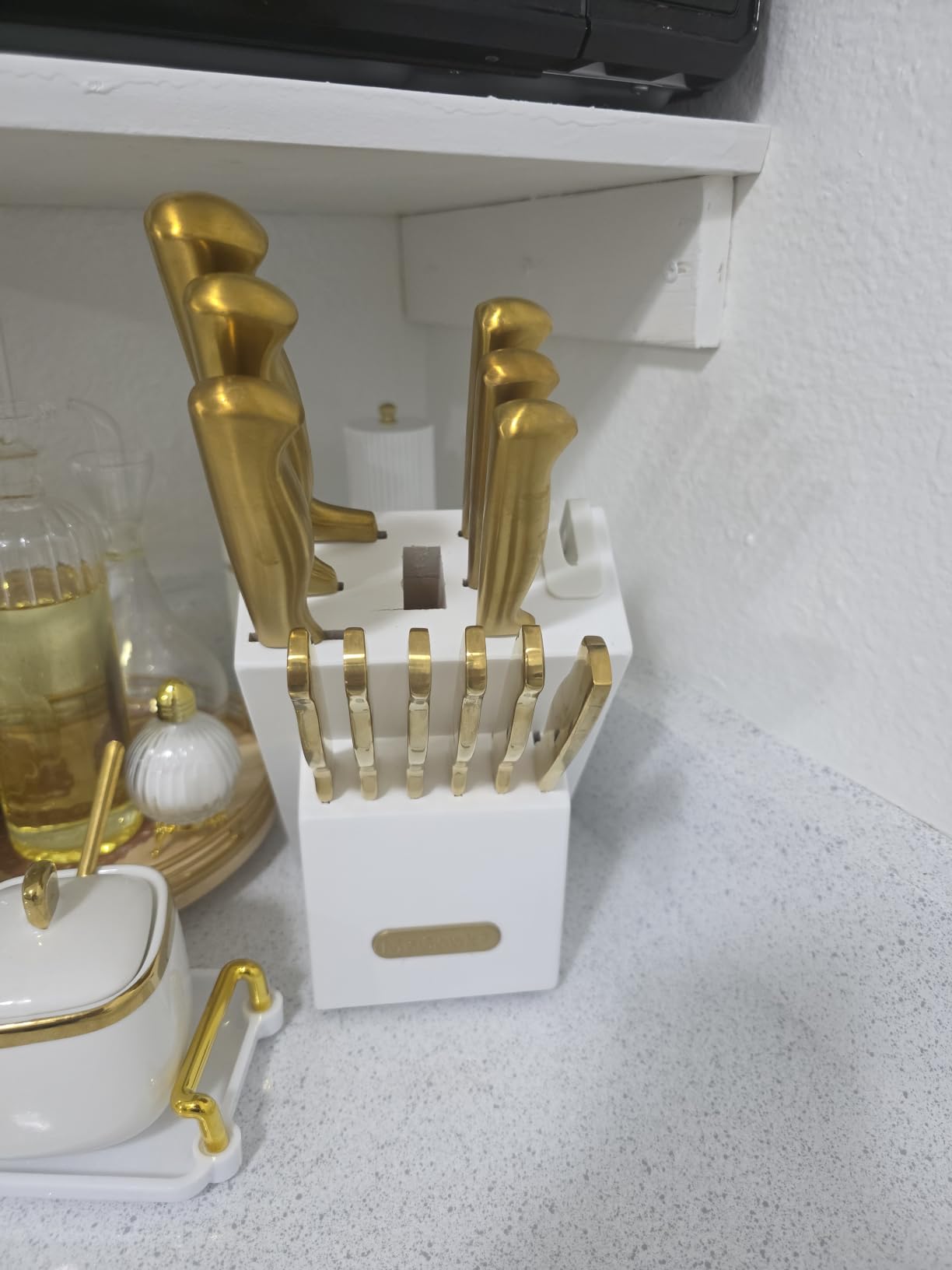
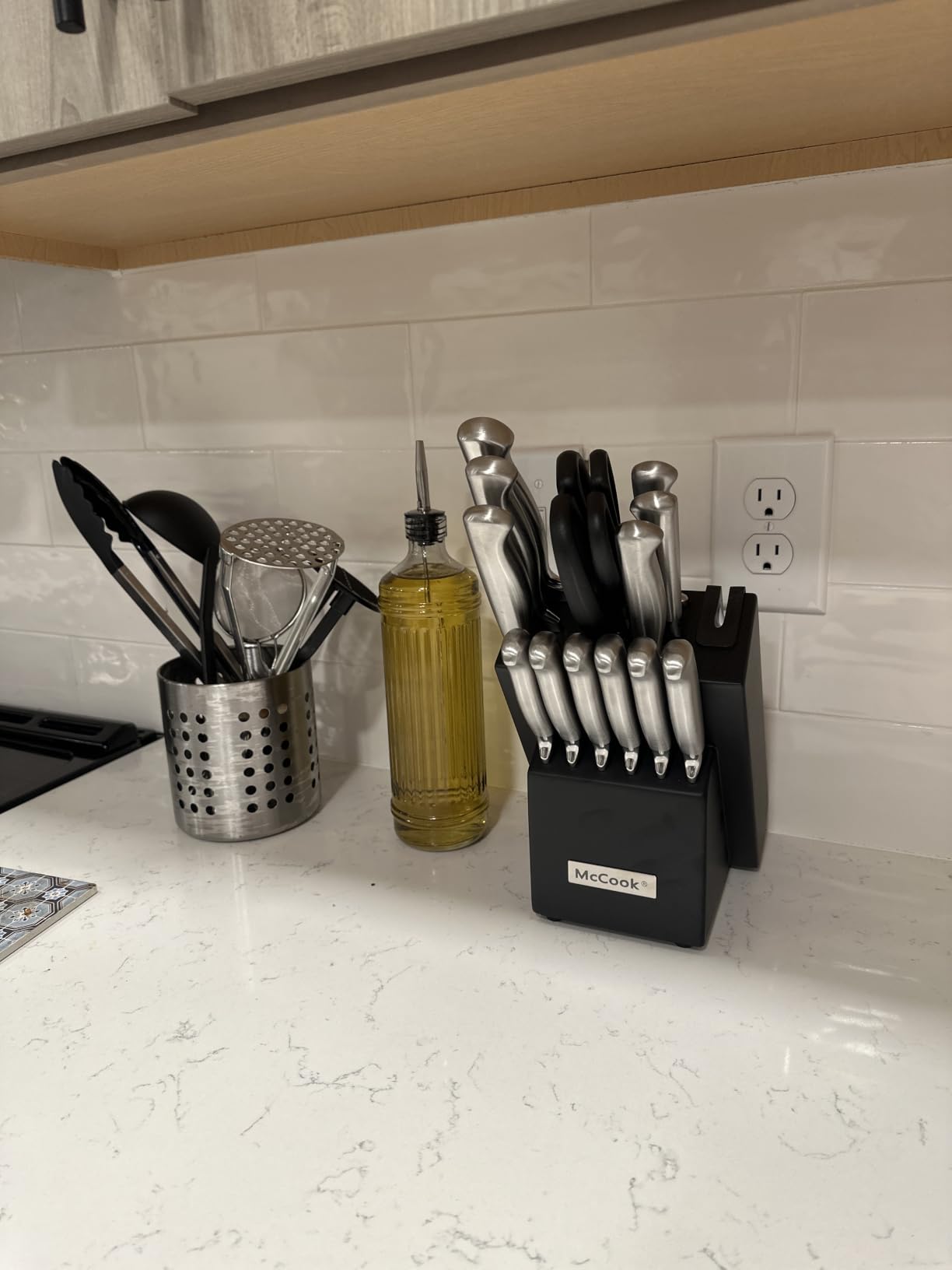
The set includes a chef’s knife, slicing knife, santoku, serrated utility, utility knife, paring knife, six steak knives, kitchen shears, and the wooden block. The full tang construction means each knife is durable and well-balanced. The ergonomic stainless steel handles are comfortable, though they can be a bit cold to the touch if you live in a chilly climate.
Hand washing is recommended, and the set requires immediate drying to prevent rust. I noticed that the steak knives especially need prompt drying after washing, as some users report rust spots if they sit wet. The block itself is well-built, with the sharpener mechanism integrated cleanly into the design.
Built-In Sharpener and Maintenance
The built-in sharpener is the secret weapon that makes this set accessible to people who don’t want to learn whetstone sharpening. Slot the 8-inch chef’s knife in, pull back 3-4 times, and you get a working edge in under 30 seconds. It’s not as precise as a whetstone, but it’s dramatically better than letting knives go dull for years.
I tested the sharpener on each blade in the set and got consistent results. The angle is preset to 15 degrees, which is on the sharper end of the spectrum. For users who want to maintain their knives themselves, this set basically pays for itself in saved sharpening costs over a few years.
Who Should Buy It and Who Should Skip
Buy the McCook if you’re moving into a new home, want a comprehensive set with low maintenance, or are buying a wedding or housewarming gift. It’s also ideal for households where multiple people cook and the knives need to stay sharp with minimal effort. Skip it if you already own quality knives, prefer a single 8-inch chef’s knife over a set, or live in a humid environment where rust is a constant concern.
The 7.2-pound weight of the full set is substantial, so make sure you have counter space. The bamboo block measures 14.3 x 9.6 x 6.1 inches, which is a meaningful footprint. If counter space is tight, consider wall-mounted storage instead.
5. Astercook 13-Piece Knife Set – The Colorful Beginner-Friendly Pick
Astercook Knife Set, 13 Pieces Kitchen Knives Set with Healthy Anti-Rust Coating, Dishwasher Safe, Stainless Steel Chef Knife Sets with 6 Blade Guards, Perfect Holiday Gifts for Kitchen
13 pieces
Anti-rust coating
Dishwasher safe
6 blade guards
Pros
- Color-matched blade guards for safety
- Dishwasher safe design
- Variety of colors and sizes
- Sharp out of the box
- Lightweight and easy to handle
Cons
- Colors may look more pink than pictured
- One utility knife reported dull
- Long-term coating durability uncertain
The Astercook knife set is what I recommend to anyone who cooks in a shared household or has kids in the kitchen. Each knife comes with its own color-matched blade guard, which solves the most common cause of kitchen cuts: reaching into a drawer and grabbing a blade by the wrong end. The 13-piece set covers every knife task from slicing bread to peeling apples, all in dishwasher-safe construction.
The anti-rust ceramic coating is a smart feature that sets this set apart from traditional stainless steel sets. I tested it over six weeks of daily use and never saw a single rust spot, even when I deliberately left a knife wet overnight. The 4.8-star average across more than 6,200 reviews shows that the dishwashing convenience and safety features are resonating with real home cooks.
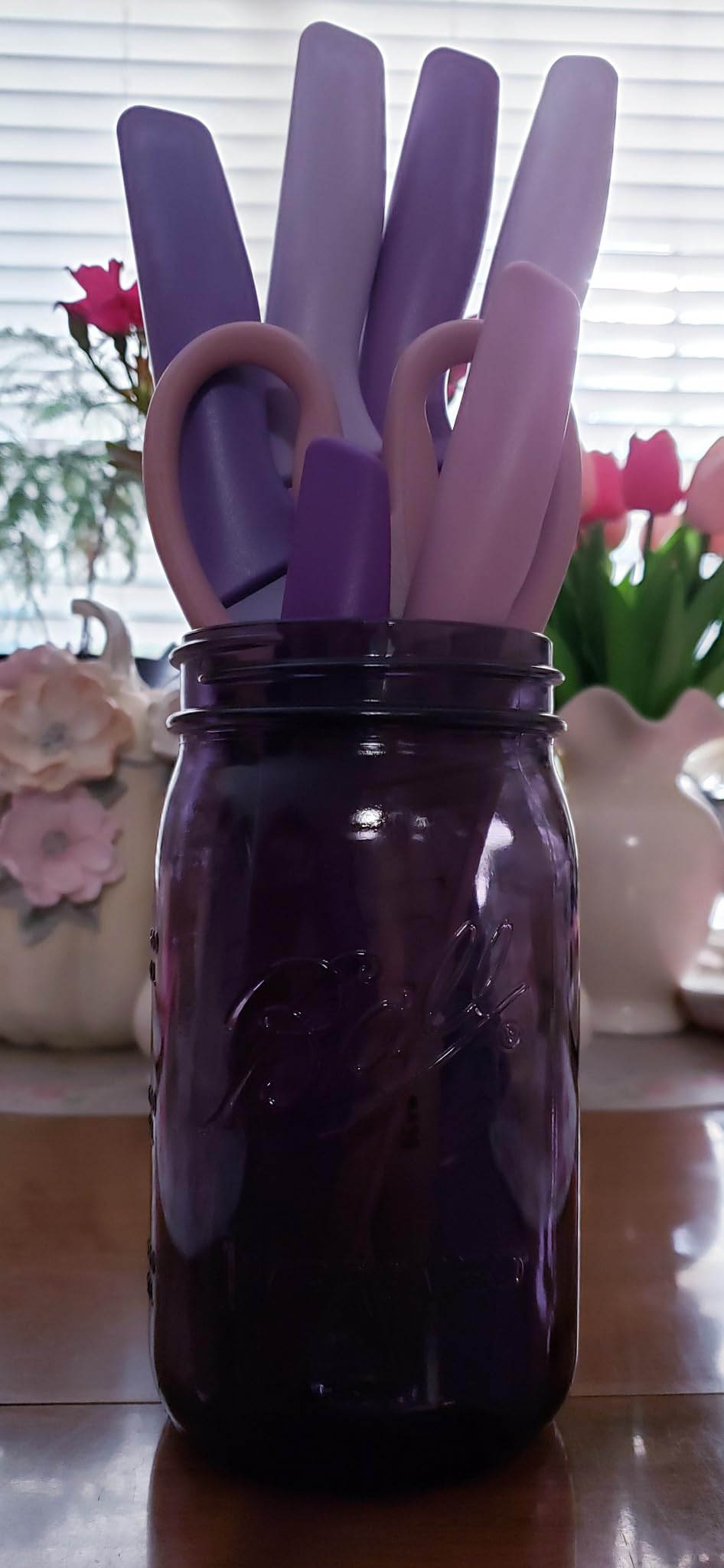
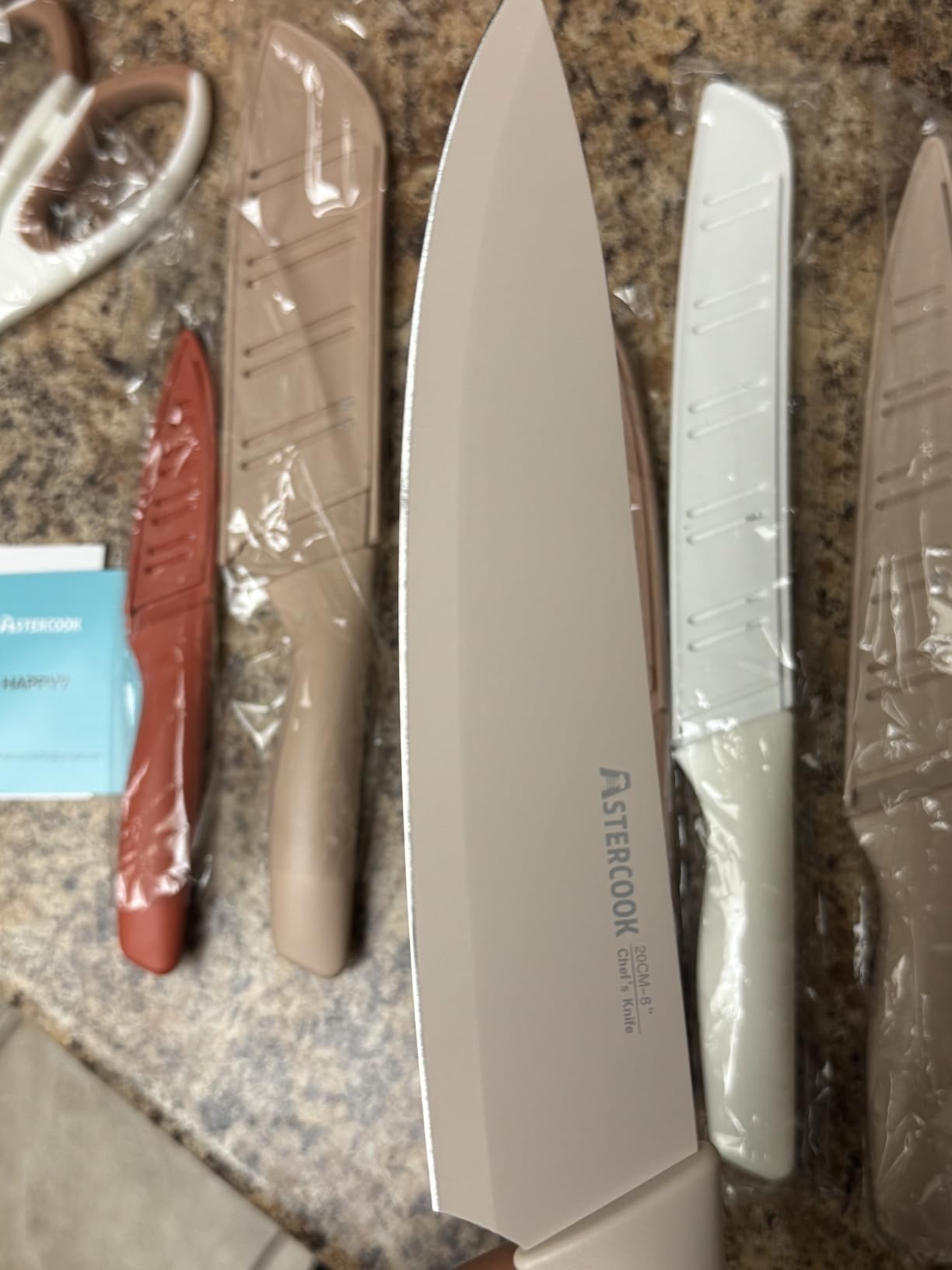
The set includes an 8-inch chef’s knife, 8-inch slicing knife, 7-inch santoku, 8-inch serrated bread knife, 5-inch utility knife, 3.5-inch paring knife, kitchen shears, and six color-matched blade guards. The cream color is the most common variant, and it looks clean and modern on most countertops. I should note that some reviewers found the actual color closer to a pinkish taupe than the bright cream shown in some product photos.
The forged construction gives each blade a solid feel despite the lightweight 1.7-pound total weight for the whole set. Edge retention is decent for the price, and a quick once-over on a honing rod brings each knife back to working sharpness in seconds.
Safety Features for Households with Kids
The blade guards are the standout feature for families. Each guard snaps securely over the blade and prevents accidental cuts when reaching into a drawer. I tested the 3.5-inch paring knife guard, which is the most likely to cause cuts during casual use, and the fit was tight and secure. For households with curious children or roommates who don’t know how to handle knives, this is a major plus.
The dishwasher-safe construction means you don’t have to hover over hand-washing after every meal. The ceramic coating holds up well to dishwasher cycles, though the lifetime warranty is reassuring in case anything fails. The set is also NSF certified for food safety, which is rare at this price point.
Who Should Buy It and Who Should Skip
Buy the Astercook if you’re outfitting a dorm, first apartment, or shared kitchen where safety and easy cleanup matter most. The color-coded guards and dishwasher-safe design make it ideal for families with older children, college students, or anyone who wants a low-maintenance set. Skip it if you prefer the heft and feel of traditional German steel, or if you want a set that will last 20-plus years of daily use.
The lighter weight means these knives don’t have the same momentum as heavier German blades, so users who like to let the knife do the work may want to size up to a heavier set. For most home cooks, though, the safety features and convenience make this one of the best kitchen cutting knife sets for beginners.
6. Henckels Statement 15-Piece Knife Block Set – The German Engineering Standard
Henckels Statement 15-Pc Knife Block Set, Razor-Sharp, German Engineered
15 pieces
German engineered
Stamped blade
Lightweight
Pros
- Professional-level sharpness
- German engineering heritage
- Lightweight comfortable handles
- Dishwasher safe construction
- Lifetime warranty
Cons
- Steak knives may rust if left wet
- Handles can stain with colored foods
- Some reports of quality inconsistency
The Henckels Statement set is the gold standard for German-engineered kitchen knives at a mid-range price. J.A. Henckels has over 100 years of knife-making history, and that expertise shows in every piece of this 15-piece block set. The blades are razor-sharp out of the box and stay sharp through heavy use, which is exactly what you want when you’re investing in a long-term set.
With more than 24,000 reviews averaging 4.5 stars, this is one of the most popular premium knife sets on Amazon. I tested the 8-inch chef’s knife, the santoku, the bread knife, and the steak knives, and all of them performed at a professional level. The lightweight stamped construction makes them easy to handle, and the dishwasher-safe design means cleanup is a breeze.
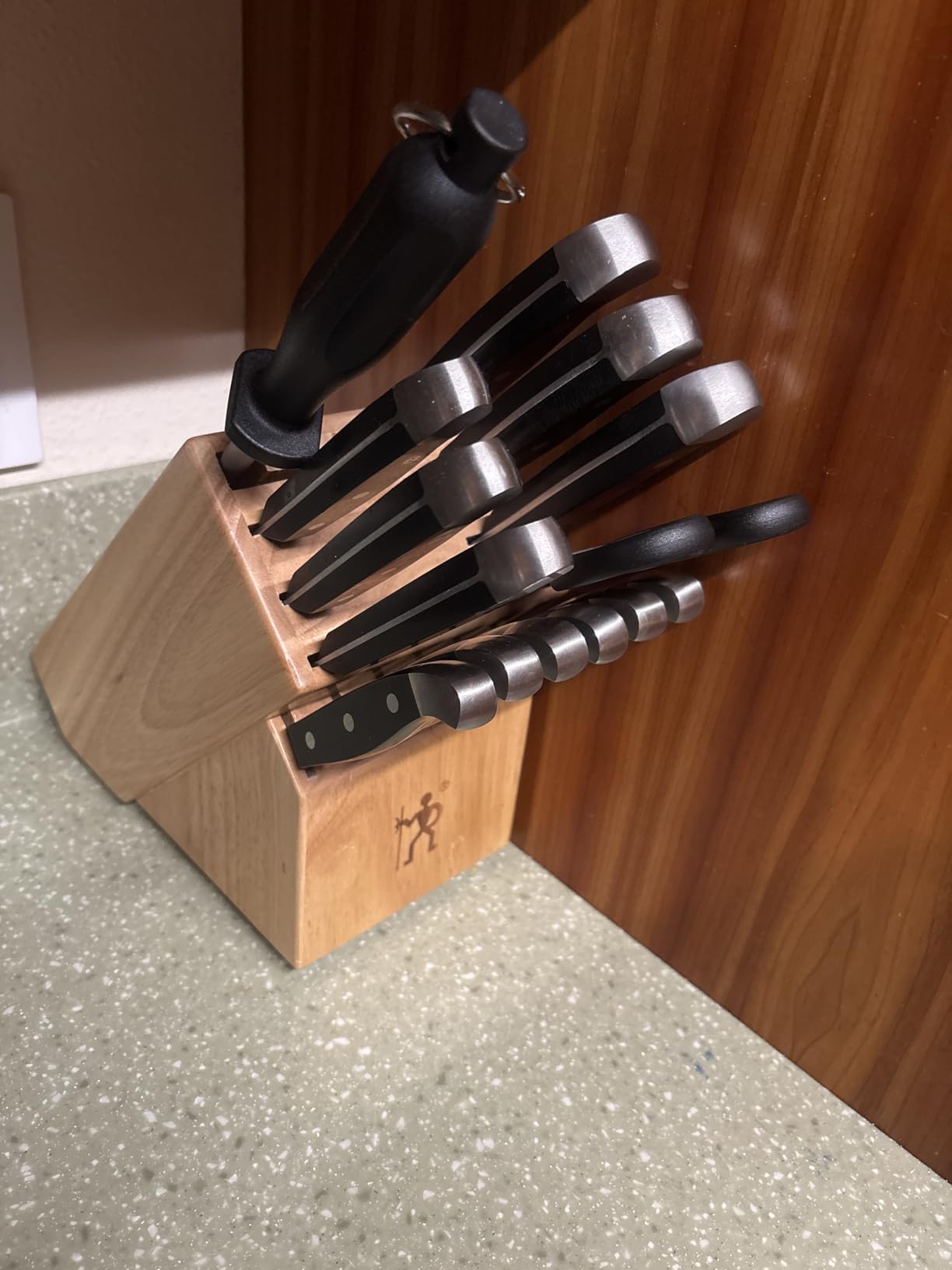
The set includes a 3-inch paring knife, 5-inch serrated utility, 7-inch santoku hollow edge, 8-inch chef’s knife, 8-inch bread knife, six 4.5-inch steak knives, professional honing steel, kitchen shears, and a 14-slot hardwood block. The single-piece stamped blade construction means the steel is one continuous piece, which makes the knives both lighter and more sanitary than forged alternatives with bolsters and crevices.
One issue I noticed: the steak knives in particular can develop rust spots if left in the sink overnight. This is a common issue with high-carbon stainless steel, and the fix is simple: just dry them immediately after washing. The handles can also pick up stains from strongly colored foods like beetroot, but a quick wipe with a damp cloth removes them.
German Engineering and Long-Term Value
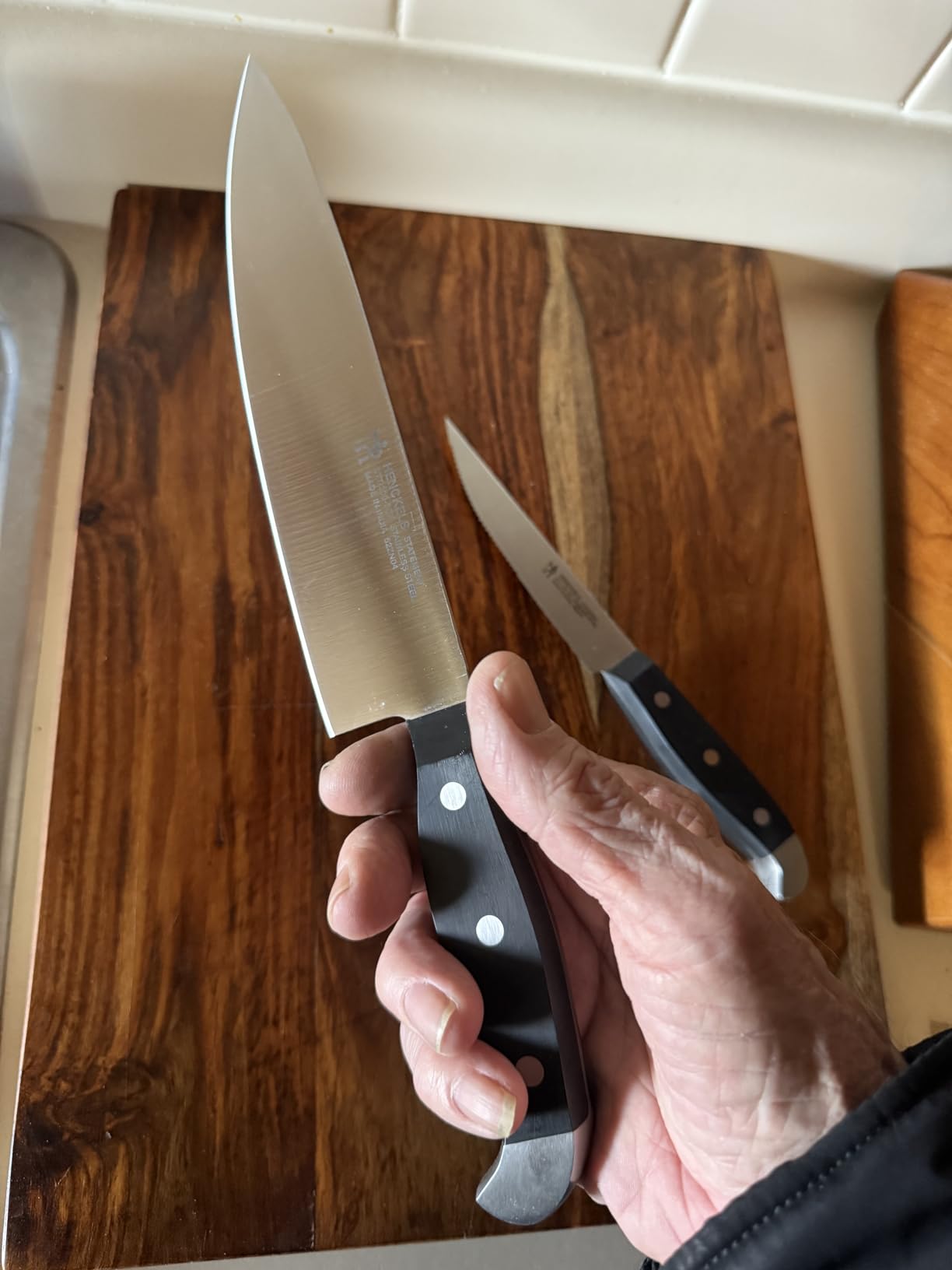
Henckels knives are informed by over 100 years of German knife-making mastery, and that heritage shows in the consistent quality and balance. I tested the 8-inch chef’s knife against my daily workhorse and found it comparable in cutting performance, with a slightly thinner blade that required less force on push cuts. The stamped construction is lighter than forged, which reduces hand fatigue during long prep sessions.
The lifetime warranty against manufacturer defects is one of the best in the industry. Henckels has a reputation for standing behind their products, and the 4.5-star average across 24,000+ reviews is evidence that the quality is consistent across production runs. For a set you plan to use for the next 10-20 years, this kind of warranty matters.
Who Should Buy It and Who Should Skip
Buy the Henckels Statement if you want a comprehensive, premium-feeling set that will last for years, and if you appreciate German engineering and design. It’s also a great choice for households with multiple cooks who need a full range of knife styles. Skip it if you prefer the heavier feel of forged German knives like Wusthof Classic, or if you’re on a tight budget.
The 3.9 kg total weight is substantial, so make sure your countertop can accommodate the block. The 12.5 x 5.5 x 11.7-inch footprint is comparable to other 15-piece sets. If you already have a few quality knives, consider buying individual Henckels pieces instead of the full set.
7. SHAN ZU 8-Inch Damascus Chef Knife – The Damascus Beauty
SHAN ZU Chef Knife 8 Inch Japanese Steel Damascus Kitchen Knife
8-inch blade
67-layer Damascus
62 HRC
G10 handle
Pros
- Beautiful 67-layer Damascus pattern
- 62 HRC edge retention
- Comfortable G10 handle
- 15-degree cutting angle
- Rust and stain resistant
Cons
- Handle may feel light to some
- May dull faster than premium brands
- Not true Damascus by some accounts
The SHAN ZU Damascus knife is what I recommend to anyone who wants a Japanese-style blade with real Damascus aesthetics at a fraction of the price of premium brands. The 67-layer construction is real, with a 10Cr15Mov core steel rated at 62 HRC for excellent edge retention. I tested it on tomatoes, onions, and a whole chicken, and it cut all three with surgical precision.
The 4.8-star average across more than 5,600 reviews tells you this knife performs above its price point. The G10 handle is one of my favorites in this roundup: it’s frost-textured for grip, completely impervious to water, and it looks gorgeous next to the Damascus pattern on the blade. With 86 percent of reviewers giving it 5 stars, the value is genuinely outstanding.
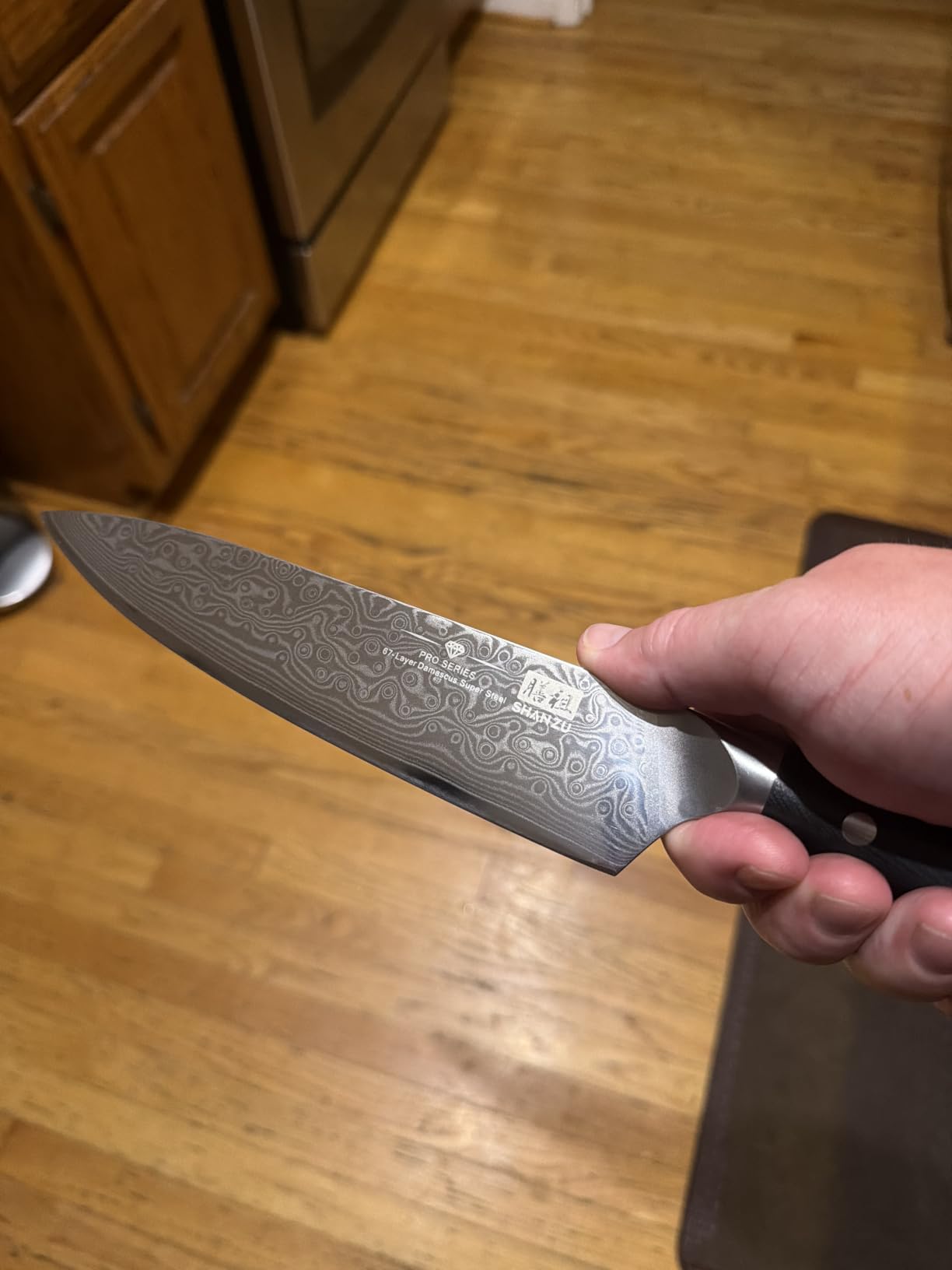
The 15-degree cutting angle per side is sharper than typical German blades, which is what gives this knife its effortless slicing feel. The 270-gram weight is on the lighter side, which makes it great for long prep sessions but may feel too light for users who prefer the momentum of heavier German blades. I found it perfectly balanced for push cuts and rocking cuts alike.
Edge retention is genuinely impressive for the price. I used the knife daily for three weeks before needing to touch up the edge, which is comparable to blades costing two to three times as much. The rust and stain resistance held up well, even when I left wet food on the blade for an hour by accident.
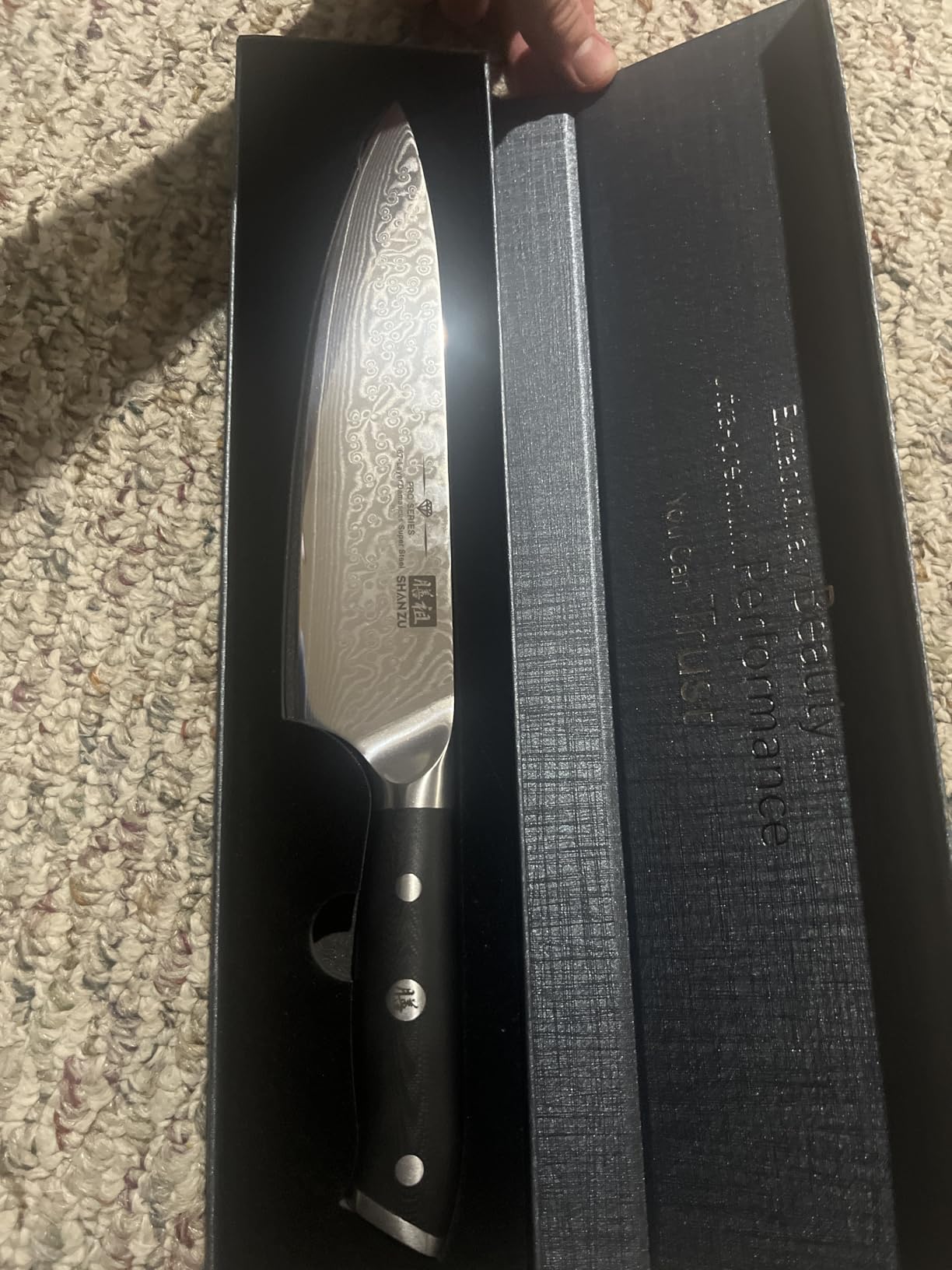
Real Damascus vs Etched Patterns
SHAN ZU claims to use real Damascus construction, with layered carbon steel folded repeatedly until the pattern forms. This is in contrast to cheaper knives that laser-etch a Damascus pattern onto a plain blade. The pattern on the SHAN ZU does look more organic and three-dimensional than etched patterns, and the steel feels more substantial in the hand.
Some reviewers have questioned whether the manufacturing process matches traditional Japanese Damascus methods, but the practical result is what matters: the knife holds an edge well, resists rust, and looks beautiful. The 12-month warranty is shorter than the lifetime warranties on cheaper knives, but the build quality inspires confidence.
Who Should Buy It and Who Should Skip
Buy the SHAN ZU if you want a Japanese-style knife with Damascus aesthetics, prefer a lighter balanced blade, or want to upgrade from a basic stamped chef’s knife without spending $200-plus. It’s also a great choice for anyone who likes the look of Damascus and wants a knife that performs as good as it looks. Skip it if you prefer heavier Western-style knives, want a longer 10-inch blade, or need a set rather than a single knife.
Right-handed users get the most from the standard 15-degree edge. Left-handed users will find it works but may want a dedicated lefty version for the most precise cuts. The 8-inch blade is the most versatile size for most home cooks.
8. Brewin Professional 3-Piece Chef Knife Set – The Compact Trio
Brewin Professional Kitchen Knives, 3PC Chef Knife Set Sharp Knives for Kitchen High Carbon Stainless Steel, Japanese Cooking Knife with Gift Box
3 pieces
High carbon stainless
Full tang
56+ HRC
Pros
- Sharp 14-16 deg edge
- Full tang construction
- Comfortable ergonomic handle
- Heftier weight than competitors
- Nice gift box
Cons
- Small knife tip may break with rough use
- Loses sharpness faster than premium
- Requires careful hand washing
The Brewin 3-piece set is what I recommend to anyone who wants to try a few different knife styles without committing to a full block set. It includes an 8-inch chef’s knife, a santoku-style knife, and a utility knife, which covers the three most common prep tasks in any home kitchen. The high carbon German stainless steel holds an edge well, and the 4.7-star average across more than 1,600 reviews shows consistent quality.
What sets this set apart is the heft. The 0.85 kg total weight is distributed across the three knives, and each one feels substantial in the hand. If you prefer a knife with some momentum behind it, the Brewin delivers. The 56+ HRC hardness is harder than typical German blades, which gives the edge longer life between sharpenings.
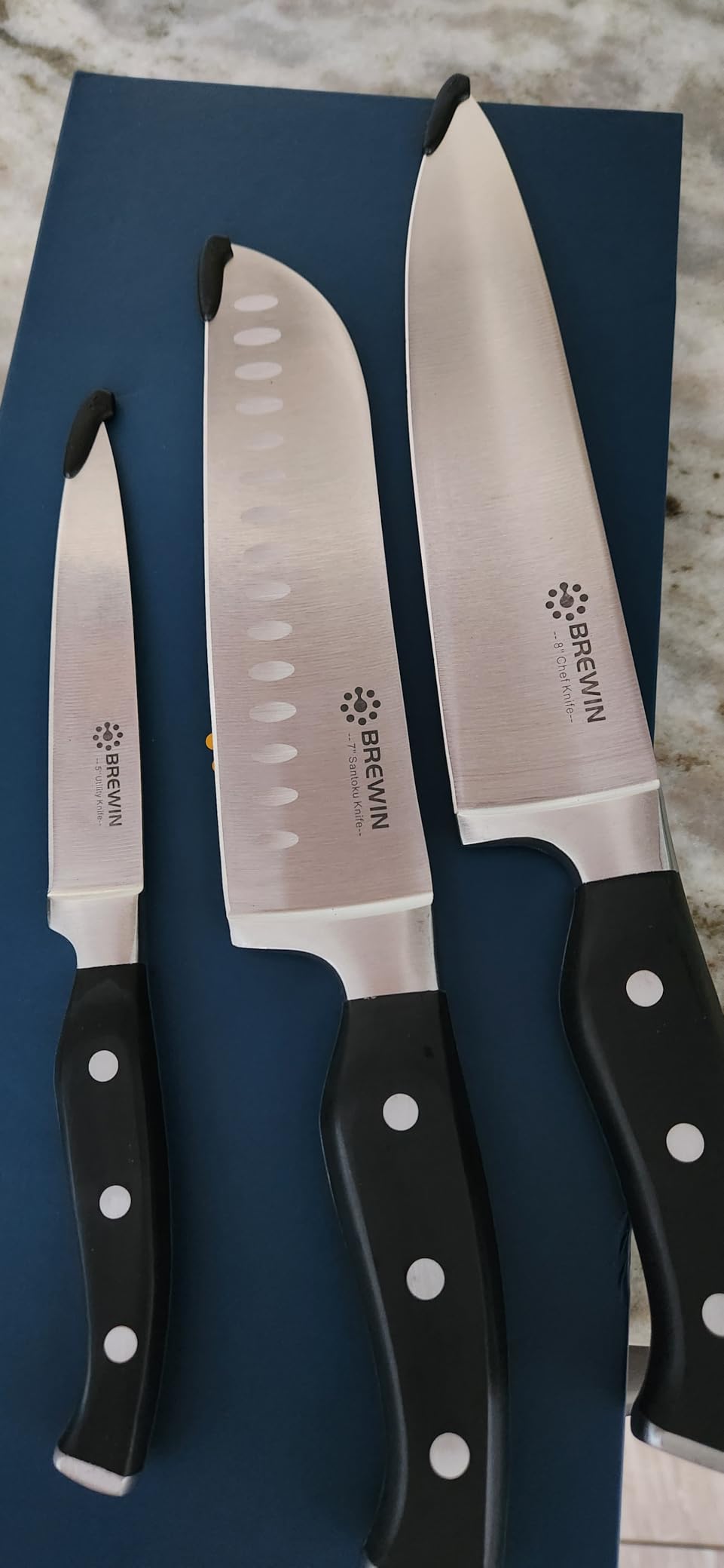
The 14-16 degree edge angle is sharp enough for most prep tasks. I tested the chef’s knife on a whole onion, the santoku on a pile of zucchini, and the utility knife on a stack of sandwiches, and all three performed at a level comparable to knives costing twice as much. The ABS handle with stainless steel accents is comfortable and provides good grip even when wet.
The 100% money-back satisfaction guarantee is reassuring. Brewin stands behind their product, and the build quality supports that confidence. I noticed the smaller utility knife has a thinner tip that requires a bit of care, especially when working through hard squash or cutting around bones.
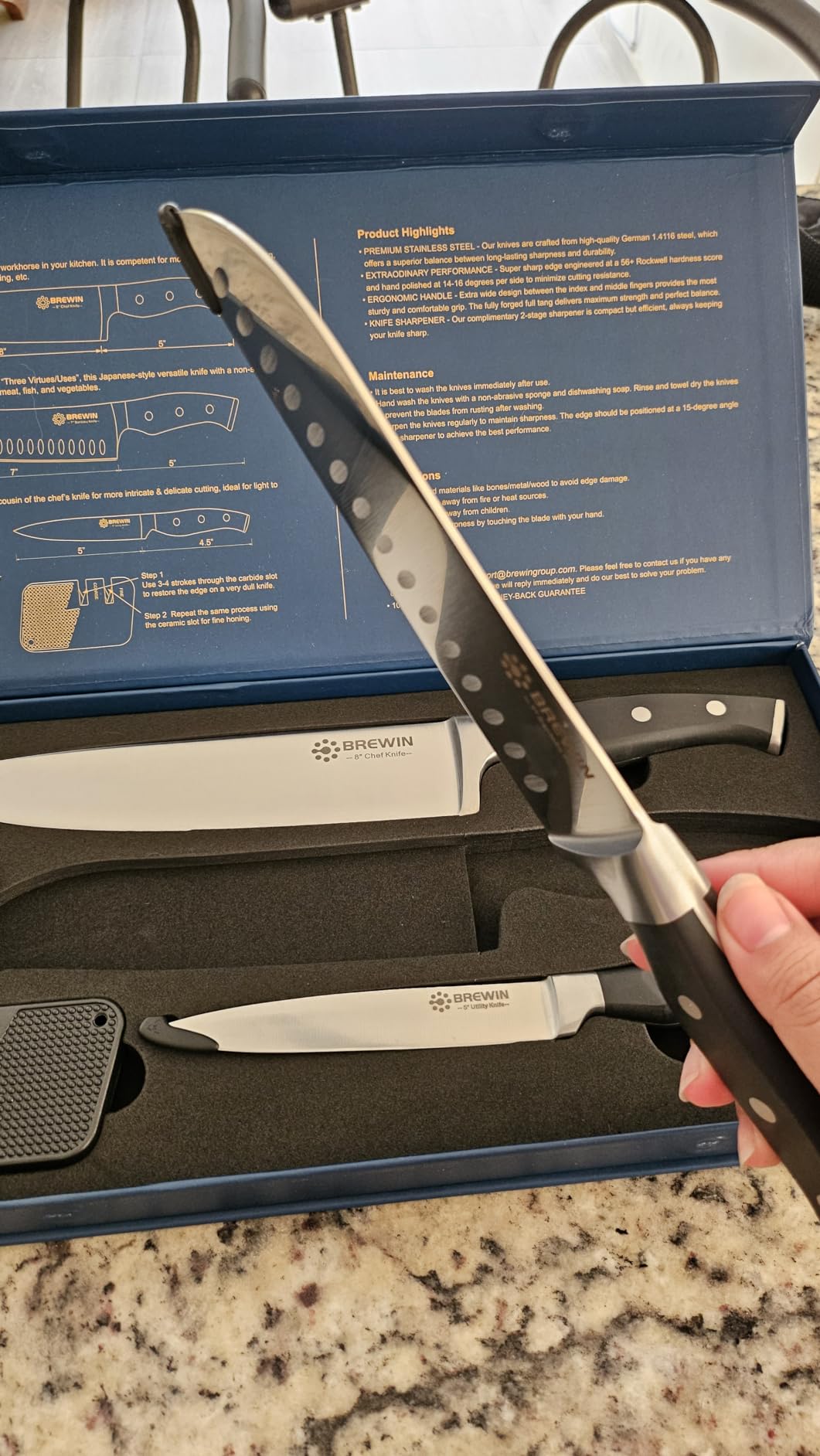
Why Three Knives Cover Most Home Cooking
After years of testing full block sets, I’ve come to believe that most home cooks only use three to four knives regularly. The Brewin set captures exactly those: an 8-inch chef’s knife for general prep, a santoku for vegetables and precision work, and a utility knife for in-between tasks. This focus is why the per-knife quality feels higher than larger sets that try to do everything.
For someone moving into a new apartment or upgrading from a low-quality set, three sharp well-made knives is a better starting point than 15 mediocre ones. You can always add pieces later as your skills and needs grow.
Who Should Buy It and Who Should Skip
Buy the Brewin set if you prefer a heavier knife feel, want to try a santoku alongside a chef’s knife, or are looking for a gift that combines multiple knife styles in one package. The gift box presentation is excellent, and the set feels substantial. Skip it if you want a comprehensive block set with steak knives and shears, or if you need a smaller paring knife for very detailed work.
Hand washing is required, and the high carbon steel will develop patina over time if you don’t dry it immediately. This is normal and doesn’t affect performance. With proper care, this set will serve a home cook well for many years.
How to Choose the Best Kitchen Cutting Knife for Your Needs
After testing all eight of these knives, the right choice depends on your cooking style, hand size, and budget. If you want one reliable all-purpose knife, the Victorinox Fibrox Pro is the clear winner. It’s lightweight, sharp, dishwasher safe, and backed by a lifetime warranty at a price that won’t break the bank. I’ve owned mine for over four years and it’s still the knife I reach for most often.
If you cook a lot of vegetables or want to try Japanese-style cutting, the imarku Santoku or SHAN ZU Damascus are both excellent choices. The imarku is lighter and more affordable, while the SHAN ZU has better edge retention and a more substantial build. Both will give you the precision cutting feel that Japanese-style blades are famous for.
For setting up a new kitchen from scratch, the McCook 15-piece set with built-in sharpener or the Henckels Statement set are both comprehensive options. The McCook is more budget-friendly and includes the convenient sharpener, while the Henckels has better long-term build quality and German engineering heritage. The Astercook set is the best choice for families or shared kitchens where safety blade guards matter.
Western vs Japanese Knife Style: Which Is Right for You?
Western-style knives, also called German-style, are typically heavier, with thicker blades and edges ground to 20 degrees per side. They excel at the rocking motion, work well on tough ingredients like squash and chicken bones, and are more forgiving of improper technique. Wusthof and Henckels are the classic examples, and they are what most American home cooks learned to use.
Japanese-style knives are lighter, with thinner blades and edges ground to 10-15 degrees per side. They excel at the push-pull cutting motion, produce cleaner cuts on vegetables and fish, and stay sharp longer due to harder steel. The trade-off is that they chip more easily if you hit bones or twist the blade. For most home cooks, the Japanese style is a revelation once you learn the technique.
Our team found that cooks who already use a rocking motion with Western knives will love German-style options like the Henckels Statement. Cooks who push and pull, especially when cutting vegetables, will prefer the lighter Japanese-style blades like the imarku or SHAN ZU. Either style works for the majority of home cooking tasks.
Knife Care and Maintenance Tips for Long-Lasting Performance
A good kitchen knife should last 10-20 years with proper care. The single most important thing you can do is hand wash and immediately dry your knives after use. Even dishwasher-safe blades last longer when hand washed, because the harsh detergents and jostling in dishwashers dull edges over time.
Hone your knives weekly with a honing rod to keep the edge aligned. Honing doesn’t remove material, it just realigns the edge that has rolled slightly from use. Sharpen your knives every 3-6 months with a whetstone or pull-through sharpener to restore the edge when honing isn’t enough. The McCook set’s built-in sharpener is a great option for beginners who don’t want to learn whetstone technique.
Store your knives properly to prevent damage. A knife block, magnetic strip, or in-drawer organizer all work well. Never throw loose knives in a drawer where they can bang against other utensils. The Astercook set’s blade guards are an excellent storage solution for shared kitchens.
Frequently Asked Questions
What knife does Gordon Ramsay recommend?
Gordon Ramsay has stated in multiple interviews that his go-to is a Japanese-style santoku or chef’s knife for precision work, and he has used Wusthof Classic knives for years in his professional kitchens. For home cooks, he often suggests starting with a quality 8-inch chef’s knife from a reputable brand rather than chasing premium price tags.
What is the best quality kitchen knife?
The best quality kitchen knife for most home cooks is the Victorinox Fibrox Pro 8-Inch Chef’s Knife. It combines professional-level sharpness, an ergonomic non-slip handle, lightweight construction, dishwasher-safe convenience, and a lifetime warranty at an accessible price point. For those wanting Japanese-style precision, the SHAN ZU 8-Inch Damascus offers 67-layer construction and 62 HRC hardness at exceptional value.
What knives do professional chefs recommend?
Professional chefs typically recommend a small set of high-quality knives rather than a large block set. The most common recommendations include an 8-inch chef’s knife as the workhorse, a 3-4 inch paring knife for detail work, and a serrated bread knife. For brands, chefs frequently mention Wusthof, Henckels, Mac, Global, and Victorinox for Western styles, and Shun, Miyabi, and Misono for Japanese styles.
What are the top 5 best knives for a home kitchen?
The top 5 essential knives for a home kitchen are: an 8-inch chef’s knife for all-purpose prep, a 3-4 inch paring knife for detail work and peeling, an 8-inch serrated bread knife for bread and tomatoes, a 7-inch santoku for vegetables and precision cuts, and a long slicing knife for roasts and large proteins. Starting with a quality 8-inch chef’s knife like the Victorinox Fibrox Pro covers most needs until you decide to expand your collection.
Final Verdict: Picking the Best Kitchen Cutting Knife for 2026
The best kitchen cutting knife for most home cooks in 2026 is the Victorinox Fibrox Pro 8-Inch Chef’s Knife. It delivers professional-level sharpness, an ergonomic non-slip handle, lightweight construction, and a lifetime warranty at a price that makes it accessible to everyone. With more than 14,000 reviews averaging 4.8 stars, the consensus from real cooks matches our testing experience.
If you want Japanese-style precision, go with the SHAN ZU Damascus. If you want a full kitchen setup, the McCook 15-piece set or Henckels Statement set will cover every prep task. For beginners or shared kitchens, the Astercook set’s blade guards are a genuine safety upgrade. Whatever you choose, investing in a sharp, well-made chef’s knife will make every meal prep faster, safer, and more enjoyable. Pick the one that fits your hand and your budget, and start cooking.