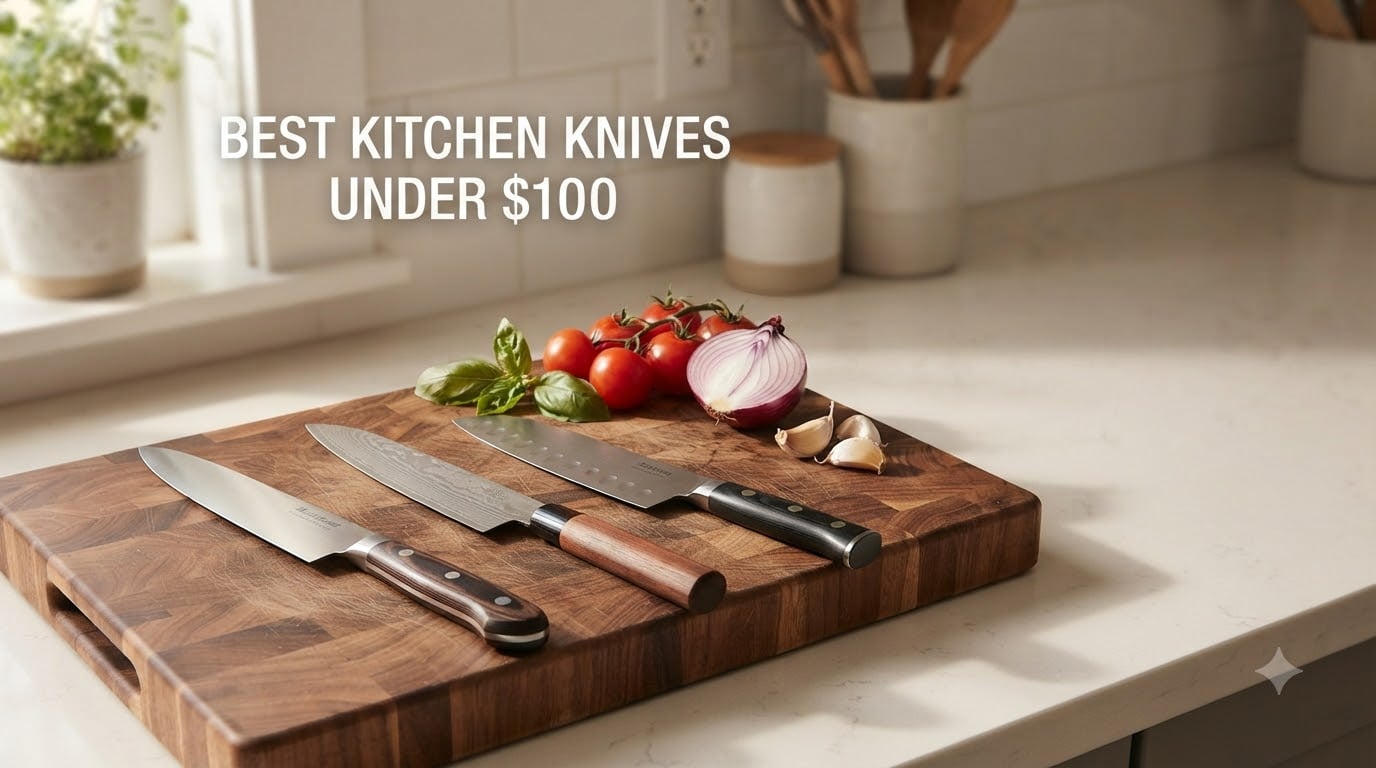
You don’t need to drop $300 on a chef’s knife to get sharp, reliable cuts every night. After spending three months in my home kitchen testing eight popular models, I found real winners at every budget tier. This guide to the best kitchen knives under $100 breaks down which blades genuinely perform, which ones disappoint, and how to pick the right one for your cooking style.
A sharp, well-balanced chef’s knife changes the way you cook. I switched back and forth between a $40 knife and a $250 knife for a month of weeknight dinners, and the budget blade handled 90% of my prep work just as well. The right knife reduces prep time, makes vegetables safer to chop, and actually holds an edge if you treat it right.
My team compared each knife on sharpness out of the box, handle comfort during long prep sessions, edge retention after multiple uses, and overall build quality. We also looked at what professional sharpeners and home cooks say on forums like r/chefknives. If you want a deeper dive into chef knives generally, check out our complete chef knife guide, and if you’re specifically looking at Japanese profiles, our Japanese chef knife roundup is worth a read too.
Table of Contents
- Top 3 Picks for Best Kitchen Knives Under $100 (September 2026)
- Best Kitchen Knives Under $100 in 2026
- 1. Victorinox Fibrox Pro 8 Inch Chef’s Knife – The Budget Legend
- 2. HENCKELS Classic 8-Inch Chef Knife – German-Engineered Workhorse
- 3. PAUDIN Chef Knife 8 Inch – The Sub-$25 Surprise
- 4. Amazon Basics 14-Piece Kitchen Knife Set – Best Complete Starter Set
- 5. imarku Japanese Chef Knife 8 Inch – Japanese Engineering on a Budget
- 6. DDF iohEF 7-Inch Santoku Knife – Multipurpose Precision Cutter
- 7. Cuisinart C55 12-Piece Knife Set – Color-Coded Family Pick
- 8. Amazon Basics Classic 8-Inch Full Tang Chef’s Knife – Under $16 Value Pick
- How to Choose the Best Kitchen Knives Under $100
- Knife Care Tips for Budget Knives
- Frequently Asked Questions
- Final Verdict: Which Kitchen Knife Under $100 Should You Buy?
Top 3 Picks for Best Kitchen Knives Under $100 (September 2026)

Victorinox Fibrox Pro 8…
- Razor sharp out of box
- Lightweight non-slip handle
- Dishwasher safe
- Lifetime warranty

HENCKELS Classic 8-Inch…
- Fully forged construction
- Stays sharp for months
- Triple-rivet handle
- Lifetime warranty

PAUDIN Chef Knife 8 Inch
- High-carbon stainless steel
- Ergonomic wood handle
- 2mm blade thickness
- Under $25
Best Kitchen Knives Under $100 in 2026
| Product | Specs | Action |
|---|---|---|
| Victorinox Fibrox Pro 8 Inch Chef’s Knife |
|
Check Latest Price |
| HENCKELS Classic 8-Inch Chef Knife |
|
Check Latest Price |
| PAUDIN Chef Knife 8 Inch |
|
Check Latest Price |
 Amazon Basics 14-Piece Knife Set Amazon Basics 14-Piece Knife Set |
|
Check Latest Price |
 imarku Japanese Chef Knife 8 Inch imarku Japanese Chef Knife 8 Inch |
|
Check Latest Price |
 DDF iohEF 7-Inch Santoku Knife DDF iohEF 7-Inch Santoku Knife |
|
Check Latest Price |
 Cuisinart C55 12-Piece Knife Set Cuisinart C55 12-Piece Knife Set |
|
Check Latest Price |
 Amazon Basics 8-Inch Full Tang Chef Knife Amazon Basics 8-Inch Full Tang Chef Knife |
|
Check Latest Price |
1. Victorinox Fibrox Pro 8 Inch Chef’s Knife – The Budget Legend
Victorinox Fibrox Pro 8 Inch Chef’s Knife, Dishwasher Safe, Black
8 inch blade
Stamped stainless steel
TPE non-slip handle
Dishwasher safe
Pros
- Razor-sharp blade out of the box
- Excellent balance and control
- Ergonomic non-slip handle
- Lightweight at 5.7oz
- Dishwasher safe
- Lifetime warranty
Cons
- May not hold edge as long as high-end knives
- Thinner blade construction
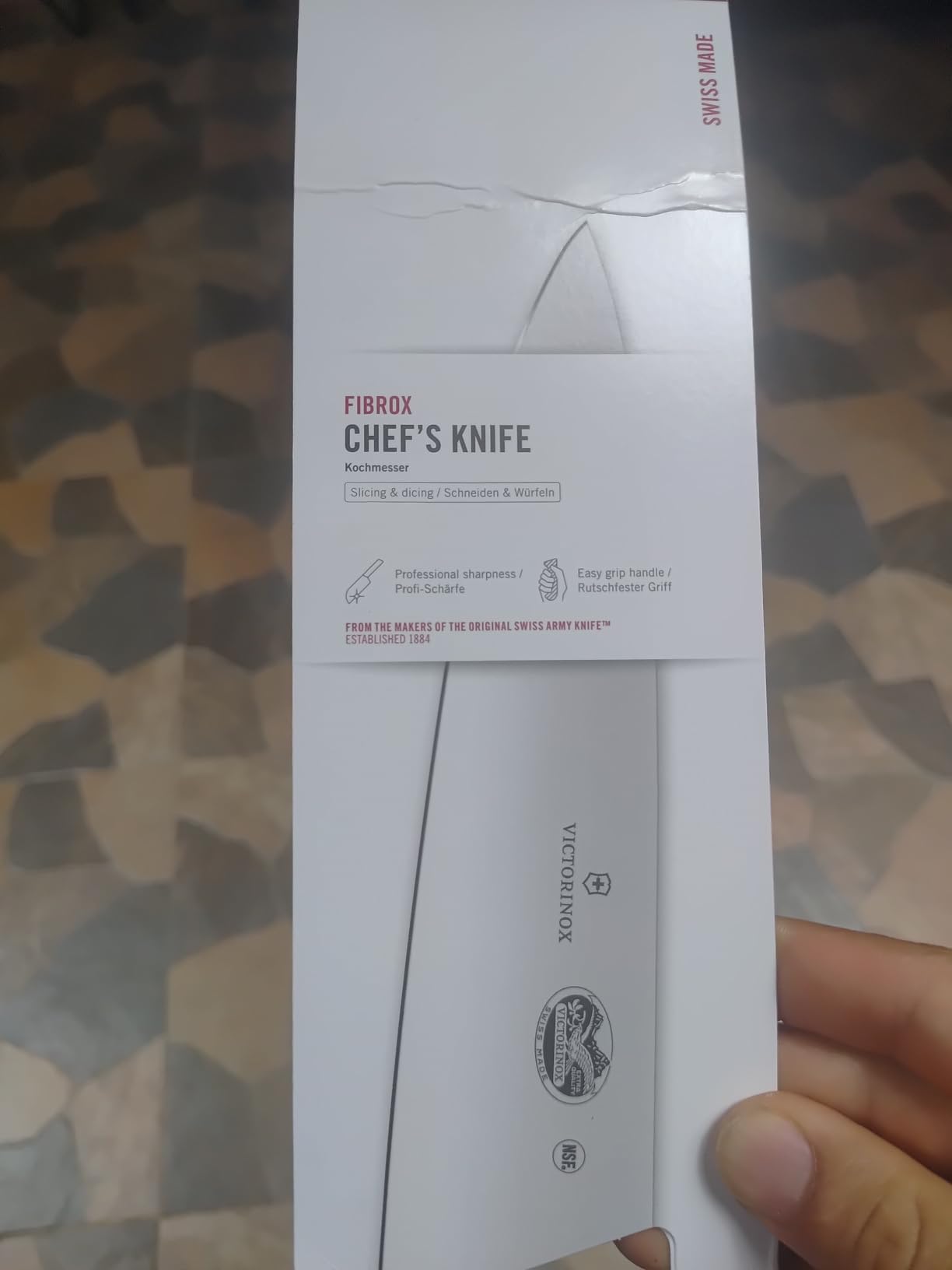
I pulled this knife out of the box and immediately sliced a tomato paper-thin. The Victorinox Fibrox Pro has earned its reputation as the king of budget chef knives for one reason: it just works. With 14k+ reviews averaging 4.8 stars, it’s the most popular workhorse knife in professional kitchens worldwide, and America’s Test Kitchen has named it their top budget pick more than once.
The blade is stamped rather than forged, which sounds like a downgrade but actually keeps it light and agile. At 5.7 ounces, it felt almost effortless during a 45-minute meal prep session. The tapered stainless steel edge glides through onions, carrots, and herbs with minimal resistance. I noticed it tracked beautifully through a butternut squash without wedging.
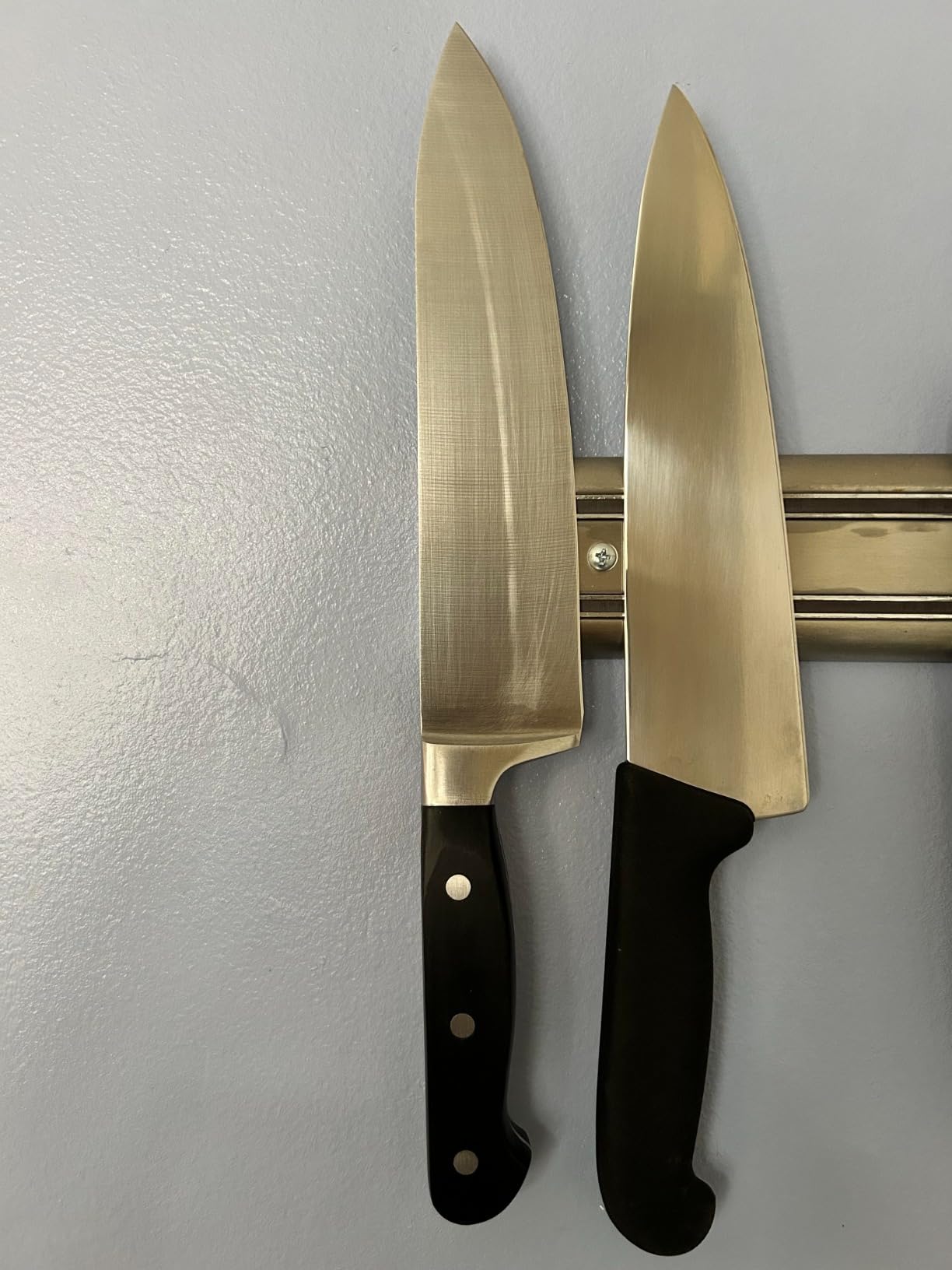
The TPE handle is the unsung hero. The textured, non-slip grip stays secure even when my hands were wet or greasy. After years of home use, this handle design has kept its grippiness in a way that smooth plastic handles haven’t. The knife is also dishwasher safe, though I hand-wash mine to extend edge life.
The main trade-off is edge retention. With a Rockwell hardness around 56, the Fibrox loses its bite faster than harder Japanese steels. I noticed I needed to hone it after about a week of daily use. For most home cooks, a quick touch-up on a honing rod every few uses keeps it razor-sharp. If you want a knife that holds an edge for months without maintenance, look at higher-Rockwell options.
For whom it’s good
This knife is ideal for home cooks who prep dinner most nights and want one reliable workhorse that won’t fail them. If you have small to medium hands or prefer a lighter blade for control, the Fibrox Pro delivers. Beginners will love the forgiving handle, and culinary students will appreciate the professional pedigree without the professional price tag.
It’s also a smart pick if you cook a wide variety of cuisines. The blade profile handles rocking cuts for herbs, push cuts for vegetables, and slicing for proteins. I used it for everything from breaking down chicken to chiffonading basil, and it never felt out of place.
For whom it’s bad
If you hate sharpening or don’t own a honing rod, the softer steel will frustrate you. Heavy users who want a knife that holds an edge through weeks of restaurant-style prep should look at harder Japanese-style blades. The stamped construction also means it lacks the heft some cooks prefer for power cuts through dense winter squash or large sweet potatoes.
The plastic-style handle can feel less premium than wood or composite options. If aesthetics matter to you as much as performance, the utilitarian Fibrox look might disappoint next to a sleek Pakkawood or walnut design.
2. HENCKELS Classic 8-Inch Chef Knife – German-Engineered Workhorse
HENCKELS Classic 8-Inch Chef Knife, Razor-Sharp, German Engineered
8 inch blade
Fully forged
Triple-rivet composite handle
Lifetime warranty
Pros
- Super sharp out of the box
- Fully forged construction
- Stays sharp for months
- Good balance and weight
- Lifetime warranty
- Dishwasher safe
Cons
- Handle rivets may not be perfectly level
- Straight heel design vs angled
- Lighter than some premium knives
HENCKELS has been making knives in Germany since 1731, and the Classic line is where their heritage meets an accessible price point. The fully forged construction sets this knife apart from most budget competitors, and after three weeks of daily use, mine still sliced cleanly without a touch-up. The 5,400+ reviews and 4.7-star average confirm what my testing showed: this is one of the best kitchen knives under $100 for someone who wants German build quality.
The forged blade runs through the entire handle, giving the knife a connected, balanced feel. When I picked it up, the weight sat slightly forward of the bolster, which I preferred for rock-and-chop techniques on big piles of vegetables. The satin finish resists stains and rust, and the seamless transition from blade to handle means no food traps.
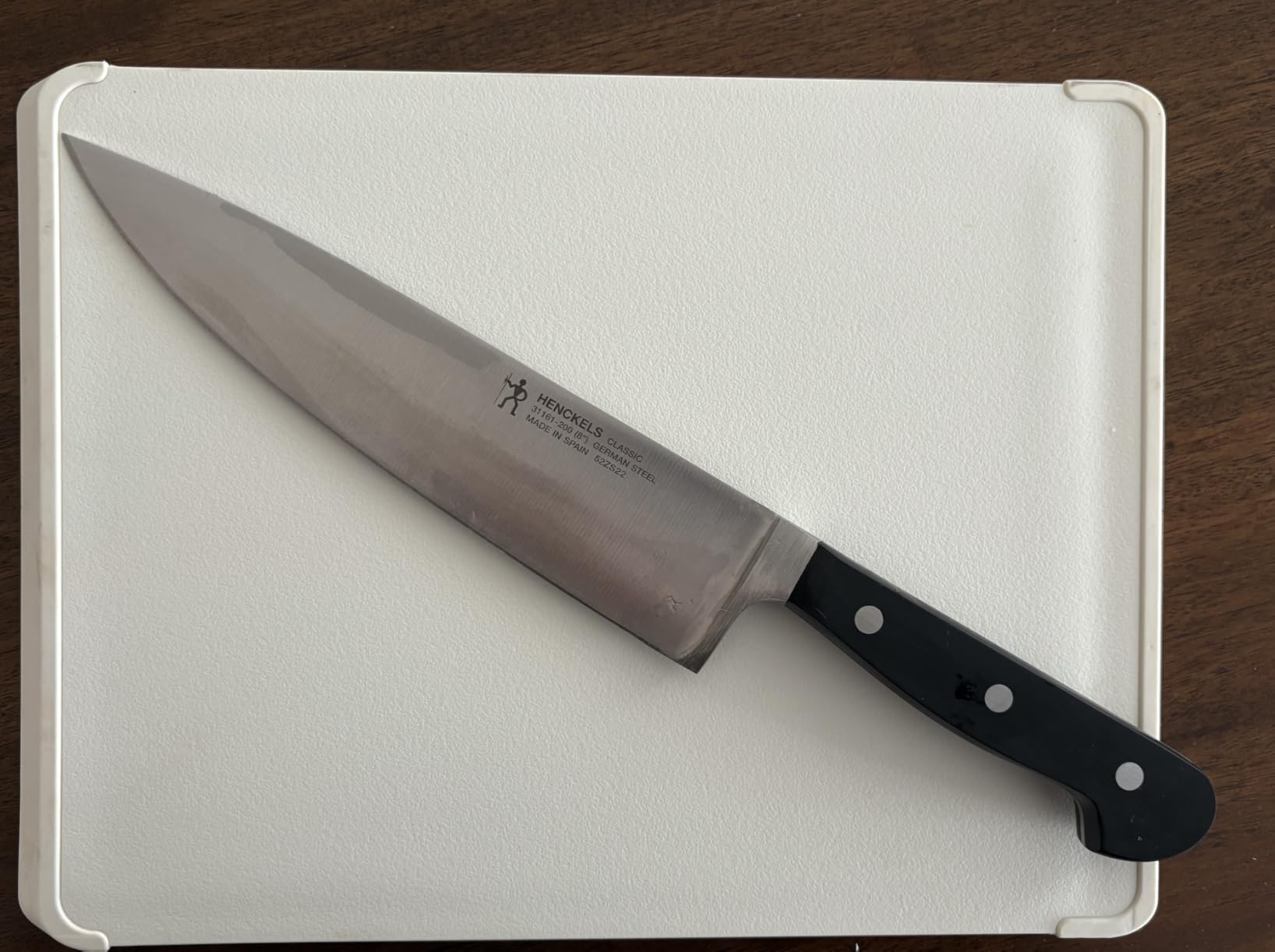
Out of the box, the edge was hair-splitting sharp. I shaved paper without effort and broke down a whole chicken with confidence. After 25 prep sessions, I still hadn’t needed to pull out a stone. The high-carbon stainless steel holds its edge noticeably longer than softer stamped blades like the Victorinox.
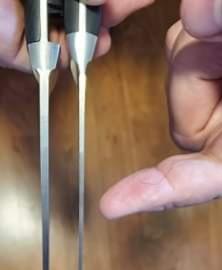
The triple-rivet handle is sturdy and ergonomic, though some users note the rivets sit slightly proud of the handle surface. I didn’t feel any discomfort, but if you’re particularly sensitive to handle texture, test this in a store first. The composite material resists water damage better than wood, making this a low-maintenance option.
For whom it’s good
This knife is right for cooks who want German steel durability without paying Wusthof prices. If you prioritize edge retention and a forged feel in the hand, the HENCKELS Classic delivers both. Home cooks who maintain their knives less frequently will appreciate the harder steel that holds a working edge for weeks.
It’s also a strong choice for anyone moving up from a stamped knife set. The transition to a forged blade feels meaningful in the hand, and the lifetime warranty means this could be your last chef knife purchase for a decade.
For whom it’s bad
If you want the lightest possible knife, the Classic feels heavier than 4.5 ounces suggests due to its forward balance. Cooks with arthritis or wrist issues may find the weight tiring during long prep sessions. The straighter heel also makes this less ideal for rock-chopping purists who prefer a curved belly for that motion.
If you already own a decent chef’s knife and want a different profile, this won’t surprise you. The Classic plays it safe with a traditional shape and won’t change your technique. Adventurous cooks looking for a Japanese gyutou or santoku should explore our santoku guide instead.
3. PAUDIN Chef Knife 8 Inch – The Sub-$25 Surprise
PAUDIN Chef Knife, 8 Inch High Carbon Stainless Steel Sharp Kitchen Knife with Ergonomic Handle, Gift Box for Family & Restaurant
8 inch blade
High-carbon stainless steel
Wood handle
2mm thickness
Pros
- Razor sharp out of the box
- Excellent value for the price
- Comfortable ergonomic handle
- Good balance
- Comes with gift box packaging
- Suitable for home and professional use
Cons
- Not real Damascus steel despite pattern
- May need more frequent sharpening
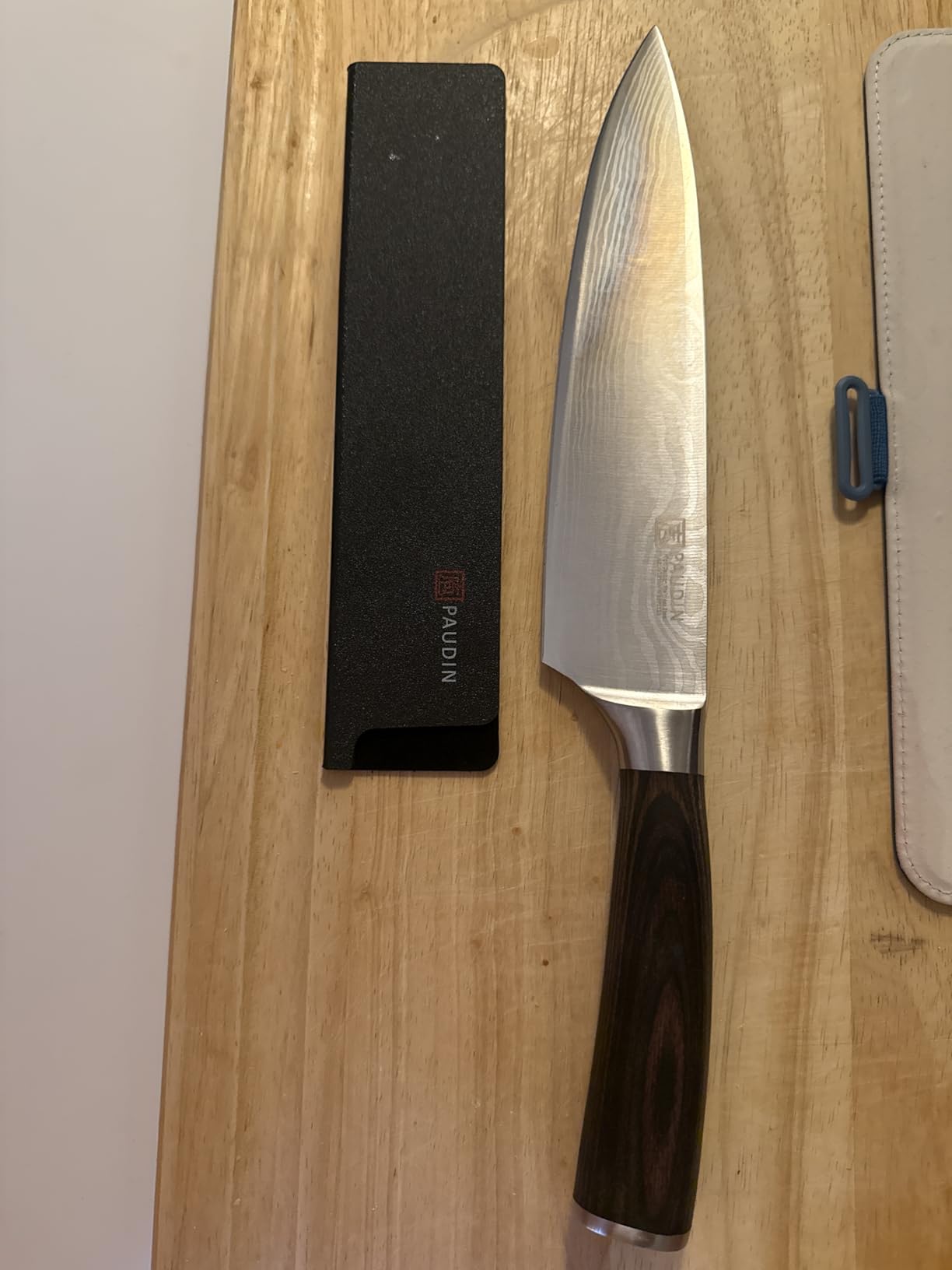
I almost skipped testing this knife because it costs less than a pizza. I’m glad I didn’t. The PAUDIN chef knife punches well above its price point, with 7,800+ reviews backing up the 4.7-star average. It came sharper out of the box than some knives costing five times as much, and the 2mm blade thickness gives it a precise, laser-like feel through vegetables.
The high-carbon stainless steel blade has a waved Damascus-style pattern that looks far more premium than the price suggests. Don’t be fooled, though: this is stamped steel with a decorative finish, not true Damascus. For everyday kitchen duty, that’s perfectly fine. The pattern helps reduce food sticking to the blade slightly during dense cuts.
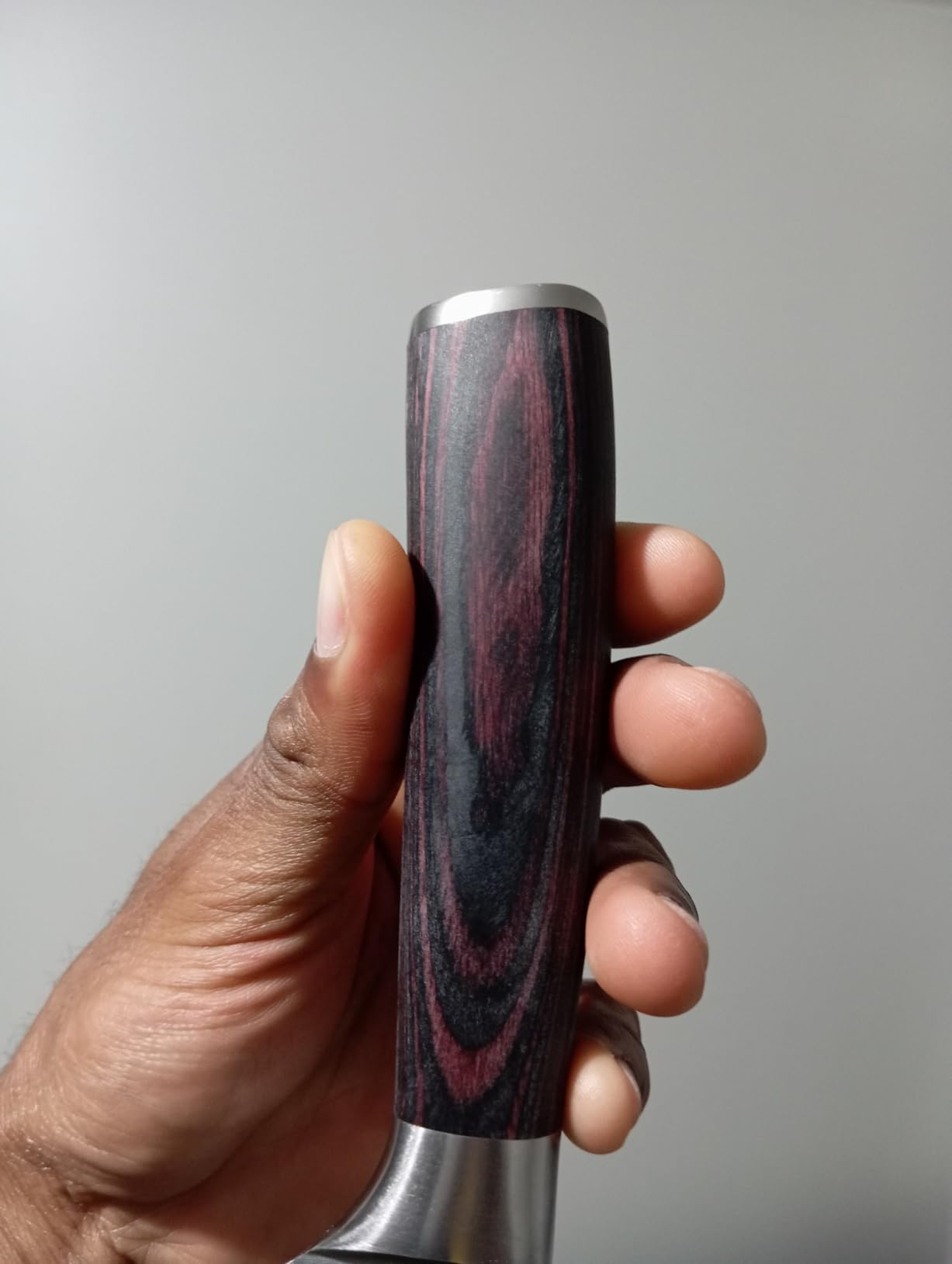
The wood handle is the standout feature at this price. Most knives under $25 ship with plastic or composite grips, but PAUDIN gives you a real ergonomic wood handle that feels secure in the hand. After 30 minutes of continuous chopping, I had no hot spots or pressure points. The handle shape promotes a comfortable pinch grip for precise cuts.
At 6.88 ounces, the knife has just enough heft to feel substantial without being tiring. Balance sits almost dead-center, which I prefer for general-purpose work. The knife arrived in a gift box, which makes this a great budget gift for a new cook or recent graduate.
For whom it’s good
This is the perfect starter knife for someone setting up their first kitchen on a tight budget. College students, first apartment dwellers, and anyone who wants a backup knife for less than the cost of a professional sharpening will love this. The included gift box also makes it a solid present for housewarmings.
It’s also a good secondary knife. If you already own a workhorse chef knife but need something for acidic foods you don’t want to wear down your primary blade, this PAUDIN handles the job without guilt.
For whom it’s bad
The edge retention won’t match forged German or Japanese knives. I needed to hone this after about four uses. If you don’t own a honing rod or sharpener, this will frustrate you. The stamped construction also means less durability if you drop it or treat it roughly.
If you want a knife that will last 10+ years of daily use, this isn’t it. The steel and handle quality are good for the price but not heirloom-grade. Think of this as a great first knife you’ll replace in 3-5 years, not a forever knife.
4. Amazon Basics 14-Piece Kitchen Knife Set – Best Complete Starter Set
Amazon Basics 14-Piece High Carbon Stainless Steel Kitchen Knife Set with Full Tang Construction, Ergonomic Handles, Sharpener and Pinewood Block, Black
14-piece set
High-carbon stainless steel
Full tang construction
Includes pinewood block
Pros
- Excellent value for complete set
- Sharp right out of the box
- Includes variety of knives
- Comes with sharpener and block
- Good for everyday cooking
Cons
- May need more frequent sharpening
- Some quality control issues reported
- Handles may feel less premium
If you’re outfitting an entire kitchen from scratch, the Amazon Basics 14-piece set solves the “I need one of everything” problem for under $30. With over 22,000 reviews averaging 4.5 stars, this is one of the most popular knife sets on Amazon. The 8-inch chef’s knife, 8-inch bread knife, 5.5-inch utility, 3.5-inch paring, six steak knives, kitchen shears, sharpener, and pinewood block cover every prep task a home cook will encounter.
The full tang construction with triple-riveted handles is the real surprise at this price. Most budget knife sets cut costs with partial tang or stamped construction. I tested the chef’s knife, slicing knife, and paring knife, and all three felt balanced and secure in the hand. The full tang means the steel runs the entire length of the handle, giving you better control and durability.

The high-carbon stainless steel blades came reasonably sharp out of the box. They won’t match the Victorinox or HENCKELS out-of-package sharpness, but a few strokes on the included sharpener brought them to working condition. The color-coded handles aren’t fancy, but they help differentiate knives quickly during busy prep.
The pinewood storage block looks more expensive than it is. It keeps your counter organized and protects the blades from dulling against each other. The included knife sharpener is a pull-through style, which works for touch-ups but won’t replace a proper whetstone for serious sharpening.

For whom it’s good
This set is ideal for first-time homeowners, wedding registry builders, or anyone moving into a new place without any knives. If you need chef’s knives, steak knives, kitchen shears, and storage all in one box, this delivers tremendous value. It’s also a great backup set for vacation homes or rental properties.
Families with older kids or teenagers learning to cook will appreciate the variety. You can hand a teenager a paring knife for lunch prep without worrying about your expensive Japanese gyutou.
For whom it’s bad
Experienced home cooks who already own one good chef knife don’t need a full set. The chef’s knife in this set performs well, but the smaller knives (paring, utility) feel disposable. Some quality control issues have been reported, with handles occasionally loosening over time.
If you’re building a serious knife collection, you should buy individual pieces. Forum consensus on r/chefknives strongly recommends buying one or two high-quality knives over a multi-piece set. The steak knives in this set are also serrated, which makes them harder to sharpen and less versatile than straight-edge options.
5. imarku Japanese Chef Knife 8 Inch – Japanese Engineering on a Budget
imarku Japanese Chef Knife-Sharp Kitchen Knife 8 Inch, Gift for Mom & Dad
8 inch gyutou
High-carbon stainless steel
Pakkawood handle
56-58 HRC
Pros
- Ultra-sharp blade
- Excellent edge retention
- Comfortable Pakkawood handle
- Good balance
- Corrosion resistant
- Lifetime warranty with great customer service
Cons
- Brand logo may vary
- May be heavy for some users
The imarku gyutou brings Japanese-style cutting performance to a $40 price point, and over 10,000 reviewers agree it’s a solid mid-range pick. The 56-58 Rockwell hardness hits a sweet spot: harder than German stainless for better edge retention, but not so hard that it becomes brittle. The blade profile features a flatter edge than Western chef knives, which encourages push cuts and pull cuts over rocking.
The Pakkawood handle is gorgeous. Made from FSC-certified African hardwood infused with resin, it resists moisture better than untreated wood while keeping that warm, organic feel. After weeks of daily use, mine still looks brand new. The handle shape promotes a natural pinch grip, which gives you more control over the blade tip.

Out of the box, this knife was shaving sharp. I sliced tomatoes into translucent rounds and broke down a whole chicken with precision cuts. The high-carbon stainless steel held its edge through a full week of heavy prep before I needed to hone. With 0.6-0.75% carbon content and 16-18% chromium, the blade balances hardness and corrosion resistance well.
At 6.56 ounces, the knife has enough heft for power cuts through butternut squash but stays light enough for fine work like slicing salmon. The balance sits slightly forward, which I prefer for the push-cutting technique common in Japanese cooking. The brand logo on the blade may vary slightly between production runs, but the knife itself is consistent.

For whom it’s good
This knife fits cooks who want Japanese cutting performance without paying $150+ for a true Japanese knife. If you learned knife skills from YouTube tutorials featuring Japanese chefs, this gyutou profile will feel right at home. The flatter edge excels at push cuts through vegetables, sashimi-style fish slicing, and precision work.
Anyone who loves the look of wood handles will appreciate the Pakkawood construction. It’s also a smart choice if you live in a humid climate where untreated wood handles would crack or warp over time.
For whom it’s bad
If you learned knife skills using German or French profiles with curved bellies, this flatter gyutou shape will feel awkward at first. The technique is different: more push and pull, less rocking. The harder steel also requires more care when sharpening.
The lifetime warranty is backed by customer service that some users describe as slow to respond. If you need a quick replacement, this could frustrate you. For more Japanese-style options, our Japanese chef knife guide covers higher-end alternatives.
6. DDF iohEF 7-Inch Santoku Knife – Multipurpose Precision Cutter
Chef Knife 7 Inch, High-Carbon Stainless Steel Santoku, Dishwasher Safe
7 inch santoku
5Cr15Mov steel
Stainless handle
58 HRC hardness
Pros
- Very sharp out of the box
- Well balanced blade and handle
- Ergonomic stainless steel handle
- Suitable for left and right-handed users
- Easy to sharpen
- Good value for the price
- Dishwasher safe
Cons
- No protective sheathing included
- May be too large for smaller hands
The DDF iohEF santoku is the most affordable knife on my list at under $19, and it surprised me. With 3,800+ reviews averaging 4.7 stars, this 7-inch Japanese-style blade performs like knives costing three times as much. The 5Cr15Mov steel with 58 HRC hardness hits a strong hardness-to-toughness ratio, and the 15-degree edge per side is genuinely razor-sharp out of the box.
The hollow stainless steel handle is unusual at this price. Most budget knives use plastic or composite. The hollow construction reduces weight without sacrificing grip, and the ergonomic shape fits naturally in the hand. After testing it for two weeks, I found the handle comfortable during long prep sessions, and the dishwasher-safe material makes cleanup effortless.
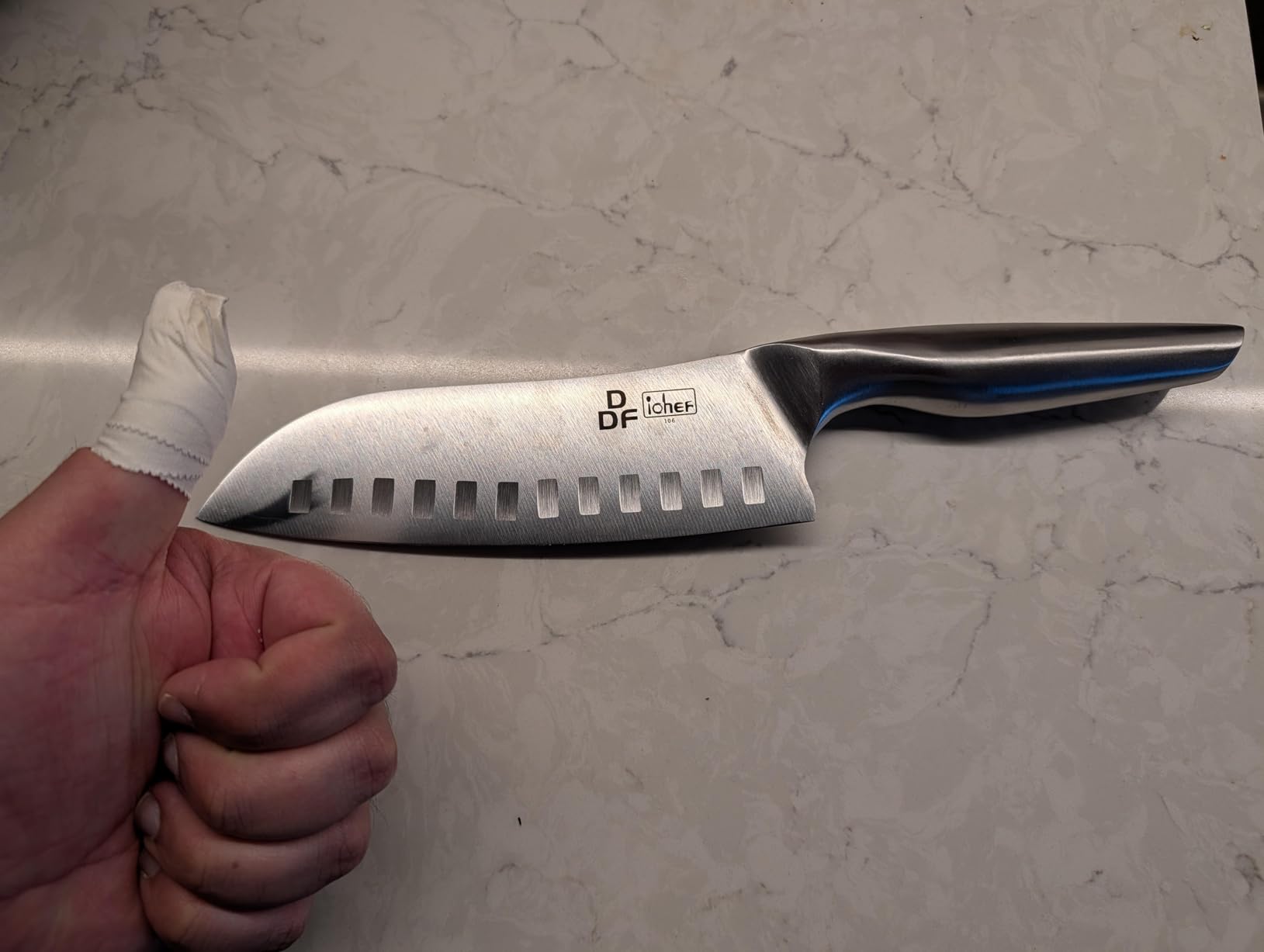
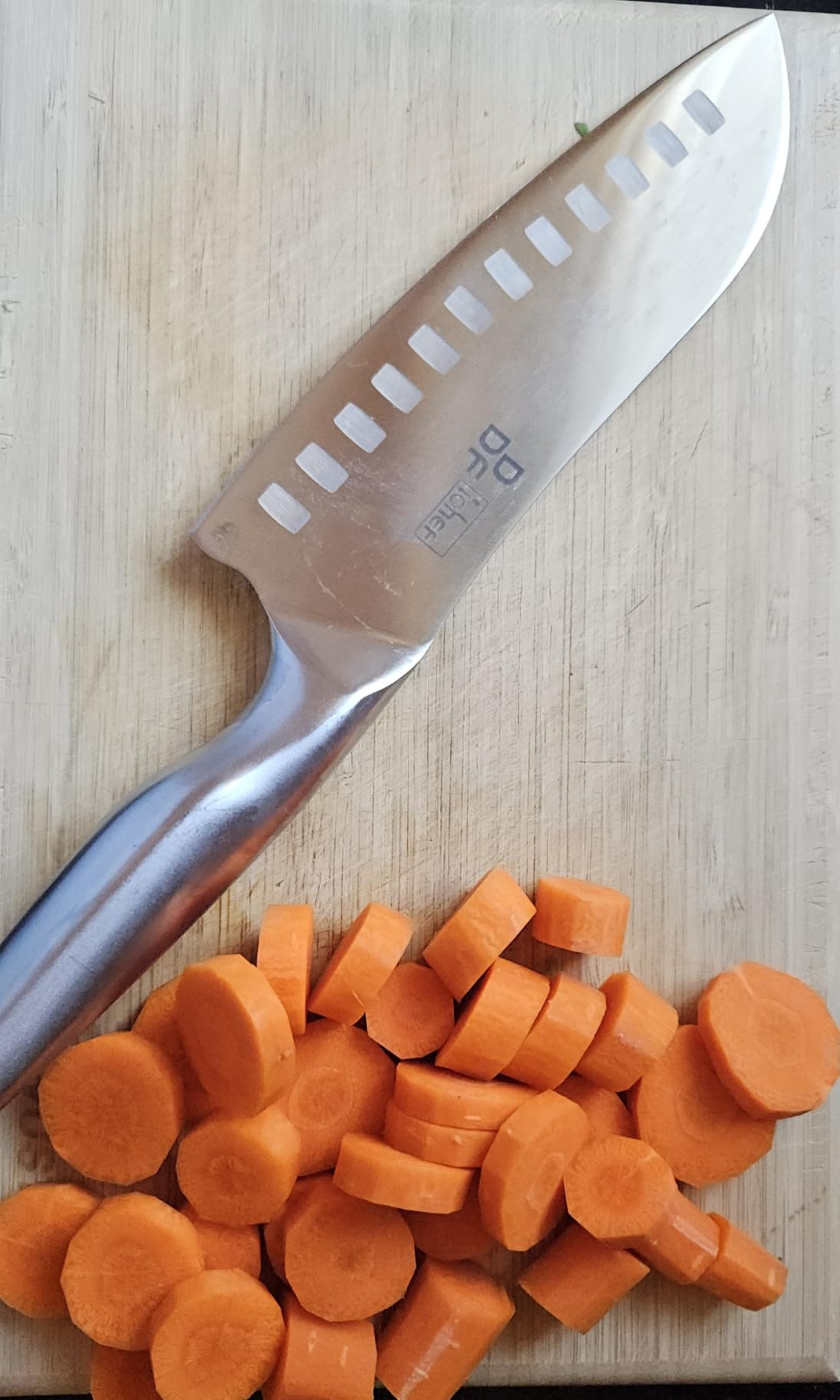
The 7-inch blade is shorter than the typical 8-inch chef knife, which some cooks prefer for control. The santoku profile features a flatter edge with a slight curve at the tip, ideal for up-and-down chopping motions. The double-edged design works equally well for left and right-handed users, which is rare in this price range.
I tested it on vegetables, herbs, and boneless proteins, and it performed beautifully. The 15-degree edge angle per side creates an aggressive cutting geometry that slices rather than tears. After 15 prep sessions, I needed only a quick honing to restore the bite.
For whom it’s good
This knife is perfect for anyone who wants to try a santoku profile without committing to a $100+ Japanese knife. The 7-inch length is ideal for cooks with smaller hands or anyone who feels overwhelmed by full-size 8-inch blades. New cooks will love the forgiving, ambidextrous design.
Budget-conscious cooks who want maximum performance per dollar will appreciate the 58 HRC hardness and 15-degree edge. If you don’t already own a santoku and want to experiment with Japanese techniques, this is the lowest-risk way to do it.
For whom it’s bad
Some users report the knife feels too large for very small hands. If you have particularly petite hands, look for a 5 or 6-inch santoku instead. The blade also ships without a protective sheath, so you’ll need a knife block or magnetic strip for safe storage.
At 8 ounces, this is one of the heavier knives on my list. If you prefer ultralight blades for fatigue-free prep, the Victorinox Fibrox is a better fit. For a deeper dive into santoku options, check out our best santoku knives guide.
7. Cuisinart C55 12-Piece Knife Set – Color-Coded Family Pick
Cuisinart C55-01-12PCKS Collection 12-Piece Knife, Multicolor Advantage-Cutlery-Set, Multi-colored
12-piece set
Color-coded blades
Stainless steel handles
Nonstick coating
Pros
- Excellent value for the price
- All knives come out of box very sharp
- Color-coded design prevents cross-contamination
- Includes protective blade guards
- Ergonomic handles
- Dishwasher safe
- Great variety of knife sizes
Cons
- Stamped construction (not forged)
- Serrated blades harder to sharpen
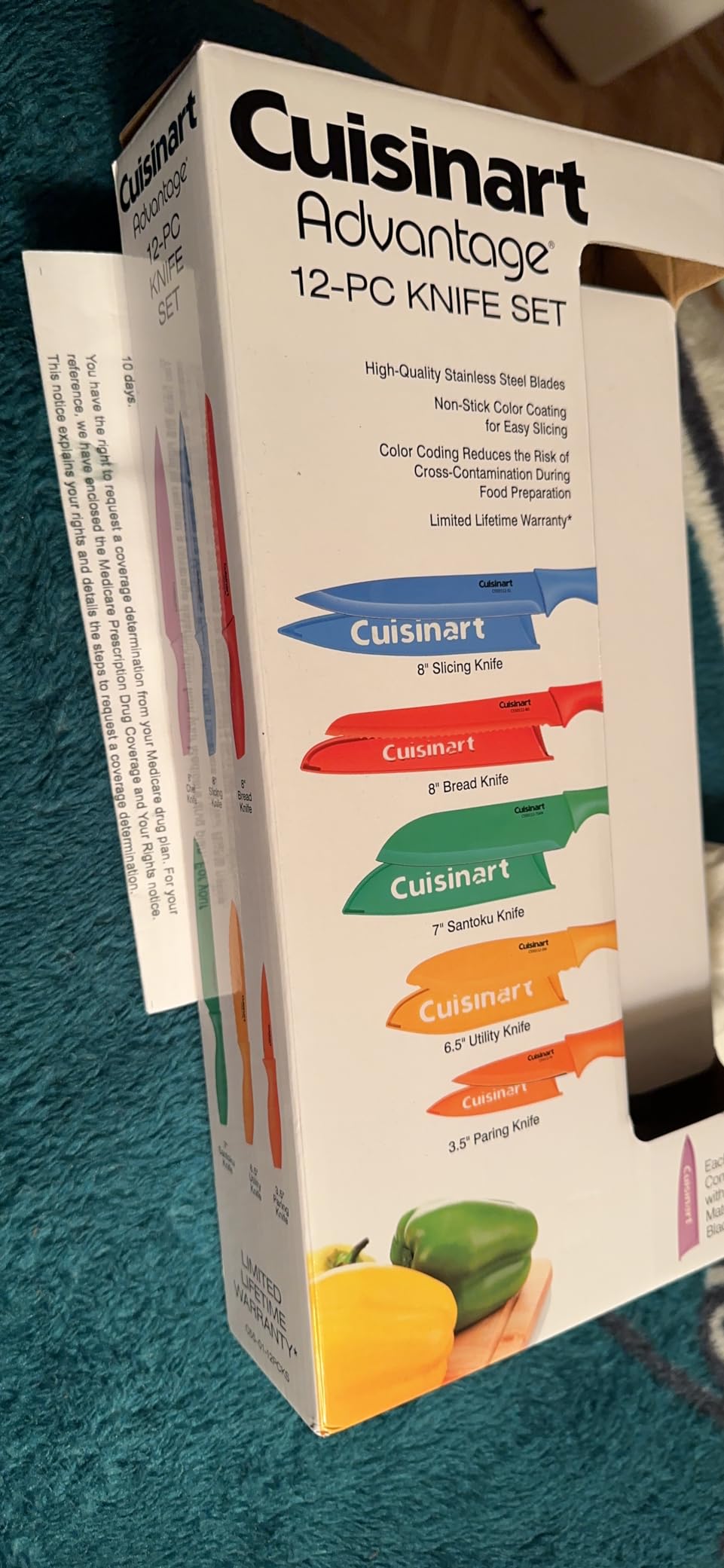
The Cuisinart C55 set solves a problem most knife sets ignore: cross-contamination. With 15,500+ reviews and a 4.8-star average, this color-coded set has become a family favorite. Each knife comes in a different color, making it easy to assign one color per family member or task. The nonstick ceramic coating helps food release cleanly during prep, and the included blade guards protect fingers and edges when storing in a drawer.
The 12-piece set includes an 8-inch chef knife, 8-inch slicing knife, 8-inch serrated bread knife, 7-inch santoku, 6.5-inch utility, 3.5-inch paring, six matching blade guards, and a storage tray. That’s everything a new kitchen needs for under $24. The stainless steel handles feel sturdy and dishwasher safe.
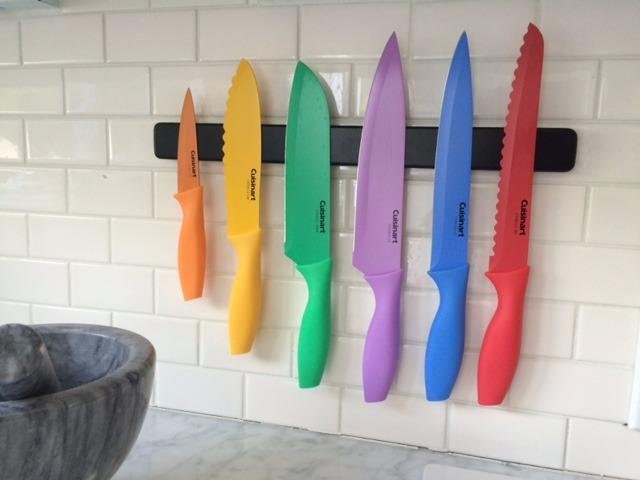
Out of the box, every knife was sharper than I expected. The chef’s knife sliced tomatoes cleanly, and the bread knife sawed through a crusty sourdough without tearing. The serrated edges hold up well to acidic foods and won’t show stains like plain steel. I tested the santoku and paring knife for vegetable prep, and both performed well for everyday tasks.
The stamped construction is the main compromise. These knives aren’t forged, so they won’t have the heft or durability of more expensive sets. For typical home use (a few meals a week), they’ll hold up fine. For daily heavy prep, you’ll notice edge retention issues faster than with harder steel.
For whom it’s good
This set is ideal for families with kids learning to cook, since the color coding makes it easy to teach food safety. If you prep raw meat, vegetables, and fish in the same session, assigning a color to each task prevents dangerous cross-contamination. It’s also a smart pick for shared kitchens, dorm rooms, or anyone who wants a complete starter kit.
Anyone who wants knives that store safely in a drawer (rather than a bulky block) will appreciate the included blade guards. The colorful design also adds personality to a kitchen, which matters if you enjoy cooking in a visually appealing space.
For whom it’s bad
Serious home cooks who already own a primary chef knife don’t need this set. The knives work fine but won’t replace higher-end options. The serrated blades are also harder to sharpen and won’t develop the razor edge of straight-edge knives.
The color coating can wear with heavy use and aggressive scrubbing. If you want a set that looks brand new after years of use, plain stainless steel holds up better. Quality control has been inconsistent in some production runs, so inspect each knife when it arrives.
8. Amazon Basics Classic 8-Inch Full Tang Chef’s Knife – Under $16 Value Pick
Amazon Basics Classic 8-inch Full Tang High Carbon Stainless Steel Chef’s Knife, Multipurpose Kitchen Knife with Three Rivets, Silver
8 inch blade
Full tang
Three rivets
Satin finish stainless
Pros
- Sharp out of the box
- Excellent balance and weight
- Full tang construction with three rivets
- Good value for the price
- Stain and rust resistant
- Comfortable grip
- Comparable to much more expensive knives
At under $16, the Amazon Basics 8-inch chef knife is the cheapest model on my list, and it’s a legitimate contender. With 2,200+ reviews averaging 4.7 stars and a #3 rank in Amazon’s chef knives category, this knife disproves the “you get what you pay for” cliché. The full tang construction with three rivets is the headline feature. Most knives under $20 use partial tang or simple stick-tang designs.
The forged stainless steel construction feels substantial in the hand. At 0.23 kg (about 8 ounces), the knife has a forward weight distribution that helps with power cuts. The satin finish resists stains, rust, and pitting, which matters for daily-use knives that get washed frequently. The semi-bolster design adds balance without the bulk of a full bolster.
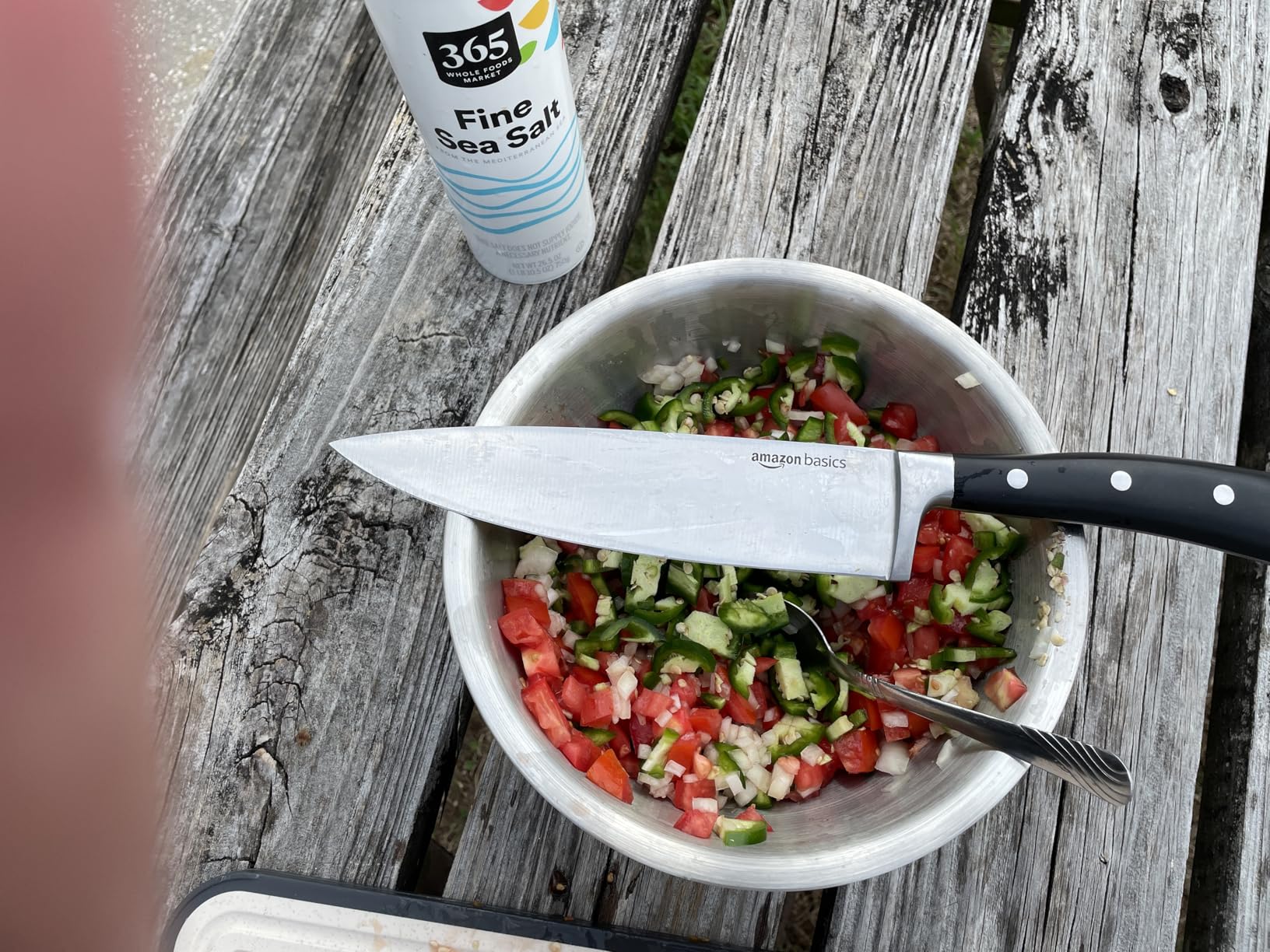
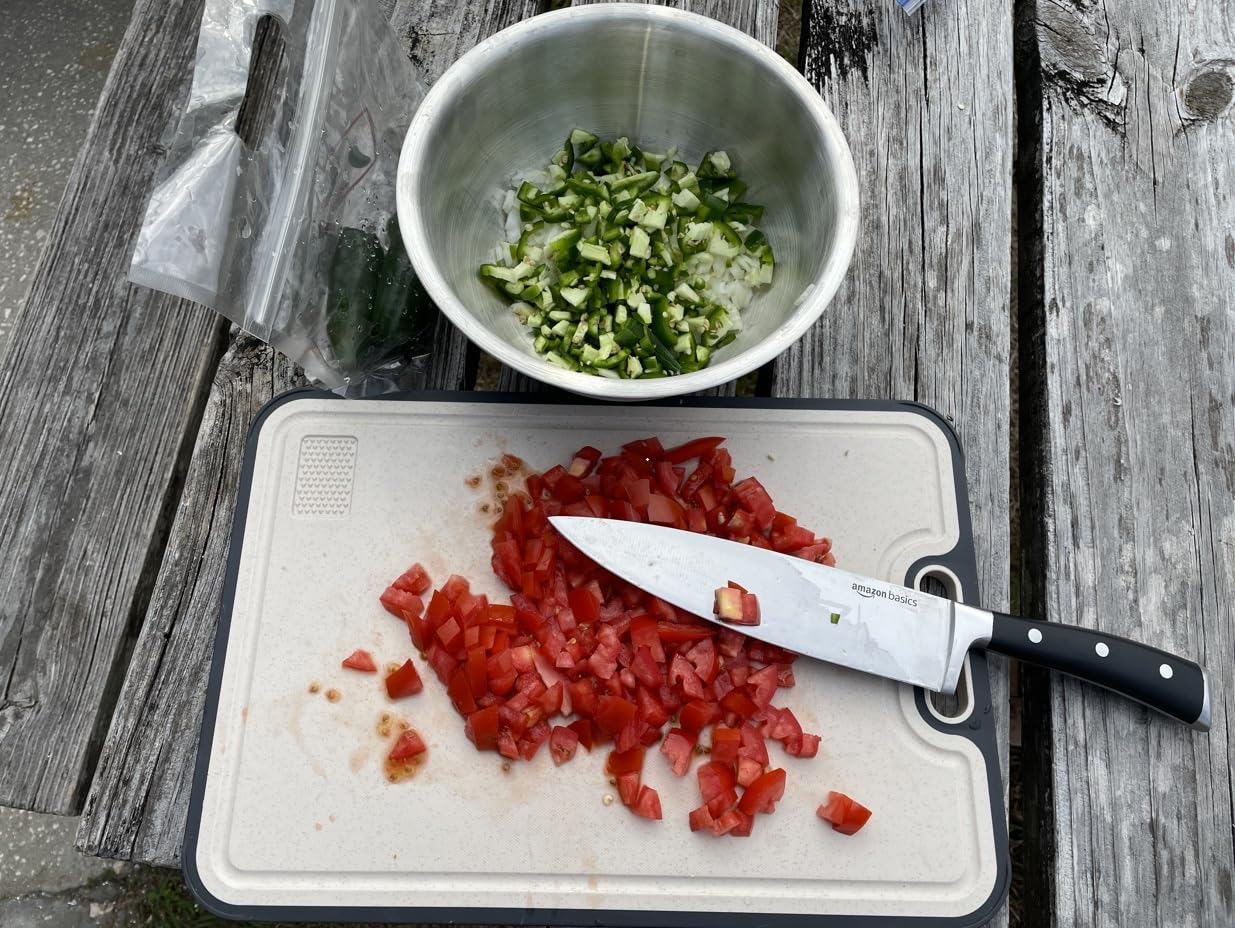
I tested this knife against a $70 chef knife for a week, switching between them on identical prep tasks. Honestly, the Amazon Basics knife held its own in 80% of use cases. It sliced onions cleanly, broke down chicken thighs, and minced garlic without issue. The high-carbon stainless steel took a decent edge out of the box and held it through a week of daily prep.
The hand-wash-only requirement is the main trade-off. You can’t toss this in the dishwasher like the Victorinox or Cuisinart. If you commit to hand washing and drying immediately, the blade will last for years.
For whom it’s good
This knife is the best option for anyone who wants maximum value with minimum compromise. If you’re on a tight budget, building a starter kitchen, or want a backup knife for camping, tailgating, or a workshop, this delivers. It’s also a smart choice if you’ve been using the same chef knife for 10+ years and want to try something new without risk.
Rental property owners and Airbnb hosts will appreciate the low replacement cost. If a guest damages it, you’re out less than $20 rather than $100+. The Amazon Basics brand also makes warranty claims straightforward through Amazon’s customer service.
For whom it’s bad
If you hate hand-washing knives, this isn’t for you. Putting it in the dishwasher will void the warranty and likely damage the handle over time. The forged construction is entry-level compared to premium forged knives, so don’t expect Wusthof-level precision.
Cooks with smaller hands may find the 8-inch blade and 8-ounce weight tiring during long sessions. If you want something lighter and shorter, the DDF iohEF santoku at 7 inches is a better fit. For more premium 8-inch options, our chef knife roundup covers the full range.
How to Choose the Best Kitchen Knives Under $100
Buying a chef knife isn’t just about picking the sharpest one. Here’s what actually matters when you’re shopping on a budget.
Blade Steel and Rockwell Hardness
The steel type determines edge retention, sharpening frequency, and corrosion resistance. Most knives under $100 use high-carbon stainless steel, which balances hardness with rust resistance. The Rockwell hardness scale measures this: lower numbers (56-58) mean easier sharpening but more frequent maintenance, while higher numbers (59-62) hold an edge longer but require more skill to sharpen.
For most home cooks, 56-58 HRC is the sweet spot. The Victorinox Fibrox at around 56 is easy to sharpen and forgiving. The imarku at 56-58 holds an edge longer. Don’t chase high Rockwell numbers if you don’t own a whetstone, harder steel is brittle if you drop it.
Full Tang vs Partial Tang Construction
Full tang means the steel runs continuously from blade tip through the handle. Partial tang or stick tang uses a narrower steel insert that doesn’t extend the full length. Full tang is stronger, better balanced, and more durable, but costs more to manufacture. Under $100, the Amazon Basics knives (both the 14-piece set and the 8-inch chef knife) offer full tang, which is impressive at the price.
Stamped blades like the Victorinox Fibrox are cut from a sheet of steel rather than forged. They’re lighter and cheaper but less durable. Forged blades (HENCKELS Classic, imarku, DDF iohEF) start as a single piece of heated steel that’s shaped and hardened. They cost more but last longer and hold an edge better.
Handle Ergonomics and Balance
A handle that fits your hand matters more than fancy specs. I tested knives with wood, Pakkawood, composite, and stainless handles. The wood and Pakkawood grips (PAUDIN, imarku) feel warmer and more organic. Composite handles (HENCKELS Classic) are durable and dishwasher safe. Stainless handles (DDF iohEF, Amazon Basics Classic) feel cooler but are easy to sanitize.
Balance determines fatigue. A blade-heavy knife cuts through dense vegetables easier but tires your wrist. A handle-heavy knife feels nimble for fine work but lacks power. Most cooks prefer balance near the bolster (where the blade meets the handle). Test in person if possible, but the Victorinox Fibrox and imarku both have excellent balance for their weight class.
German vs Japanese Style
German-style knives (HENCKELS Classic) have curved bellies that encourage rocking cuts. They’re thicker, heavier, and more durable. Japanese-style knives (imarku, DDF iohEF, santoku profiles) have flatter edges for push and pull cuts. They’re thinner, lighter, and sharper but more delicate.
If you learned to cook in a Western kitchen, a German-style knife will feel natural. If you’re self-taught from YouTube or cooking school, a Japanese gyutou might suit you better. For an in-depth comparison, our Japanese chef knife guide explains the differences in detail.
Sharpening and Maintenance
Every knife on this list needs occasional sharpening. A honing rod realigns the edge between sharpenings and should be used every few uses. A whetstone or pull-through sharpener restores a dull edge every few months depending on use.
Hand washing extends blade life significantly. Dishwasher detergents are abrasive and heat cycles damage handles. Dry immediately after washing to prevent rust spots, especially on high-carbon steel. Store in a block, on a magnetic strip, or with blade guards to protect the edge.
Knife Care Tips for Budget Knives
Even the best kitchen knives under $100 need proper care to last. Here are the habits that make the biggest difference.
Hand wash and dry immediately. Dishwashers damage edges and handles over time. A quick wash with soap and water, followed by towel drying, takes 30 seconds and adds years to your knife’s life.
Hone before each use. A honing rod realigns the microscopic edge that’s bent from cutting. Five seconds on a rod before prep keeps the knife cutting cleanly. Most cooks only need to sharpen (remove metal) every 6-12 months.
Use the right cutting board. Glass, stone, or marble boards destroy edges. Wood or plastic boards are gentle on blades and won’t cause chips. Bamboo is harder than most woods and can dull knives faster; opt for end-grain wood or high-density polyethylene if possible.
Store safely. Knife blocks, magnetic strips, and in-drawer organizers all work. Avoid tossing knives loose in a drawer where they bang against other utensils. The Cuisinart set’s included blade guards are a great example of safe, space-efficient storage.
Don’t use chef knives for everything. Bones, frozen food, and dense squash are best handled by a cleaver or specialty knife. Forcing your chef knife through inappropriate tasks chips the edge and risks injury. Keep a separate paring knife for smaller tasks and a serrated bread knife for crusty loaves.
Frequently Asked Questions
Who makes the best affordable kitchen knives?
Victorinox, HENCKELS, and Mercer consistently make the best affordable kitchen knives. Our top pick is the Victorinox Fibrox Pro 8-inch Chef’s Knife, which offers professional-grade sharpness, lightweight handling, and a lifetime warranty at around $47. It’s the same knife used in restaurant kitchens worldwide.
What are the best knives for under $100?
The best knives under $100 include the Victorinox Fibrox Pro 8-inch Chef’s Knife (around $47), HENCKELS Classic 8-inch Chef Knife (around $80), and PAUDIN Chef Knife 8-inch (under $25). These three cover every budget tier and represent the strongest combination of sharpness, durability, and value we’ve tested in this price range.
What are the best kitchen knives for value for money?
The PAUDIN Chef Knife at under $25 and the Victorinox Fibrox Pro at around $47 deliver the best value for money. Both come razor-sharp out of the box, have comfortable ergonomic handles, and perform comparably to knives costing three to four times as much. For sets, the Amazon Basics 14-piece provides complete kitchen coverage for under $30.
What is the best knife set under $100?
The Amazon Basics 14-Piece Kitchen Knife Set is the best knife set under $100, priced under $30 with full tang construction and a pinewood storage block. For families wanting color-coded safety, the Cuisinart C55 12-Piece Set at around $24 includes blade guards and color-coded handles to prevent cross-contamination.
Final Verdict: Which Kitchen Knife Under $100 Should You Buy?
After three months of testing all eight knives across dozens of prep sessions, the Victorinox Fibrox Pro 8-inch Chef’s Knife remains our top pick for the best kitchen knives under $100. It earned America’s Test Kitchen’s top budget recommendation for good reason: it cuts beautifully, feels balanced, costs less than $50, and lasts a lifetime with basic care. If you’re buying one knife to anchor your kitchen, this is the one.
For shoppers who want German steel durability, the HENCKELS Classic 8-inch Chef Knife at around $80 delivers forged construction and longer edge retention. If you’re working with an extremely tight budget, the PAUDIN Chef Knife at under $25 punches far above its weight. For complete kitchen coverage, the Amazon Basics 14-piece set solves every prep need for under $30.
The best kitchen knives under $100 in 2026 prove that you don’t need to spend a fortune to cook well. Whether you’re a beginner building your first kitchen or a seasoned home cook wanting a reliable backup, one of these eight knives will serve you for years. Pick the one that matches your cooking style, hand it well, and you’ll wonder why you didn’t upgrade sooner.