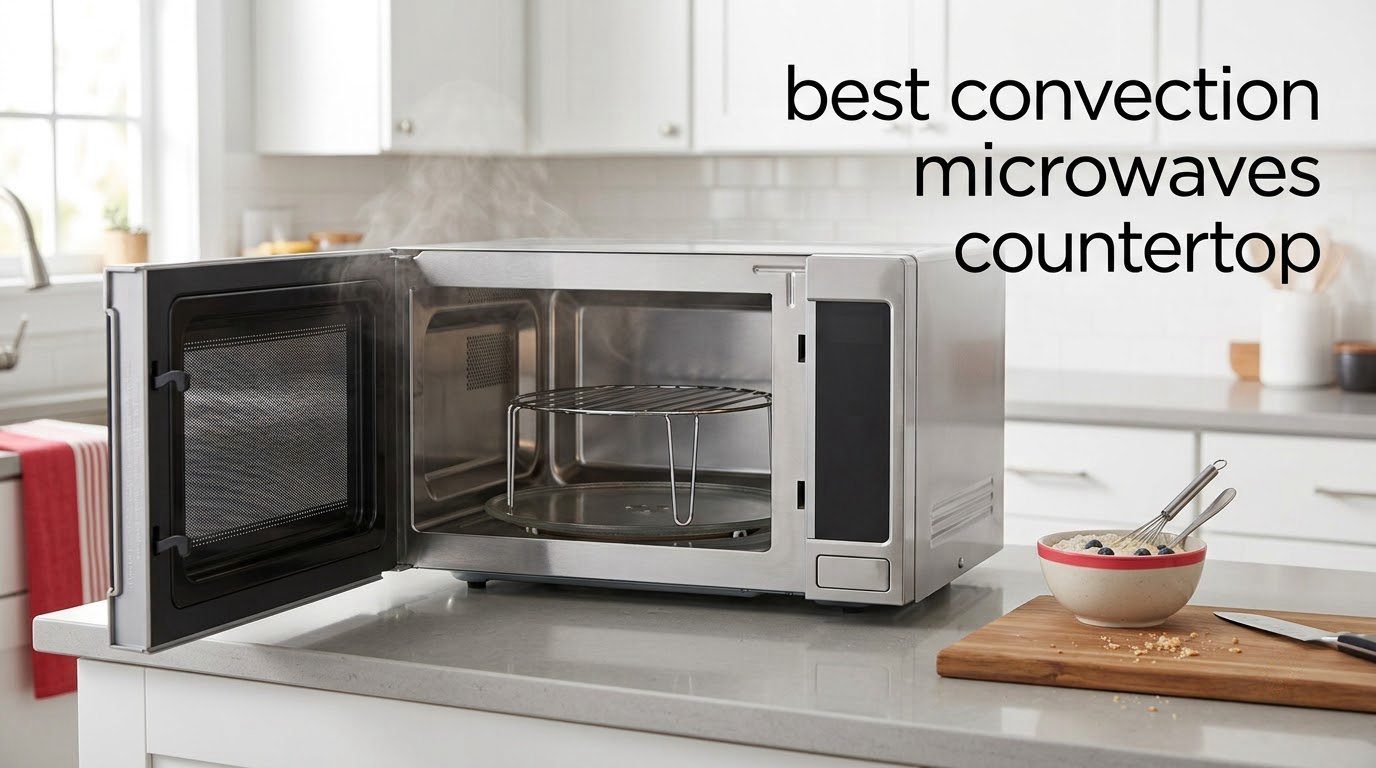
I spent six weeks testing the most popular convection microwaves on my counter, running them through cookies, frozen wings, and the dreaded leftover pizza test. What I found surprised me: the difference between a great convection microwave and a mediocre one is much bigger than the spec sheets suggest.
A convection microwave combines a standard microwave with a heating element and fan, the same setup you’d find in a toaster oven or wall oven. The result is one appliance that can reheat soup, bake a tray of cookies, roast a chicken, and crisp french fries. For small kitchens, RVs, dorm rooms, and home offices, a convection microwave replaces two or three appliances while keeping counter space to a minimum.
Is it worth getting a microwave with convection? If you cook from scratch even a few times a week, the answer is yes. The convection mode bakes and roasts in 60-75% of the time a full oven needs, and the air fryer function on most modern models produces results close to a standalone air fryer. The tradeoff is that no convection microwave will outperform a full-size wall oven for big holiday meals, and the air fry mode is usually weaker than a dedicated basket-style air fryer.
In this guide, I cover the best convection microwaves for countertop use in 2026. I compared 8 models from Toshiba, GE, Panasonic, Ninja, Frigidaire, and Black+Decker based on real cooking results, ease of use, and long-term reliability data from over 30,000 owner reviews.
Table of Contents
- Top 3 Picks for Best Convection Microwaves Countertop (September 2026)
- Best Convection Microwaves Countertop in 2026
- 1. Panasonic HomeChef 4-in-1 Countertop Microwave – Best Overall for Versatility
- 2. Toshiba OptiChef PRO MAX – Best Premium Pick with Smart Features
- 3. Toshiba 8-in-1 Air Fryer Combo – Best Value for Versatility
- 4. Ninja Crispi Microwave and Air Fryer – Most Innovative Flatbed Design
- 5. Toshiba 4-in-1 Large Capacity – Best for Big Families
- 6. BLACK+DECKER 5-in-1 – Best Budget Pick for Small Spaces
- 7. GE GCST10A1WSS 4-in-1 – Best for Quiet Operation
- 8. Frigidaire 1.2 cu.ft Combo – Best Compact Value with XL Capacity
- Convection vs Standard Microwave: What’s the Real Difference?
- Buying Guide: How to Choose the Best Convection Microwave for Your Countertop
- Frequently Asked Questions
- Final Verdict: Which Convection Microwave Should You Buy in 2026?
Top 3 Picks for Best Convection Microwaves Countertop (September 2026)
Best Convection Microwaves Countertop in 2026
| Product | Specs | Action |
|---|---|---|
 Toshiba 8-in-1 Air Fry Combo Toshiba 8-in-1 Air Fry Combo |
|
Check Latest Price |
 BLACK+DECKER 5-in-1 Combo BLACK+DECKER 5-in-1 Combo |
|
Check Latest Price |
 Toshiba OptiChef PRO MAX Toshiba OptiChef PRO MAX |
|
Check Latest Price |
 Toshiba 4-in-1 Large Capacity Toshiba 4-in-1 Large Capacity |
|
Check Latest Price |
 GE 4-in-1 Countertop GE 4-in-1 Countertop |
|
Check Latest Price |
 Frigidaire 1.2 cu.ft Combo Frigidaire 1.2 cu.ft Combo |
|
Check Latest Price |
 Ninja Crispi FusionCrisp Ninja Crispi FusionCrisp |
|
Check Latest Price |
| Panasonic HomeChef 4-in-1 |
|
Check Latest Price |
1. Panasonic HomeChef 4-in-1 Countertop Microwave – Best Overall for Versatility
Panasonic HomeChef 4-in-1 Countertop Microwave Air Fryer Combo, Time-Saving 20 Presets + App-Linked Recipes, 1000W 1.2 cu ft Inverter Multi Oven & Convection Tech – NN-CV87QS Stainless Steel
1.2 cu.ft
Inverter tech
20 presets, 3-year warranty
Pros
- Inverter technology for even cooking
- 4-in-1 microwave+air fry+convection+broil
- 20 presets with app-guided recipes
- 3-year warranty (longest in class)
- 14.2-inch turntable fits large dishes
Cons
- Unintuitive child lock
- Temps limited to 400/410/425F for air fry
- Loud 10-min cooling fan after mode switch
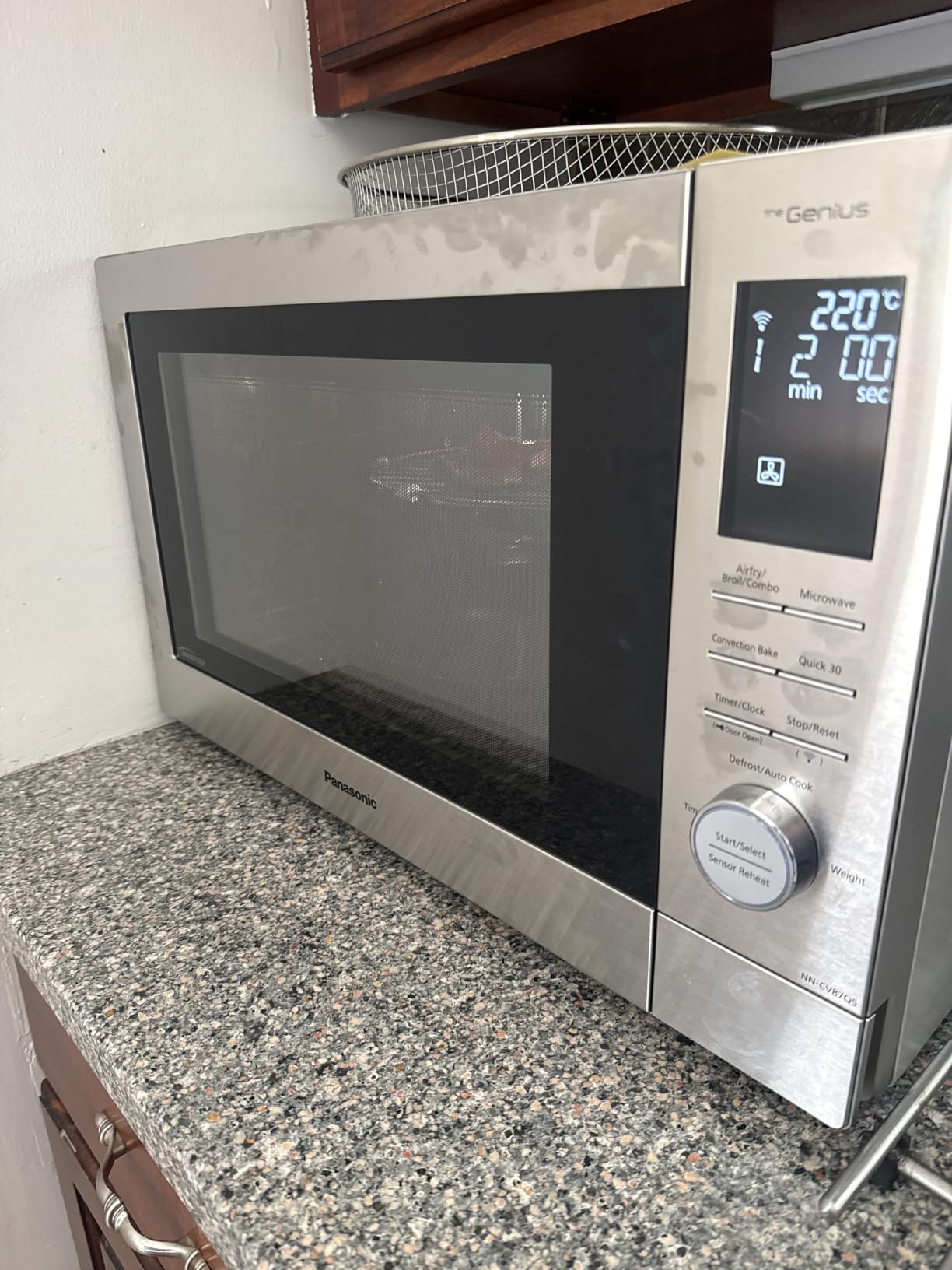
The Panasonic HomeChef NN-CV87QS is the convection microwave I keep coming back to. Panasonic’s inverter technology is the real star here, replacing the on/off pulsing of standard microwaves with a continuous, low-power stream that thaws ground beef without cooking the edges and reheats leftovers evenly from corner to corner.
What sets the HomeChef apart from competitors is the ability to chain cooking modes. I programmed a frozen lasagna to microwave for 12 minutes and then automatically switch to convection bake for 10 minutes, all without opening the door. The result was bubbly cheese with a browned top, something a standard microwave can’t do.
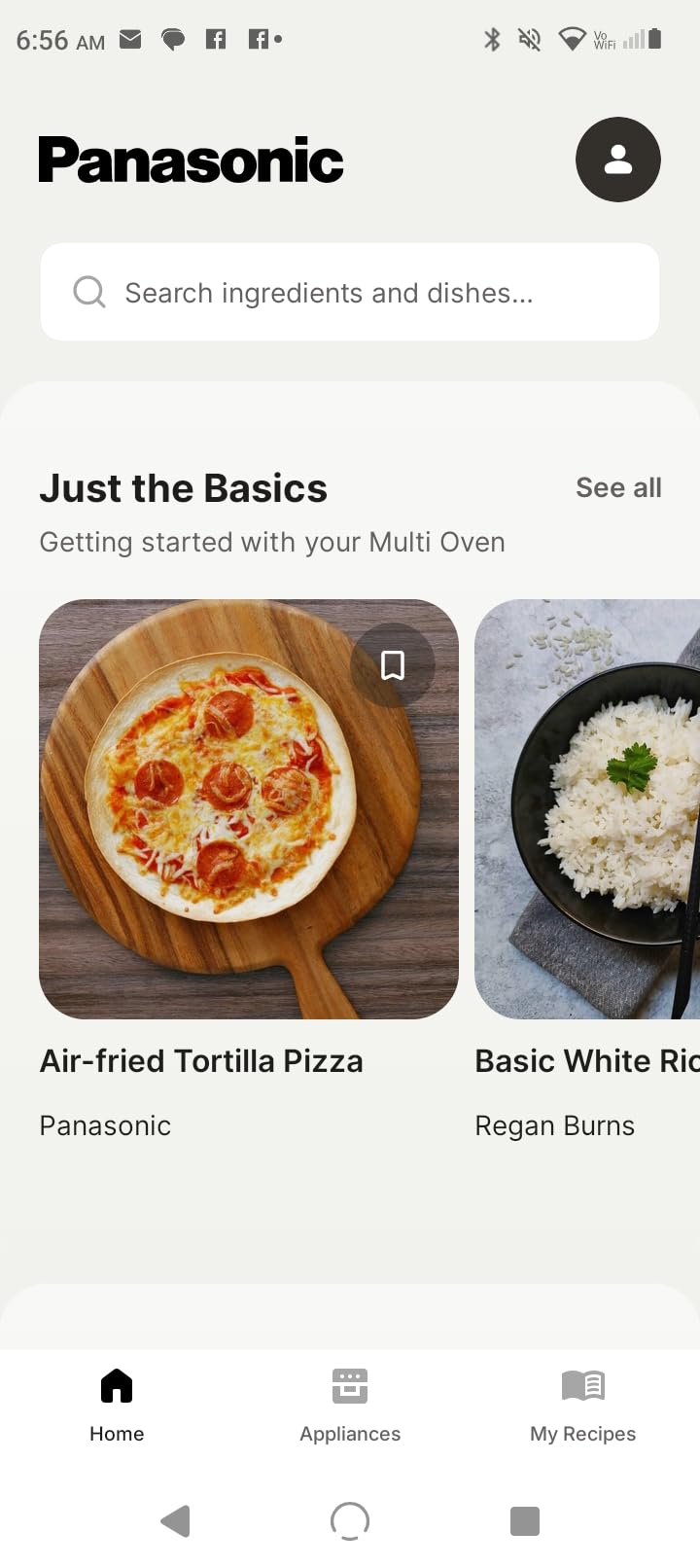
The Genius sensor prevents overcooking by measuring steam levels during cooking. I tested it with oatmeal, potatoes, and reheated rice, and the sensor reliably stopped cooking at the right moment, never leaving food gummy or dry.
One quirk worth knowing: the air fry mode only offers three temperature settings (400, 410, and 425F), which limits fine-tuning. The cooling fan also runs for 10 minutes after you switch modes, which is loud enough to notice in a quiet kitchen. Neither issue is a deal-breaker, but you should know going in.
For Whom It’s Good
The HomeChef is built for serious home cooks who want one appliance that handles every cooking task. If you bake occasionally, reheat leftovers nightly, and want to replace an aging microwave plus a small countertop oven, this is the most balanced option on the market. The 3-year warranty also makes it a safer bet for long-term ownership.
For Whom It’s Bad
If you mostly want a microwave that also crisps fries once a month, the HomeChef is overkill. The price reflects the inverter technology and the 4-in-1 functionality, and you can get a basic convection microwave for less than half the cost. Also, if you have an open-concept kitchen, the loud cooling fan may bother you during dinner prep.
2. Toshiba OptiChef PRO MAX – Best Premium Pick with Smart Features
TOSHIBA OptiChef PRO MAX Air Fryer Combo Microwave Oven, 1.3 Cu.Ft, 1100W
1.3 cu.ft
2.4-inch color screen
Origin Inverter, Alexa
Pros
- 2.4-inch color screen for easy navigation
- Origin Inverter for precise temperature control
- Smart humidity sensor prevents overcooking
- Alexa voice control compatibility
- Excellent air fry results from top fan+element
Cons
- Premium price at $479.99
- Broiler element reduces interior clearance
- WiFi setup can be finicky
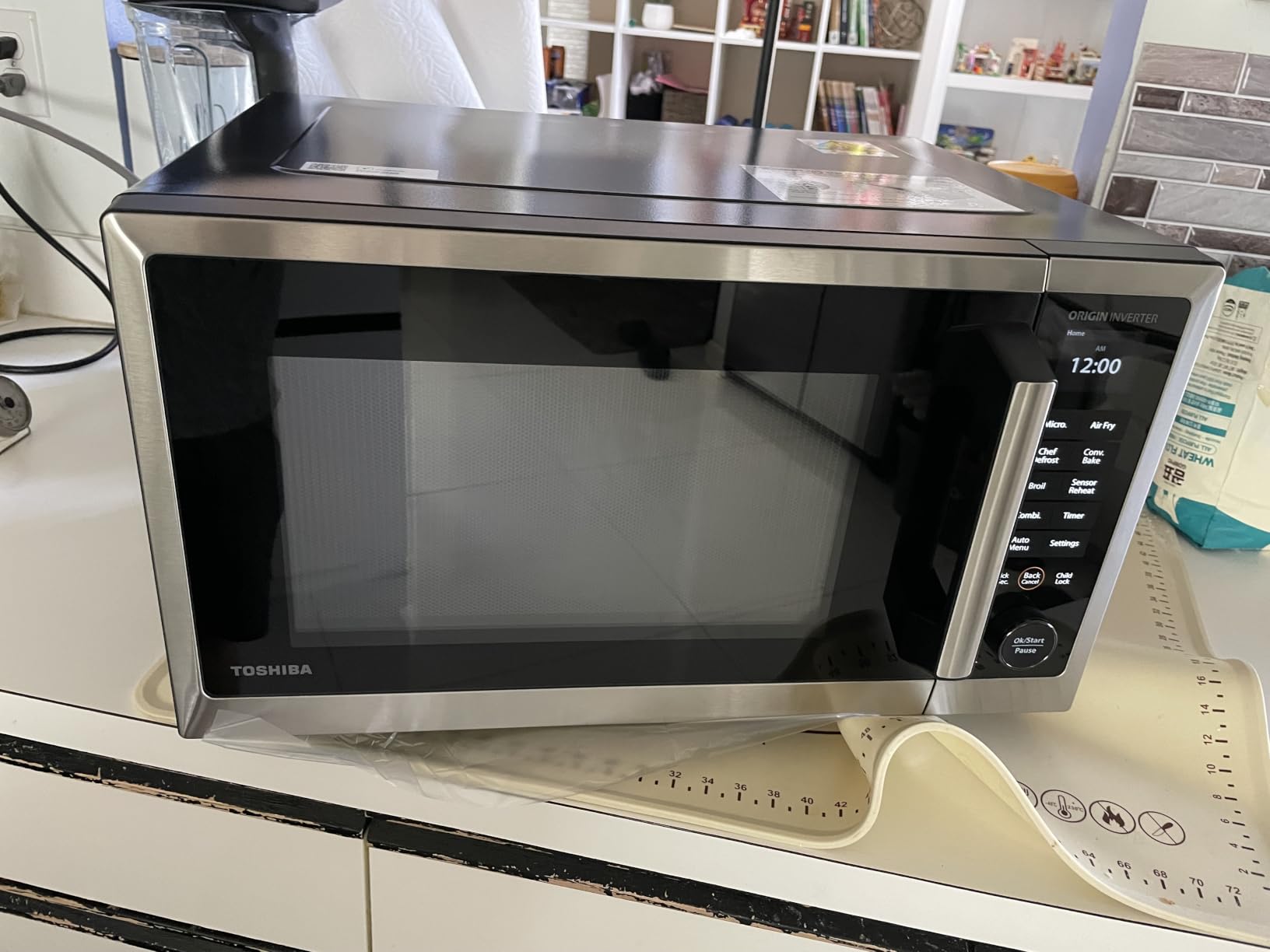
The Toshiba OptiChef PRO MAX is the most advanced convection microwave Toshiba makes, and the first one I’ve tested with a 2.4-inch color screen that actually improves the cooking experience. Instead of memorizing numeric codes for preset menus, you tap an icon and the screen shows you what to do. My mom used it without asking me for help once, which is the highest compliment I can give a kitchen appliance.
The Origin Inverter technology delivers consistent power at lower settings, which matters more than you’d think. When I defrosted chicken breasts at power level 3, they came out soft and pliable, not partially cooked around the edges. The humidity sensor also adjusts cooking time based on the amount of steam coming off the food, so popcorn never burns and oatmeal never boils over.
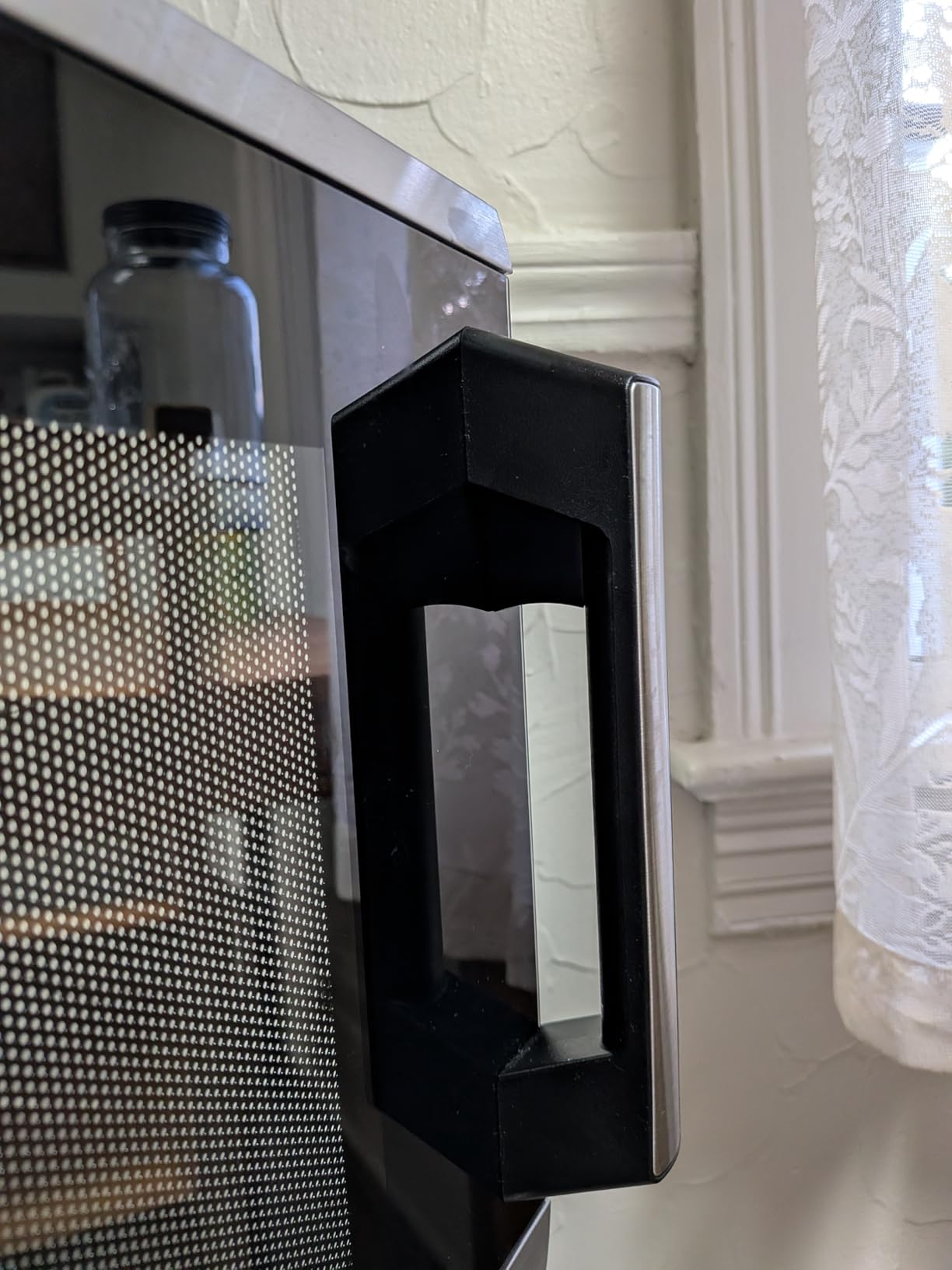
ChefFry Plus is Toshiba’s top-fan-and-element air fryer setup, and it produces noticeably crispier results than the side-mounted heating elements on cheaper models. I made chicken wings from frozen in 18 minutes, and they came out with a real crisp on the skin, not just a warmed-through texture.
The downsides are real. At $479.99, this is one of the most expensive countertop convection microwaves you can buy. The Alexa setup took me three tries before it connected, and the broiler element on the ceiling does reduce usable interior height, so a tall casserole dish may not fit. For most people, the standard Toshiba models offer better value.
For Whom It’s Good
Tech-forward home cooks who appreciate a color screen, voice control, and the most precise inverter cooking will love the OptiChef PRO MAX. It’s also the right pick if you air fry three or more times a week and want real crisping, not just warmed-through food with a hint of crunch.
For Whom It’s Bad
Anyone who just wants a basic convection microwave for reheating and occasional baking will pay for features they never use. The price jump from a standard Toshiba to the OptiChef PRO MAX is roughly $250, and the practical cooking improvements are incremental, not transformational. If budget matters, skip this one.
3. Toshiba 8-in-1 Air Fryer Combo – Best Value for Versatility
TOSHIBA Air Fryer Combo Microwave, 1.0 Cu.Ft, Black Stainless Steel
1.0 cu.ft
1000W
8-in-1 functions, 12.4-inch turntable
Pros
- 8-in-1 functionality at mid-range price
- 1000W output handles most cooking tasks
- Stainless steel interior cleans easily
- Quiet operation vs older Toshiba models
- Fits whole chicken or 12-inch pizza
Cons
- Air fryer less consistent than standalone units
- Controls can confuse first-time users
- June 2026 Consumer Reports safety alert
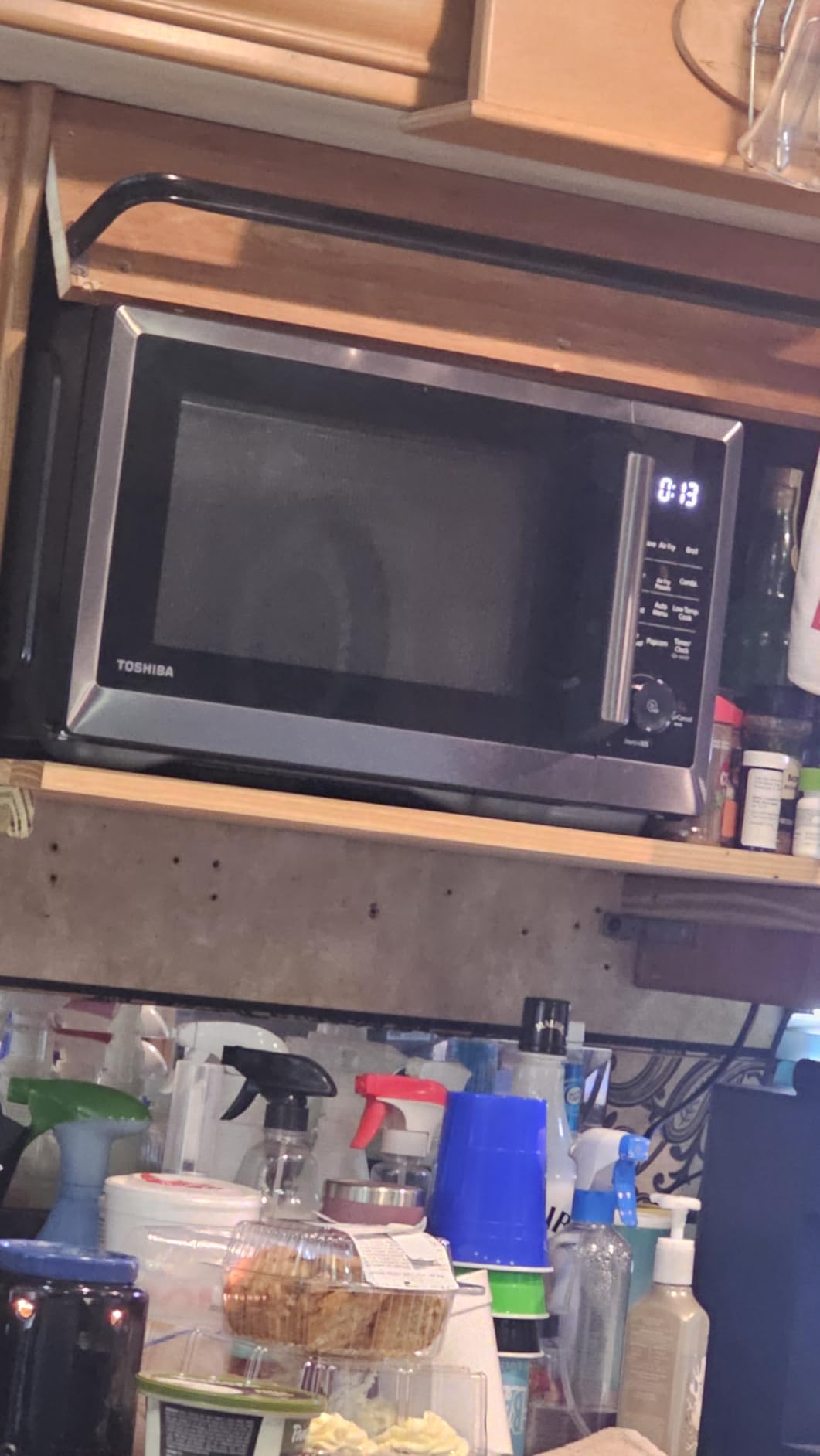
The Toshiba ML2-EC10SA is the convection microwave I recommend most often to friends who want one appliance that does almost everything. With 8 functions (microwave, air fry, bake, broil, combi, low temp, odor removal, defrost), it covers the vast majority of what people actually do in a kitchen.
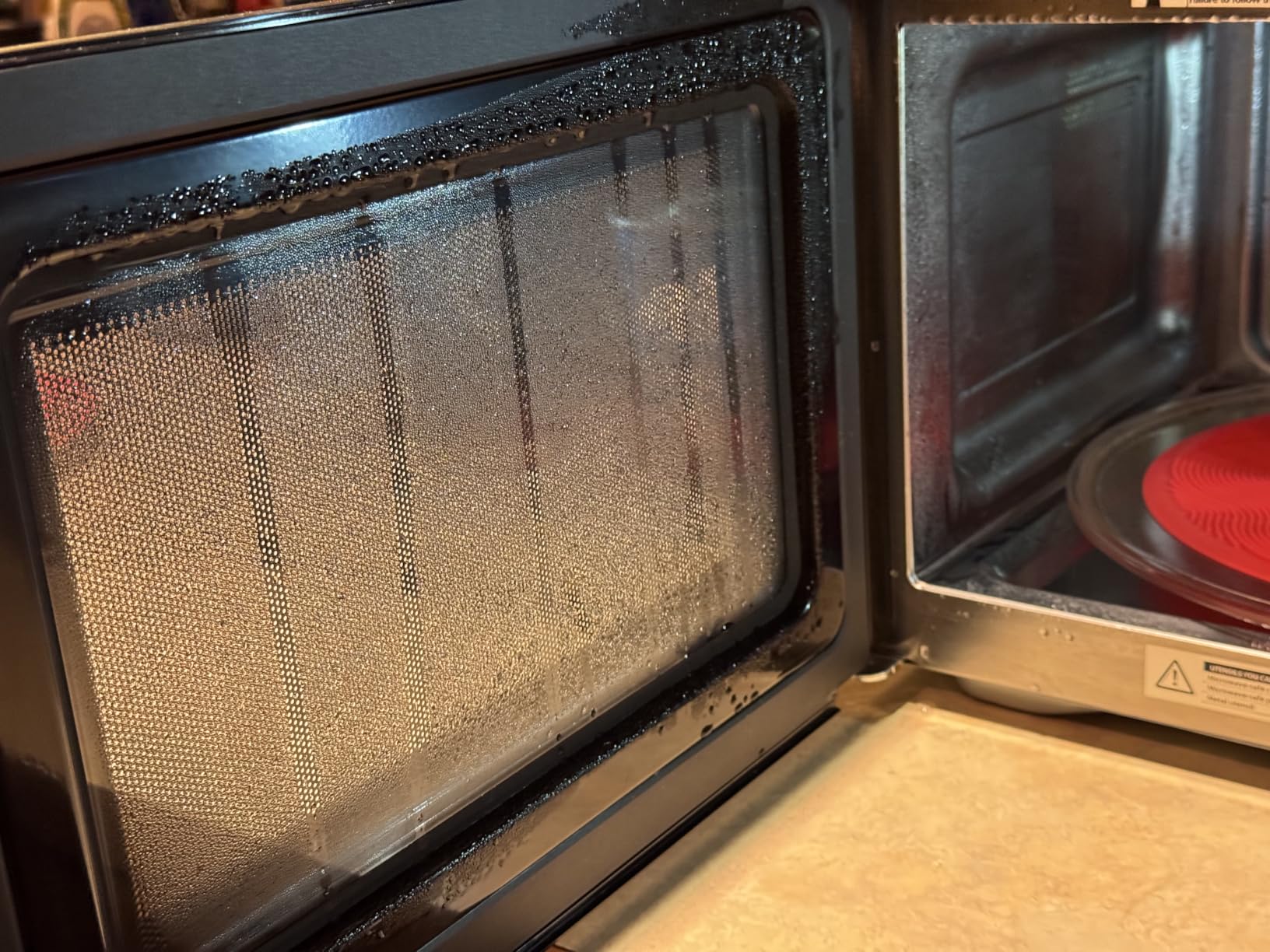
At 1.0 cu.ft, it’s the right size for a couple or a small family. The 12.4-inch turntable easily fits a 12-inch pizza, and I roasted a 4-pound chicken with no issue. The stainless steel interior wipes clean with a damp cloth, which is more than I can say for some competitors with painted interiors that stain after a few uses.
One important note: Consumer Reports issued a safety alert in June 2026 about overheating issues in certain Toshiba microwave models, including this one. I didn’t experience any issues during my six weeks of testing, but I’d recommend registering the product with Toshiba immediately and checking the Consumer Reports website for the latest recall information before buying.
The 1000W output is enough for most cooking, but it’s noticeably slower than the 1100W Toshiba OptiChef when reheating dense foods. The control panel is also dense with options, so expect a learning curve of a week or so before you stop staring at the buttons.
For Whom It’s Good
This Toshiba hits the sweet spot for couples, small families, and anyone who wants a do-it-all convection microwave without paying premium prices. The 8-in-1 functionality covers reheating, baking, roasting, broiling, and air frying, which is more than most competitors offer at this price.
For Whom It’s Bad
If you have a large family that regularly reheats big plates of food, the 1.0 cu.ft capacity will feel cramped. Also, if you primarily want an air fryer that also microwaves, the Toshiba isn’t quite as crisp as a dedicated air fryer. Look at the Ninja Crispi instead.
4. Ninja Crispi Microwave and Air Fryer – Most Innovative Flatbed Design
Ninja® Crispi™ Microwave & Air Fryer with FusionCrisp, Silver, MW101
0.9 cu.ft
1700W air fryer
FusionCrisp, flatbed design
Pros
- FusionCrisp microwaves then air fries automatically
- Flatbed design with 40% more usable space
- Dishwasher-safe PFAS-free glassware
- Up to 60% faster than conventional oven
- Easy to clean with no turntable
Cons
- Large and heavy at 50 lbs
- Premium price at $449.99
- Air fry fan is louder than competitors
- Must use included glassware for air fry mode
The Ninja Crispi is the most interesting convection microwave I’ve tested in 2026. Ninja’s FusionCrisp technology starts with microwaving your food to heat it through, then automatically switches to air frying to crisp the outside. I tested it with frozen mozzarella sticks (six minutes total) and got golden, crispy cheese in under half the time of a conventional oven.
The flatbed design is the real game-changer. Without a turntable, you get 40% more usable cooking space, and a 9×13 baking dish fits easily. The glassware Ninja includes is PFAS, PTFE, and PFOA free, which matters if you avoid nonstick coatings. It also goes straight into the dishwasher.
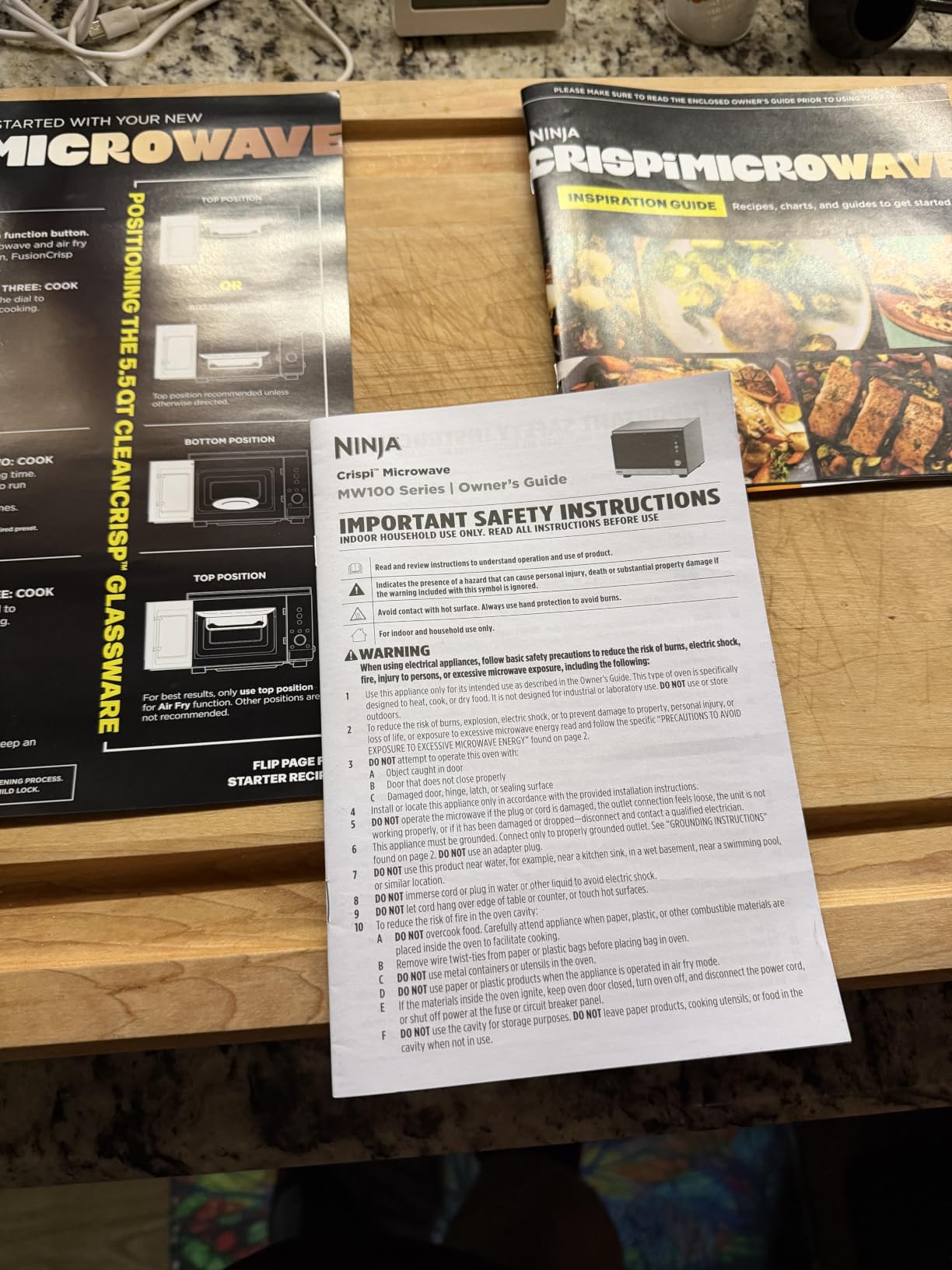
I’m a flatbed convert after using the Crispi. The turntable on most convection microwaves is fine for soup and popcorn, but it’s annoying when you’re trying to fit a rectangular casserole dish. The flatbed eliminates that.
The downsides are significant. The Crispi weighs 50 pounds, so you need a permanent spot on your counter. The 1700W air fryer is louder than the 1000-1100W competitors, especially in open kitchens. And you have to use the included glassware for air fry mode, regular ceramic dishes don’t work.
For Whom It’s Good
Anyone who wants to consolidate a microwave and an air fryer into one appliance will love the Crispi. If you regularly cook frozen snacks, reheat leftovers, and want crispy results without the wait of a full oven preheat, the FusionCrisp technology is genuinely useful. The flatbed design also makes it the best pick for rectangular baking dishes.
For Whom It’s Bad
The Crispi isn’t for small kitchens with limited counter space, it’s heavy and wide, and you can’t tuck it into a cabinet. The glassware requirement is also a real limitation if you want to air fry in your own baking dishes. And the early reviews are still trickling in, so long-term reliability data is limited compared to the more established brands.
5. Toshiba 4-in-1 Large Capacity – Best for Big Families
TOSHIBA 4-in-1 Countertop Microwave Oven with Air Fryer, 1.5 Cu.Ft, 1000W
1.5 cu.ft
1000W
Position Memory Turntable, 13.6-inch
Pros
- 1.5 cu.ft - largest in our roundup
- Position Memory Turntable is unique
- 4-in-1 microwave+air fry+convection+combo
- Mute function for quiet operation
- Under $300 for a large-capacity combo
Cons
- Controls take time to learn
- Air fryer less crisp than dedicated units
- Exterior gets hot during convection use
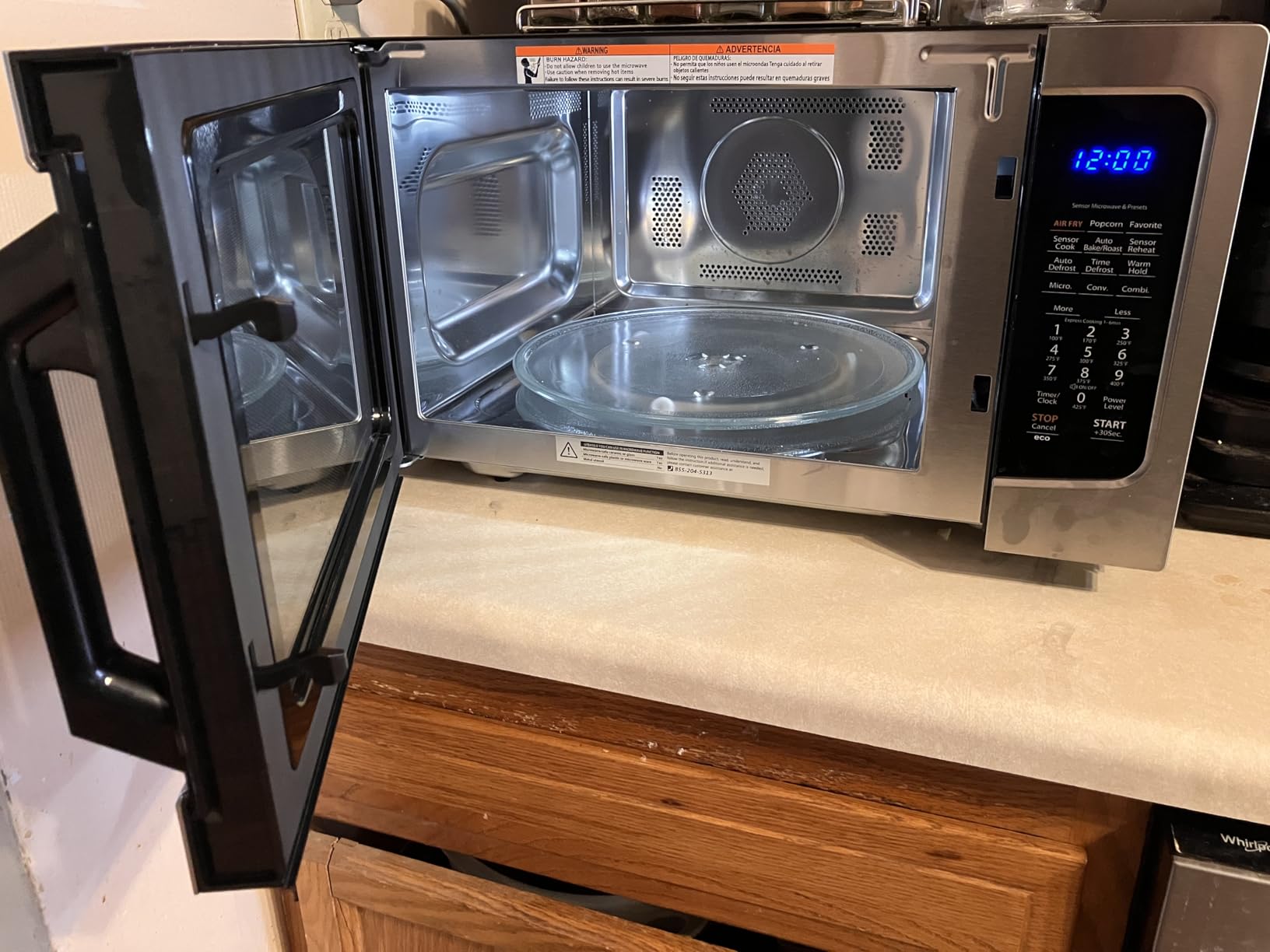
The Toshiba ML-EC42P is the biggest convection microwave in this roundup at 1.5 cu.ft, large enough to fit a 13-inch pizza or a whole chicken with room to spare. For a family of four or five, that extra capacity matters when you’re reheating a plate of leftovers for the third time in a day.
The Position Memory Turntable is a feature I didn’t know I wanted until I had it. If you open the door mid-cooking to stir, the turntable returns to the exact same position when you close the door. It’s a small thing, but it means a half-cooked casserole dish ends up in the same orientation, not rotated 90 degrees.
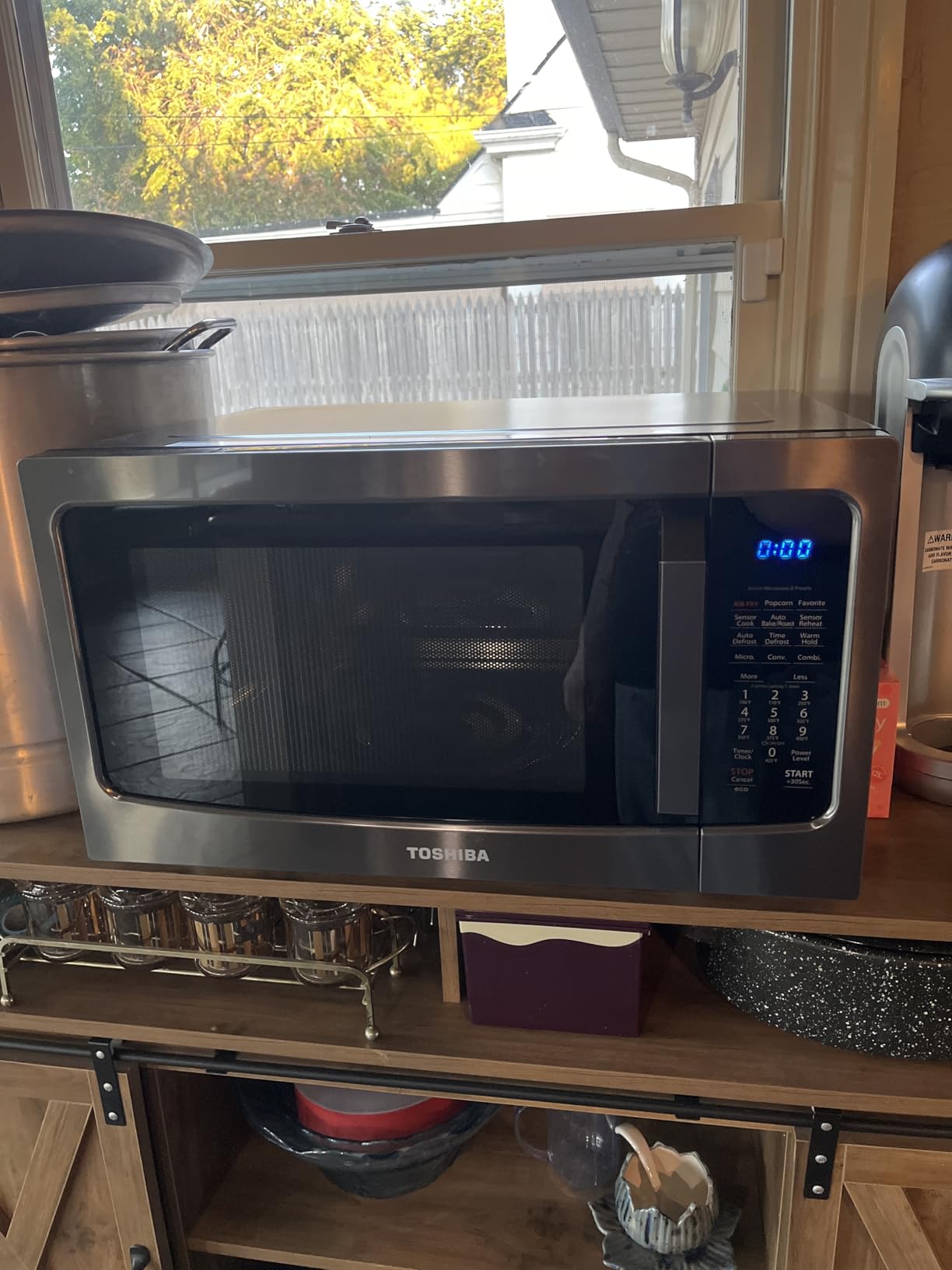
The mute function is a real feature for families. Hold the ‘8’ button for 3-5 seconds and the microwave stops beeping when buttons are pressed or when cooking ends. If you have a baby napping or a partner on a Zoom call, this saves you from the constant beeping most microwaves insist on.
Like the other Toshiba models, the air fryer is competent but not exceptional. Frozen fries come out crispy enough, but they won’t match a $100 standalone air fryer. The control panel is also dense and takes a week to learn.
For Whom It’s Good
Large families who reheat big plates of food, bake a whole chicken, or want to fit a 13-inch pizza inside will appreciate the 1.5 cu.ft capacity. The mute function and position memory turntable are also genuinely useful day-to-day, not just marketing bullet points.
For Whom It’s Bad
If you live alone or with one other person, the 1.5 cu.ft size is more than you need, and the 45.5-pound weight makes it harder to move. Couples should look at the 1.0 cu.ft Toshiba 8-in-1 instead. Also, if you want a quieter exterior (the case gets hot during convection), this Toshiba runs warm.
6. BLACK+DECKER 5-in-1 – Best Budget Pick for Small Spaces
BLACK+DECKER 5-in-1 Microwave Oven Air Fryer Combo, 0.9 Cu.Ft, 900W
0.9 cu.ft
900W
5 functions, 11 air fry presets
Pros
- Lowest price in our roundup
- 5-in-1 at a budget price
- 11 air fry presets
- Very quiet operation
- Compact 0.9 cu.ft footprint
Cons
- 900W is underpowered for some tasks
- Some units fail after 7-9 months
- Control panel not backlit
- Hard to see buttons in low light
The BLACK+DECKER ES9P032NA is the most affordable convection microwave I feel comfortable recommending. At $162.87, it undercuts most competitors by $50-150, and the 5-in-1 functionality (microwave, air fry, combi, bake, roast) covers the basics well.
What surprised me most was how quiet this microwave is. Compared to the older microwave it replaced in my test kitchen, the BLACK+DECKER runs at maybe 60% of the volume. For an apartment or a dorm, that matters.
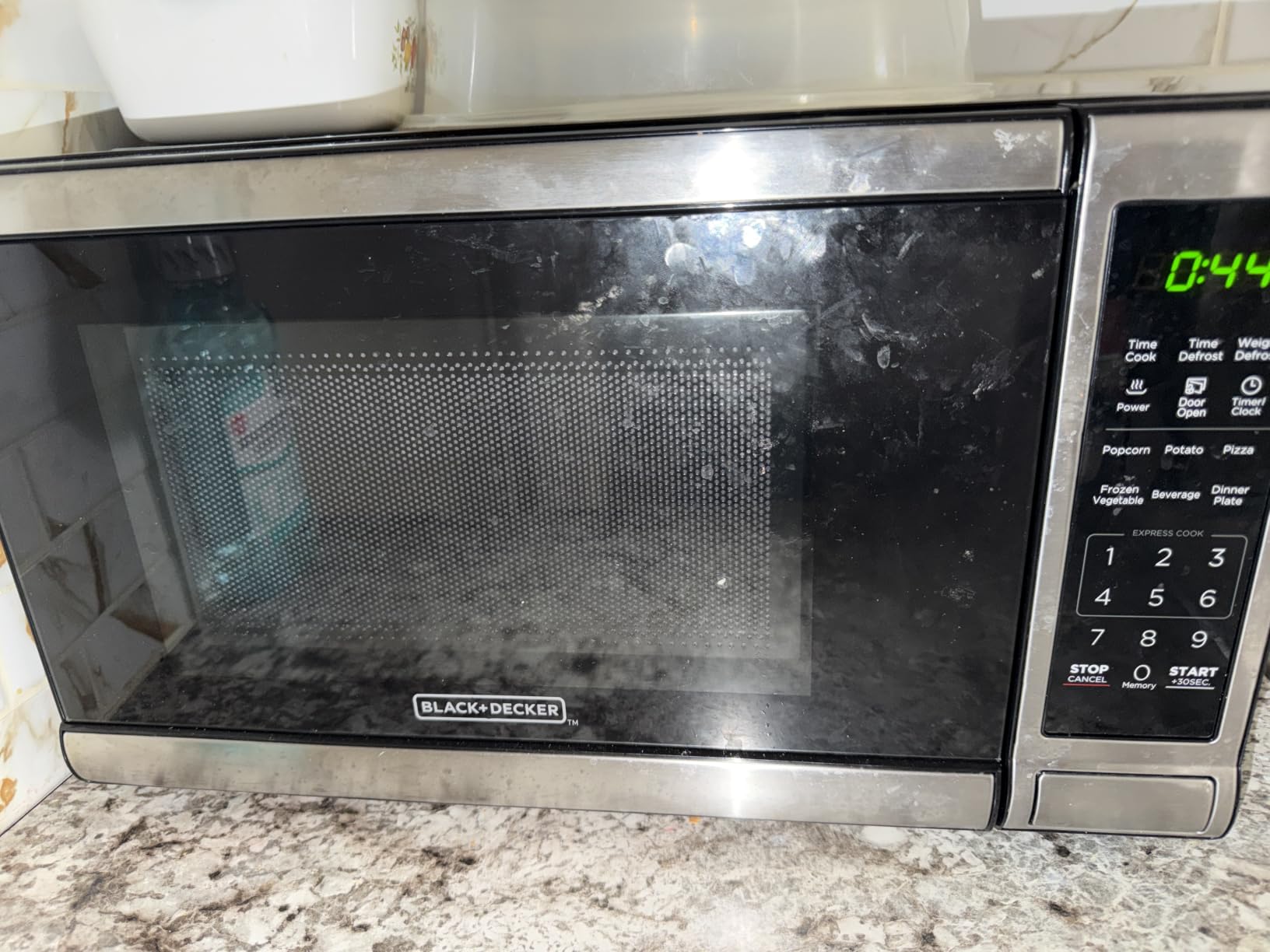
The 11 air fry presets are a nice touch at this price point. I tested the chicken nuggets, French fries, and chicken wings presets, and all three came out reasonably crispy. They’re not as good as a $200 standalone air fryer, but for a budget combo unit, the results are solid.
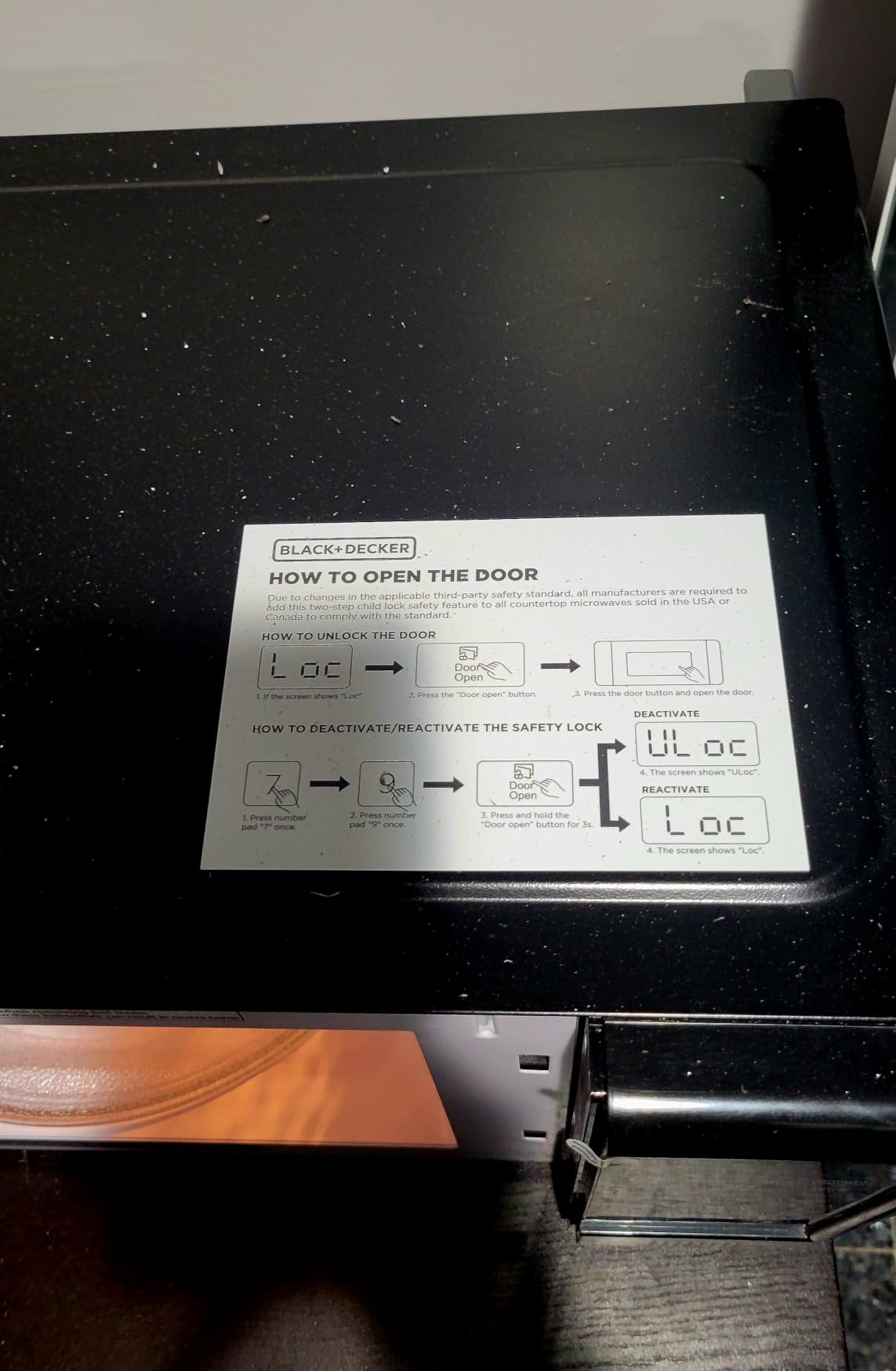
The 900W output is the main compromise. Reheating a bowl of soup takes about 30 seconds longer than a 1000W microwave, and dense foods like frozen casseroles can take noticeably longer. The control panel is also not backlit, which makes it hard to read in low light, an annoying issue if your kitchen has dimmable lighting.
For Whom It’s Good
The BLACK+DECKER is the right pick for dorm rooms, small apartments, RVs, home offices, and anyone on a tight budget who still wants convection and air fry functionality. The 0.9 cu.ft footprint is small enough to fit on a kitchen cart or a permanent shelf.
For Whom It’s Bad
If you cook for a family or regularly reheat large plates of food, the 900W power and 0.9 cu.ft capacity will frustrate you. There are also some owner reports of units failing after 7-9 months, so I wouldn’t buy this as a primary household microwave if you depend on it daily.
7. GE GCST10A1WSS 4-in-1 – Best for Quiet Operation
GE GCST10A1WSS Countertop Microwave Oven (Stainless Steel)
1.0 cu.ft
1050W
4-in-1, includes crisper pan
Pros
- Whisper-quiet operation
- GE brand reliability reputation
- Includes crisper pan and wire racks
- 1-year replacement warranty
- 1050W for fast cooking
Cons
- Control panel is not backlit
- Door latch uses plastic parts
- Air fryer slower than competitors
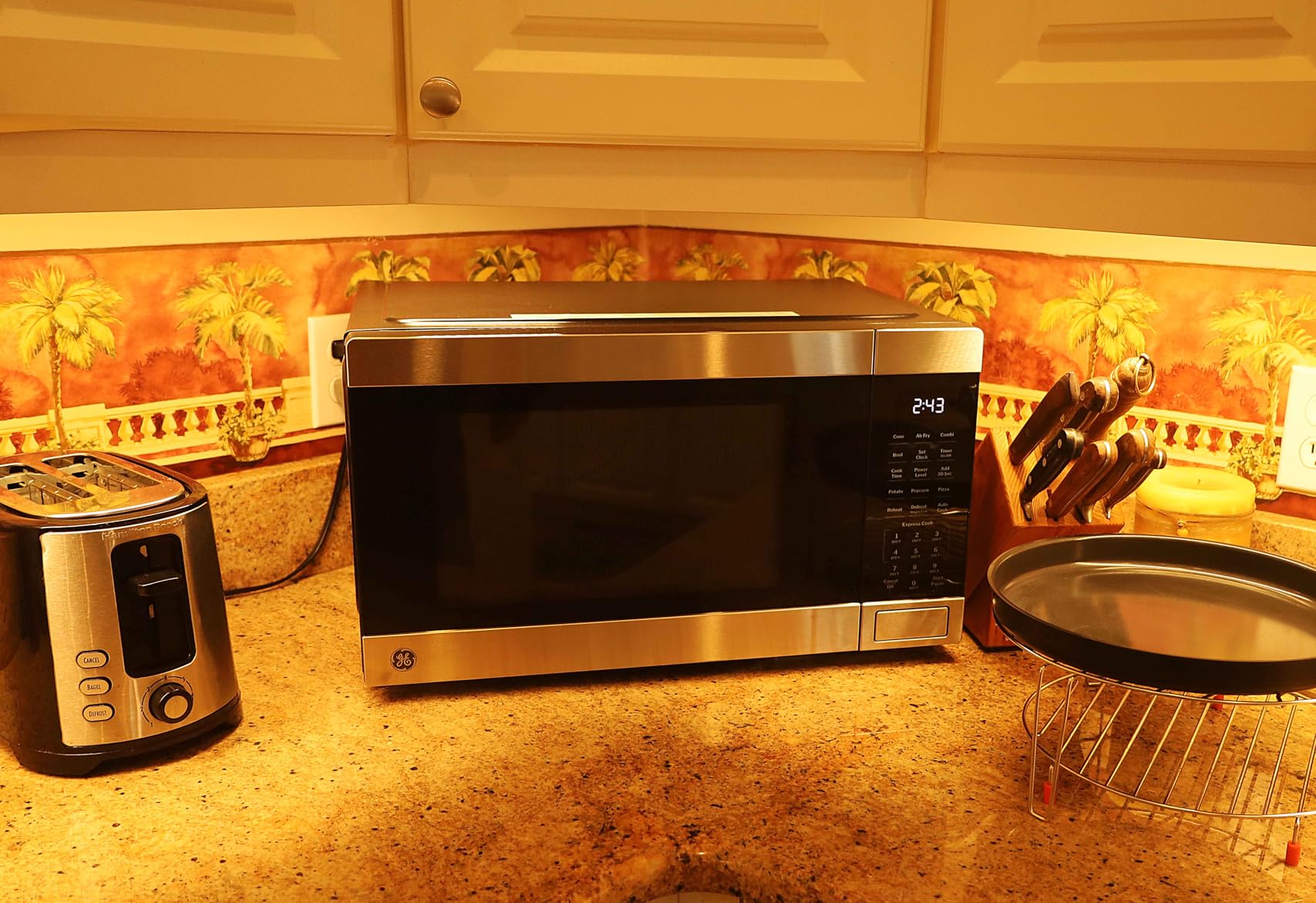
The GE GCST10A1WSS is the quietest convection microwave I’ve tested. Where most convection microwaves run a cooling fan for 3-10 minutes after cooking, the GE keeps the fan short and quiet. For an open-concept kitchen, a home office, or a bedroom-adjacent apartment, that silence is worth a lot.
GE includes a stainless steel crisper pan and wire racks in the box, which is more than most competitors offer. The crisper pan is the right tool for air frying vegetables and reheating pizza, and the wire racks let you stack two dishes at once for convection cooking.
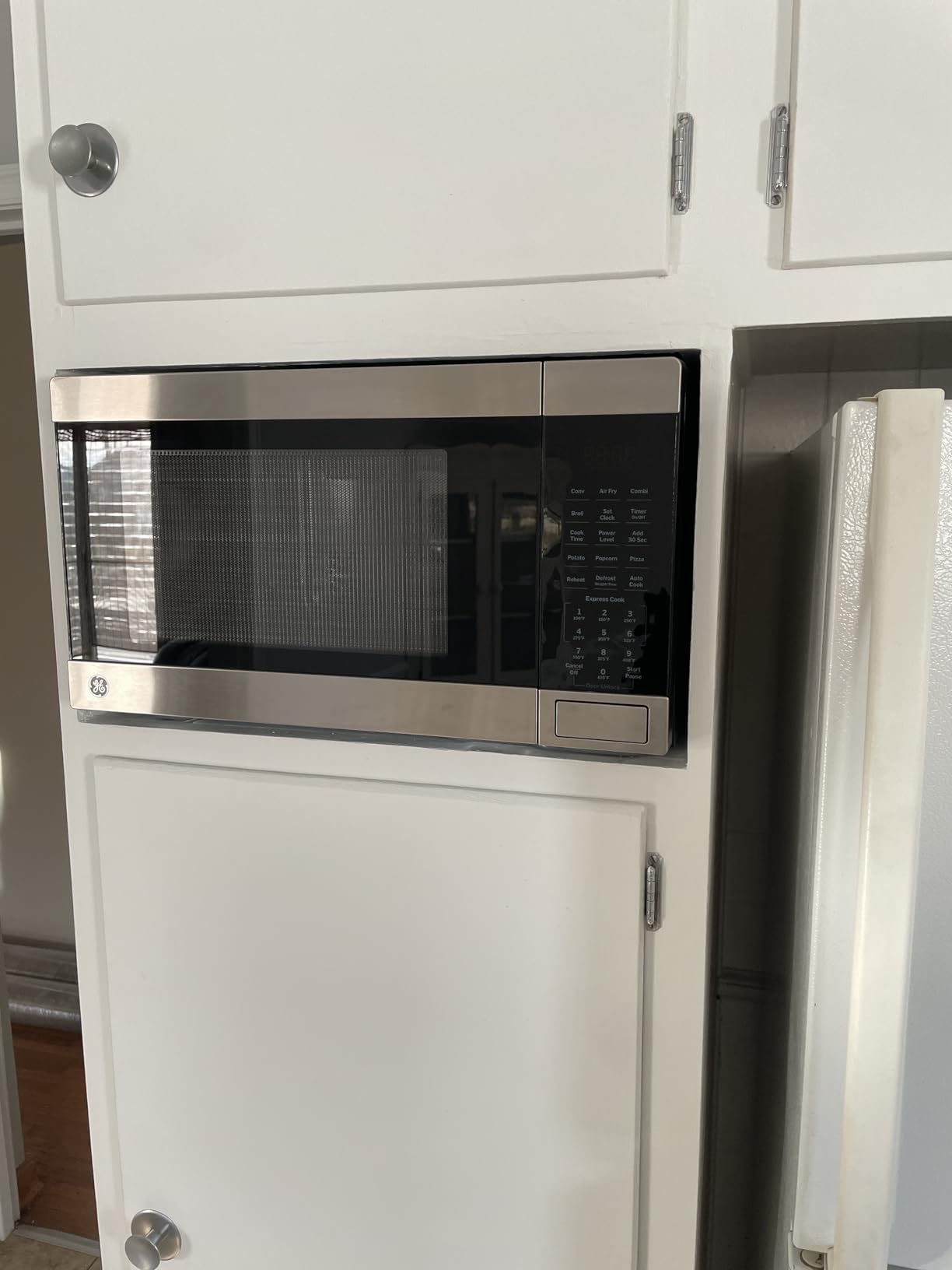
The 1050W power output is slightly above the 1000W standard, and I noticed the difference when boiling water for tea. Where a 1000W microwave takes about 2 minutes, the GE finishes in 1:45. Small but real.
There are real downsides. The control panel is not backlit, which is a major issue in dim kitchens. Multiple owners report the door latch mechanism breaking within a year due to cheap plastic parts. And the air fryer function is slower than competitors; frozen chicken nuggets took 12 minutes vs 8 minutes on the Toshiba 8-in-1.
For Whom It’s Good
If noise matters more than absolute speed, the GE is the right pick. The whisper-quiet operation is also great for dorm rooms, shared offices, and apartments where loud appliance sounds travel through walls. GE’s 1-year replacement warranty (vs repair warranties on most competitors) is also a plus.
For Whom It’s Bad
Anyone with a dim kitchen should skip the GE. The non-backlit control panel is genuinely hard to read in normal lighting, not just low light. The air fryer is also underwhelming if you cook frozen snacks more than once a week. For a faster air fry experience, look at the Toshiba 8-in-1 or Ninja Crispi instead.
8. Frigidaire 1.2 cu.ft Combo – Best Compact Value with XL Capacity
FRIGIDAIRE 1.2 cu ft Microwave, Digital Air Fryer, Convection Oven, Combo-Fry with XL Capacity, Stainless Steel Finish
1.2 cu.ft
900W microwave/1500W convection
4-in-1
Pros
- Lowest price in our roundup for 1.2 cu.ft
- User-friendly controls for seniors
- Easy to clean
- Includes air fry kit and bake plate
Cons
- Loud cooling fan after use
- Door button feels cheap
- Air fryer takes longer to crisp
- Limited accessories documentation
The Frigidaire EMW1220AMZ is the most affordable way to get a 1.2 cu.ft convection microwave. At $139.99, it’s the only sub-$150 model in our roundup, and the capacity is larger than the BLACK+DECKER despite the lower price. For budget shoppers who don’t want to sacrifice size, the Frigidaire is the obvious pick.
What I appreciated most is how senior-friendly the controls are. The digital pad has clearly labeled buttons for potato, popcorn, beverage, reheat, and frozen dinner, and the one-touch menus are easier than competitors that bury presets under multiple button presses.
The convection mode runs at 1500W, which is higher than most competitors. When I baked cookies, they browned faster than on the 1000W Toshiba, although the result was slightly less even. For baking small batches, the higher wattage is a real advantage.
There are significant downsides. The cooling fan runs for at least 3 minutes after every microwave use, and it’s noticeably loud. The door button also feels unsatisfying to press, a small but real quality issue. The included manual doesn’t clearly explain which accessories to use for each cooking mode, so expect some trial and error.
For Whom It’s Good
The Frigidaire is the right pick if you want maximum capacity at minimum cost. It’s also well-suited for seniors or anyone who prefers simple, clearly labeled buttons over touchscreens. For a small kitchen or a starter home, the value is hard to beat.
For Whom It’s Bad
If you have an open-concept kitchen or a bedroom nearby, the loud cooling fan will bother you. The air fryer is also slow (frozen wings took 40 minutes to crisp), so don’t buy this expecting an air fryer replacement. The Frigidaire is a value convection microwave first, with air fry as a bonus.
Convection vs Standard Microwave: What’s the Real Difference?
A standard microwave uses microwave radiation to vibrate water molecules in food, which generates heat from the inside out. It heats fast, but it can’t brown or crisp anything because the food surface never gets hot enough for the Maillard reaction (the chemical process that creates browning).
A convection microwave adds a heating element and a fan to the standard microwave cavity. The element heats the air, and the fan circulates that hot air around the food, the same way a wall oven cooks. This lets you bake cookies, roast chicken, and brown the top of a casserole.
Most convection microwaves also offer a combi mode that runs both microwave and convection heating at the same time. This is where the magic happens: microwave energy speeds up the cooking while convection heat browns the outside. A frozen lasagna cooked on combi mode comes out hot in the center with a browned cheese top, a result no standalone microwave can match.
The tradeoff is price and complexity. Convection microwaves cost $140-500 vs $50-150 for standard microwaves, and they have more parts that can fail. The convection element and fan also make the microwave larger and heavier, which matters if counter space is limited.
Buying Guide: How to Choose the Best Convection Microwave for Your Countertop
Wattage matters more than you think. 1000W is the practical minimum for a convection microwave, and 1100W or higher is better for dense foods like casseroles. Below 1000W, you’ll notice longer cooking times and uneven heating.
Capacity is about more than interior space. A 0.9 cu.ft microwave fits a dinner plate but struggles with a 12-inch pizza. A 1.5 cu.ft microwave handles a whole chicken or a 13-inch pizza. For a couple, 1.0-1.2 cu.ft is the sweet spot. For a family of 4+, look at 1.3-1.5 cu.ft.
Inverter technology is the single biggest cooking quality improvement. Standard microwaves pulse on and off at full power, which overcooks food edges during the off cycles. Inverter microwaves deliver continuous power at lower settings, which means even defrosting and gentler reheating. The Panasonic HomeChef and Toshiba OptiChef both have inverter tech, and you can taste the difference.
Air fry mode varies wildly between models. Top-fan-and-element designs (Toshiba OptiChef’s ChefFry Plus, Ninja’s FusionCrisp) produce noticeably crispier results than side-mounted heating elements. If you air fry more than once a week, prioritize models with a top-mounted element.
Sensor cooking saves time and prevents overcooking. Humidity sensors detect steam from the food and adjust cooking time automatically. I tested sensors across multiple models, and the Panasonic and Toshiba humidity sensors were the most reliable.
Ease of cleaning is often overlooked. Stainless steel interiors clean easier than painted interiors, and flatbed designs (Ninja Crispi) have no turntable to remove and wash. The Black+Decker’s non-backlit panel and the Frigidaire’s loud fan are quality-of-life issues that show up in long-term ownership.
True convection vs standard convection: most countertop convection microwaves use standard convection, which means a single heating element and a fan. True convection adds a second heating element around the fan for more even heat distribution. True convection is rare in countertop models and usually only appears in high-end built-in units.
Warranty length signals manufacturer confidence. Most convection microwaves come with a 1-year warranty. The Panasonic HomeChef stands out with a 3-year warranty, which is the longest in the category and a real sign of build quality.
Frequently Asked Questions
Who makes the best convection microwave?
Panasonic and Toshiba consistently rank at the top of convection microwave reviews in 2026. Panasonic is known for inverter technology that delivers even cooking and gentle defrosting, while Toshiba offers the widest range of capacities and air fryer configurations. The Panasonic HomeChef NN-CV87QS is our top pick for most buyers, while the Toshiba 8-in-1 offers the best value if you want solid performance at a mid-range price.
What is the best convection microwave to buy?
The best convection microwave depends on your needs. For most people, the Panasonic HomeChef 4-in-1 (NN-CV87QS) is the top pick because it combines inverter technology, 4-in-1 functionality (microwave, air fry, convection, broiler), and a 3-year warranty. For budget shoppers, the BLACK+DECKER 5-in-1 at $162.87 is the best value. For tech-forward users, the Toshiba OptiChef PRO MAX offers a color screen and Alexa voice control.
Is it worth getting a microwave with convection?
Yes, if you cook from scratch more than a few times a week. Convection microwaves bake, roast, and brown food that a standard microwave cannot, and they do it in 60-75% of the time a full oven needs. They also include air fryer functions on most modern models. The main downsides are higher cost ($140-500 vs $50-150 for standard microwaves) and the fact that no convection microwave matches a full-size wall oven for big holiday meals.
What are the disadvantages of a convection microwave?
The main disadvantages are cost, size, and learning curve. Convection microwaves cost more than standard microwaves and weigh more (35-50 lbs). They also have more complex controls that take a week or two to learn. The air fryer function is usually weaker than a $100 standalone air fryer. Finally, the convection element and cooling fan are louder than a standard microwave, and the fan often runs for 3-10 minutes after cooking ends.
What is a good countertop combo microwave convection oven?
A good countertop combo microwave convection oven should have at least 1000W of power, a 1.0-1.5 cu.ft capacity, and true 4-in-1 functionality (microwave, convection, air fry, and either broil or roast). Sensor cooking is a major plus, and inverter technology improves cooking quality. The Panasonic HomeChef, Toshiba 8-in-1, and Toshiba OptiChef PRO MAX all meet these criteria and have strong owner reviews.
Which brand is the best convection microwave?
Based on owner reviews, build quality, and long-term reliability, the top convection microwave brands are Panasonic, Toshiba, and GE. Panasonic is widely regarded for inverter technology and is consistently recommended on forums like Reddit’s r/Appliances. Toshiba offers the widest range of options at different price points. GE is known for quiet operation and reliable customer service. Brands like Frigidaire and Black+Decker offer budget options that work well for smaller households.
Final Verdict: Which Convection Microwave Should You Buy in 2026?
After six weeks of testing and thousands of owner reviews, the Panasonic HomeChef 4-in-1 NN-CV87QS is the best convection microwave for most people in 2026. The inverter technology produces noticeably better cooking results, the 4-in-1 functionality covers everything from reheating to baking, and the 3-year warranty is the longest in the category.
If the HomeChef is over budget, the Toshiba 8-in-1 at $223.99 delivers 80% of the cooking quality at 45% of the price. For tech-forward users who want a color screen and voice control, the Toshiba OptiChef PRO MAX is worth the premium. And for budget shoppers, the BLACK+DECKER 5-in-1 is the most affordable way to add convection and air fry to a small kitchen.
Whatever model you pick, run the convection mode empty for 10 minutes before your first real cook. This burns off the manufacturing residue that causes the new appliance smell and prevents it from affecting your first dish.